First Chronicles 12 describes the gathering of Israel’s tribes at Hebron to make David king. Its numbers identify warriors, commanders, and priestly leaders. Read in their transmitted order, they also support a proposed numerical structure connecting the priestly figure 23, Issachar’s 200 chiefs, calendar units, and Temple chronology.
Now these are the numbers of men armed for battle who came to David at Hebron to turn Saul’s kingdom over to him, in accordance with the word of the LORD:
This detailed study develops the argument introduced in David’s Warriors: The Census, the Calendar, and the Key of 23. The source tables provide a compact reference. Here the local patterns are examined first, followed by a second Issachar list, later service rosters, and the more extensive chronological comparisons.
The controlling distinction is between counting people, adding the numbers printed in a passage, and transforming a selected total. Each answers a different question. A subgroup can be included within a personnel total while its separately printed number still contributes to an analytical sum. The proposed calendar and chronology readings depend on keeping those operations visible.
1. The gathering at Hebron
The list belongs to the accession narrative. It is distinct from the census David later orders in 1 Chronicles 21. Its purpose is allegiance: the contingents come to establish David’s kingship in accordance with the divine word.
The preceding narrative gives the gathering a military and theological setting. BSB describes Amasai as chief of the Thirty in 12:18; the passage then describes continuing arrivals before introducing the numbered divisions. This prefatory 30 is outside the numbered list and is not added to its totals.
The bounded numerical list runs from verses 24 to 37. English verse numbering is used below; some Hebrew editions number this sequence one verse later.
| Verse | Group | Printed figure | Kind of entry |
|---|---|---|---|
| 12:24 | Judah | 6800 | armed troop body |
| 12:25 | Simeon | 7100 | warriors |
| 12:26 | Levi | 4600 | Levitical body |
| 12:27 | Jehoiada, leader of the house of Aaron | 3700 | Aaronite body; inclusion disputed |
| 12:28 | Zadok’s paternal-house chiefs | 22 | priestly leaders; Zadok named separately |
| 12:29 | Benjamin | 3000 | Saulide / Benjaminite body |
| 12:30 | Ephraim | 20800 | warriors |
| 12:31 | Western half-Manasseh | 18000 | designated men |
| 12:32 | Issachar | 200 | chiefs who understood the times; kin unnumbered |
| 12:33 | Zebulun | 50000 | battle-ready troops |
| 12:34 | Naphtali commanders | 1000 | commanders |
| 12:34 | Naphtali troops | 37000 | shield-and-spear body |
| 12:35 | Dan | 28600 | battle-ready troops |
| 12:36 | Asher | 40000 | battle-ready troops |
| 12:37 | Reuben, Gad, eastern half-Manasseh | 120000 | joint trans-Jordan body |
These are analytical summaries. Digits in the calculations omit thousands separators; quotations retain the wording and number formatting of their cited translation. The two Naphtali figures remain separate, and the final 120000 remains a joint figure for three eastern tribal identities.
Issachar’s 200 counts chiefs. Their kinsmen are mentioned but unnumbered. Zadok is named separately from his 22 commanders, while Jehoiada’s men stand in a potentially overlapping relationship to the preceding Levites. These features prevent the list from functioning as a simple series of mutually exclusive troop totals without further decisions.
Counting tribal identities, rather than every numerical row, reveals two groups of seven:
| First seven | Position | Following seven | Position |
|---|---|---|---|
| Judah | 1 | Zebulun | 8 |
| Simeon | 2 | Naphtali | 9 |
| Levi | 3 | Dan | 10 |
| Benjamin | 4 | Asher | 11 |
| Ephraim | 5 | Reuben | 12 |
| Western half-Manasseh | 6 | Gad | 13 |
| Issachar | 7 | Eastern half-Manasseh | 14 |
Manasseh occupies a place on both sides of the Jordan; Jehoiada and Zadok remain within the Levitical grouping. Issachar therefore stands seventh in this declared count. The resulting 7 + 7 arrangement describes tribal positions, not fourteen equally sized military contingents. File 57 §§4.1–4.3 develops this framing.
2. Four western totals and the choices behind them
The inclusion question is particularly clear in BSB:
From Levi: 4,600, including Jehoiada, leader of the house of Aaron, with 3,700 men, and Zadok, a mighty young man of valor, with 22 commanders from his own family.
BSB groups the following entries under Levi. The Hebrew sequence also permits the numerical study to retain an additional printed-number reading: Levi’s 4600 and Jehoiada’s 3700 are both entered in the sum. That addition does not require claiming that BSB describes two disjoint populations.
Zadok’s 22 commanders introduce a separate choice. They can be added as a printed figure, or kept outside a selected subtotal because the interpretation treats the 22, completed by Zadok himself, as disclosing the key 23.
| Western ledger | Treatment of Jehoiada’s 3700 | Treatment of the 22 | Total |
|---|---|---|---|
| Minimum under the selected personnel convention | Included within Levi’s 4600 | Not added | 217100 |
| Minimum plus printed chiefs | Included within Levi’s 4600 | Added | 217122 |
| Selected symbolic base | Added separately | Reserved for the key | 220800 |
| Every printed western figure | Added separately | Added | 220822 |
The differences are 3700 and 22, precisely the figures at issue. Even the first total is only a minimum under its counting conventions: the unnumbered kinsmen of Issachar prevent an exhaustive reconstruction of everyone present. Adding the 22 separately in the second row is another declared convention; BSB does not compel it.
The primary transformation uses 220800. Every western printed number contributes except the 22, which remains visible as the proposed key. Adding all printed western and eastern figures instead gives 340822. The complete cumulative calculations appear in Appendix A and the supporting tables.
This approach preserves the whole list before selecting a calculation. It also allows the reader to see exactly how a changed inclusion rule changes the result. The accounting decisions are part of the interpretation, not editorial repairs to the biblical text.
3. Levi, Jehoiada, and Zadok
The first three tribal figures total:
6800 + 7100 + 4600 = 18500 = 5 × 3700.
When Jehoiada’s 3700 is entered separately, the subtotal becomes 22200 = 6 × 3700. Adding Zadok’s 22 produces the all-printed subtotal 22222. These relations give Jehoiada’s apparently irregular number a role in the opening structure.
The inclusive convention produces another comparison: 4600 − 3700 = 900 = 30². This remainder assumes that the 22 is kept separate as a leadership/key entry. If both the 3700 and the 22 are deducted from the 4600, the remainder is 878. The 900 result therefore depends on the declared treatment; it is not the only possible personnel subtraction.
The same choice changes the selected subtotal through Benjamin:
| Counting Jehoiada | Total through Benjamin, with the 22 withheld | Factorization |
|---|---|---|
| Within Levi’s 4600 | 21500 | 50 × 430 |
| Added separately | 25200 | 70 × 360 |
Thus 25200 − 21500 = 3700. The two totals preserve different readings of the same position in the list. Their numerical relationship to the 430 and 360 units is the proposed chronological and calendrical comparison.
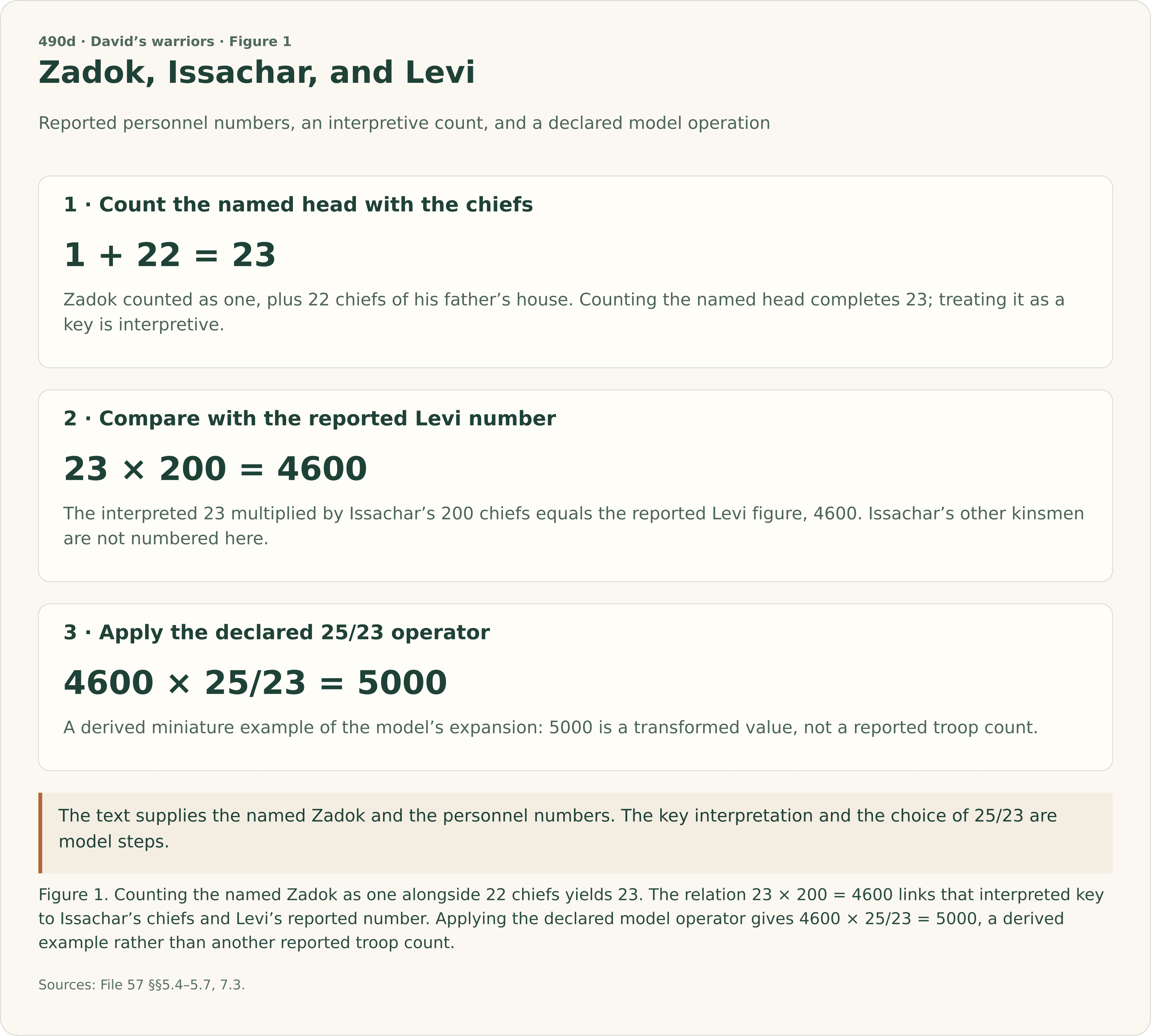
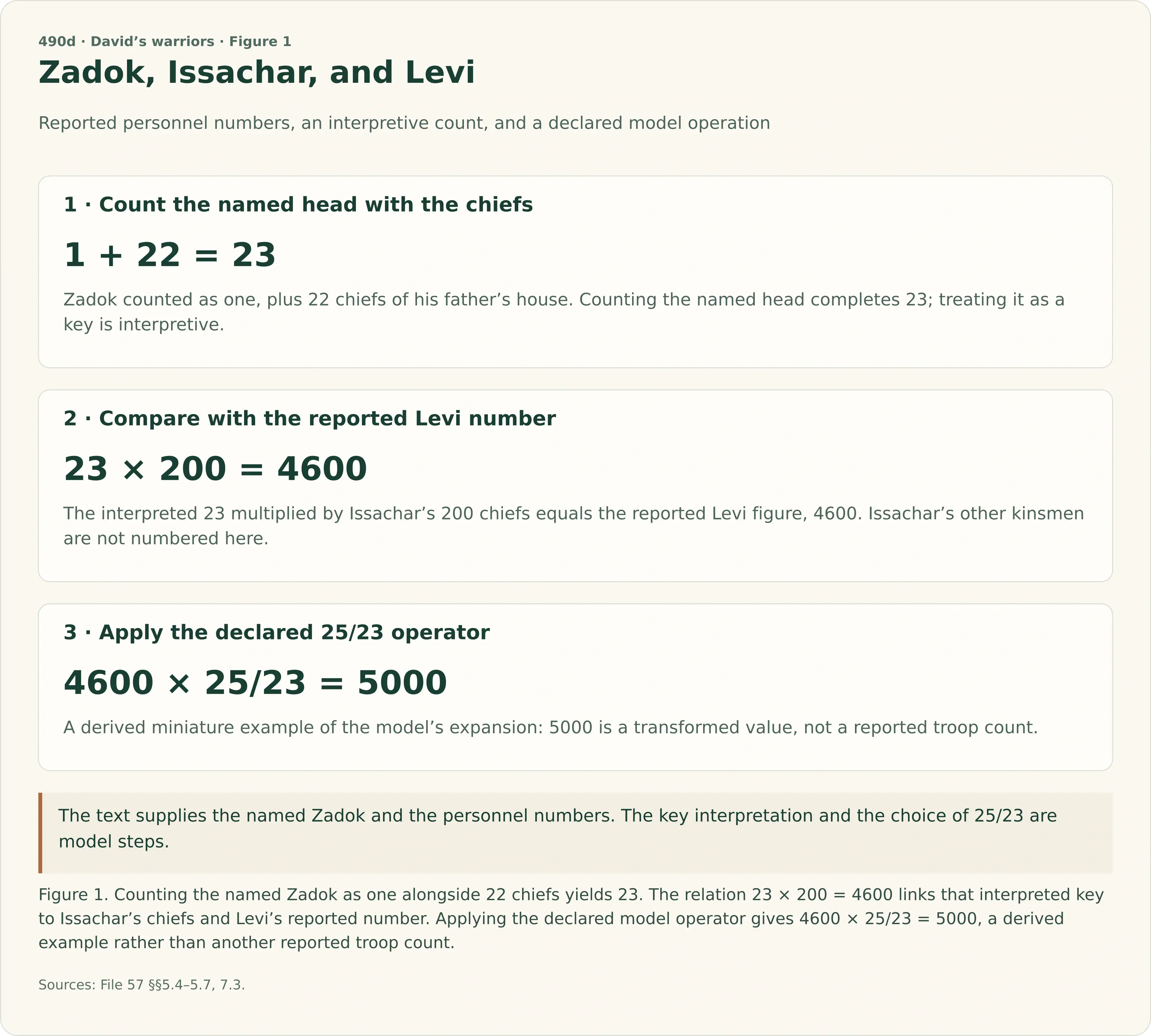
Zadok supplies the next step. The text gives his name and 22 commanders from his family. Counting the named leader with them yields 22 + 1 = 23. Identifying that completed number as the Key of 23 is a structural inference. The study then applies the predeclared ratio 25/23; the verse itself does not state that formula.
Issachar’s 200 supplies a direct connection:
(22 + 1) × 200 = 23 × 200 = 4600.
That is Levi’s reported figure. As an introductory illustration, 4600 × 25/23 = 5000. The result is a transformed value rather than a substitute troop count.
490d · David’s warriors · Figure 1
Zadok, Issachar, and Levi
Reported personnel numbers, an interpretive count, and a declared model operation
1 · Count the named head with the chiefs
1+ 22= 23
Zadok counted as one, plus 22 chiefs of his father’s house. Counting the named head completes 23; treating it as a key is interpretive.
2 · Compare with the reported Levi number
23× 200= 4600
The interpreted 23 multiplied by Issachar’s 200 chiefs equals the reported Levi figure, 4600. Issachar’s other kinsmen are not numbered here.
3 · Apply the declared 25/23 operator
4600× 25/23= 5000
A derived miniature example of the model’s expansion: 5000 is a transformed value, not a reported troop count.
Sources: File 57 §§5.4–5.7, 7.3.
Read the calculation and scope
File 57 §§5.4–5.6 distinguishes the named Zadok and 22 chiefs as textual data from the proposed key interpretation. Counting the named head gives 1+22=23; multiplying by Issachar’s 200 chiefs gives 4600. The 25/23 operation is a predeclared model choice, not a fraction supplied by the verse. The local 4600→5000 example is derived for this introductory diagram. File 57’s explicit larger-scale application uses 46000→50000, and §7.3 applies the same operator to the western subtotal. This diagram does not reconstruct the headcount of Zadok’s whole household or Issachar’s unnumbered kinsmen.
Open the full-resolution image version

The fuller list contains an especially useful comparison. Under the selected ledger, the subtotal from Judah through Ephraim is:
6800 + 7100 + 4600 + 3700 + 3000 + 20800 = 46000.
The same ratio gives 46000 × 25/23 = 50000, the number later printed for Zebulun. The input is an earlier source-order subtotal, and the output matches a later entry. This does not establish conscious use of the ratio by itself, but it is more informative than an isolated factorization.
The priestly context also has a biblical comparison. Numbers 3:39 gives 22000 Levite males from a month old upward; Numbers 26:62 gives 23000 at the same age threshold. The stated totals supply a 22000 → 23000 comparison, while 23000 = 5 × 4600. In the Hebrew reading behind BSB, the three clan figures in Numbers 3 sum to 22300. BSB’s note to 3:28 identifies 8300 in some LXX manuscripts instead of the Hebrew 8600; that alternative yields 22000. The readings remain distinct. The present comparison uses the two explicitly reported census totals.
The Book of Jubilees provides a related, noncanonical comparison through its 22-fold creation-and-generation structure. In the count with the second Cainan omitted, Jacob completes the 22 and Levi follows in the next generation; retaining that Cainan changes Jacob’s position to 23. This is a comparison of structures, not proof that Chronicles depends on Jubilees. The Jubilees study and File 53 explain that separate witness. The local priestly argument is developed in File 57 §5.
4. Issachar’s 200 and the calendar
Issachar receives an explanation of its leadership:
From Issachar, men who understood the times and knew what Israel should do: 200 chiefs with all their kinsmen at their command.
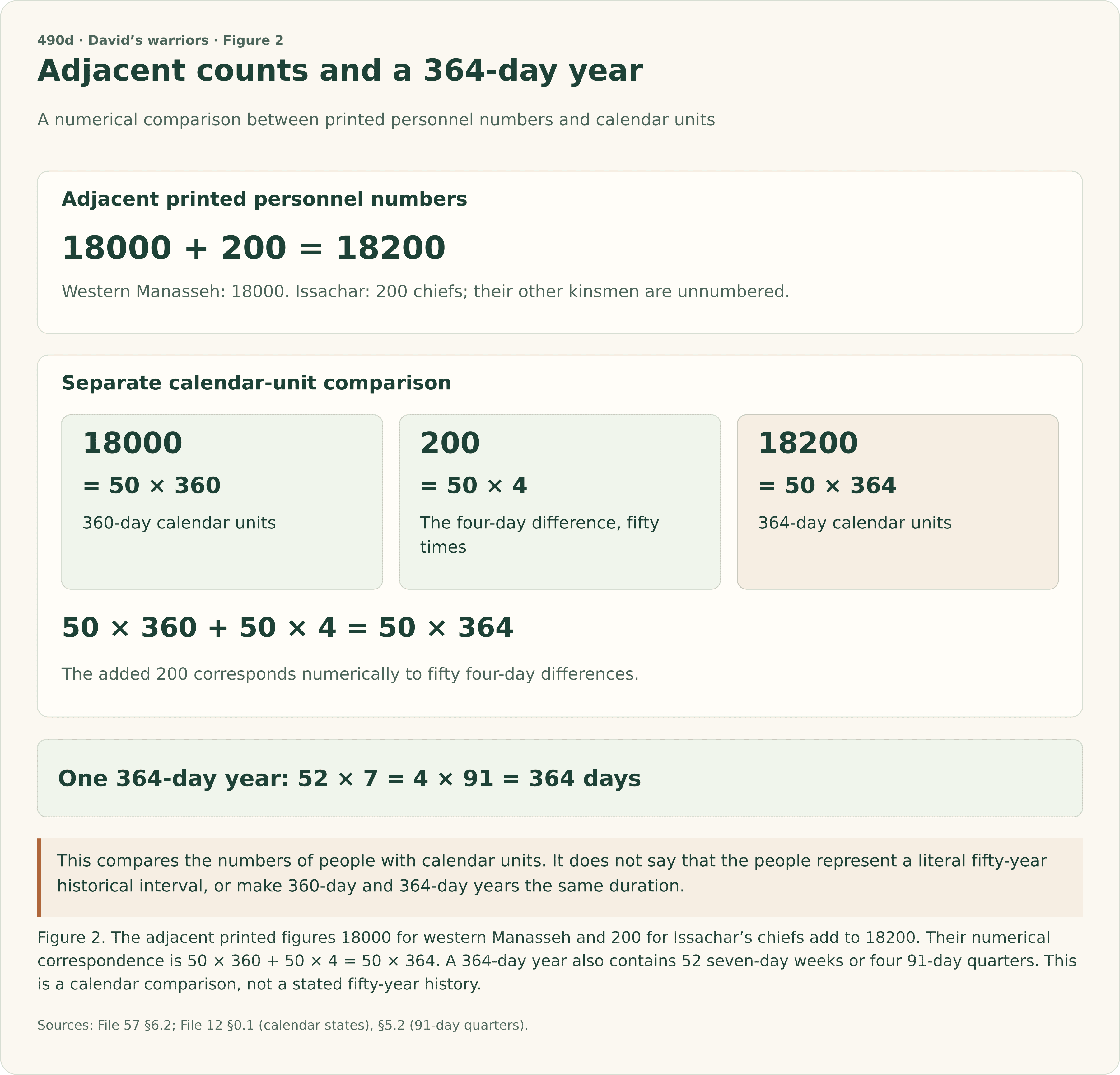
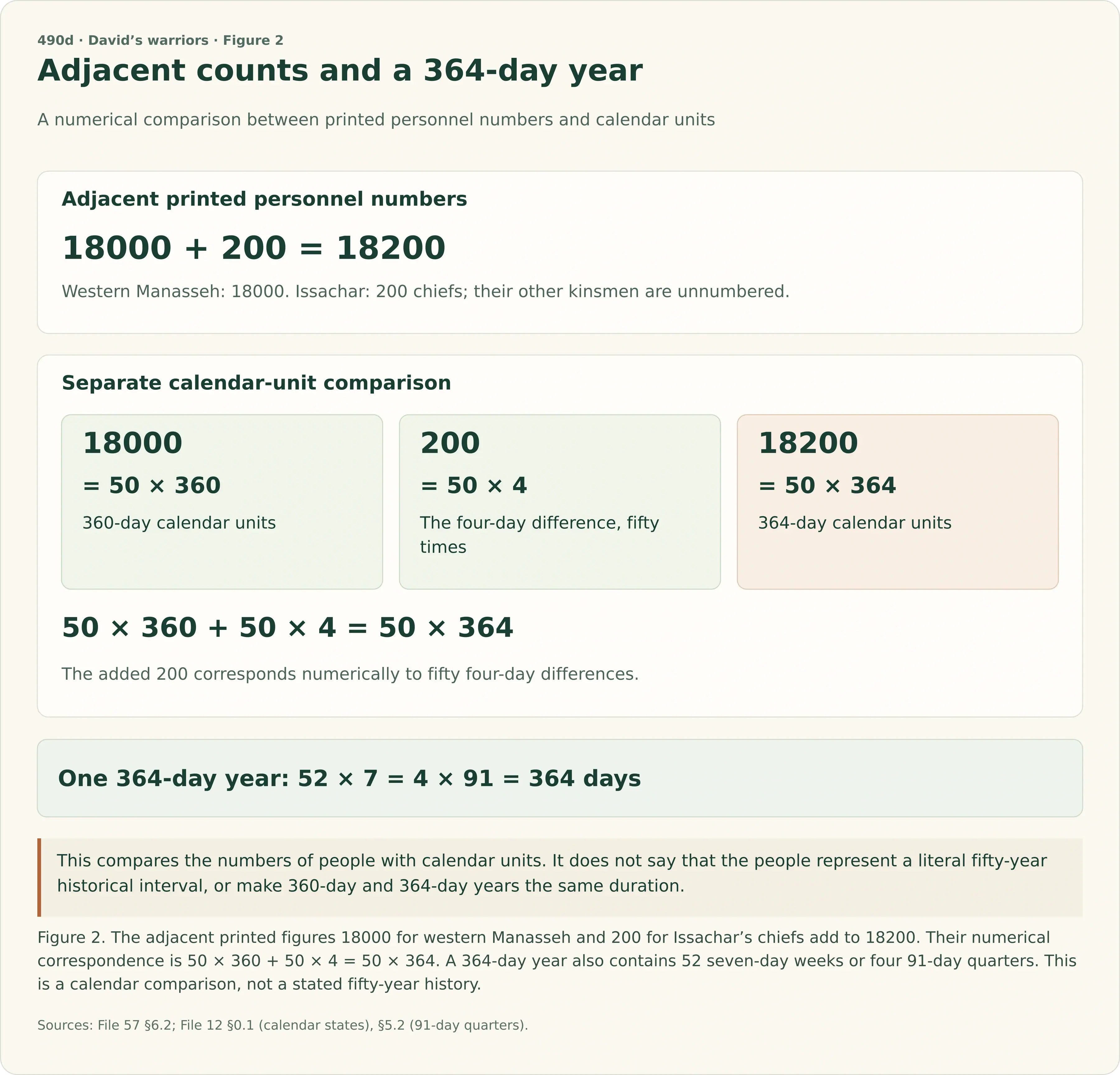
The preceding entry is western Manasseh’s 18000. Together they give 18000 + 200 = 18200. Comparing those numbers with calendar units produces:
50 × 360 + 50 × 4 = 50 × 364.
The added 200 supplies fifty four-day differences. The resulting 18200 is also 200 × 91, where 91 = 7 × 13 is one quarter of a 364-day year. The year contains 52 weeks, or four 91-day seasons.
490d · David’s warriors · Figure 2
Adjacent counts and a 364-day year
A numerical comparison between printed personnel numbers and calendar units
Adjacent printed personnel numbers
18000+ 200= 18200
Western Manasseh: 18000. Issachar: 200 chiefs; their other kinsmen are unnumbered.
Separate calendar-unit comparison
50 × 360+ 50 × 4= 50 × 364
The added 200 corresponds numerically to fifty four-day differences.
One 364-day year: 52 × 7 = 4 × 91 = 364 days
Sources: File 57 §6.2; File 12 §0.1 (calendar states), §5.2 (91-day quarters).
Read the calculation and scope
File 57 §6.2 derives the list-based 18200 directly from adjacent printed personnel numbers, 18000+200. Factoring the two addends gives 50×360 and 50×4, and their sum is 50×364. File 12 controls the distinct 360-day and 364-day calendar states. The identity is exact, but it does not identify fifty 360-day years with fifty 364-day years without the added 200 day units. Issachar’s 200 counts chiefs, not all of their unnumbered kinsmen. The same numerical total elsewhere in a rounded display does not make that separate source state identical to this list-derived sum.
Open the full-resolution image version

The move from personnel counts to calendar quantities is interpretive. The equation does not describe fifty years of military service. Likewise, understanding the times does not explicitly identify the chiefs as astronomers or calendar specialists. Their description supplies a literary setting for the proposal; identifying a particular scribal institution remains a historical hypothesis.
Three calendar units are used in the wider study:
| Calendar model | Numerical form | Role here |
|---|---|---|
| Priestly service-year ledger | 24 × 7 × 2 = 336 days | Ideal two-cycle service architecture. |
| Prophetic year | 360 days | A comparison unit in several sums and projections. |
| Enochian year | 4 × 91 = 52 × 7 = 364 days | The calendar form generated by the adjacent Issachar comparison. |
The arithmetic relates these models while preserving their different lengths. The 336-day service-year is an architectural calculation based on the priestly courses; it is not a statement that 1 Chronicles 24 explicitly names a 336-day civil year. These distinctions are explained in Levi and the Priestly Year, The 364-Day Calendar, and File 12.
5. The wider pattern around Issachar
The case for Issachar’s numerical role extends beyond the adjacent pair. Every subsequent western number is divisible by 200:
| Entry | Printed figure | Units of 200 | Cumulative units from Issachar |
|---|---|---|---|
| Issachar | 200 | 1 | 1 |
| Zebulun | 50000 | 250 | 251 |
| Naphtali commanders | 1000 | 5 | 256 |
| Naphtali troops | 37000 | 185 | 441 |
| Dan | 28600 | 143 | 584 |
| Asher | 40000 | 200 | 784 |
The cumulative column counts 200-unit blocks from Issachar onward. It reaches 256 = 16² at Naphtali’s commanders, 441 = 21² after Naphtali’s troops, and 784 = 28² at Asher.
Two adjacent blocks explain the final square:
| Block | Sum | Equivalent forms |
|---|---|---|
| Issachar through Naphtali’s troops | 200 + 50000 + 1000 + 37000 = 88200 | 200 × 21² = 180 × 490 = 245 × 360 |
| Dan and Asher | 28600 + 40000 = 68600 | 200 × 7³ = 140 × 490 |
| Issachar through Asher | 88200 + 68600 = 156800 | 200 × 28² = 320 × 490 |
The relation is 21² + 7³ = 28², or 441 + 343 = 784. It is obtained from specified blocks in source order, with no rearrangement of the entries.
The comparisons extending toward the earlier entries emphasize 13 and 130:
| Selected window | Total | Factorization |
|---|---|---|
| Western Manasseh + Issachar | 18200 | 130 × 140 = 200 × 7 × 13 |
| Ephraim + western Manasseh + Issachar | 39000 | 130 × 300 = 200 × 15 × 13 |
| Ephraim by itself | 20800 | 13 × 40 × 40 |
The left-facing and right-facing windows share Issachar’s 200. They are overlapping comparisons, not a disjoint partition of the list.
A further calendar relation comes from the selected block from Jehoiada through western Manasseh, with Zadok’s 22 withheld:
3700 + 3000 + 20800 + 18000 = 45500 = 125 × 364.
Comparing this with the Manasseh–Issachar 18200 gives 45500 − 18200 = 27300 = 75 × 364 = 100 × 273. The two blocks overlap at Manasseh, while Issachar extends beyond the first block. Their difference is therefore an arithmetic comparison between totals, not another contiguous troop body or a pair of literally nested groups.
These relations account for the irregular entries and the full later western sequence. File 57 §§6.2–6.10 treats them together: 200 connects priestly 23, calendrical 91, and the square/cube/Jubilee forms. The arithmetic is exact; the inference that the arrangement intentionally emphasizes Issachar remains a claim about composition.
6. The western total and the Temple framework
The selected western base is 220800 = 460 × 480. Its chronological significance depends on the framework used for the Exodus, Conquest, and Temple:
| Comparison | Calculation | Status |
|---|---|---|
| Exodus to Temple foundation | 1446 − 966 = 480 years | Ordinary 490d chronological anchors. |
| Temple and palace construction | 7 + 13 = 20 years | Whole-year comparison based on the biblical durations. |
| Construction-envelope endpoint | 966 − 20 = 946 BC | Local schematic endpoint. |
| Conquest to that endpoint | 1406 − 946 = 460 years | Conquest-origin span. |
| Exodus to that endpoint | 1446 − 946 = 500 years | Exodus-origin span. |
The biblical references are 1 Kings 6:1, 6:38, 7:1, and 9:10. They supply relative years and construction durations, not BC dates. The 480th year in 1 Kings 6:1 is an ordinal designation; the table’s 480-year interval follows the selected annual coordinates. The 946 BC label is a schematic whole-year endpoint; finer completion dates must respect the stated months. No date for Solomon’s marriage or moral decline is inferred from it.
The Key of 23 links the two origins through a common endpoint:
460 × 25/23 = 500.
Keeping the Temple factor 480 fixed gives:
220800 × 25/23 = (460 × 480) × 25/23 = 500 × 480 = 240000.
The 20-year construction factor appears in both forms: 460 = 23 × 20 and 500 = 25 × 20. This is why the factorization is useful within the declared chronological interpretation. The model changes the span being compared; it does not change the dates of the Exodus or the Conquest. File 57 §§7.1–7.3 and File 08 supply the controls.
7. Western and eastern Israel
The eastern figure is left unchanged at 120000. Adding it to the transformed west gives 240000 + 120000 = 360000.
490d · David’s warriors · Figure 3
From the selected western ledger to 360000
A declared subtotal, a model transformation, and a two-to-one result
Add the reported eastern number
240000+ 120000= 360000
The reported eastern figure is added after the western transformation. The result is a transformed national total, not a reported headcount.
Three equal shares of the transformed total
The bar represents a 2:1 ratio within 360000.
Sources: File 57 §§4.4–4.5, 7.1–7.4.
Read the calculation and scope
File 57 §§7.1–7.4 controls the chosen western cipher base and national-thirds comparison. The selected western subtotal is 220800, not the all-printed western 220822: it treats Jehoiada’s 3700 as additional but withholds the 22 chiefs as a key. The numerical transformation is 220800×25/23=240000. The eastern printed number remains 120000, giving 240000+120000=360000 and a 2:1 relation. No extra 22 or named Zadok is added after that selection. Other possible personnel and printed-number ledgers are distinguished in the article’s ledger table; this diagram uses only the declared selected subtotal.
Open the full-resolution image version

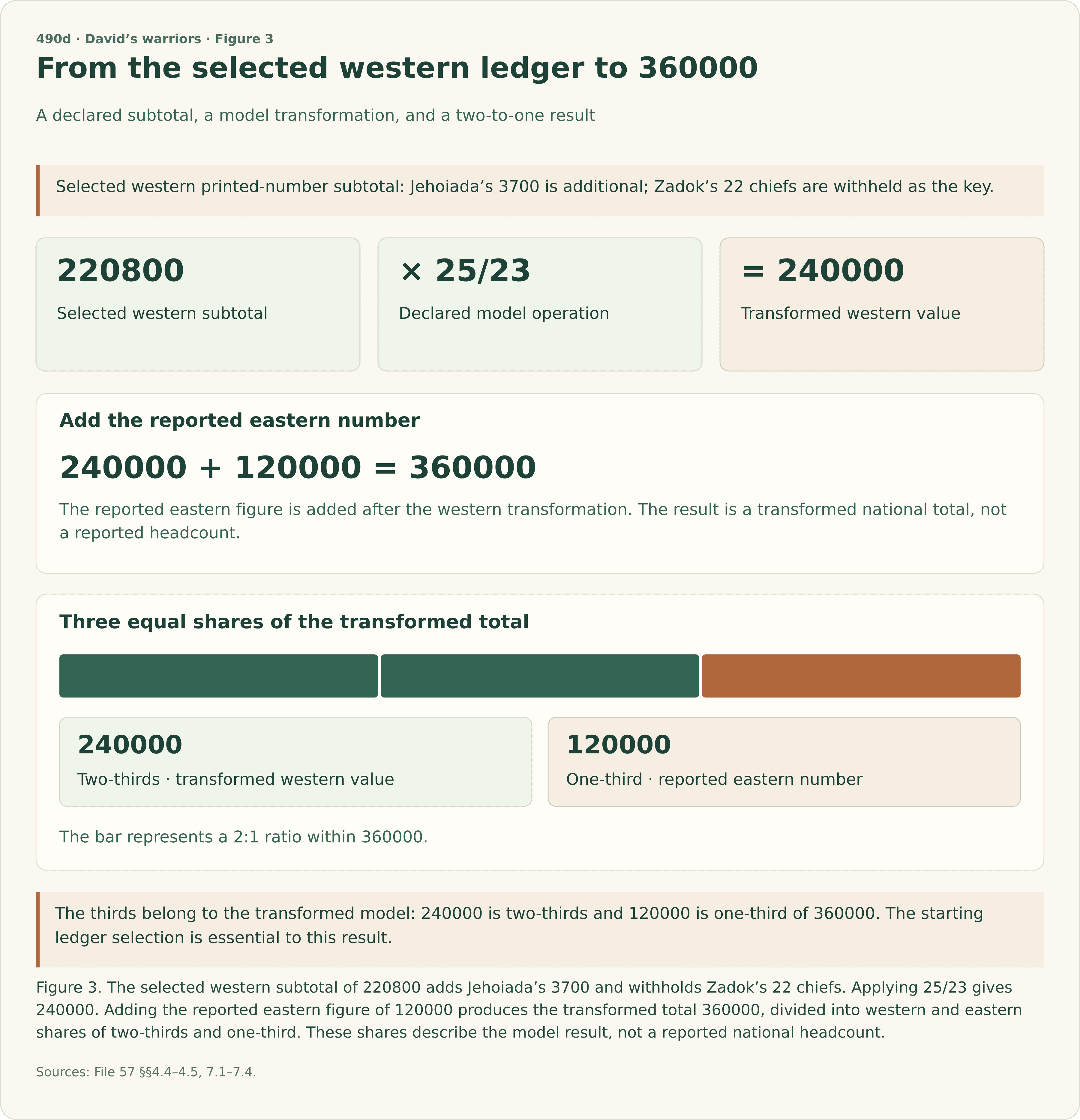
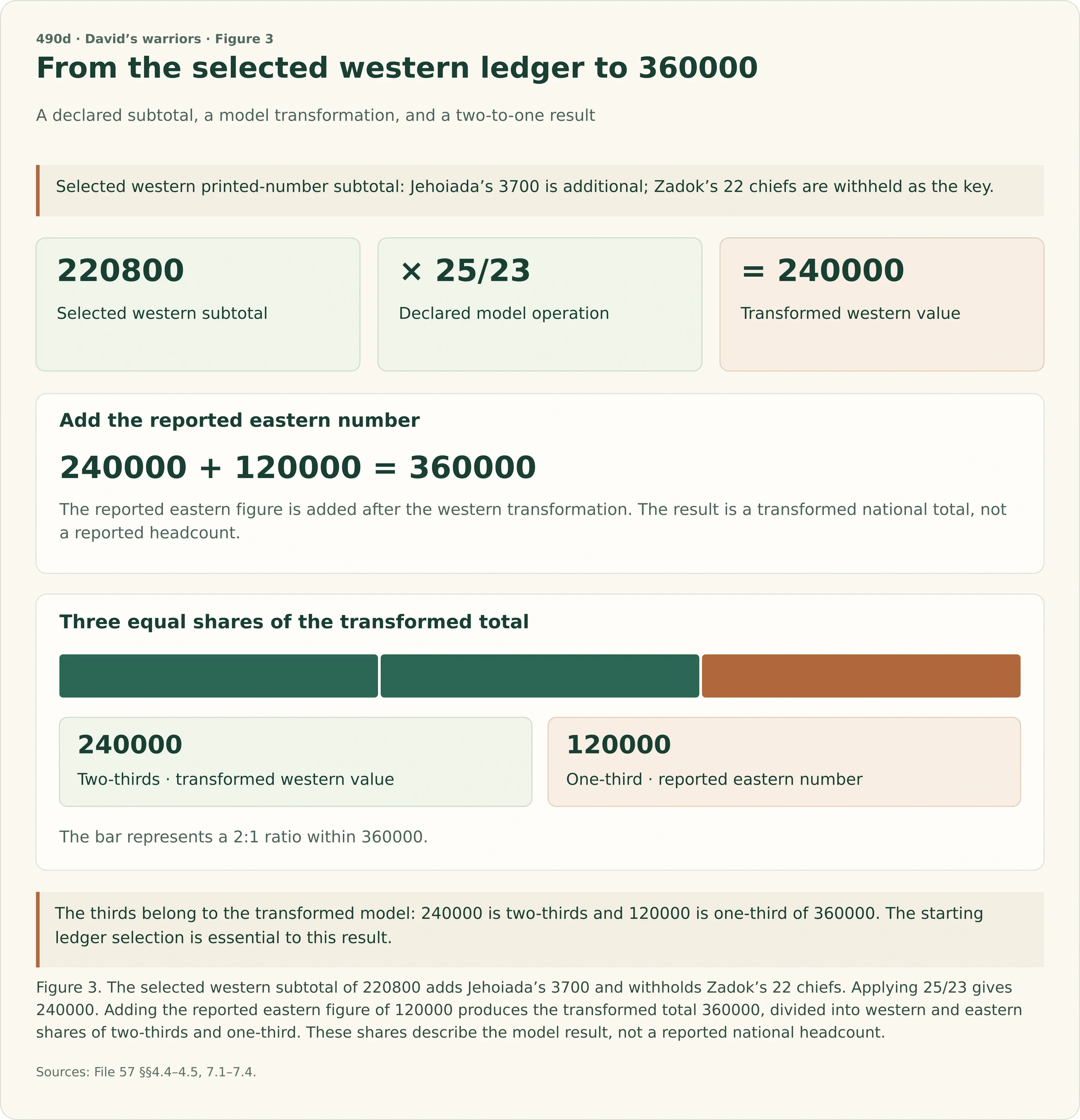
The west is two-thirds and the east one-third of this transformed whole. Asher’s 40000 also equals one-sixth of the transformed western 240000, giving the secondary partition 200000 + 40000. These fractions belong to the numerical model.
All principal totals remain available for comparison:
| Ledger or transformation | West | East | National total | Operation |
|---|---|---|---|---|
| Minimum under the selected personnel convention | 217100 | 120000 | 337100 | No ratio applied |
| Minimum plus printed chiefs | 217122 | 120000 | 337122 | No ratio applied |
| Selected symbolic base | 220800 | 120000 | 340800 | No ratio applied |
| All printed numbers | 220822 | 120000 | 340822 | No ratio applied |
| 25/23 transformed | 240000 | 120000 | 360000 | Western base × 25/23 |
| 70/69 transformed | 224000 | 120000 | 344000 | Western base × 70/69 |
The companion 70/69 operation acts on the same 220800 western base: 220800 = 69 × 3200, so 220800 × 70/69 = 224000. With the east, this gives 344000 = 430 × 800. The difference between the two transformed national totals is 16000.
The 25/23 branch carries the primary argument because it connects with Zadok’s completed 23, transforms the 460 factor to 500, and produces the national thirds. The alternative branch remains visible rather than being silently suppressed. The broader thirds framework is developed in File 55; the local geographic comparison does not import that file’s other chronological origins or directions.
8. A second Issachar list
First Chronicles 7:1–5 supplies another bounded Issachar list. Its three displayed military figures are:
| Reference | Description | Printed figure |
|---|---|---|
| 7:2 | Tola’s descendants, in David’s days | 22600 |
| 7:4 | The household associated with Izrahiah and his sons | 36000 |
| 7:5 | The broader Issachar family total | 87000 |
Their kinsmen belonging to all the families of Issachar who were mighty men of valor totaled 87,000, as listed in their genealogies.
The 87000 remains the encompassing personnel total in the canonical study. A second analytical ledger adds the three displayed figures, including that total:
22600 + 36000 + 87000 = 145600 = 400 × 364.
This deliberately overlapping sum is a printed-number calculation. The 145600 is not a revised population figure. It corresponds to 400 × 360 + 400 × 4, reproducing the same calendar comparison as the 50-unit Manasseh–Issachar pair in chapter 12. The two results are related by 145600 = 8 × 18200. The middle figure also supplies a calendar marker: 36000 = 100 × 360.
490d · David’s warriors in detail · Figure 4
Two Issachar passages and the 364 pattern
A repeated numerical factorization across distinct printed-number ledgers
1 Chronicles 12 · adjacent printed numbers
18000+ 200= 18200
18200= 50 × 364
Western Manasseh’s 18000 plus Issachar’s 200 chiefs. Issachar’s other kinsmen remain unnumbered.
1 Chronicles 7 · overlapping printed numbers
22600+ 36000+ 87000= 145600
145600= 400 × 364= 8 × 18200
87000 remains the encompassing Issachar personnel total. Adding the displayed subtotals and that total gives 145600 as a printed-number sum, not a headcount.
A separate subtraction and model operation
87000− 22600= 64400
64400= 23 × 2800
64400 × 25/23= 70000= 25 × 2800
The 25/23 operator gives a transformed comparison value; 70000 is not a newly reported personnel total.
Sources: File 57 §6.2, §§8.1–8.8.
Read the calculation and scope
File 57 §§8.1–8.8 separates Issachar’s encompassing personnel total, 87000, from the overlapping printed-number ledger 22600+36000+87000=145600. It links 145600=400×364 to the independently formed adjacent sum 18000+200=18200=50×364 in §6.2. The ratio of these printed-number sums is eight. The independent subtraction in §8.4 yields 64400=23×2800, followed by 64400×25/23=70000=25×2800. The diagram makes no additional disjoint-family assumption and does not convert overlapping displayed numbers into a literal troop total. Calendar factorizations remain numerical comparisons.
Open the full-resolution image version

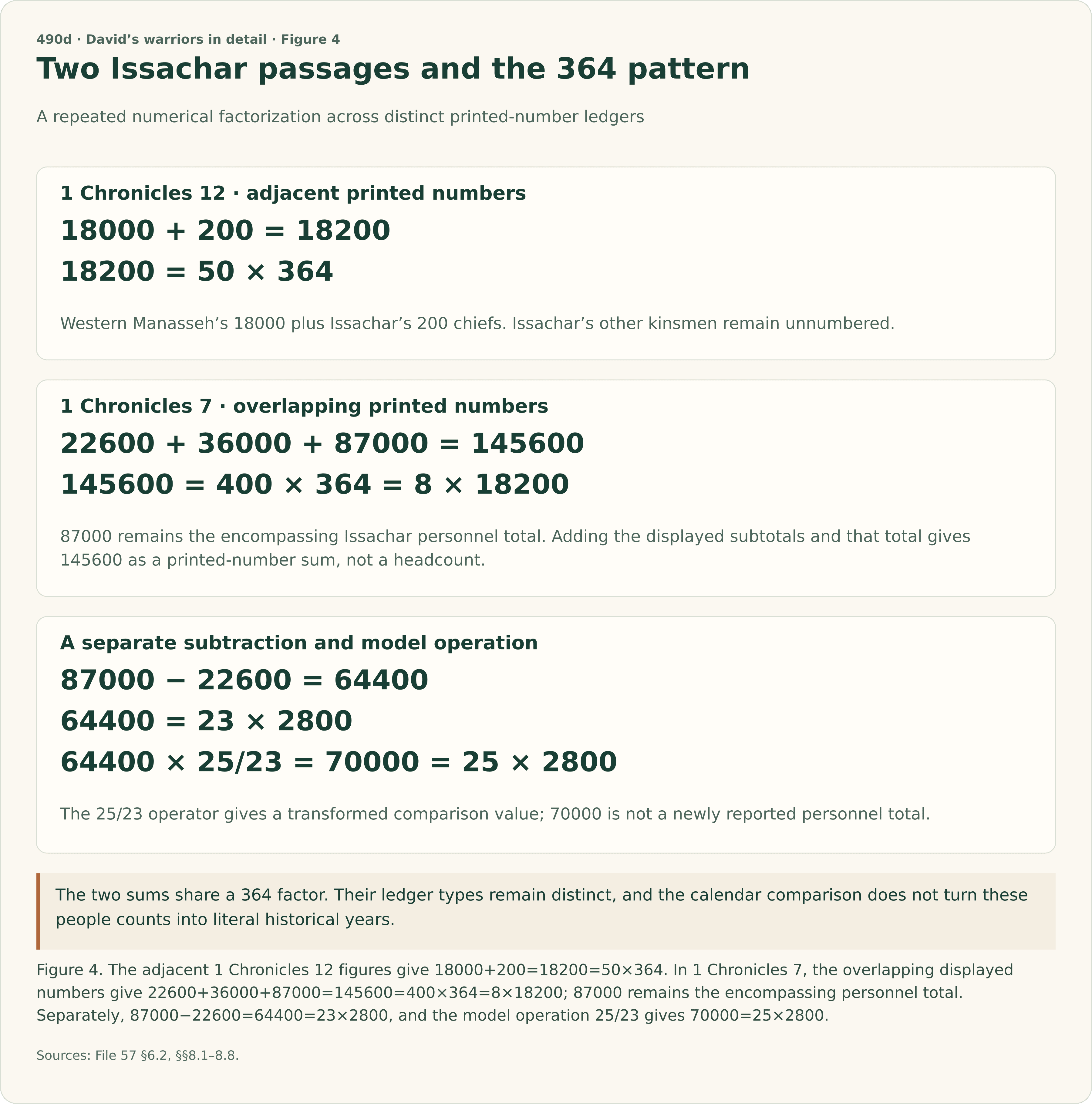
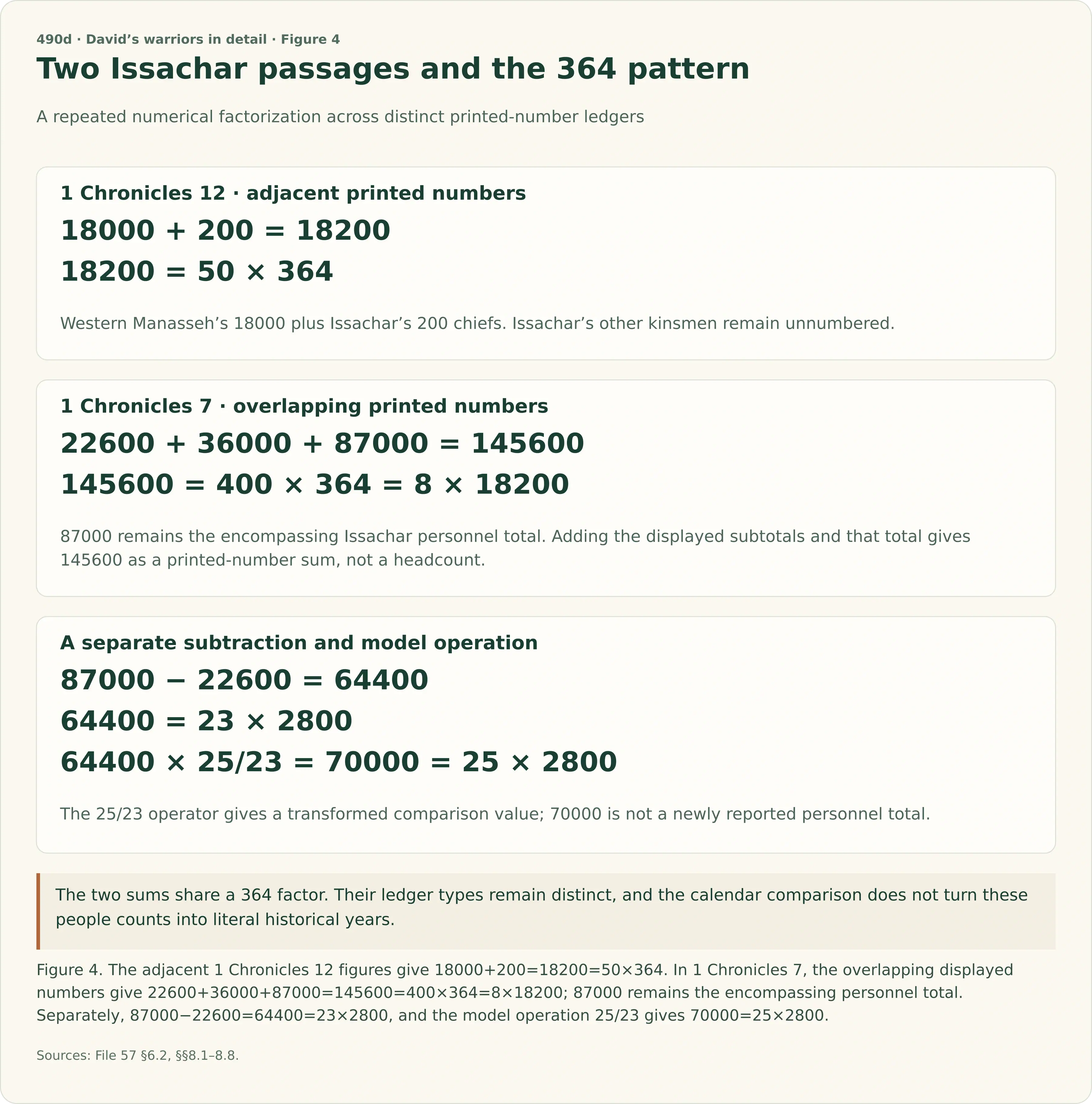
The less regular 22600 also has a defined role:
87000 − 22600 = 64400 = 23 × 2800.
64400 × 25/23 = 70000 = 25 × 2800.
The increase is 5600 = 200 × 28. The common 2800 unit joins the three quantities 145600 = 52 × 2800, 64400 = 23 × 2800, and 70000 = 25 × 2800. Thus the same bounded list supports both the 52-week calendar number and the 23→25 ratio.
One personnel calculation requires an additional qualification. File 57 gives 87000 − 22600 − 36000 = 28400 as a working remainder. That treats the smaller figures as separate components within the total. The genealogy runs through Tola, Uzzi, and Izrahiah, so the passage itself does not establish that the two smaller bodies are disjoint contemporaneous subsets. The 28400 is consequently a conditional accounting remainder, not an explicitly reported group. This qualification leaves the printed-number sum and the 64400 comparison unchanged.
The second list strengthens the argument by repeating the association between Issachar and 364 with a different set of figures. It remains corroboration: the counting operation, overlap, and interpretation must be stated each time. File 57 §8 treats this comparison as a principal part of the detailed case.
9. Priestly courses and monthly military divisions
First Chronicles 24 organizes the priesthood into 24 courses. The ideal service-year calculation uses 24 × 7 = 168 days for one cycle and 168 + 168 = 336 for two. Historical execution and festival arrangements require their own evidence; the numerical ledger preserves the ideal cycle separately.
First Chronicles 27:1–15 supplies a more direct annual military roster: twelve monthly divisions of 24000, totaling 12 × 24000 = 288000 = 800 × 360. This describes annual rotation capacity; it does not require all 288000 to be serving at once.
The transformed chapter 12 totals can be expressed in those division units:
| Chapter 12 quantity | Value | Equivalent 24000-unit divisions |
|---|---|---|
| Transformed west | 240000 | 10 |
| Reported east | 120000 | 5 |
| Transformed whole | 360000 | 15 |
The ratio remains 10:5 = 2:1, and 360000 = 15 × 24 × 1000 = 360 × 1000. The difference between the transformed national total and the annual roster is 360000 − 288000 = 72000 = 200 × 360, bringing Issachar’s 200 into the comparison again.
Revelation 7:4–8 offers a further twelvefold roster: 12 × 12000 = 144000 = 400 × 360. The Chronicles 27 total is twice this quantity. These comparisons identify a shared numerical form; arithmetic alone does not establish direct literary dependence.
The expression 360 × 1000 also supports a theological reading. If the model first interprets the 360000 count as years and then applies its millennial-day scale, the result is 360 thousand-year days. Psalm 90:4 and 2 Peter 3:8 provide the biblical day/thousand-year analogy. Using it as an exact computational scale is the model’s declared typological operation, rather than a chronological equation commanded by either verse. File 57 §9 develops this national “divine year” reading.
10. From counts to Temple-centered chronology
The argument now opens a second level of interpretation. A count is treated numerically as a span of years and projected from a stated date. These generated coordinates are comparison tools. They leave the ordinary historical anchors intact.
The first anchor is the Temple foundation at 966 BC. The western factor 480 already relates to the Temple, and Chronicles moves from the national gathering toward the Ark, Davidic covenant, Temple preparations, and ordered service. Choosing this anchor is a structural interpretation grounded in that narrative setting.
Projecting backward gives:
| Count used as a year-span | Anchor | Generated coordinate | Verification |
|---|---|---|---|
| 220800, selected western base | 966 BC | 221766 BC | 221766 − 966 = 220800 |
| 120000, eastern figure | 966 BC | 120966 BC | 120966 − 966 = 120000 |
The gap between the generated coordinates is 100800 = 300 × 336 = 280 × 360. From the eastern coordinate to the project’s 6 BC Christ-birth hinge is 120960 = 336 × 360.
490d · David’s warriors in detail · Figure 5
Temple-anchored projections from the selected counts
Declare the model step: treat the selected counts as symbolic years, then count backward
The projected coordinates and the selected Christ-birth hinge
Whole: 221760 years = 22 × 10080
Sources: File 57 §§10.1–10.5; File 22 §9A.1.
Read the calculation and scope
File 57 §§10.1–10.5 declares the symbolic projection state. The two backcounts from 966 BC are 966+220800=221766 BC and 966+120000=120966 BC. The interval between their projected heads is 221766−120966=100800. From the eastern head to the project’s selected 6 BC Christ-birth hinge, 120966−6=120960. Their sum is 221760=22×10080. File 22 §9A.1 controls 10080=30×336=28×360. These are factorizations using distinct calendar units, not an assertion that the personnel numbers measure literal historical lifespans or that the Chronicle passage states the Christ-birth coordinate. All shown timeline endpoints are BC, so ordinary subtraction applies.
Open the full-resolution image version

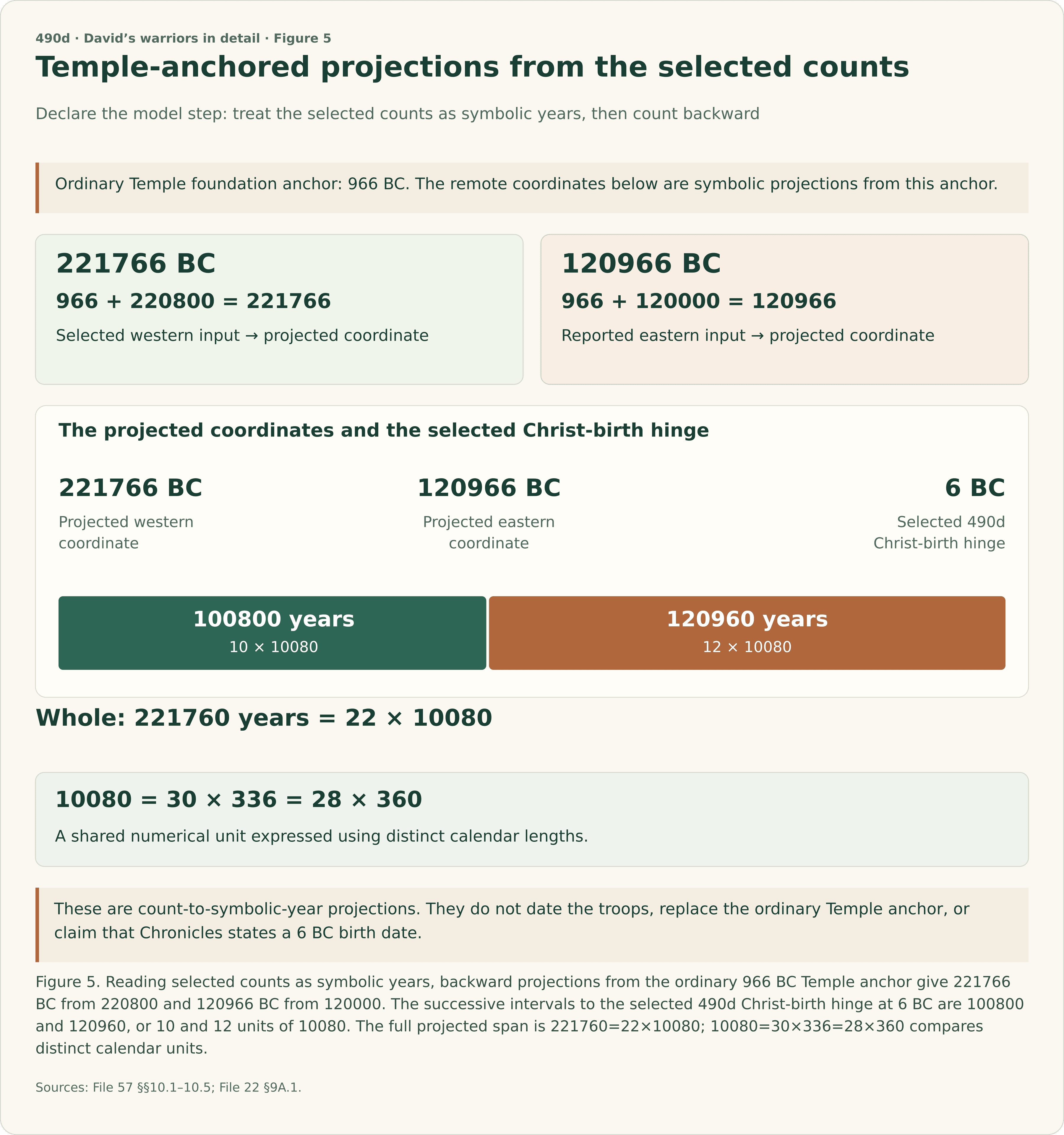
The common numerical unit is 10080 = 30 × 336 = 28 × 360. The first span contains ten such units; the second contains twelve. Together:
221766 − 6 = 221760 = (10 + 12) × 10080 = 22 × 10080.
These factorizations reuse calendar-sized numbers within a symbolic year-span. They do not equate 100800 historical years with 300 literal 336-day years. Source units and interpretive scaling remain separate.
The ordinary and computational anchors also supply the sequence 1446 → 966 → 486 → 6 BC, with three equal intervals of 480 years. The 486 BC member is the Berossus computational anchor; 536 BC remains the restoration reference. The 6 BC hinge is supplied by the project’s Christological chronology, not explicitly dated by the Chronicler. The exact threefold spacing is arithmetic; ancient anticipation of the terminal date is a historical hypothesis, with providential synchronization as a theological alternative.
The Thirty reading in the census preface and David’s stated accession age of 30 in 2 Samuel 5:4 can be compared with the 30 in 10080 = 30 × 336. This is a framing analogy. It does not authorize adding 30 to every census total. Controls for these projections are File 57 §10, File 22, and File 13.
11. Comparisons with the Sumerian and Berossus models
The external comparisons use the chronological system developed in the Sumerian King List study and Berossus, Babylon, and the Fifty-Year Shift. Each imported coordinate must retain its own origin and function:
| Coordinate | Function in this comparison |
|---|---|
| 536 BC | Restoration reference in the biblical framework. |
| 486 BC | Computational anchor used by the Berossus model. |
| 60486 BC | Selected Enmendurana/Enoch coordinate in the SKL model. |
| AD 29515 | Projected Jachin Pillar boundary, not a predicted historical event. |
| 275766 BC | Hybrid SKL/Berossus Alulim-aligned opening, distinct from either native chronology. |
Project the eastern 120000 forward from 486 BC. Ordinary BC–AD counting has no year zero, so the span is calculated as BC + AD − 1:
486 + 119515 − 1 = 120000.
This generates AD 119515. From the Exodus anchor, the span is 1446 + 119515 − 1 = 120960 = 336 × 360, repeating the numerical rectangle found in the Temple projection.
The selected Enmendurana/Enoch coordinate and the projected Pillar boundary divide a larger whole into equal intervals:
60486 BC → AD 29515 → AD 119515 = 90000 + 90000.
The first interval uses 60486 + 29515 − 1 = 90000; the second uses 119515 − 29515 = 90000. The total is 180000 = 500 × 360.
The Jachin coordinate comes from the Temple-Time model of Ezekiel’s temple measurements; the 90000 + 90000 division compares that projected boundary with the present spans.
490d · David’s warriors in detail · Figure 6
One 180000-year model envelope, two divisions
The same outer endpoints · equal halves and unequal thirds on an ordinary civil axis
A · The projected Pillar boundary divides the envelope in half
60486 + 29515 − 1 = 90000; 119515 − 29515 = 90000.
B · The computational anchor divides the same envelope in thirds
60486 − 486 = 60000; 486 + 119515 − 1 = 120000.
Sources: File 57 §§11.1–11.4; File 21 §0.1, Table 6.3, §7; File 34 §§6.5–6.6.
Read the calculation and scope
File 57 §§11.2–11.4 uses externally controlled states: the File 21 Enmendurana/Enoch model coordinate 60486 BC, the Jachin Pillar coordinate AD 29515 as a projected boundary, and the File 34 computational anchor 486 BC. The eastern input yields 486+119515−1=120000. Equal halves are 60486+29515−1=90000 and 119515−29515=90000. The alternative partition gives 60486−486=60000 and 486+119515−1=120000. Both share the whole 60486+119515−1=180000=500×360. The scale comparison 240000÷4=60000 is explicit; it does not identify an unchanged western total with the backward arm. The 536 BC restoration reference is not substituted for the computational anchor. Ordinary civil arithmetic is used, with no year zero and no formal Mirror transformation. The calendar factorization does not establish a literal historical or future event interval.
Open the full-resolution image version

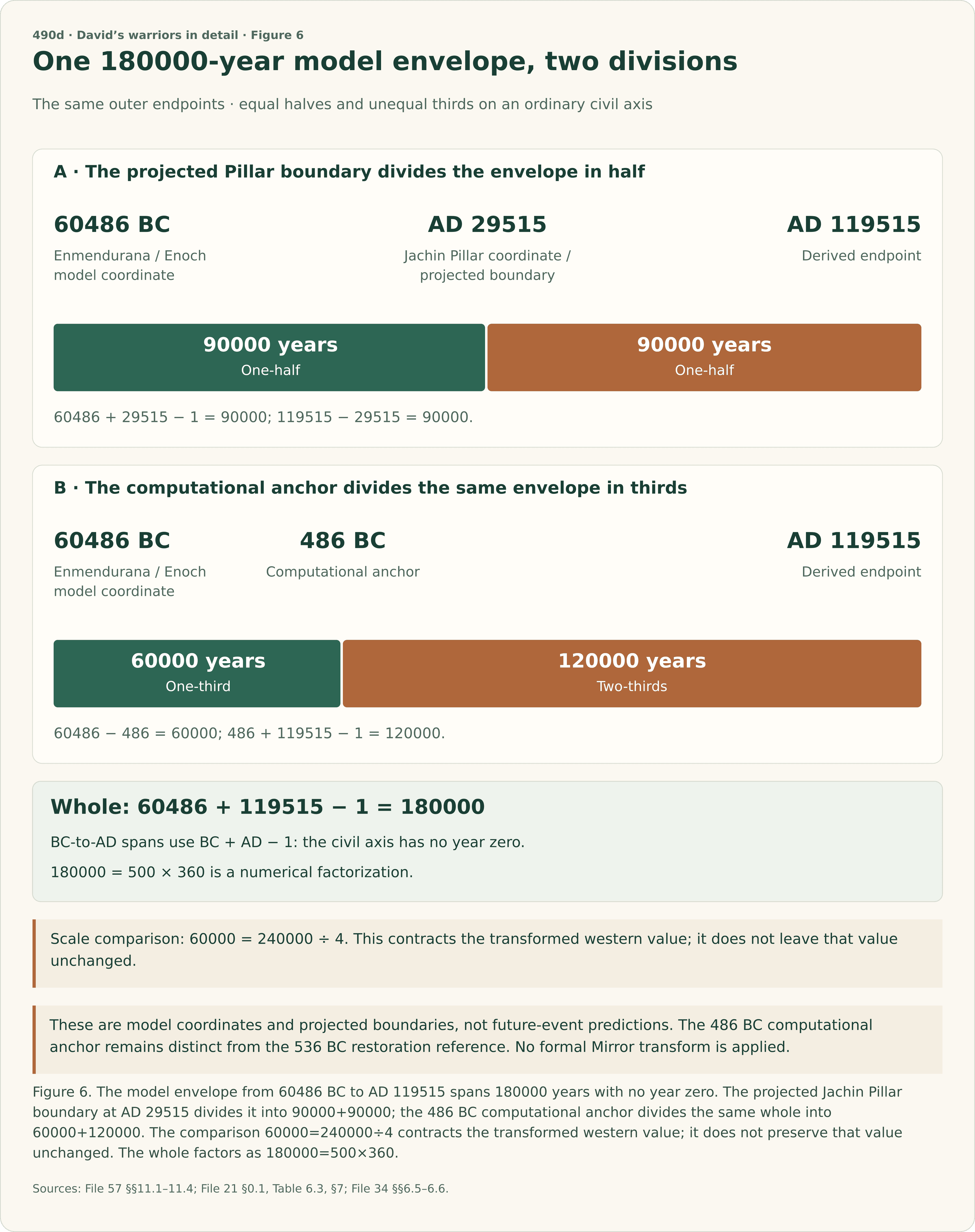
The same whole can be divided at the Berossus anchor as 60000 + 120000 = 180000, since 60486 − 486 = 60000. Here the earlier arm is one-third and the later arm two-thirds. This differs from the national model’s western two-thirds and eastern one-third. Connecting the earlier 60000 with the transformed west requires a separate, explicit 240000 ÷ 4 = 60000 comparison. The scale change is part of the construction.
These equations establish compatibility among declared models. They neither identify the biblical and Mesopotamian textual traditions nor demonstrate that the Chronicler knew a surviving Berossus text. The historical comparison concerns the older king-list grammar later represented by the SKL and Berossus. File 21 and File 34 control the imported states; File 57 §§11.1–11.4 controls their use here.
12. National order, sacred time, and Davidic kingship
The local argument joins two complementary entries. Zadok’s named presence completes the proposed 23, while Issachar supplies 200. Their product reproduces Levi’s 4600. The selected western total then becomes 460 × 480; its transformation gives 500 × 480 and a national whole of 360 × 1000. A second Issachar list and later service rosters provide further comparisons.
I read this ordered numerical field in relation to the movement of Chronicles itself. The tribes gather around David, priestly leaders hold a distinct place, and the narrative proceeds toward covenant, sanctuary, and service. Within that theological reading, numerical reconciliation expresses the ordering of Israel under the chosen king and points toward the greater Davidic reign.
The comparison with neighboring king-list traditions extends the same proposal: the numerical language used to express kingship and cosmic time is brought into relation with the God of Israel, the Exodus, the Temple, and the Davidic promise. Direct borrowing from a particular surviving text remains unproved. The remotest correspondences may be read providentially without assigning undocumented knowledge to ancient scribes.
The evidential levels therefore remain distinct:
| Level | What this study establishes or proposes |
|---|---|
| Textual data | Named groups, printed numbers, source order, and statements about leadership and service. |
| Arithmetic | Exact relationships under explicitly stated counting and transformation rules. |
| Compositional interpretation | The convergence of local patterns may reflect deliberate arrangement. |
| Historical hypothesis | A trained scribal circle may have preserved such calendar-related knowledge; the text does not identify its members or institution. |
| Theological interpretation | National and priestly order participate in a wider account of divine sovereignty and Davidic hope. |
Exact arithmetic does not by itself determine probability, literary dependence, or authorial intention. The case rests on the cumulative explanatory value of the specified relationships, including the irregular and overlapping entries, rather than on a claim that coincidence has been numerically excluded.
Appendix A. Complete cumulative ledgers
These tables retain every numbered row in biblical order. A repeated total means that the corresponding figure is not added under that column’s rule. The east is added once as a joint body.
Inclusive conventions
| Entry | Printed figure | Minimum cumulative | Minimum + chiefs cumulative |
|---|---|---|---|
| Judah | 6800 | 6800 | 6800 |
| Simeon | 7100 | 13900 | 13900 |
| Levi | 4600 | 18500 | 18500 |
| Jehoiada, leader of the house of Aaron | 3700 | 18500 | 18500 |
| Zadok’s paternal-house chiefs | 22 | 18500 | 18522 |
| Benjamin | 3000 | 21500 | 21522 |
| Ephraim | 20800 | 42300 | 42322 |
| Western half-Manasseh | 18000 | 60300 | 60322 |
| Issachar | 200 | 60500 | 60522 |
| Zebulun | 50000 | 110500 | 110522 |
| Naphtali commanders | 1000 | 111500 | 111522 |
| Naphtali troops | 37000 | 148500 | 148522 |
| Dan | 28600 | 177100 | 177122 |
| Asher | 40000 | 217100 | 217122 |
| Reuben, Gad, eastern half-Manasseh | 120000 | 337100 | 337122 |
Printed-number conventions
| Entry | Printed figure | Selected-base cumulative | All-printed cumulative |
|---|---|---|---|
| Judah | 6800 | 6800 | 6800 |
| Simeon | 7100 | 13900 | 13900 |
| Levi | 4600 | 18500 | 18500 |
| Jehoiada, leader of the house of Aaron | 3700 | 22200 | 22200 |
| Zadok’s paternal-house chiefs | 22 | 22200 | 22222 |
| Benjamin | 3000 | 25200 | 25222 |
| Ephraim | 20800 | 46000 | 46022 |
| Western half-Manasseh | 18000 | 64000 | 64022 |
| Issachar | 200 | 64200 | 64222 |
| Zebulun | 50000 | 114200 | 114222 |
| Naphtali commanders | 1000 | 115200 | 115222 |
| Naphtali troops | 37000 | 152200 | 152222 |
| Dan | 28600 | 180800 | 180822 |
| Asher | 40000 | 220800 | 220822 |
| Reuben, Gad, eastern half-Manasseh | 120000 | 340800 | 340822 |
The minimum columns are working accounting conventions, not exhaustive lists of persons. The selected symbolic base deliberately adds Jehoiada separately and withholds the 22 as a key. The all-printed column includes every numeral in the bounded list. File 57 Appendix B supplies the controlling values.
Appendix B. Further controlled comparisons
An additional Enochian ratio comparison
The selected ordinary chronology based on the Masoretic Text (MT) places Jared’s birth at 3654 BC and the Flood’s opening at 2458 BC. These are File 18’s minimum-table coordinates, 3439 and 2243 BC, with the same 215-year adjustment applied; the 60-year Terah extension is not used. The interval is therefore 3654 − 2458 = 1196 = 4 × 299.
The Enochian ratio 300/299 gives two related calculations:
| Input | Operation | Result |
|---|---|---|
| The 1196-year interval | 1196 × 300/299 | 1200 |
| Its number multiplied by 100 | 119600 × 300/299 | 120000 |
The second result matches the eastern figure in 1 Chronicles 12:37. It is a derived numerical comparison, not a correction of that figure or a date for the gathering. The ratio is exact as an arithmetic operation; its solar-calendar interpretation remains approximate. This comparison does not date the Watchers’ descent to Jared’s birth. Its controls are File 18 §§2.1.2–2.1.3, File 12 §5.1, and File 17 §0.4.
The hybrid opening and Temple projections
The hybrid 275766 BC coordinate imports the selected SKL duration onto a Berossus-linked base. It is neither the native Berossus opening nor a date printed in Chronicles. With that qualification, it extends the Temple comparison:
| Interval | Span | 360-unit coefficient |
|---|---|---|
| 275766 → 221766 BC | 54000 | 150 |
| 221766 → 120966 BC | 100800 | 280 |
| 120966 → 6 BC | 120960 | 336 |
| 275766 → 120966 BC | 154800 | 430 |
| 275766 → 6 BC | 275760 | 766 |
Thus 150 + 280 = 430, and 430 + 336 = 766. This is the external compatibility calculation of File 57 §11.5, with the hybrid origin controlled by File 34. It supplies no independent evidence that the Chronicler had access to that generated origin.
The schematic Samaria center and the mixed-anchor display
The selected 726 BC Samaria node divides 1446 → 726 → 6 BC into 720 + 720 years. It is a schematic node; the actual fall remains in the late 722 BC ±1 historical range of the controlling study. The distinct 720, +30, and local +2 operations in related studies are not interchangeable merely because they occur nearby in the model.
File 57 §11.8 retains a further comparison using the transformed western 240000 in two directions from different anchors:
| Launch | Operation | Generated endpoint |
|---|---|---|
| 486 BC, Berossus computation | 240000 years backward | 240486 BC |
| 966 BC, Temple foundation | 240000 years forward | AD 239035 |
The resulting endpoints are equally distant from the schematic 726 BC center:
240486 − 726 = 239760 = 666 × 360.
726 + 239035 − 1 = 239760 = 666 × 360.
The backward launch is 486 BC; the forward launch is 966 BC. Both must remain visible. This is a mixed-anchor comparison using ordinary year arithmetic, not a single-anchor reflection or an application of the project’s formal Mirror protocols.
The generated 240486 BC label also occurs in an Alalngar maximum state in the SKL system. The shared label does not make that SKL state identical with this backward projection. File 57 §11.8 and its source-state controls preserve the distinction.
The opening subtotal and Hezekiah
The chapter 12 opening subtotal 18500 = 5 × 3700 has the decimal-scale relation 18500 × 10 = 185000 = 50 × 3700. The Hezekiah narrative supplies the 185000 count in 2 Kings 19:35. File 57 §11.7 retains the relation as corroboration; File 19 controls its separate chronological application. The shared factor does not establish an explicit reference to Hezekiah in the Chronicler’s first subtotal.
Appendix-only tests using 87000
Two further projections use the chapter 7 total 87000:
| Starting anchor and direction | Generated coordinate | Verification |
|---|---|---|
| 486 BC, backward | 87486 BC | 87486 − 486 = 87000 |
| 966 BC, forward | AD 86035 | 966 + 86035 − 1 = 87000 |
These are the appendix-only compatibility tests preserved by File 57 Appendix C. They do not support the primary Issachar argument, which is already local to the two biblical lists.
Appendix C. Method, sources, and limits
The method begins by declaring a bounded passage and recording its source order. It then distinguishes troop numbers, leaders, subtotals, encompassing totals, and unnumbered persons. Any withheld number, ratio, unit change, anchor, or direction is stated before the result is interpreted. A favorable output is meaningful only in relation to those choices.
Genesis genealogies offer an elementary list-to-time precedent: stated ages generate chronology. Applying related reasoning to a military list is a further proposal because troop figures are not explicitly ages. The sacrificial-list study offers another comparison, but its complete Numbers 28–29 calculations and calendar conditions are controlled separately by File 58. Neither comparison licenses treating every biblical list as a cipher.
This report uses the transmitted sequence. It does not establish its argument through simulated probabilities, reordered or duplicated troop entries, or a dated identification of this gathering with a 1006 BC census. A statistical investigation would need a separately specified sampling model, fixed selection rules, reproducible calculations, and treatment of the full search process. No such probability claim is required for the exact relationships presented here.
The primary biblical list is read in its Hebrew-text setting through individually verified English passages. BSB’s note at 1 Chronicles 12:33 identifies “to David” as LXX-supplied wording absent from the Hebrew; it does not change the 50000. The Samaritan Pentateuch has no Chronicles counterpart. Translation notes remain distinct from Scripture quotations.
The principal source for this detailed synthesis is File 57: The Biblical List–Chronology Template, especially §§1, 4–12 and Appendices A–E. File 18 supplies chronological data; the linked calendar, Kings, Christological, cumulative, SKL, and Berossus files control the comparisons assigned to them. The source-table companion and introductory article offer shorter entry points.
Scripture quotations: Berean Standard Bible (BSB), public domain.