The Sumerian King List places the Flood at a great turning point. Before it stand eight kings whose reigns stretch across immense periods; afterward, kingship begins again. Genesis also measures the world on both sides of the Flood, but through a family line and the ages of its patriarchs:
“Now Noah was 600 years old when the floodwaters came upon the earth.”
The shared setting invites comparison. What happens when we examine the numbers in these two traditions—not just their size, but the way they form totals, divisions and calendar patterns?
This study introduces the approach used in the canonical chronology files. It begins with the reign figures, explains the chosen scale, and follows two comparisons far enough to make their structure visible. The supporting tables give the complete arithmetic.
Eight kings before the Flood
The Ashmolean Museum’s king-list prism, dated to about 1800 BC, preserves a tradition combining royal succession, the remote past and the transfer of kingship between cities. Its exceptionally long early reigns belong to that literary presentation.
In the selected eight-king sequence, the reigns are:
28800 + 36000 + 43200 + 28800 + 36000 + 28800 + 21000 + 18600 = 241200 years.
The Flood closes the sequence. These are reign lengths, whereas Genesis supplies patriarchal ages and lifespans. Keeping that distinction allows the numbers to be compared without treating every king as a historically identified biblical patriarch.
The old chart associates particular kings with patriarchs, including Alulim with Adam and En-men-dur-ana with Enoch. Those are proposed correspondences within the model. The starting point here is firmer and simpler: the actual numbers retained in the reign table.
Reading the large numbers at a scale of 360 to 1
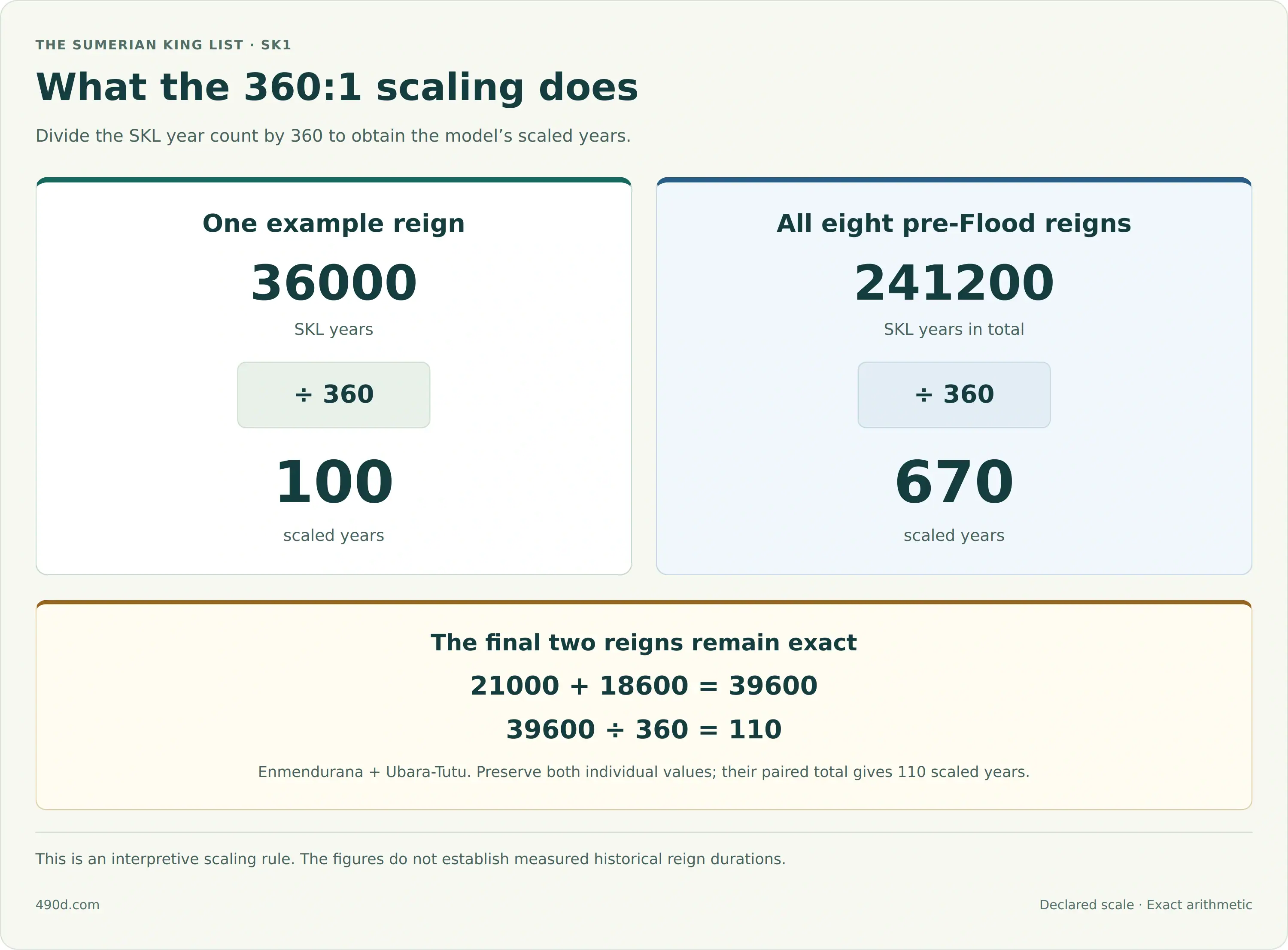
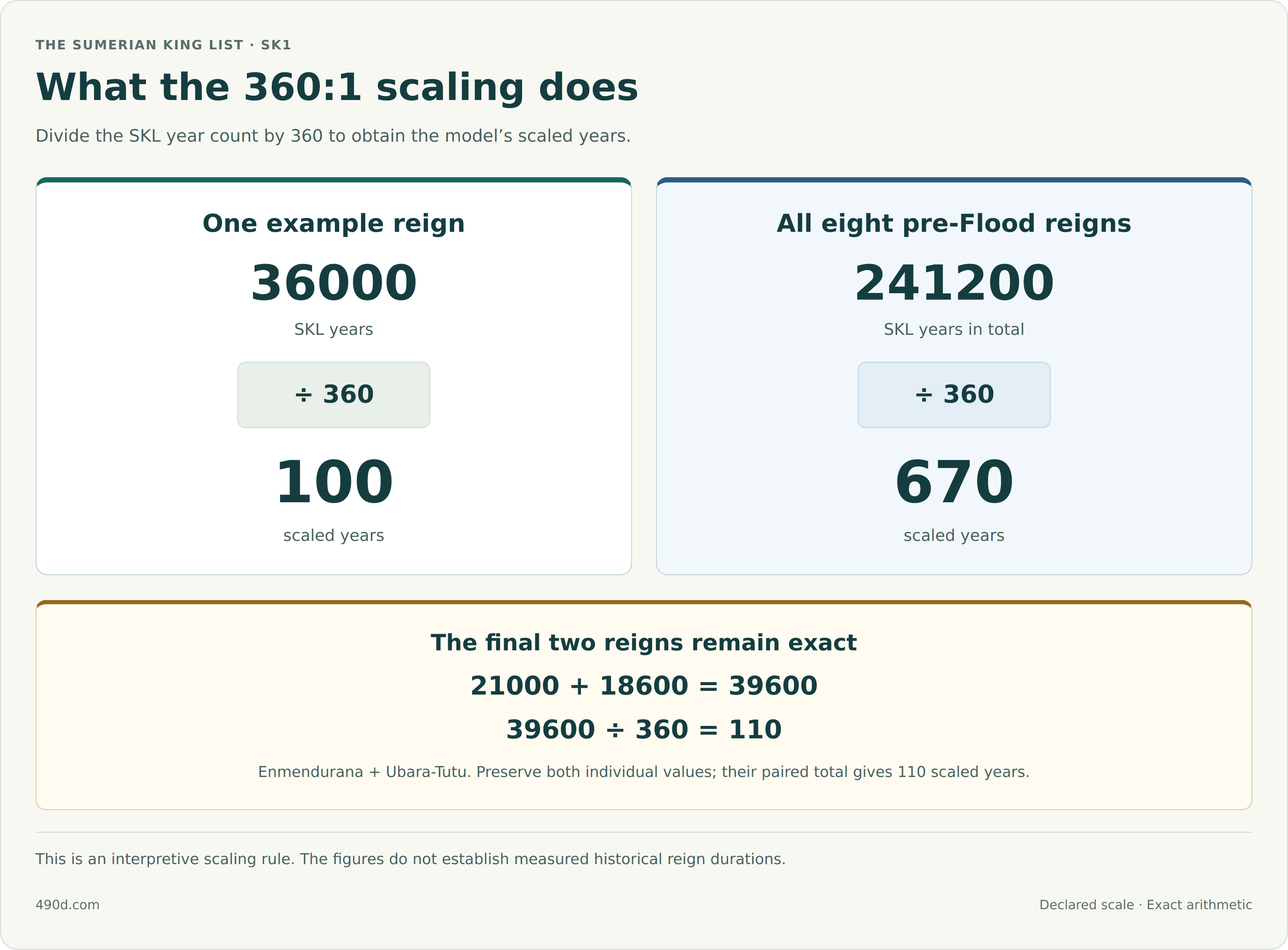
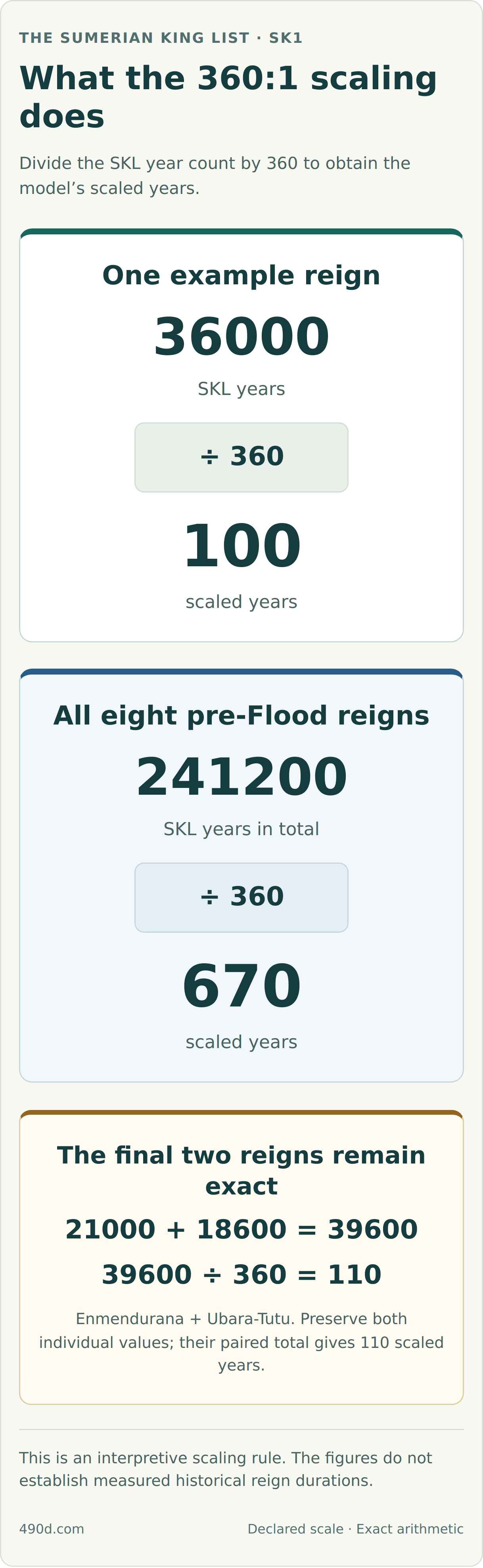
The comparison uses a stated rule: 360 years in the king-list calculation correspond to one year in the scaled comparison. Thus a reign of 36000 becomes 100, and the complete pre-Flood total becomes 670:
36000 ÷ 360 = 100
241200 ÷ 360 = 670
One example reign
All eight pre-Flood reigns
The final two reigns remain exact
Enmendurana + Ubara-Tutu. Preserve both individual values; their paired total gives 110 scaled years.
Sources: File 21 §1, Protocol 1.1; §6, Table 6.1.
Image version and full-size download
Download the full-size PNG · Download the WebP · Download the stacked phone PNG
The factor 360 comes from the schematic year. Biblical day-for-year passages, such as Numbers 14:34 and Ezekiel 4:6, provide an interpretive analogy; applying that analogy to the king list is a further proposal. The ancient text does not instruct us to divide its reigns by 360.
The rule is useful because it makes the chosen comparison transparent. We can see the source number, the operation and the result. We also retain inconvenient fractions: 21000 ÷ 360 = 58⅓, and 18600 ÷ 360 = 51⅔. Together, the last two reigns give 110, but neither should be silently rounded to make the pattern smoother.
Nor does the result 670 replace the normal MT Creation-to-Flood span of 1656 years. It is a scaled Sumerian total. The traditions retain their different contents while we examine their numerical relationships.
Two totals after the Flood
The first post-Flood dynasty, Kish, introduces a revealing difference. Adding the selected whole-year reign values displayed in the Oxford edition gives 17980. Its dynasty summary instead reports 24510 years, followed by 3 months and 3½ days. The 23-row table lets the reader inspect the addition.
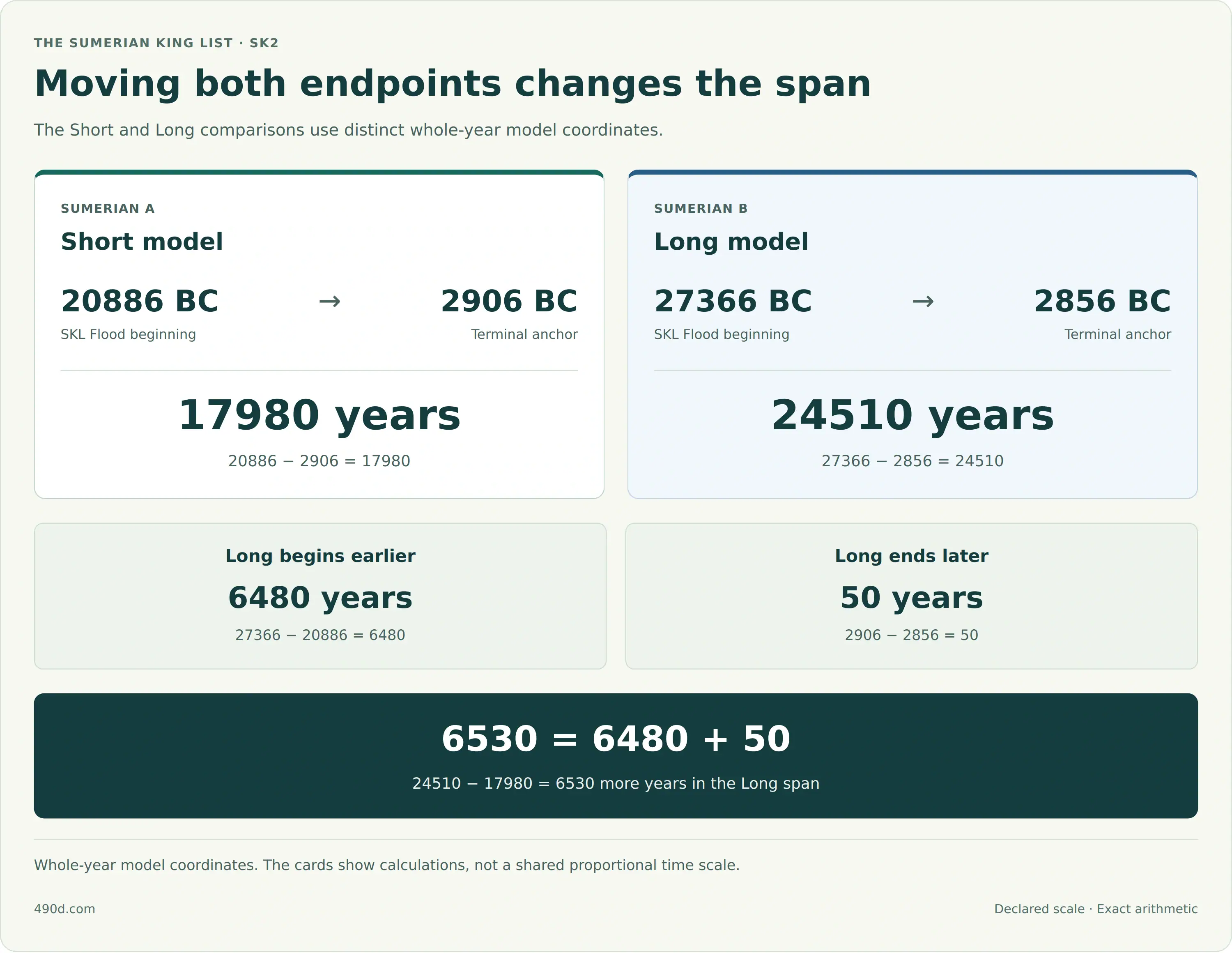
The canonical model calls the two whole-year constructions SKL Short and SKL Long. It places their later boundaries at 2906 BC and 2856 BC, respectively. Working backward gives:
On smaller screens, scroll a wide table horizontally to see every column.
| Model | Adopted later boundary | Whole-year duration | Calculated Flood boundary |
|---|---|---|---|
| Short | 2906 BC | 17980 | 20886 BC |
| Long | 2856 BC | 24510 | 27366 BC |
These large BC labels are calculated positions in the comparative model. The later boundaries serve as its Babel comparisons; the king list itself does not identify its Kish boundary as the biblical Babel event. The months and days remain recorded in the appendix, outside these whole-year equations.
Now compare the two rows. Their Flood boundaries are 6480 years apart, while their later boundaries differ by 50 years in the opposite direction. The Long construction therefore begins earlier and ends later:
24510 − 17980 = 6530 = 6480 + 50.
Short model
Long model
Long begins earlier
6480 years27366 − 20886 = 6480Long ends later
50 years2906 − 2856 = 50Sources: File 34 §§4.1–4.4; File 21 §6, model-coordinate tables.
Image version and full-size download
Download the full-size PNG · Download the WebP · Download the stacked phone PNG
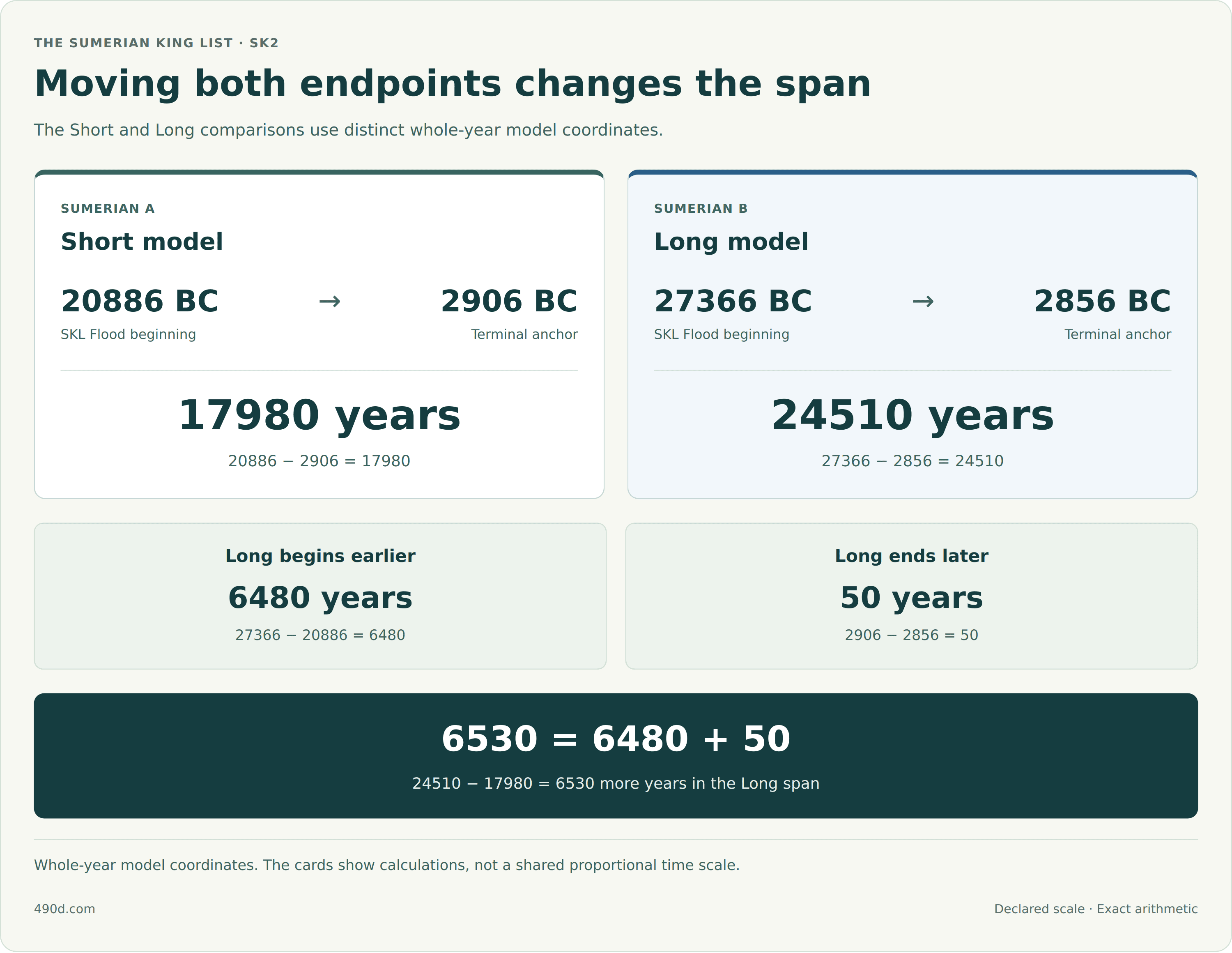
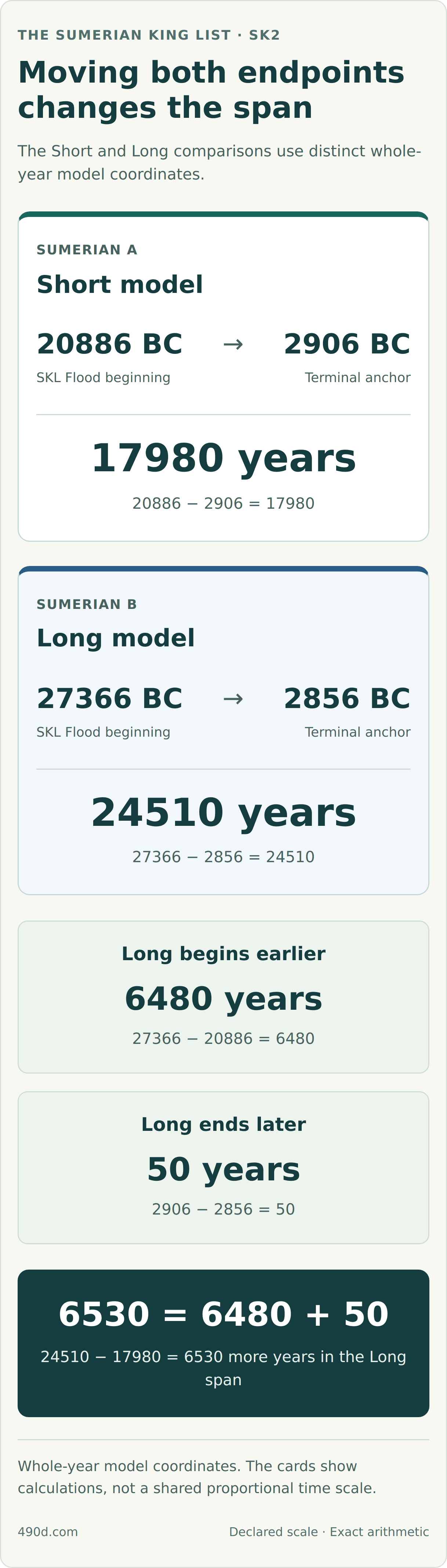
This explains why the model speaks of a 6480-year movement although the two durations differ by 6530. Both ends matter. In the broader canonical study, 6480 = 90 × 72 is read as a schematic precessional quarter-cycle, and 50 supplies a jubilee comparison. The exact arithmetic comes first; the calendrical interpretation explains why those components attract attention.
A connection with the 364-day calendar
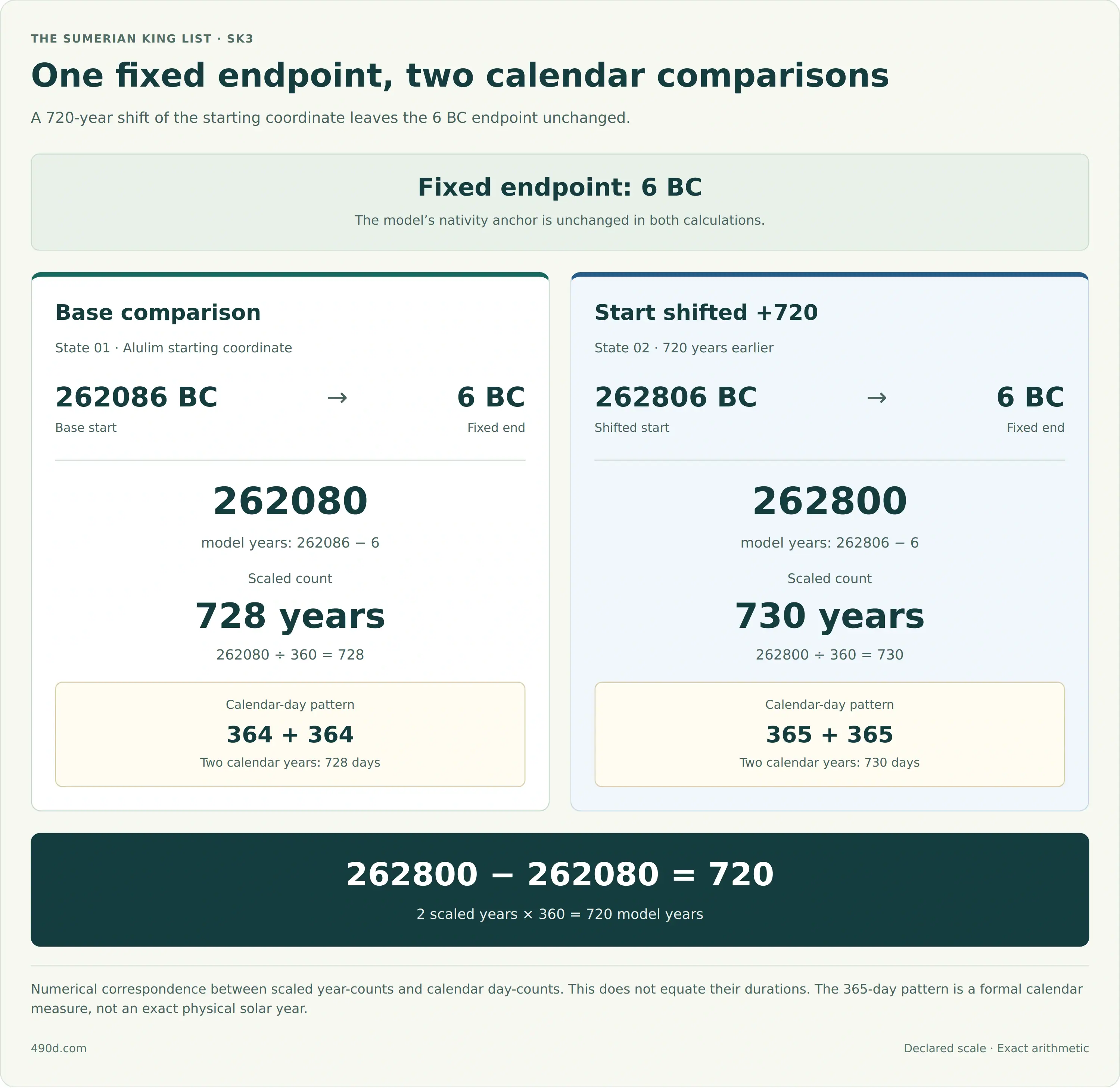
The Short construction places Alulim, the first king, at 262086 BC. That position follows by adding the pre-Flood reigns to its Flood boundary:
20886 + 241200 = 262086.
Measure from that model coordinate to 6 BC, the nativity anchor used in this chronology. The resulting span is:
262086 − 6 = 262080 = 728 × 360.
At the chosen scale, the count is 728. Its numerical form, 364 + 364, echoes the day-count of two years in the 364-day calendar.
The canonical files also retain a declared +720 companion position. Genesis 11:10 supplies the two-year Flood reference behind this scaling motif; 2 × 360 = 720. Moving the early coordinate back by that amount gives 262806 BC, while the 6 BC endpoint stays fixed:
262806 − 6 = 262800 = 730 × 360.
Now the scaled count is 730 = 365 + 365, echoing two schematic 365-day years. The paired calculations bring the two calendar patterns together:
Base comparison
Start shifted +720
Sources: File 21 §2, Protocol 2.4; §9, Theorem 9.1.
Image version and full-size download
Download the full-size PNG · Download the WebP · Download the stacked phone PNG
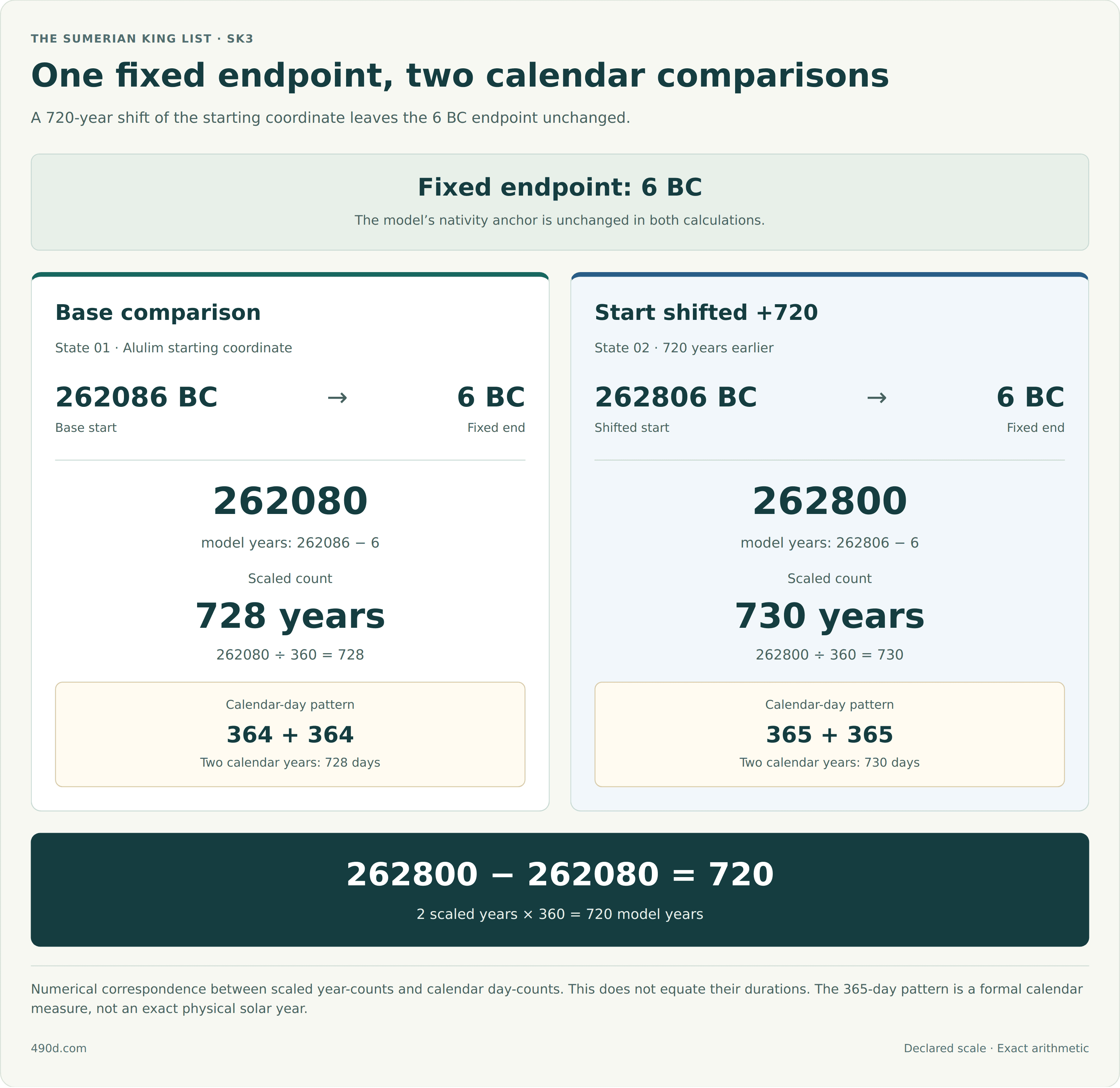
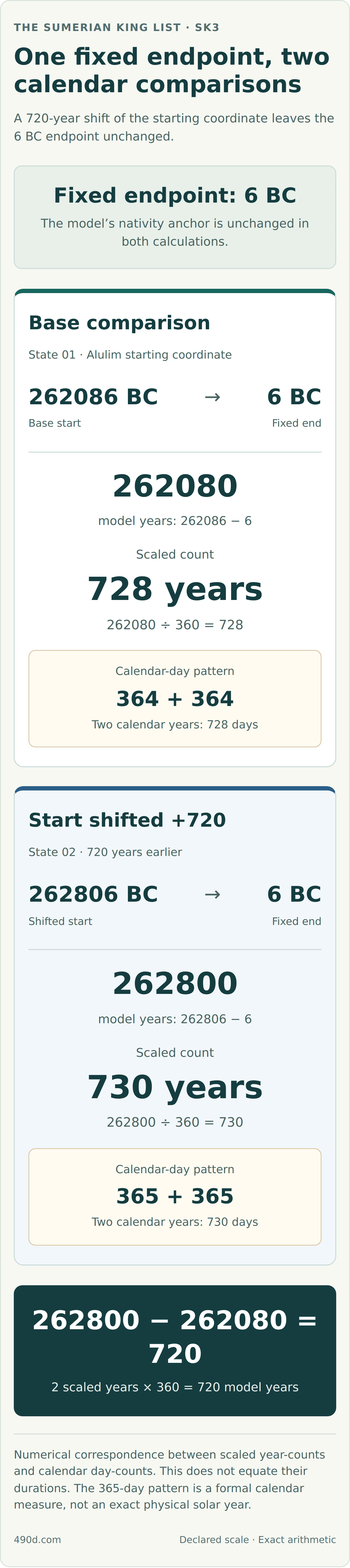
The numerical correspondence is precise: two scaled units match the two-day difference between the calendar totals. Those two scaled units represent 720 in the enlarged chronology. Here 365 is the whole-day solar-year schematic, not the exact length of the tropical year. The +720 is an explicitly chosen comparison state, not an addition to any king’s transmitted reign.
This relation brings the immense numbers into a familiar frame. It also shows why the fixed endpoint matters: the calculation concerns the span to 6 BC, not division of a BC label by itself. The calendar comparison table keeps both constructions together.
Reading the pattern without losing the text
The comparison rests on a few visible steps: preserve the reign figures, name the scale, identify the anchors, and then examine the resulting structure. The eight reigns total 241200; the two post-Flood constructions differ by 6480 + 50; and the first-king comparison opens the 364/365 calendar pair.
I read these relationships as part of a shared numerical language through which ancient traditions express order, judgment and renewal. Their theological significance does not require us to confuse a king-list reign with a patriarch’s life, or a generated coordinate with an independently dated historical event. The interesting question is how the distinct traditions arrange their numbers around recognizable forms of sacred time.
Continue with the technical appendix and complete tables, the detailed study, or the fuller treatment in File 21 and File 34.
Scripture quotations: Berean Standard Bible (BSB), public domain.