Genesis measures the world before and after the Flood through a family line. The Sumerian King List measures it through kings and the cities in which they reign. Both make the Flood a dividing point, but their numbers belong to different kinds of narrative:
“Now Noah was 600 years old when the floodwaters came upon the earth.”
The king list, by contrast, assigns its first eight rulers reigns totaling 241200 years. The question explored here is how those immense figures behave when read through a stated numerical scale and compared with biblical chronology.
This detailed study develops the argument introduced in The Sumerian King List: Reigns, the Flood, and Biblical Comparisons. It supplies the complete pre-Flood table, the selected reigns of the first dynasty of Kish, and the steps behind the principal comparisons. The current canonical files, especially Files 21 and 34, govern the reconstruction.
Go directly to: eight kings and their coordinates · the 23 Kish reigns · four date settings · the 364/365 comparison · sources and reading conventions.
Reigns, coordinates, and biblical dates
The Ashmolean Museum’s Sumerian King List prism, dating to about 1800 BC, preserves a literary account of kingship passing between cities. Its early reigns are extraordinarily long. These are the starting data; the large BC dates in the following diagrams are calculated positions in a comparative model, not dates written on the prism.
Three kinds of number therefore remain visible throughout this study. A reign such as 28800 comes from the selected king-list text. A position such as 262086 BC comes from placing that reign in the model. A biblical date such as 2166 BC, Abraham’s birth, comes from the biblical chronology used for comparison.
The normal MT framework remains Creation 4114 BC, the Flood 2458 BC, and Abraham 2166 BC, using the Nisan convention and the ordinary 430-year Egypt sojourn. The Sumerian calculations neither replace those dates nor change the MT Creation-to-Flood span of 1656 years.
The old chart also proposes correspondences between Sumerian rulers and biblical patriarchs. Those comparisons are retained in the eight-reign table, but they are not identities established by the ancient list. Eight kings cannot reproduce every name in the ten-generation Adam-to-Noah genealogy. The comparison concerns selected positions, themes, and numbers.
The scale: 360 to 1
The model uses a schematic year as its scale: 360 king-list years yield one scaled comparison-year. A reign of 36000 therefore becomes 100, and the eight-reign total becomes 670:
36000 ÷ 360 = 100
241200 ÷ 360 = 670
Biblical day-for-year signs provide an analogy for this method. Ezekiel is told, “I have assigned to you 40 days, a day for each year.” (Ezekiel 4:6, BSB, excerpt) That instruction belongs to Ezekiel’s sign; applying a 360:1 scale to the Sumerian reigns is the interpretive step developed here.
The operation must preserve the supplied numbers. In particular, the last two reigns are 21000 and 18600. They yield 58⅓ and 51⅔, not whole numbers. Together they give 39600 ÷ 360 = 110. Retaining both fractions is more informative than rounding them away.
Building the sequence before the Flood
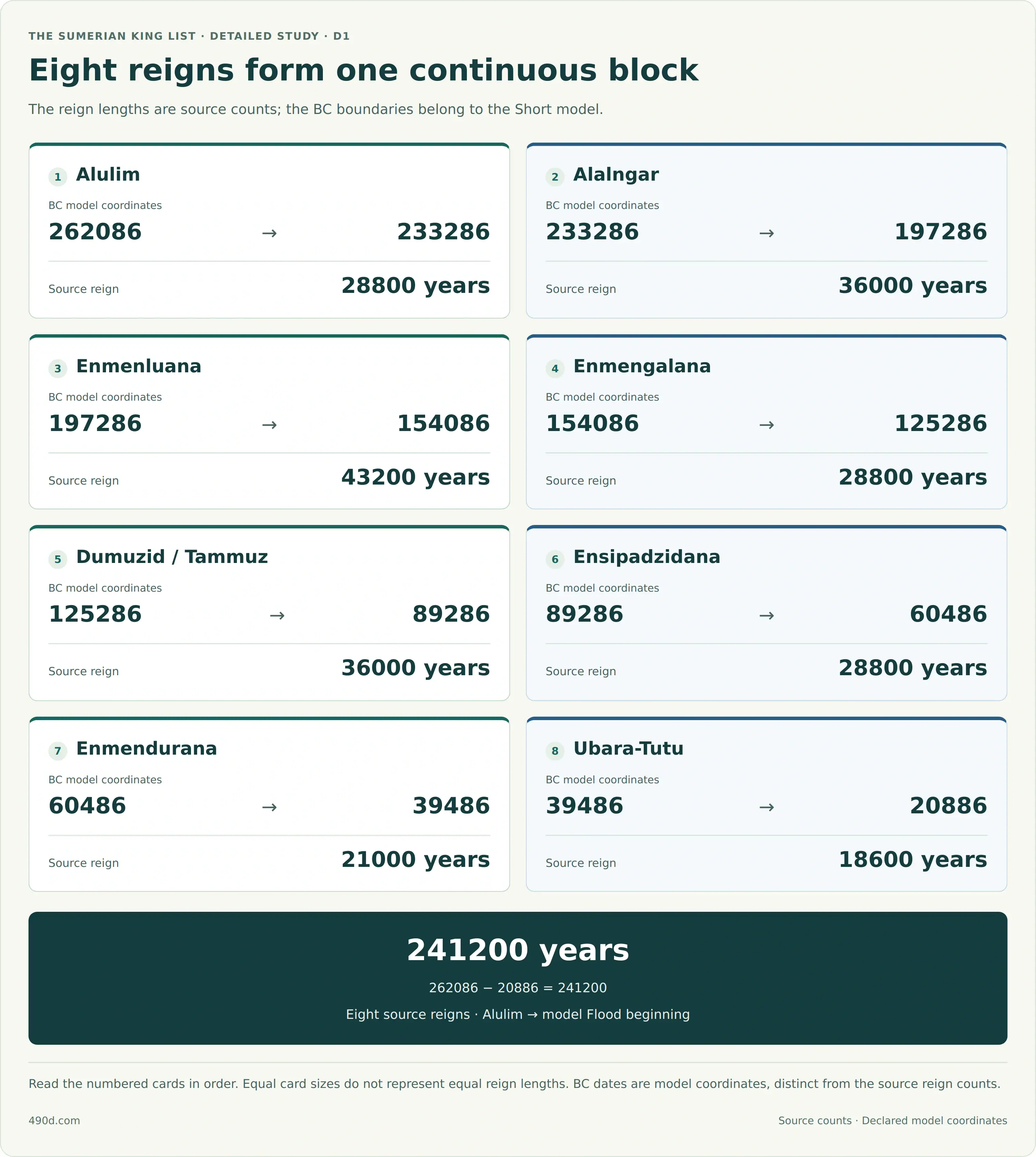
The Short construction places its Flood boundary at 20886 BC. Adding the eight reigns backward from that boundary locates the first king, Alulim:
20886 + 241200 = 262086 BC.
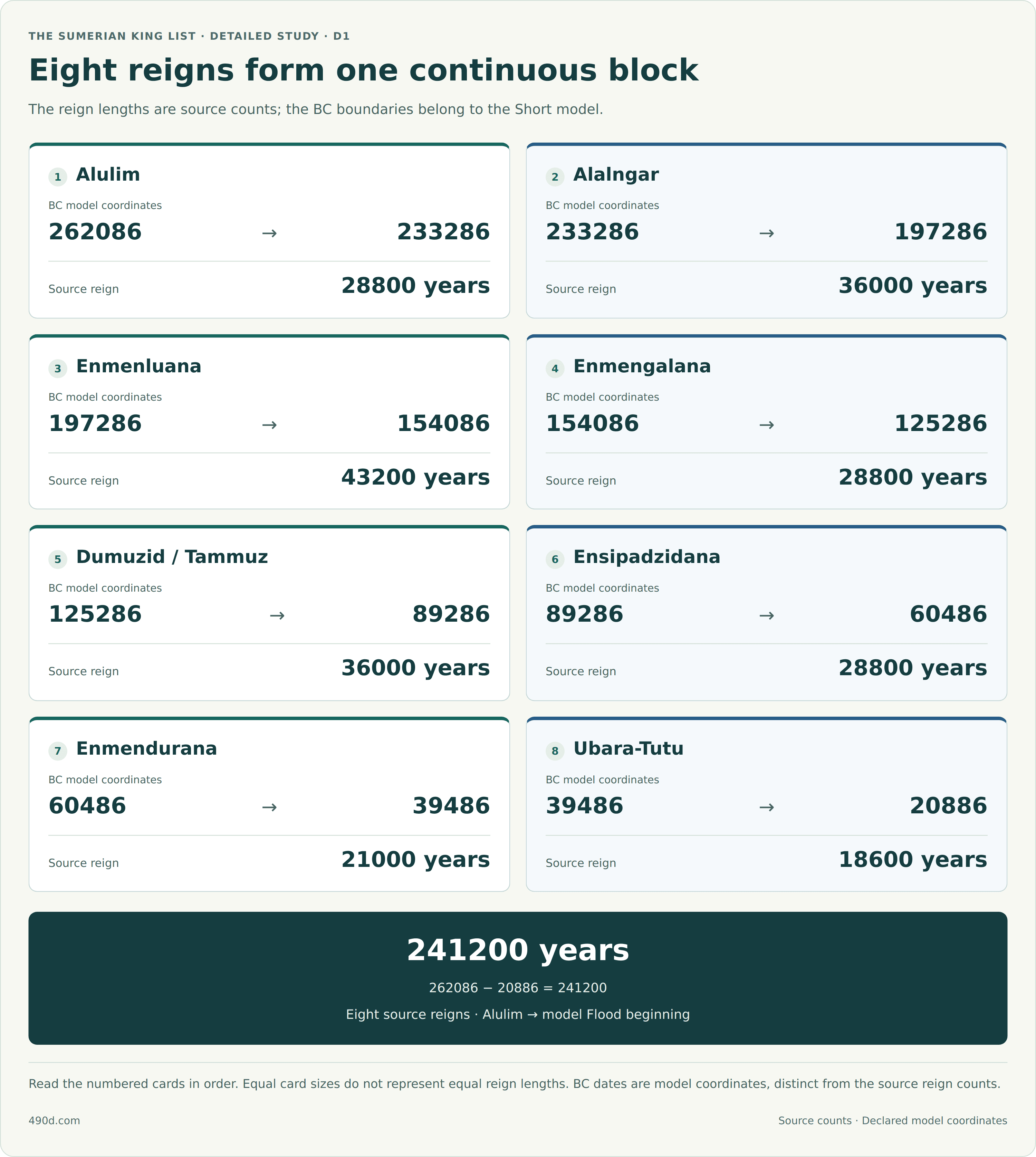
The intervening coordinates follow by subtraction. Alulim’s 28800-year reign ends at 233286 BC; Alalngar’s 36000 then ends at 197286 BC; the same process continues through Ubara-Tutu and the Flood. The figure shows the whole sequence without implying that the boxes are drawn to scale.
1Alulim
2Alalngar
3Enmenluana
4Enmengalana
5Dumuzid / Tammuz
6Ensipadzidana
7Enmendurana
8Ubara-Tutu
Sources: File 21 §6, Table 6.1.
Image version and full-size download
Download the full-size PNG · Download the WebP · Download the stacked phone PNG

Some useful relationships are internal to the sequence and therefore survive a uniform change of its BC placement. From Enmenluana’s beginning to the Flood is 197286 − 20886 = 176400 = 490 × 360. From Dumuzid, also called Tammuz, to Enmendurana is 125286 − 60486 = 64800 = 180 × 360. These are exact relationships among the retained reigns before any biblical endpoint is introduced.
Enmendurana occupies the seventh position in this sequence, which invites comparison with Enoch’s seventh position from Adam. The numerical argument does not depend on treating the two as the same historical person. Likewise, the eighth king’s proposed Noah association marks the Flood boundary without requiring a complete name-for-name equivalence.
After the Flood: the Short and Long constructions
For the first dynasty of Kish, the Oxford ETCSL edition presents individual reign readings and a dynasty summary that do not give the same whole-year total. The selected individual values add to 17980. The transmitted summary gives 24510 years, 3 months and 3½ days.
The 23-row table below makes the selection explicit. It draws on a composite edition, with some figures supplied from other witnesses and alternatives recorded by its editors. Thus 17980 is the sum of a declared set of readings, not an invariant total claimed for every surviving manuscript.
The canonical model calls the corresponding whole-year constructions Short and Long. It adopts later boundaries of 2906 BC and 2856 BC and calculates backward:
On smaller screens, scroll a wide table horizontally to see every column.
| Construction | Adopted later boundary | Whole-year component | Calculated Flood boundary |
|---|---|---|---|
| Short | 2906 BC | 17980 | 20886 BC |
| Long | 2856 BC | 24510 | 27366 BC |
The later boundaries function as Babel comparisons within the model. The Sumerian source speaks of Kish and the transfer of kingship, not of the biblical Tower of Babel. Nor does this comparison replace the normal MT Peleg/Babel date of 2357 BC.
Two differences account for the longer duration. Its Flood boundary lies 6480 years earlier, while its later boundary lies 50 years later:
24510 − 17980 = 6530 = 6480 + 50.
This is why adding 6480 to the pre-Flood coordinates can coexist with a 6530-year difference between the two post-Flood durations. The later endpoints differ too. The transmitted months and days remain separate from this comparison of whole-year components; they have not been converted to a fractional year or erased from the source.
Four selected settings, with the reigns unchanged
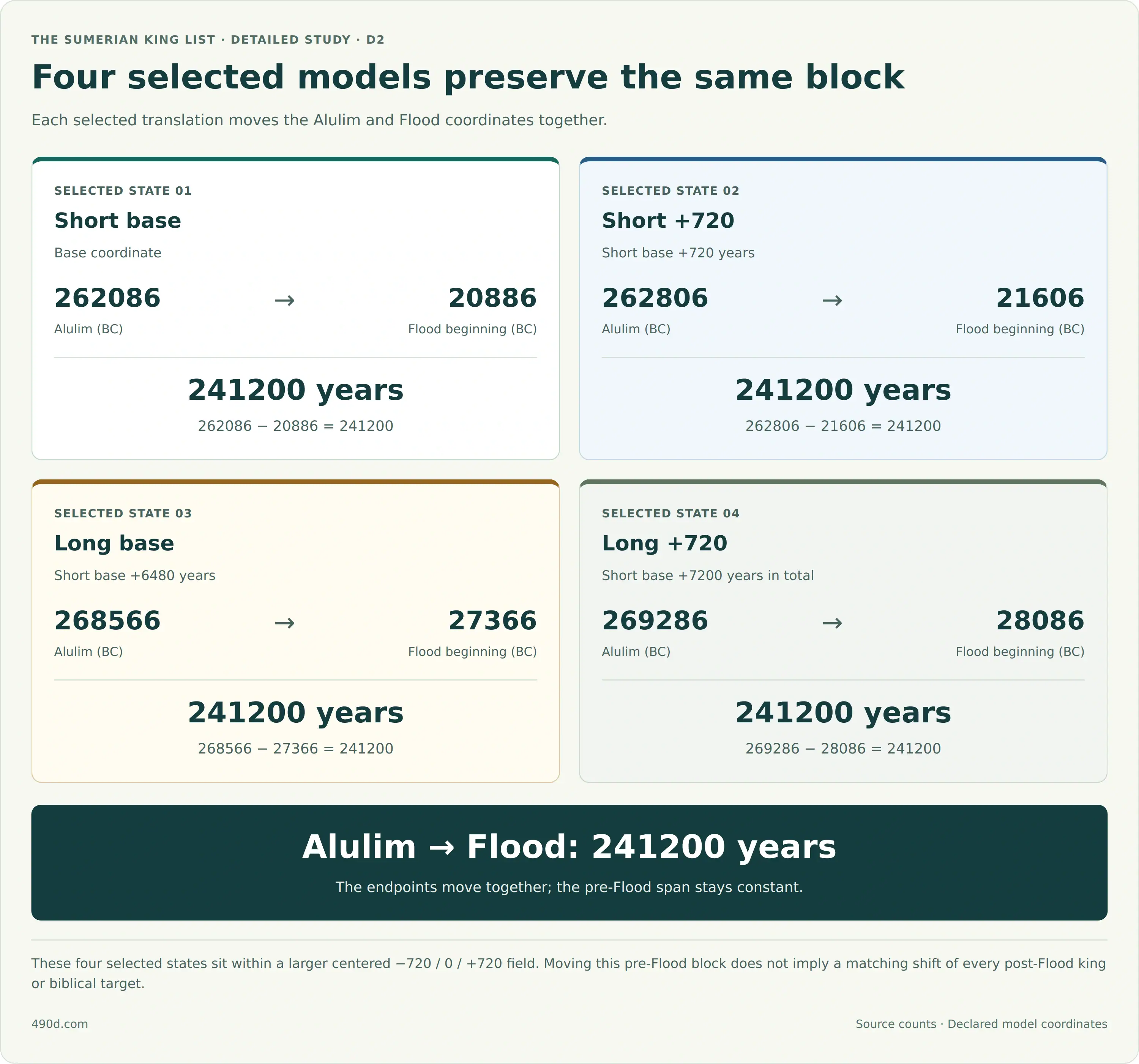
Two operations generate the four settings used in the original chart. The first is the 6480-year change from the Short to the Long pre-Flood placement. The second is a 720-year shift associated with the model’s use of Shem’s two-year interval:
“Two years after the flood, when Shem was 100 years old, he became the father of Arphaxad.”
Under the stated scale, 2 × 360 = 720. The biblical two years and the generated 720-year displacement are related by this operation; they are not interchangeable elapsed durations.
Short base
Short +720
Long base
Long +720
Sources: File 21 §2, Protocols 2.2–2.4; §6, Table 6.1; centered-field controls.
Image version and full-size download
Download the full-size PNG · Download the WebP · Download the stacked phone PNG
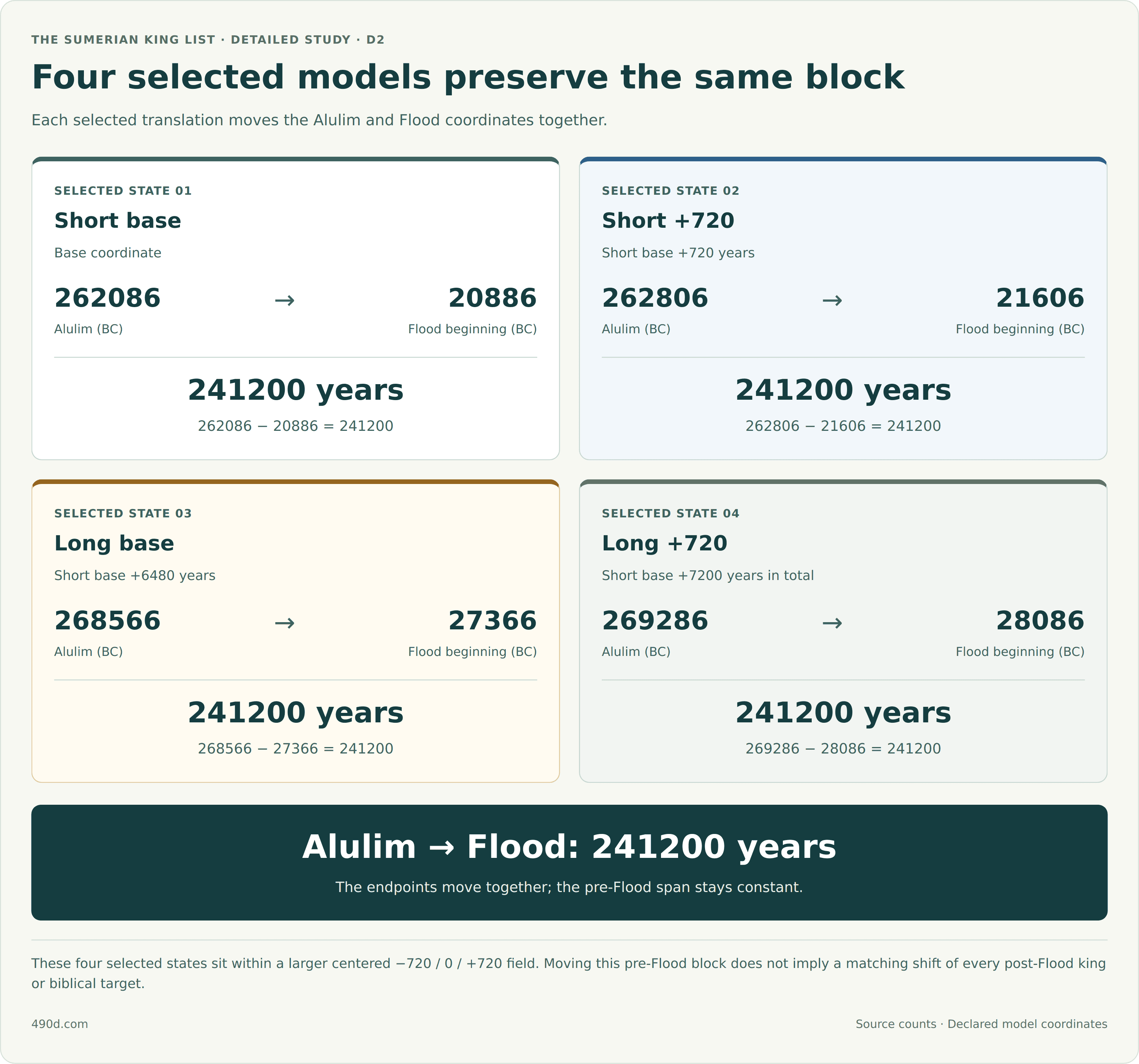
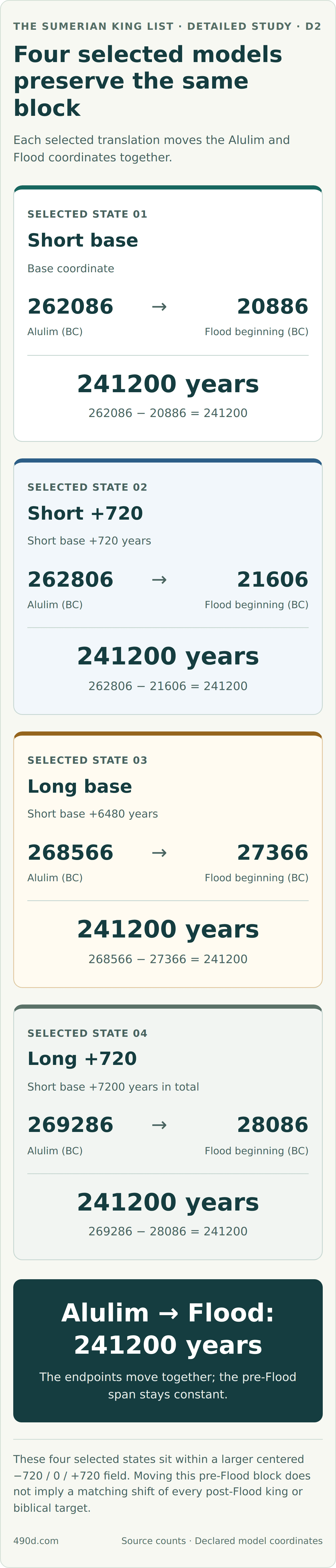
Every panel retains 241200 years from Alulim to the Flood. What changes is the placement of that entire pre-Flood block. The combined displacement is 6480 + 720 = 7200. This does not mean that every later Sumerian ruler or imported biblical target moves with it; each subsequent comparison names its own endpoints.
These four settings are a selected display from the wider canonical framework. The current controls also recognize the centered −720 / 0 / +720 field, corresponding at the stated scale to −2 / 0 / +2. The positive 720-year setting shown here is one member of that field, not the entire system. File 21 §§0.1 and 2 gives the full controls.
Why the 720-year difference matters to the calendar comparison
The simplest use of the two Short settings holds the model’s nativity reference at 6 BC. The two Alulim coordinates then give:
On smaller screens, scroll a wide table horizontally to see every column.
| Alulim setting | Span to the fixed 6 BC reference | Result after division by 360 | Numerical calendar correspondence |
|---|---|---|---|
| Short base | 262086 − 6 = 262080 | 728 | 364 + 364 |
| Short +720 | 262806 − 6 = 262800 | 730 | 365 + 365 |
The 720-year change adds two scaled units, corresponding numerically to the two-day difference between two 364-day years and two schematic 365-day years. This links the discussion with the 364-day calendar.
The units remain distinct: 728 or 730 scaled years in the chronological calculation correspond numerically to 728 or 730 calendar days. This is a comparison of numerical forms, not an assertion that years and days are physically equal. The 365-day figure is the schematic solar year, not the precise tropical year.
The original chart also supplies a +30 “Apparent Mode,” using a symbolic leap-month analogy. When applied to both endpoints, it preserves the same spans: 262116 − 36 = 262080 and 262836 − 36 = 262800. Here 36 BC is the companion comparison endpoint, not a replacement nativity date. No 30-year adjustment is needed for the two base equations above.
The 670 + 50 pattern—and its exact limits
The 670 obtained from the eight reigns has a further counterpart within the selected Kish readings: Nangishlishma’s reign is 670, although that reading carries an uncertainty mark in the edition. The recurrence becomes especially suggestive when set beside 720 − 670 = 50.
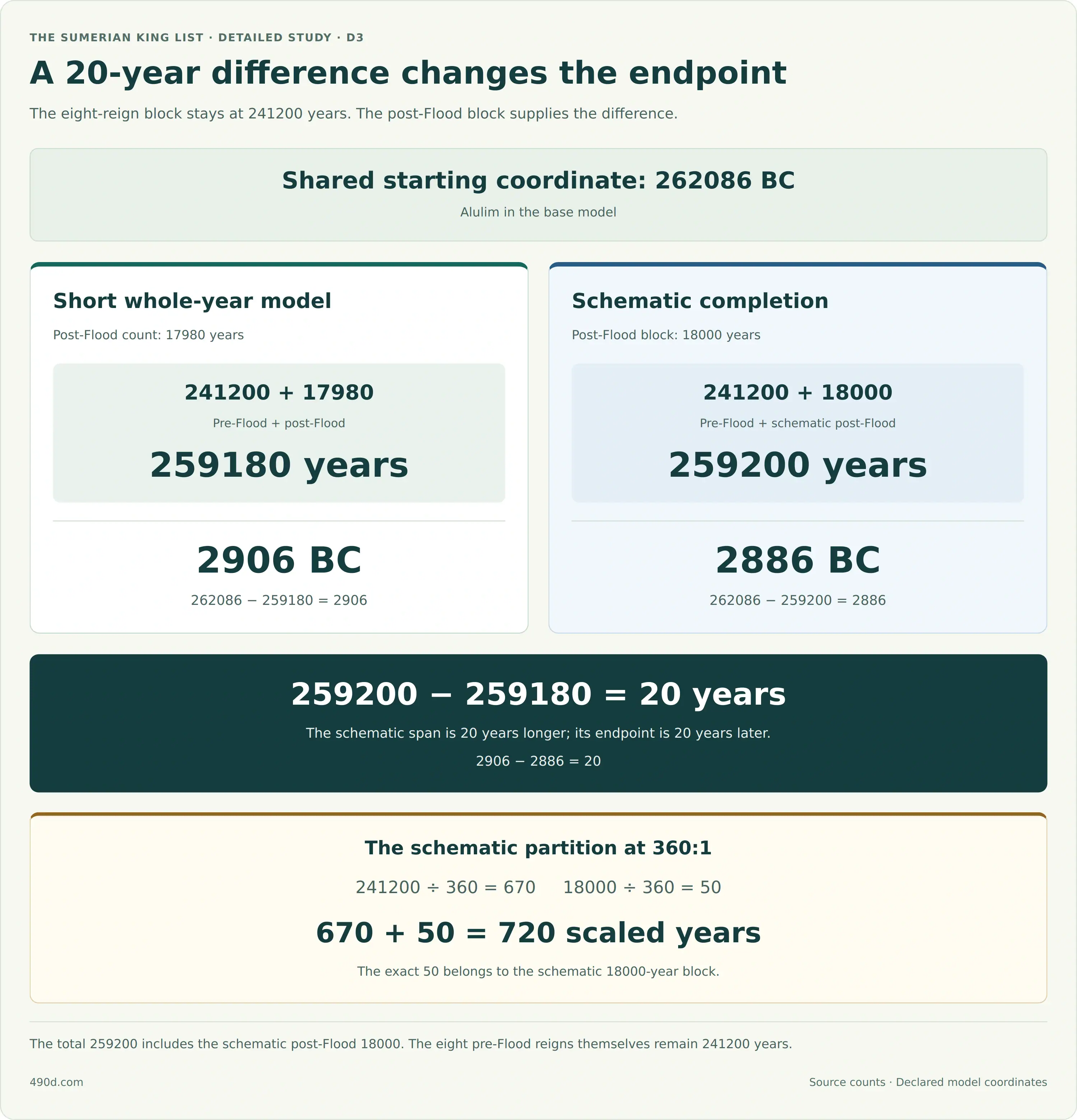
At the 360:1 scale, 50 × 360 = 18000. This produces a schematic division of the model’s Alulim-to-Babel span:
241200 + 18000 = 259200
670 + 50 = 720.
But the selected Kish reigns total 17980, not 18000. Keeping this 20-year distinction visible requires two different endpoints:
Short whole-year model
Schematic completion
The schematic partition at 360:1
The exact 50 belongs to the schematic 18000-year block.
Sources: File 21 §6; §29.2; §32.1; §34.3.
Image version and full-size download
Download the full-size PNG · Download the WebP · Download the stacked phone PNG
The first row ends at the Short boundary 2906 BC. The second reaches 2886 BC, 20 years later. The latter is the canonical schematic construction; it does not revise the source readings to make their sum a round number.
The same 20 has a scaled counterpart in the combined displacement: 7200 ÷ 360 = 20. I read this recurrence as a structural connection between the selected settings and the schematic completion. The arithmetic is exact; the interpretation rests on the declared scale and on keeping the two constructions distinct.
Tammuz, the divided year, and the biblical comparisons
Dumuzid/Tammuz provides a particularly clear example of how the chart connects an internal relationship with biblical reference points. The literary half-year motif has an independent source: the conclusion of Inana’s Descent to the Netherworld, lines 404–410, assigns alternating half-years to Dumuzid and his sister. That motif supplies a thematic comparison; it does not itself prescribe the BC coordinates or the 360:1 calculation.
The model retains three distinct comparisons:
On smaller screens, scroll a wide table horizontally to see every column.
| Selected setting | Earlier coordinate | Later reference | Span |
|---|---|---|---|
| Short base, both Sumerian positions | Tammuz 125286 BC | Enmendurana 60486 BC | 64800 = 180 × 360 |
| Long pre-Flood placement, +6480 | Tammuz 131766 BC | Abraham’s birth 2166 BC | 129600 = 360 × 360 |
| Short pre-Flood placement, +720 | Tammuz 126006 BC | Nativity reference 6 BC | 126000 = 1260 × 100 |
The first row is internal to the eight-king sequence: the interval covers half of a 360-unit cycle after scaling. The second uses the Long placement and the normal MT Abraham date. The third uses the positive 720 setting and the fixed nativity reference. They are related comparisons, but not three measurements made in one unchanged setting.
Tammuz’s own 36000-year reign also has an exact midpoint at 107286 BC, since 125286 − 18000 = 107286. That midpoint is distinct from the 64800-year distance to Enmendurana.
Within a Christian reading, the shepherd motif and the recurring 1260 invite theological reflection. The case should be made through the visible relationships, without turning a proposed correspondence into proof that a Sumerian king was a biblical patriarch or that ancient scribes possessed the entire later reconstruction.
The larger scale: 432000 and 25920
The original chart begins even earlier, at a point labeled Pre-Creation. In the canonical construction, 452886 BC stands 432000 years before the Short Flood boundary:
452886 − 20886 = 432000 = 1200 × 360.
This interval contains the eight reigns. It is not an additional 432000 years before Alulim. Its two parts are 190800 from the Pre-Creation coordinate to Alulim and 241200 from Alulim to the Flood. The label belongs to the comparative model, not to the eight-king sequence as printed in the source.
A uniform change to the Long placement moves both boundaries by 6480: 459366 − 27366 = 432000. The duration is preserved because both ends move together.
The Long Flood settings also give a compact biblical comparison:
On smaller screens, scroll a wide table horizontally to see every column.
| Sumerian model boundary | Biblical reference | Span |
|---|---|---|
| Long Flood, 27366 BC | Exodus, 1446 BC | 25920 |
| Long +720 Flood, 28086 BC | Abraham’s birth, 2166 BC | 25920 |
The biblical references are themselves 720 years apart, so the equal spans follow from moving both ends by 720. In the canonical model, 25920 = 360 × 72 is the schematic precessional cycle, and 6480 is its quarter. This identifies the numerical scale being used; it is not a measurement of an exact, unchanging astronomical cycle or an independent proof of ancient intent.
What the comparison brings into view
The strength of this approach is that its relationships can be followed step by step. The eight reigns give 241200, or 670 at the stated scale. The Short and Long constructions differ through both their Flood and later boundaries. The 720-year displacement preserves the pre-Flood reigns while opening the 364/365 comparison. The separate 18000-year schematic interval completes 670 + 50 = 720 without overwriting the selected Kish sum.
I understand these patterns as part of a shared numerical language through which ancient traditions express order, judgment, and renewal. The biblical comparisons give that language a theological direction. Their value becomes clearer when the source readings, the generated dates, and the interpretive connections remain visible together.
For the shorter explanation, return to the introductory article. For additional calculations beyond this study, consult File 21 and File 34. The complete tables used here follow immediately below.
Supporting table 1: the eight pre-Flood reigns
Reign values follow the selected eight-king sequence in ETCSL, lines 1–39. Coordinates and proposed patriarchal comparisons follow File 21, Table 6.1. Names use familiar forms from the canonical chart; Oxford’s spellings vary. “Beginning” and “end” mean positions in the Short base model, not independently dated historical reigns.
On smaller screens, scroll a wide table horizontally to see every column.
| King | Proposed patriarchal comparison | Reign | Reign ÷ 360 | Beginning, BC | End, BC |
|---|---|---|---|---|---|
| Alulim | Adam | 28800 | 80 | 262086 | 233286 |
| Alalngar | Seth | 36000 | 100 | 233286 | 197286 |
| Enmenluana | Enosh | 43200 | 120 | 197286 | 154086 |
| Enmengalana | Kenan | 28800 | 80 | 154086 | 125286 |
| Dumuzid / Tammuz | Mahalaleel | 36000 | 100 | 125286 | 89286 |
| Ensipadzidana | Jared | 28800 | 80 | 89286 | 60486 |
| Enmendurana | Enoch | 21000 | 58⅓ | 60486 | 39486 |
| Ubara-Tutu | Noah | 18600 | 51⅔ | 39486 | 20886 |
| Total | Eight selected rulers | 241200 | 670 | 262086 | 20886 |
These pairings leave Methuselah and Lamech without separate king-list rows. They should therefore be read as a proposed comparative arrangement, not a transcription of the Genesis genealogy.
Return to the explanation of the sequence.
Supporting table 2: the selected 23 reigns of Kish
The table follows the main displayed whole-year values in ETCSL, lines 40–94. It preserves the selected readings used to calculate 17980. The running total makes the addition reproducible without assigning a BC date to every ruler.
On smaller screens, scroll a wide table horizontally to see every column.
| Position | Ruler, ETCSL spelling | Selected years | Running total |
|---|---|---|---|
| 1 | Jucur | 1200 | 1200 |
| 2 | Kullassina-bel | 960 | 2160 |
| 3 | Nanjiclicma† | 670 | 2830 |
| 4 | En-tarah-ana† | 420 | 3250 |
| 5 | Babum† | 300 | 3550 |
| 6 | Puannum | 840 | 4390 |
| 7 | Kalibum | 960 | 5350 |
| 8 | Kalumum | 840 | 6190 |
| 9 | Zuqaqip | 900 | 7090 |
| 10 | Atab | 600 | 7690 |
| 11 | Macda | 840 | 8530 |
| 12 | Arwium | 720 | 9250 |
| 13 | Etana | 1500 | 10750 |
| 14 | Balih | 400 | 11150 |
| 15 | En-me-nuna | 660 | 11810 |
| 16 | Melem-Kic | 900 | 12710 |
| 17 | Barsal-nuna | 1200 | 13910 |
| 18 | Zamug | 140 | 14050 |
| 19 | Tizqar | 305 | 14355 |
| 20 | Ilku | 900 | 15255 |
| 21 | Iltasadum | 1200 | 16455 |
| 22 | En-men-barage-si | 900 | 17355 |
| 23 | Aga | 625 | 17980 |
† The edition supplies these three readings from P2+L2 and marks 670 as uncertain. “Nanjiclicma” is the name rendered “Nangishlishma” in the canonical discussion. Other reign variants remain available in the linked edition. En-tarah-ana’s entry also preserves 3 months and 3½ days beside damaged text. That fractional tail is retained as source data but is excluded from this whole-year addition.
The dynasty summary—24510 years, 3 months and 3½ days—is a separate transmitted datum, not the sum of this selected column. ETCSL’s opening editorial note identifies WB as its default numerical witness and states that WB62 was not used. Its witness bibliography identifies WB as Ash 1923,444. “Short” and “Long” here name the model’s two constructions, not two fully verified, internally uniform manuscripts.
Etana’s selected reign remains 1500, followed by Balih’s 400. The king list describes Etana’s ascent and identifies Balih as his son. This study retains those source features without using an incompatible 1560-year coordinate interval as though it were the selected reign.
Return to the Short/Long comparison.
Sources and reading conventions
The source links distinguish the ancient textual evidence from the chronology developed on this site:
On smaller screens, scroll a wide table horizontally to see every column.
| Source | Material used in this study |
|---|---|
| Oxford ETCSL, The Sumerian King List, lines 1–94; bibliography | Eight pre-Flood reigns, selected Kish readings, summary and witness controls. |
| Ashmolean Museum, Sumerian King List | The prism’s date, object context, and presentation of kingship. |
| Inana’s Descent to the Netherworld, lines 404–410 | Dumuzid and his sister’s alternating half-years; distinct from the numerical reconstruction. |
| File 18, chronological data tables, SKL tables | Canonical comparative data and imported biblical dates. |
| File 21, SKL Unified Protocol, §§0.1, 1–2, 6, 8–9, 11, 29.2, 32.1 and 34.3 | Scale, selected settings, complete pre-Flood matrix, calendar and Tammuz comparisons, schematic 670 + 50. |
| File 34, SKL–Berossus–Bible integration, §§4–5 and Appendix B.8 | Whole-year/fractional distinction, wider scales, and source-family distinctions. |
| File 02, File 10, the Restart Capsule and State Vocabulary Register | Flood terminology, interpretive controls, and current amendments. |
All BC-to-BC intervals above use the earlier label minus the later label. No calculation here crosses from BC to AD. The figures are source reigns, ordinary biblical dates, or explicitly named model coordinates; they are not the separate Rounded biblical chronology. Decimal rounding has not been used to force the fractional reigns into whole units.
The original chart also explored Berossus, Temple-Time pillars, and further extensions. Their fuller canonical treatment remains available in File 34; they are not needed to establish the comparisons developed here.
Scripture quotations: Berean Standard Bible (BSB), public domain.