Matthew and Luke place Jesus within the history of Israel, but they arrange that history differently. Matthew moves from Abraham toward Jesus, with David and the Babylonian exile marking its great divisions. Luke moves backward from Jesus through David and Abraham to Adam and God. Their lists invite us to consider both descent and the shape given to sacred history.
The numbers become clearer when we distinguish people named, positions occupied, and intervals calculated. Matthew explicitly announces three groups of fourteen. Luke’s count depends on the text being read and the endpoints included. The 490d research then explores a further question: what patterns emerge when a stated genealogical arrangement is represented by equal 70-year units?
The supporting tables supply the full name lists, the relevant textual variant, and the calculations behind this introduction.
1. Two directions through the story
Matthew 1:1–17 BSB begins with Jesus as the son of David and Abraham, then presents the ancestry in forward order. Its Davidic line proceeds through Solomon. Luke 3:23–38 BSB follows Jesus’ baptism and traces the ancestry backward, taking David’s line through Nathan.
| Feature | Matthew | Luke |
|---|---|---|
| Reading direction | Abraham → Jesus | Jesus → Adam → God |
| Davidic branch | Solomon | Nathan |
| Organizing emphasis | Abraham, David, exile, Christ | Jesus within Israel and the human family |
| Explicit numerical summary | Three groups of fourteen | No closing numerical total |
Luke’s final verse reads:
the son of Enosh, the son of Seth, the son of Adam, the son of God.
That ending extends the genealogy beyond Israel’s patriarchs to humanity’s origin. Matthew’s opening and Luke’s conclusion therefore give different theological frames to the same central subject: Jesus’ place in the history of God’s people.
Both passages name Joseph. Matthew identifies him as Mary’s husband and says Jesus was born of her; Luke qualifies Joseph’s relationship to Jesus and names Heli next. The differing lines should remain visible when their numerical structures are compared. Luke does not explicitly introduce its list as Mary’s genealogy.
2. Matthew: 41 figures and 42 occupied positions
Matthew states his arrangement directly:
In all, then, there were fourteen generations from Abraham to David, fourteen from David to the exile to Babylon, and fourteen from the exile to the Christ.
The main male sequence in verses 2–16 contains 41 figures, including Jesus. This count follows the line of descent; it does not count every person mentioned alongside it. Tamar, Rahab, Ruth, Uriah’s wife, and Mary remain essential to the narrative, while Zerah and Uriah do not occupy additional positions in the main sequence. The two men named Jacob are separate people, even though their names have the same spelling.
File 69 §1.9 uses this particularly clear partition:
| Undoubled sequence | Figures |
|---|---|
| Abraham through David | 14 |
| Solomon through Josiah | 13 |
| Jeconiah through Jesus | 14 |
| Total | 41 |
How, then, can the same genealogy occupy three groups of fourteen? The 490d study adopts Jeconiah’s overlap at the exile as its leading explanation. Matthew names Jeconiah at the deportation in verse 11, then resumes with him after the deportation in verse 12. Count him at the end of the middle group and again at the beginning of the final group, and the arrangement becomes:
14 + (13 + 1) + 14 = 42 occupied positions.
490d · Gospel genealogies · Figure 1
Matthew: forty-one figures, forty-two positions
The Jeconiah boundary-overlap model · one person occupies two block positions
Undoubled male begetting chain
14 + 13 + 14 = 41distinct male figures, including Jesus
Jeconiah counted at both sides of the deportation boundary
14 + 14 + 14 = 42occupied positions, including Jesus
Sources: Matthew 1:11–17 (BSB); File 69 §1.9.
Read the calculation and scope
Matthew 1:11 places Jeconiah at the deportation; 1:12 resumes after the deportation with Jeconiah. File 69 §1.9 uses this boundary overlap as its leading compositional model. Without overlap, 14 + 13 + 14 = 41 distinct male genealogical figures, comprising forty antecedent figures and Jesus as terminal figure. Counting Jeconiah in both the middle and final blocks gives 14 + (13 + 1) + 14 = 42 occupied positions. This count does not include the women as separate male begetting-chain positions; their presence in the narrative remains important. Other valid partitions of the undoubled inventory do not change its total. A later schematic Christ-generation extension is a separate state and does not supply Matthew’s internal missing position.
Open the full-resolution image version

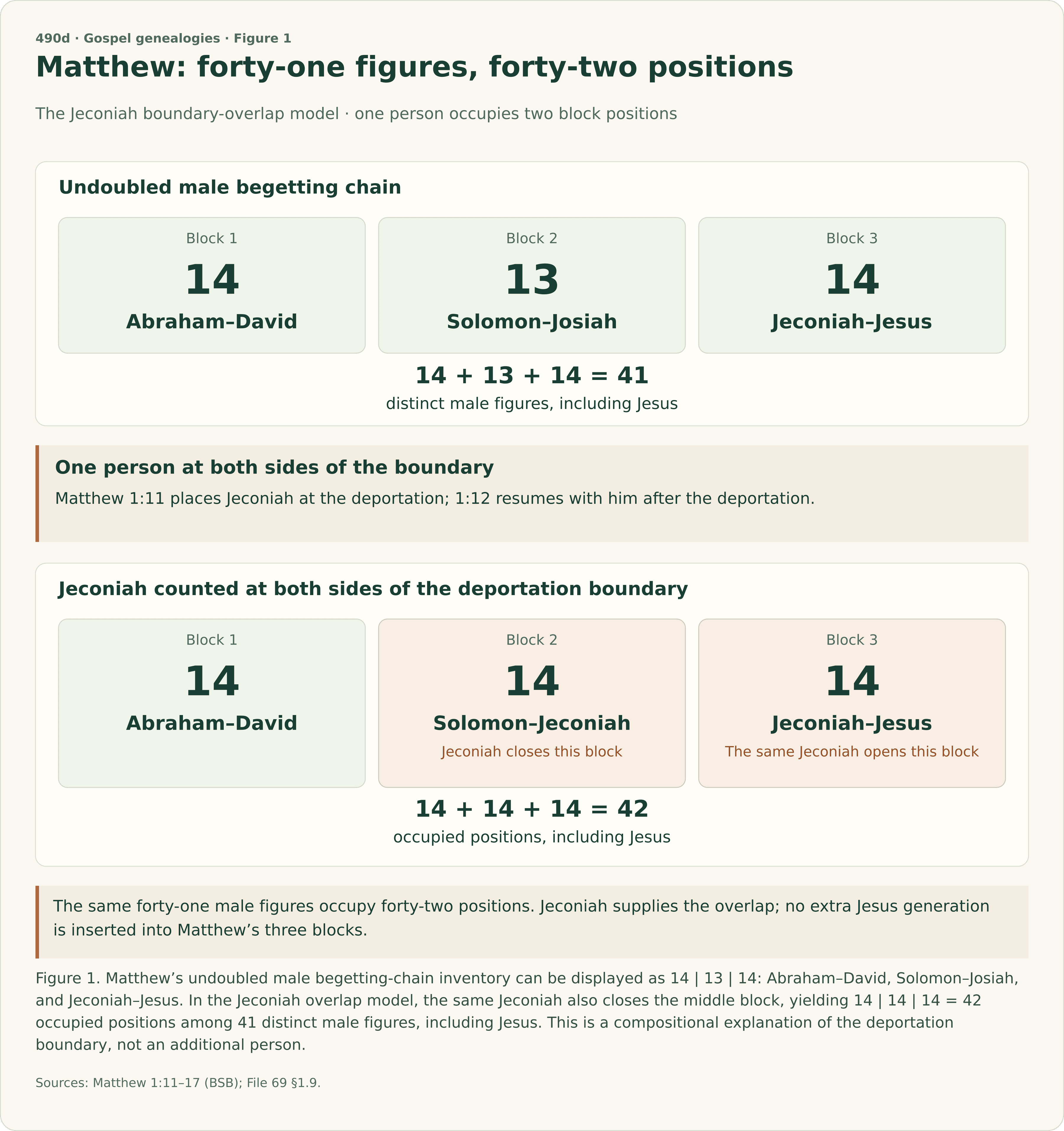
The repeated position does not create a second Jeconiah. It gives one person a place on both sides of a literary boundary. This is the study’s interpretation of how Matthew’s declared arrangement works; the verse itself does not spell out the counting procedure.
Matthew’s genealogy is also selective. Comparison with 1 Chronicles 3:10–16 BSB shows royal names between Joram and Uzziah, and between Josiah and Jeconiah, that Matthew does not list. Its fourteens organize a presented genealogy, rather than supplying a complete year-by-year chronology of every biological generation.
3. Luke: specify the edition before counting
Luke presents a longer list, but a bare statement that it contains “76” or “77” names leaves too much unstated. Does the count include Jesus? Does it include God? Which reading of Luke 3:33 is being counted?
The BSB prints Admin and Arni between Amminadab and Hezron. The KJV at the same passage prints the single name Aram. The BSB’s textual notes identify this difference. Both editions retain the later Cainan between Arphaxad and Shelah, as well as the earlier Cainan in the line before the Flood.
| Counted sequence | BSB printed list | KJV single-Aram list |
|---|---|---|
| Human figures, Jesus through Adam | 77 | 76 |
| All positions, Jesus through God | 78 | 77 |
| Adjacent links, Jesus through Adam | 76 | 75 |
These are counts of figures or positions, not counts of unique name spellings. Repeated names elsewhere in Luke belong to different positions.
The 490d 70-year model uses the single-Aram/Ram sequence, with the second Cainan retained. File 43’s display calls that ancestor Ram. Its 76-human-figure count agrees with the KJV’s single-Aram form; it must not be presented as a count of the BSB’s longer printed list. The BSB remains the quotation text here, and the appendix shows both lists without removing or combining its names.
4. From genealogical positions to a 70-year model
The equal 70-year unit is a declared rule of the chronological model in File 43 §§1–3. Neither Gospel says that every person in its genealogy lived, or fathered a child, at intervals of exactly 70 years.
The counting distinction can be expressed simply. A sequence of 76 people has 75 links between adjacent people. Assigning one 70-year period to each of those 76 people instead produces 76 occupied periods. Their totals differ by one period:
75 × 70 = 5250; 76 × 70 = 5320.
The model places Jesus’ opening boundary at the selected 6 BC nativity anchor. His completed 70-year period ends at AD 65, since civil BC/AD reckoning has no year zero:
6 + 65 − 1 = 70.
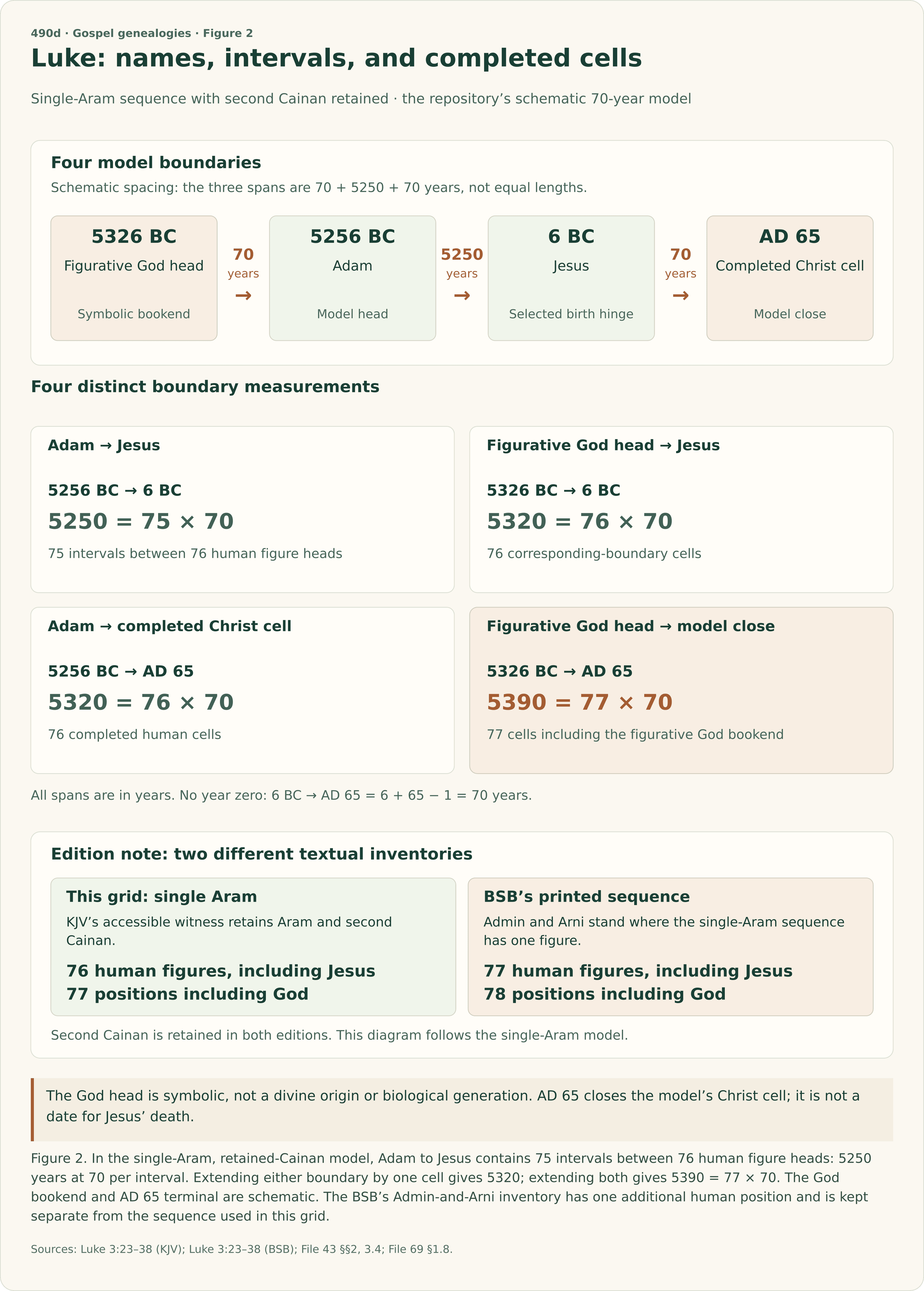
Starting from that rule, the single-Aram Lukan sequence produces an Adam boundary at 5256 BC. Adding a preceding figurative “God” position produces 5326 BC. The divine label reflects Luke’s ending and serves as a symbolic frame; it assigns no beginning or biological generation to God.
490d · Gospel genealogies · Figure 2
Luke: names, intervals, and completed cells
Single-Aram sequence with second Cainan retained · the repository’s schematic 70-year model
Four model boundaries
Schematic spacing: the three spans are 70 + 5250 + 70 years, not equal lengths.
Four distinct boundary measurements
Adam → Jesus
5256 BC → 6 BC
5250 = 75 × 70
75 intervals between 76 human figure heads
Figurative God head → Jesus
5326 BC → 6 BC
5320 = 76 × 70
76 corresponding-boundary cells
Adam → completed Christ cell
5256 BC → AD 65
5320 = 76 × 70
76 completed human cells
Figurative God head → model close
5326 BC → AD 65
5390 = 77 × 70
77 cells including the figurative God bookend
All spans are in years. No year zero: 6 BC → AD 65 = 6 + 65 − 1 = 70 years.
Edition note: two different textual inventories
KJV’s accessible witness retains Aram and second Cainan.
76 human figures, including Jesus77 positions including GodAdmin and Arni stand where the single-Aram sequence has one figure.
77 human figures, including Jesus78 positions including GodSecond Cainan is retained in both editions. This diagram follows the single-Aram model.
Sources: Luke 3:23–38 (KJV); Luke 3:23–38 (BSB); File 43 §§2, 3.4; File 69 §1.8.
Read the calculation and scope
The single-Aram inventory, represented by the KJV at Luke 3:33 with second Cainan retained at 3:36, contains 76 human figures including Jesus, or 77 positions when God is included. The BSB prints Admin and Arni in place of single Aram, giving 77 humans and 78 including God; this is an edition difference, not merely a change in which endpoints are counted. The model dates are generated schematic boundaries, not literal birth dates for Adam or God. 5326−5256=70; 5256−6=5250=75×70; 6+65−1=70. The corresponding pairs are 5326−6=5320 and 5256+65−1=5320. The full outer pair is 5326+65−1=5390=77×70. Cross-era arithmetic omits a year zero. The diagram follows File 43 §§2, 3.4 and File 69 §1.8; it does not replace the separate BSB inventory or confuse 75 head-to-head intervals with 76 completed human cells.
Open the full-resolution image version

The endpoints explain the model’s 76/77 distinction:
| Selected model boundaries | Calculation | Meaning |
|---|---|---|
| Adam 5256 BC → Jesus 6 BC | 5250 = 75 × 70 | Adjacent human intervals |
| Adam 5256 BC → AD 65 | 5320 = 76 × 70 | All human periods completed |
| Figurative God boundary 5326 BC → AD 65 | 5390 = 77 × 70 | Full model including the symbolic opening period |
The companion pairing 5326 BC → 6 BC also spans 5320 years. File 69 §1.8 preserves both 76-period pairings and distinguishes them from the full 77-period span. These endpoint changes are separate from the textual variation in Luke 3:33.
AD 65 is the completion of a schematic period. It is not a revised date for Jesus’ death. Likewise, the calculated Adam boundary is not being substituted for an ordinary MT, SP, or LXX Creation date.
5. Sevens, fourteens, and sacred time
Once the counting rule is stated, the sevenfold patterns are easy to see:
| Grouping in the model | Years |
|---|---|
| 7 periods of 70 | 490 |
| 14 periods of 70 | 980 |
| Matthew’s 42 occupied periods | 2940 = 6 × 490 |
| Luke’s full 77-period model | 5390 = 11 × 490 |
Matthew’s three fourteens can thus be viewed as six groups of seven. The full Lukan model contains eleven such groups. These calculations connect the genealogical study with the weeks, sabbatical periods, and jubilee patterns explored in the Enoch and Jubilees introductions.
The units still matter. 490 = 7 × 70 describes seven schematic generations; 490 = 10 × 49 describes ten jubilees. Equal totals permit comparison, while the operations remain distinct. A jubilee has not become a 70-year period.
Matthew’s date calculations also depend on the overlap choice. Completing 41 periods at AD 65 places the undoubled Abraham boundary at 2806 BC. Completing 42 periods places the Jeconiah-overlap boundary at 2876 BC. These generated coordinates are model boundaries, not competing claims about Abraham’s ordinary birth date. The endpoint tables show the arithmetic.
6. One connection to the wider chronology
The model places Enoch six 70-year intervals after Adam:
5256 − (6 × 70) = 4836 BC.
File 54 §7.1 compares this boundary with a selected cumulative MT Flood coordinate:
| Chronological construction | What 4836 BC identifies |
|---|---|
| Lukan 70-year model | Enoch’s opening boundary, closing Jared’s period |
| Cumulative MT chronology | Selected Flood boundary |
The shared label brings Enoch’s place in the genealogy into comparison with the Flood and judgment themes developed in the wider Enoch research. The two rows retain different methods and different events. Neither Luke’s text nor ordinary patriarchal ages independently supplies this generated 4836 BC date.
This is where interpretation follows calculation. Matthew’s declared fourteens and the Gospel name lists are textual evidence. The selected overlap explains occupied positions. The 70-year rule generates dates and spans. Theological significance is then considered in light of those stated choices. That order allows the numerical design to be explored without making the arithmetic prove more than it does.
Open the full counted-name and endpoint tables.
Scripture quotations: Berean Standard Bible (BSB), public domain. The King James Version is identified separately for the Luke 3 counting comparison. Textual notes are discussed separately from Scripture wording; digit-based calculations belong to this study’s prose and tables.
Continue with the detailed study.