Creation, the Flood, and the Conquest form the main outline of the Rounded Chronology. Their intervals also support a second reading: reverse the significant digits of a span, preserve its trailing zeros, and rebuild the comparison from a stated anchor. The resulting pattern brings the regular and cumulative chronologies to a shared numerical boundary.
The biblical ages remain the starting material:
“So Adam lived a total of 930 years, and then he died.”
“Moses was a hundred and twenty years old when he died, yet his eyes were not weak, and his vitality had not diminished.”
Adam and Moses frame the ancestral line used in the cumulative study. Their 930 and 120 years will also supply a small example of the inverse pattern below. The arithmetic is exact under the stated rules; its significance within the biblical narrative is an interpretation developed from those relationships.
This article uses the Rounded Masoretic Text (MT) framework. Regular chronology follows successive births; cumulative chronology adds complete lifespans. Rounding the underlying chronological inputs produces the regular Creation boundary at 4106 BC and the cumulative boundary at 14006 BC. Both are measured here to the Conquest in 1406 BC. The normal unrounded MT dates remain Creation 4114 BC and the Flood 2458 BC; the Rounded layer has its own defined coordinates. The 9900-year bridge article explains that foundation, with direct links to its regular rounding table and cumulative table.
Reverse the span, keeping its scale
The regular Rounded interval from Creation to the Conquest is 2700 years:
4106 − 1406 = 2700.
Read 2700 as 27 hundreds. Reverse 27 to 72, keeping the hundreds, and the inverse span becomes 7200. Likewise, 12600 is 126 hundreds; reversing 126 to 621 produces 62100. A span of 600 remains 600 because its significant part is the single digit 6.
490d · Reversing the Numbers · Figure 1
Reverse the core; keep the zeros
A simple place-value rule governs the two main spans.
Whole-span reversal · Rounded MT · Conquest anchor: 1406 BC
Regular chronology
2700 = 27 × 100
Keep the two trailing zeros in place.
Cumulative chronology
12600 = 126 × 100
Keep the two trailing zeros in place.
These are transformed durations. The dates themselves are not reversed.
Rounded MT dates; no second Cainan or Terah +60. Both source spans end at 1406 BC. Whole-span reversal is distinct from the segment-by-segment construction in Figure 2. Cards are schematic.
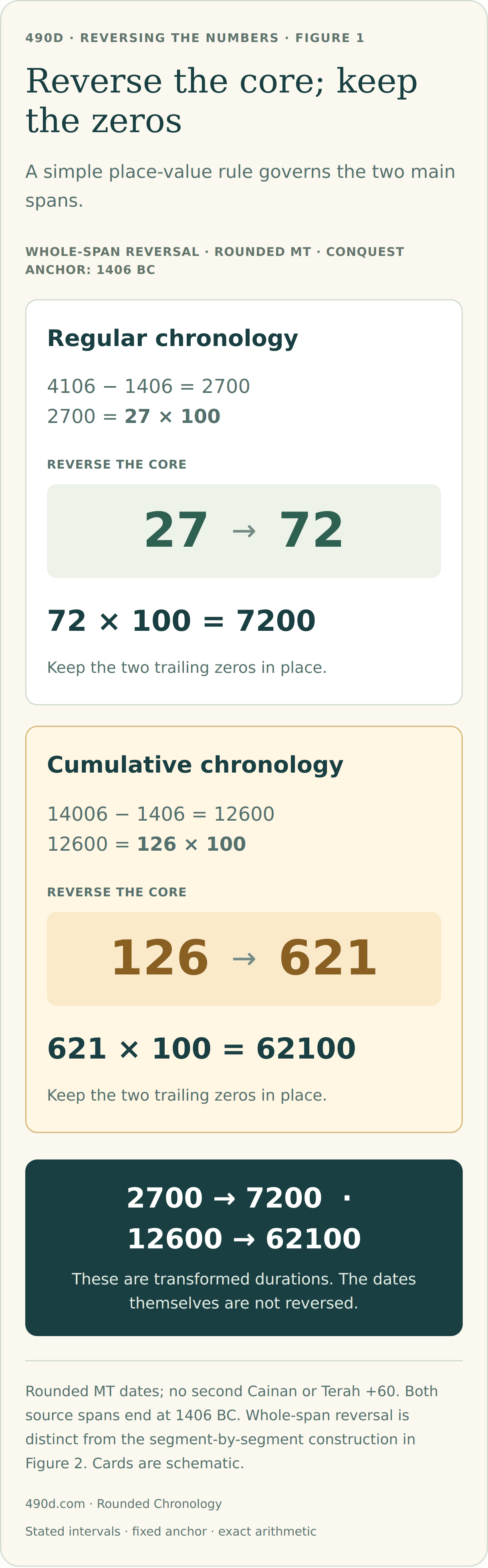
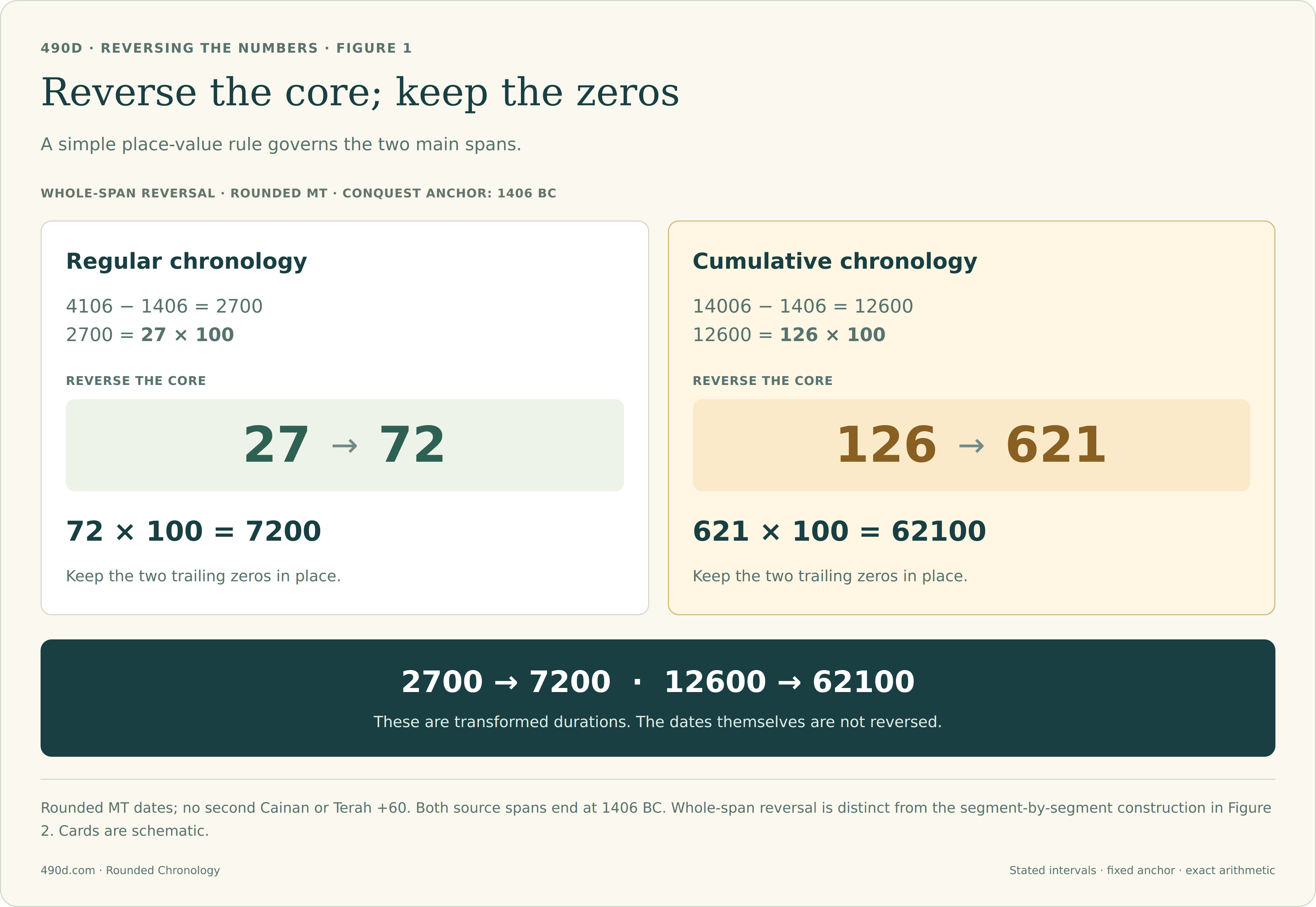
We reverse the measured span, not the printed BC date. The Conquest remains the anchor. If a reversed span is then laid backward from 1406 BC, 7200 gives 8606 BC, while 62100 gives 63506 BC. These are generated comparison coordinates, not replacement dates for historical Creation. The complete calculations are in Table 2.
The two original spans are joined by the familiar bridge:
2700 + 9900 = 12600.
The next question is what happens when each chronology is divided at the Flood before its intervals are reversed.
Two routes to the same boundary
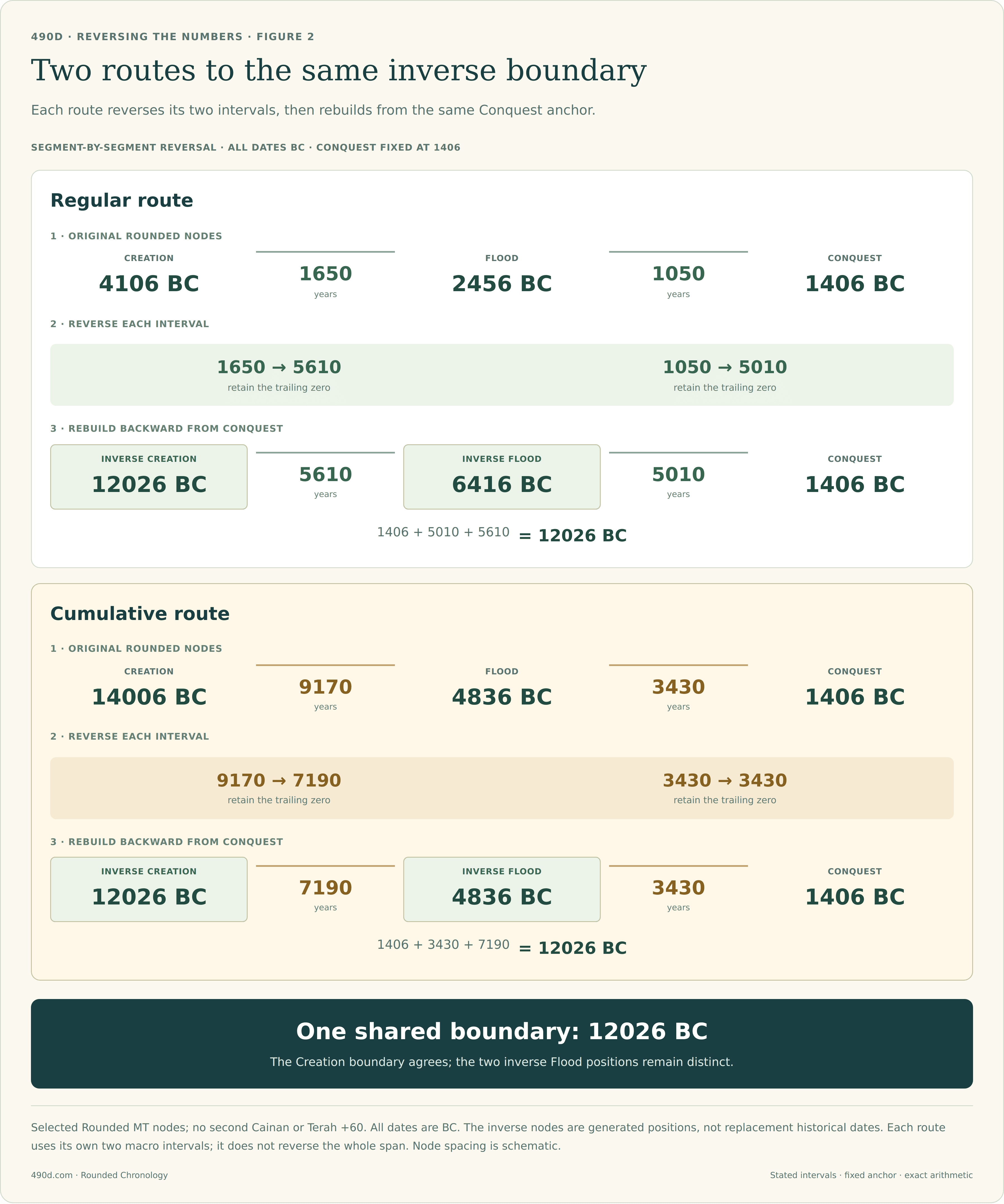
In the regular Rounded chronology, Creation 4106 BC, the Flood 2456 BC, and the Conquest 1406 BC divide the whole into 1650 + 1050 years.
Reverse those two spans separately:
1650 → 5610, and 1050 → 5010.
Rebuild backward from the Conquest. The nearer interval gives 1406 + 5010 = 6416 BC. Adding the earlier interval gives 6416 + 5610 = 12026 BC. The resulting line is therefore 12026 → 6416 → 1406 BC.
Now follow the cumulative route. Its Rounded Creation boundary is 14006 BC, and its selected Flood/Arphaxad boundary is 4836 BC. The two spans are 9170 + 3430. Here 9170 reverses to 7190, while 3430 remains 3430: its significant part, 343, already reads the same in either direction.
Starting again at 1406 BC, the unchanged 3430 reaches 4836 BC, and another 7190 reaches 12026 BC.
490d · Reversing the Numbers · Figure 2
Two routes to the same inverse boundary
Each route reverses its two intervals, then rebuilds from the same Conquest anchor.
Segment-by-segment reversal · all dates BC · Conquest fixed at 1406
Regular route
1 · Original Rounded nodes
2 · Reverse each interval
3 · Rebuild backward from Conquest
Cumulative route
1 · Original Rounded nodes
2 · Reverse each interval
3 · Rebuild backward from Conquest
The Creation boundary agrees; the two inverse Flood positions remain distinct.
Selected Rounded MT nodes; no second Cainan or Terah +60. All dates are BC. The inverse nodes are generated positions, not replacement historical dates. Each route uses its own two macro intervals; it does not reverse the whole span. Node spacing is schematic.

The two constructions share the same generated Creation boundary while retaining different intermediate Flood boundaries. Their reversed totals agree:
5610 + 5010 = 7190 + 3430 = 10620.
That shared result is the central comparison. It follows from the stated Creation–Flood–Conquest divisions in each chronology. Table 3 shows every step.
Why does this differ from reversing the whole 2700 or 12600? Because digit reversal does not distribute over addition. Reversing 1650 and 1050 separately gives 10620 when the results are added; reversing their combined total, 2700, gives 7200. Each answers a different question. The segments must be chosen and named before the operation is performed.
The 600-year center
The regular route has a further, particularly readable structure:
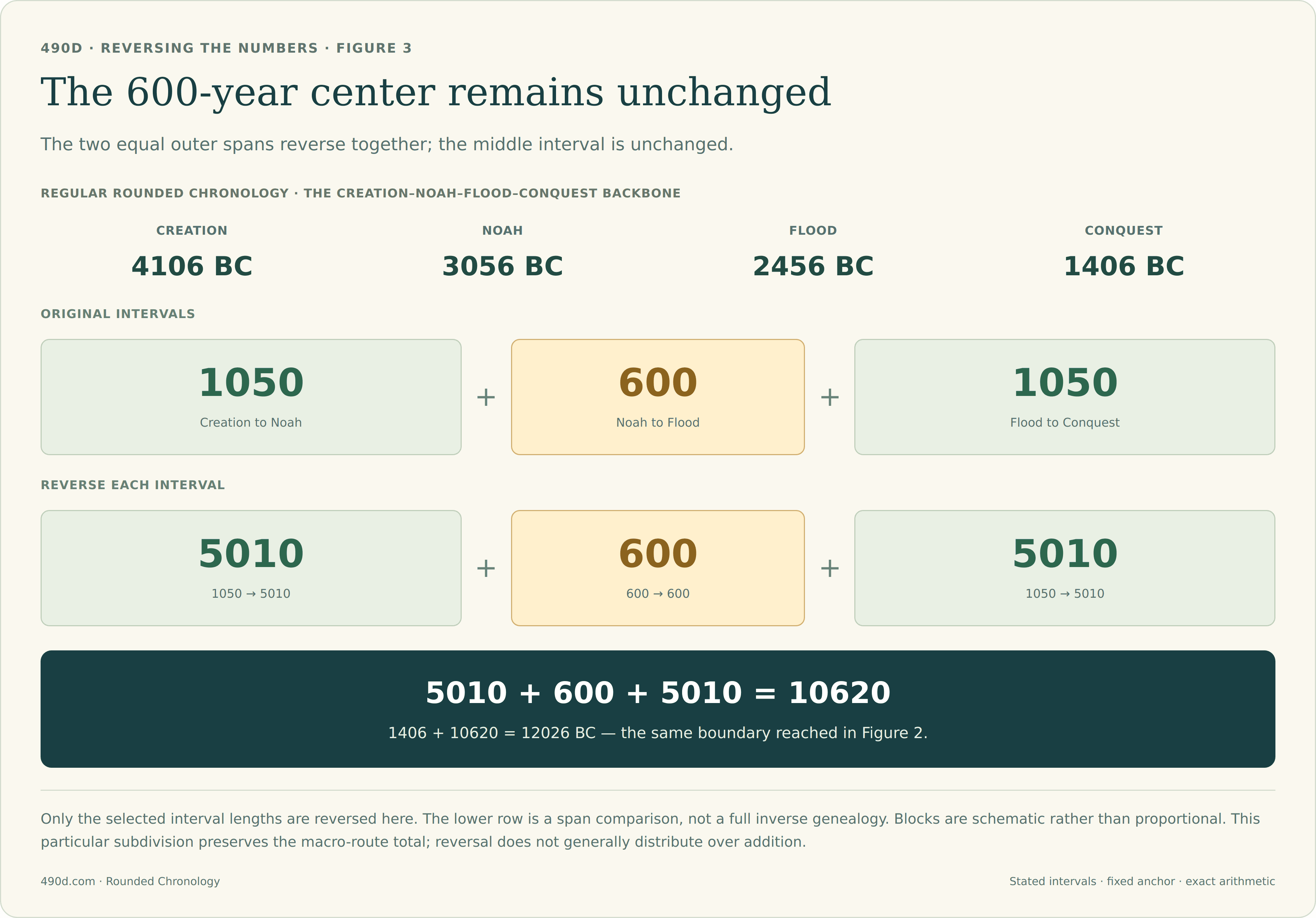
Creation 4106 → Noah 3056 → Flood 2456 → Conquest 1406 BC.
Its intervals are 1050 + 600 + 1050. Creation to Noah and Flood to Conquest have equal lengths, with Noah’s 600 years to the Flood between them. This is the same backbone developed in the 9900-year bridge article.
Under the inverse rule, the two outside spans become 5010, while the central 600 remains unchanged:
5010 + 600 + 5010 = 10620.
490d · Reversing the Numbers · Figure 3
The 600-year center remains unchanged
The two equal outer spans reverse together; the middle interval is unchanged.
Regular Rounded chronology · the Creation–Noah–Flood–Conquest backbone
Original intervals
Reverse each interval
1406 + 10620 = 12026 BC — the same boundary reached in Figure 2.
Only the selected interval lengths are reversed here. The lower row is a span comparison, not a full inverse genealogy. Blocks are schematic rather than proportional. This particular subdivision preserves the macro-route total; reversal does not generally distribute over addition.
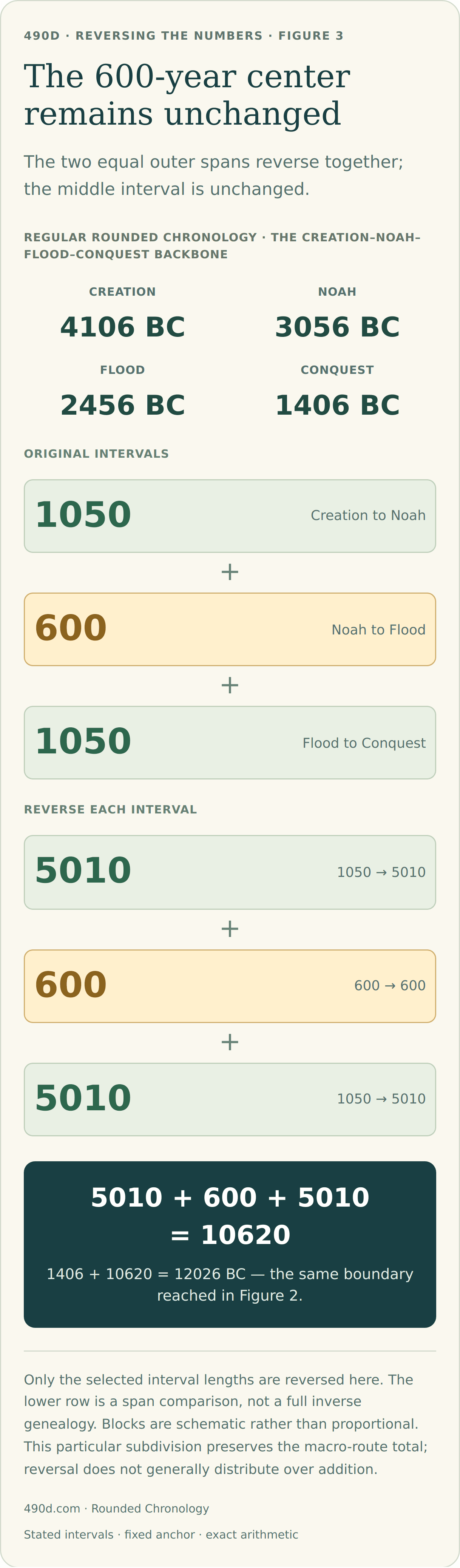
This particular subdivision therefore returns to 12026 BC, just as the regular two-part route did. The reason is visible: 5610 = 5010 + 600. Introducing Noah into this regular outline preserves the result. It does not imply that every possible subdivision will do so.
The biblical lifespans quoted at the beginning offer a compact companion relationship. Adam’s 930 years and Moses’ 120 total 1050, the length of either outside interval. Their individual reversals are 390 and 210, totaling 600, the central interval:
930 + 120 = 1050; 390 + 210 = 600.
Here again the operation is applied to the two named lifespans separately. It is a numerical correspondence between the framing lives and the chronological backbone. Table 4 keeps the two measurements explicit.
Where the shared boundary falls
The generated 12026 BC boundary falls inside the 9900-year interval between cumulative Creation 14006 BC and regular Creation 4106 BC. It divides that bridge into 1980 and 7920 years:
14006 − 12026 = 1980; 12026 − 4106 = 7920.
The larger interval is four times the smaller. Together they recover the whole bridge:
1980 + 7920 = 9900.
490d · Reversing the Numbers · Figure 4
Where the shared boundary falls
The generated boundary divides the gap between the two original Creation nodes.
All dates BC · the original 9900-year bridge
The shared inverse boundary divides the bridge in the ratio 1:4.
The bar is proportional: each of its five equal units represents 1980 years. On phones, the date labels are listed above the same proportional bar. Original Creation nodes and the generated inverse boundary remain distinct.
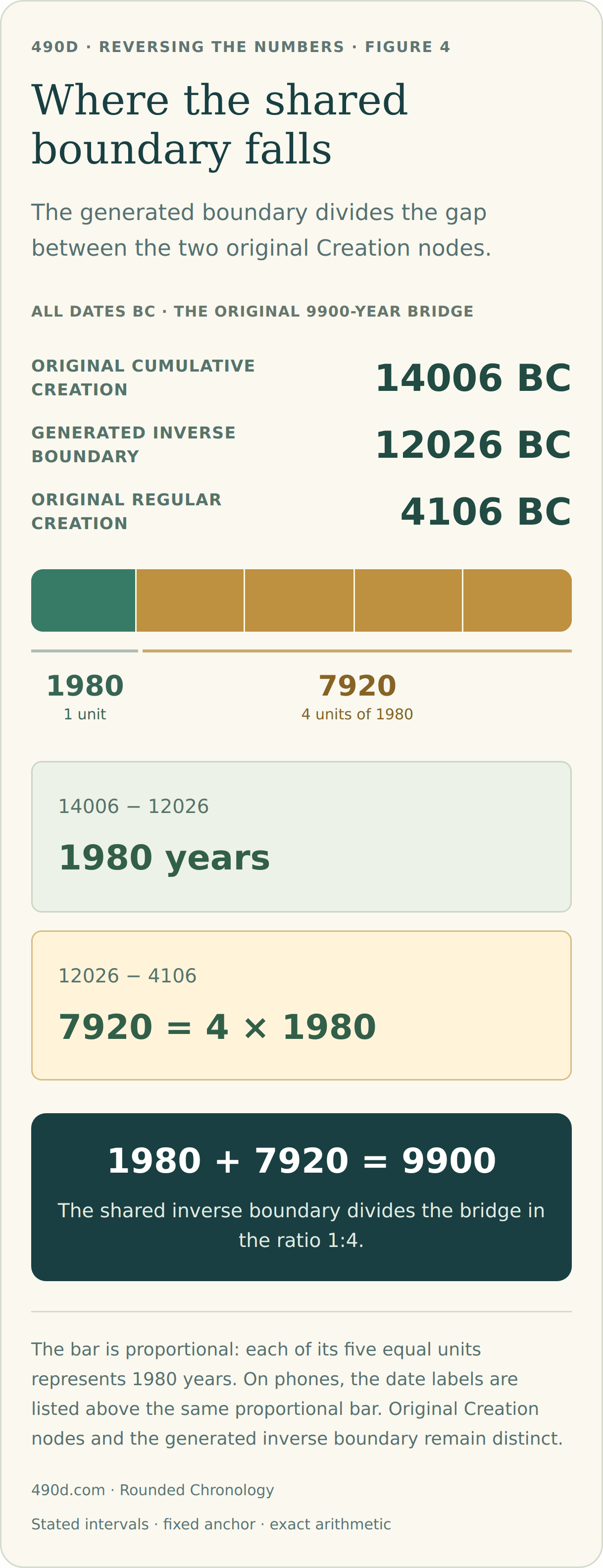
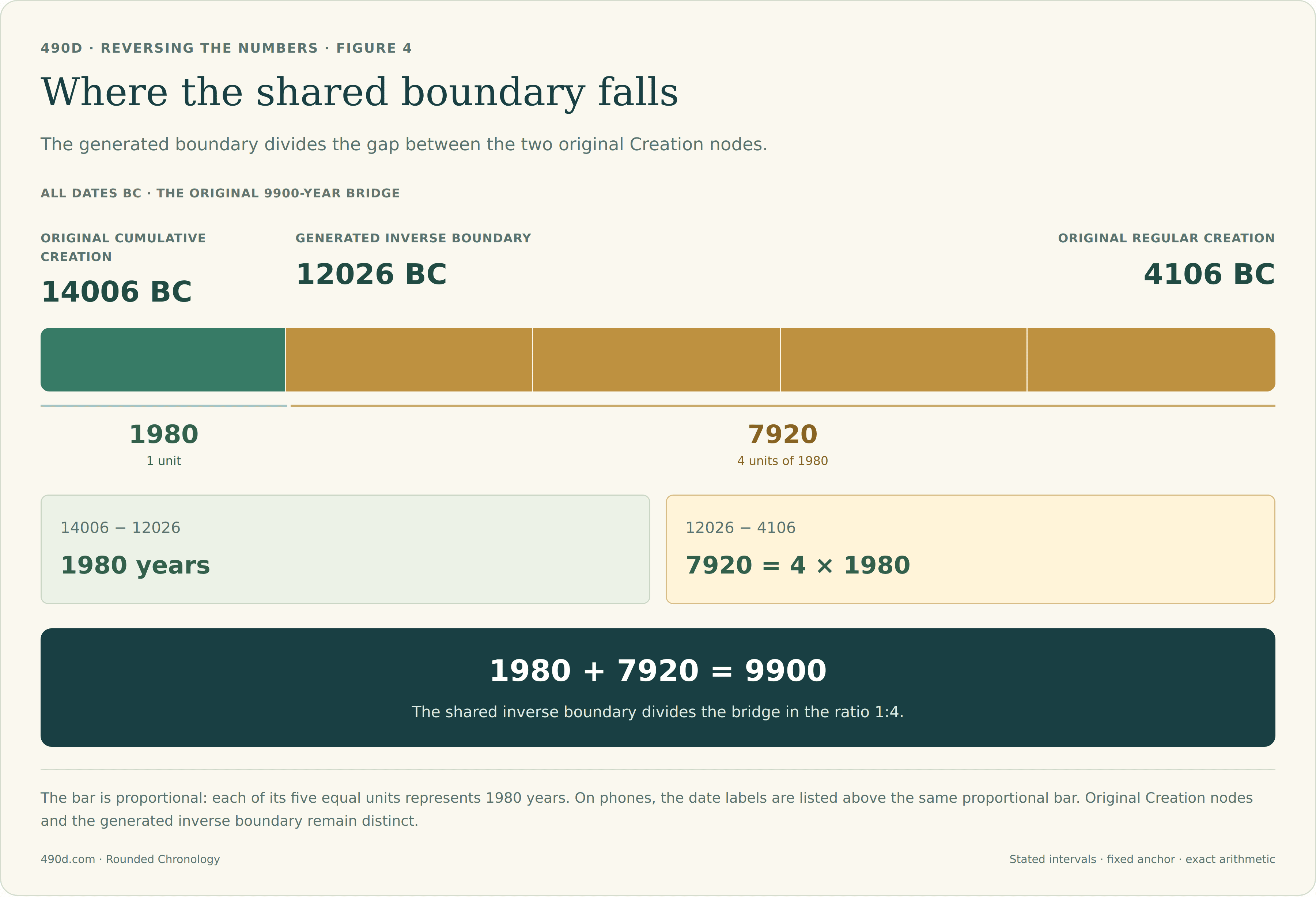
The inverse construction thus gives an internal division of the same bridge that joined the two original chronologies. The 1:4 proportion is an exact consequence of these selected nodes. Its wider importance rests on how it fits the other relationships, rather than on the proportion alone. Table 5 gives the supporting arithmetic.
Reading the pattern together
The progression is simple enough to follow without a catalogue of every inverse date: two complete spans, two Flood-based routes to 12026 BC, a preserved 600-year center, and a 1:4 division of the 9900-year bridge.
All of these examples remain on the BC side. The BC–AD Mirror is a separate operation; the appendix distinguishes its counting conventions. Here the governing action is digit reversal, with a stated scale, segmentation, and anchor.
For a Christian reading of biblical chronology, Creation, judgment, preservation, and entry into rest belong to one narrative. These numerical correspondences offer a way to examine how its chronological forms may belong together. Their arithmetic can be checked directly; the theological interpretation remains a further judgment.
The technical appendix supplies the source dates, reversal rules, anchor-selection table, and supporting calculations. The fuller canonical treatment is in File 52a and File 52b. The detailed study, Inverted Timelines, develops the Rounded chronology with its supporting tables and figures at the original article address.
Further study. The technical appendix supplies the full supporting tables, and Part 5e, Inverted Timelines develops the wider comparisons. The current Repository companion is File_52f — Rounded Whole-Span Inverse Detailed Study, with LXX/SP Appendix D. Its former research label File_52c is distinct from the exploratory second-order File_52c article.
Scripture quotations: Berean Standard Bible (BSB), public domain.