These tables are an active companion to Ezekiel’s Symbolic Dates: The 430-Year Corridor and the Covenant. They preserve the complete working matrices, the Kings comparison, both original illustrations’ data, and the less-developed proposals. The original page records the dialogue’s history; the present companion keeps its substantive content available within the revised study.
The repository’s chronological tables control ordinary dates. The day–year cells are generated coordinates, and the covenantal correspondences are the author’s interpretation. A proposal absent from the repository is retained here without being presented as an already canonized result.
1. The complete working matrices
The shared working editions are inherited unchanged from the Part 2a v3 reconstruction. Each whole-day count is floor(event JD − datum JD). Braces identify datum rows; asterisks preserve the source alternatives. They do not change a negative cell into a historical BC date by themselves. To project a signed cell q as a year coordinate, q ≤ 0 becomes (1−q) BC; q > 0 becomes AD q.
Two source datum cells in Return A contain reversed signs: the Nisan B row prints {−210}, while its JD subtraction gives +210; the Tishri C row prints {−4050}, while its JD subtraction gives +4050. The raw source cells are preserved in the table and JSON. Active arithmetic uses the reconstructed positive values. All other 138 source counts equal the floor of their JD subtraction. These are two source-copy corrections, not changes to the calendar phase.
Some Julian-day entries include a fractional timestamp other than .5. The complete JSON retains that exact delta, its floor, source formatting, and the inherited calendar checks. The table below displays the original whole-day coordinate, rather than erasing the source timestamp or silently rounding it to the nearest day.
Exile working edition
| Sheet row | Event / marker | Passage | Source year / phase | Julian day | A | B | C | D | Source note |
|---|---|---|---|---|---|---|---|---|---|
| 2 | A) Tishri Datum (Jecon’s exile) | 598 BC | 1503251.5 | {0} | {-180} | {-4020} | {-4200} | Datumn to Datumn count of days | |
| 3 | Jecon 3mo/3mo10d reign | 2Ch 36:9-10; 2Kg 24:8 | 9/25 (Nov 30) 3mo/3mo10d, 598 BC | 1503336.75 | 85 | -95 | -3935 | -4115 | Actual: 3mo/3mo, 5d +/-5d |
| 4 | B) Nisan Datum (Jecon’s exile) | 597 BC | 1503431.5 | {180} | {0} | {-3840} | {-4020} | Datumn to Datumn count of days | |
| 5 | Jecon/Ezek exile: Zed 11yr reign | 2Ch 36:10 | 1/1 (Mar 4/5, MD), 597 BC | 1503432.5 | 181 | 1 | -3839 | -4019 | Likely Adar 25th, 597 BC, corresponding to Elul 25 of 445 BC (= symbolic -4124) |
| 6 | “7-d” Vision | Ezek 1-4 | 5th yr, 4th mo, 5th-(12th) d, 593 BC | 1504996.5 | 1745 | 1565 | -2275 | -2455 | |
| 7 | “7-d” Vision +390 d | Ezek 1-4 | 5th yr, 4th mo, 6th-(12th) d, 592 BC | 1505386.5 | 2135 | 1955 | -1885 | -2065 | |
| 8 | 1st Temple vision | Ezek 8:1 | 6th yr, 6th mo, 5th d, 592 BC | 1505416.5 | 2165 | 1985 | -1855 | -2035 | |
| 9 | “7-d” Vision +390+40=430 d | Ezek 1-4 | 5th yr, .6th mo, 15th-(12th) d, 592 BC | 1505426.5 | 2175 | 1995 | -1845 | -2025 | |
| 10 | 2.) Siege of Jrslm begins | Ezek 24:1 | 9th yr, 10th mo, 5th d, 590 BC | 1506256.5 | 3005 | 2825* | -1015 | -1195* | Alt. Yr. Actual: “10mo, 10d” |
| 11 | 1.) Siege of Jrslm begins | Ezek 24:1 | 9th yr, 10th mo, 5th d, 589 BC | 1506616.5 | 3365* | 3185 | -655* | -835 | Actual: “10mo, 10d” |
| 12 | 2a.) Fall of Jrslm. Bab Exile | 4/5 (Jun 10), 587 BC | 1507186.75 | 3935 | 3755* | -85 | -265* | Alt. Year | |
| 13 | 2b.) Temple destroyed | 5/5 (Jul 10), 587 BC | 1507216.75 | 3965 | 3785* | -55 | -235* | Alt. Year | |
| 14 | C) Tishri Datum (Zed’s exile) | 587 BC | 1507271.5 | {4020} | {3840*} | {0} | {-180*} | Datumn to Datumn count of days | |
| 15 | 2.) 1st Refugee Post-Fall | Ezek 33:21 | 12th yr, 10th mo, 5th d, 587 BC | 1507366.5 | 4115 | 3935* | 95 | -85* | Alt. Year |
| 16 | D) Nisan Datum (Zed’s exile) | 586 BC | 1507451.5 | {4200*} | {4020} | {180*} | {0} | Datumn to Datumn count of days | |
| 17 | 1a.) Fall of Jrslm. Bab Exile | 4/5 (Jun 10), 586 BC | 1507546.75 | 4295* | 4115 | 275* | 95 | ||
| 18 | 1b.) Temple destroyed | 5/5 (Jul 10), 586 BC | 1507576.75 | 4325* | 4145 | 305* | 125 | ||
| 19 | 1.) 1st Refugee Post-Fall | Ezek 33:21 | 12th yr, 10th mo, 5th d, 586 BC | 1507726.5 | 4475* | 4295 | 455* | 275 |
Exile CSV · Exile JSON with calculation details (in supporting-data ZIP).
Return refitted working edition
| Sheet row | Event / marker | Passage | Source year / phase | Julian day | A | B | C | D | Source note |
|---|---|---|---|---|---|---|---|---|---|
| 2 | A) Tishri Datum (Jecon’s exile) | 457 BC | 1554731.5 | {0} | {-210} | {-4050} | -4230 | Datumn to Datumn count of days | |
| 3 | Jecon 3mo/3mo10d reign | 2Ch 36:9-10; 2Kg 24:8 | 9/25 (Nov 30) 3mo/3mo10d, 457 BC | 1554846.5 | 115 | -95 | -3935 | -4115 | Actual: 3mo/3mo, 5d +/-5d |
| 4 | B) Nisan Datum (Jecon’s exile) | 456 BC | 1554941.5 | {-210} | {0} | {-3840} | -4020 | Datumn to Datumn count of days | |
| 5 | “7-d” Vision | Ezek 1-4 | 5th yr, 4th mo, 5th-(12th) d, 452 BC | 1556476.5 | 1745 | 1535 | -2305 | -2485 | |
| 6 | “7-d” Vision +390 d | Ezek 1-4 | 6th yr, 5th mo, 5th-(12th) d, 451 BC | 1556866.5 | 2135 | 1925 | -1915 | -2095 | |
| 7 | 1st Temple vision | Ezek 8:1 | 6th yr, 6th mo, 5th d, 451 BC | 1556896.5 | 2165 | 1955 | -1885 | -2065 | |
| 8 | “7-d” Vision +390+40=430 d | Ezek 1-4 | 5th yr, 4th mo, 5th-(12th) d, 451 BC | 1556906.5 | 2175 | 1965 | -1875 | -2055 | |
| 9 | 2.) Siege of Jrslm begins | Ezek 24:1 | 9th yr, 10th mo, 5th d, 449 BC | 1557766.5 | 3035 | 2825* | -1015 | -1195* | Alt. Yr. Actual: “10mo, 10d” |
| 10 | 1.) Siege of Jrslm begins | Ezek 24:1 | 9th yr, 10th mo, 5th d, 448 BC | 1558126.5 | 3395* | 3185 | -655* | -835 | Actual: “10mo, 10d” |
| 11 | 2a.) Fall of Jrslm. Bab Exile | 4/5 (Jun 10), 446 BC | 1558696.5 | 3965 | 3755** | -85 | -265* | Alt. Year | |
| 12 | 2b.) Temple destroyed | 5/5 (Jul 10), 446 BC | 1558726.5 | 3995 | 3785* | -55 | -235* | Alt. Year | |
| 13 | C) Tishri Datum (Zed’s exile) | 446 BC | 1558781.5 | {-4050} | {3840*} | {0} | {-180*} | Datumn to Datumn count of days | |
| 14 | 2.) 1st Refugee Post-Fall | Ezek 33:21 | 12th yr, 10th mo, 5th d, 446 BC | 1558876.5 | 4145 | 3935* | 95 | -85* | Alt. Year |
| 15 | D) Nisan Datum (Zed’s exile) | 445 BC | 1558961.5 | {4230*} | {4020} | {180*} | {0} | Datumn to Datumn count of days | |
| 16 | 1a.) Fall of Jrslm. Bab Exile | 4/5 (Jun 10), 445 BC | 1559056.5 | 4325* | 4115 | 275* | 95 | ||
| 17 | 1b.) Temple destroyed | 5/5 (Jul 10), 445 BC | 1559086.5 | 4355* | 4145 | 305* | 125 | ||
| 18 | 1.) 1st Refugee Post-Fall | Ezek 33:21 | 12th yr, 10th mo, 5th d, 445 BC | 1559236.5 | 4505* | 4295 | 455* | 275 |
Return CSV · Return JSON with calculation details (in supporting-data ZIP).
The reference points and transfer
| Column | Exile JD | Return JD | JD separation |
|---|---|---|---|
| A | 1503251.5 | 1554731.5 | 51480.0 |
| B | 1503431.5 | 1554941.5 | 51510.0 |
| C | 1507271.5 | 1558781.5 | 51510.0 |
| D | 1507451.5 | 1558961.5 | 51510.0 |
The call/+390/+420/+430 cluster transfers by 51480 days. The later siege/report cluster transfers by 51510. A therefore preserves the earlier call readout; B/C/D’s refitted datum relation changes that cluster by thirty day-years. In particular, Return C −2305 projects to 2306 BC, compared with Exile C −2275 projecting to 2276 BC. The table’s named year references shift by 141; the broader authorial restoration argument also uses 139, their average 140, and a season-specific 140.5. Those spans are distinct measures, not interchangeable descriptions of one exact Julian-day difference.
The source’s repeated partial sequences are all represented above. Exile D includes −4115, −4019, −2455, −2065, −2035, −2025, −1195, −835, −265, −235, −85, +95, +125, +275 and its braced datums. Return C includes −3935, −2305, −1915, −1885, −1875, −1015, −655, −85, −55, +95, +275, +305, +455 and its datums. These unselected values are conserved even when the main discussion develops only a subset.
2. Exact day, containing week, and intercalation
The carried fifth-to-twelfth-day envelope is a unit, rather than a claim that every narrative event occurred on the fifth day. The literal tenth day selects +5 within it; the seventh day selects +2. The fifth through twelfth includes eight printed day labels but seven elapsed day intervals. Call +390 carries the 5–12 month-day unit; +430 carries 15–22 on the 360-day base.
The cycle begins at 606n BC. Its 6+6+6+6+6+6+4 closures are 600n, 594n, 588n, 582n, 576n, 570n, 566n BC. This declares the 1446n/6n epoch phase: 1446−606=840=21×40; 606−6=600=15×40. Whether a harmonic span counts its inserted month is a separate operator choice, admitted by File 12 §7A and File 17 §13A.
| Window | Leap treatment | Base + additions | Total |
|---|---|---|---|
| 593 Tammuz → 586 Tammuz | omitted | 2520 | 2520 |
| 593 Tammuz → 586 Tammuz | counted at 588n | 2520+30 | 2550 |
| 593 Tammuz → 586 Av | omitted | 2520+30 ordinary month | 2550 |
| 593 Tammuz → 586 Av | counted at 588n | 2520+30 leap+30 ordinary | 2580 |
A seven-year period that actually contains two intercalary months can also register 1290+1290. That general option does not mean that the particular Tammuz→Av 2580 above contains two leap months: its second thirty is an ordinary month.
The source’s half-week components are 360+720+180=1260 and 390+720+180=1290. With the printed 2456→1196→AD95 endpoints the first leg is 1260 and the second 1290. Reassigning the leap to the first leg requires a different midpoint. Tishri/Nisan gives the additional 180-day datum separation; it does not add an unexplained third half-week to the selected seven-year span.
3. The call, siege, refugee, and 430 multiples
| Comparison | Computed span | Meaning |
|---|---|---|
| 2456 BC → AD95 | 2550 | Call → city projection |
| 2456 BC → AD125 | 2580 | Call → Temple projection |
| 2456 BC → AD275 | 2730 | Call → refugee projection |
| 1876 BC → AD275 | 2150 = 5×430 | Egypt entry → shared projection |
| 1446 BC → AD275 | 1720 = 4×430 | Exodus → shared projection |
| 586 BC → AD275 | 860 = 2×430 | Fall → shared projection |
| 2306 BC → AD275 | 2580 = 6×430 | Return C corridor |
| AD1565 → AD1995 | 430 | Exile B symbolic action |
| AD1995 → AD4295 | 2300 | Completion → refugee |
| AD1565 → AD4295 | 2730 = 430+2300 | Full call → refugee |
| 831 BC → AD30 | 860 | Tenth-day point → retained Passion alternative |
| 831 BC → AD60 | 890 | Thirty-unit extension |
| 2091 BC → AD60 | 2150 | Abraham departure → Pauline horizon |
The original “586 BC→AD125=860” reverses the event label: AD275 yields 860, while AD125 yields 710. Likewise, the source sometimes calls AD95 a Temple-fall projection; the preserved matrix assigns it to the city, with Temple thirty later at AD125. These are corrected event identities, not new historical destructions.
The source’s Adar-25 hypothesis selects a date five days before Nisan in 597 BC. That is the B datum, not D. q=−5 reads 6 BC; relative to the other Nisan reference it gives −4025, hence 4026 BC. The copied deportation row is separately −4019/4020 BC. The proposal is conserved with its assumption rather than blended with the different source row. The source places a conception or birth of John the Baptist or Jesus somewhere within 6 BC–AD1; the extended 6 BC–AD2 display is its seven-year carrier, not a claim that every birth occurred at the first edge. Its six-block span is 4026−1446=2580.
The separate Joseph overlay 4035→4028→4021 is 2150 earlier than 1885→1878→1871. Both contain 7+7 years. It is not derived from the selected 4026 endpoint. The 2091→1876 ordinary interval is 215 years, half of 430; the source’s “215 days” does not describe those ordinary BC endpoints.
The first-refugee event in Ezekiel 33 opens into restoration. The mouth opens in the evening before his morning arrival. Zechariah’s mouth opens at John’s naming/circumcision, not at the instant of John’s birth. Their speech-restoration parallel remains part of the author’s covenant reading. The Hosea 11/Matthew 2 Egypt comparison likewise remains interpretive; 6 BC is a chronology-model anchor.
4. Jubilee and ministry-window checks
| Quantity / interval | Result | Qualification |
|---|---|---|
| 40×49 | 1960 | 49-year jubilee register |
| 30×49 | 1470 | Same register |
| 70×49 | 3430 | Thirty plus forty jubilees |
| 6 BC → AD1955; AD2 → AD1962 | 1960; 1960 | Corresponding birth-window boundaries |
| AD25 → AD1985; AD32 → AD1992 | 1960; 1960 | Corresponding ministry-window boundaries |
| 1446 BC → AD25 | 1470 | Exodus → selected ministry boundary |
| 1446 BC → AD1985 | 3430 | Exodus → Temple-vision projection |
| 966 BC → AD3935 | 4900 | Ordinary Temple → refugee |
| 606 BC → AD4295 | 4900 | Selected 606 exile horizon |
| 586 BC → AD4295 | 4880 | Not the source’s 4830 claim |
| 49+434+3.5+3.5 | 490 | Daniel’s 7+62+1 weeks |
| 49+343+3.5+3.5 | 399 | Legacy transcription, corrected |
The intended 4830+70=4900 family is preserved. The source’s selected 606/586 endpoints differ by twenty, so they cannot be its 70-year subdivision. Daniel 9:1 identifies Darius’ first year; 536 remains the project’s return/foundation comparison, not a date printed for that revelation.
The source relates Christ’s about-thirty ministry age to thirty jubilees, and the forty-day wilderness/purification counts to forty jubilees. Luke 4:18–19 supplies the proclaimed favor-year language. These are typological correspondences, rather than new literal ages for Jesus. AD25–32 is a seven-year envelope; AD33 is a separately phased/preferred Passion coordinate and cannot be placed inside it without declaring the alternative convention.
5. Patriarchal windows, the two-year hinges, and the Key of 23
Return C call 2306–2299 translates 2300 years to 6 BC–AD2. Exile C 2276–2269 translates 2300 to AD25–32. Return C +390 gives 1916–1909: the proposed Joseph-conception boundary, his 1915 ordinary birth, and Jacob’s return in 1909. Benjamin’s 1906 belongs later in Canaan. Genesis records conceptions and births, but does not print a modern BC date for each conception.
Return C’s +420 Temple-vision row gives 1886–1879. 2306−1886=420, not 430. The +430 completion is 1876–1869. The source’s equation ending the action at 1886 is repaired while its Isaac/Joseph succession reading is retained. Return D and C’s same +420 row supply 2066 and 1886, the 180 years of Isaac’s ordinary life. Exile D’s +390 also reads 2066, but belongs to a different row and edition.
Joseph’s plentiful years are 1885–1878; the famine is 1878–1871. Genesis 41:50 places Ephraim and Manasseh before the famine, without giving two separate modern BC birth years. Their connection to the northern house is retained as the interpretation of the 390 burden. The LXX’s Canaan-and-Egypt wording is an allocation alternative; the ordinary MT baseline remains 430 in Egypt. A −215 translation used for a local comparison does not make all MT/SP/LXX genealogical ages identical.
The two-year offsets are three declared applications: call-coordinate Arphaxad 2456→Flood 2458; entry/famine window 1876–1869→1878–1871; Joseph-conception proposal 1916→Judah birth 1918. The local mechanism fixes the Temple endpoint at 1886: 420−(390+7)=23, 1909−1886=23, 1911−1886=25, then 1911+7=1918. Thus the earlier edge expands by two. The Flood and famine applications add event-binding assumptions; this local operation does not automatically alter all four datums or every calendar cell.
The exact ideal day volume is 25×336=8400 and 23×(8400/23)=8400, with schematic reference year 8400/23=365.217391…. At the physical solar input 365.2422, 23 years give 8400.5706 days. Similarly, 70×360=25200 versus 69×365.2422=25201.7118; 490×360=176400 versus 483×365.2422=176411.9826. The near physical equalities do not alter the exact allowable operator 70/69. 483×70/69=490 and 483×25/23=525 remain distinct.
The 400/430 entry alternatives also stay separate. Figurative 1846→1446 is 400, while ordinary 1876→1446 is 430. Toward 586, they give 1260 and 1290. Return C’s later refugee alternative AD455 closes 1846→6 BC→AD455 = 1840+460=2300. Adam 4114→Jared 3654 gives the other 460. First Enoch 6:6 supplies the Watcher descent in Jared’s days; the chronology supplies the interval. The theological proposal treats this as a covenant/fall correspondence, not a new literal Adam-fall date stated by Enoch.
6. The retained NIV passage: Ezekiel 8:9–16
The original quoted this passage in the NIV. It is retained here in the current NIV, 2011 wording, including its spelled-out numbers. The reader link identifies the edition; verse labels below locate the quotations. Calculated digits follow separately.
9 And he said to me, “Go in and see the wicked and detestable things they are doing here.”
10 So I went in and looked, and I saw portrayed all over the walls all kinds of crawling things and unclean animals and all the idols of Israel.
11 In front of them stood seventy elders of Israel, and Jaazaniah son of Shaphan was standing among them. Each had a censer in his hand, and a fragrant cloud of incense was rising.
12 He said to me, “Son of man, have you seen what the elders of Israel are doing in the darkness, each at the shrine of his own idol? They say, ‘The LORD does not see us; the LORD has forsaken the land.’ ”
13 Again, he said, “You will see them doing things that are even more detestable.”
14 Then he brought me to the entrance of the north gate of the house of the LORD, and I saw women sitting there, mourning the god Tammuz.
15 He said to me, “Do you see this, son of man? You will see things that are even more detestable than this.”
16 He then brought me into the inner court of the house of the LORD, and there at the entrance to the temple, between the portico and the altar, were about twenty-five men. With their backs toward the temple of the LORD and their faces toward the east, they were bowing down to the sun in the east.
The text says Jaazaniah stands among the seventy, and about twenty-five men turn toward the sun. The author selects one named elder to obtain 70−1=69 and associates 69→70 and 23→25 with the conversion families. Neither an additional seventy-first elder nor an exact text-stated group of sixty-nine is asserted. The context of incense, darkness, Tammuz mourning and sun worship supplies covenant-breaking, not endorsement of those practices.
7. Coordinate polarity, formal Mirror, and ordinary elapsed spans
File 00 §3.9 separates civil elapsed arithmetic, Mirror, 10× scaling and digit reversal. File 09 §3 / Appendix A controls phase. A single Nisan/Tishri node has its numeric-year counterpart, whereas a pair Yt/(Y−1)n BC maps to AD(Y−1)t/Yn. A paired six-month state must retain both suffixes and the corrected civil crossing. The source’s “Mirror” comparisons are retained under their actual operator:
| Source relationship | Executable form | Status |
|---|---|---|
| −95 ↔ +95 | 96 BC / AD95 when signed cells are read as years | Coordinate polarity; not bare 95 BC |
| Ordinary Creation week | 4121→4114 BC | Seven-year MT envelope |
| Paired Creation start / finish | 4122t/4121n; 4115t/4114n BC | Phase-completed Canon pairs |
| Corresponding AD endpoints | AD4121t/4122n; AD4114t/4115n | Formal paired Mirror |
| AD4115→4122 | B city window | Not B Temple at 4145 |
| 966→959 BC / AD3935→3942 | 4900 for each matched boundary | Ordinary civil span across matched windows |
| −3935 → AD966 | 3936+966−1=4901 | Raw sign readout; not 4900 |
| 3936t/3935n BC → AD965t/966n | 4900 in each component | Explicit conditional phase completion |
| 4295+3755 | 8050=7×1150=3.5×2300 | Numerical sum |
| −3755 → AD4295 | 3756+4295−1=8050 | Raw coordinate polarity comparison |
| 3755 BC → AD4295 | 8049 | Bare civil labels differ from raw coordinate operation |
| 3756t/3755n BC → AD4295t/4296n | 8050 in each component | Conditional phase-completed companion |
| AD3755−(−25) | 3780; −25 projects to 26 BC | Retained birth/ministry comparison coordinates |
| AD3785−AD5 | 3780 | Separate opposite-side comparison |
| 1406 BC → AD3755 | 5160=12×430 | Ordinary civil span |
Here t means Tishri (autumn), and n means Nisan (spring). The phase-completed 3936/965 and 3756/4295 comparisons illustrate valid component arithmetic once their pairs are explicitly supplied. They are matched cross-axis spans, not either BC pair’s own reflected counterpart. In particular, 3756t/3755n reflects to AD3755t/3756n; the displayed AD4295t/4296n is a further 540-unit translation. The legacy raw cells alone do not establish those phase assignments. The article therefore preserves the proposed quantity and also states the additional datum required for formal seasonal use. It does not silently promote an algebraic sign flip into the Canon’s paired Mirror.
8. The complete legacy Kings comparison
This is the original table reorganized into readable columns. All 35 source rows and all nine fields are retained, including uncertain ages, both anchored routes and every birth column. The historical column is the article’s older “NIV / Thiele” input. Current ordinary dates are governed by File 18 §2.5; preserving the old column does not silently substitute it for that file.
| Source number | King / event | Reign or duration | Legacy NIV / Thiele column | A: first Temple anchored ↓ | B: restoration anchored ↑ | Accession age | A: birth column | B: birth column |
|---|---|---|---|---|---|---|---|---|
| — | Creation (MT); MT and −215 comparison | N/A | 4114 (3899) | 4114 BC (3899) | Same | — | — | — |
| — | Flood / Arphaxad (MT); −215 comparison | 2 | 2458–2456 (2243/1) | Same | Same | — | — | — |
| — | Abram birth and call; −215 comparison | 75 | 2166–2091 (1951–1876) | Same | Same | — | — | — |
| — | Enter Egypt; alternative allocation | 430 (215) | 1876 (1661) | Same | Same | — | — | — |
| — | Exodus to Conquest | 40 | 1446–1406 | 1446 as anchor point | Same; +50 difference ends | — | — | — |
| 1 | Saul | 40 | 1050/1 | 1051/0 | 1101/0 | 30 | 1081/0 | 1131/0 |
| 2 | David | 40 or 40.5 | 1010/1 | 1011/0 | 1061/0 | 30 | 1041/0 | 1091/0 |
| 3 | Solomon | 40 | 970/1 | 970/1 | 1020/1 | ? | ? | ? |
| — | First Temple and palace (7+13) | 20 | 967/6–947/6 | 966/7–946/7 | 1016/7–996/7 | — | — | — |
| 4 | Rehoboam | 17 | 930 | 930/1 | 980/1 | 41 | 971/2 | 1021/2 |
| — | Temple gold plundered; Rehoboam fifth year | — | 926 | 925/6 | 975/6 | — | — | — |
| 5 | Abijah | 3 | 913 | 913/4 | 963/4 | ? | ? | ? |
| 6 | Asa | 41 | 910 | 910/1 | 960/1 | ? | ? | ? |
| 7 | Jehoshaphat | 25 | 870 | 869/870 | 919/920 | 35 | 904/5 | 954/5 |
| 8 | Jehoram | 8 | 848 | 844/5 | 894/5 | 32 | 876/7 | 926/7 |
| 9 | Ahaziah | 1 | 841 | 836/7 | 886/7 | 22 | 858/9 | 908/9 |
| 10 | Athaliah | 7 | 841 | 835/6 | 885/6 | ? | ? | ? |
| 11 | Jehoash (Joash) | 40 | 835 | 828/9 | 878/9 | 7 | 835/6 | 885/6 |
| 12 | Amaziah | 29 | 796 | 788/9 | 838/9 | 25 | 813/4 | 863/4 |
| 13 | Uzziah (Azariah) | 52 | 792 | 759/760 | 809/810 | 16 | 775/6 | 825/6 |
| 14 | Jotham | 16 | 750/740 | 707/8 | 757/8 | 25 | 732/3 | 782/3 |
| 15 | Ahaz | 16 | 732 | 691/2 | 741/2 | 20 | 711/2 | 761/2 |
| 16 | Hezekiah | 29 | 715 | 675/6 | 725/6 | 25 | 700/1 | 750/1 |
| — | Fall of Samaria; Hezekiah sixth year | 3-year siege | 725–722 | 669/670 | 719/720 | — | — | — |
| 17 | Manasseh | 55 | 697 | 646/7 | 696/7 | 12 | 658/9 | 708/9 |
| 18 | Amon | 2 | 642 | 591/2 | 641/2 | 22 | 613/4 | 663/4 |
| 19 | Josiah | 31 | 640 | 589/590 | 639/640 | 8 | 597/8 | 647/8 |
| 10 [source number] | Jehoahaz | 3 months | 609 | 559/8 | 609/8 | 23 | 581/2 | 631/2 |
| 21 | Jehoiakim | 11 | 609 | 558/9 | 608/9 | 25 | 583/4 | 633/4 |
| — | Babylon exile; Daniel 1:1 / Jeremiah 25:1 | Jehoiakim third / fourth year | 605 | 556/5 | 606/5 | — | — | — |
| 22 | Jehoiachin (Jeconiah) | 3 months, 10 days | 598 | 547/8 | 597/8 | 18 | 565/6 | 615/6 |
| 23 | Ezekiel exile / Zedekiah | 11 | 597 | 547 | 597 | 21 | 568 | 618 |
| — | Zedekiah; Jeremiah exile | 2.5-year siege | 589–586 | 539–536 | 589–586 | — | — | — |
| — | Fall of Babylon, Return, second Temple foundation; Daniel 9 comparison | 70 years | 539–536 | 489–486 | 539–536 | — | — | — |
| — | Second Temple built; Zechariah / Haggai; Zechariah 1:12 | 3.5 years / 70 years | 520–516 | 470–466 | 520–516 | — | — | — |
Complete Kings CSV · Kings JSON and provenance (in supporting-data ZIP).
The chronological comparison is the +50 relationship, not a claim that the old historical column resolves every co-regency. The forward route fixes the first Temple and shifts restoration toward 486; the backward route fixes 536 and moves the first Temple toward 1016. File 34 keeps 536 historical restoration and 486 computational anchor distinct. The selected schematic 1016→586 span is 430, beside ordinary 966→536=430. The 967-second-month→537-second-month comparison retains its explicit monthly phase.
The source’s exact ledger 36+394.5=430.5 is season-sensitive. Its footnote reports “49.5 years & ten days or 50 years with David’s ‘40.5’—both exact jubilees.” The two accounting displays are retained as alternatives; 49.5 plus ten days is not exactly fifty completed years in the same state. David’s same-phase 40 and diagonal 40.5 are separately controlled by Files 08/18. Athaliah’s source 7 can reflect the seventh-year ordinal notice; the active completed reign is six, as in File 18. The seven-count is not summed as seven completed years in the current ledger.
The Temple/palace field preserves 7+13=20: ordinary 966/967→946/947 and schematic 1016/1017→996/997. First Kings 6:37–38 gives second month / fourth year to eighth month / eleventh year and calls the building seven years. Its season-sensitive envelope is 7.5. These useful forms remain separate: 7.5×360=2700, 2700+30=2730 with a model leap month, and 7.5×364=2730 in the Enochian register. The day–year action/refugee partition is 390+40+2300=2730. Equal totals do not make their component calendars identical.
The table’s opening −215 entries are retained as local Canaan/Egypt allocation comparisons. They are not a universal MT→SP/LXX conversion. Distinct pre-Flood and post-Flood genealogical differences retain the ordinary controls in Files 07/18.
9. Both original images: complete data and corrected comparisons
The covenant thread and numbered AM years
The active article redraws the main multiples-of-23 thread. The original chart is available here and in the archive. Its primary numbered AM nodes, subsidiary labels and margin comparisons are all conserved:
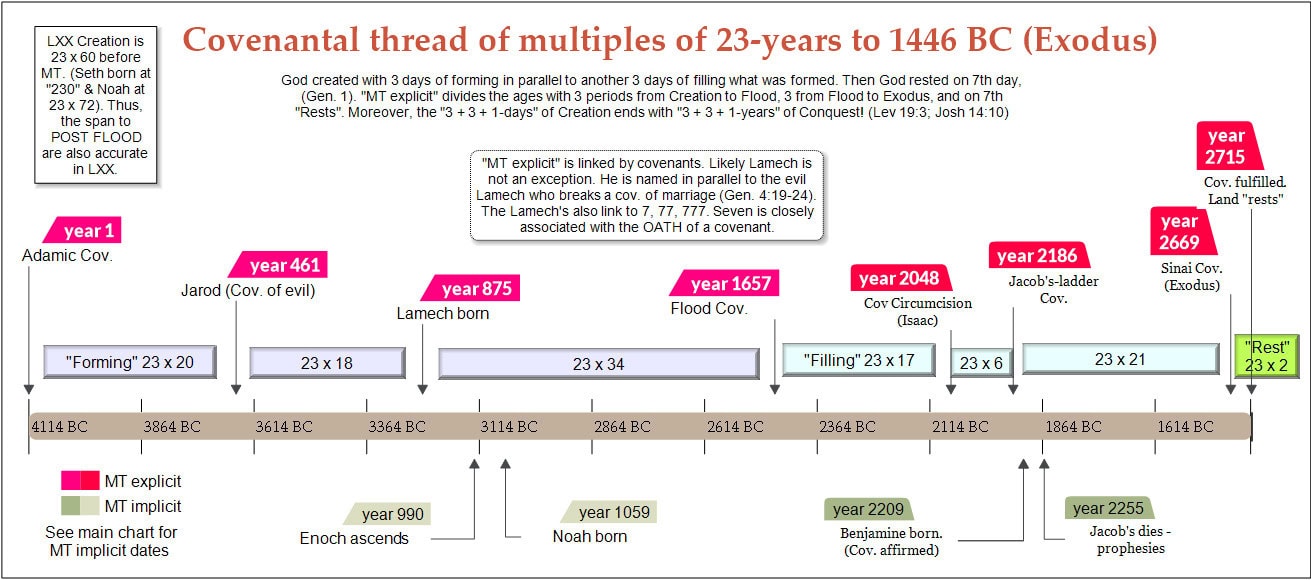
| Chart item | Original AM / quantity | Current selected display | Assessment |
|---|---|---|---|
| Adam / endpoint | 1 | 4114 BC / AM1 | Numbered AM, endpoint-root state |
| Jared birth | 461 | 3654 BC / AM461 | 460=23×20 from root |
| Lamech birth | 875 | 3240 BC / AM875 | 414=23×18 from Jared |
| Enoch ascent | 990 | 3127 BC / AM988 | Legacy 3125 implied; current ordinary table controls |
| Noah birth | 1059 | 3058 BC / AM1057 | Legacy 3056 implied; current ordinary MT controls |
| Flood | 1657 | 2458 BC / AM1657 | 782=23×34 from Lamech |
| Covenant / Isaac promised | 2048 | 2067 BC / AM2048 | 391=23×17 from Flood |
| Jacob ladder / flight | 2186 | 1929 BC / AM2186 | 138=23×6 |
| Benjamin birth | 2209 | 1906 BC / AM2209 | Reconstructed modern BC input |
| Jacob death | 2255 | 1859 BC / AM2256 | Legacy 1860 implied; current ordinary table controls |
| Exodus | 2669 | 1446 BC / AM2669 | 483=23×21 |
| Rest boundary | 2715 | 1400 BC / AM2715 | 46=23×2; interval edge, ordinary rest 1399 |
| LXX–MT Creation margin | 1380 | 5494−4114=23×60 | Separate ordinary textual states |
| LXX Seth begetting margin | 230 | 230 | LXX input; not MT |
| MT Creation-to-Flood margin | 1656 | 23×72 | Ordinary MT |
| Derived covenant-to-Exodus sum | 621 | 2067−1446=621=23×27 | Derived comparison, not an original image label |
The main sequence forms seven intervals: three forming, three filling and one resting. This is compared with Genesis’ creation-week structure. The image also proposes a 3+3+1 conquest division by analogy with that week; it is retained as a schematic theological arrangement, not three independently dated conquest stages. The ordinary 1406→1399 interval is seven. Watcher oath/covenant traditions are supplied by 1 Enoch; Jared’s ordinary birth comes from Genesis 5. Genesis 4’s Lamech supplies the vengeance/two-wife context, contrasted with Genesis 5’s Lamech and Noah’s promised relief. The source’s seven/seventy-seven/777 oath vocabulary remains a theological comparison. An image label “explicit” refers to text-derived ages or sequence, not a claim that every modern BC date, conception boundary and interpretive division is written in Scripture.
Three 1656-year fields
The second original chart is available here. Its comparison is the following full-430/equalized state:
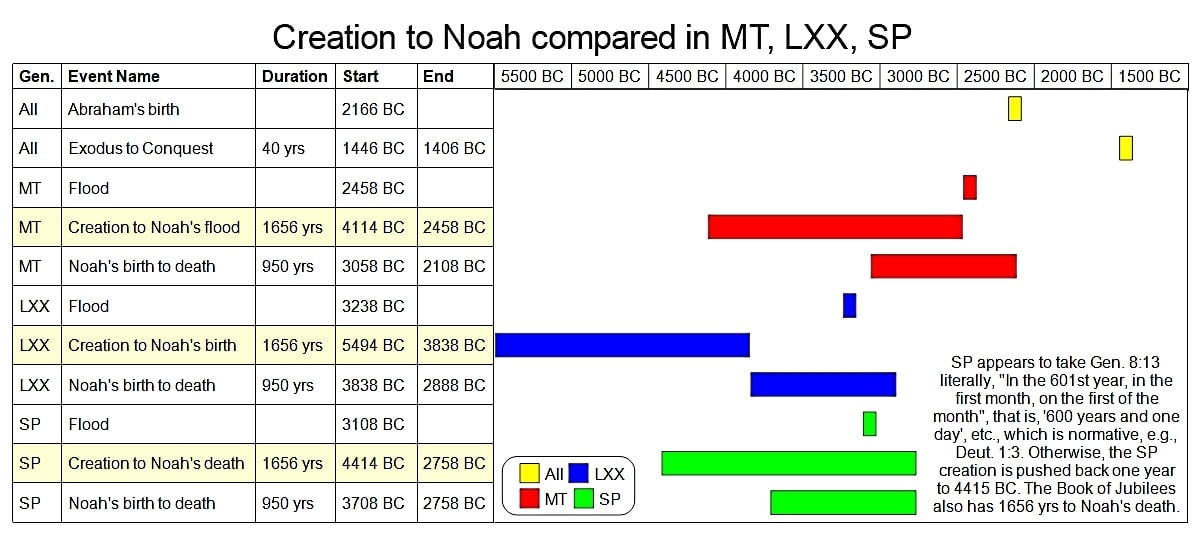
| Tradition | Creation | Noah birth | Flood start | Noah death | 1656-year field |
|---|---|---|---|---|---|
| MT ordinary | 4114 | 3058 | 2458 | 2108 | Creation → Flood |
| LXX main selection, native Cainan | 5494 | 3838 | 3238 | 2888 | Creation → Noah birth |
| SP native +215 equalized, primary Gear 2 | 4414 | 3708 | 3108 | 2758 | Creation → Noah death |
| SP adjacent biography companion | 4414 retained | 3707 | 3108 start / 3107 adjacent year | 2757 | Adjacent Noah biography, not new Adam head |
Every primary Noah biography above is 950 years. The SP image prints 1665 in the Creation-to-Noah-death field; 4414−2758=1656 corrects that transcription. Native SP Noah 3493→2543 translated +215 becomes 3708→2758. The 3707→2757 companion is one-year adjacent person-station accounting.
The older image caption proposes 4415 as a necessary alternative Creation head for its Flood/Arphaxad account. File 18 §3.1 specifically retains the 4199 native / 4414 equalized head while allowing the adjacent Noah/Shem rail; 4415 is superseded for the active comparison. The source proposal is documented here so it is not lost as historical reasoning. It must not become a fresh canonical upstream chain head.
The common lower anchors, Abram 2166 and Exodus 1446→Conquest 1406, remain the selected comparison coordinates. Main canonical LXX Lamech is 753, with native Cainan; MT’s 777 is not silently imported into that LXX table. Book of Jubilees offers a separate Creation-to-Noah-death architecture, under File 20; it supports the thematic comparison without supplying the SP’s transmitted verse text.
10. The modern overlay: preserved proposals and missing derivation
The source explicitly keeps this overlay secondary. The whole surviving datum row is:
| Julian day | Datum label | A | B | C | D |
|---|---|---|---|---|---|
| 2430941.5 | Tishri A, 1943 | 0 | −180 | −4020 | −4230 |
The article’s proposed outputs are AD1955 seven years after Israel’s 1948 nationhood, another seven to 1962, and a fifth-month tenth-day placement at 28 December 1962. It states an exact-day relationship to 1948, but does not supply a full modern table identifying the event row, datum assignment, day boundary or insertions. The present rewrite retains that statement as a source proposal needing those details. It does not invent a missing table or treat absence from the repository as contradiction.
The alternate midpoint 2855, thirty beyond Exile B’s 2825, is assigned to different leap placement in this overlay. Its check 1446 BC→AD2855=4300 is executable. The source’s lunar 1240+1240=2480 is retained both as a day-level quantity and as a 2480-year application toward 1948–1955. At NASA’s mean lunation 29.53059, 84 months are 2480.56956 days; this is an unintercalated lunar register. Seven civil solar years at 365.2422 give 2556.6954 days. The exact rounded difference 2520−2480=40 survives; it does not prove a specific lunisolar historical interval.
The linked tenfold proposal gives the labels “4300 BC” for Exodus and “4700 BC” for entry in the modern overlay. Their sign/epoch mapping is not defined in the pasted row. Their conserved span-content is 430×10=4300, 470×10=4700, and 40×10=400 for the wilderness difference. The 2825/2855 mapping and bare epoch labels therefore remain separate unfinished parts of the original proposal.
Extending chart readouts into AD4145/4295 retains the author’s possible continuing theological meaning. A generated coordinate alone does not identify a future event. This separation leaves the proposal readable without adding an event prediction the source did not demonstrate.
11. Sources and control map
| Subject | Controlling repository files | Use in this study |
|---|---|---|
| Ordinary roots and patriarchs | Files 07, 18 | 4121/4114 envelope; MT/SP/LXX roots, biographies and event dates |
| Kings and restoration ledgers | Files 08, 18, 34, 64 | 966 versus 1016; 536 historical versus 486 computational; 50-year comparison |
| Calendar and span grammar | Files 12, 17, 23 | 360/364/336; leap treatment; week/day and seasonal state |
| Mirror and scaling | Files 00, 09, 44 | Operator separation; single/pair phase rules; span versus coordinate scaling |
| Egypt nexus and Christological comparisons | Files 13, 14, 16, 55 | Ordinary dates, birth/ministry phase, 400/430 and two-year comparisons |
| Enoch/Jubilees | Files 20, 31 | External chronological architecture and interpretive comparison |
| Numerical harmonics / ancillary state | Files 19, 22, 63, 65 | 430, 23 and 480/483/490 families; controls rather than blanket canonization |
Open the canonical directory. The accompanying publication evidence contains the retrieved files and their SHA-256 receipts. The source-conservation record identifies the original block ranges and the active destination of each substantive family. No repository edit is included in this article package.
Read the original Part 2b dialogue.
Scripture quotations marked BSB are from the Berean Standard Bible (BSB), public domain. Official terms.
Scripture taken from the Holy Bible, NEW INTERNATIONAL VERSION®, NIV® Copyright © 1973, 1978, 1984, 2011 by Biblica, Inc.® Used by permission. All rights reserved worldwide. Official quotation permissions.