Ezekiel’s symbolic siege begins with an instruction that supplies its own scale:
“When you have completed these days, lie down again, but on your right side, and bear the iniquity of the house of Judah. I have assigned to you 40 days, a day for each year.”
— Ezekiel 4:6, Berean Standard Bible (BSB).
The preceding instruction assigns 390 days to Israel. Together, the two burdens give 390 + 40 = 430. This study follows that number through the symbolic dates generated by the Exile and Return charts. Its central argument is that the same measured span repeatedly meets covenantal events: Israel’s descent into Egypt, the Exodus, the Temple, exile, and restoration. The finer comparisons bring Joseph, Isaac, the opening of a prophet’s mouth, and Christ’s ministry into that framework.
The numbers and their interpretation belong together. I read the recurrence of the same divisions as an expression of covenant continuity: judgment reaches the house that has broken the covenant, yet God preserves its promised seed and prepares a return. Each comparison below states its anchors so that this reading can be assessed through the calculations that support it.
Contents of this detailed study
- The three-block framework
- Four datums
- 2520, 2550 and 2580
- The 430-year corridor
- Column B
- The opened mouth and Egypt
- The exact siege day
- Jubilees and Danielic sevens
- Joseph, Isaac and Return C
- The 400/430 alternatives
- The 23-to-25 expansion
- Seventy elders and twenty-five men
- Mirror controls
- Temple and Kings ledgers
- The original covenant charts
- The modern overlay
- Interpretation
- Original dialogue
1. The large framework: three blocks of 430 years
The starting framework is the one emphasized in File 08 §1.1 and controlled by the chronological tables:
| From | To | Span | Meaning of the endpoint |
|---|---|---|---|
| 1876 BC | 1446 BC | 430 years | Jacob’s entry into Egypt → Exodus, in the ordinary MT Egypt-only frame |
| 1446 BC | 1016 BC | 430 years | Exodus → schematic Temple pivot |
| 1016 BC | 586 BC | 430 years | Schematic Temple pivot → Jerusalem’s fall |
| 1876 BC | 586 BC | 1290 years | The three blocks taken together |
The 1016 BC pivot belongs to the verbatim/schematic Kings ledger. The ordinary Temple foundation remains 966 BC, reached by 1446 − 480 = 966. Their 50-year difference is an explicit relationship between ledgers. It is essential to the argument, because calling both dates the same historical foundation would erase the distinction that explains the pattern.
The blocks can be opened internally as 390 + 40, 40 + 390, and 390 + 40: 1876→1486→1446, 1446→1406→1016, and 1016→626→586 BC. Moses’ Midian period and the wilderness occupy the two forty-year divisions around the Exodus. The 626 coordinate supplies the Jeremiah-call comparison in the final block. These are the centuries-long framework within which the day-sized measurements operate.
2. What the four datums actually do
A datum is the reference point from which a table counts days. A single event receives four coordinates because its Julian day number is compared with four different reference points. Changing a datum changes the coordinate; it does not change the biblical event.
| Column | Exile table reference | Return table reference |
|---|---|---|
| A | Tishri, 598 BC | Tishri, 457 BC |
| B | Nisan, 597 BC | Nisan, 456 BC |
| C | Tishri, 587 BC | Tishri, 446 BC |
| D | Nisan, 586 BC | Nisan, 445 BC |
The original discussion sometimes called B the 586 BC datum. The copied values themselves identify B as the 597 BC Nisan reference and D as the 586 BC Nisan reference. Their separation is 4020 model days. Keeping the labels attached to their columns is necessary to reproduce the comparisons.
For an event with Julian day number (J), the whole-day cell is floor(J − datum JD). The fractional timestamp remains part of the source record. The day–year reading then treats the signed whole-day value as an astronomical year number: zero becomes 1 BC, −5 becomes 6 BC, and positive 95 becomes AD 95. Thus the rule for a nonpositive coordinate is BC label = 1 − coordinate.
This is a symbolic projection. The sign alone does not turn the result into a historical AD event or invoke the repository’s formal Mirror. When a comparison crosses the civil BC–AD boundary, its elapsed-year check is BC + AD − 1.
The two working tables preserve the Exile/Return relationship discussed in the methodology. Their corresponding integer reference years differ by 141, while the wider restoration argument also uses 139, their mean 140, and explicitly seasonal 140.5. The reconstructed tables include a calendar refit: the call cluster changes by 51,480 days, while B/C/D and the siege/report cluster change by 51,510. Accordingly, Return C’s call is 30 day-years earlier than Exile C’s call. The full matrices and transfer notes are directly available.
3. The seven-year forms: 2520, 2550, and 2580
The call-week in Tammuz 593 BC and the containing Tammuz week in 586 BC frame seven years. On the 360-day base, that gives 1260 + 1260 = 2520 days. Counting the model’s 588n intercalary month gives 1260 + 1290 = 2550. Moving from Tammuz to Av adds an ordinary month: the corresponding Temple window gives 2550 with the leap omitted, or 2580 with it counted.
These forms preserve the distinction established in Part 2a between a containing week and an exact day. The carried unit runs from the fifth to the twelfth day of its month; an actual ninth, seventh, or tenth-day notice selects a position within that unit. Likewise, +390 retains the 5–12 month-day window on the 360-day base, while +430 closes in the 15–22 window. The inserted month may be included in a declared calculation or omitted from its harmonic register.
The model’s forty-year cycle begins at 606n BC and closes its constituent spans at 600n, 594n, 588n, 582n, 576n, 570n, and 566n BC. This is the same 6+6+6+6+6+6+4 structure carried from the 1446 BC phase; 6 BC stands 36 forty-year cycles later. The calendar reconstruction is controlled by File 12 §7A. Its schedule and a particular calculation’s treatment of the inserted month are separate choices.
Column D makes the seven-year comparison visible at the day–year scale:
| Column D marker | Symbolic coordinate | Interval from the call |
|---|---|---|
| Call-week start | 2456 BC | 0 |
| Selected half-week marker | 1196 BC | 1260 |
| City-fall containing-week start | AD 95 | 2550 |
| Temple-fall containing-week start | AD 125 | 2580 |
| First-refugee marker | AD 275 | 2730 |
The checks are 2456 + 95 − 1 = 2550 and 2456 + 125 − 1 = 2580. AD 95 is the city marker; AD 125 is the Temple marker. They are projections of the ancient events, rather than additional historical destructions in those AD years.
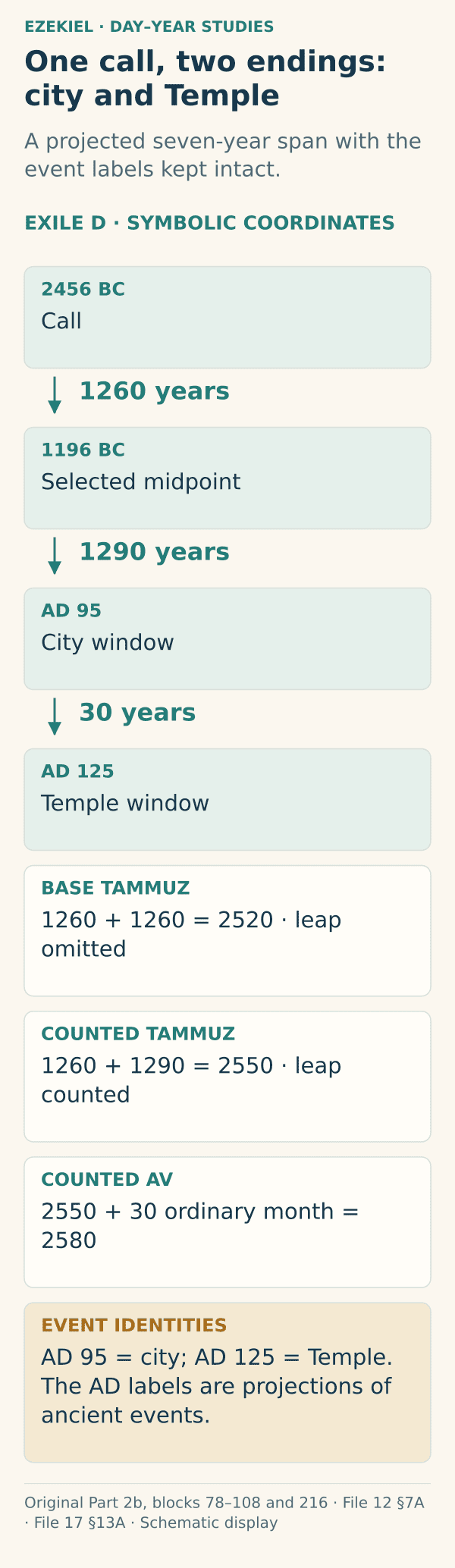
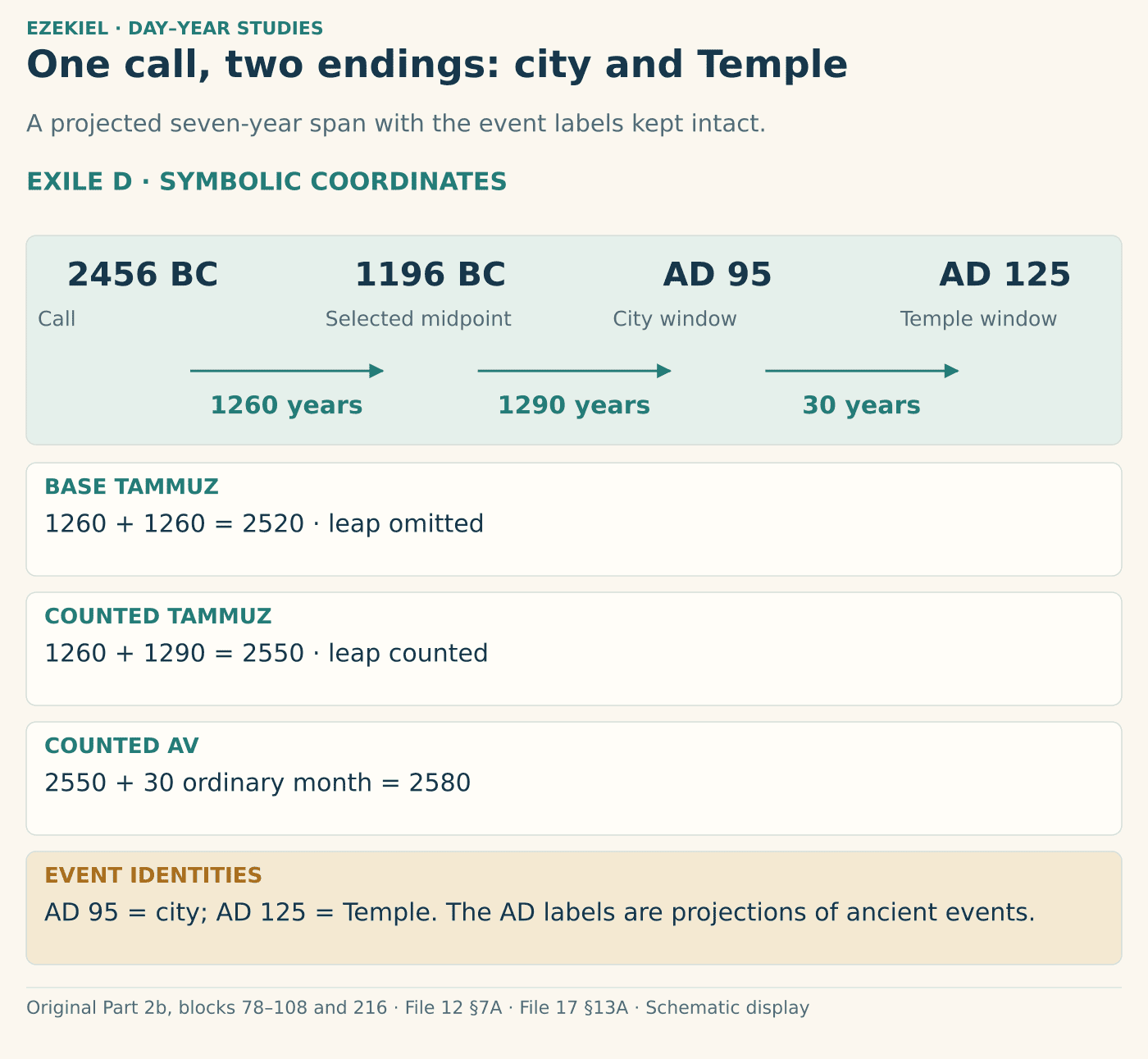
The source’s decomposition into “time, times, and half a time” survives at the component level. A half-week is 360 + 720 + 180 = 1260; counting a month with its first year gives 390 + 720 + 180 = 1290. The selected displayed midpoint 1196 BC gives a 1260 first leg and a 1290 second leg to AD 95. The original occasionally reversed those labels while retaining these endpoints. If the extra month is instead assigned to the first leg, its midpoint changes; the same printed midpoint cannot mean both lengths simultaneously.
The remaining 180-day half-year is also expressed by the Tishri/Nisan datum separation. Together these comparisons explain the source’s finer time/times/half-time reading without confusing a single 390-day year with a whole 1290-day half-week. Daniel 12:7, 11 and Revelation 12:6, 14 provide the related textual counts and expressions; the detailed decomposition is the study’s interpretation.
4. The 430-year corridor through the tables
Column D’s first-refugee marker, AD 275, joins the ordinary 1876→1446 framework through repeated 430s:
| Comparison | Calculation | Result |
|---|---|---|
| Egypt entry → AD 275 | 1876 + 275 − 1 | 2150 = 5 × 430 |
| Exodus → AD 275 | 1446 + 275 − 1 | 1720 = 4 × 430 |
| Jerusalem’s fall → AD 275 | 586 + 275 − 1 | 860 = 2 × 430 |
In Return C, the call, completion, selected siege window, and later city window supply 2306 BC, 1876 BC, 1016 BC, and AD 275. These combine with ordinary 1446 and 586 BC to extend the corridor:
2306 → 1876 → 1446 → 1016 → 586 BC → AD 275.
The first four intervals are 430 years each. The final interval is 860, two blocks, bringing the total to 2580 = 6 × 430 = 1290 + 1290. The intermediate boundary of that final 860 is the calculated label 156 BC; it is a mathematical joint, not an independently dated narrative event.
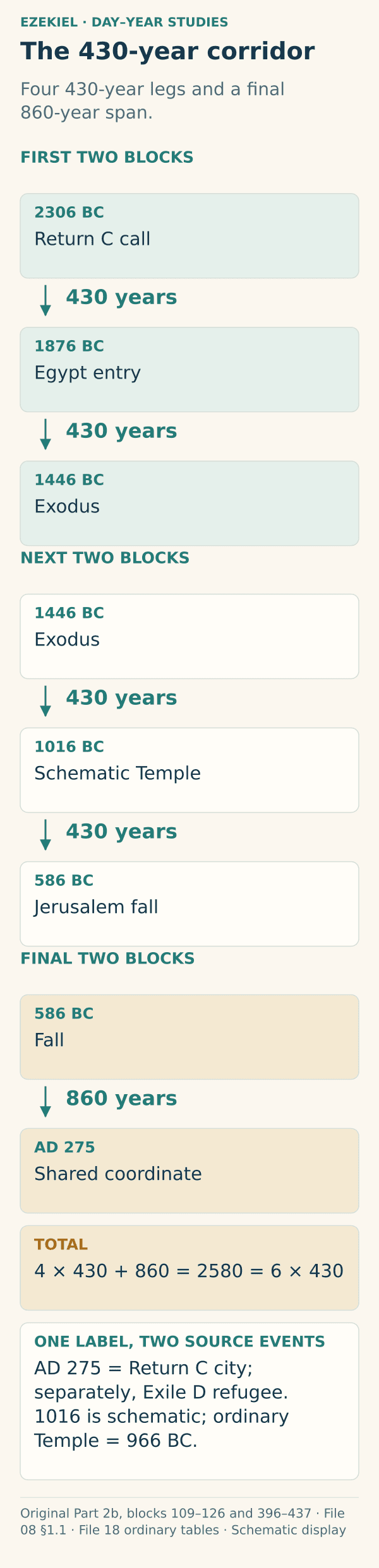
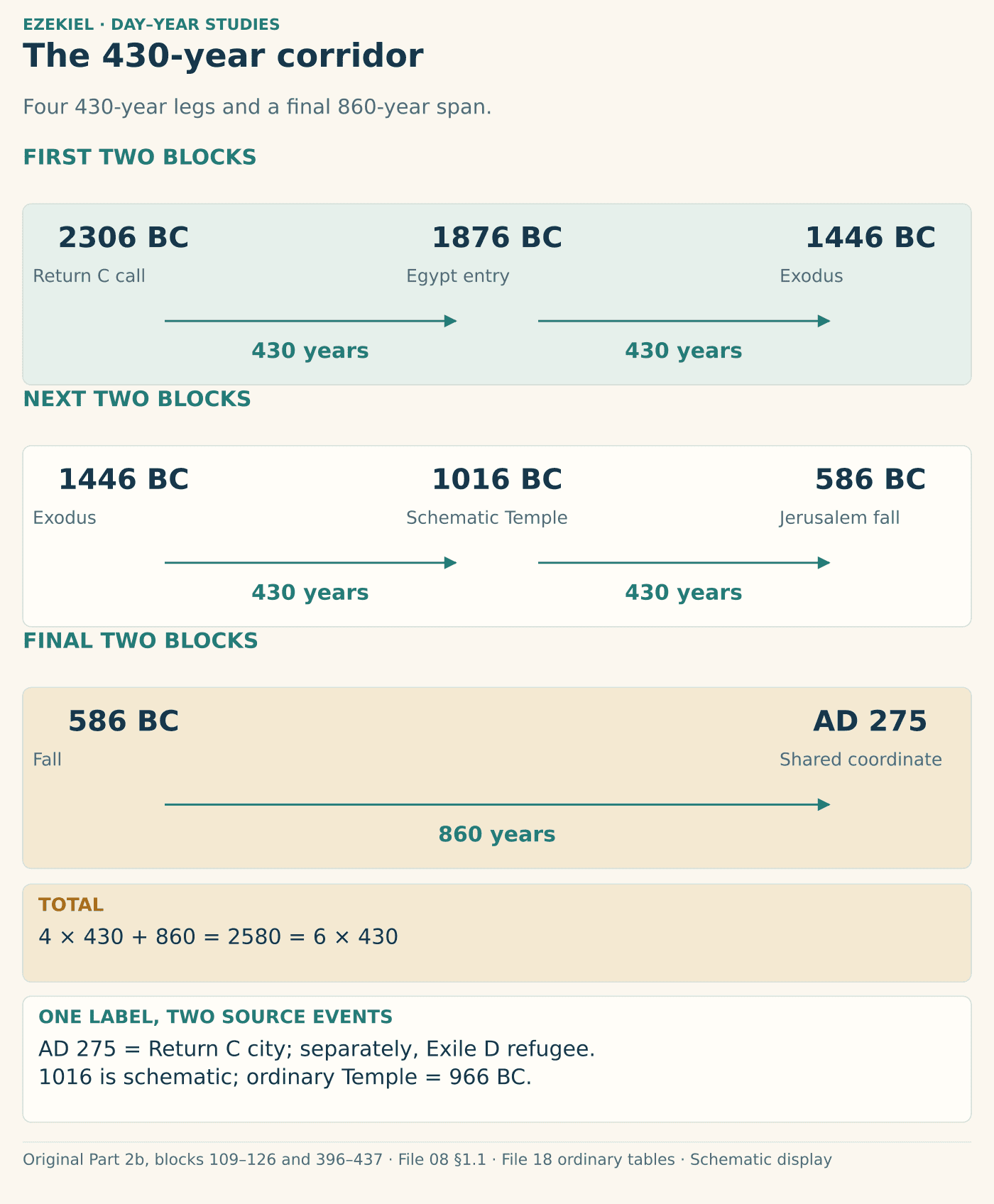
The same AD 275 label consequently appears in two roles: Exile D’s refugee marker and Return C’s city marker. This overlap is one of the original study’s important observations. It does not identify those two source events as one event. It shows that changing the table and datum can place their projections on a shared coordinate.
The earlier proposed Adar-25 placement provides a related six-block comparison. Five days before the selected Nisan reference gives the signed coordinate −5, read as 6 BC. Against the other Nisan reference, the selected deportation placement gives −4025, read as 4026 BC:
4026→1876→1446 BC = 2150 + 430 = 2580.
The selected Adar date remains a hypothesis; it is not the separately printed deportation row’s 4020/4021 readout. Joseph’s proposed symbolic windows 4035→4028→4021 BC and ordinary-model 1885→1878→1871 BC each contain seven plentiful and seven famine years, with corresponding endpoints 2150 years apart. Their offset is retained as a distinct proposed overlay, rather than forced into agreement with the 4026 anchor. These constructions connect preservation in famine, Egypt, and the Exodus through the same five-plus-one 430 division.
5. Column B: the same action in a different coordinate frame
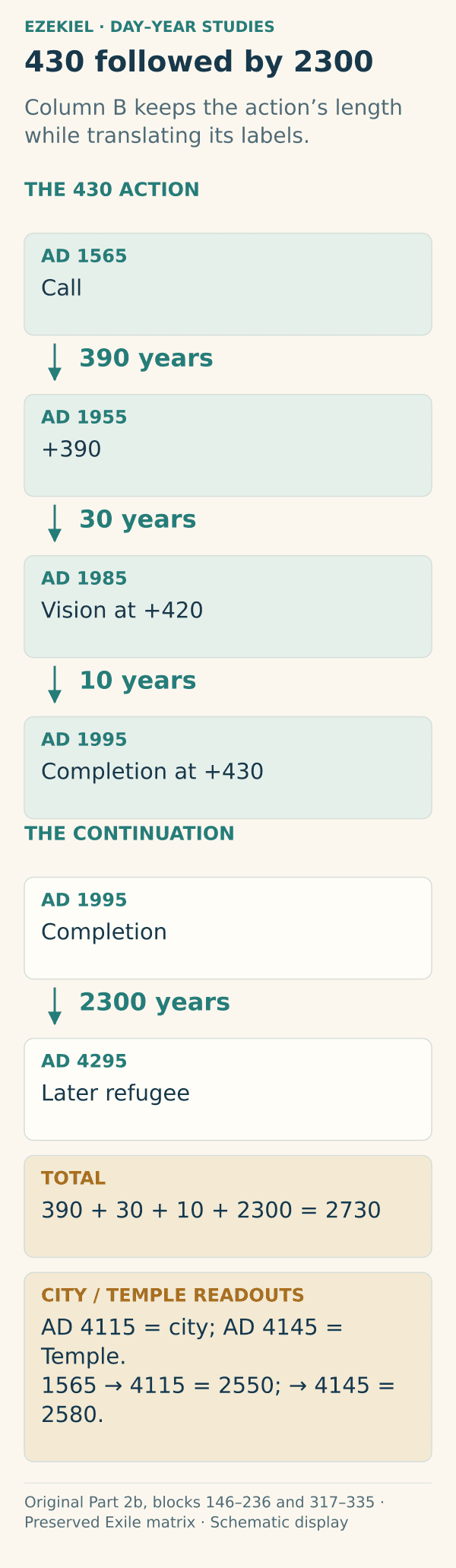
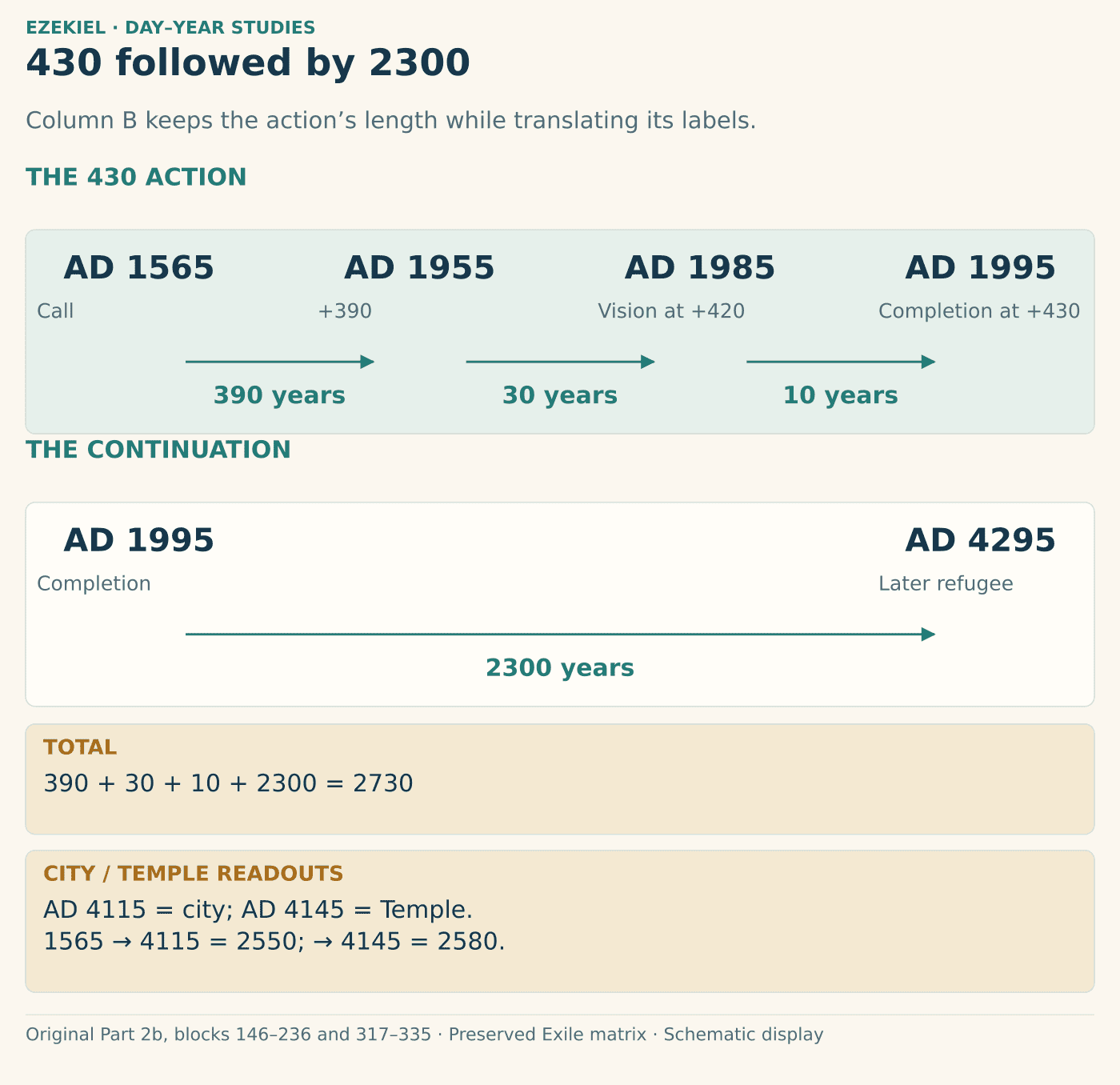
The Exile B readout projects Ezekiel’s call to AD 1565 and the +430 completion to AD 1995. The action remains 430 because both endpoints change together when the datum changes.
| Exile B event or derived marker | Day–year readout |
|---|---|
| Call-week start | AD 1565 |
| Call +390 days | AD 1955 |
| Temple vision / call +420 days | AD 1985 |
| Call +430 days | AD 1995 |
| Selected half-week siege window | AD 2825 |
| Other siege window | AD 3185 |
| Alternate city/Temple windows | AD 3755 / AD 3785 |
| Earlier first-refugee window | AD 3935 |
| Later city/Temple windows | AD 4115 / AD 4145 |
| Later first-refugee window | AD 4295 |
The full table retains the datum rows, signs, braces, asterisks and all other generated outputs. The asterisks identify source alternatives; they should not disappear merely because a particular readout is selected for illustration.
Several long spans now close on the same 430-unit corridor:
| Comparison | Span |
|---|---|
| 586 BC → AD 1565 | 2150 = 5 × 430 |
| 586 BC → AD 1995 | 2580 = 6 × 430 |
| 2306 BC → AD 1995 | 4300 = 10 × 430 |
| 1876 BC → AD 1995 | 3870 = 3 × 1290 |
| AD 1995 → AD 4145 | 2150 = 5 × 430 |
| AD 1565 → AD 4145 | 2580 = 6 × 430 |
| 586 BC → AD 4145 | 4730 = 11 × 430 |
| 1446 BC → AD 4145 | 5590 = 13 × 430 |
| 1876 BC → AD 4145 | 6020 = 14 × 430 |
| 2306 BC → AD 4145 | 6450 = 15 × 430 |
The final 6450-year comparison is ten times 2091−1446 = 645, the ordinary Abraham-call-to-Exodus interval. Here “ten times” is a proportional comparison of spans. It does not automatically make the calculation a formal 10× Mirror.
The seven-year subdivision also survives: 1565→2825→4115 = 1260 + 1290. Extending from the city marker 4115 to the Temple marker 4145 adds the ordinary month, giving 2580 from the call. Thus 1260+1290 is 2550, while the Temple form is 2580; the original summary mistakenly equated the two totals.
6. The refugee, the opened mouth, and “out of Egypt”
The refugee’s report marks a turning point in Ezekiel 33:21–22. Ezekiel’s mouth opens in the evening before the fugitive comes to him in the morning. The symbolic chart’s AD 4295 readout reaches the chosen 6 BC birth anchor through 6 + 4295 − 1 = 4300.
I connect the restoration of prophetic speech with Zechariah in Luke 1:59–64. His mouth opens at John’s eighth-day naming and circumcision. The texts locate both openings carefully: one around the evening/morning arrival of the refugee, the other after John’s birth at his naming. Their correspondence concerns speech restored at a covenantal turning point, rather than an assertion that both happened at the instant of a birth or arrival.
The Egypt theme continues in Hosea 11:1 and Matthew 2:13–15. Matthew applies Israel’s sonship language to Jesus’ return from Egypt. Israel’s 430-year sojourn and the chart’s 4300 comparison supply the numerical scale; the opening of the mouth and preservation of the promised son supply its narrative meaning. The 6 BC coordinate is the study’s chosen chronological anchor, not a year printed by Luke.
7. The exact siege day and the sin-bearer comparison
Ezekiel 24:1–2 dates the siege notice to the tenth day. Its containing fifth-to-twelfth-day window gives symbolic 836–829 BC in the selected D readout, with the tenth-day position five days after its first boundary: 836−5 = 831 BC.
That selected point supplies 831 BC→AD 30 = 831+30−1 = 860 = 430+430. I read this doubling in relation to Christ’s bearing sin, with Ezekiel’s representative burden furnishing the type. AD 30 is the retained Passion alternative used by this comparison; AD 33 remains the preferred ordinary Passion anchor elsewhere in the project. The calculation does not establish AD 30 as the beginning of Jesus’ ministry.
The original also follows the thirty-year increment AD 30→AD 60. It compares the month-sized adjustment in day–year units with the closure of Acts around Paul’s captivity in Rome:
| Comparison | Span |
|---|---|
| 831 BC → AD 30 | 860 |
| 831 BC → AD 60 | 890 = 860 + 30 |
| 2091 BC → AD 60 | 2150 = 5 × 430 |
| 2091 BC → 1876 BC | 215 = half of 430 |
| 1876 BC → 1446 BC | 430 |
The ordinary 2091 coordinate identifies Abraham’s Haran-to-Canaan departure, with Ur belonging to the preceding narrative. The source’s “215 days” between 2091 and 1876 is corrected to 215 years; the separate day–year projection remains available when explicitly applied. The long 2150 comparison gives the tenfold counterpart.
The AD 60 association is a reconstructed Pauline horizon. Acts 28:30–31 also gives two years of residence in Rome, so arrival and the narrative’s terminal residence should not be treated as the same dated moment. The source’s larger point survives: the movements from Mesopotamia, into Egypt, and toward Rome are read as covenant history carried through different forms of exile.
8. Danielic sevens and forty jubilees
The original brings the 430 corridor beside the 490 family. Column B offers these checks:
| Comparison | Calculation | Result |
|---|---|---|
| Ordinary Temple → earlier refugee marker | 966 + 3935 − 1 | 4900 |
| 606 BC exile horizon → later refugee marker | 606 + 4295 − 1 | 4900 |
| 586 BC fall → later refugee marker | 586 + 4295 − 1 | 4880 |
| 1446 BC Exodus → Temple-vision marker | 1446 + 1985 − 1 | 3430 = 70 × 49 |
The 606 horizon belongs to the repository’s 606/605 convention. Daniel 9:1–2 places the chapter in Darius’ first year, rather than naming 536 BC; 536 remains the project’s return/foundation comparison. Moreover, the third line is 4880, not the original’s claimed 4830. Its intended Danielic 4830+70=4900 division remains a useful number-family comparison, but these particular 606/586 endpoints differ by twenty, not seventy, and cannot prove it.
Daniel’s seventy weeks are 70×7 = 490, divided as 7×7 + 62×7 + 7 = 49+434+7. Splitting the final week gives 49+434+3.5+3.5 = 490. The original’s 343 in this equation is a transcription/calculation mistake; its separate 3430-year comparison remains valid.
In the 49-year register, 40 jubilees = 1960 years and 30 jubilees = 1470 years. The B readouts produce two corresponding forty-jubilee windows:
| Earlier window | Later symbolic window | Separation |
|---|---|---|
| 6 BC → AD 2 | AD 1955 → AD 1962 | 1960 between corresponding boundaries |
| AD 25 → AD 32 | AD 1985 → AD 1992 | 1960 between corresponding boundaries |
For example, 6+1955−1 = 1960, and 1985−25 = 1960. A seven-year envelope can contain eight named integer boundaries; that is the same inclusive/elapsed distinction used by the carried week. The ordinary AD 33 Passion is not silently inserted into a displayed interval that closes at AD 32; its month/phase or inclusive companion must be declared separately.
The second comparison connects 1446 BC→AD 25 = 1470 with AD 25→AD 1985 = 1960, giving 1470+1960 = 3430, thirty plus forty jubilees. I relate this to Luke’s description of Jesus as about thirty at his ministry’s beginning, the forty-day wilderness testing, and the male-child purification period. Those textual counts are found in Luke 3:23, Luke 4:1–2, 18–19, Leviticus 12:2–4, and Luke 2:22–35. The use of forty jubilees as their larger counterpart is my interpretation. The 49-year schematic unit is stated explicitly; it does not erase the fiftieth-year language of Leviticus 25.
9. Return C: Joseph, Isaac, and the promised seed
The call and subsequent markers in Return C are especially important because they meet the patriarchal chronology:
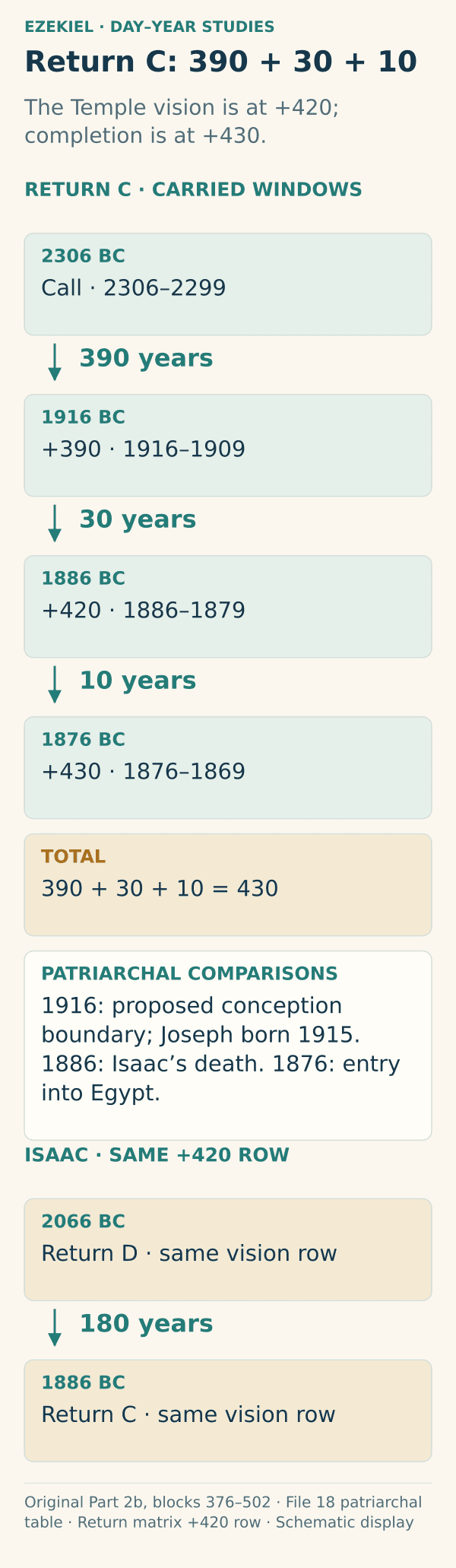
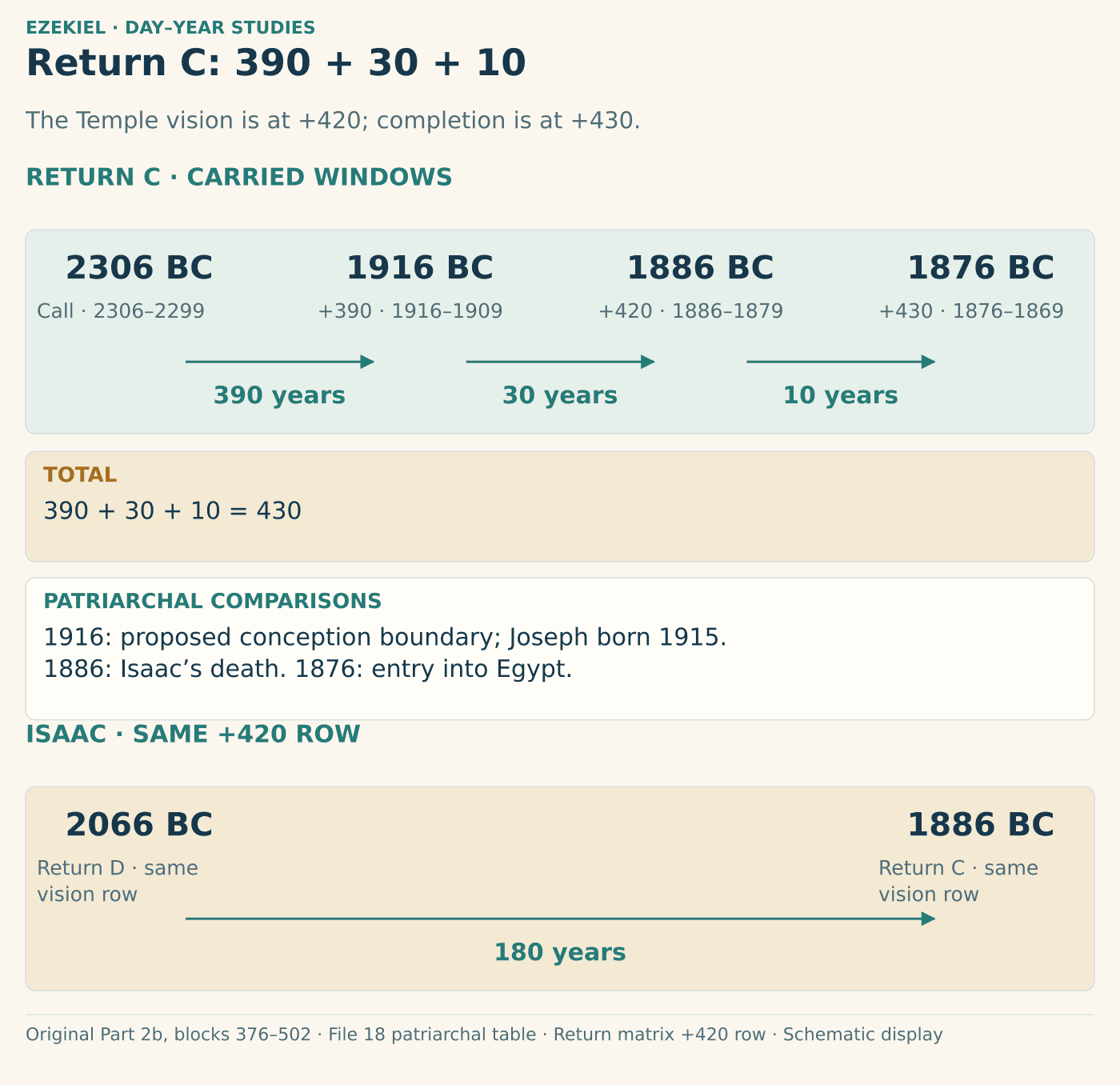
| Marker | Return C readout | Interval from the call | Narrative comparison |
|---|---|---|---|
| Call-week | 2306–2299 BC | 0 | 2300-year window toward the chosen birth frame |
| +390 | 1916–1909 BC | 390 | Reconstructed Joseph-conception boundary → Jacob’s return to Canaan |
| Temple vision / +420 | 1886–1879 BC | 420 | Isaac’s death boundary; Joseph’s household during the plentiful years |
| +430 completion | 1876–1869 BC | 430 | Jacob’s entry into Egypt; a window two years later than the famine frame |
The call-week 2306–2299 BC reaches 6 BC–AD 2 through a 2300-year translation. In Exile C the call-week is 2276–2269 BC, thirty years later, and reaches AD 25–32 through the same translation: 2276+25−1 = 2300. I read that change alongside Christ’s birth and ministry, including the cleansing of the Temple. Luke supplies the about-thirty description; the thirty-year relationship here comes from the two calendar tables.
Joseph’s ordinary birth is 1915 BC. The preceding 1916 point is a reconstructed conception-year label, not an additional date stated by Genesis. The births and conceptions in Genesis 29–30 establish the household narrative, while the chronology supplies its modern BC coordinates. Joseph is the last son born before Jacob’s return from Haran in 1909 BC; Benjamin is born later in Canaan. The carried 1916–1909 window thus reaches from the proposed conception boundary to the return.
Joseph goes ahead into Egypt to preserve the family. His sons Ephraim and Manasseh are associated with the northern house, and Ephraim becomes a representative name for Israel. I therefore read the +390 division, assigned to Israel in Ezekiel 4, as fitting the Joseph/northern-house story. The contrast between exile and return is reinforced by the LXX’s inclusion of Canaan and Egypt in the sojourn wording. The ordinary MT baseline here remains 430 years in Egypt; an alternative Canaan-and-Egypt allocation must retain its own textual and chronological state.
Isaac’s ordinary life is 2066→1886 BC = 180 years. Within the Return table’s same Temple-vision row, D gives 2066 BC and C gives 1886 BC. The 180-year difference comes from the half-year, 180-day C/D datum separation. The earlier Exile D +390 marker also reads 2066 BC, but it is a different row in a different table. This distinction repairs the original’s event labels while preserving its Isaac correspondence.
The C point at 1886 is +420, not the end of +430. The thirty days from +390 to +420, followed by ten days to +430, explain the full 390+30+10 = 430 action. Isaac’s death and the birth of Joseph’s sons during the plentiful years form a covenantal succession reading of the 1886–1879 window. Genesis dates those sons before the famine, without printing a separate BC birth year for each.
The following 1876–1869 completion window overlaps, but does not equal, the ordinary famine 1878–1871. The two-year difference is one of the hinges that the next section preserves.
10. The 400/430 alternatives and the 2300 continuation
The actual entry in the ordinary MT frame is 1876 BC. Counting four hundred years back from the Exodus yields 1846 BC as a figurative entry coordinate: 1846−1446 = 400. Genesis 15:13 provides the four-hundred-year oppression statement, while Exodus 12:40–41 supplies the 430-year sojourn. Their scope must be considered before treating one as a mechanical rounding of the other.
The source uses the thirty-year difference as a day–year counterpart of a month. Toward the exile it gives 1876−586 = 1290 and 1846−586 = 1260. This is a symbolic relationship between two declared entry coordinates; it does not redetermine Jacob’s ordinary entry or turn a year in Egypt into a 336-day year.
Return C’s later refugee alternative reads AD 455. Its continuation checks as:
1846 BC→6 BC→AD 455 = 1840 + 460 = 2300.
The first piece is 1846−6 = 1840; the second is 6+455−1 = 460. This preserves the original’s 2300/460 decomposition. The 460 family also appears at Adam-to-Jared: 4114−3654 = 460. In 1 Enoch 6:6, Charles translation, the Watchers’ descent is placed in Jared’s days. Genesis supplies Jared’s place in the genealogy; the Enochic text supplies the external narrative association. It does not itself print the calculated 460-year interval or date Adam’s fall by a modern BC coordinate.
The source’s tenfold Egypt/wilderness comparison is retained as well: 430×10 = 4300, 470×10 = 4700, and their difference 400 = 40×10. The original’s bare 4300/4700 BC labels lack an explicit origin in the copied modern table. Their preserved, executable content is the scaling of the 1876→1446 and 1876→1406 spans. The full supporting notes identify the remaining epoch-dependent label proposal.
11. Twenty-three days, two years, and the Temple vision
A small interval in the chart supplies a proposed link to the Key of 23. The call +390 marker carries a seven-day window. From the end of that carried week to the +420 Temple vision:
420−(390+7) = 23.
The exact Priestly expansion is 23×25/23 = 25, adding 2 units. With the later endpoint fixed at Return C’s 1886 BC Temple-vision point, the original 1909→1886 gap of 23 becomes 1911→1886, a gap of 25. Restoring the seven-year window before that earlier boundary moves its first edge from 1916 to 1918 BC.
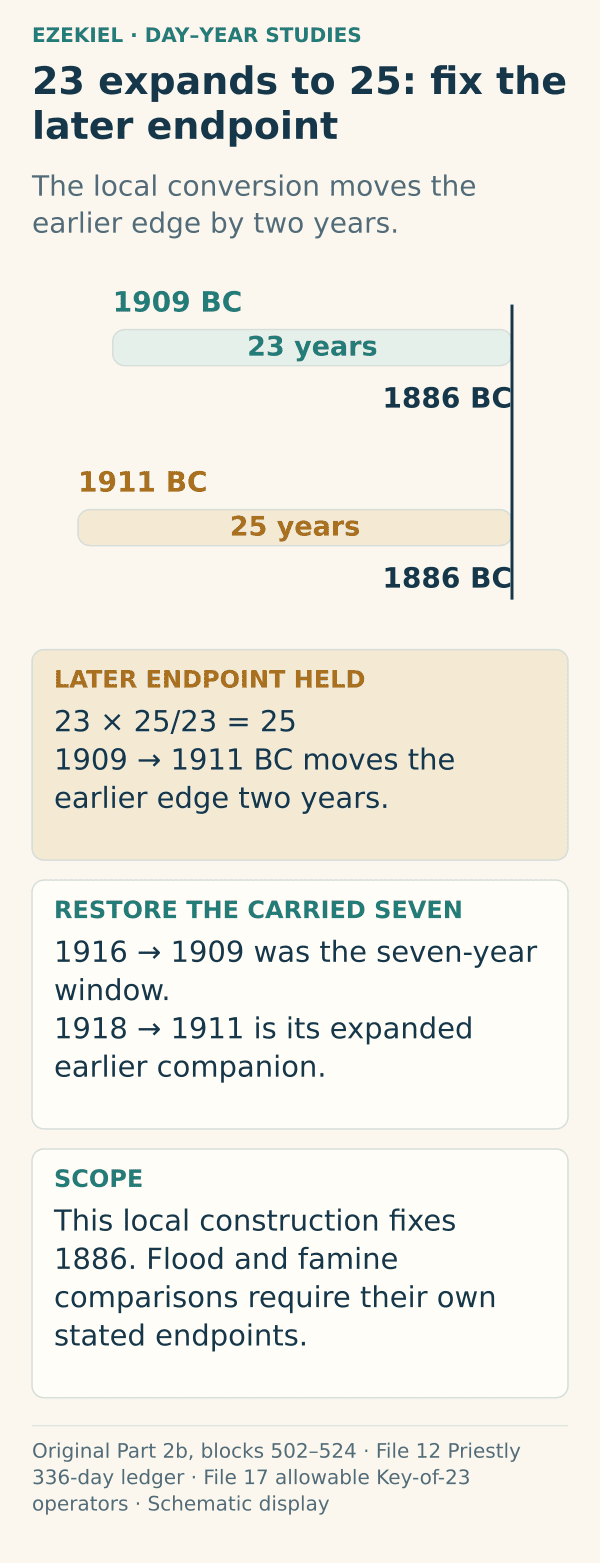
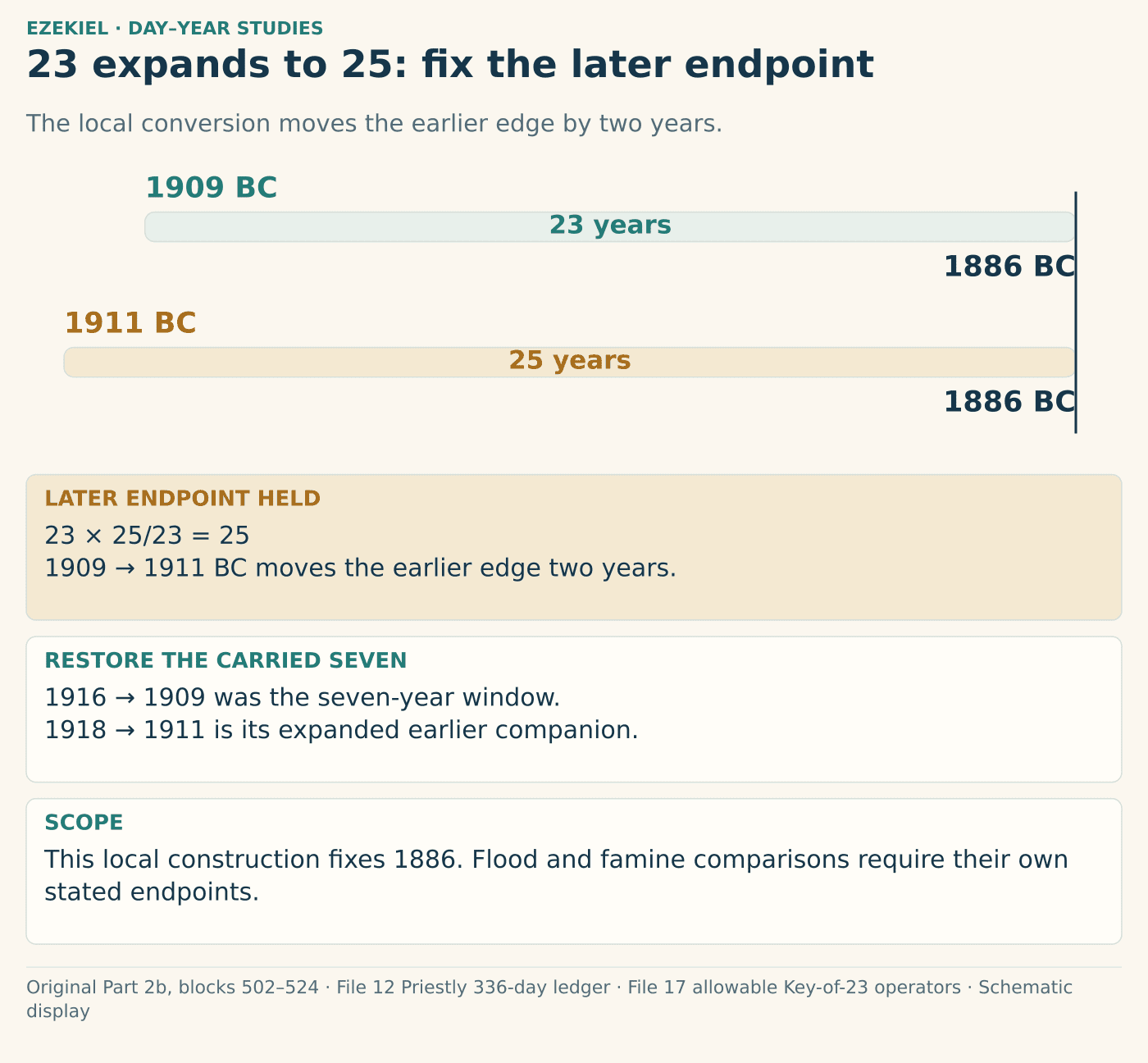
That derived earlier edge meets Judah’s ordinary 1918 BC birth, whereas 1916 is the Joseph-conception proposal. I read this as reconciliation across the Israel/Joseph and Judah divisions of Ezekiel’s burden. The same two-unit increment is proposed in the other two hinges: 2456→2458 at Arphaxad/Flood and 1876–1869→1878–1871 at entry/famine.
These are separate applications of an increment. The local 23→25 expansion has a stated fixed endpoint; it does not by itself move every cell in both tables two years. The proposed Flood and famine translations retain their additional event-binding choices. In the ordinary MT Gear-2 frame the Flood starts at 2458 BC and Arphaxad is born at 2456 BC. Their relationship is already represented in File 18’s Noah/Shem controls; the typological comparison does not make Arphaxad’s fixed birth a mistaken Flood date.
The Priestly explanation must also preserve the difference between ideal arithmetic and physical solar time:
| Comparison | Exact day volume or result |
|---|---|
| 25 × 336-day Priestly years | 8400 days |
| 23 × the schematic reference year (8400/23) | 8400 days |
| 23 × 365.2422 true-solar days | 8400.5706 days |
| 70 × 360-day prophetic years | 25200 days |
| 69 × 365.2422 true-solar days | 25201.7118 days |
| 490 × 360-day prophetic years | 176400 days |
| 483 × 365.2422 true-solar days | 176411.9826 days |
Thus the rational conversions are exact within their declared architecture, while the quoted physical solar comparisons are near, rather than exact, equalities. Files 12 and 17 keep the Priestly 336, prophetic 360, Enochian 364, and solar reference distinct. The 25/23 and 70/69 operators cannot be exchanged: 483×70/69 = 490, whereas 483×25/23 = 525.
12. Seventy elders and about twenty-five men
The original study used the NIV for Ezekiel 8. Its key excerpts are retained in that translation, with their wording checked against the current edition:
“In front of them stood seventy elders of Israel, and Jaazaniah son of Shaphan was standing among them.”
— Ezekiel 8:11, New International Version (NIV, 2011).
“He then brought me into the inner court of the house of the LORD, and there at the entrance to the temple, between the portico and the altar, were about twenty-five men. With their backs toward the temple of the LORD and their faces toward the east, they were bowing down to the sun in the east.”
The full retained passage, Ezekiel 8:9–16, remains in the linked supporting material. Its context matters: hidden images and incense, the denial that the LORD sees, mourning for Tammuz, and worship turned toward the sun describe the covenant-breaking that the Temple vision exposes.
I connect the seventy and about twenty-five with the two conversion families. Seventy minus the one named elder gives 69, and 69×70/69 = 70; the other group supplies 25 beside the proposed 23-day interval. Jaazaniah is among the seventy. The subtraction selects the named person from that group; the verse does not state a second group of sixty-nine or seventy plus one.
This is a numerical interpretation of a vision about idolatry. The text gives the group counts; the connection to calendrical conversion is my reading. The sin is particularly fitting to the comparison because a solar-facing group is positioned beside an argument about solar and Priestly time, while the covenant-breaking Temple vision sits beside Isaac, the promised son.
13. What “Mirror” can mean in these comparisons
Several original observations use mirror language. They are preserved here with the distinctions required by File 00 §3.9 and File 09 Appendix A.
First, changing a datum is a translation. Second, opposite signed cells such as −95 and +95 form a coordinate-polarity symmetry. Third, the repository’s Mirror has its own single-date and paired seasonal rules. Finally, BC+AD−1 measures the civil span after the endpoints have been specified. These operations must not be merged merely because their displayed numbers resemble one another. In the seasonal pairs below, t means Tishri (autumn) and n means Nisan (spring).
Signed correspondences and the Creation week
The −95 Jeconiah marker in B and the +95 city marker in D retain their algebraic symmetry. If −95 is read as an astronomical year it becomes 96 BC, while +95 is AD 95. Bare “95 BC” is a different label.
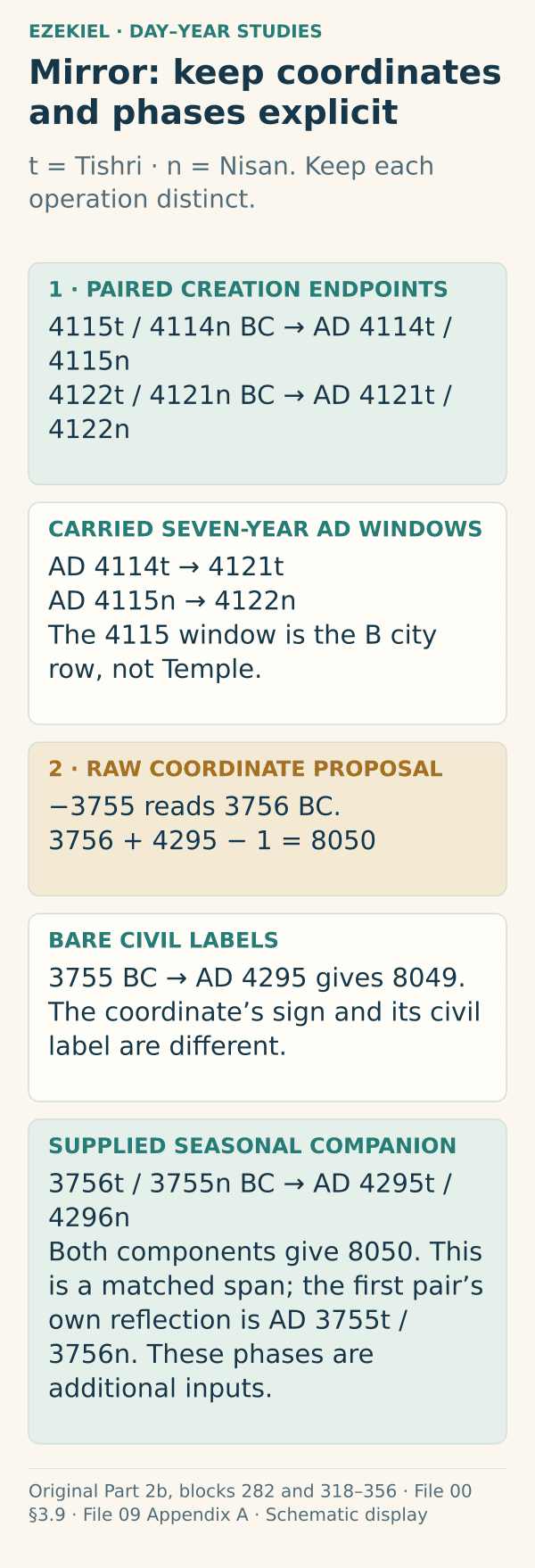
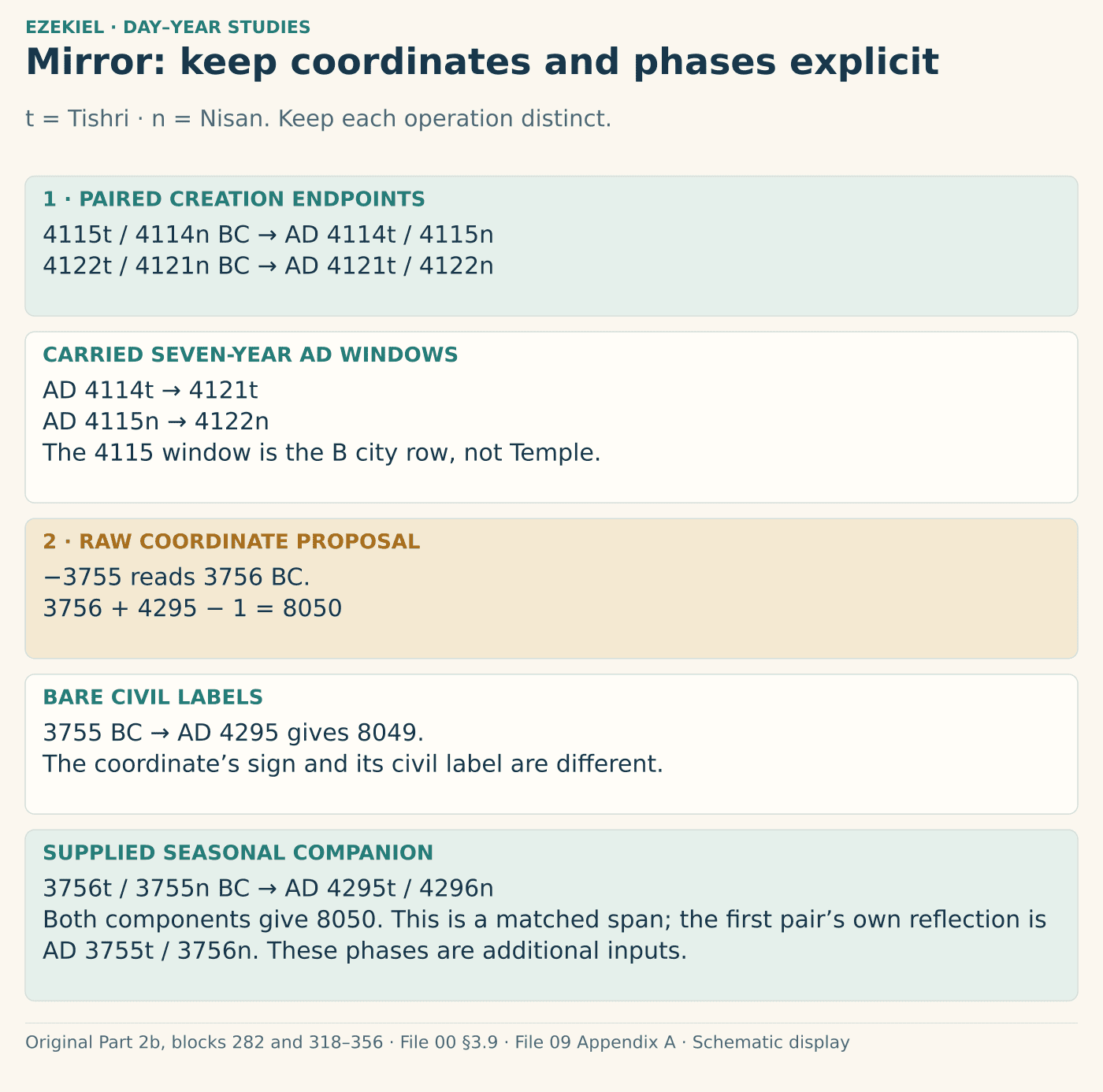
The Creation-week proposal also survives in a stronger form. The ordinary MT envelope is 4121→4114 BC. Its seasonal endpoint pairs are 4122t/4121n and 4115t/4114n. Under the Canon’s paired rule, the AD counterparts are AD 4121t/4122n and AD 4114t/4115n. The resulting seven-year spans are AD 4114t→4121t and AD 4115n→4122n.
The B city window AD 4115→4122 overlaps the latter paired Creation display. Its base row is the city window at 4115; the Temple row begins at 4145. Jeconiah’s D readout of 4116 BC separately lies inside the ordinary Creation envelope. These relationships preserve the source’s new-creation interpretation with the event labels repaired.
The 4900-year Temple windows
The B refugee window AD 3935→3942 and ordinary Temple-building labels 966→959 BC satisfy a constant 4900-year cross-axis separation between corresponding boundaries:
966+3935−1 = 4900, and 959+3942−1 = 4900.
The carried week therefore provides two matched seven-year windows. Separately, the raw −3935 in C reads as 3936 BC. Reaching AD 966 from that unsuffixed civil label gives 4901, not 4900. A phase-completed comparison 3936t/3935n BC→AD 965t/966n gives 4900 in both components, but those pairs have to be stated. The source’s shortened “−3935 to AD 966” cannot serve as the unqualified civil calculation.
The 8050 and 3780 proposals
The numerical sum 4295+3755 = 8050 = 7×1150 = 3.5×2300 is retained. As a raw-coordinate polarity construction, a reflected −3755 reads as 3756 BC, giving 3756+4295−1 = 8050. With unsuffixed 3755 BC→AD 4295, the civil span is instead 8049.
An explicitly supplied half-year comparison, 3756t/3755n BC→AD 4295t/4296n, gives 8050 in both components. This is a matched cross-axis span; the first pair’s own reflection would be AD 3755t/3756n, with a further 540-unit translation needed to reach the displayed AD pair. This is a phase-completed companion to the source’s numeric proposal; the printed day–year cells alone do not prove those seasonal assignments.
The two additional 3780 comparisons retain their coordinate choices: AD 3755−(−25) = 3780, and AD 3785−AD 5 = 3780. In the first, −25 is read as 26 BC, so 26+3755−1 = 3780. These are opposite-side birth/ministry comparison coordinates, not a claim that ordinary Jesus was born in AD 5 or ministered in 26 BC. Their potential formal seasonal Mirror use requires the same stated pairing rule. The independent 1406 BC→AD 3755 = 5160 = 12×430 remains ordinary civil arithmetic.
For a genuine seasonal pair, the rule is Yt/(Y−1)n BC→AD (Y−1)t/Y n. It preserves the half-year relation. A standalone exact Nisan or Tishri node has its own numeric-year counterpart and can change midpoint polarity. Neither form permits dropping the civil crossing adjustment by default or turning a datum translation into a reflection.
14. The schematic Temple and the fifty-year Kings shift
Return C’s selected siege-week coordinate is 1016–1009 BC. That symbolic envelope meets the Temple pivot of the schematic Kings route. The fifth-to-twelfth-day containing unit remains distinct from the tenth-day siege notice in Ezekiel 24.
| Comparison | Ordinary historical route | Schematic route |
|---|---|---|
| Exodus | 1446 BC | 1446 BC held |
| Temple foundation | 966 BC | 1016 BC |
| Exodus → foundation | 480 years | 430 years |
| Foundation → linked ending | 536 BC restoration/foundation | 586 BC fall |
| Foundation → linked ending span | 430 years | 430 years |
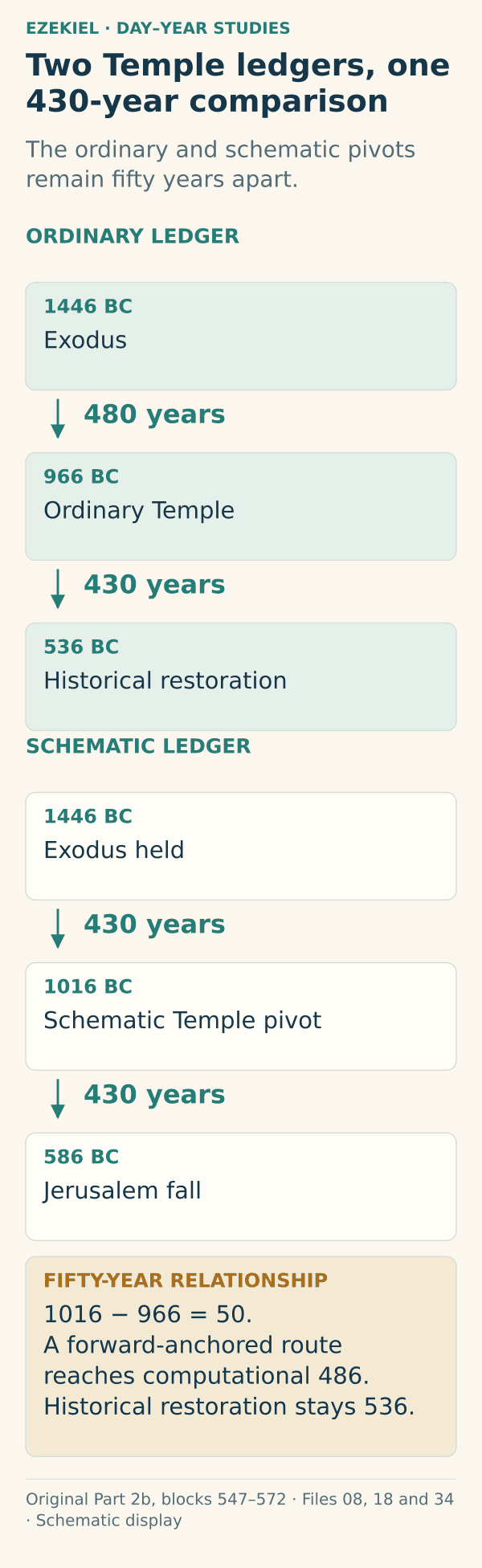
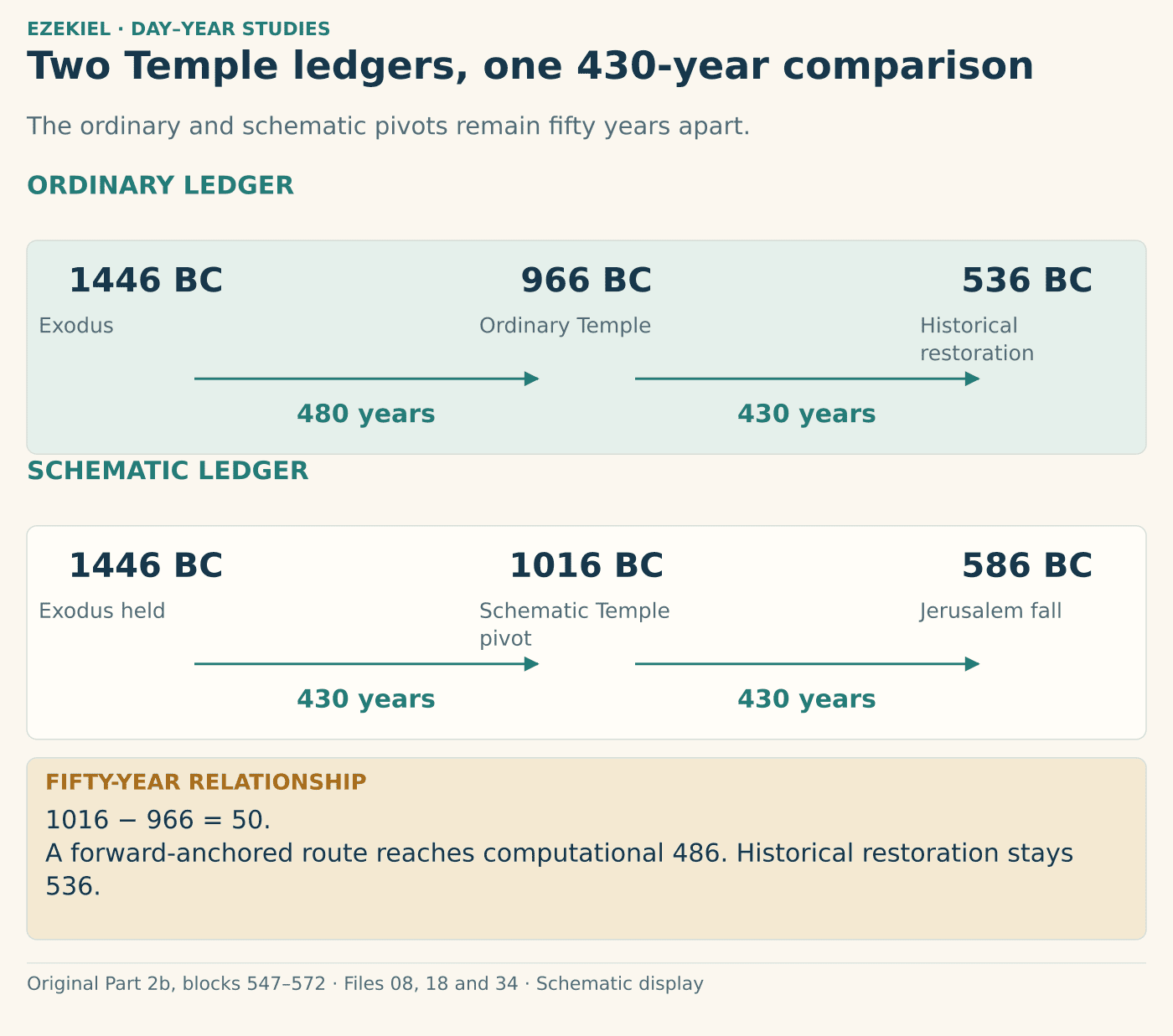
The ordinary 966→536 foundation comparison stands alongside the schematic 1016→586 bridge. The month-qualified 967 second month→537 second month is another exact 430-year form. It does not overwrite the ordinary whole-year display.
The source’s full Kings comparison is preserved with its qualifications. It includes both forward and backward anchored schematic ledgers, reigns, accession ages, derived birth columns, exile/return rows, and the twenty-year Temple-and-palace sequence. Its older historical column is distinguished from the current controlling File 18 §2.5 table.
In the schematic comparison, 1016/1017→996/997 BC parallels the ordinary 966/967→946/947 Temple-plus-palace twenty-year field: seven for the Temple and thirteen for the palace. The source’s backward route keeps 536 fixed and moves the first Temple to 1016; its forward route keeps the first Temple near 966 and moves the restoration endpoint to 486. File 34 controls the distinction: 536 BC remains the historical restoration reference, while 486 BC is a computational endpoint.
The exact monarchy ledger also gives 36+394.5 = 430.5, with a month-aware close to the schematic 430. The original’s “49.5 years and ten days” and “50 with David’s 40.5” preserve alternative accounting conventions in the source table. They should not both be called exact fifty-year elapsed intervals. Likewise, Athaliah’s legacy seven-count display is retained beside the Canon’s six completed years; it is not silently added as seven full years to the active ledger. David’s same-phase forty and exact diagonal forty-and-a-half remain separately controlled.
The Temple duration itself has two useful displays. 1 Kings 6:37–38 names the second and eighth months, and states seven years in building. The corresponding season-sensitive envelope is about 7.5 years. On the 360 base that gives 2700 days, or 2730 when a model leap month is counted. The same 2730 is 390+40+2300, the span from the call to the later refugee marker. It is also 7.5×364 in the separate Enochian register. These are related numerical forms with explicitly different calendars, rather than a claim that every actual building day is known.
15. The original covenant chart and its counted years
The first legacy illustration makes the covenant argument visible through multiples of 23. Its substantive sequence is retained in a clearer table. Numbered AM years use the 4114 BC genealogical endpoint as their beginning, so a numbered year is one greater than its completed interval.
| Marker in the original chart | Selected BC label | Numbered AM year | Span from preceding marker |
|---|---|---|---|
| Adam/Creation endpoint | 4114 | 1 | — |
| Jared’s birth | 3654 | 461 | 460 = 23×20 |
| Lamech’s birth | 3240 | 875 | 414 = 23×18 |
| Ordinary MT Flood start | 2458 | 1657 | 782 = 23×34 |
| Circumcision covenant / Isaac promised | 2067 | 2048 | 391 = 23×17 |
| Jacob’s flight and ladder vision | 1929 | 2186 | 138 = 23×6 |
| Exodus | 1446 | 2669 | 483 = 23×21 |
| 1400 boundary of the land-rest interval | 1400 | 2715 | 46 = 23×2 |
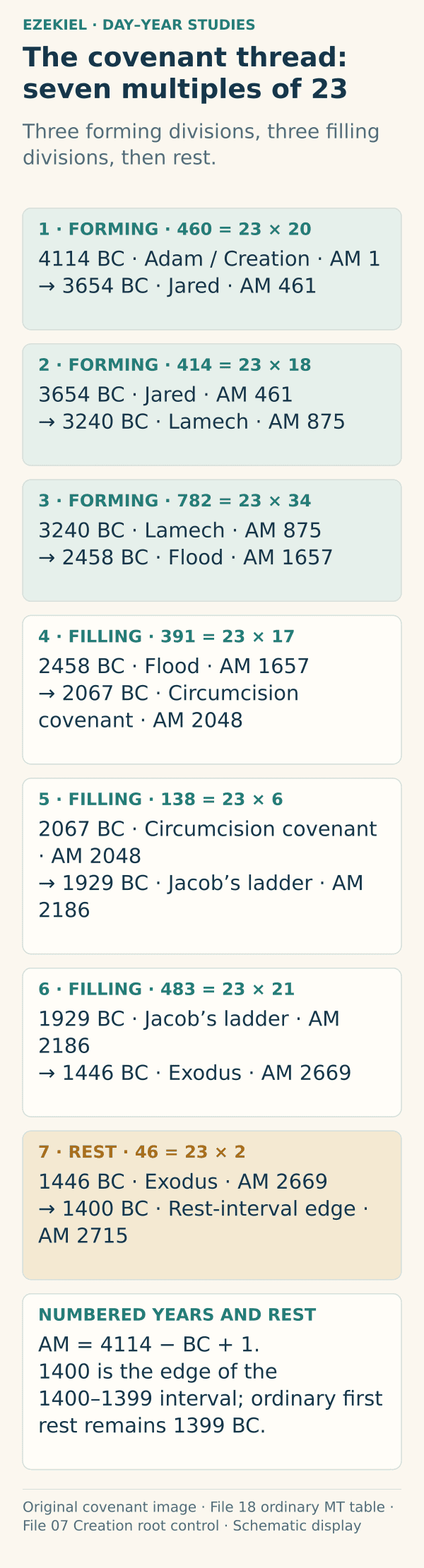
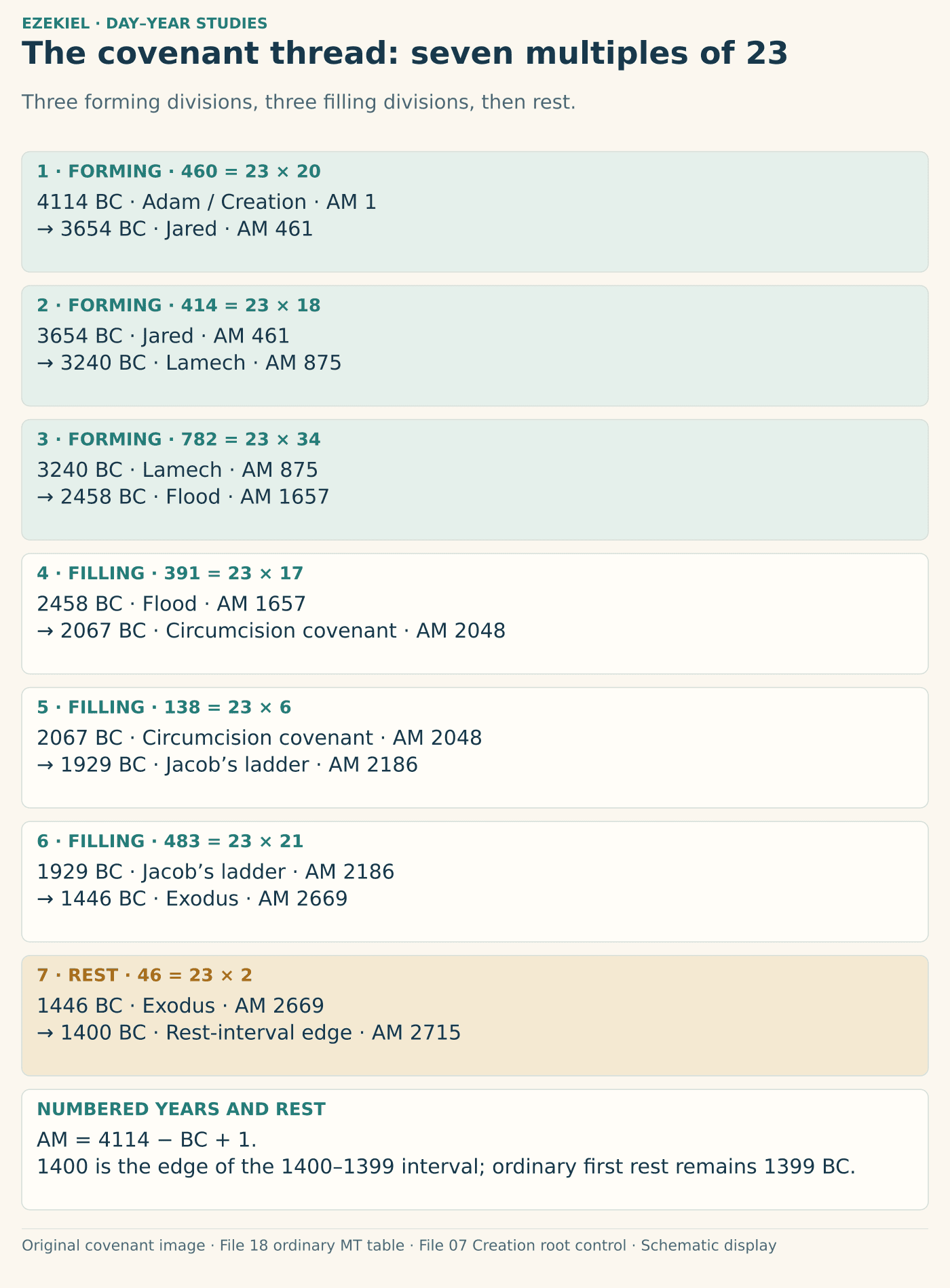
The first three divisions are read as forming; the next three as filling; the seventh as rest. This is a theological arrangement of the seven chronological divisions, compared with Genesis’ three-plus-three-plus-one Creation structure. Jared’s association with an evil covenant comes from the Watcher tradition. The two Lamechs provide the contrast between the vengeance and broken-marriage world of Genesis 4 and the Noah/relief lineage of Genesis 5; their shared name and the seven/seventy-seven/777 associations supply the original’s oath/covenant reading.
The final point needs its boundary stated. 1446→1400 = 46, preserving the chart’s multiple of 23. The project’s ordinary first-rest label is 1399 BC, with a 1400–1399 land-rest interval. The chart’s 1400 edge is therefore retained as an interval boundary, rather than made a replacement for 1399 or proof that the entire wilderness and Conquest lasted exactly forty-six completed years to that first-rest label.
The image’s subsidiary events are also retained in the full supporting crosswalk: Enoch’s ascent, Noah’s birth, Benjamin’s birth, and Jacob’s death. Its older AM labels 990/1059/2255 are not the current ordinary MT coordinates. The supporting table gives their original numbers beside Enoch 3127/AM 988, Noah 3058/AM 1057, and Jacob’s death 1859/AM 2256. Benjamin 1906/AM 2209 remains a reconstructed chronological input. The original claim of textual explicitness is refined accordingly: Genesis supplies ages and sequences; some of these modern dates, conceptions, annual stations and interpretations are derived.
The second image compares three distinct 1656-year fields. In the equalized full-430 comparison frame, MT 4114→2458 is Creation to Flood; LXX 5494→3838 is Creation to Noah’s birth; and SP 4414→2758 is Creation to Noah’s death. The SP image’s printed 1665 is corrected to 1656 by its own endpoints. LXX’s native Cainan and the main canonical Lamech selection remain part of that LXX state; the SP frame is explicitly the native table translated by +215 for comparison.
The SP 3708→2758 Noah life is the primary equalized Gear-2 biography; the adjacent 3707→2757 companion is separately admitted. Its one-year person-station convention does not create a new Adam 4415 chain head. The current head stays 4414 in this comparison frame. The older chart’s conditional 4415 proposal is retained in the technical source history with the specific canonical supersession identified.
The LXX–MT Creation difference is 5494−4114 = 1380 = 23×60. The image also notes LXX Seth at 230 and the MT Creation-to-Flood total 1656 = 23×72. These are declared arithmetic relationships; the traditions do not have interchangeable genealogical rows. The Book of Jubilees’ comparable Creation-to-Noah-death architecture is an external witness, controlled separately by File 20.
16. The retained modern-calendar overlay
The original expressly makes the modern overlay secondary to the Exile and Return tables, but includes it for completeness. It associates the symbolic AD 1955 readout with seven years after 1948, adds another seven to 1962, and proposes a 360-calendar fifth-month tenth-day correspondence with 28 December 1962. It also supplies an alternate AD 2855 half-week coordinate in place of 2825 when the leap-month position changes. The latter gives 1446+2855−1 = 4300.
These are retained proposals. They are not ordinary consequences of merely reading +1955 from Exile B. Reproducing an exact Gregorian day requires the modern overlay’s epoch, day boundary, insertion schedule and row correspondence. The surviving article gives one modern datum row, but not a complete formula-bearing modern table. The claim of an exact-day match is therefore recorded with those missing derivation requirements in the supporting assessment, rather than supplied with an invented calendar.
The same applies to 1240+1240 = 2480. Seven unintercalated twelve-month lunar years are approximately 2480.57 days when the NASA mean lunation of 29.53059 days is used. Seven civil solar years are about 2556.70 days. The source’s lunar quantity may be a rounded, insertion-excluding register, but it cannot be an exact universal count for every historical seven-year lunisolar or civil interval. Its separate 2480-year application and proposed relation to 1948–1955 are preserved as a model needing the full original mapping. 2520−2480 = 40 remains the checkable difference between its rounded lunar and 360-day registers.
The coordinate sequences and numerical comparisons can extend into later AD labels. I retain the original’s suggestion that such patterning may have continuing theological significance. A generated label, however, does not by itself assign an event to a future calendar year. The study’s primary argument remains the covenantal structure of the biblical dates, not an unsupported historical identification attached to every output.
17. From the large spans to the fine dates
The purpose of the method is to read the levels together. The centuries-long threefold 430 framework opens into years, seven-year units, month-sized increments and exact days. The dates of Ezekiel’s visions then become part of a structured covenant account rather than an isolated diary of experiences.
The call’s storm and rainbow invite comparison with the Flood and covenant preservation. Joseph’s movement ahead of the family into Egypt supplies another preservation narrative; Isaac supplies the promised son and succession of the covenant. The Temple vision exposes the corruption of that covenant, and the refugee’s arrival opens the prophet’s mouth for the restoration message. In the Christian reading developed here, these themes converge on Christ as sin-bearer, promised son and source of restoration.
That interpretation is more than a repeated claim that a number is significant. It depends on the nesting of related spans and on the identities of the events those spans join. The structure may include connections whose full later outcome the original prophets and scribes did not consciously calculate. I read such convergence as providential coherence; the arithmetic can be checked without claiming statistical certainty or proving a particular prophet’s conscious design.
Part 2a establishes the underlying dates and week windows. This Part 2b develops their covenantal corridor, datum relationships and conversion proposals. Part 2c continues into further dated oracles. The full supporting tables preserve every matrix cell, the original Kings comparison and image data, the retained longer Scripture passage, and the unresolved modern-calendar proposals.
Original dialogue
The original Part 2b dialogue is preserved with its historical wording, calculations, images and speaker labels. It records the development of this study; the present article and directly linked supporting material retain its substantive arguments in revised prose.
Scripture quotations marked BSB are from the Berean Standard Bible (BSB), public domain. Official terms.
Scripture taken from the Holy Bible, NEW INTERNATIONAL VERSION®, NIV® Copyright © 1973, 1978, 1984, 2011 by Biblica, Inc.® Used by permission. All rights reserved worldwide. Official quotation permissions.