Ezekiel’s prophecies against Tyre and Egypt extend the chronological argument developed in the earlier studies. The enacted siege gives the central division, 390 + 40 = 430. The later oracles bring that number into relation with 70, with the first week of a proposed New Year, and with a series of symbolic dates built from repeated 430-year units. Their theological setting is judgment among the nations, the movement into exile, and the preservation of a people through judgment.
One of the two Tyre-related date headings compared here is explicit:
In the twenty-seventh year, on the first day of the first month, the word of the LORD came to me, saying,
The oracle gives Egypt to Nebuchadnezzar as compensation for his army’s work against Tyre (Ezekiel 29:18–20, BSB). That exchange supplies a thematic connection between the nations as well as a date to compare with the earlier Tyre oracle.
This detailed study follows the dates from their biblical headings into the reconstructed calendar and then into their day–year projections. The biblical date, the calendar coordinate, the chosen symbolic boundary and its interpretation each have their own role. The full supporting tables retain the alternative readings and less-developed comparisons, including the original scalar coordinates. The original dialogue preserves the development record.
Contents of this detailed study
1. The chronological backbone
The wider pattern is easiest to see before turning to individual days:
1876 → 1446 → 1016 → 586 BC = 430 + 430 + 430 = 1290 years.
| Movement | Coordinates BC | Inner division | Chronological role |
|---|---|---|---|
| Egypt → Midian → Exodus | 1876 → 1486 → 1446 | 390 + 40 | Jacob’s entry; Moses’ departure for Midian; Exodus |
| Exodus → Conquest → Temple pivot | 1446 → 1406 → 1016 | 40 + 390 | Wilderness; Conquest; schematic Kings-of-Judah route |
| Temple pivot → Jeremiah’s call → fall/exile | 1016 → 626 → 586 | 390 + 40 | Schematic Temple; selected Jeremiah call year; destruction and dispersal |
The 1016 BC Temple coordinate belongs to the schematic Kings-of-Judah ledger. The ordinary Temple foundation remains 966 BC, which gives a corresponding 966 → 536 BC = 430 years to the restoration reference. File 08 §§1.1–1.3 and File 18 §2.5 distinguish these ledgers. Keeping both makes the repeated 430 visible without changing the historical Temple date.
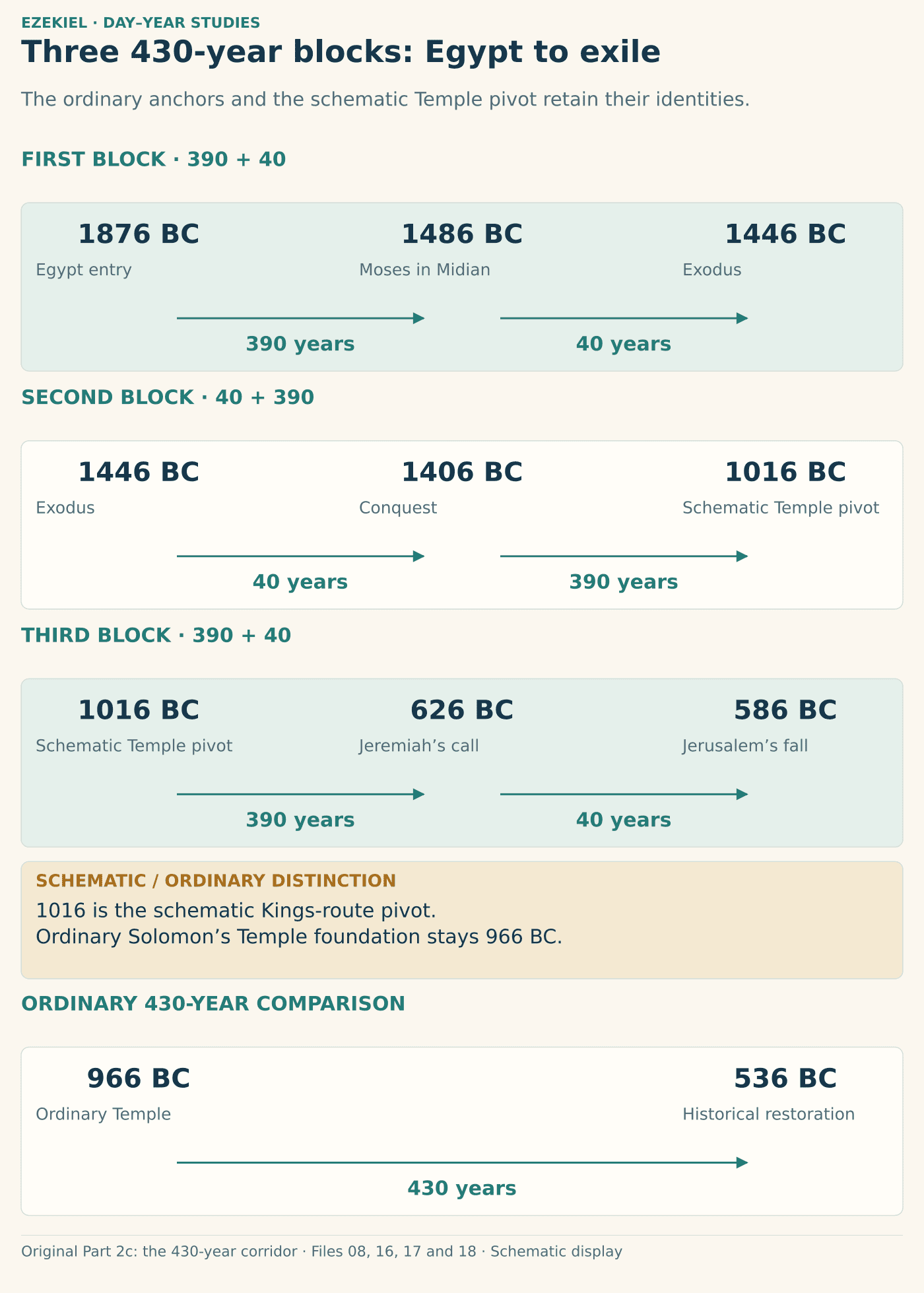

Abraham’s 2091 BC departure for Canaan precedes the Egypt-entry coordinate by 215 years, half of 430. This is the Haran-to-Canaan departure; his earlier departure from Ur belongs to the preceding narrative. The baseline MT comparison places Jacob’s entry into Egypt at 1876 BC. The 1661 BC entry belongs to the SP 215-year Egypt selection. A corresponding MT genealogical chronology translated by 215 years can also be compared, but the native LXX register has additional differences and must be selected separately. File 18 controls those states.
The dates of Ezekiel fit into this larger sequence. At the day scale, the prophet’s enacted 390 + 40 recalls its year-scale counterpart. The long spans then provide the setting for the shorter intervals between his prophecies. This is the nesting developed throughout the Ezekiel studies: centuries, years, containing weeks, and particular days express related numerical divisions.
2. The dated headings and their textual readings
The source study lists thirteen dated headings. Most use the exile-year register associated with Jehoiachin; the opening also mentions a thirtieth year, and the final Temple vision gives a further count from Jerusalem’s fall. The table preserves those particulars rather than flattening them into one undifferentiated year number.
| Passage | Date supplied by the MT-based reading | Event or oracle |
|---|---|---|
| Ezekiel 1:1–2 | Year 30; month 4, day 5; also exile year 5 | Initial vision of God’s glory |
| Ezekiel 8:1 | Year 6, month 6, day 5 | Abominations in the Temple |
| Ezekiel 20:1 | Year 7, month 5, day 10 | Elders inquire of God |
| Ezekiel 24:1–2 | Year 9, month 10, day 10 | Beginning of Jerusalem’s siege |
| Ezekiel 26:1, NET | Year 11, day 1; month unspecified | Tyre oracle; MT input used below |
| Ezekiel 29:1 | Year 10, month 10, day 12 | Oracle against Egypt |
| Ezekiel 29:17 | Year 27, month 1, day 1 | Egypt as compensation for Tyre |
| Ezekiel 30:20 | Year 11, month 1, day 7 | Pharaoh’s broken arm |
| Ezekiel 31:1 | Year 11, month 3, day 1 | Assyria’s cedar as a warning to Pharaoh |
| Ezekiel 32:1 | Year 12, month 12, day 1 | Lament for Pharaoh |
| Ezekiel 32:17 | Year 12, day 15; month unspecified | Lament over Egypt’s descent |
| Ezekiel 33:21 | Year 12, month 10, day 5 | Refugee reports Jerusalem’s fall |
| Ezekiel 40:1 | Year 25, beginning of year, day 10; year 14 after the fall | New Temple vision |
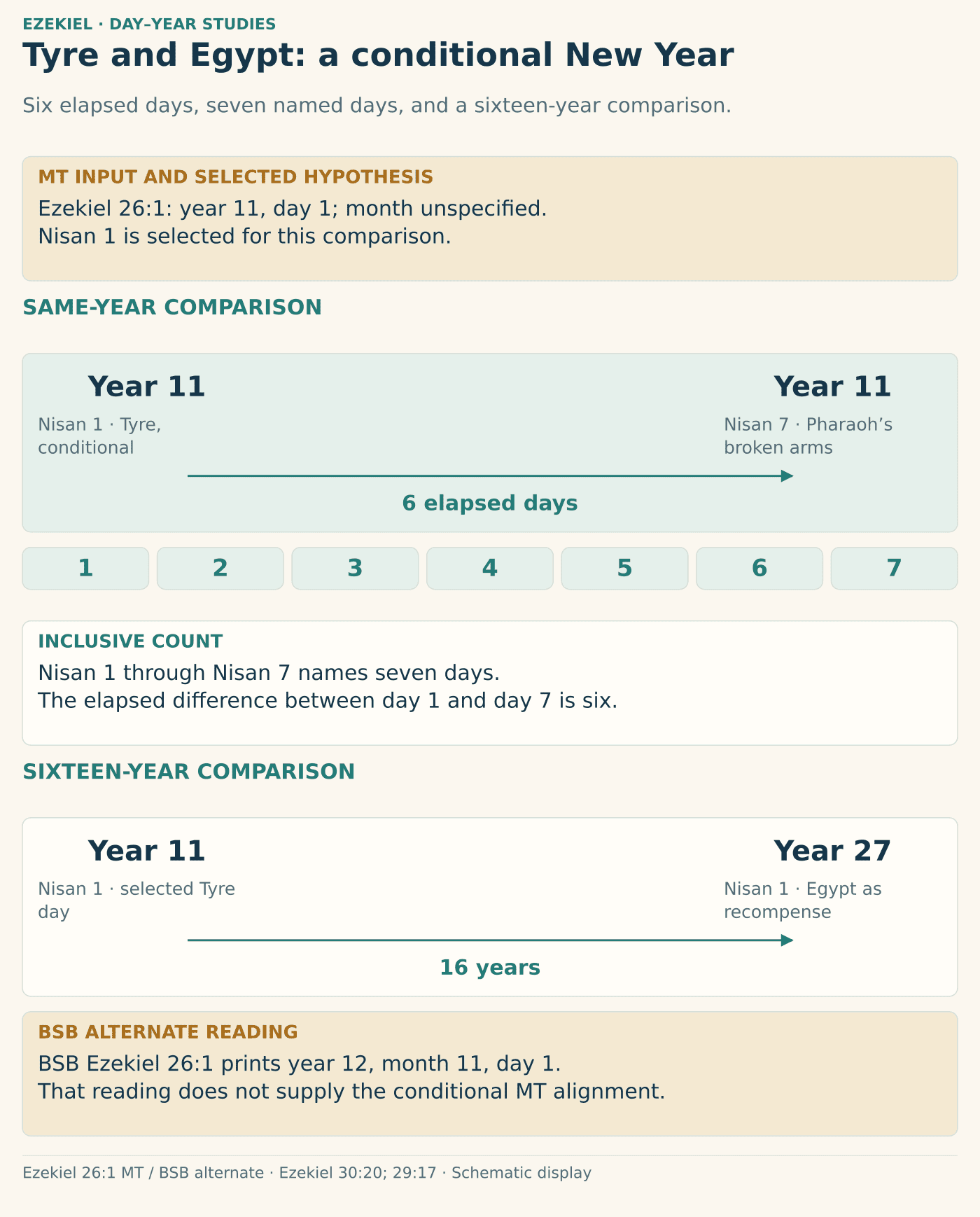
The linked BSB pages are the quotation edition used elsewhere in this study. Ezekiel 26:1 is a significant exception. Current BSB reads month 11 of year 12; its textual note identifies the MT alternative as year 11. The present Tyre comparison follows the MT year-11 reading, represented in the linked NET reader, whose month remains unspecified. The BSB reading is retained as a separate textual selection; it cannot supply the year-11/New-Year premise.
For Ezekiel 32:17, current BSB leaves the month unspecified. Reading month 12 from the immediately preceding lament in 32:1 is a contextual inference. The BSB note also identifies an LXX month-1 reading. These three forms—an unstated MT month, an inferred month 12, and an explicit LXX month 1—must remain distinguishable.
The reconstructed calendar uses 360-day years with separately declared intercalation. Its phase begins a forty-year cycle at 606n BC, with six-year boundaries at 600n, 594n, 588n, 582n, 576n and 570n BC, followed by the four-year close at 566n BC. A leap month can be counted or omitted in the corresponding numerical register. The exact occurrence of an oracle remains distinguishable from its containing week. The detailed rules and matrices are directly available in the methodology and Part 2a; Files 12 and 17 §13A supply the canonical controls.
3. The exchange between 430 and 70
The dialogue begins with two paired constructions:
| Selected comparison | Principal span | Alternative relative construction |
|---|---|---|
| Ezekiel 31:1 → Temple destruction | 430 days | 430 − 360 = 70 |
| Refugee’s arrival → Ezekiel 32:17 | 70 days | 70 + 360 = 430 |
The key word is relative. Shifting both endpoints by the same amount preserves their separation. The exchange requires one endpoint’s year/register selection to change relative to the other, or a whole-year symbolic counterpart to be selected. The 360 is one model year, expressed as days or projected day–years. The physical separation of Nisan and Tishri is about half a year, represented by 180 in the unexpanded 360-day register.
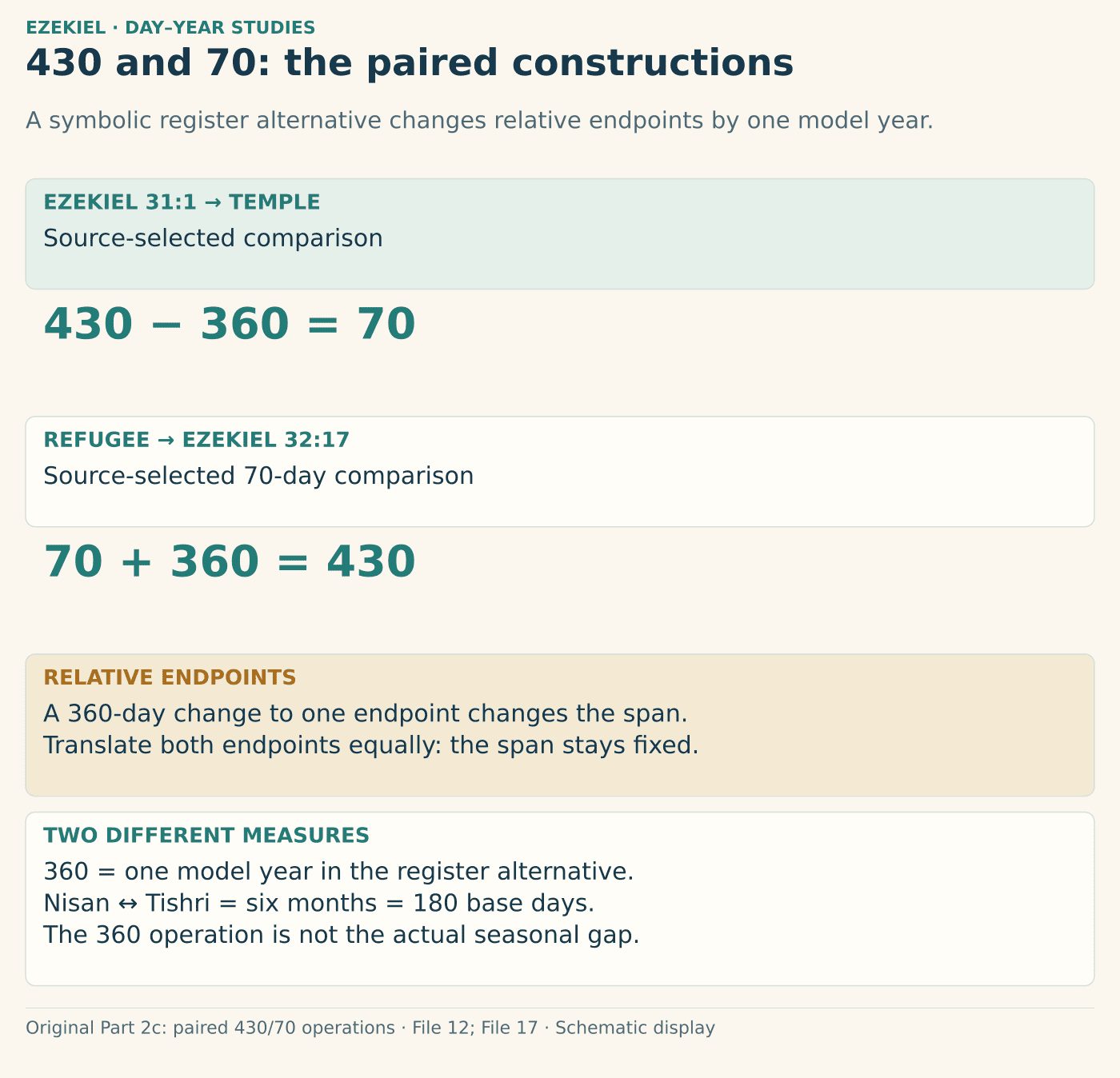
The original study itself describes the 430/70 interchange as figurative and says that the underlying spans remain 430 and 70 in their respective constructions. That qualification is essential. A change of labels cannot shorten a fixed historical interval. A changed model state can generate a related interval, whose numerical and theological significance can then be examined.
The two numbers evoke distinct biblical settings. 430 recalls Israel’s stay in Egypt (Exodus 12:40–41, BSB) and Ezekiel’s enacted sign (Ezekiel 4:4–6, BSB); 70 recalls Jeremiah’s Babylonian period (Jeremiah 25:11–12; 29:10). The comparison therefore joins Egypt and Babylon through judgment, exile and promised restoration. It does not establish that every event discussed occurs seventy years before the return: 606 → 536 BC = 70, whereas 586 → 536 BC = 50.
The literal coordinates quoted in the dialogue give an exact 430-day subtraction:
1507581.5 − 1507151.5 = 430.
They represent the source’s selected Ezekiel 31 day and Temple-fall day. The shared matrix’s Temple containing-week start is instead JD 1507576.75, whose separation from the quoted oracle point is 425.25 days. Those are different within-week reference points. The complete coordinate reconciliation preserves the exact values and shows their relation to the symbolic boundaries. It also explains the selected 70-day refugee-to-lament construction and the inferred month behind it.
4. Tyre, the New Year, and sixteen years
The MT-based opening of the Tyre oracle supplies a year and day but no month:
In the eleventh year, on the first day of the month… (NET)
The study proposes Nisan 1. Its strongest internal comparison is the explicit year 27, month 1, day 1 heading in Ezekiel 29:17, which returns to the army’s labor against Tyre while giving Egypt as compensation. With Nisan 1 chosen for the earlier oracle, the two date headings stand sixteen numbered years apart on the same month/day:
27 − 11 = 16.
That is an exact anniversary comparison within the stated reading and calendar selection, represented by 587 → 571 BC in the source’s proposed Nisan frame. Its premise remains visible: the missing month in 26:1 is inferred. The two headings compared here also do not exhaust the Tyre material; Ezekiel 26–28 contains the larger sequence of Tyre oracles and related judgments.
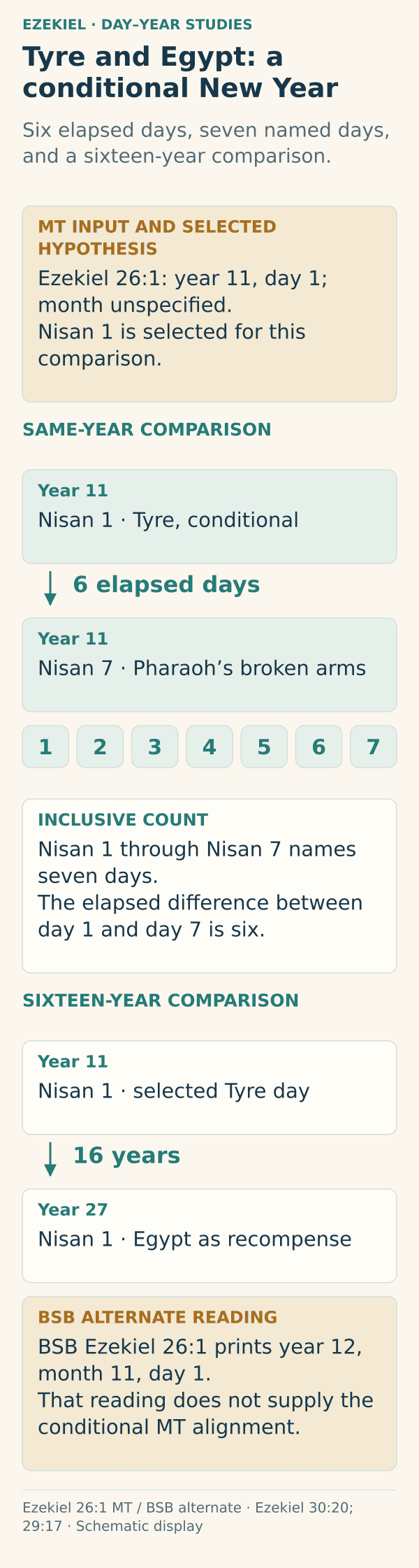
The dialogue also retains a broader reading: the unspecified month allows the whole eleventh year to become a symbolic field. On the proposed Nisan convention, that year runs from 587n to 586n BC. Its completion at the 586 Nisan boundary accompanies the whole-year alternative used in the 430/70 exchange. A date heading still identifies an occasion on a first day; the whole-year field is an added interpretive use of that heading, rather than another month printed in Scripture.
This proposal links a point and a larger unit in the same way that the earlier studies link an individual day with its containing week. I read the date’s sparseness as permitting a broader chronological correspondence, although its arithmetic cannot prove why the month was omitted. The immediate context in 26:2 concerns Tyre’s response to Jerusalem’s breaking; it should accompany any historical placement of the oracle, rather than allowing the numerical model alone to determine the occasion.
One small comparison from the dialogue is also retained in the technical notes: 16 × 365 = 5840, which is 40 short of 12 × 490 = 5880. This is a proposed proximity, using a 365-day comparison year. It is distinct from the 360-day Ezekiel calendar and from a demonstrated 5880-day interval.
5. The first seven named days
The proposed Nisan 1 Tyre heading can be compared with the explicit year 11, month 1, day 7 in Ezekiel 30:20. The count is:
Days 1 through 7 = seven named days; day 7 − day 1 = six elapsed days.
That distinction preserves the Creation-week interpretation. A seven-day unit includes its first and seventh dates. The source’s wording “seven days later” overstates the elapsed interval by one when these particular endpoints are selected.
The comparison associates Tyre’s judgment and Pharaoh’s broken arm with the first week of a New Year. In the theological reading, judgment becomes an act of unmaking and reordering, with the Creator governing the nations. The theme belongs to the proposed chronological arrangement and the imagery of the oracles together. It remains conditional on the MT year-11 reading and the inferred Nisan month for Ezekiel 26:1.
6. The two 430-day bookends
The original’s symbolic sequence places the enacted 430-day sign at one end and the 430-day oracle-to-Temple comparison at the other:
AD 1565 → 1995 → 3715 → 4145
430 + 1720 + 430 = 2580 = 6 × 430 = 1290 + 1290.
| Selected symbolic boundary | Role in the proposed sequence |
|---|---|
| AD 1565 | Call / beginning of the enacted-sign comparison |
| AD 1995 | Completion after 430 days |
| AD 3715 | Proposed Ezekiel 31 comparison boundary |
| AD 4145 | Temple containing-week boundary |
| AD 4360, with AD 4365 as a separate day selection | Later Egypt-lament comparison |
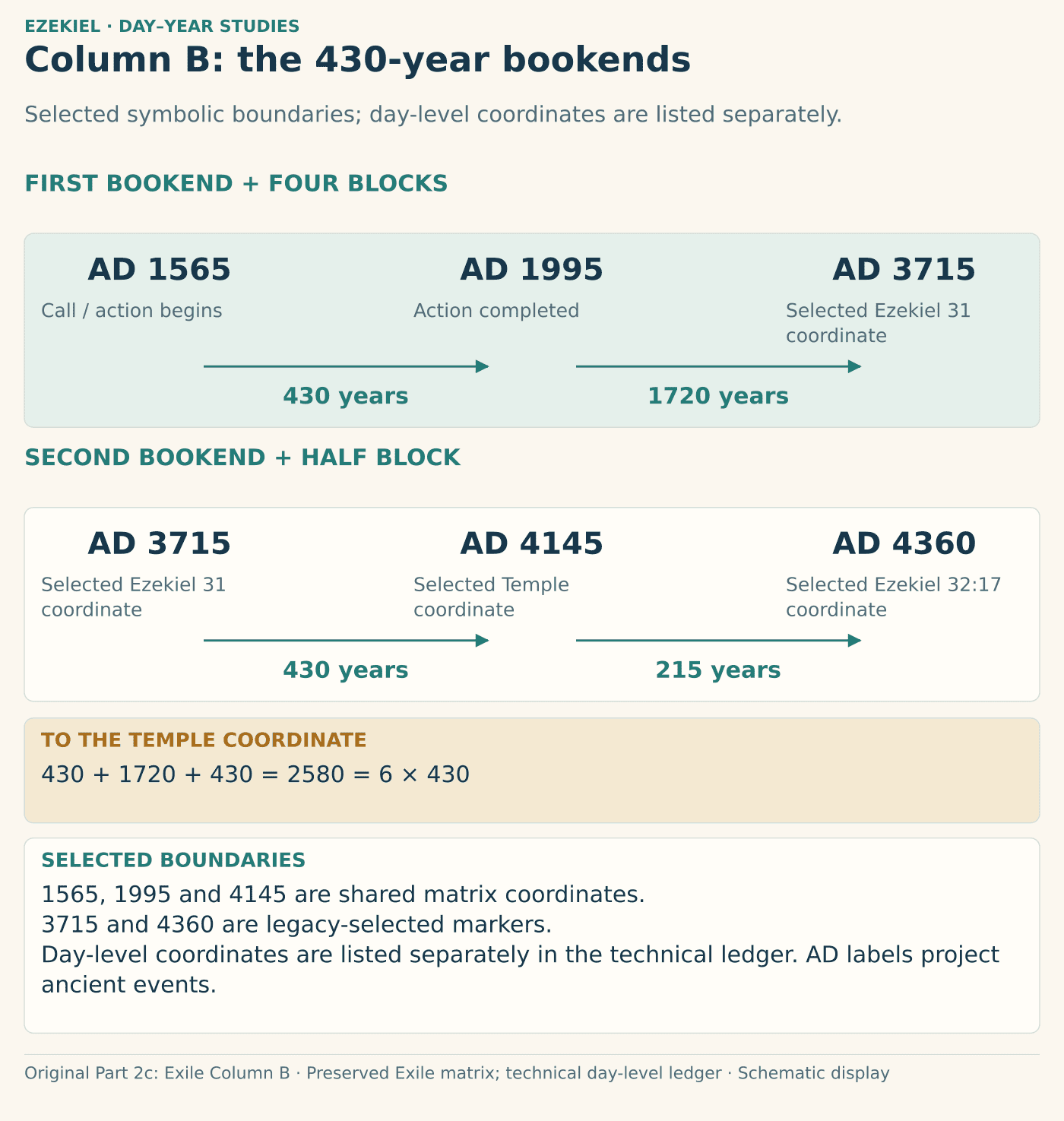
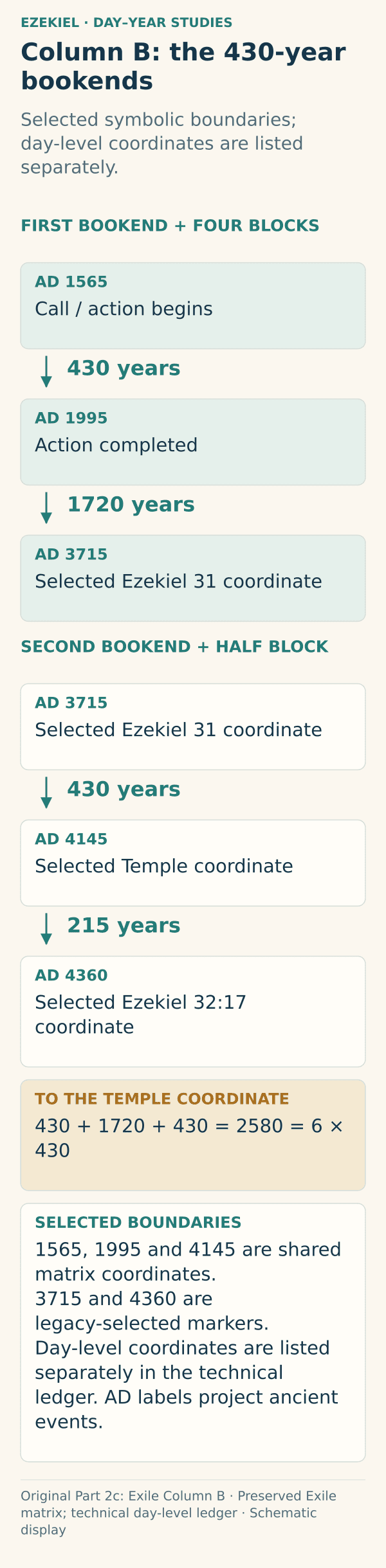
These AD labels are generated day–year coordinates. They allow a span measured in model days to be compared with a span measured in years. They do not identify historical events in those AD years simply by being plotted there.
The source occasionally calls this chain Tishri-based, but explicitly develops it as Nisan datum B. The common matrix gives AD 1565, 1995 and 4145 from B. Its quoted later scalar day points, however, yield AD 3720 and 4150 against that same datum. Their separation is still 430. The selected 3715 → 4145 pair is five units earlier at both ends:
3720 − 5 = 3715; 4150 − 5 = 4145.
This relation preserves the source’s 430 comparison while exposing its point selection. The full six-block chain also depends on choosing the earlier boundary: 4150 − 1565 = 2585, while 4145 − 1565 = 2580. The difference belongs to the fine-grained coordinate discussion; it should not disappear inside a claim of universal exactness.
The subsequent 215 half-block is treated similarly. 4145 + 215 = 4360, while 4150 + 215 = 4365. Under the inferred month-12 reading, the later day-level coordinate supplies the second endpoint. Keeping those companion values distinct preserves both the intended half-cycle and the original’s admitted alternatives.
Seven model years can carry 2520, 2550 or 2580 in declared calendar registers, according to whether zero, one or two leap months are included. The call-to-Temple comparison has an additional ordinary month: from 593 BC Tammuz to 586 BC Av, seven base years plus the counted 588 BC leap month and the Tammuz-to-Av month give 2520 + 30 + 30 = 2580. Thus this particular total does not require two leap insertions. Its six-block numerical form is 2580, divided into two 1290 halves. The framework does not require the chosen exact day of every oracle to have that same total in every calendar register. File 17 §13A expressly distinguishes these day-scale forms and their year-scale correspondences.
7. The 215- and 430-year corridor
The symbolic sequence reinforces the ordinary chronological corridor introduced above. The theological thread is movement between lands: Abraham’s departure, Israel in Egypt, the Exodus, Babylonian exile, and Paul’s journey to Rome. 215, 430 and their multiples organize the comparisons, although each endpoint must retain its actual event identity and chronological state.
| Selected comparison | Elapsed years |
|---|---|
| 2091 → 1876 BC | 215 |
| 1876 → 1446 BC | 430 |
| 1446 → 1016 BC, schematic Temple | 430 |
| 1016 → 586 BC, schematic ledger | 430 |
| 2091 BC → AD 60 | 2091 + 60 − 1 = 2150 = 5 × 430 |
| AD 60 → AD 4360 | 4300 = 10 × 430 |
| 2091 BC → AD 4360 | 6450 = 2150 + 4300 = 15 × 430 |
The cross-boundary calculations use ordinary civil numbering with no year zero. The AD 60 Rome-arrival reference is the study’s chronological selection for Acts 28:14–16, retained in the Christological comparisons of File 13. Acts describes the arrival; the BC/AD label comes from the chronological model.
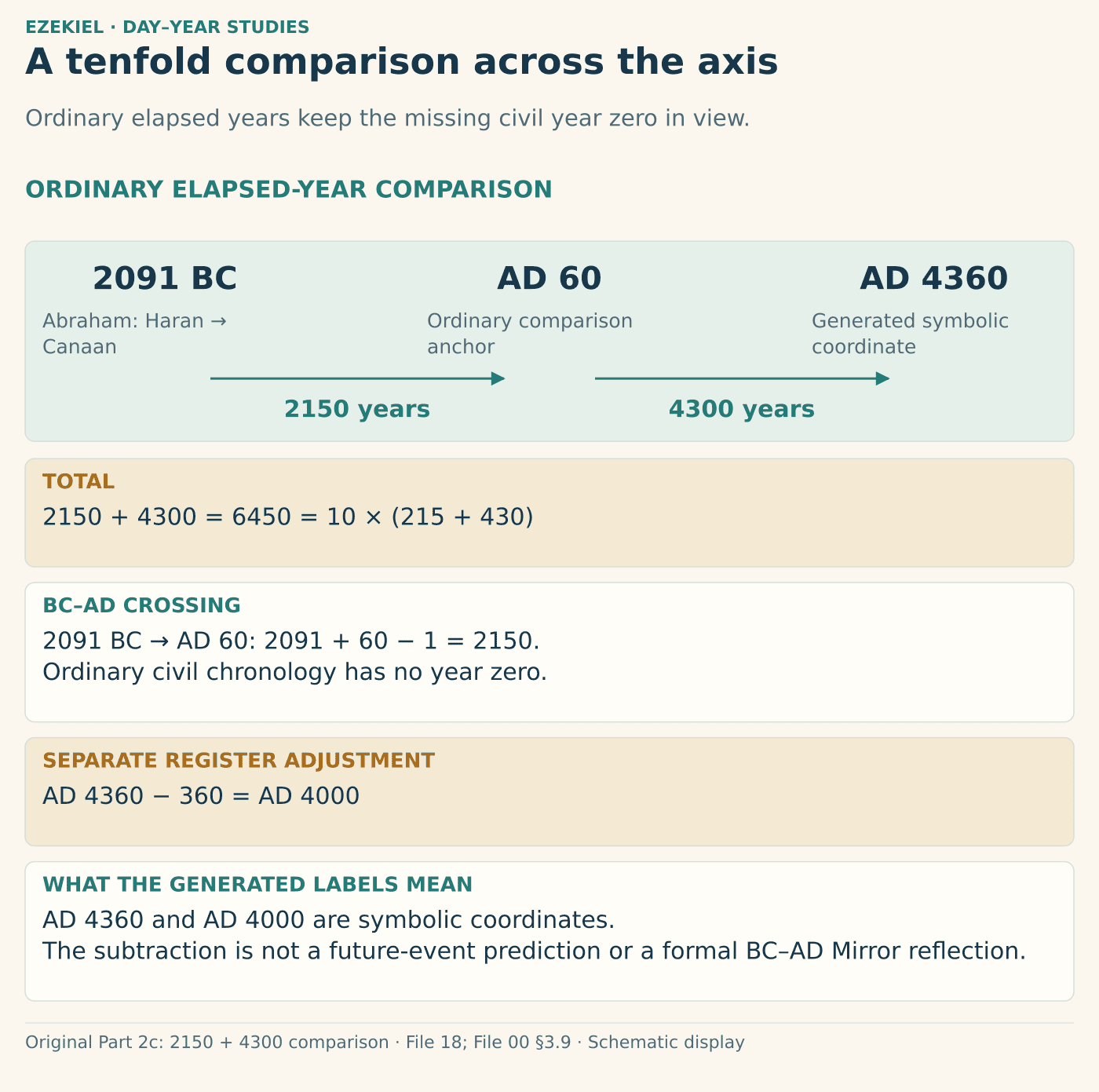
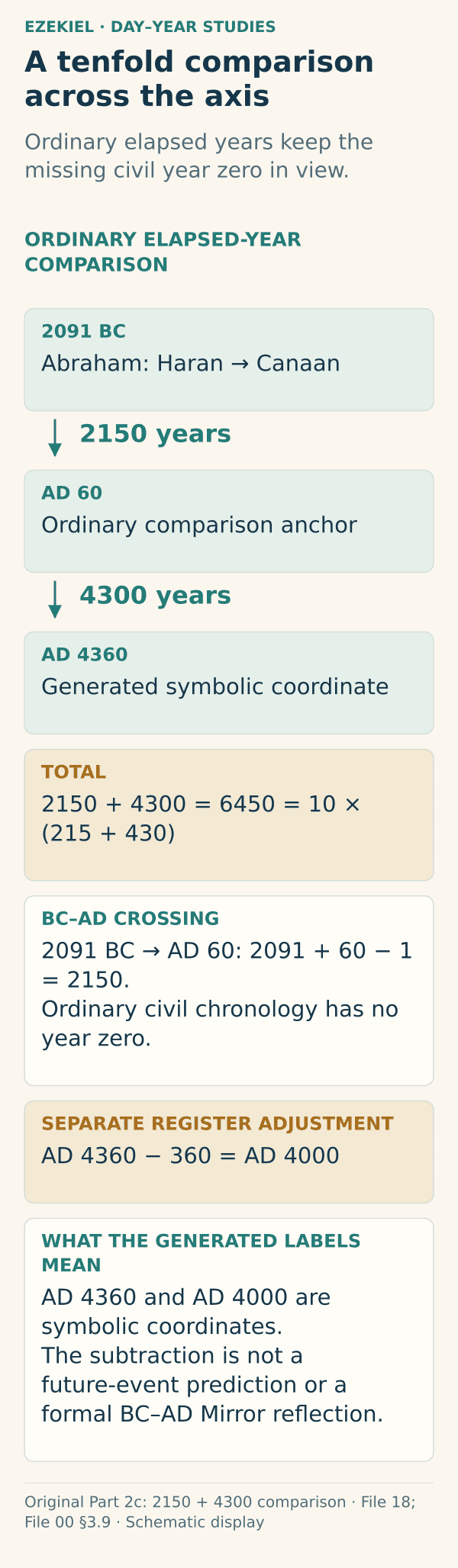
The source’s sentence saying AD 4360 is “2150 to Abraham” compresses the two legs incorrectly. 2150 belongs to Abraham → AD 60; 4300 belongs to AD 60 → AD 4360. Their total is 6450, the tenfold form of 215 + 430 = 645. The intended structure survives with the endpoint statements corrected.
The further adjustment AD 4360 − 360 = AD 4000 retains the source’s four-thousand-year subpattern, including 4000 = 10 × 400. The original reference to Ezekiel 33:17 in that sentence is corrected to 32:17, the Egypt-lament heading under discussion, and its stray “4000 BC” is corrected to AD 4000. Selecting 4365 instead gives 4005 after the same subtraction. The operation is a one-model-year day–year adjustment; it is separate from the formal BC–AD Mirror and from the physical difference between lunar and solar years.
I retain the proposal that these extended coordinates may have continuing theological significance beyond the biblical period. The source associates the 4000 motif with completion, broad epochs and possible further correspondences. It supplies no defined future event at AD 4000 or 4360, however; the numerical target and a proposed event identification would be separate claims. The technical companion lists the complete original comparisons and their arithmetic.
8. Egypt for Tyre: judgment and substitution
The theological argument begins with the text’s compensation: Babylon receives Egypt for the labor spent against Tyre. I read that exchange alongside Ezekiel’s bearing the iniquity of Israel and Judah. These are distinct actions, but they allow the chronological study to develop a common theme of bearing, exchange and deliverance.
The source extends this into a Christological reading encompassing Jews and Gentiles. Joseph provides an earlier pattern: his brothers put him in a pit and sell him toward Egypt (Genesis 37:23–28); later they fail to recognize him in his Egyptian setting (42:7–8). His suffering and presence in Egypt become the means of their preservation (45:5–8; 50:20). Describing Joseph as bearing their sins is typological language; Genesis narrates his brothers’ wrongdoing and God’s saving purpose rather than assigning him Ezekiel’s enacted commission. The original’s figurative identification of Christ with Egypt similarly concerns His bearing the burden of the nations, with Joseph’s Egyptian identity supplying the analogy.
Matthew brings Jesus into Egypt and applies Hosea’s son-and-Egypt language to His return (Matthew 2:13–15; Hosea 11:1). Revelation describes the city where the Lord was crucified through the names Sodom and Egypt (Revelation 11:8). Its Babylon imagery, especially the lament of merchants and seafarers in Revelation 18, also invites comparison with Tyre’s commerce and lament in Ezekiel 27. The original’s broader Revelation 13–18 comparison remains part of this interpretive synthesis.
Within that reading, Egypt, Tyre and Babylon represent more than isolated national episodes: their judgment imagery reaches the world of the nations, and Christ’s substitution embraces Jew and Gentile. The proposed calendar symmetry supplies a chronological setting for that theological argument. It does not turn the stated compensation in Ezekiel 29 into an explicit prediction of the crucifixion.
The dialogue groups the Egypt material into seven oracle units: Ezekiel 29:1–16; 29:17–21; 30:1–19; 30:20–26; 31; 32:1–16; 32:17–32. Six of these have the dated headings listed above; 30:1–19 begins an undated oracle. The source suggests that difficulties in aligning every detail with an obvious historical fulfillment invite an additional fulfillment in Christ. That proposal is retained as an interpretive layer. Establishing the extent of historical fulfillment for each oracle requires its own historical evidence; the calendar calculations alone do not settle it.
9. From the close view to the whole pattern
The useful result is a connected argument whose scales remain visible. The chronology’s broad 430-year divisions lead into Ezekiel’s enacted 430 days; the later Tyre and Egypt headings permit conditional New-Year and whole-year comparisons; selected boundaries then extend the sequence into multiples of 215 and 430. The day-level details belong within that structure.
I understand the pattern as a witness to providence and the unity of Scripture. The prophets and scribes need not have consciously calculated every correspondence that later appears in the whole chronology. That theological conclusion goes beyond the repository’s narrower arithmetic controls, while remaining central to the purpose of these Ezekiel studies.
The Key of 23 belongs to this wider setting, as developed in Part 2b. This installment introduces no additional 23-to-25 transformation. Its distinct contribution is the linked Tyre–Egypt material, the proposed New-Year week, the 430/70 exchange, and the two 430 bookends with their 215 extension.
Sources and full tables
The full supporting tables and textual notes provide the source/scalar reconciliation, all retained numerical comparisons, the thirteen date headings, and the original alternatives. The shared foundations are the chart register and methodology. The central canonical controls are File 12, File 17 §13A, File 18, File 08 and File 13. Formal Mirror operations are governed separately by File 00 §3.9 and File 09 Appendix A.
Original discussion
The original Part 2c dialogue, preserved on 6 October 2026, retains its wording, order and developing calculations. The present study and its directly linked full tables retain the substantive research in readable form, with textual readings, point selections and interpretations identified where they affect the argument.
Scripture quotations identified as BSB are from the Berean Standard Bible. The Holy Bible, Berean Standard Bible, BSB is produced in cooperation with Bible Hub, Discovery Bible, OpenBible.com, and the Berean Bible Translation Committee. This text of God’s Word has been dedicated to the public domain. Official BSB terms.
Scripture quoted by permission. Quotations designated (NET) are from the NET Bible® copyright ©1996, 2019 by Biblical Studies Press, L.L.C. http://netbible.com All rights reserved. Official NET terms. The abbreviated NET quotation follows Bible.com reader 107; it is not labelled NET Second Edition. Translators’ notes are discussed separately and are not quoted.