This appendix supports Cainan and the 16,560-Year Mirror Pattern. It records the selected chronological setting, the two canonical 16560-year comparisons, and the difference between measuring a span and generating a Mirror coordinate.
Go directly to: Cainan’s life · chronological operators · Creation positions · Mirror spans · method comparison · 2300-year transfer · person and event figure index · sources.
1. Cainan’s life and its textual inputs
Luke 3:35–36 places the second Cainan between Arphaxad and Shelah. It supplies no age for him. The age figures used in this study come from the Cainan passage under Genesis 11:13 in Brenton’s Septuagint: 130 years before Sala’s birth and 330 afterward, totaling 460. Sala is the name rendered Shelah in the BSB.
In the received MT, Genesis 11:12–13, BSB, has Arphaxad father Shelah at 35 and live 403 years afterward. The present restored-Cainan comparison retains those MT ages and inserts Cainan’s generation. It is not a wholesale adoption of Brenton’s LXX chronology, whose Arphaxad row has different ages. The Samaritan Pentateuch (SP) is a separate textual chronology; no SP dates are used to establish this pattern.
Selected regular state: MT-based chronology with the second Cainan restored; 430-year Egyptian sojourn; no extra sixty-year Terah adjustment; Nisan where indicated. File 18 §1.3.1’s variant-boundary table supplies the Shelah 2421 / Cainan 2551 / Cainan death 2091 row. File 22 §6.1 repeats the regular lifespan.
| Event | Regular date | Cainan’s age | Placement / textual control |
|---|---|---|---|
| Cainan’s birth | 2551 BC | 0 | File 18 §1.3.1; File 22 §6.1 |
| Shelah’s birth | 2421 BC | 130 | File 18 §1.3.1; Brenton Genesis 11:13 |
| Cainan’s death | 2091 BC | 460 | File 18 §1.3.1; File 22 §6.1 |
These dates are reconstructed placements. The textual age inputs and their arithmetic can be distinguished from their placement in BC years. The earlier Kenan, father of Mahalalel in Genesis 5:9–14, BSB, is another person.
Figure 1 in the introduction · Download the lifespan table.
2. Three uses of 460 and 130
| Use | Years | Meaning | Canonical control |
|---|---|---|---|
| Regular insertion | 130 | Adds the age before Shelah’s birth to the upstream regular sequence. | File 18 §1.6 |
| Cumulative insertion | 460 | Adds Cainan’s complete lifespan to the upstream cumulative sequence. | File 18 §1.6 |
| Regular lifespan | 460 | Measures the life from 2551 to 2091 BC; it is not the regular insertion operator. | File 18 §1.3.8; File 22 §6.1 |
Download the chronological operators table (CSV).
In regular chronology, successive generations overlap. In cumulative chronology, the calculation places complete lives end to end; the death of one figure meets the next figure’s schematic birth. Thus cumulative “Cainan death / Shelah birth” is a computational junction. It does not say that Shelah was historically born at his father’s death.
The words restored Cainan always identify an explicitly opened comparison. They do not assert that the second Cainan appears in the received MT. The full textual question belongs to The Second Cainan: Why 130 and 460 Years Matter and its technical appendix.
3. Corresponding positions in cumulative Creation
File 09 §3A.1 and File 18 §6 give the base and restored-Cainan cumulative frameworks. The whole envelope moves together; selecting its opening does not erase its other positions.
| Position | Base cumulative MT | With Cainan | Difference |
|---|---|---|---|
| Opening boundary | 14011 BC | 14471 BC | 14471 − 14011 = 460 |
| Year 6 position | 14006 BC | 14466 BC | 14466 − 14006 = 460 |
| Closing boundary | 14004 BC | 14464 BC | 14464 − 14004 = 460 |
The envelope lasts seven years between its opening and closing boundaries: 14011 − 14004 = 7 and 14471 − 14464 = 7. The Year 6 positions lie five years after the openings. All differences here are same-side BC subtraction; the civil BC–AD subtraction of one has no role in these checks.
Figure 2 in the introduction · Download Creation positions.
4. The two canonical Mirror comparisons
File 22 §6.1 supplies these endpoints and labels the comparison Mirror corroboration. Its file-wide Mirror-language rule states that a displayed BC–AD calculation uses BC + AD − 1 unless a formal Mirror protocol is explicitly opened. That classification controls this article.
| Regular starting point | AD comparison target | Civil calculation | Span |
|---|---|---|---|
| Cainan’s birth: 2551n BC | AD 14010n | 2551 + 14010 − 1 | 16560 |
| Cainan’s death: 2091n BC | AD 14470n | 2091 + 14470 − 1 | 16560 |
The suffix n identifies Nisan; t, used in the method table below, identifies Tishri. We preserve the source’s n suffix on both ends of each comparison. The AD values are Mirror comparison targets, not newly dated narrative events.
The difference between the two BC labels is 2551 − 2091 = 460. Moving from the first BC date to the second means moving later in time. The target difference is 14470 − 14010 = 460, also later. The common duration therefore survives the change of endpoints:
(2551 − 460) + (14010 + 460) − 1 = 2551 + 14010 − 1 = 16560.
Factoring the span gives 16560 = 23 × 720. This introduction stops at the stated corroboration. It does not convert the duration into a new endpoint or silently add a Key-of-23 expansion.
Figure 3 in the introduction · Download the exact Mirror rows.
5. Year numbers, seasonal reflection, and measured spans
Measuring selected endpoints is not the same operation as generating them. The following distinctions preserve the method of Files 00 and 09.
| Operation | Stated inputs and output | What the operation establishes |
|---|---|---|
| Civil elapsed span | 2551n BC → AD 14010n; 2551 + 14010 − 1 = 16560 | The separation of the endpoints already supplied by File 22. |
| Ordinary astronomical numbering | B BC becomes x = 1 − B; AD D becomes x = D | Another notation for the year labels, with 1 BC designated year 0. |
| Reflection of signed year numbers | 14011 BC → x = −14010 → +14010 → AD 14010 | An annual-coordinate illustration; it assigns no season. |
| File 09 standalone Nisan counterpart | 1406n BC → AD 1406n; 1406 + 1406 − 1 = 2811 | A specified single-date counterpart, distinct from the paired construction. |
| File 09 paired seasonal Mirror | 1407t/1406n BC → AD 1406t/1407n | A preserved half-year pair; matched autumn and spring comparisons both yield 2812. |
The final row checks as 1407 + 1406 − 1 = 2812 for autumn and 1406 + 1407 − 1 = 2812 for spring. It is the pair as a whole that crosses the Mirror; the matched-season span lines are not themselves individual point-reflection arrows. File 09 Appendix A supplies the precise phase proof.
For the present Cainan study, an ordinary year-number illustration produces these two correspondences:
| Cumulative opening | Astronomical year number | Reflected year number | Generated annual label |
|---|---|---|---|
| 14011 BC | −14010 | +14010 | AD 14010 |
| 14471 BC | −14470 | +14470 | AD 14470 |
Download the annual-coordinate illustration table (CSV).
These calculated illustrations explain how the AD target numerals correspond to the cumulative Creation openings. They are not a derivation of File 22’s seasonal suffixes. No suffix is attached to the illustration rows. File 22 supplies its Nisan-tagged comparisons directly; it does not open the full paired seasonal derivation at §6.1. Consequently, the publication preserves those rows and their local corroborative status without relabeling an annual sign flip as a phase-resolved proof.
Nor does the cumulative Creation opening mean the Year 6 coordinate or the envelope’s closing boundary. Substituting 14006 or 14004 for 14011 would change the calculation. Selecting another calendar phase or a Rounded display would likewise require its own declared operation; none is opened here.
The Mirror introduction and its technical appendix explain the wider conventions.
6. The 2300-year transfer between cumulative and regular Cainan
File 22 §6.1 supplies the cumulative envelopes 4858–4851 BC for Cainan’s birth and 4398–4391 BC for the Cainan-death / Shelah-birth junction. File 18 §1.3.8 corroborates their selected lower members, 4851 BC and 4391 BC.
Using those members gives two exact transfers:
| Comparison | Cumulative lower member | Regular member | Calculation |
|---|---|---|---|
| Birth to birth | 4851 BC | 2551 BC | 4851 − 2551 = 2300 |
| Death to death | 4391 BC | 2091 BC | 4391 − 2091 = 2300 |
Cainan and the 16560-year pattern · Figure 4
Matching endpoints lie 2300 years apart
Selected lower cumulative envelope members → regular restored life.
from the BC label
from the BC label
4851 − 4391 = 460
2551 − 2091 = 460
Corresponding endpoints: 2300 = 5 × 460
Full supporting table · File 22 · File 18
View or download the image version of Figure 4

Full-size PNG · SVG source ZIP (all four figures and JSON data)
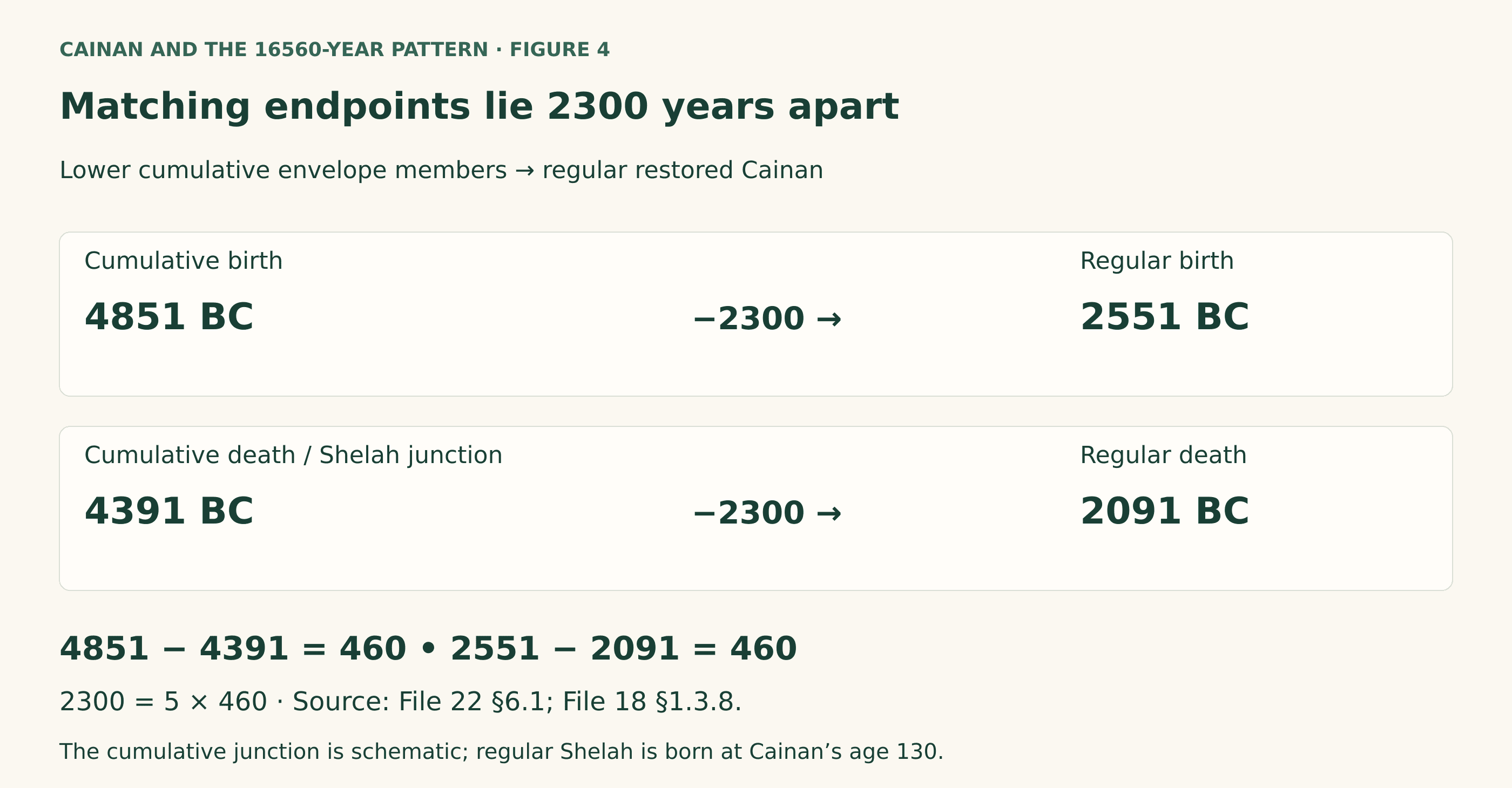
Both intervals are 460 years: 4851 − 4391 = 460 and 2551 − 2091 = 460. The distance between the corresponding beginnings and endings is 2300 = 5 × 460. These are same-side BC calculations, so no subtraction of one is appropriate.
The selected lower members must not be confused with the ordinary cumulative Moses-line table entries 4853 BC and 4393 BC in File 18 §6B. Nor should the upper envelope members 4858 and 4398 be silently substituted: those would give 2307 to the stated regular endpoints. The publication uses the exact members identified by File 22.
File 22 also develops a larger Jared/Cainan ladder with completed boundary values 4600, 5060 and 5520. That argument requires its separate forwarded-envelope and endpoint-counting rules. It is outside this introduction’s proof; the simpler 460 / 2300 relationship and the two explicitly stated Mirror spans are sufficient here.
7. Find a person or event in the diagrams
The links below connect each illustrated person or chronological position to the relevant figure and supporting table. A Scripture reference supplies narrative or genealogical context; it does not itself supply a cumulative or reflected AD date.
| Person / event / position | Linked figures | Classification and context |
|---|---|---|
| Arphaxad | Figure 1 · table | Genealogical predecessor; no separate dated row in this figure; Luke 3:36 |
| Second Cainan | Figure 1 · table; Figure 2 · table; Figure 3 · table; Figure 4 · table | Genealogical person; restored chronological comparison; Luke 3:35–36 |
| Shelah / Sala | Figure 1 · table; Figure 4 · table | Regular birth and distinct cumulative junction; Genesis 11:13, Brenton |
| Cainan’s birth | Figure 1 · table; Figure 3 · table; Figure 4 · table | Regular restored birth at 2551 BC; Genesis 11:13, Brenton |
| Cainan’s death | Figure 1 · table; Figure 3 · table; Figure 4 · table | Regular restored death at 2091 BC; Genesis 11:13, Brenton |
| Creation framework | Figure 2 · table | Cumulative schematic Creation envelope |
| Creation opening | Figure 2 · table; Figure 3 · table | Cumulative opening and annual-coordinate correspondence |
| Creation Year 6 | Figure 2 · table | Cumulative Year 6 position |
| Creation closing boundary | Figure 2 · table | Cumulative envelope closing boundary |
| AD 14010n target | Figure 3 · table | Mirror comparison coordinate; no narrative event |
| AD 14470n target | Figure 3 · table | Mirror comparison coordinate; no narrative event |
| BC–AD boundary | Figure 3 · table | Civil notation boundary; no year zero |
| Cumulative Cainan birth | Figure 4 · table | Selected lower envelope member 4851 BC |
| Cumulative Cainan death / Shelah birth | Figure 4 · table | Selected lower schematic junction member 4391 BC |
Download all calculation data and SVG sources (ZIP). The package also includes the vector and raster originals, accessible figure pages, and a machine-readable person/event index.
8. Sources and scope
| Source | Material used |
|---|---|
| File 22: Cumulative MT Harmonics, §6.1 and Mirror-language rule | The 460-year Cainan life, corresponding 2300-year transfers, and both 16560-year corroborative comparisons. |
| File 18: Chronological Data Tables, §§1.3.1, 1.3.8, 1.6 and 6 | Regular variant boundary; cumulative envelopes and selected members; separate +130 and +460 insertion rules. |
| File 09: Cumulative Architecture, §3A.1 and Appendix A | Cumulative Creation positions; distinctions among single dates, paired seasonal reflection and civil span checks. |
| File 00: Repository Foundation, §3.9 | Distinction between the Mirror principle and ordinary BC–AD elapsed-span arithmetic. |
| Luke 3:35–36, BSB | The second Cainan’s genealogical position. |
| Genesis 11:12–13, BSB | Received MT Arphaxad–Shelah sequence and ages. |
| Genesis 11:13, Brenton Septuagint | Cainan’s age at Sala’s birth and remaining years. |
The original Key of 16560 discussion is the research background. This introduction selects its central subject through the current canonical files. The broader cross-tradition, calendar-conversion and scribal-intent claims of that discussion do not carry the argument here. Equality of two chosen spans is an arithmetic result; its structural or theological meaning is an interpretation, and no probability calculation is asserted.
Scripture quotations: Berean Standard Bible (BSB), public domain. References to the LXX use the public-domain Brenton Septuagint Translation. Translators’ notes are separate from the Scripture text; none is quoted in this appendix.