Companion to The Key of 23 Capstone: Sums and Collective Dates. The tables distinguish the fixed Part 5B input, declared arithmetic families, and later interpretive comparisons.
Go directly to: definitions · eight central sums · all twelve family states · complete addends · pair counts · internal relationships · seasonal companions · tripling · historical event table · supporting research · source controls.
The coordinates and operations
These calculations work with signed symbolic coordinates. A positive coordinate c has the civil label AD c. A negative coordinate −n has the label (n + 1) BC: −200 is 201 BC, −800 is 801 BC, and −6 is 7 BC. Coordinate zero labels 1 BC; it is not a civil year zero. Signed differences agree with civil elapsed spans, BC + AD − 1, when this conversion is followed consistently.
The sum of coordinates depends on their origin. If each of n coordinates is increased by k, its total increases by n × k. Consequently, a collective coordinate is a declared symbolic use of a sum in the stated register. It is not an origin-independent historical date or a prediction.
Use three distinct operations:
- Family translation: subtract t + u from every lower addend; add t + u to every upper addend. The fixed Part 5B input has t = 0. The central Part 5C family has t = 1. Its 30-unit companion has u = 30; otherwise u = 0.
- Local signed reflection: M(c) = −c. Thus −200 reflects to +200. This arithmetic operation does not import the phase, season, or Rounded display conventions of the canonical Chronological Mirror.
- Selected seasonal companion: a separate aggregate conversion assigns s = 90n/360 to a side of n addends. Its balanced companion adds s to the lower sum and subtracts s from the upper sum. This is an additional model convention, not a consequence of the first day–year mapping.
The three source-retained arithmetic family states t = 0, 1, 2 are retained as specified arithmetic. They are not automatically the three Noah/Shem gears. The exact two-day calendar displacement belongs to the separate calendar-datum appendix, which anchors the Mirror datum to circumcision on January 1, AD 1.
The normal biblical controls remain MT/Nisan, 430 years in Egypt, no optional +60 Terah or inserted second Cainan. They give Creation 4114 BC, the symbolic creation week 4121–4114 BC, Year-6 position 4116 BC, Flood 2458 BC, fixed Arphaxad 2456 BC, and Abram 2166 BC. Variants appear only when a comparison explicitly names them. Noah/Shem Gear 2 is normal; Gear 1 comparisons remain separately labeled.
The eight central totals
| Stage / family | Values per side | Lower total | Upper total |
|---|---|---|---|
| Initial · six pairs · central | 6 | 1,224 | 11,616 |
| Initial · six pairs · 30-unit companion | 6 | 1,044 | 11,796 |
| Expanded · twenty pairs · central | 20 | −200 | 43,000 |
| Expanded · twenty pairs · 30-unit companion | 20 | −800 | 43,600 |
All twelve family states
Let the six lower Part 5B values be L and its six upper values be R. Let P and Q be the lower and upper twenty values of the final forty-value set. In either stage, with n values on each side:
Lower sum = original lower sum − n(t + u)
Upper sum = original upper sum + n(t + u)
| Stage | t | u | Lower sum | Upper sum | Paired sum | Upper − lower |
|---|---|---|---|---|---|---|
| Initial | 0 | 0 | 1,230 | 11,610 | 12,840 | 10,380 |
| Initial | 0 | 30 | 1,050 | 11,790 | 12,840 | 10,740 |
| Initial | 1 | 0 | 1,224 | 11,616 | 12,840 | 10,392 |
| Initial | 1 | 30 | 1,044 | 11,796 | 12,840 | 10,752 |
| Initial | 2 | 0 | 1,218 | 11,622 | 12,840 | 10,404 |
| Initial | 2 | 30 | 1,038 | 11,802 | 12,840 | 10,764 |
| Expanded | 0 | 0 | −180 | 42,980 | 42,800 | 43,160 |
| Expanded | 0 | 30 | −780 | 43,580 | 42,800 | 44,360 |
| Expanded | 1 | 0 | −200 | 43,000 | 42,800 | 43,200 |
| Expanded | 1 | 30 | −800 | 43,600 | 42,800 | 44,400 |
| Expanded | 2 | 0 | −220 | 43,020 | 42,800 | 43,240 |
| Expanded | 2 | 30 | −820 | 43,620 | 42,800 | 44,440 |
All rows preserve the paired total: 12,840 for six pairs, 42,800 for twenty pairs. The upper-minus-lower contrast changes when the sides move apart; it is a different calculation from their sum.
Every addend behind the central totals
Within each table, the upper counterpart is shown in reverse order to make the pair total of 2140 visible. The unshifted raw columns reproduce Part 5B; the companion columns are applied afterward. No shifted family is silently substituted into the expansion algorithm.
Six pairs: original seed halves
| Pair | Raw lower | Raw upper | t=1 lower | t=1 upper | t=1,u=30 lower | t=1,u=30 upper | Pair sum |
|---|---|---|---|---|---|---|---|
| 1 | −5 | 2,145 | −6 | 2,146 | −36 | 2,176 | 2140 |
| 2 | 35 | 2,105 | 34 | 2,106 | 4 | 2,136 | 2140 |
| 3 | 175 | 1,965 | 174 | 1,966 | 144 | 1,996 | 2140 |
| 4 | 215 | 1,925 | 214 | 1,926 | 184 | 1,956 | 2140 |
| 5 | 315 | 1,825 | 314 | 1,826 | 284 | 1,856 | 2140 |
| 6 | 495 | 1,645 | 494 | 1,646 | 464 | 1,676 | 2140 |
| Total | 1,230 | 11,610 | 1,224 | 11,616 | 1,044 | 11,796 | 12,840 |
Twenty pairs: final expanded halves
| Pair | Raw lower | Raw upper | t=1 lower | t=1 upper | t=1,u=30 lower | t=1,u=30 upper | Pair sum |
|---|---|---|---|---|---|---|---|
| 1 | −685 | 2,825 | −686 | 2,826 | −716 | 2,856 | 2140 |
| 2 | −645 | 2,785 | −646 | 2,786 | −676 | 2,816 | 2140 |
| 3 | −505 | 2,645 | −506 | 2,646 | −536 | 2,676 | 2140 |
| 4 | −465 | 2,605 | −466 | 2,606 | −496 | 2,636 | 2140 |
| 5 | −325 | 2,465 | −326 | 2,466 | −356 | 2,496 | 2140 |
| 6 | −285 | 2,425 | −286 | 2,426 | −316 | 2,456 | 2140 |
| 7 | −185 | 2,325 | −186 | 2,326 | −216 | 2,356 | 2140 |
| 8 | −145 | 2,285 | −146 | 2,286 | −176 | 2,316 | 2140 |
| 9 | −105 | 2,245 | −106 | 2,246 | −136 | 2,276 | 2140 |
| 10 | −5 | 2,145 | −6 | 2,146 | −36 | 2,176 | 2140 |
| 11 | 35 | 2,105 | 34 | 2,106 | 4 | 2,136 | 2140 |
| 12 | 75 | 2,065 | 74 | 2,066 | 44 | 2,096 | 2140 |
| 13 | 175 | 1,965 | 174 | 1,966 | 144 | 1,996 | 2140 |
| 14 | 215 | 1,925 | 214 | 1,926 | 184 | 1,956 | 2140 |
| 15 | 315 | 1,825 | 314 | 1,826 | 284 | 1,856 | 2140 |
| 16 | 355 | 1,785 | 354 | 1,786 | 324 | 1,816 | 2140 |
| 17 | 395 | 1,745 | 394 | 1,746 | 364 | 1,776 | 2140 |
| 18 | 495 | 1,645 | 494 | 1,646 | 464 | 1,676 | 2140 |
| 19 | 535 | 1,605 | 534 | 1,606 | 504 | 1,636 | 2140 |
| 20 | 575 | 1,565 | 574 | 1,566 | 544 | 1,596 | 2140 |
| Total | −180 | 42,980 | −200 | 43,000 | −800 | 43,600 | 42,800 |
The machine-readable family summary and complete coordinate lists include the t = 0 and t = 2 companion states as well. The calculation reproducer (ZIP) independently rebuilds the fixed set and each sum.
What each combined total counts
| View | Coordinate occurrences | Complementary pairs | Ordinary signed total |
|---|---|---|---|
| Initial central view | 12 | 6 | 12,840 = 6 × 2140 |
| Initial central + 30-unit views | 24 | 12 | 25,680 = 12 × 2140 |
| Expanded central view | 40 | 20 | 42,800 = 20 × 2140 |
| Expanded central + 30-unit views | 80 | 40 | 85,600 = 40 × 2140 |
| Both stages / two views | 104 | 52 | 111,280 = 52 × 2140 |
Two family views share underlying values and structure. Coordinate occurrences are counted before any deduplication. A total across two views is not the sum of a newly generated set of that many independent dates.
Selected internal and covenant relationships
| Inputs / operation | Exact result | State / meaning |
|---|---|---|
| M(−200) − (−200) | 400 | Local signed reflection; 201 BC → AD 200. |
| 43,000 − (−200) | 43,200 = 120 × 360 | Expanded central contrast; Moses lifespan comparison. |
| M(−800) − (−800) | 1600 = 4 × 400 = 40² | Local reflection; 801 BC → AD 800. |
| 1224 − 314 | 910 = 2½ × 364 | Initial central sum / selected addend. |
| 1224 − 494 | 730 = 2 × 365 | Initial central sum / selected addend. |
| 1044 − (−36) | 1080 = 3 × 360 | Same shifted family. |
| 1224 − (−36) | 1260 = 3½ × 360 | Central sum, shifted-family datum; cross-family comparison. |
| 11,796 − 1996 | 9800 = 20 × 490 | Initial upper 30-unit companion / own addend. |
| 1996 − 36 | 1960 = 4 × 490 | Selected symbolic AD 36 comparison. |
| 11,796 − 36 | 11,760 = 24 × 490 = 35 × 336 = 70 × 168 | Same selected AD 36 comparison. |
| 14006 BC → AD 184 | 14,189 civil | Selected cumulative Year-6 position; not 33 × 430. |
| 14006 + 184 | 14,190 = 33 × 430 | Nominal label addition, separate from civil elapsed reckoning. |
| 1044 − 184 | 860 = 2 × 430 | Exact initial-family difference. |
The six-addend central families have matching final digits in their sums and addends, making their differences multiples of ten. This observation does not apply unchanged to the expanded families: their sums end in zero, while their shifted addends end in four or six.
The comparisons with 360, 364, 365, 336, and 490 are schematic numerical readings. John’s modeled conception and Jesus’ modeled conception are associated with the selected addends through the preceding coordinate construction; the totals alone do not independently establish those event dates. The 1260-day ministry and subsequent 3½-day interval are separately identified in Revelation 11:3, 9, 11, BSB.
The separately declared seasonal conversion
At the first day–year stage, changing every addend by ninety literal days would change a side’s total by 90n symbolic years. The seasonal branch instead applies a further 360-to-1 aggregate conversion, producing 90n/360. Those operations have different units and must not be conflated.
| Values per side | 30-unit view | Additional scalar 90n/360 | Lower companion | Upper companion | Pair total |
|---|---|---|---|---|---|
| 6 | No | 1½ | 1225½ | 11,614½ | 12,840 |
| 6 | Yes | 1½ | 1045½ | 11,794½ | 12,840 |
| 20 | No | 5 | −195 | 42,995 | 42,800 |
| 20 | Yes | 5 | −795 | 43,595 | 42,800 |
For six addends, the exact quantities include halves: 1225½ and 11,614½, not automatically 1226 and 11,614. The latter whole-number pairing preserves 12,840 but requires an additional boundary/rounding rule. An exact Nisan–Tishri identification is not supplied by the aggregate alone.
For twenty addends, the balanced seasonal pair −195 + 42,995 = 42,800 is exact under the declared additional convention. Pure reflection of 42,995 gives −42,995. The legacy counterpart −43,005 instead belongs to a different reflection centered at coordinate −5, or 6 BC:
N(c) = −10 − c
Thus N(42,995) = −43,005, and N(195) = −205. In civil labels, 43,006 BC → 6 BC → AD 42,995 gives 43,000 on each side. Likewise 206 BC → 6 BC → AD 195 gives 200 on each side. These are explicitly Nativity-centered counterparts, not the same operation as M(c) = −c. The 6 BC comparison point is a symbolic era point and is distinct from December 25’s coordinate −6/7 BC in its own January 1 register and January 1’s +1/AD 1.
The whole-set sum 42,800 has its own five-unit companions: AD 42,795 and coordinate −42,805, labeled 42,806 BC, when the declared orientation is selected. Do not carry the 42,995 endpoint of the 43,000 family into this separate total.
Tripling totals and polarity contrasts
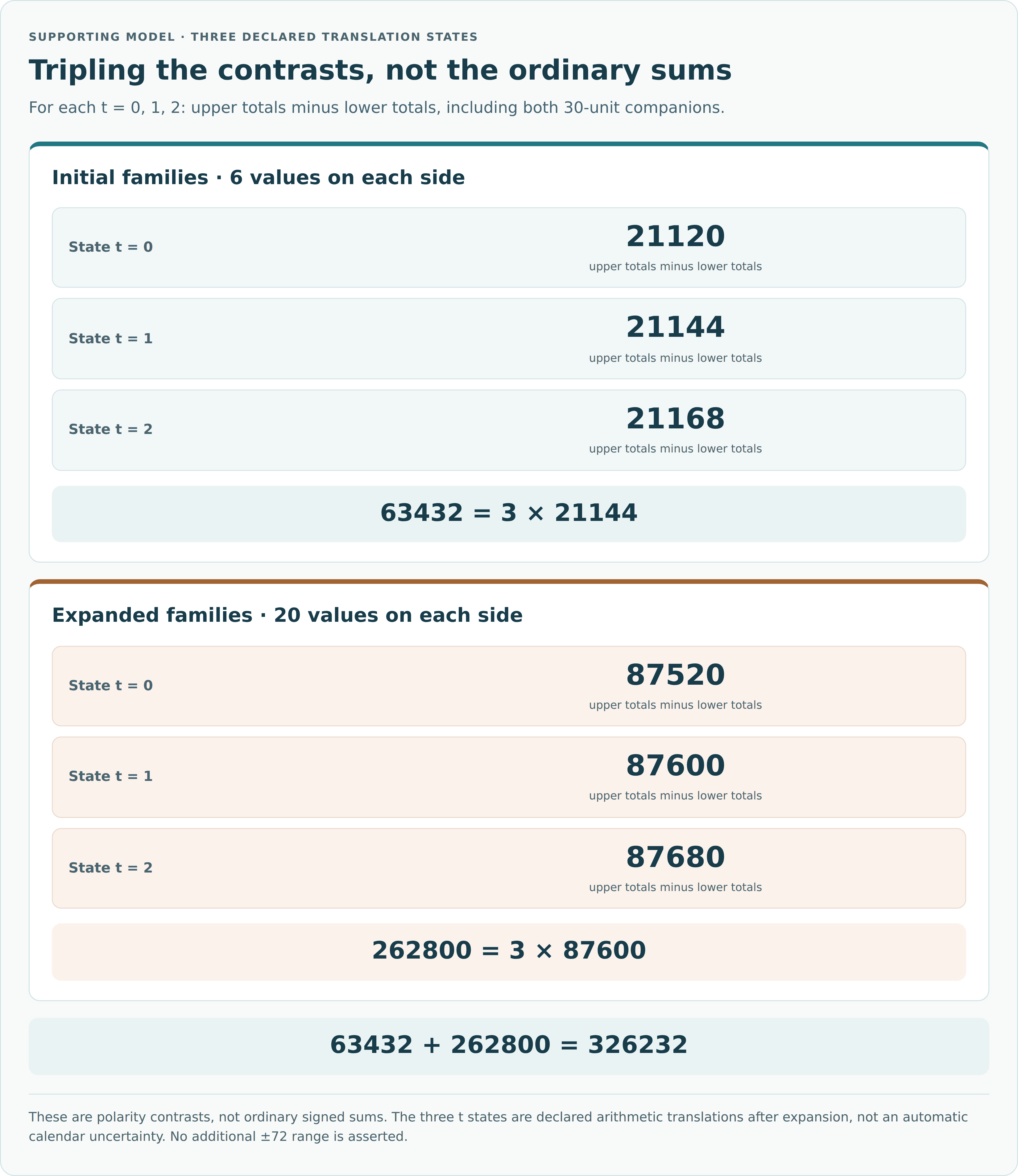
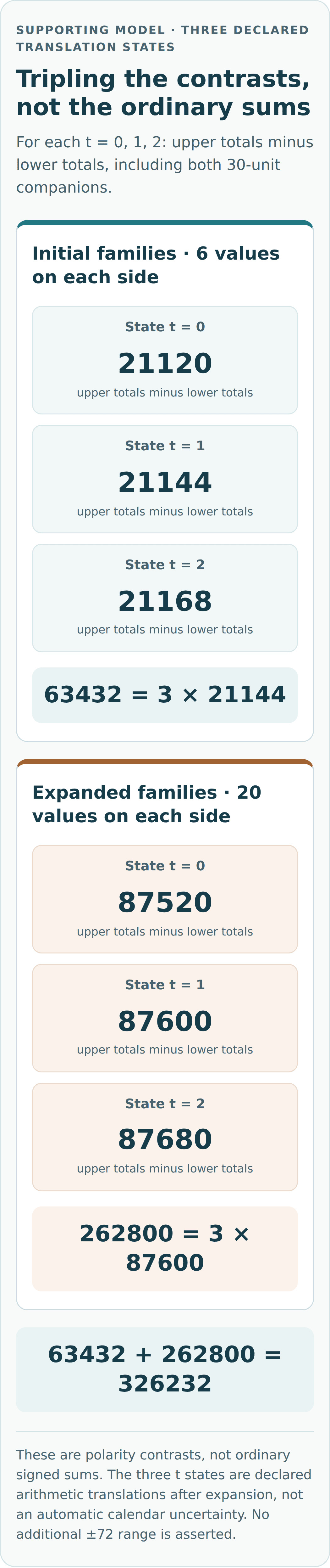
At the central family t = 1, add both upper totals and subtract both lower totals:
(11,616 + 11,796) − (1224 + 1044) = 21,144
(43,000 + 43,600) − (−200 − 800) = 87,600
These are polarity contrasts, not the ordinary sums 25,680 and 85,600. For n values on each side, the two-view contrast satisfies:
Dₙ(t) = Dₙ(1) + 4n(t − 1)
| Stage / both views | t=0 contrast | t=1 contrast | t=2 contrast | Sum | Coordinate contributions |
|---|---|---|---|---|---|
| Initial | 21120 | 21144 | 21168 | 63,432 = 3 × 21,144 | 72 |
| Expanded | 87520 | 87600 | 87680 | 262,800 = 3 × 87,600 | 240 |
| Both stages | 108640 | 108744 | 108848 | 326,232 = 3 × 108,744 | 312 |
Adding the three equally spaced states gives three times the middle contrast. The combined result is 63,432 + 262,800 = 326,232. It contains 312 coordinate contributions: 72 from the initial two-view families and 240 from the expanded two-view families. This summation is fixed by its stated families; tripling does not itself produce an uncertainty range.
SUPPORTING MODEL · THREE DECLARED TRANSLATION STATES
Tripling the contrasts, not the ordinary sums
For each t = 0, 1, 2: upper totals minus lower totals, including both 30-unit companions.
Initial families · 6 values on each side
Expanded families · 20 values on each side
If a further common outward one-unit translation is applied to the 72 initial contributions, 63,432 changes by 72, yielding 63,360 or 63,504. One possible explicit construction of 326,232 ± 72 would move only the initial contributions and hold the expanded contribution fixed. The original discussion does not specify that operator, so this remains a proposed clarification rather than an established derivation. Moving all 312 contributions outward would change the combined contrast by 312 instead. This optional branch is not a general calendar tolerance.
Supporting research notes
Seasonal and formal operators
A schematic quarter-year allowance assigns 90 days per addend. Summing those allowances gives 540 for six addends or 1800 for twenty. This branch then applies the additional aggregate 360-to-1 conversion defined above, obtaining 1½ or 5 as the companion shift. Without that further conversion, ninety-day movements of the original day–year coordinates would change their sums by 540 or 1800 symbolic years. Balanced companion shifts preserve the paired total.
The legacy example 42995 + (−195) = 42800 preserves the total. Pure reflection sends those terms to −42995 and +195. Its further −43005 and +205 alternatives require separately oriented seasonal adjustments; they are not pure reflections of the first pair.
The original discussion associates this allowance with spring/summer and autumn/winter positions, the approximate spring-to-winter interval from the 6 BC era to the later birth datum, and Moses’ three hidden months in Exodus 2:2. Those associations belong to the schematic interpretation. Ninety days does not measure the ordinary Nisan-to-Tishri separation, which is approximately six months; an exact seasonal calendar date requires its own verified calendar calculation.
The earlier approximate interval 2109.75 remains a seasonal research estimate. It does not replace the exact Julian-day counts between the fixed era starts and the separately verified calendar datums in Part 5A’s endpoint table. In particular, a purely schematic six years less ninety days gives 6 × 360 − 90 = 2070; the model and the literal calendar count are distinct.
The six-addend lower variants sum to 1218, 1224, 1230, while their paired upper variants sum to 11622, 11616, 11610. The twenty-addend apparatus similarly permits a collective ±20 when each addend receives the same declared ±1. These alternatives explain later research bounds. They should not be presented as free uncertainty in every biblical date.
Historical event reference table
The original’s full event table is retained here as a historical formal display. It is not a replacement for Part 5A’s individually verified calendar dates. Its event positions and the aggregate half-shifted lists are related through separately declared translations/reflections; they must not be treated as one untransformed event list.
| Event | Historical era display, outward 30 | Historical January 1-era display | Exodus 360-era display | Christ 360-era display |
|---|---|---|---|---|
| John’s conception | 497 BC | 467 BC | AD 1646 | AD 1676 |
| Jesus’ conception | 317 BC | 287 BC | AD 1826 | AD 1856 |
| John’s birth | 217 BC | 187 BC | AD 1926 | AD 1956 |
| John’s circumcision, seven/eight elapsed-day alternatives | 210/209 BC | 180/179 BC | AD 1933/1934 | AD 1963/1964 |
| John’s completed 40-day position | 177 BC | 147 BC | AD 1966 | AD 1996 |
| Jesus’ birth | 37 BC | 7 BC | AD 2106 | AD 2136 |
| Jesus’ circumcision, seven/eight elapsed-day alternatives | 30/29 BC | AD 1/AD 2 | AD 2113/2114 | AD 2143/2144 |
| Jesus’ completed 40-day position | AD 4 | AD 34 | AD 2146 | AD 2176 |
The Exodus 360 circumcision row corrects the source’s 2113/2144 to 2113/2114. The seven/eight elapsed-day alternatives explain the historical inclusive/exclusive labels; they do not establish two different normative circumcision datums. The current calendar system anchors the circumcision to January 1. A completed 40-day position is also distinct from the 40th inclusive date.
Covenant, Moses, and the small Mirror comparisons
The covenant of the pieces supplies the main interpretive theme: affliction, deliverance, and return in the fourth generation (Genesis 15:13–18). The 400-year affliction and 430-year Egyptian sojourn remain distinct. The sum 43000 is 430 × 100; Abraham’s age when Isaac was born was 100 (Genesis 21:5). This suggests a generational reading of the larger sum, while the wilderness generation supplies a second schematic scale of 40. Scripture does not define every generation as one fixed length.
The small mirrored sum gives a clear halving illustration:
| Operation | Exact result | Interpretive comparison |
|---|---|---|
| Coordinates −200 to +200 | 400 | Two halves of the covenant’s 400-year period |
| Coordinates −800 to +800 | 1600 = 4 × 400 = 40² | The same pattern at a larger scale |
| Coordinates −200 to +43000 | 43200 = 120 × 360 | Moses’ 120-year lifespan expressed on a schematic day–year scale |
| 1406 BC to 206 BC | 1200 | Tenfold comparison with Moses’ lifespan |
| 206 BC to AD 195 | 400 | Shifted small Mirror comparison |
| 1406 BC to AD 195 | 1600 | Four 400-year periods |
The latter three rows use the declared seasonal projection. They do not alter Moses’ actual dates, 1526–1406 BC, or his age of 80 at the Exodus and 120 at death (Exodus 7:7; Deuteronomy 34:7).
The original also examines the 20-related collective alternatives 42980/43020 and Herod’s Temple’s 20 BC framework, alongside the 46 years mentioned in John 2:20. These are formal endpoint constructions, not a statement that AD 20 was 46 years after 20 BC. Its integer 44444 comparisons can be retained with specified endpoints, such as 1446 BC to AD 42999. The additional 44444.44444 suggestion lacks a specified fractional terminal moment and remains an unresolved precision lead.
Creation, Conquest, and the conversion spans
The cumulative framework supplies a recognizable backbone: the MT cumulative Year-6 position 14006 BC and Conquest position 1406 BC are separated by 12600 years. The cumulative week is 14011–14004 BC, with corresponding Year-6 and closing positions 14006 and 14004. The regular week is 4121–4114 BC, with corresponding positions 4116 and 4114. Both matched comparisons give 9890 = 23 × 430. These node classes remain distinct from the Rounded regular creation position 4106 BC and from the Rounded cumulative core that also uses 14006. Files 07, 18 §6A and 22 control these states.
Using the declared five-year seasonal projection of the upper expanded sum gives AD 43595. Two civil elapsed comparisons then meet at the Conquest:
| Endpoints | Span | Factorization |
|---|---|---|
| 14006 BC to AD 43595 | 57600 | 160 × 360 = 240² |
| 1406 BC to AD 43595 | 45000 | 125 × 360 = 360 × 5³ |
| 43606 BC to 606 BC | 43000 | 100 × 430 |
| 43586 BC to 586 BC | 43000 | 100 × 430 |
| 43586 BC to 1446 BC | 42140 | 98 × 430 = 2 × 49 × 430 |
Another small covenant comparison starts from coordinate −800 = 801 BC: 2091 BC→801 BC = 1290 = 3 × 430. The 2091 BC call/entry framework is followed by 215 to 1876 BC and 430 to 1446 BC. The legacy associates the promise with the call and the covenant sacrifice with a ten-year interval, but its specific Ur/Haran assignment and exact sacrifice date require their own source control.
The last two rows depend on the separately declared twenty-addend offset; they are not independent calendar dates. The 606/586 exile framework connects this large-scale comparison to the familiar chain from 1876 BC through 1446 BC to 586 BC. The numerical chain is useful without merging the 400-year affliction and 430-year sojourn.
The combined forty-addend sum 42800 can be mirrored and seasonally projected to 42806 BC. Its span to 1406 BC is 41400. Here the Key of 23 acts on a single anchored span:
| Scalar operation | Converted span | Increase |
|---|---|---|
| 41400 × 25/23 | 45000 | 3600 = 60² = 10 × 360 |
| 41400 × 70/69 | 42000 | 600 |
These scalar conversions differ from Part 5B’s procedure that moves both endpoints outward. That procedure’s mutual span multiplies by 27/23 or 71/69; it must not be confused with 25/23 or 70/69 applied to one anchored span.
The 42000 conversion projects its earlier endpoint to 43406 BC, leaving 29400 = 600 × 49 = 60 × 490 to 14006 BC. Before that conversion, 42806 BC to 14006 BC is 28800 = 80 × 360. Two matching 45000 spans make 90000 = 300² = 250 × 360. These squared and cubed factorizations motivate the original’s proposed self-similarity across scales; they are not a demonstrated fractal theorem.
The recurring 600 appears in the difference between sums 43600 and 43000, in the scalar increase, in the 600 jubilee counts, and in Jacob’s 2006→1406 BC interval. Noah’s age at the Flood and Shem’s lifespan add biblical comparisons at the ordinary scale.
The initial sums and their addends
A collective sum can also be compared with the numbers that produced it. This is especially clear in the initial six-addend lists:
| Initial comparison | Difference | Calendar or chronological analogy |
|---|---|---|
| 1224 − 314 | 910 | 2.5 × 364 |
| 1224 − 494 | 730 | 2 × 365 |
| 1044 − (−36) | 1080 | 3 × 360 |
| 1224 − (−36), using the translated birth addend | 1260 | 3.5 × 360 |
| 11796 − 1996 | 9800 | 20 × 490 = 200 × 49 |
| 1996 − 36 | 1960 | 4 × 490 |
| 11796 − 36 | 11760 | 24 × 490 = 35 × 336 = 70 × 168 |
The table deliberately states when an addend is taken from the translated list. 1224 − (−6) is 1230, not 1260. The 910/730 comparison draws on 364-day and 365-day schematic calendar units; Genesis records Enoch’s 365 years and being taken by God, not his death (Genesis 5:23–24). Likewise, 336/168 are priestly-cycle comparisons; their day–year interpretation must be declared rather than treated as physical years of priestly service.
The original’s broad claim that all eight collective totals align every own addend in multiples of ten needs narrowing. These six-addend examples work, but expanded twenty-addend totals end in 0 while their addends end in 4 or 6.
The raw seed extends from −5 to +2145, a width of 2150 = 5 × 430. The expanded upper collective sum gives 43000 = 20 × 2150; its seasonal mirrored projection 43006 BC→AD 2145 is 45150 = 21 × 2150. The raw −5 and formal middle −6 are distinct declared inputs, not conflicting calendar measurements.
The larger initial totals offer additional routes:
| Declared comparison | Exact relationship |
|---|---|
| Positive total 11616 treated as a BC label, to 6 BC | 11610 = 27 × 430 = 3³ × 430 |
| 11796 BC to 1446 BC | 10350 = 450 × 23 = 150 × 69 |
| 10350 × 70/69 | 10500 |
| 10350 × 25/23 | 11250; increase 900 = 2.5 × 360 |
| 14006 BC to AD 11795 | 25800 = 2 × 12900 = 60 × 430 |
| 14006 BC to AD 1045 | 15050 = 35 × 430 |
| 14006 BC to AD 185, then AD 1045 | 33 × 430 + 2 × 430 |
The AD 185/1045 rows explicitly choose civil endpoint companions to the legacy’s nominal AD 184/1044 comparisons; they are not the same endpoint states. The AD 11795 endpoint belongs to the stated seasonal/integer projection of the initial adjusted upper total. The difference between 15050 = 35 × 430 and 25800 = 60 × 430 is 10750 = 25 × 430, correcting the original’s stray 45 × 430. The intermediate 12900 = 12600 + 300 invites comparison with Jephthah’s 300-year statement in Judges 11:26. It does not independently establish a precise event date for Jephthah. The creation-to-sum comparison 4114 BC→AD 11796 is 15909 civil elapsed years; 15910 = 37 × 430 belongs the separate legacy nominal-label addition. The two conventions cannot be silently combined.
Ministry, the Flood, and jubilees
The declared lower alternatives 1230 and 1050 can be negatively projected. Astronomical coordinate −1230 is 1231 BC, giving 1260 civil elapsed years to AD 30. Coordinate −1050 is 1051 BC, giving 1080 to AD 30. Their separation is 180, half a schematic year. This compares the 1260 days and 3.5 days of Revelation 11:3, 11 with the three-day resurrection motif. It remains a theological comparison; Revelation does not identify the two witnesses’ resurrection as a date calculation for Christ.
AD 30 is retained here as the historical comparison endpoint or possible Passion framework, not the present canonical primary beginning of Jesus’ ministry, AD 27. The source’s exile chain 2091 BC→1231 BC→AD 60 comprises 860 then 1290 civil years. Paul reaching Rome is associated with the AD 60 framework, while Acts 27–28 supplies the shipwreck/Rome narrative without a numbered AD date. The source’s 2031 BC in this chain is a typo for 1231 BC.
A separate 1225 numeral observation gives 1225 + 1225 = 2450 = 5 × 490, with 1225 = 35². It is nominal-label addition: the civil span 1225 BC→AD 1225 is 2449. Astronomical reflection of coordinate −1224 gives a reflected separation of 2448. These are different operations, and the 2450 nominal observation is not the canonical pure Rounded Mirror.
Other exact civil endpoints clarify the Flood comparisons. AD 1045 is an explicitly chosen civil companion to the legacy’s AD 1044 nominal-label observations; the original AD 1044 calculations remain in the full arithmetic tables as nominal-label comparisons rather than being silently moved:
| Endpoints or operation | Span | Interpretation |
|---|---|---|
| 1445 BC to 1045 BC | 400 | Tabernacle-era covenant comparison |
| 1406 BC to AD 1045 | 2450 = 50 × 49 | Conquest/jubilee comparison |
| Cumulative Flood 4836 BC to Conquest 1406 BC | 3430 = 70 × 49 | Matching seven-year ranges continue through 4829/1399 |
| 4836 BC to AD 1045 | 5880 = 120 × 49 | Seventy plus fifty jubilees |
| 5880 + schematic 120 | 6000 | Tenfold comparison with Noah’s age 600 and Shem’s lifespan 600 |
| Cumulative Shem 5436 BC to AD 1045 | 6480 | Quarter of the schematic 25920 celestial cycle |
| 6480 + 180 | 6660 | Historical ±6 apparatus permits the further 6666 observation |
| 5436 BC / 4836 BC to 536 BC | 4900 / 4300 | Shem/Flood and exile-return framework |
| G1 Flood/Arphaxad 2456 BC to AD 1045 | 3500 | Compared with Noah’s 350 post-Flood years |
| G1 Shem 2556 BC to AD 1045 | 3600 = 60² | Six times 600 |
| G1 Shem 2556 BC to 6 BC | 2550 = 1260 + 1290 | Combined prophetic units |
The last rows name Gear 1; normal MT Gear 2 remains Flood 2458 and Shem 2558 BC. Shelah’s birth is 35 after Arphaxad’s birth, or 37 after normal Gear 2 Flood. Thus the 35/350/3500 motif must use the declared Arphaxad/Gear 1 station if calling the first interval ‘after the Flood.’ Adding a schematic 120 does not revise the fixed chronological nodes.
Celestial and Sumerian comparisons
The classic schematic celestial cycle 25920 = 360 × 72 is compared with a 25800 = 60 × 430 model. These are research scales, not claims of an unchanging measured astronomical precession period. The original also interprets the stellar cycle as a proposed ‘Grand Year of the Angels’; this is a theological analogy, not a biblical definition of a measured angelic period. Their day units are 72 and 215/3 years respectively. The exact fraction matters: rounding it to 71.666 before dividing loses precision.
| Formal span | Schematic celestial reading |
|---|---|
| 28800 | 400 × 72 |
| Reflection span 23220 = 54 × 430 | 324 × (215/3), where 324 = 18²; also 322.5 ×72 |
| 2150 | One month of the 25800 model |
| 64500 | 2.5 ×25800 = 150 ×430; half 129000 |
| 19440 | 270 ×72; three-quarters 25920 |
The actual regular creation wrappers are MT 4121–4114 BC and native LXX 5501–5494 BC, with LXX Cainan present and no +60 Terah adjustment. Corresponding boundaries differ by 1380 = 23 × 60. Specifically, the opening LXX wrapper node 5501 BC→AD 42800 gives 48300 civil years; 48300 × 70/69 = 49000. This does not relabel the normal LXX closing endpoint 5494 BC as 5501 BC. The cumulative/regular 9890 = 23 × 430 bridge likewise uses matched endpoints or Year-6 positions, as specified above.
The Sumerian comparisons use model anchors, not archaeological BC dates printed in ancient tablets. The Enochian base 262086 BC and Solar 262806 BC rail are not interchangeable: they are 720 apart in the controlling model (File 02, §4.3). Their distances to 6 BC are respectively 262080 = 364 × 720 and 262800 = 365 × 720. Likewise 20916 BC is the separate +30 Apparent-Mode counterpart of 20886 BC.
| Model comparison | Exact intra-BC relationship |
|---|---|
| 20886 BC to 2906 BC | 17980, twenty short of 18000 = 5 sars = 50 ×360 |
| 262086 BC to 20886 BC | 241200 |
| 262086 BC to 2906 BC | 259180, twenty short of 259200 = 10 ×25920 |
| 2906 BC to 606 BC | 2300 |
| 20886 BC to 1446 BC | 19440 |
| 262086 BC to 1406 BC | 260680 = 5320 ×49 = 532 ×490 = 19 ×40 ×7³ = 76 ×3430 |
The 23-kings subtotal and pre-Flood reign totals require the declared Sumerian model/recension. The source associates their twenty-year shortfall with the twenty-addend collective bound; intentional design is the interpretation, not a consequence of subtraction alone. Its 260680 multiple of 3430 explains why a comparison already aligned to the Conquest on that modulus also aligns to the selected Sumerian creation node. Noah’s naming and comfort/rest in Genesis 5:29 supplies the theological rest motif without independently proving the 3430 period.
The projected upper bound AD 43615 gives 20886 BC→AD 43615 = 64500. Further comparisons link 2906 BC to AD 1995 = 4900 and AD 11795 = 14700. AD 11795 is an explicitly stated civil companion to the source’s nominal AD 11796 observation. These remain formal projected coordinates. The ordinary totals may be placed beside the tenfold numeral similarities 14006/1406 and 20916/2091.6, but visual resemblance is a separate operation from elapsed time.
Tenfold imaging and the Magi lead
The original follows 215-year and 2150-year chains across the BC/AD boundary, comparing the 2091/20916 models and the 6/60/600/6000 scales. These emphasize exile: Jesus to Egypt, Paul to Rome, the 606–586 captivity framework, and Adam’s fall/exile within a day-as 1000-years analogy. It is a proposed thematic correspondence, not an assertion that all four are one historical date.
Exact civil subtraction from 20916 BC proceeds through 18766, 16616, 14466 and 1566 BC, then AD 585 after another 2150, and AD 4885 after 4300 more. The source’s AD 586/4886 labels employ a different year-label treatment. Its subsequent fifteen/twenty-year compensation near 4906 must therefore be treated as a declared imaging adjustment, not derived calendar uncertainty. Also, 1661 BC is the SP 215-year Egypt-entry alternative; the distinct localized LXX −33 interpretation uses 1843 BC.
The source also compares signed coordinate −20915 with +2091.5. Their exact difference is 23006.5, not its claimed 23005 = 53.5 × 430. The discrepancy is preserved as a correction in the tenfold-imaging branch.
The large collective variants likewise supply 4300/2150 chains:43600−38700 = 4900 and 43600−43000 = 600. The optional fifteen/twenty-year bounds are used to compare those with the tenfold image of AD 490 and AD 60. Every such row needs its starting variant, seasonal offset and crossing convention specified.
At the widest scale, 259200 can be rescaled by 360 to 720, then by 360 to 2. These are successive formal unit reinterpretations, not equal durations in physical years. The final two-unit analogy is compared with the real two-day separation of the Julian and proleptic Gregorian December 25 datums.
The Magi/Herod proposal then relates this to the two-year cutoff in Matthew 2:16 and to the 6 BC–AD 1 era. The passage establishes Herod’s age cutoff, not that the Magi calculated from Sumerian/Berossus tables or understood a Julian/Gregorian difference. That historical interpretation is retained as a research lead.
Tripling and fractal research
The closing branch triples the records through the historical t−1, t and t+1 apparatus. The important numbers are contrasts between upper and lower totals, distinct from ordinary addition of all eight totals:
| Contrast | One apparatus state | Three states |
|---|---|---|
| Initial upper totals minus lower totals | 21144 | 63432 |
| Expanded upper totals minus lower totals | 87600 | 262800 |
| Combined contrast | 108744 | 326232 |
Tripled records form a multiset: it is necessary to check uniqueness before describing them as three times as many distinct dates. For the initial tripled contrast, a further ±72 can be constructed by shifting each of 36 upper contributions by +1 and each of 36 lower contributions by −1, or vice versa. That is an additional operator, not uncertainty in the fixed three-family sum. The combined 312-contribution contrast would vary by ±312 under the same full-record operation, so the source’s combined 326232 ±72 requires a different specified operator.
The valid boundary factorizations are 63504 = 252² and 63360 = 176 ×360, surrounding 63432 by 72. The subsequent claim that 63432 AD to AD 32 spans 64400 is arithmetically false: it spans 63400. Therefore the alleged 28×2300 route to 70000/70006 remains unresolved without a corrected, sourced operator. No replacement endpoint is invented here.
The proposed grand-fractal rim 262806–262086 BC, center 70006 BC, lower rim AD 122075–122795, divisibility 326232 by 1656 = 72×23, Daniel 8’s 552 BC framework, and 575² Mirror observation remain explicitly identified research leads. They must not be presented as a demonstrated mapping merely because some constituent factors are exact.
The source also proposes centers 1070/1075/1076/1077 and, with+30, 1100/1105/1106/1107. 1070 is the exact raw seed reflection center. The others require their own stated rebase, seasonal or imaging operator. The approximate 5.75-year span has 23/5.75 = 4. The historical midpoint near 3 BC, the claimed 1/196 smaller-fractal scale, and the common 1076 center are preserved as display/construction proposals. From 1446 BC, exact civil spans to AD 1075 and AD 1105 are 2520 and 2550;1446→1231 BC is 215 years, not 2300. The 1224→1260 observation requires an additional +6 per each of six addends, not the±1 apparatus alone.
The original images remain available with their provenance. Their bird-circle bounds 3250/3180 AD and 1161/1231 BC each span 4410 = 90 ×49, correcting the original 80 ×49. Their centers are AD 1045/975, with a 70-year shift; these are distinct from the raw seed center 1070. The 1196 BC→AD 1105 comparison is 2300 civil years. The linked bird/eagle study and cocoon/moth study preserve the proposed death/resurrection imagery and its wider visual setting.
Canonical controls and further reading
The current Unified Chronology repository controls the established date nodes and named operations used in these comparisons. The collective-sum construction is presented here as the Part 5C research model, rather than as an independently registered canonical theorem.
| Current source | Relevant control | Use here |
|---|---|---|
| File 00 | Repository hierarchy and state safeguards | Current sources and amendments control established claims; raw sum models retain declared scope. |
| File 04 | §1.2 and sojourn controls | 430 Egypt normal MT; SP/215 and localized LXX −33 distinguished. |
| File 09 | Cumulative framework and terminal anchor | Complete lifespans; Moses death / Conquest anchor and seven-year envelope. |
| File 13 | §8 and Christological endpoints | AD 27 primary ministry node; AD 30 / AD 36 only as declared comparison states. |
| File 17 | §6 | 400-year affliction and 430-year Egyptian sojourn are distinct. |
| File 18 | §6 / §6A and regular tables | Actual MT centers, selected upper cumulative envelope positions, normal regular dates. |
| File 22 | §1.2 / §§5, 7 | 14006 Year-6 cumulative → 4116 Year-6 regular = 9890; 14004 close → 4114 close = 9890. |
| File 21 | SKL state protocol | Retained whole years versus separately recorded appendage; named modes/rails. |
| File 02 | §4.1–§4.3 | 262086 Enochian and 262806 Solar +720 rails are distinct. |
| File 34 | §4–§5 and Sumerian totals | Whole-year SKL and SKL–Berossus controls; native 262086 anchor. |
| File 26 | Precessional schematic controls | 25,800 / 25,920 symbolic scales; not fixed empirical precession measurements. |
| File 46 | §0–§1 / §7 and scalar definitions | 25/23 and 70/69 single-span scalars; distinguish two-ended set expansion. |
| File 51b | September 25 clarification and Mirror controls | Pure Rounded grid: BC+AD−2 display width, distinct from civil BC+AD−1 and nominal addition. |
| File 68 | Schematic creation/calendar context | Developed celestial/calendar arguments have their own controlling states. |
| File 69 | Enoch-centered calendar context | Schematic/genealogical comparisons remain separate from empirical dating. |
The checked sources establish the individual chronology and conversion controls. The particular sums, seasonal companions, and fractal identifications require the additional definitions given above. A bounded source check is not a claim that related research is absent from the wider repository or research text index.
Related studies: Part 5A: symbolic dates and calendar frames · Part 5B: expanding sets · Part 5B supporting tables · Cumulative chronology · Shem and the Flood.
Return to Part 5C · Preserved original discussion.
Scripture references and the main article’s excerpts: BSB. The Holy Bible, Berean Standard Bible, BSB is produced in cooperation with Bible Hub, Discovery Bible, OpenBible.com, and the Berean Bible Translation Committee. This text of God’s Word has been dedicated to the public domain.