Part 5A · Return to the detailed study
These tables distinguish the event model, literal calendar dates and generated symbolic years. The principal calculation holds the two Julian 6 BC era starts fixed, selects either calendar’s own December 25, and assigns each calendar’s own January 1 the symbolic coordinate +1, AD 1. The older means and translated families remain separate research displays.
Go directly to event intervals · principal dates · Julian Day checks · older translated dates · averaging · Mirror spans · inverse-calendar operations · sources.
1. Counts and principal event tables
For a signed symbolic coordinate c, positive values display as AD c; zero and negative values display as (1 − c) BC. Thus +1 is AD 1, 0 is 1 BC and −6 is 7 BC. There is no civil year zero. With January 1 assigned +1, a date’s coordinate is 1 + its elapsed-day offset from January 1.
For either fixed 360-era start, ordinal = elapsed days + 1. The ordinal supplies the positive symbolic AD label in that frame. These are day-generated coordinates in the astronomical/civil register, not the symmetric Rounded date-label convention.
Table 1. The selected event sequence
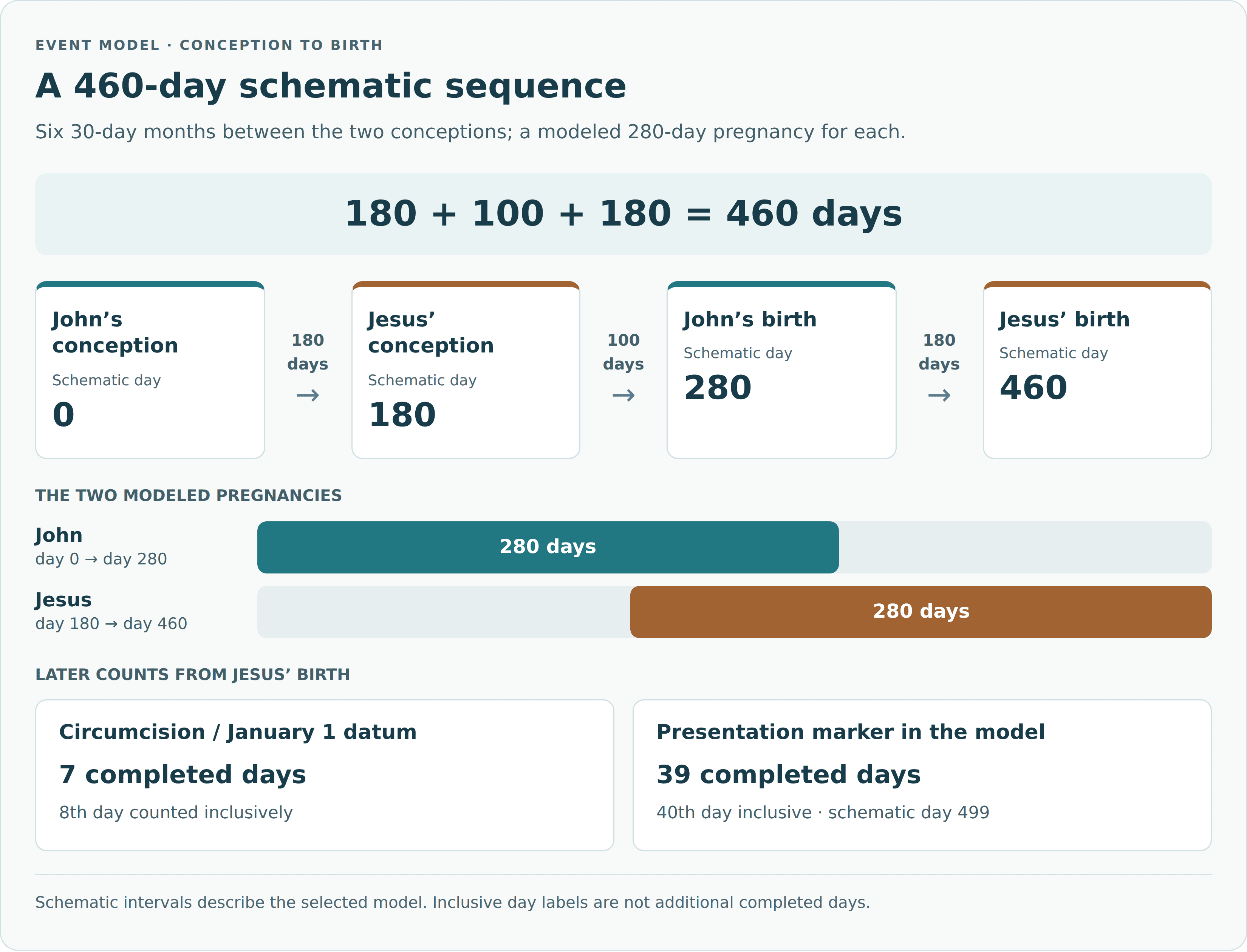
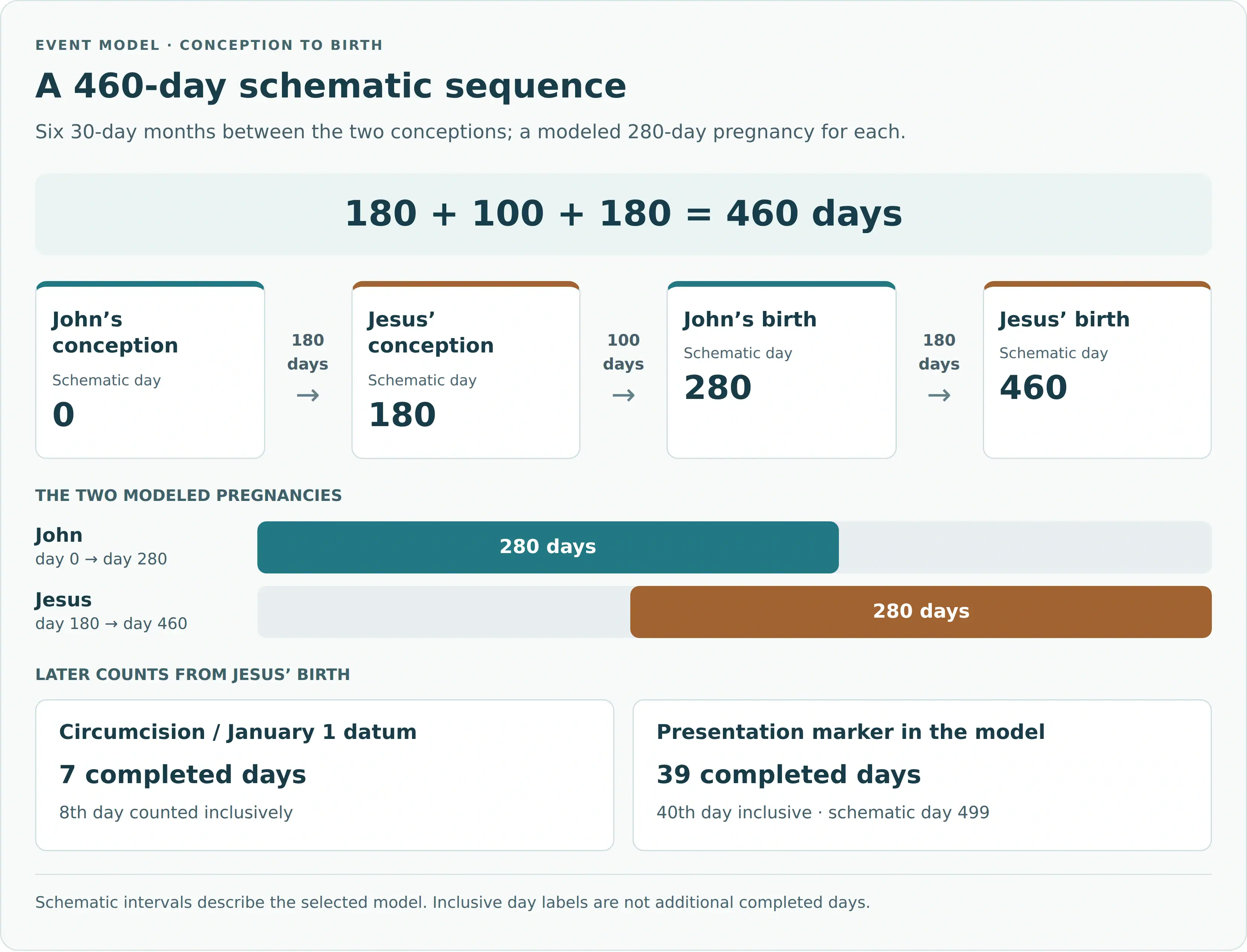
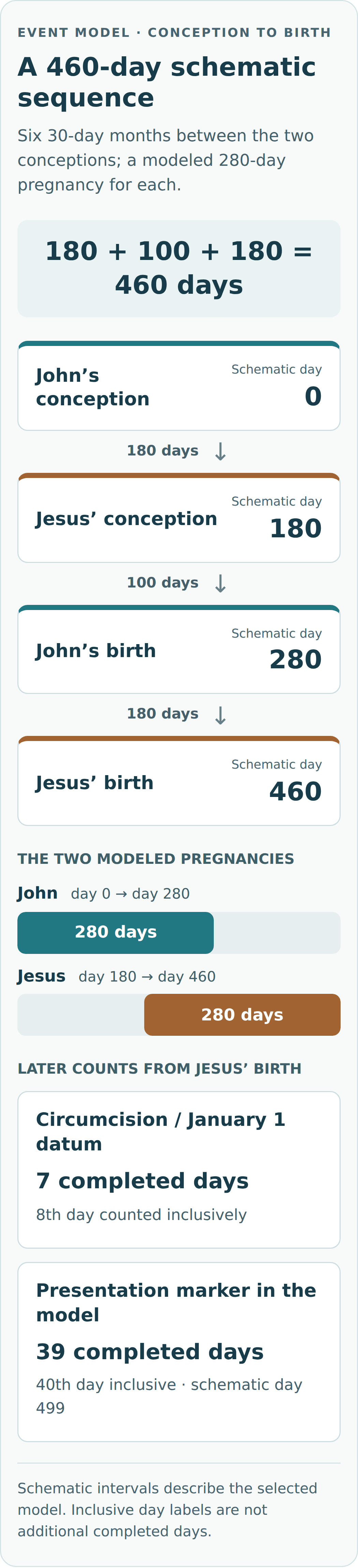
| Event or marker | Days from John’s conception | Elapsed interval from preceding row |
|---|---|---|
| John’s conception | 0 | — |
| Jesus’ conception | 180 | 180 |
| John’s birth | 280 | 100 |
| John’s eighth inclusive day | 287 | 7 |
| John’s eight-completed-day terminal | 288 | 1 |
| John’s fortieth inclusive day | 319 | 31 |
| John’s forty-completed-day terminal | 320 | 1 |
| Jesus’ birth | 460 | 140 |
| Jesus’ eighth inclusive day / naming | 467 | 7 |
| Jesus’ eight-completed-day terminal | 468 | 1 |
| Jesus’ fortieth inclusive day | 499 | 31 |
| Jesus’ forty-completed-day terminal | 500 | 1 |
The original decomposition 7 + 1 + 32 = 40 reaches the forty-completed-day terminal when its terms are treated as consecutive elapsed intervals. The law’s allocation of forty numbered days is also 7 + 1 + 32, but starts with birth as day 1: circumcision occurs at elapsed day 7 and day 40 at elapsed day 39. The two uses of the same numbers do not give identical elapsed endpoints. The completed introduction illustrates the numbered-day allocation.
Table 2. Exact Julian event family
| Modeled event | Literal Julian date | Own-Jan-1 symbol | Exodus ordinal | Christ ordinal |
|---|---|---|---|---|
| John’s conception | September 22, 2 BC | 467 BC | 1645 | 1675 |
| Jesus’ conception | March 20, 1 BC | 287 BC | 1825 | 1855 |
| John’s birth | June 28, 1 BC | 187 BC | 1925 | 1955 |
| John’s circumcision — eighth day inclusive | July 5, 1 BC | 180 BC | 1932 | 1962 |
| John — eight completed days | July 6, 1 BC | 179 BC | 1933 | 1963 |
| John — fortieth day inclusive | August 6, 1 BC | 148 BC | 1964 | 1994 |
| John — forty completed days | August 7, 1 BC | 147 BC | 1965 | 1995 |
| Jesus’ birth | December 25, 1 BC | 7 BC | 2105 | 2135 |
| Jesus’ circumcision / naming — eighth day inclusive | January 1, AD 1 | AD 1 | 2112 | 2142 |
| Jesus — eight completed days | January 2, AD 1 | AD 2 | 2113 | 2143 |
| Jesus / Mary — fortieth day inclusive | February 2, AD 1 | AD 33 | 2144 | 2174 |
| Jesus / Mary — forty completed days | February 3, AD 1 | AD 34 | 2145 | 2175 |
The conception dates and June 28 birth above are derived model dates, obtained by subtracting the selected 280- and 180-day intervals from December 25. They are not dates supplied by Luke. The traditional June 24 feast of John’s nativity is not being moved. “John’s purification” is shorthand for the corresponding maternal purification model; Luke does not narrate his mother’s presentation on a named date.
The two added inclusive-fortieth rows make the original ten-row table’s count explicit. Its old “exclusive circumcision” rows are now named eight-completed-day terminals. The original purification endpoints at AD 1965/1995 and AD 2145/2175 remain as forty-completed-day terminals.
Table 3. Selecting Gregorian December 25
| Modeled event | Literal Gregorian date | Own-Jan-1 symbol | Exodus ordinal | Christ ordinal |
|---|---|---|---|---|
| John’s conception | September 22, 2 BC | 467 BC | 1647 | 1677 |
| Jesus’ conception | March 20, 1 BC | 287 BC | 1827 | 1857 |
| John’s birth | June 28, 1 BC | 187 BC | 1927 | 1957 |
| John’s circumcision — eighth day inclusive | July 5, 1 BC | 180 BC | 1934 | 1964 |
| John — eight completed days | July 6, 1 BC | 179 BC | 1935 | 1965 |
| John — fortieth day inclusive | August 6, 1 BC | 148 BC | 1966 | 1996 |
| John — forty completed days | August 7, 1 BC | 147 BC | 1967 | 1997 |
| Jesus’ birth | December 25, 1 BC | 7 BC | 2107 | 2137 |
| Jesus’ circumcision / naming — eighth day inclusive | January 1, AD 1 | AD 1 | 2114 | 2144 |
| Jesus — eight completed days | January 2, AD 1 | AD 2 | 2115 | 2145 |
| Jesus / Mary — fortieth day inclusive | February 2, AD 1 | AD 33 | 2146 | 2176 |
| Jesus / Mary — forty completed days | February 3, AD 1 | AD 34 | 2147 | 2177 |
Each Gregorian event is two real days later than the same-named Julian model event. Its ordinals from the unchanged Julian starts are two greater. Its own-January-1 symbolic label stays the same because the endpoint and its governing New Year move together. Relabelling a fixed instant in the other calendar does neither of these things.
For the December 24–January 1 backward lookup, with Julian weekdays, use the calendar-datum appendix’s exact table. The additional January 2 terminal is symbolic AD 2 in its own frame, while its literal year remains AD 1.
Table 4. Independently computed endpoint checks
| Literal endpoint | JD | Exodus elapsed / ordinal | Christ elapsed / ordinal |
|---|---|---|---|
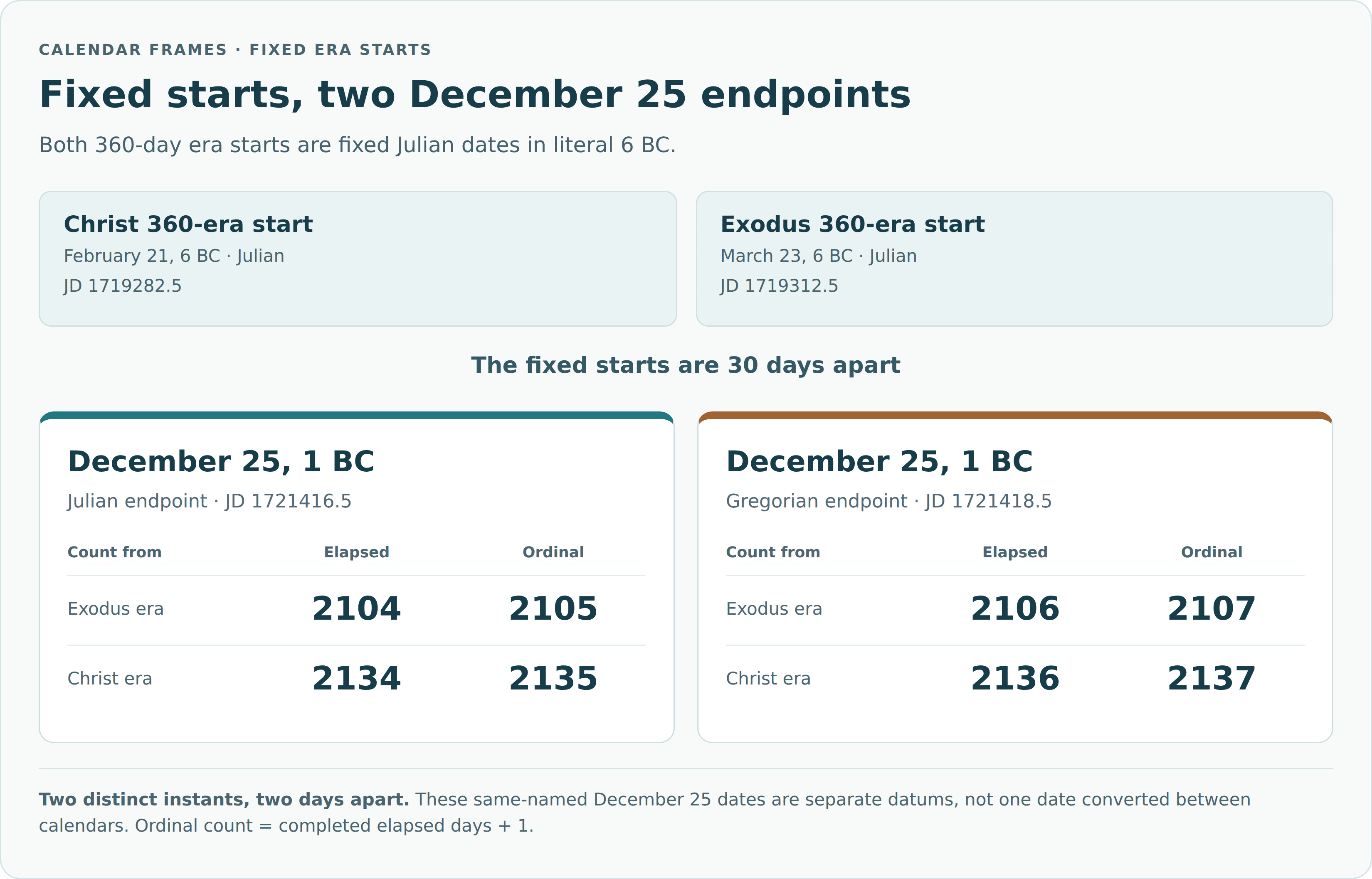
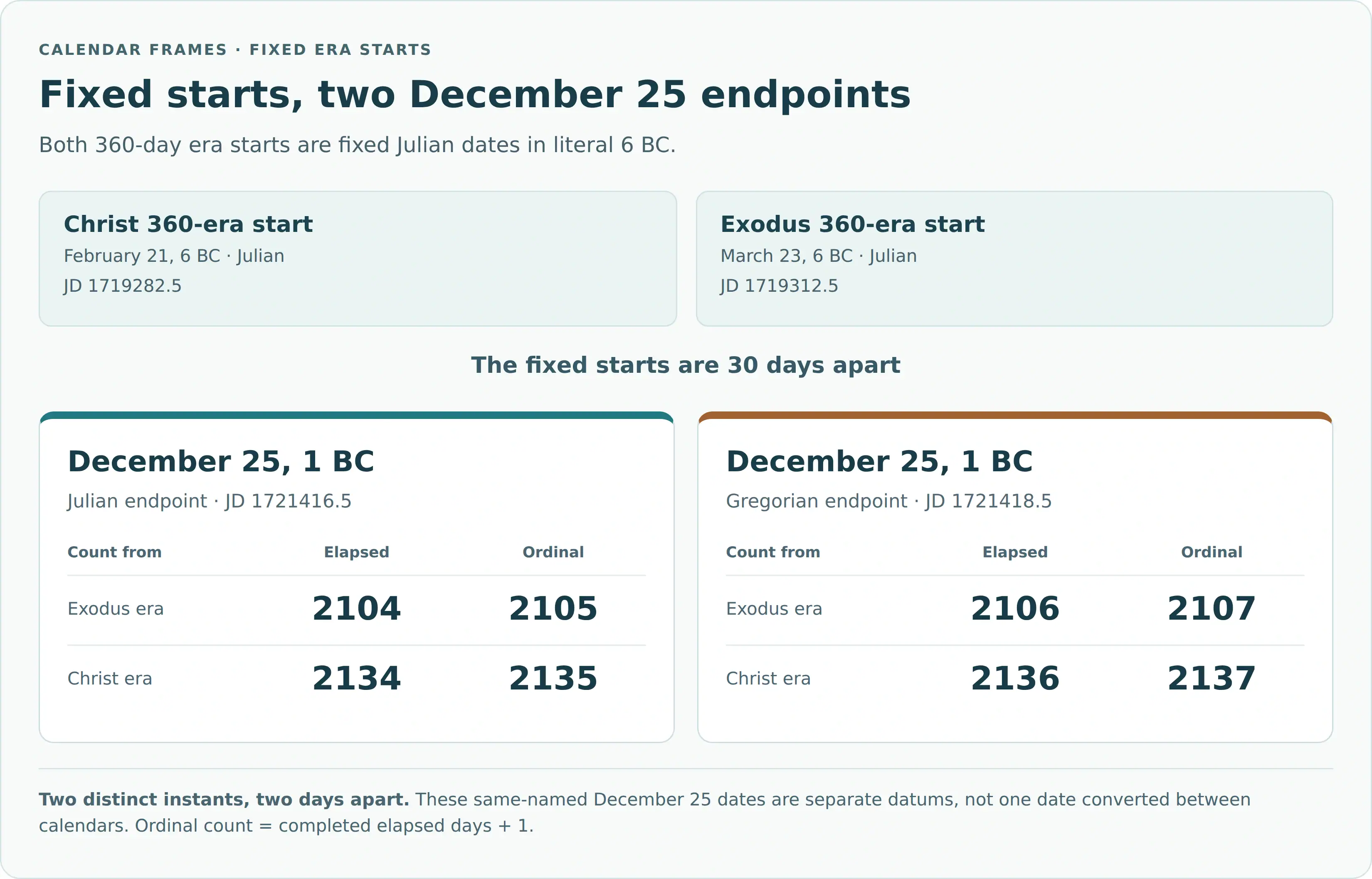
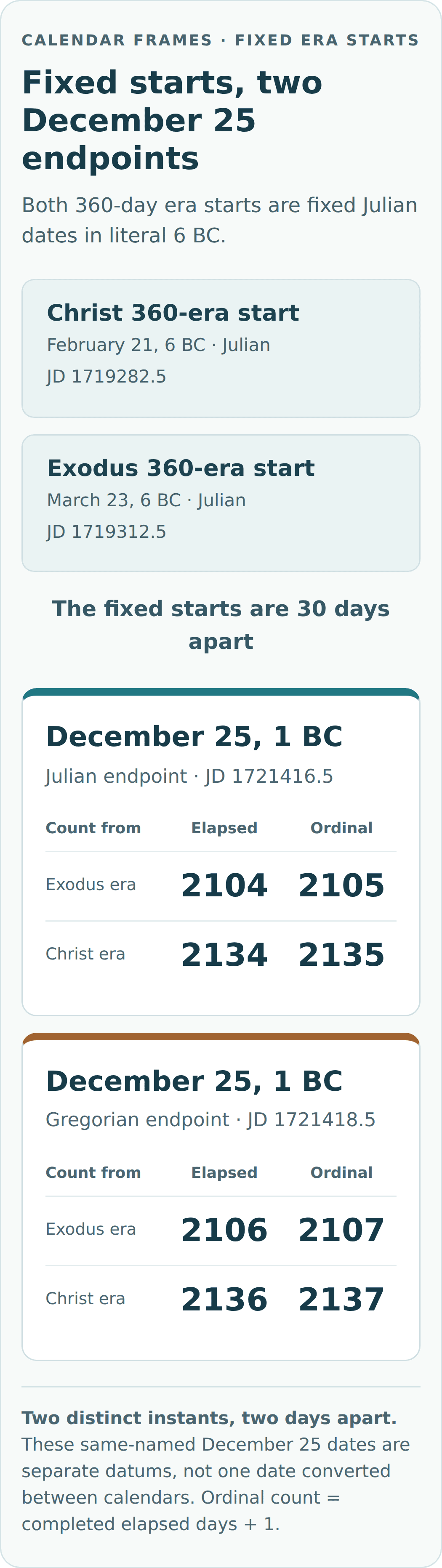
| Julian December 25, 1 BC | 1721416.5 | 2104 / 2105 | 2134 / 2135 |
| Gregorian December 25, 1 BC | 1721418.5 | 2106 / 2107 | 2136 / 2137 |
| Julian January 1, AD 1 | 1721423.5 | 2111 / 2112 | 2141 / 2142 |
| Gregorian January 1, AD 1 | 1721425.5 | 2113 / 2114 | 2143 / 2144 |
Starts: Christ, JD 1719282.5, Julian February 21, 6 BC; Exodus, JD 1719312.5, Julian March 23, 6 BC. Their difference is exactly 30 days. Julian Day is a continuous count, distinct from a date in the Julian calendar. The .5 endings here identify midnight in the standard Julian Day convention.
2. Preserve the older display families
Table 5. Exact coordinates and the older +1 translation
| Event / terminal | Exact symbol | Exact −30 | Older +1 symbol | Older +1, then −30 |
|---|---|---|---|---|
| John’s conception | 467 BC | 497 BC | 466 BC | 496 BC |
| Jesus’ conception | 287 BC | 317 BC | 286 BC | 316 BC |
| John’s birth | 187 BC | 217 BC | 186 BC | 216 BC |
| John’s circumcision — eighth day inclusive | 180 BC | 210 BC | 179 BC | 209 BC |
| John — eight completed days | 179 BC | 209 BC | 178 BC | 208 BC |
| John — forty completed days | 147 BC | 177 BC | 146 BC | 176 BC |
| Jesus’ birth | 7 BC | 37 BC | 6 BC | 36 BC |
| Jesus’ circumcision / naming — eighth day inclusive | AD 1 | 30 BC | AD 2 | 29 BC |
| Jesus — eight completed days | AD 2 | 29 BC | AD 3 | 28 BC |
| Jesus / Mary — forty completed days | AD 34 | AD 4 | AD 35 | AD 5 |
The older 466/286/186/6 BC family is the exact 467/287/187/7 BC family translated by +1 signed coordinate. Its naming marker becomes symbolic AD 2. It therefore cannot replace the principal own-January-1 datum at AD 1. It survives as the provenance of several comparisons and of the later Capstone seed.
The thirty-unit family in this table subtracts 30 from the signed coordinate. The source also associates January 30 with symbolic AD 30. That date is the thirtieth numbered date, but only 29 elapsed days after January 1. An exact thirty-elapsed-day alternative datum would be January 31. Until a different datum convention is specified, the −30 family is a declared symbolic translation, not a claimed thirty-day interval to January 30.
Table 6. Actual arithmetic means of the two calendar endpoint families
| Event / terminal | Julian Exodus / Christ ordinals | Gregorian ordinals | Mean ordinals |
|---|---|---|---|
| John’s conception | 1645 / 1675 | 1647 / 1677 | 1646 / 1676 |
| Jesus’ conception | 1825 / 1855 | 1827 / 1857 | 1826 / 1856 |
| John’s birth | 1925 / 1955 | 1927 / 1957 | 1926 / 1956 |
| John’s circumcision — eighth day inclusive | 1932 / 1962 | 1934 / 1964 | 1933 / 1963 |
| John — eight completed days | 1933 / 1963 | 1935 / 1965 | 1934 / 1964 |
| John — forty completed days | 1965 / 1995 | 1967 / 1997 | 1966 / 1996 |
| Jesus’ birth | 2105 / 2135 | 2107 / 2137 | 2106 / 2136 |
| Jesus’ circumcision / naming — eighth day inclusive | 2112 / 2142 | 2114 / 2144 | 2113 / 2143 |
| Jesus — eight completed days | 2113 / 2143 | 2115 / 2145 | 2114 / 2144 |
| Jesus / Mary — forty completed days | 2145 / 2175 | 2147 / 2177 | 2146 / 2176 |
The birth means 2106/2136 and New Year means 2113/2143 are genuine means of inclusive ordinals. The corresponding New Year elapsed means are 2112/2142. Mixing them causes a one-day error.
These means are retained as an arithmetic research display. They do not define a third historical birth or the normal Gear-2 biography. The principal tables no longer carry a blanket ±1. The calendar-datum appendix gives the reciprocal ±2 readings, the normal MT Gear-2 center and the separately qualified SP primary/lower companions. The genuine 6/8 → 7 carrier mean in File 69 §3.4C has its own counting premises; it is not a general calendar uncertainty rule.
3. Calendar snapshots and longer cycles
Table 7. The four original civil-calendar snapshots
| Julian datum | Same instant: Gregorian | JD | Weekday | MJD |
|---|---|---|---|---|
| January 1, AD 1 | December 30, 1 BC | 1721423.5 | Saturday | -678577 |
| December 25, 1 BC | December 23, 1 BC | 1721416.5 | Saturday | -678584 |
| February 21, 6 BC | February 19, 6 BC | 1719282.5 | Sunday | -680718 |
| March 23, 6 BC | March 21, 6 BC | 1719312.5 | Tuesday | -680688 |
The original converter’s additional non-Egyptian fields are retained below as reported snapshot metadata. The Julian Day, weekday and same-instant civil conversions above were independently recomputed. The custom month/day fractions, cycle identifiers and Hebrew-calendar rows below have not been established by that civil-date check alone.
Table 8. Reported converter metadata
| Reported field | Julian Jan 1, AD 1 | Julian Dec 25, 1 BC | Julian Feb 21, 6 BC | Julian Mar 23, 6 BC |
|---|---|---|---|---|
| 360-Calendar (Exodus) | Day12.25, Month11, Year6 | Day5.25, Month11, Year6 | Day1.25, Month13, Year40 | Day1.25, Month1, Year1 |
| 40-year cycle (Exodus) | 37 | 37 | 36 | 37 |
| 4000-year cycle (Exodus) | 1 | 1 | 1 | 1 |
| Leap/Normal Year (Exodus) | Leap (390days) | Leap (390days) | Leap (390days) | Normal (360days) |
| 360-Calendar (Christ) | Day12.25, Month12, Year6 | Day5.25, Month12, Year6 | Day1.25, Month1, Year1 | Day1.25, Month2, Year1 |
| 40-year cycle (Christ) | 1 | 1 | 1 | 1 |
| 4000-year cycle (Christ) | 2 | 2 | 2 | 2 |
| Leap/Normal Year (Christ) | Leap (390days) | Leap (390days) | Normal (360days) | Normal (360days) |
| Hebrew Date (legacy converter) | 16Teveth,3761 | 9Teveth,3761 | 3Adar,3755 | 4Nisan,3755 |
| Hebrew Year Type (legacy converter) | Common complete (355days) | Common complete (355days) | Common regular (354days) | Common regular (354days) |
The quarter-day fractions belong to the converter’s output convention; they must not be turned into a new event time without specifying that convention. The study uses the two thirty-separated 6 BC starts as fixed inputs. Its broader calendar observation is an alternation of agreement and one-month separation over successive 200-year phases, with a 4000-year cycle transition near this frame. This is an instance-dependent calendar relationship, not a claim that every 200-year block of every calendar behaves identically. File 12 §§7–7A supplies the intercalation and instance controls. The converter evidence retains the specific cycle labels; Egyptian rows remain outside this study as originally intended.
The February start’s precedence over the March start is read through Christ as the Morning Star preceding dawn. The associated AD 26–30 and AD 30–33 ministry frameworks are retained as interpretive alternatives, not consequences proved by thirty literal days. The preferred Passion center and the qualified AD 30 alternative remain under File 13’s control.
The source’s ±30 describes reciprocal interval displacements. If −30 and +30 are instead treated as absolute coordinates in this table’s register, they display as 31 BC and AD 30, not 30 BC and AD 30. A change from an interval to a date label must state its origin.
4. Priestly, purification and creation motifs
168 = 24 × 7 = 12 × 14 gives twenty-four weekly units, grouped into twelve pairs. Luke names Zechariah’s division and its service; it does not state this whole cycle as an exact elapsed interval at John’s conception. The framework’s 280 = 7 × 40 is a selected pregnancy unit, not a claim that Scripture fixes every conception-to-birth interval at that length.
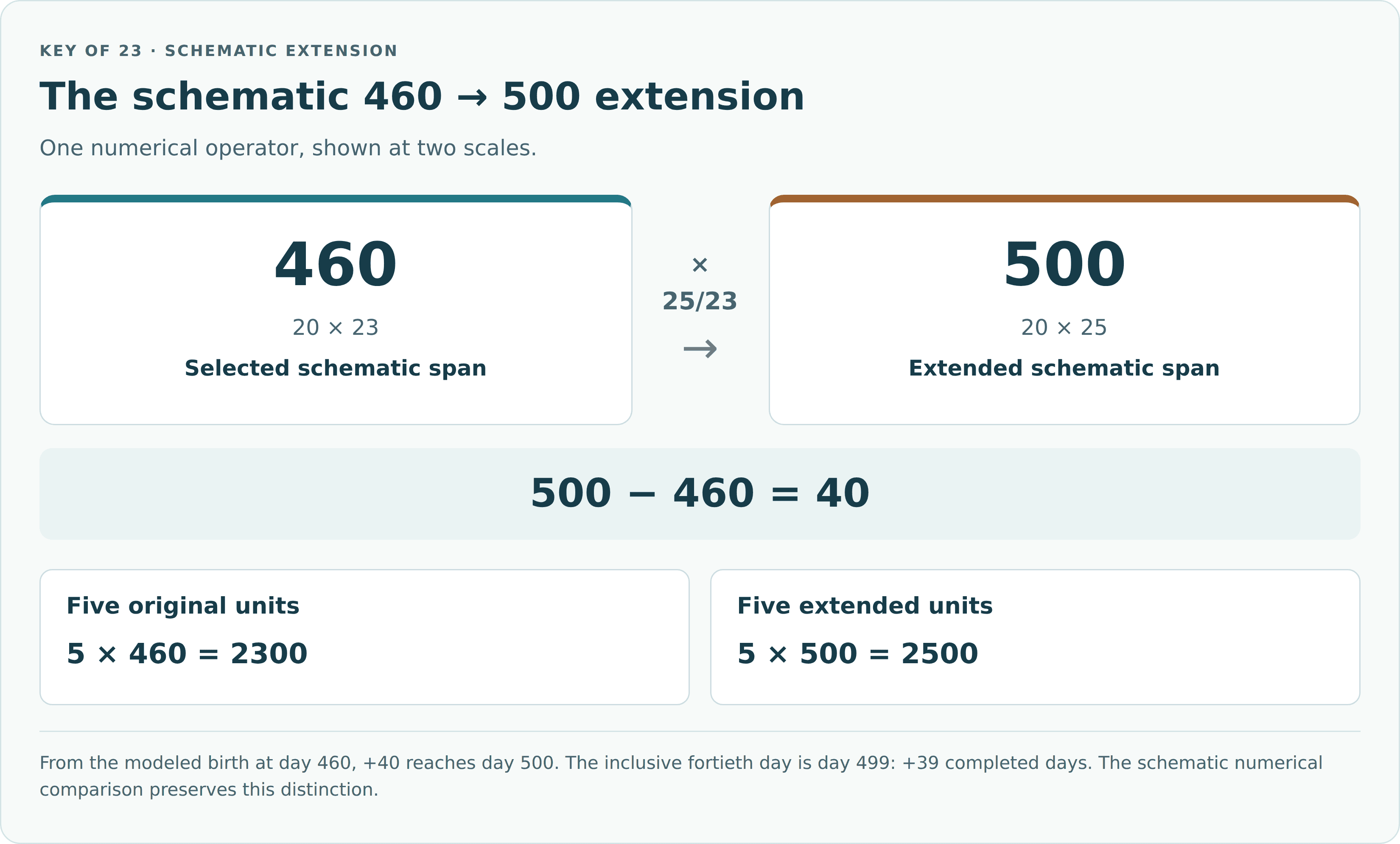
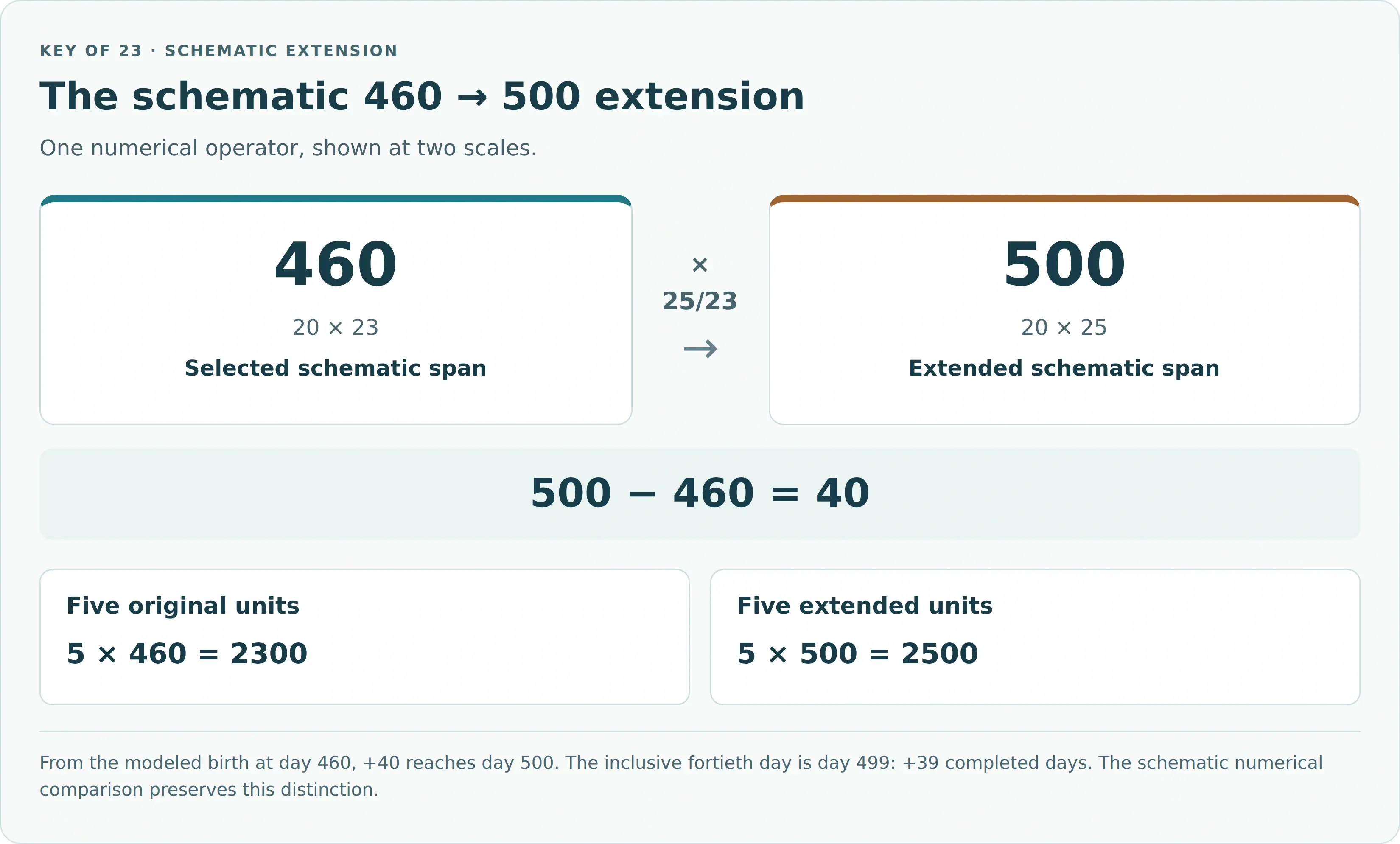
Leviticus supplies male-related periods 7 + 33 = 40, and female-related periods 14 + 66 = 80. The comparison 280 + 80 = 360 joins the schematic pregnancy unit to the latter total. In the John–Jesus model, 460 × 25/23 = 500 adds forty to the conception-to-birth span and reaches the forty-completed-day endpoint. The inclusive fortieth day remains 499 from John’s conception.
Gabriel’s appearances in Daniel and Luke, the paired birds, Simeon and Anna, and Adam/Eve supply the study’s theological connections: announcement, covenant, male and female, purification and restoration. The two-forty interpretation accompanying 460 → 500 is a comparison of overlapping structures; it does not change the mother’s prescribed male-child purification to eighty days. Luke’s narrative and Leviticus’ law retain their own subjects.
5. Generation units, Conquest and cumulative Creation
The Exodus/temple/Incarnation scaffold uses 480 = 12 × 40 and 1440 = 3 × 480 = 36 × 40. The chosen 1446 → 6 BC endpoints give the latter exactly. First Kings 6:1 speaks of the 480th year; its ordinal expression and the source’s 967/966 BC temple phases must be specified before a precise elapsed-year calculation. The Tabernacle’s 1446/1445 phases likewise remain separate.
LCM(40, 70, 100) = 1400, with 35, 20 and 14 generations respectively. The legacy seasonal comparison pairs 1407t/1406n BC with 7t/6n BC, then the six-year conquest portion 1407t/1406n → 1401t/1400n with the near-era birth frame. Here t = Tishri/autumn and n = Nisan/spring. These are matched season-label comparisons. They do not make autumn and spring endpoints simultaneous or replace the canon’s seven-year Conquest/rest framework.
The separate conventional 6 BC → AD 1 → AD 2 Incarnation week is already explained in the introduction. The February/March 6 BC starts to the winter and early-year birth/purification dates occupy nearly six civil years; that approximate observation must not be substituted for the exact seven-block Nisan framework.
The source’s cumulative comparison retains two matched research pairs:
| Selected cumulative / phase coordinate | Selected symbolic conception | Span | Then 280 to matched symbolic birth |
|---|---|---|---|
| Derived 14007 BC companion | 287 BC, exact family | 13720 | 7 BC; whole span 14000 |
| 14006 BC normal MT cumulative Adam Year-6 center | 286 BC, older +1 family | 13720 | 6 BC; whole span 14000 |
13720 = 280 × 49 = 28 × 490 = 7³ × 40. The normal 14006 → 287 pairing instead gives 13719; it must not be folded into the 13720 claim. The 14007 companion is the legacy phase construction using 12600 and the 1407 autumn label. It is not an independently transmitted Creation endpoint. File 18 §6A controls the normal 14006 Adam/Year-6 center and 14011–14004 cumulative envelope; File 09 controls cumulative structure.
The half-year Aaron/Moses terminal analogy is retained alongside John/Jesus’ selected half-year birth separation. It does not infer a half-year biological birth gap for Aaron and Moses: Exodus 7:7 gives 83/80, and the canonical phase-resolved cumulative branches have their own lifespan arithmetic. Their formal coordinates must not be merged with literal birth dates.
6. Exodus, Gabriel and prophetic-period comparisons
The legacy’s seasonal display 187t/186n BC for John and 7t/6n BC for Jesus retains the 180-unit separation. The morning/autumn interpretation is a selected phase analogy; it is not produced merely by relabelling one Julian instant Gregorian.
| Comparison | Calculation | Selected state |
|---|---|---|
| Plague/Exodus phase to John | 1447 − 187 = 1446 − 186 = 1260 | Matched legacy autumn/spring labels |
| Exodus to John’s conception | 1446 − 466 = 980 = 490 + 490 | Older +1 conception family |
| Principal conception comparison | 1446 − 467 = 979 | Exact own-January-1 family |
| Priestly-service detail | 483 + 483 = 966; 980 − 966 = 14 | Retained interpretive scaffold; service endpoint not independently dated |
| Wilderness and John’s completed-purification model | 1446 − 186 = 1406 − 146 = 1260 | Older +1 family, forty-unit interval |
| Wilderness and Jesus’ completed-purification model | 1446 − 6 = 1406 + 35 − 1 = 1440 | Older +1 family, forty-unit interval |
The last comparison in the exact family instead uses 7 BC → AD 34 and gives 1439 on both parallel sides. The inclusive 7 BC → AD 33 interval is 39, so it cannot serve as a forty-elapsed-year parallel without changing the count.
Daniel 9 decrees seventy weeks. The doubled-490 scaffold reads one 490-year period with its 70 sabbatical years alongside a further 490; this is the study’s interpretation, not an assertion that Daniel explicitly writes two separate decrees of seventy weeks. The 483-pair/priestly-service detail survives as a related research motif. Aaron/Moses, John/Jesus and Revelation’s witnesses are likewise typological comparisons, not a statement that Revelation explicitly names all those figures as its witnesses.
Table 9. The retained Herodian numerical branch
| Display family | John’s birth | After 180 units: Jesus’ birth | After a further 720 | After a further 360 |
|---|---|---|---|---|
| Exact own-January-1 | 187 BC | 7 BC | AD 714 | AD 1074 |
| Older +1 translation | 186 BC | 6 BC | AD 715 | AD 1075 |
180 + 720 + 360 = 1260 reads half a time, two times and a time in that order. The older family also gives 1446 BC → 186 BC → AD 1075, two consecutive 1260 spans. The latter AD labels are generated coordinates, not predictions or historically identified fulfilments.
Matthew’s “two years old and under” supplies an upper age category; it does not require Jesus to be at least two. The legacy’s asserted minimum is therefore not retained as a textual claim. Its selected 720/360-day prophetic units remain as a schematic branch, with the connection to Herod and the dragon of Revelation presented as interpretation (Matthew 2:16, BSB; Revelation 12).
Table 10. Selected longer comparisons
| Fixed historical / chronological node | Generated symbolic endpoint | Civil span |
|---|---|---|
| 2166 BC, normal MT Abram birth | AD 2135, Christ-frame birth ordinal | 2166 + 2135 − 1 = 4300 = 10 × 430 |
| 166 BC, legacy Daniel-8 comparison | AD 2135 | 166 + 2135 − 1 = 2300 = 5 × 460 |
| 1446 BC, Exodus | AD 1995, John-family forty-completed terminal | 1446 + 1995 − 1 = 3440 = 8 × 430 |
| 586 BC, Jerusalem’s fall | AD 1995 | 586 + 1995 − 1 = 2580 = 6 × 430 = 1290 + 1290 |
The legacy’s 166 BC association with Antiochus and Daniel 8 survives as its selected research comparison. This does not establish that year as the uniquely correct historical fulfilment date, nor translate the 2300 evenings and mornings into 2300 ordinary civil years without an explicitly symbolic step. It is not used to set the principal calendar datums.
Table 11. MT Flood and Shem orientation
| Comparison in the stated research state | Span |
|---|---|
| Flood 2458 BC → older thirty-shifted conception 498 BC | 1960 = 4 × 490 |
| Fixed Arphaxad 2456 BC → older paired conception 496 BC | 1960 = 4 × 490 |
| Flood 2458 BC → birth comparison 8 BC | 2450 = 5 × 490 |
| Fixed Arphaxad 2456 BC → birth comparison 6 BC | 2450 = 5 × 490 |
| G2 Shem 2558 BC → 8 BC | 2550 = 1260 + 1290 |
| G1 elected station 2556 BC → 6 BC | 2550 = 1260 + 1290 |
| G2 Shem 2558 BC → thirty-shifted 38 BC | 2520 = 1260 + 1260 |
| G1 elected station 2556 BC → thirty-shifted 36 BC | 2520 = 1260 + 1260 |
The 498/496 and 8/6 endpoints are separately retained outer research labels, not all members of the exact principal table. In particular 2456 BC is fixed Arphaxad, not a relabelled normal Flood start, and Shem’s normal G2 reference is 2558 BC, not 2458. A 490-year unit comprises ten 49-year jubilees: 1960 and 2450 are respectively forty and fifty such jubilees. The Noah/Shem gear and SP companion qualifications are directly accessible in the calendar-datum appendix.
7. Thirty-separated spans and Joseph’s famine
Within the precise era families, 2105 − 1645 = 2135 − 1675 = 460. Cross the two eras on the same side, and 2105 − 1675 = 430, while 2135 − 1645 = 490. The reflected BC family retains those differences. Thus the source’s 430/460/490 pattern survives without a blanket ±1.
Its specific mirrored comparison 2136 → 1676 BC is 460. From the Exodus at 1446 BC, those stations are 690 = 10 × 69 and 230 = 10 × 23 earlier. This links the inputs used by the distinct 70/69 and 25/23 ratios; it does not substitute one operator for the other.
Table 12. The retained famine and sojourn comparisons
| Earlier node | Selected conception label | First span | Selected birth label | Second span |
|---|---|---|---|---|
| 1878 BC, famine begins | 498 BC | 1380 = 3 × 460 | 8 BC | 1870, not 1840 |
| 1876 BC, Egypt entry | 496 BC | 1380 = 3 × 460 | 6 BC | 1870, not 1840 |
| 1878 BC, famine begins | 498 BC | 1380 = 3 × 460 | 38 BC, thirty-shifted birth | 1840 = 4 × 460 |
| 1876 BC, Egypt entry | 496 BC | 1380 = 3 × 460 | 36 BC, thirty-shifted birth | 1840 = 4 × 460 |
| 1846 BC, schematic 400-year endpoint before Exodus | 466 BC | 1380 = 3 × 460 | 6 BC | 1840 = 4 × 460 |
The 1840 relationship at the famine/entry nodes is recovered using the source’s 38/36 thirty-shifted birth labels, not its 8/6 labels. This explicitly reconstructed pairing preserves the useful motif and corrects the source’s incomplete assignment. 1840 is four times 460, not twice. Entry at 1876 precedes the Exodus by the normal 430-year sojourn; 1846 is the separate schematic 400-year node. Sojourn and affliction must not be made identical. The sojourn introduction explains that distinction.
Table 13. Explicit cross-Mirror pairs
| Comparison | AD event / frame | Reflected BC event / frame | Civil calculation |
|---|---|---|---|
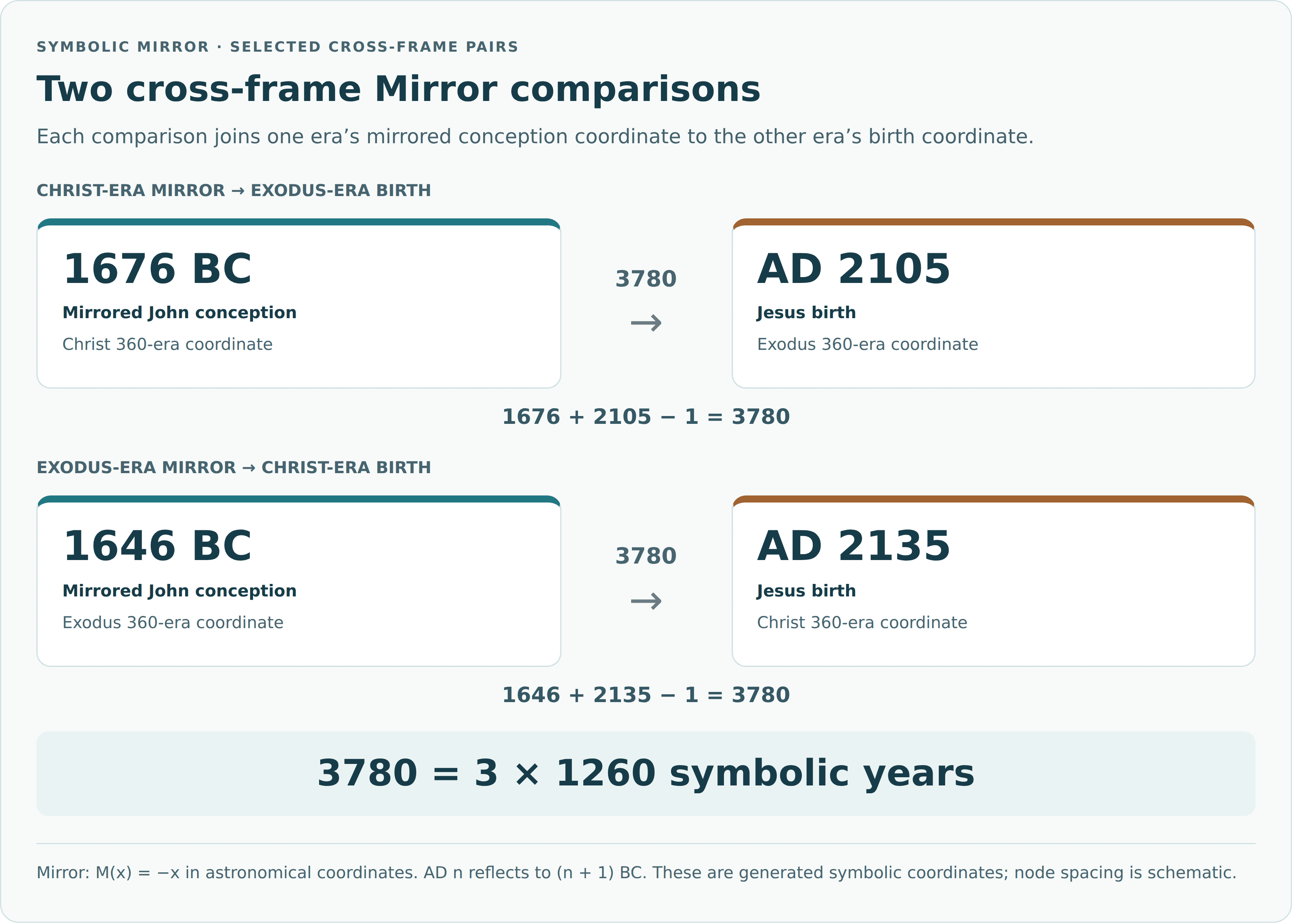
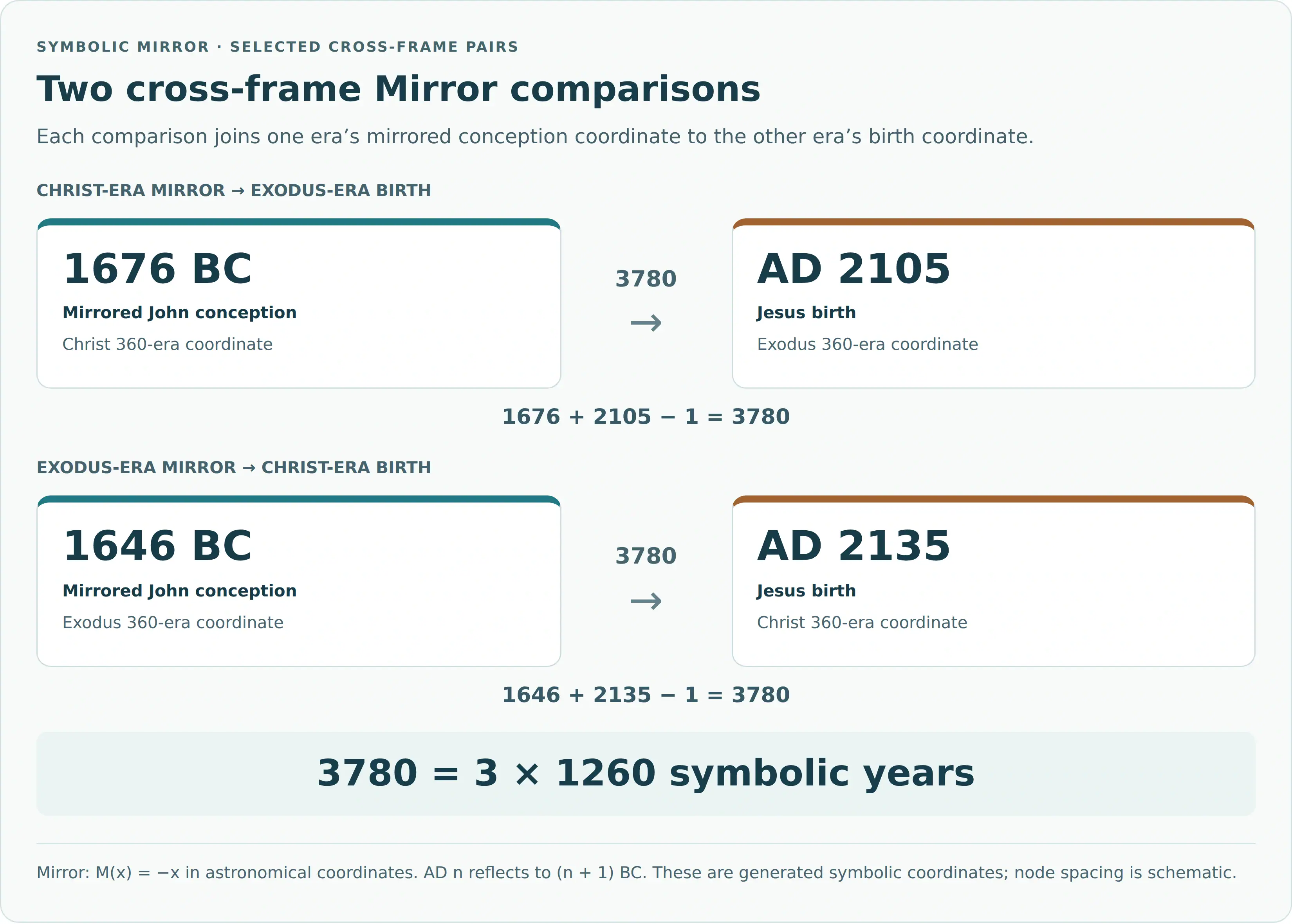
| 3780: Jesus birth / John conception, opposite era A | AD 2105: Jesus’ birth (exodus) | 1676 BC: John’s conception (christ) | 2105 + 1676 − 1 = 3780 |
| 3780: Jesus birth / John conception, opposite era B | AD 2135: Jesus’ birth (christ) | 1646 BC: John’s conception (exodus) | 2135 + 1646 − 1 = 3780 |
| 3780: John birth / Jesus conception, opposite era A | AD 1925: John’s birth (exodus) | 1856 BC: Jesus’ conception (christ) | 1925 + 1856 − 1 = 3780 |
| 3780: John birth / Jesus conception, opposite era B | AD 1955: John’s birth (christ) | 1826 BC: Jesus’ conception (exodus) | 1955 + 1826 − 1 = 3780 |
| 3600: John conception / John birth, opposite era A | AD 1645: John’s conception (exodus) | 1956 BC: John’s birth (christ) | 1645 + 1956 − 1 = 3600 |
| 3600: John conception / John birth, opposite era B | AD 1675: John’s conception (christ) | 1926 BC: John’s birth (exodus) | 1675 + 1926 − 1 = 3600 |
| 3640: John conception / forty-completed terminal A | AD 1645: John’s conception (exodus) | 1996 BC: John — forty completed days (christ) | 1645 + 1996 − 1 = 3640 |
| 3640: John conception / forty-completed terminal B | AD 1675: John’s conception (christ) | 1966 BC: John — forty completed days (exodus) | 1675 + 1966 − 1 = 3640 |
| 3960: Jesus conception / Jesus birth, opposite era A | AD 1825: Jesus’ conception (exodus) | 2136 BC: Jesus’ birth (christ) | 1825 + 2136 − 1 = 3960 |
| 3960: Jesus conception / Jesus birth, opposite era B | AD 1855: Jesus’ conception (christ) | 2106 BC: Jesus’ birth (exodus) | 1855 + 2106 − 1 = 3960 |
The operation here is M(c) = −c, rendered AD n → (n + 1) BC, and the civil interval is BC + AD − 1. The 3780 rows use opposite calendar frames, not same-frame slash alternatives. The 3600 = 10 × 360, 3640 = 10 × 364 and 3960 = 11 × 360 rows reconstruct explicit cross-Mirror pairs for the source’s terminal observations. The legacy printed same-side endpoints with those larger totals; the same-side differences are only 280 or 320. The reconstructed pairs are therefore identified here as a repair, not claimed as the exact original derivation. The 3640 uses the forty-completed terminal; the inclusive-fortieth counterpart would be 3639.
The 500 span is the forty-completed conception-to-terminal total. The separate 540 = 460 + 40 + 40 = 1½ × 360 observation is retained as a formal second-forty extension. The source does not establish a second ritual event at 540, so it is not assigned to Jesus’ presentation.
The captivity analogy retains 597 → 587 = 10 and 597 → 586 = 11 at the year-label level, beside 3600/3640/3960. Its 10½ × 360 = 3780 Tishri-phase comparison needs named seasonal endpoints to become an elapsed historical interval. It survives as a phase-qualified research lead; it does not replace 586 BC as the normal fall-of-Jerusalem node or treat a 364-day comparison as a 360-day one.
8. The inverse-calendar observation
The legacy also subtracts the counts 2112 and 2142 directly from Julian January 1’s JD 1721423.5:
1721423.5 − 2112 = 1719311.5, Julian March 22, 6 BC.
1721423.5 − 2142 = 1719281.5, Julian February 20, 6 BC.
These are one day before the corresponding fixed era starts. The arithmetic survives exactly. With January 1 assigned coordinate +1, however, direct subtraction and reflection through coordinate zero are different operations.
Table 14. Two explicitly different operations
| Event / era | Operation | Reflected label | Literal Julian projection | Elapsed offset from era start |
|---|---|---|---|---|
| Jesus’ birth / Exodus | R0: c → −c | 2106 BC | March 28, 6 BC | 5 |
| Jesus’ birth / Exodus | R1: c → 1−c | 2105 BC | March 29, 6 BC | 6 |
| Jesus’ birth / Christ | R0: c → −c | 2136 BC | February 26, 6 BC | 5 |
| Jesus’ birth / Christ | R1: c → 1−c | 2135 BC | February 27, 6 BC | 6 |
| Jesus’ circumcision / naming — eighth day inclusive / Exodus | R0: c → −c | 2113 BC | March 21, 6 BC | -2 |
| Jesus’ circumcision / naming — eighth day inclusive / Exodus | R1: c → 1−c | 2112 BC | March 22, 6 BC | -1 |
| Jesus’ circumcision / naming — eighth day inclusive / Christ | R0: c → −c | 2143 BC | February 19, 6 BC | -2 |
| Jesus’ circumcision / naming — eighth day inclusive / Christ | R1: c → 1−c | 2142 BC | February 20, 6 BC | -1 |
To project a reflected coordinate −n back into literal days from the +1 datum, use JD(January 1) − (n + 1). Direct subtraction JD(January 1) − n instead gives coordinate 1 − n. The first implements the table’s M(c) = −c; the second is a separately declared origin choice.
The source’s era-eve / first-month-sixth-day description combines these operations and its averaged values, and in places reverses the birth and circumcision assignments. The first-month sixth position is compatible with the rebuilt zero-origin birth projection’s five elapsed days after the era start; the circumcision projection then lies two days before, not one. No single exact diagram of the source’s combined claim is supplied. The unresolved boundary identification remains available for further research without altering the canonical Mirror operator.
Sources, diagrams and further research
| Source | Controlling role |
|---|---|
| File 00 §0.1 | Civil Mirror counterpart labels; operation-specific states. |
| File 13 §§2, 6, 7.1–7.4 | Incarnation week, covenant datum, AD 33/34 and 460/500 model qualification. |
| File 69 §3.4C | Six intervening, seven elapsed and eight inclusive counts; distinct carrier mean. |
| File 12 §§7–7A | Calendar-instance and intercalation controls. |
| File 18 §6A and regular tables | Cumulative Adam and envelopes; normal MT, SP and LXX table states. |
| File 09, File 47 | Cumulative structure and Noah/Shem role-state pairings. |
| File 15 §§1–3 and LCM treatment, File 06 §0.5 | Generation units and 1400 bridge; Conquest/rest and Aaron/Moses phase controls. |
| File 14, File 17 | Schematic gestation/purification; prophetic counts and 586/587 states. |
| File 46 §1, L0 and L3 | Civil cross-axis count and 25/23 ratio; distinct from 70/69. |
| U.S. Naval Observatory, Julian Date algorithms | Independent civil-calendar arithmetic; use the general algorithm for this ancient epoch. |
The separate calendar-datum appendix supplies the three-gear MT field and SP’s qualified primary/lower biographies. Supporting SP and LXX witnesses are not silently substituted for the normal MT chronology. This subject also retains original research beyond the canonical files’ developed treatments; its status is stated locally rather than treated as a new canonical theorem.
| Figure / relationship | Direct illustration | Image download |
|---|---|---|
| 1. A 460-day schematic sequence | In the detailed study · Responsive HTML (ZIP) | Full-size PNG · WebP · Phone PNG |
| 2. Fixed starts, two December 25 endpoints | In the detailed study · Responsive HTML (ZIP) | Full-size PNG · WebP · Phone PNG |
| 3. The schematic 460 → 500 extension | In the detailed study · Responsive HTML (ZIP) | Full-size PNG · WebP |
| 4. Two cross-frame Mirror comparisons | In the detailed study · Responsive HTML (ZIP) | Full-size PNG · WebP |
Return to the detailed study · Original research discussion
Scripture wording marked BSB is from the Berean Standard Bible. This text of God’s Word has been dedicated to the public domain. Official terms. Exact quotations and their passage/translation links appear in the main article.