And the rain fell upon the earth for forty days and forty nights.
Genesis 7:12, Berean Standard Bible (BSB)
Forty days of rain are the best-known part of the Flood’s chronology. They are not the whole story. Genesis also names 150 days, dates the Ark’s resting and the appearance of the mountain tops, and distinguishes a drying surface from an earth ready for Noah’s family to leave.
The sequence matters. Rain, rising waters, the Ark’s resting, reconnaissance by birds and the final departure describe different stages of judgment and renewal. A clear timeline lets each number keep its place in that movement.
This introduction follows the Masoretic Text (MT) account as rendered in the BSB. Where it calculates elapsed days, it declares a schematic calendar of twelve thirty-day months, without intercalation. The biblical dates and those calculated intervals are shown separately. The supporting tables and source notes provide the full arithmetic and a separately identified comparison with Brenton’s Septuagint (LXX) translation.
1. Forty days within a longer flood
Genesis 7:12 gives forty days and nights of rain. At the close of the chapter, Genesis 7:24 gives 150 days during which the waters prevail. Genesis 8:3 returns to that 150-day period as the waters recede. These two references belong to the same chronological interval in the continuous reading used here; they do not establish two successive blocks of 150 days.
The dates support that reading. The Flood begins in Noah’s year 600, on the seventeenth day of the second month. The Ark rests on the seventeenth day of the seventh month (Genesis 7:11; 8:4, BSB). With thirty-day months, the five-month interval is 5 × 30 = 150 days. The rainfall’s forty days fit within this span.
Figure 1 · Noah’s Flood
Forty days within the 150 days
A continuous reading of Genesis 7–8 keeps the rainfall within the longer waters period.
ONE CONTINUOUS WATERS PERIOD
150 days
40 days of rain
The shorter blue bar belongs within the green 150-day span under this reading.
THE SAME PERIOD REFERRED TO TWICE
Genesis 7:24 · The waters prevail.
Genesis 8:3 · The 150 days reach their end.
Sources: Genesis 7:12 (BSB) · Genesis 7:24 (BSB) · Genesis 8:3–4 (BSB).
Model and calculation details
The bars show a reading of the narrative sequence, not an independently supplied calendar for the rain’s end. Genesis 7:12 states forty days and nights of rain; Genesis 7:24 states 150 days of prevailing waters. Genesis 8:3 returns to the endpoint of the 150 days. The dated Ark-rest event is separately stated in Genesis 8:4. No month/day for the end of the rainfall is asserted here.
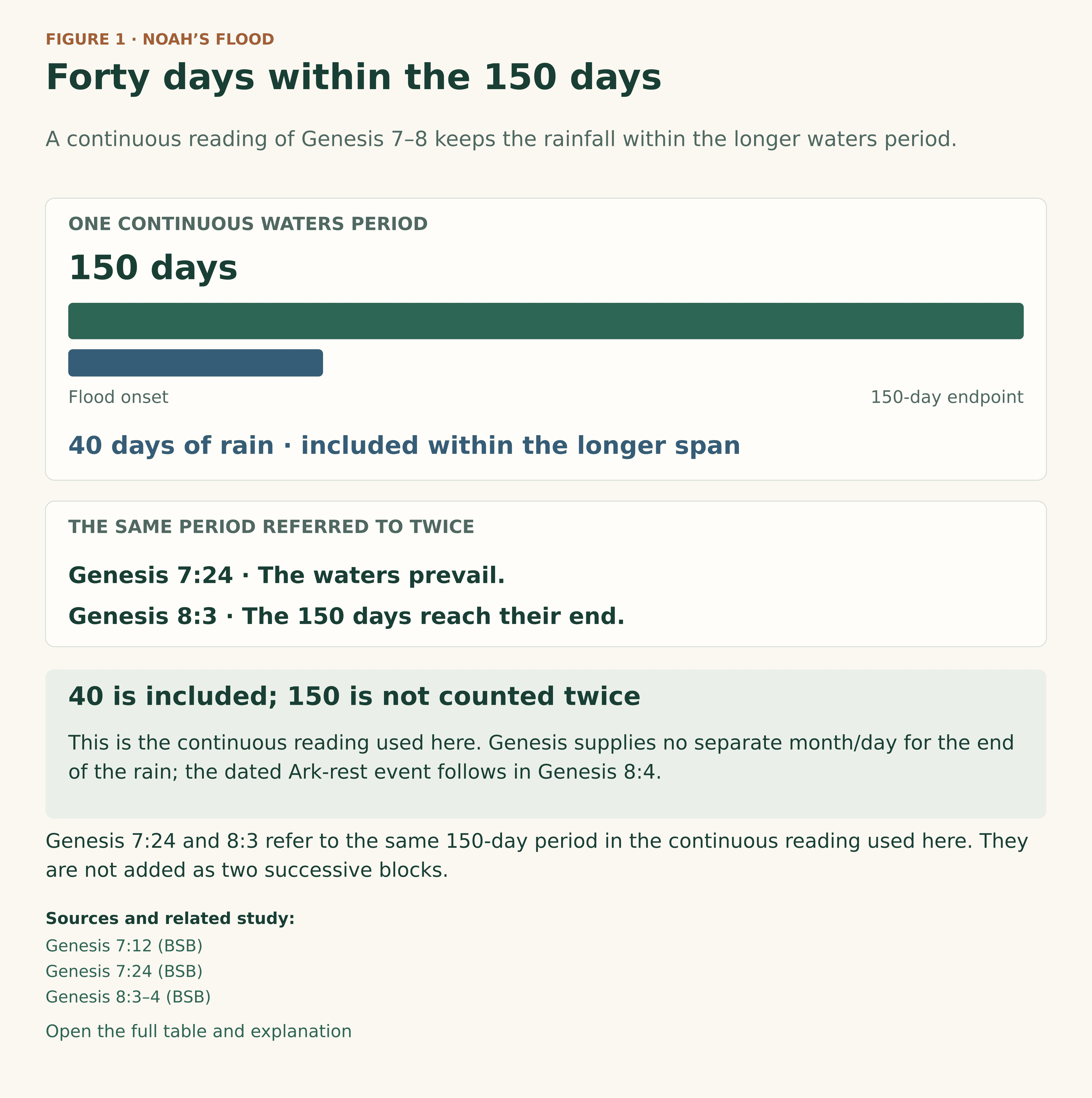
On that reading, the calculation is 150 − 40 = 110 days beyond the initial rainfall period. The 110 is our subtraction, not an additional duration named in Genesis. Adding 40 + 150 + 150 would count overlapping or repeated material as though every mention began a new interval.
The narrative later includes another forty-day wait before Noah opens the window (Genesis 8:6, BSB). That later forty has its own place in the story. Its precise calendar starting point requires interpretation; it should not be placed immediately after the first forty merely because the same number appears twice.
2. Five dated stages
Genesis gives five particularly useful dates. The first three fall in Noah’s six-hundredth year; the sequence then continues into his six-hundred-and-first. These year labels belong to Noah’s life, while the month-and-day labels locate events within the narrative.
Figure 2 · Noah’s Flood
Five dates through the Flood
Read the narrative dates first. The elapsed column uses the calendar assumption stated below.
Sources: Genesis 7:11 (BSB) · Genesis 8:4 (BSB) · Genesis 8:5 (BSB) · Genesis 8:13 (BSB) · Genesis 8:14 (BSB) · Genesis 8:15–19 (BSB) · File 12: calendrical controls.
Model and calculation details
Dates are Noah-year / month / day in the MT-based BSB. Calculated elapsed days assume twelve thirty-day months, no intercalation, and origin 600 / 2 / 17. E = 360 × (Y − 600) + 30 × (M − 2) + (D − 17). A 360-day calculation is not a claim that every biblical calendar year had this length. The 150-day rest coordinate matches five thirty-day months under this convention.
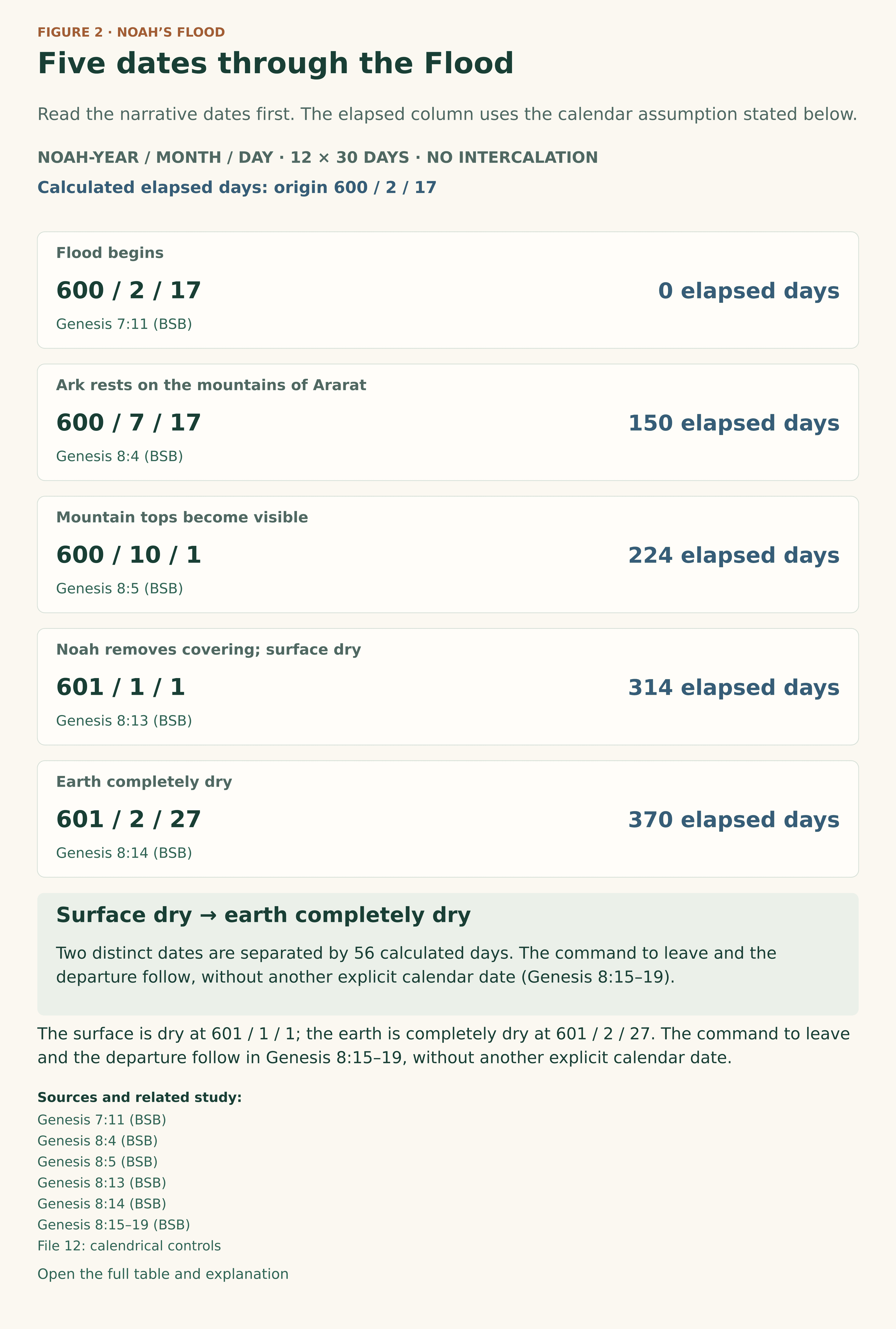
The progression is gradual. The Ark rests before the mountain tops become visible. Later, Noah removes the covering and sees that the ground’s surface is dry. Only afterward does the text date the earth’s complete dryness. The command to leave and the family’s departure follow that last dated notice (Genesis 8:13–19, BSB).
The diagram’s dates come from Genesis. Its elapsed-day column is calculated under the stated thirty-day-month scheme, beginning at the Flood’s onset. On that basis, the interval to the fully dry earth is:
360 + (27 − 17) = 370 elapsed days.
Counting both endpoint dates would give 371 dates counted inclusively. Those are two ways of describing the count, not two different events. Genesis does not itself label the whole Flood “370 days,” and it gives no separate month-and-day date for the family’s exit in verses 15–19. The table therefore identifies its endpoint as the fully dry earth.
Open the full dated-event table and calculation.
3. What the raven and dove reveal
The bird episodes show Noah testing conditions outside the Ark. After the later forty-day wait, he opens the window and sends out a raven. He also sends a dove, which finds no place to rest and returns. After seven days he sends the dove again; it returns in the evening with a freshly plucked olive leaf. After another seven days, the dove goes out and does not return (Genesis 8:6–12, BSB).
Figure 3 · Noah’s Flood
The window, the raven, and the dove
The birds reveal the changing earth. Only two seven-day waits are explicitly numbered in this sequence.
LATER WAIT · GENESIS 8:6
40 days → window opens
The starting month and day are not explicitly stated.
Goes back and forth until the waters dry
Genesis 8:6–7 (BSB)↓ Interval not numbered ↓
No resting place; returns to Noah
Genesis 8:8–9 (BSB)↓ 7 days ↓
Returns in the evening with a freshly plucked olive leaf
Genesis 8:10–11 (BSB)↓ 7 days ↓
Does not return
Genesis 8:12 (BSB)Sources: Genesis 8:6–7 (BSB) · Genesis 8:8–9 (BSB) · Genesis 8:10–11 (BSB) · Genesis 8:12 (BSB).
Model and calculation details
Genesis 8:6 places the window-opening after forty days. Verses 7–9 recount the raven and the first dove sending without specifying a numbered interval between them. Verses 10 and 12 each state a seven-day wait. The wording “another seven days” has prompted further reconstructions, but a first seven-day interval is not inserted into this diagram. No inferred absolute date is assigned to any bird sending.
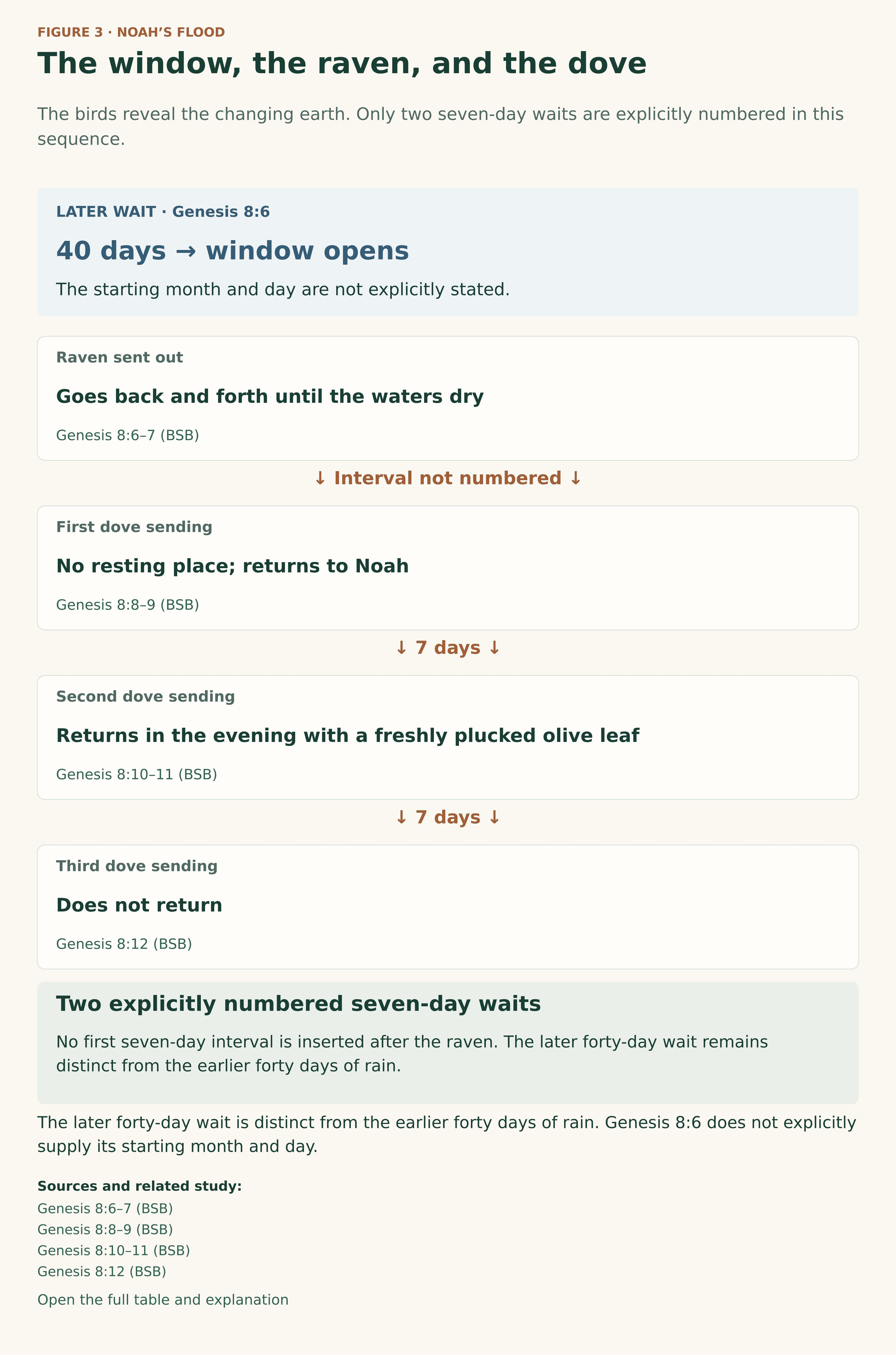
Each result moves the account forward. The dove’s first return shows that conditions remain unsuitable. The olive leaf supplies a sign of returning vegetation. Its final absence signals a further change, but Noah’s departure still follows God’s command in the narrative.
The two seven-day waits between the three dove sendings are explicit. Their combined length is 7 + 7 = 14 days. The passage does not give a numbered interval between the raven’s sending and the first dove’s, nor does it print exact month-and-day dates for the bird episodes. A detailed reconstruction may investigate those gaps; the introduction keeps them open. The bird-sequence table distinguishes what is stated from what would need to be supplied.
4. God remembers Noah
But God remembered Noah and all the animals and livestock that were with him in the ark. And God sent a wind over the earth, and the waters began to subside.
This is the narrative’s turning point. The text moves from prevailing waters toward recession, resting, renewed vegetation and dry land. The language of remembering is followed immediately by action: God sends the wind, and the waters begin to subside.
The new beginning also reaches beyond the calendar. God commands Noah’s household and the animals to come out, Noah builds an altar, and the account turns to the continuing rhythms of the earth (Genesis 8:15–22, BSB). In the following chapter, the covenant with Noah and the living creatures gives the rainbow its stated significance (Genesis 9:8–17, BSB).
The dates make the process of renewal visible. The first glimpse of dry ground is not treated as identical to the completed drying, and neither observation replaces the divine command to leave. The movement from the Ark’s resting to a renewed inhabited earth is part of the story the numbers serve.
5. Why the starting point changes the number
A continuous day count needs an origin. Start at the Flood’s onset and the fully dry earth falls 370 elapsed days later in the declared scheme. Start instead at the first day of the first month of Noah’s year 600, and the same endpoint is 416 elapsed days later—or numbered day 417 when the first day is called day 1.
From that earlier year origin, the Flood begins on numbered day 47. The difference remains:
417 − 47 = 370 days.
This explains how a useful number from the older study can be retained without confusing it with a duration. Day 417 is a label from a particular starting point; it is not a 417-day interval from the Flood’s onset. The related 410-day construction requires further assumptions and does not supply another dated event in Genesis. Figure 4 and the origin comparison show the distinction directly.
Textual readings also matter. Brenton’s Septuagint translation gives the twenty-seventh day, rather than the seventeenth, for the Flood’s beginning and the Ark’s resting. Its dates therefore need their own calculation. The matched MT/BSB and Brenton table keeps those readings separate rather than combining their inputs.
6. Reading the patterns in their narrative setting
The Flood offers a strong foundation for comparison with other biblical accounts: testing measured in forty days, preservation through water, a resting vessel and a new beginning. File 23 develops the connection between Noah’s Ark and Moses’ basket; the same Hebrew term, tebah, is used in those two narrative settings (Genesis 6:14; Exodus 2:3, BSB). First Peter also interprets Noah’s deliverance through water in relation to baptism (1 Peter 3:20–21, BSB).
Further numerical comparisons should begin from that carefully identified evidence. The day–year instructions in Numbers 14:34 and Ezekiel 4:6 do not automatically assign a historical year to every day in the Flood account. A proposed projection must explain its origin, scale, counting convention and destination before its significance can be assessed.
The dated sequence already has considerable explanatory power: forty days of rain within a longer flood; one 150-day period referred to twice; an Ark at rest while the earth continues to dry; and two seven-day waits as the dove’s reports change. These relationships give the reader a clear basis for exploring wider patterns without losing the events that first give the numbers meaning.
Continue with the supporting tables and source notes. The completed detailed study, Noah’s Flood Chronology: Dates, Durations, and Symbolic Patterns, examines the dated sequence, calendar assumptions, and symbolic comparisons.
Passage links identify the translation. Brenton’s Septuagint readings are separately identified. Dates, calculations and diagrams are analytical presentations, not additional Scripture quotations.
Scripture quotations: Berean Standard Bible (BSB), public domain.