The Ark’s measurements are easy to remember: 300 cubits long, 50 wide, and 30 high. Genesis presents them as instructions for a vessel that will preserve life through the Flood:
And this is how you are to build it: The ark is to be 300 cubits long, 50 cubits wide, and 30 cubits high.
Those three numbers also invite a chronological comparison. Doubled, they become 600, 100, and 60: numbers associated with Noah, Shem, Abraham, Isaac, and the long passage from Jacob’s birth to the Conquest.
The comparison begins with the dimensions, but its strongest feature is the structure of the 600 years. The same total can describe an age, a complete lifespan, or an era extending across generations. Looking at those different uses together brings the figures into focus.
From three measurements to three time spans
The proposed reading doubles each numerical measurement and compares the result with years:
300 × 2 = 600 · 50 × 2 = 100 · 30 × 2 = 60.
The animals entering in pairs provide a fitting image for the doubling (Genesis 7:9). Genesis does not, however, instruct the reader to convert cubits into years. That step belongs to the interpretation developed here. A cubit remains a measure of length; the comparison concerns the numbers attached to the measurements.
490d · Noah’s Ark · Figure 1
The measurements and the proposed comparison
Genesis gives dimensions in cubits. The chronological reading doubles their numerical values.
The length is 6 times the width.
The length is 10 times the height.
300 cubits → a proposed 600-year correspondence
50 cubits → a proposed 100-year correspondence
30 cubits → a proposed 60-year correspondence
Plan and elevation retain the stated 6:1 and 10:1 rectangle proportions. They show dimensions, not a reconstruction of the Ark’s hull. Chronological doubling is an interpretation.
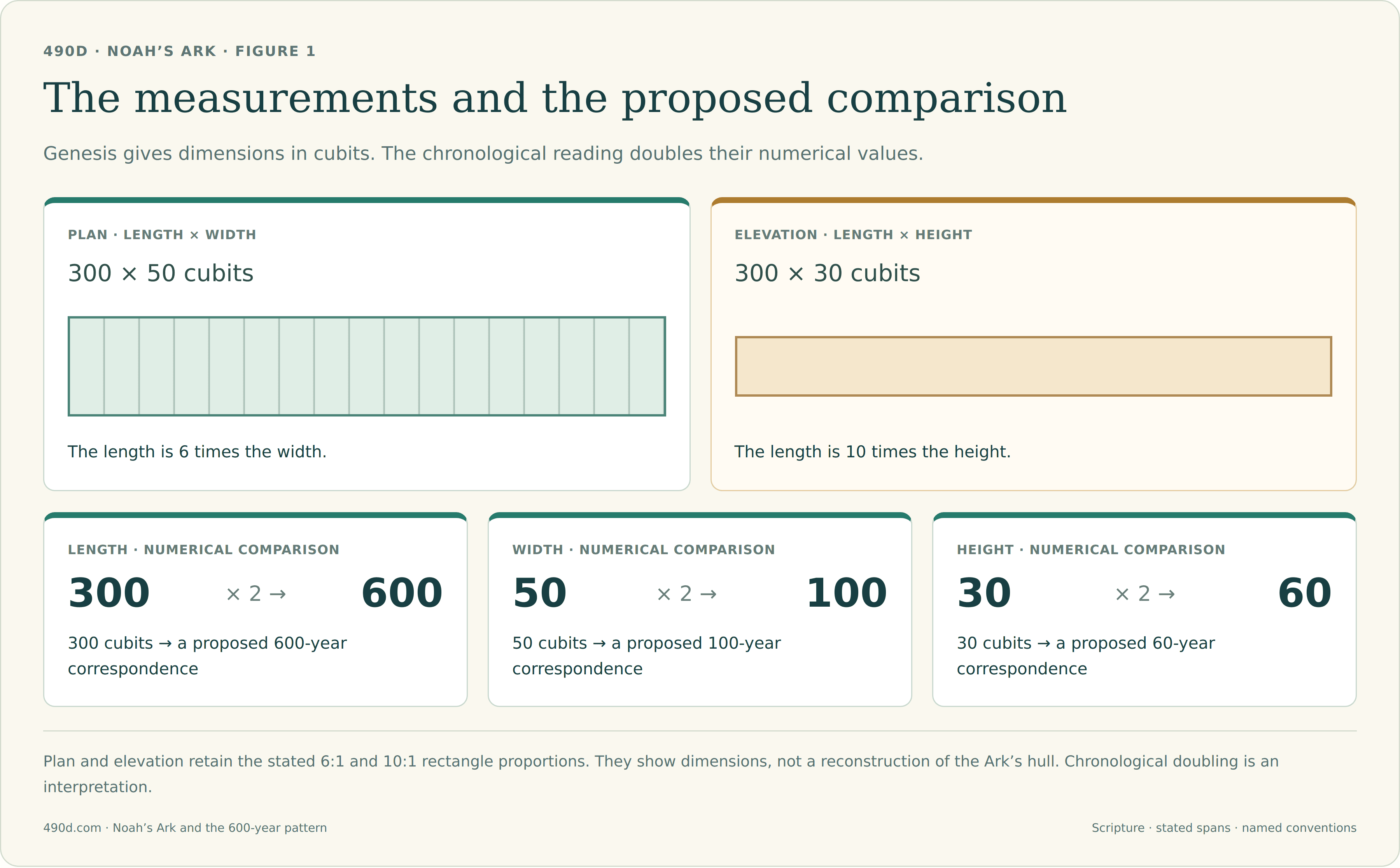
Doubling preserves the proportions. The length is six times the width and ten times the height, so the proposed time spans retain 600:100:60. We can now ask whether those numbers connect meaningful events in the chronology.
The dates below use the normal Masoretic Text (MT) framework: Nisan reckoning and 430 years in Egypt, without the optional +60 Terah adjustment or an inserted second Cainan. These are regular chronological dates, rather than cumulative lifespan coordinates. The supporting tables make the calculations immediately accessible.
Six centuries in Noah’s and Shem’s lives
Noah’s connection is direct. Genesis 7:6 gives his age when the floodwaters came as 600 years. The doubled length of the Ark therefore corresponds to the age of its builder at the Flood.
Shem supplies a different kind of 600:
This is the account of Shem. Two years after the flood, when Shem was 100 years old, he became the father of Arphaxad. And after he had become the father of Arphaxad, Shem lived 500 years and had other sons and daughters.
Here 100 + 500 = 600 is a complete lifespan. The first 100 years lead to Arphaxad’s birth; the following 500 complete Shem’s life. Both the doubled width and the doubled length thus have a natural place in this one genealogy.
490d · Noah’s Ark · Figure 2
Six centuries, two different measures
The doubled length meets both Noah’s Flood age and Shem’s full lifespan.
Noah · age at the Flood
600 years from birth to the Flood; his life continues afterward.
Shem · complete lifespan
100 years to Arphaxad’s birth, followed by 500 years.
Equal totals, different endpoints: Flood for Noah; death for Shem.
Each bar begins at its own person’s birth. Segment lengths are proportional to years. No BC dates or mixed Noah/Shem bindings are implied.
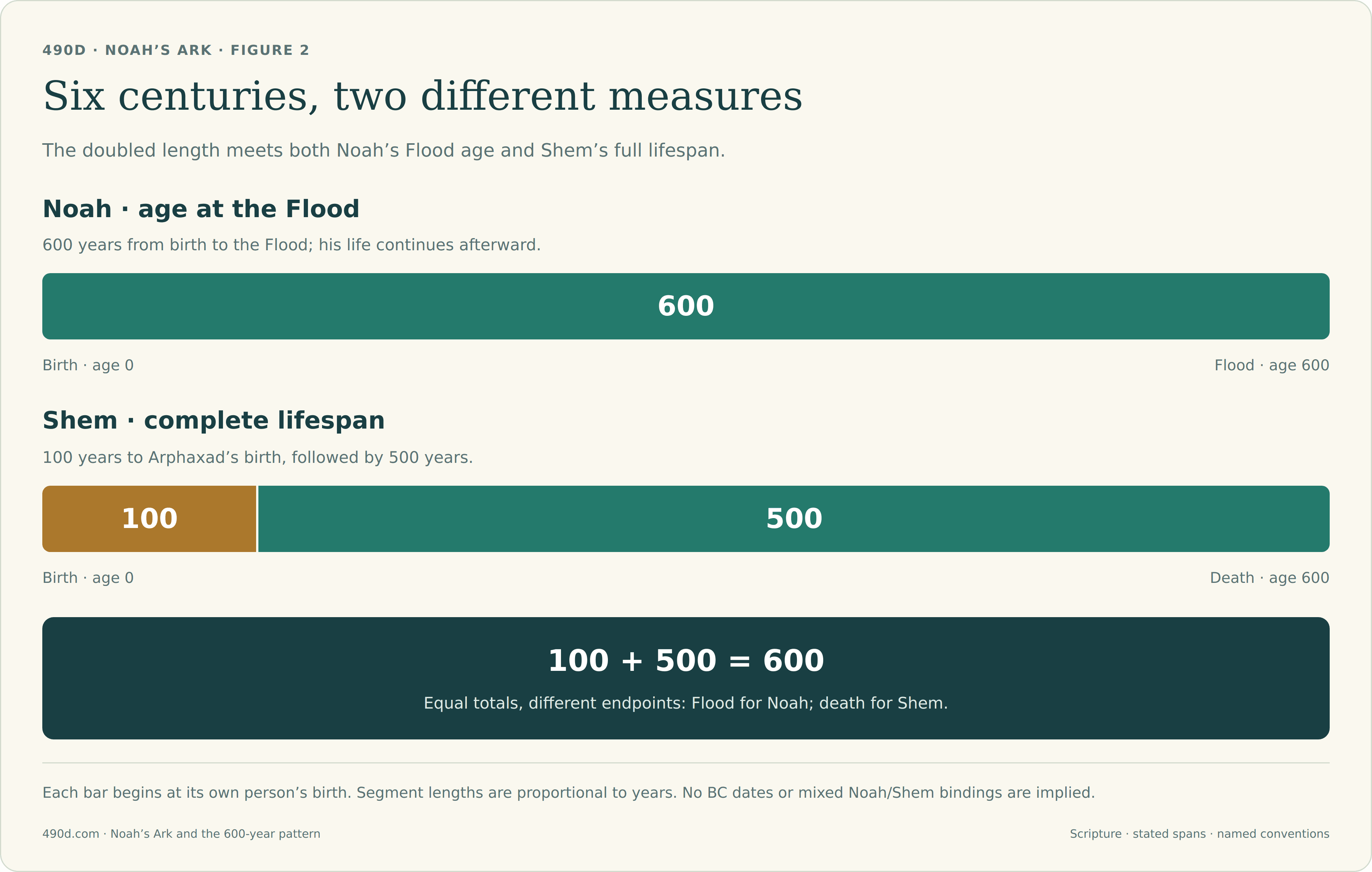
The distinction matters: Noah’s 600 ends at the Flood; Shem’s 600 ends at his death. Likewise, Genesis 11 attaches Shem’s age of 100 to Arphaxad’s birth, two years after the Flood. A separate Noah-bound comparison places Shem at 100 at the Flood. The appendix explains those two bindings; they should not be blended into one calculation.
From Jacob’s birth to the Conquest
The clearest extension of the pattern is the 600 years from Jacob’s birth in 2006 BC to Moses’ death and the opening of the Conquest in 1406 BC.
This total can be followed through the story. Jacob was 130 when he entered Egypt (Genesis 47:9). Israel’s Egyptian sojourn then lasted 430 years (Exodus 12:40–41), followed by the 40-year wilderness period:
130 + 430 + 40 = 600.
The same era divides at Moses’ birth. Jacob was born in 2006 BC; Moses was born in 1526 BC, 480 years later. Moses then lived 120 years, bringing the sequence to 1406 BC:
480 + 120 = 600.
490d · Noah’s Ark · Figure 3
One era, two divisions
Jacob’s birth in 2006 BC → Moses’ death / Conquest opening in 1406 BC
Through Egypt and the wilderness
Jacob’s birth → Egypt entry
Egypt entry → Exodus
Exodus → Conquest
Through Moses’ birth and life
Jacob’s birth → Moses’ birth
Moses’ birth → death
480 + 120 = 600
The same start: Jacob’s birth. The same endpoint year: 1406 BC.
Normal MT; Nisan; 430 years in Egypt; no +60 Terah or second Cainan. Thin bars are proportional. Cards and their spacing are schematic. Whole-year spans do not assert matching days.
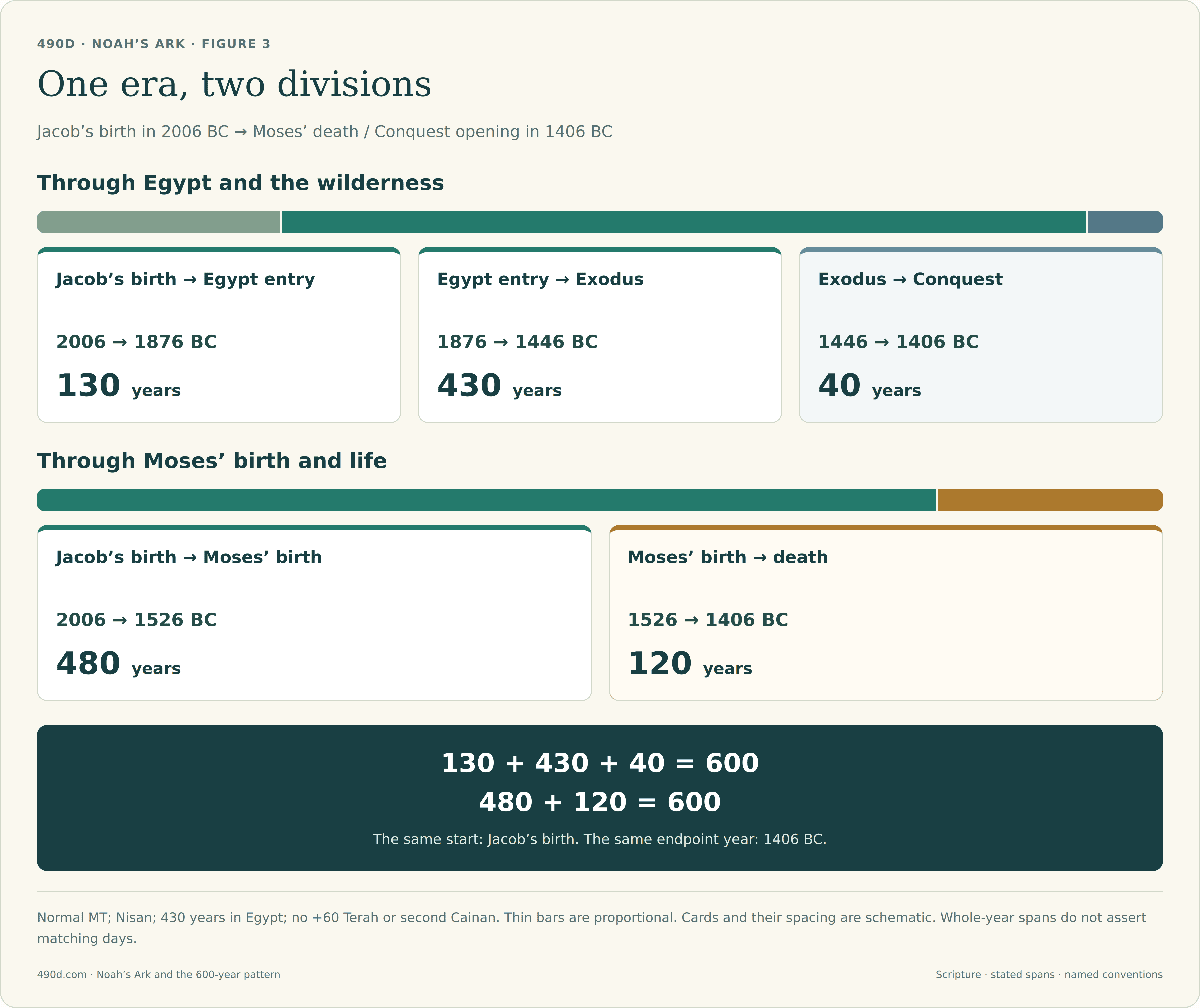
These are two divisions of the same interval. One follows the family’s movement into Egypt, the Exodus, and the approach to the land. The other places the birth of the deliverer at the beginning of the final fifth of the span: 120 out of 600 years.
Jacob did not live for 600 years. His birth begins an era that closes long after his own death, with the people descended from him preparing to enter the land. Moses’ lifespan supplies the final part of that era. The arithmetic gives a compact way to see the relationship between a patriarch, a people, and their deliverer.
The 120 years before a turning point
Genesis 6:3 introduces another 120-year measure before the Flood. The 120 years can be read as a warning period leading to the Flood and as an anticipation of Moses’ lifespan. Under that countdown reading, Noah is 480 when the final 120 begins: 600 − 120 = 480.
This sets the two arrangements side by side. Noah’s age reaches 600 through 480 + 120; the Jacob-to-Conquest span reaches 600 through 480 + Moses’ 120. In each, the final 120 years lead toward a decisive transition involving judgment, preservation, and a new beginning.
The countdown is an interpretation of Genesis 6:3, developed in File 23 §5.5. It should not be turned into a claim that the Bible dates 120 years of Ark construction. The appendix separates the stated ages from the inferred warning point.
The 100 and the 60 within the family line
The smaller numbers also appear in the ancestral line leading to Jacob. Abraham was 100 when Isaac was born; Isaac was 60 when Esau and Jacob were born (Genesis 21:5; 25:26).
The sequence therefore carries all three comparison numbers: 100 from Abraham’s birth to Isaac’s, 60 from Isaac’s birth to Jacob’s, and 600 from Jacob’s birth to the Conquest.
490d · Noah’s Ark · Figure 4
The 100, the 60, and the 600
The normal MT ancestral line supplies the smaller comparisons.
60 + 600 = 660
Isaac’s birth extends the Jacob-to-Conquest interval by 60 years.
Normal MT dates, with 430 years in Egypt. No +60 Terah adjustment. Card spacing is schematic, not proportional to elapsed time.
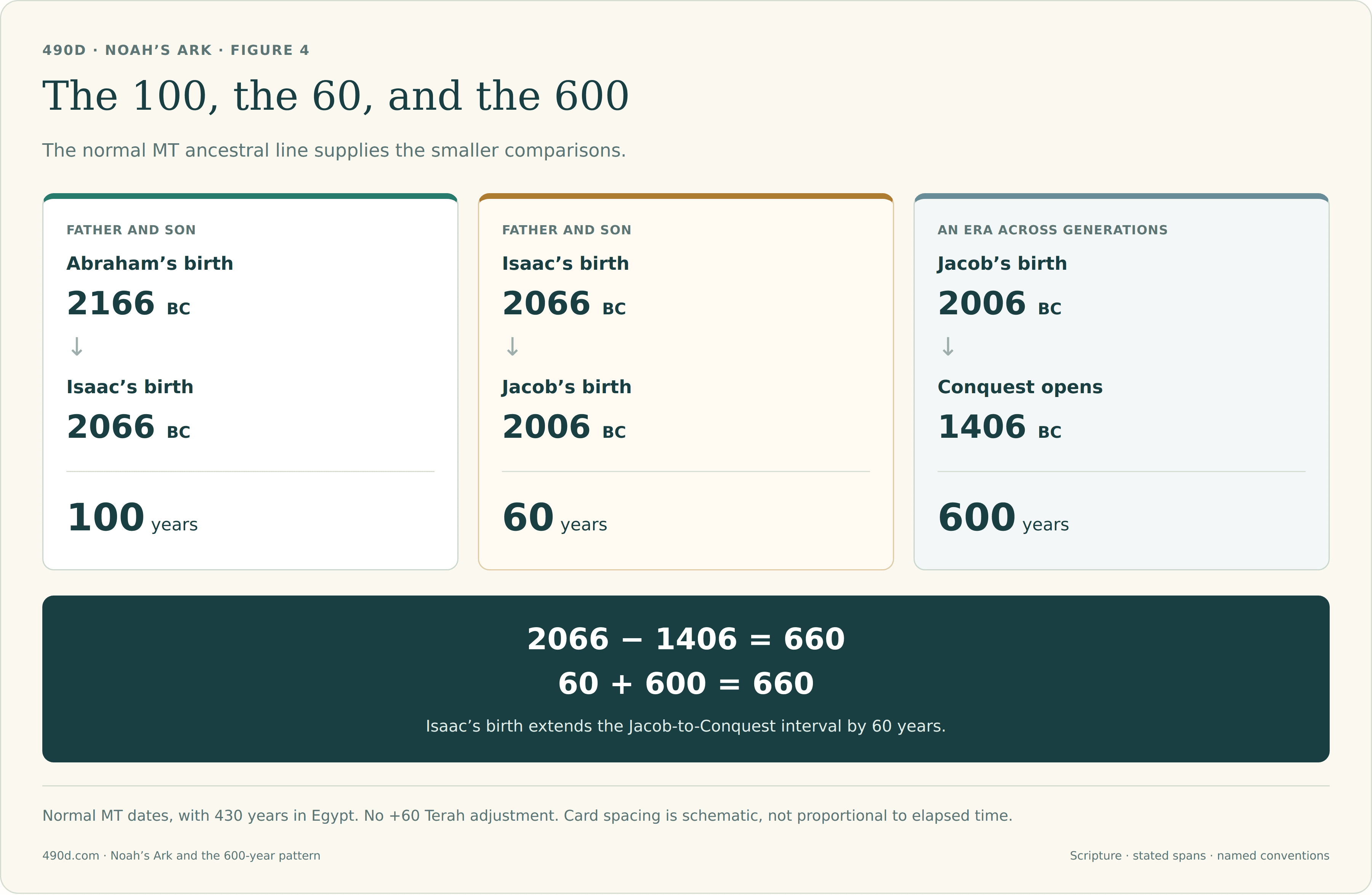
Isaac’s birth extends the Jacob-to-Conquest span backward by 60 years: 2066 − 1406 = 660, or 60 + 600. The 60-year comparison is available within the normal MT dates themselves. It does not require changing the article’s chronological framework.
These relationships give the Ark’s proposed numerical template its interest. The 600 is already present in Noah’s age and Shem’s lifespan, and it reappears as a coherent era from Jacob to Moses. The 100 and 60 belong to named father-and-son relationships along the same ancestral line.
Preserved through the waters
The connection between Noah and Moses is also narrative. Noah is preserved in the Ark; the infant Moses is preserved in the basket placed among the reeds of the Nile (Exodus 2:3). Both vessels are called tebah in Hebrew. The canonical Tebah study develops this relationship as a theological comparison: preservation through water prepares the way for deliverance.
The numerical pattern gives that comparison a visible shape. It brings an Ark, a patriarchal family, and Moses’ life into a shared field of 600, 100, 60, and 120 years. The arithmetic can be checked directly; the further judgment that the Ark’s dimensions intentionally anticipate those later spans remains an interpretation of their relationship.
For the full calculations, use the technical appendix, especially the 600-year table, 120-year comparison, and Noah/Shem date table. The canonical Markdown sources govern the dates and conventions. The detailed Ark study develops the overlapping spans and wider comparisons, with seven supporting tables.
Scripture quotations: Berean Standard Bible (BSB), public domain.