Solomon’s Temple stands at the meeting point of two ways of reading biblical time. One follows the succession of events. The other places the recorded reigns end to end, allowing their combined shape to come into view. The distinction explains why the same study can speak of a historical Temple foundation in 966 BC and a schematic Temple pivot in 1016 BC—fifty years earlier.
The biblical starting point is unusually specific:
In the four hundred and eightieth year after the Israelites had come out of the land of Egypt, in the month of Ziv, the second month of the fourth year of Solomon’s reign over Israel, he began to build the house of the LORD.
This verse connects the Exodus, Solomon’s reign, and the Temple foundation. When that connection is placed beside the later reigns of Judah, a second arrangement emerges: the Temple becomes the midpoint of two spans of 430 years.
Supporting tables: Every reign and its biblical reference · How the fifty years are calculated · The date conventions.
Two views of the same span
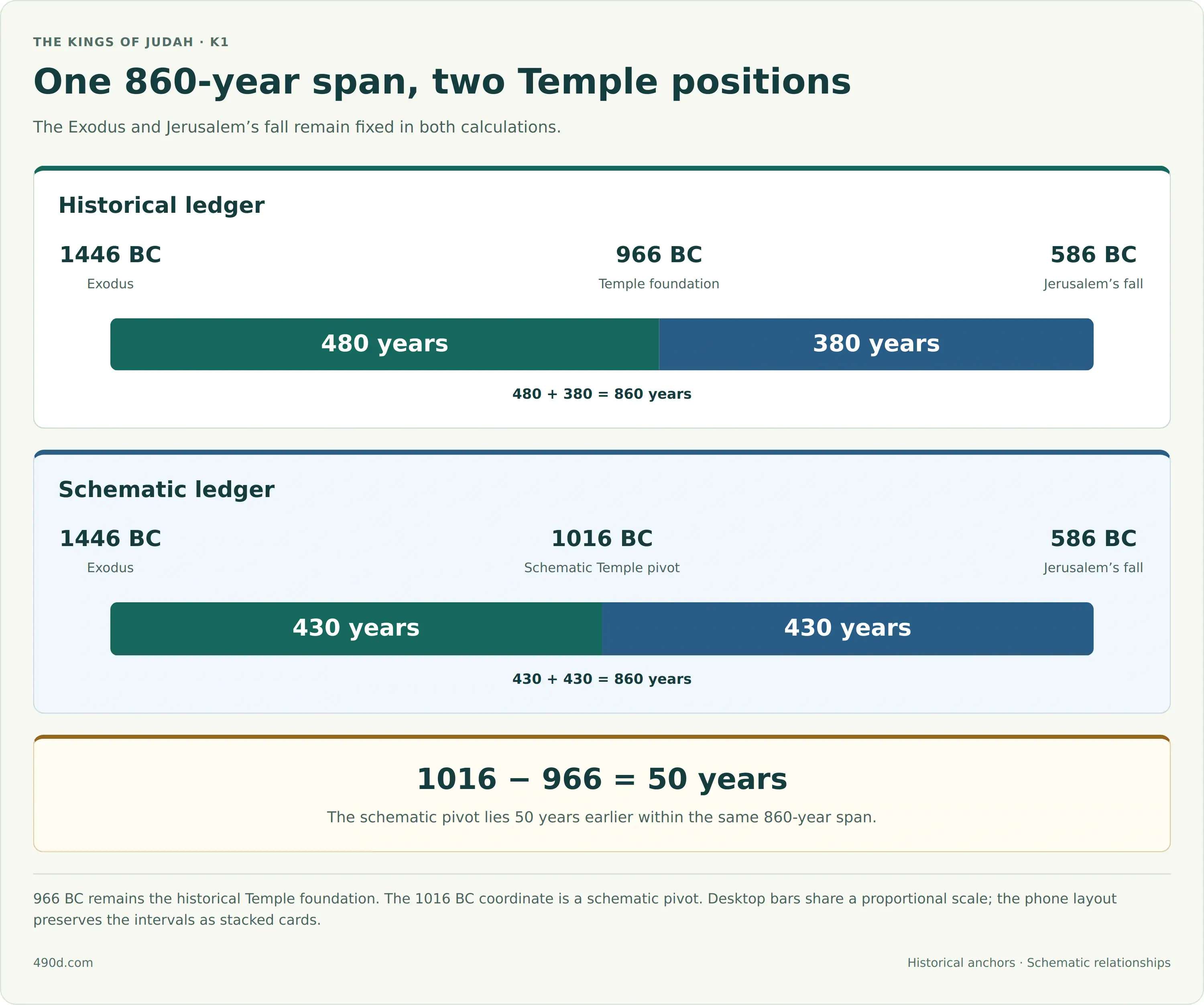
The normal MT chronology used here places the Exodus in 1446 BC, the Temple foundation in 966 BC, and Jerusalem’s fall in 586 BC. At the level of year labels, the Temple divides the interval into 480 + 380 years.
The schematic arrangement keeps the Exodus and Jerusalem’s fall in place but puts the Temple pivot at 1016 BC. The same interval then divides into 430 + 430 years.
Historical ledger
Schematic ledger
Historical ledger
Schematic ledger
Sources: File 08 §§1.1, 1.3; File 18 §§2.5.4–2.5.5.
Image version and full-size download
Download the full-size PNG · Download the WebP · Download the stacked phone PNG
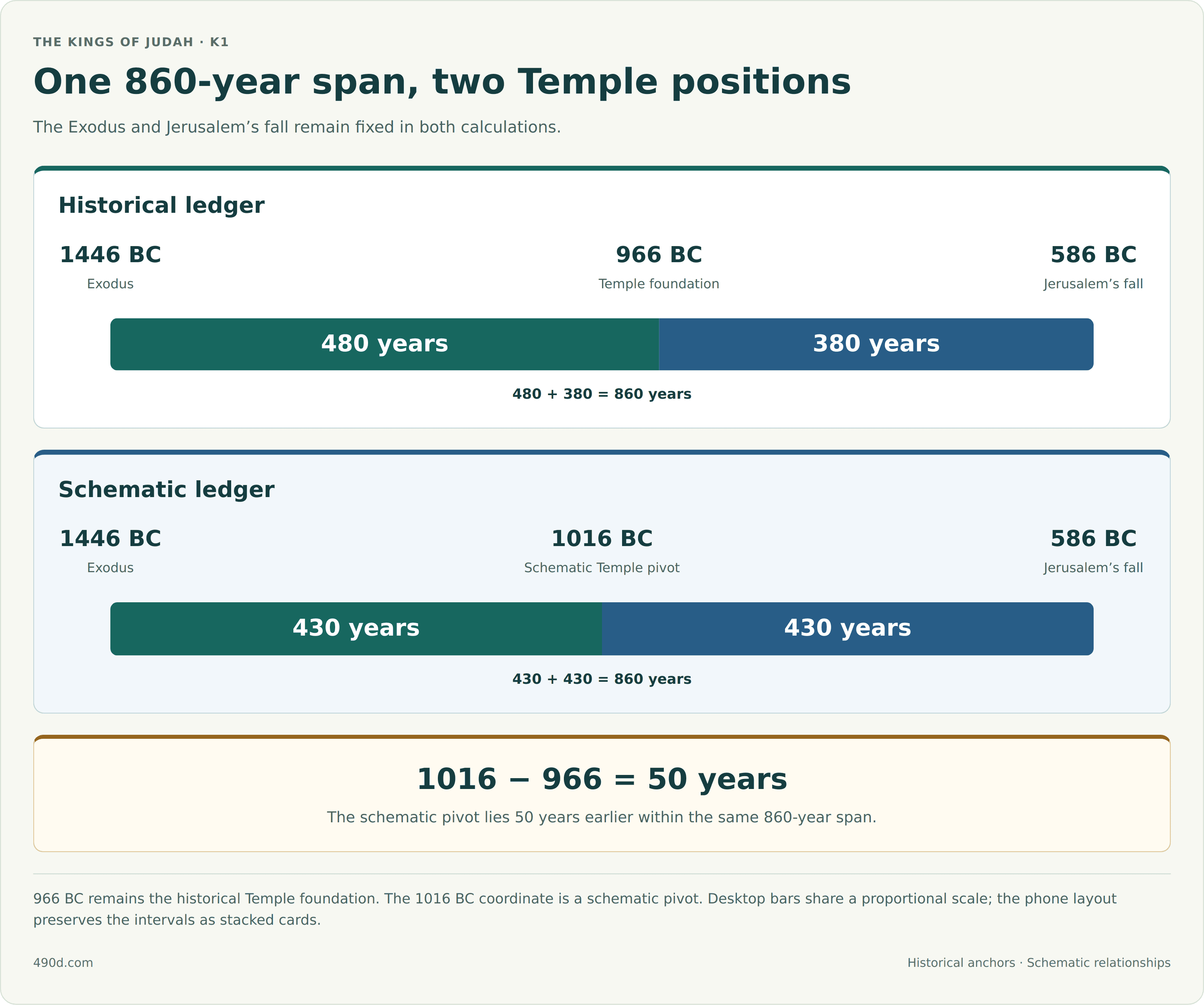
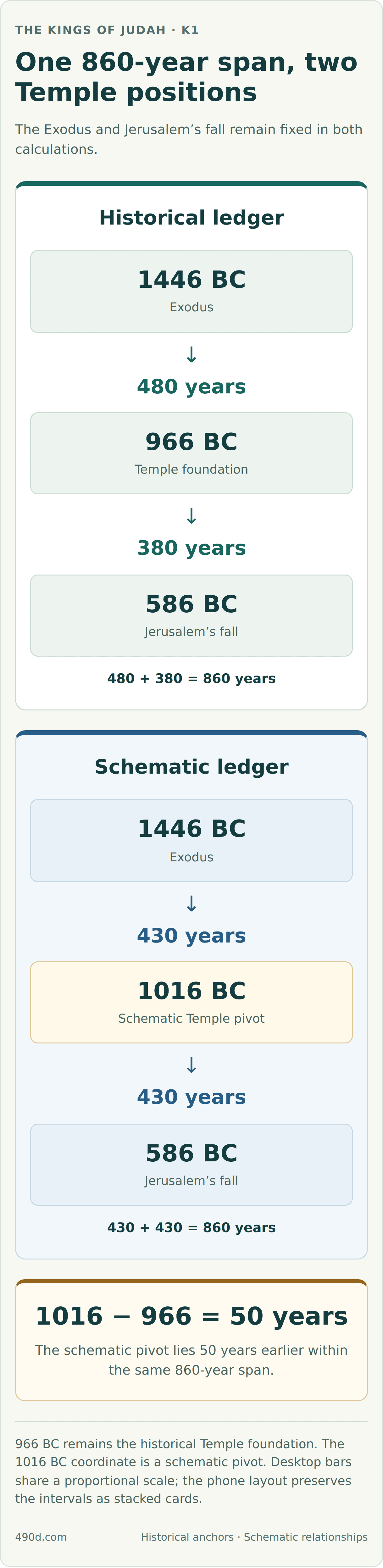
Both arrangements cover 860 years. Moving the central coordinate fifty years earlier reduces the first part by fifty and increases the second by fifty:
On smaller screens, scroll a wide table horizontally to see every column.
| Arrangement | Exodus to Temple | Temple to Jerusalem’s fall | Whole span |
|---|---|---|---|
| Historical year labels | 480 | 380 | 860 |
| Schematic year labels | 430 | 430 | 860 |
The historical foundation remains 966 BC. The 1016 BC coordinate belongs to the arrangement generated by the reign ledger. Keeping those two meanings visible lets us study the pattern without confusing a calculated structure with a revised historical date.
What happens when the reigns are added?
A list of reign lengths and an elapsed historical chronology answer different questions. A reign total preserves the figures attached to individual rulers. A historical reconstruction also has to account for overlapping reigns, accession conventions, and the synchronisms between Judah and Israel. Adding each reign as a separate block therefore need not reproduce the elapsed time between the first and last events.
For the Temple-era ledger, the starting allowance is 36 years: Solomon’s forty-year reign less the four years assigned before the foundation in this formal calculation. The later rulers run from Rehoboam to Zedekiah. Their whole-year entries, using the canonical schematic treatment of Athaliah, total 394 years. Two reigns of three months add another half-year:
36 + 394 + ½ = 430½ years.
Athaliah needs one sentence of explanation. Scripture says Joash was hidden for six years while she ruled, followed by Jehoiada’s action “in the seventh year” (2 Kings 11:3–4, BSB). The primary schematic ledger uses that seventh-year boundary. The six completed years remain visible in the supporting table; they are not rewritten as seven completed years.
The half-year also stays in the calculation. In the canonical calendar comparison, the corresponding historical span is 380½ years, from the Nisan boundary of 966 BC to the Tishri boundary of 586 BC. Thus:
430½ − 380½ = 50 years.
That Tishri endpoint is the comparison boundary, later than the Temple’s burning in the fifth month. The appendix shows the full calculation, including the six-year audit and Chronicles’ additional ten days. The clean 430 + 430 diagram presents the annual structure; the detailed ledger preserves its calendar qualifications.
Why fifty matters
Fifty already has a defined place in biblical sacred time. Leviticus 25:8–10 counts seven sabbaths of years—7 × 7 = 49—and then sets apart the fiftieth year for liberty and the return of possessions. The relation between forty-nine and fifty gives the Judah comparison a natural Jubilee setting.
Here the two readings of Athaliah’s notice produce just that pair: the completed-duration audit gives a 49-year surplus, while the seventh-year-boundary ledger gives 50. The correspondence is particularly fitting in a narrative about the preservation and restoration of the Davidic heir. It does not establish that Athaliah’s overthrow occurred in an actual Jubilee year, or demonstrate that the reign notices were deliberately composed to produce the result. Its strength is the combination of a transparent calculation and an apt biblical theme.
There is a second scriptural correspondence. Ezekiel 4:4–6 assigns 390 days for Israel and 40 days for Judah, a day for a year: 390 + 40 = 430. Those are prophetic sign periods, distinct from the kings’ reign lengths. Their shared total helps explain why 430 is worth following through the larger chronology.
Three spans of 430 years
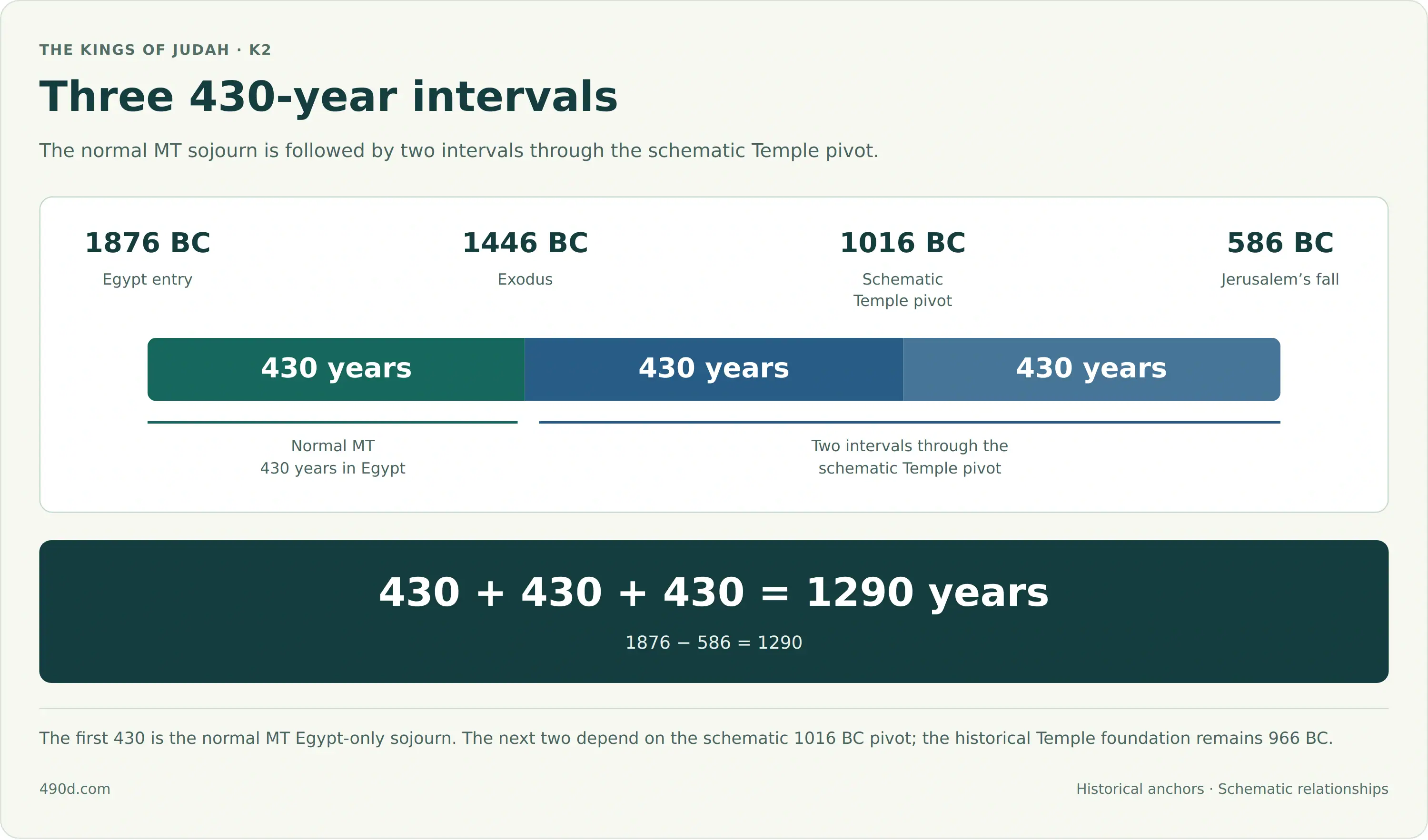
Extending the view back to Jacob’s entry into Egypt produces the article’s larger pattern:
1876 → 1446 → 1016 → 586 BC.
Temple pivot
430 years in EgyptTwo intervals through the
schematic Temple pivot
Sources: File 08 §1.1; §1.3; File 18 §2.5.5.
Image version and full-size download
Download the full-size PNG · Download the WebP · Download the stacked phone PNG
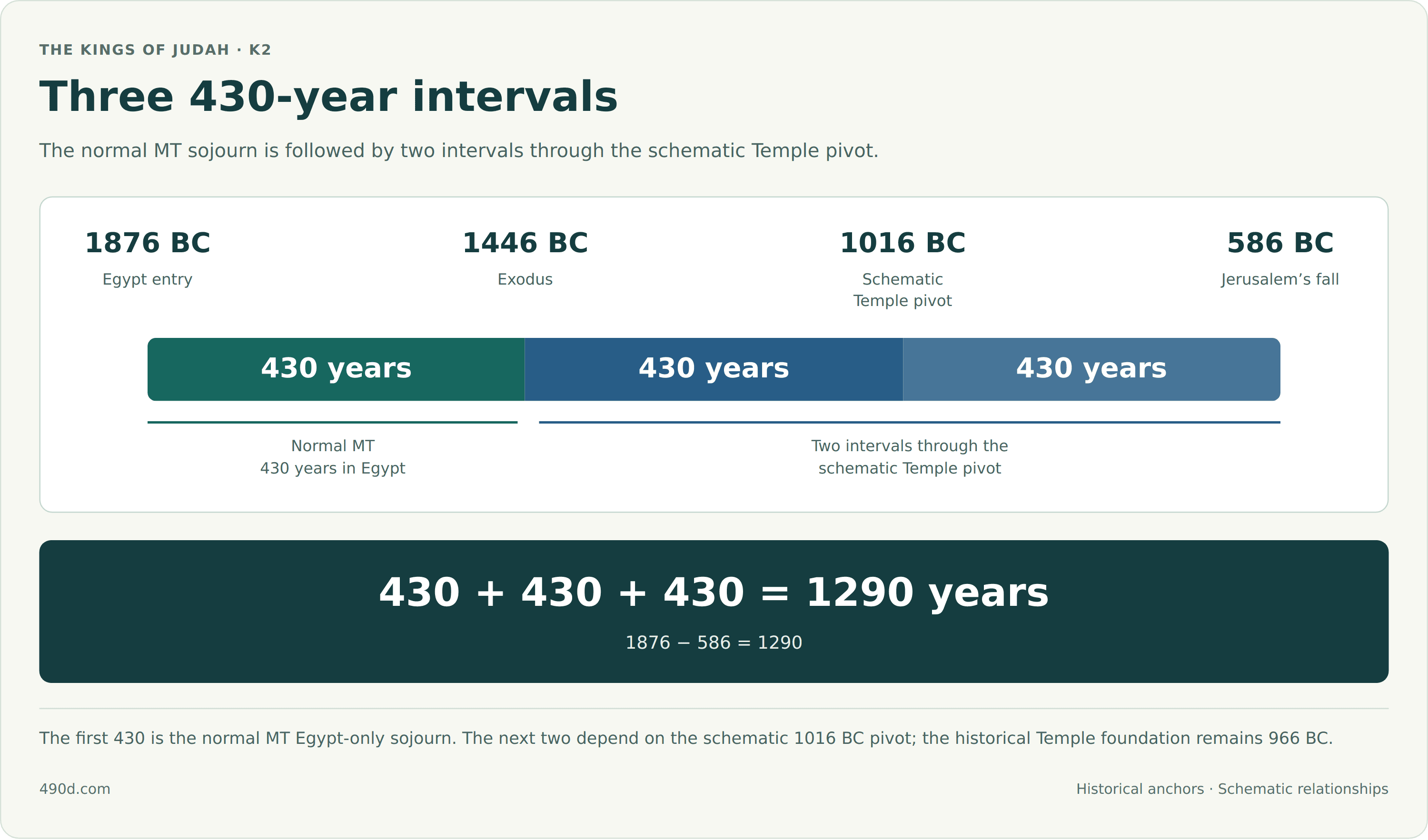
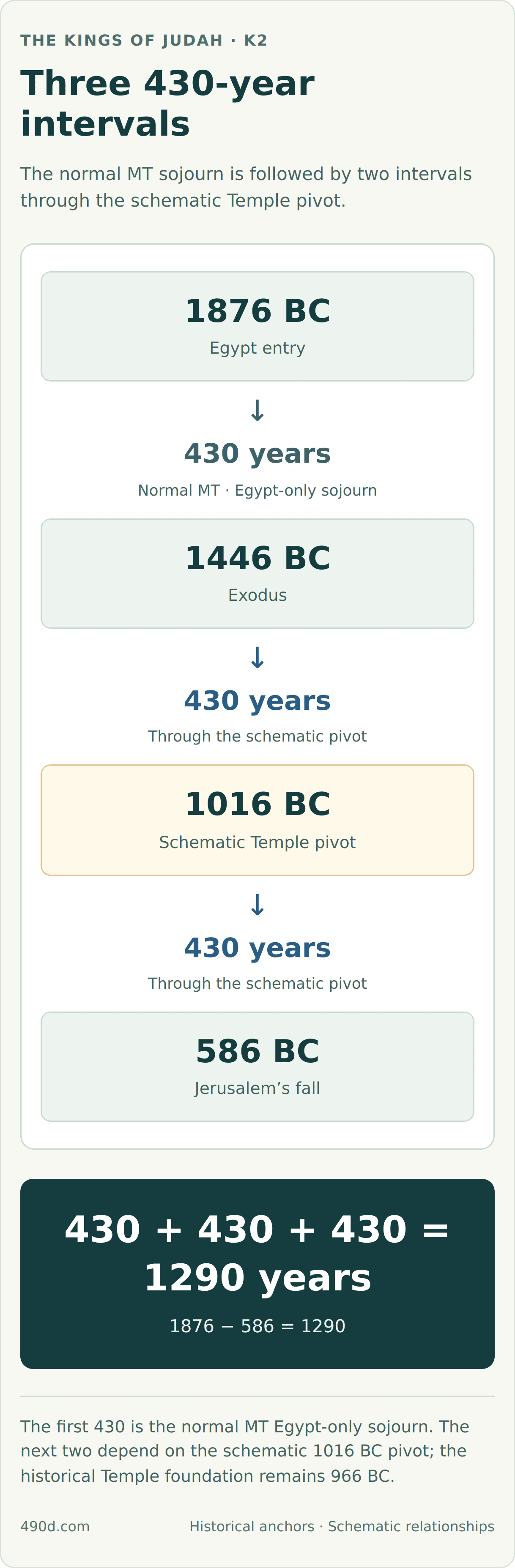
The first span is the normal MT sojourn: 430 years in Egypt, ending at the Exodus. The next two spans use the schematic Temple pivot. Together they form:
430 + 430 + 430 = 1290 years.
The distinction matters. Egypt’s 430 years belongs to the normal historical framework used in this study; the two later equal spans become visible through the schematic arrangement. For the textual basis of the first interval, see Harmonizing the Exodus Sojourn.
The Temple now stands within a sequence of entry, deliverance, sanctuary, and judgment. Its fifty-year displacement is what allows the later 860 years to take the same 430-year measure as the Egyptian sojourn. The pattern can be appreciated at a glance, while every part remains available for examination.
Reading the two accounts together
The value of this comparison lies in retaining both views. The historical chronology locates the Temple in the sequence of events. The reign ledger reveals a formal total; the schematic chronology displays its balanced arrangement. Their fifty-year difference connects that arrangement with the biblical relation between seven sevens and the Jubilee.
The result is a clear structure: 480 + 380 and 430 + 430 describe two arrangements of the same 860-year span, and the latter joins the Egyptian sojourn to form three spans of 430. The supporting table makes the arithmetic inspectable, especially at the Athaliah boundary where the counting convention matters most.
Continue with the technical appendix, consult the canonical Kings source, or explore the detailed Kings of Judah study for the full historical and schematic comparison and the 299/300 completion.
Scripture quotations: Berean Standard Bible (BSB), public domain.