Kohath and Amram stand between Levi and Moses in the family line. Exodus records their full lifespans in two brief statements:
“Kohath lived 133 years.”
— Exodus 6:18, BSB, excerpt
“Amram lived 137 years.”
— Exodus 6:20, BSB, excerpt
Levi also lives 137 years, and Moses is 80 when he stands before Pharaoh. Yet the genealogy does not tell us Kohath’s age when Amram was born, or Amram’s age when Moses was born. The complete lives are supplied; the intervals between those births are left unstated.
That distinction opens a useful comparison between two ways of reading the chronology. Regular chronology places people within overlapping lives. Cumulative chronology adds complete lifespans end to end. Around Kohath and Amram, the comparison reveals a fourteen-year difference—and a precise connection with Levi’s life.
The setting is the normal MT chronology: Nisan reckoning, 430 years in Egypt, without the additional 60 years of Terah or a restored second Cainan. The calculations use the stated lifespans, without rounding. The supporting tables keep the biblical ages and reconstructed BC dates together.
The regular span from Levi to the Exodus
The regular chronology places Levi’s life at 1919–1782 BC, with Jacob’s household entering Egypt in 1876 BC and the Exodus in 1446 BC. His life therefore divides into 43 years before the Entry and 94 years afterward:
43 + 94 = 137 years.
From Levi’s death to the Exodus are another 336 years, the interval explored in Levi and the Priestly Year. Together, these give a simple framework:
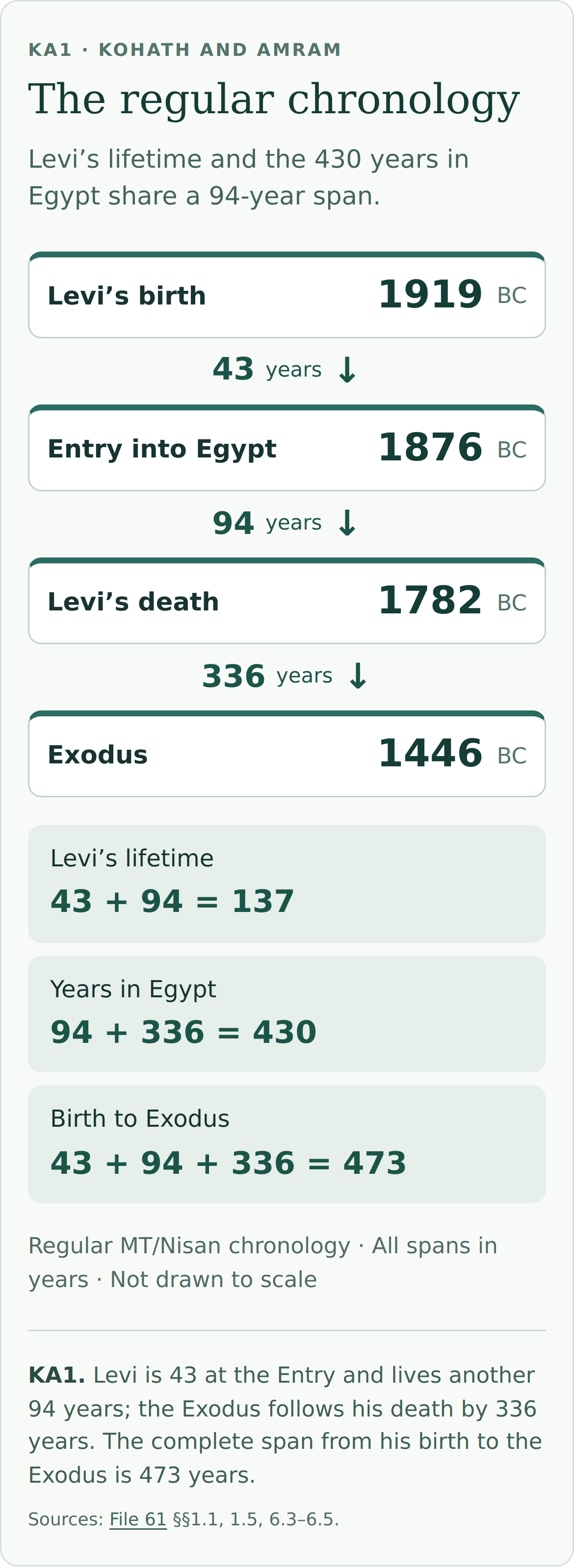
KA1 · Kohath and Amram
The regular chronology
Levi’s lifetime and the 430 years in Egypt share a 94-year span.
Regular MT/Nisan chronology · All spans in years · Not drawn to scale
Image version and full-size download
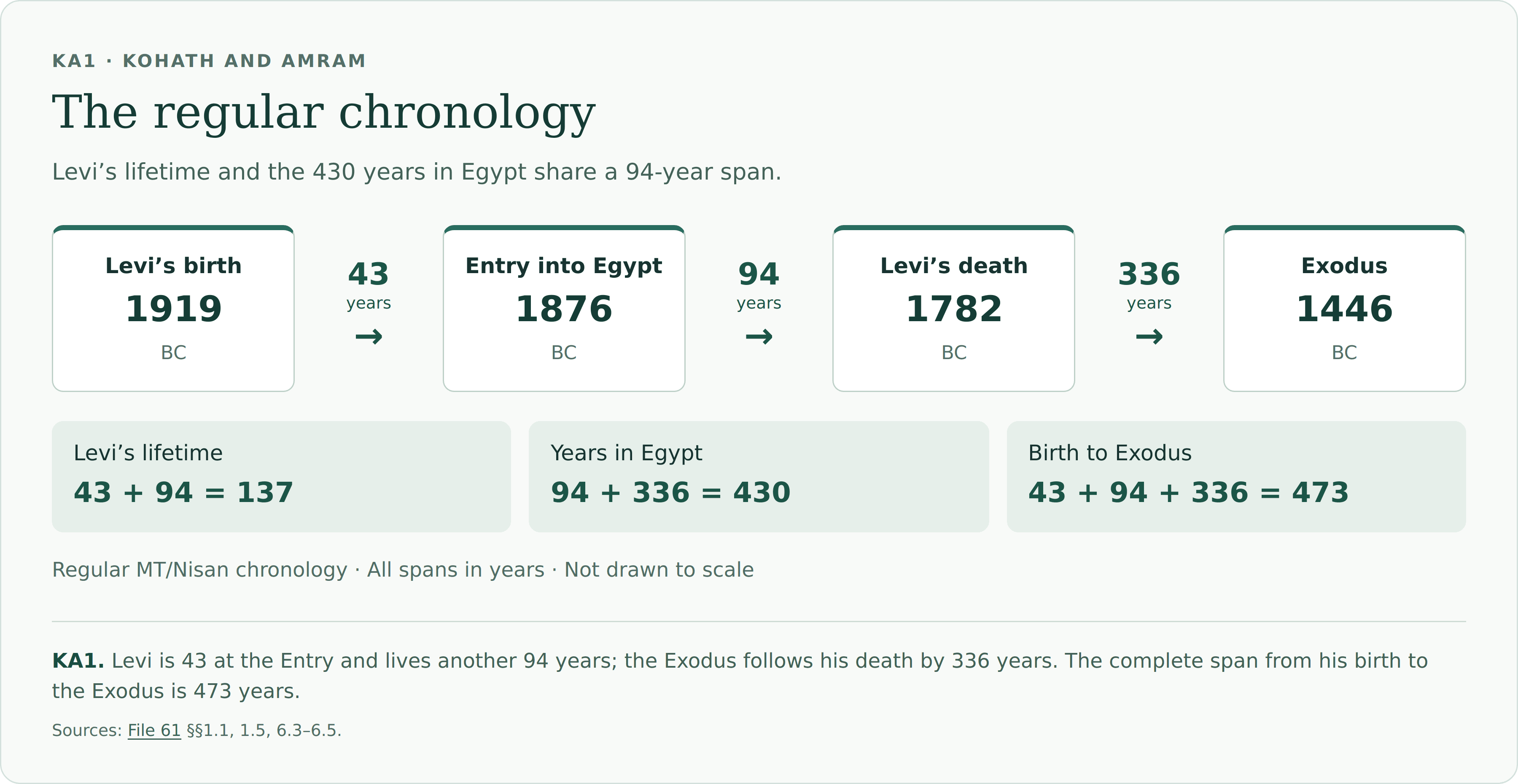
KA1. Levi is 43 at the Entry and lives another 94 years; the Exodus follows his death by 336 years. The complete span from his birth to the Exodus is 473 years.
We can measure toward the Exodus from any of these three starting points. From Levi’s birth the span is 473 years; from the Entry it is 430; from Levi’s death it is 336. These are ordinary elapsed intervals within the same reconstruction.
Three starting points, one fourteen-year difference
Now place Levi’s, Kohath’s, and Amram’s full lifespans consecutively, followed by Moses’ 80 years to the Exodus:
137 + 133 + 137 + 80 = 487.
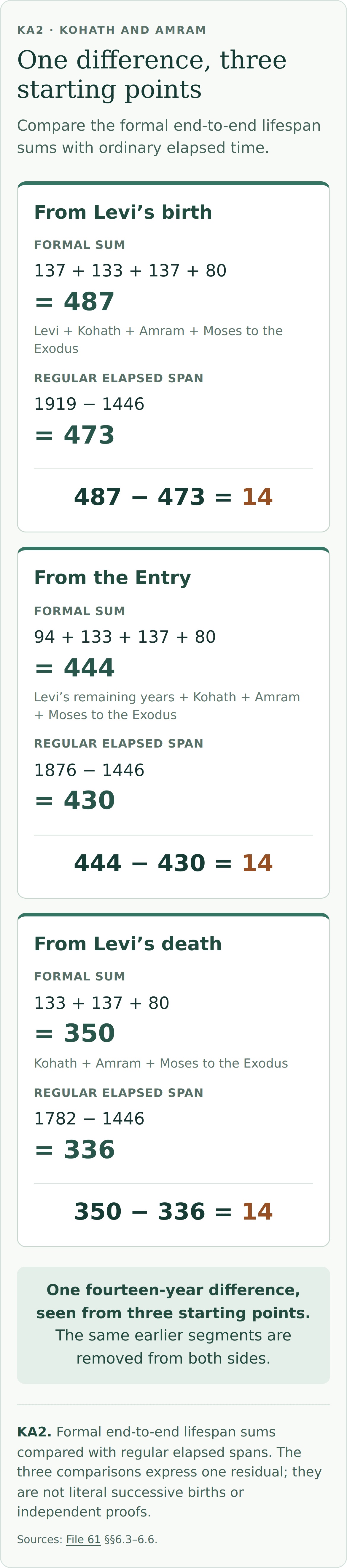
This formal sum is 14 years longer than the regular span of 473. Starting at the Entry instead, substitute Levi’s remaining 94 years for his full 137. The sum becomes 444, again 14 longer than the regular 430. Starting at Levi’s death, remove Levi’s portion entirely: 133 + 137 + 80 = 350, which exceeds 336 by the same 14.
KA2 · Kohath and Amram
One difference, three starting points
Compare the formal end-to-end lifespan sums with ordinary elapsed time.
From Levi’s birth
Formal sum
137 + 133 + 137 + 80= 487
Levi + Kohath + Amram + Moses to the Exodus
Regular elapsed span
1919 − 1446= 473
487 − 473 = 14
From the Entry
Formal sum
94 + 133 + 137 + 80= 444
Levi’s remaining years + Kohath + Amram + Moses to the Exodus
Regular elapsed span
1876 − 1446= 430
444 − 430 = 14
From Levi’s death
Formal sum
133 + 137 + 80= 350
Kohath + Amram + Moses to the Exodus
Regular elapsed span
1782 − 1446= 336
350 − 336 = 14
One fourteen-year difference, seen from three starting points.
The same earlier segments are removed from both sides.
Image version and full-size download
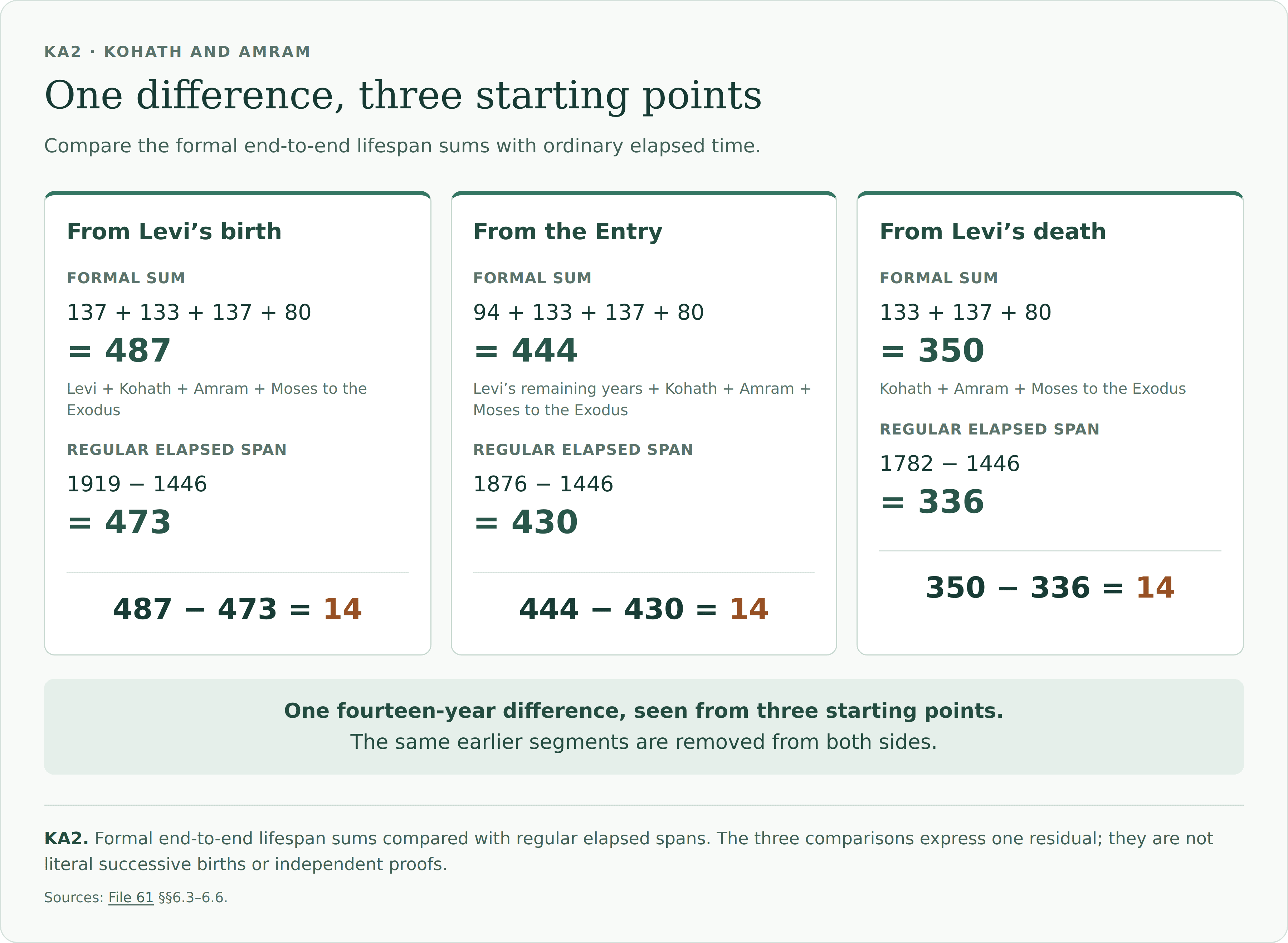
KA2. Formal end-to-end lifespan sums compared with regular elapsed spans. The three comparisons express one residual; they are not literal successive births or independent proofs.
The relation is compact:
487 − 473 = 444 − 430 = 350 − 336 = 14.
Each comparison preserves the same difference because the same earlier segment is removed from both sides. The three starting points make one relationship visible. Its clearest form is the last: Kohath’s 133 + Amram’s 137 + Moses’ 80 gives 350, while Levi’s death stands 336 years before the Exodus.
These sums belong to a formal lifespan model. Genesis 46:11 already names Kohath among the family entering Egypt, so we cannot turn the calculation into a story in which he is born only after Levi dies. It does not recover the missing birth dates or demonstrate that a literal, uninterrupted three-generation succession fills the Egyptian 430 years. The appendix explains this boundary alongside the arithmetic.
The connection with Levi’s complete life
The fourteen-year difference becomes more interesting when we return to the cumulative chronology. Its method is explained in Adding the Lifespans: complete lives are laid end to end, working backward from Moses’ death and the Conquest in 1406 BC.
Moses’ full 120 years reaches his birth in 1526 BC. Adding Amram’s 137 reaches 1663; Kohath’s 133 reaches 1796; Levi’s 137 reaches 1933. Thus Levi’s cumulative block is:
1933 − 1796 = 137 years.
Move both boundaries fourteen years forward. Because these are BC labels, subtract fourteen from each:
1933 − 14 = 1919
1796 − 14 = 1782
The resulting span is 1919–1782 BC—Levi’s complete regular biography. His 137 years remain intact.
This is the central link. The same fourteen-year difference found between the lifespan sum and regular elapsed time also separates the cumulative Levi block from Levi’s regular life. Moving two boundaries equally always preserves their distance; the particular interest here is that both boundaries reach the corresponding dates of the same patriarch’s life.
KA3 · Kohath and Amram
The same lifespan, fourteen years later
Moving both boundaries preserves the full 137-year interval.
Levi boundary
Kohath boundary
Shifted Levi boundary
Shifted Kohath boundary
Regular Levi birth
Regular Levi death
7 + 7 = 14 years forward
Each complete block remains 137 years long.
Image version and full-size download
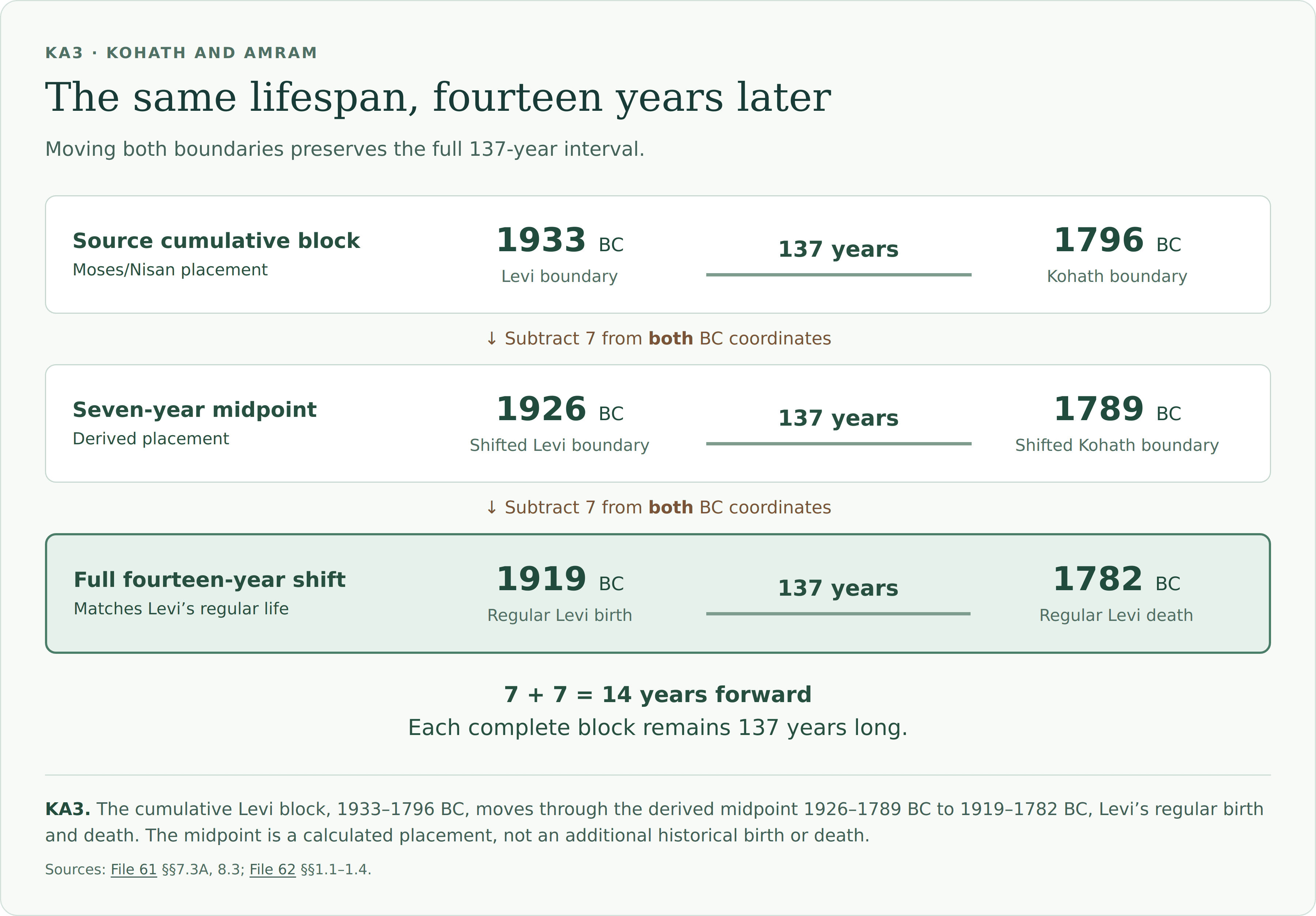
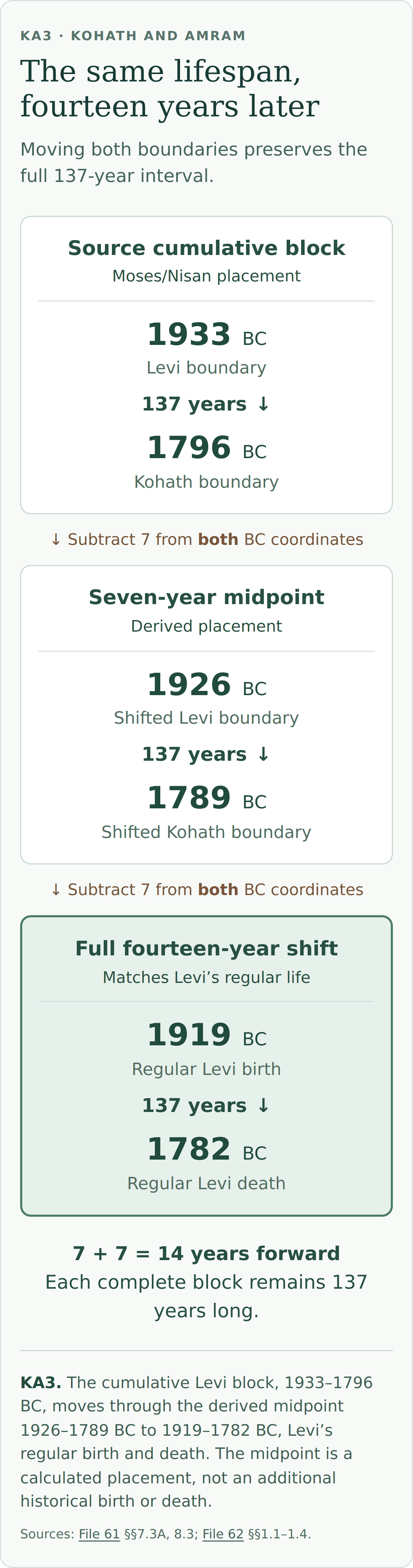
KA3. The cumulative Levi block, 1933–1796 BC, moves through the derived midpoint 1926–1789 BC to 1919–1782 BC, Levi’s regular birth and death. The midpoint is a calculated placement, not an additional historical birth or death.
The canonical studies call this a fourteen-year clutch, an image of two chronological arrangements engaging. It is a local comparison of their calculated positions. Moses’ birth, the Exodus, and the Conquest keep their established dates.
The lower translated positions need the same care. 1782→1649 preserves Kohath’s 133 years, and 1649→1512 preserves Amram’s 137. Those are formal consecutive blocks. They do not establish Kohath’s and Amram’s historical biographies, nor does 1512 replace Moses’ birth in 1526. The complete boundary table makes each position’s role explicit.
Fourteen as two sevens
A fourteen-year movement contains an exact halfway step of seven years. Levi’s cumulative starting position illustrates it:
1933 → 1926 → 1919 BC: 7 + 7 years.
The ending boundary moves in parallel: 1796→1789→1782. Every placement still spans 137 years. The midpoint follows directly from the full movement; it supplies a way to see the relation in two equal stages.
The family narrative already gives fourteen a familiar form. Jacob serves seven years and another seven for his wives; Joseph’s interpretation joins seven years of plenty and seven of famine. These periods form and preserve the household that enters Egypt. Their textual foundations and dates are collected in the narrative table.
Fourteen also connects the stated lifespans: Jacob’s 147 exceeds Kohath’s 133 by 14, while Levi’s and Amram’s 137 exceed Aaron’s 123 by 14. These differences help explain why fourteen belongs naturally in this part of the numerical structure.
Reading the link
The missing begetting ages and the preserved lifespans invite us to read this genealogy at more than one scale. The regular chronology follows the family toward the Exodus; the cumulative arrangement places the complete lives beside one another. The fourteen-year comparison joins them most clearly in Levi, whose full 137 years appear in both arrangements.
I read that connection within the wider biblical pattern of sevens: the household is formed, sustained through famine, and brought toward deliverance. The arithmetic provides a definite structure for that reading. The proposal that the genealogy’s arrangement was intended to carry this meaning remains an interpretation of the structure.
For the calculations and their source settings, use the technical appendix. Files 61–62 in the canonical source collection develop the broader framework, while the extended study offers the longer discussion behind this focused account.
Scripture quotations: Berean Standard Bible (BSB), public domain.