The Book of Jubilees retells the history of Genesis and the beginning of Exodus through a repeated pattern of sevens. Events belong to numbered years, weeks of years, and jubilees. This arrangement gives sacred history a calendar-like structure: creation, covenant, judgment, and the inheritance of the land occupy places within an ordered whole.
Three ideas make that chronology easier to read. A week of years contains 7 years. A jubilee contains 49 years. And the book’s closing reckoning supplies a 2450-year framework, which the 490d study places from Creation to the Conquest. Within that framework, dates derived from the text must remain distinct from dates reconstructed from stated ages.
This introduction explains the counting system and provides a short chronology. The supporting tables and source notes identify the basis of each date and the limits of the reconstruction.
1. Years, weeks, and jubilees
A normal week groups seven days. Jubilees applies the same pattern to years: seven years make one year-week, and seven year-weeks make one jubilee.
1 year-week = 7 years.
1 jubilee = 7 × 7 = 49 years.
The biblical background is the counting of “seven Sabbaths of years—seven times seven years” in Leviticus 25:8, Berean Standard Bible (BSB). Verse 10 also speaks of consecrating the fiftieth year. The present study follows the Book of Jubilees’ own 49-year chronological units; the separate question of how to reckon the fiftieth year in Leviticus should not change those units silently.
The number 50 enters at a different scale when the study counts fifty jubilees:
50 × 49 = 2450 years.
These are fifty units of 49 years, not fifty-year units. Keeping the unit and the number of units separate prevents a common misunderstanding.
2. How to read a date
Jubilees often locates an event by giving its jubilee, week, and year. To convert that description into a numbered year from Creation, count the completed jubilees and weeks, then add the current year.
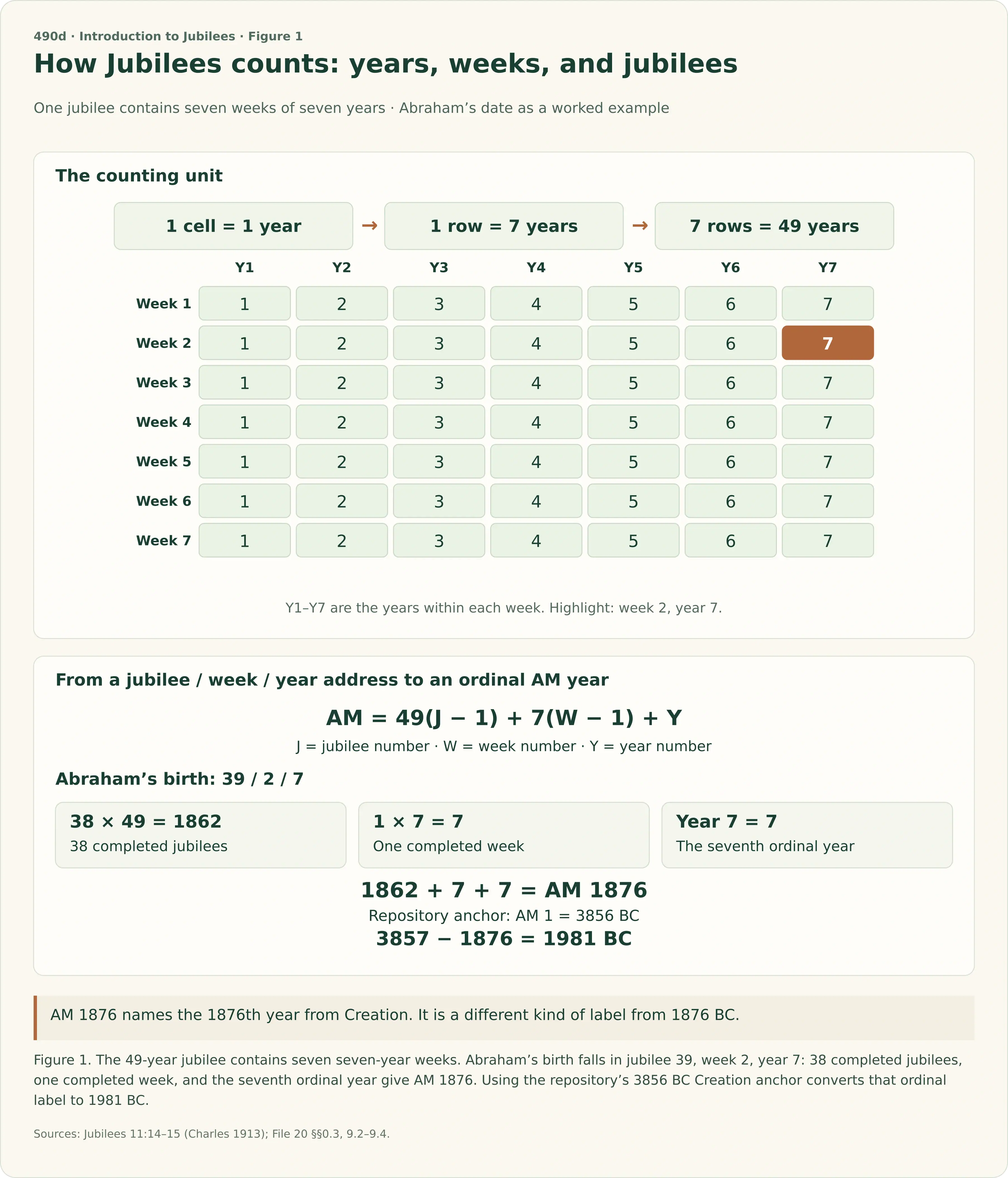
Abraham provides a clear example. In Charles’s 1913 translation, Jubilees 11:14–15 places Abram’s birth in the 39th jubilee, second week, seventh year. The calculation is:
38 × 49 + 1 × 7 + 7 = 1876.
This is AM 1876: the 1876th numbered year from Creation. AM, short for Anno Mundi, means “in the year of the world.” The label names a position in a calendar; it does not mean that 1876 whole years have already elapsed at the beginning of that year.
490d · Introduction to Jubilees · Figure 1
How Jubilees counts: years, weeks, and jubilees
One jubilee contains seven weeks of seven years · Abraham’s date as a worked example
The counting unit
Y1–Y7 are the years within each week. Highlight: week 2, year 7.
From a jubilee / week / year address to an ordinal AM year
J = jubilee number · W = week number · Y = year number
Abraham’s birth: 39 / 2 / 7
1862 + 7 + 7 = AM 1876
Repository anchor: AM 1 = 3856 BC
3857 − 1876 = 1981 BC
Figure 1. The 49-year jubilee contains seven seven-year weeks. Abraham’s birth falls in jubilee 39, week 2, year 7: 38 completed jubilees, one completed week, and the seventh ordinal year give AM 1876. Using the repository’s 3856 BC Creation anchor converts that ordinal label to 1981 BC.
Sources: Jubilees 11:14–15 (Charles 1913); File 20 §§0.3, 9.2–9.4.
Read the calculation and scope
J is the numbered jubilee, W the numbered week within it, and Y the numbered year within that week. W and Y each range from 1 through 7. Completed periods contribute 49(J−1) and 7(W−1); the ordinal year contributes Y. Jubilees 11:14–15 in the printed Charles 1913 translation places Abram’s birth in jubilee 39, week 2, year 7. The linked CCEL transcription groups this passage under 11:13. Therefore 38×49=1862, 1×7=7, and the seventh year adds 7, yielding AM 1876. This is an ordinal label, not 1876 completed years; 3856−1981 gives 1875 elapsed years. The repository conversion is BC=3856−(AM−1)=3857−AM, giving 1981 BC. The 3856 BC anchor is the repository’s chronological reconstruction; the tuple comes from Jubilees.
View or download the full-size illustration
The 490d framework assigns AM 1 to 3856 BC. At the beginning of AM 1876, 1875 years have elapsed from that starting point. Therefore:
3856 − (1876 − 1) = 1981 BC.
The general conversion for the BC dates used here is BC year = 3857 − AM year. It depends on the declared Creation anchor; Jubilees itself does not print BC dates. In particular, AM 1876 and 1876 BC are different dates. Abraham’s AM 1876 converts to 1981 BC in this framework.
3. The 2450-year framework
At its close, Jubilees 50:4 totals 49 jubilees, one week, and two years, with another 40 years before the crossing into Canaan. Its arithmetic is:
49 × 49 + 7 + 2 = 2410.
2410 + 40 = 2450 = 50 × 49.
The repository places that complete span between its Creation and Conquest anchors:
3856 BC → 1406 BC = 2450 years.
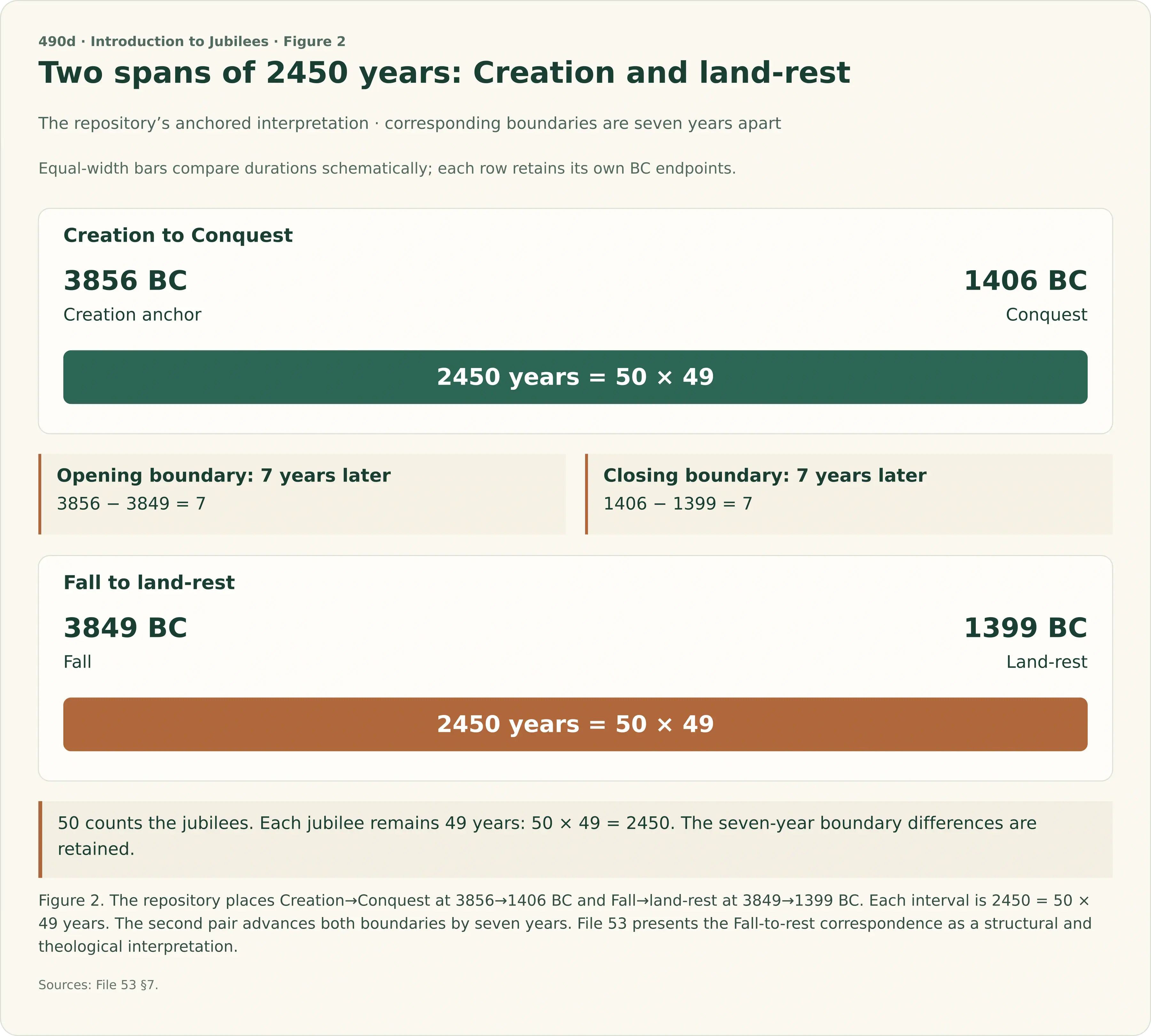
File 53 §7 develops a parallel theological comparison. Jubilees places the Fall in the eighth year, after the first seven-year threshold. The study then places the land-rest threshold seven years after the Conquest anchor. Both ends consequently move forward by seven years:
3849 BC → 1399 BC = 2450 years.
490d · Introduction to Jubilees · Figure 2
Two spans of 2450 years: Creation and land-rest
The repository’s anchored interpretation · corresponding boundaries are seven years apart
Equal-width bars compare durations schematically; each row retains its own BC endpoints.
Creation to Conquest
Fall to land-rest
Figure 2. The repository places Creation→Conquest at 3856→1406 BC and Fall→land-rest at 3849→1399 BC. Each interval is 2450 = 50 × 49 years. The second pair advances both boundaries by seven years. File 53 presents the Fall-to-rest correspondence as a structural and theological interpretation.
Sources: File 53 §7.
Read the calculation and scope
3856−1406=2450 and 3849−1399=2450. At the opening boundary, 3856−3849=7; at the closing boundary, 1406−1399=7. The equal-width bars compare durations schematically; they do not merge the separate BC endpoints. All four endpoints are BC labels, so ordinary subtraction suffices. File 53 §7 preserves a literal 49-year jubilee while describing a 50-jubilee macrostructure. Its Fall-to-land-rest pairing is a structural inference and theological reading anchored to the repository’s selected dates. It does not redefine a jubilee as 50 years or erase either seven-year difference.
View or download the full-size illustration
The first span joins Creation to entry into the land. The second joins the loss of Eden to the land’s rest. The second pairing is the repository’s structural and theological interpretation; it is not an additional BC timeline explicitly printed in Jubilees.
Numbered years and elapsed totals still need separate labels. Under the AM 1 = 3856 BC convention, the Exodus anchor at 1446 BC is AM 2411, after 2410 elapsed years. The Conquest anchor at 1406 BC is AM 2451, after 2450 elapsed years. Charles’s edition displays AM 2410 and AM 2450 beside the closing tally. The appendix explains those different presentations; this article does not treat them as interchangeable labels.
4. The chronology at a glance
Every BC date below uses the same stated anchor. Text-derived means calculated from a date expression in Jubilees. Reconstructed means obtained from the age sequence adopted in File 53. Framework identifies an anchor or extension used to place the complete scheme.
| Event | AM year in this framework | BC date | Basis |
|---|---|---|---|
| Creation | 1 | 3856 | Framework epoch |
| Fall, in the eighth year | 8 | 3849 | Text-derived |
| Jared’s birth | 461 | 3396 | Text-derived |
| Flood begins | 1308 | 2549 | Text-derived, with an emended numeral* |
| Abraham’s birth | 1876 | 1981 | Text-derived |
| Isaac’s birth | 1976 | 1881 | Reconstructed |
| Jacob’s birth | 2036 | 1821 | Reconstructed |
| Jacob enters Egypt | 2166 | 1691 | Reconstructed |
| Exodus | 2411 | 1446 | Framework anchor |
| Conquest / crossing into the land | 2451 | 1406 | Framework anchor |
| Land-rest threshold | 2458 | 1399 | Framework extension |
The Flood row follows Charles’s correction of the jubilee numeral to the twenty-seventh; the appendix identifies this reading.
The labels are part of the table’s meaning. In particular, the reconstructed patriarchal rows are not substitutions for the transmitted chronology. The source-labeled reference table gives the passages and canonical controls beside the dates.
5. When the text and an age-based reconstruction differ
File 53 §13A begins its patriarchal reconstruction with Abraham’s 1981 BC anchor and applies the Genesis-compatible sequence 100 + 60 + 130: Abraham to Isaac’s birth, Isaac to Jacob’s birth, and Jacob to entry into Egypt.
1981 → 1881 → 1821 → 1691 BC.
That chain is internally consistent under its stated assumptions. It is a controlled reconstruction, and the transmitted year-week dates must be retained for comparison.
Jacob’s birth shows the distinction clearly. Jubilees 19:13, Charles 1913, places it in the 42nd jubilee, sixth week, second year:
41 × 49 + 5 × 7 + 2 = AM 2046.
| Basis for Jacob’s birth | AM year | BC conversion |
|---|---|---|
| Transmitted jubilee/week date | 2046 | 1811 BC |
| File 53’s age-based reconstruction | 2036 | 1821 BC |
The difference is 10 years. It remains visible rather than being removed by relabeling one date as the other. Explaining the divergence—whether through compositional priorities, textual problems, or some combination—requires an argument beyond subtraction. The numerical disagreement itself can be stated precisely without prejudging every step of that explanation.
The ordinary MT dates remain a separate comparison baseline. For example, the selected Jubilees anchor for Abraham is 1981 BC, while the repository’s ordinary MT full-430-year setting gives 2166 BC. Using a Genesis-compatible sequence inside the Jubilees reconstruction does not make the two chronologies identical.
6. What this arrangement contributes
Jubilees’ chronology places the history of the patriarchs within the same sevenfold order that governs Sabbath and sacred time. Its landward movement gives the large framework a theological direction: creation, estrangement, covenant, and inheritance belong to one ordered history.
The calendar operates on another scale. Jubilees 6:30–32 describes 52 weeks and a 364-day year. A year-week contains seven years; a calendar week contains seven days. Their shared sevenfold form connects calendar and chronology without making their durations interchangeable.
This also clarifies the relationship to Enoch’s seven-week framework. The Enoch study explores schematic generations of 70 or 72 years. Jubilees’ ordinary year-weeks contain seven years. The two studies investigate related ways of organizing sacred history, while retaining their different units and textual foundations.
Within the 490d research, Jubilees serves as a comparative witness alongside the Masoretic Text, Samaritan Pentateuch, and Septuagint. Its usefulness depends on preserving what belongs to each: the transmitted dating expressions, the chosen BC anchors, the reconstructed age sequence, and the interpretation drawn from their relationships.
Tables and further reading
- Supporting chronology, worked conversions, and edition notes.
- The 364-Day Calendar: Weeks, Seasons, and Sacred Time.
- File 20: Jubilees as a fourth chronological witness.
- File 53: the 2450-year frame and reconstruction method.
For the full source discussion, dated-event comparisons, and broader numerical patterns, see The Book of Jubilees in Detail: Dates, Texts, and Chronological Patterns.
Scripture quotation: Berean Standard Bible (BSB), public domain; see the official translation terms. Jubilees references follow R. H. Charles’s 1913 edition; the supporting notes distinguish its printed verse numbering from the linked web transcription.