Genesis preserves two kinds of time within the same genealogy: a father’s age when his son was born, and the length of his whole life. Adam supplies the first example:
When Adam was 130 years old, he had a son in his own likeness, after his own image; and he named him Seth.
So Adam lived a total of 930 years, and then he died.
Ordinary chronology follows the successive births. Cumulative chronology places the complete lifespans along the ancestral line end to end. Thus Adam contributes 130 years to the first calculation and 930 years to the second. The cumulative arrangement is a formal reading of the lifespan figures: in ordinary history, fathers and sons were alive together.
Once both chronologies are anchored, their relationship can also be measured. One especially clear comparison gives 9,890 years—23 × 430. A second comparison gives 989 years, exactly one-tenth as much. Together they connect Creation, Abraham, and the Exodus through a repeated numerical proportion.
Supporting tables: The dates and their meanings · How cumulative Abraham reaches 2435 BC · The calculations · 9,890, 9,900, and 10,000.
Measuring the distance between the two Creations
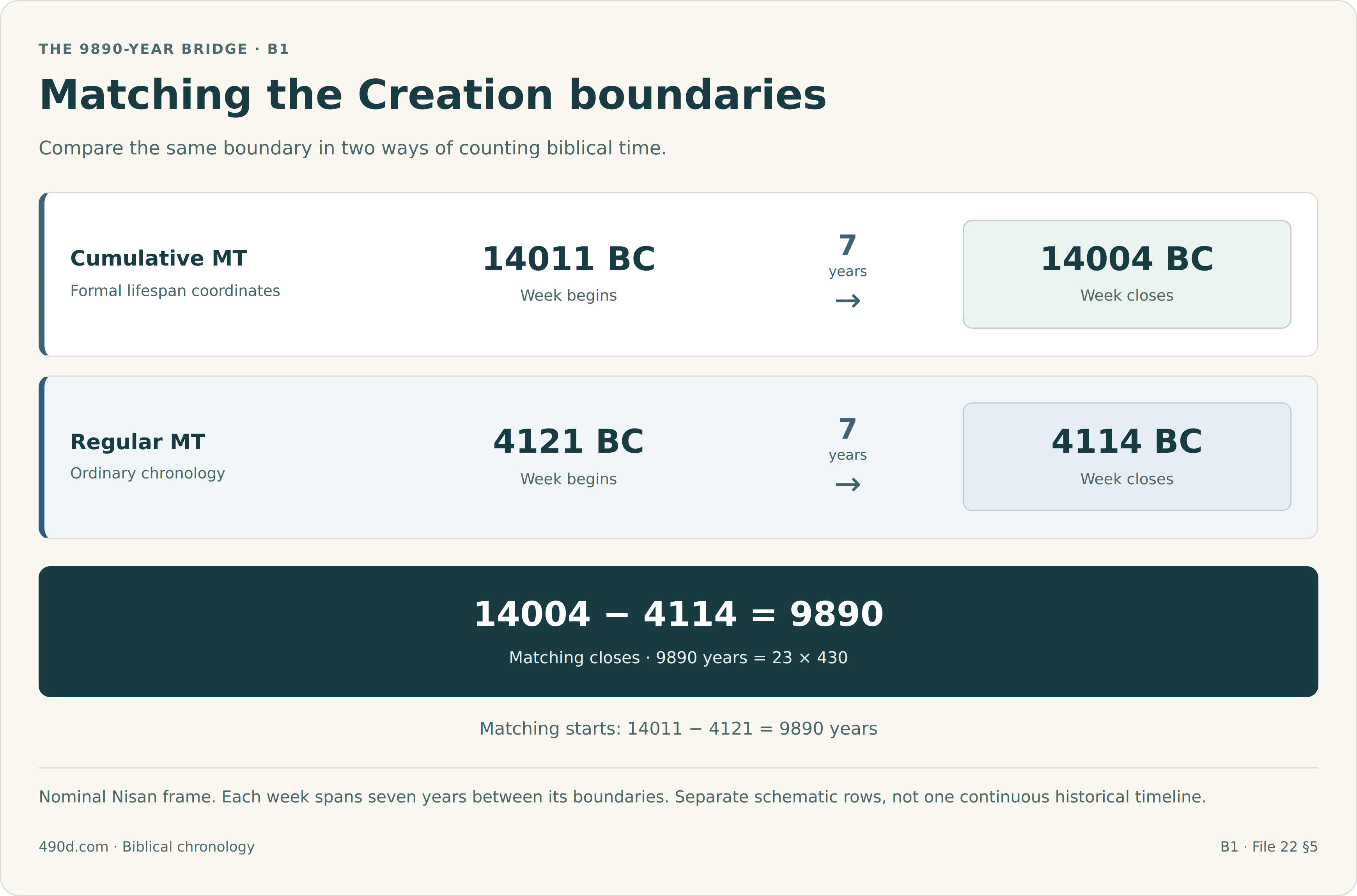
The normal Masoretic Text (MT) chronology used here places the close of the symbolic Creation week at 4114 BC, with the week extending from 4121 to 4114 BC. The corresponding cumulative week runs from 14011 to 14004 BC. These are the unrounded figures in the Nisan framework.
Compare the closing boundary of each week:
14004 − 4114 = 9890 years.
The same difference appears at their beginnings:
14011 − 4121 = 9890 years.
Matching the Creation boundaries
Compare the same boundary in two ways of counting biblical time.
Matching starts: 14011 − 4121 = 9890 years
Nominal Nisan frame. Each week spans seven years between its boundaries. Separate schematic rows, not one continuous historical timeline.
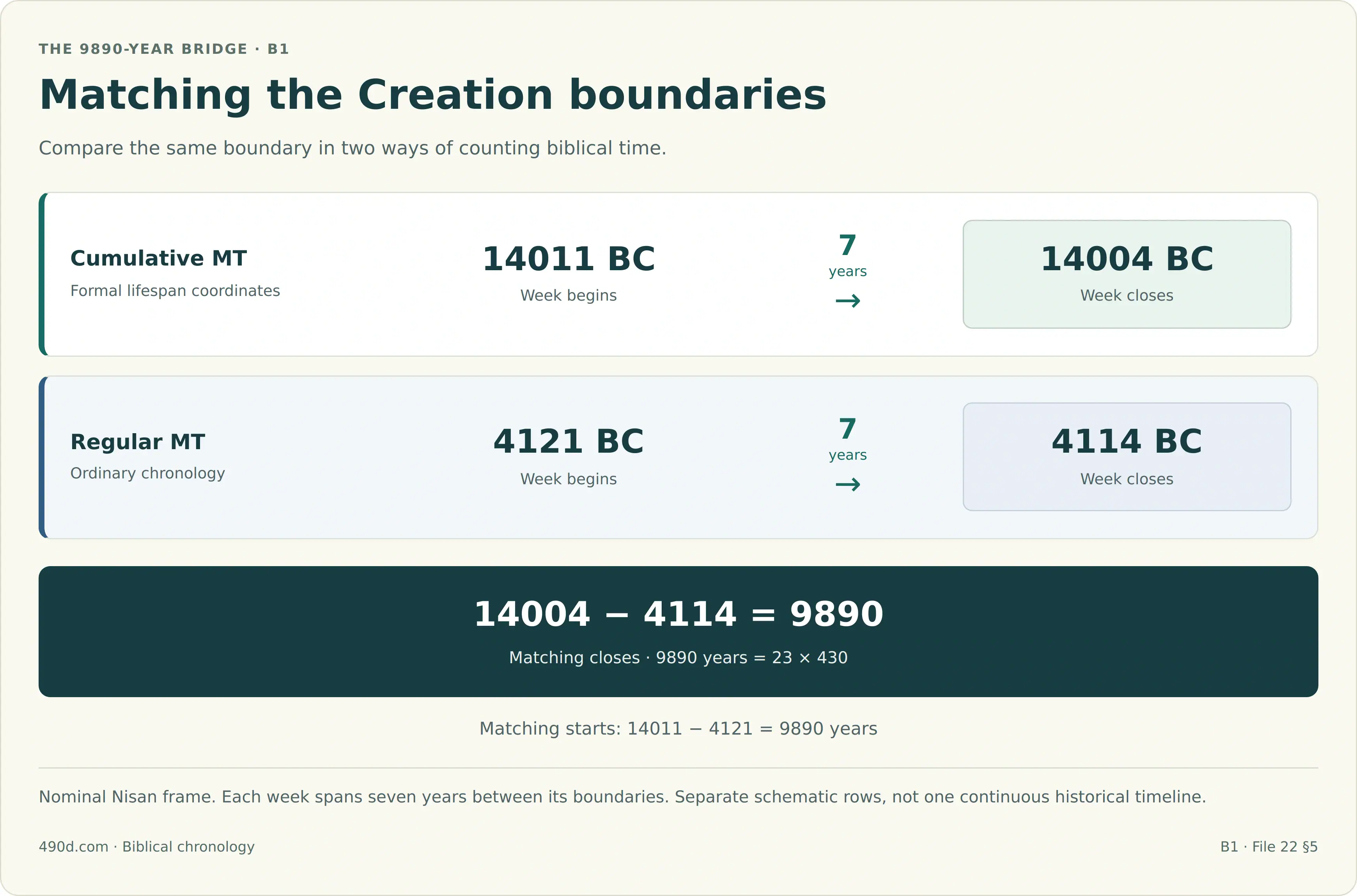
Matching positions throughout the two weeks preserves the same 9,890-year difference. The appendix distinguishes the boundaries from Adam’s internal Year-6 position and explains how they relate to the cumulative lifespan total.
This is a comparison between two constructions from the biblical numbers. It does not place two historical creations 9,890 years apart. For the method behind the longer construction, see Cumulative Biblical Chronology: Adding the Lifespans.
Why the 430-year measure matters
The bridge factors into a number already central to the Exodus:
9890 = 23 × 430.
Now the duration of the Israelites’ stay in Egypt was 430 years.
The next verse emphasizes the completion of that span, “to the very day” (Exodus 12:41, BSB). In the normal MT framework, Jacob’s entry into Egypt is 1876 BC and the Exodus is 1446 BC: another direct subtraction of 430 years.
The number therefore has a narrative meaning before it becomes a unit in the larger comparison. The distance between the two Creation boundaries contains 23 sojourn-length measures. These are repeated numerical units; the calculation does not propose twenty-three historical Egyptian sojourns.
This brings the bridge into the same family of relationships explored in The Key of 23. It also keeps the present argument within the normal MT chronology: 430 years in Egypt, with neither the additional Terah 60 years nor a restored second Cainan required.
The same proportion at one-tenth the scale
The cumulative ancestral line places Abraham at 2435 BC. His ordinary MT birth date remains 2166 BC; the two dates belong to different ways of arranging the biblical figures.
From cumulative Abraham to the ordinary Exodus date:
2435 − 1446 = 989 years.
The relationship to the Creation bridge is exact:
9890 ÷ 10 = 989.
One pattern at two scales
Two precisely named comparisons have durations in a ten-to-one ratio.
The Creation comparison
Creation close
Creation close
Cumulative Abraham to the regular Exodus
Abraham birth
Exodus
2435 BC is Abraham’s formal cumulative coordinate; his normal regular birth remains 2166 BC. These separate measurements do not share a uniform historical axis.
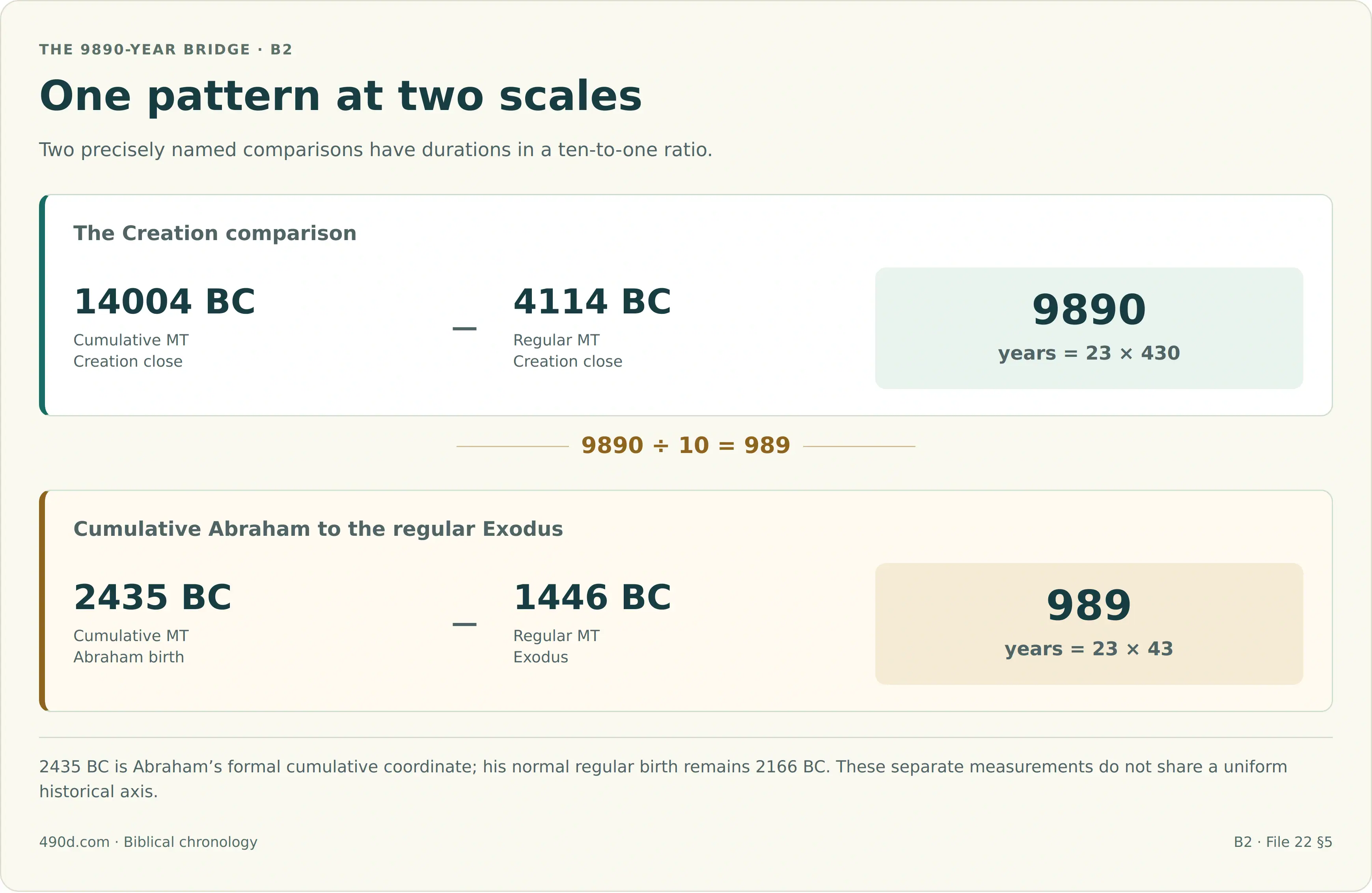
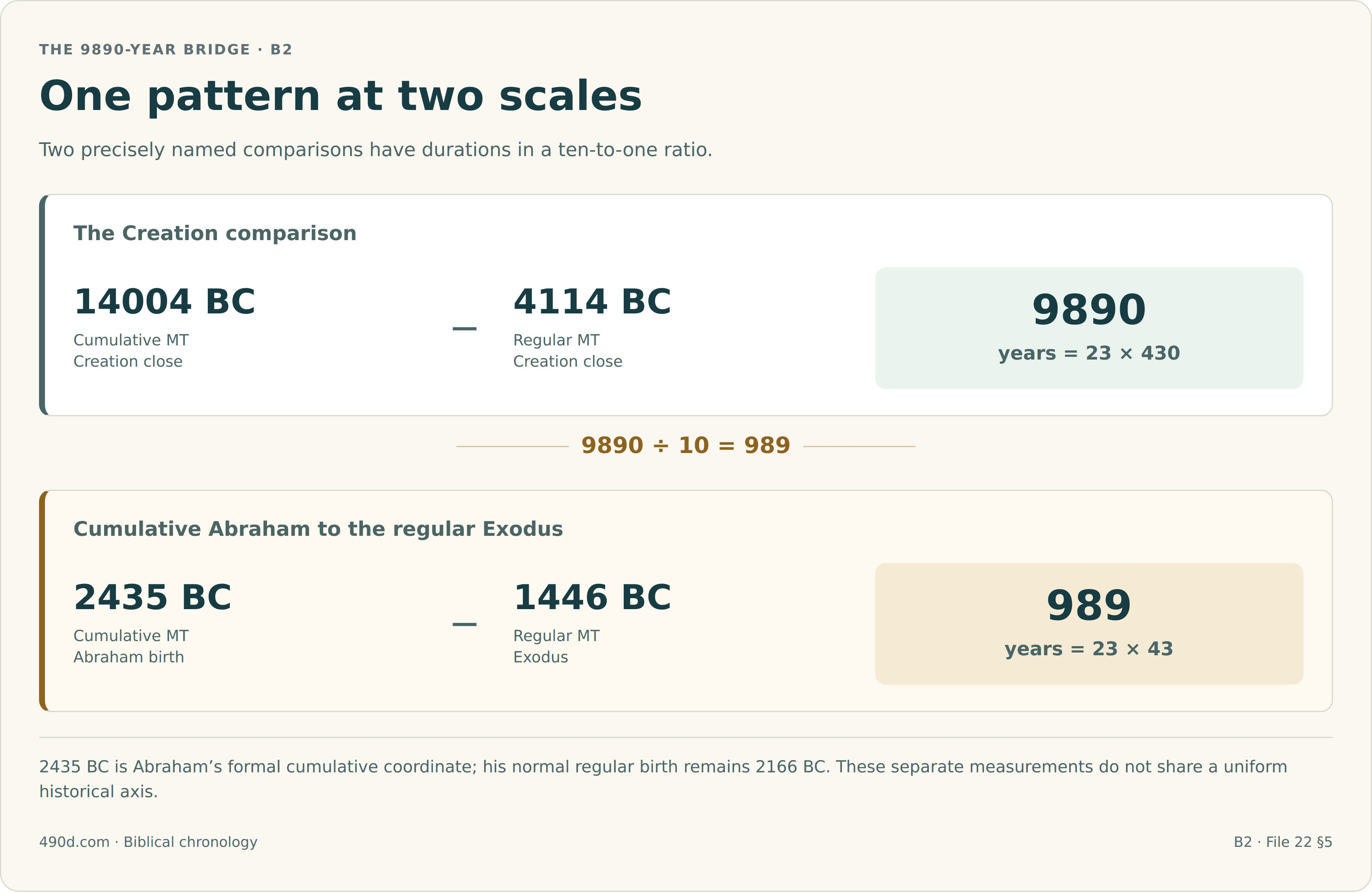
Both spans retain the factor 23. The larger is 23 × 430; the smaller is 23 × 43. Dividing the larger measure by ten reduces 430 to 43 while preserving the relationship.
The two rows compare different endpoints. One measures cumulative Creation against regular Creation; the other measures cumulative Abraham against the regular Exodus. Their interest lies in the exact ten-to-one correspondence between these named spans. The supporting table derives 2435 BC directly from the lifespans from Abraham through Moses, so the smaller span can be checked without taking its starting date on trust.
From the smaller bridge to a sojourn symmetry
The 25/23 relationship discussed in the Key of 23 gives the smaller bridge a further shape. Replacing its 23 equal parts with 25 equal parts produces:
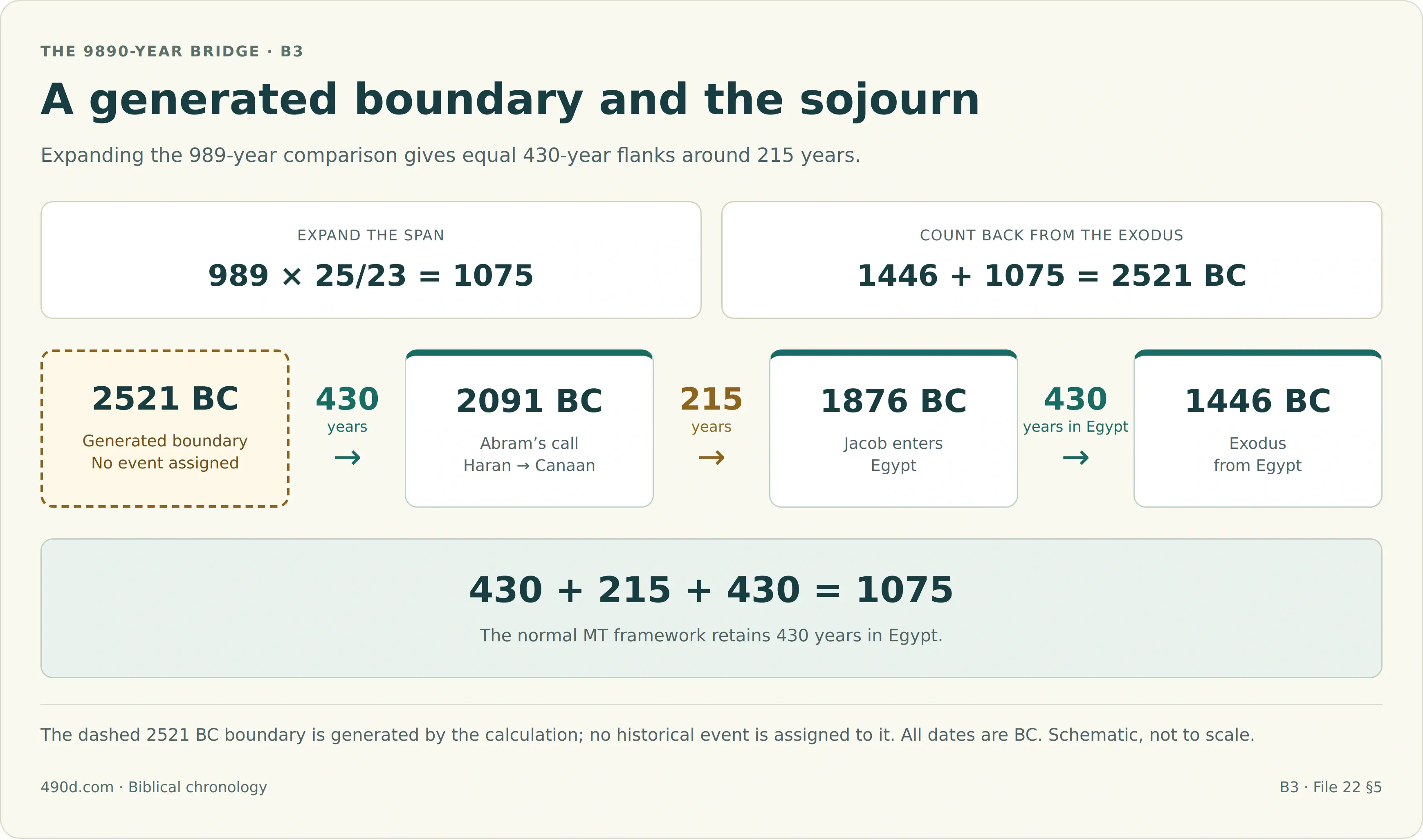
989 × 25/23 = 1075 years.
Keep the Exodus fixed at 1446 BC and measure 1075 years backward. The result is 2521 BC. This is a generated comparison boundary; it is not an independently dated event.
Between that boundary and the Exodus, the familiar dates of Abram’s call and Jacob’s entry into Egypt divide the span:
2521 → 2091 → 1876 → 1446 BC
430 + 215 + 430 = 1075 years.
A generated boundary and the sojourn
Expanding the 989-year comparison gives equal 430-year flanks around 215 years.
No event assigned
Haran → Canaan
Egypt
from Egypt
The dashed 2521 BC boundary is generated by the calculation; no historical event is assigned to it. All dates are BC. Schematic, not to scale.
Image version and full-size download
Download full-size PNG · Download WebP · Download stacked phone PNG
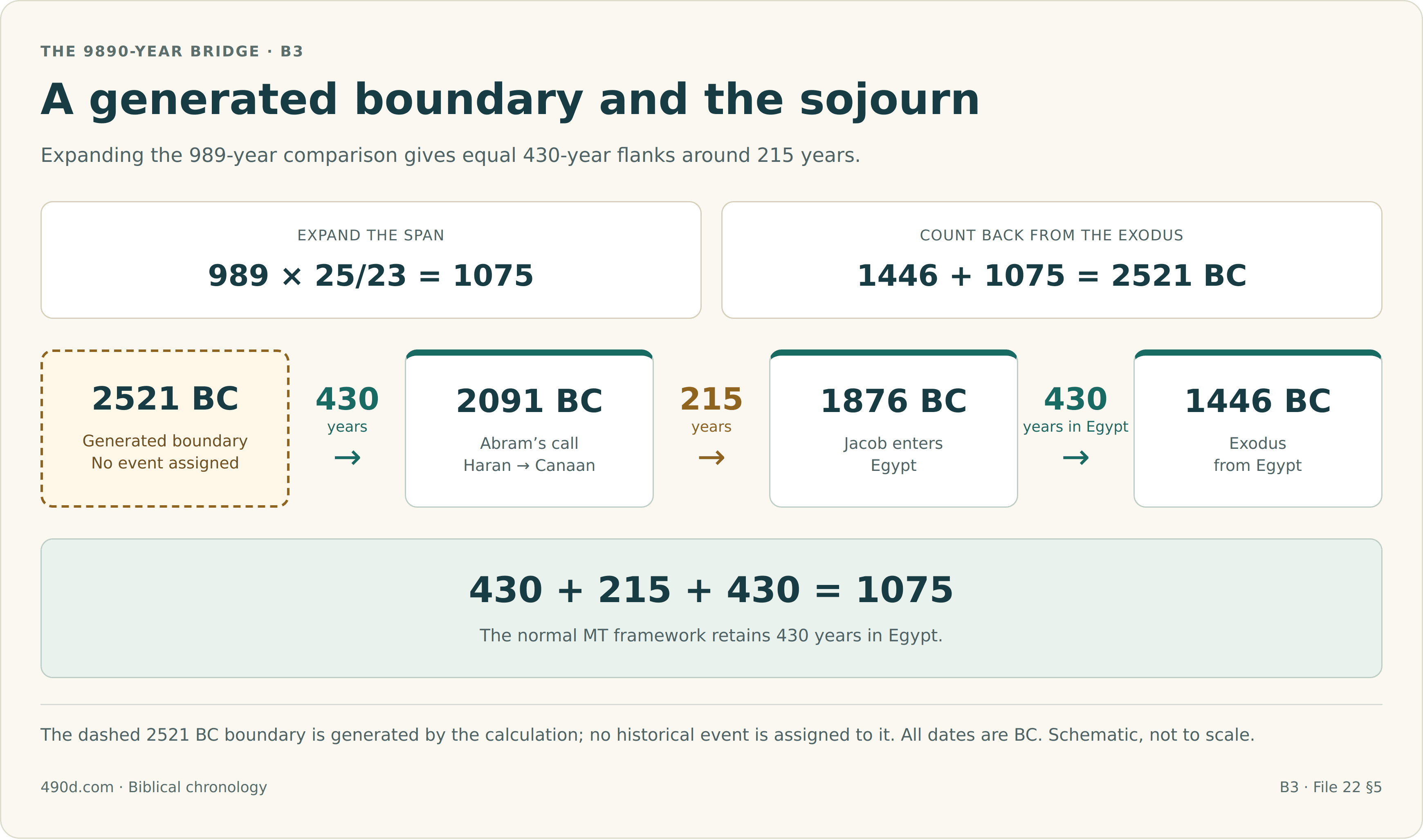
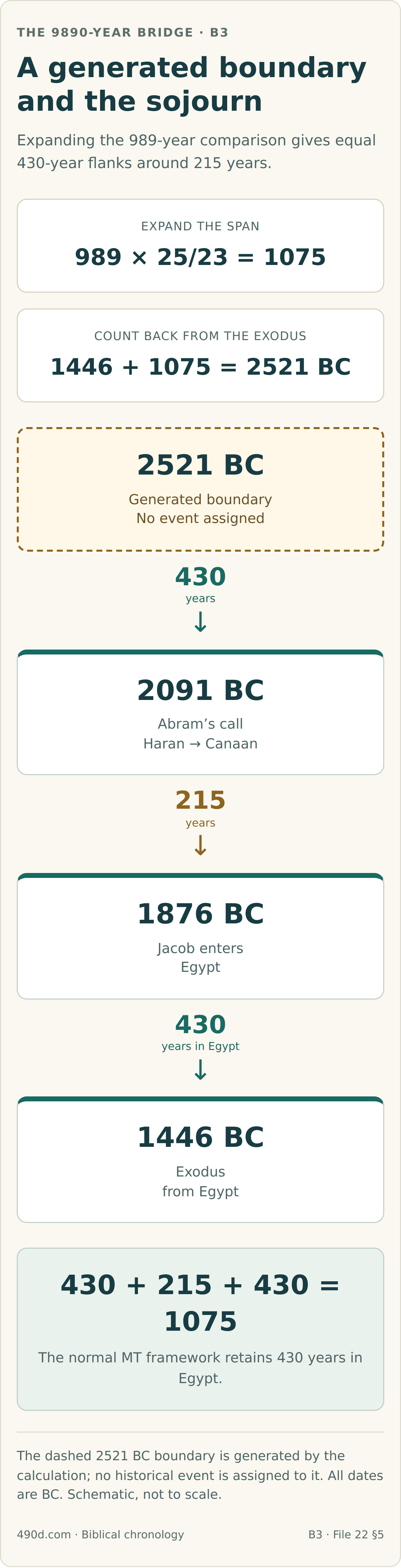
The middle 215 years run from Abram’s departure from Haran for Canaan to Jacob’s entry into Egypt. On its later side stand the 430 years in Egypt. On its earlier side is an equal 430-year interval, measured back from Abram’s call to the generated boundary.
This arrangement places two equal spans around the patriarchal interval. It leaves the ordinary event dates intact. The expansion changes the span being examined, while the Exodus remains the fixed endpoint. The sojourn article explains the event chronology in fuller detail.
How this relates to the rounded 9,900-year bridge
The 9,900-year article studies the Rounded Chronology, with its connected 1650-year spans. Here we have used the unrounded comparison specified in the canonical files: 9890 = 23 × 430.
These are related presentations with distinct calculations. The rounded Creation comparison is 14006 − 4106 = 9900; the unrounded closing-boundary comparison is 14004 − 4114 = 9890. The Rounded Chronology has its own construction, rather than being a casual rounding of the final answer.
The detailed study also explores 10,000-year constructions. Their particular transformations and endpoint choices require separate treatment; the appendix gives the essential distinction.
The strength of the present bridge is its simplicity. 9,890 years join corresponding Creation boundaries; 989 years join cumulative Abraham to the Exodus. Their ten-to-one relation carries the factor 23 at both scales, while the 25/23 expansion of the smaller span reveals a 430–215–430 symmetry around the patriarchal era. The numbers return us to a recurring biblical theme: a family called into the land, a people brought into Egypt, and a deliverance at the appointed end of their sojourn.
Technical appendix and supporting tables · Canonical source: File 22 §§5.1–5.4 and 7.1 · Detailed study.
Scripture quotations: Berean Standard Bible (BSB), public domain.