Detailed study · 7 October 2026 · v1. Full tables and an unchanged original archive accompany this replacement.
Daniel reads the promise of Jerusalem’s restoration while living among the exiles. His attention is drawn to a measured period:
in the first year of his reign, I, Daniel, understood from the sacred books, according to the word of the LORD to Jeremiah the prophet, that the desolation of Jerusalem would last seventy years.
The chapter moves from Jeremiah’s seventy years to the seventy weeks announced in response to Daniel’s prayer (Daniel 9:24–27, ESV). Taking the weeks as weeks of years gives 70 × 7 = 490 years. The larger chronological comparison developed here follows that arrangement at ten times the scale: 10 × 490 = 4900 years.
The central relationship joins Shem, the Flood, the Exodus, and the return from Babylon. It brings together a 600-year life, a 4300-year span, and a 4900-year whole. A second arrangement places the seventy-year exile at the end of that whole. The same figures then provide a bridge toward the birth of Christ and the judgment of Jerusalem.
These are comparisons within the cumulative chronology, which places the patriarchs’ complete lifespans consecutively. Its early dates are schematic coordinates generated by that rule. They differ from the ordinary chronology, which follows the ages at the birth of the next generation. For the method and full source tables, see Cumulative Biblical Chronology: Adding the Lifespans and the ordinary and cumulative comparison.
Supporting tables: The two journeys · The 4900-year partitions · Shem and Christ · The expansion · The seven-year fields.
1. Shem, the Flood, and two journeys of deliverance
Genesis assigns Shem one hundred years before Arphaxad’s birth and five hundred afterward:
This is the account of Shem. Two years after the flood, when Shem was 100 years old, he became the father of Arphaxad. And after he had become the father of Arphaxad, Shem lived 500 years and had other sons and daughters.
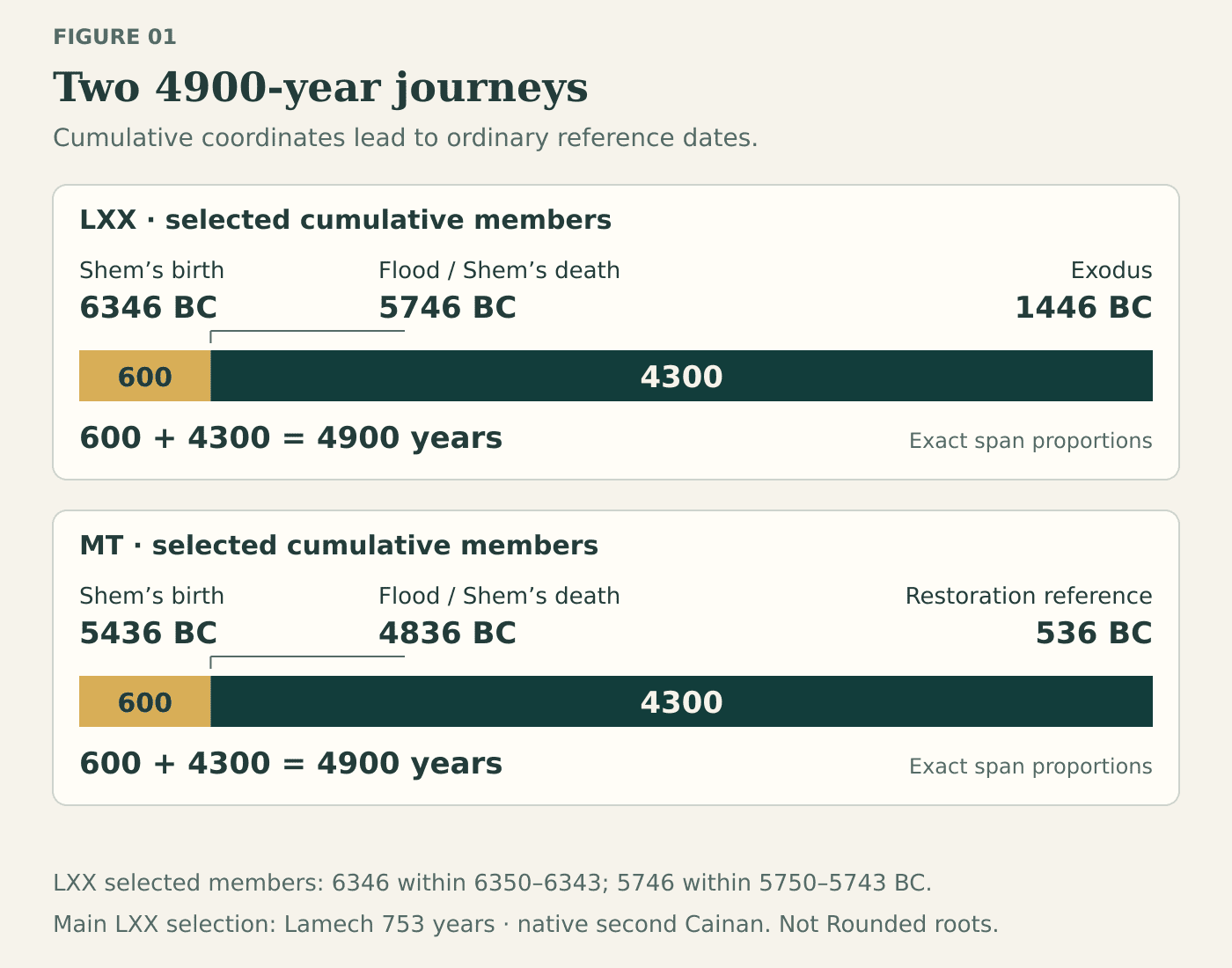
The two parts give 100 + 500 = 600 years. In the selected MT cumulative display, Shem’s contribution runs from 5436 to 4836 BC. The endpoint at 4836 BC opens the cumulative Flood/Arphaxad field; the full source field extends to 4829 BC. These are coordinates in the lifespan-added construction, rather than Shem’s ordinary birth and death dates.
From the selected 4836 BC endpoint to the restoration reference of 536 BC, the span is 4300 years. Adding Shem’s preceding six hundred years gives the larger total:
600 + 4300 = 4900
The two large measures resemble the ordinary Egyptian sojourn and Daniel’s seventy weeks at ten times their scale:
| Biblical or interpretive measure | Tenfold comparison |
|---|---|
| The 430-year Egyptian sojourn, MT (Exodus 12:40–41, BSB) | 4300 years |
| Seventy weeks of years: 70 × 7 = 490 | 4900 years |
| Difference: 490 − 430 = 60 | Difference: 4900 − 4300 = 600 |
File 30 preserves a companion LXX comparison ending at the Exodus in 1446 BC. It selects cumulative Shem and Flood coordinates at 6346 and 5746 BC. The two journeys have the same arrangement:
Full table and calculation · Scripture: Genesis 11:10–11 (BSB) · Exodus 12:40–41 (BSB) · Ezra 1:1–3 (BSB)
The LXX selections require care. 6346 lies within the main cumulative Shem field of 6350–6343 BC; 5746 lies within the corresponding Flood field of 5750–5743 BC. They preserve the required six-hundred-year interval. This uses the main LXX reconstruction with Lamech’s 753-year lifespan and native second Cainan. The 5746 label also appears in Rounded studies, but its role here is a selected member of the actual cumulative field. The complete settings table shows the distinction.
The two displayed journeys differ by 910 years, matching 1446 − 536. That is a comparison of these selected endpoints; it does not translate every MT cumulative row into its LXX counterpart. The Exodus supplies the first deliverance reference, while the restoration supplies a second departure from exile. Their theological correspondence accompanies the arithmetic.
2. The seventy years complete the larger span
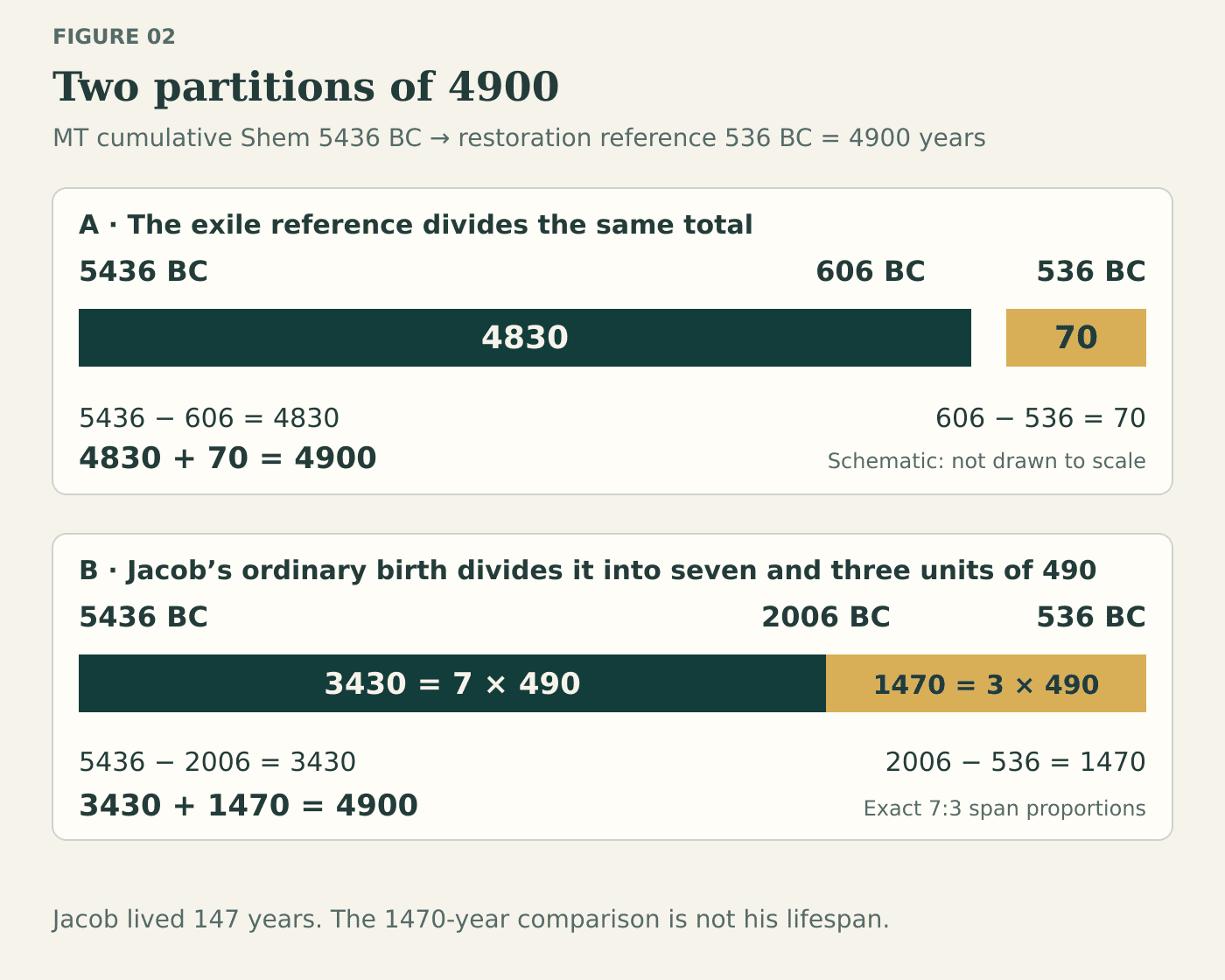
The MT display can be divided another way. From cumulative Shem at 5436 BC to the exile reference at 606 BC are 4830 years. From 606 to 536 BC are 70 more:
5436 → 606 → 536 BC = 4830 + 70 = 4900
This arrangement is especially appropriate to Daniel 9. Daniel begins by reading about the seventy years; the larger comparison places that same measure at its conclusion. Expressed in seventy-year units, 4830 = 69 × 70, and 4900 = 70 × 70. The last seventy completes the seventieth unit.
The 606/605–536 BC exile-and-restoration field is the repository’s chronological comparison frame. It should not imply that every deportation occurred in 606 BC or that every stage of rebuilding finished in 536 BC. Jeremiah 25:11–12, Jeremiah 29:10, and Ezra 1:1–4 supply the scriptural setting: Babylonian domination, an appointed return, and the rebuilding of the house of God.
Full table and calculation · Scripture: Jeremiah 25:11–12 (BSB) · Genesis 47:28 (BSB)
3. Jacob divides the whole into seven and three
Another partition connects cumulative Shem with Jacob’s ordinary birth in 2006 BC:
5436 → 2006 → 536 BC = 3430 + 1470 = 4900
The larger span is 7 × 490; the remaining span is 3 × 490. Together they give ten such measures. Files 63 and 22 emphasize Jacob’s role within this comparison.
Jacob lived 147 years (Genesis 47:28, BSB). The 1470 years from his birth to the restoration reference are ten times that lifespan. Jacob’s actual life remains 2006–1859 BC. The larger span connects the patriarch who entered Egypt with the later return from Babylon; it does not extend his biography to 536 BC.
| Position in the comparison | Date or span | Chronological role |
|---|---|---|
| Shem’s selected birth coordinate | 5436 BC | Cumulative MT |
| Jacob’s birth | 2006 BC | Ordinary MT |
| Restoration reference | 536 BC | Historical reference in the model |
| Shem to Jacob | 3430 = 7 × 490 | A comparison between the two chronologies |
| Jacob to restoration | 1470 = 3 × 490 = 10 × 147 | A span beginning at Jacob’s ordinary birth |
This joining of ordinary and cumulative coordinates gives the partition its character. Jacob stands at the meeting point of two ways of counting the same biblical family history.
4. Shem’s six hundred years recur from exile to Christ
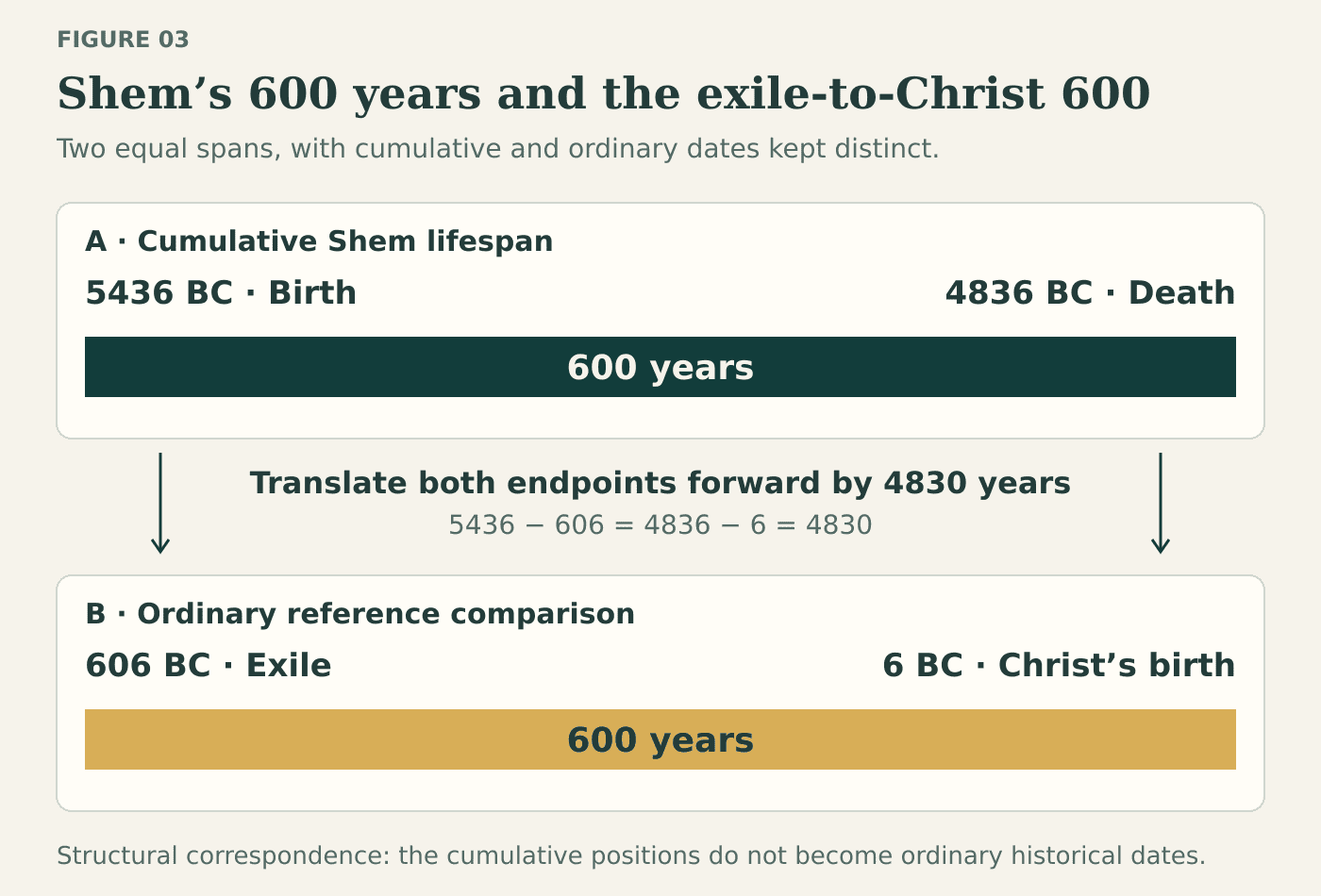
The first six hundred years of the MT display belong to Shem. A corresponding six hundred years connect the exile reference with the preferred birth-era reference for Jesus:
5436 → 4836 BC = 600
606 → 6 BC = 600
Moving both Shem endpoints forward by 4830 years sends the earlier one to the exile reference and the later one to 6 BC. The interval between them stays six hundred years.
Full table and calculation · Scripture: Genesis 11:10–11 (BSB) · Luke 2:1–7 (BSB)
The 6 BC date is the repository’s preferred chronological anchor for Christ’s birth. Luke 2:1–7 supplies the birth narrative, without printing that BC date. The comparison therefore combines a biblical lifespan, cumulative coordinates, and a declared birth-era anchor.
The family line from Shem continues toward Abraham and ultimately to Christ (Luke 3:23–38, BSB). In the numerical comparison, Shem’s six-hundred-year life supplies a measure for the movement from exile toward the Messiah. The Noahic preservation of the family, Israel’s return, and Christ’s coming become related stages in the study’s theological reading.
5. From 4830 to 4900: the Key of 23
The same pair of spans also has an exact proportional relationship:
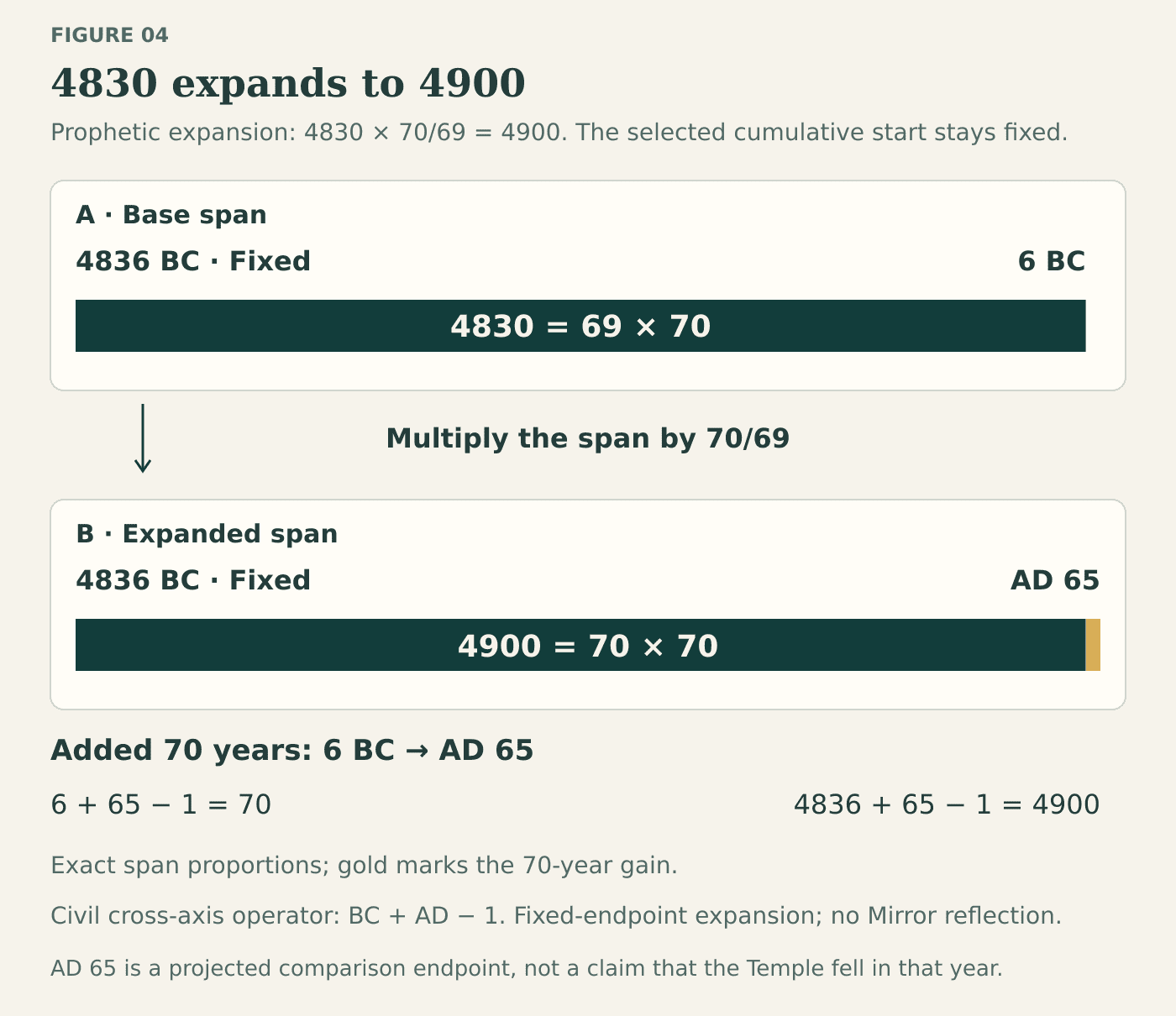
4830 × 70/69 = 4900
Because 69 = 3 × 23, this belongs to the Key-of-23 family. There are seventy units of sixty-nine in the base span. Expanding each unit from sixty-nine to seventy adds 70 years altogether.
The earlier endpoint must stay visible. Hold the cumulative 4836 BC coordinate fixed. The original 4830-year span reaches 6 BC; the expanded 4900-year span reaches AD 65. Crossing the era boundary requires the civil calculation BC + AD − 1, because ordinary BC/AD numbering has no year zero:
4836 + 65 − 1 = 4900
The increase is also exact: 6 BC → AD 65 = 6 + 65 − 1 = 70 years.
Full table and calculation · Scripture: Daniel 9:24 (BSB)
This operation expands a declared span while holding its start fixed. It does not reflect a date across a Mirror axis. It also does not change the ordinary dates of Shem or Christ. AD 65 is the generated endpoint of this comparison and part of File 30’s wider judgment field; it is not a date assigned here to the crucifixion or to the destruction of the Temple.
The ratio establishes the arithmetic relationship. Its prophetic meaning comes from the people, events, and repeated measures brought together by the model. For the general method, see The Key of 23.
The generated-Creation table also preserves the earlier chart’s 7 + 62 + 1 arrangement: 490 + 4340 + 70 = 4900. Its intermediate 4346 BC coordinate is generated by a separately declared expansion of ordinary Creation. It is a useful schematic comparison, while the two journeys and the exile partition provide the main cumulative framework.
6. The seven-year field carries the pattern forward
The cumulative chronology gives each person or event a field of possible placements determined by its stated calendar and chronological settings. File 30 carries a seven-year Flood/Shem endpoint field forward by 4830 years to an Incarnation field.
To read the more precise comparison, keep the calendar suffixes: t means Tishri or autumn reckoning; n means Nisan or spring reckoning.
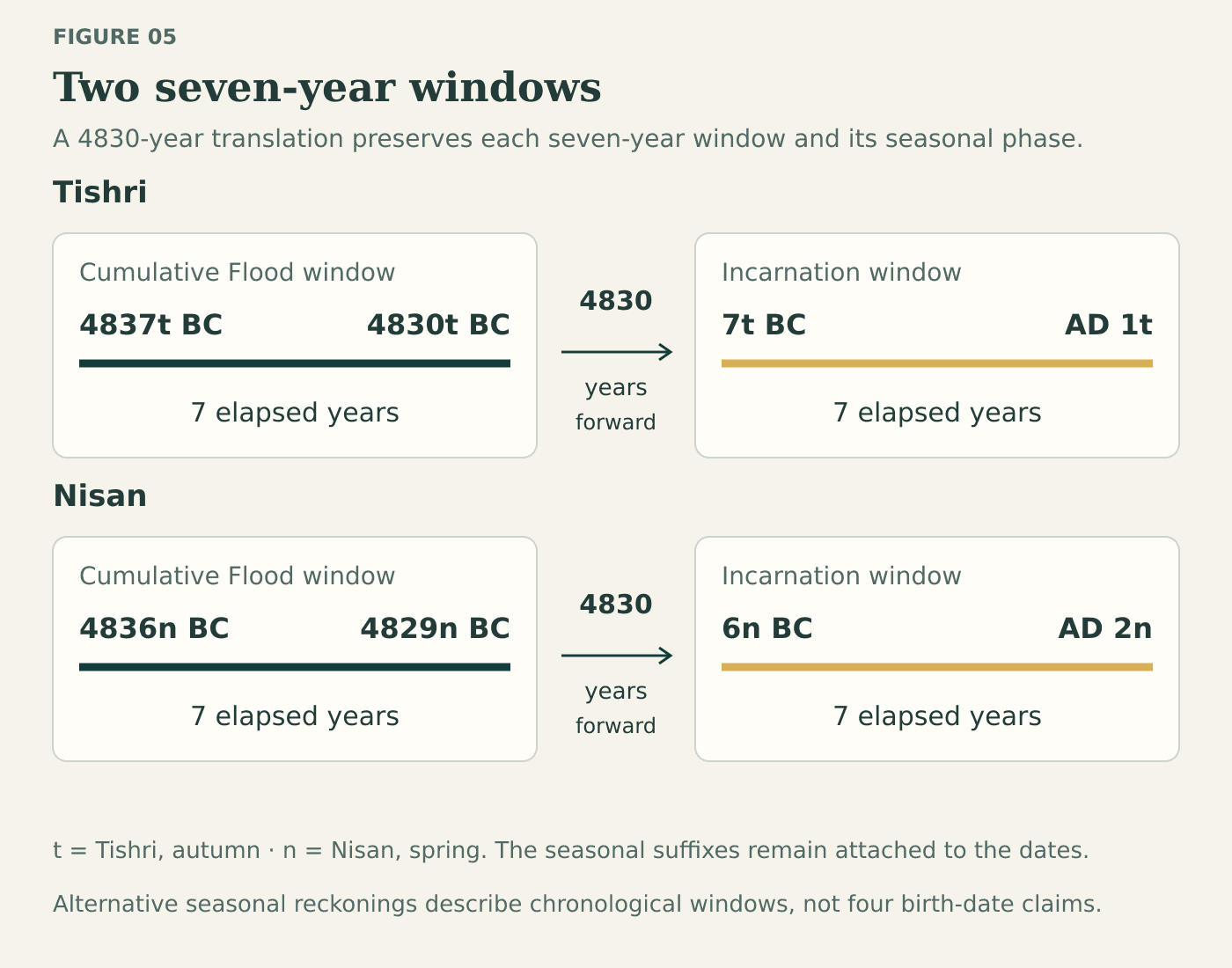
Full table and calculation · Scripture: Genesis 8:13–14 (BSB) · Luke 2:1–7 (BSB)
Each row covers seven elapsed years. In the Nisan row, 6 BC → AD 2 = 6 + 2 − 1 = 7. The paired Tishri row gives 7 BC → AD 1 = 7 + 1 − 1 = 7. These are corresponding chronological fields, rather than four separately asserted dates for Jesus’ birth.
The full 4837t–4829n BC outer range is seven and a half years wide. The seven-year width belongs to each matching-season row. This distinction prevents an autumn endpoint and a spring endpoint from being treated as though they were the same position in the year.
Adding 4900 years instead gives the corresponding judgment field:
AD 64t/65n → AD 71t/72n
Within that field, AD 70 is the destruction-of-the-Temple climax. It is not the final endpoint of the whole seven-year arrangement. Likewise, AD 65 is the exact civil target from the selected 4836 BC source coordinate; the outbreak of revolt in AD 66 belongs to the neighboring historical event discussion. The full phase table keeps those roles distinct.
File 30 also places the ministry and Passion within the concluding seventy-year block. The midpoint belongs to that last seventy, rather than to the entire 4900-year span. Its ministry/Passion comparison uses seasonal coordinates under File 13; the supporting table records that narrower construction separately.
7. The larger pattern
The strongest relationships form a connected argument. Shem contributes 600 years to the cumulative chain. Those years, followed by 4300, make 4900. The same whole can be arranged as 4830 + 70, or as 3430 + 1470 through Jacob. Moving Shem’s two endpoints forward by 4830 preserves his six-hundred-year measure from exile toward Christ. Expanding that span by 70/69 produces the larger 4900 again.
Daniel’s weeks, the Egyptian sojourn, and the restoration of Jerusalem supply the scriptural themes through which I read these correspondences. The cumulative chronology draws those themes together at a larger scale; the ordinary narrative gives them their meaning. Judgment is followed by preservation and return, and the family history moves toward Christ.
The numerical comparisons support that interpretation through defined spans and endpoints. They do not require Daniel 9 to state a literal 4900-year prediction. The text’s seventy weeks and the study’s tenfold comparison retain their distinct roles.
Tables, sources, and original study
The full tables and source notes provide every displayed calculation, the LXX selections, the phase pairs, and the person-and-event figure index. The main canonical controls are File 30 §§1–6, File 63 §8.7, File 22 §3.2, File 18 §6, and File 13 §§2.3, 3, 6.1–6.2. Direct source links accompany the tables.
The original article and charts are preserved unchanged in the archive. They retain the earlier presentation and proposals; this replacement supplies the selected, source-checked explanation at the original address.
The Holy Bible, Berean Standard Bible, BSB is produced in cooperation with Bible Hub, Discovery Bible, OpenBible.com, and the Berean Bible Translation Committee. This text of God’s Word has been dedicated to the public domain.