Hezekiah’s recovery is a promise about both a person and a city. The king is told that he will live; Jerusalem is told that it will be defended. A shadow moving backward gives the promise a visible form. The question explored here is how the narrative’s numbers relate to the larger chronology of Judah, the Exodus and the ancient king lists.
I will add fifteen years to your life. And I will deliver you and this city from the hand of the king of Assyria.
So Isaiah the prophet called out to the LORD, and He brought the shadow back the ten steps it had descended on the stairway of Ahaz.
The biblical starting points are straightforward: 15 added years, 10 backward steps, recovery associated with a third-day Temple visit, and the defeat of 185000 Assyrians. The chronological comparisons begin when those different kinds of number—years, steps, days and people—are brought into a common mathematical reading. That change of units is an interpretive choice, and it needs to remain visible throughout the argument.
For the shorter illustrated explanation, begin with Hezekiah’s Sign: Fifteen Years and the Reversing Shadow. Its technical appendix supplies the basic calculations. This detailed companion develops the connections to the Kings chronology, the precessional model and Berossus.
Go directly to: The king and the city · 115 becomes 125 · The 185000 and its remainder · The two precessional units · Sabbath and Jubilee · Berossus and the Pillar · The 185150 companion · Supporting tables · Sources.
1. The king, the Temple and the city
The promise belongs to a life already associated with Temple restoration. Hezekiah begins his reign at twenty-five, and in its first year and first month opens and repairs the Temple doors (2 Chronicles 29:1–3). During his illness, his return to the Temple on the third day becomes part of the assurance of healing (2 Kings 20:5, 8). The narrative joins royal life, worship and Jerusalem’s preservation.
The focused chronology used in this study places the crisis and promise in 701 BC, Hezekiah’s death in 686 BC, and Jerusalem’s fall in 586 BC. These are reconstructed chronological dates. The biblical verses supply the events and numbered intervals, rather than BC labels.
From the common crisis, the king lives another 15 years; the city survives another 115 years. After the king’s death, the city continues for 100 years:
On smaller screens, scroll the table horizontally to see every column.
| Relationship | Calculation | Years |
|---|---|---|
| Crisis to Hezekiah’s death | 701 − 686 | 15 |
| Hezekiah’s death to Jerusalem’s fall | 686 − 586 | 100 |
| Crisis to Jerusalem’s fall | 701 − 586 | 115 |
The preservation of both king and city is explicit in the promise. Reading 701 BC as their shared appointed death horizon, subsequently deferred by different amounts, is a further theological interpretation. It expresses the closeness of their destinies without making Scripture say that Jerusalem had received a dated sentence of destruction in that year.
The later warning to Hezekiah about Babylon gives the preservation its limit: the treasures and royal descendants will eventually be carried away (Isaiah 39:6–8). Deliverance in the Assyrian crisis does not remove the later Babylonian judgment.
A dating qualification matters here. The general reign table in File 18 ends Hezekiah’s reign at 687 BC; the focused Hezekiah studies in Files 19, 66 and 67 use 686 BC for this construction. We follow their local 701/686 framework. The consequences of substituting the adjacent date are shown in the date-control table.
2. How 115 becomes 125
The historical span from the crisis to Jerusalem’s fall is 115 = 5 × 23. The Priestly form of the Key of 23 changes each unit of 23 into 25:
115 × 25/23 = 125.
Keep Jerusalem’s fall fixed at 586 BC. A span of 115 reaches back to 701 BC; a span of 125 reaches back to 711 BC. The additional ten years agree with the separation between the historical and schematic Hezekiah crisis dates in the Kings chronology.
The two chronologies preserve parallel biographies:
On smaller screens, scroll the table horizontally to see every column.
| Stage | Verbatim / schematic | Historical / local |
|---|---|---|
| Derived birth label | 750 BC | 740 BC |
| Formal accession, age 25 | 725 BC | 715 BC |
| Crisis | 711 BC | 701 BC |
| Death after the extension | 696 BC | 686 BC |
The ten-year displacement remains constant. The birth labels are calculated from the selected accession dates and accession age; they are not separate dated birth notices. The wider co-regency and regnal-year questions are treated in File 66 §4 and the detailed Kings of Judah study.
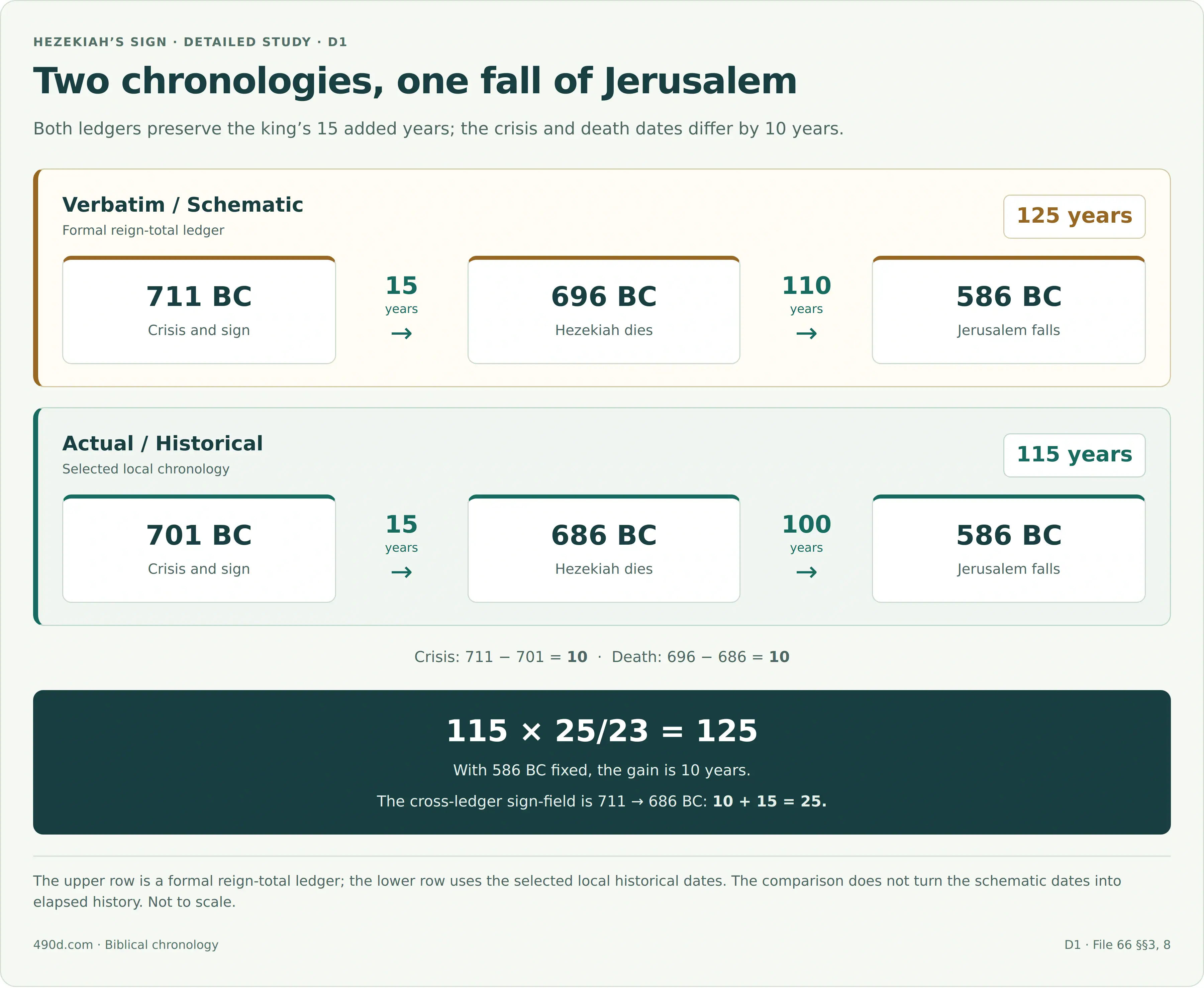
Two chronologies, one fall of Jerusalem
Both ledgers preserve the king’s 15 added years; the crisis and death dates differ by 10 years.
Verbatim / Schematic
Formal reign-total ledgerActual / Historical
Selected local chronologyCrisis: 711 − 701 = 10 · Death: 696 − 686 = 10
The upper row is a formal reign-total ledger; the lower row uses the selected local historical dates. The comparison does not turn the schematic dates into elapsed history. Not to scale.
Image version and full-size download
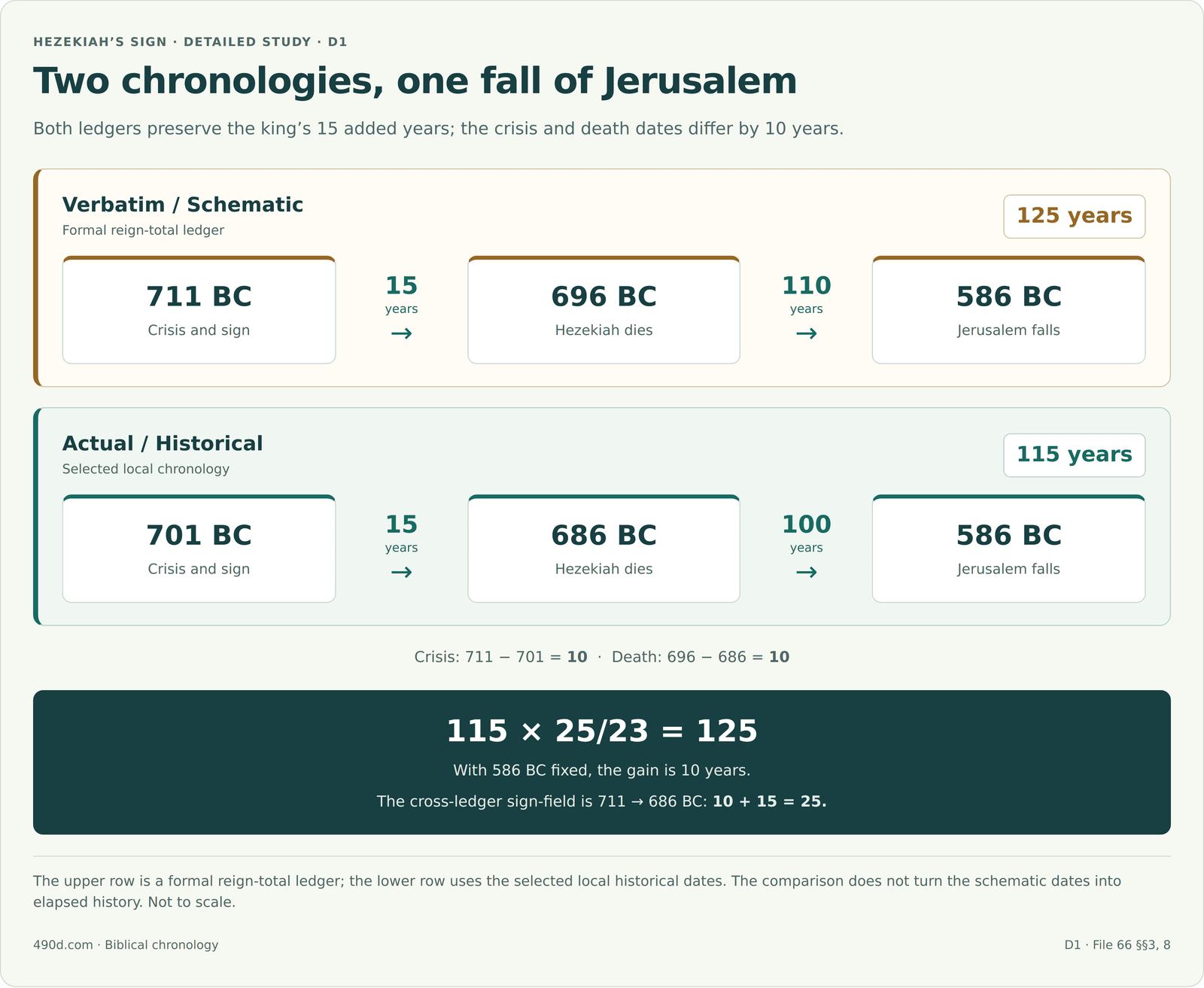
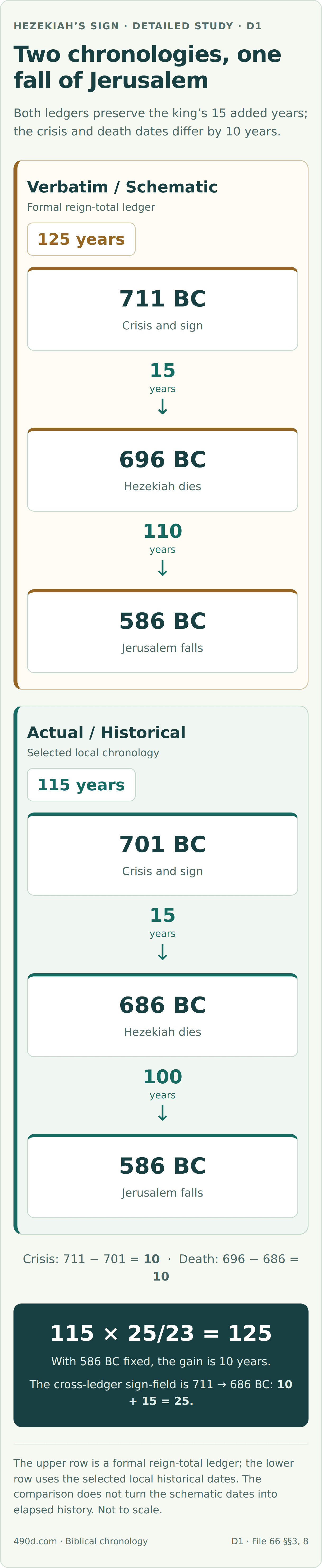
Download full-size PNG · Download WebP · Download stacked phone PNG
The comparison gives the shadow’s ten steps a chronological counterpart: 711 → 701 BC = 10 years, followed by the literal extension 701 → 686 BC = 15 years. Together they form 25 years. This is a reading across the two chronologies; it does not claim that Hezekiah historically lived through both crisis dates.
The same 125-year field has a particularly clear division at the historical death date:
711 → 686 → 586 BC = 25 + 100 = 5 × 25.
The combined 25-year interval occupies the first fifth; the remaining four fifths lead to the city’s fall. The fifteen added years remain within the stated twenty-nine-year reign. They are not added to a completed reign of twenty-nine years. The formal pattern can be displayed as 14 + 15 = 29, or 14 + 1 + 14 = 29, with the first extension year serving as the central unit.
There is also an Abrahamic comparison. The normal Masoretic Text (MT) chronology places Abraham’s call at 2091 BC and Isaac’s birth at 2066 BC, a span of 25 years. File 66 uses 2081 BC as its Covenant-of-Pieces comparison point, dividing the span into 10 + 15. The source assigns this intermediate date for the comparison; Genesis 15 itself supplies no BC date. Each Abrahamic coordinate stands 1380 = 12 × 115 = 60 × 23 years before its paired Hezekiah coordinate. The supporting table makes both the correspondence and its mixed historical/schematic basis explicit.
Source: File 66, §§3, 6 and 8.
3. The 185000 and the hundred-year remainder
And that very night the angel of the LORD went out and struck down 185,000 men in the camp of the Assyrians.
The count stands close to an exact square:
430 × 430 = 184900.
185000 − 184900 = 100.
That hundred-year difference matches the interval from Hezekiah’s selected death in 686 BC to Jerusalem’s fall in 586 BC. This is the central local correspondence. The number 430 already has a chronological setting: the normal MT sojourn places Israel’s entry into Egypt in 1876 BC and the Exodus in 1446 BC, a full 430 years in Egypt.
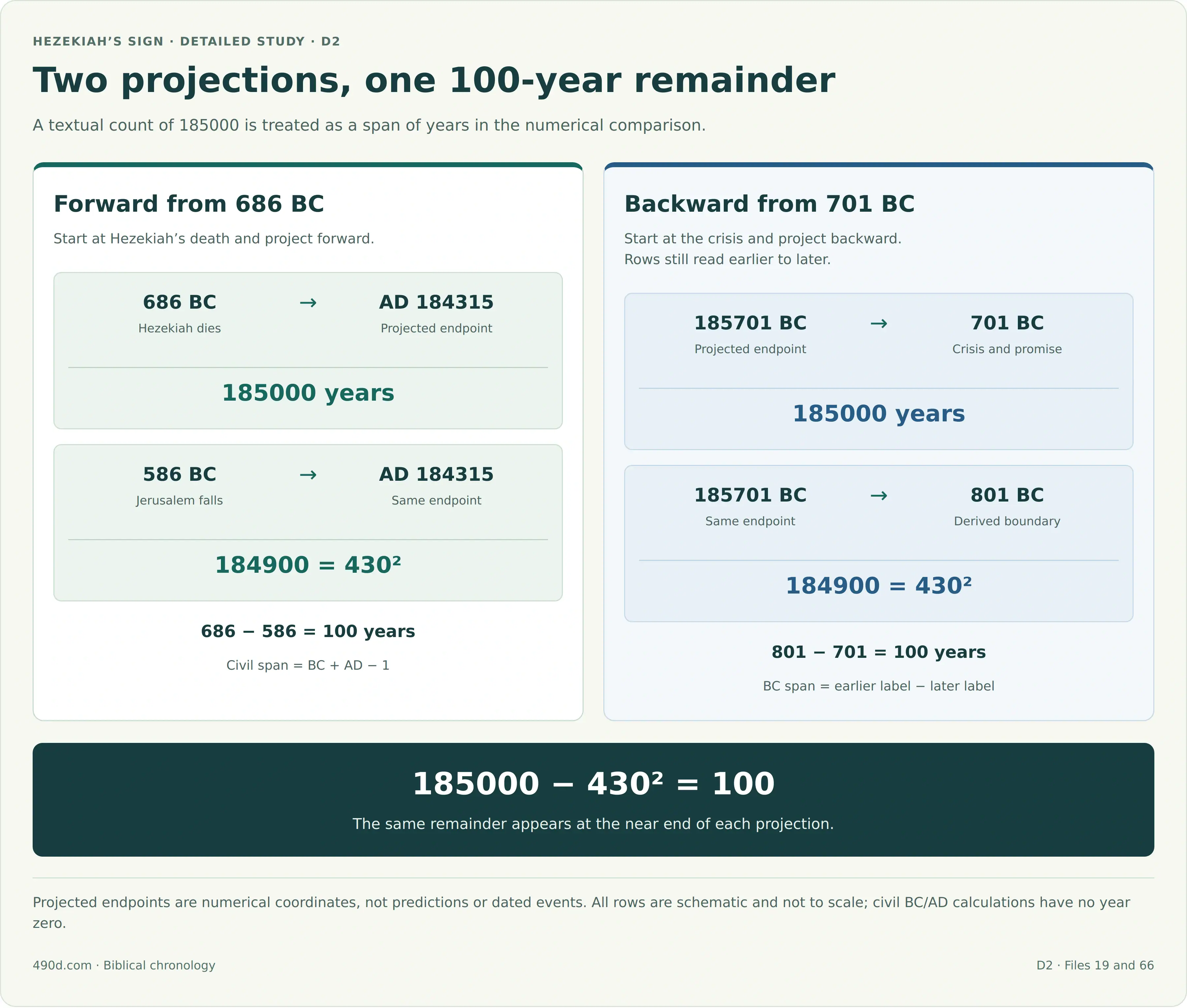
To explore the count as a span, measure 185000 years forward from 686 BC. The generated endpoint is AD 184315. Measure to that same endpoint from 586 BC, and the span is 184900 = 430². The difference between the two measurements is the historical hundred-year interval.
Now reverse the direction. Measuring 185000 years backward from the crisis in 701 BC generates 185701 BC. From that remote boundary, a span of 184900 reaches 801 BC, one hundred years before the crisis.
Two projections, one 100-year remainder
A textual count of 185000 is treated as a span of years in the numerical comparison.
Forward from 686 BC
Start at Hezekiah’s death and project forward.
686 − 586 = 100 years
Civil span = BC + AD − 1
Backward from 701 BC
Start at the crisis and project backward.
Rows still read earlier to later.
801 − 701 = 100 years
BC span = earlier label − later label
Projected endpoints are numerical coordinates, not predictions or dated events. All rows are schematic and not to scale; civil BC/AD calculations have no year zero.
Image version and full-size download
Download full-size PNG · Download WebP · Download stacked phone PNG
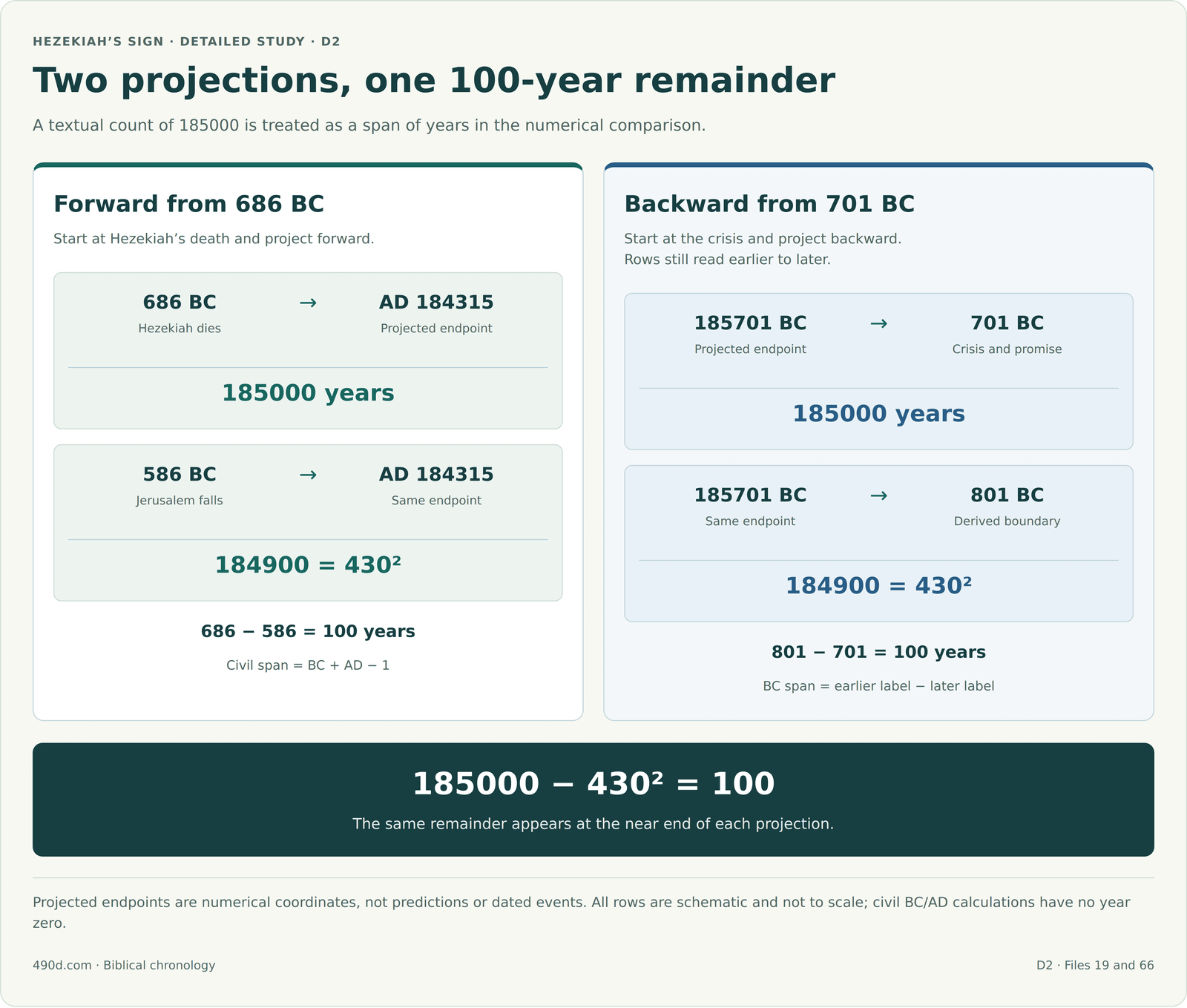
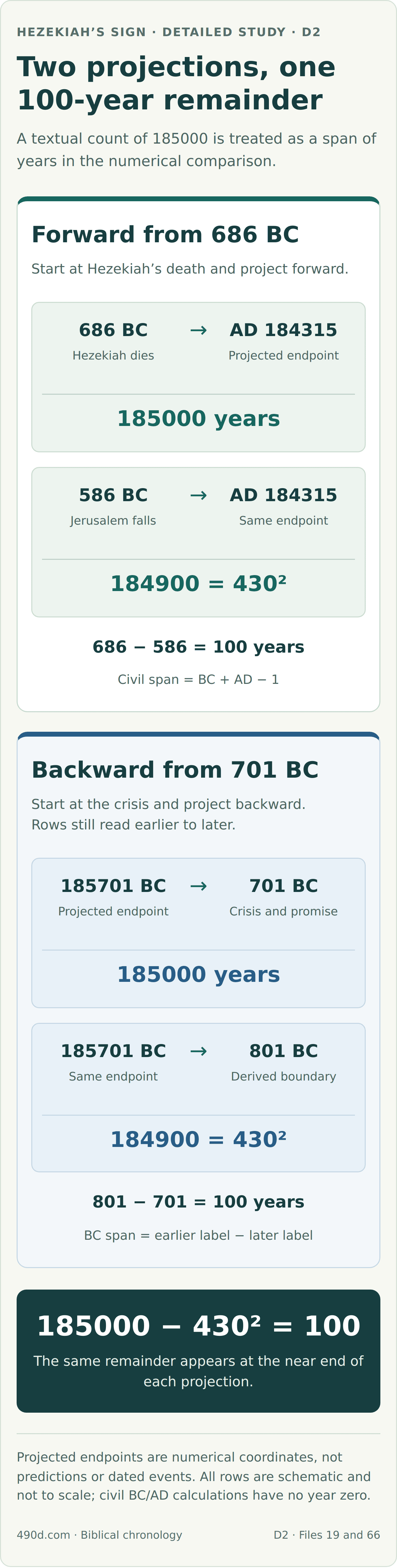
The two remote endpoints are mathematical projections, not proposed dates for historical or future events. Crossing BC/AD uses BC + AD − 1, because the civil calendar has no year zero. Moving backward from a BC date uses ordinary addition to its BC label. The full endpoint table shows the operations directly.
The local dates now form a balanced arrangement:
801 → 701 → 686 → 586 BC = 100 + 15 + 100 = 215.
The fifteen years between equal flanks
The two 100-year remainders enclose the king’s 15-year extension.
801 BC is derived from the backward comparison; no historical event is assigned to it. Schematic layout, not to scale.
Image version and full-size download
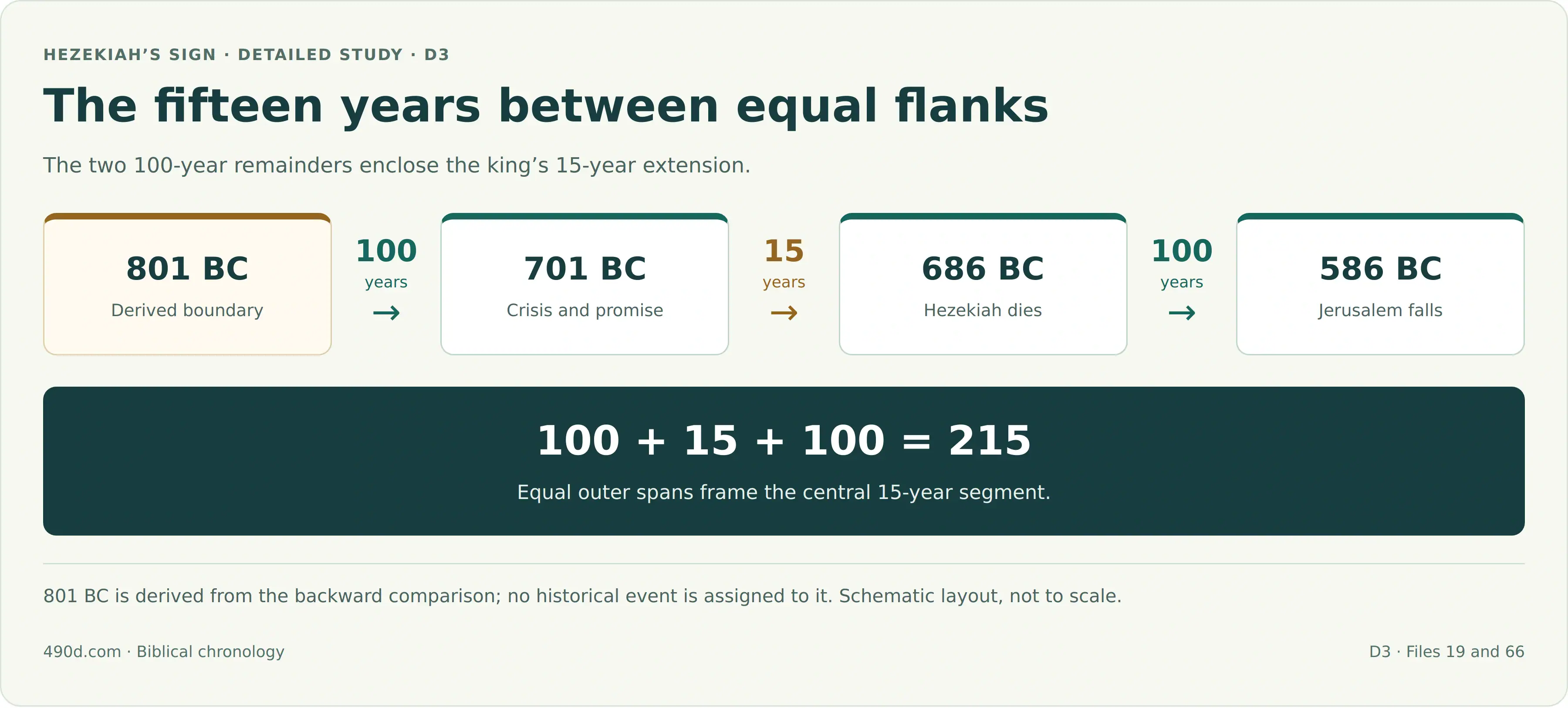
Download full-size PNG · Download WebP · Download stacked phone PNG
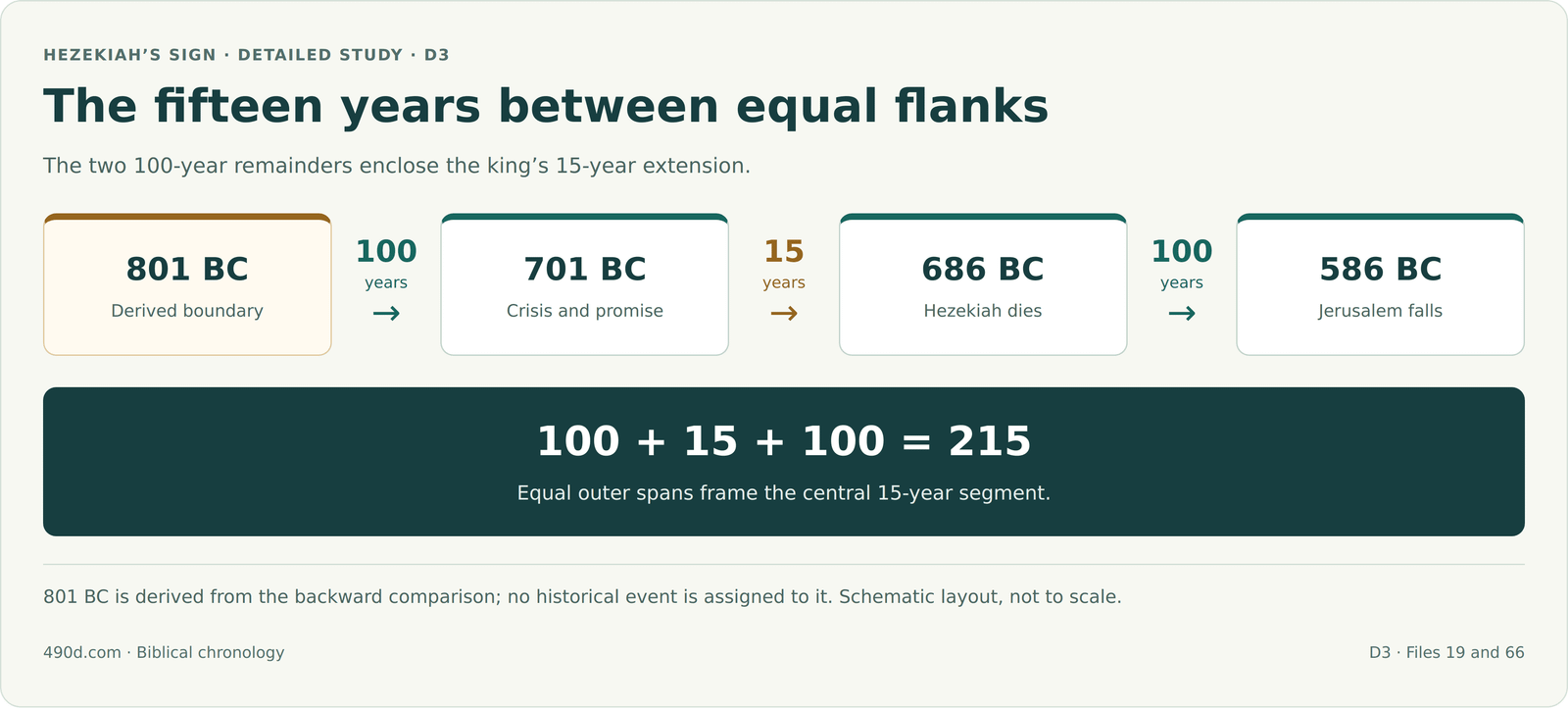
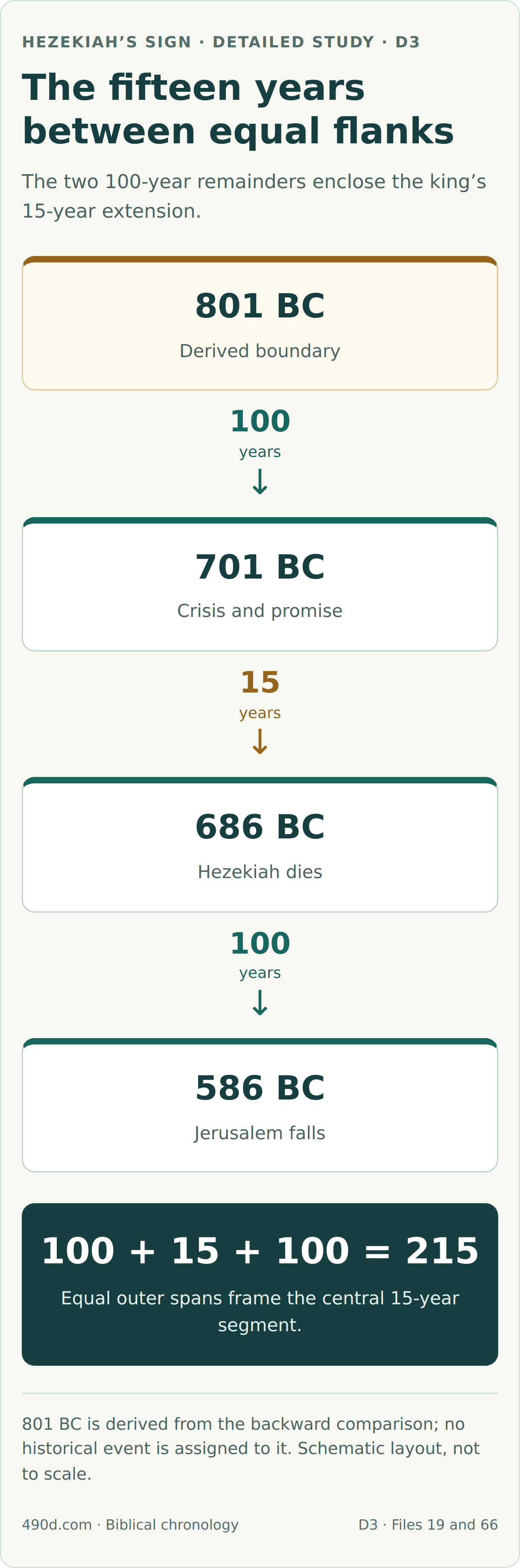
Two spans of 115 years overlap across the king’s fifteen-year extension: 801 → 686 BC and 701 → 586 BC. Their combined coverage is therefore 115 + 115 − 15 = 215.
The earlier boundary, 801 BC, has been generated by the calculation. It is not a second independently supplied historical witness. The strength of the initial comparison lies in the agreement between the numerical remainder of 100 and the selected king-to-city interval; the backward construction then makes its symmetry visible.
The outer endpoints also close exactly:
185701 BC → AD 184315 = 370015 = 2 × 185000 + 15 = 1721 × 215 years.
This larger total follows from placing the two projections on opposite sides of the fifteen-year interval. It is another expression of the same construction, not an additional independent proof.
Source: File 19, §§3 and 6; File 66, §§10.1–10.2.
4. Ten steps, two models of the Great Year
The BSB describes the shadow moving backward ten steps. The text does not supply a measured ten-degree astronomical angle. The precessional interpretation takes the number ten from the sign and compares it with an idealized cycle of 25920 years, traditionally called a Great Year in this research.
Divide that model into 360 units and each is 72 years. Ten units give 720 years. In the normal MT chronology, 1406 BC, the Conquest coordinate, lies exactly 720 years before Hezekiah’s selected death in 686 BC. Joshua’s long day and Hezekiah’s reversing shadow thus provide the narrative basis for comparing two signs involving the sun’s apparent movement. The computation does not establish their physical mechanism or identify the stairway’s steps with measured celestial degrees.
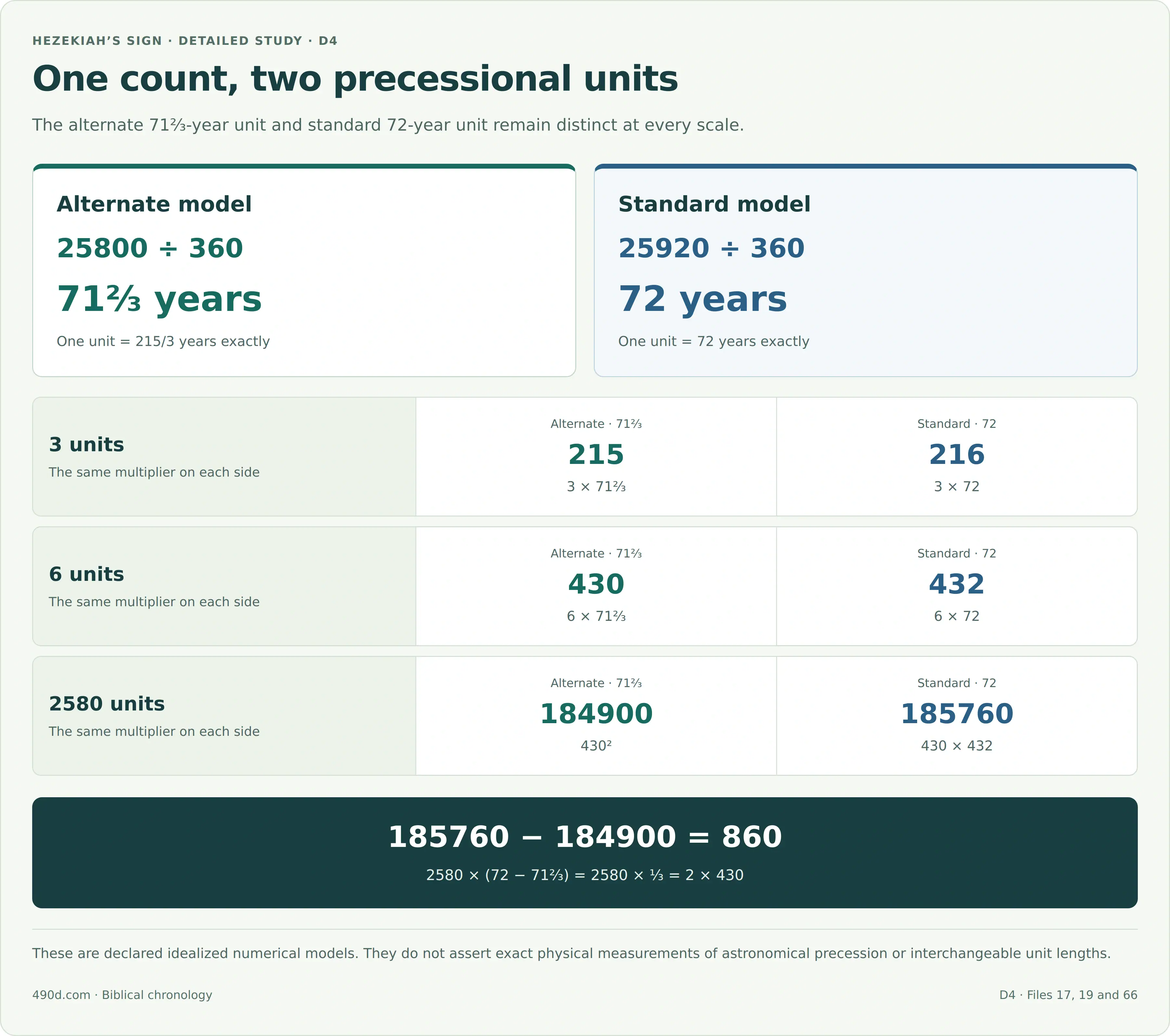
The sources also employ an alternate Great Year of 25800 years. Its unit is 71⅔ years, exactly 215/3. Three such units give 215; three standard units give 216. Doubling those results produces the familiar pair 430 and 432.
One count, two precessional units
The alternate 71⅔-year unit and standard 72-year unit remain distinct at every scale.
Alternate model
25800 ÷ 36071⅔ yearsOne unit = 215/3 years exactly
Standard model
25920 ÷ 36072 yearsOne unit = 72 years exactly
These are declared idealized numerical models. They do not assert exact physical measurements of astronomical precession or interchangeable unit lengths.
Image version and full-size download
Download full-size PNG · Download WebP · Download stacked phone PNG
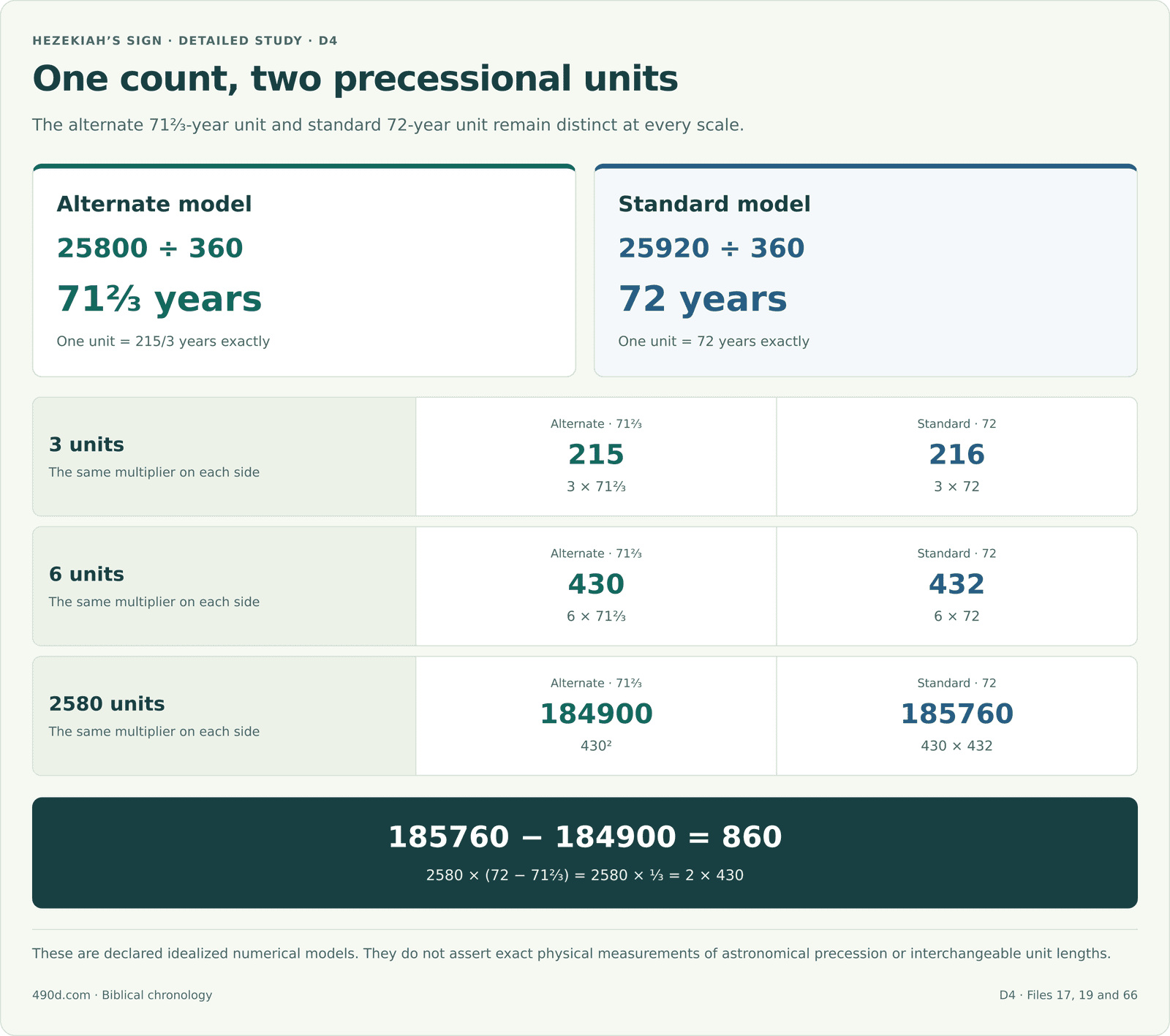
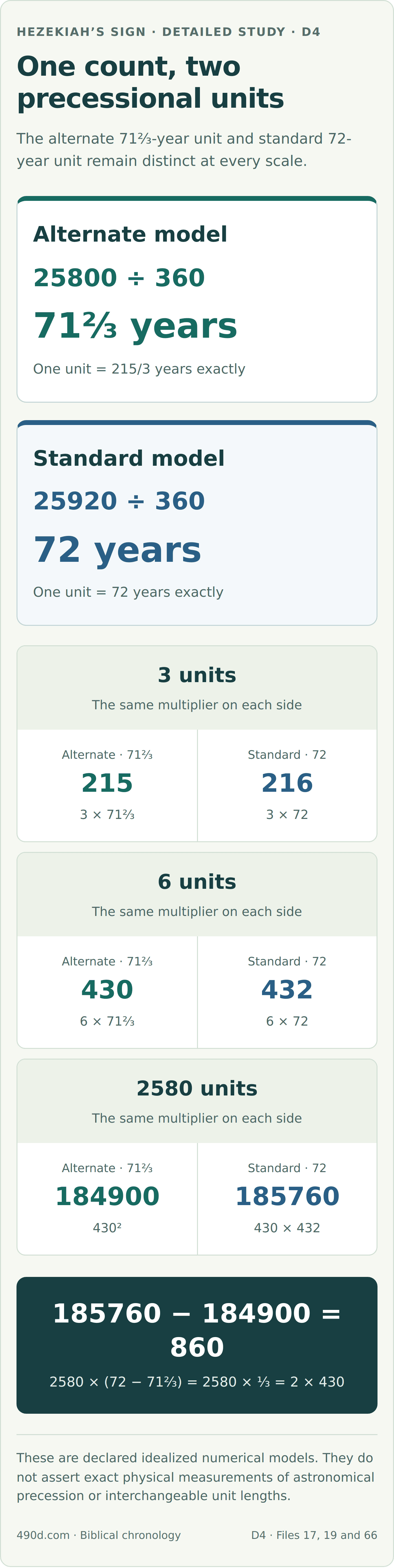
The two products surrounding the 185000 construction carry the same count of 2580 precessional units:
430 × 430 = 184900 = 2580 × 71⅔.
430 × 432 = 185760 = 2580 × 72.
Their difference is 860 = 2 × 430, because each of the 2580 units differs by one third of a year.
This difference has exact endpoint expressions. From the forward endpoint AD 184315, the square reaches Jerusalem’s fall in 586 BC; the larger product reaches the Exodus in 1446 BC. Those biblical anchors are 860 years apart. From the backward endpoint 185701 BC, the square reaches 801 BC; the larger product reaches AD 60, the repository’s Pauline horizon. Those targets likewise span 860 years under civil counting.
The associated outer span 1446 BC → AD 60 is 1505 = 7 × 215 = 3½ × 430. This is a controlled New Testament comparison, not a change to the normal Exodus date. Its endpoint arithmetic is in the projection table.
The Great Years here are stated mathematical models. Neither 25800 nor 25920 is being asserted as an exact measurement of the present physical precession period. Likewise, the narrative promises a Temple visit on the third day; comparing that third-day promise with three precessional units is a symbolic enlargement.
Source: File 17, §§5.1–5.3; File 19, §§2–3 and 6; File 66, §12.1.
5. Why Sabbath and Jubilee belong in the discussion
The agricultural sign accompanying Jerusalem’s deliverance gives the chronological reading a textual setting:
And this will be a sign to you, O Hezekiah:
This year you will eat
what grows on its own,
and in the second year
what springs from the same.
But in the third year you will sow and reap;
you will plant vineyards and eat their fruit.
The movement is from dependence on uncultivated produce to renewed sowing and harvest. It recalls the land-rest provisions of Leviticus 25:4 and the Jubilee count in verses 8–12, where seven Sabbaths of years make 49 years and the fiftieth is sanctified as Jubilee. Isaiah’s passage does not explicitly declare a formal Jubilee observance; the comparison concerns its language and pattern of rest, provision and restoration.
One substantial MT span reaches directly to Hezekiah:
4116 BC → 686 BC = 3430 = 7 × 490 = 70 × 49 years.
Here 4116 BC is the Creation Year-6 / Adam coordinate. It is distinct from the normal 4114 BC Creation endpoint and the 4121–4114 BC symbolic Creation-week frame. The choice of starting point is part of the stated calculation.
The sources also preserve a subordinate Conquest comparison at 1191 BC, 215 years later than the normal 1406 BC coordinate. It produces 1191 → 701 BC = 490 years, or ten 49-year cycles. Combining these intervals gives:
1406 → 1191 → 701 → 686 BC = 215 + 490 + 15 = 720.
This alternate comparison is useful because it shows how the 720-year whole can be partitioned. It does not replace the normal MT Exodus of 1446 BC, Conquest of 1406 BC, or Egypt-only sojourn of 430 years.
Source: File 19, §§4–5; File 66, §11.2.
6. Where Berossus enters the comparison
The old king-list comparisons become clearer when their anchors are named carefully. In the repository’s Berossus reconstruction, 536 BC remains a biblical restoration coordinate. 486 BC is a computational anchor displaced by the Kings chronology’s fifty-year difference. It is not the historical date of Babylon’s fall.
The Berossus post-Flood duration used in that reconstruction is 34080 years. Projected backward from 486 BC, it produces 34566 BC as the model’s Berossus Flood coordinate. These long coordinates belong to the king-list construction, not to the ordinary MT Flood date of 2458 BC.
File 34 develops a second route through a Sumerian comparison point at 28086 BC. Its distance to the same 486 BC anchor is 27600 = 12 × 2300 years. Applying the Priestly Key gives:
27600 × 25/23 = 30000.
Measure 30000 years forward from 486 BC and the result is AD 29515. The source calls this a Pillar: a generated point where several comparative constructions meet. The name does not turn it into a dated future event.
On smaller screens, scroll the table horizontally to see every column.
| Step in the source construction | Exact calculation | Result |
|---|---|---|
| Berossus Flood projection | 486 + 34080 | 34566 BC |
| Sumerian comparison span | 28086 − 486 | 27600 years |
| Priestly expansion | 27600 × 25/23 | 30000 years |
| Forward Pillar projection | 30000 − 486 + 1 | AD 29515 |
| Pillar to Hezekiah’s remote endpoint | 184315 − 29515 | 154800 = 430 × 360 years |
The final row is the direct link to this article. The same AD 184315 generated from Hezekiah’s death is 430 × 360 years beyond the established Pillar coordinate. The repeated unit is therefore 430, now scaled by a schematic 360-day year.
A further source-controlled comparison uses 269286 BC, the Adam coordinate in the extended cumulative construction:
269286 + 184315 − 1 = 453600 = 1260 × 360.
This is an extended cumulative coordinate, not the regular MT date for Creation. Its role is to show how the Hezekiah endpoint participates in the wider comparison already developed in the sources. The ordinary and extended chronologies retain their separate meanings.
The complete king-list derivation belongs in the detailed Berossus study and File 34, §§1, 3 and 6. The Hezekiah connections themselves are stated in File 19, §3.5. No extra correction of the Pillar date is needed to obtain these two products.
7. From 185000 to the derived 185150 companion
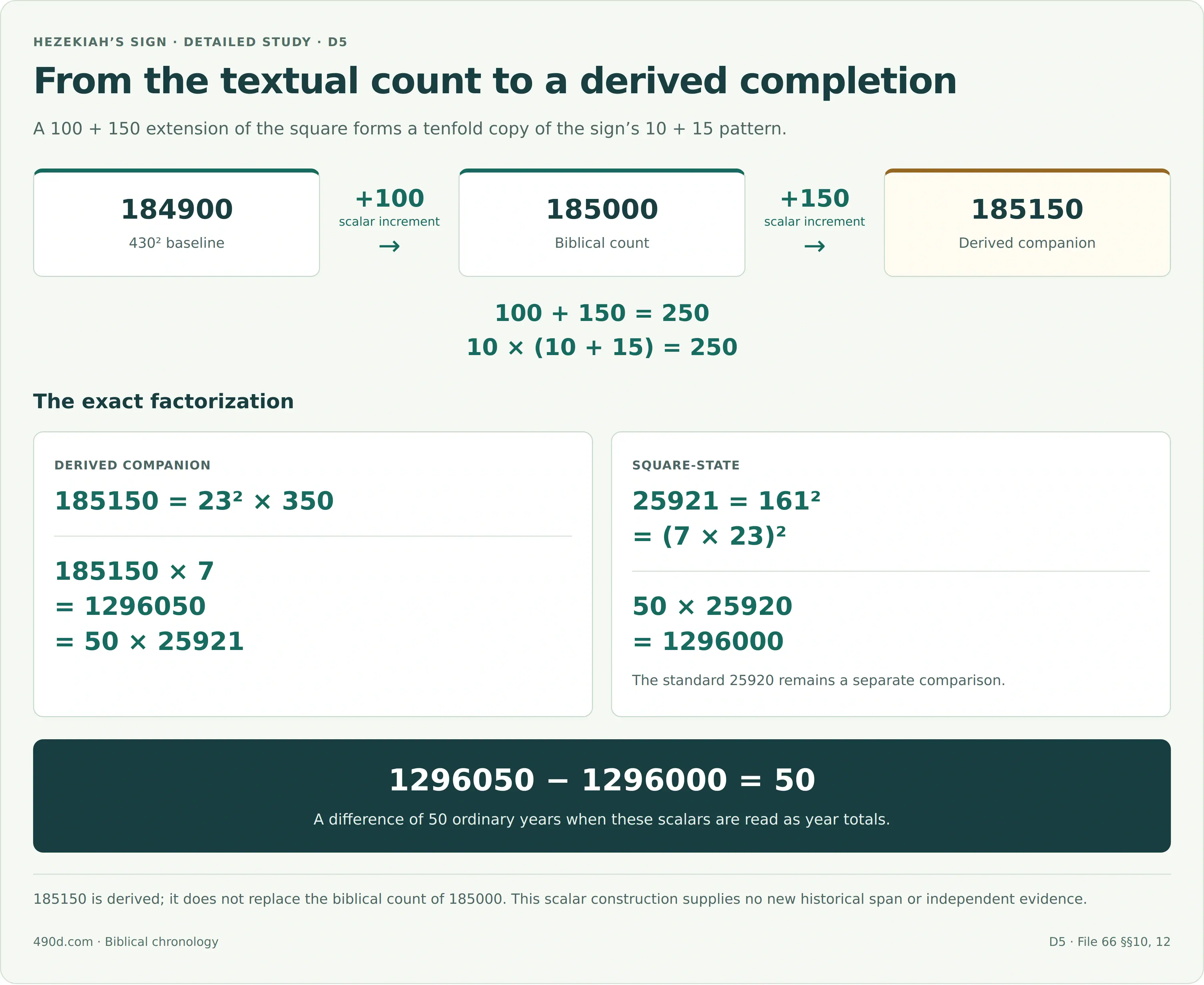
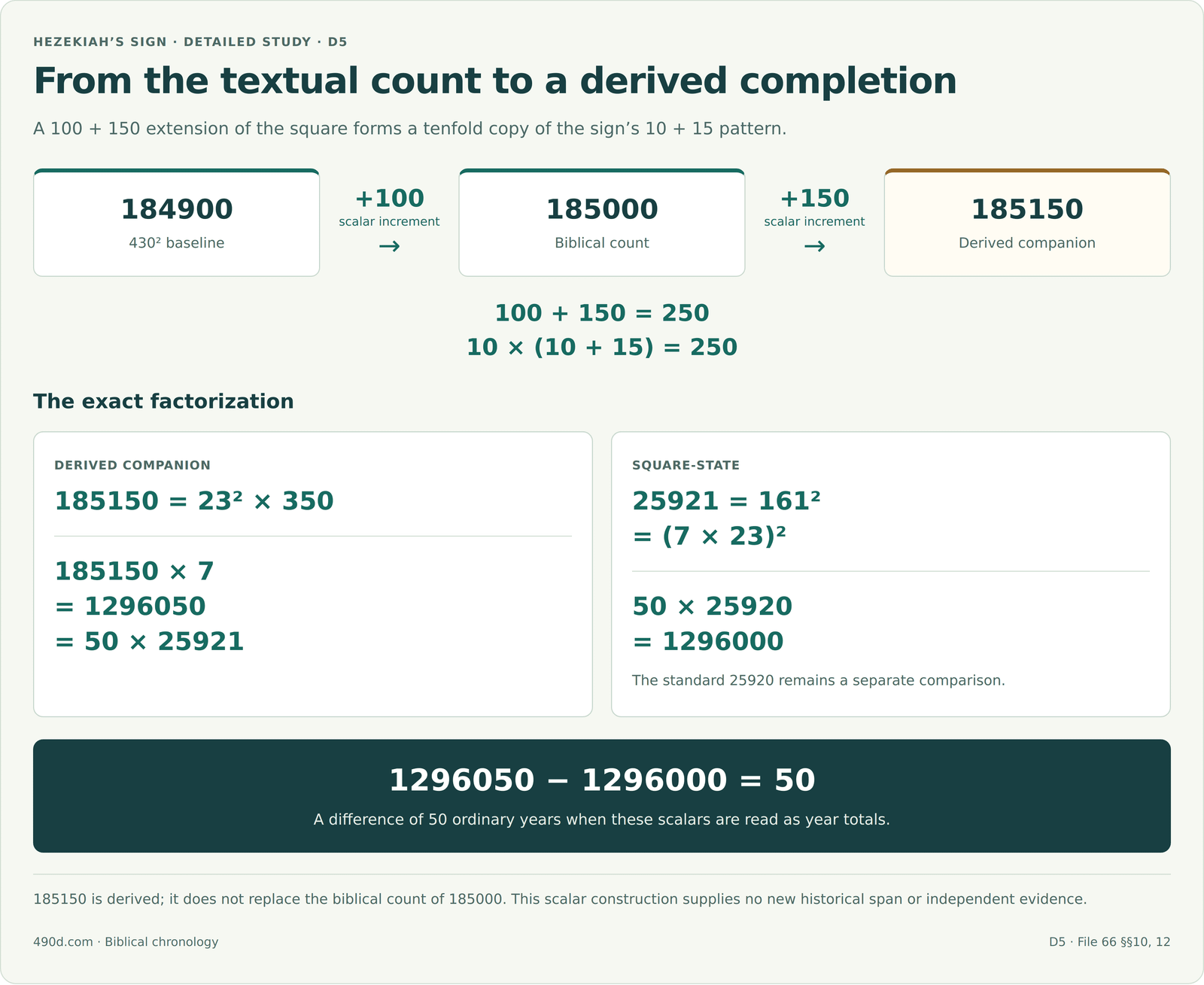
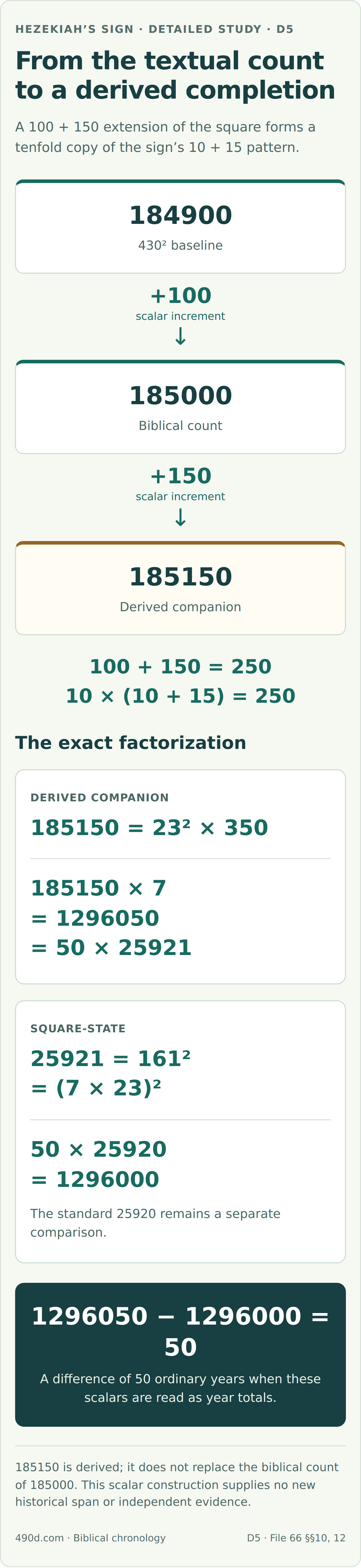
The later canonical treatment takes the 10 + 15 = 25 sign-field one stage further. Multiplying that structure by ten gives 100 + 150 = 250.
The first hundred already appears between the square and the biblical count:
184900 → 185000 = 100.
Add the corresponding 150 on the other side:
185000 → 185150 = 150.
Thus 184900 → 185000 → 185150 is a tenfold numerical copy of 10 + 15. This construction explains why 185150 is examined. The biblical army count remains 185000; the additional 150 is supplied by the declared scaling, not by a different reading of the verse.
The new value factors exactly:
185150 = 23² × 350 = 1610 × 115 = 161 × 1150.
The factor 115 returns to Jerusalem’s survival from 701 to 586 BC. The factor 350 connects with the source’s 886 → 536 BC restoration comparison. Its earlier date is the completed schematic Ahaziah–Athaliah boundary; its later date is historical restoration. This deliberately combines two chronology registers and is not an ordinary historical reign interval. It belongs to the primary ledger using Athaliah’s seventh-year boundary, whose broader Kings comparison yields a fifty-year difference. The audit using her six completed years yields 49; the two ledgers are not silently interchanged.
From the textual count to a derived completion
A 100 + 150 extension of the square forms a tenfold copy of the sign’s 10 + 15 pattern.
The exact factorization
= 1296050
= 50 × 25921
= (7 × 23)²50 × 25920
= 1296000
The standard 25920 remains a separate comparison.
185150 is derived; it does not replace the biblical count of 185000. This scalar construction supplies no new historical span or independent evidence.
Image version and full-size download
Download full-size PNG · Download WebP · Download stacked phone PNG
Now multiply 185150 by seven:
185150 × 7 = 1296050 = 50 × 25921.
The significance of 25921 is its exact square:
25921 = 161² = (7 × 23)² = 49 × 529.
It combines the Jubilee-related 49 with two factors of 23. Its square root also carries the Priestly relation 161 × 25/23 = 175, changing 7 × 23 into 7 × 25.
This 25921 is called the Precession Square in the sources. It is a square-completion model, distinct from the standard Great Year of 25920 and alternate Great Year of 25800. It does not correct either one or establish a new measured astronomical period.
Compare fifty copies of the standard and square models:
50 × 25920 = 1296000.
50 × 25921 = 1296050.
Their difference is 50 ordinary years. That reproduces the number of years separating the primary historical and schematic Kings chronologies. The two products contain fifty modeled Great-Year cycles each; their difference is not fifty Great Years.
The chain is exact, but its later results depend on the earlier choices. Once 185150 is defined and factored, the sevenfold square relation follows. It is a coherent extension of the proposed pattern, not a separate historical observation or a probability calculation.
Source: File 66, §§7, 9.4, 10.3–10.6 and 12; File 10, Precession-Square control.
8. Two further links within Isaiah’s chronological setting
The Temple and the 430-year unit
The Kings study preserves an exact distinction that matters to this argument. The selected post-Solomonic reign ledger totals 394.5 years. Add Solomon’s 36 post-foundation years and the formal Temple block is 430.5, not exactly 430.
Alongside that ledger, the schematic interval from Temple foundation to destruction, 1016 → 586 BC, gives 430. Its second-month-to-Tammuz/Av setting is a close calendrical bridge; it does not erase the half-year in the reign sum. A separate historical comparison runs from Solomon’s Temple foundation to the restored Temple’s foundation: 967 → 537 BC = 430, with 966 → 536 BC = 430 as the ordinary adjacent-year display.
These are complementary constructions with different starting points and endpoints. They help explain why 430 recurs in the Hezekiah argument without treating every occurrence as the same historical duration. File 19 §§10.4–10.6 and the Kings study give the supporting reign ledger.
Immanuel and the distinction between 65 and 49
The Hezekiah episode also sits within Isaiah’s earlier sign to Ahaz. The focused source uses 735 BC for the prophecy/conception coordinate and 734 BC for the companion birth display. They are two defined labels, not an uncertainty range.
From 735 BC, 49 years reach Hezekiah’s selected death in 686 BC, 65 years reach the source’s 670 BC shattering horizon for Ephraim, and 196 = 4 × 49 years reach Babylon’s fall in 539 BC. The 670 coordinate interprets the longer horizon of Isaiah 7:8; it is not a substitute date for Samaria’s earlier capture.
The difference between the two units also forms a near crossing: 3 × 65 = 195, while 4 × 49 = 196. The full Immanuel construction develops that one-year distinction rather than blending the cycles. Its broader treatment belongs in File 17 §2.4; the supporting table retains the local relationships needed here.
9. The promise remains the center
The pattern begins with the preservation of a king and a city. Its simplest numerical expression is still 15 years for Hezekiah, 115 years to Jerusalem’s fall, and 100 years between their terminal dates. The remainder 185000 − 430² = 100 connects the army count with that chronology; the backward projection gives the local 100 + 15 + 100 symmetry.
The fuller comparisons then ask how the same units behave at other scales: 115 becomes 125, 430 is paired with 432, the Pillar stands 430 × 360 from the generated endpoint, and the derived 185150 completes a sevenfold square relationship. These extensions make the proposed structure richer, while their stated operations keep it open to inspection.
The theological reading is that the God who preserves Hezekiah and Jerusalem also rules the ordering of time. The arithmetic can be checked directly; the judgment that its coherence expresses intention is an interpretation of the combined narrative and numerical evidence. It does not require claims that every displayed relationship is independent or that chance has been formally excluded.
Supporting tables and conventions
A. Date controls
| Coordinate or convention | Use in this article |
|---|---|
| 701 / 686 / 586 BC | Local crisis, death and fall framework of Files 19 and 66 |
| 687 BC in File 18 §2.5.3 | Adjacent general-table terminal: substituting it gives 701 − 687 = 14 and 687 − 586 = 101, changing this construction |
| 711 / 696 BC | Schematic crisis and death; not additional historical events |
| 801 BC | Generated local boundary, 100 years before the crisis |
| 185701 BC / AD 184315 | Generated distant endpoints; no event prediction attached |
| Same-side BC intervals | Earlier BC label minus later BC label |
| Same-side AD intervals | Later AD label minus earlier AD label |
| Cross-axis civil intervals | BC + AD − 1; no year zero |
| Seasonal convention | Annual coordinates; no new Nisan/Tishri adjustment is applied |
| Rounded display convention | Not used here; these are not September 25 Rounded-display calculations |
B. The complete retained endpoint calculations
On smaller screens, scroll the table horizontally to see every column.
| Relationship | Exact calculation | Result in years |
|---|---|---|
| 686 BC → AD 184315 | 686 + 184315 − 1 | 185000 |
| 586 BC → AD 184315 | 586 + 184315 − 1 | 184900 = 430 × 430 |
| 1446 BC → AD 184315 | 1446 + 184315 − 1 | 185760 = 430 × 432 |
| 185701 BC → 701 BC | 185701 − 701 | 185000 |
| 185701 BC → 801 BC | 185701 − 801 | 184900 = 430 × 430 |
| 185701 BC → AD 60 | 185701 + 60 − 1 | 185760 = 430 × 432 |
| 185701 BC → AD 184315 | 185701 + 184315 − 1 | 370015 = 1721 × 215 |
| 1446 BC → AD 60 | 1446 + 60 − 1 | 1505 = 7 × 215 |
| AD 29515 → AD 184315 | 184315 − 29515 | 154800 = 430 × 360 |
| 269286 BC → AD 184315 | 269286 + 184315 − 1 | 453600 = 1260 × 360 |
All are annual-coordinate calculations. The BC/AD formula does not assert exact day-level durations for events whose anniversaries have not been specified. The source’s local forward/backward shadow comparison is not the separate formal Mirror protocol.
C. The Abraham–Hezekiah comparison
On smaller screens, scroll the table horizontally to see every column.
| Abrahamic coordinate | Hezekiah coordinate | Difference |
|---|---|---|
| Call, 2091 BC | Schematic crisis, 711 BC | 1380 |
| Covenant comparison, 2081 BC | Historical/local crisis, 701 BC | 1380 |
| Isaac’s birth, 2066 BC | Historical/local death, 686 BC | 1380 |
Both sets divide as 10 + 15 = 25. The repeated 1380 is the consequence of translating the same interval structure; the three rows are not three independent tests. File 66 §6 controls the comparison, including its reconstructed 2081 BC node.
D. Selected Isaiah relationships
On smaller screens, scroll the table horizontally to see every column.
| From the 735 BC prophecy/conception coordinate | Calculation | Years |
|---|---|---|
| To Hezekiah’s local death, 686 BC | 735 − 686 | 49 |
| To the Ephraim shattering horizon, 670 BC | 735 − 670 | 65 |
| To Jerusalem’s siege, 588 BC | 735 − 588 | 147 = 3 × 49 |
| To Babylon’s fall, 539 BC | 735 − 539 | 196 = 4 × 49 |
The later city-fall coordinate remains 586 BC, distinct from the siege opening at 588 BC. The 735/734 pair and the event identifications are source-defined chronological interpretations; the subtraction checks do not independently establish them. File 19 §7 gives these local rows, while File 17 controls the extended Immanuel framework.
Sources and further reading
The current canonical Markdown and its incorporated amendments govern the calculations used here. “Canonical” identifies the controlling research repository; it does not equate these chronological interpretations with the biblical canon.
On smaller screens, scroll the table horizontally to see every column.
| Source | Relevant sections | What it supplies |
|---|---|---|
| File 19: Hezekiah Prophetic Complex | §§2–7; §§10.4–10.6 | Local anchors, projections, 100-year remainder, 720 and Jubilee comparisons, Pillar link, Temple distinctions |
| File 66: Dial of Ahaz and Hezekiah–Jerusalem Fifth Expansion | §§1–4, 6–8, 9.4, 10–12 | Twin chronologies, 115 → 125, Abrahamic comparison, 185150, precessional square and claim controls |
| File 67: Flanking Kings of the Hezekiah Sign | §2 | Supporting control for the local historical/schematic dates |
| File 17: Prophetic Time Span Anatomy | §§2.4, 5.1–5.3 | Alternate/standard precessional units and the wider Isaiah comparison |
| File 18: Chronological Data Tables | §2.5.3 | General reign table and its adjacent 687 BC terminal |
| File 34: Unified Chronology of the SKL, Berossus and Bible | §§1, 3, 6 | Computational 486 BC anchor, king-list construction and AD 29515 Pillar |
| File 10: External Validation | §§3–3.1 | 25921 as a square/Jubilee model, distinct from 25920 |
These source sections were checked on October 4, 2026. Their larger statistical, Mirror, co-regency and prophetic frameworks remain available in the canonical source index. The present report develops a connected selection rather than treating every numerical branch as necessary to the central explanation.
Return to the illustrated introduction, consult its direct calculation tables, or continue with the Kings of Judah study and Berossus comparison.
Scripture quotations: Berean Standard Bible (BSB), public domain.