The studies on this website approach biblical time from several directions: the years between births, complete lifespans, calendar units, and symbolic correspondences. This guide explains how to tell those approaches apart and where to begin reading.
The Knowledge Catalog leads to the Unified Chronology source files. Those files and their applicable amendments are the final authority for the chronology used here. The website articles explain the research in readable prose; the sources supply its definitions, tables, and detailed controls.
One person, two useful numbers
Genesis gives both Adam’s age when Seth was born and Adam’s complete lifespan. Genesis 5:3, BSB places Seth’s birth when Adam was 130 years old. Two verses later:
“So Adam lived a total of 930 years, and then he died.”
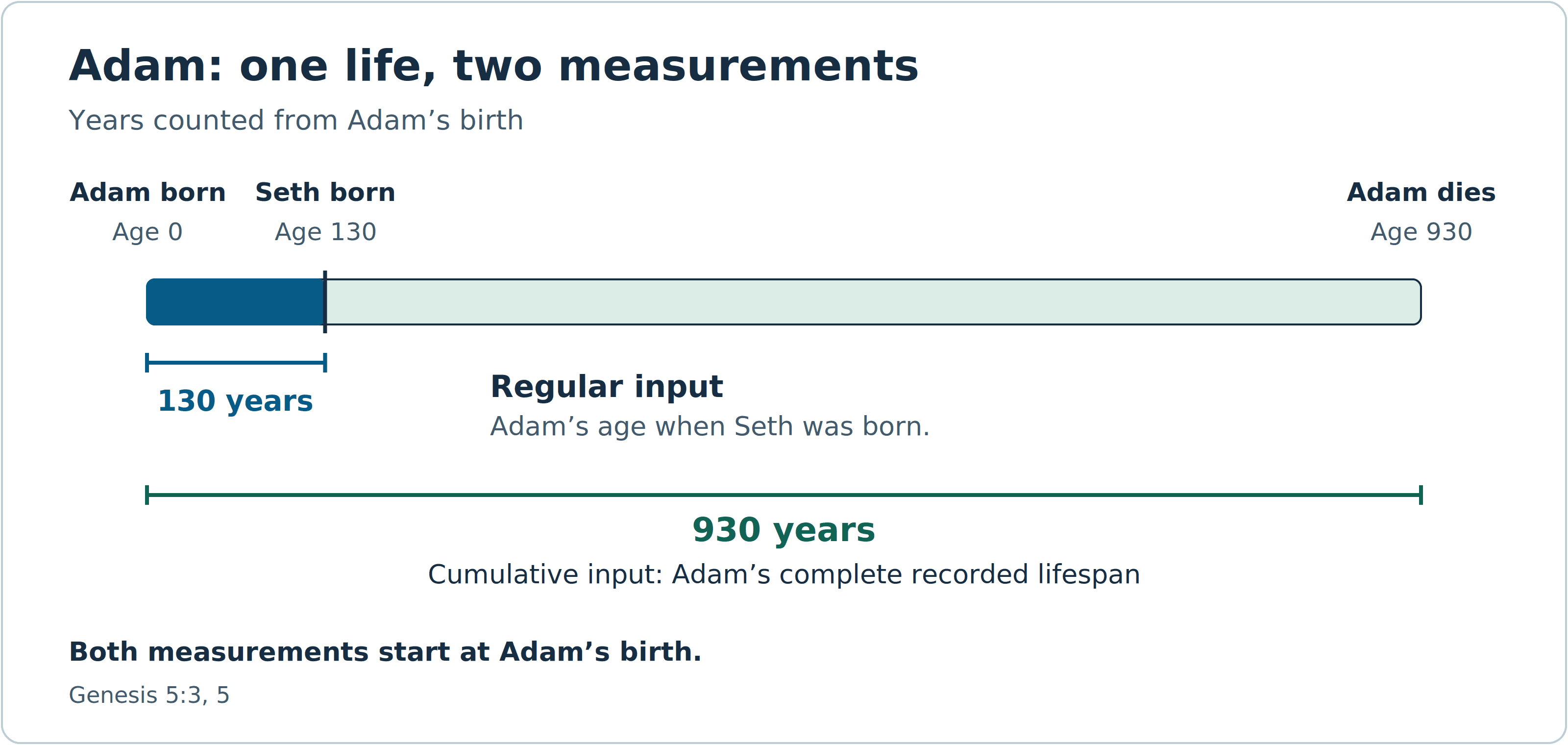
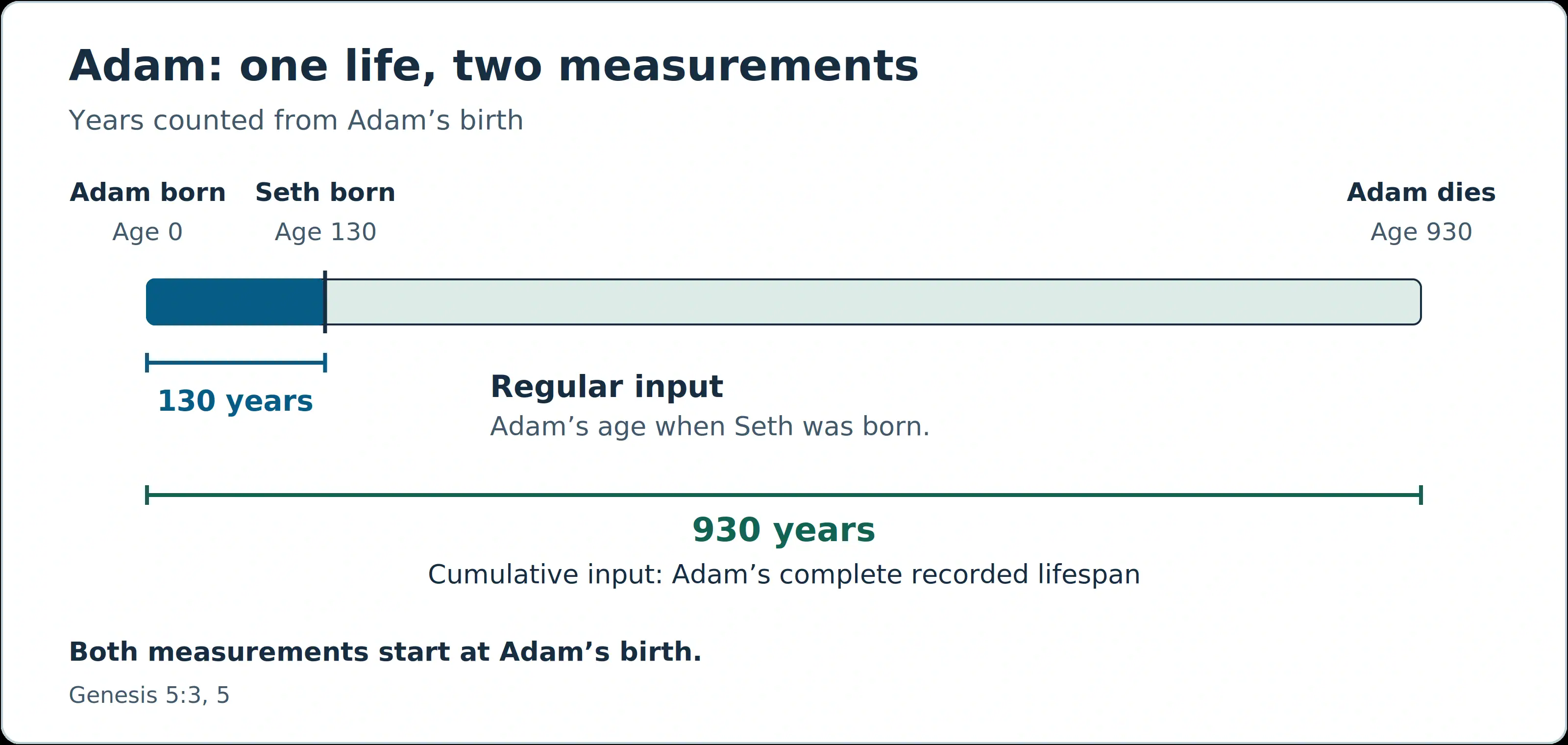
The 130 years measure the interval from Adam’s birth to Seth’s birth. The 930 years measure Adam’s entire life. Both figures belong to the same account, but they answer different questions.
Adam: one life, two measurements
Years counted from Adam’s birth
- Adam born
- 0years
- Seth born
- 130years
- Adam dies
- 930years
Regular input
130 years
Adam’s age when Seth was born.
Cumulative input
930 years
Adam’s complete recorded lifespan.
Both measurements start at Adam’s birth.
Adam: one life, two measurements
| Event or input | Years from Adam’s birth |
|---|---|
| Adam born | 0 |
| Seth born — regular input | 130 |
| Adam dies — cumulative input | 930 |
Both measurements start at Adam’s birth. Source: Genesis 5:3, 5.

Regular chronology follows the intervals between successive births, together with the later historical intervals needed to reach a dated event. People’s lives overlap: Seth’s birth does not mark Adam’s death. Begin with how to read the Regular tables, then open the MT table itself.
Cumulative chronology adds complete lifespans along the specified ancestral line. It places them consecutively in a formal construction. Its coordinates therefore describe positions in that construction; they are not ordinary birth dates, and they do not imply that one person waited for the previous person to die before being born.
For the principal Masoretic Text construction, the line passes through Jacob, Levi, Kohath, Amram, and Moses. Joseph belongs to a collateral branch, not this trunk. The 26 lifespans total 12,600 years, with Moses’ death and the Conquest boundary anchored at 1406 BC. The cumulative introduction explains the method; the complete lifespan ledger shows every contribution.
Recorded figures and Rounded figures
The method is one choice. The treatment of its numerical inputs is another.
Actual is the sources’ name for calculations using the recorded figures within a declared chronological framework. It identifies the numerical register; it does not, by itself, establish the historical certainty of every resulting BC date.
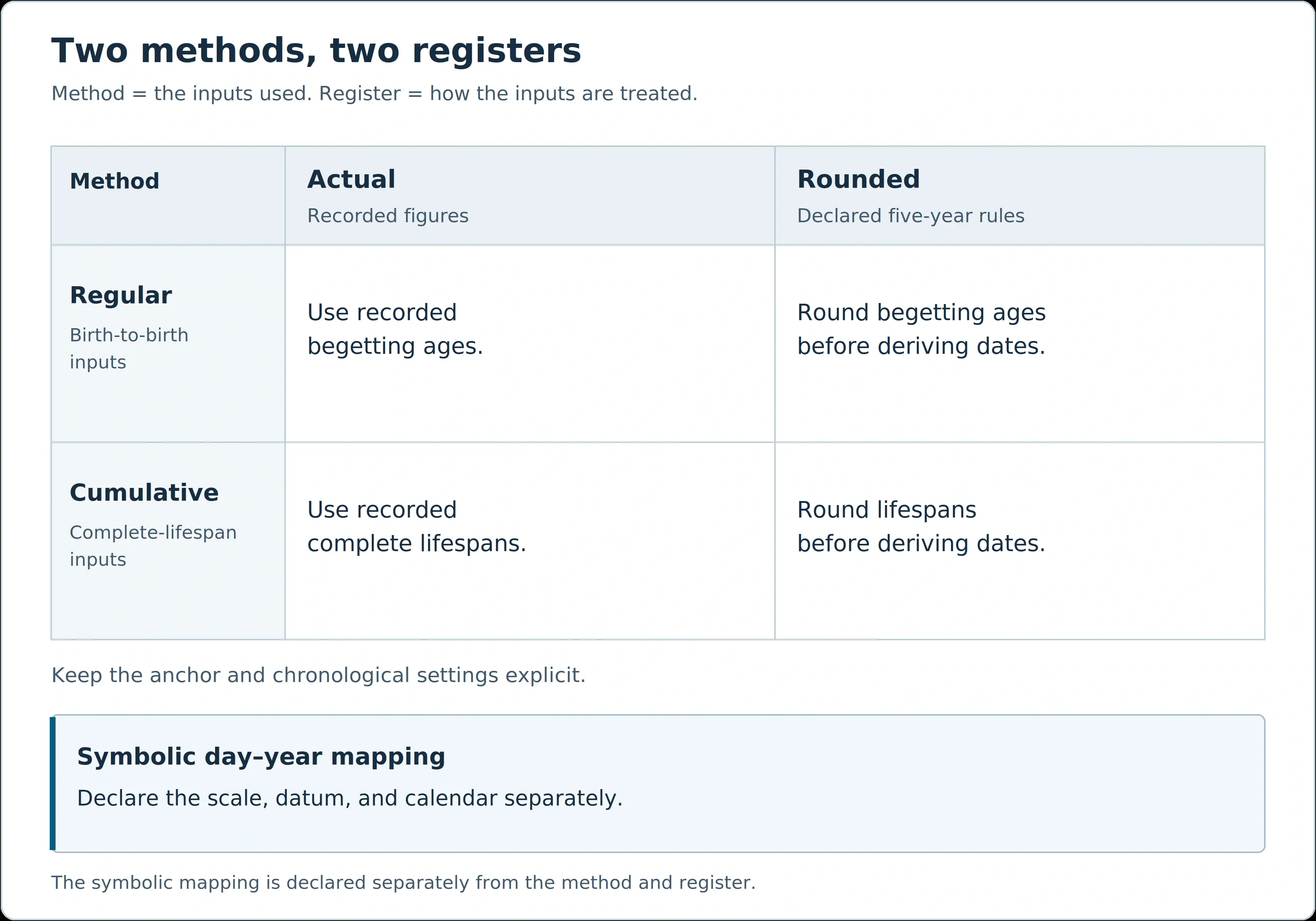
Rounded uses the prescribed five-year rounding rules before deriving the dates. In a Regular calculation, the relevant inputs are the begetting ages. In a Cumulative calculation, they are the full lifespans. The resulting coordinates are then propagated from the stated anchor. Rounding a final printed BC date would not reproduce this method.
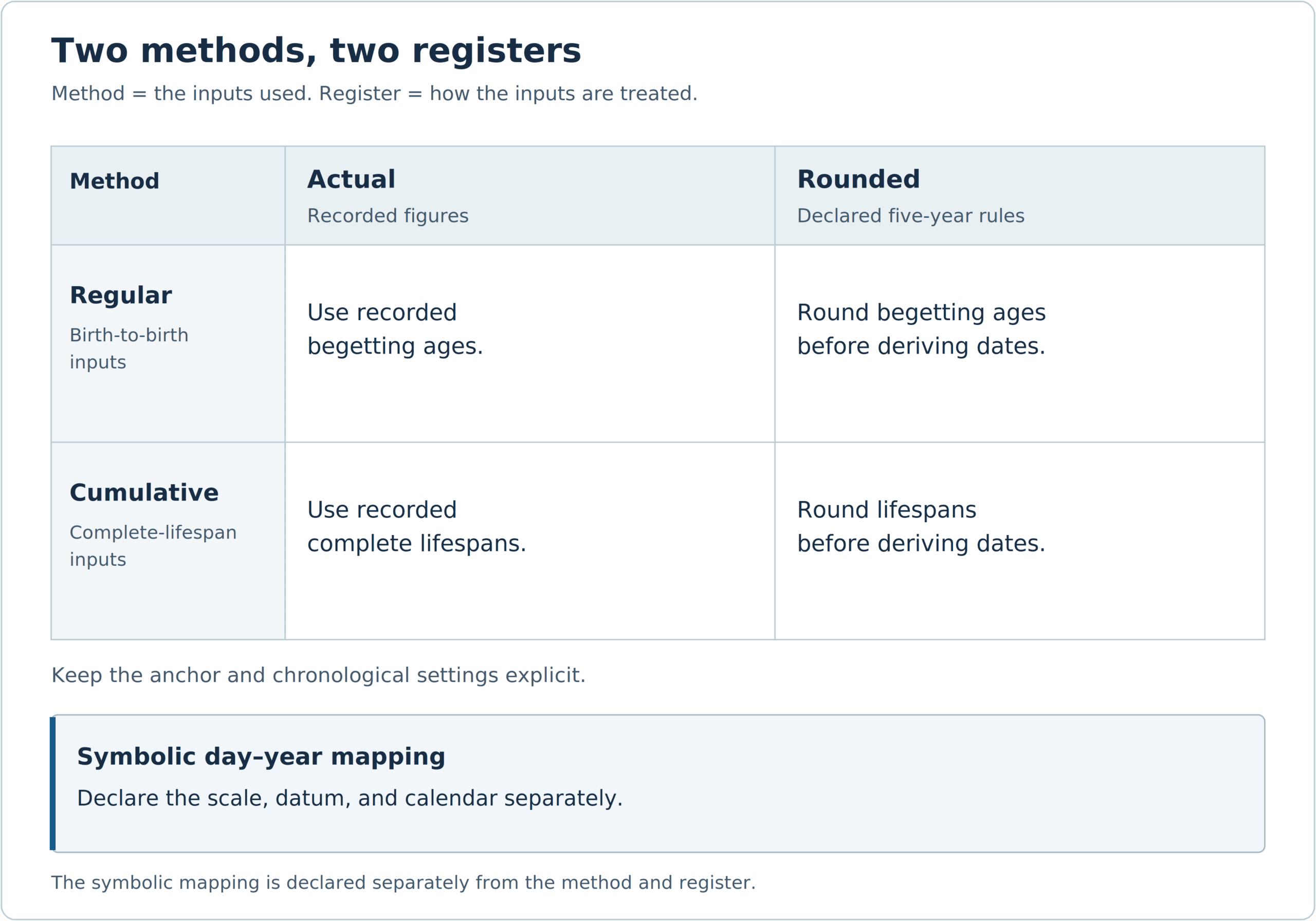
Two methods, two registers
| Method | ActualRecorded figures | RoundedDeclared five-year rules |
|---|---|---|
| RegularBirth-to-birth inputs | ActualUse recorded begetting ages. | RoundedRound begetting ages before deriving dates. |
| CumulativeComplete-lifespan inputs | ActualUse recorded complete lifespans. | RoundedRound lifespans before deriving dates. |
Keep the anchor and chronological settings explicit.
Symbolic day–year mapping
Declare the scale, datum, and calendar separately.
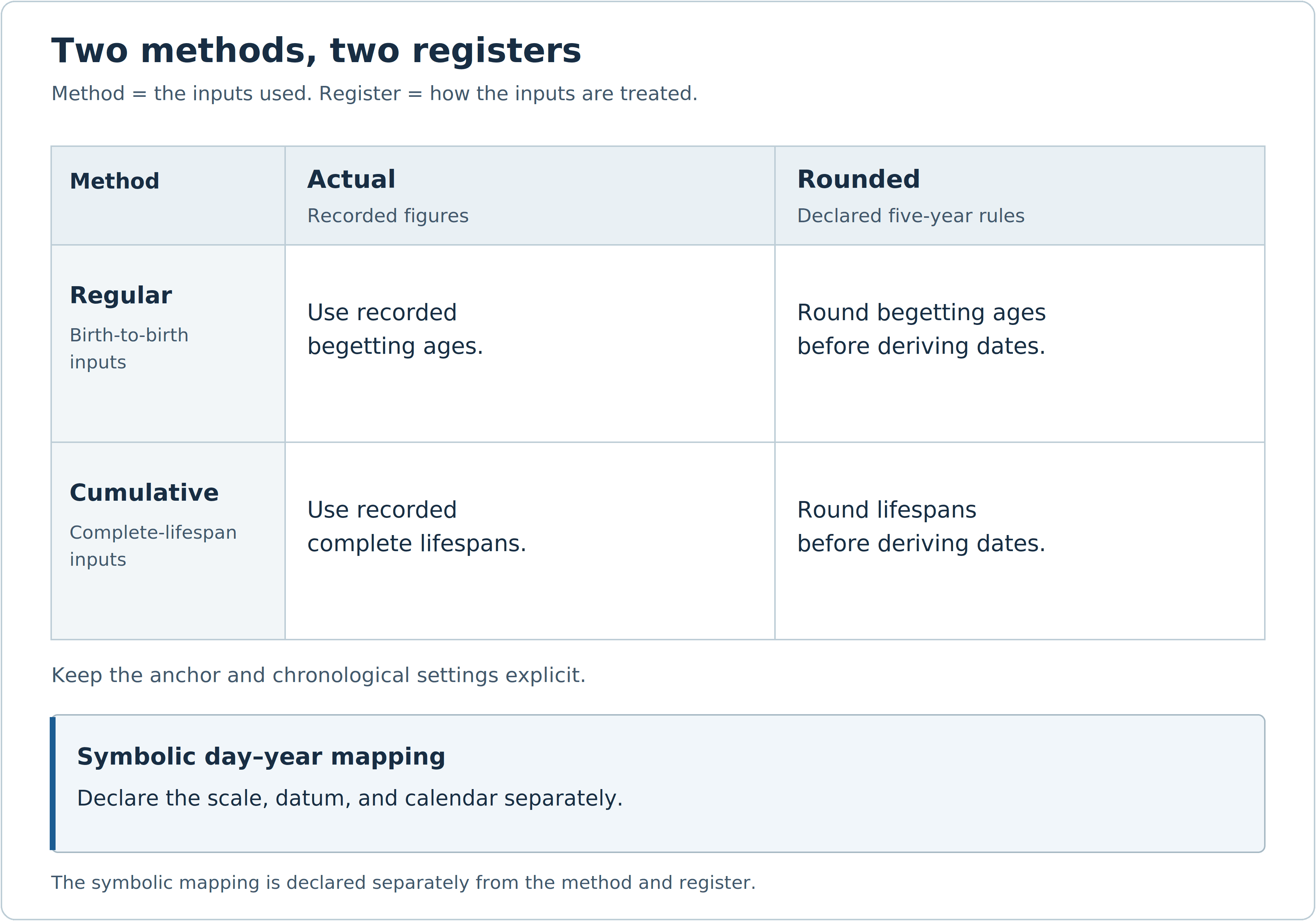
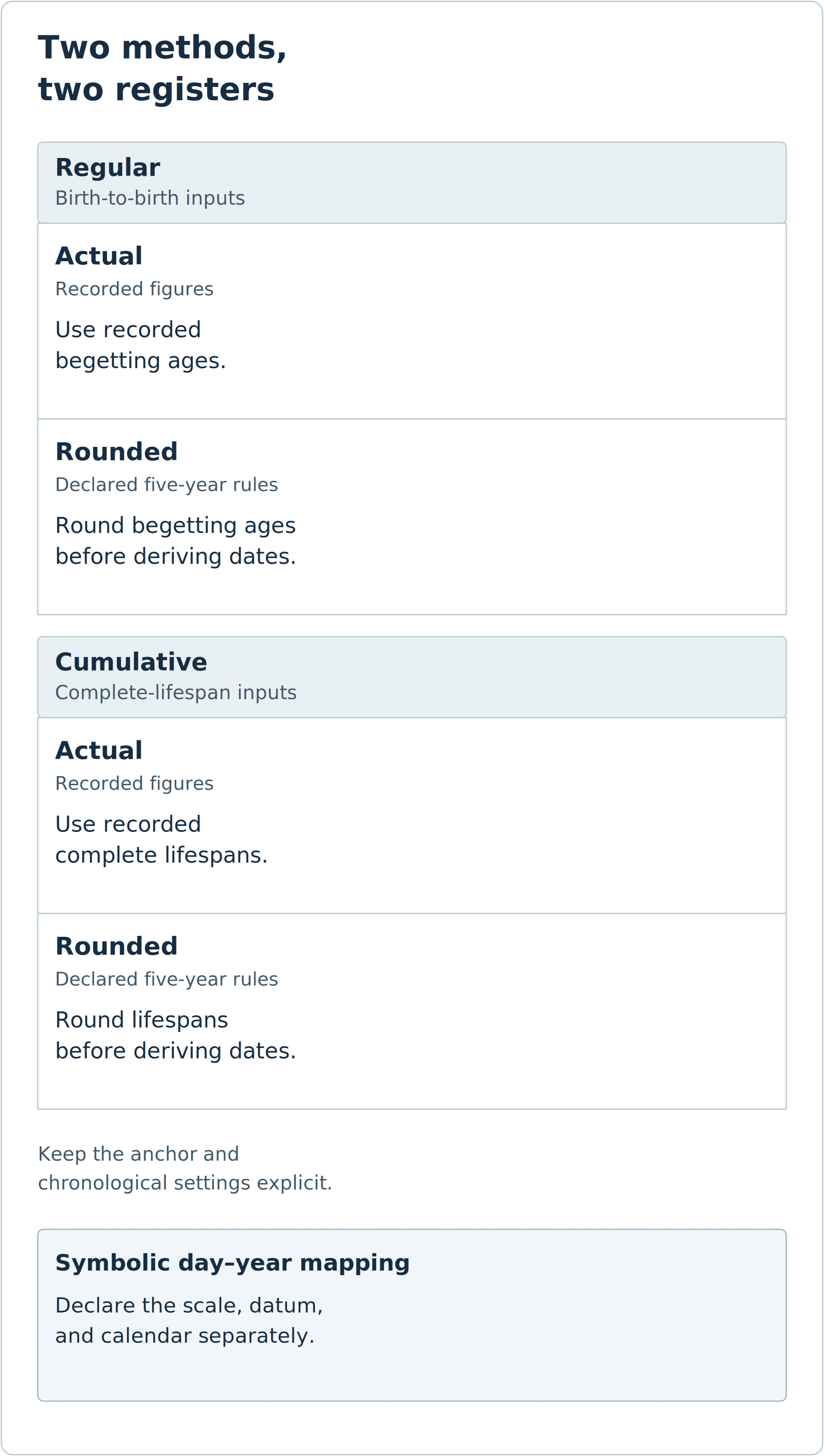
Two methods, two registers
| Method | Actual: recorded figures | Rounded: declared five-year rules |
|---|---|---|
| Regular | Use recorded begetting ages. | Round begetting ages before deriving dates. |
| Cumulative | Use recorded complete lifespans. | Round lifespans before deriving dates. |
Keep the anchor and chronological settings explicit.
Symbolic day–year mapping: Declare the scale, datum, and calendar separately.
This distinction helps explain why the website has both the precise cumulative reference table and a study of the 9900-Year Bridge in Rounded Biblical Chronology. Each has its own purpose. The bridge study provides directly linked Regular rounding calculations and Cumulative rounding calculations, so the reader can see how its figures were obtained.
Check the settings before comparing dates
The normal framework here is the Masoretic Text (MT), with Nisan, the spring month, as the usual calendar setting, 430 years in Egypt, no additional 60 years for Terah, and no restored second Cainan. In that Regular framework, the principal dates are Creation at 4114 BC, the Flood at 2458 BC, and Abram’s birth at 2166 BC.
Other settings are useful when a study calls for them. The Samaritan Pentateuch (SP) and the Septuagint (LXX) preserve different chronological readings. The additional 60 years for Terah is also used frequently, but it is an explicitly identified alternative. The sojourn introduction and its comparison table give an accessible example of why these distinctions matter.
Before comparing two dates, check their tradition, method, numerical register, and anchor. Also check any named adjustment or calendar convention. A source table may begin from a different declared comparison state; its heading and accompanying explanation tell you which one. A difference between two printed dates can arise from their settings rather than from an error.
When days symbolize years
A symbolic calculation introduces another relationship: a stated number of days, calendar units, or other units is mapped to years. To follow it, identify the scale, the datum from which counting begins, and the calendar and counting convention. A symbolic year label is not automatically a proposed historical date.
The Birth of Jesus day–year introduction provides a worked example, with a complete day table close at hand.
The Chronological Mirror reflects coordinates under a specified rule. Inverse studies reverse numerical digits. These are different operations, and their conventions should be read before using their results. Across the BC–AD Divide is the introductory route to the Mirror. Its explanations also show why civil BC–AD elapsed time must be distinguished from a specially defined display or symbolic span.
Choose a reading path
There is no need to read the entire website in sequence. Choose the question that interests you, read its introduction, and open the supporting table when you want to examine the calculation.
| Your starting question | Begin here | Open the calculation |
|---|---|---|
| How are ordinary dates derived? | Reading the Regular tables | Regular MT table |
| What happens when complete lifespans are added? | Cumulative chronology | Complete MT lifespan ledger |
| What does rounding make easier to see? | The 9900-Year Bridge | Regular inputs · Cumulative inputs |
| Why do sojourn chronologies differ? | The Exodus Sojourn | What the 430 years include |
| Can I begin with one focused numerical study? | Peleg and the Division of the Earth | The lifespan-halving framework |
An introductory article presents the central relationship. Its appendix or supporting-table page supplies the derivation. A detailed companion develops additional relationships where they are useful. The exact source-file links let you follow the explanation back to its controlling definitions.
Where the definitions are controlled
The Knowledge Catalog is the starting point for the authoritative sources. For the distinctions in this guide, consult:
- File 18 — Chronological Data Tables, §0.1 for the working settings, §§1.4–1.6 for deriving dates and named adjustments, and §§6–6A for the cumulative method and MT ancestral trunk.
- File 09 — Cumulative Architecture, §0 and §0.3.1 for the construction and its node classes; Appendix A for the phase-resolved Mirror.
- File 51a — Rounded Scaffold, §2.1 and §§16.1–16.2 for rounding the inputs and propagating the resulting chronology.
- File 17 — Prophetic Time-Span Anatomy, §§13A.1–13A.3 for textual date data and the declared 360-day calendar mapping.
Use the current files and applicable amendments when following a relationship into greater detail. The reading paths above provide a manageable beginning; the tables and sources remain available whenever you need them.
The Holy Bible, Berean Standard Bible, BSB is produced in cooperation with Bible Hub, Discovery Bible, OpenBible.com, and the Berean Bible Translation Committee. This text of God’s Word has been dedicated to the public domain.