First Chronicles 12 describes a national gathering at Hebron: men from Israel’s tribes come to make David king. Among the thousands of warriors, two small leadership counts invite closer attention—Zadok’s 22 commanders and Issachar’s 200 chiefs. Their relationship to Levi’s 4600 and the wider tribal totals forms the starting point of this study.
Now these are the numbers of men armed for battle who came to David at Hebron to turn Saul’s kingdom over to him, in accordance with the word of the LORD:
Read the complete list in its biblical order. Here, census means the enumerated gathering in 1 Chronicles 12:23–37; it is distinct from David’s later census in 1 Chronicles 21. The proposal is that the Hebron list carries a secondary numerical structure alongside its account of allegiance to the king.
Read the list before adding it
The passage mixes troop bodies, commanders, and named leaders. These require different counting decisions. Issachar’s 200 are chiefs with an unnumbered body of kinsmen under their authority. Naphtali has two printed figures: 1000 commanders and 37000 men. The eastern 120000 is a single joint figure for Reuben, Gad, and the half-tribe of Manasseh beyond the Jordan.
The most consequential question concerns the Levites. BSB presents Jehoiada and his 3700 men as included within Levi’s 4600. The Hebrew sequence has also been read additively. The study therefore distinguishes a count that treats the groups as overlapping from a numerical ledger that adds the displayed figures separately. It does not require the latter to be the ordinary headcount.
Four western totals make the choices visible:
| Western total | How it is formed |
|---|---|
| 217100 | Jehoiada’s 3700 is treated as included in Levi’s 4600; Zadok’s 22 commanders are not added. |
| 217122 | The preceding total plus the 22 commanders. |
| 220800 | Jehoiada’s 3700 is added separately; the 22 is reserved for the proposed key. |
| 220822 | Every printed western figure is added, including the 22. |
Even the first total is a minimum under its stated conventions, not a complete count of every person present: Issachar’s kinsmen remain unnumbered. The 220800 total is the selected base for the calculation below. The supporting tables show every addition and preserve all four alternatives.
Zadok’s 22 and the Key of 23
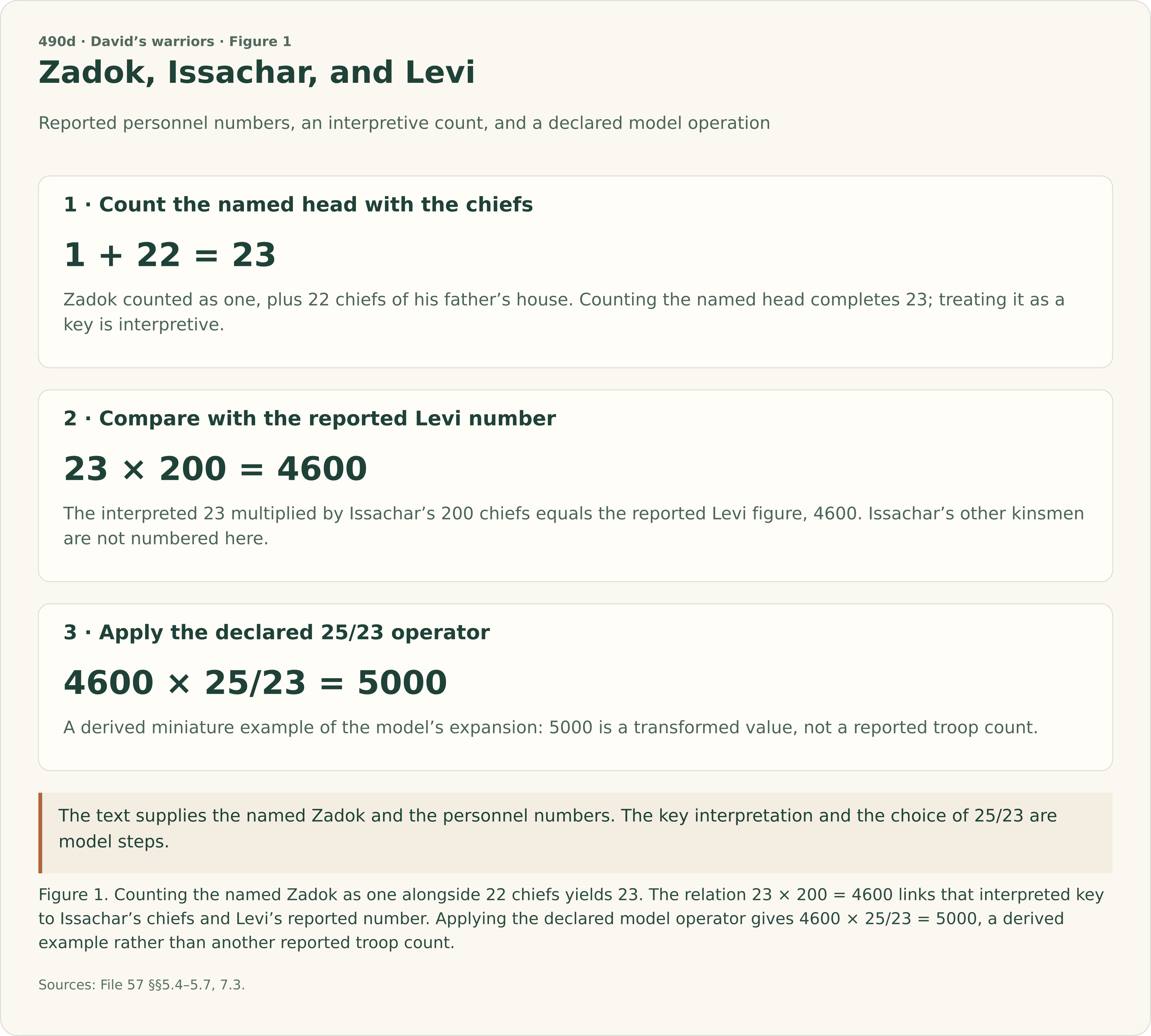
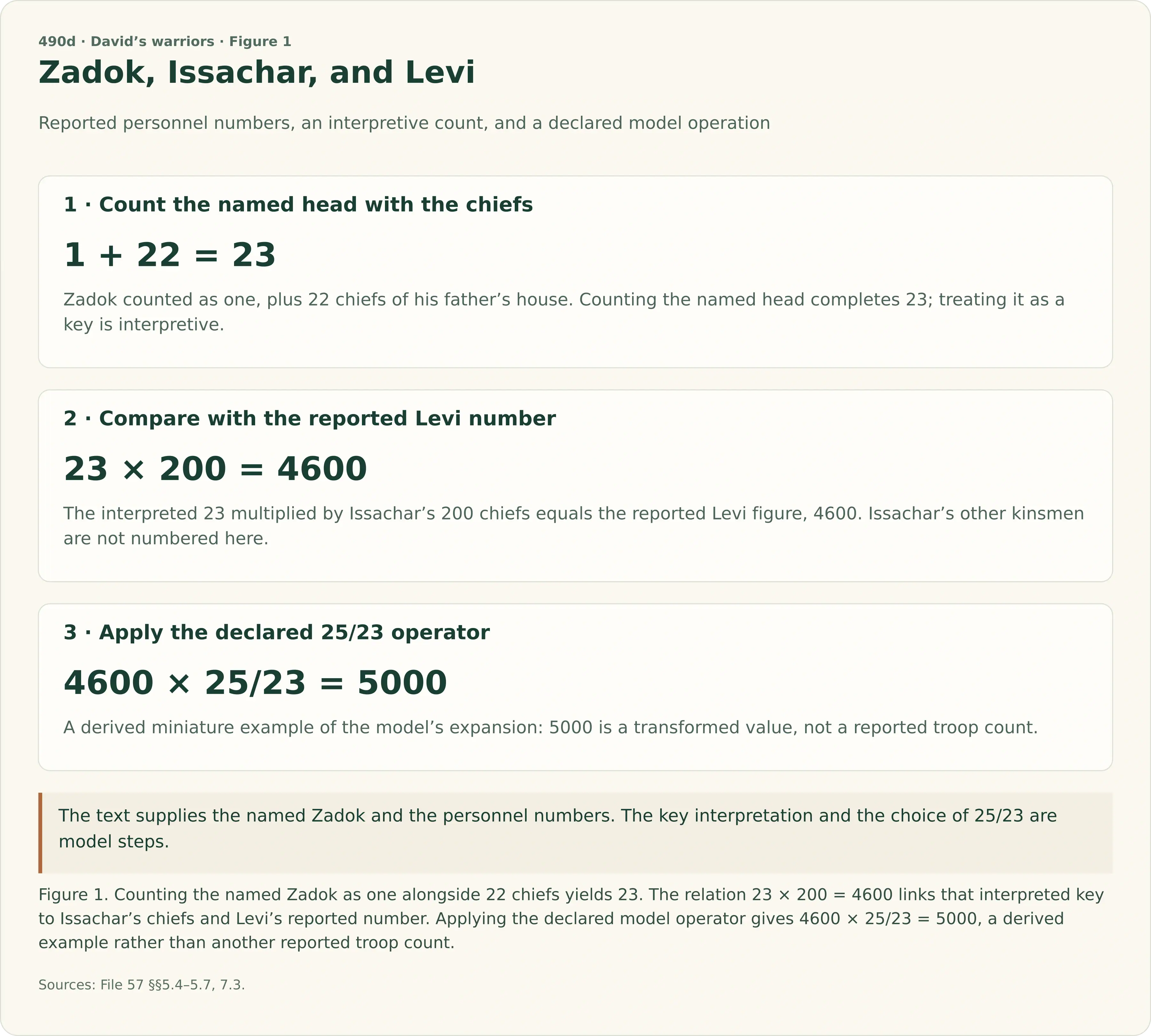
First Chronicles 12:28 names Zadok and gives 22 commanders from his father’s house. Counting the named leader together with those commanders produces:
22 + 1 = 23.
The 22 is explicitly stated; counting Zadok as the additional member is an interpretive step. The further proposal is that this completed 23 signals the divisor used in the Key of 23: multiplication by 25/23. The verse itself does not state that formula.
Levi’s figure provides a simple example:
4600 = 23 × 200
4600 × 25/23 = 5000.
The 200 is also the number of Issachar’s chiefs. Thus (22 + 1) × 200 = 4600 connects the two leadership entries with the Levitical body. The resulting 5000 is a transformed value, not a corrected reading of Levi’s troops.
490d · David’s warriors · Figure 1
Zadok, Issachar, and Levi
Reported personnel numbers, an interpretive count, and a declared model operation
1 · Count the named head with the chiefs
1+ 22= 23
Zadok counted as one, plus 22 chiefs of his father’s house. Counting the named head completes 23; treating it as a key is interpretive.
2 · Compare with the reported Levi number
23× 200= 4600
The interpreted 23 multiplied by Issachar’s 200 chiefs equals the reported Levi figure, 4600. Issachar’s other kinsmen are not numbered here.
3 · Apply the declared 25/23 operator
4600× 25/23= 5000
A derived miniature example of the model’s expansion: 5000 is a transformed value, not a reported troop count.
Sources: File 57 §§5.4–5.7, 7.3.
Read the calculation and scope
File 57 §§5.4–5.6 distinguishes the named Zadok and 22 chiefs as textual data from the proposed key interpretation. Counting the named head gives 1+22=23; multiplying by Issachar’s 200 chiefs gives 4600. The 25/23 operation is a predeclared model choice, not a fraction supplied by the verse. The local 4600→5000 example is derived for this introductory diagram. File 57’s explicit larger-scale application uses 46000→50000, and §7.3 applies the same operator to the western subtotal. This diagram does not reconstruct the headcount of Zadok’s whole household or Issachar’s unnumbered kinsmen.
Open the full-resolution image version

There is a larger comparison within the list itself. Adding the displayed figures from Judah through Ephraim, while keeping the 22 outside the subtotal, gives 46000. Applying the same ratio yields 46000 × 25/23 = 50000—the number later stated for Zebulun. This is an exact relation between an earlier subtotal and a later entry; its explanation as deliberate design remains an interpretation. The full calculation shows the original sequence.
Issachar and the 364-day year
Issachar is the seventh tribal entry, with Jehoiada and Zadok classified within Levi.
Issachar receives a distinctive description:
From Issachar, men who understood the times and knew what Israel should do: 200 chiefs with all their kinsmen at their command.
Immediately before Issachar’s 200 chiefs stands western Manasseh’s 18000. Keeping those adjacent entries together gives:
18000 + 200 = 18200.
Their calendar comparison is transparent:
50 × 360 + 50 × 4 = 50 × 364.
The first figure corresponds numerically to 50 units of a 360-day year. The second supplies the additional 4 days for each unit, producing 50 units of the 364-day calendar. That calendar contains 52 weeks, or four seasons of 91 days, as explained in The 364-Day Calendar: Weeks, Seasons, and Sacred Time.
490d · David’s warriors · Figure 2
Adjacent counts and a 364-day year
A numerical comparison between printed personnel numbers and calendar units
Adjacent printed personnel numbers
18000+ 200= 18200
Western Manasseh: 18000. Issachar: 200 chiefs; their other kinsmen are unnumbered.
Separate calendar-unit comparison
50 × 360+ 50 × 4= 50 × 364
The added 200 corresponds numerically to fifty four-day differences.
One 364-day year: 52 × 7 = 4 × 91 = 364 days
Sources: File 57 §6.2; File 12 §0.1 (calendar states), §5.2 (91-day quarters).
Read the calculation and scope
File 57 §6.2 derives the list-based 18200 directly from adjacent printed personnel numbers, 18000+200. Factoring the two addends gives 50×360 and 50×4, and their sum is 50×364. File 12 controls the distinct 360-day and 364-day calendar states. The identity is exact, but it does not identify fifty 360-day years with fifty 364-day years without the added 200 day units. Issachar’s 200 counts chiefs, not all of their unnumbered kinsmen. The same numerical total elsewhere in a rounded display does not make that separate source state identical to this list-derived sum.
Open the full-resolution image version

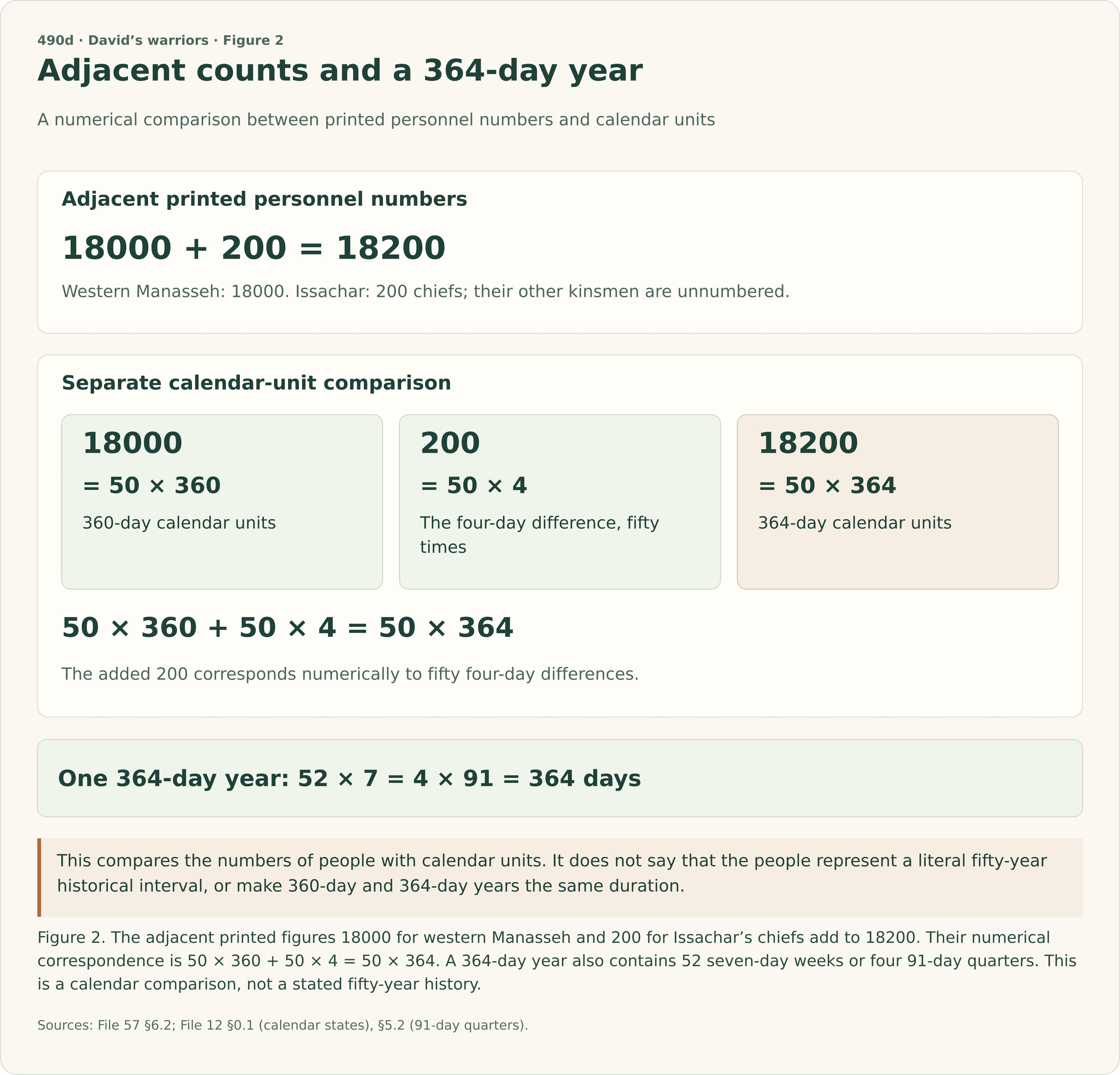
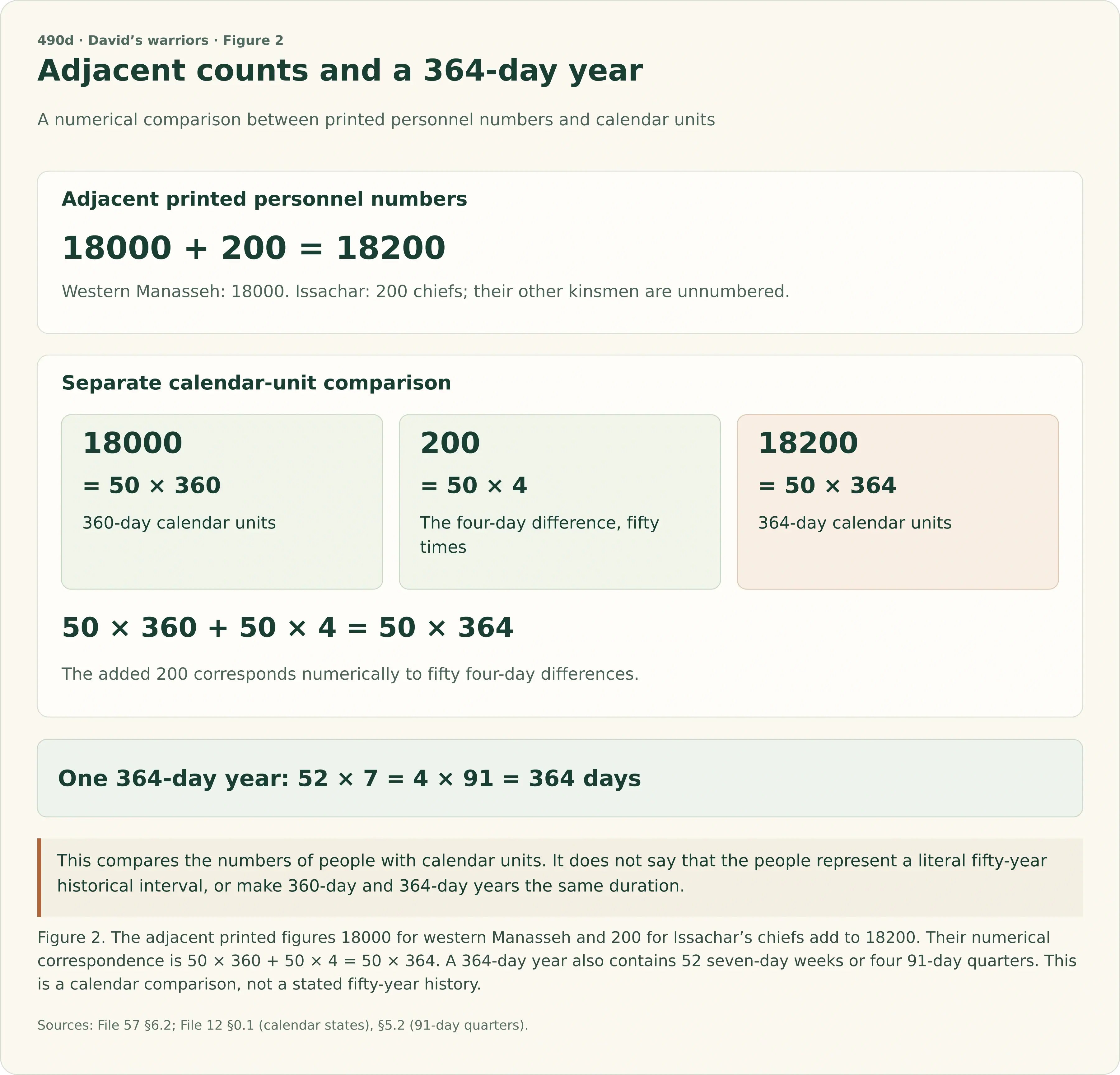
This comparison changes the unit of interpretation: the biblical passage counts people, while the equation compares their numbers with calendar days. It does not say that the men served for 50 years or that Issachar operated a documented calendrical school. Their understanding of the times gives the comparison a literary setting; identifying their precise professional knowledge goes beyond the text.
Issachar’s 200 also measures every subsequent western number: Zebulun’s 50000, Naphtali’s 1000 and 37000, Dan’s 28600, and Asher’s 40000 are all exact multiples of 200. The unit table makes that wider role visible.
From the western ledger to a national whole
We can now apply the declared ratio to the complete selected western base. This ledger adds Jehoiada’s 3700 separately and keeps Zadok’s 22 outside the subtotal as the proposed key. It preserves the biblical order and requires no splitting, duplication, or reversal of entries.
The western total factors as:
220800 = 460 × 480.
The Key of 23 changes the 460 factor to 500 while leaving 480 fixed:
220800 × 25/23 = 500 × 480 = 240000.
The eastern 120000 is then added without transformation:
240000 + 120000 = 360000.
490d · David’s warriors · Figure 3
From the selected western ledger to 360000
A declared subtotal, a model transformation, and a two-to-one result
Add the reported eastern number
240000+ 120000= 360000
The reported eastern figure is added after the western transformation. The result is a transformed national total, not a reported headcount.
Three equal shares of the transformed total
The bar represents a 2:1 ratio within 360000.
Sources: File 57 §§4.4–4.5, 7.1–7.4.
Read the calculation and scope
File 57 §§7.1–7.4 controls the chosen western cipher base and national-thirds comparison. The selected western subtotal is 220800, not the all-printed western 220822: it treats Jehoiada’s 3700 as additional but withholds the 22 chiefs as a key. The numerical transformation is 220800×25/23=240000. The eastern printed number remains 120000, giving 240000+120000=360000 and a 2:1 relation. No extra 22 or named Zadok is added after that selection. Other possible personnel and printed-number ledgers are distinguished in the article’s ledger table; this diagram uses only the declared selected subtotal.
Open the full-resolution image version

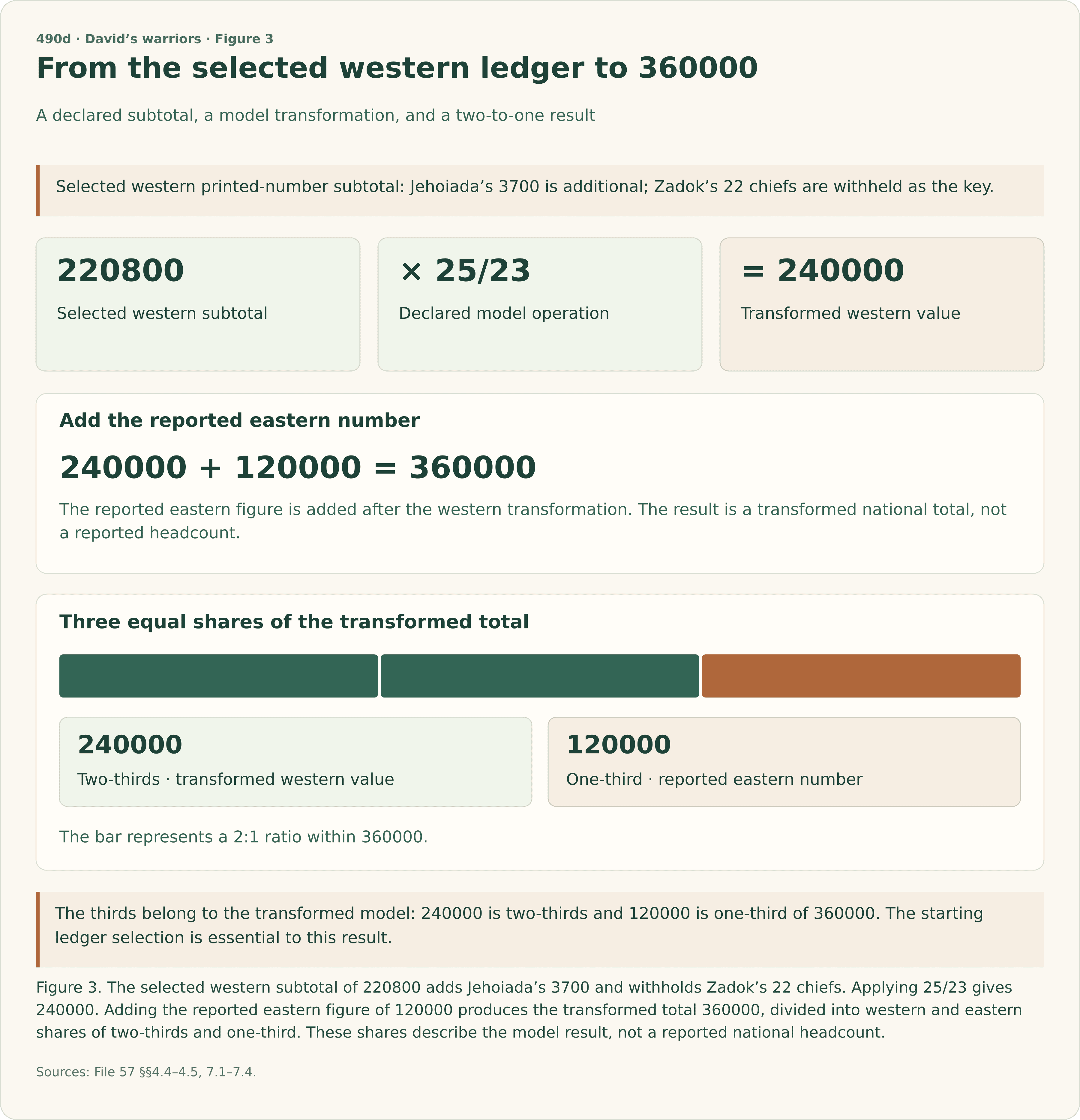
Within this transformed total, the west supplies two-thirds and the east one-third. The untransformed sum of every printed figure is 340822, including the 22 commanders. The 360000 belongs to the declared numerical model; it is not a replacement army headcount.
The factors also connect the list with Temple chronology. In the chronology used here, 1446–966 BC spans 480 years from the Exodus to the Temple foundation. A schematic 20-year Temple-and-palace construction envelope, 7 + 13, reaches 946 BC; that endpoint is 460 years after the Conquest at 1406 BC and 500 years after the Exodus. Thus the transformation 460 → 500 compares two origins with the same schematic endpoint. The chronological table distinguishes these reconstructed dates from the biblical durations and explains why 946 BC is a whole-year model endpoint.
What the pattern contributes
The strongest case rests on relationships that can be inspected in the list: the small leadership counts, the contiguous Manasseh–Issachar pair, the repeated 200-unit measure, and the full western total. None requires an invented number of Issacharite kinsmen or an altered sequence.
The text supplies the numbers. Addition and multiplication establish the displayed relationships. Choosing Zadok’s completed 23 as a key, withholding the 22 from the transformed subtotal, and interpreting the results calendrically are further steps in the argument. They should remain visible rather than being presented as explicit biblical instructions.
I read this numerical order in relation to the narrative’s national and priestly themes: the tribes assemble around David, priestly leaders have a distinct place, and Israel acts together to establish the kingdom. The calendar and Temple comparisons extend that movement toward ordered sacred service. They offer a coherent theological reading without turning exact arithmetic into a statistical proof of ancient intent.
For the full source list, alternative totals, cumulative additions, and the companion 70/69 calculation, see David’s Warriors: Source Tables and Calculation Notes. The calculations are documented in File 57, especially §§4–7 and Appendices B/D; File 12 controls the calendar distinctions. This introduction opens the local argument; the more extensive cross-list and deep-time comparisons belong to a detailed study.
Scripture quotations: Berean Standard Bible (BSB), public domain.