Constants studies · Alpha (1/137) · Pi (π) · Phi (Φ) · Euler’s number (e) · Square root of two (√2) · π and √2 together
Appendices · Pi · Phi · Euler’s e · √2 · π and √2 · Creation Pillars
The series culminates in The Rounded MT Trunk. Its map shows how π and √2 shape the circles and squares of the Rounded Masoretic Text chronology, and where Φ, α and e fit that pattern from Creation to Christ.
Source · Canonical file index
Supplementary research appendix · Part I: 16 November 2026 · Part II: 17 November 2026 · Parts III and IV: 18 November 2026. Sections 1–9 preserve the original critical assessment and its cautious evaluation of local geometric comparisons. The later Part II continuation records the larger MT Mirror and SP–LXX discoveries subsequently developed from research scratchpad v43–v46. Part III records why the 560-year square-and-circle construction at the Exodus failed when tested within each manuscript. Part IV traces the square diagonal from Rounded MT Shem to the Conquest Mirror. This page supplements, but does not silently replace or alter, the separate main square-and-circle article and original technical appendix.
1. Purpose and principal conclusion
A detailed exploratory discussion following the published π–√2 square-and-circle study considered possible connections at Regular and Rounded Creation, their cumulative counterparts, the Key of 23, the Book of Jubilees (BJ), Samaritan Pentateuch (SP), and Sumerian King List (SKL) comparison states. The exercise generated many exact numerical equalities, but not all equalities carry equal evidentiary weight. Its most useful result was a decision to return from local numerical resemblance to the larger chronological architecture.
The principal conclusion is to retain 4206–4106 BC as the “Creation Pillars,” a 100-year comparison framework, while treating the more elaborate local π-, √2-, triangle-, circumference-, and perimeter-matches as provisional or low-priority. The term “Pillars” describes the repeated involvement of these nodes in the chronology and their controlled comparison with the canonical Main Pillars. It is a research classification, not a claim that the ancient biblical texts literally name these absolute dates.
Three questions must remain separate: (1) Is a numerical equality exact? (2) Are its endpoints and operations independently justified within the 490d source chronology? (3) Does the comparison establish an intentional ancient design? An affirmative answer to the first or second does not automatically settle the third.
2. Evidence register and boundary discipline
| Category | What can be maintained | Necessary qualification |
|---|---|---|
| Source-controlled chronology | Actual and Rounded MT variants; cumulative Creation dates; native SP states; the canonical SKL and Pillar coordinates. | Absolute BC/AD positions are schematic reconstructions within the specified 490d model, not dates stated verbatim in the ancient sources. |
| Exact derived arithmetic | 100/99, 70/30, 115/215/315, specified Key-of-23 expansions, 33,600-year translations, and relevant factorisations. | A derivation from common inputs is not an additional independent confirmation. |
| Cross-register alignment | Connections to the pre-existing Main Pillars, SP/BJ heptads, SKL variants and already identified MT dates. | Source roles, calendar conventions, event phases and held-fixed endpoints must be stated. |
| Proposed interpretation | The Creation Pillars may function as a smaller-scale counterpart of the Main Pillars. | The underlying arithmetic is firm within the model; intentional architectural correspondence remains a hypothesis. |
| Exploratory geometric overlay | New comparisons with 220, 311, 396, 440 and related square/circle measures. | Numerically correct matches can still be selected from a crowded field of permissible dates. |
Controlling rule: keep the Regular/actual Creation week as a seven-year envelope, with its internal year boundaries, and keep the Rounded Creation register in its canonical five-year Year-1-to-Year-6 presentation. A possible extra two-year Rounded extension remains an explicitly marked, Creation-specific hypothesis, not the default rule. The possibility of straddled 99-year comparisons must not be erased by forcing every Regular boundary onto a mod-5 grid.
The same numeral can refer to distinct chronological objects. In particular, 4206 BC functions both as the native SP Creation-week opening and, in a different MT construction, as a Regular Year-6 coordinate with +60 Terah and +30 Adam apparent-age overlays. These are not the same textual event or the same derivation. Likewise, cumulative 14006 BC carries distinguishable actual-internal and Rounded roles.
3. The Creation Pillars: 4206–4106 BC
| Coordinate | Defined role in this comparison |
|---|---|
| 4206 BC | Regular/actual MT Year-6 coordinate with +60 Terah and +30 Adam apparent-age overlays; also separately a native SP Creation coordinate. |
| 4176 BC | The corresponding Regular Year-6 coordinate with the +60 Terah overlay alone. |
| 4136 BC | Rounded 4106 BC with +30 apparent-age overlay; an important internal comparison state. |
| 4116 BC / 4114 BC | Ordinary actual Regular Year-6 opening / Creation completion, respectively. |
| 4106 BC | Canonical Rounded Regular Creation Year-6 coordinate; opposite Creation Pillar. |
The first central identity is 4206 − 4106 = 100 years. The interval has two equally exact, source-defined decompositions: 4206 → 4176 → 4106 = 30 + 70 and 4206 → 4136 → 4106 = 70 + 30. The appearance of 70 is therefore not the product of an arbitrarily inserted date: it follows from the independently named +60 and +30 chronological overlays and the Regular–Rounded comparison. At the neighboring boundary, 4205 − 4106 = 99; the 99-year straddle is valid even while 100 remains the governing whole-number Pillar span.
The resulting pair 99/70 has a close numerical relationship to √2, but the chronological relationship should stand before that interpretation. The two 30+70 decompositions share inputs and must not be presented as separate statistical discoveries.
4. The cumulative Creation anchor and the 115–315 bracket
The cumulative MT Year-6 coordinate at 14006 BC supplies the already established comparison 14006 − 4206 = 9800 and the canonical Rounded comparison 14006 − 4106 = 9900. The earlier square-and-circle publication also records the actual matching bridge 14006 − 4116 = 9890, preserved between the corresponding Creation completions 14004 − 4114 = 9890. These different results reflect declared states; they are not interchangeable roundings of the same endpoints.
Within the lower −215-year Sojourn variant, four source-recognized Creation reference coordinates give the following matrix:
| Upper Creation reference | To 3991 BC: lower actual overlaid state | To 3891 BC: lower Rounded state |
|---|---|---|
| 4206 BC | 215 | 315 |
| 4106 BC | 115 | 215 |
The four-anchor matrix yields 115 → 215 → 315 in two 100-year steps, with 215 as the midpoint. The minimum in this specified matrix is 115 = 5 × 23. Under the established Priestly Key-of-23 operator, 115 × 25/23 = 125, a gain of ten years. Holding 3991 BC fixed moves the upper end from 4106 to the already recognized 4116 BC; holding 4106 BC fixed instead moves the lower end from 3991 to the derived 3981 BC, which may be compared with its stated 90-year overlay removal. These are alternative applications of one operation, not independent proofs.
The complementary Rounded Year-1 boundary is 3896 BC: 4206 − 3896 = 310, whereas 4206 − 3891 = 315. The five-year difference belongs to the canonical Rounded block. 315 does not “round to” 310 under nearest-five rounding; the two values represent different chronological endpoints. The 115 and 315 extremes are relative to the specified four-anchor matrix, not the largest possible distance among all seven-year Regular boundaries.
5. Connection to the canonical Main Pillars
The name “Creation Pillars” gains its strongest large-scale support from an already documented 33,600-year translation, using ordinary elapsed-year arithmetic across BC and AD (BC + AD − 1, with no historical year zero).
| Creation coordinate | +33,600 elapsed years | Evidence role |
|---|---|---|
| 4206 BC | AD 29395 | Existing canonical Main-Pillar anchor. |
| 4136 BC | AD 29465 | Existing canonical Boaz comparison. |
| 4106 BC | AD 29495 | Generated translation; not a canonical Main-Pillar endpoint. |
The Creation Pillars divide their 100 years as 70 + 30. The established Main-Pillar extent, AD 29395–29515, divides its 120 years as 70 + 50. The shared 70-year segment is exact, but the outer endpoints differ by 20 years: AD 29495 is not AD 29515. The projected third point should never be substituted for the canonical Jachin endpoint.
The factorisation 33,600 = 100 × 336 uses the 490d schematic Priestly 336 day-year number scaled into a year-number; it does not assert that 33,600 civil years literally equal one hundred physical 336-day years. Since the 33,600-year translation itself preserves 70- and 30-year offsets by definition, the resulting internal parallels are a controlled expression of one macro correspondence rather than three independent coincidences.
5A. The Creation Pillars across the Mirror: 8,280 and the 69→70/75 boundary
The canonical cross-polarity Mirror gives another source-controlled reason to prioritize the Creation Pillars over local geometric near-matches. The Regular +60 Terah Creation envelope runs from 4181 BC (Year 1) through 4176 BC (Year 6) to 4175 BC (Year 7 opening). The comparison with 4106 BC, the Rounded Creation Pillar, therefore retains both the full seven-year Regular phase resolution and the canonical five-year Rounded presentation. The named 30/29 and 70/69 alternatives are boundary states, not free-standing extra chronological systems.
| Comparison | Exact value | Significance |
|---|---|---|
| 4206 → 4176 → 4106 BC | 30 + 70 = 100 | Full Creation-Pillar interval, Regular Year-6 boundary. |
| 4205 → 4176 → 4106 BC | 29 + 70 = 99 | Adjacent-year straddle underlying working 99/70. |
| 4181 → 4176 → 4175 BC | 5 + 1 = 6 | Actual +60 Terah Creation Year-1 to Year-7 openings. |
| 4175 → 4106 BC | 69 = 3 × 23 | Neighboring Year-7-to-Rounded boundary. |
| 4176 → 4106 BC | 70 | Year-6-to-Rounded boundary. |
| 4181 → 4106 BC | 75 | Full +60 Terah Year-1 opening to Rounded boundary. |
The 69-year interval has two distinct, exact Key-of-23 expansions: 69 × 70/69 = 70 (a one-year gain) and 69 × 25/23 = 75 (a six-year gain). With 4106 BC held fixed, these expanded lengths reach the already established 4176 BC and 4181 BC Creation boundaries, respectively. This is a compact local transition among 69, 70, and 75, governed by the native 5+1 year spread. Because the 70- and 75-year targets are themselves adjacent phases of the same Creation week, the two landings must be understood as one constrained boundary family, not as two statistically independent demonstrations.
Mirror lock: In ordinary no-year-zero elapsed-year arithmetic, 4176 BC → AD 4105 = 4176 + 4105 − 1 = 8280; AD 4105 is the Protocol-1 mirror coordinate of 4106 BC. The equivalent one-year-translated civil interval is 4175 BC → AD 4106 = 4175 + 4106 − 1 = 8280. The same number may be expressed in a Rounded signed-coordinate convention using the labels 4176 BC and AD 4106, where the assigned coordinate width is 4176 + 4106 − 2 = 8280; it must not be confused with their ordinary civil elapsed span, which is 8281. Thus these are phase/coordinate representations of a single lock, not three independently verified 8280-year intervals.
The key factorization is 8280 = 23 × 360 = 5 × 1656. Applying the established Priestly operator gives 8280 × 25/23 = 9000 = 25 × 360, a gain of 720 = 2 × 360. The 1656 connection is the Actual MT pre-Flood backbone, contrasted in the Rounded Scaffold with the 1650-year backbone. This exact 8280/720 Mirror relationship was already noted in the canonical research; its importance here is that it independently locates the previously identified 4176/4175 and 4106 boundary family in that pre-existing macro structure. See the canonical inverse/Mirror technical notes (File 52b) and the Rounded Scaffold and Cross-Polarity Mirror protocol.
Evidence assessment: This belongs with the stronger structural Creation-Pillar findings: established chronological endpoints, named Mirror protocol, and predeclared Key-of-23 operators. The exact arithmetic is secure within those conventions, while the assertion that it reflects intentional ancient design remains interpretive. It reinforces the priority of the 4206–4106 BC framework; it does not rescue the more speculative 220/311/396/440 local geometry.
5B. The 357–360–363 Mirror progression and the Year-6 boundary seam
A more precise arithmetic progression underlies the 8,280-year observation. With ordinary no-year-zero civil counting (BC + AD − 1): 4106 BC → AD 4106 = 8211 = 357 × 23; 4175 BC → AD 4106 = 8280 = 360 × 23; and 4175 BC → AD 4175 = 8349 = 363 × 23. Each successive gain is 69 = 3 × 23. The three rows use different fixed endpoints (first the AD coordinate is held fixed, then the BC coordinate); they are a structured arithmetic progression, not three strict reflections under one unchanged Mirror operation.
| Comparison | Civil elapsed years | Relation |
|---|---|---|
| 4106 BC → AD 4106 | 8211 = 357 × 23 | Starting endpoint pair |
| 4175 BC → AD 4106 | 8280 = 360 × 23 | +69 at the BC endpoint |
| 4175 BC → AD 4175 | 8349 = 363 × 23 | +69 at the AD endpoint |
The seasonal pair removes any ambiguity about the principal 8280 span. The end of the +60 Terah Regular seven-year Creation envelope is 4175t/4174n BC. The Rounded comparison 4107t/4106n BC is reflected by the canonical seasonal Mirror as AD 4106t/4107n, not as AD 4107t/4106n. Tishri-to-Tishri gives 4175 + 4106 − 1 = 8280; Nisan-to-Nisan gives 4174 + 4107 − 1 = 8280. The doubled suffix crossing is the standard File 09 convention, not an extra year inserted for the result.
The Mirror uses January 1, AD 1 as its global coordinate origin. In the paired seasonal orientations, the local midpoints occupy equal and opposite −34/+34 elapsed-year coordinates; the positive coordinate +34 is labeled AD 35 because AD 1 is coordinate zero. This is a technical distinction between civil year labels, elapsed-year coordinates, and the neighboring Year-6 (4176–4175 BC) inclusive/exclusive boundary carried across the Tishri/Nisan rails. It does not change either 8,280-year Mirror width or its 4,140-year half-span. The principal finding is the 8,280 = 360 × 23 lock and its declared Key-of-23 expansions; the 34/35 bookkeeping is retained only to keep the phases reproducible. See the canonical phase-center rules and the BC–AD counting appendix.
Each 8,280-year span is 2 × 4140. The exact midpoint of the reversed orientation 4106 BC → AD 4175 is AD 35: 4106 BC → AD 35 = 4140 and AD 35 → AD 4175 = 4140. This is the already-canonical Christological Mirror interval, not an inference that AD 1 itself lies 4,140 years from the endpoints. Its declared expansions are 4140 × 25/23 = 4500, gaining 360, and 4140 × 70/69 = 4200, gaining 60. If AD 35 remains fixed for the second operation, the earlier BC endpoint moves from 4106 to 4166 BC, the established Rounded +60 Terah coordinate. Holding a different endpoint fixed yields a different date and must be specified.
The older 4176 BC → AD 4105 = 8280 Actual-to-Rounded Protocol-1 statement, the new 4175 BC → AD 4106 = 8280 phase-neighbor civil statement, and the pure Rounded signed-coordinate width are compatible only when their rendering rules are kept separate. This extension strengthens the Creation Pillars hypothesis at a source-controlled Mirror scale, without promoting local π/√2 near-matches to established evidence. Cross-reference File 52b §13.3 and File 51a §23.3.
5C. One Creation-to-Fall node, two Mirror arms: 23 × 360 and 23 × 364
Central three-node claim. The following two calculations are not isolated near-matches. They use distinct phases of the same middle Creation-to-Fall node to connect across the cross-polarity Mirror with the two established outer Creation Pillars: (I) 4206t/4205n BC, the source-defined apparent-Adam Year-6 field (also a different native SP Creation state); (II) the Regular +60 Terah Creation-to-Fall complex, including Year 6 4176t/4175n, Year 7 4175t/4174n, Year 13 4169t/4168n, and Year 14 4168t/4167n BC; and (III) 4106 BC, the Rounded Creation Pillar. The seven years from the middle node’s Year-7 opening to its Year-14 opening are a schematically inferred second heptad, not an explicit biblical Fall date. The previously suggested 4166 BC is not a Year-13 or Year-14 boundary in this stated register.
| Middle Creation-to-Fall phase, BC | Outer Pillar reflected in AD | Exact Mirror width | Priestly expansion ×25/23 |
|---|---|---|---|
| 4175t/4174n, Year 7 | AD 4106t/4107n, third Pillar reflection | 8280 = 23×360 | 9000, gain 720 |
| 4168t/4167n, Year 14 | AD 4205t/4206n, first Pillar reflection | 8372 = 23×364 | 9100, gain 728 |
The defining relationship between the two arms is 8372 − 8280 = 92 = 23×4. It is also exactly (4205 − 4106) − (4175 − 4168) = 99 − 7 = 92: the 99-year, straddled separation of the two reflected Pillar members, less the seven-year movement across the middle node’s Creation-to-Fall heptad. Under the common 25/23 operation the interval lengths become 9000 and 9100, differing by 100, the full 4206–4106 BC Creation-Pillar number. These equalities follow together from the specified endpoints and the chosen common operator: the 92 and the expanded 100 are a single structured mechanism, not independent statistical confirmations. The comparison of the 360 and 364 calendar modules is meaningful within Enochic reckoning (360 ordinary day positions plus four seasonal days on the 364-day scheme); the author’s circle-and-Enoch interpretation is developed in the published √2 study, especially §8, and the combined square-and-circle article.
| Mirror direction and matching seasonal phases | Elapsed-year calculation | Value |
|---|---|---|
| Fall-boundary 4168t BC → AD 4205t | 4168 + 4205 − 1 | 8372 |
| Fall-boundary 4167n BC → AD 4206n | 4167 + 4206 − 1 | 8372 |
| Apparent-Adam 4206t BC → AD 4167t | 4206 + 4167 − 1 | 8372 |
| Apparent-Adam 4205n BC → AD 4168n | 4205 + 4168 − 1 | 8372 |
Each matching comparison gives the same 8372 = 23 × 364 years. Under the established 25/23 Priestly operation it expands to 9100 = 25 × 364, a gain of 728 = 364 + 364. The distinction from §5A is informative: 8280 = 23 × 360 uses the schematic 360 module, while 8372 = 23 × 364 uses the Enochian 364 module. The 92-year difference is 23 × (364−360), a consequence of changing the calendrical module, not an additional independent Pillar confirmation. The expansion 8372→9100 and gain 728 also have prior canonical use, though in different inverse-chronology endpoint applications (see File 52c).
The source BC apparent-Adam reference 4206t/4205n must not be confused with the AD reflected rails 4205t/4206n or with the AD reflected Fall rails 4167t/4168n. The 8372-year result arises across BC and AD on the specified paired phases; a wholly BC-to-BC comparison of 4206 and 4168 gives 38 years, not 8372. Both reciprocal Mirror directions above express the same 364-based relation and should not be counted as separate discoveries.
The apparent-age 30-year overlay is independently defined by 4206 − 4176 = 30. If the proposed verbal connection “23 and seven years of Creation give thirty” means 23 + 7 = 30, that additive equality is correct but no corresponding independent 23-year chronological movement has yet been established in this comparison. The product 23 × 7 = 161 is not 30. The 30-year overlay should therefore be retained as a source-state premise, not claimed as the arithmetic product of the seven-year Fall span and the Key of 23.
Assessment: The Fall-heptad-to-Mirror 8372 result is an exact, reproducible candidate reinforcing the Creation Pillars at a second calendrical scale. Its evidentiary strength is conditional on the chosen second-heptad source phase and the predetermined cross-polarity Mirror. Its 360-to-364 relation is structurally informative; its intentional ancient meaning remains a hypothesis, and it does not raise any new local π or √2 correspondence to primary status. For the inherited Year-13/Fall framework see the main square-and-circle article and original technical appendix.
5D. The recovered one: Year 6, complete “times,” and divine covering
Controlling Christological hermeneutic. This study does not begin with geometry and subsequently attach a Christian meaning to an otherwise independent design. Its starting premise is the Christ-centered unity of Scripture: Jesus teaches that the Scriptures testify concerning him (John 5:39), reads Moses, the Prophets and the Psalms in relation to his fulfillment (Luke 24:27, 44), and insists that not even the smallest letter or stroke of the Law passes away apart from fulfillment (Matthew 5:17–18). The author consequently investigates whether a providentially ordered chronological and numerical grammar—under the same textual and calendrical constraints as the prose—also serves that witness to Christ. The statement that every stroke points to Christ is the author’s synthesis of these passages, not a single verbatim statement of Matthew 5:18. This is the declared interpretive framework for the Creation Pillars, not a newly invented explanation for their arithmetic. The critical test remains whether each proposed pattern is genuinely supported by source-controlled dates and reproducible operations.
The proposed theological interpretation of the Creation Pillars is reconciliation and restoration. The middle Regular +60 Terah Creation node has a Year-6 opening at 4176 BC and a Year-6 completion / Year-7 opening at 4175 BC; the third Pillar, 4106 BC, is itself a Rounded Year-6 opening. Accordingly, 4175→4106 = 69 becomes 4176→4106 = 70 when the neighboring Year-6 boundary is restored. The parallel apparent-Adam phase moves 4205→4106 = 99 to 4206→4106 = 100. Both gains of one arise from source-defined adjacent year boundaries, rather than arbitrary increments.
Geometrically, 99/70 ≈ √2 is the working diagonal ratio of the 70:70 square/triangle framework; the exact diagonal is 70√2 ≈ 98.994949, not 99. Theologically, 99→100 expresses the recovery of the missing one, while 69→70 supplies a parallel restoration of the unit in the Year-6 boundary accounting. These are distinct mathematical states: 100/70 = 10/7 does not retain the original √2 approximation. The number 100 signifies the completed hundred, not a supposedly more accurate value of √2.
The two Enochian Mirror arms complete the calendrical picture: 8280 = 23×360 → 9000 = 25×360 gains 720 = 2×360, and 8372 = 23×364 → 9100 = 25×364 gains 728 = 2×364. Interpreted symbolically, each gain is two complete annual circuits, or two “times,” using the 360-day and 364-day calendrical numbers. The Mirror durations and gains are year-number intervals under the day-year chronology; they are not literally 720 or 728 elapsed days between the ancient and reflected dates. The Enoch-and-circle setting belongs to the previously published √2 investigation and combined square-and-circle study.
In Genesis 3:9, God asks the hiding man, “Where are you?” In Genesis 3:21, God clothes the man and woman with garments of skin. A retrospective Christian canonical reading can bring this search and covering alongside the shepherd who seeks and recovers one missing sheep out of a hundred (Matthew 18:12–14; Luke 15:4–7). The combined study already connects the lost-one motif, Genesis 3:21, covering and Christological fulfillment. Yet Genesis does not literally designate Adam a sheep, name the animal species, narrate an animal’s killing, or date the garments to a feast day. Those details must not be presented as express historical statements of Genesis.
Evidence assessment within the stated hermeneutic: For the author, the chronological geometry is being tested as a possible second numerical witness to Christ alongside the canonical prose, not as a religious meaning appended to a supposedly neutral diagram. The 69/70 and 99/100 boundary comparisons and the two Mirror expansions are exact within the declared chronological system; their thematic convergence on the Shepherd seeking, the lost one recovered, and the fallen clothed is therefore a serious proposed Christological reading. The remaining question is not whether a Christ-centered interpretation is permissible under the study’s premises, but which individual constructions are sufficiently source-constrained to support it. That question still requires the local π, triangle, perimeter, and other near-matches to remain provisional unless they acquire independent chronological control.
5E. The 363-day Palindromic Calendar: 11², intercalation, and forgiveness
The earlier §5B Mirror triad already included 4175 BC → AD 4175 = 8349 = 363×23, an exact palindromic civil-year-label comparison under the ordinary no-year-zero rule 4175+4175−1. The BC 4175 boundary is the completion of Creation Year 6 / opening of Year 7 in the Regular +60 Terah state (Year 6 runs 4176→4175 BC). An alternative elapsed interval, 4176 BC → AD 4174 = 8349, uses different boundary labels; neither should be silently equated with 4176 BC → AD 4176, which would give 8351. The “palindrome” is therefore exact for the 4175/4175 labels, with its chronological phase identified, not a claim that all neighboring t/n rails produce the identical printed date.
| Mirror or derived comparison | Exact expression | Role |
|---|---|---|
| Middle→third Pillar, 4175 BC → AD 4106 | 8280 = 69×120 = 23×360 | Established 360-based arm |
| Year-6 completion across like-numbered BC/AD years, 4175→AD 4175 | 8349 = 69×121 = 23×363 | Intermediate palindrome and square factor |
| Middle→first Pillar, 4168 BC → AD 4205 | 8372 = 23×364 | Established 364-based arm |
| 8349 expanded by 70/69 | 8470 = 70×121 = 77×110 | Key-of-23 gain 121 |
Pre-existing 363-day calendar, not an invented intermediate unit. The author’s earlier 363-day Palindromic Calendar of Angels and Sumerian King List (published 11 July 2023) explicitly defines a 363-day base year and its two intercalation cycles: 121 additional days every 54 years, plus one additional day every 666 years. The resulting designed mean is 363 + 121/54 + 1/666 = 365 + 242/999 = 365.242242… days. The published proposal relates these cycles to the third of the angels, Enoch, the SKL, and reconciliation/atonement. Its 363-day year is thus an established author-defined schematic palindromic calendar with a reproducible leap method, distinct both from the ordinary 360-day prophetic year and the 364-day Enochian calendar. It is not being claimed that the ancient Book of Enoch explicitly transmits this particular 363-day intercalation method.
The central identity is 8349 = 69×121 = 69×11². Its 70/69 expansion converts the 69 into 70 while keeping the square 121 unchanged: 8349×70/69 = 8470 = 70×11², gain 121. This 121 is already the precisely identified Flood-day span 318−197 = 121 = 11² from the ark’s resting to the reconstructed olive-leaf dove in the combined π–√2 study. The chronological and Flood-day units differ: this is numerical correspondence in a day-year hermeneutic, not a claim that a 121-year interval literally equals 121 elapsed days.
The transformed result also factors as 8470 = 77×110 = 10×77×11. This is the appropriate exact relationship to 77; writing 77×11 alone would be ten times too small. Matthew 18:12–14 places the recovery of the one sheep alongside the ninety-nine, and Matthew 18:21–22 immediately links forgiveness with a seventy-seven/seventy-times-seven expression, depending on translation. The original combined article already joins that chapter to the circle’s seventy-seven-unit components. Here the 11² square, 69→70 recovery, and 77 factor supply a further Christological interpretation of a constrained interval, not independent proof of an intentional historical encoding.
Within the three-node two-arm Mirror, the progression is 8280 = 23×360 → 8349 = 23×363 → 8372 = 23×364, with successive differences 69 and 23. The middle value is no longer to be described as an unattested or newly postulated year-length: the 363-day Palindromic Calendar is a separately documented, intercalated system in the author’s earlier research. It also stands one day short of the 364-day Enochian base year. Its chronological palindrome 8349 = 69×11² converts under 70/69 to 8470 = 70×11² with gain 121—precisely the 121-day leap packet already stipulated for each 54-year intercalation in the 363-day system. The 121 also appears independently as the reconstructed Flood-day distance from Ark rest (Day 197) to the dove (Day 318), while 8470 = 77×110 supplies the forgiveness-number comparison. This gives the author’s Christ-centered restoration reading a stronger prior calendrical basis. Evidence guard: the interval, Key transformation, and published leap design are exact mathematical constructs; their thematic connection is a proposed reading, not independent historical proof that the ancient Enochic writers used this specific 363-day scheme. The 69, 121, 77 and 23 factors should still not be tallied as separate statistical confirmations.
6. The larger cumulative-to-Pillar scale
From 14006 BC to the canonical Main Pillars the respective civil elapsed-year intervals are 43,400 to AD 29395 and 43,470 to AD 29465. The first equals 10 × 4,340, recalling the earlier 4346 BC → 6 BC = 4,340 Key-generated interval. The second equals 630 × 69 = 207 × 210. Applying the declared 70/69 multiplier gives 44,100 = 210², a mathematically exact square, with a gain of 630.
This square formation is a potentially meaningful Pillar-scale geometric comparison because both the input span and the multiplier are prior chronological constructs. Nevertheless, its factorisation into 207 × 210 and the resulting 210 × 210 are consequences of the same arithmetic, not independent evidence of ancient geometric intention. A bilateral comparison that yields 44,730 and a total gain of 1,260 must be labeled separately from the single-interval 70/69 operation.
7. Wider witnesses: SP, Jubilees, and the SKL
SP and the Book of Jubilees. The source-controlled SP Creation week, 4206–4199 BC, lies 343 = 7³ years before the inferred preliminary Jubilees week 3863–3856 BC on matching phases; the subsequent BJ Eden/Fall week is 3856–3849 BC. The 3863 opening is an inference and should not be presented as an explicit biblical date. The SP and BJ 1,307-year Flood correspondences are exact under declared but different phases: SP 4199 → 2892 = 1307 terminates at the SP Flood close, while BJ 3856 → 2549 = 1307 terminates at the BJ Flood start. The matching 343-year offsets follow from the equal intervals and are not independent discoveries.
SKL variant and the Enochian Key. The canonical comparison places the Ubara-Tutu/Noah transition at 39486 BC and in its +6480 state at 45966 BC; these are 490d schematic alignments, not explicit absolute dates on the ancient SKL tablet. The interval 45966 − 4106 = 41860 = 140 × 299 accepts the distinct Enochian 300/299 operator: 41860 → 42000, generating 3966 BC with 45966 fixed. The resulting 3966 BC is the already recognized MT −215 Sojourn/+60 Terah Creation opening; from it to the 1446 BC Exodus are 2520 = 7 × 360 years. This is the strongest of the newly noticed SKL cross-register tests because the transformation terminates at a source-recognized MT state.
Precessional comparison. The other SKL interval 39486 − 4206 = 35280 = 490 × 72 corresponds to 490 degrees or symbolic “precessional days” only under the expressly schematic rate of 72 years per degree. It is not 490 ordinary days, and exact astronomical precession should not be presumed. The +6480 SKL state amounts to another 90 such units automatically.
LXX and other chronology families. Their wider place in the unified chronology motivated the investigation, but the particular follow-up calculations presented here do not independently demonstrate an additional LXX Pillar theorem. Any such claim requires a separate source-controlled date and endpoint ledger. This report does not count a general cross-tradition resemblance as a new verified result.
8. Findings retained as provisional or weak
| Proposed local correspondence | Assessment |
|---|---|
| 70π ≈ 220; 70√2π ≈ 311; 140π ≈ 440 | The geometric calculations are correct. Their newly proposed coincidences with selected Creation intervals require independent chronological endpoint justification. |
| Working 99/70, doubled 198, square perimeter 396 | The exact or approximate geometry is elementary; the recent Creation-specific alignments often employ neighboring internal-year boundaries or mixed chronology states. |
| 308 + 3 = 311; 308–311–315–322 | A suggestive 3+4+7 ordering, but its 322 maximum used a non-default two-year extension of a Rounded block and affords many nearby endpoint choices. |
| 4346/4347 BC to 4206/4207, 3951, 3906 BC | 4346 BC has its own legitimate Key-of-23 derivation; the additional circle-and-square perimeter readings use differing year phases and should not be elevated to primary evidence. |
| Rounded Creation 5 + 2 = 7 special case | The actual cumulative Creation envelope documents a 5+2 overlap; this does not authorize a general extension of every Rounded block. |
The conclusion is not that π and √2 are irrelevant to the published square-and-circle article. That article contains its own chronology-led discoveries and an independently exact geometric construction. The present caution is narrower: new local matches around Regular and Rounded Creation should not be treated as confirmations merely because their numbers are close to familiar geometric values. The more freely one selects adjacent year boundaries, alternate overlays, and expansion directions, the more chance correspondences become available.
9. Working conclusions and further tests
What is solid within the declared chronological model: the 4206–4106 BC 100-year Creation framework; the named 70/30 and 99/100 boundary distinctions; the 9800/9900 cumulative links; the 115/215/315 and 310/315 matrices; the correctly executed Key-of-23 operations; and the source-defined Main-Pillar and SP/BJ/SKL comparison dates, with their stated conventions.
What is promising but interpretive: treating the 100-year Creation span as a deliberate smaller counterpart to the canonical 120-year Main Pillars; the 33,600-year macro co-registration; the SKL-to-3966 Enochian landing; and the square 210² after a 70/69 expansion. These are best evaluated as a small number of related structural arguments rather than many independent numerical hits.
What is not established: that the original biblical authors or ancient Near Eastern scribes consciously encoded all the proposed cross-corpus alignments; that every local circle/triangle near-match was intended; or that symbolic precession and schematic day-year conversions describe exact observed astronomy.
The next test, if pursued, should begin with independently fixed, widely separated chronological nodes; declare event phases and the allowed operator before testing; count dependent transformations as one finding; and preserve negative or imperfect matches (including the 100-versus-120 Main-Pillar difference). The larger chronological structure should constrain the interpretation of geometry, not vice versa.
Final decision: Retain the “Creation Pillars” as the principal outcome of the follow-up discussion. Preserve the weaker calculations in research notes for possible later reassessment, without modifying the arguments or conclusions of the two previously published square-and-circle companion pages.
Part II — The MT Mirror and its SP–LXX extensions (17 November 2026)
Publication chronology. Sections 1–9 above preserve the critical assessment completed on 16 November 2026. The further source-controlled investigation of 17 November produced larger bilateral constructions not considered in that assessment. Consequently, the earlier decision to give local geometric echoes low priority remains valuable as a methodological caution, but is not the final assessment of the new 8,096/8,800-year and MT–LXX findings. This continuation is a synthesis of research scratchpad v43–v46, not a replacement for the original square-and-circle article or its technical appendix.
10. Method: the biblical narrative governs the geometry
The MT is the primary organizer. Its Rounded mod-5 chronology supplies the broad narrative trunk; the Actual chronology and source-licensed variants supply branches and subbranches. The BC–AD Mirror adds a further, reciprocal range of comparisons. Samaritan Pentateuch (SP) and Septuagint (LXX) witnesses are examined as distinct textual chronologies within that architecture, not as mere mechanical rescalings of the MT.
The author’s hermeneutic begins with Genesis Creation and the Fall as the narrative seed of the chronology and understands the larger biblical witness as moving toward Christ as its ultimate goal and fulfillment. Scripture, narrative parallels, chronological constraints and authorized calendar registers supply the allowable anchors before the numerical geometry is interpreted. The diversity of manuscript traditions, asymmetry of events, and distinction between providential interpretation and what individual scribes consciously knew remain essential to this approach.
The evidence is graded throughout: (a) dates or intervals established within their stated canonical register; (b) exact arithmetic using the already specified Key-of-23 operators; (c) derived algebraic checks, which are not independent attestations; and (d) proposed π/√2 or theological readings, where intent and calendar-phase interpretation can remain open. For literal civil crossings, without a year zero, the elapsed span is BC + AD − 1; formal Rounded Mirror and phase-resolved Tishri/Nisan Mirror conventions are distinct (File 51b).
11. Creation completion: the 92 → 100 transformation
The earlier 4206–4106 BC Pillars become more intelligible when their Actual completion counterpart is retained. The seven-year Actual MT Creation envelope is 4121–4114 BC; the Rounded comparison begins at 4111 BC and completes at 4106 BC. Its sequential boundaries are 4121 → 4114 → 4111 → 4106, or 7 + 3 + 5 = 15 elapsed years. The opening positions are ten years apart (4121−4111); the completion positions are eight years apart (4114−4106). These are two descriptions of the same declared source states, not two literal Creation events.
| Register / stage | BC coordinates | Measured or transformed span |
|---|---|---|
| Upper MT apparent-age Pillar → Actual completion | 4206 → 4114 | 92 = 4 × 23 |
| Key-of-23 conversion, upper Pillar fixed | 92 × 25/23 → 100 | 4206 → 4106 (Rounded completion) |
| Corresponding −215 Sojourn variant | 3991 → 3899 | 92 = 4 × 23 |
| Same conversion in the lower variant | 92 × 25/23 → 100 | 3991 → 3891 (Rounded completion) |
Thus the same 92 → 100 operation relates the Actual completion and its Rounded counterpart in two corresponding Creation-Pillar sets: 4206/4114/4106 BC and 3991/3899/3891 BC. The latter is the former shifted 215 years; it is not a statistically independent origin of the ratio. The 4206 BC node is a +60 Terah and +30 apparent-age Year-6 overlay, not an ordinary, unsuffixed literal Creation-completion date. The 3899 BC Actual and 3891 BC Rounded completion states must likewise remain distinct.
The 7+3+5 envelope also permits a narrative-calendrical comparison: the seventh day of Creation, the tenth-day Atonement / Passover-lamb / Jordan-crossing anniversaries, and the fourteenth- and fifteenth-day Passover and festival measures (Exod. 12:3,6; Lev. 23:5–6,27,34; Num. 33:3; Josh. 4:19). These are day-year and typological readings subject to their specified ordinal blocks, not claims that Genesis explicitly supplies later civil-year dates for all these festivals. The related 40/80-day Creation and purification tradition (Lev. 12; Jubilees 3) deserves separate treatment.
12. The lower 215-year Mirror and the 314–315-year π scale
The two 100-year sets generate 100 + 115 + 100 = 315 between 4206 and 3891 BC. A neighboring, source-warranted boundary of the 4206n–4205n Year-6 phase reduces the outer separation to 4205 − 3891 = 314. With the already established 100-year reference, the ratios are 3.15 and 3.14; the latter is the closer whole-year approximation to π (100π ≈ 314.1593). The significance is not an exact equality with irrational π, but that the 99/100, 115 and 215 pieces have prior chronological reasons for appearing.
The lower Actual pair also gives a compact civil cross-era triad. Treat the selected AD labels as elapsed-year comparisons; a detailed phase-sensitive Mirror proof is still required before calling every row a fully resolved Tishri/Nisan reflection.
| Selected civil comparison | Exact interval | × 25/23 result |
|---|---|---|
| 3991 BC → AD 3991 | 7981 = 23 × 347 | 8675 = 25 × 347 |
| 3991 BC → AD 3899 | 7889 = 23 × 343 = 23 × 7³ | 8575 = 25 × 7³ |
| 3899 BC → AD 3899 | 7797 = 23 × 339 | 8475 = 25 × 339 |
The differences 92 and 92 expand to differences 100 and 100, preserving the same operator as §11. The middle 8575 has a separate canonical counterpart in the 14011 BC cumulative Adam → 5436 BC Shem interval; that is a comparison of unlike source-defined intervals, not identification of their endpoints. The older 360/363/364-day Mirrors of §§5A–5E remain distinct from this 347/343/339 triad.
13. The bilateral MT construction: 8,096 → 8,800 and a 2,800-year diameter
The missing large-scale counterpart was found by crossing the outer endpoints of the two Creation-Pillar sets across the BC–AD boundary. With the civil rule BC + AD − 1, either diagonal yields the same exact interval:
4206 BC → AD 3891 = 4206 + 3891 − 1 = 8096 = 23 × 352; likewise 4106 BC → AD 3991 = 8096. The equality of the two diagonals derives from the exchanged 100-year endpoint differences. It is one structural relationship, not two independent confirmations.
| Chronologically anchored input | Operator | Output and comparison |
|---|---|---|
| Mirror: 8096 = 23 × 352 | × 25/23 | 8800 = 25 × 352; 4206 BC → AD 4595 |
| Creation Pillar → Exodus: 4206 − 1446 = 2760 = 69 × 40 | × 70/69 | 2800; directly 4206 BC → Conquest 1406 BC |
| Resulting proposed circumference / diameter | 8800 / 2800 | 22/7 ≈ 3.14285714; radius 1400 |
These are two different, already defined operations on two separately sourced intervals: 8096 × 25/23 = 8800, while 2760 × 70/69 = 2800. Assigning the resulting 8800 as schematic circumference C and 2800 as diameter d gives C/d = 22/7, the classical approximation to π. The corresponding 1400-year radius is also directly available between the Conquest (1406 BC) and the Nativity anchor (6 BC). The resulting circle is a proposed numerical-geometrical organization, not a claim that 22/7 literally equals π or that a one-dimensional timeline by itself proves a Euclidean two-dimensional figure.
The comparison is a 40-fold expression of the original 70/220 working circle: 70 × 40 = 2800 and 220 × 40 = 8800. The factor 40 is independently present in the Exodus-to-Conquest interval. From 4206 BC to AD 4595 the 8800 years partition at 6 BC as 4200 + 4600; the two segments bracket the 4400-year half-circumference without making 6 BC the mathematical midpoint.
13A. Coarse 22/7 and finer calendar-phase tests
For a diameter of exactly 2800 years, the circumference according to irrational π is 2800π = 8796.459430…, or 3.540569… years less than 8800. The difference is near 3½ years; the remaining 0.04057 year is about 14.8 mean solar days. A schematic 8796.5/2800 ≈ 3.14160714 is much nearer π than 22/7, provided its proposed half-year Tishri/Nisan placement can be independently established under the phase-resolved Mirror protocol. This is a calendrical-precision research proposal, not a verified ancient observation accurate to fifteen days.
The inverse residue, 8800/π − 2800 ≈ 1.126998417 years, is a different quantity from the circumference shortfall. Its resemblance to about 410.23 days under a 364-day multiplier is intriguing, but the Sinai Day-410 index uses a 360-day schematic-year convention. The precise meaning of that mixed-calendar residue remains unresolved. The purpose of the long spans is to make finer, independently warranted year-, half-year- and day-scale tests possible—not to force π to become rational.
14. The Rounded MT narrative trunk within the 19,600-year Mirror
The larger Mirror is organized by the previously established 14006 BC cumulative Rounded Creation and AD 5595 Conquest-side endpoint. The 4206 BC Creation Pillar divides the resulting 19,600 years into two precise halves:
14006 BC → 4206 BC = 9800 = 20 × 490; 4206 BC → AD 5595 = 9800 = 20 × 490; together 19600 = 40 × 490 = 7 × 2800. The equality is a bilateral midpoint in elapsed-year arithmetic; the cumulative, apparent-age and Conquest node types remain separate.
More striking is the way the original Rounded MT narrative nests within the same diameter. It is not invented to fit the circumference:
| Rounded narrative stage | BC years | Elapsed duration |
|---|---|---|
| Creation → Noah’s birth | 4106 → 3056 | 1050 |
| Noah’s birth → Rounded Flood | 3056 → 2456 | 600 |
| Rounded Flood → Conquest | 2456 → 1406 | 1050 |
| Three segments | 1050 + 600 + 1050 | 2700 |
| Add 4206 → 4106 Pillar width | +100 | 2800 |
Thus the complete cumulative field is 7 × (100 + 1050 + 600 + 1050) = 19600. Its Flood division yields the same whole another way: 14006 → 2456 BC = 11550 = 7 × 1650, and 2456 BC → AD 5595 = 8050 = 7 × 1150, so 11550 + 8050 = 7 × (1650 + 1150) = 19600. These are competing partitions of one chronological whole, not seven separate Flood events.
The Actual MT Creation-completion → standard Flood interval instead equals 4114 − 2458 = 1656 = 23 × 72 = 69 × 24. It can expand to 1800 by 25/23 or to 1680 by 70/69, while the Rounded trunk measures 1650. Do not exchange 2458 BC standard actual Flood with 2456 BC Rounded Flood / actual Arphaxad birth; the Flood Gear states have separate meanings. The relationship of the broad 1650 to the more detailed 1656 is a useful example of Rounded trunk and Actual branches.
15. Nativity, Conquest and the two terminal 7,000-year routes
The enlarged pattern is not confined to the 8800 circle. Measured from the Conquest, 1406 BC → AD 4595 = 6000, followed by AD 4595 → AD 5595 = 1000. Within the author’s Christological reading this echoes the six Creation days and seventh-day rest; in the underlying chronology the six-year Conquest through land-division envelope (1406n → 1400n BC) and seventh/rest year (1400n → 1399n BC) retain their own explicit phases. No future historical events are being predicted for these AD coordinates.
The Nativity anchor at 6 BC supplies a second Key expansion: 6 BC → AD 4595 = 4600 = 23 × 200; after 25/23 this becomes 5000 = 25 × 200, reaching AD 4995. Measured from Exodus, 1446 BC → AD 4995 = 6440 = 23 × 280, and the same operation gives 7000 = 25 × 280, reaching AD 5555. Translate both endpoints by forty years to obtain the corresponding 1406 BC → AD 5595 = 7000 Conquest route. AD 5555 and AD 5595 are not the same target.
The Actual MT Creation completion provides another comparison: 4114 − 1446 = 2668 = 29 × 92; expanding by 25/23 gives 2900, placing the backward projected Exodus-side coordinate at 4346 BC. Then 4346 BC → AD 5555 = 9900, equal in interval length to 14006 BC → 4106 BC = 9900 in the Rounded cumulative-to-regular transfer. Their overlapping structure is 9660 + 240 + 9660. The 9660 itself expands to 10500 by 25/23 (or 9800 by 70/69); it does not directly expand to 7000. The direct 7000 comes from 6440 × 25/23.
The Rounded cumulative Flood supplies a complementary Nativity hinge: 4836 BC → 6 BC = 4830 = 69 × 70 → 4900 by 70/69, while 6 BC → AD 4595 = 4600 → 5000 by 25/23. The resulting 4906 BC → AD 4995 = 4900 + 5000 = 9900 is a derived two-sided comparison. The generated 4906 BC coordinate must not inherit the separate canonical Shem-head source label merely because the number matches.
16. Flood–Exodus intervals and the Ark–Sinai anniversary pattern
Using the standard MT Flood Gear-2 reference, 2458 − 1446 = 1012 = 23 × 44. It is exactly one-eighth of the new 8096-year Mirror; expanding by 25/23 gives 1012 → 1100, likewise one-eighth of 8800. The narrative comparison is also relevant: the Flood begins on month 2 day 17 (Gen. 7:11), preceded by the seven-day warning (Gen. 7:4,10), whereas the dry-earth statement in month 2 day 27 and Noah’s exit command occur together in the sequence of Gen. 8:14–19. Departure from Sinai is explicitly month 2 day 20 of the second year (Num. 10:11–12). In the author’s schematic 360-day indexing, these are the Day-40/47 and Day-410/417 corridors, respectively, each separated by seven days. The ark’s exact departure day is a bounded narrative inference from the dry-earth notice and command, not an independently stated date.
The established Sinai anniversary argument has another internal control. With Sinai arrival at schematic Day 61 (Exod. 19:1 under the author’s Sivan 1 convention), Pentecost at Day 65, and Sinai departure at Day 410, the five days 61–65 inclusive precede the 345 days 66–410 inclusive. Hence 410 − 65 = 345 = 69 × 5 and 345 × 70/69 = 350—exactly the full inclusive count 410 − 61 + 1 = 350 = 5 + 345. The author regards the Ark–Sinai anniversary relationship as established within his larger published corpus; this compact account preserves its textual / inferred date distinctions and does not claim to reproduce all of that supporting evidence here.
17. SP and LXX: companions to the MT, not replacements for its trunk
The native SP Creation-week wrapper is 4206–4199 BC (File 18; File 56). Its opening coincides numerically with the MT’s 4206 BC upper Pillar, although the two 4206 labels carry different source-register meanings. The wider SP investigation is not completed by that observation alone.
The selected MT-to-LXX Creation-head displacement, by contrast, is 1380 = 23 × 60 = 3 × 460. In the matching high apparent-age states: 5586 − 4206 = 1380. In matching Actual completion states: 5494 − 4114 = 1380. The 5494 BC LXX Actual completion is distinct from the 5486 BC LXX Rounded completion; so is the LXX Year-6 state at 5496 BC. The canonical cumulative LXX-to-MT 430 + 30 + 430 and crossing 460-year patterns have already been documented separately; this continuation concentrates on Regular and Rounded Creation and the π question.
The 1380 offset is exact for the stated matched Creation anchors, not a claim that every patriarchal date in the two genealogies is 1380 years apart. Different begetting ages cause internal departures: for example, Minimum-Regular Adam differs by 5279−3899 = 1380, whereas Seth differs by 5049−3769 = 1280. The manuscript chronologies therefore remain distinct witnesses.
18. The LXX 1,380-year offset and its two Key transformations
Because 1380 × 70/69 = 1400 and 1380 × 25/23 = 1500, the LXX translation is immediately compatible with the earlier 1400-year radius and 100-year Key units. The Exodus provides a fixed common hinge:
| Source-qualified Creation reference | Interval to 1446 BC | × 70/69 | × 25/23 |
|---|---|---|---|
| MT high 4206 BC | 2760 = 2 × 1380 | 2800 → 4246 BC | 3000 → 4446 BC |
| LXX high 5586 BC | 4140 = 3 × 1380 | 4200 → 5646 BC | 4500 → 5946 BC |
The first Key retains the 2:3 relationship (2800 : 4200); the second does likewise (3000 : 4500). In both cases the newly projected BC position is a Key-generated coordinate, not a claim about an additional literal manuscript Creation date. The common 1446 BC → AD 5555 = 7000 interval gives total comparisons of 9800/10000 from the two MT projections and 11200/11500 from the LXX projections. For example, 5946 BC → AD 5555 = 11500 = 23 × 500, and 11500 × 25/23 = 12500. These are an organized family of dependent comparisons, not separate independent chronological events.
19. The LXX bilateral Mirror: 10,856 → 11,800 and the 460/622 genealogy
Now translate both ends of the MT’s original 8096-year civil comparison by the 1380-year head displacement: 4206 BC → 5586 BC and AD 3891 → AD 5271. Then 5586 + 5271 − 1 = 10856 = 8096 + 2760 = 23 × 472. Applying the same Priestly operator produces 10856 × 25/23 = 11800 = 25 × 472, reaching AD 6215 with 5586 BC held fixed.
| Comparison | MT construction | LXX translated construction |
|---|---|---|
| Pre-Key crossing | 8096 years | 10856 years (+2760) |
| Post-Key crossing | 8800 years; 4206 BC → AD 4595 | 11800 years; 5586 BC → AD 6215 |
| Start-coordinate shift | — | +1380 years BC |
| Endpoint shift after expansion | — | +1620 years AD |
| Added post-Key interval | — | 1380 + 1620 = 3000 |
This unexpected 1380 + 1620 allocation matches an Actual MT genealogical measure from Genesis 5: Adam to Jared’s birth is 460 years; Jared begets Enoch at 162, making Adam to Enoch 622. At the fixed 6 BC Christological anchor, 6 BC → AD 4595 = 4600 = 10 × 460 and 6 BC → AD 6215 = 6220 = 10 × 622; the difference is 1620 = 10 × 162. The Rounded Jared age of 160 must not replace the Actual 162 in this branch. An associated but distinct civil interval is AD 5 → AD 6215 = 6210 = 23 × 270, a number also found elsewhere in the canonical Mirror, with different endpoints.
The 11,800-year construction is a companion of the MT’s 8,800-year circumference architecture. It is not a claim that 11,800 is a second circumference for the original 2,800-year diameter. The genealogy is source-defined, while the tenfold endpoint alignment emerges from the selected bilateral translation and Key operation; these stages should remain distinguishable in the evidentiary argument.
20. The LXX Actual Creation → Exodus as a π semicircumference
A more direct half-scale result comes from moving from the LXX high 5586 BC pillar to the separately attested Actual LXX Creation completion at 5494 BC. The reduction is the same 92 years that relates MT 4206 to 4114 BC: 5586 − 5494 = 4206 − 4114 = 92. Measured to Exodus: 5494 − 1446 = 4048 = 23 × 176 = 44 × 92. Under the already established operator, 4048 × 25/23 = 4400 = 44 × 100; fixing Exodus projects the expanded coordinate backward to 5846 BC.
The resulting half-scale match is exact: 2 × 4048 = 8096, and 2 × 4400 = 8800. Thus 4400 is half the schematic 8800 circumference, or under 22/7 the semicircumference of a circle of radius 1400: (22/7) × 1400 = 4400. This identifies a possible geometric role for the new LXX interval without proving any further independent π or √2 theorem. The narrative / calendrical significance of the generated 5846 BC node is still open.
| MT/LXX Creation reference | To Exodus (before expansion) | × 25/23 | BC projection with Exodus fixed |
|---|---|---|---|
| MT Actual completion, 4114 BC | 2668 = 29 × 92 | 2900 = 29 × 100 | 4346 BC |
| MT high apparent-age, 4206 BC | 2760 = 30 × 92 | 3000 = 30 × 100 | 4446 BC |
| LXX Actual completion, 5494 BC | 4048 = 44 × 92 | 4400 = 44 × 100 | 5846 BC |
| LXX high apparent-age, 5586 BC | 4140 = 45 × 92 | 4500 = 45 × 100 | 5946 BC |
As a separate narrative cross-check, the standard MT Flood → Exodus span is 2458 − 1446 = 1012 = 23 × 44. Accordingly 4048 = 4 × 10¹² and 8096 = 8 × 10¹²; the same 25/23 operation converts the 1012-unit to 1100, yielding 4400 = 4 × 1100 and 8800 = 8 × 1100. The multiply-by-four and multiply-by-eight expressions are consequences of the same input module; they should not be counted as independent discoveries.
21. Current assessment, qualifications, and the next test
Established within the specified 490d chronology: the 4206/4114/4106 Actual–Rounded relationship and its −215 variant; the MT 8096 → 8800 and 2760 → 2800 transformations; the Rounded Creation–Noah–Flood–Conquest trunk and 14006 BC → AD 5595 = 19600 Mirror; the selected MT–LXX 1380-year Creation offsets; the 10856 → 11800 bilateral comparison; and the LXX 4048 → 4400 half-circumference result. These equalities are exact under their named chronological states and operators, while their roles in a deliberate π geometry remain interpretations to be evaluated, not simply assumed.
Still open: a complete Tishri/Nisan Protocol-2 phase diagram for the 8096/8796½ and LXX 5586/5585 → AD 6215/6216 alternatives; the precise calendrical function of the inverse-π residue; any independent biblical narrative role for the Key-generated 5846 BC date; and the full implications of the SP and LXX genealogical branches. The √2 argument developed in the earlier sections retains its own evidence, but the new LXX results should not be advertised as a separate established √2 theorem.
Interpretive conclusion: The earlier 100-year Creation-Pillar and 360/363/364 calendar patterns now admit a larger, narratively anchored framework in which 2800 and 8800 behave as schematic diameter and circumference, the cumulative MT Mirror gives seven diameters = 19600, and the LXX supplies both a bilateral extension and an exact 4400 semicircumference counterpart. π remains irrational, and the coarse 22/7 approximation may be refined through source-authorized calendar phases rather than forced to be exact. This is a progressive research argument, not a mechanical prophecy or an unqualified claim about the conscious intentions of ancient scribes.
21A. Canonical controls and further reading
Principal source controls: File 07, Creation Seed; File 18, Chronological Tables; File 51a, Rounded Scaffold; File 51b, Mirror protocols; File 13, LXX Actual states; File 02, Flood Gear states; File 06, Conquest/rest phases. For the anniversary argument consult Exodus and Conquest: Additional Day–Year Patterns and its technical tables. The full derivations and research history remain in the locally versioned Creation Pillars scratchpad v46 (17 November 2026).
Scope of this update: The original 16 November critical assessment above is retained as Part I. This 17 November continuation incorporates the later MT–SP–LXX findings without editing the separate main π–√2 article or original technical appendix.
Part III — Testing the Exodus square and circle within each manuscript (18 November 2026)
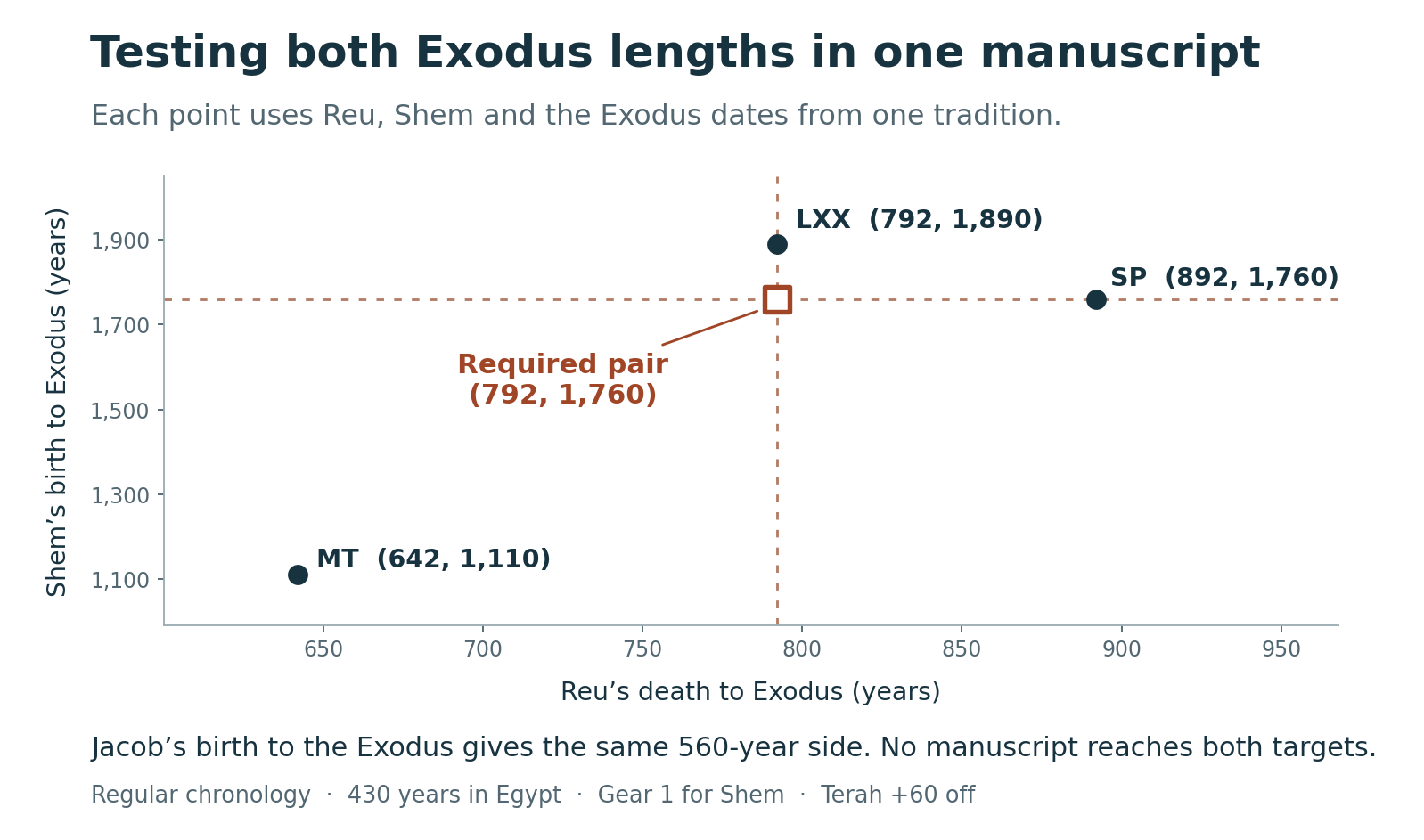
The illustrated Exodus construction failed. Luke places Jacob, Reu and Shem in the genealogy of Jesus. The genealogy gives a reason to study these people. It leaves open which births and deaths to measure. The original figure selected Reu’s death from the LXX for the diagonal and Shem’s birth from the SP for the circumference. It then appealed to an MT-based Mirror calculation for corroboration. With that many choices, the two exact fractions carry too little evidential weight to establish a joint geometry. Luke 3:34–38 · Regular chronology tables
The test below keeps the same events in every tradition. Jacob’s birth at 2006 BC and the Exodus at 1446 BC give 560 years in the selected full-430 chronology. The required lengths are 560 × 99/70 = 792 and 560 × 22/7 = 1760. All dates are regular, Terah +60 is off, and Shem’s birth uses Gear 1 throughout. Second Cainan is native to the LXX. The separately identified Mirror endpoint in §26 retains its own setting. Regular chronology tables · Noah and Shem, Gear 1 tables · Technical appendix, working ratios
22. The 4528 BC prediction from Noah’s hundredth year
In native LXX Gear 1, Noah’s birth at 3836 BC places his hundredth birthday at 3736 BC. The proposed working diagonal of 792 years predicts 4528 BC when counted back from that birthday. A search for both “4528” and “4,528” in the 80 numbered canonical files found no occurrence. In the regular table the nearby event is Jared’s birth in 4534 BC on normal Gear 2. On that same Gear, Noah reaches 100 in 3738 BC. The interval to Jared’s birth is 796 years, four longer than the working diagonal. The 4528 BC date remains a geometric projection. Noah and Shem, Gear 1 tables · Regular chronology tables · Canonical source index
23. Jared’s birth bisects two spans of 962 years
The normal LXX table gives Actual Creation Year 6 at 5496 BC, Jared’s birth at 4534 BC, and his death at 3572 BC. Both intervals are 962 years, Jared’s recorded lifespan. The five begetting ages from Adam to Jared total 230 + 205 + 190 + 170 + 165 = 960. Counting those from the genealogical Creation endpoint at 5494 BC produces 4534 BC. Measuring from the opening of Year 6 adds the two years that give 962. This establishes a chronological midpoint within the LXX. Its arithmetic depends on the selected Year 6 boundary. File 71, §1.2 · Regular chronology tables
24. The 792-year interval in the native LXX
Jacob’s birth at 2006 BC and the Exodus at 1446 BC give the proposed side of 560 years. Jacob is 130 at the entry into Egypt, followed by the selected 430 years to the Exodus. Count one working diagonal back from the Exodus and the result is 1446 + 560 × 99/70 = 2238 BC. The regular LXX table reaches that same year from Reu’s birth at 2577 BC. Greek Genesis 11:20–21 gives 132 years to the birth of Serug and 207 afterward, a life of 339 years. Thus 2577 − 339 = 2238 BC. This derivation supplies the endpoint without using √2. Greek Genesis 11:20–21 in NETS · Regular chronology tables · File 18, chronological data tables
The manuscript comparison holds the Exodus fixed. SP and LXX assign Reu the same birth year here. Their different lifespans account for the full 100-year difference between the two intervals. The regular dates from Arphaxad through Moses stay fixed when the pre-Flood Gear changes at these variant settings. Regular chronology tables · File 18, chronological data tables
25. The two measurements within each manuscript
The seventh circle in the published construction has diameter 70(√2)⁶ = 560. Its ideal circumference is 560π ≈ 1759.291886 and the enclosing square’s ideal diagonal is 560√2 ≈ 791.959595. The published SP measurement from Shem’s birth to the Exodus gives the working circumference of 1760 years. Testing Reu’s death in that same SP chronology gives 892 years. Conversely, the LXX gives the working diagonal of 792 years and a Shem-to-Exodus span of 1890. Each row below is a separate test. Published square-and-circle study · Published π study, SP comparisons · Regular chronology tables · Noah and Shem, Gear 1 tables
| Tradition | Reu’s death to the Exodus (target 792) | Shem’s birth to the Exodus (target 1760) |
|---|---|---|
| MT | 2088 − 1446 = 642 | 2556 − 1446 = 1110 |
| SP | 2338 − 1446 = 892 | 3206 − 1446 = 1760 |
| Native LXX | 2238 − 1446 = 792 | 3336 − 1446 = 1890 |
26. The scope of the comparison with the Exodus Mirror
Section 15 fixes the Exodus and applies 25/23 to both arms of the Mirror. The 2668 years from 4114 BC to the Exodus expand to 2900, giving a gain of 232. The 6440 civil years from the Exodus to AD 4995 expand to 7000, giving a gain of 560 and reaching AD 5555. The whole span grows from 9108 to 9900, a gain of 792. The cross-era counts use BC + AD − 1. AD 5555 is also the integer Mirror of the 5556 BC opening of Actual LXX Year 6 with +60 Terah. Earlier Exodus calculation in §15 · File 07, Creation and Mirror calculations · File 71, §1.2
The selected LXX intervals reproduce 2238 → 2006 → 1446 BC = 232 + 560 = 792. Applying 25/23 to both arms of the MT-based Mirror necessarily preserves their proportions. Matching those gains to the selected LXX dates repeats the change of tradition and adds no independent support for the proposed Exodus figure. Regular chronology tables
Research decision. The midpoint of the SP span from 3206 to 1446 BC is 2326 BC. The regular SP event table supplies no named event there, and the search for a matching date in another manuscript is closed. For post-Creation tests, the passage will determine the few events needed, within one manuscript, before the arithmetic is evaluated. At Creation, corresponding accounts can be compared at the same Creation event. A later cross-manuscript comparison would require a particularly striking correspondence with its own narrative and mathematical warrant. Regular chronology tables
Next goal. Test the two consecutive 339-year lives of Peleg and his son Reu in the native LXX against the published triangle construction, using its fixed dimensions and the LXX genealogy alone. Greek Genesis 11:20–21 in NETS · Regular chronology tables · Published square-and-circle study
Part IV — Shem’s diagonal in the Rounded MT Conquest Mirror (18 November 2026)
Genesis carries the story from Creation and the Fall through the preservation of Noah’s household. Shem’s line leads to Abraham, Israel enters the land under Joshua, and Luke traces the ancestry of Jesus through Shem to Adam. These passages identify the people and events. The Rounded MT chronology supplies their dated positions. The tests below keep the full 430 years in Egypt. For symmetric Rounded labels the Mirror width is BC + AD − 2. The earlier 8,096-year civil Mirror in §13 uses BC + AD − 1. Genesis 11 · Joshua 4 · Luke 3 · File 51b, Mirror display
27. The Conquest end member supplies the 2,800-year diameter
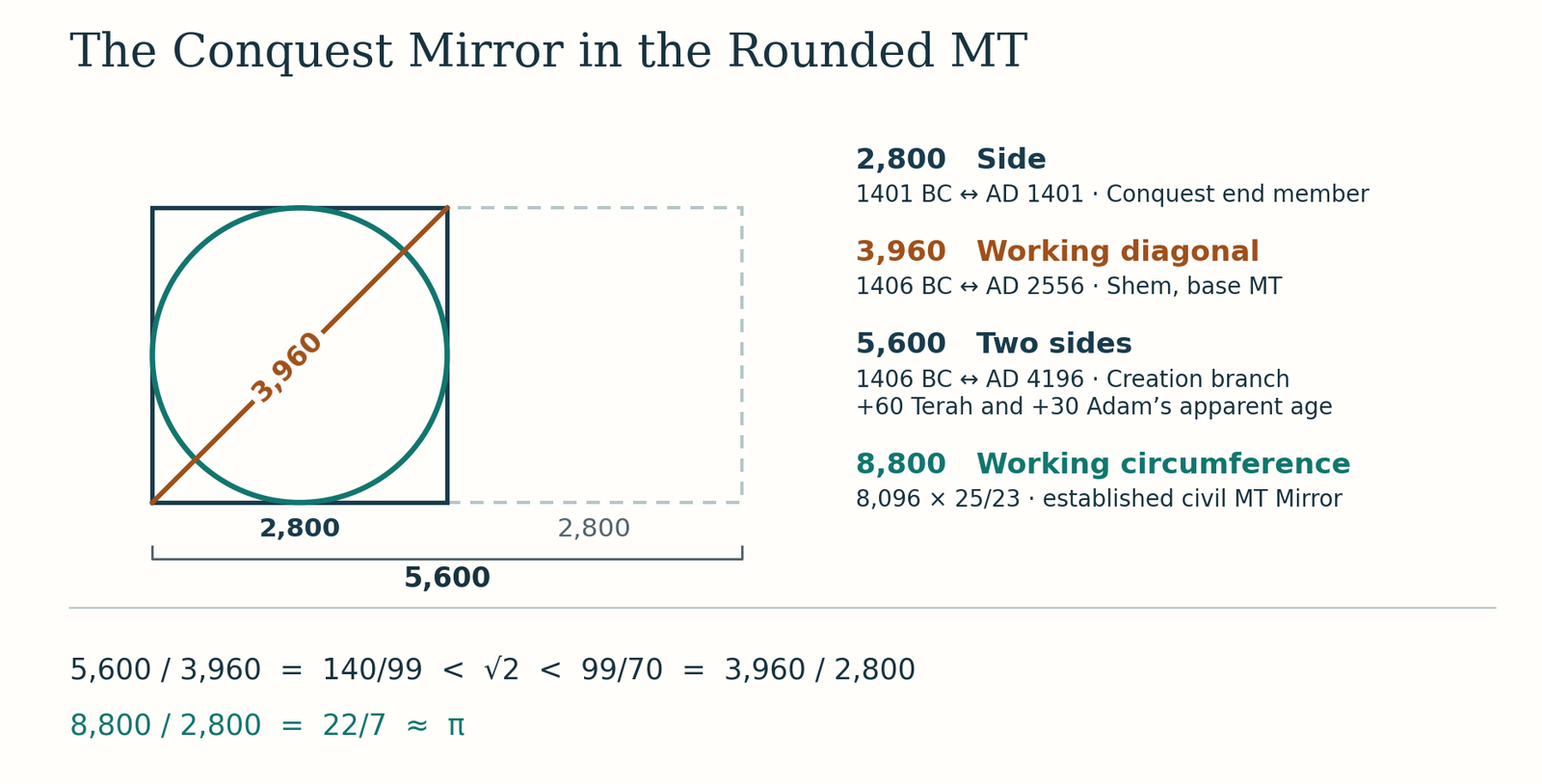
The published MT circle has diameter 2,800 and a radius of 1,400 years from the Conquest in 1406 BC to the selected Christ datum in 6 BC. File 51a pairs the other Conquest member, 1401 BC, with 1 BC. Its radius is also 1,400. Across the Rounded Mirror, 1401 BC to AD 1401 gives 1401 + 1401 − 2 = 2800. The mixed 1401/1406 pairing gives 2,805, and the two 1406 labels give 2,810. Only the two end members recover the diameter. File 51a, paired anchors and Conquest block · Creation Pillars §13 · Test record
28. Shem supplies the working diagonal at the Conquest opening
A square of side 2,800 predicts a working diagonal of 2,800 × 99/70 = 3,960. Genesis 11:10–11 places Shem’s hundredth year at Arphaxad’s birth, two years after the Flood. The base Rounded MT table places Shem’s birth at 2556 BC. File 51a already measures 4,000 years from Shem to the Exodus Mirror. Moving the endpoint forty years from Exodus to Conquest gives 4,000 − 40 = 3,960. In symmetric Rounded labels, 2556 BC to AD 1406 gives 2556 + 1406 − 2 = 3960. Exchanging the BC and AD labels preserves that same width. Genesis 11:10–11 · File 51a, Shem and the Exodus Mirror · Published √2 study · Test record
29. Twice the side reaches the named 4196 BC Creation branch
Keep the Conquest opening fixed at AD 1406. A width of 5,600 predicts the opposite label 5600 − 1406 + 2 = 4196 BC. File 51b §11.4 names this MT state independently as Rounded Creation at 4106 BC, plus 60 for Terah and 30 for Adam’s apparent age. The three measured widths give 5600/3960 = 140/99 < √2 < 99/70 = 3960/2800. The ideal diagonal is 2,800√2 ≈ 3,959.798. The fortyfold scale preserves the published integer residual, since 3960² − 2 × 2800² = 40². File 51b §11.4, MT Creation at 4196 BC · Published square-and-circle geometry · Test record
30. Holding the Terah setting fixed
The table holds the Conquest at AD 1406 and uses the full 430 years in Egypt throughout. Applying +60 Terah to the earlier genealogy also moves Shem to 2616 BC. Adam’s apparent age applies at Creation. Thus the diagonal of 3,960 belongs to base Shem, while twice the side at 5,600 belongs to the modified Creation branch. If the Conquest end member AD 1401 is used instead, those two selected widths are 3,955 and 5,595. Scope of the Terah adjustment · MT Shem with Terah on and off · File 51b, Creation states · Test record
| MT setting | Shem to Conquest Mirror | Creation to Conquest Mirror |
|---|---|---|
| Base | 2556 BC → AD 1406 = 3,960 | 4106 BC → AD 1406 = 5,510 |
| +60 Terah, +30 at Adam | 2616 BC → AD 1406 = 4,020 | 4196 BC → AD 1406 = 5,600 |
31. The 4,400-year semicircle at the fixed Conquest
The established civil MT Mirror gives 8,096 × 25/23 = 8,800 and 8,800/2,800 = 22/7. Its working semicircle of 4,400, measured to AD 1406 under the Rounded rule, would start at 2996 BC. That is sixty years after the base Rounded birth of Noah in 3056 BC. File 51a’s regular MT birth and death tables supply no named event there. The semicircle at this particular Conquest boundary therefore remains a projection. Creation Pillars §13, civil Mirror · File 51a, regular MT tables · Test record
Next test. Hold the Conquest Mirror fixed. The published cumulative MT Enoch span of 9,900 and the regular MT Shem span of 3,960 stand in the ratio 5:2. Test whether the corresponding sides of 7,000 and 2,800 also have independently named MT endpoints at the same Conquest boundary. Published √2 study, cumulative Enoch and the Conquest Mirror
References and reciprocal reading
Read the original π–√2 Square-and-Circle main article and its technical appendix. Source-control and related discussion may be checked against the 490d Knowledge Catalog, the √2 technical appendix, the Key of 23 technical appendix, and the forward-machine reference together with the repository’s SP, BJ, and SKL tables.
Research status: updated 18 November 2026. Sections 1–9 retain the 16 November 2026 critical research assessment as a dated record. Part II (sections 10–21) adds the later MT, SP and LXX chronology-led geometrical findings. Part III (sections 22–26) records the failed joint test at the Exodus and the chronological checks on Jared and Reu. Part IV (sections 27–31) tests the 2,800-year square and its 3,960-year diagonal at the MT Conquest Mirror. This is a supplementary research appendix and does not revise the 15 November 2026 main π–√2 article or its original technical appendix.