The Hebrew, Samaritan, and Greek genealogies differ in their numbers. When I compare their rounded chronologies, some of those differences form a connected pattern: small five-year changes, the same forty-year completion, and a shared meeting point across the chronological Mirror.
“So Methuselah lived a total of 969 years, and then he died.”
Genesis 5:27, Berean Standard Bible
The surrounding verses give Methuselah’s 187 years before Lamech and 782 afterward. Genesis therefore supplies both the parts of a life and its total. That distinction matters when the numbers are rounded.
This article brings together selected findings from the rounded comparative study. The earlier Shem and the Flood comparison explains the 120–480–120 arrangement and its 4300- and 4900-year connections. Here I take the next step: how the broader Creation and Flood comparisons fit together.
Two ways of reading the genealogies
Regular chronology adds the ages at which each father begets the next named son. Cumulative chronology places the complete lifespans end to end. Cumulative positions are therefore constructed coordinates for studying the genealogy; they are not the patriarchs’ ordinary historical birth dates.
My normal MT framework retains Creation at 4114 BC, the Flood at 2458 BC, Abram’s birth at 2166 BC, the Exodus at 1446 BC, and the Conquest at 1406 BC. The MT is the Masoretic Hebrew text; SP is the Samaritan Pentateuch; LXX is the Greek Septuagint. The rounded comparisons below use their own expressly stated figures.
Rounding means bringing each input to the nearest multiple of five and rebuilding the chain. For a regular rounded biography, Methuselah’s parts become 185 and 780, totaling 965. For a cumulative chain, his complete 969-year life becomes 970. Both calculations follow a consistent method, but they answer different questions.
The regular rounded MT Creation block is 4111/4106 BC; its rounded Flood coordinate is 2456 BC. A slash joins two declared comparison boundaries. In the cumulative tables, Aaron’s 123 years round to 125, while Moses’ 120 remain 120. Choosing Aaron instead of Moses adds five years to earlier cumulative positions. Thus 14011/14006 BC is the rounded MT cumulative Creation pair. These pairs arise from stated constructions, rather than from freely moving dates to obtain a pattern.
The small unit: 115, 120, and 125
The number 115 is the smallest positive whole number divisible by both five and 23. It brings rounding and the Key of 23 into the same arithmetic. The Key’s 25/23 conversion changes 115 into 125, with 120 midway between them.
This little arrangement has a chronological setting. The rounded MT warning point, Lamech’s death, and the Flood stand at 2576, 2461, and 2456 BC: 115 years followed by five, totaling 120. I use Genesis 6:3’s 120 years as a Flood countdown; the verse does not itself give an ark-building commencement date. At the other end of the cumulative chain, Moses’ 120 years and rounded Aaron’s 125 provide the same five-year step.
A larger comparison also converges. The regular native-LXX–MT Creation gap is 1380; multiplying it by 25/23 gives 1500. The rounded cumulative native-LXX–SP Creation gap is 1495; multiplying it by 300/299 also gives 1500. Different source gaps and different conversions reach the same completion.
Why the means are 1150 and 1152
Now compare three cumulative Creation arrangements. They place the traditions beside one another while keeping the second Cainan’s 460-year lifespan explicit. In the LXX that Cainan is native to the adopted reconstruction; adding him to the MT is a comparison state. Regular comparisons instead use his 130-year begetting interval.
The three rounded widths are 1495, 890, and 1065 years. Their sum is 3450, and their average is 1150. Repeating the comparison with unrounded lifespans gives widths of 1498, 890, and 1068: a sum of 3456 and an average of 1152.
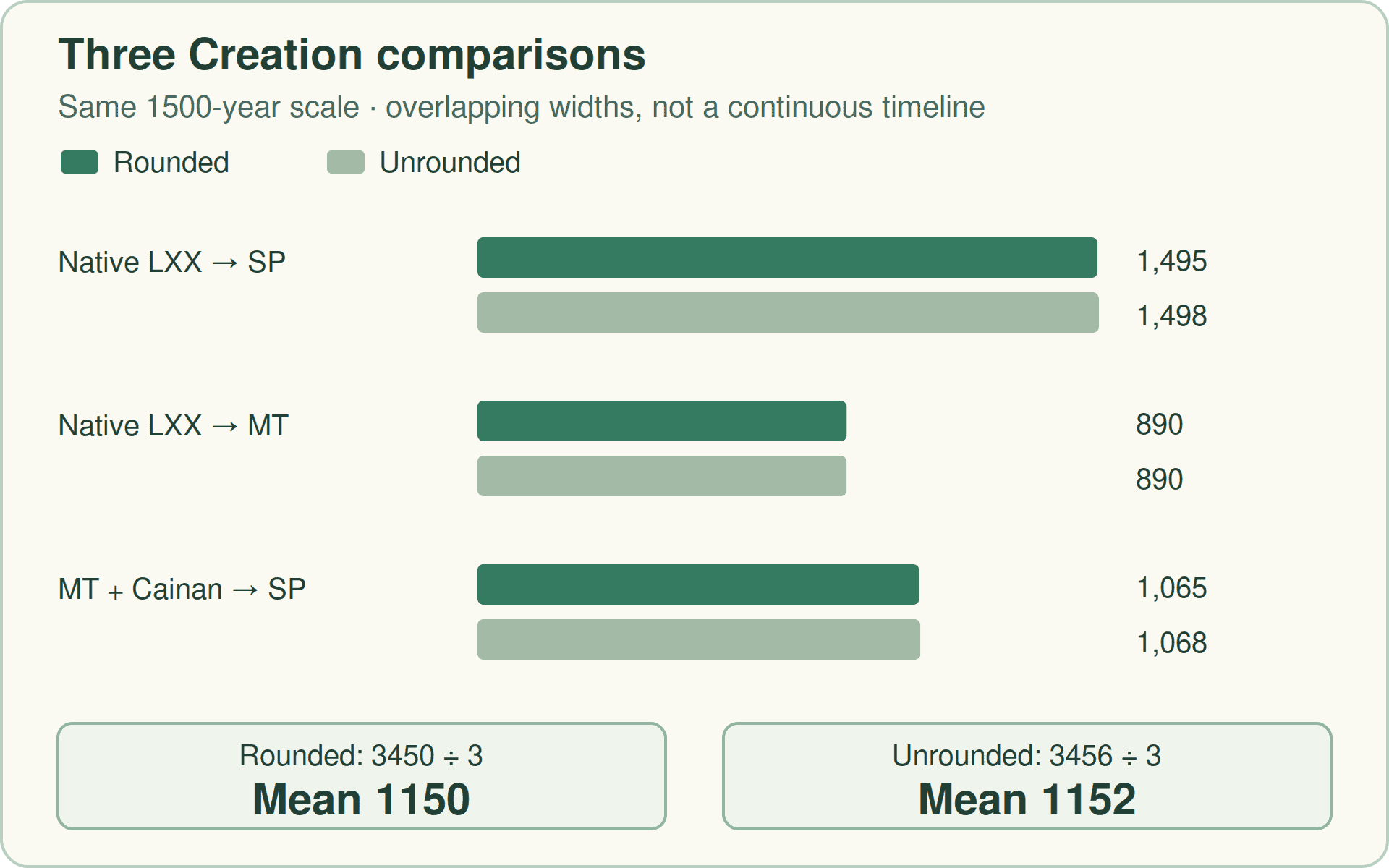
The two-year difference is explainable. Rounding moves the SP cumulative Creation position three years earlier, from 13398 to 13401 BC. That change affects two of the three comparisons. Six years of total change, divided among three comparisons, changes the average by two.
The same pair appears in the regular MT Shem-to-Conquest comparison. Gear 2 places Shem’s birth at 2558 BC, giving 1152 years to 1406 BC. Gear 1 places it at 2556 BC, giving 1150. I retain Gear 2 as the normal state and name Gear 1 when used. The agreement makes the aggregate worth studying; it does not make its three overlapping widths independent spans.
The SP completes both comparisons by forty years
For the SP’s own sojourn setting, I use the Canaan-and-Egypt reading of Exodus 12:40, executed as 215 + 215 years. This shifts the regular comparison 215 years later than the plane used to compare equal sojourn settings. The verse gives the combined scope; the two 215-year parts come from the chronological reconstruction.
Select the SP’s actual regular Creation-week opening, 4206 BC, and its upper rounded cumulative Creation boundary, 13406 BC. These are deliberately different kinds of coordinate. Their separation is 9200 years.
From 4206 BC to the Exodus is 2760 years, or 69 groups of forty. The 70/69 conversion gives 2800, reaching the Conquest instead. From 13406 BC to the Exodus is 11960 years, or 299 groups of forty. The 300/299 conversion gives 12000, likewise reaching the Conquest.
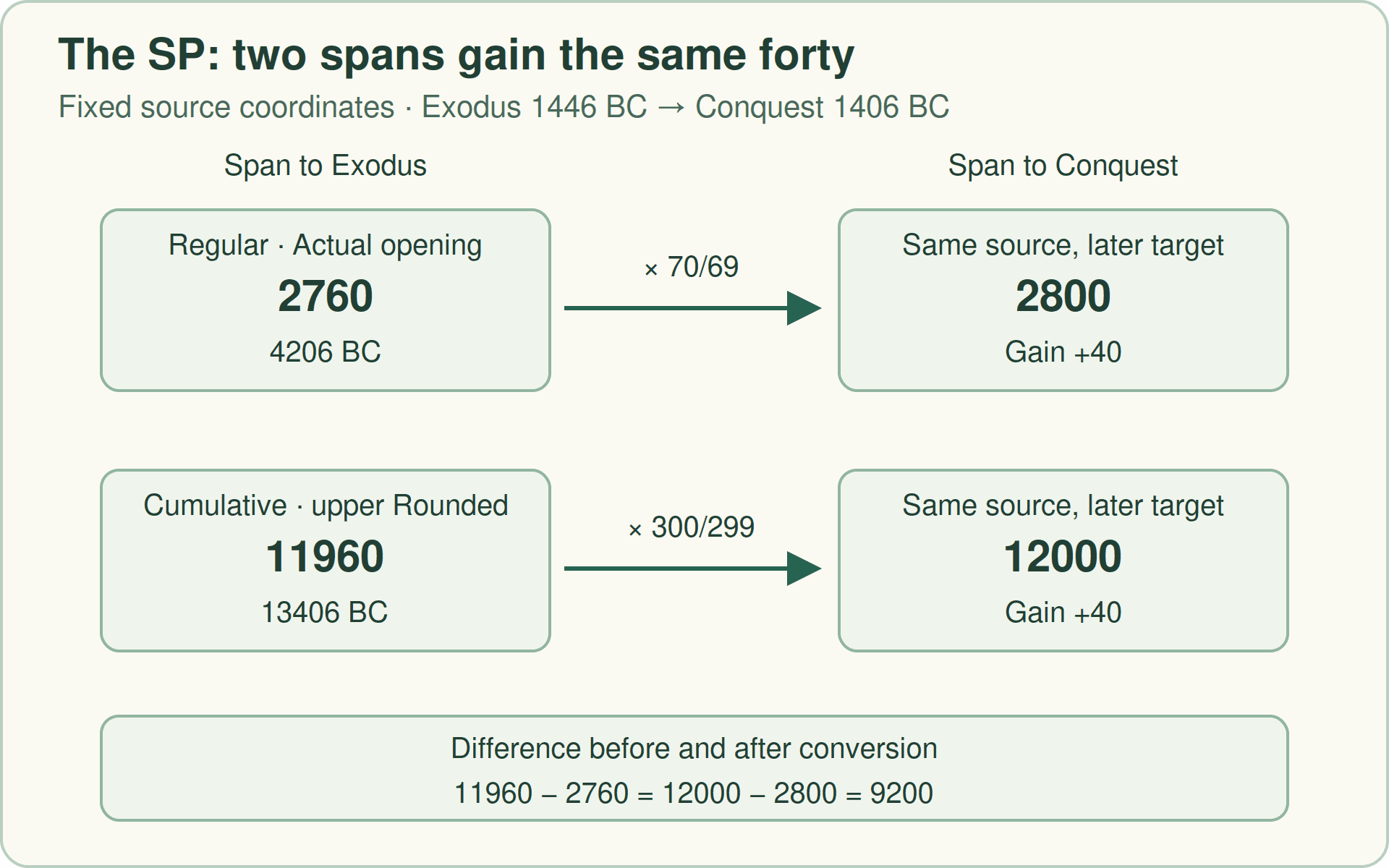
The shared gain preserves the separation: 11960 − 2760 = 12000 − 2800 = 9200. The result connects the SP’s regular and cumulative comparisons with the wilderness forty. It is stronger than finding the number forty somewhere in an unrelated sum, because all four endpoints are stated.
A native and a generated span meet at 11500
The chronological Mirror supplies another connection. Here I use the report’s civil label convention: 5291 BC has the AD 5290 counterpart. Crossing from B BC to AD A spans B + A − 1 years, since the civil calendar has no year zero. These Mirror counterparts are comparison labels.
With second Cainan removed for comparison, the upper rounded LXX cumulative Flood boundary is 5291 BC. Its span to AD 5290 is 10580 years. The 25/23 conversion gives 11500.
Keeping the native LXX Cainan instead adds 460 years to each side: 5751 BC to AD 5750 already spans 11500. The same number is therefore reached in two ways—directly from the native-Cainan coordinates and by expanding the Cainan-removed span.
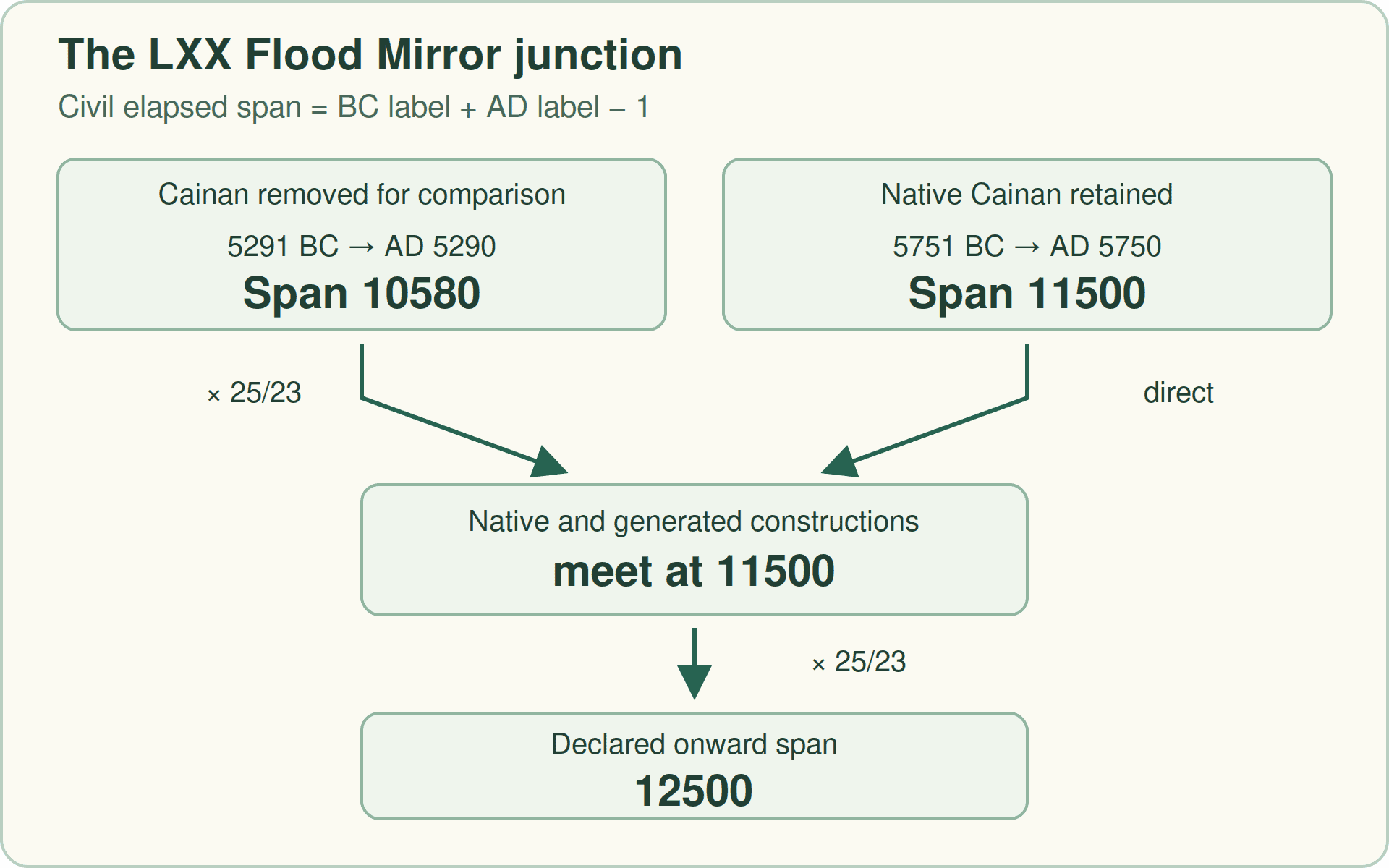
The next 25/23 conversion gives 12500. The first gain was 920, twice Cainan’s 460; the next is 1000, twice the completed 500. From the native 11500 span this is one conversion; from 10580 it is the second. The original span’s 23² factor and the native intermediate span support this particular sequence. They do not establish unrestricted repeated expansion.
Reading the connected pattern
I see these relations as part of a providential architecture in the received chronological traditions. The five-year steps, the 1150/1152 pair, the SP’s shared forty-year completion, and the LXX Mirror junction connect calculations that otherwise appear separate.
The tables and appendix retain the inputs, endpoints, and a brief SP–Book of Jubilees comparison. The fuller research report preserves additional applications and open questions. The arithmetic is exact within each stated construction; its theological meaning is my interpretation. Keeping that distinction lets the patterns be explored without flattening the differences that give them their structure.
Scripture quotation: Berean Standard Bible (BSB), public domain.