The biblical chronologies can be compared in more than one way. We can measure the years between two events, reflect their positions across the BC–AD boundary, or move a whole chronological sequence forward by a stated amount. Keeping these operations distinct reveals connections that a single list of dates can conceal.
Two years after the flood, when Shem was 100 years old, he became the father of Arphaxad.
— Genesis 11:10, Berean Standard Bible (BSB)
The two years in this verse matter. So do the lifespans and begetting ages surrounding them. My study follows those numerical details through the Masoretic Text (MT), Samaritan Pentateuch (SP), and Septuagint (LXX), asking how their chronological structures relate to one another and to the themes of Creation, judgment, covenant, and restoration.
This article brings together two research studies: the 4232 / 8464 / 12696 translation framework and the 8395-year correspondence. The separate supporting tables preserve the exact seasonal labels and source settings. Readers new to the method can begin with Across the BC–AD Divide.
A fixed Mirror, with room to move a sequence
The seasonal Mirror has a fixed center at January 1, AD 1. Autumn and spring dates stand on either side of that center in the repository’s simplified seasonal model. The letters t and n identify Tishri and Nisan. Thus the Conquest pair, 1407t/1406n BC, reflects to AD 1406t/1407n. There is no civil year zero.
Reflection reverses a sequence’s order while preserving its length. Translation does something different: it moves every member by the same amount and preserves their order. If Noah’s birth, the Flood, and Noah’s death are all moved forward together, the 600 years before the Flood and 350 afterward remain 600 and 350. We have calculated counterparts for comparison; we have not reassigned Noah’s life to a future age.
A translation can then be compared with the ordinary Mirror. That is the main procedure here. The dates retain their source identities, and January AD 1 remains the original center throughout.
Three related widths
The principal translation widths are 4232, 8464, and 12696 years. Their relationship is straightforward: 8464 is twice 4232, and 12696 is three times 4232. Each width is also twice a corresponding radius: 2116, 4232, or 6348.
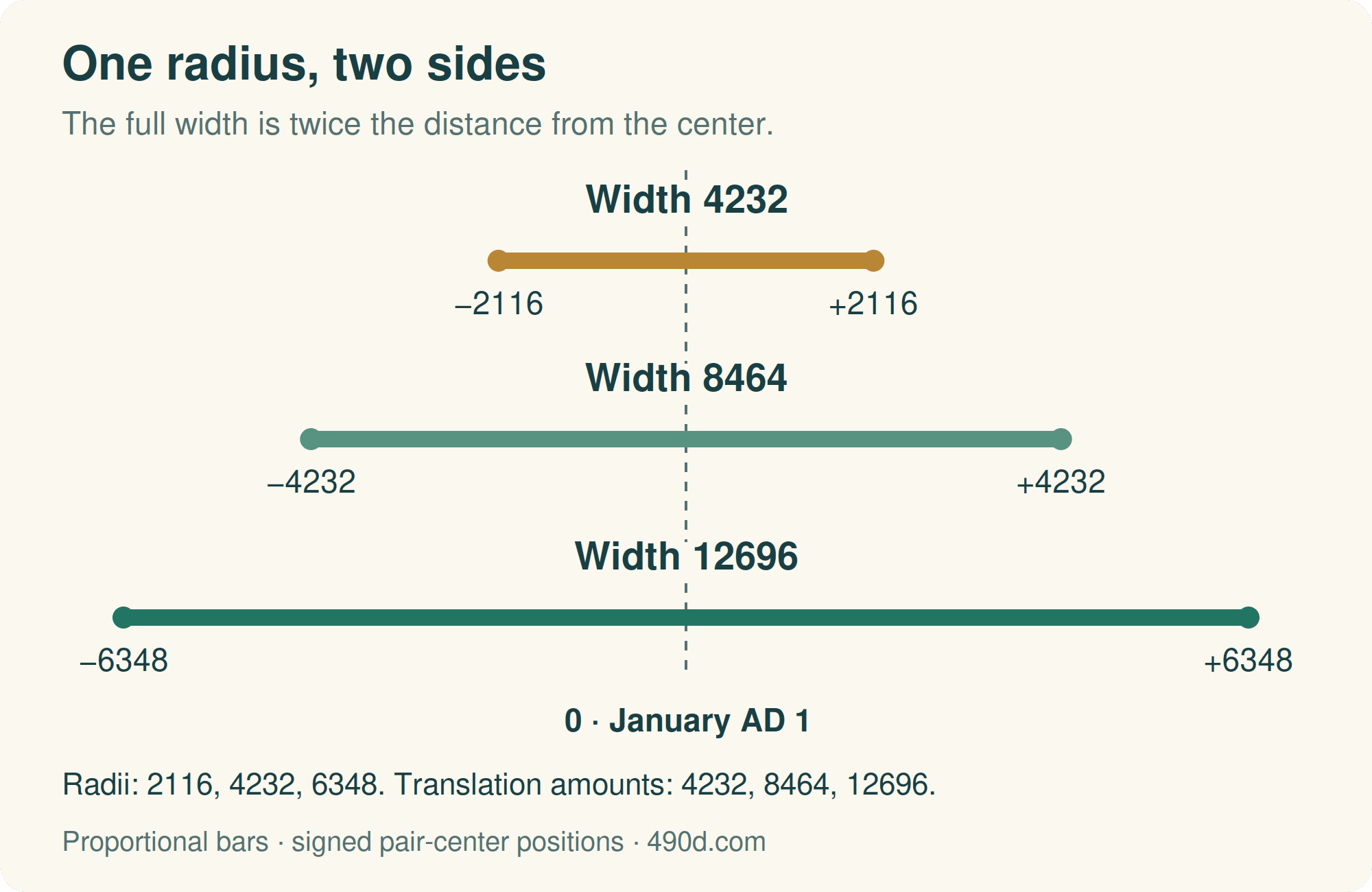
The common unit is 529, which is 23 squared. The radii contain 4, 8, and 12 such units. This explains the family resemblance without requiring us to treat every member as a perfect square. For example, 2116 is 46 squared, while 4232 is twice that square.
The Key of 23, multiplying a duration by 25/23, carries the widths through another coordinated family: 4232 becomes 4600, 8464 becomes 9200, and 12696 becomes 13800. A second application produces 5000, 10000, and 15000. These are converted durations. A date appears only when we also state where the converted duration begins or ends.
4232: from the patriarchs to Moses
Abram’s birth at 2166 BC and Isaac’s at 2066 BC provide a simple example. Their year numerals add to 4232. Moving Abram’s complete seasonal pair forward by 4232 lands at Isaac’s ordinary reflected birth; moving Isaac’s pair by the same amount lands at Abram’s reflected birth. Their 100-year separation divides into 50 years on either side of the 2116 center.
The same width links the selected 2226 BC firstborn position with Jacob’s birth at 2006 BC. That example uses the explicitly declared +60 Terah reconstruction. The ordinary Abram date remains 2166 BC; the extra 60 is not silently added to every date.
Moses’ biography supplies another connection. His birth at 1526 BC, the Exodus at 1446 BC, and the Conquest at 1406 BC retain their 80 + 40 arrangement under translation. The crossed comparison between the translated birth and the reflected Exodus is 1260 years. Replacing birth with death gives 1380. Converting that 1380 by 25/23 gives 1500.
We therefore encounter 1260, 1380, and 1500, or 60 multiplied by 21, 23, and 25. The two successive gains are both 120, but they have different causes: the first substitutes the other end of Moses’ life; the second converts a duration. Naming the operation keeps the relationship intelligible.
8464: Noah and Shem retain their biographies
For the regular MT chronology, I use the normal Gear 2 setting, the full 430 years in Egypt, no second Cainan, and no +60 Terah shift. Noah’s birth is 3058 BC, the Flood begins at 2458 BC, and Shem’s death is 1958 BC. Translating their seasonal pairs by 8464 gives AD counterpart pairs beginning with 5406, 6006, and 6506.
Compare those landings with the ordinary reflection of the 6 BC Christ anchor, AD 6t/7n. The resulting widths are 5400, 6000, and 6500. The Flood landing is also 4600 years beyond the reflected Conquest. The 500 + 100 + 500 arrangement from Noah’s birth through Shem’s birth and the Flood to Shem’s death remains intact.
This connects with the earlier 6500/6000 Mirror study, while identifying the exact operation used here. These AD positions are mathematical landings. They do not predict future Floods or future births.
If second Cainan is explicitly restored to the regular chain, his 130-year begetting interval moves the upstream BC sources 130 years earlier. With the translation held fixed, their AD landings also move 130 years earlier. The translated Flood then stands 4000 years beyond the reflected 1876 BC Entry into Egypt. The Cainan setting changes the comparison, not the meaning of translation.
12696: the cumulative week remains a whole week
The cumulative chronology adds lifespans successively. Its principal dates occupy seven-year fields rather than a single year. Translating these fields by 12696 preserves every member and the full seven-year length.
Restoring Cainan here adds his 460-year lifespan, rather than the regular genealogy’s 130-year begetting interval. The Flood and earlier fields move 460 years earlier; Shelah and later fields stay fixed. Their translated landings follow the same rule.
One selected Flood member then stands exactly 6000 years beyond the reflected Conquest. Selected Cainan and Shelah closing members give 6440 and 6900 against the separately stated one-year-earlier Conquest companion. The conversions explain their connection: 6440 multiplied by 25/23 gives 7000; 6900 multiplied by 70/69 also gives 7000, while 25/23 gives 7500.
The one-year distinction belongs in the explanation. The complete Flood comparison field lies one year after the reflected Conquest/rest field; the Cainan and Shelah comparisons lie one year before it. Their endpoints are listed in the appendix, where spring is compared with spring and autumn with autumn.
8395: a span preserved across two source settings
The second study finds a complementary relationship between a cumulative LXX boundary and a regular Flood boundary. One configuration gives 5290 + 3105 = 8395. Another gives 5750 + 2645 = 8395. The common span is 23 × 365.
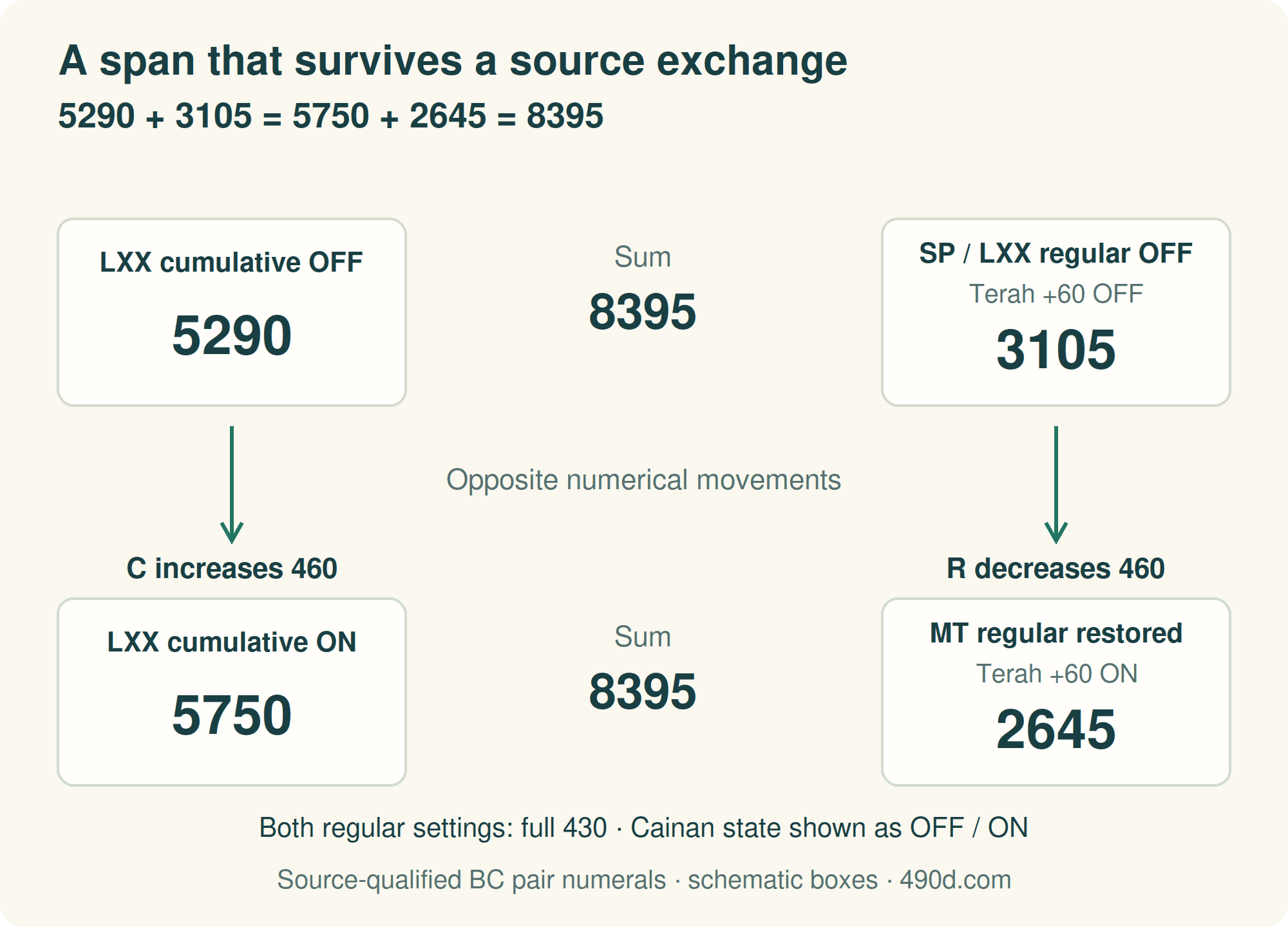
In the first configuration, cumulative LXX has Cainan removed, and regular SP or Cainan-removed LXX uses no +60 Terah shift. In the second, cumulative LXX retains native Cainan, while regular MT explicitly restores Cainan and selects Terah +60. The cumulative endpoint increases by 460. The regular endpoint decreases by 460 because its original 650-year difference is reduced by the selected 130 + 60 additions.
The equality extends through six selected positions: as the cumulative numeral decreases by one, the regular numeral increases by one. Every pair retains 8395. These regular start/close positions lie within the ordinary three Flood Gears. The cumulative members remain members of their own seven-year field; they have not acquired Flood Gears.
Three Book of Jubilees birth positions—Shem 2650, Ham 2648, and Japheth 2645—also coincide numerically with selected positions in the second regular column. Births and Flood boundaries retain their different meanings. Their agreement is a positional correspondence, not an assertion that those births occurred at the MT Flood.
The preserved sum also explains why this is not a uniform enlargement of the whole first configuration. Multiplying both original endpoints by 25/23 would give 5750 and 3375, whose sum is 9125. The 8395 relationship instead follows the stated exchange between qualified sources.
Two seven-year intervals, and a second January junction
A final construction brings the comparison close to the center. The translated MT Flood week has pair-centers from −6 to +1, measured from January AD 1. Its translated Shem partner is two years earlier. Reflecting that partner gives a week from +1 to +8. The two seven-year intervals meet at +1: January AD 2.
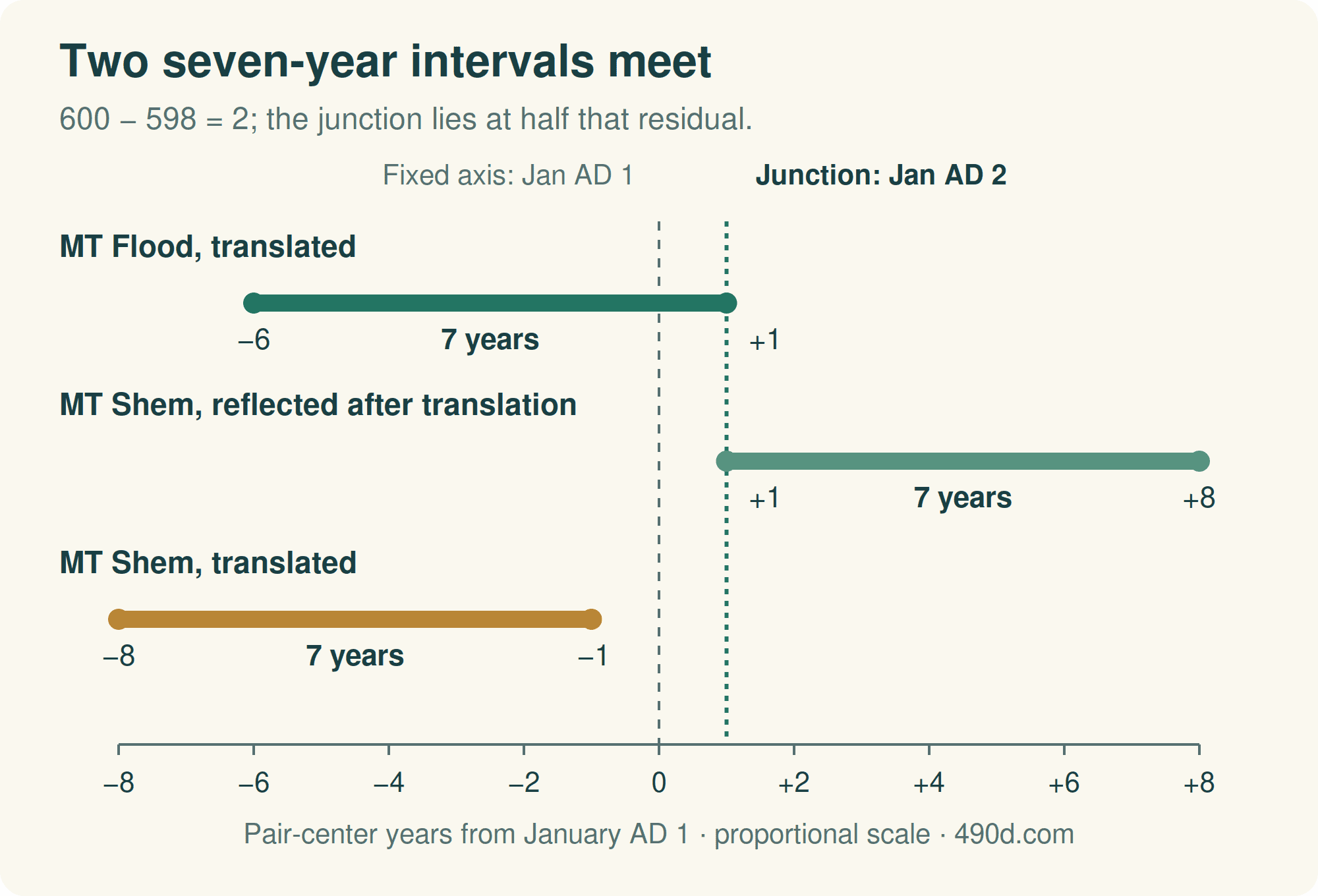
This second junction leaves the original Mirror fixed. It follows from the particular two-year residual and the selected placement of the weeks. If we include both autumn and spring outside edges, each seasonal envelope spans 7½ years. They share half a year, giving a 14½-year union. The double seven and the larger seasonal envelope describe different measurements.
I read these relationships within the biblical movement from Creation and judgment toward covenant, restoration, and renewed life. Their mathematical contribution is a coordinated set of comparisons with visible sources and operations. Their theological meaning concerns the unity of that larger story. The supporting tables allow each step to be followed without confusing a narrative event, a reflected counterpart, and a converted duration.
Scripture quotation: Berean Standard Bible (BSB). Public domain.