At the end of the 430 years, to the very day, all the LORD’s divisions went out of the land of Egypt.
The Exodus gives Israel’s story a decisive turning point: the end of servitude and the beginning of a journey toward the land. It also provides a fixed center for the chronological comparison explored here. Within the chronology used on this website, the Exodus is placed at 1446 BC. Two carefully defined endpoints stand 490 years on either side:
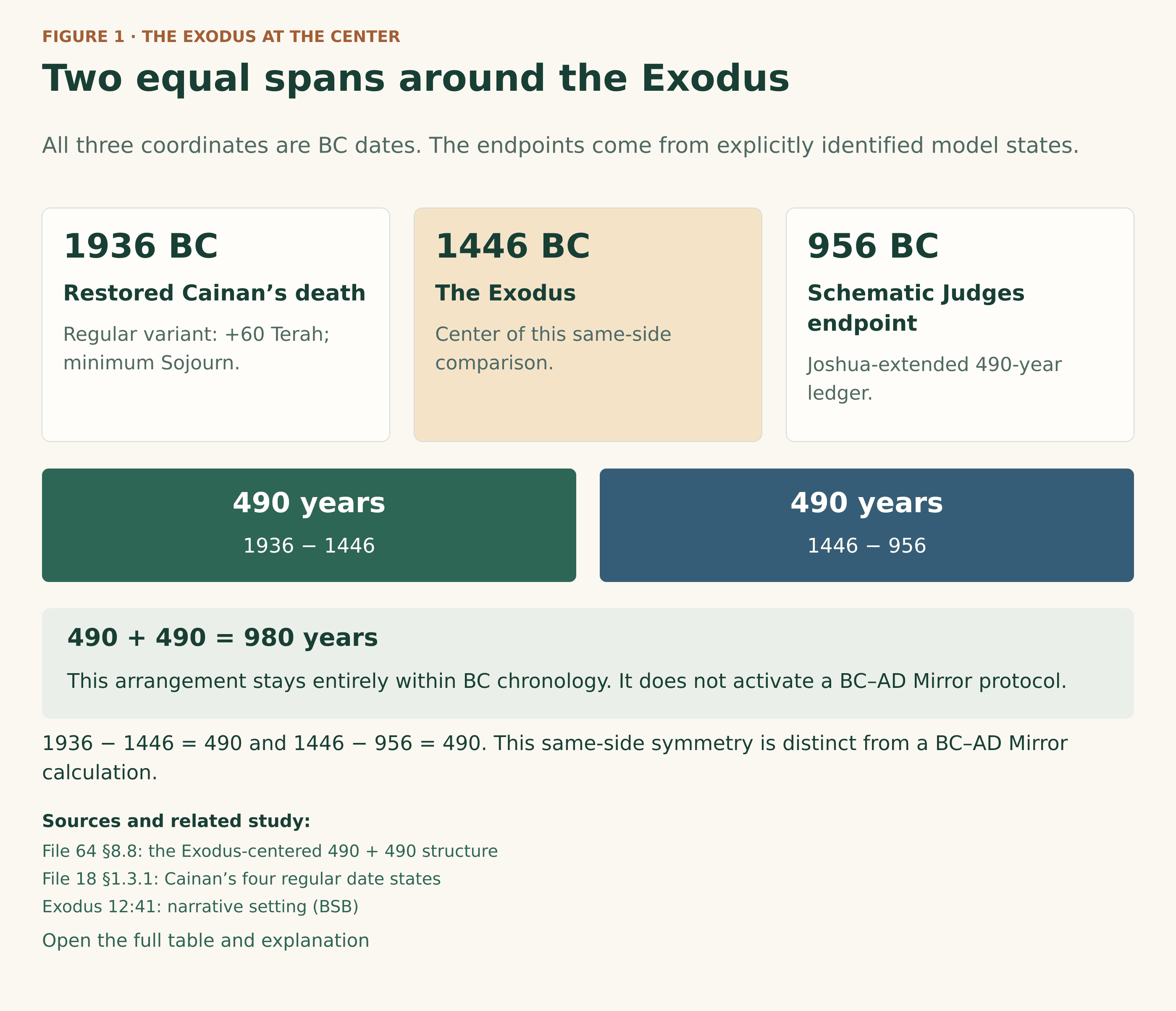
1936 BC → 1446 BC → 956 BC = 490 + 490 = 980 years.
The dates need their labels. 1936 BC is second Cainan’s death in a restored-Cainan variant that includes the +60 Terah adjustment and the shorter Sojourn setting. 956 BC is a schematic endpoint calculated from the periods of the wilderness, Joshua, and Judges. These are different kinds of coordinates, brought together in a declared comparison. They do not form an ordinary historical chronology with three independently dated narrative events.
1. The two equal spans
Figure 1 · The Exodus at the Center
Two equal spans around the Exodus
All three coordinates are BC dates. The endpoints come from explicitly identified model states.
1936 BC
Restored Cainan’s deathRegular variant: +60 Terah; minimum Sojourn.
1446 BC
The ExodusThe center of this same-side comparison.
956 BC
Schematic Judges endpointJoshua-extended 490-year ledger.
Sources: File 64 §8.8: the Exodus-centered 490 + 490 structure · File 18 §1.3.1: Cainan’s four regular date states · Exodus 12:41: narrative setting (BSB).
Model and calculation details
The left endpoint is the death of the restored second Cainan in the regular +60 Terah, minimum-Sojourn state. It is not the ordinary MT genealogy. The right endpoint is calculated by the Joshua-extended schematic Judges ledger. The total distance is 1936 − 956 = 980 years. No civil BC–AD crossing occurs, so no −1 correction applies. File 64’s local complement around 1446 is not a new formal Mirror protocol.

The arithmetic is straightforward. Within BC chronology, dates decrease as time advances:
| Comparison | Calculation | Years |
|---|---|---|
| Restored-Cainan endpoint to the Exodus | 1936 − 1446 | 490 |
| Exodus to the extended Judges endpoint | 1446 − 956 | 490 |
| Entire arrangement | 1936 − 956 | 980 |
The Exodus is the exact midpoint of this arrangement. What requires explanation is how the endpoints were selected. The governing study, File 64, especially §8.8 and Appendix D, supplies those controls; the supporting tables make the choices visible.
2. Why the left endpoint is 1936 BC
The Cainan in this comparison is the post-Flood figure between Arphaxad and Shelah, listed in Luke 3:35–36 (BSB). He must be distinguished from the earlier Kenan in Adam’s genealogy.
The textual traditions also require care. The Masoretic Text (MT) and Samaritan Pentateuch (SP) do not include this second Cainan in their Genesis 11 genealogical sequence. The Septuagint (LXX) reading represented by Brenton’s translation of Genesis 11 includes him and gives the inputs used here: 130 years before the birth of Sala, followed by 330 years. Their sum is a lifespan of 460 years.
The present comparison restores that figure within a specified regular chronology. In the selected variant, his dates are 2396–1936 BC. Two settings identify the row: the +60 Terah adjustment is active, and the minimum, or shorter, Sojourn setting is retained, with 215 years in Egypt. Other settings produce other dates. The four-row comparison shows why 1936 BC should never be presented as an unqualified MT date.
There is a further distinction behind the calculation. A regular genealogy follows successive begetting ages; the restored Cainan therefore introduces a 130-year genealogical step. A cumulative chronology adds lifespans and uses a 460-year insertion. This article uses the regular setting. Cainan’s 460-year lifespan remains relevant to his biography, but it is not the insertion rule used to construct the regular dates.
3. Why the right endpoint is 956 BC
The right arm combines three components:
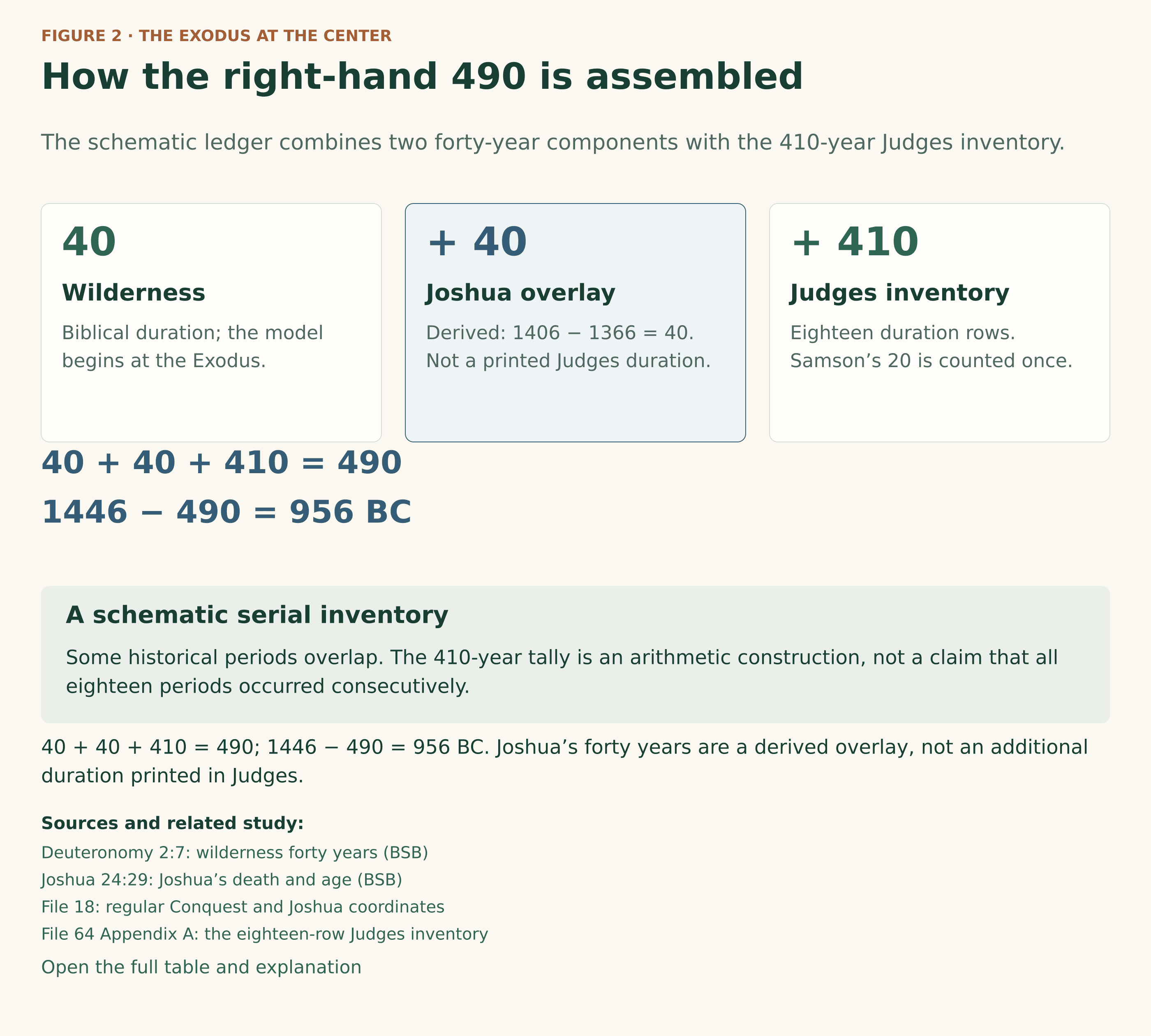
40 years of wilderness + 40 years from the Conquest to Joshua’s death + 410 years in the Judges duration ledger = 490 years.
Figure 2 · The Exodus at the Center
How the right-hand 490 is assembled
The schematic ledger combines two forty-year components with the 410-year Judges inventory.
Biblical duration; the model begins at the Exodus.
Derived: 1406 − 1366 = 40. Not a printed Judges duration.
Eighteen duration rows. Samson’s 20 is counted once.
40 + 40 + 410 = 490
1446 − 490 = 956 BC
Sources: Deuteronomy 2:7: wilderness forty years (BSB) · Joshua 24:29: Joshua’s death and age (BSB) · File 18: regular Conquest and Joshua coordinates · File 64 Appendix A: the eighteen-row Judges inventory.
Model and calculation details
The wilderness contributes 40 years. The regular chronological dates 1406 BC for the Conquest and 1366 BC for Joshua’s death yield the derived Joshua overlay of 40. File 64 sums eighteen stated Judges duration rows to 410, counting Samson’s 20 years once. This is a serial arithmetic inventory: overlapping historical events are not made consecutive by adding their durations. Jephthah’s retrospective 300 years are not added to the 410 tally.

The wilderness forty has an explicit biblical basis, including Numbers 14:33–34 (BSB). The Joshua forty is different: it is derived from the chronology’s 1406 BC Conquest and 1366 BC death of Joshua. Scripture gives Joshua’s age at death as 110 in Joshua 24:29 (BSB); it does not print a separate forty-year reign for him. His regular lifespan here remains 1476–1366 BC.
The 410 comes from adding eighteen expressly stated durations in Judges. Six periods of subjugation total 111 years; twelve periods of rest, rule, or judgeship total 299 years. Together they give 410. Every entry, its passage, and the running total are available in the complete Judges ledger.
This is a ledger of the book’s stated durations. Some historical periods overlap, so their serial sum is not a claim that Judges describes 410 uninterrupted years. For example, Judges 15:20 (BSB) locates Samson’s judgeship within the days of the Philistines. His twenty years are repeated in Judges 16:31 (BSB), but the ledger counts that tenure once. Jephthah’s retrospective 300-year statement in Judges 11:26 (BSB) has a separate function and is not added as a nineteenth entry.
Starting at the Exodus, the declared construction gives 1446 − 490 = 956 BC. The resulting coordinate marks the end of the model’s extended ledger; it does not date Samson’s death historically to 956 BC.
4. Symmetry around the Exodus and the BC–AD Mirror
The original discussion used the language of a mirror. Here that word needs a precise distinction. The present arrangement is symmetry around 1446 BC, entirely within BC chronology. Ordinary subtraction gives each 490-year arm. No year-zero convention or missing-year correction enters those calculations.
The repository’s formal BC–AD Mirror has a different axis and its own rules for generating counterpart dates. Its controls distinguish single dates from seasonal pairs and distinguish target generation from measuring the resulting elapsed span. When an ordinary civil BC-to-AD span is measured, the calculation is BC + AD − 1, because civil dating has no year zero. That cross-axis formula is not the operation used here.
File 64 explicitly preserves this distinction. Its local complement around the Exodus does not establish a new repository-wide Mirror rule. The method comparison in the appendix shows the operations side by side, with links to File 00 §3.9 and File 09 Appendix A, which govern the formal Mirror.
5. Keep the Temple’s historical date distinct
A schematic coordinate should not displace a historical anchor. The chronology’s normal date for the Temple foundation remains 966 BC. 1 Kings 6:1 (BSB) places the beginning of construction in the 480th year after the Exodus. The repository’s whole-year coordinate comparison is 1446 − 966 = 480. The verse states an ordinal year; the 480 shown here is the difference between the model’s date coordinates.
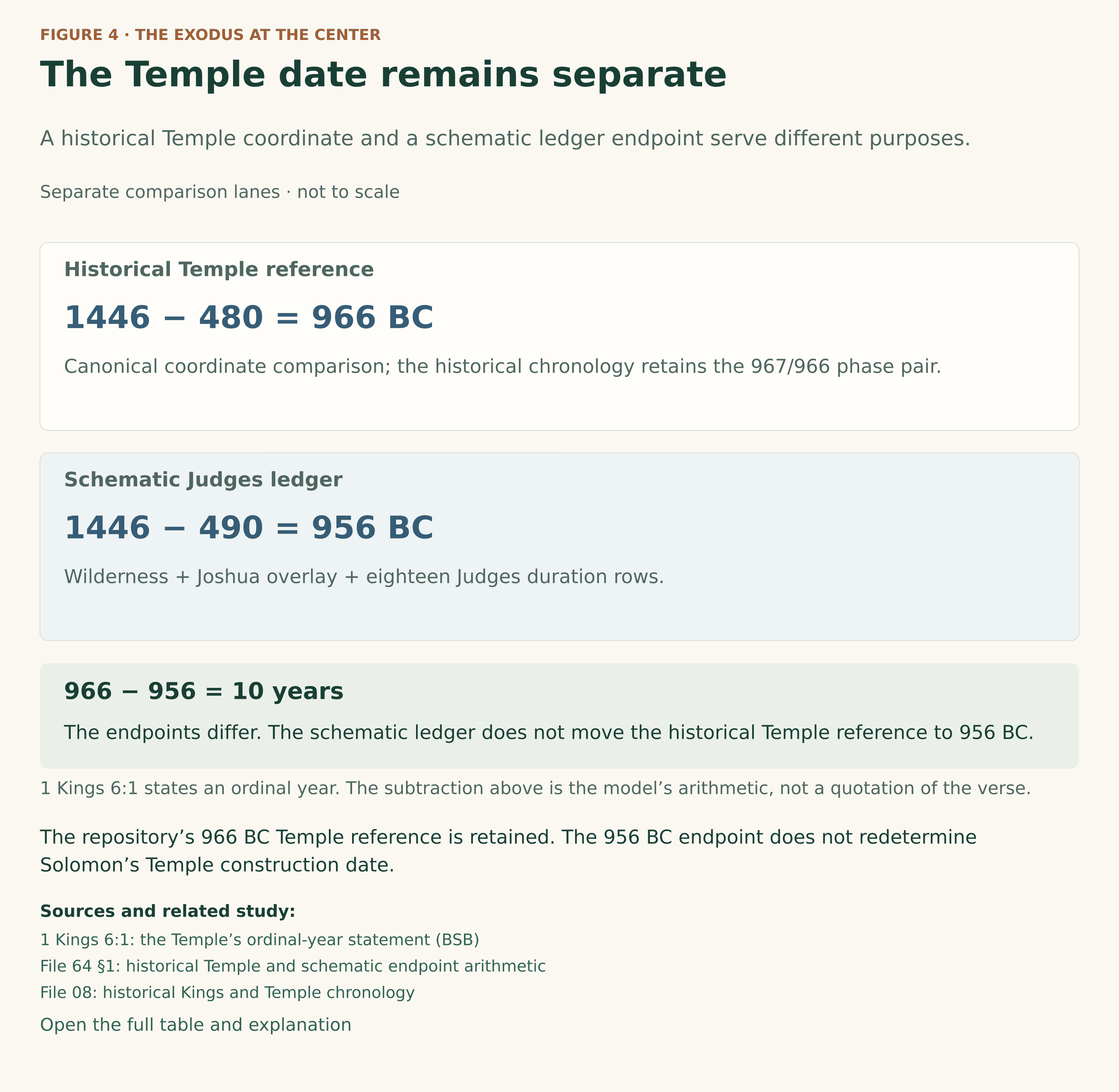
Figure 4 · The Exodus at the Center
The Temple date remains separate
A historical Temple coordinate and a schematic ledger endpoint serve different purposes.
Separate comparison lanes; not to scale.
Historical Temple reference
1446 − 480 = 966 BC
Canonical whole-year coordinate comparison. The historical chronology retains the 967/966 phase pair.
Schematic Judges ledger
1446 − 490 = 956 BC
Wilderness + Joshua overlay + eighteen Judges duration rows.
1 Kings 6:1 states an ordinal year. The coordinate subtraction above is the model’s arithmetic, not a quotation of the verse.
Sources: 1 Kings 6:1: the Temple’s ordinal-year statement (BSB) · File 64 §1: historical Temple and schematic endpoint arithmetic · File 08: historical Kings and Temple chronology.
Model and calculation details
File 64 distinguishes the historical Exodus-to-Temple branch, 1446 − 966 = 480, from the Joshua-extended schematic frame, 1446 − 956 = 490. The displayed endpoints differ by 10 years. First Kings 6:1 gives the ordinal 480th-year statement; the 480 shown here is the repository’s whole-year coordinate subtraction, not a quotation of that verse or a new solution to accession-year and seasonal issues. The historical chronology also preserves a 967/966 BC phase pair.

The ledger endpoint 956 BC is ten years later than 966 BC. It is generated by the 490-year construction, not by relocating the Temple foundation. Likewise, the related 1016 BC sanctuary coordinate belongs to a separate schematic calculation. These distinctions allow the numerical relationships to be studied without assigning every calculated endpoint to the same historical event.
6. Reading the pattern
The symmetry places deliverance at the center: 490 years lead toward the Exodus, and another 490 extend beyond it in the declared model. The number 490 can also be expressed as 10 × 49, inviting comparison with the biblical pattern of seven weeks of years in Leviticus 25:8 (BSB). That is a numerical and theological correspondence; this construction does not establish ten historically observed jubilees on either side of the Exodus.
The strongest claim is also the clearest: the specified Cainan variant and the extended Judges ledger form an exact 490 + 490 arrangement around 1446 BC. Reading providential significance in that correspondence goes beyond the arithmetic. The calculation itself does not prove that the biblical authors encoded this particular 980-year design.
The supporting appendix contains the complete eighteen-entry ledger, the alternative Cainan dates, three related Judges calculations, and the Mirror-method comparison. Each gives readers a way to follow the pattern from its sources to its result.
For the full analysis, see The Exodus at the Center: A Detailed Study of the 980-Year Scaffold.
Scripture quotations: Berean Standard Bible (BSB), public domain.
Brenton’s English Septuagint is cited separately for its Genesis 11 reading; see edition information.