The entire lifetime of Adam was 930 years, and then he died.
The entire lifetime of Noah was 950 years, and then he died.
Genesis records Adam’s life as 930 years and Noah’s as 950. Read together, these lifespans suggest a question: do their measures recur in the larger movement from humanity’s beginning to Israel’s settlement in the land?
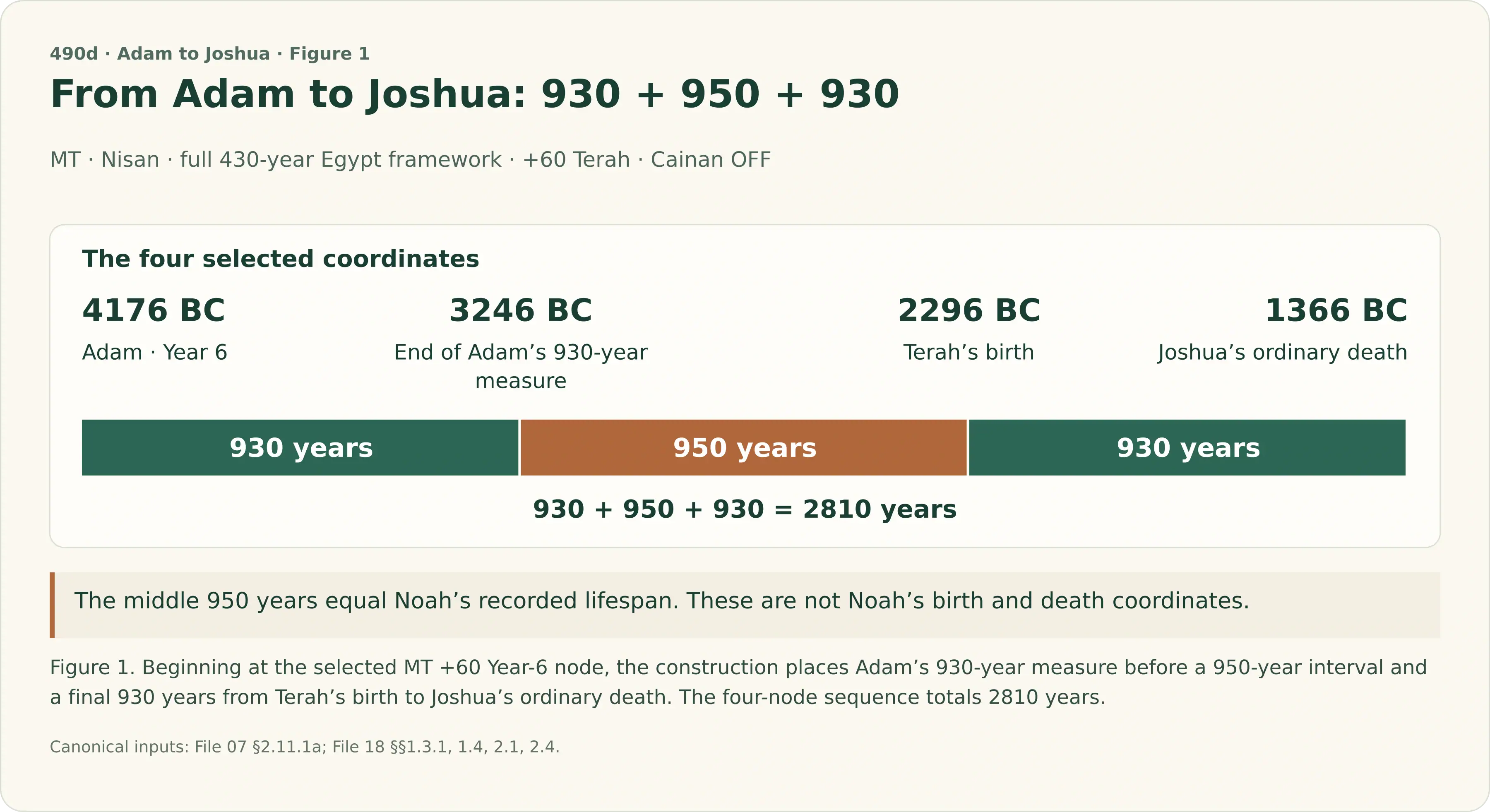
One particular arrangement in the 490d chronology gives a three-part answer. From Adam’s selected starting point to Joshua’s death, the intervals are 930 + 950 + 930 years. Adam’s life supplies the first measure. A span equal to Noah’s life occupies the middle. The final 930 years run from Terah’s birth to Joshua’s death, gathering Abraham’s family and the journey to the land into a second Adam-sized period.
The pattern is most useful when its dates and conditions are visible. It belongs to a specific Masoretic Text (MT) comparison, and its theological meaning grows from that declared arrangement.
The setting: Adam’s Year 6 and Terah’s +60
This study uses the MT, Nisan reckoning, a full 430-year Egyptian sojourn, and the +60 Terah setting. It begins at Adam’s Year-6 position, 4176 BC. The native MT genealogy is used, without the second Cainan between Arphaxad and Shelah. The dates are reconstructed BC coordinates in this research framework.
The +60 setting follows a familiar comparison of Genesis and Acts. Terah lives 205 years; Abraham leaves Haran at 75; and Acts places that departure after Terah’s death. Aligning the departure with the death gives 205 − 75 = 130 for Terah’s age at Abraham’s birth. This is 60 more than the 70 years attached to the opening of Terah’s family in Genesis 11:26. Within the reconstruction, the earlier chronology moves 60 years, while Abraham and the later fixed dates retain their positions.
Thus Terah is born in 2296 BC, Abraham in 2166 BC, and Joshua dies in 1366 BC. Terah is 130 at Abraham’s birth. The 2296 date belongs to Terah himself.
The starting point also matters. File 07’s table distinguishes 4176, the selected Year-6 position, from 4174, the Creation endpoint in this same variant. Measuring Adam’s 930 years from 4176 gives 3246. Starting two years later would give 3244 and a different central interval. The appendix shows both calculations.
Three spans, four dates
490d · Adam to Joshua · Figure 1
From Adam to Joshua: 930 + 950 + 930
MT · Nisan · full 430-year Egypt framework · +60 Terah · Cainan OFF
The four selected coordinates
Canonical inputs: File 07 §2.11.1a; File 18 §§1.3.1, 1.4, 2.1, 2.4.
Read the dates, calculation, and scope
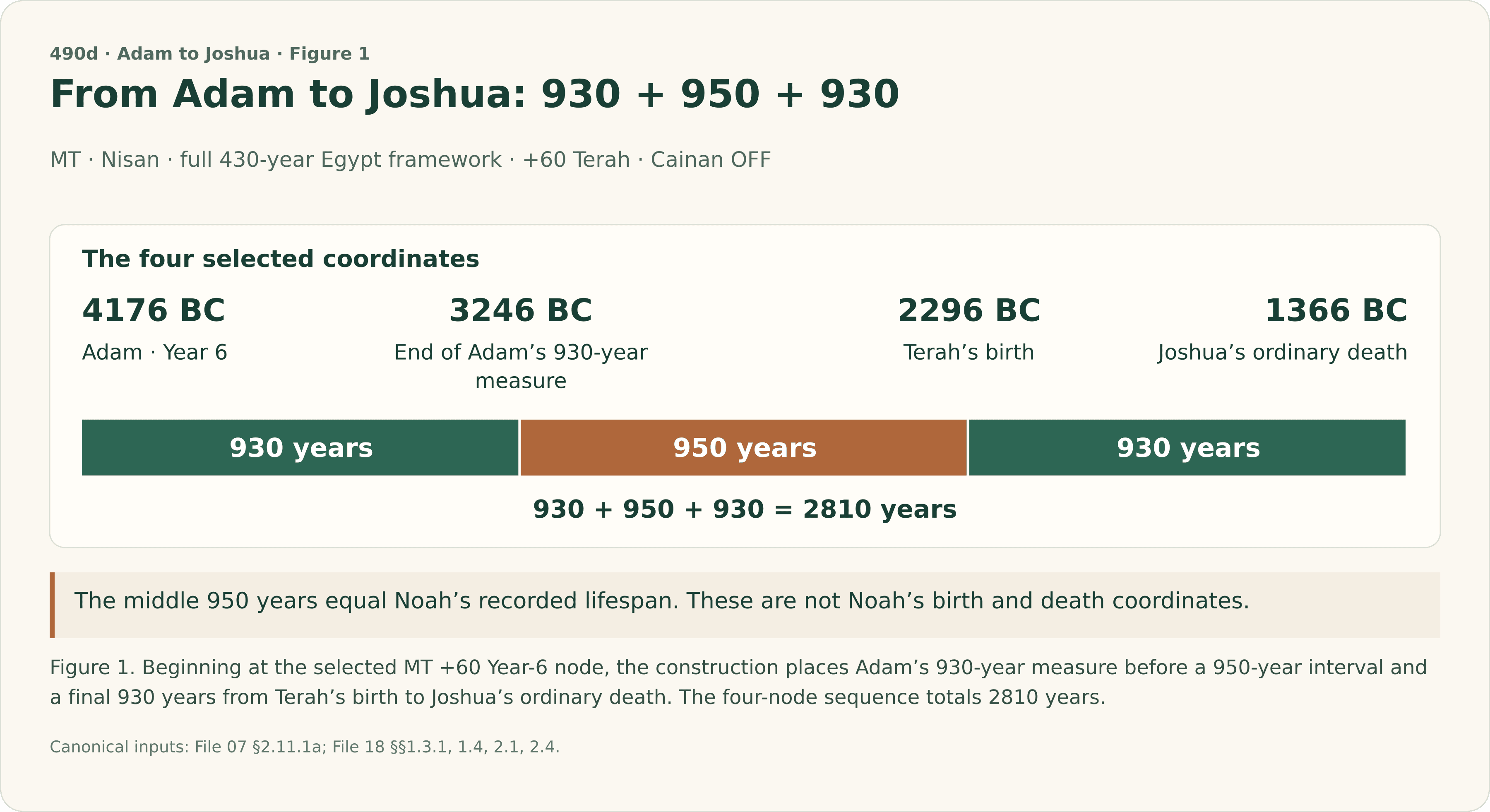
The selected Year-6 starting coordinate is 4176 BC, distinct from the 4174 BC Creation endpoint. Subtracting Adam’s 930 years gives the measured terminal 3246 BC. Then 3246 − 2296 = 950 and 2296 − 1366 = 930. The sum is 2810. Terah’s +60 birth state is 2296 BC; Joshua’s fixed ordinary death is 1366 BC. The middle interval compares a duration with Noah’s recorded 950 years, without identifying its endpoints as Noah’s birth and death. No second Cainan is inserted.
| Beginning → end | Years | Meaning within the comparison |
|---|---|---|
| Adam’s Year-6 position 4176 → terminal 3246 | 930 | Adam’s lifespan measured from the selected start |
| Terminal 3246 → Terah’s birth 2296 | 950 | An interval equal to Noah’s lifespan |
| Terah’s birth 2296 → Joshua’s death 1366 | 930 | The second outer span |
| 4176 → 1366 | 2810 | 930 + 950 + 930 |
This is a simple three-part symmetry: A–B–A. The outer intervals are equal, and Noah’s 950-year measure stands between them. The middle interval is not presented as Noah’s actual birth and death in the same native-MT chronology. It is a comparison of durations, with its own endpoints clearly identified.
Joshua’s endpoint is his regular death in 1366 BC, following a 110-year life from 1476. The Conquest begins in 1406, and the research’s Conquest/rest framework reaches 1399. Those events give the narrative its movement toward the land, while Joshua’s death closes the larger generation. The separate cumulative Joshua endpoint belongs to another method and is not used here.
The two 930s also divide alike
The resemblance goes beyond the total. Genesis 5:3–5 divides Adam’s life into 130 years before Seth and 800 afterward. The final 930-year span can be divided by Abraham’s birth in the same proportions:
Terah 2296 → Abraham 2166 → Joshua’s death 1366 = 130 + 800.
490d · Adam to Joshua · Figure 2
The two outer spans share 130 + 800
MT · Nisan · full 430-year Egypt framework · +60 Terah · Cainan OFF
Adam’s 930 years, measured from the selected Year-6 node
Terah’s birth to Joshua’s ordinary death
Canonical inputs: File 07 §2.11.1a; File 18 §§1.3.1, 1.4, 2.1, 2.4.
Read the dates, calculation, and scope
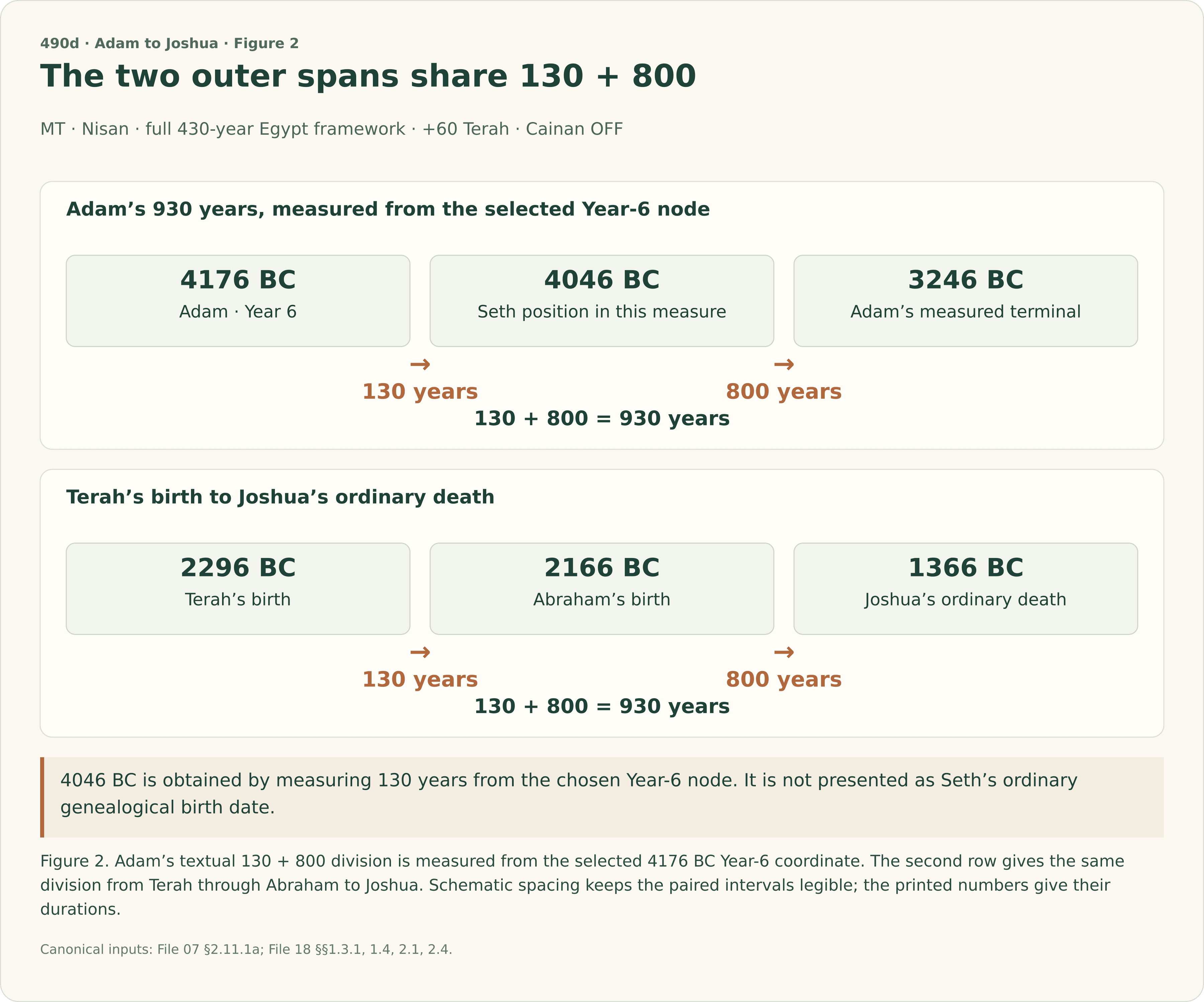
Adam’s biblical lifespan is divided into 130 years before Seth and 800 afterward. Applied to the expressly selected Year-6 node, 4176 − 130 = 4046 and 4046 − 800 = 3246. This row measures the textual divisions from the chosen node; it does not replace the ordinary genealogical Seth row. The corresponding historical-coordinate comparison is 2296 − 2166 = 130 and 2166 − 1366 = 800. Abraham’s 2166 BC date and Joshua’s 1366 BC date remain fixed at this full-430 setting. Each row totals 930; schematic spacing is not a common absolute-date axis.
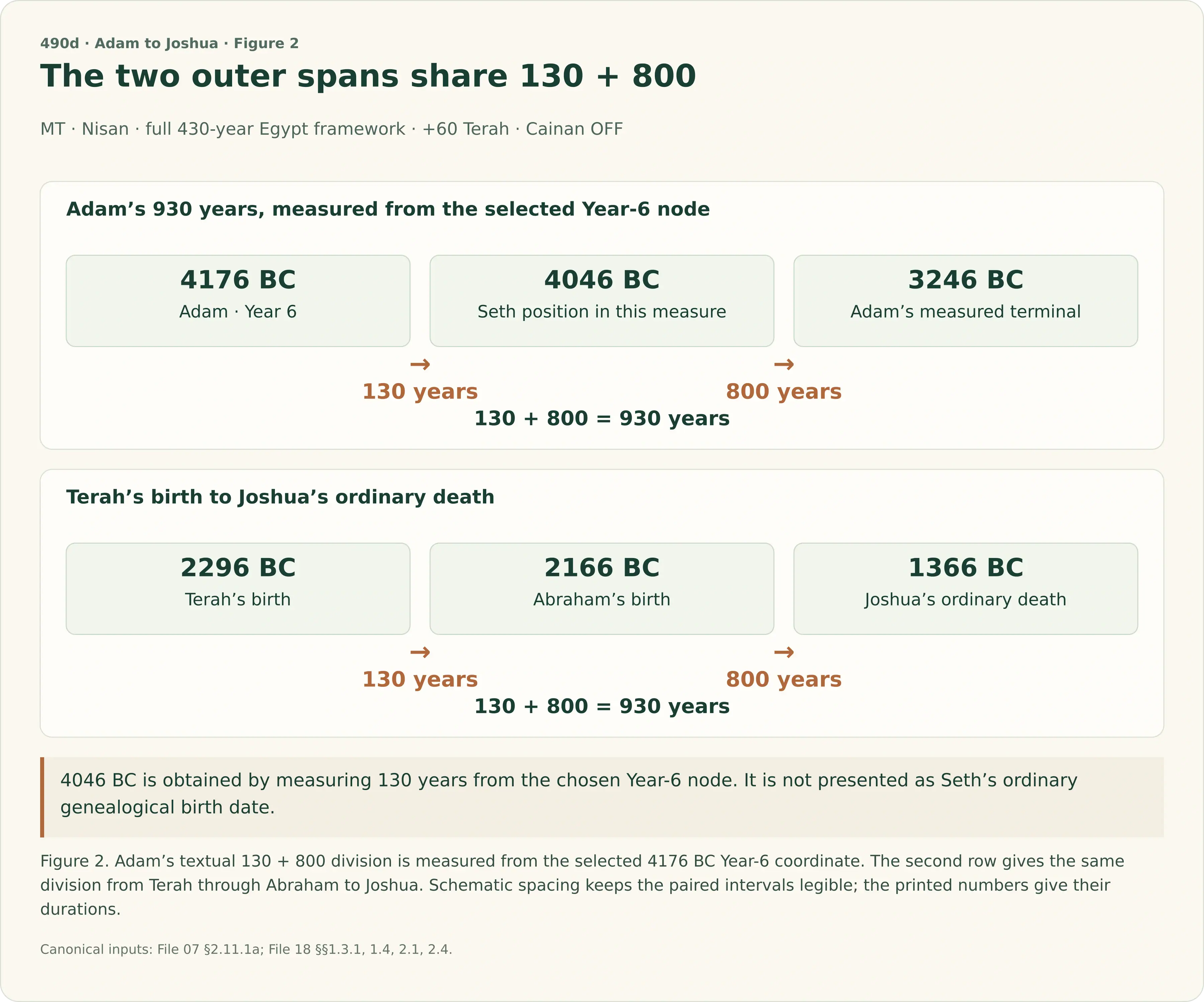
For Adam, the division belongs to one person’s life. For Terah’s family, it stretches across generations: 130 years to Abraham’s birth and 800 from Abraham to Joshua’s death. Abraham’s own lifespan remains 175 years. The final 800 years are the history of the promise-bearing line, rather than one person’s age.
The comparison therefore joins two beginnings. Seth continues Adam’s family after the loss of Abel; Abraham becomes the bearer of the promise that leads toward the land. The same 130 + 800 measure provides a way to read those beginnings together. In the diagram, Adam’s internal date is measured consistently from the selected Year-6 start; the derivation table distinguishes that calculation from the ordinary Creation-endpoint table.
Where Cainan belongs in the wider study
The second Cainan appears between Arphaxad and Shelah in Luke 3:36 and the LXX comparison used by this research. The native MT omits that generation. Restoring its 130-year begetting interval opens an additional chronological comparison, explored in the detailed study.
The 930–950–930 arrangement above already works with Cainan absent from the native MT. Its four dates do not depend on inserting him. The wider Cainan study can set a restored-Cainan Noah against the native-MT Adam measure, but those settings must remain visible. A numerical correspondence offers a reason to investigate the relationship; establishing the history of a textual reading also requires manuscript and textual evidence.
From the first family to the promised land
Adam, Noah, and Joshua stand at different transitions in the biblical story. Adam marks humanity’s beginning and life under mortality. Noah carries a family through judgment into a renewed world. Joshua leads Israel into the land and calls the people to covenant faithfulness before his death.
The repeated lifespan measures allow these transitions to be read as parts of a larger theological composition. The first 930 concerns a single man; the final 930 encompasses the family called through Abraham. Between them, the 950-year measure recalls preservation through the Flood. The arrangement brings creation, judgment, promise, and inheritance into one chronological picture.
Within this study’s providential reading, the symmetry is a meaningful correspondence across the biblical narrative. Its force depends on the exact dates and measures shown here: 930 + 950 + 930, with 130 + 800 repeated in the two outer spans. The detailed study develops the broader comparisons while preserving the differences among their chronological settings.
Supporting material: Technical appendix: dates, derivations, and starting-point comparison · Detailed study: the 930–950–930 pattern and Cainan · Regular MT, LXX, and SP tables.
Source controls: File 07 §2.11.1a; File 18 §§1.3.1, 1.4, 2.1, and 2.4. These establish the inputs and their scope. The assembled pattern and its interpretation are developed in this study.
Scripture quoted by permission. Quotations designated (NET) are from the NET Bible® copyright ©1996, 2019 by Biblical Studies Press, L.L.C. netbible.com. All rights reserved.