After the flood Noah lived 350 years. The entire lifetime of Noah was 950 years, and then he died.
The Flood does not end Noah’s story. He lives another 350 years, carrying the history of the old world into the new. Those years also give the Samaritan Pentateuch’s chronology one of its most striking relationships: the same 1656-year span that reaches the Flood in the Masoretic chronology reaches Noah’s death in the Samaritan comparison.
The endpoints matter. In the MT, the span runs from Creation to judgment. In the SP, it runs from Creation to the end of Noah’s life. This study follows that relationship through the dates, explains the inclusive counting behind the SP table, and considers why Noah’s association with rest gives the comparison theological weight.
1. How to read the dates
The Samaritan Pentateuch (SP) preserves the five books of Moses in the Samaritan textual tradition. Its genealogical figures differ at several points from those of the Masoretic Text (MT) and the Greek Septuagint (LXX). These differences produce different chronological arrangements.
Here we use Regular chronology: successive births are connected by the ages given for begetting the next generation, while lifespans extend alongside those connections. This differs from Cumulative chronology, which places complete lifespans end to end. The companion article Shem and the Flood: A Rounded Comparison uses that other method. Its dates should therefore be read within its own framework.
All dates below are BC coordinates in the 490d reconstruction, anchored to the Exodus in 1446 BC and the Conquest in 1406 BC. They are calculated dates, not BC dates printed in Genesis.
For the main comparison, the SP is displayed in the same full-430 sojourn frame used for the normal MT table. The SP’s native shorter-sojourn table instead has 215 years in Egypt within a 215 + 215 arrangement. Adding 215 to its affected early dates gives the comparison coordinates used here. This makes the frames explicit without changing the genealogical intervals under examination.
We use the normal Gear 2 (G2) Noah/Flood setting, with no Terah +60 adjustment and no second Cainan inserted into the SP or MT. In this research, “Gear” names a defined chronological alignment; its alternatives are explained in the appendix. The figures in this article are not Rounded chronology.
For the full inputs, see the standardized Regular chronology table. The native-SP and full-430 table in this appendix gives the exact conversion beside each principal date.
2. Noah’s life: 600 years, then 350
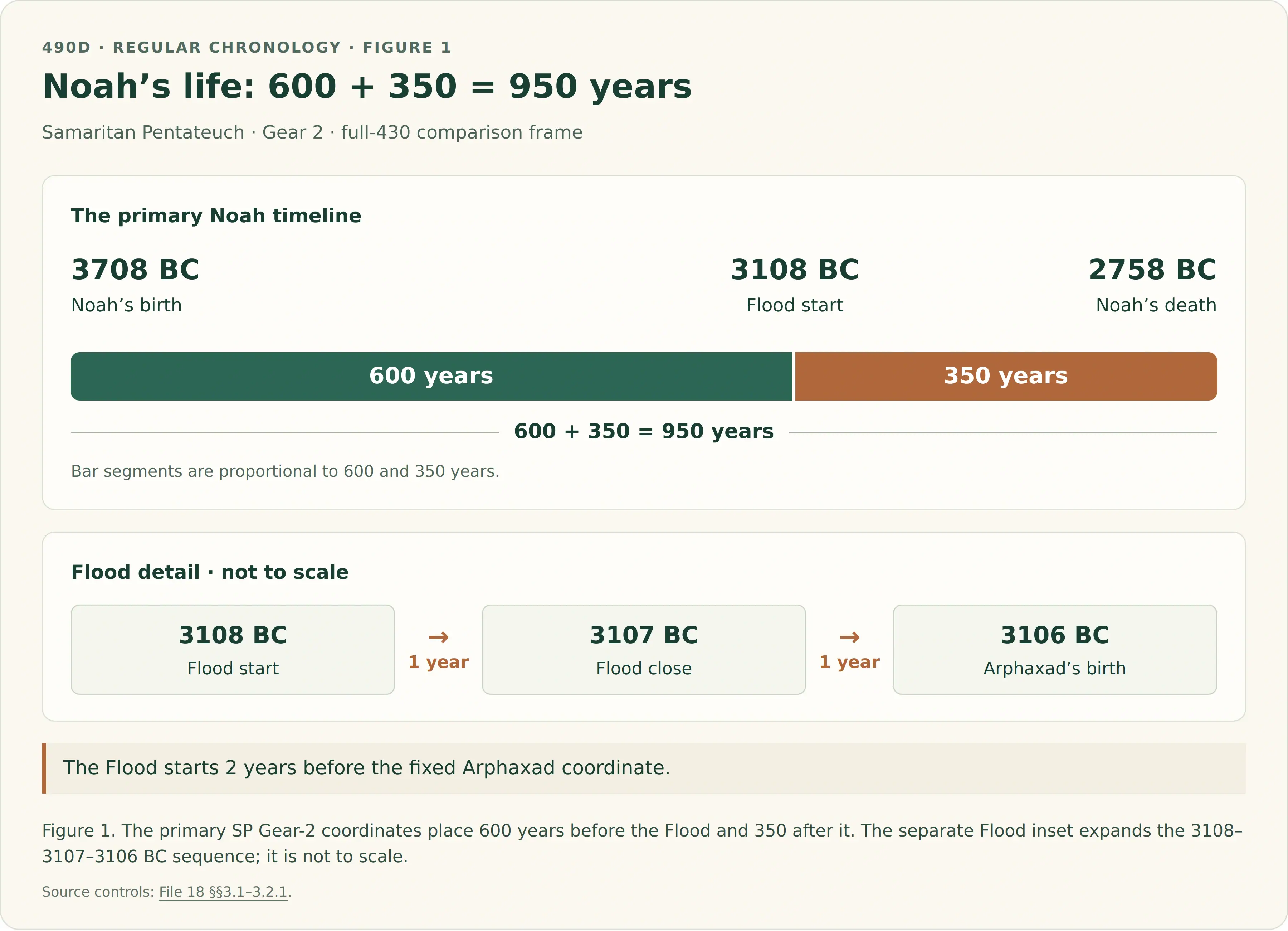
Genesis 7:6 gives Noah’s age at the Flood as 600. Genesis 9:28–29 adds 350 years afterward and gives his total lifespan as 950. The main SP comparison displays those figures as follows:
| Event | SP date | Interval from the previous event |
|---|---|---|
| Noah’s birth | 3708 BC | — |
| Flood start | 3108 BC | 600 years |
| Noah’s death | 2758 BC | 350 years |
Thus 3708 − 3108 = 600, 3108 − 2758 = 350, and 3708 − 2758 = 950.
490d · Regular chronology · Figure 1
Noah’s life: 600 + 350 = 950 years
Samaritan Pentateuch · Gear 2 · full-430 comparison frame
The primary Noah timeline
Bar segments are proportional to 600 and 350 years.
Flood detail · not to scale
Source controls: File 18 §§3.1–3.2.1.
Read the diagram’s dates and calculation
These are whole-year model coordinates in the full-430 comparison frame, without Terah’s +60 variant. The displayed Noah death is the primary harmonic coordinate; the diagram does not assert exact birthdays. The 3108–3107 Flood year is included. Arphaxad at 3106 BC is fixed: 3108 − 3106 = 2. The inset uses equal visual spacing for readability and is expressly not to scale.
View the image version or download it full size
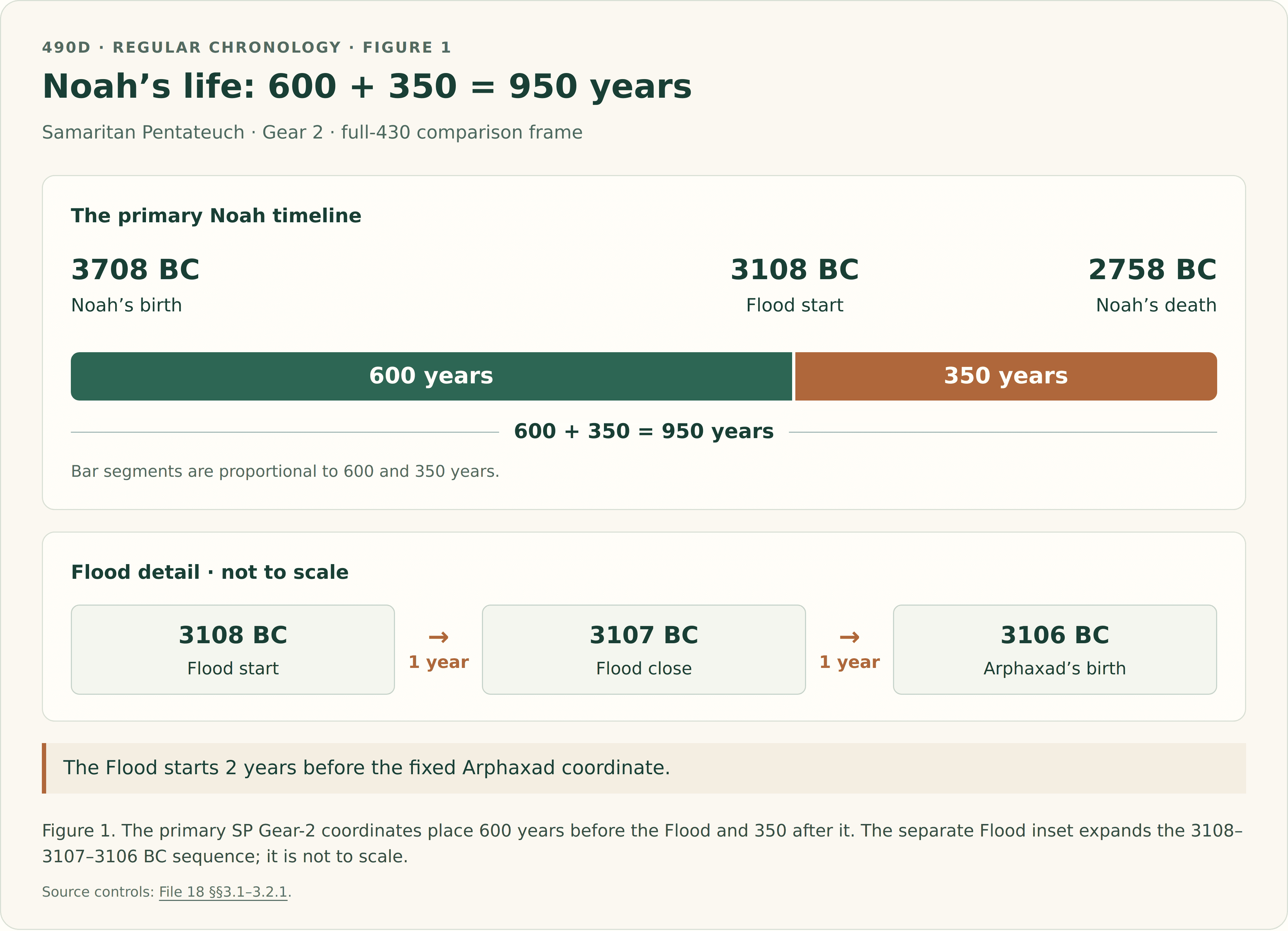
The Flood itself has a start and a close. In this annual display it runs 3108 → 3107 BC, while Arphaxad’s birth is fixed at 3106 BC. The sequence is therefore:
Flood start 3108 → Flood close 3107 → Arphaxad’s birth 3106 BC.
Genesis 11:10 places Arphaxad’s birth two years after the Flood. The G2 reconstruction measures those two years from the Flood’s starting coordinate. It does not make 3106 BC the normal Flood date, or assign Arphaxad a conception date during the Flood.
These are whole-year comparison coordinates. The primary Noah row also carries the inclusive/harmonic qualification explained in the counting and endpoint notes; it is not a reconstruction of otherwise unstated birthdays.
3. The same 1656 years, with different endpoints
The central comparison is compact:
| Tradition and frame | Starting point | Ending point | Span |
|---|---|---|---|
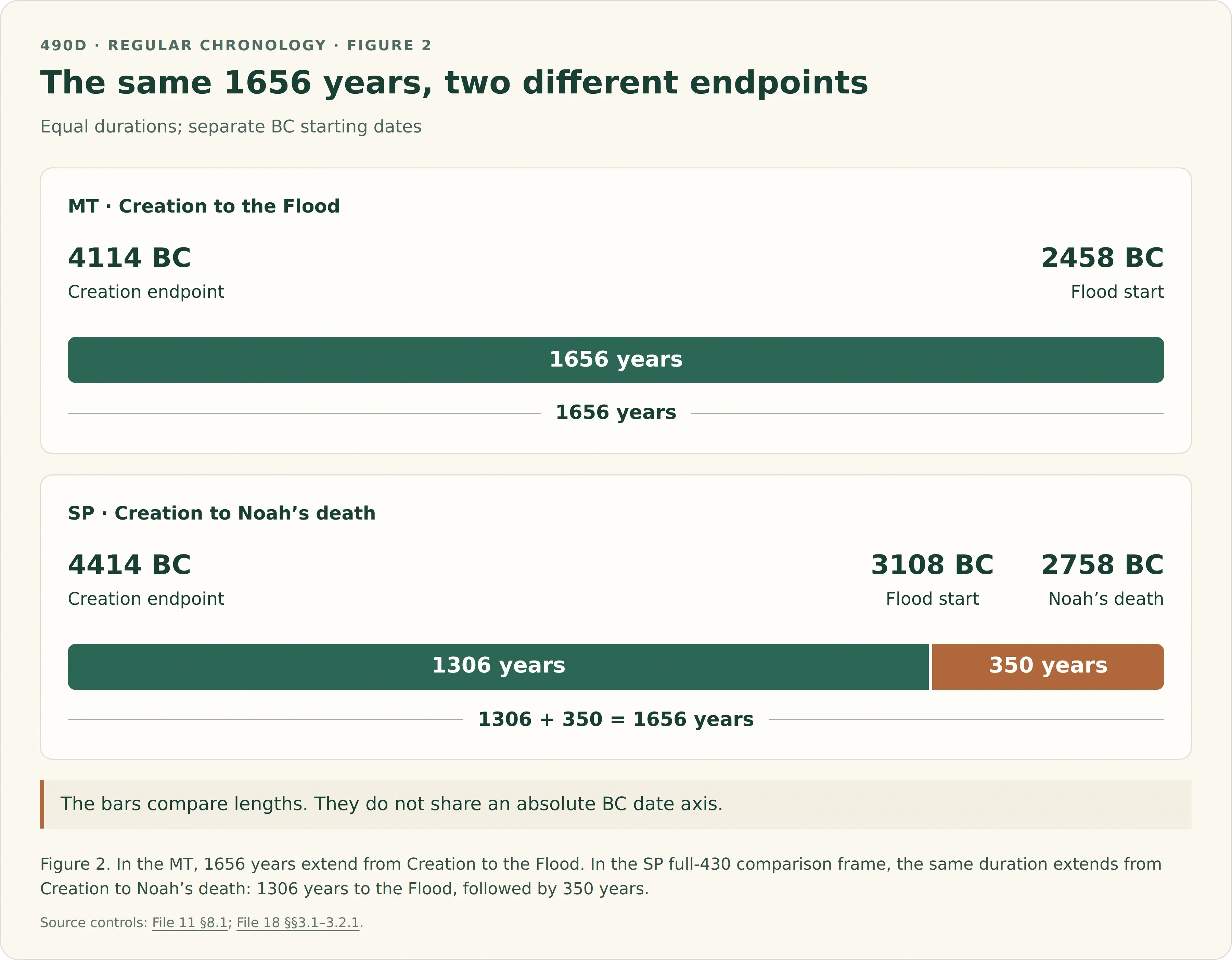
| MT, normal full-430 | Creation: 4114 BC | Flood start: 2458 BC | 1656 years |
| SP, full-430 comparison | Creation: 4414 BC | Noah’s death: 2758 BC | 1656 years |
490d · Regular chronology · Figure 2
The same 1656 years, two different endpoints
Equal durations; separate BC starting dates
MT · Creation to the Flood
SP · Creation to Noah’s death
Source controls: File 11 §8.1; File 18 §§3.1–3.2.1.
Read the diagram’s dates and calculation
The common bar length represents 1656 years. MT arithmetic: 4114 − 2458 = 1656. SP arithmetic: 4414 − 3108 = 1306; 3108 − 2758 = 350; 1306 + 350 = 1656. The starts are aligned only for comparing duration. All dates shown are Gear-2 whole-year coordinates; SP uses the full-430 comparison frame without Terah’s +60.
View the image version or download it full size
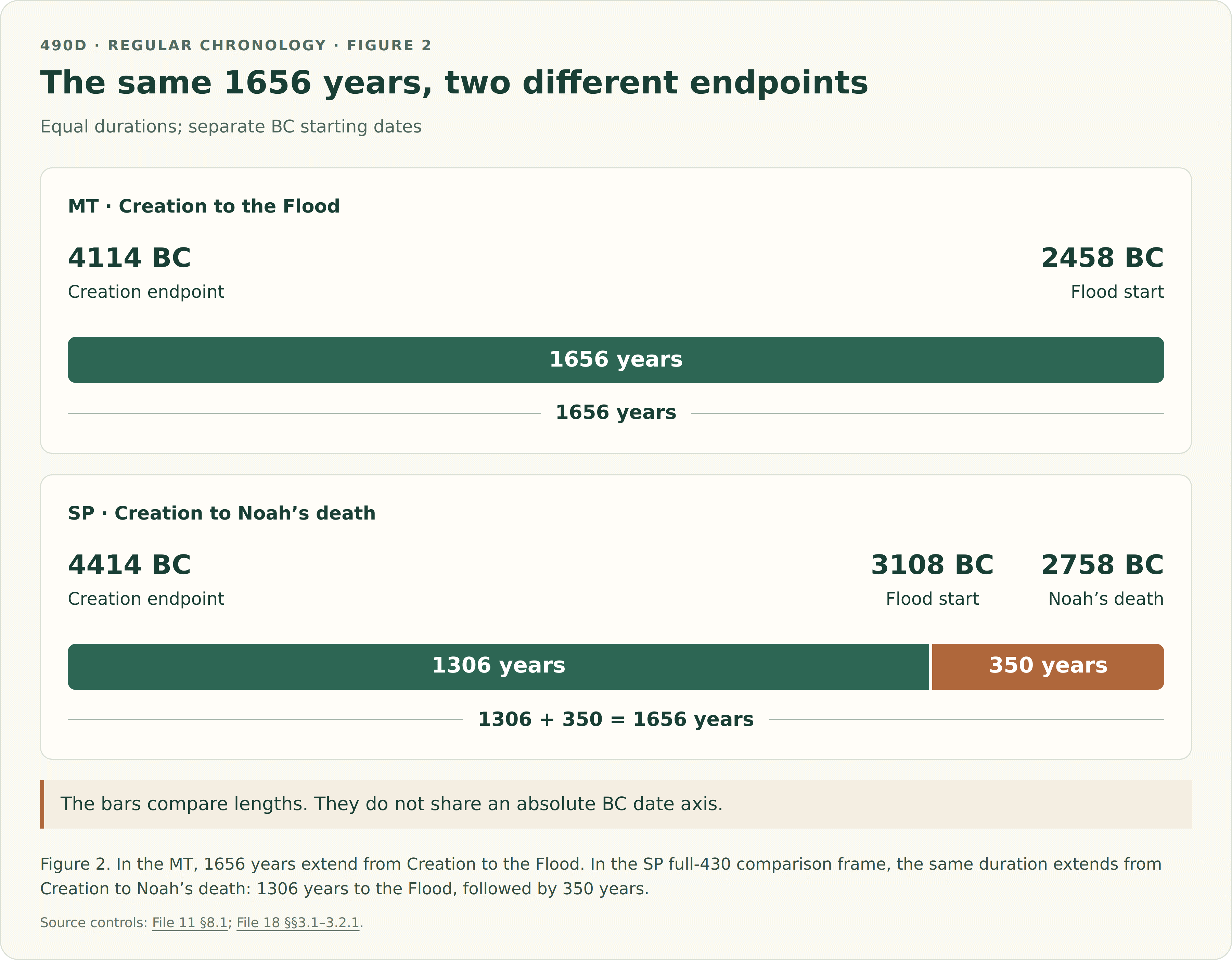
In the SP, the span divides at the Flood:
4414 → 3108 → 2758 BC = 1306 + 350 = 1656 years.
This is why Noah’s post-Flood life belongs in the comparison. The SP’s 1656 is not its Creation-to-Flood interval. It includes the 350 years that follow the Flood, and ends at Noah’s death.
The two complete spans also stand 300 years apart on the BC scale. SP Creation is 300 years earlier than MT Creation: 4414 − 4114 = 300. SP Noah’s death is likewise 300 years earlier than the MT Flood: 2758 − 2458 = 300. The equal lengths do not make these different events simultaneous.
This exact relationship is retained in File 11, §8.1. It also survives the change of display frame: the native SP dates give 4199 − 2543 = 1656. Moving both endpoints by 215 years preserves their interval. See the endpoint calculations.
4. Why the SP table uses inclusive counts
The SP figures require us to distinguish completed intervals from counted years. Counting both the opening and closing year produces one more counted year than ordinary subtraction between their labels.
For example, the corrected SP table places Lamech’s birth at 3760 BC and his death at Flood start, 3108 BC. Ordinary subtraction gives 652; counting both endpoint years gives 653, his SP lifespan count:
3760 − 3108 + 1 = 653.
The same convention preserves Jared’s 847 and Methuselah’s 720 at the Flood boundary. Their dates and calculations are listed in the inclusive lifespan table.
This also explains the two descriptions of the SP Creation-to-Flood interval. 4414 − 3108 = 1306 completed years; counting both endpoint years gives 1307. The 1656 comparison above uses ordinary endpoint subtraction: 1306 + 350. Adding the inclusive 1307 to the completed 350 would mix counting conventions and give 1657, one more than the completed span between the outer endpoints.
The distinction is local and controlled. It does not add a year to every patriarch’s life. Adam still has 930 years; Enoch has 365; the matched Noah dates preserve 950. Nor does it move the fixed Arphaxad date. The complete Creation-to-Flood ledger shows how the SP’s recorded begetting figures lead to the selected annual positions.
5. Where Shem and the other traditions fit
Shem’s 600 years must likewise be distinguished from his age at a particular event. Genesis 11:10–11 gives 100 years to Arphaxad’s birth and 500 afterward. The SP post-Flood genealogy accordingly selects 3206 → 3106 → 2606 BC = 100 + 500.
The Noah/Flood comparison has a separate Shem position at 3208 BC: 500 years after Noah’s birth at 3708, and 100 before Flood start at 3108. That position is 102 years before Arphaxad. The two positions belong to the research’s named Noah-bound and Arphaxad-bound alignments; they are not two births in one ordinary biography. The appendix places their matching lifespans side by side.
The regular Flood dates also differ from the familiar cumulative comparison. In the matched full-430 frame, the G2 Flood starts are 2458 BC (MT), 3108 BC (SP), and 3238 BC (LXX). The SP is therefore 650 years earlier than the MT, while the LXX is 780 years earlier. The 120-year MT/SP displacement discussed in the rounded cumulative article belongs to that cumulative construction. The three-tradition table records the exact states and boundaries.
One further SP relationship makes Lamech’s place especially striking:
Creation 4414 → Lamech’s birth 3760 → Arphaxad’s birth 3106 BC = 654 + 654 years.
Lamech stands at the midpoint between the preferred Creation endpoint and the birth of the first named post-Flood descendant. This midpoint ends at Arphaxad, two years beyond the normal Flood start. It is a distinct comparison from Lamech’s inclusive 653-year life. See the midpoint diagram and its derivation.
6. From Creation’s rest to Noah’s rest
In Genesis 5:29, Lamech names Noah in hope of relief from the labor associated with the cursed ground. The name Noah is associated with rest, while the verse’s word for comfort supplies a related sound-play. Noah’s story therefore carries the hope of relief before the Flood arrives.
The chronological comparison gives that theme a particular shape. Its SP starting point, 4414 BC, is the Creation-Sabbath endpoint in the study’s symbolic seven-year Creation framework. Its ending point is the death of the man associated with rest. The corresponding MT span reaches the Flood’s judgment. The same duration thus joins two related readings of the story: judgment upon the old world, and the completed life of the man who passes through it.
“Noah’s rest” is a theological reading of this endpoint, not a claim that Genesis explicitly names his death a sabbath. Likewise, the equality of the spans is an exact calculation within the declared reconstruction; it does not by itself establish how an ancient scribe produced the figures.
The value of the comparison lies in its precision. With Creation, Flood, Arphaxad, and Noah’s death kept distinct, the SP has a coherent pattern of its own: 1306 years to the Flood, 350 afterward, and 1656 from Creation to the close of Noah’s life.
Further study: Flood Chronology in the Samaritan Pentateuch: Detailed Study.
Supporting material: Technical appendix: dates, inclusive counts, and the Lamech midpoint · Full Regular chronology tables · Canonical source catalog.
Scripture quoted by permission. Quotations designated (NET) are from the NET Bible® copyright ©1996, 2019 by Biblical Studies Press, L.L.C. netbible.com. All rights reserved.