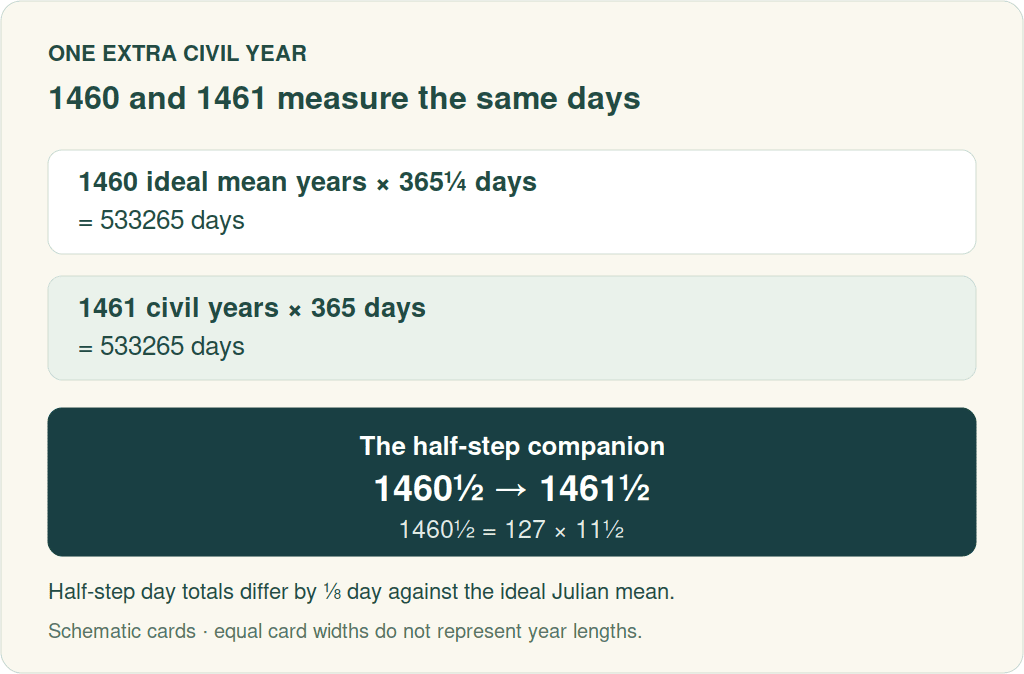
A 365-day year offers a useful way to examine the relationship between biblical chronology and the Key of 23. The starting point is an ancient calendar problem: a civil year of exactly 365 days gradually falls behind a year measured by the seasons. A familiar idealized solution compares 1460 years of 365¼ days with 1461 years of 365 days. Both contain the same number of days.
This study asks a more focused question. What happens when the 1460-year count is moved forward by half a year, to 1460½? That small change brings the Sothic comparison into the half-units of 23 already used elsewhere in the chronology. It also helps connect Moses, the Creation week, and a limited group of Sumerian King List dates.
“So the tabernacle was set up on the first day of the first month of the second year.”
Exodus 40:17, BSB
The distinction between the Exodus year and the following year gives the discussion a concrete biblical setting. In this chronology the Exodus is placed at 1446 BC, and the erection of the Tabernacle at the beginning of the next first month falls in 1445 BC. These dates provide an existing framework for the comparison. They are not dated by discovering a Sothic reset.
Why 1460 and 1461 belong together
The Egyptian civil calendar contained 365 days. Against the ideal mean of 365¼ days, it loses one day every four years. Over 1460 of those longer years, the difference amounts to one whole 365-day civil year:
1460 × 365¼ = 1461 × 365 = 533265 days.
This is the arithmetic behind the ordinary Sothic comparison. Censorinus describes the Egyptian civil year and its canicular, or Sirius-related, cycle in chapter 18 of De die natali. Here I use the ideal mean-year relation as a mathematical comparison. Reconstructing an actual ancient observation of Sirius would require a different investigation.
The half-unit of 23
The original Keys use three different calendar bodies: 336 days in the Priestly comparison, 360 in the Prophetic comparison, and 364 in the Enochian comparison. Their ratios turn 11½ into 12½, 69 into 70, and 299 into 300. Each adds one to its stated starting count.
Half of 23 is 11½. The three starting counts are respectively one, six, and twenty-six such units. The Sothic half-step adds another member to this same completion pattern:
127 × 11½ = 1460½ → 1461½.
Its ratio is 1461½ divided by 1460½, or 2923/2921. I call this the Sothic-adjacent companion to the Key of 23. It is especially close to the ideal Sothic relation: the two associated day totals differ by only one-eighth of a day across the whole block.
That description matters. The companion organizes a particular one-year completion; it does not by itself explain why every member of the family has its particular multiplier. Nor does it preserve the exact common day-equivalent of the original three Keys. A second 365-day ratio, 1680/1679, preserves that property. The two ratios answer different questions. Their definitions and calibration comparisons are kept separate in the appendix.
Moses and the following year
The Sumerian King List comparison already supplies a 2906 BC coordinate. Measured to the Exodus at 1446 BC, it gives 1460 years. Completing that count to 1461, while keeping its beginning fixed, reaches 1445 BC—the Tabernacle year.
The same beginning stands 1380 years before Moses’ birth at 1526 BC. Under the Priestly Key, 1380 expands to 1500, gaining 120 years and reaching the Conquest at 1406 BC. The gain corresponds to Moses’ whole lifetime. The original 1380-year interval and its 120-year gain therefore join Moses’ birth and death within one construction.
The half-step becomes visible when seasons are specified. A comparison from Tishri to Nisan includes the extra half-year: the route from 2907 Tishri BC to 1446 Nisan BC measures 1460½ years. It can be divided into 1380 plus 80½:
1380 + 80½ = 1460½ = 127 × 11½.
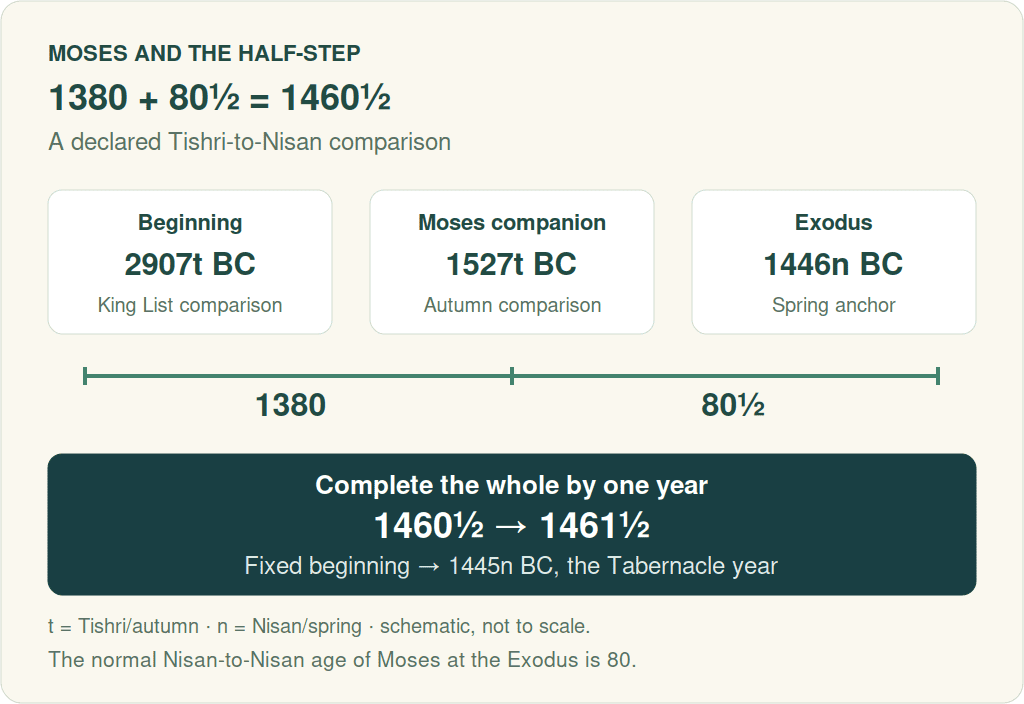
Nisan and Tishri name the spring and autumn positions. Their half-year spacing is represented schematically here, rather than by reconstructing lunar month dates. The ordinary Nisan-to-Nisan interval from Moses’ birth in 1526 BC to the Exodus in 1446 BC remains 80 years. The half-year belongs to the specified seasonal comparison.
Seven cycles between two Creation constructions
The Regular chronology follows fatherhood ages through overlapping generations. The Cumulative chronology adds lifespans end to end as a separate mathematical construction. In a corresponding comparison their actual Creation coordinates stand 9890 years apart.
The second Cainan provides a useful declared variant. Including his 460-year lifespan in the Cumulative construction, and his 130-year fatherhood interval in the Regular construction, increases their separation by 330:
9890 + 460 − 130 = 10220 = 7 × 1460.
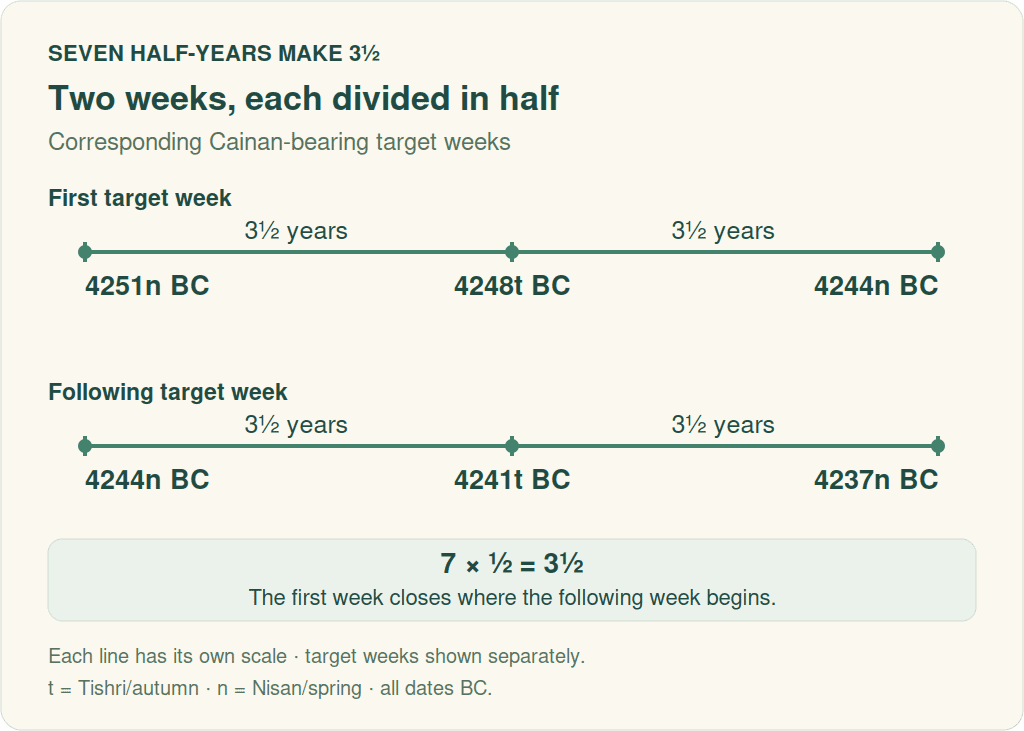
This comparison uses Cainan on both sides. It does not change the usual MT Creation anchor of 4114 BC or quietly insert Cainan into every chronology. In the selected construction, the Cumulative Creation head at 14471 BC corresponds to the Regular head at 4251 BC. Their seventh-year closes at 14464 and 4244 BC are also 10220 apart.
Completing seven counts of 1460 to seven counts of 1461 adds seven years to each corresponding span. With each Cumulative beginning held fixed, the Regular target week moves from 4251–4244 BC to 4244–4237 BC. The new week begins where the former week closes.
The half-step adds 3½ to the seven-cycle span, because seven half-years make 3½ years. It therefore reaches the midpoint of the target week. Completing the half-step reaches the midpoint of the following week.
A small group with exact Mirror symmetry
The Sumerian comparison also contains a precisely limited group of twelve seasonal positions. They come from two date groups thirty years apart, with three two-year variants in each and spring and autumn positions for every variant. Their center falls at the opening of 2921 BC.
Four half-step counts total 5842 years. Moving every member of this group forward by that same amount produces exactly its paired Mirror across the opening of AD 1. Every one of the twelve positions has a partner; none needs a separate adjustment.
The placement has an additional connection to the Mosaic dates. The principal King List positions, 2936 and 2906 BC, stand 1460 years before the proposed Joshua-birth coordinate at 1476 BC and the Exodus at 1446 BC. Their midpoint is 2921 BC. Thus the calendar comparison and the previously defined target dates locate the same center.
This is a result about that complete, specified group. The adjacent ordinary and completed counts match fewer members. The Long King List variant has its own center and does not reproduce the same whole-group result. The appendix includes the complete comparison counts so the successful relation can be assessed at its proper scope.
What this companion contributes
The Sothic companion brings a recognizable calendar relation into contact with several existing chronological structures. Its half-unit of 23 joins 1380 to the seasonal age of Moses; seven cycles connect corresponding Creation constructions; and four half-step cycles give an exact Mirror relation within a defined King List group.
I read these relationships within a Christian understanding of providence, while distinguishing the numerical arrangement from its interpretation. The strongest contribution is the way a small set of stated inputs produces several connected results. Those related results should be considered together rather than counted as separate independent proofs.
The technical appendix supplies the dates, fractions, complete twelve-position comparison, and the applications that remain incomplete. For the underlying definitions, see The Key of 23 and the canonical source catalog. The original Report V remains available as a dated research record.
Scripture quotation: Berean Standard Bible (BSB), public domain.