Detailed companion · Part 4b · 6 October 2026 · v1. Seasonal columns, fixed-anchor expansions and controlled Mirror comparisons develop the Flood day–year research. The full calculation tables and unchanged earlier discussion are linked below.
He waited seven more days and again sent out the dove from the ark. When the dove returned to him in the evening, there in its beak was a freshly plucked olive leaf! Then Noah knew that the water had receded from the earth. He waited seven more days and sent the dove out again, but this time it did not return to him.
The Flood narrative moves from rain and confinement toward a renewed earth. Its dated notices, forty-day waits and seven-day intervals invite a close study of time. They also supply the small-scale framework for this article’s larger comparisons: the Exodus, the land’s rest, Ezekiel’s symbolic siege, the Temple, and the chronological Mirror.
The central question is how these different measures fit together. A seven-day interval can be read as seven ordinary days, represented by a week as a whole, or projected as seven symbolic years. A calendar span can retain its intercalary month or be expressed through its 360-day core. Such choices are meaningful only when their units, starting points and boundaries remain visible.
This detailed companion follows the Flood introduction and its narrative chronology. It develops the additional research in Part 4b rather than repeating those studies. Its full tables and source notes preserve the earlier ledger, alternative counters, all numerical comparison grids, and the larger cumulative and Sumerian constructions. The original discussion is preserved separately.
1. Read the calendar before enlarging the numbers
Four levels of evidence run through this study. Genesis gives narrative events and dated notices. A reconstructed calendar assigns those events to a common day scale. A day–year projection turns positions on that scale into symbolic coordinates. Interpretation then asks what the resulting relationships might mean.
| Level | Example | What it establishes |
|---|---|---|
| Scripture | Seven more days before the next dove flight | A stated narrative interval |
| Calendar reconstruction | Locating bird flights within a 360-day year | A result dependent on the reconstruction |
| Symbolic projection | Naming a selected position “434 BC” | A model coordinate, not a historical date for that flight |
| Interpretation | Comparing that coordinate with Temple or Exodus spans | A proposed correspondence whose arithmetic can be tested separately |
Genesis places the outbreak in month II, day 17; the Ark’s rest in month VII, day 17; visible mountain tops in month X, day 1; uncovered, surface-dry ground in the next year’s month I, day 1; and complete dryness in month II, day 27. God’s instruction to leave follows that last notice. Surface dryness and complete dryness are separate events. They must not share the same label. See Genesis 7:11, BSB, and Genesis 8:4–19, BSB.
The bird sequence needs a similar distinction. Genesis explicitly gives two later waits of seven days. The preceding interval between the raven and first dove is less explicit. The earlier discussion explored an additional seven-day separation; its final ledger places the raven and first dove together at the beginning of the sequence, followed by the two stated seven-day waits. Both reconstructions remain available in the ledger history. A suggested raven flight at dusk and first dove flight the following morning is a reconstruction, not a stated hour in Genesis.
Inclusive and exclusive counts do not describe different events. They describe different ways of numbering an interval. An inclusive first day is day 1; at that starting boundary, zero full days have elapsed. This explains why an entry, dove flight or new-year boundary may have adjacent labels. The pair must remain attached to the event and its declared counting convention.
2. The four seasonal columns
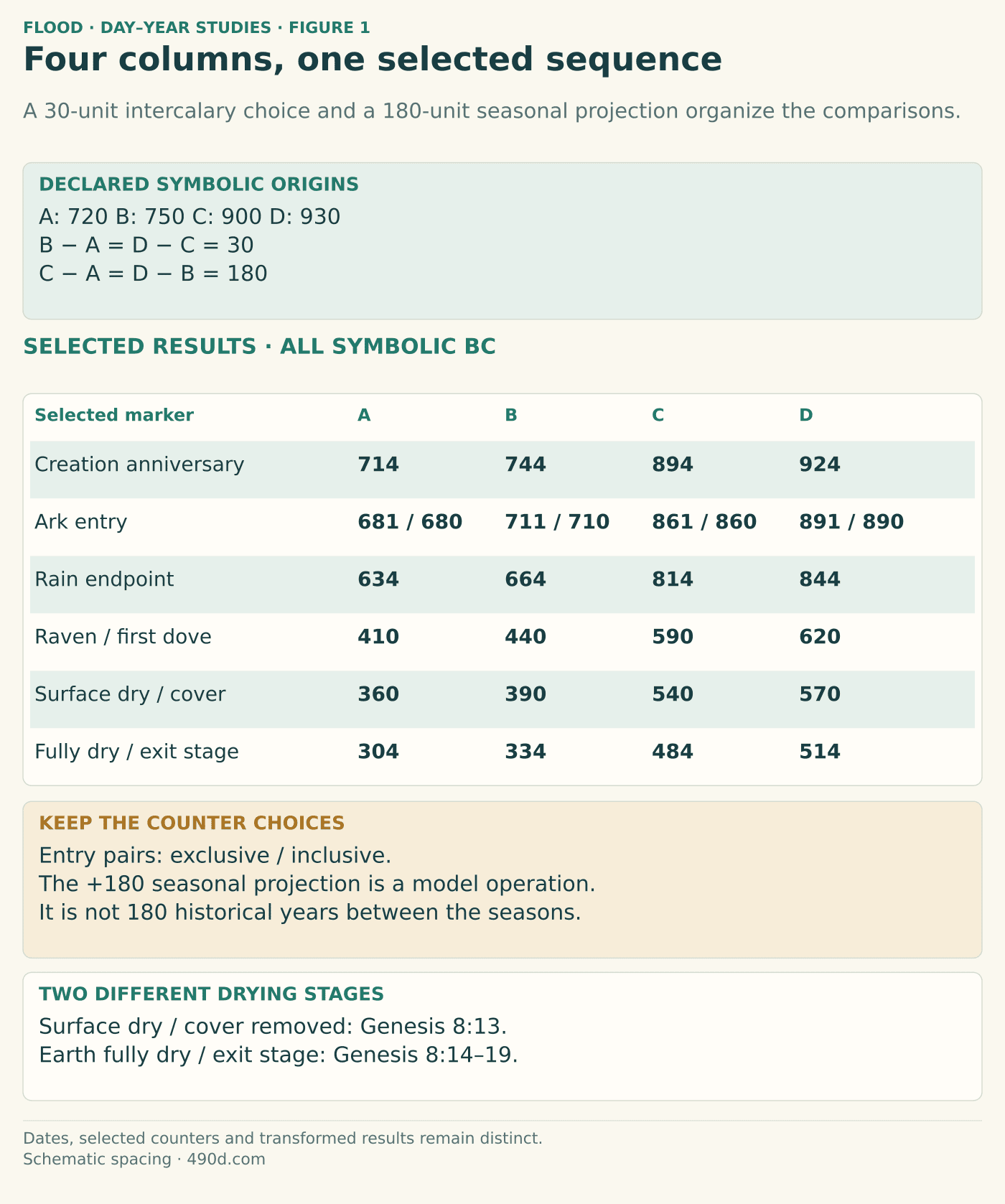
The refined ledger has four origins. Column A begins at 720; column B adds 30; column C adds 180 to A; and column D adds both adjustments. The 30 represents a retained leap-month field. The 180 is a half-year translation on the symbolic 360-day scale. These are changes to the projection, not claims that Noah’s historical events happened 30 or 180 years apart.
Accessible text and image downloads
A four-column symbolic table has origins A720, B750, C900 and D930. B minus A and D minus C equal30, while C minus A and D minus B equal180. Creation anniversary:714,744,894,924. Ark entry exclusive / inclusive:681/680,711/710,861/860,891/890. Rain endpoint:634,664,814,844. Raven and first dove:410,440,590,620. Surface dry and cover removed:360,390,540,570. Fully dry and exit stage:304,334,484,514. All are selected symbolic BC coordinates. The seasonal180-unit lift does not redate historical events.
Desktop PNG · Phone PNG · Desktop WebP (ZIP) · Phone WebP (ZIP) · Text-based SVG (ZIP)
Full table and calculation · Scripture: Genesis 8:6–14 (BSB) · Genesis 7:11; narrative basis, not four-column calculation (BSB) · Genesis 8:3–14; narrative basis, not four-column calculation (BSB) · Genesis 2:1–3; interpretive anniversary (BSB) · Genesis 7:1–10 (BSB) · Genesis 7:12 (BSB) · Genesis 8:6–7 (BSB) · Genesis 8:8–9 (BSB) · Genesis 8:13 (BSB) · Genesis 8:14–19 (BSB)
| Selected position | A: 720 | B: 750 | C: 900 | D: 930 |
|---|---|---|---|---|
| Creation-anniversary position | 714 | 744 | 894 | 924 |
| Ark entry: exclusive / inclusive | 681 / 680 | 711 / 710 | 861 / 860 | 891 / 890 |
| Door closure / outbreak position | 674 | 704 | 854 | 884 |
| End of rain | 634 | 664 | 814 | 844 |
| Ark’s rest | 524 | 554 | 704 | 734 |
| Mountain tops | 450 | 480 | 630 | 660 |
| Raven and first dove | 410 | 440 | 590 | 620 |
| Olive-leaf dove: inclusive / exclusive | 404 / 403 | 434 / 433 | 584 / 583 | 614 / 613 |
| Third dove: inclusive / exclusive | 397 / 396 | 427 / 426 | 577 / 576 | 607 / 606 |
| Surface dry; covering removed | 360 | 390 | 540 | 570 |
| Complete dryness / ensuing exit | 304 | 334 | 484 | 514 |
All entries in this table are symbolic BC coordinate labels. The year number decreases as the projected narrative advances. The full ledger explains its event positions, adjacent evening boundaries and selected inclusive pairs. Open the complete table or download its data (data ZIP).
The seasonal construction follows the evening–morning analogy: evening can be represented by autumn, and morning by spring. A displayed 711t/710n pair therefore describes successive seasonal positions in the model. Genesis does not independently tell us that each selected Flood event occurred at dawn. The analogy supplies a way of arranging boundaries; the narrative supplies the events.
Later festivals provide additional reference positions. The Ark rests on the seventeenth day of its seventh month; Tabernacles begins on the fifteenth day of Israel’s seventh month. The two-day offset gives 526, 556, 706 and 736 beside the rest positions 524, 554, 704 and 734. In a Tishri-start model the seasonal analogy can instead point toward spring and Passover. These are retrospective comparisons with later institutions, not evidence that Noah observed those festivals.
A related comparison places Kislev 25, the later Hanukkah reference, two days before the modeled rain-end position at Kislev 27 in the Tishri arrangement. Its four coordinates are 636, 666, 816 and 846. Evening boundaries may add one to these labels. Those choices become important in the Mirror calculations below. Festival offsets and their assumptions.
3. The 23-and-46 spine
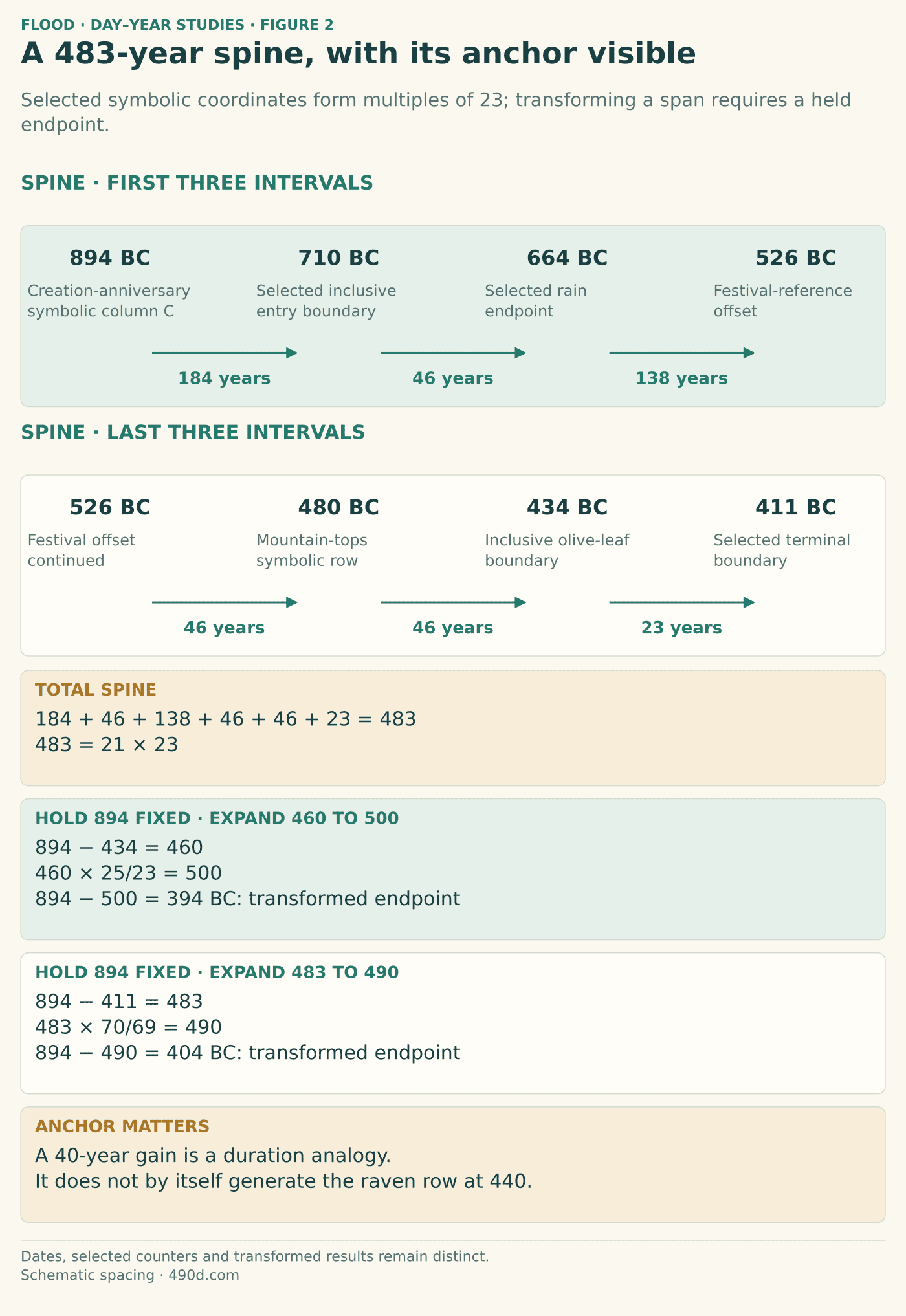
Selecting coordinates from the different columns produces a compact numerical chain:
894 → 710 → 664 → 480 → 434 → 411.
Its intervals are 184 + 46 + 184 + 46 + 23. Each is a multiple of 23, and the whole span is 483. The festival coordinate 526 subdivides the middle 184 into 138 + 46.
Accessible text and image downloads
The symbolic BC spine is split into two linked panels.894 to710 is184;710 to664 is46;664 to526 is138. Continuing526 to480 is46;480 to434 is46;434 to411 is23. Total483 equals21 times23. The526 point is a selected festival offset and411 a selected terminal boundary. With894 held fixed,894 minus434 equals460, expanded by25/23 to500 and endpoint394.894 minus411 equals483, expanded by70/69 to490 and endpoint404. The transformed endpoints are not historical event dates.
Desktop PNG · Phone PNG · Desktop WebP (ZIP) · Phone WebP (ZIP) · Text-based SVG (ZIP)

Full table and calculation · Scripture: Genesis 2:1–3; symbolic comparison (BSB) · Genesis 7:1–10; selected counter (BSB) · Genesis 7:12; selected counter (BSB) · Genesis 8:4; Ark rest (BSB) · Leviticus 23:34; later Tabernacles reference (BSB) · Genesis 8:5 (BSB) · Genesis 8:10–11; inclusive selected counter (BSB) · Genesis 8:6–13; selected comparison, not directly dated Scripture node (BSB) · Ezekiel 4:6; day–year background, not the fractional expansion rule (BSB)
| Comparison | Span | Factorization |
|---|---|---|
| 894 → 664 | 230 | 10 × 23 |
| 664 → 434 | 230 | 10 × 23 |
| 894 → 434 | 460 | 20 × 23 |
| 894 → 411 | 483 | 21 × 23 = 3 × 161 |
| 710 → 434 | 276 | 12 × 23 |
The chain combines selected columns and counter positions. Its symmetry is a property of that declared selection; it does not mean that every consecutive Flood event is separated by 23 or 46 days. The proposed connection to Daniel’s seventy sevens rests particularly on 483 + 7 = 490. Daniel’s own account supplies the seventy-sevens framework and its final seven; the Flood arrangement supplies a separate numerical correspondence. See Daniel 9:24–27, BSB.
The same coordinates can be compared with regular chronological anchors. The normal MT register used here has Creation at 4114 BC, Jared’s birth at 3654 BC, the Flood at 2458 BC and the Exodus at 1446 BC. These are identified repository states, not dates printed in Genesis. Their differences from the selected coordinates often contain multiples of 23:
| Earlier anchor → symbolic coordinate | Input span | Expansion by 25/23 |
|---|---|---|
| MT Creation 4114 → 434 | 3680 | 4000 |
| Jared 3654 → 434 | 3220 | 3500 |
| Flood 2458 → 434 | 2024 | 2200 |
| Exodus 1446 → 434 | 1012 | 1100 |
| Flood 2458 → Exodus 1446 | 1012 | 1100 |
The last two spans are equal. The source’s interpretation connects 2024 = 23 × 88 and its half, 1012 = 23 × 44, with the eight people preserved through the Flood. It also reads 3680 = 10 × 368, with 368 = 8 × 46, through those eight people, and 276 = 12 × 23 through the twelve tribes. The arithmetic is exact; the association of the factors with people is theological interpretation. The separate comparison with the 276 people in Acts 27:37, BSB follows the same method: 710 − 434 = 276, while 3654 − 894 = 2760. The tenfold relationship remains visible without making either passage a chronology formula.
The full anchor grids include all thirty cells in the earlier six-by-five comparison, the 98-cell comparison using seven symbolic coordinates and fourteen reference anchors, and the additional regular spans. MT, SP and LXX states are named separately. The older SP coordinates 4413, 3953 and 2757 remain in the historical-selection grid; the current primary equalized register uses 4414, 3954 and 2758. A companion year valid for one event does not automatically move all upstream dates.
There is nevertheless a useful paired-counter comparison: 4414 − 711 = 4413 − 710 = 3703 = 161 × 23 = 23² × 7. Both sides of the second expression shift together. It preserves the span without requiring the Canon’s primary SP Creation anchor to become 4413 BC.
4. Fix the endpoint before expanding a span
The Key of 23 changes a measured span. To locate its result on a timeline, one endpoint must stay fixed. Without that anchor, an added forty or seven years is merely a difference between lengths.
For example, 460 × 25/23 = 500 adds forty. If 894 is fixed, 894 → 434 becomes 894 → 394. It does not end at the raven position 440 or mountain position 480. Similarly, 483 × 70/69 = 490 adds seven; holding 894 fixes the generated endpoint at 404, a selected inclusive olive-leaf position in column A. The old discussion also compared a gain of forty with the forty-day bird window. That duration analogy remains useful, but its unresolved endpoint placement must not be presented as a demonstrated overlap.
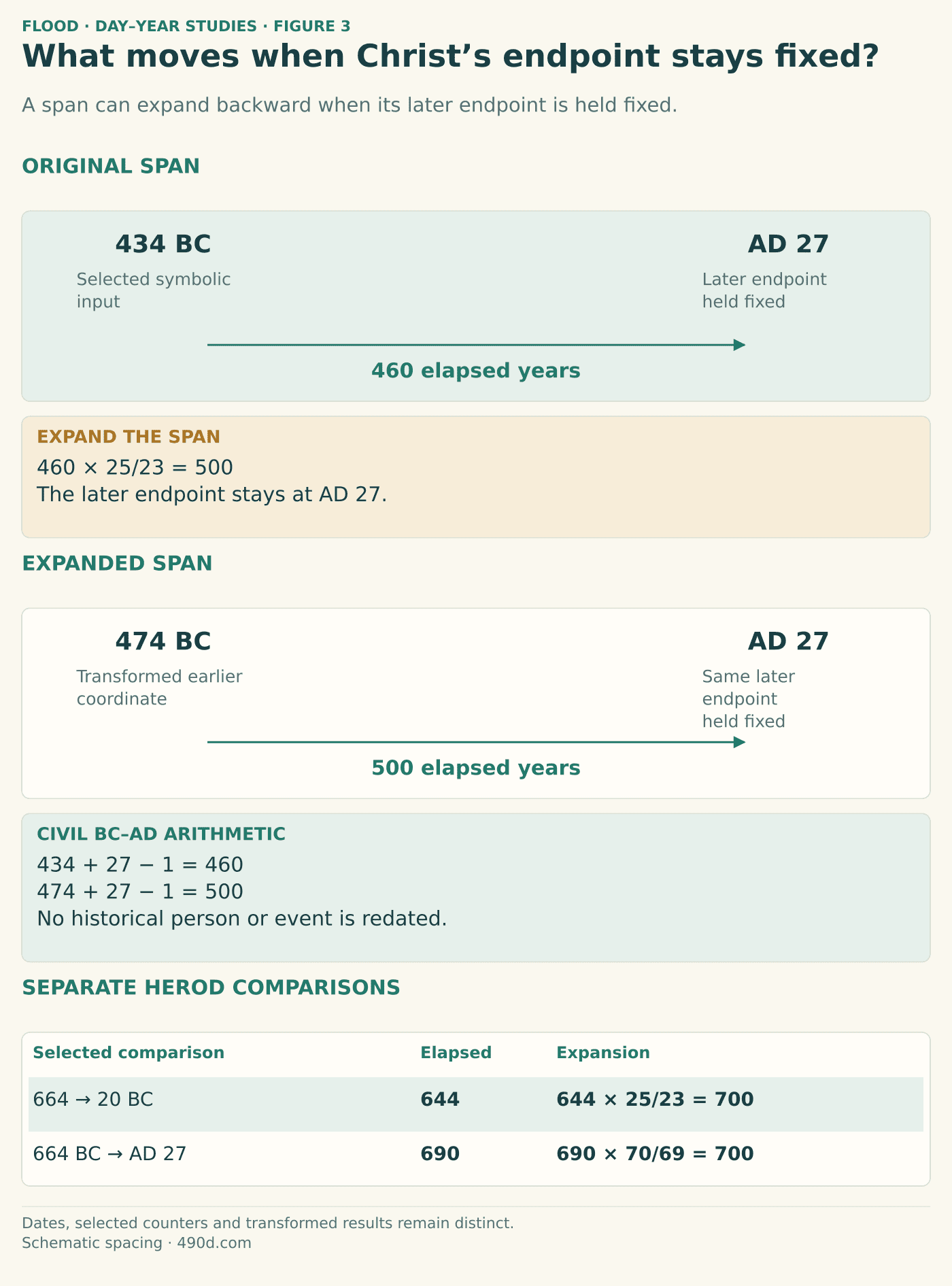
The Christ-fixed example works in the opposite direction. From 434 BC to AD 27, the civil elapsed span is 434 + 27 − 1 = 460. Holding AD 27 fixed and expanding the span to 500 moves the earlier symbolic endpoint to 474 BC, forty years earlier. The source relates this backward movement to Noah’s sons walking backward to cover their father in Genesis 9:23, BSB. That narrative interpretation accompanies the operation; it does not establish the operation itself.
Accessible text and image downloads
First row: symbolic434BC to heldAD27 equals460elapsedyears because434plus27minus1equals460. Second row: transformed474BC to the same heldAD27 equals500.460times25dividedby23equals500, moving the earlier coordinate40years earlier. A separate table shows664to20BC equals644;644times25/23equals700.664BCtoAD27 equals690;690times70/69equals700. Civil BC–AD elapsed counts exclude a year zero.
Desktop PNG · Phone PNG · Desktop WebP (ZIP) · Phone WebP (ZIP) · Text-based SVG (ZIP)
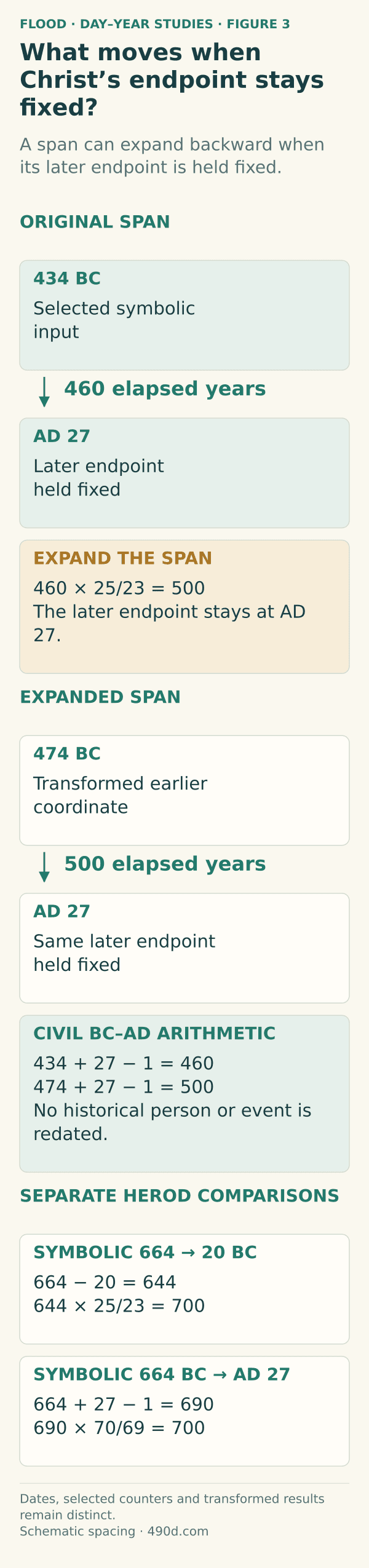
Full table and calculation · Scripture: John 2:19–21 (BSB) · John 2:20 (BSB) · John 2:20; background reference, not a biblical 20 BC date (BSB) · Genesis 8:10–11; symbolic counter (BSB) · Ezekiel 4:6; day–year background, not the fractional expansion rule (BSB)
The initial Temple comparison reaches 700 by two different routes:
| Selected comparison | Elapsed span | Operation | Result |
|---|---|---|---|
| 664 BC → 20 BC | 644 | × 25/23 | 700 |
| 664 BC → AD 27 | 690 | × 70/69 | 700 |
| 20 BC → AD 27 | 46 | Civil span: 20 + 27 − 1 | 46 |
John records a forty-six-year Temple-building statement and identifies Jesus’ intended temple as His body. The selected 20 BC and AD 27 chronology is the model’s dating of that statement, not a pair of years explicitly supplied by the Gospel. See John 2:19–22, BSB.
One older equation needs a direct correction: 414 × 25/23 = 450, not 420. The figure 420 belongs to 414 × 70/69. The supporting table keeps both operations visible rather than preserving an incorrect equality. The author’s contrast between Jared’s expanded 1300 and the Temple comparison’s 700 is a reading of curse and restoration, not a statistical conclusion about the number thirteen.
5. A priestly measure and its remainders
The priestly comparison uses a schematic 336-day measuring year: 12 × 14 + 12 × 14, or 24 two-week units. It draws on the twenty-four divisions in 1 Chronicles 24, BSB, but does not establish that every ancient priestly or civil year contained only 336 days. The 360-day core, the complete 364-day Enochian year and a solar-year approximation remain distinct measures.
Three exact symbolic transformations organize the comparison:
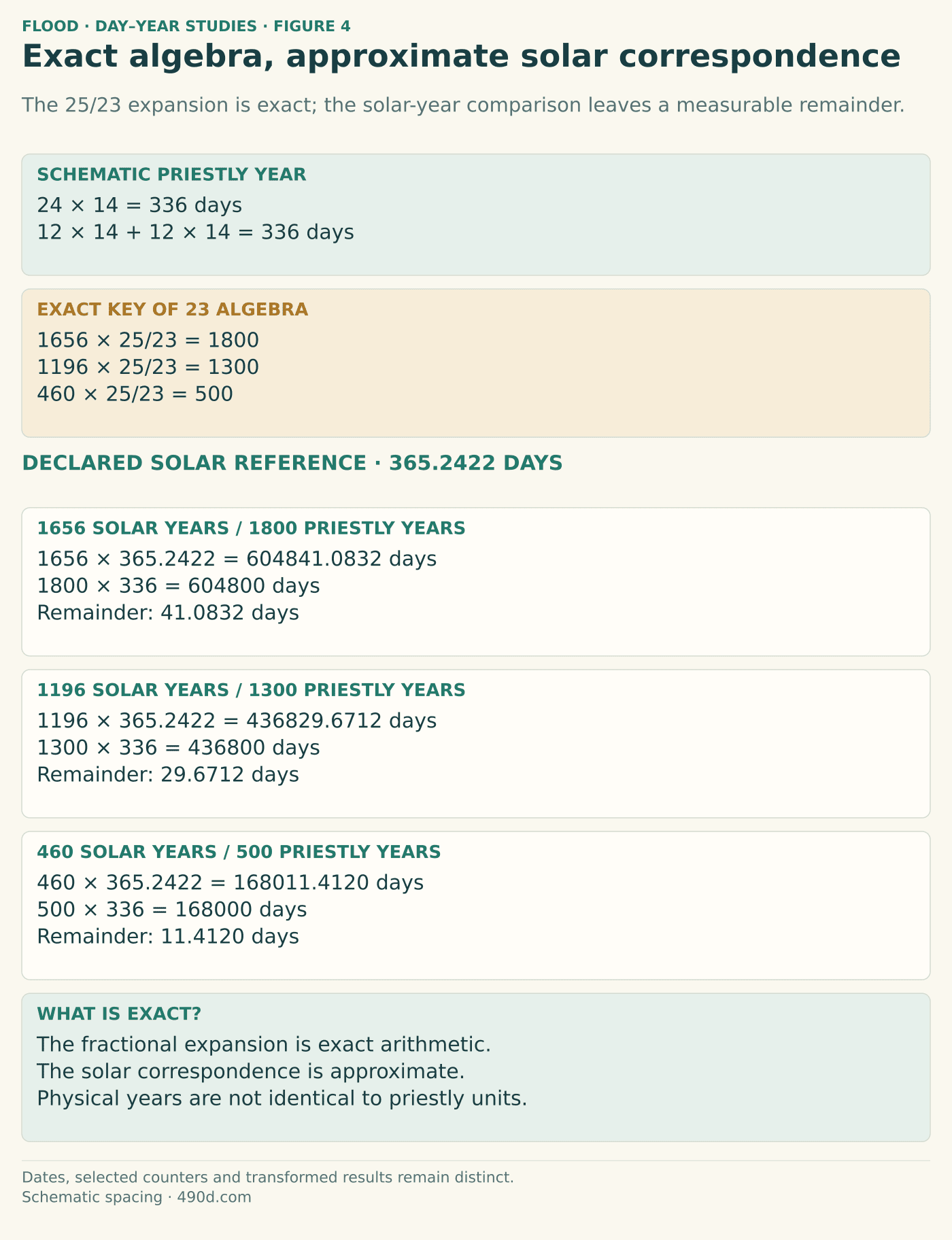
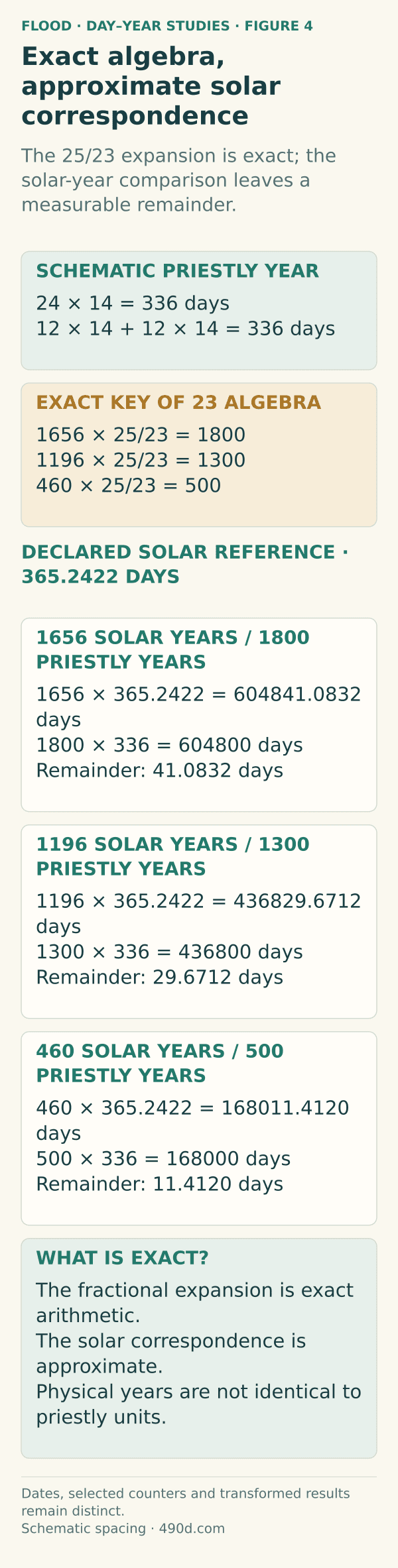
460 → 500; 1656 → 1800; 1196 → 1300, each by 25/23.
With a solar approximation of 365.2422 days, however, the corresponding physical-duration comparison leaves small remainders:
Accessible text and image downloads
A schematic priestly year equals24times14or336days.1656times25/23equals1800exactly. Using365.2422days per solar reference year,1656solar years total604841.0832days and1800priestly years total604800days, leaving41.0832days.1196to1300 compares436829.6712with436800days, leaving29.6712.460to500 compares168011.4120with168000days, leaving11.4120. Exact arithmetic expansion and approximate solar correspondence are distinguished.
Desktop PNG · Phone PNG · Desktop WebP (ZIP) · Phone WebP (ZIP) · Text-based SVG (ZIP)
Full table and calculation · Scripture: Genesis 5; genealogy inputs (BSB) · Genesis 7:6; Flood-age input (BSB) · Genesis 5:15–20; Jared genealogy inputs (BSB) · Genesis 5:1–18 (BSB) · 1 Chronicles 24:1–19; cycle basis, not an explicit 336-day year (BSB) · Genesis 1:14; reference background, not a 365.2422-day measurement (BSB)
| Solar-year input | Solar days | Expanded 336-day measure | Remainder in days |
|---|---|---|---|
| 460 | 168011.412 | 500 × 336 = 168000 | 11.412 |
| 1656 | 604841.0832 | 1800 × 336 = 604800 | 41.0832 |
| 1196 | 436829.6712 | 1300 × 336 = 436800 | 29.6712 |
The numbers 1656 and 1196 arise respectively from MT Creation → Flood and Jared’s birth → Flood. The expanded 1800 × 336 also equals 1680 × 360. Thus the symbolic operation is exact while its solar analogy is approximate. A remainder near forty-one or thirty days must not be silently replaced by exactly forty or thirty.
The intercalated 360-day calendar supplies a separate calculation. Using the repository’s declared epoch and 6 + 6 + 6 + 6 + 6 + 6 + 4 pattern, each completed cycle adds seven thirty-day leap months. In the selected Nisan span, Creation 4114 → Flood 2458 contains 289 leap months and leaves thirty days above the expanded priestly measure. The +60 variant, 4174 → 2518, contains 290 and leaves sixty. Both selected Nisan Jared spans contain 209 and leave thirty. A specifically declared Tishri opening can include an additional boundary leap month. The full cycle and remainder calculations keep these cases separate.
The interpretation then brings in purification. Leviticus 12, BSB gives 7 + 33 = 40 after the birth of a boy and 14 + 66 = 80 after the birth of a girl. These are the mother’s purification periods. Applying them to Adam and Eve is typology, supplemented by the garden-entry tradition in Jubilees 3:8–14; Genesis does not prescribe those periods for the first pair. The earlier alternative places Eve’s formation at a sixth- or eighth-day position. That eighth-day choice also remains a proposal rather than a Genesis date.
In this reading, retaining or setting aside a remainder can highlight different endpoints: a sixth-day origin, a forty-/forty-one-day purification analogy, a thirty-day month, or a sixty-day variant. Their coherence depends on keeping the counting method attached to each case. No lifespan changes when a duration is expressed in another calendar measure.
6. The Mirror requires its own operation
An entirely BC comparison, a civil BC–AD span and a chronological Mirror are different operations. Moving a symbolic coordinate by 180 is not itself a Mirror. Nor is digit reversal.
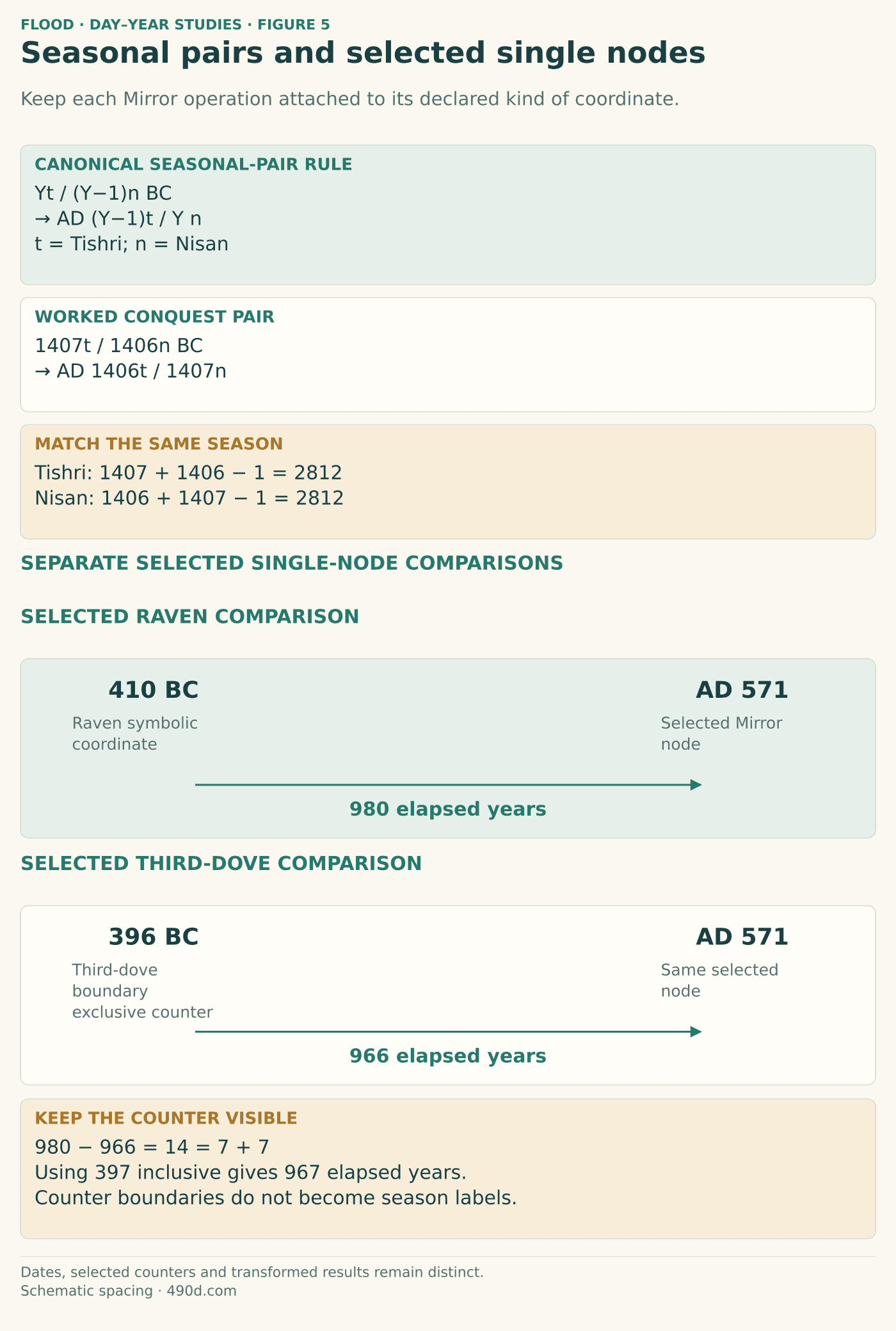
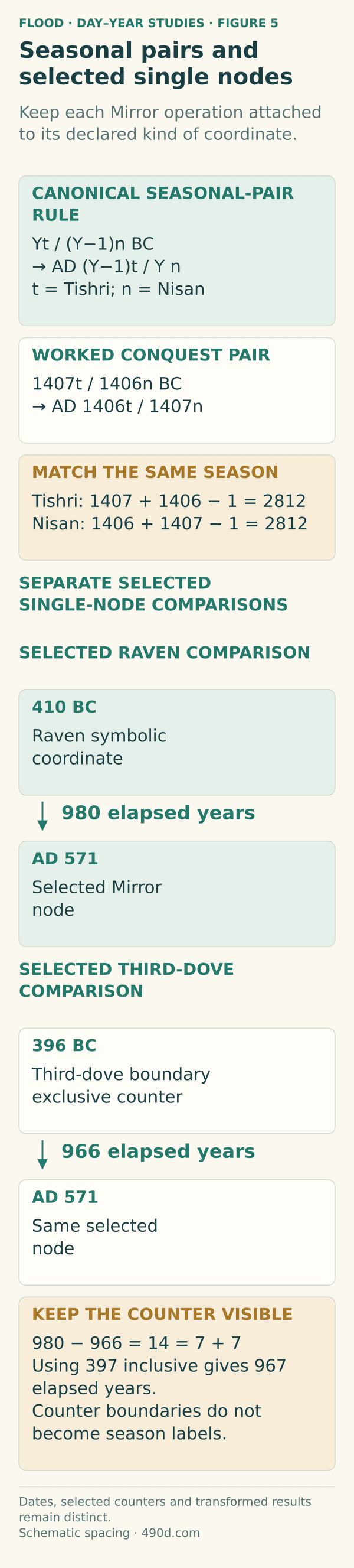
For ordinary year labels across the BC–AD divide, elapsed years are BC + AD − 1, because civil dating has no year zero. The repository also distinguishes a single named Mirror node from the phase-resolved reflection of a seasonal pair. Its current rule for a pair is:
Yt / (Y − 1)n BC → AD (Y − 1)t / Yn.
For example, the paired Conquest state 1407t/1406n BC becomes AD 1406t/1407n. Each matched seasonal component spans 2812 years. A separately declared single 1407t → AD 1407t comparison spans 2813; a single 1406n → AD 1406n comparison spans 2811. Those single-node results must not be mistaken for the paired state. File 09, Appendix A explains why the suffix-inverted pair preserves the half-year relation. File 00 §3.9 distinguishes the civil-span operator from the Mirror protocols.
Accessible text and image downloads
The seasonal-pair rule Yt/(Yminus1)nBC maps to AD(Yminus1)t/Yn. Worked example1407t/1406nBC maps to AD1406t/1407n. Same-phase spans1407plus1406minus1 and1406plus1407minus1 both equal2812. Separately, single selected nodes410BC toAD571 give980years, and396BC toAD571 give966years, a14year difference.396 is the selected exclusive third-dove counter; using inclusive397 gives967. tmeansTishri andnmeansNisan.
Desktop PNG · Phone PNG · Desktop WebP (ZIP) · Phone WebP (ZIP) · Text-based SVG (ZIP)
Full table and calculation · Scripture: Joshua 4:19; Conquest calendar reference (BSB) · Genesis 1:14; chronological comparison is a model operation (BSB) · Genesis 8:6–7; symbolic comparison (BSB) · Genesis 8:12; selected exclusive counter (BSB) · Genesis 8:6–13; source of the reflected symbolic comparisons (BSB)
The Flood study’s valid 980/966 family illustrates the care required:
| Earlier symbolic BC label | Selected AD label | Elapsed years |
|---|---|---|
| Raven / first dove: 410 | 571 | 980 |
| Raven / first dove: 440 | 541 | 980 |
| Raven / first dove: 590 | 391 | 980 |
| Raven / first dove: 620 | 361 | 980 |
| Third dove: 396 | 571 | 966 |
| Third dove: 426 | 541 | 966 |
| Third dove: 576 | 391 | 966 |
| Third dove: 606 | 361 | 966 |
These are civil checks of explicitly selected AD companion labels. Whether each is supplied by a single-node, seasonal or outer-boundary reflection is documented in the Mirror table. The arithmetic does not prove the proposed hour of a raven or dove flight. It does preserve 966 × 70/69 = 980, a fourteen-year gain corresponding to two sevens.
The ordinary BC Conquest comparison is especially clear: 1406 → 440 = 966, 1406 → 433 = 973, and 1406 → 426 = 980. These can be read as 483 + 483, 490 + 483 and 490 + 490. Using adjacent inclusive labels 434 or 427 changes the result by one; it does not invalidate their separate counters.
The larger paired comparison links the Conquest, a raven coordinate, a reflected festival coordinate and a reflected Flood position through four units of 966. Its complete seasonal table preserves the 3864 construction. An unsuffixed 1406 BC → AD 2458 span is only 3863. The seasonal wrapper is essential; the extra year cannot be manufactured by ignoring the civil transition.
Other source families use 1150, 1260, 1290 and 1335. All are retained in the boundary audit, with the operation shown before interpretation. For instance, 636 BC → AD 514 is 1149; an outer evening coordinate 637 gives 1150. Reading Daniel’s 2300 evenings and mornings as 1150 paired daily offerings is an interpretive option, not the only possible meaning of Daniel 8:14.
The three families whose raw labels add to 1334 require equal caution. Their unseasoned civil spans are 1333. A declared boundary reconstruction can produce 1334 completed units and a 1335th numbered position. 1334 = 46 × 29; 1335 does not. Daniel 12:12 itself gives 1335 days. The numbered-position comparison is this study’s proposal, not a replacement for the wording of Daniel 12:11–12, BSB.
7. Egypt, Ezekiel and Enoch: a shared backbone
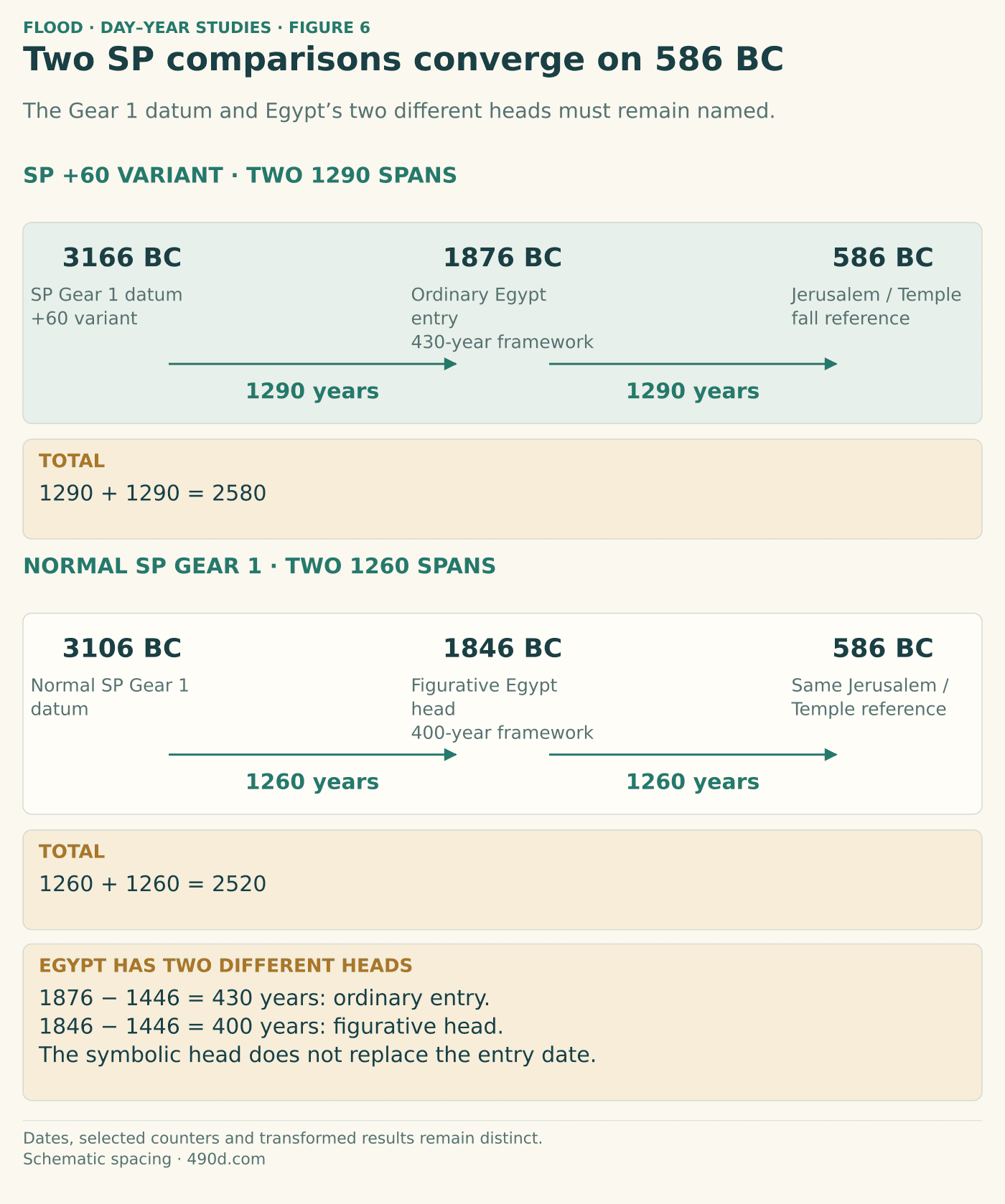
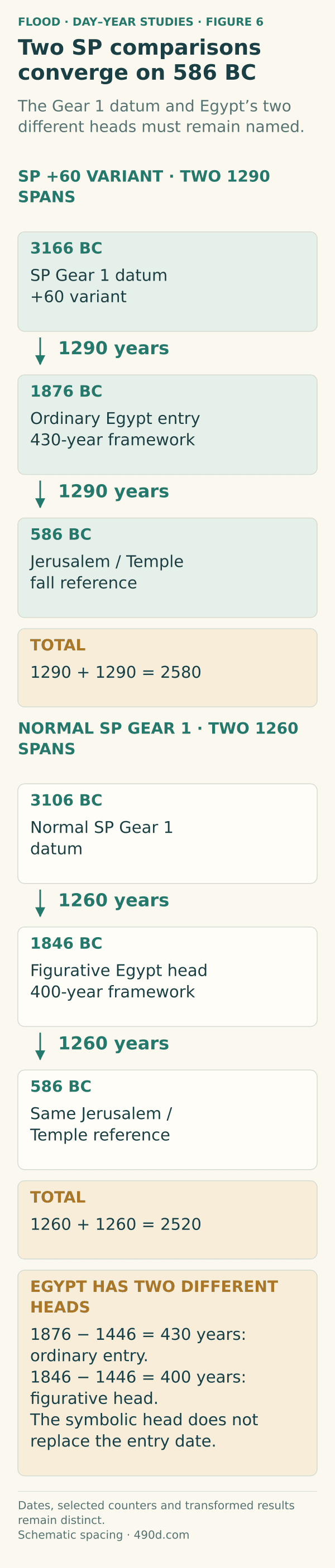
The SP comparison places a Flood/Arphaxad boundary at the head of two equal spans. In the Gear 1 register, 3106 and its +60 companion 3166 produce these chains:
Accessible text and image downloads
Upper sequence:SPGear1plus60datum3166BC to ordinaryEgypt entry1876BC by1290years, then to Jerusalem and Temple fall586BC by1290, total2580. Lower sequence:normalSPGear1datum3106BC to figurative400-yearEgypthead1846BC by1260, then to586BC by1260, total2520.1876to1446equals430, while1846to1446equals400. The latter head is symbolic and does not replace ordinary Egypt entry.
Desktop PNG · Phone PNG · Desktop WebP (ZIP) · Phone WebP (ZIP) · Text-based SVG (ZIP)
Full table and calculation · Scripture: Genesis 11:10–26; genealogy background; BSB is MT-derived, not an SP reading (BSB) · Genesis 11:32 (BSB) · Acts 7:4 (BSB) · Genesis 46:1–7 (BSB) · Exodus 12:40–41; 430-year comparison (BSB) · Genesis 15:13–16; 400-year comparison (BSB) · Exodus 12:40–41 (BSB) · 2 Kings 25:8–10 (BSB) · Ezekiel 4:4–6; day–year sign (BSB)
3166 → 1876 → 586 BC = 1290 + 1290.
3106 → 1846 → 586 BC = 1260 + 1260.
Here 1876 is the regular entry-into-Egypt anchor; 1846 is the representative head of a 400-year affliction span terminating at the Exodus in 1446. They are different nodes. Native SP sojourn reckoning also differs from the full 430 years in Egypt used for the cross-tradition comparison. Its manuscript chronology must not be silently relabeled as the MT’s.
The matched Gear 2 Flood coordinates also preserve the cross-tradition offsets: SP 3108 − MT 2458 = 650 = 5 × 130, and LXX 3238 − SP 3108 = 130. Gear 1 gives the same differences with 3106, 2456 and 3236. These comparisons use the equalized later framework and retain the LXX’s native second Cainan; their variants remain identified.
Gear 2 restores the two-year Flood → Arphaxad interval: 3168/3166 or 3108/3106. The two-year windows invite comparison with 1878/1876 around the entry into Egypt and 588/586 around Jerusalem’s siege. Those pairings form part of the wider Ezekiel framework. They do not identify the Flood, Egyptian entry and siege as simultaneous historical events.
The two half-week units also connect literal days and enlarged years. A seven-year 360-day core is 1260 + 1260; retaining a leap month may give 1260 + 1290, and a declared placement of two months gives 1290 + 1290. The day-level Ezekiel dates and their containing week units remain legitimate alternative levels of precision. The Ezekiel study, File 12, and File 17 supply the calendar and prophetic-period context.
Three larger regular comparisons are retained alongside those chains. The +60 MT Creation 4174 → projected exit 304 gives 3870 = 3 × 1290; normal MT Creation 4114 → exit 334 gives 3780 = 3 × 1260. The +180 exit coordinate 514 gives 4114 − 514 = 3600. With the independently selected LXX +60 Creation 5554, it gives 5040. Each result uses its stated variant; the two Creation traditions are not interchangeable.
Enoch supplies a further four-column comparison. His MT translation coordinate is 3127 BC. To the inclusive third-dove positions, the spans are:
| Enoch 3127 BC → third-dove coordinate | Span | Measure |
|---|---|---|
| 607 | 2520 | 7 × 360 = 1260 + 1260 |
| 577 | 2550 | 1260 + 1290 |
| 427 | 2700 | 7.5 × 360 |
| 397 | 2730 | 7.5 × 364 |
Adjacent exclusive labels produce different results by one year. The Enoch tradition’s 360 ordinary days and four additional days explain a distinction in reckoning; its complete calendrical year remains 364 days. It does not say that 360 and 364 days are identical physical durations. See 1 Enoch 75 and 82 and Jubilees 6.
The corresponding single-node AD 3127 comparisons give 3430 from 304 BC and 3640 from 514 BC. Enoch’s 365-year lifespan, his translation, the Watcher tradition and the Ark’s emergence supply the narrative setting for these proposed correspondences. All Enoch and Creation comparisons include the additional triple-half-week and seven-/seven-and-a-half constructions.
8. Cumulative chronology and the restored-Cainan variant
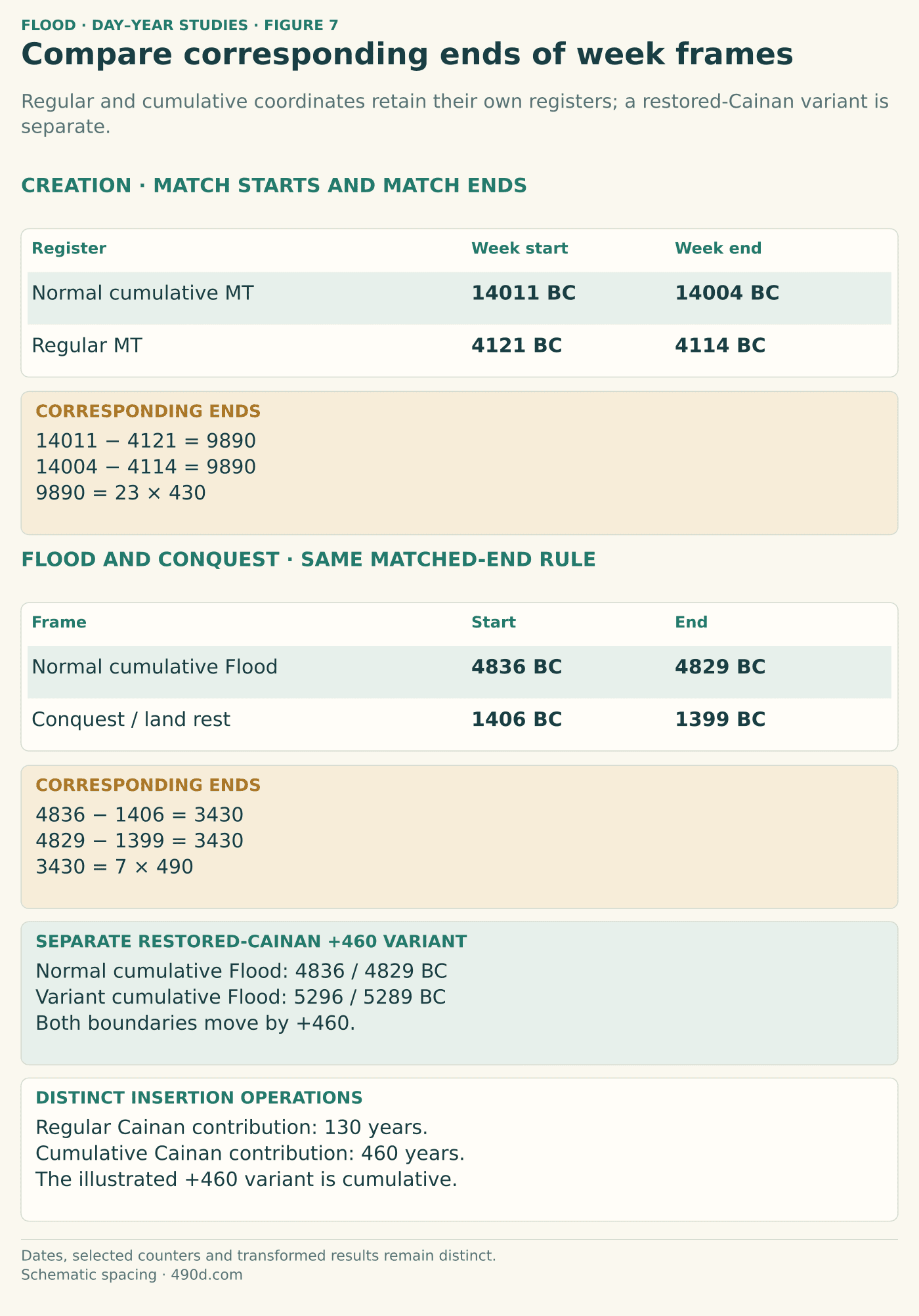
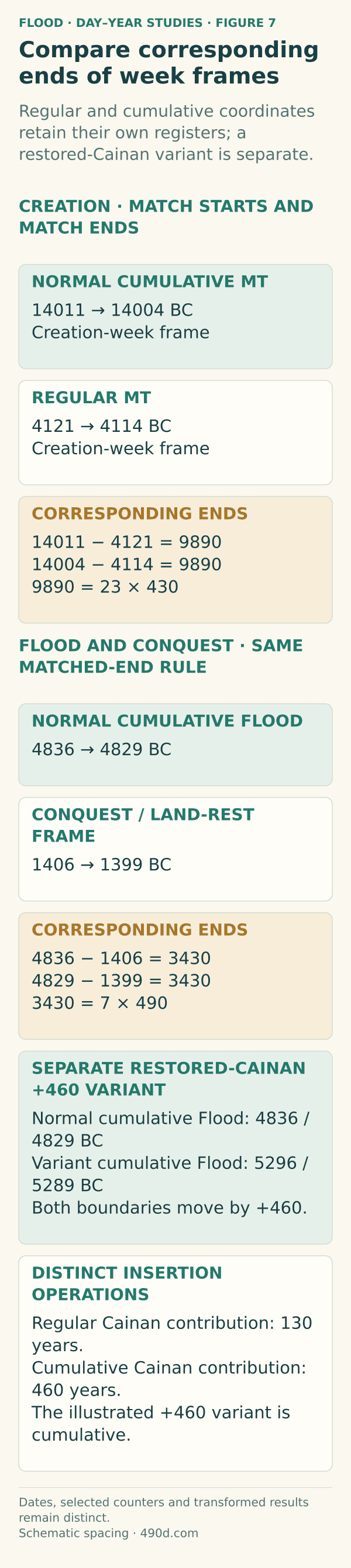
Cumulative chronology adds whole lifespans; ordinary genealogy dates a descendant by the stated age at begetting. Their different totals do not describe longer lives for the same people. The current MT cumulative Creation week is 14011 → 14004 BC, while the regular Creation week is 4121 → 4114 BC. Each matched boundary differs by 9890 = 23 × 430.
Accessible text and image downloads
Three panels preserve matched week envelopes. NormalMTcumulativeCreation14011to14004BC and regularCreation4121to4114BC differ9890at both corresponding starts and ends.9890equals23times430. NormalcumulativeFlood4836to4829BC and Conquest/rest1406to1399BC differ3430at corresponding starts and ends.3430equals7times490. Separate restored-Cainanplus460cumulative variant movesFlood4836/4829to5296/5289, adding460to both boundaries. This variant does not alter the normal register.
Desktop PNG · Phone PNG · Desktop WebP (ZIP) · Phone WebP (ZIP) · Text-based SVG (ZIP)
Full table and calculation · Scripture: Genesis 1:1–31 (BSB) · Genesis 2:1–3 (BSB) · Genesis 5; cumulative frame is schematic (BSB) · Genesis 5; regular genealogy inputs (BSB) · Genesis 7:6; cumulative frame is schematic (BSB) · Joshua 11:23 (BSB) · Joshua 14:7–10 (BSB) · Luke 3:36; second Cainan input (BSB) · Luke 3:36 (BSB)
The cumulative Flood week 4836 → 4829 and the Conquest week 1406 → 1399 differ by 3430 = 7 × 490 at either matched endpoint. Shem’s corresponding week is 5436 → 5429. Its upper boundary gives 5436 → 606 = 4830 and 5436 → 536 = 4900; the Flood’s upper boundary gives 4836 → 536 = 4300. Keeping Shem and the Flood separate corrects the older misattribution of a 4410-year span: it is 4836 → 426, not 5436 → 426.
The full twenty-six-life register preserves the original table alongside its controlled states. Moses’ and Aaron’s Nisan/Tishri alternatives also remain visible. A three-year age difference can appear as 3 ± 0.5 when the seasonal endpoints differ; such an expression is not automatically a chronological error. Joshua’s regular lifespan remains 1476–1366 BC. The cumulative schematic extension to 1296 belongs to a separate Moses-line model and does not replace that death date.
Adding the second Cainan’s cumulative 130 + 330 = 460 shifts the MT cumulative Flood week to 5296 → 5289 and Creation to 14471 → 14464. This is a restored-Cainan comparative variant, not the native MT baseline. In ordinary genealogy the insertion adds a 130-year begetting interval; the cumulative insertion uses his full 460-year lifespan. Genesis 11, Brenton LXX supplies those LXX inputs.
The expanded model produces the selected 5296 → 6 BC span of 5290 = 23 × 230. The source’s related 10580 Mirror lead and the phase-completed 15870 Creation–Conquest construction are retained in the Cainan table, with explicit node and protocol conditions. Their raw labels must not be added as though every date were an astronomical coordinate. Likewise, 4836 BC → AD 70 is 4905, not 4900; the controlled 4900 comparison reaches AD 65. AD 70 remains a distinct historical reference.
The recurring 460 connects to the central column span, the Creation → Jared interval and the Key of 23. These numerical relationships do not demonstrate why an ancient manuscript included or omitted Cainan. Any proposed editorial purpose remains a hypothesis.
9. The Sumerian comparison: great and small measures
The original chart aligns figures in the Sumerian King List with biblical figures and projects their reign totals into a very long chronology. It is a modern comparative construction. The tablets do not themselves date Alulim at 262086 BC or identify him as Adam.
The principal modeled Adam/Alulim coordinate nevertheless has exact relationships within the chosen construction:
| Model comparison | Span | Structure |
|---|---|---|
| 262086 → 6 BC | 262080 | 720 × 364 |
| 262086 → Conquest 1406 BC | 260680 | 76 × 3430 |
| 262086 → cumulative Flood 4836 BC | 257250 | 75 × 3430 |
| 262086 BC → AD 2025 | 264110 | 77 × 3430, by the civil cross-axis rule |
The last comparison belongs to the research’s 2024–2025 context; it is not a claim that the current year is 2025 or a prediction based on today’s date. AD 2024 gives 264109 under ordinary civil arithmetic. Seasonal or numbered-year alternatives must be declared separately.
The complete Sumerian chart register preserves every principal figure and the chart’s alternatives: the +30 Apparent Mode and source leap-month analogy, a 720-unit shift, the alternative Babel horizon and +6480 field, Etana’s 1500 textual reign and 1560 displayed interval, the remaining kings, and the Jachin/Boaz comparisons. Its original full-resolution image is also retained. Unverified image-only relationships are identified rather than discarded.
The large-scale compression is 720 × 360 = 259200, followed by 720-year and two-year measures, and then a day–year projection. These are successive unit mappings. In particular, 262086 − 259200 = 2886, not 2166. Reaching 2166 requires a further 720-unit move. The two-step construction must remain visible.
The number 259200 is ten times a schematic 25920-year precessional cycle, based on 72 years per degree. Actual precession is not a fixed, precisely measured 25920-year clock, and this article does not establish that every ancient writer knew that convention. The near-neighbor relation is exact arithmetic: 25921 = 161² = (23 × 7)² = 23² × 49. The proposed connection to jubilee units and the chart’s twenty-three post-Flood kings remains an interpretation of the numerical proximity.
Two additional links remain in the research record: 23 × 490 = 11270 and 10 × 1656 = 16560 = 23 × 720. This Part 4b source did not supply a complete endpoint pair for its 16560-year Sumerian lead; the supporting notes preserve that limit rather than inventing one. The separate Cainan and 16560 study can be consulted on its own stated endpoints.
10. Interpretation: the Flood’s story on several scales
The interpretation begins with the narrative: judgment gives way to an inhabited earth, an olive leaf signals life, the dove ceases to return, and the covenant follows the emergence from the Ark. Rest, cleansing, new creation and covenant therefore supply the meanings proposed for the numerical correspondences.
Enoch’s translation, the Flood, the Exodus and Christ’s resurrection can all be studied through deliverance and a renewed beginning. The comparison of the Ark’s seventeenth-day rest with a selected seventeenth-day resurrection calendar, and complete dryness on month II, day 27 with an ascension forty days later, depends on the stated Passion-calendar model. The Gospels and Acts do not explicitly print both of those month/day dates. The older month II, day 17 exit label is corrected to day 27.
The same approach reads Revelation 10, BSB through several earlier scenes: rainbow and Flood, fiery pillars and Exodus, and book-eating and Ezekiel. The little scroll is interpreted as a small day-level structure, while the Lamb’s scroll suggests the larger chronological picture. Seven thunders evoke the impending storm after the Flood’s seven-day warning. The seals and trumpets give a nested literary setting for this reading. Revelation itself does not identify the little scroll as a day–year chart; that connection is the proposal developed here.
The source also compares the birds’ wings with the desolation imagery in Daniel 9:27. BSB’s Scripture text refers to the wing of the temple; NIV renders the relevant clause at the temple. A wings-and-flight interpretation therefore needs its textual and translation setting. It is not an additional date stated in Daniel, and a translators’ note alternative must not be substituted for the quoted Scripture text.
Daniel’s cast-down celestial host and wise figures shining as stars connect celestial and earthly imagery within the source’s reading. Revelation 12, BSB adds the woman, sun, moon, twelve stars and her offspring. The author proposes that renewed sons of God through Christ take the place of rebellious angelic sons of God, and relates the slow celestial cycle through twelve zodiacal sectors to the saints’ enduring life. The text does not expressly identify its twelve stars with the zodiac. This is an interpretation of renewal after rebellion; the numerical study does not turn the celestial imagery into a dated instruction.
Calling these arrangements “fractal” describes the perceived repetition of a pattern across scales. It is an analogy of nesting, not proof that biblical chronology is a mathematical fractal. The arithmetic can show that a relation repeats; it cannot by itself establish what a prophet knew about every later correspondence.
But do not forget this one thing, dear friends: With the Lord a day is like a thousand years, and a thousand years are like a day.
The context of 2 Peter 3:3–10 includes Creation, the Flood, future judgment and patience that allows repentance. Its two-direction expression—day as a thousand years and a thousand years as a day—suits this study’s movement between large and small measures. Yet its ethical point remains central: divine patience and human urgency coexist. The passage is not a general permission to turn every date into a forecast.
11. What the comparison grids can—and cannot—show
The original research also asked how unusual these alignments might be. That question is preserved in the exploratory statistics notes, including the four-of-twelve, five-of-thirteen, seven-of-sixty-six and conditional 161 models. Their formulas, declared populations and corrected numerical results remain available for examination.
They do not supply a validated probability of intentional design. The selected coordinates share origins, offsets and residues; the comparisons were refined during exploration; some tables repeat labels; and the seven chosen examples are not all members of the stated sixty-six-slot population. Conditional selection on multiples of 23 also changes the relevant probability: the remaining factor of seven cannot be tested as though no prior selection occurred.
The older 98-cell grid contains fourteen, not fifteen, exact multiples of 161. The current primary SP anchor grid contains ten. Its legacy results remain useful as a record of the selected counter state, while its primary results show what the current anchor selection actually yields. Neither table should be silently substituted for the other.
This is also why unsupported claims of “99.99% certainty” have been replaced by transparent calculations and assumptions. The study’s value lies in its reproducible relationships, its narrative coherence and the opportunity to test its proposed structures—not in an unmodeled statistical guarantee.
Sources, tables and the preserved original
The complete supporting document supplies every substantive research family retained from the discussion, including older ledgers, exact matrices, alternate endpoints, probability questions, the full cumulative register, the Sumerian chart and a concise research-history note. Its source map identifies the relevant repository files and primary texts. The principal controls are Files 00, 02, 09, 11, 12, 17, 18, 21, 22, 23 and 46.
The author’s recorded research began on 22 October 1991; the original identifies 12–13 September 2024 as an important stage in refining this Flood work. Those recollections remain in the supporting history note. An undeveloped suggestion about an exact-hour relationship is retained as a lead, without being represented as a verified result.
Series navigation: charts and tables · Ezekiel methodology · Part 4a · Part 4b: this study · Part 4c. The Ark study and Flood introduction provide the narrative and dimensional foundations; the later day–year studies develop additional symbolic constructions.
Read the original Part 4b discussion. Its wording, historical alternatives and original image references are preserved unchanged. The revised study and active supporting tables identify the corrected arithmetic and controlled states.
The Holy Bible, Berean Standard Bible, BSB is produced in cooperation with Bible Hub, Discovery Bible, OpenBible.com, and the Berean Bible Translation Committee. This text of God’s Word has been dedicated to the public domain.
The Holy Bible, New International Version® NIV® Copyright © 1973, 1978, 1984, 2011 by Biblica, Inc.® Used by Permission of Biblica, Inc.® All rights reserved worldwide.