Moses was a hundred and twenty years old when he died, yet his eyes were not weak, and his vitality had not diminished.
Moses’ life ends just before Israel crosses the Jordan. In Joshua 1:2, that death becomes the starting point for the next movement: entering the promised land. This transition also gives the cumulative chronology its principal anchor. In the chronology used here, Moses’ death and the west-side Jordan crossing belong to 1406 BC.
An anchor is a fixed reference point from which a sequence can be measured. The cumulative chronology takes the complete lifespans along the ancestral line from Adam to Moses, places those lengths end to end, and fixes their conclusion at the Conquest. Creation, the Flood, and the promised land then become the principal landmarks of a much larger numerical structure.
The question is simple: what holds the structure together when its measurements are so different from ordinary chronology? The answer begins with the shared endpoint, then becomes clearer through the Creation week and the Flood boundary.
One endpoint, two ways of measuring
The Masoretic Text (MT) supplies both a patriarch’s age when his son was born and his complete lifespan. Those figures answer different questions. Adam was 130 when Seth was born, but Adam’s full life was 930 years (Genesis 5:3–5). Ordinary, or regular, chronology follows the intervals between births. Cumulative chronology instead arranges the full lifespans consecutively.
The table compares actual, unrounded MT positions at the same 1406 BC target. It uses Nisan reckoning, the full 430-year Egyptian sojourn, no +60 Terah adjustment, and no restored second Cainan.
| Measurement to the Conquest | Adam’s Year-6 position | Span to 1406 BC |
|---|---|---|
| Regular MT chronology | 4116 BC | 2710 years |
| Cumulative MT chronology | 14006 BC | 12600 years |
These are matched Year-6 positions within the symbolic Creation week read as seven years, rather than two different labels for the end of Creation. The normal regular Creation week runs 4121–4114 BC, with Adam’s Year-6 position at 4116 BC. Its cumulative counterpart runs 14011–14004 BC, with the corresponding position at 14006 BC.
One endpoint, two measurements
The two measurements meet at the same target.
Figure 1. Regular and cumulative MT chronology share the Conquest target, but use different measurements. Adam’s matched Year-6 positions are 4116 and 14006 BC. The cumulative positions are formal lifespan-stacking coordinates. Spacing is schematic.
Sources: File 18 §6A: 14006, 1406, 12600 · File 22 §5 and §7.1: matched regular/cumulative Creation positions and 9890 · File 00 §3.4.4: symbolic regular Creation week 4121–4114; Year 6 begins 4116.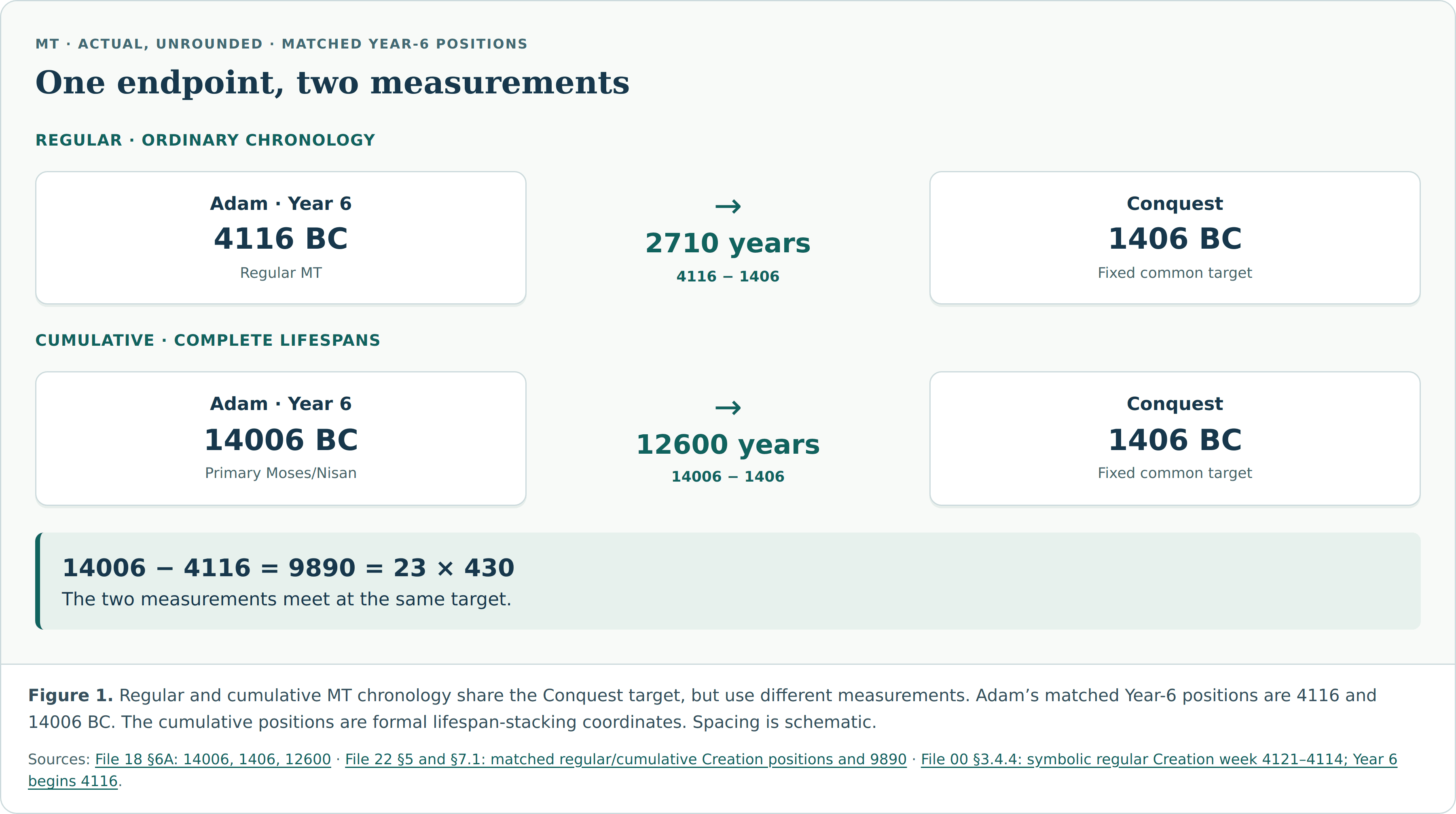
View the image version

The cumulative total comes from 26 lifespans. After Jacob, the ancestral line continues through Levi, Kohath, Amram, and Moses. Joseph is important to the story of Egypt, but he does not belong in this direct lifespan-stacking line. Joshua leads the Conquest, but his lifespan is not part of the Adam-to-Moses total. The complete 26-name table makes the calculation easy to follow.
The two Year-6 positions differ by 9890 years:
14006 − 4116 = 9890 = 23 × 430.
That is the actual, unrounded relationship. The related Rounded chronology displays a 9900-year bridge under its own conventions. The 9890-year introduction and the 9900-year article explore those comparisons separately.
Anchoring the cumulative construction at the Conquest keeps its purpose clear: it is an arrangement of scriptural lifespan lengths. The cumulative positions do not replace ordinary birth dates or imply that descendants waited for their fathers to die before being born.
The Flood boundary in the larger structure
In regular MT chronology, the Flood begins in 2458 BC, and Arphaxad is born in 2456 BC, two years later. The cumulative table uses a different kind of position. Shem’s complete 600-year segment leads to the formal Flood/Arphaxad station at 4831 BC, within the seven-year envelope 4836–4829 BC.
That shared station expresses a boundary in the cumulative architecture. It does not erase the two years separating the Flood and Arphaxad in the regular chronology. Nor does it mean that the cumulative Flood is 600 years after Noah’s ordinary birth. It is the end of Shem’s full-lifespan segment in the stacked construction. The Flood-position comparison places the two methods side by side.
The opening of that cumulative Flood week, 4836 BC, produces an especially clear relationship with the Conquest:
4836 − 1406 = 3430 = 70 × 49 = 7 × 490.
Here, 49 is the seven-times-seven-year measure behind the Jubilee pattern. It connects the length of the interval to the biblical language of weeks, release, and restoration. Dividing this interval at Abraham’s primary Moses/Nisan position, 2435 BC, gives the two spans below. The subtraction uses actual cumulative MT coordinates: the Flood contributes its week opening, and the Conquest remains fixed at 1406 BC.
| Selected span | Years | Pattern |
|---|---|---|
| Flood-week opening, 4836 BC → Abraham, 2435 BC | 2401 | 49 × 49 |
| Abraham, 2435 BC → Conquest, 1406 BC | 1029 | 21 × 49 = 7 × 147 |
| Entire Flood-week-opening → Conquest span | 3430 | 70 × 49 = 7 × 490 |
The second interval also equals seven of Jacob’s 147-year lifespans. Within this construction, the descendants’ entry into the land completes the movement from Abraham’s promise toward Jacob’s inheritance. That is a theological reading of an exact numerical relationship; the calculation itself remains straightforward.
A spine of 8575, 600, and 3430 years
The same opening-boundary perspective extends back to Creation. From the opening of the cumulative Creation week, 14011 BC, to the opening of Shem’s birth week, 5436 BC, the interval is 8575 years:
8575 = 175 × 49 = 7 × 7 × 7 × 5 × 5.
Shem’s 600-year segment then reaches the opening of the Flood week at 4836 BC. Another 3430 years, or 7 × 7 × 70, reaches the Conquest.
The Jubilee spine
2401 + 1029 = 3430
14011 → 1406 BC. The Year-6 route begins at 14006 BC and spans 12600.
Figure 2. 8575 + 600 + 3430 = 12605. Creation, Shem, and Flood use week openings; Abraham uses his primary Moses/Nisan position; the Conquest remains at 1406 BC. The 12605 route begins five years earlier than the 12600-year lifespan total. Nodes and connectors are schematic, not proportional to duration.
Sources: File 09 §1: 8575, 2401, 1029 tripartite spans · File 18 §6A: Creation 14011–14004; Shem 5436–5429; Flood 4836–4829; Abraham 2435; Conquest 1406.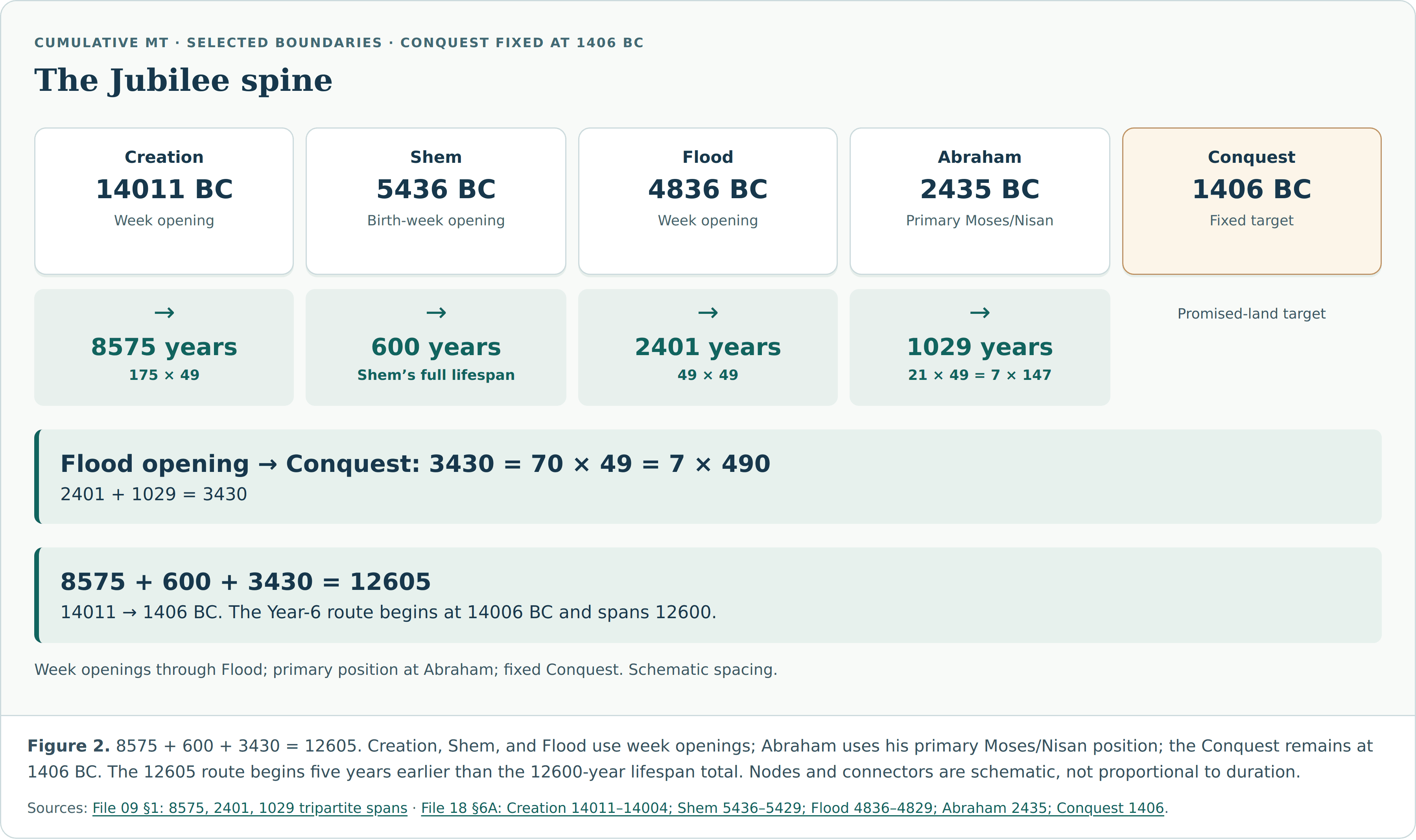

View the image version

The resulting spine is:
8575 + 600 + 3430 = 12605 years.
This is five years longer than the 12600-year lifespan total because the spine begins at 14011 BC, the opening of Creation’s week, while the lifespan total begins at 14006 BC, Adam’s Year-6 position. The lifespans have not changed.
The selected positions also deserve to be visible. Creation, Shem, and Flood use their week openings in this diagram; Abraham uses the primary Moses-line position, and the Conquest remains fixed at 1406 BC. On the primary Moses line throughout, the Flood station is 4831 BC, and its span to the Conquest is 3425, rather than 3430. The boundary table and derivation show both routes.
The five-year difference matters because the pattern depends on the stated positions. Once those positions are named, the architecture is easy to see: a long Jubilee-based movement to Shem, his complete 600-year segment, and seventy further 49-year cycles leading to the land.
Why the chronology carries a week of years
The cumulative table gives each patriarchal position a seven-year envelope. Its whole-year form brings together the Aaron–Moses branch difference and the propagated Shem boundary relation. For Creation, the balanced display is:
14011 → 14009 → 14006 → 14004 BC, forming 2 + 3 + 2 = 7 years.
One week; a separate seasonal track
Separate exact seasonal tracks · Creation-side positions
Figure 3. The whole-year week is 2 + 3 + 2 = 7. The separate exact Aaron/Tishri track is 3.5 years earlier than the Moses/Nisan track; that half-year is not another lifespan year. The integer Aaron-side node 14009 is distinct from Day 4 at 14008. The layout is schematic.
Sources: File 09 §0.3.1, §3A.1: whole-year and exact-phase node classes · File 18 §6 and §6A: +3.5 Aaron phase; lifespans 123/120 · State Vocabulary Register D.44.3–D.44.4: primary seven-year object and terminal-phase safeguard.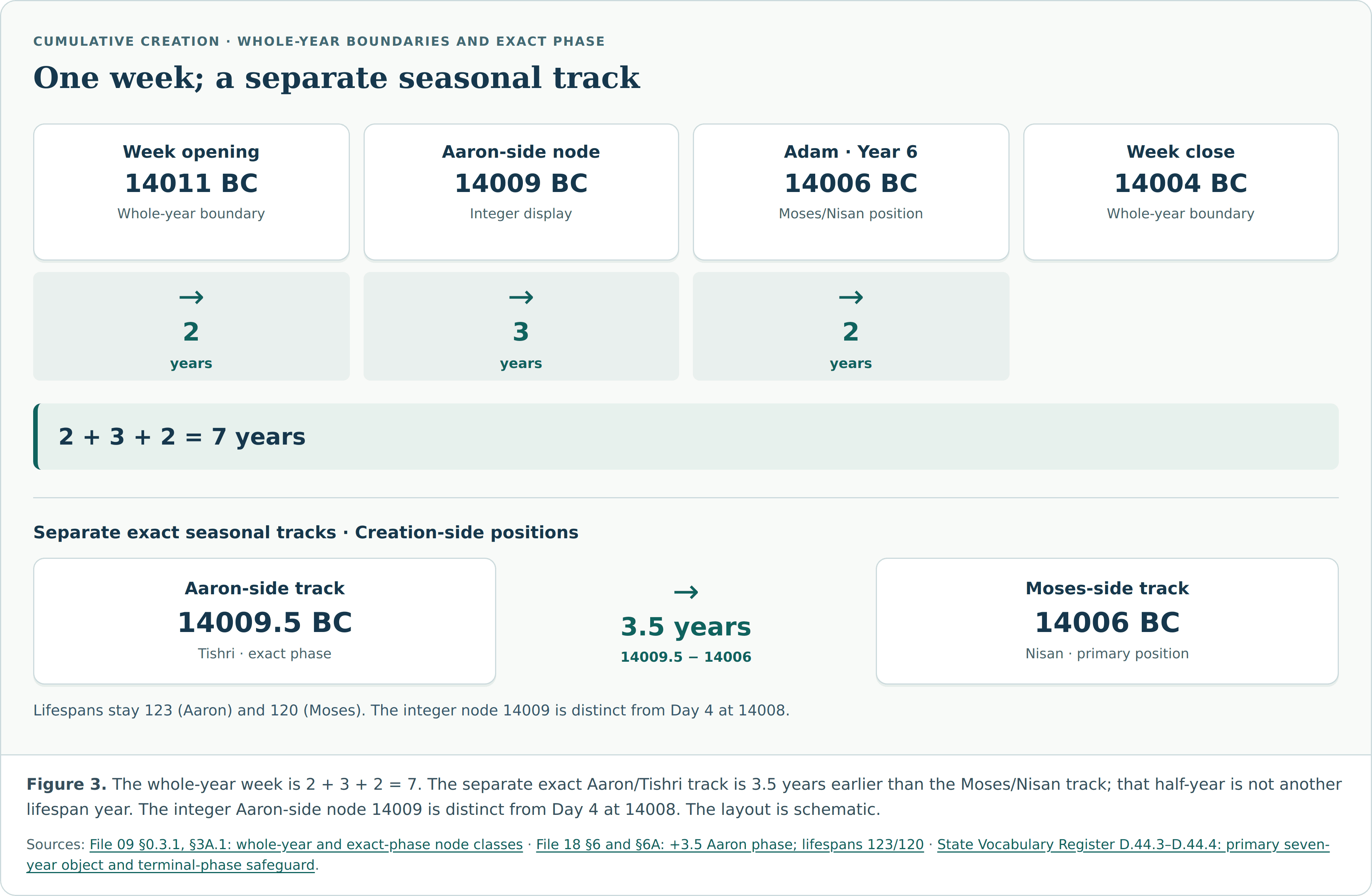

View the image version

The envelope is a coordinated feature of the construction. It is not a separate uncertainty allowance to apply independently to every patriarch. Moving from one permitted boundary to another means naming the corresponding state of the table.
Aaron and Moses also introduce a finer distinction. Their scriptural lifespans remain 123 and 120 years. The whole-year lifespan sums differ by three years; the table’s exact seasonal tracks are separated by 3.5 years. That half-year belongs to the Nisan/Tishri phase treatment, rather than an extra year added to either man’s life.
The seven-year envelope and the exact seasonal tracks therefore serve related but distinct purposes. The Aaron–Moses explanation sets them out without requiring the reader to reconstruct the entire chronology first.
Creation and Conquest across the Mirror
There is one further comparison in the canonical architecture. The regular Creation endpoint can be compared with the reflected Conquest pair across the BC–AD divide. With t denoting Tishri, in autumn, and n denoting Nisan, in spring, the paired displays are:
4115t/4114n BC → AD 1406t/1407n.
Both matched seasonal components span 5520 years. Applying the Key of 23’s 25/23 conversion gives:
5520 × 25/23 = 6000.
Creation and reflected Conquest
6000 is the Priestly-converted measure; 5520 is the civil span.
Reflected pair: AD 1406t/1407n. No year zero; no future-event prediction.
Figure 4. Both seasonal components give 5520 civil years. The 25/23 conversion gives 6000 in the Priestly measure. The reflected Conquest pair is AD 1406t/1407n; t denotes Tishri/autumn and n Nisan/spring. These are formal Mirror coordinates. Spacing is schematic; this is not the Rounded Mirror display.
Sources: File 09 §3 and Appendix A.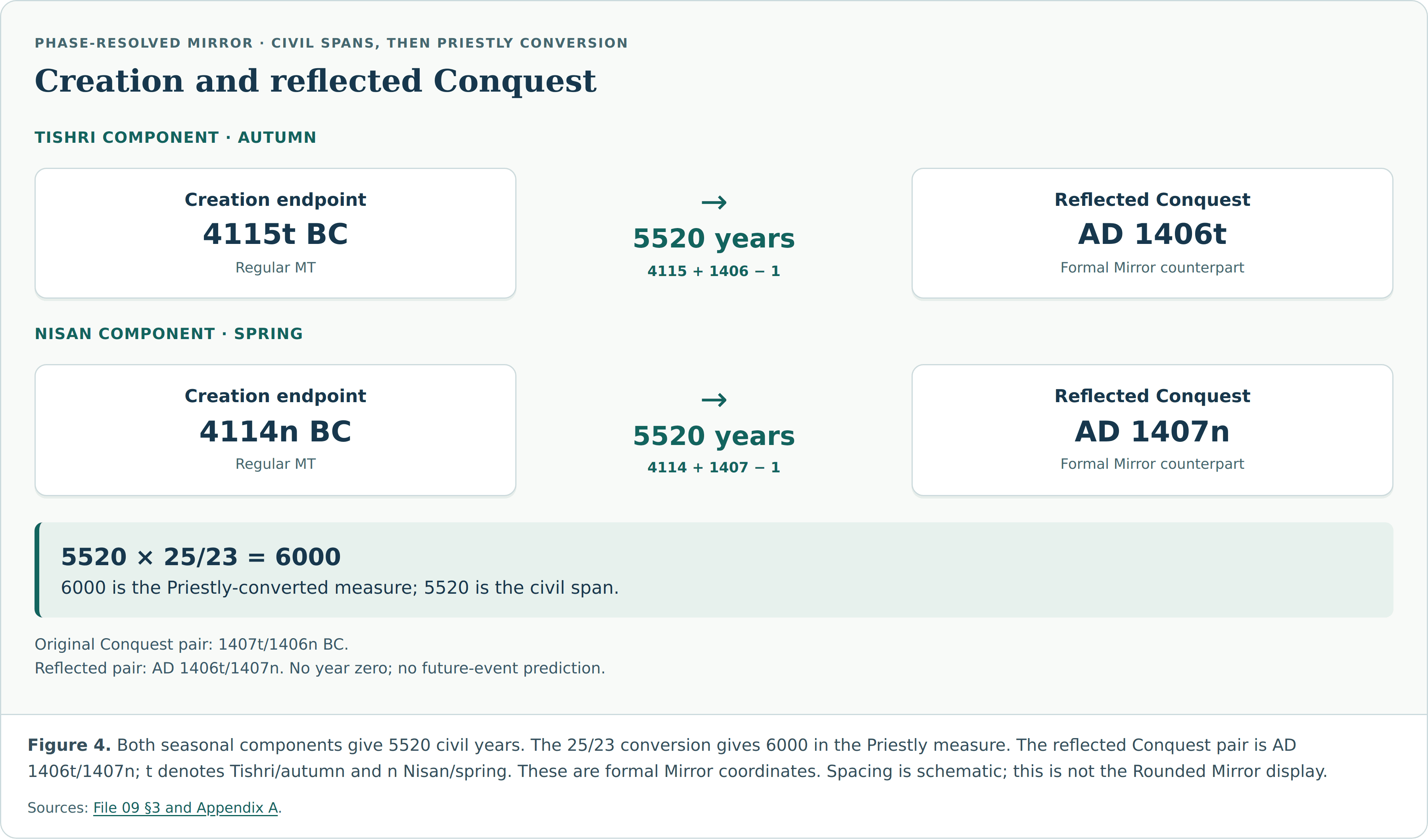

View the image version

The six-thousand figure supports a six-days-of-work followed by seventh-day-rest reading, with the Conquest pictured as entry into a renewed Eden. Here 6000 is a converted measure, not an unconverted count of civil years. The AD positions are reflected coordinates used for comparison, rather than predicted future conquests.
The seasonal pair is essential to the 5520 calculation. Ordinary civil reckoning has no year zero, so an unsuffixed 4114 BC → AD 1406 interval would be 5519 years. The Mirror component table gives the two correct calculations directly.
Reading the anchors together
Creation supplies the week-shaped opening; the Flood supplies the boundary of renewal; the Conquest supplies the fixed destination. The cumulative arrangement connects them through full lifespans, while the regular chronology retains the intervals between births and the ordinary order of events.
The most useful starting point is the visible spine: 8575 + 600 + 3430, with its named boundaries and its Jubilee-based measures. The wider comparisons grow from that structure. Keeping the anchor, the selected position, and the kind of measurement clear allows the numbers to illuminate the biblical movement from beginnings, through renewal, toward inheritance and rest.
For the full derivations, use the technical appendix and its table links. The controlling sources are File 00, §3.4.4 for the regular symbolic Creation week, File 18, §6A, File 09, §§1 and 3, and File 22, within the Unified Chronology repository.
For the full lifespan table and the carefully distinguished alternative-anchor comparisons, see Anchors of Time: A Detailed Study of the MT Cumulative Chronology.
Download the supplied person/event image index (CSV) · Download the exact HTML, CSS, JSON and PNG source bundle (ZIP). The CSV retains the original package-relative figure paths; the ZIP preserves that local file layout.
Scripture quotations: Berean Standard Bible (BSB), public domain.