Luke places Jesus’ circumcision and presentation at the Temple within the law’s ordered sequence after childbirth:
When the eight days until His circumcision had passed, He was named Jesus, the name the angel had given Him before He had been conceived.
Leviticus identifies the next part of the mother’s purification:
The woman shall continue in purification from her bleeding for thirty-three days. She must not touch anything sacred or go into the sanctuary until the days of her purification are complete.
The preceding verses specify an initial 7 days and circumcision on the eighth day. Together the mother’s two periods give 7 + 33 = 40. Luke then describes the family bringing Jesus to Jerusalem when the purification period was complete (Luke 2:22–24, BSB).
The day–year study places this sequence within a larger Creation pattern: 6 BC → AD 1 → AD 2, or 6 + 1 years. Within that framework, the traditional December birth calendar brings the eighth day, the forty-day purification count and the naming of Jesus into a common comparison. The Key of 23 adds a further numerical link: 460 → 500, a gain of 40.
The eighth day within the forty
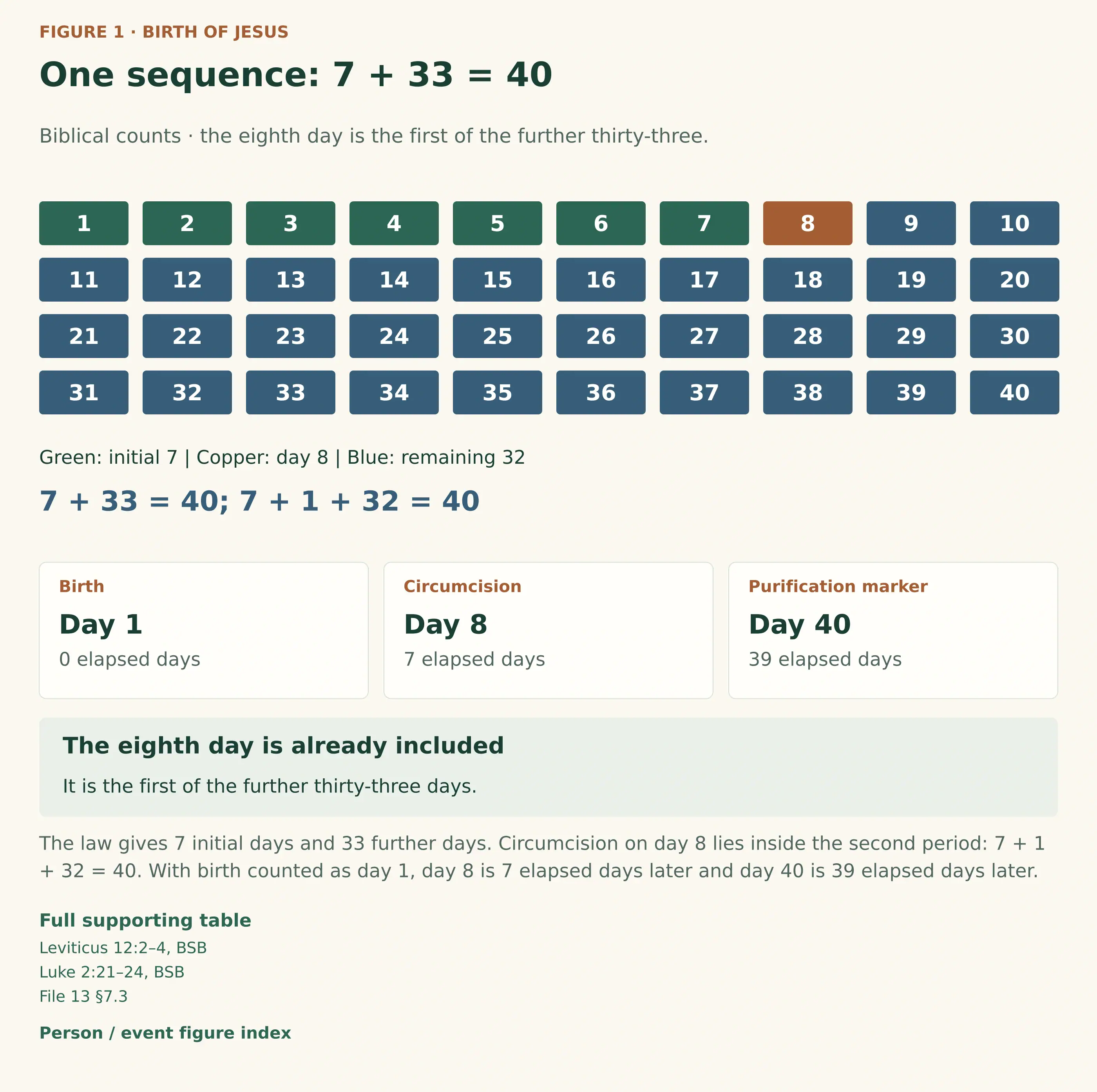
The law supplies consecutive periods for the mother: the initial 7 days and the further 33 days. Circumcision occurs on day 8, at the beginning of the second period (Leviticus 12:2–4, BSB). The same sequence can therefore be displayed as:
7 + 33 = 40
7 + 1 + 32 = 40
The second form singles out the circumcision day: 7 preceding counted days, the eighth day itself, and 32 remaining counted days.
One sequence: 7 + 33 = 40
Biblical counts · the eighth day is the first of the further thirty-three.
7 + 33 = 40
7 + 1 + 32 = 40
0 elapsed days
7 elapsed days
39 elapsed days
Full supporting table · Leviticus 12:2–4, BSB · Luke 2:21–24, BSB · File 13 §7.3
Counting and source notes
This is the biblical Levitical count, without an assigned BC or AD date. It concerns the mother’s purification after a male birth. The boy’s circumcision does not add an extra day to 7 + 33. Luke describes Jesus’ circumcision and naming, then presentation after the purification time was complete.
Image version and downloads for Figure 1
Full-size PNG · Editable SVG (ZIP) · Responsive diagram in this article
Download the exact standalone HTML, SVG and JSON source bundle (ZIP)
Both the eighth day and the fortieth day can be reckoned inclusively, with birth counted as day 1. Their elapsed intervals from that starting date are then 7 and 39 days respectively. The supporting tables show the numbered days and elapsed intervals separately.
Six years, then a year of rest
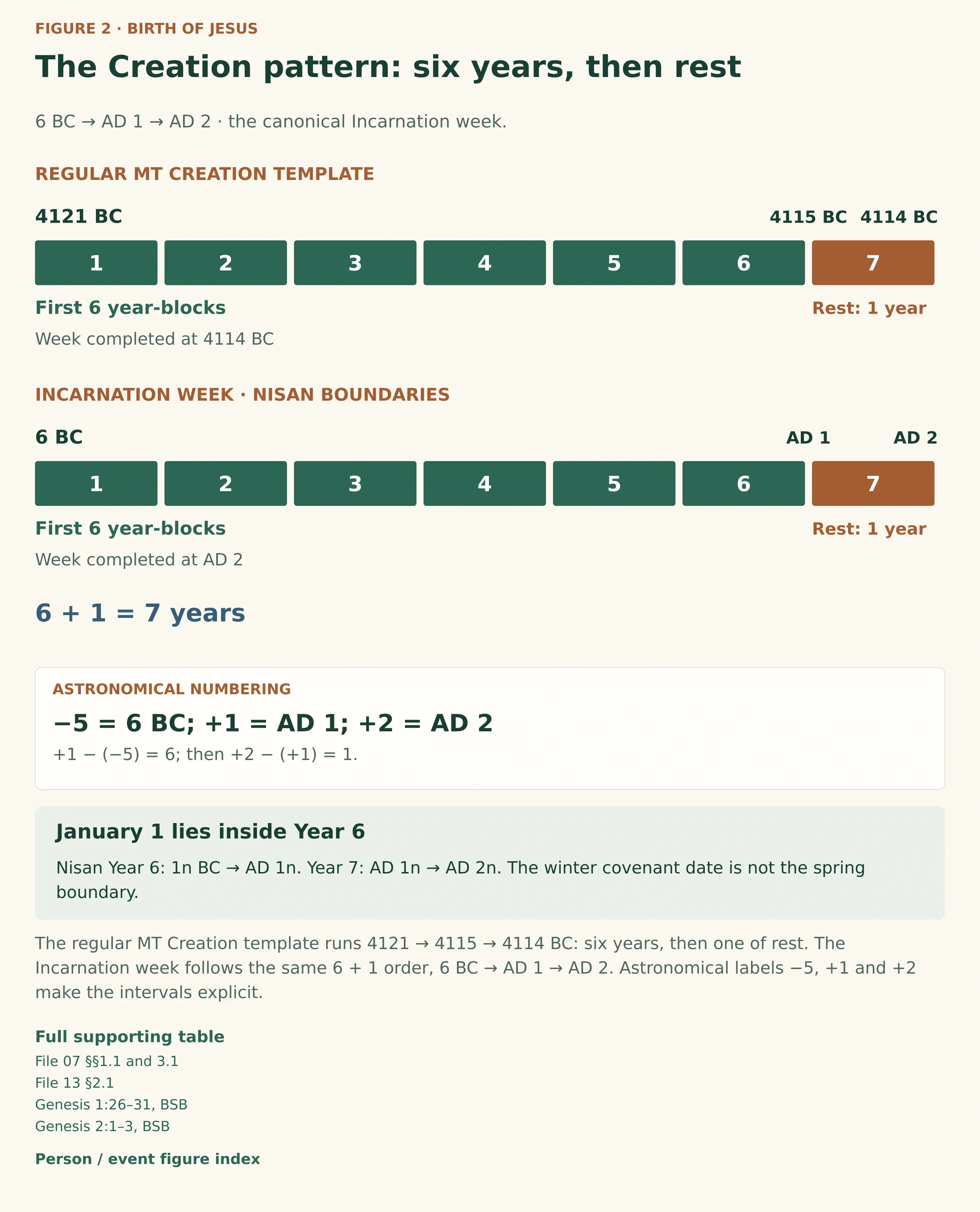
Genesis describes six days of Creation followed by the seventh-day rest (Genesis 1:31–2:3, BSB; the seventh day). The chronology applies that order to its Incarnation, or New Creation, week:
6 BC → AD 1 = 6 years
AD 1 → AD 2 = 1 year
6 + 1 = 7 years
This is the standard framework of the comparison. File 13 §2 aligns it with the Creation week; File 07 §3.1 supplies the regular MT Creation template. Its six years of work run from 4121 to 4115 BC, followed by rest from 4115 to 4114 BC. The corresponding Incarnation structure runs from 6 BC to AD 1, followed by rest from AD 1 to AD 2.
The Creation pattern: six years, then rest
6 BC → AD 1 → AD 2 · the canonical Incarnation week.
Regular MT Creation template
6 years
1 year
Incarnation week · Nisan boundaries
6 years
1 year
6 + 1 = 7 years
Opening boundary
Six years later
Rest year completed
Full supporting table · File 07 §§1.1 and 3.1 · File 13 §2.1 · Genesis 1:26–31, BSB · Genesis 2:1–3, BSB
Counting and source notes
File 07 supplies the MT Creation-week model, including Adam’s sixth-year opening at 4116 BC. File 13 supplies the Incarnation week. Its Nisan form is 6n BC → AD 2n; Year 6 is 1n BC → AD 1n and Year 7 is AD 1n → AD 2n. January 1 is inside Year 6, not the Nisan boundary. This compares corresponding structures; it generates no reflected date.
Image version and downloads for Figure 2
Full-size PNG · Editable SVG (ZIP) · Responsive diagram in this article
Download the exact standalone HTML, SVG and JSON source bundle (ZIP)
Astronomical numbering makes this particularly easy to see. 6 BC is year −5, AD 1 is +1, and AD 2 is +2. Thus +1 − (−5) = 6, followed by +2 − (+1) = 1. The civil labels pass directly from 1 BC to AD 1; astronomical year 0 labels 1 BC.
The precise seasonal setting also matters. In the canon’s Nisan form, Year 6 runs 1n BC → AD 1n, and Year 7 runs AD 1n → AD 2n. Here n means Nisan. The traditional January 1 naming date falls within Year 6, before its Nisan endpoint. It is a covenant event inside the year, rather than the spring boundary at which Year 7 begins. The seven-row comparison preserves all these positions.
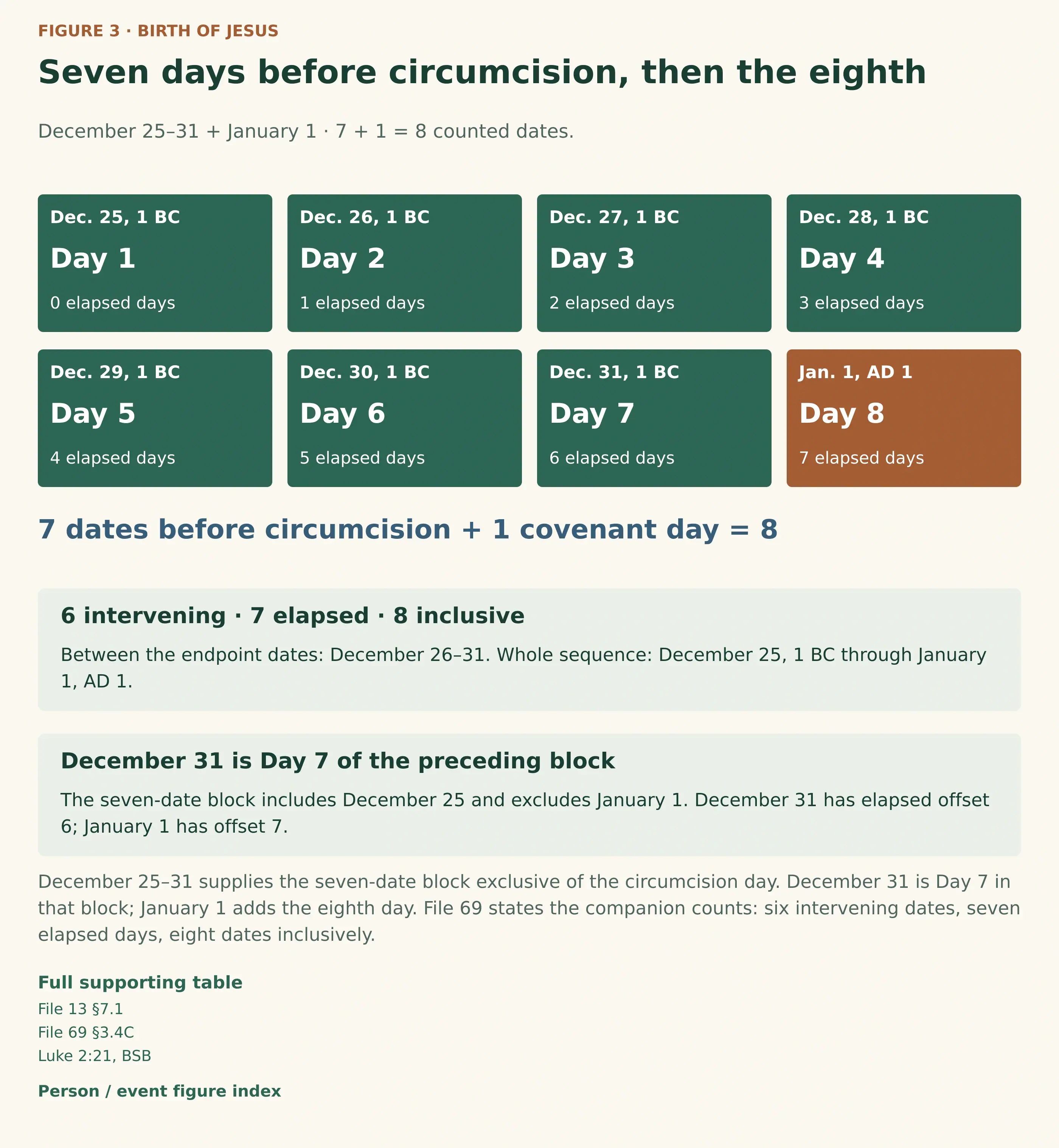
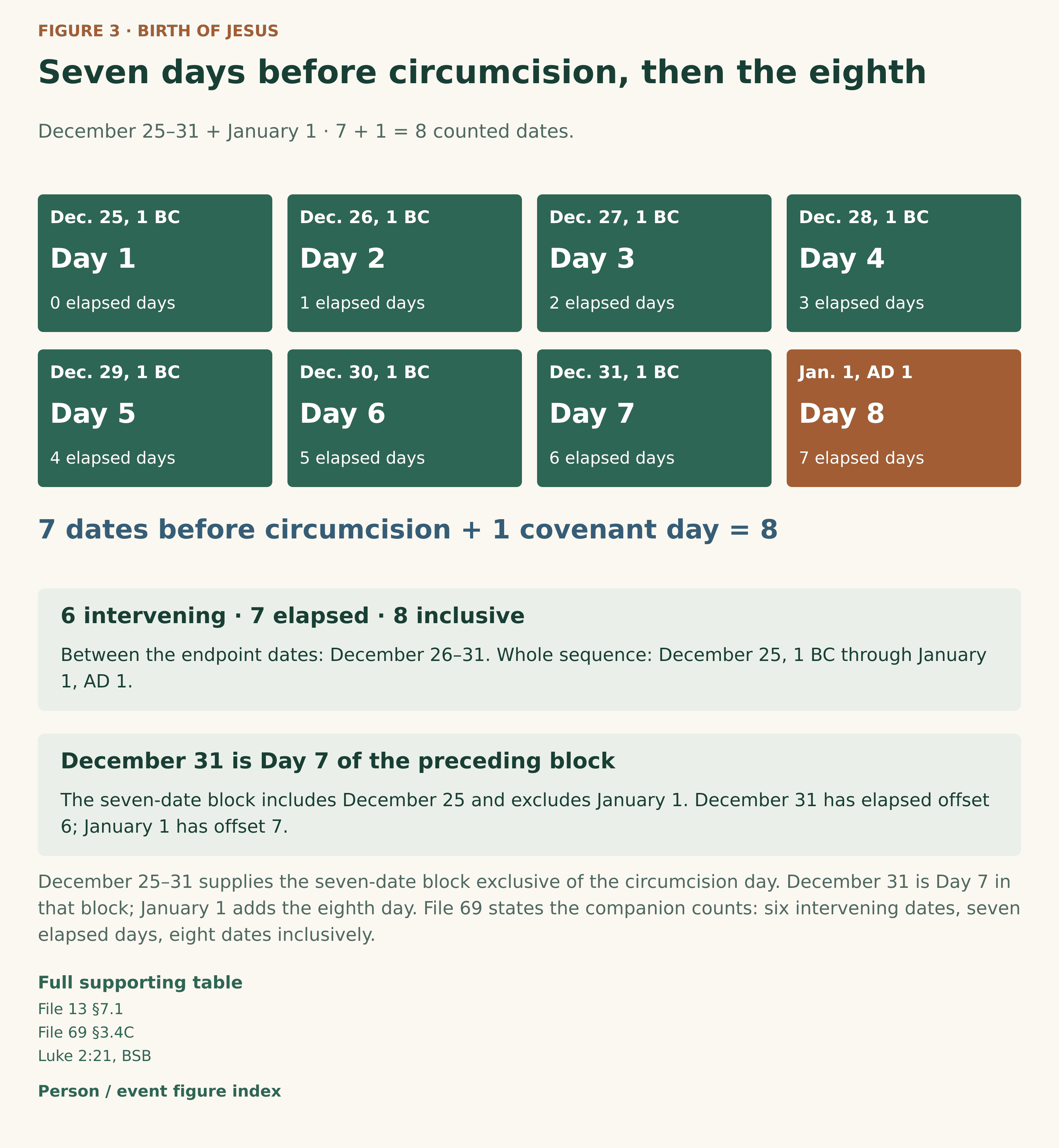
December 25 to January 1: seven days plus one
For the birth-calendar example, File 13 §7.1 uses December 25, 1 BC, followed by circumcision and naming on January 1, AD 1. Luke supplies the events and their order; the December date is the traditional datum used by the model.
Count the dates from December 25 through December 31: there are 7. January 1 adds 1, giving 7 + 1 = 8. December 31 is therefore Day 7 of the block exclusive of the circumcision day; January 1 is the eighth day inclusively. This expresses the seven days before circumcision and the added covenant day without losing either endpoint.
Seven days before circumcision, then the eighth
December 25–31 + January 1 · 7 + 1 = 8 counted dates.
7 dates before circumcision + 1 covenant day = 8
December 26–31
December 25 → January 1
December 25 through January 1
Full supporting table · File 13 §7.1 · File 69 §3.4C · Luke 2:21, BSB
Counting and source notes
The terminal exclusion is explicit: the first seven-date block includes the birth date and excludes January 1. It is not a claim that seven full days had elapsed at the December 31 marker. The whole December 25–January 1 sequence is eight dates inclusively, separated by seven elapsed days. The traditional calendar supplies the dates; Luke supplies the circumcision and naming sequence. In the separate day-year table December 31 is coordinate 0, displayed symbolically as 1 BC.
Image version and downloads for Figure 3
Full-size PNG · Editable SVG (ZIP) · Responsive diagram in this article
Download the exact standalone HTML, SVG and JSON source bundle (ZIP)
File 69 §3.4C draws out three related counts: 6 intervening dates (December 26–31), 7 elapsed days from December 25 to January 1, and 8 days inclusively when both dates are counted. The interval stays the same; the question being counted changes.
The Creation comparison gives the sequence its theological setting: six, then Sabbath seven, then the eighth-day covenant sign as a new beginning. The day sequence and the seven-year Incarnation framework operate at different scales. The anchor notes explain the canon’s uses of 6 BC and the January 1 covenant datum.
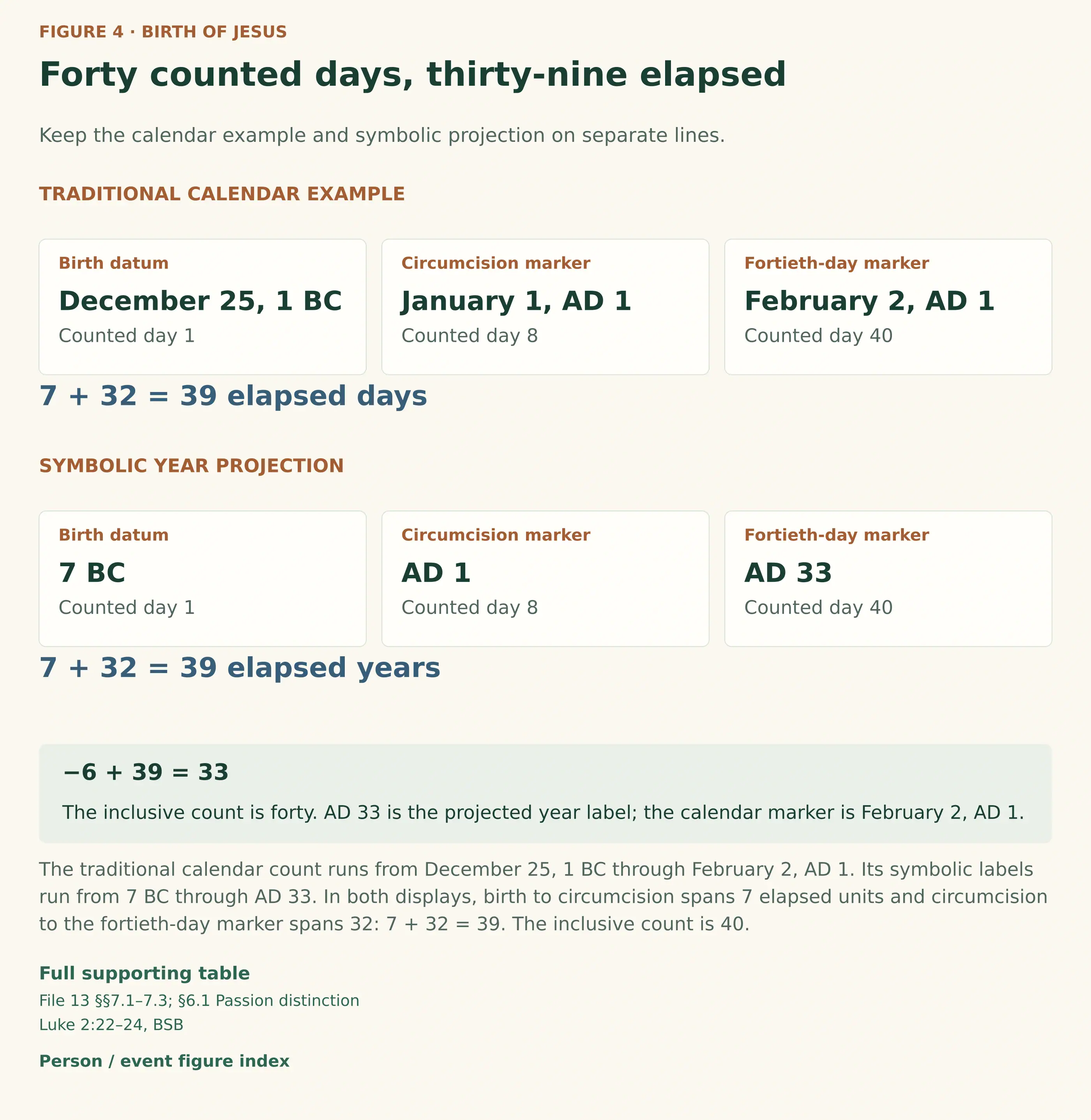
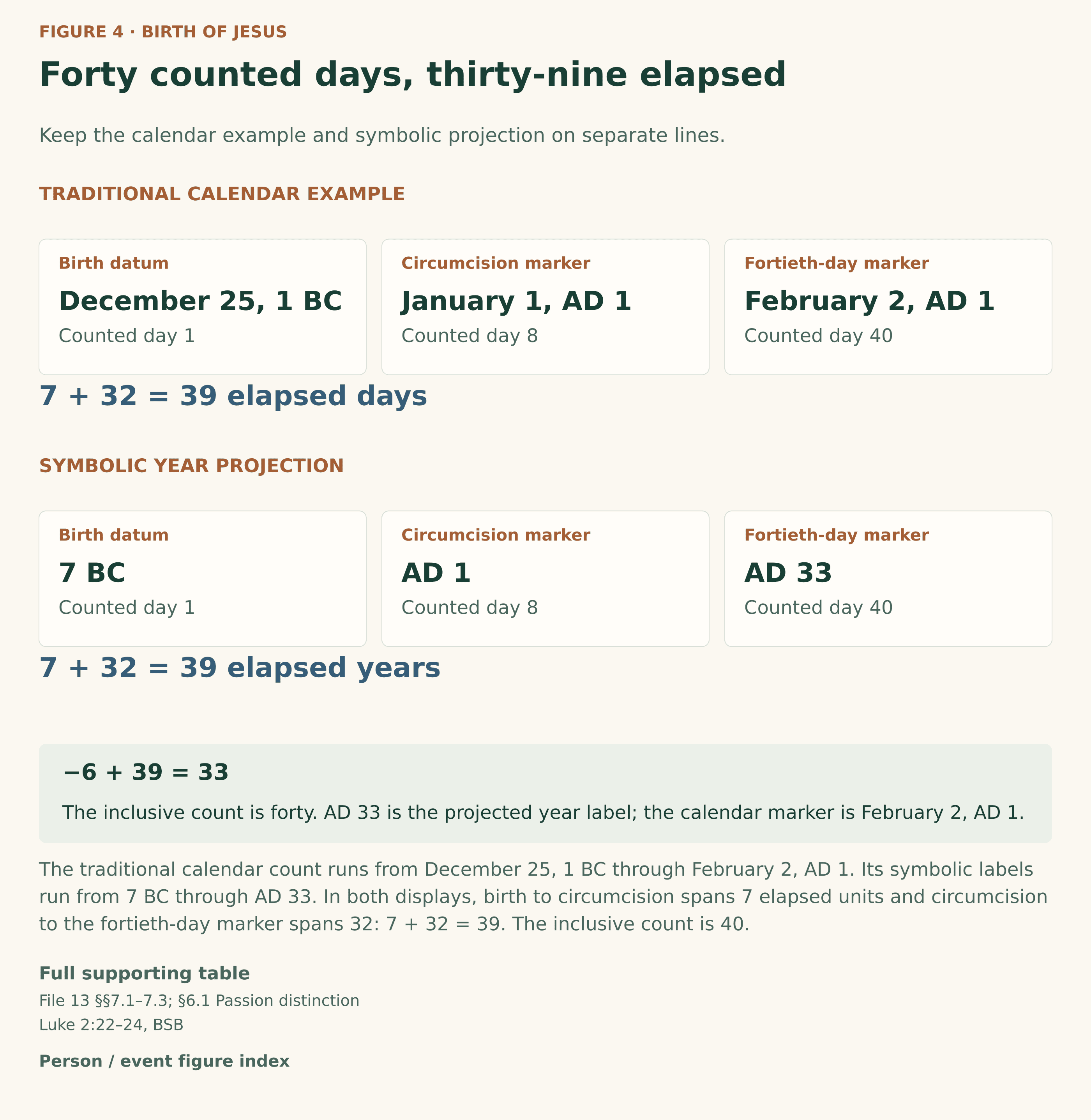
The fortieth day and the AD 33 projection
The short day–year table uses January 1 as coordinate +1, December 31 as 0, and December 26 as −5. The last of these corresponds to the astronomical label 6 BC, the familiar starting label of the larger framework. Including the birth date itself, December 25, takes the table one position earlier, to −6, whose symbolic label is 7 BC.
That earlier position belongs to the inclusive day table. It does not replace 6 BC as the starting label of the Incarnation week. Calendar dates, numbered days and projected year labels remain separate columns in the complete conversion table.
With birth counted as day 1, the fortieth day is 39 elapsed days later:
−6 + 39 = 33
The result is coordinate +33, displayed symbolically as AD 33. In the traditional calendar example, the corresponding fortieth-day marker is February 2, AD 1.
Forty counted days, thirty-nine elapsed
Keep the calendar example and symbolic projection on separate lines.
Traditional calendar example
Counted day 1
Counted day 8
Counted day 40
7 + 32 = 39 elapsed units
Symbolic year projection
Counted day 1
Counted day 8
Counted day 40
7 + 32 = 39 elapsed units
Full supporting table · File 13 §§7.1–7.3; §6.1 Passion distinction · Luke 2:22–24, BSB
Counting and source notes
February 2 is derived as the fortieth-day marker of this chosen example. Luke does not supply that civil date or the exact presentation hour. AD 33 here is a symbolic coordinate label. Comparison with the preferred AD 33n Passion center is typological; AD 30n remains a possible Passion state.
Image version and downloads for Figure 4
Full-size PNG · Editable SVG (ZIP) · Responsive diagram in this article
Download the exact standalone HTML, SVG and JSON source bundle (ZIP)
The comparison with Christ’s Passion is typological. The canonical chronology prefers AD 33 in the Nisan setting for the Passion and retains AD 30 as possible. The projected AD 33 label brings the purification count into comparison with that preferred center; it does not establish the crucifixion year independently (File 13 §§6–7).
As with the circumcision count, a completed interval must be distinguished from an inclusively numbered day. Adding 40 elapsed days reaches −6 + 40 = 34. The canon retains AD 34 as a completed-period purification display, never as a replacement Passion date. Figure 6 and its table explain the boundary.
Numbers 14:34 provides an explicit biblical application of a year for each day (BSB). Here that principle is applied interpretively to the Nativity sequence; Luke does not itself supply the symbolic year table.
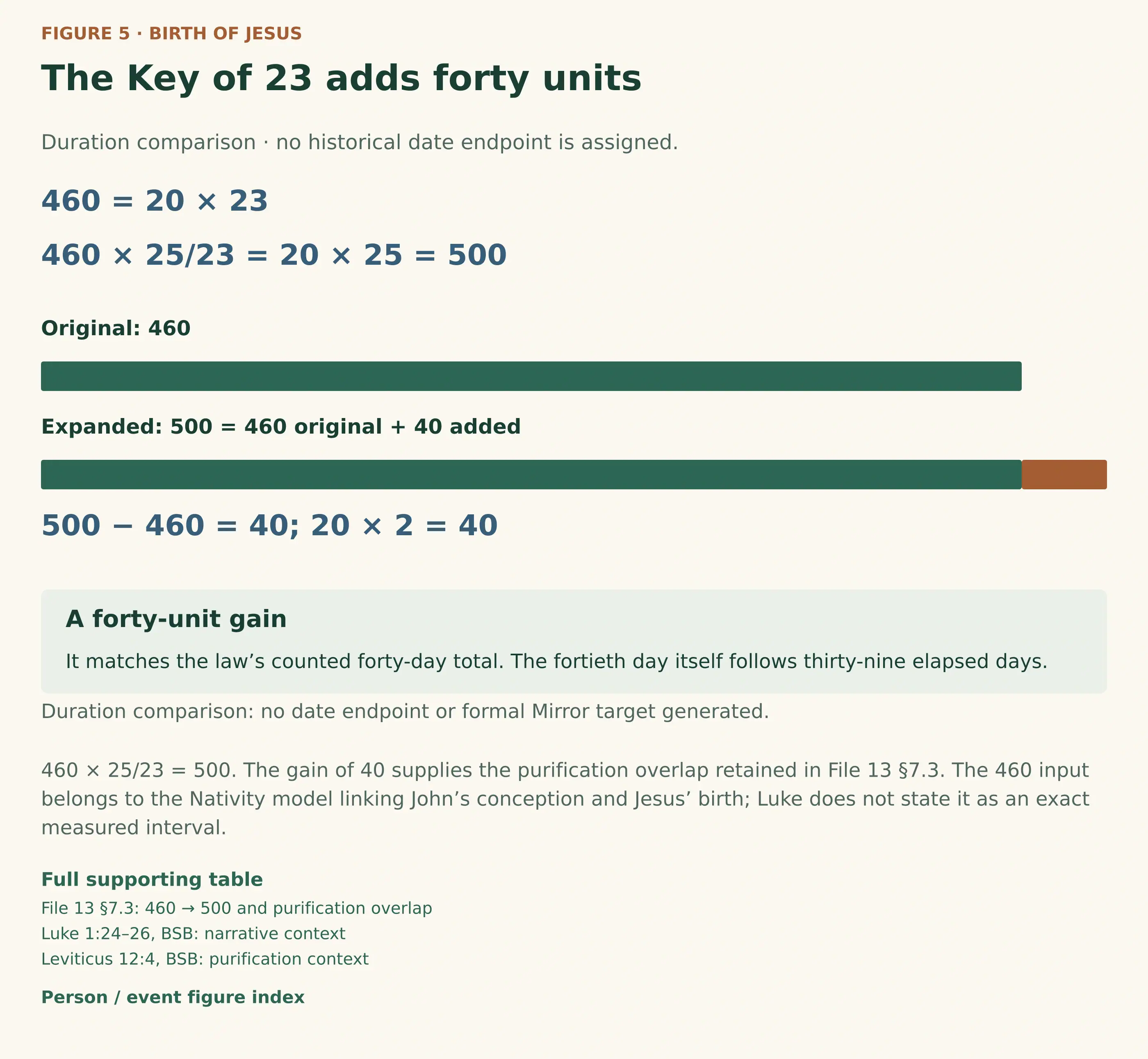
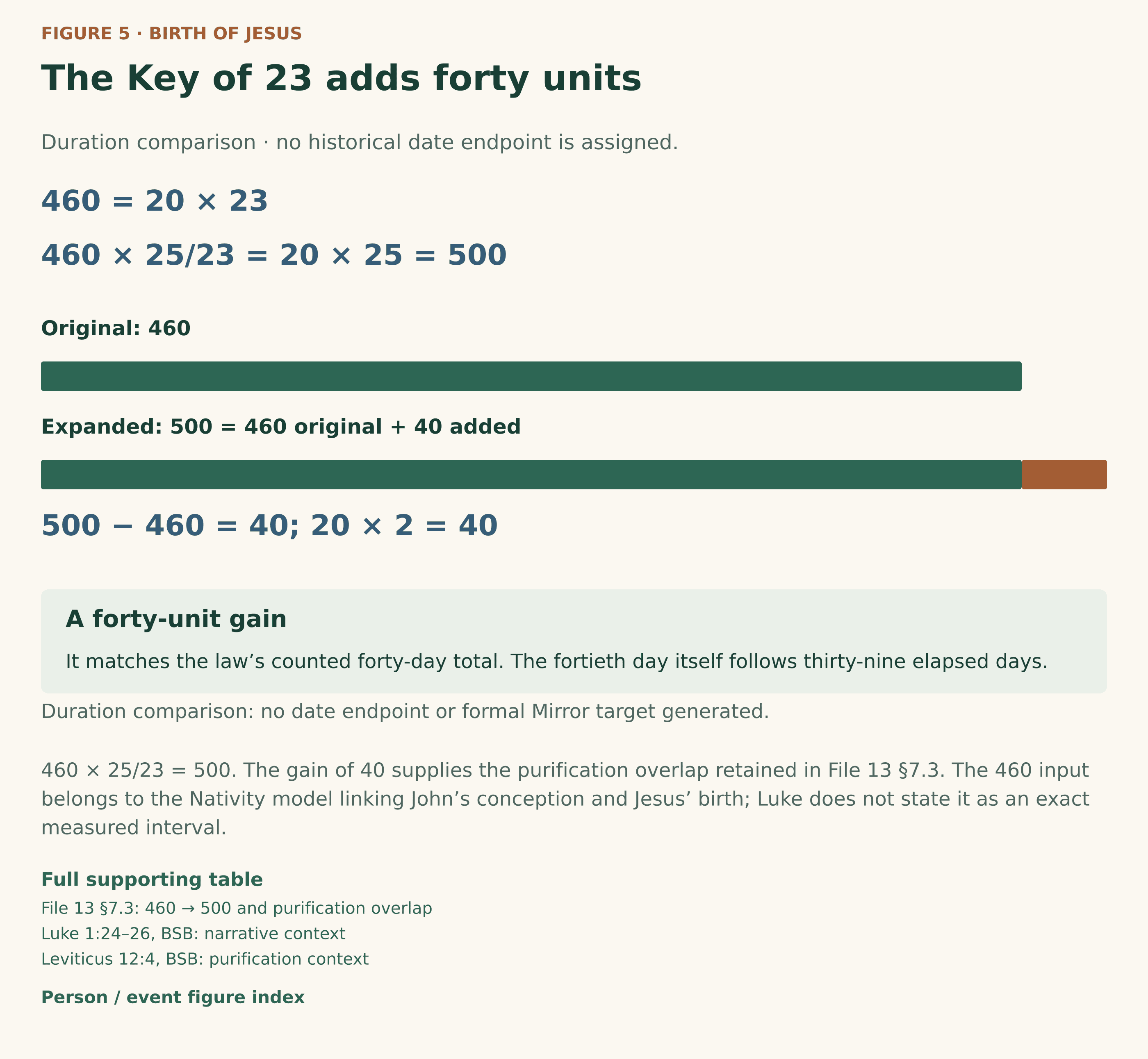
The Key of 23 adds another forty
The Nativity model also preserves 460 as a starting value associated with John’s conception and Jesus’ birth. Its expansion changes 20 units of 23 into 20 units of 25:
460 = 20 × 23
460 × 25/23 = 20 × 25 = 500
500 − 460 = 40
The Key of 23 adds forty units
Duration comparison · no historical date endpoint is assigned.
460 = 20 × 23
460 × 25/23 = 20 × 25 = 500
500 − 460 = 40
20 × 2 = 40
No dated endpoint or formal Mirror target is generated.
Full supporting table · File 13 §7.3: 460 → 500 and purification overlap · Luke 1:24–26, BSB: narrative context · Leviticus 12:4, BSB: purification context
Counting and source notes
The transformation is exact under 25/23; its application to purification is typological. Assigning a dated endpoint requires the input’s origin and counting convention. This diagram presents the canonical forty-unit gain without selecting an unverified historical conception-to-presentation date.
Image version and downloads for Figure 5
Full-size PNG · Editable SVG (ZIP) · Responsive diagram in this article
Download the exact standalone HTML, SVG and JSON source bundle (ZIP)
Each unit gains 2, giving 20 × 2 = 40. The added forty supplies the purification overlap preserved in File 13 §7.3, linking the John–Jesus birth comparison with Mary’s purification and the Temple presentation.
The numerical expansion is exact; its application is a model comparison. Luke does not state a measured 460-day interval, and the forty-unit gain needs its own endpoint convention when applied to calendar dates. The expansion table records the input, transformation and interpretation.
From Creation to covenant and presentation
The numbers accompany the narrative: Jesus is born, circumcised and named, then presented to the Lord as the family fulfills the prescribed law. Luke records a pair of turtledoves or two young pigeons; Leviticus provides that offering for a mother who cannot afford a lamb (Luke 2:24; Leviticus 12:8, BSB). The purification concerns Mary’s ritual status after childbirth.
The study reads that sequence through the Creation pattern: 6 + 1 in the week of years, 7 + 1 in the inclusive circumcision sequence, and 7 + 33 in purification. The Key’s 460 → 500 transformation adds another forty. Each relationship keeps its own count and setting while contributing to the larger comparison of Creation, covenant and new beginning.
For all seven year-blocks, the complete day table and links connecting each person or event to its diagrams, see The Birth of Jesus: Supporting Tables and Source Notes.
Sources and further reading
File 13 §§2 and 7 controls the Incarnation week and the birth-day comparison. File 07 §3.1 supplies the MT Creation template, and File 69 §3.4C states the six-intervening, seven-elapsed and eight-inclusive sequence. File 14 §§1–2 supplies the biological-model and Levitical distinctions. File 00, File 09, File 12 and File 17 govern the wider numbering, calendar and operation settings.
This introduction accompanies the original Birth of Jesus discussion.
Scripture quotations: Berean Standard Bible (BSB), public domain.