Crossing the Jordan brought Israel into the land, but entry was only the beginning. The book of Joshua follows the movement from crossing and conflict to inheritance and rest:
So Joshua took the entire land, in keeping with all that the LORD had spoken to Moses. And Joshua gave it as an inheritance to Israel according to the allotments to their tribes. Then the land had rest from war.
In the chronology used here, the Jordan crossing belongs to 1406 BC. The conquest and land-division process reaches 1400 BC, and the following rest-year interval closes in 1399 BC. Together these form six years followed by a year of rest: a seven-year movement from entry toward settled inheritance.
That seven also occupies a distinctive position within the larger chronology. It closes one forty-year span and opens another. Following those spans makes the land’s rest a visible center in the transition from Moses to Joshua.
The supporting tables provide the dates and derivations. The discussion follows the normal Masoretic Text chronology and its Nisan-based year labels; the BC dates are chronological reconstructions, not dates printed in Joshua.
Caleb helps locate the year of rest
The narrative gives a precise day for the crossing: Israel comes up from the Jordan on the tenth day of the first month (Joshua 4:19). Four days later, Israel observes Passover in the land (Joshua 5:10). After Passover, Israel ate the land’s produce, and the manna ceased (Joshua 5:11–12). These are the opening events of a new era.
Caleb’s testimony helps place its later turning point. He was 40 when Moses sent him to explore Canaan. When he asks Joshua for his inheritance, 45 years have passed and he is 85 (Joshua 14:7, 10).
The working chronology places the reconnaissance in 1445 BC, the year after the Exodus. Caleb’s forty-five years therefore reach 1400 BC:
1445 − 1400 = 45.
The Jordan crossing divides that interval into 39 years before entry and 6 after it. The additional year of rest is the interval 1400–1399 BC, bringing the full entry-to-rest-endpoint span to seven.
490d · From the Jordan to Rest · Figure 1
From the Jordan to the year of rest
Caleb’s testimony and the Conquest sequence answer different chronological questions.
Caleb: forty-five years remembered
His stated ages are 40 at the mission and 85 at the land division.
Mission to Canaan
1445 BCCaleb age 40
Jordan / Conquest
1406 BC39 years after the mission
Land division
1400 BCCaleb age 85
1445 − 1400 = 45
The reconstructed sequence gives 39 + 6, while Caleb’s testimony supplies the 45-year total.
The Conquest and its rest year
The seven-year frame distinguishes the six-year process from the following year of rest.
Conquest begins
1406 BCNisan
Land-rest onset
1400 BCRest year begins
Completed rest-year endpoint
1399 BCRest year ends
1400–1399 BC is the rest year within the seven-year frame.
Normal MT / Nisan working chronology. Caleb’s ages and 45-year interval are textual; the BC placement is reconstructed. Bars are proportional within each panel, using independent scales. Cards are schematic. Rest-year phase labels correspond to 1400n–1399n BC.
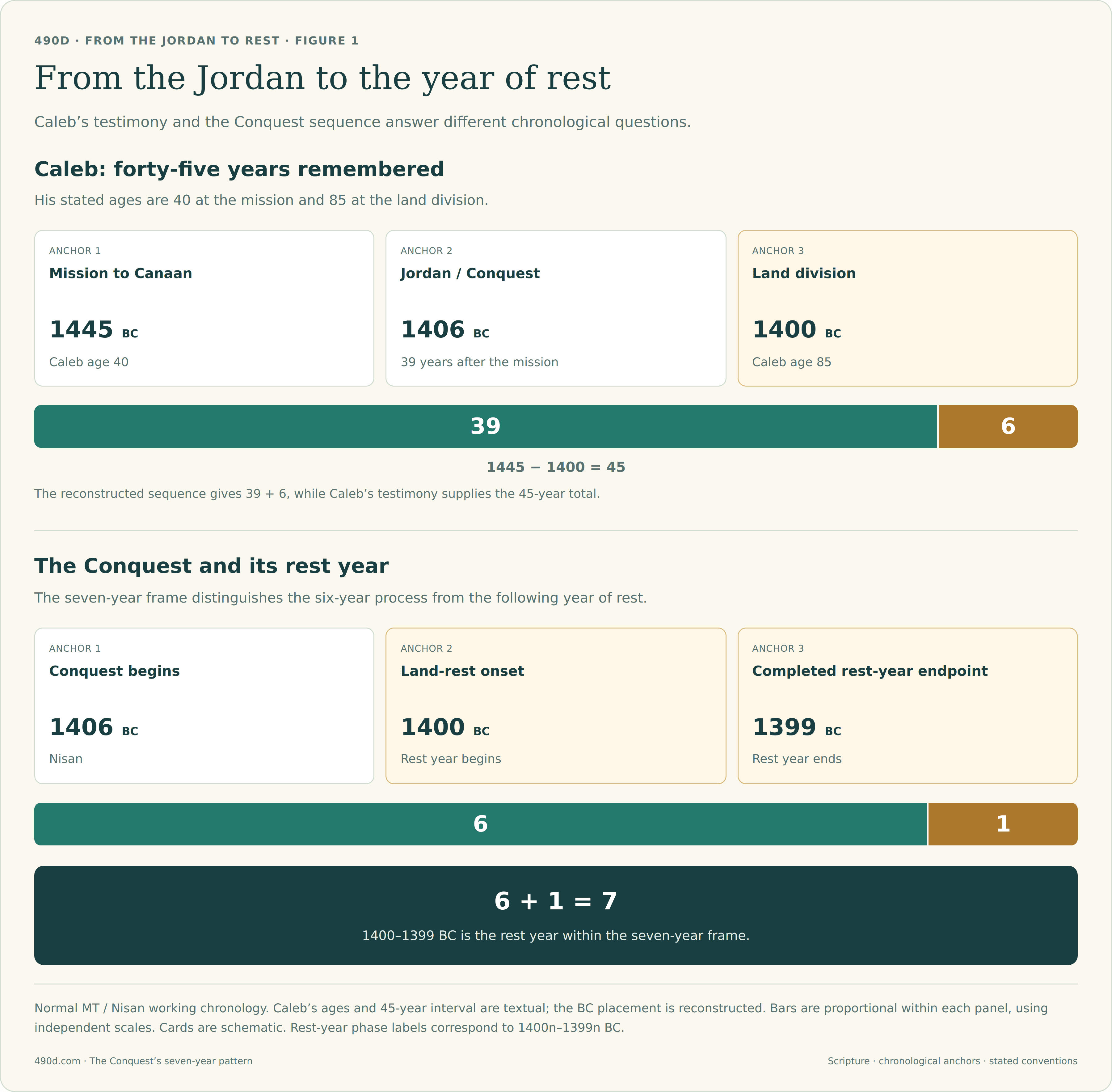
This distinction matters. 1400 BC marks the onset of the rest year; 1399 BC marks its completed endpoint. Calling the whole interval “seven years of warfare” would lose the very feature that gives the pattern its meaning: the seventh year belongs to rest. The Caleb calculation and rest-year table keep the two boundaries visible.
Two forties, each divided into seven and thirty-three
The broader framework runs from the Exodus in 1446 BC, through the Conquest in 1406 BC, to Joshua’s death in 1366 BC. Under these working dates, Moses’ final forty years are followed by another forty extending through Joshua’s later life:
1446 → 1406 → 1366 BC = 40 + 40 = 80.
The second forty has a meaningful division already established by the land-rest endpoint:
1406 → 1399 → 1366 BC = 7 + 33 = 40.
The seven years carry the story from entry through the completed rest year; thirty-three remain to Joshua’s death in this chronology.
To compare the two forties, mark the same seven-plus-thirty-three division in the earlier one:
1446 → 1439 → 1406 BC = 7 + 33 = 40.
Here 1439 BC is a structural division, seven years after the Exodus. Joshua does not identify an event at that coordinate. Its role is to make the repeated arrangement visible:
7 + 33 | 7 + 33 = 80.
File 63 §§3.2–3.6 supplies this comparison and its distinction between narrative anchors and structural divisions.
The seven years shared by two forty-year spans
Now look across the middle of the sequence. From 1439 to 1399 BC is forty years. From 1406 to 1366 BC is also forty years. Both include the same seven-year interval from the Conquest to the completed rest-year endpoint:
1439 → 1406 → 1399 → 1366 BC = 33 + 7 + 33.
The seven sits at the end of the first span and the beginning of the second. Counting the shared years once gives:
40 + 40 − 7 = 73.
490d · From the Jordan to Rest · Figure 2
Two forties, and the seven they share
First see the whole sequence; then shift the starting point to reveal the overlap.
The full eighty-year sequence
Exodus
1446 BCBeginning of the first 40
Structural partition
1439 BCNo separately dated event
Conquest
1406 BCBeginning of the second 40
Completed rest-year endpoint
1399 BCSeven years after entry
Joshua’s death
1366 BCEnd of the second 40
1446 → 1406 BC
First consecutive span: 40 years
1406 → 1366 BC
Second consecutive span: 40 years
The two consecutive forty-year spans meet at the Conquest.
A shifted pair shares the seven
The focus now begins at 1439 BC. The bars use a new, 73-year scale.
1439 → 1399 BC: 33 + 7 = 40
1406 → 1366 BC: 7 + 33 = 40
33 + 7 + 33 = 73
The shared seven runs from Conquest entry to the completed rest-year endpoint.
Normal MT / Nisan working chronology. The 1439 BC node is a structural partition. Bars are proportional within each panel, with independent 80-year and 73-year scales. Anchor-card spacing is schematic. The 73-year union is a derived calculation.
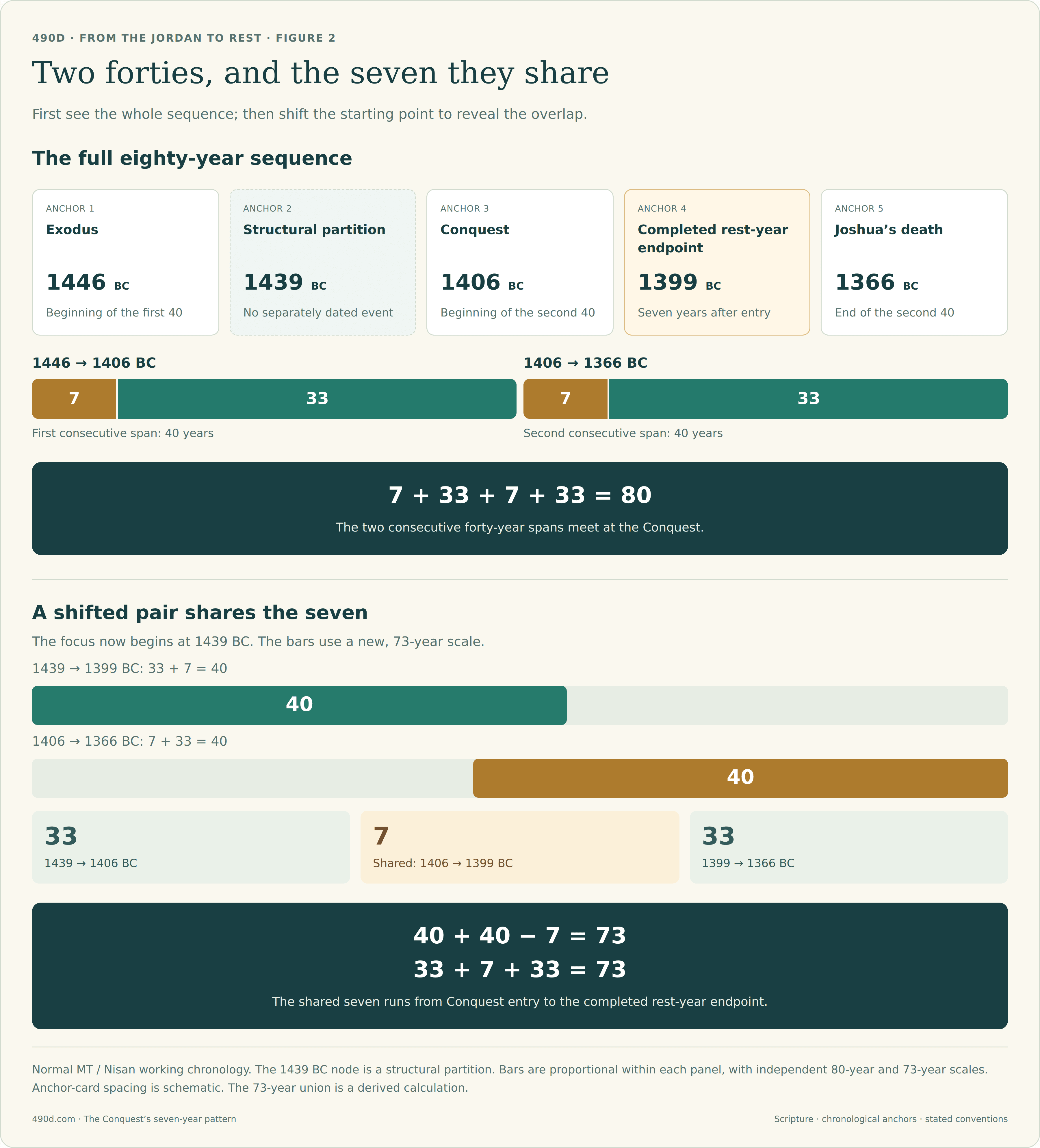
The two views answer different questions. Eighty years is the whole Exodus-to-Joshua interval, divided into two consecutive forties. Seventy-three years is the reach of the two overlapping forties, beginning at the structural 1439 division. The span table shows both without confusing their starting points.
This is why the central seven deserves attention. It is not an extra block inserted between two complete forties. It belongs to both, joining the end of one measure to the beginning of the next.
Joshua’s life makes the framework personal
Joshua’s final age is stated directly:
Some time later, Joshua son of Nun, the servant of the LORD, died at the age of 110.
The working chronology places his birth in 1476 BC and his death in 1366 BC. Those endpoints put him at 30 at the Exodus, 70 at the Conquest, and 77 at the completed land-rest endpoint.
These intermediate ages are calculated from the model’s dates; Scripture explicitly supplies the final 110. They allow us to see the same seven-year interval within one person’s life:
70 + 7 + 33 = 110.
490d · From the Jordan to Rest · Figure 3
Joshua’s life frames the seven
The working chronology places the Conquest at age 70 and the completed rest year at age 77.
Joshua’s birth
1476 BCAge 0 · derived date
Exodus
1446 BCAge 30 · calculated
Conquest
1406 BCAge 70 · calculated
Completed rest-year endpoint
1399 BCAge 77 · calculated
Joshua’s death
1366 BCAge 110 · stated lifespan
Three periods within one life
The seven-year Conquest-to-rest frame brings the calculated age to 77.
The first seventy divide at the Exodus
30 + 40 + 7 + 33 = 110
Normal MT / Nisan working chronology; regular, not cumulative, Joshua dates. Bar lengths are proportional within each panel, with independent 110-year and 70-year scales. Anchor-card spacing is schematic. The age comparisons are calculated, except the textual lifespan of 110.
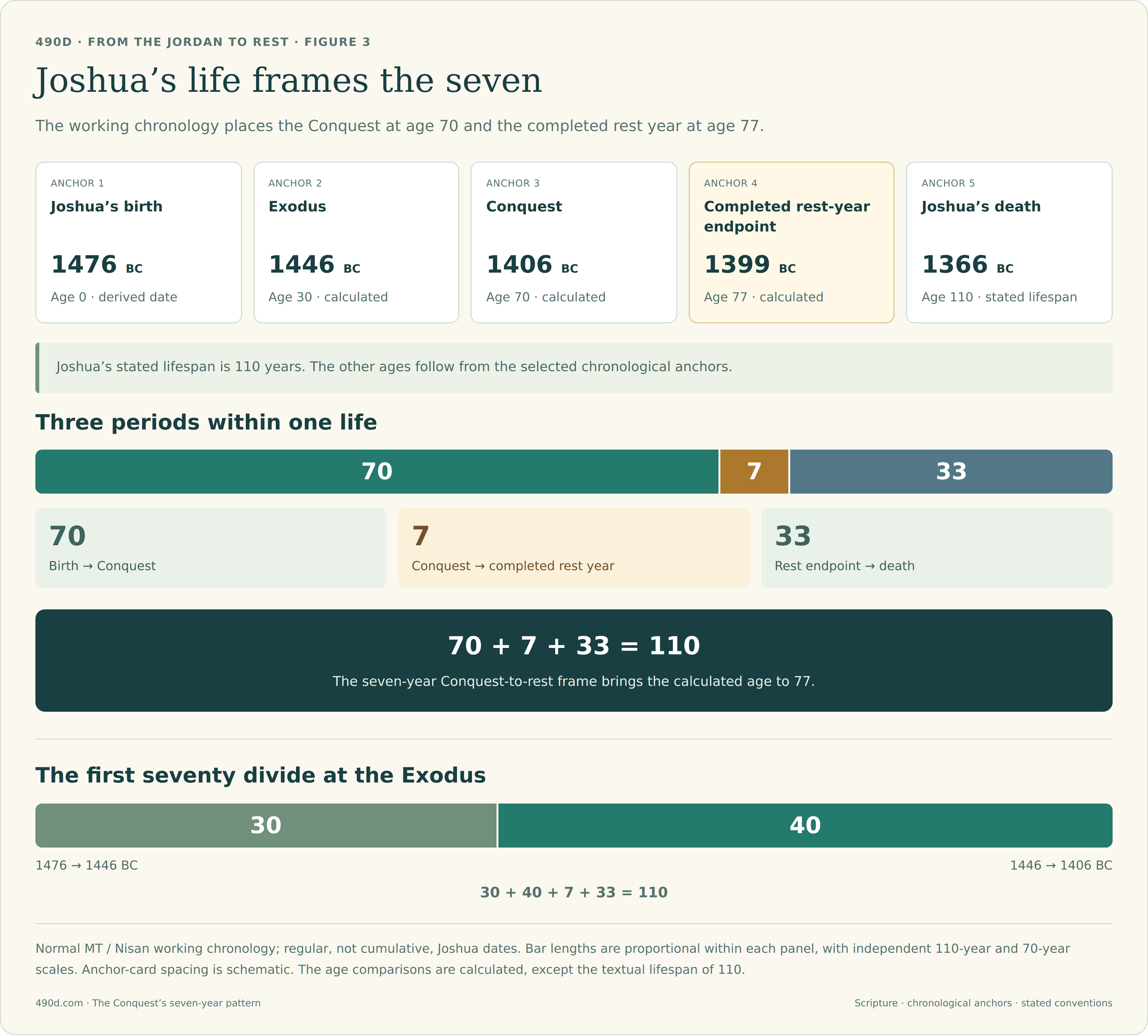
Joshua leads Israel across the Jordan at the modeled age of 70. Seven years bring him to 77 and the completed rest-year boundary. The remaining 33 complete his 110-year life. The narrative’s long movement toward inheritance is thus carried through a human biography as well as a sequence of eras. See the Joshua table for every subtraction.
Why the seven-year shape matters
The movement from six to seven recalls the biblical pattern of work followed by rest. Creation’s six days lead into the seventh; Israel’s law likewise joins six years of cultivation to a seventh-year rest for the land (Genesis 2:2–3; Leviticus 25:3–4). The conquest-and-rest chronology is read here in that theological setting.
The division 7 + 33 = 40 also has a textual counterpart in the birth-purification periods of Leviticus 12:2–4. File 14 and File 63 compare that day-scale form with the year-scale pattern (see the comparison table). The comparison is interpretive; the dates retain their separate chronological basis.
Rest also has a narrative scope. Joshua records territory still to be possessed (Joshua 13:1). The land’s rest marks a decisive transition into inheritance, without implying that every future conflict has disappeared.
The seven-year pattern draws attention to that transition. Entry leads through the conquest process into rest; the completed week then opens the remaining years of Joshua’s life. The numbers give visible form to the book’s movement from promise to possession:
Not one of all the LORD’s good promises to the house of Israel had failed; everything was fulfilled.
Supporting tables and further reading
The technical appendix contains the Caleb derivation, rest-year boundaries, consecutive and overlapping spans, Joshua’s ages, and textual versus structural comparisons.
The controlling sources are File 06, File 63, and the canonical chronological tables, with File 55 for Joshua’s working biography and File 14 for the seven-plus-thirty-three comparison. The detailed companion develops the wider Exodus–Conquest comparisons and their derivations.
Scripture quotations: Berean Standard Bible (BSB), public domain.