Abraham lived a total of 175 years.
Abraham’s lifespan remains 175 years whether his dates are written in BC or counted from Creation. Changing the date labels changes where an event appears on the scale. It does not change the interval between two events.
Anno Mundi (AM) means “in the year of the world”. An AM date counts numbered years from a chosen Creation starting point. To understand a table, we therefore need to know both its starting point and its counting convention.
This introduction uses 4121 BC as AM 1, the beginning of the project’s normal figurative Creation week. Its examples follow the normal Masoretic Text (MT) chronology, with the 430-year Egyptian sojourn and Nisan, or spring, convention. This is a defined model for the present tables; the term AM by itself does not identify one universally agreed Creation date.
The conversion tables and notes give the working formulas, patriarchal lifespans and selected event dates. The three distinctions below make those tables straightforward to read.
For the full treatment, see Converting Biblical Chronology to Anno Mundi (AM): A Detailed Study.
1. Three Creation references, three distinct roles
The dates 4121, 4116 and 4114 BC belong to the same defined Creation framework, but they mark different places within it:
| BC coordinate | Role in the framework | Numbered AM year | Completed years at that boundary |
|---|---|---|---|
| 4121 BC | Beginning of the figurative Creation week | AM 1 | 0 |
| 4116 BC | Beginning of Year 6, the Adam position | AM 6 | 5 |
| 4114 BC | Completion of Year 7; normal Creation reference | AM 8 begins | 7 |
File 07 §§1 and 3.1 supplies these distinctions. Its seven-year representation runs through five preparatory years, a sixth year associated with Adam, and a seventh year of rest. This is the project’s figurative Creation-week-as-years framework, kept distinct from the literal seven-day narrative.
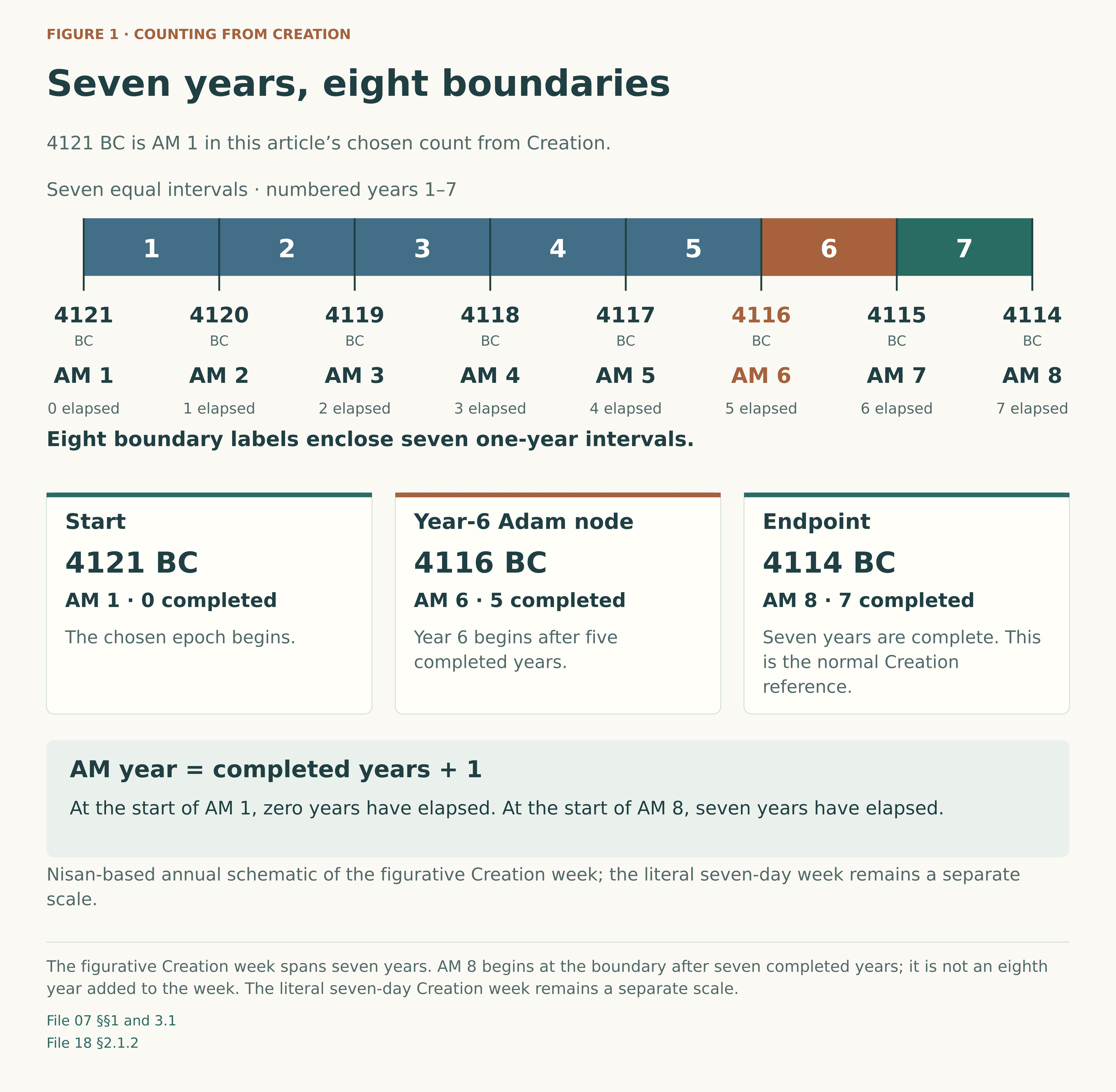
Figure 1 · Counting from Creation
Seven years, eight boundaries
4121 BC is AM 1 in this article’s chosen count from Creation.
Seven equal intervals · numbered years 1–7
The boundary after interval 7 begins AM 8.
| BC year | AM year | Years completed |
|---|---|---|
| 4121 | 1 | 0 |
| 4120 | 2 | 1 |
| 4119 | 3 | 2 |
| 4118 | 4 | 3 |
| 4117 | 5 | 4 |
| 4116 | 6 | 5 |
| 4115 | 7 | 6 |
| 4114 | 8 | 7 |
Start
4121 BC · AM 10 years completedThe chosen epoch begins.Year-6 Adam node
4116 BC · AM 65 years completedYear 6 begins after five completed years.Endpoint
4114 BC · AM 87 years completedSeven years are complete; the normal Creation reference remains 4114 BC.Nisan-based annual schematic of the figurative Creation week. The literal seven-day week is a separate scale.
Sources: File 07 §§1 and 3.1 · File 18 §2.1.2. Conversion table
Calculation and model details
Primary epoch: 4121 BC = AM 1. At corresponding annual boundaries, elapsed offset = 4121 − BC and numbered AM year = elapsed offset + 1. The 4116 BC milestone belongs to File 07’s Year-6 / Adam state. The 4114 BC endpoint remains the normal Creation reference. This is a Nisan-based annual schematic, not independent proof of the historical epoch or a claim that a named biblical event occurred at the instant a numbered year began.
Open the static image alternative
Open full-size PNG · Open full-size WebP · Download SVG source (ZIP)
At the beginning of AM 1, no year has yet been completed. After one year, AM 2 begins. After seven years, AM 8 begins. Thus the interval 4121 − 4114 = 7 years connects eight boundaries, from the start of AM 1 to the start of AM 8. The number on the final boundary does not turn the seven-year interval into eight elapsed years.
The normal genealogical table uses 4114 BC as its Creation/Adam reference. The 4116 BC Year-6 position has a different role. A conversion must preserve that distinction: replacing one coordinate with the other while retaining the rest of a biography would change the inputs, not merely its date notation.
2. A numbered year is not a completed-year total
With 4121 BC assigned to AM 1, first subtract the event’s BC date from 4121. That gives the elapsed-year offset between corresponding annual coordinates. Then add 1 to obtain the numbered AM year:
Elapsed-year offset = 4121 − BC date.
Numbered AM year = 4121 − BC date + 1.
For Abraham’s birth in the normal table:
4121 − 2166 = 1955.
1955 + 1 = AM 1956.
The 1955 measures the offset from the starting boundary; 1956 identifies the year that begins there. Both describe the same position in the chosen system.
An AM year contains events at different points within it. These formulas convert the tables’ annual coordinates; they do not supply an unknown birthday, month or day. Exact completed age on a particular date requires that additional information. The distinction between a numbered year and completed years must therefore remain visible when applying the tables to a passage.
3. New labels preserve the same lifespan
The normal table places Abraham at 2166–1991 BC. Converting both endpoints with the same rule gives:
| Event | BC date | Conversion | AM date |
|---|---|---|---|
| Abraham’s birth | 2166 | 4121 − 2166 + 1 | 1956 |
| Abraham’s death | 1991 | 4121 − 1991 + 1 | 2131 |
In BC notation, time moves toward smaller numbers. In AM notation, it moves toward larger numbers. The difference is the same:
2166 − 1991 = 175.
2131 − 1956 = 175.
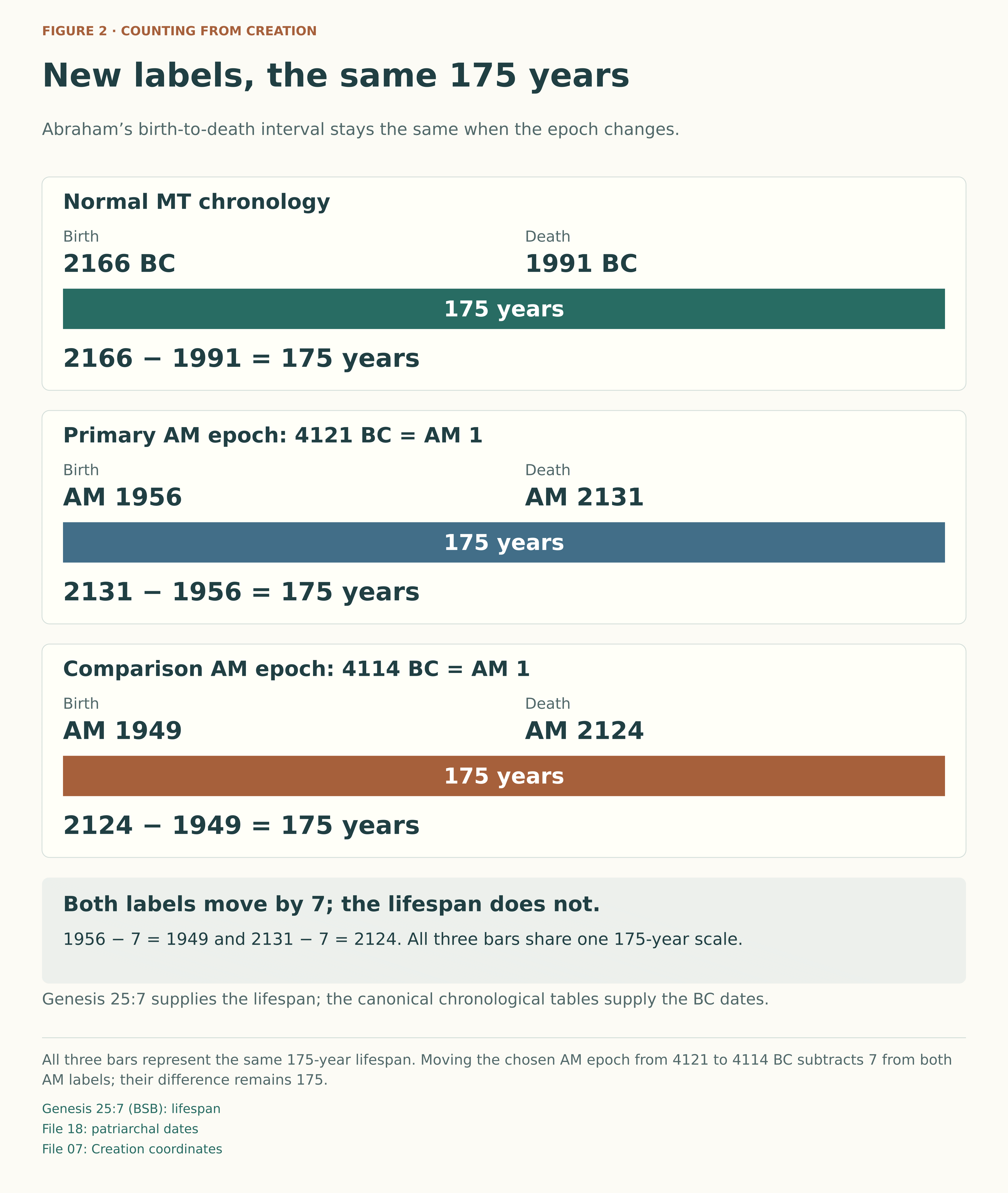
Figure 2 · Counting from Creation
New labels, the same 175 years
Abraham’s birth-to-death interval stays the same when the epoch changes.
Normal MT chronology
2166 − 1991 = 175 years
Primary AM epoch: 4121 BC = AM 1
2131 − 1956 = 175 years
Comparison AM epoch: 4114 BC = AM 1
2124 − 1949 = 175 years
2131 − 7 = 2124
Genesis 25:7 (BSB) supplies the 175-year lifespan. Canonical chronological tables supply the BC dates. The bars share one 175-year scale.
Sources: Genesis 25:7 (BSB): lifespan · File 18: patriarchal dates · File 07: Creation coordinates. Conversion table
Calculation and model details
The BC event dates come from the normal MT chronology. The second AM epoch is a labeling comparison only; it does not change the underlying chronology, textual tradition, fatherhood ages, or lifespan. Genesis 25:7 supplies the lifespan of 175 years, not the BC birth date.
Open the static image alternative
Open full-size PNG · Open full-size WebP · Download SVG source (ZIP)
The added 1 occurs at both endpoints and cancels when they are subtracted. Changing the starting point works the same way. If a separately labelled comparison assigned 4114 BC to AM 1, Abraham’s dates would become AM 1949–2124. Both labels move down by 7, and 2124 − 1949 = 175.
The same protection applies to every lifespan. Sarah’s 2156–2029 BC becomes AM 1966–2093, preserving 2093 − 1966 = 127. A result of 120 would come from mixing different origins at the two endpoints; it would not be a valid conversion of her 127-year life.
The lifespan table makes this comparison directly for the selected patriarchs. Biblical ages remain the inputs; the AM notation displays their chronological placement.
4. A few useful conversions
The following dates all use the same 4121 BC = AM 1 origin and the same normal MT chronology:
| Event or reference | BC coordinate | Numbered AM year |
|---|---|---|
| Normal Creation reference | 4114 | 8 |
| Flood begins | 2458 | 1664 |
| Abraham’s birth | 2166 | 1956 |
| Exodus | 1446 | 2676 |
| Conquest / Moses’ endpoint | 1406 | 2716 |
These are conversions of the project’s reconstructed dates, controlled by File 18. Scripture does not print these BC or AM labels. The full selected-event table places the BC coordinate, elapsed offset and AM year beside one another.
For example, the normal Creation reference to the Flood remains 1656 years:
4114 − 2458 = 1656, and 1664 − 8 = 1656.
Counting from the earlier 4121 BC boundary instead gives 1663 elapsed years, or the start of AM 1664. The seven-year difference comes from the earlier starting point. It does not lengthen the interval from the normal Creation reference to the Flood.
5. Reading an AM table with confidence
First identify the Creation origin, then the year-numbering rule, and finally the underlying chronology. All three are needed. A table based on the Samaritan Pentateuch (SP) or the Septuagint (LXX) may use different genealogical inputs from the MT. Those textual differences must be identified separately from the conversion into AM dates.
When a range crosses from BC to AD, remember that the civil sequence runs 1 BC, AD 1. There is no intervening year 0. The boundary diagram and formulas show how AM numbering continues through that transition without a gap.
AM dating is useful because it gives events a common point of reference. Its reliability depends on applying that point consistently: change both date labels by the same rule, and the lifespan or interval stays the same.
Scripture quotation: Berean Standard Bible (BSB), public domain.
The quotation preserves the linked edition’s wording and number formatting. Calculations and chronological tables are analytical presentations.