And to Seth also a son was born, and he called him Enosh. At that time men began to call upon the name of the LORD.
Enosh stands at a significant point near the beginning of Genesis. He is Adam’s grandson, the son of Seth, and his naming is followed by the notice that people began to call upon the name of the LORD. The genealogy thus carries both a family history and a theme of worship.
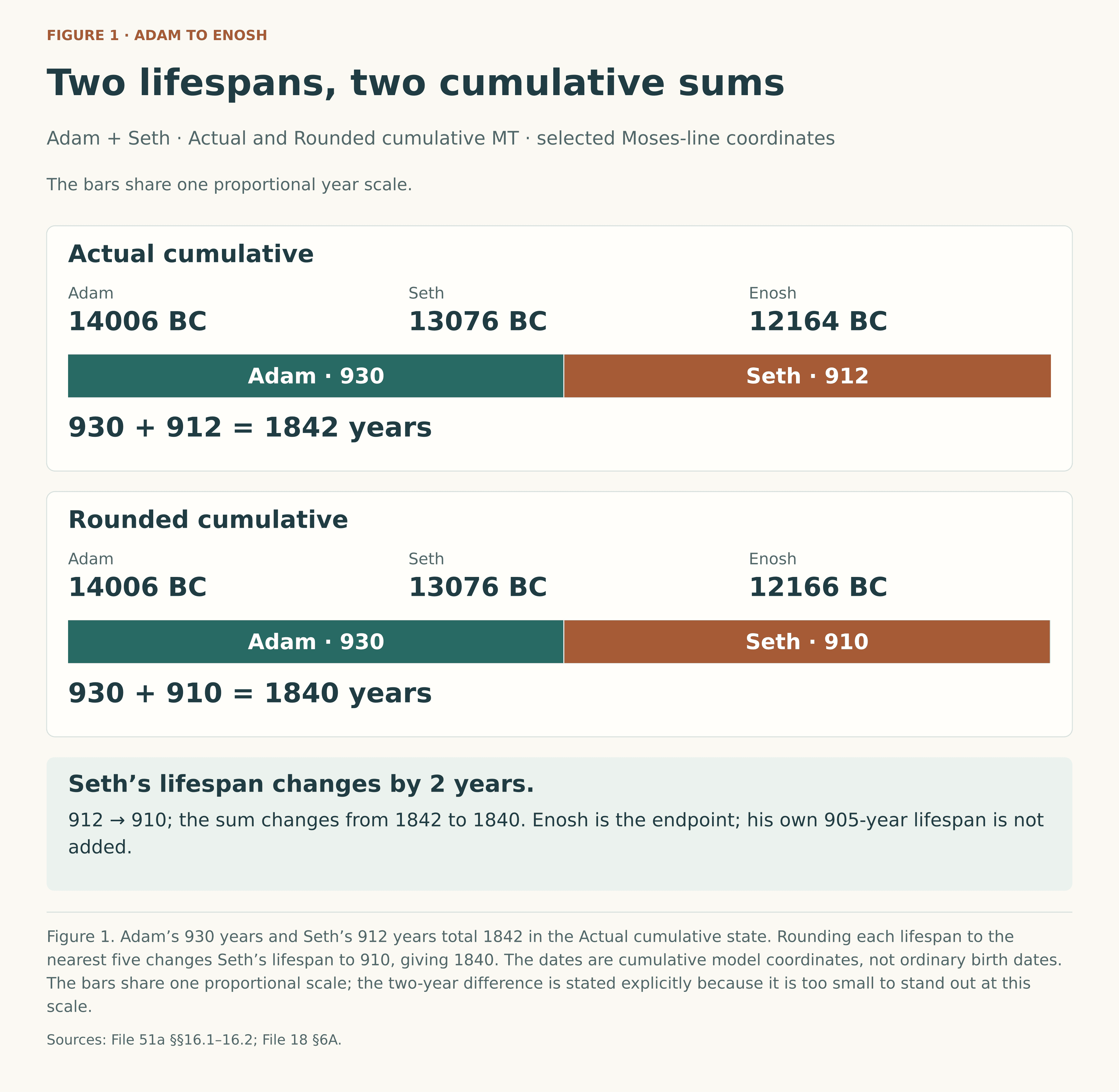
A numerical comparison brings the first two lifespans in that family into focus. Adam lives 930 years, and Seth 912 years. Their combined lifespans total 1842. In the Rounded cumulative model, Seth’s 912 becomes 910, giving 1840. Applying the Key of 23 ratio, 25/23, converts that Rounded span to 2000.
Each step matters. The scriptural lifespans, their Rounded representation, and the converted duration are three distinct quantities. This introduction explains how they fit together. The supporting tables and chronological notes give the complete calculations and source controls.
1. Two lifespans before Enosh
Genesis gives the two totals directly:
So Adam lived a total of 930 years, and then he died.
So Seth lived a total of 912 years, and then he died.
Adding those lives gives:
930 + 912 = 1842 years.
This is a cumulative lifespan total. The cumulative method places complete lives end to end, so the Adam-to-Enosh interval contains Adam’s life followed by Seth’s life. It reaches the beginning of Enosh’s position in the constructed sequence. Enosh’s own 905 years are not part of that interval; they carry the cumulative sequence onward to Kenan (Genesis 5:11, BSB).
Ordinary genealogy measures something different. Adam is 130 when Seth is born, and Seth is 105 when Enosh is born (Genesis 5:3 and 5:6, BSB). The ordinary birth interval is therefore:
130 + 105 = 235 years.
The lives overlap in ordinary time. Arranging their full lengths consecutively creates the much longer cumulative interval. Thus 1842 measures two stacked lives, while 235 measures the ordinary interval between Adam and Enosh. The calculations here follow the Masoretic Text (MT), the Hebrew textual tradition underlying these chronological inputs.
2. Why the Rounded total is 1840
In the Rounded cumulative model, each lifespan is rounded to the nearest multiple of five before the sequence is calculated. Adam’s 930 already meets that condition. Seth’s 912 rounds to 910. Enosh’s 905 remains unchanged.
| Lifespan input | Actual MT | Rounded model | Change |
|---|---|---|---|
| Adam | 930 | 930 | 0 |
| Seth | 912 | 910 | −2 |
| Total before Enosh | 1842 | 1840 | −2 |
The two-year reduction therefore has a specific source: Seth’s 912 → 910. The Bible’s wording remains 912, as quoted above. The Rounded figure belongs to the model’s arithmetic.
File 51a §§16.1–16.2 supplies both the lifespan inputs and their propagated cumulative coordinates. Capitalized Rounded here identifies that defined representation, rather than a loose approximation. The full table also shows that the positive and negative rounding changes cancel across the complete Adam-to-Moses chain, leaving its overall 12600-year lifespan total unchanged.
3. The same comparison in cumulative coordinates
Both cumulative forms are anchored at Moses’ death and the Conquest in 1406 BC. Because each complete chain totals 12600 years, both begin with Adam at 14006 BC. Moving forward subtracts each lifespan from the preceding BC coordinate:
| Cumulative position | Actual MT coordinate, BC | Rounded coordinate, BC |
|---|---|---|
| Adam | 14006 | 14006 |
| Seth | 13076 | 13076 |
| Enosh | 12164 | 12166 |
The two intervals are now visible as differences between their endpoints:
14006 − 12164 = 1842.
14006 − 12166 = 1840.
Figure 1 · Adam to Enosh
Two lifespans, two cumulative sums
Adam + Seth · Actual and Rounded cumulative MT · selected Moses-line coordinates
The bars share one proportional year scale.
Actual cumulative
930 + 912 = 1842Years to the Enosh boundary in this cumulative state
Rounded cumulative
930 + 910 = 1840Years to the Enosh boundary in this cumulative state
Sources: File 51a §§16.1–16.2 · File 18 §6A
Calculation and model details
The Actual and Rounded cumulative lifespan tables are independently anchored to Moses’ death at 1406 BC. Both retain Adam at 14006 BC and Seth at 13076 BC. Actual Enosh is 12164 BC; Rounded Enosh is 12166 BC. The dates are propagated from the lifespan sums, not individually rounded. 14006−13076=930; 13076−12164=912; 13076−12166=910. Thus Actual Adam-to-Enosh is 1842 and Rounded Adam-to-Enosh is 1840. The displayed coordinates use the selected Moses line without restored second Cainan or Adam’s apparent-age extension.
Image version and full-size downloads
Open full-size PNG · Open full-size WebP · Download SVG source (ZIP)
The Rounded sequence reaches Enosh two years earlier on the BC scale because the intervening lifespan of Seth has been shortened by two years. Adam’s and Seth’s starting coordinates are identical in the two columns. Enosh’s own lifespan has not changed.
These are cumulative model coordinates, not ordinary historical birth dates. The complete Actual–Rounded table makes the method traceable through all 26 lifespans. The dates are calculated from the Rounded lives; the dates themselves are not independently rounded to multiples of five.
4. From four units of 460 to four units of 500
The Rounded interval has a useful factorization:
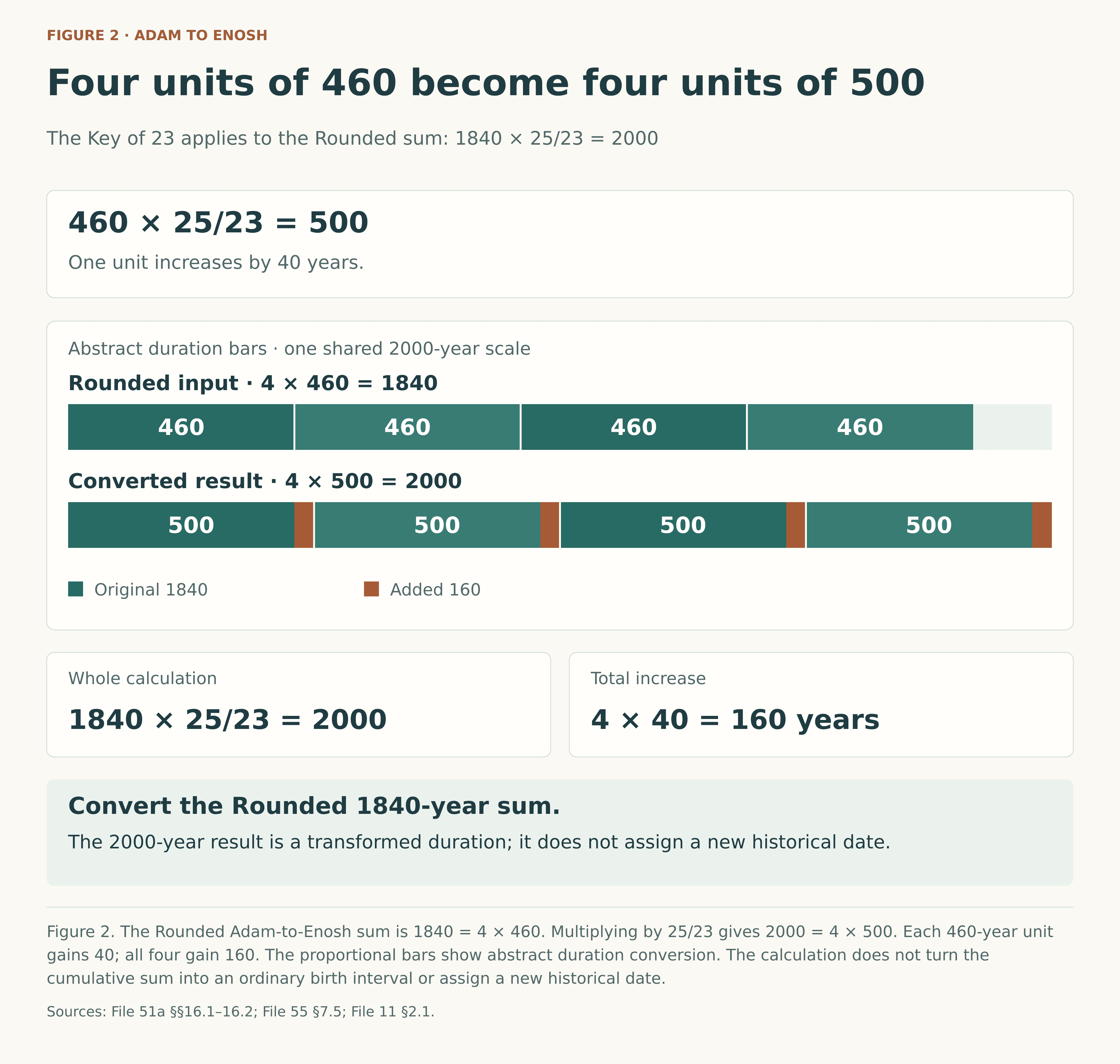
1840 = 23 × 80 = 4 × 460.
The Key of 23 operation used here is multiplication by 25/23. It replaces twenty-three equal parts with twenty-five parts of the same size. Since each part of this 1840-year span is 80 years, the calculation becomes:
1840 × 25/23 = 80 × 25 = 2000.
The fourfold form shows the same operation at a smaller scale:
460 × 25/23 = 500.
4 × 460 → 4 × 500.
Each unit gains 40 years, so the complete span gains 160:
1840 + 160 = 2000.
Figure 2 · Adam to Enosh
Four units of 460 become four units of 500
The Key of 23 applies to the Rounded sum: 1840 × 25/23 = 2000
Abstract duration bars · one shared 2000-year scale
Sources: File 51a §§16.1–16.2 · File 55 §7.5 · File 11 §2.1
Calculation and model details
File 55 §7.5 expressly gives 14006−12166=1840=4×460 in the Rounded cumulative state. The multiplication uses the 25/23 operator in File 11 §2.1. 460×25/23=500; 500−460=40; 4×460=1840; 4×500=2000; 4×40=160. The shared duration scale is 2000 years. Each input segment is 23 percent of the full scale; each converted segment is 25 percent, consisting of a 23-percent original portion plus a 2-percent increase. No converted date is assigned.
Image version and full-size downloads
Open full-size PNG · Open full-size WebP · Download SVG source (ZIP)
File 55 §7.5 explicitly registers the Rounded Adam-to-Enosh interval as 1840 = 4 × 460. The 2000 result is the direct application, in this study, of the established 25/23 operator to that interval. The operator is described in File 11; the distinction between supplied coordinates and a calculated extension remains visible.
This is a converted duration. It does not replace either the ordinary 235-year birth interval or the Actual cumulative total of 1842. Applying the ratio directly to 1842 would produce a different result, as the calculation notes show.
5. Two lives, ten names, and eight names
The genealogy also permits two inclusive counts. From Adam to Noah there are ten names. Beginning with Enosh and ending with the same Noah gives eight names. The difference consists of Adam and Seth—the same two lives whose cumulative sum forms the interval examined here.
| Count through Noah | First name | Names included | Parent-to-son steps |
|---|---|---|---|
| Complete Genesis 5 line | Adam | 10 | 9 |
| Same line beginning with Enosh | Enosh | 8 | 7 |
The counted-name table lists every position. Counting names includes both ends, so the number of links between them is one fewer. Enosh remains the third person in the complete genealogy. Starting a second count with him changes the counting boundary; it does not change his place in the family.
File 55 brings this ten/eight relationship together with the 1840-year interval. The count and the interval share the same two-name difference, but they measure different things: names in one case, complete lifespans in the other. The comparison does not require a claim that Adam or Seth was historically inserted into an earlier eight-name text.
The 2000-year total likewise belongs to the pair as a whole. Its average is 1000 per life, but the two converted lifespans remain unequal if the same ratio is applied to each. The supporting calculation preserves that distinction.
6. Enosh and the continuity of the human line
Genesis 4:26 gives Enosh’s place in the story a significance that is not supplied by arithmetic alone. The notice about calling upon the LORD’s name connects this early generation with worship. Genesis 5 then places him within the continuing family line from Adam toward Noah. File 55 §7.5 also draws attention to the shared vocabulary of humanity associated with Adam and Enosh, reinforcing this theme of continuity.
I read the numerical comparison alongside that continuity. Two full lives lead to Enosh in the cumulative arrangement; the Rounded form gathers their total into four units of 460; the Key of 23 expands those units to four of 500. The resulting 2000-year pattern expresses a balanced total across the pair while preserving the distinct lives from which it was formed.
Its force lies in the visible relationship among the steps. The pattern uses the transmitted lifespans as its starting point, a declared rounding rule, and a stated transformation. It can therefore be considered as a theological reading of chronological structure without presenting the final 2000 as a number explicitly stated in Genesis.
The appendix supplies the supporting tables, arithmetic, and source distinctions. The detailed companion develops the ordinary family intervals, the complete lifespan ledger, and the later comparisons with Moses.
Scripture quotations: Berean Standard Bible (BSB), public domain.