Book 2 · Celestial Signs of the First Advent · Chapter 16
The coming of Christ and the creation that bears witness
John sees a door standing open in heaven. The voice he has heard calls him upward:
“Come up here, and I will show you what must happen after these things.”
Revelation 4:1 BSB [1]
That invitation gives the direction I have tried to follow through both books. I want to look with John, as far as I am able, and see the events of earth from the place where Christ’s authority is already acknowledged. His coming, His death, and His reception in heaven concern the whole creation. The people who watched from below saw part of what was happening.
Book 1 approached the Cross through the Gospel accounts and their calendars. Book 2 returned to Christ’s birth, then followed the wider history through Abraham, the Exodus, Israel’s entry into the land, Jerusalem’s fall, and the Gospel among the nations. The celestial comparisons have given us particular events to examine along that course. We can now hold the history in view without going through every calculation again.[2]
I read these relationships as a deliberate witness to God’s Son. Heaven belongs within that proposal from the beginning. Its inhabitants need not wait for us to notice a sign before it can have meaning. The question is what God was declaring through the creation He made, and to whom He was declaring it.
The Child and the Lamb
The birth accounts already give us more than an earthly audience. The Magi travel because they have seen the King’s star. Shepherds hear the announcement of His birth, and a heavenly company praises God. Revelation places the Woman and the Child within a conflict that includes the dragon and the throne of God. The Child enters a human history whose heavenly significance is already being disclosed.[3]
That is why the early chapters kept returning to the Woman, the royal encounters, the Manger, and the gathered lights. I read those scenes in relation to Christ’s coming. The historical birth anchor, the later celestial sequence, and the received calendar’s naming and circumcision framework retain the distinctions set out at the beginning. Their relationships can be considered together while their dates keep their stated meanings.
The Sun, Moon, and planets are part of the world into which the Word came. John’s Gospel begins with the Word through whom everything was made and then tells us that He became flesh. That gives the celestial inquiry its subject. The Maker entered the life measured by the lights He had made.
Revelation then brings the Lamb into the center of the heavenly scene. John hears of the Lion of Judah and sees the Lamb standing with the marks of slaughter. The victory is recognized in heaven through the death accomplished on earth. The company around the throne worships the One who has purchased people for God from the peoples of the earth.[4]
I hold the birth and that heavenly recognition together. The body first carried by Mary is the body later given at the Cross. His earthly life has its course, and the heavenly scene shows why that course concerns far more than the people who happened to stand nearby. The coming of the Child and the authority of the Lamb belong to the same work.
The promise reaches the nations
Abraham gives that work a history long before Bethlehem. God promises blessing for the families of the earth through him. When Abraham has no son to inherit the promise, God takes him outside and directs him to the stars. The heavens become part of a conversation about the family God intends to bring from him.[5]
Abraham sees Isaac born. He does not live to see the nations gathered through Christ. God asks him to receive a purpose whose extent exceeds the part he will witness. We have needed that same enlargement of view throughout this book.
The Exodus and the crossing of the Jordan carry the promise forward through real deliverance, wilderness years, and entry into the land. Moses and Joshua have different work to do. Their history has its own people, places, and losses. In the celestial windows considered beside it, I see a testimony that can be compared with the later work of Christ. I read their work in light of the Son toward whom Scripture leads us.
The repeated counts and returning stellar settings make those comparisons particular. They let another reader identify the events and examine the proposed relationship. Their theological direction comes from the history Scripture has given us: a people brought out, an inheritance entered, a sacrifice provided, and blessing carried beyond the first recipients.
God’s promise concerned nations Abraham would never visit. The Gospel’s movement outward belongs to its fulfillment. The later eclipse paths were considered across the earth because the history itself had opened toward the earth’s peoples.
I read the earlier and later signs as parts of that continuing witness. The time between them remains substantial. From heaven, the purpose running through those centuries can be seen together. We have to learn it one generation and one event at a time.
A witness beyond human sight
The supplied birth-era procession is worth seeing once more at this point. It displays together bodies that an observer could not have seen together against a dark sky. The Sun is among them. Removing daylight in the software lets us inspect their arrangement; it does not reproduce what someone standing in Jerusalem saw.
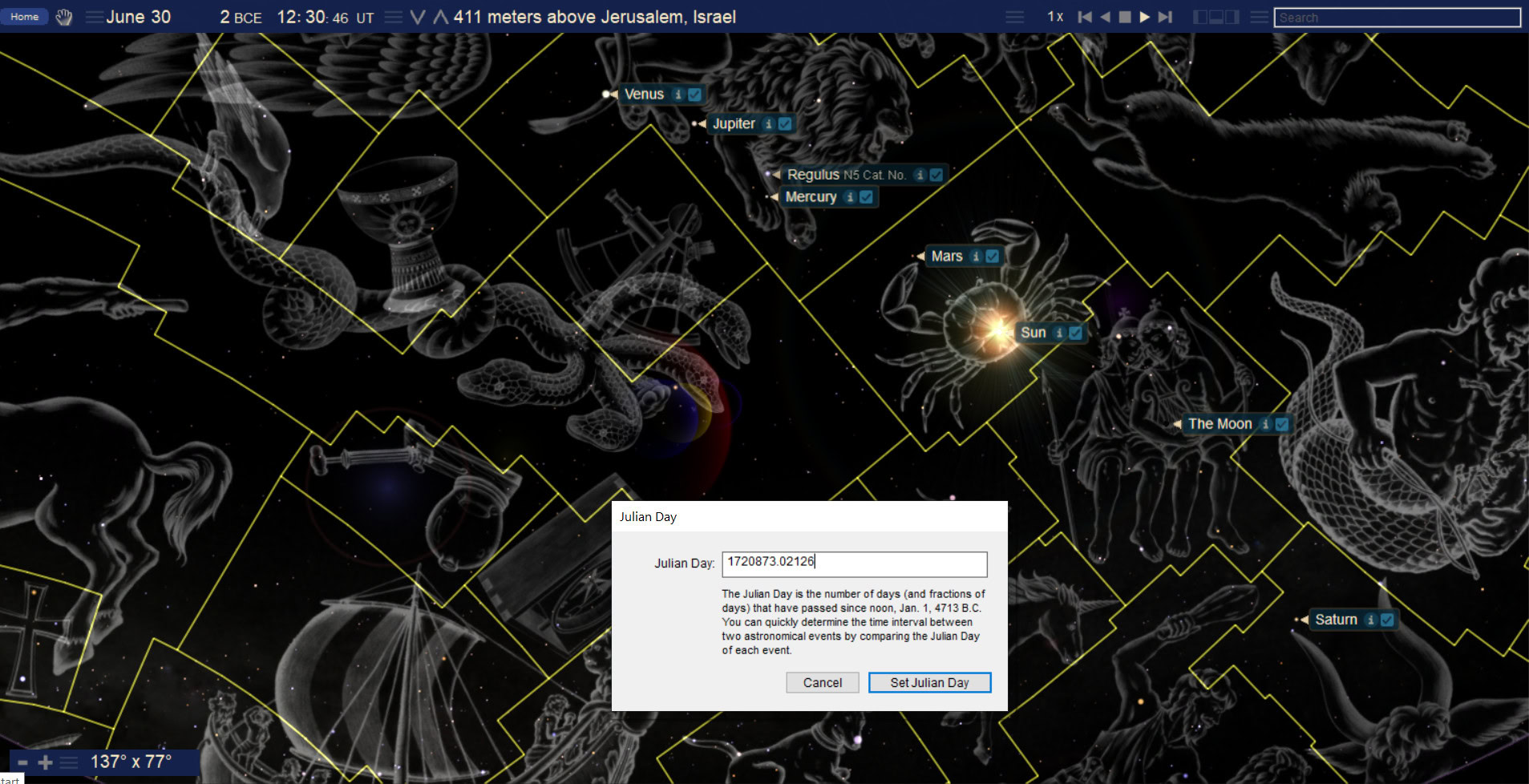
The arrangement existed while daylight concealed much of it from human eyes. That difference has mattered from the birth-related scenes through the Ascension comparison. Calculation can recover a configuration that people beneath it may never have seen in full or understood. I suggest that such a configuration could still have borne witness before the heavenly host.
Paul gives a scriptural reason to take that audience seriously. Through the church, God’s wisdom is made known to rulers and authorities in the heavenly realms. The earthly witness has a reach beyond its human hearers. Heaven is involved in the unfolding disclosure of God’s purpose.[6]
The partial lunar eclipse beside the Cross raises the same question from another direction. Its ending phase lay at the edge of local visibility. Whether anyone in Jerusalem noticed it or understood it remains a human question. Its occurrence within creation, and its possible place in a testimony concerning Christ’s death, need not depend on that answer.
I take the possibility of a witness at that threshold seriously. The limits of sunset and moonrise may themselves belong to what God intended. I can consider that meaning while retaining the particular horizon calculation. The event and its interpretation each need to be stated honestly.
This is also where I distinguish the visible sky from the whole heavenly reality. A planet’s position can be calculated. The throne John sees is disclosed to him. Astronomical software does not give us access to everything heaven knows. The visible creation can nevertheless bear witness to a work whose audience includes the unseen world.
I am suggesting an intention larger than the surviving human record. The heavenly host may have understood things that went unnoticed below. An inspired account may also carry relationships whose meaning becomes clearer to later readers. Our arrival at an understanding is one part of the history of a sign.
The Cross within the whole creation
Paul places the Cross within that full extent. In Colossians, the Son is the One through whom and for whom all things were created, including the visible and invisible orders. The same passage speaks of reconciliation:
… whether things on earth or things in heaven, by making peace through the blood of His cross.
Colossians 1:20 BSB [7]
The blood belongs to an actual death. Its reach includes heaven. That is a substantial scriptural basis for approaching the Passion as an event whose meaning exceeds the part observed on earth.
I continue to consider the stronger possibility set out in Book 1: the accomplishment of the Cross may give earlier and later events their order within God’s purpose. I mean an actual relation, even though I cannot explain how God would bring it about. From our place in history, an earlier event comes before the fulfillment. From God’s side, that fulfillment may be the reason the earlier event has the form it does.
The celestial comparisons give that question definite points at which it can be examined. They do not supply a physical mechanism. Nor does the Cross have to fall halfway between a calculated first and last day of the universe for Christ to be central to its history. The proposal concerns the One through whom creation exists and what He has accomplished within it.
That is why the two books belong together. The calendars of the Passion and the wider celestial sequences ask how the particulars may be held within one work of God. The different measures remain useful precisely because their relations can be stated. Their common subject is Christ.
I approach John as inspired Scripture. I expect God’s meaning to exceed the understanding a narrative reports at a particular moment. My own applications still have to answer to the text. Recognizing a correspondence now does not establish that John privately calculated it then. I am following his testimony while asking what God may have joined within the history to which it bears witness.
The earth remains in view
Looking from heaven should make us attend more closely to the people on earth. Stephen sees the glory of God and Jesus standing at God’s right hand while the people around him turn against him. His vision belongs to the account of his suffering and death.[8]
The same care is necessary at Jerusalem. Jesus wept over the city. The siege and the destruction of the Temple involved hunger, terror, and death. Celestial correspondences have to be read beside that suffering. The view from heaven includes the city over which Christ grieved.
The Gospel had already reached beyond Jerusalem before the Temple fell. Its witnesses continued among the nations afterward. The Fish sequence carries the comparison through AD 80, and the chapter examining it stated that extension openly. It surrounds and follows the catastrophe; the whole sequence is not another date for the destruction in AD 70.[9]
The supplied globe helps the eye make that outward movement. The paired paths are seen across a round earth, with continents and oceans within one field.
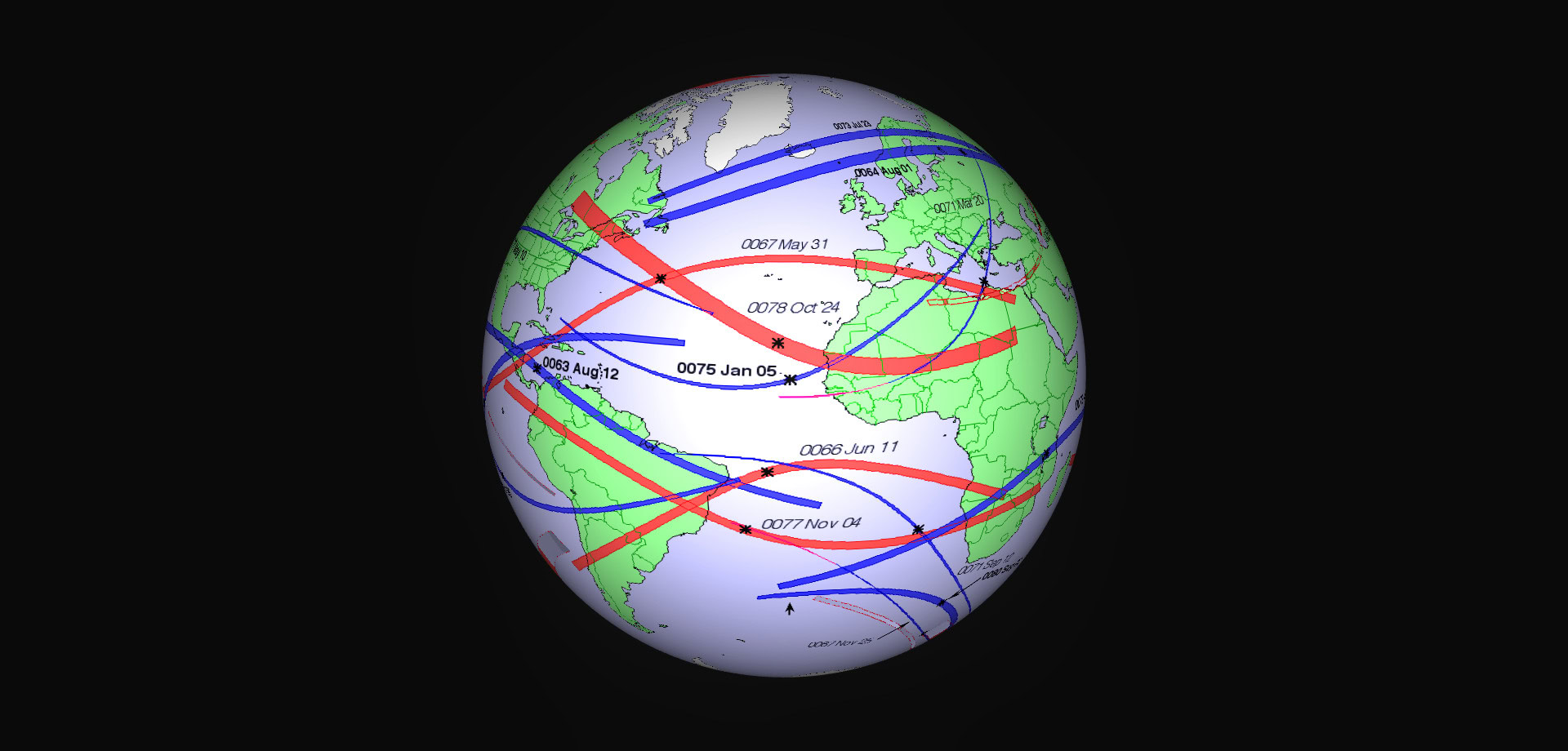
I read the paired outlines beside the gathering of people under the risen Christ. John’s Gospel ends beside the sea, where Jesus directs a catch the disciples could not produce through their night’s work. That scene keeps the person directing the gathering in view. The proposed Fish image has meaning for me through that scriptural account.
The map remains an image of selected eclipse paths, with the qualifications established in its chapter. Its spiritual interest concerns the Lord whose witnesses go outward. The history began in particular places and reached people far beyond them. Heaven could hold that wider purpose in view while each messenger traveled only part of the way.
The measures and their Lord
The calculations have mattered because the proposed signs are particular. A date identifies an event. A stated count allows its interval to be checked. A sky plate or map lets a reader examine the image I am describing. Those details make the interpretation available for consideration beyond my own impression of it.
They also require different kinds of attention. A measured celestial interval may be described approximately, while a count of lunar cycles or specified civil dates has its own integer result. A festival name depends on how the month is opened. A constellation drawing and a modern boundary describe different aspects of a sky view. The earlier chapters have kept those distinctions beside the comparisons they affect.
I have brought the numbers into the discussion because I think God may have ordered these relationships deliberately. The purpose is to understand what they may be saying about Christ. A repeated count can draw our attention to a comparison; Scripture supplies the people, acts, and promises through which I read it.
The inherited figures serve that same inquiry. The Woman, the Lion, the Manger, the Messenger, and the Fish have been considered in relation to the biblical account. Their use belongs under the authority of the Creator. Human traditions concerning the lights do not give those lights dominion over the people whose lives we are examining.
The records and images put the particulars within reach of other readers. A calculation can be checked and, where necessary, corrected. A proposed interpretation can be examined at the passage or comparison on which it rests. I want that work to remain possible. Agreement with every association I have made is not required to understand the larger question I am asking.
The city and the light
John’s final vision brings us to God dwelling with His people:
“Behold, the dwelling place of God is with man, and He will dwell with them.”
Revelation 21:3 BSB [10]
The city descends from heaven. The nations walk by its light. God and the Lamb supply that light, and the vision continues with a river, the tree of life, fruit for each month, and the healing of the nations. The purpose we began to follow through Abraham reaches toward life in God’s presence.
These are fitting final images for an inquiry into the heavens and their appointed measures. The luminaries belong to the creation Christ entered. The vision brings their service into relation with the glory of God and the Lamb. Its continuing life and fruitfulness give us more to contemplate than the stopping of a clock.
I leave those features together, as we did at the end of Book 1. The absence of night and the fruit for each month both remain in John’s account. We can receive what the vision shows without forcing it to settle every question we might ask about sequence and eternity.
The heavenly perspective has brought us back to the earth, now seen within a purpose that reaches beyond the knowledge of its inhabitants. The Child, the covenant, the deliverance, the Cross, the city, and the nations have their own places within that history. Christ holds the inquiry together.
I began by asking what the heavens might have borne witness to when He entered the world. I have read the events and comparisons as a testimony to His coming and rule. The heavenly host could have understood what people missed. I am prepared to read the signs with that audience in view.
My aim has been to bring the reader high enough to see earthly history in the presence of its Lord. I believe the Cross reaches further into creation and time than we can presently explain. We understand the events below better when we allow heaven its full place in the account.
Source notes
1. Revelation 4:1–11 BSB. The opening reproduces the voice’s speech in verse 1. The throne and the worship of the Creator set the context for the Lamb’s appearance in Revelation 5. Return
2. Current Chapters 1–15 of this book and Book 1’s conclusion The Cross at the Center of All Time. Current File 13 Christological Matrix preserves historical 6 BC, the distinct 1 BC/AD 1 covenant framework, and the preferred AD 33/possible AD 30 Passion states. The 3–2 BC celestial sequence remains a separate comparison. Return
3. Matthew 2:1–12 BSB; Luke 2:8–20 BSB; Revelation 12:1–17 BSB. Chapters 1–3 and 12 develop the birth-related and later Woman/Child comparisons. These scriptural scenes ground the heavenly perspective; they do not identify every planetary arrangement selected in this study. Return
4. John 1:1–14 BSB and Revelation 5:5–14 BSB. John hears the Lion and sees the slain Lamb standing; the chapter’s worship concerns the Lamb’s victory and people purchased for God. Chapters 2, 11, and 12 develop the celestial applications. The relationship between the Nativity, Passion, and heavenly rule is theological; no new date is derived here. Return
5. Genesis 12:1–3 BSB; Genesis 15:1–6 BSB; Galatians 3:6–14 BSB. Chapter 4 develops the promise; Chapters 5–7 treat the early windows. Current File 1 Abraham, File 5 Exodus, and File 6 Judges Bridge retain the chronological states used earlier. The conclusion preserves the Masoretic 430-year stay in Egypt, the primary 1446 BC Exodus, and the 1406 BC Conquest. Genesis 15 supplies no recovered civil date or identified eclipse for Abraham’s star encounter. Return
6. Ephesians 3:6–11 BSB, especially verse 10. Figure 1 is supplied original IMG0409, unchanged, “2 BC June 30 Parade.png,” with its Julian-date label and software settings retained. Chapter 2 note 11 checks the dated overview’s geometric grouping; this chapter introduces no new width measurement. Daylight and the horizon are suppressed in the source rendering. The partial lunar eclipse beside the Cross and the Ascension comparisons follow current Chapters 10–11 and Book 1’s qualified local-visibility treatment. Heavenly recognition of these particular events is the author’s proposal, not a recovered angelic or human observation. Return
7. Colossians 1:15–20 BSB. The quotation is the final clause of verse 20; an initial ellipsis marks the excerpt. The passage explicitly includes visible and invisible creation and reconciliation through the Cross. The further possibility that the Cross’s accomplishment may order earlier and later temporal patterns belongs to the author’s theological proposal, carried from Book 1. It is not offered as a demonstrated physical mechanism or a new astronomical result. Return
8. Acts 7:54–60 BSB. Stephen’s heavenly sight and earthly death occur within the same narrative. Chapter 12 considered the post-Passion witness in connection with the later sky scenes. No new calendar date for Stephen’s death is assigned in this conclusion. Return
9. Luke 19:41–44 BSB; Luke 21:20–24 BSB; Acts 28:23–31 BSB; John 21:1–19 BSB; current Chapters 13–15. The selected Fish sequence is AD 66–80, distinct from the AD 70 destruction. Figure 2 reuses supplied original IMG0433 unchanged. Its four red bands carry AD 66, 67, 77, and 78 dates; other dated eclipse bands remain in blue. Chapter 14 supplies the five-event map, the AD 80 extension, and the declared path/local models. The paired-Fish reading remains the author’s interpretation; this reuse does not certify precise ancient city crossings or the older atlas model’s settings. Return
10. Revelation 21:1–27 BSB; Revelation 22:1–5 BSB. The quotation is the first sentence of the throne’s speech in 21:3. The city, light, nations, river, tree, monthly fruit, and absence of night are drawn from the vision. As in Book 1’s conclusion, the reading leaves those features together without claiming that every temporal sequence or the existence of the luminaries is abolished. No further celestial prediction is introduced. Return
Scripture quotations are from the Berean Standard Bible. Supplied images are preserved unchanged; their source settings and the author’s interpretation remain identified.
← Previous: Chapter 15 — One Witness across the Ages
Book 2 contents