Technical appendix: formulae, states, and proofs · Pi companion · Alpha and 1/137
A research companion to Alpha, Creation, and Christ:
1/137 and Pi and the Biblical Chronology
Research companion · v12 · 8 November 2026 · Exploratory,
noncanonical
“And God blessed Noah and his sons and said to them, ‘Be fruitful and multiply, and fill the earth.’” — Genesis 9:1
Reading this study
The Alpha–137 study examines 137 and 138 within a biblical chronological framework informed by the Key of 23. The companion π study finds circular approximations around the Flood, the years of Noah and Shem, and the rainbow covenant. This third investigation asks a connected question: can Φ (phi), the golden ratio, be recovered from the same established chronological coordinates, rather than from a new collection of dates selected for the occasion?
The answer is that a remarkably precise approximation emerges when the Samaritan Pentateuch (SP) and Masoretic Text (MT) Flood comparison is combined with the established 360-day schematic calendar. Its principal calculation does not require fractional calendar dates. Instead, a 100-day phase adjustment, arising from already used Flood and Mosaic calendar stations, brings a whole-year proportion close to Φ. The study then asks why this happens in the same narrative corridor that already supports π and the Key of 23. Two adjacent Fibonacci partitions underlie the more precise result: the SP–MT Arphaxad–Conquest sequence gives 13 + 21 = 34 Jubilees of fifty years, while an LXX–MT Gear-1 Shem–Joshua sequence gives 8 + 13 = 21 intervals of sixty years. The latter connects Revelation’s 1260, Daniel’s 1290, and the 430-year Egypt measure; the Gear-2 and day-phase refinement supplies a 6:5-scaled mirror of the principal Φ approximation.
The second half of this study carries the result into the MT cumulative chronology, where the 1470-year Φ projection, Shem’s 600 years, seven-year fields, and the canonical seasonal Mirror bring π and Φ into a common algebraic architecture. The 21–34–55–89–144 Fibonacci extrapolations are treated separately, since their outer coordinates are generated candidates, not additional historical dates.
The arithmetic is reproducible. The absolute BC dates, manuscript-comparison states, symbolic calendars, and implied event dates belong to the 490d Unified Chronology; they are not claims that archaeology has independently established every BC label. Likewise, mathematical accuracy does not, by itself, prove that a biblical author intentionally encoded an irrational constant. The purpose is to show the relationship clearly enough that its possible literary meaning can be assessed.
- 1. What a golden division requires
- 2. The Flood–Conquest golden division
- 3. The 100-day adjustment: the principal Φ finding
- 4. Shem, the Key of 23, and the meaning of one hundred
- 5. Two consecutive Fibonacci windows: Jubilees, 1260, and the refined Φ
- 6. Judgment, renewal, and the two arks
- 7. The 377-day span: a direct bridge from π to Φ
- 8. A more precise, but less securely dated, companion alignment
- 9. Why inferred dates belong here: conserving narrative information
- 10. Three constants, one chronological corridor
- 11. The 1470-year Φ projection and Shem’s double 600 years
- 12. Why π’s 7706 BC and Φ’s 6306 BC belong together
- 13. The seven-year field activates the 7705-year canonical Mirror
- 14. The reciprocal π–Φ Mirror: 14,000 and 12,600 years
- 15. From 1470 + 3430 to 4900: the Danielic 70, seven, and Passion week
- 16. The 14th–17th phases, Revelation’s 1260/1290, and the three forties
- 17. What is established by the cumulative construction?
- 18. The Fibonacci 144 and its doubled Key-of-23 corridor: a possible extrapolation
- 19. Conclusion — one coherent chronological architecture
Part I — The regular MT, SP, and LXX
1. What a golden division requires
The golden ratio is
If a span consists of a smaller part a and a larger part b, golden division requires both
A whole-number biblical chronology cannot equal an irrational number exactly. The question is therefore whether its already established intervals form a close, consistently derived approximation. It is helpful to work in schematic days from the beginning: first multiply the years by 360, then apply the calendar phases. This avoids mistaking a day-level correction for an extra whole year.
2. The Flood–Conquest golden division
The selected Gear-2 comparison state supplies three anchors:
| Event | Date (BC) | Interval toward next anchor |
|---|---|---|
| SP Flood, co-registered comparative position | 3108 | 650 years |
| MT Flood, Gear 2 | 2458 | 1052 years |
| Conquest | 1406 | — |
Their complete span is 1702 years:
Meanwhile, the MT Flood-to-Exodus interval is another exact multiple of 23:
The forty wilderness years from the Exodus to the Conquest change 1012 into 1052, while the difference between the Flood coordinates is 650:
Accordingly,
comes from two established Key-of-23 intervals and the forty-year Exodus–Conquest bridge. The year-only comparison is already close:
These ratios straddle Φ; the difference between them is not a second independent discovery, since both describe the same division. The related Arphaxad-to-Conquest chronology gives an exact 13 + 21 = 34 Jubilee partition before the Flood-year two-year shift; Section 5 explains why that earlier Fibonacci form matters.
Three narratives on the same horizontal rails
Now place two more sets of independently meaningful events alongside the Flood and Conquest:
| Narrative level | SP comparative G2 | MT G2 | Shared terminal node |
|---|---|---|---|
| Beginnings | Noah born 3708 BC | Noah born 3058 BC | Jacob born 2006 BC |
| 120-year transition | 3228 BC: 120 years before SP Flood | 2578 BC: 120 years before MT Flood | Moses born 1526 BC |
| Judgment and inheritance | SP Flood 3108 BC | MT Flood 2458 BC | Conquest 1406 BC |
Every row retains the 650 + 1052 = 1702 partition. Every column descends by 480 + 120 = 600 years. The second row is not a third independent mathematical fit: it is a translation of the first and third rows. Its significance is that the translated stations correspond to recognizable biblical periods—Noah’s age 480 at the beginning of the 120-year warning, and the 120-year life of Moses ending at Israel’s entry into the land.
In Genesis 6:3, 120 years may be read as the period of warning before judgment, although interpreters also understand it as a statement concerning human lifespan. Moses’ actual lifespan of 120 years is expressly given in Deuteronomy 34:7. Within this model his birth is 1526 BC, his age eighty corresponds to the Exodus in 1446 BC, and forty subsequent years lead to 1406 BC.
There is also a literary bridge: Genesis uses תֵּבָה (tēbāh), “ark,” for Noah’s vessel, and Exodus 2:3 uses the same uncommon Hebrew noun for the basket preserving the infant Moses. The chronology need not invent that association; the narrative supplies it.
3. The 100-day adjustment: the principal Φ finding
The whole-year division is approximate. But the same canonical schematic calendar that refines the π study has two relevant boundaries:
- The seven-day warning before the Flood is located at Iyar 10, schematic day 40, in each Flood year.
- The Mosaic terminal sequence places Moses’ death at the beginning of the eleventh month, schematic day 300, sixty days before the following Nisan New Year. This is an inferred placement, not an explicitly dated death in Deuteronomy.
The day-40-to-day-40 SP–MT interval remains an exact 650 schematic years. The later interval, from MT Flood day 40 to the Mosaic day-300 terminal phase within the Nisan-year labeled 1407 BC, is 100 days less than 1052 complete 360-day years: 40 days from the Flood-year origin and 60 days before the next New Year.
It is easiest to see the result in days:
Now multiply the smaller span by Φ:
The predicted golden-division length differs from the calendar-derived 378620 days by merely
—or 67 minutes and 9 seconds. Thus,
The equivalent whole-to-larger test is closer still:
Its ideal-interval discrepancy is 0.028820485 day, about 41 minutes and 30 seconds. These are two measurements of one partition, not two independent observations.
Why the remainder looked like Φ
The uncorrected whole-to-larger proportion misses the ideal golden division by 61.83221936 days, when the denominator is retained at 1052 × 360. A 100-day contraction of both the whole and its larger part changes that discrepancy by precisely
The difference is only 0.028820485 day. This explains the unusual closeness without requiring a biblical calendar to specify “61.832 days.” The underlying chronology supplies the simple number 100; Φ’s own identity, , supplies the mathematical transformation.
This distinction is central to the interpretation. The result is not obtained by moving to a peculiar date chosen to match a decimal expansion. It follows the model’s established preference for whole months and round-number spans. The exact day-boundary conventions needed to reproduce the 100-day result are specified in the technical appendix; no civil or astronomical timestamp is claimed from the minute-level error.
4. Shem, the Key of 23, and the meaning of one hundred
The number 100 is not foreign to the Noah–Shem structure. The corresponding Gear-2 biographical stations give, in both compared lines,
Noah’s birth precedes the selected Shem-birth station by 500 years; Shem’s birth precedes the Flood by 100; and Shem lives another 500 years. The π study has already used the same 1100-year structure in its familiar comparison. The new 100-day refinement therefore repeats, on the smaller day scale, a number already prominent in the genealogical year scale. This is a symbolic correspondence, not a claim that a 100-year interval forces a 100-day interval.
There is a further structural consequence. The 1100 years admit two complementary 500/600-year partitions, both tied to actual biographical stations, not merely to the commutative law of addition:
| Partition | 500-year arm | 600-year arm |
|---|---|---|
| 500 + 600 | Noah’s birth → Shem’s birth | Shem’s birth → Shem’s death (100 + 500) |
| 600 + 500 | Flood → Shem’s death | Noah’s birth → Flood (500 + 100) |
Thus the two 600-year windows overlap by 100 years, from Shem’s birth to the Flood, while each complements a 500-year interval to make the same 1100-year whole. In either the SP or the MT co-registered Gear-2 line, the ratio of the long and short windows is exactly 600:500 = 6:5. These are two legitimate partitions of a single chronological corridor, not independent discoveries. That ratio becomes important when the SP–MT 650-year displacement is compared with the LXX–MT 780-year displacement below.
Shem also supplies a second, independently established way to reach Jacob’s 2006 BC birth coordinate. In the selected MT Gear-2 state, Shem’s death is 1958 BC; the Conquest remains 1406 BC:
Holding 1406 BC fixed, the expansion reaches 2006 BC, Jacob’s birth. This Key-of-23 correspondence was already present in the π v8 investigation. It strengthens the role of Jacob in the Φ lattice without shifting the argument into a different Gear.
The Alpha–137 study likewise works with the Noah–Shem corridor, 137 and 138, the Key of 23, and five-day Creation-phase movements. Here the Conquest sequence supplies another five-day pair: Israel crosses the Jordan on Nisan 10 (Joshua 4:19), while Nisan 15 marks the first day of Unleavened Bread and the proposed comparison endpoint forty schematic years after the departure from Egypt on Nisan 15 (Numbers 33:3). The two applications are not identical formulas. They show a shared preference for controlled phase movements expressed in simple integers.
5. Two consecutive Fibonacci windows: Jubilees, 1260, and the refined Φ
Before the day-level corrections, two overlapping biblical-chronological divisions already follow consecutive Fibonacci numbers exactly. The SP–MT Arphaxad line uses units of 50 years (Jubilees); the LXX–MT Shem–Joshua line uses units of 60 years. Together they display the successive integers 8, 13, 21, 34, which makes the later 1702 and 1262 adjustments easier to understand.1
The SP–MT Arphaxad division: 13 + 21 = 34 Jubilees
Genesis 11:10 associates Arphaxad’s birth with the second year after the Flood. Within the selected Gear-2 comparative state, moving both earlier Flood positions forward two years in elapsed sequence gives:
| Gear-2 chronological station | BC | Span to next station | Units of 50 years |
|---|---|---|---|
| SP Arphaxad’s birth | 3106 | 650 years | 13 |
| MT Arphaxad’s birth | 2456 | 1050 years | 21 |
| Conquest | 1406 | — | — |
| Total | 1700 years | 34 |
Consequently,
These are consecutive Fibonacci numbers. Both natural proportions surround Φ:
The change from Arphaxad to the Flood stations is not a Gear-1-to-Gear-2 switch. Both comparisons here are Gear 2. Rather, Arphaxad’s two-years-after-the-Flood relation shifts the two earlier endpoints from 3106/2456 to 3108/2458 BC, preserving the 650-year SP–MT interval while increasing the MT-to-Conquest interval from 1050 to 1052 and the whole from 1700 to 1702. Applying the established −100-day phase then yields the primary precision result of Section 3. The exact Fibonacci division therefore precedes the refined Φ ratio; it is not constructed by rounding that ratio afterward.
The LXX–MT Shem–Joshua division: 8 + 13 = 21
The SP–MT separation of 650 years has an established LXX–MT counterpart of 780 years in the same Noah–Shem comparison block: the former is five units of 130 years; the latter is six. This makes their scale ratio an exact 6:5. The same ratio has already appeared in the adjacent Noah–Shem 500/600-year windows of Section 4: in fact, 650 = 13×50 and 780 = 13×60, so the comparison uses one-tenth of those biographical units and the shared Fibonacci number 13. The proportional correspondence is exact; it is a structural resonance, not independent proof of deliberate design. In the selected Gear-2 register, the LXX death of Shem is 2738 BC and the MT death is 1958 BC. The rounded working chronology places Joshua’s birth at 1476 BC, making his age at the 1406 BC Conquest approximately seventy within that model. These coordinates are drawn from the Noah and Shem comparison tables and the Joshua working biography, rather than inferred from Φ.
In the LXX comparison, the Gear-1 foundation likewise begins with exact Fibonacci intervals. The same registered comparison has the LXX death of Shem at 2736 BC and the MT death at 1956 BC, while Joshua’s working birth year remains 1476 BC:
| Gear-1 station | BC date | Years to next station |
|---|---|---|
| LXX Shem’s death | 2736 | 780 |
| MT Shem’s death | 1956 | 480 |
| Joshua’s birth (working anchor) | 1476 | — |
This means that the 1260-year whole is already divided into three consecutive Fibonacci numbers multiplied by sixty:
The two associated approximations, and , fall on opposite sides of Φ. This is a discrete, exact Fibonacci structure, not an exact equality with the irrational golden ratio. The same LXX date also reaches the Exodus thirty years after Joshua’s modeled birth:
The established Egypt-entry anchor also makes the three 430-year measures concrete: 2736 → 1876 → 1446 BC = 860 + 430 = 2 × 430 + 430. The last 430-year leg is the selected MT Egyptian sojourn, not merely a free-floating factorization.
The 1260 recalls Revelation 11:3 and 12:6; 1290 recalls Daniel 12:11, and reuses the threefold measure of Israel’s 430-year Egypt frame (Exodus 12:40) in the selected MT chronology. These are numerical and thematic correspondences, not an assertion that the prophetic books directly date Shem’s death or Joshua’s birth. The repository previously recorded the 2736 BC → 1446 BC = 1290 connection; what this Φ comparison makes visible is the consecutive-Fibonacci partition of its 1260-year neighbor. For chronology and state controls, see the Noah–Shem Gear tables and the canonical File 21, Theorem 12.4.
Then LXX Gear 2 supplies the precision adjustment. Both Shem-death coordinates move two years earlier in BC numbering (2736 → 2738; 1956 → 1958), keeping their 780-year separation fixed. Joshua’s 1476 BC anchor does not move, so the second interval increases from 480 to 482 years and the whole increases from 1260 to 1262. This explains why 1262, although not an immediately recognizable prophetic number, has a distinct mathematical role: it is the Gear-2 form of the familiar 1260-year Fibonacci whole.
The two Fibonacci foundations can now be seen side by side:
| Consecutive Fibonacci window | Scale | Smaller part | Larger part | Whole |
|---|---|---|---|---|
| LXX Shem → MT Shem → Joshua, Gear 1 | 60 years | 8 × 60 = 480 | 13 × 60 = 780 | 21 × 60 = 1260 |
| SP Arphaxad → MT Arphaxad → Conquest, Gear 2 | 50 years | 13 × 50 = 650 | 21 × 50 = 1050 | 34 × 50 = 1700 |
The shared Fibonacci integers 13 and 21 link the two windows, while their orientations differ. These are two exact integer decompositions, not two independent probabilities of discovering Φ. Their subsequent two-year changes also have different causes: Arphaxad-to-Flood dating within Gear 2 for the SP–MT construction; Gear 1 to Gear 2 for the LXX–MT Shem construction. Both preserve the earlier manuscript separation, then refine the later arm toward Φ with the already defined −100 and +24 completed-day phases, respectively.
In the first division, the earlier interval (650) was smaller than the later interval (1052). Here the order reverses: the earlier 780 is larger and the later 482 is smaller.
Working in 360-day units:
The larger interval exceeds the uncorrected ideal by about 38.742 days. To compensate, the smaller interval needs about 23.944 more days. With a selected 24-day terminal phase at Joshua’s birth, the calculation becomes
The result is not merely close to the primary Φ ratio; it is exactly the same rational number, now expressed in reverse golden-division orientation:
The identity follows from the six-fifths scaling of the manuscript separation:
The 100-day contraction in the primary SP–MT calculation and the 24-day extension in the LXX–MT mirror are therefore two expressions of an exactly linked proportion. They must not be counted as statistically independent confirmations of Φ. The interest is that distinct, already registered Noah–Shem and Joshua stations produce both orientations of the same golden-division geometry.
The integer 24 also occurs in the previously established Key-of-23 expansion from MT Shem’s death to the Conquest:
The proposed 24-day extension can be associated schematically with Joshua reaching the modeled 70-year age boundary near Nisan 24, 1406 BC, close to the tentative Nisan 23 Jericho endpoint discussed below. Joshua’s actual birth month and day are not textually recorded. The 24-day correction is calculated in completed-day phase units: the strict elapsed interval from the opening of Nisan 1 to the opening of Nisan 24 is 23 days. The technical appendix retains both conventions, rather than claiming that the Nisan date alone establishes 24 elapsed days.
A reverse use of the same 40-day phase strengthens the pattern’s structural coherence. In the primary SP–MT construction, day 40 is used at both Flood stations. In the LXX comparison, the phase can instead be placed on the earlier Shem-death station, with the later Shem-death and Joshua-birth thresholds held at day 0. The operation is a 40-day contraction rather than the primary 100-day correction:
The ideal reduction from the unadjusted 780-year arm is 38.7422721… days; the round 40-day phase leaves a discrepancy of only 1.2577279 days, removing approximately 96.75% of the original day-level residual. This makes the reuse and reversal of the familiar day-40 boundary a worthwhile secondary reinforcement, now discussed in the main article rather than hidden in the appendix. Its evidentiary confidence is just below the primary 100-day construction as a pattern of phase reuse, in the present research assessment—not because its ratio is equally precise or because the LXX Shem-death event is actually dated to day 40. That placement is an explicitly identified symbolic cross-narrative overlay; the precise +24-day mirror remains the stronger algebraic LXX result.
6. Judgment, renewal, and the two arks
The same proportions would mean less if their dates were narratively unrelated. But the three rows are not neutral points on a calendar.
The birth of Noah anticipates a world renewed after judgment. Noah and his three sons emerge from the Ark under the command to be fruitful and multiply (Genesis 9:1, 7). Jacob’s twelve sons become the ancestral tribes of Israel, who multiply in Egypt (Genesis 35:11; Exodus 1:7) before emerging as a nation and entering their inheritance. These are different events, but their narrative vocabulary of family, proliferation, land, and renewal permits a typological comparison.
The lower row joins two great judgments. Genesis 6:4 speaks of the Nephilim “and also afterward”; Numbers 13:33 identifies the Anakim with the Nephilim; Joshua 11:21–22 relates the campaign against the Anakim. The Book of the Watchers (1 Enoch 6–11) and its account of continuing giant spirits (15:8–12) provide a further Jewish interpretive witness to the antediluvian rebellion and its enduring significance. This is a continuity of narrative and theological theme, not a calculation that requires establishing biological descent from before the Flood.
Between the two judgments stands the figure of Moses, preserved as an infant in an ark and living 120 years. The double use of tēbāh invites us to recognize a deliverer preserved through threatened waters. Jordan’s waters then stop near a place named Adam (Joshua 3:16), an evocative setting for the crossing into a renewed inheritance. At Gilgal Israel undergoes circumcision, keeps Passover, and begins to eat the land’s produce (Joshua 5).
The narrative itself suggests a movement from judgment to preservation, from preservation to multiplication, and from exile or wandering to inheritance. The golden division does not create that movement. It asks whether the chronology gives it an accompanying numerical shape.
7. The 377-day span: a direct bridge from π to Φ
Here is the most important cross-reference to the π study.
The canonical schematic Flood calendar places the beginning of the seven-day warning at day 40 in 2458 BC and the dry-earth/departure phase at day 417 in 2457 BC:
The π study has already examined the closing Iyar 27 boundary in its cross-state day-level alignment and the fraction
The present Φ study reaches back to day 40, the opening of the same 377-day narrative envelope. Thus the two studies approach the Ark from opposite ends of an independently established interval. This is a more substantial connection than merely observing another equal number in two separate articles.
The integer 377 also belongs to the Fibonacci sequence:
In the 360-day Flood representation, the tenth-month mountain-top boundary falls at day 270. From day 40 to 270 is 230 days, leaving 147 days to day 417:
The intermediate date lies three days away from the ideal Fibonacci division, while the total matches exactly. That is an intriguing secondary resemblance—it does not mean the Flood narrative independently supplies the numbers 233 and 144, nor should it be confused with the later forty days and seven-day intervals of the dove narrative in Genesis 8.
8. A more precise, but less securely dated, companion alignment
Another comparison begins at the Nisan-year origin of the SP Flood, 3108 BC, and runs to the MT onset of the Flood at day 47 in 2458 BC. This adds the established 7 + 40 = 47 days to the 650-year first arm:
The ideal golden-ratio second arm becomes
But
so the proposed endpoint is Nisan 23, 1406 BC. The ratio is
Its difference from the ideal larger interval is only 0.000964947 day, or 83.37 seconds. This is mathematically closer to Φ than the primary 100-day result, but its Nisan 23 event assignment is inferential.
One possible narrative fit is the seven-day procession around Jericho. Joshua states that Jericho was shut and that its walls fell on the seventh day (Joshua 6), but does not state the procession dates. In the proposed earliest-boundary reconstruction, Israel crosses on Nisan 10, completes the preceding Passover/firstfruits and recovery sequence, begins the procession on Nisan 17, and reaches its seventh day on Nisan 23. These are seven inclusive dates, not seven elapsed days from the seventeenth. If this inference is not accepted, the equation remains valid but the Nisan 23 association is unconfirmed.
The New Testament adds an interpretive possibility rather than a proof. John describes the disciples behind shut doors on the first resurrection appearance and again “after eight days” (John 20:19, 26). In the selected Johannine reckoning, Nisan 16 → 23 constitutes seven elapsed days, or eight counted inclusively. The seven inclusive dates Nisan 17–23 assigned to Jericho therefore terminate at the same proposed Nisan 23 boundary. The dual Johannine/Synoptic Nisan 16/17 representations belong to the separate Passion Week study and should not be silently identified as one historical day label. One may see a literary contrast between Jericho’s closed city and the disciples’ shut doors, but John does not explicitly refer to Jericho or describe the disciples as continuously confined for a week.
The striking 83-second difference is a mathematical residual relative to a selected schematic endpoint, not evidence that a physical event occurred 83 seconds after sunset. That distinction protects the result from claiming more precision than the narrative provides.
9. Why inferred dates belong here: conserving narrative information
The principle employed in these investigations is the Conservation of Narrative Information. Scripture does not need to repeat every minor chronological specification if an earlier boundary or a parallel narrative already gives the reader enough information to infer a useful schematic position.
The method has a deliberate order of priority:
- Earliest bounded inference. For an undated event, take the earliest position consistent with the explicit chronological and narrative constraints. The inferred placement is schematic, not a historical certainty.
- Narrative inheritance. A clear earlier event may supply a convention for a later analogous event without requiring the author to restate every detail.
- Retrospective canonical corroboration. A New Testament number, festival, or motif may lend secondary interpretive weight to an Old Testament inference. It may show how a later writer understood an earlier account, without proving that earlier event’s unstated historical date.
These are not three equal licenses to choose any attractive date. The second and third may support the first; they do not overrule it. In the π study, the rainbow is associated with the earliest suitable phase following the Ark’s departure, even though Genesis does not separately date the first appearance of the rainbow. In 1 Enoch 6:6 and Jubilees 4:15, Jared’s named lifetime supplies a boundary for the Watchers’ descent, with Jared’s birth adopted as the schematic beginning of that window. Moses’ death illustrates the same approach: Aaron dies explicitly on Av 1 (Numbers 33:38), Moses addresses Israel on Shevat 1 (Deuteronomy 1:3), and the selected death position at the opening of the eleventh month produces an exact 180-day Aaron–Moses separation in the 360-day model. Neither Deuteronomy nor Joshua expressly dates Moses’ death to Shevat 1.
The later, roughly half-year separation of John the Baptist and Jesus at their births (Luke 1) may be read as a secondary typological echo of the Aaron–Moses half-year relationship. Likewise, Pentecost’s fire and speech in Acts 2 may reinforce a Sinai association already suggested by Exodus 19’s third-month arrival and ancient Jewish festival traditions. Neither New Testament comparison should be presented as independent historical proof of the earlier event date. Their value is literary and theological corroboration.
This restraint matters. A chronology crowded with guessed dates loses the elegance of the underlying biblical narrative. The present method seeks the fewest necessary inferred positions, each transparently selected, and allows the numerical and narrative connections to become visible rather than explaining every calculation in the running prose.
10. Three constants, one chronological corridor
The three companion studies should retain their own mathematical identities:
| Study | Mathematical object | Principal shared corridor |
|---|---|---|
| Alpha / 137–138 | Measured physical constant’s inverse and symbolic integer/Key-of-23 correspondences | Creation, Noah–Shem, covenantal and Messianic horizons |
| π | Circular constant; 22/7 and refined Flood/calendar approximations | Noah, Shem, Iyar 27, rainbow covenant, cumulative and regular chronologies |
| Φ | Irrational golden ratio; whole/larger and larger/smaller division | SP–MT Floods, Jacob, Moses, Conquest, 100-day phase, 377-day Ark envelope |
The inverse fine-structure constant is an empirical physical quantity, while π and Φ are mathematical constants. A shared biblical corridor does not make them physically equivalent. The proposed unity lies instead in the chronological grammar: dated stations, manuscript states, Key-of-23 transformations, symbolic day–year comparisons, and simple calendar boundaries.
A secondary exact span can be recorded without making it carry the argument: the cumulative MT midpoint at 7706 BC lies 4600 years before the SP Arphaxad station at 3106 BC, and . This may be useful in later synthesis, but it is less important here than the 377-day Ark correspondence.
Part II — The MT cumulative chronology: one pattern at another scale
The regular chronology established a golden-ratio approximation in the 650 + 1052-year Flood–Conquest corridor. The cumulative MT chronology presents a different test. Here the relevant span is 1470 years and the constant projects across the cumulative-to-regular interface. The outcome is close to a half-year seasonal reversal plus three and a half days. That is why the Tishri/Nisan calendar phases, the seven-year fields, and the canonical Mirror cannot be stripped from this part of the study.
The dates 6906 BC and 6306 BC below are projected research coordinates obtained by extending canonical cumulative points backward by 1470 years. They must not be promoted to direct genealogical dates. The first relates to cumulative Shem; the second to the cumulative Flood/Arphaxad boundary. Their function is to organize correspondences already present in the canon.
11. The 1470-year Φ projection and Shem’s double 600 years
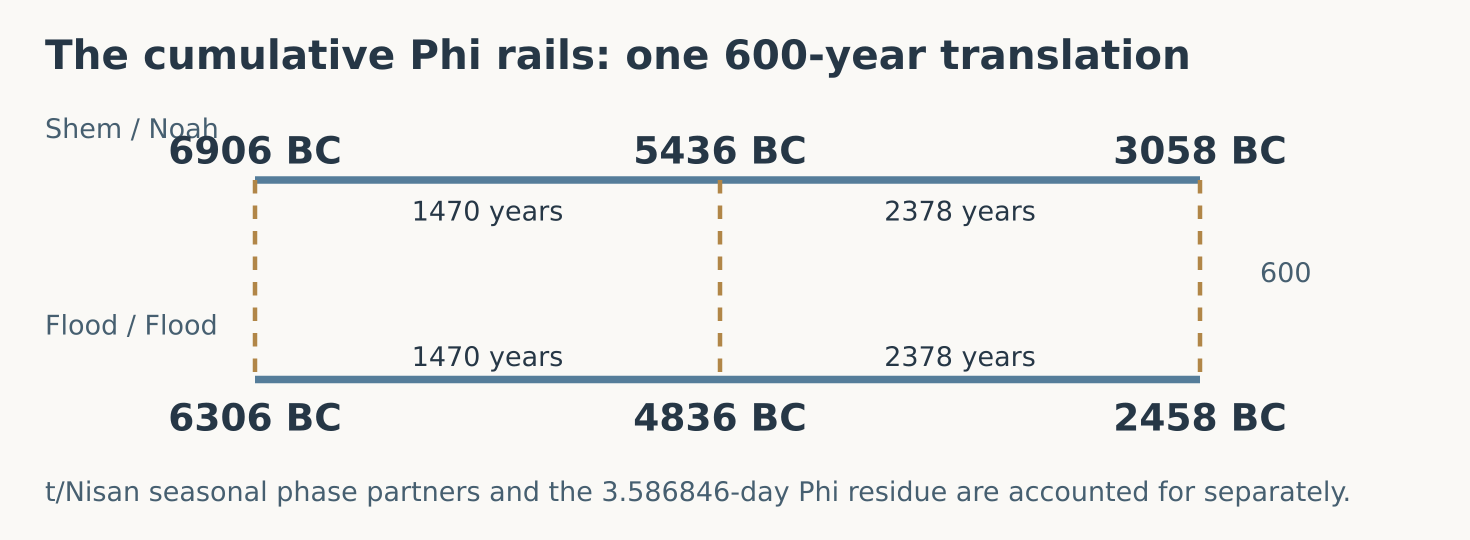
In the canonical cumulative MT scheme, the selected Shem interval is 5436–4836 BC; in the corresponding regular Gear-2 line the Noah-to-Flood interval is 3058–2458 BC. Each has exactly 600 years, so moving one sequence by 600 years produces the other without altering any interval.
| Cumulative Φ track | Projected beginning | Cumulative hinge | Regular destination |
|---|---|---|---|
| Shem → Noah | 6906 BC | 5436 BC | 3058 BC |
| Flood → Flood | 6306 BC | 4836 BC | 2458 BC |
The horizontal intervals are identical:
The whole seven-year units translate in the same manner. For the Shem track, 6907t/6906n → 6900t/6899n BC corresponds to 5437t/5436n → 5430t/5429n BC. For the Flood track, 6307t/6306n → 6300t/6299n BC corresponds to 4837t/4836n → 4830t/4829n BC. At the regular destination the corresponding chronological 2458 → 2451 BC interval remains seven years; the separate t/n date-phase swap is specified below. The latter 2451 BC position may receive a hypothetical Second-Cainan interpretation under the MT-like 30-year begetting variant, but that variant is not needed for the Φ calculation (Appendix M).
The two tracks differ vertically by 600 years at every position. This is one translated construction, not two independently discovered approximations. The special feature is that both 600-year rails are already defined by patriarchal chronology: Shem in cumulative and Noah before the Flood in regular MT. The same 500 + 100 Noah–Shem segmentation that supported the first Φ discovery remains in view.
Work in days, as in the earlier calculation:
Now separate the ordinary years from the seasonal and fractional residue:
Thus 1470 × Φ yields 2378 years plus a half-year plus 3.586846… days. In the 360-day model the 180 days exchange spring and autumn, and the final interval approximates the three-and-a-half-day period that will be considered with Revelation 11. The unscaled excess over exactly 3½ days is 0.086846444… day, about two hours and five minutes.
For calendar presentation the full starting pairs are 6907t/6906n and 6307t/6306n BC, leading through 5437t/5436n and 4837t/4836n BC. The schematic point under discussion is from a selected Nisan/Tishri 14th phase toward the opposite Tishri/Nisan 17th phase—not a claim that the ratio fixes an actual astronomical hour. A half-day phase sensitivity can be retained in the technical appendix; it is unnecessary to adjust the main result to the minute.
12. Why π’s 7706 BC and Φ’s 6306 BC belong together
The π study’s projected 7706 BC and the present Φ study’s 6306 BC are separated by exactly 1400 years. The same 1400 years separates the Conquest (1406 BC) from the modeled Christ-birth anchor (6 BC):
Two complementary 7700-year intervals appear on opposite sides of the cumulative narrative:
Equally, 7706 → 1406 and 6306 → 6 BC each span 6300 years. The pattern is thus an exact translation; π and Φ are not mathematically dependent constants, but their selected projected chronological positions are related by necessity once the common canonical endpoints are fixed.
The second projected starting point 6906 BC is especially useful because the established Key-of-23 operator transforms the 6900-year interval to Christ’s 6 BC birth anchor into 7000 years:
Holding 6 BC fixed moves the earlier coordinate to 7006 BC, precisely midway between 14006 BC and 6 BC:
The π and Φ projected Nisan starting points stand 700 years on either side of this midpoint:
In the biblical thousand-years-as-a-day analogy (Psalm 90:4; 2 Peter 3:8), this yields two symbolic seven-day spans, or fourteen days in all. Their association with the seventh and fourteenth Nisan/Tishri phases belongs to the interpretive layer; the 7000 + 7000 arithmetic is exact. The midpoint is generated by a pre-existing Key-of-23 operation, not inferred from Φ’s decimal expansion.
A second permitted operator, , maps the same 6900 years to 7500 years, moving 6906 → 7506 BC with the 6 BC endpoint held fixed. Also, 6906 − 4836 = 2070 = 23 × 90 = 69 × 30. These useful secondary connections are preserved for audit but do not carry the main argument.
13. The seven-year field activates the 7705-year canonical Mirror
The single cumulative Adam Year-6 coordinate 14006 BC must not be confused with the opening of the complete Creation field 14011n–14004n BC, whose Tishri partners are 14012t–14005t BC. Moving that whole field forward 7705 years produces the corresponding projected Φ field:
| Season | Cumulative Creation field (BC) | Projected Φ field (BC) | Difference |
|---|---|---|---|
| Nisan | 14011n → 14004n | 6306n → 6299n | 7705 at each boundary |
| Tishri | 14012t → 14005t | 6307t → 6300t | 7705 at each boundary |
The 7700 years of the previous section use the internal Adam Year-6 position, whereas 7705 years use the full Creation week’s opening boundary. The distinction is intentional, not a conflict or a license to mix Rounded and ordinary cumulative states.
In File 09’s paired seasonal Mirror, the Conquest/rest field 1407t/1406n → 1400t/1399n BC is presented on the AD side as the corresponding reflected field AD 1399t/1400n → AD 1406t/1407n; chronological order reverses. Compare the same-season components across the Mirror:
Its Tishri partner gives the same result, . The result is 7705 + 7705 = 15410 = 46 × 335 for the full outer comparison. The AD positions are Mirror images, not historical claims of a new Conquest in AD 1400.
The regular MT Creation week 4121n–4114n BC supplies an additional exact check:
The canonical cumulative-to-regular Creation span is 14011 − 4121 = 9890 = 23 × 430, so the new projected point subdivides it into:
Moreover, the regular Creation counterpart reaches AD 1400n in 5520 = 23 × 240 years, making or . This is an exact Mirror and Key-of-23 identity. It is not itself a new approximation to Φ, and no new canonical event is introduced at 6306 BC.
14. The reciprocal π–Φ Mirror: 14,000 and 12,600 years
Both projected starting positions possess complete seven-year fields. Preserve the Tishri/Nisan order:
| Stage | π field (BC) | Φ field (BC) |
|---|---|---|
| Opening | 7707t / 7706n | 6307t / 6306n |
| Six elapsed years | 7701t / 7700n | 6301t / 6300n |
| Seven elapsed years | 7700t / 7699n | 6300t / 6299n |
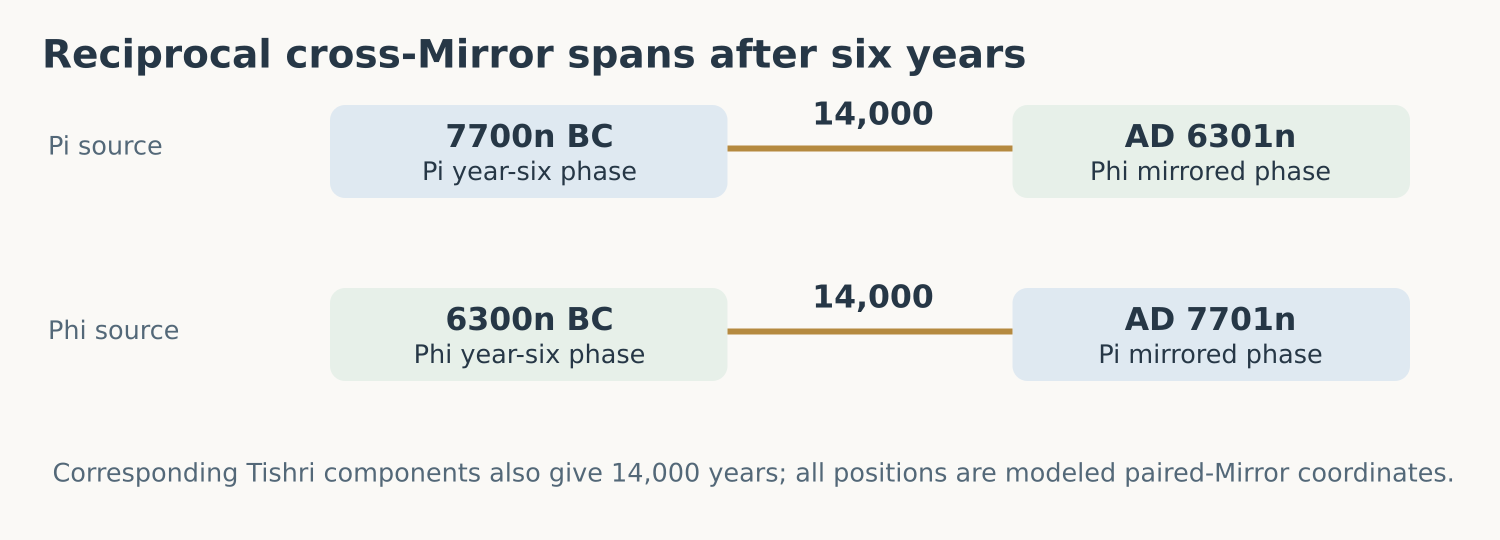
At six elapsed years, the canonical paired Mirror represents 7701t/7700n BC as AD 7700t/7701n, and 6301t/6300n BC as AD 6300t/6301n. Crossing from one projected field to the other field’s reflected counterpart produces four equal 14,000-year spans. For example:
The Tishri components give the same result. The two 7000-year midpoints are 700 BC and AD 701 in the Nisan displays, themselves a reflected pair separated by 1400 years, the original π–Φ displacement. This is self-replication of a selected coordinate system, not a derivation relating the transcendental π to the algebraic Φ.
For the whole seven-year field, if completed years have elapsed since its opening, the cross-span is:
It yields 14012, 14010, 14008, 14006, 14004, 14002, 14000, 13998. The precise 14,000 is thus the completed-sixth-year member; 14,010 is also a genuine earlier member rather than a new separately selected date.
The Φ field further reproduces the canonical 12,600-year cumulative Adam-to-Conquest interval through its own reflection. Advancing the opening pair by six complete Creation years gives 6301t/6300n BC, whose paired counterpart is AD 6300t/6301n:
This exact interval is also 14006n → 1406n BC = 12,600 years = 35 × 360. The 12,605-year comparison instead measures from the original cumulative Creation week’s opening 14011n BC to 1406n BC, preserving the five years between the week’s opening and Adam’s Year-6 position. Translated to the Φ field, the same internal coordinate is 6301n BC (five years after 6306n), while 6300n is reached after six completed years. These two labels must not be collapsed. A 12,605-year same-season cross-era comparison can be formed from 6306n BC → AD 6300n, but that is not the direct reflection of the opening Φ pair. The technical appendix distinguishes field translation, endpoint comparison, and paired reflection.
Within the canon’s symbolic interpretation, the center of the paired Mirror is associated with the traditional eighth-day circumcision of Christ, conceived here as the New Adam. The 12,600 arithmetic is exact within the selected Mirror state; the Christological connection is theological rather than an independent dating proof.
15. From 1470 + 3430 to 4900: the Danielic 70, seven, and Passion week
The projected cumulative field also belongs to the previously established 4900-year framework:
Hence 6906 → 2006 BC and 6306 → 1406 BC each span 4900 years. The original cumulative 4837t/4836n → 4830t/4829n week is displaced backward by 1470 to the corresponding 6307t/6306n → 6300t/6299n week, without losing its width. The 4900-year interpretation of Enoch’s ten-week oracle is the 490d canonical schematic reading, not a claim that 1 Enoch directly prints these BC dates.
The same totals appear through a smaller series of chronological stations:
The 4830-year leg expands by the Key of 23’s factor to 4900, just as the pre-existing 4836 → 6 BC = 4830 leg can. The two constructions differ by 1470 years at both ends. The second chain moves through AD 25 (thirty years after the selected 6 BC Christ-birth anchor) toward AD 65. This is numerical translation, not a claim that all those moments are identical calendar events.
In the tenfold form of Daniel’s seventy weeks, the final seventy years can be written:
The original 4837t/4836n BC opening field reaches AD 29t/30n after 4865 = 4830 + 35 years. Translating its entire seven-year field, the Tishri path runs AD 29t → AD 36t and reaches its midpoint AD 33n, while the Nisan path runs AD 30n → AD 37n, reaching AD 33t. The two phases remain distinct: the Passion is associated with AD 33 Nisan, while the autumn midpoint remains available for the later Pentecost/Ascension extensions of the canon.
Three scales are being compared: the middle of seventy years (35 + 35), the middle of seven years (3½ + 3½), and the seven days of Passion Week. The detailed dual-calendar Gospel mechanism belongs to Book 1, Chapter 1 and its subsequent chapters, not this mathematical companion article. The present task is to show the controlled translation into the Christological field, not to retell the entire Passion chronology.
The 49-year and 50-year Jubilee conventions provide a small subsidiary comparison: 6306 → 1406 BC = 4900 = 100 × 49, while the 6406 → 1406 BC = 5000 = 100 × 50 coordinate is a 100-year offset tied to the same Noah–Shem 500 + 100 grammar. It is useful for examining complete seven-year fields and the alternative Cainan alignment, but 6906 and 6306 BC remain the two principal cumulative Φ nodes. These variants are detailed in the appendix rather than multiplied throughout the main narrative.
16. The 14th–17th phases, Revelation’s 1260/1290, and the three forties
The final 3.586846… days from Section 11 are the reason the day-level phases matter. In the selected 360-day model, 3½ years = 1260 days, taking a Tishri opening phase to the complementary Nisan phase or the reverse; 3½ days is also the period preceding the witnesses’ restoration in Revelation 11:9–11. Revelation 12:6 and 12:14 supply the related 1260-day and time-times-half-time imagery in its birth-and-preservation setting. These are established biblical numbers, not produced by Φ.
The 14th supplies the Passover-related phase, while the 17th supplies the resurrection-related phase in the symbolic calendar developed in Book 1. The half-year 180-day term in the cumulative Φ equation reverses the season, and the remaining 3.586846… days approaches the passage from the 14th to the 17th. The selected source phases are thus T14 → N17, or the reverse N14 → T17, while the exact named-day boundary and hour remain subject to the model’s phase semantics.
There is a more precise second-scale comparison. Applying the research’s declared day–year magnification 360 to the remaining fraction gives:
The comparison is:
Equivalently, before scaling, the difference from days is only 0.00351311… day ≈ 5 minutes 3.53 seconds. It is a numerically close approximation, not an exact equality of Daniel’s 1290 and Revelation’s 1260. The 30-day difference is the intercalary-month alternative in the previously selected ministry calendar states; a nonintercalated 360-day 3½-year interval remains 1260 days.
The 40 days on either side of the ministry reinforce the already established seasonal vocabulary: Tishri 17 + 40 schematic days → Cheshvan 27 for the wilderness-testing phase, and Nisan 17 + 40 → Iyar 27 for post-resurrection appearances and the Ascension phase (Acts 1:3). The Flood already uses the seventeenth and twenty-seventh dates: the Ark rests on the seventeenth of the seventh month (Genesis 8:4), and the earth is dry on the twenty-seventh of the second month (Genesis 8:14). A third forty-day period at Christ’s birth is the 7 + 33 purification of a woman after a male birth (Leviticus 12; Luke 2). These forty-day spans are explicit in biblical sources; their precise pairing to the schematic phases is the model developed separately in Book 1.
No intricate Gospel harmonization is required here. The narrower claim is that the Nisan/Tishri 14th and 17th have established theological and calendrical uses elsewhere in the project, so they were not chosen solely because they produce a convenient Φ remainder. Their application remains interpretive and depends on the distinct Passion-calendar states being handled correctly.
17. What is established by the cumulative construction?
The cumulative argument has a clear hierarchy. The 1470-year starting interval, the two 600-year translations, the 1400-year π–Φ displacement, the 7705-year full-field Mirror, and the 12,600/14,000-year reciprocal identities can all be checked exactly in their declared coordinate systems. The 3.586846-day and 1291.2647 scaled-day figures are mathematical approximations to scripturally meaningful intervals. Their theological application is interpreted through the independent Passion study, without making Christ’s historical calendar dates a consequence of an irrational constant.
This separation matters. Much of the apparent proliferation of numbers follows necessarily from translating or reflecting one seven-year field. The recurring totals are evidence of an algebraically closed construction within the proposed chronology, not a count of independent probabilities. Their relevance to biblical authorship and to deliberate encoding remains a question for interpretation.
Part III — The Fibonacci 144 and Alpha–137: possible cumulative extrapolation
18. The Fibonacci 144 and its doubled Key-of-23 corridor: a possible extrapolation
The cumulative Φ framework has two principal generated starting points, 6906 BC and 6306 BC. They are already linked to two established narrative stations by equal 4900-year intervals:
Both pairings retain the 600-year difference between Jacob and the Conquest, as well as between the projected cumulative Shem and Flood tracks. This is the starting constraint for the following exploratory Fibonacci projection. The outer dates are algebraic positions, not manuscript events or new canonical dates; they do not replace the primary 100-day Φ fit or the 377-day Ark bridge to π.
Two 144-Fibonacci windows, both using 6906 BC
The regular MT Arphaxad coordinate 2456 BC, the Conquest 1406 BC, and the projected 6906 BC position generate the following scales:
| Fibonacci window | First interval | Second interval | Total |
|---|---|---|---|
| 50-year units: 9656 → 6906 → 2456 BC | 2750 = 55 × 50 | 4450 = 89 × 50 | 7200 = 144 × 50 |
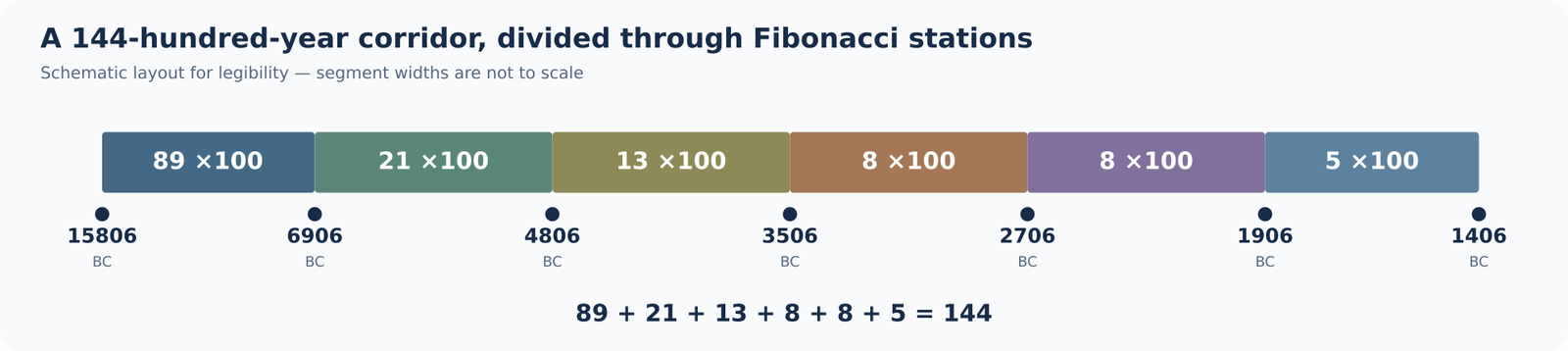
| 100-year units: 15806 → 6906 → 1406 BC | 8900 = 89 × 100 | 5500 = 55 × 100 | 14400 = 144 × 100 |
Thus the shared 6906 BC pivot places the complementary Fibonacci members 55 and 89 in opposite order, and with the second sequence doubled in unit size. These are two dependent expressions of the same arithmetic vocabulary, not independent approximations to the irrational number Φ.
A companion 7200-year span can be written
The outer intervals 34 + 21 = 55 reuse the earlier Arphaxad Jubilee measures; 8606 → 1406 BC and 9656 → 2456 BC are two translated 7200-year spans, and 15806 → 8606 → 1406 BC divides the 14,400-year projection into two equal 7200-year parts. The new outer positions 8606, 9656, and 15806 BC remain projected research coordinates in this Fibonacci construction; 8606 BC also has a separately derived role in the canonical inverse-number literature (File_52b / File_52c), whose derivation must not be conflated with the present 144 × 50 route.
The 4806 BC bridge: Fibonacci 21–34–55–89–144 and Alpha 137/138
An internal Fibonacci station follows directly from the established cumulative Shem/Flood 4836 BC hinge. The original interval to the projected 6906 BC Shem starting point is 2070 = 69 × 30 years. Applying the canonically defined 70/69 Key-of-23 expansion, and holding 6906 BC fixed, gives a 2100-year interval and a later endpoint of 4806 BC:
The additional 30 years move the cumulative 4836 BC station toward 4806 BC; this does not redate the original Shem/Flood hinge. It is a generated Key-of-23 output. Its consequence is a contiguous 100-year-unit Fibonacci partition:
| BC sequence | Years | Fibonacci units of 100 years |
|---|---|---|
| 15806 → 6906 | 8900 | 89 |
| 6906 → 4806 | 2100 | 21 |
| 4806 → 1406 (Conquest) | 3400 | 34 |
| 6906 → 1406 | 5500 | 55 = 21 + 34 |
| 15806 → 1406 | 14400 | 144 = 89 + 55 |
The sequence now exhibits 21, 34, 55, 89, and 144, five consecutive Fibonacci numbers, with the 6906 BC node and the canonical 1406 BC Conquest endpoint held fixed throughout. The first 8900-year component is already part of the projected 144-fold Fibonacci structure, and the 3400-year arm is determined by subtraction after the 70/69 expansion. This is internal closure of the chosen arithmetic, not five independent tests of Φ.
Independent Alpha–137 antecedent. The projected 4806 BC coordinate is already generated by a different construction in Alpha, Creation, and Christ: 1/137, §15: with 6 BC fixed, 30 × 137 + 5 × 138 = 4800 years, giving 4806 BC. The 4836/4806 difference of 30 years is therefore intelligible within both the cumulative Key-of-23 projection and the existing 137/138 grid, without claiming that the methods are independent probabilities or that 4806 BC is a genealogical event.
The same enlarged 15806 BC starting point also straddles Noah’s death, MT Gear 1 (2106 BC), and Jacob’s birth (2006 BC):
Here the difference of 100 years between Noah’s death and Jacob’s birth gives the increment from 137 to 138 at hundredfold scale. As a secondary translation, 2106 → 6 BC = 2100 = 21 × 100 also echoes the 6906 → 4806 BC arm. By contrast 2106 → 1406 BC = 700 years, not 2100; the endpoints must not be silently interchanged.
Gear and Flood control. The primary Φ study uses the 2458 BC MT Gear-2 Flood, whose corresponding Noah death is 2108 BC; thus 2458 − 2108 = 350 years after the Flood. The 2106 BC death used in the 137-fold span belongs to Gear 1, with its corresponding 2456 BC Flood, also 2456 − 2106 = 350. Their respective Noah births are 3058/3056 BC. Hence the present 137-fold result is an explicitly labeled cross-gear structural comparison, not a claim that the Gear-2 Flood is 350 years before the Gear-1 death. The source controls are Birth and Cross of Christ in Symbolic Time, Table 3 and Technical Appendix: Across the BC–AD Divide.
The Fibonacci 144-fold pattern consequently joins the 137/138 series to the already established cumulative 4836 BC hinge through a declared 70/69 operation. This is stronger as a structural and intertextual finding than either a new unexplained 4806 BC date or a bare numerical echo. It remains in Part III, where projected coordinates are deliberately distinguished from the primary Φ approximation.
Completing the Fibonacci nesting: LXX Shem, Noah’s π coordinate, and Benjamin
The 3506 BC Fibonacci station is not supported merely by the identities 6906 − 3400 and 1406 + 2100. It has two further mathematical antecedents in the existing LXX and π research. These require precise source-state labels and should not be mistaken for an attested event at 3506 BC.
First, the regular LXX Gear-2 Shem-birth coordinate is 3338 BC (distinct from the LXX Gear-1 narrative/elected-line coordinate at 3336 BC). Holding the Conquest at 1406 BC fixed gives 1932 years, divisible by both 23 and 69:
The two accepted Key-of-23 operations give different projected earlier coordinates:
This does not relocate Shem’s birth from 3338 BC; 3506 BC is the expanded coordinate. The underlying 3338/3336 distinction is explicit in the Regular Chronology Tables and in the comparative Noah–Shem Gear table. The same 3506 BC appears in the π technical appendix, but by a different operation: its fivefold grid has A₄ = 7706 − 4(1050) = 3506 BC. This π antecedent and the LXX Key expansion are distinguishable sources of the coordinate, not automatically independent statistical tests.
Second, 2706 BC has an independently established position in the π study as a rearrangement of MT Noah’s Gear-1 950 years:
The 350 here lies after Noah’s birth, not after the Flood; the post-Flood 350 belongs to the separate 2456 → 2106 BC interval. This is the source of the π calculation’s auxiliary node, and its appearance in the present Fibonacci window does not require a new dated event. Relative to the Conquest,
Third, the canon-retained 1906 BC position for Benjamin’s birth (Jacob’s twelfth son) divides the latter 1300 years into 8 + 5. Benjamin’s date is a reconstructed birth label, associated with Jacob’s age of 100; Genesis 35:16–18 does not give a numbered birth year. See Terah to Joshua: Full Tables and Source Notes:
The complete, non-overlapping chain is consequently:
| Consecutive stations, BC | Years | Fibonacci hundreds | Source role |
|---|---|---|---|
| 15806 → 6906 | 8900 | 89 | extrapolated 144-window to projected Φ/Shem pivot |
| 6906 → 4806 | 2100 | 21 | expanded 2070-year cumulative hinge, also Alpha–137 antecedent |
| 4806 → 3506 | 1300 | 13 | difference between two independently derived projected stations |
| 3506 → 2706 | 800 | 8 | expanded LXX Shem / π-grid station to π Noah-life station |
| 2706 → 1906 | 800 | 8 | π Noah-life station to reconstructed Benjamin birth |
| 1906 → 1406 | 500 | 5 | Benjamin to Conquest |
| Total: 15806 → 1406 | 14400 | 144 | 144 × 100 = 40 × 360 |
Read backward from the Conquest, the nested totals make the Fibonacci progression even clearer:
| Earlier terminus | Years back from 1406 BC | Fibonacci hundreds | Recurrence |
|---|---|---|---|
| 1906 BC | 500 | 5 | initial terminal span |
| 2706 BC | 1300 | 13 | 5 + 8 |
| 3506 BC | 2100 | 21 | 13 + 8 |
| 4806 BC | 3400 | 34 | 21 + 13 |
| 6906 BC | 5500 | 55 | 34 + 21 |
| 15806 BC | 14400 | 144 | 55 + 89 |
Thus the component intervals supply 8 and 89, while the nested totals display 5, 13, 21, 34, 55, 144. Together the construction accounts for the consecutive Fibonacci values 5, 8, 13, 21, 34, 55, 89, 144. It would be incorrect to say that every one of these appears as a cumulative span measured from 1406 BC; the 8 and 89 are explicitly component measures.
The same 5500-year total also permits the opposite division 6906 → 3506 → 1406 = (34 + 21) × 100. The presence of 4806 BC yields 6906 → 4806 → 1406 = (21 + 34) × 100. Both are exact, but they are related partitions of one 55-unit span. Because 4806 has the Key-of-23/Alpha antecedents and 3506 now has LXX Shem/π antecedents, the two orders are worth preserving without multiplying their evidentiary weight.
Gear safeguard. The 2106 BC Noah-death → 2006 BC Jacob-birth 100-year separation, which produces the 137/138 × 100 pair above, remains MT Gear 1 for Noah. The main Φ Flood uses 2458 BC, Gear 2. The canonical cumulative seven-year grammar itself admits two-year Gear shifts in its 2 + 3 + 2 arrangement, with the central three-year measure associated with Aaron and Moses; therefore a declared two-year comparison is not a newly invented freedom. Nevertheless, it is not permission to present 2458 → 2106 = 352 as the literal 350-year post-Flood life within one Gear.
A still smaller Fibonacci countdown can be noted without over-interpreting its undated stations: from 1406 BC the offsets 0, 1, 1, 2, 3, 5 in hundreds give 1406, 1506, 1506, 1606, 1706, 1906 BC. Only 1406 BC is the fixed Conquest anchor and 1906 BC has the independently reconstructed Benjamin label; 1506, 1606, and 1706 BC are not newly identified biblical events. Their intervals to Christ’s selected 6 BC position are 1400, 1500, 1600, 1700, 1900 years. The first four correspond numerically at one-tenth scale to the larger 14,000, 15,000, 16,000, 17,000 spans discussed below (although those larger spans have different held anchors). This is a brief fractal-like observation, not evidence for additional events at the intermediate stations.
The 13,800-year corridor is the interpretive hinge
The more significant extension is obtained by measuring the projected 15806 BC coordinate to Jacob’s birth in 2006 BC, rather than changing the endpoint of that interval:
Why is this especially fitting? The earlier cumulative Φ calculation had already used
with its two Key-of-23 expansions holding 6 BC fixed:
The new 13,800-year interval doubles both the base and the resulting corrections. Holding Jacob’s birth, 2006 BC, fixed therefore moves the earlier endpoint backward:
| Operator | Original span to 6 BC | Doubled span to 2006 BC | Earlier projected coordinate |
|---|---|---|---|
| Unexpanded | 6900 | 13800 | 15806 BC |
| × 70/69 | 7000 (+100) | 14000 (+200) | 16006 BC |
| × 25/23 | 7500 (+600) | 15000 (+1200) | 17006 BC |
These are exact scaling relations:
Hence 15806 → 16006 adds 200 years, while 15806 → 17006 adds 1200 years, or 600 + 600. The second enlargement echoes the double use of the 600-year Shem/Noah rail. The figures are 14,000 and 15,000 years measured to Jacob; they are not 14,000 and 15,000-year spans to Christ.
The fortyfold calendar spectrum: Exodus, Conquest, and Christ
The backward direction now gains an especially constrained calendrical expression. The base 15806 BC is 40 × 360 years before the Conquest. Expanding the earlier endpoint to 16006 BC rather than advancing Jacob’s held endpoint changes the corresponding Conquest span to 40 × 365, while the Exodus, exactly forty years earlier than the Conquest, stands at 40 × 364. In other words, one forty-year wilderness interval exactly matches the difference between 40 times the Enochian 364 and 40 times the Egyptian 365:
| Projected beginning | Fixed biblical destination | Years elapsed | Calendrical / prophetic factorization |
|---|---|---|---|
| 15806 BC | Conquest, 1406 BC | 14400 | 40 × 360 (schematic year) |
| 16006 BC | Exodus, 1446 BC | 14560 | 40 × 364 (Enochian year) |
| 16006 BC | Conquest, 1406 BC | 14600 | 40 × 365 (Egyptian/solar year) |
| 16006 BC | Christ, 6 BC | 16000 | 40 × 400 (Genesis 15 affliction measure) |
| 17006 BC | Moses’ birth, 1526 BC | 15480 | 215 × 72 (215 = half of 430, in the schematic precessional register) |
| 17006 BC | Conquest, 1406 BC | 15600 | 390 × 40 = 400 × 39 (Ezekiel 4 comparison) |
The two most decisive equations are:
Their difference is 40, equal to 1446 − 1406: . Likewise, keeping 16006 BC fixed and moving from the Conquest to the Christ-birth coordinate adds 1400 = 35 × 40, carrying to . These are numerical calendar-year coefficients multiplied by forty in years, not a claim that 14,560 actual years contained 14,560 literal days.
The 17006 BC branch introduces a different but related scale: , where 72 is the canonical schematic precessional unit and 215 is half the 430-year Egypt/sojourn interval. The further 120 years from Moses’ birth to the Conquest () complete . Ezekiel 4:5–6 separately names 390 and 40 day–year assignments (together 430); the factor 400 belongs independently to Genesis 15:13, not to an explicit 400 in Ezekiel 4. These biblical correspondences are interpretive, whereas the displayed intervals are exact.
This reinforces the intended direction of the 2006 BC Jacob / 1406 BC Conquest base, rather than treating the 200- and 1200-year extensions as forward displacements of the historical endpoint. It is a calendrical convergence, not six independent samples: the 40-year difference among targets and the fixed +200/-1000-year differences among projected dates algebraically cause some of the related products.
Source-state cross-check. The independently developed inverse-number research already reaches 16006 BC by a different 25/23 operation, namely years held to 6 BC (File_52c, §3.5); File_52b, Appendix B.4 independently names 17006 BC as the twelve-position grand mean of an inverse-coordinate field. File_52b also contains 8606 BC. These are separate constructions with distinct node classes, so we cite them as antecedent appearances, not as proofs that the Fibonacci 15806/16006/17006 series is already canonicalized. The checked Prime Harmonic files center on different nearby P16 stations (e.g. 16056/16086 BC); the exact three-date series has not been located together there.
Fourteenth through seventeenth: the symbolic Creation–Passion horizon
The same newly generated outer coordinates reach Christ’s selected 6 BC birth anchor by a further 2000 years, since Jacob’s birth at 2006 BC is 2000 years earlier than that anchor:
Consequently:
Measured backward from 14006 BC, the two expanded starting coordinates are 2000 and 3000 years earlier. Under the established symbolic analogy of 1000 years as one day, the 14th-day Creation–Christ horizon is therefore supplemented by the 16th- and 17th-day horizons. A separate 15006 BC coordinate would mathematically represent 15 symbolic days to 6 BC, but it is not generated by either Key-of-23 expansion. The important fifteenth in the paired Passion projection arises instead from 17006 → 2006 BC = 15000 years, as shown below.
This is where the larger Fibonacci construction rejoins the already-developed Tishri/Nisan 14th–17th phases. Depending on the paired seasonal state and the inclusive/elapsed convention, Nisan 14–16 or Nisan 15–17 describes the death-and-resurrection pattern discussed in Book 1. The 3½-day Revelation 11 template and the corresponding ministry-calendar interpretations belong to that earlier study; the Fibonacci extrapolation does not newly determine the historical Passion date. Reversing the interpretation through the canonical Mirror preserves corresponding interval magnitudes, but the actual seasonal labels must still be taken from the t/n paired-coordinate rule, not from numerical subtraction alone. See Book 1, Chapter 1.
The paired origins, the 3506 BC half-day, and the Passion’s overlapping dates
The 14000/15000 years to Jacob and 16000/17000 years to Christ are more informative when placed in two paired lines rather than treating the missing fifteenth day as a third Key expansion:
| Jacob-fixed projected origin | To 2006 BC | To Christ’s 6 BC coordinate | Symbolic date sequence |
|---|---|---|---|
| 16006 BC (13800 × 70/69) | 14000 | 16000 | 14 → 16 |
| 17006 BC (13800 × 25/23) | 15000 | 17000 | 15 → 17 |
At 1000 years per symbolic day, the two lines reproduce the one-day displacement of the proposed Passion reckoning: Nisan 14 → 16 in John’s perspective, Nisan 15 → 17 in the Synoptic comparison. The 15 is thus not merely a proposed stand-alone 15006 BC starting coordinate; it arises as the Jacob-side endpoint of the 17006 BC line. Both Key-of-23 origins arise from one doubled 13,800-year measure, but the dates are an interpretive analogy, not historical recalculation of the Gospel week. See Book 1, Chapter 1, which leaves the actual one-day calendar mechanism under examination.
The 3506 BC projected station also sharpens the half-week:
Hence, from 17006 BC, the 3506 BC station is halfway through the symbolic fourteenth day, and the 6 BC terminus is the end of the symbolic seventeenth: the final 3½ symbolic days comprise the latter half of Day 14, all of Days 15–16, and Day 17. From 16006 BC, the same 3506-to-6 interval spans the middle of Day 13 through the end of Day 16. This offset is precisely why the paired 16006/17006 starting points matter; a single origin would conceal the alternative Nisan labels.
The 3½ days appear in Revelation 11:9–11 (the witnesses’ death and rising); Revelation 12 provides the related 1260 days / time-times-and-half-a-time, not a second literal report of the witnesses’ 3½ days. Through the day–year analogy these can be compared with the previously established cumulative Φ 3.586846…-day residue and its scaled 1291.2647…-day counterpart. The exact 3500-year relation and the irrational Φ remainder are different quantities, not a newly exact equality. The references to the resurrection and to Jesus appearing on Sunday evening behind shut doors (John 20:19) are theological endpoint correspondences: they must not be construed as 3½ literal elapsed days between Friday’s crucifixion and Sunday’s resurrection or evening appearance. The historical and inclusive-day conventions remain governed by Book 1, and the canonical Tishri/Nisan Mirror must be applied explicitly before assigning any seasonal BC–AD date label.
The 14,400-year companion remains intact
The original Fibonacci projection to the Conquest is still exact:
It crosses the established cumulative MT Adam Year-6 position:
This 5 + 35 = 40 division parallels the forty years from Exodus to Conquest:
while Joshua’s modeled 1476 → 1441 → 1406 BC divides his seventy-year field into 35 + 35. At schematic 360-day scale the corresponding 35 and 40 years become 12,600 and 14,400 days, without treating these scaled analogies as independently dated historical periods.
The 14,400-year Fibonacci/Conquest span and the 13,800 → 14,000/15,000-year Jacob-fixed Key-of-23 extensions are two intersecting presentations, not rival endpoint choices. Keeping their anchors explicit makes the underlying architecture clearer: the former preserves 144 × 100, while the latter demonstrates that the earlier 6900 → 7000/7500 transformations replicate at twice their scale and reconnect with the 14th–17th Christological day vocabulary.
This remains a possible Fibonacci extrapolation. The new earlier coordinates 16006 and 17006 BC are generated positions, not new genealogical dates. Their theological significance is proposed within the existing Passion/Mirror model, and the numerical repetitions should not be counted as independent proofs of design.
19. Conclusion — one coherent chronological architecture
The Φ companion began with the regular Gear-2 Flood and Conquest. Its principal partition 1702 : 1052 : 650 is close to the golden ratio, and the chronologically motivated 100-day correction improves the agreement dramatically. The SP Arphaxad and LXX Shem–Joshua comparisons show consecutive Fibonacci windows on 50- and 60-year scales, while the LXX +24-day refinement yields exactly the same rational Φ approximation as the primary SP–MT formula. The 377-day Ark envelope continues to provide the most direct narrative bridge back to π.
The newly integrated cumulative MT construction adds an organized second layer. The 1470 × Φ projection spans from 6906/6306 BC through the cumulative Shem/Flood hinges toward the regular Noah/Flood coordinates, repeating under the canonical 600 years. The Nisan/Tishri phases are essential: after 2378 years the computed interval has a 180-day reversal and 3.586846… days remaining. The full seven-year fields, the canonical paired Mirror, the 7705 = 23 × 335 relationship, and the reciprocal 14,000 and 12,600 spans show that the π and Φ projected nodes are algebraically connected. The 1290-day and Passion interpretations are explained briefly here and developed in Book 1.
The 5–8–13–21–34–55–89–144 Fibonacci progression, including the 4806 BC Alpha–137 coordinate, the 3506 BC expanded LXX Shem / π-grid node, 2706 BC in the π Noah-life construction, Benjamin’s model-derived 1906 BC birth, and the 137/138 × 100 Noah–Jacob pair, remains a separate exploratory coda. They generate useful larger endpoints and a repeated 14,400 = 40 × 360 measure, but they do not redefine the central canonical coordinates or provide independent evidence merely by repeating the same identities at several scales.
The organizing claim is modest but consequential: a small number of canonical chronological stations, manuscript states, interval-preserving translations, and seasonal Mirror operations generates the visible approximations and structural repetitions. Whether their literary and theological meanings were intentionally encoded is an interpretive hypothesis, distinct from the reproducible arithmetic. The research belongs alongside the π and Alpha–137 studies as a third mathematical companion, not as an amendment to the canonical repository.
Sources and methodological controls
-
File 52b — Inverse-Number Technical Tables, Appendix B.4: 17006 BC as inverse-field mean and 8606 BC among named positions.
-
File 52c — Rounded Whole-Span Inverse Detailed Study, §3.5: 16006 BC from a 14720 × 25/23 expansion with 6 BC fixed (separate draft/inverse source-state).
-
File 32 — Prime Harmonic and File 36 — Prime-Polarity / Target-Mirror, for distinct prime P16 coordinate controls; no identification with 16006 BC presumed.
-
490d Unified Chronology Knowledge Catalog and canonical Markdown index.
-
File 09 — Cumulative Architecture, especially cumulative Creation, seven-year fields and the phase-resolved paired Mirror.
-
Technical Appendix — Across the BC–AD Divide, distinguishing ordinary BC–AD intervals, number-line reflection and seasonal Mirror.
-
Technical Appendix — Peleg and Babel, including the Conquest/rest paired Mirror and cumulative fields.
-
Book 1, Chapter 1 — The Apparent Passover Contradiction, for the interpretive Passion chronology; the detailed mechanism is not repeated here.
-
File 71 — Regular MT–SP–LXX Creation-to-Noah Comparative Engine, particularly the shared G2 3708/3108 and 3058/2458 rows. The SP date is a co-registered comparative coordinate, not automatically the unshifted native SP chronology.
-
State Vocabulary Register, especially §§31.38–31.39 and D.44.2–D.44.4.
-
Pi and the Biblical Chronology, Sections 6–10 and 16; companion working archive v8, 7 November 2026, especially its updated Section 16 and Appendix T.
-
π technical appendix (published appendix may lag the attached v8 archive).
-
Alpha, Creation, and Christ: 1/137, especially §15 (4806 BC = 6 BC + 30×137 + 5×138), Noah–Shem, the Key of 23, and Nisan 1–6 phase movements.
-
Primary biblical texts: Genesis 5–9; Exodus 1–2, 7, 12, 19; Numbers 13 and 33; Deuteronomy 1 and 34; Joshua 3–6 and 11; Luke 1; John 20; Acts 2.
-
Ancient interpretive witnesses: 1 Enoch 6:6; 15:8–12 and Jubilees 4:15 (watchers/Jared), with the differences between these witnesses retained.
Research status: Comprehensive v11 research article. No WordPress replacement, canonical amendment, or historical-date certification is implied. Detailed formula and phase audit: accompanying technical appendix.