A year can be counted as a completed interval or as the year someone has entered. The difference is small, but it matters when Genesis describes Noah’s age at the Flood. In the Samaritan Pentateuch chronology, that distinction helps Noah and Shem meet the same Flood date without shifting the generations before them.
“Now Noah was 600 years old when the floodwaters came upon the earth.”
“Two years after the flood, when Shem was 100 years old, he became the father of Arphaxad.”
The next verse gives Shem a further 500 years after Arphaxad’s birth. Genesis 7:11 also describes the Flood as occurring in Noah’s six hundredth year. These BSB quotations introduce the biblical question; they are not a translation of the Samaritan Pentateuch’s distinctive genealogy.
Counting years and measuring intervals
Imagine five successive years marked on a calendar. Counting all five year positions gives five. Measuring the distance from the beginning of the first to the beginning of the fifth gives four intervals. Counting both endpoint years therefore adds one to ordinary subtraction.
The same care is needed with an age expressed as an ordinal. A person enters a 600th year after completing 599 years. That does not tell us an exact birthday within the year. It tells us why the expression “600th year” and a calculation using 600 completed years need their conventions stated.
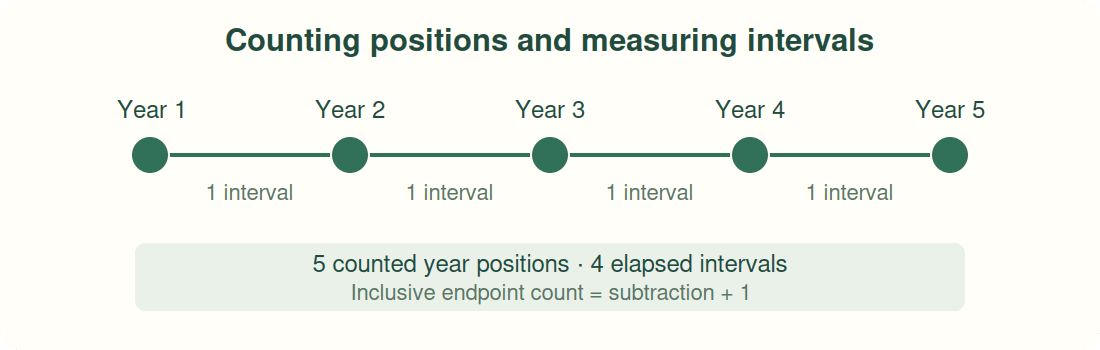
My reconstruction applies this distinction locally to Noah and Shem in the SP chronology. Each has a primary date and an adjacent companion date, one year farther forward. This does not move Adam, Seth, or the rest of the earlier birth sequence by one year. It also does not alter Arphaxad and the later generations.
Two Noah positions, one Flood start
For orientation, the normal Masoretic chronology retains Creation at 4114 BC, the Flood at 2458 BC, and Abram’s birth at 2166 BC. The SP figures below use the same full-430 comparison setting, without an added 60 years for Terah or a restored second Cainan. The native SP setting, with 215 years in Egypt, is 215 years later. The appendix shows both sets of dates. Using a common comparison setting does not change the SP’s own wording about the sojourn.
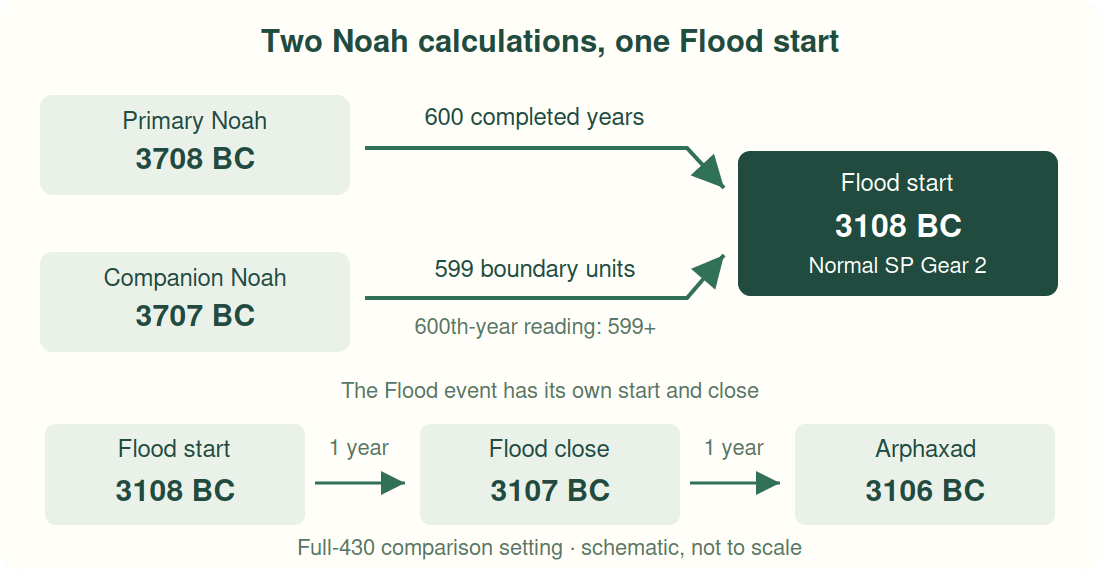
In this setting, the normal SP Flood begins at 3108 BC. Noah’s primary birth position is 3708 BC:
3708 − 3108 = 600 years.
The adjacent Noah position is 3707 BC. From that position, the Flood lies 599 annual boundary units later, placing it within the 600th counted year:
3707 − 3108 = 599.
Both routes reach the same Flood start. The one-year distinction is used once. It is not an extra year repeatedly added at every generation.
How Shem fits the same calculation
Shem’s primary SP position is 3208 BC, and his adjacent companion is 3207 BC. From primary Noah to primary Shem the interval is 500 years. From primary Shem to the Flood start it is 100 years:
3708 → 3208 → 3108 BC: 500 + 100 = 600.
A second route uses Noah’s companion position, 3707 BC, and the same primary Shem position, 3208 BC. Its first interval is 499, followed by 100 to the Flood. A third uses both companion positions: 500 from Noah to Shem, then 99 to the Flood. Both total 599.
These alternatives show where the counting distinction occurs. They do not change Shem’s inherited 600-year lifespan. Matched birth and death positions still preserve that lifespan, just as matched Noah positions preserve his 950 years.
The two-year question raised by Arphaxad remains distinct. Arphaxad’s birth stays fixed at 3106 BC. The ordinary Arphaxad-bound Shem position is 3206 BC, exactly 100 years earlier. Primary Shem at 3208 BC is instead 100 years before Flood start and 102 years before Arphaxad. Naming the endpoint makes each comparison clear.
The Flood’s year is a separate matter
The normal SP Flood extends from 3108 to 3107 BC in this annual display. Its start and close are event boundaries. Their one-year distance is not another Noah or Shem companion position.
The Three-Gear comparison likewise remains separate. It places the SP Flood starts at 3106, 3108, or 3110 BC, in two-year steps. Each start has its own closing boundary one year later. The MT and LXX chronologies also have these two-year Gear steps and one-year Flood spans. Only the SP Noah/Shem person positions receive the adjacent one-year companion described here.
Lamech’s balanced relation
The reconstruction also preserves a striking relation around Lamech. The preferred SP genealogical head is 4414 BC. Lamech is born at 3760 BC, and fixed Arphaxad at 3106 BC. The two intervals are equal:
4414 → 3760 → 3106 BC: 654 + 654.
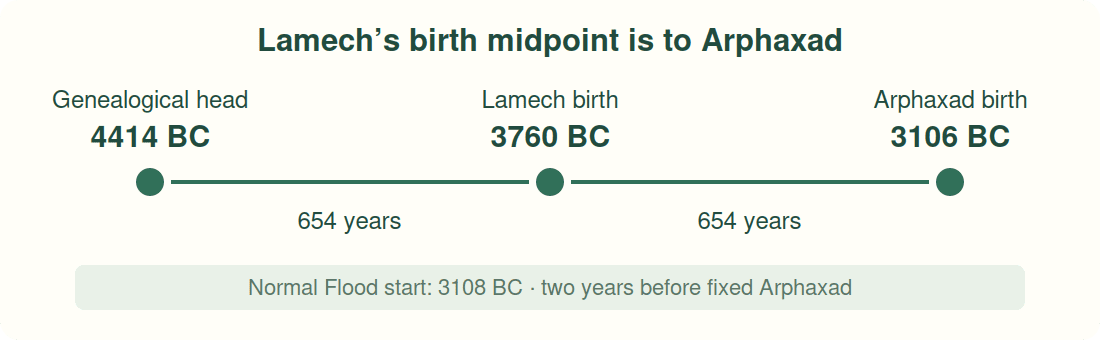
Lamech’s selected death remains at Flood start, 3108 BC. Subtraction from his birth gives 652 intervals; counting both endpoint years gives 653, the SP lifespan figure. That inclusive lifespan count does not give Lamech an adjacent companion birth date. His birth remains 3760 BC in the normal Gear.
The value of the reconstruction is the way its parts fit: Noah’s 600-year expression, the 600th-year reading, Shem’s related positions, Lamech’s inclusive count, and fixed Arphaxad can be stated together. Their arithmetic is exact under the declared conventions. The claim that the SP chronology deliberately coordinates those conventions is my structural interpretation of the figures.
The separate table appendix gives the three counting paths, native dates, Flood Gears, matched lifespans, and selected numerical comparisons, including the qualified Book of Jubilees parallels.
Scripture quotations: Berean Standard Bible (BSB), public domain. Berean Bible.