Detailed companion · Part 4c · 6 October 2026 · v1. This detailed study has its own address beneath the existing Flood introduction. The tables and original discussion are linked below.
Jacob’s service for his wives came in two seven-year periods. Noah waited seven days before sending the dove again, then waited another seven. This study follows the relationship between those two narratives into the chronology of the Exodus, the Conquest, and the exile. Its central question is how a small, stated interval can become the pattern for a much larger span.
Thus for twenty years I have served in your household—fourteen years for your two daughters and six years for your flocks—and you have changed my wages ten times!
Jacob’s words in Genesis 31:41, BSB give the starting structure: fourteen years for the two wives, followed by six for the flock. The resulting twenty years belong to his service with Laban in Haran/Paddan-aram. His return to Canaan comes afterward.
The dove’s two seven-day waits are stated in Genesis 8:10–12, BSB. Connecting them with Jacob’s two seven-year periods is an interpretive step. The proposed relationship becomes clearer when the biblical counts, reconstructed dates, and symbolic projections are shown separately.
This is the detailed companion for Part 4c of the Day–Year Studies. Part 4a develops the Flood’s sequence and calendar construction; Part 4b develops the seasonal columns and Mirror comparisons. Here the focus is Jacob and the patterns that grow from those columns. Full tables and source notes preserve the additional Flood, Creation, calendar, and residual-expansion research. The unchanged original discussion is linked at the end.
1. The sevens in Jacob’s life
The numerical argument begins with a life whose main divisions can be derived without altering its stated length. Genesis 47:28, BSB gives Jacob’s lifespan as one hundred forty-seven years. Calculated in digits, that is:
147 = 3 × 49 = 3 × 7 × 7.
The regular chronology places his birth at 2006 BC and death at 1859 BC. The reconstructed flight to Haran at age 77 divides that life into 77 + 70 years. His final seventy years then divide into twenty years of service and fifty years after his return. The age at flight is derived from the family chronology; Genesis does not print “77” beside the flight narrative.
| Division | Regular chronology | Length | Basis |
|---|---|---|---|
| Birth to flight from Esau | 2006 → 1929 BC | 77 years | Family chronology reconstructed from Jacob and Joseph’s ages |
| First seven years of service | 1929 → 1922 BC | 7 years | Genesis 29:18–20 |
| Second seven years of service | 1922 → 1915 BC | 7 years | Genesis 29:27–30; service after receiving Rachel |
| Service for the flock | 1915 → 1909 BC | 6 years | Genesis 31:41 |
| Return to Canaan to death | 1909 → 1859 BC | 50 years | Twenty-year service and the family chronology |
| Flight to death | 1929 → 1859 BC | 70 years | 20 + 50 |
| Whole life | 2006 → 1859 BC | 147 years | 77 + 70; Genesis 47:28 |
Accessible text and image downloads
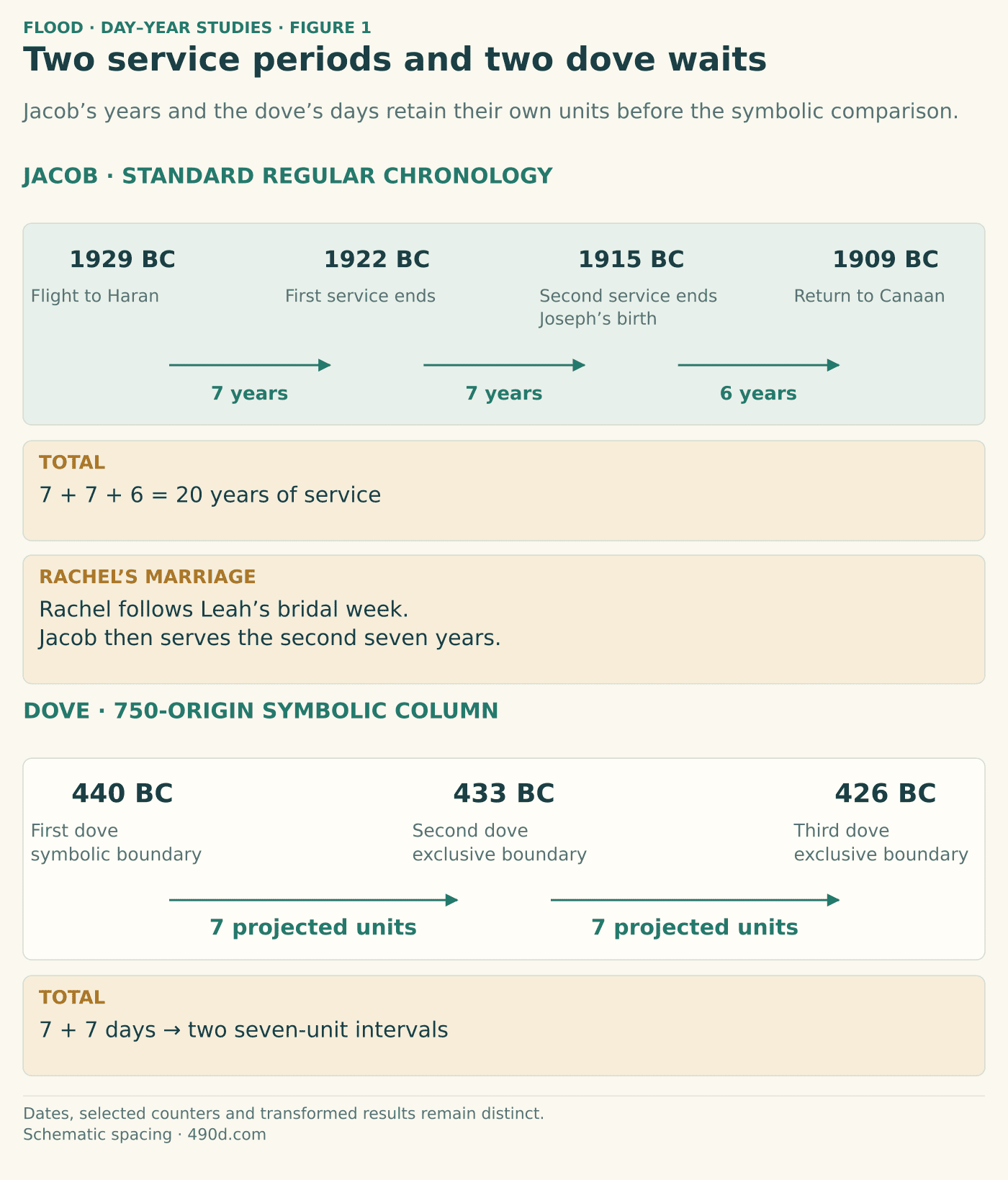
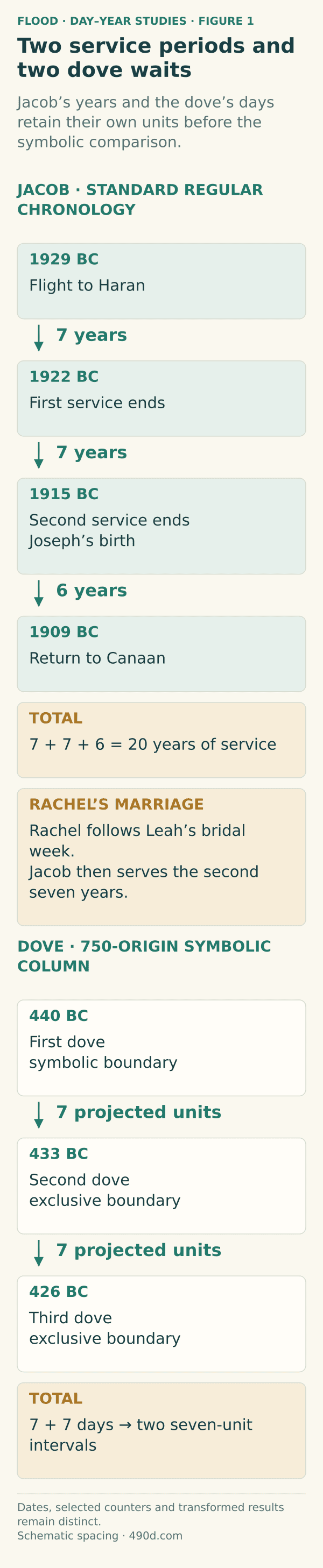
Jacob’s regular service rail runs from flight in 1929 BC to the first service ending in 1922, second service ending and Joseph’s birth in 1915, and return in 1909. Its intervals are seven, seven and six years. Rachel is received after Leah’s bridal week, before the second service ends. A separate symbolic dove rail runs 440 to 433 to 426 BC, with two seven-unit intervals derived from seven-day waits. The dove labels are projected coordinates using exclusive elapsed counting, not historical Flood dates.
Desktop PNG · Phone PNG · Desktop WebP (ZIP) · Phone WebP (ZIP) · Text-based SVG (ZIP) · Figure data CSV (data ZIP)
Full table and calculation · Scripture: Genesis 31:41; twenty-year service (BSB) · Genesis 47:28; lifespan (BSB) · Genesis 29:21–25 (BSB) · Genesis 29:27–30; bridal week and second service (BSB) · Genesis 31:41 (BSB) · Genesis 30:25; Joseph’s birth before return request (BSB) · Genesis 8:10–12 (BSB) · Genesis 8:10–12; symbolic coordinates are model selections (BSB)
There is an important distinction within the marriage story. Jacob receives Leah after the first seven years; after fulfilling Leah’s bridal week he receives Rachel, and then serves the second seven years. The second service period is therefore not a seven-year postponement of his marriage to Rachel. Genesis expressly records one bridal week in this sequence. The proposed correspondence of two wedding weeks to two service periods belongs to the interpretation, rather than to a second expressly dated wedding week in the text.
Other sevens surround the family. Joseph interprets the seven years of plenty and seven of famine (Genesis 41:29–30, BSB); Jacob’s household enters Egypt after two famine years (Genesis 45:6, BSB). The Egyptians mourn Jacob for seventy days (Genesis 50:3, BSB). In the regular chronology Levi’s death at 1782 BC falls seventy-seven years after Jacob’s death at 1859 BC. These are different kinds of evidence—stated durations, derived biography dates, and a chronological comparison—but together they explain why Jacob is a useful center for this study.
The controlled Jacob and Levi dates are set out in File 04, with Joseph’s chronology in File 03 and the broader tables in File 18. They retain Joshua’s regular lifespan of 1476–1366 BC. The Conquest begins at 1406 BC; its completion and the land’s rest belong to the 1400–1399 BC transition. The figure 1399 BC used below is the selected rest boundary, not Joshua’s death.
2. Three sojourn settings, one unchanged lifespan
The original study compares three ways of allocating the sojourn before the same primary Exodus anchor, 1446 BC. They must be identified by their actual textual and interpretive basis.
The MT wording of Exodus 12:40, BSB supports the repository’s primary 430-years-in-Egypt arrangement. The SP explicitly includes the fathers and Canaan; the LXX wording also includes Canaan. A combined Canaan-and-Egypt reading permits the familiar 215 + 215 reconstruction. The LXX also permits the repository’s 33 + 397 family-unit interpretation: thirty-three years in Canaan after Jacob’s return from Haran, followed by 397 in Egypt. Neither “215” nor “397” is printed as the Egypt total in Exodus 12:40.
| Working setting | Start of the 430-year sojourn | Jacob’s entry into Egypt | Egypt to Exodus | Treatment of Jacob’s dates |
|---|---|---|---|---|
| Primary regular MT / full Egypt | Jacob enters Egypt, 1876 BC | 1876 BC | 430 years | Standard biography |
| Comparative minimum / 215 Egypt | Abraham’s call, 1876 BC | 1661 BC | 215 years | Standard Jacob dates translated 215 years later |
| Localized LXX / 33 + 397 | Jacob returns to Canaan, 1876 BC | 1843 BC | 397 years | Standard Jacob dates translated 33 years later |
The repeated 1876 BC label therefore identifies three different event nodes: Jacob’s entry, Abraham’s call, or Jacob’s return. A shared label makes a comparison possible; it does not make those events identical.
In the family-unit reading, Jacob returns from Haran at age 97 = 77 + 20, then enters Egypt at age 130. This supplies the thirty-three-year Canaan interval:
130 − 97 = 33; 430 − 33 = 397.
File 04 §2 controls this interpretation and records its independent scholarly precedent in J. Barton Payne. The Canon localizes the −33 corridor from Terah through the Jacob/Levi family; it does not automatically shift Noah or Creation. The −215 comparison is a different operation. Keeping those operations separate is essential to the examples that follow.
| Jacob-family event | Standard regular | Comparative −215 | Localized LXX −33 |
|---|---|---|---|
| Jacob’s birth | 2006 BC | 1791 BC | 1973 BC |
| Flight to Haran | 1929 BC | 1714 BC | 1896 BC |
| End of first seven-year service | 1922 BC | 1707 BC | 1889 BC |
| End of second seven-year service / Joseph’s birth | 1915 BC | 1700 BC | 1882 BC |
| Return from Haran | 1909 BC | 1694 BC | 1876 BC |
| Entry into Egypt | 1876 BC | 1661 BC | 1843 BC |
| Jacob’s death | 1859 BC | 1644 BC | 1826 BC |
| Levi’s death | 1782 BC | 1567 BC | 1749 BC |
Accessible text and image downloads
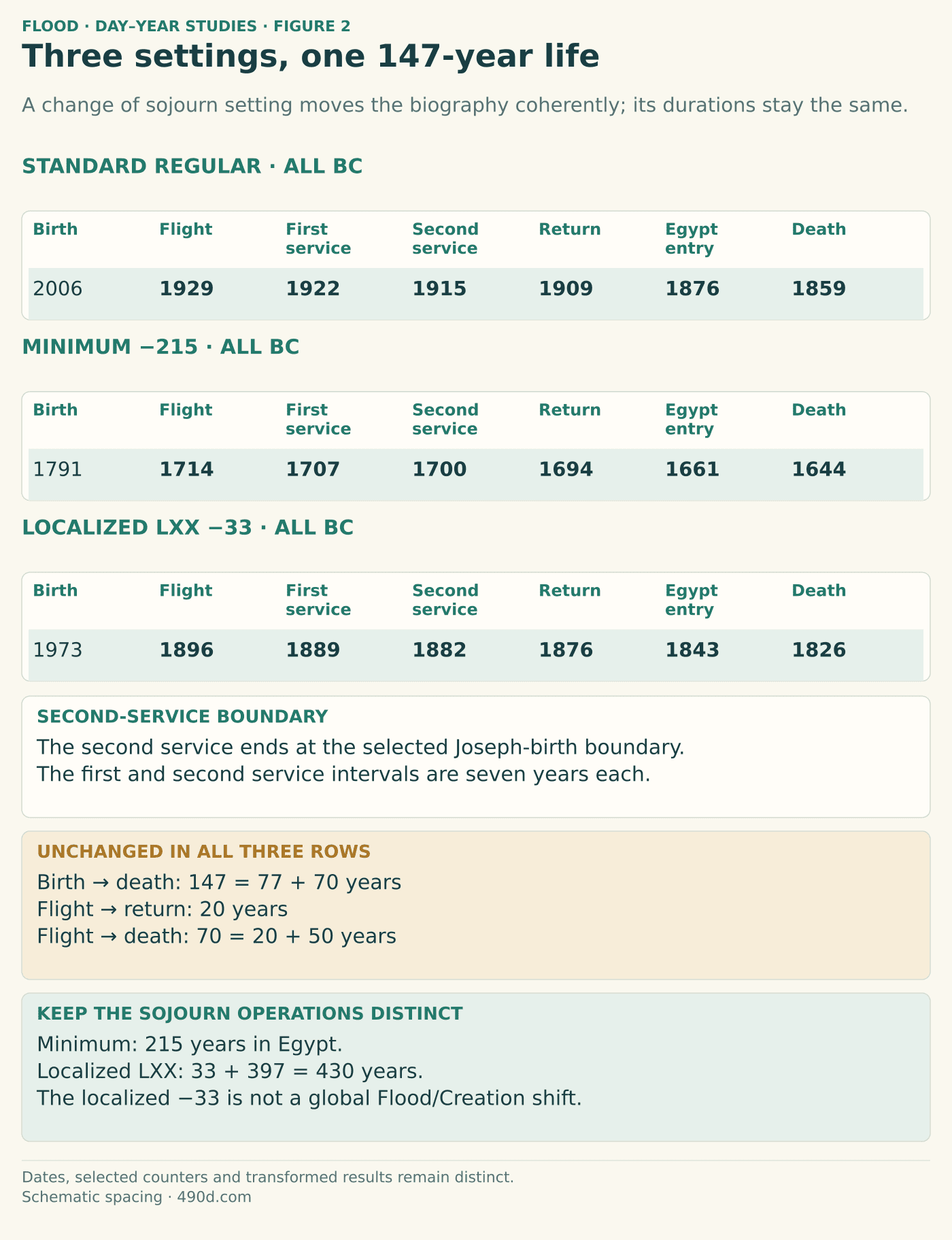
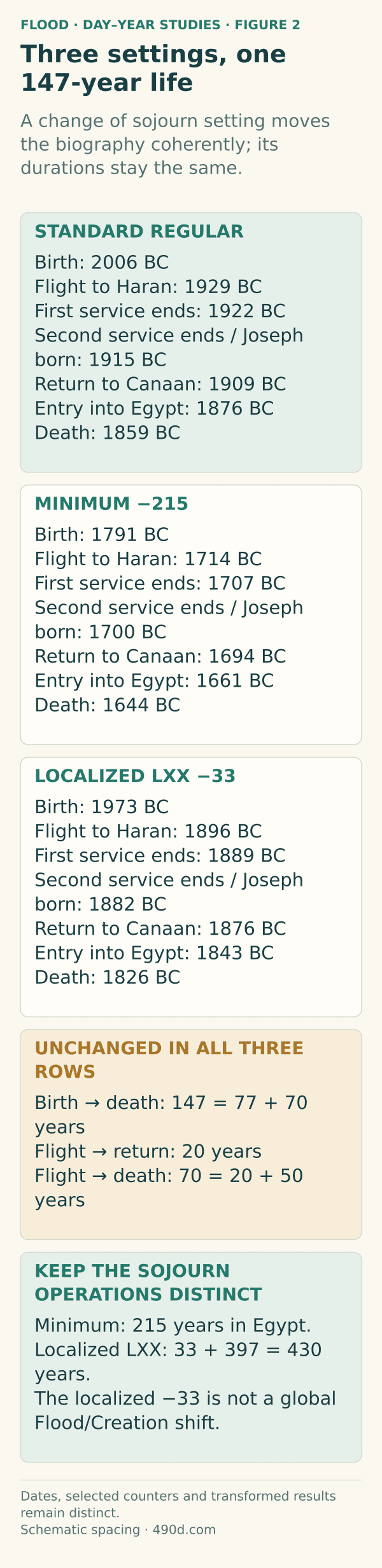
Three complete Jacob biography rows share the same events: birth, flight to Haran, end of first service, end of second service and Joseph’s birth, return to Canaan, entry into Egypt and death. Standard regular dates are 2006, 1929, 1922, 1915, 1909, 1876 and 1859 BC. Minimum minus 215 dates are 1791, 1714, 1707, 1700, 1694, 1661 and 1644 BC. Localized LXX minus 33 dates are 1973, 1896, 1889, 1882, 1876, 1843 and 1826 BC. Each lifespan is 147 years and each flight-to-death interval is 70.
Desktop PNG · Phone PNG · Desktop WebP (ZIP) · Phone WebP (ZIP) · Text-based SVG (ZIP) · Figure data CSV (data ZIP)
Full table and calculation · Scripture: Genesis 31:41; twenty-year service (BSB) · Genesis 47:28; lifespan (BSB) · Genesis 30:25; Joseph’s birth before return request (BSB) · Genesis 31:17–21; model date is reconstructed (BSB) · Genesis 46:1–7; chronology date is reconstructed (BSB) · Exodus 12:40–41; BSB is MT-derived; LXX interpretation is discussed separately (BSB)
Each chronology setting preserves Jacob’s 147-year lifespan; every flight-to-death span preserves seventy. Likewise Levi’s lifespan remains 137 years. Choosing a different sojourn setting moves a coherent set of dates. It does not shorten anyone’s life.
The four MT Flood placements used later arise from two other declared choices: full-Egypt versus comparative −215, and the independent +60 Terah harmonization of Genesis 11–12 with Acts 7:4. In the selected Gear 2 Nisan state they are 2458, 2518, 2243, and 2303 BC. These are MT-based comparison states; they are not a list of the native SP or LXX Flood dates. The source tables retain those traditions separately.
3. The dove’s two weeks in the symbolic Flood table
The Flood study maps days to symbolic year labels. Its four origin labels are 720, 750, 900, and 930 BC. The second is thirty years earlier than the first; the third is 180 earlier; the fourth combines both changes. These labels belong to the projection, not to a claim that the historical Flood occurred in those centuries.
The underlying calendar model keeps a 360-day core and declares whether a leap month is included. A Nisan/Tishri change translates the symbolic datum by half a core year, 180 days → 180 projected years. The projected morning/evening phase is a further model convention. Genesis records the dove’s evening return, but does not supply a clock time for every bird’s release.
| Dove event | 720-origin column | 750-origin column | 900-origin column | 930-origin column |
|---|---|---|---|---|
| First release | 410 BC | 440 BC | 590 BC | 620 BC |
| Second release: exclusive elapsed boundary | 403 BC | 433 BC | 583 BC | 613 BC |
| Second release: inclusive seventh-day label | 404 BC | 434 BC | 584 BC | 614 BC |
| Third release: exclusive elapsed boundary | 396 BC | 426 BC | 576 BC | 606 BC |
| Third release: inclusive seventh-day label | 397 BC | 427 BC | 577 BC | 607 BC |
In the exclusive elapsed register the first column is 410 → 403 → 396, giving 7 + 7. Counting the start as day one instead labels the seventh day at 404; the fourteen-day sequence ends at the corresponding inclusive label 397. Both conventions must keep their own counting rule. The adjacent labels do not mean that a seven-day interval has become one day long.
The broader week-unit is also useful. A narrative date can intersect a seven-day window, while a precise elapsed-day calculation selects one boundary inside that construction. This is the same distinction used in the Ezekiel studies between a unit-week and its particular dated day. The chosen boundary is stated in each equation below.
Across a single exclusive row the outer spread is 210 = 30 + 180 = 3 × 70 projected years. For example, 620 − 410 = 210. That stable spacing explains why shifting between columns can preserve multiples of seven when the Jacob dates are brought into the comparison.
The full Flood grid also includes the Creation anniversary, entry into the Ark, outbreak, rain’s end, Ark’s resting, visible mountain tops, uncovered surface, and departure. Its rows are retained for checking the argument. The fuller explanation of their construction remains in Part 4a and Part 4b.
4. Jacob’s standard chronology and the outer dove columns
Two initial comparisons place Jacob’s life against the first and third dove releases. They use standard biography dates and the 720-origin exclusive symbolic boundaries.
| Comparison | Calculation | Span | Selected expansion |
|---|---|---|---|
| Jacob’s birth → third dove | 2006 − 396 | 1610 = 23 × 70 | 1610 × 25/23 = 1750 |
| Jacob’s death → first dove | 1859 − 410 | 1449 = 3 × 483 | 1449 × 70/69 = 1470 |
The first expansion adds 140 = 70 + 70; the second adds 21 = 7 + 7 + 7. This is the numerical connection between the Key of 23 and the sevens already surrounding Jacob. The raw spans and the expanded spans remain separate entries: 1610 does not become 1750 actual elapsed years.
The outer columns add two further checks:
| Comparison | Calculation | Result |
|---|---|---|
| Birth → third dove, 930-origin exclusive boundary | 2006 − 606 | 1400 = 2 × 700 |
| Death → first dove, 930-origin boundary | 1859 − 620 | 1239 = 7 × 177 |
Both are 210 shorter than the corresponding 720-origin spans. The original argument thus links a biography divided by sevens with Flood columns divided by sevens. These equations are exact within their stated coordinates; the proposed narrative meaning is that the dove’s approach to rest echoes Jacob’s passage through labor toward the promised land.
An additional phase comparison can be opened if Jacob’s blessing of Joseph’s sons is assigned a hypothetical 1860t BC position, half a year before his 1859n BC death, and the raven a 411t BC symbolic position before the 410n BC dove. The like-phase difference is again 1449. Genesis 48–49 does not date those blessings six months apart, so this is a retained phase hypothesis, not an established date of Jacob’s first blessing. The phase table shows the conditional arithmetic.
5. The −215 comparison: 1260 and 1274
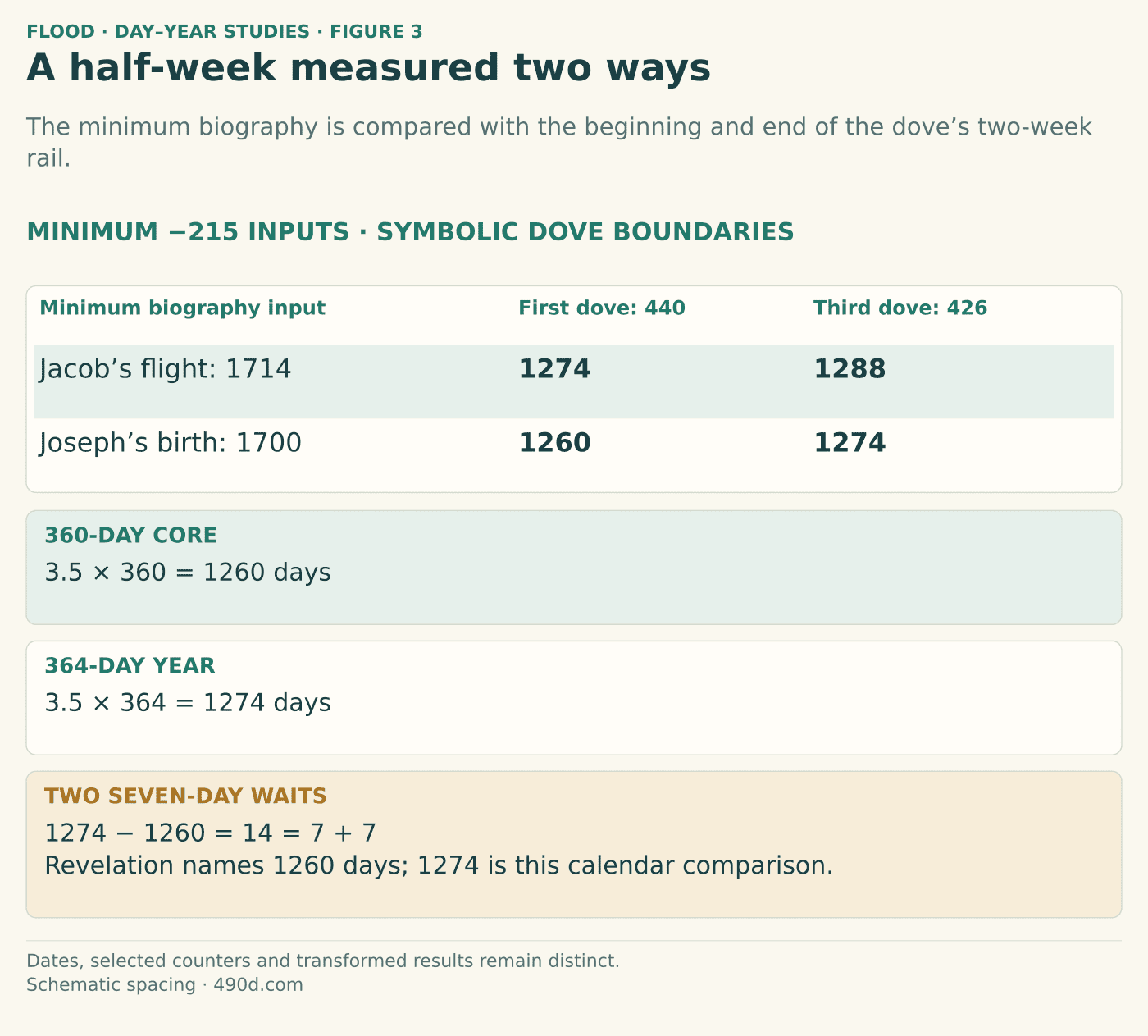
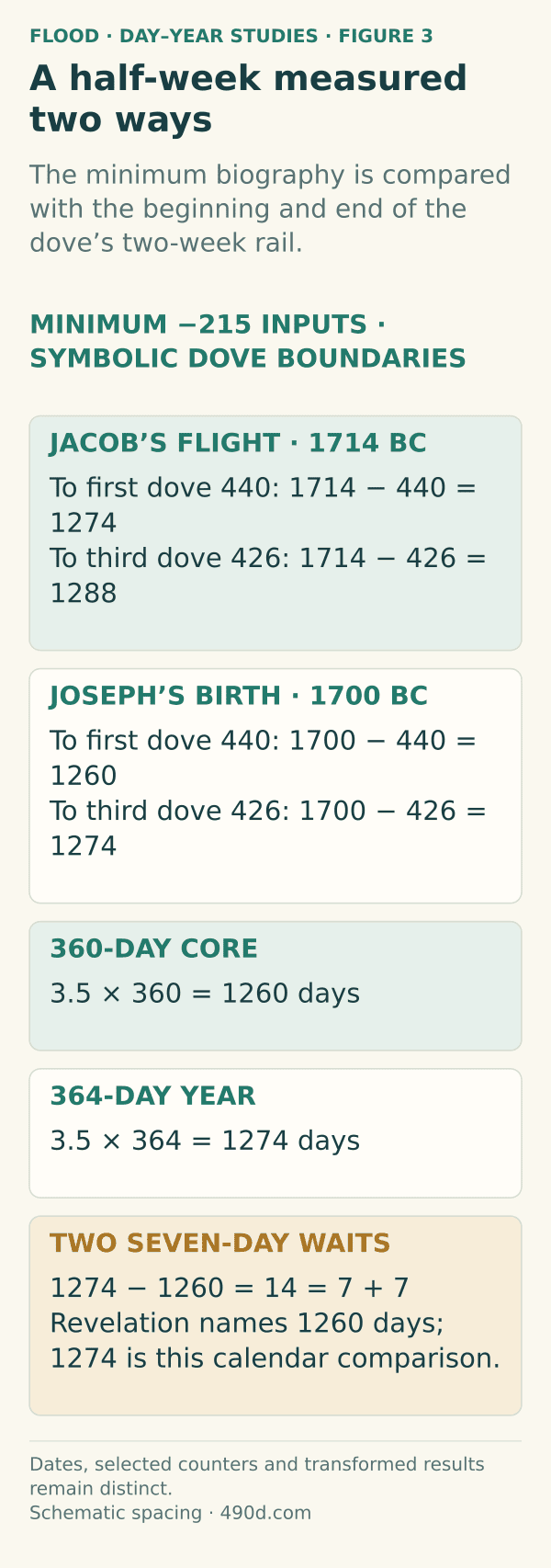
The comparative −215 setting places Jacob’s service boundaries at 1714, 1707, and 1700 BC, with Joseph’s birth at the last boundary. Against the 750-origin dove row, all three like-position differences are 1274:
| Service boundary | Corresponding dove boundary | Difference |
|---|---|---|
| Flight/start of service, 1714 BC | First dove, 440 BC | 1274 |
| End of first service, 1707 BC | Second dove, 433 BC | 1274 |
| End of second service, 1700 BC | Third dove, 426 BC | 1274 |
This preserves the 7 + 7 spacing of both sequences. It does not assert that 1714 BC is 1274 years from every dove release; the crossed differences are different.
Joseph’s birth supplies the complementary pair:
1700 − 440 = 1260; 1700 − 426 = 1274.
Accessible text and image downloads
A two-by-two comparison uses minimum-state Jacob flight at 1714 BC and Joseph’s birth at 1700 BC against symbolic first dove at 440 and third dove at 426. Flight to first dove equals 1274, flight to third equals 1288, birth to first equals 1260 and birth to third equals 1274. Three and a half times the 360-day core equals 1260; three and a half times the 364-day year equals 1274. The difference is fourteen, the two seven-day waits.
Desktop PNG · Phone PNG · Desktop WebP (ZIP) · Phone WebP (ZIP) · Text-based SVG (ZIP) · Figure data CSV (data ZIP)
Full table and calculation · Scripture: Genesis 28:1–5; chronology date is reconstructed (BSB) · Genesis 30:25; chronology date is reconstructed (BSB) · Genesis 8:8–9; selected symbolic boundary (BSB) · Genesis 8:12; selected exclusive symbolic boundary (BSB) · Genesis 7:11; Genesis 8:3–4; calendar model inference (BSB) · Genesis 8:3–4 (BSB) · Genesis 1:14; calendrical background, not a biblical 364-day count (BSB)
The lengths have distinct calendar meanings:
3.5 × 360 = 1260 days; 3.5 × 364 = 1274 days.
Their difference is 14 = 7 + 7. In the interpretation, a half-week measured by the 360-day core and a half-week measured by the 364-day year reach the beginning and end of the dove’s two-week sequence. This is an exact comparison of stipulated year lengths. It does not claim that Revelation explicitly supplies 1274 days; Revelation’s stated period is 1260 (Revelation 11:3, BSB).
The same minimum chronology places the plenty and famine boundaries at 1670 → 1663 → 1656 BC. Pairing them with 410 → 403 → 396 BC gives 1260 in each position:
1670 − 410 = 1663 − 403 = 1656 − 396 = 1260.
Levi’s death supplies another connection. In this setting 1644 − 1567 = 77 separates Jacob’s death from Levi’s. From Levi’s death to the Conquest is 1567 − 1406 = 161 = 23 × 7; to the 750-origin first dove it is 1567 − 440 = 1127 = 23 × 7 × 7. These preserve the source’s extended Jacob–Levi argument without transferring minimum-state dates into the standard biography.
6. The localized −33 comparison: service and Conquest
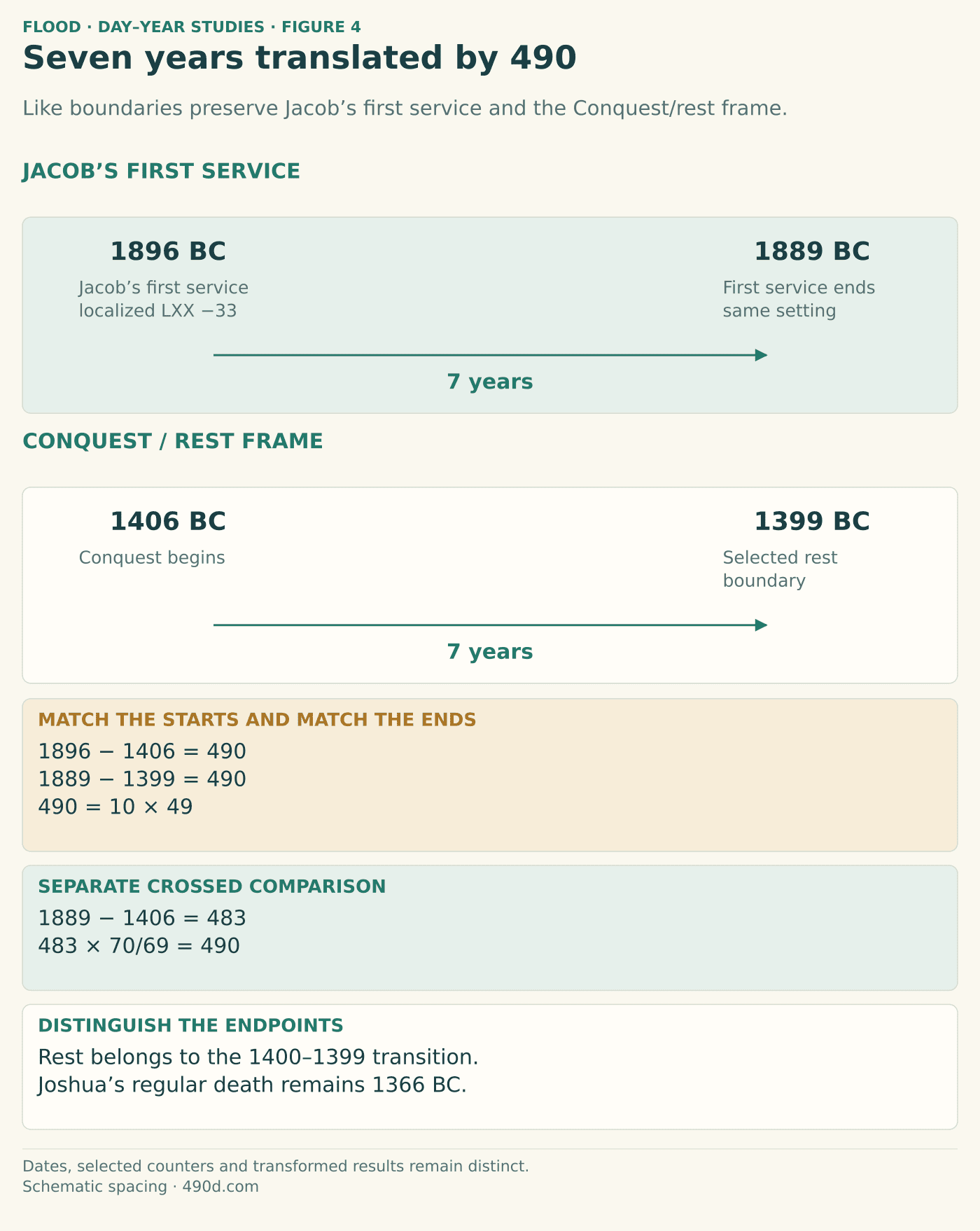
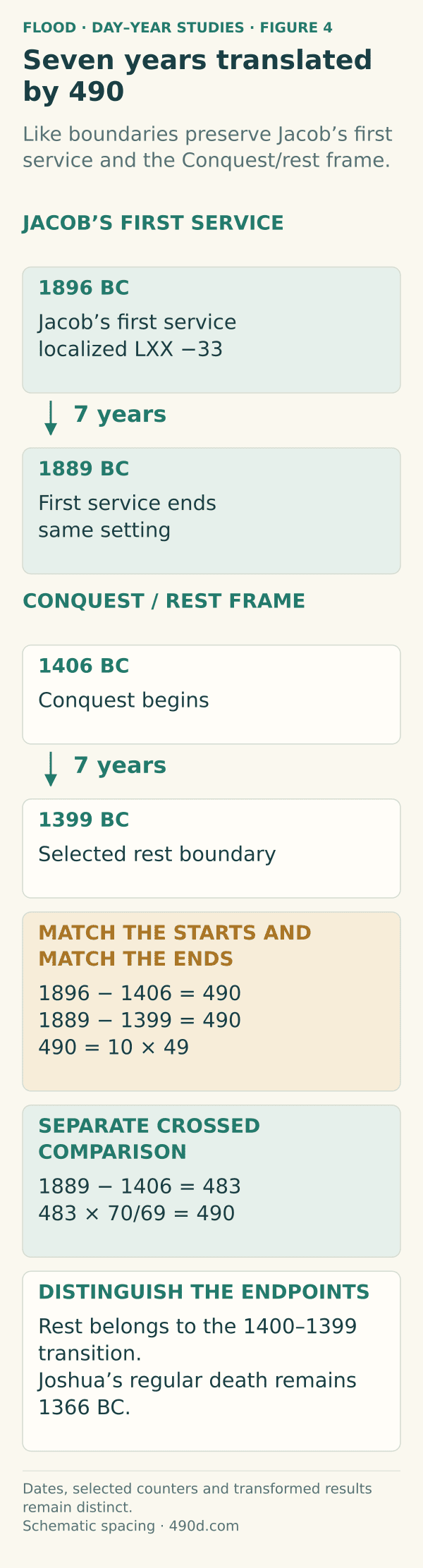
The LXX family-unit setting places Jacob’s first service at 1896 → 1889 BC, with the second ending at 1882. It then puts his return to Canaan at 1876, Egypt entry at 1843, and death at 1826. The return and Egypt entry are thirty-three years apart; Egypt entry and Exodus are 397 apart.
Its most direct Conquest comparison is:
| Jacob’s service boundary | Land boundary | Same-side span |
|---|---|---|
| First service begins, 1896 BC | Conquest begins, 1406 BC | 490 years |
| First service ends, 1889 BC | Selected rest boundary, 1399 BC | 490 years |
Accessible text and image downloads
Two parallel seven-year rails run from Jacob’s localized first service beginning in 1896 BC to its end in 1889 BC, and from Conquest beginning in 1406 BC to selected land-rest boundary in 1399 BC. Matching each start and end gives 490 years. The crossed comparison from 1889 to 1406 equals 483; 483 times 70 divided by 69 equals 490. The selected 1399 BC rest boundary does not replace Joshua’s death in 1366 BC.
Desktop PNG · Phone PNG · Desktop WebP (ZIP) · Phone WebP (ZIP) · Text-based SVG (ZIP) · Figure data CSV (data ZIP)
Full table and calculation · Scripture: Genesis 29:18–20; service count, not a printed BC date (BSB) · Joshua 4:19; entry calendar reference (BSB) · Joshua 11:23 (BSB) · Joshua 14:7–10; chronology reconstruction inputs (BSB) · Joshua 24:29; lifespan, not a printed BC date (BSB)
The seven-year service interval and the seven-year Conquest/rest interval share the same translation, 490 = 10 × 49. The crossed span 1889 − 1406 = 483 = 69 × 7 supplies the related Key-of-23 form:
483 × 70/69 = 490.
The standard flight gives a different, equally explicit comparison: 1929 − 1446 = 483 to the Exodus. Moving to the localized −33 flight at 1896 and moving the endpoint from Exodus to Conquest at 1406 changes the span by seven:
483 − 33 + 40 = 490.
Here the forty-year wilderness interval and the thirty-three-year sojourn adjustment account for the difference. The interpretation links Jacob’s labor for a wife with Israel’s delayed arrival and struggle for the land. Numbers 14 presents the delay in relation to Israel’s unbelief. The larger theological reading is that divine purpose can remain coherent through human failure and delay; the arithmetic supplies the comparison, while the narrative supplies its meaning.
The dove comparison survives in a third measure. Matching 1896, 1889, 1882 with 440, 433, 426 gives 1456 = 4 × 364 three times. The localized rail is 182 = 26 × 7 = 364/2 earlier than the minimum rail: for example, 1896 − 1714 = 182. Thus 1274 + 182 = 1456. The two settings produce different spans while retaining the same ordered seven-year boundaries.
7. Jacob’s final seventy years and the exile/restoration rail
The localized −33 biography has a final seventy-year sequence:
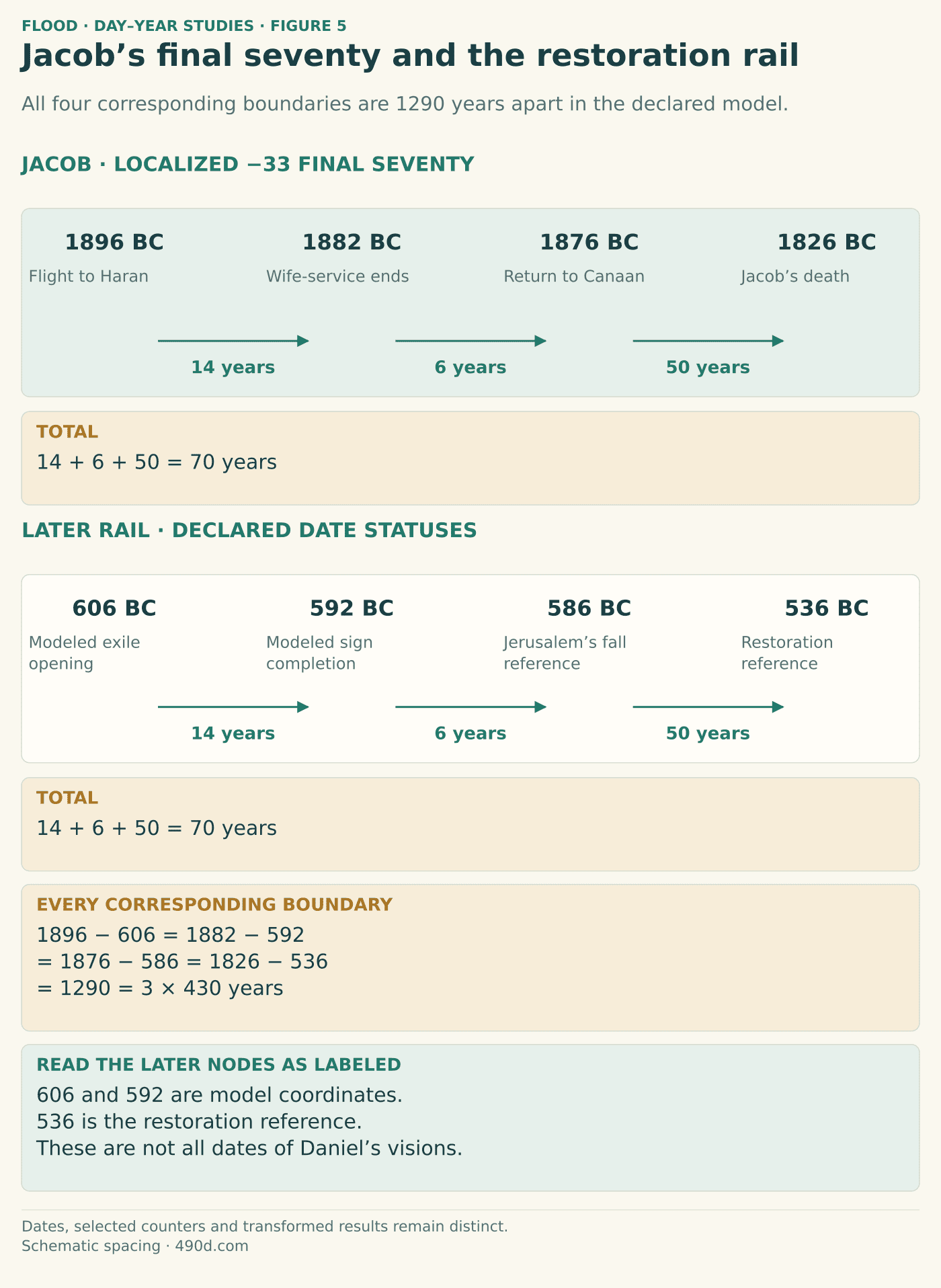
1896 → 1882 → 1876 → 1826 BC = 14 + 6 + 50 years.
Translating every coordinate by 1290 = 3 × 430 yields:
606 → 592 → 586 → 536 BC = 14 + 6 + 50 years.
| Jacob-family boundary, localized −33 | Corresponding later coordinate | Difference | Status of the later coordinate |
|---|---|---|---|
| Flight/start of service, 1896 BC | 606 BC | 1290 | Selected whole-year exile/servitude opening in the model |
| End of wife-service/start of flock-service, 1882 BC | 592 BC | 1290 | Modeled completion register for Ezekiel’s 430-day sign |
| Return to Canaan, 1876 BC | 586 BC | 1290 | Jerusalem’s fall/exile reference |
| Jacob’s death, 1826 BC | 536 BC | 1290 | Restoration/altar-and-rebuilding reference |
Accessible text and image downloads
Upper rail: localized Jacob flight in 1896 BC, wife-service ending in 1882, return to Canaan in 1876 and death in 1826. Lower rail: modeled exile opening in 606 BC, modeled Ezekiel sign-completion register in 592, Jerusalem’s fall in 586 and restoration in 536. Each rail is fourteen plus six plus fifty, totaling seventy years. Each matched boundary differs by 1290 years. The first two later nodes are model selections; the 536 endpoint is restoration.
Desktop PNG · Phone PNG · Desktop WebP (ZIP) · Phone WebP (ZIP) · Text-based SVG (ZIP) · Figure data CSV (data ZIP)

Full table and calculation · Scripture: Genesis 28:1–5; chronology date is reconstructed (BSB) · Genesis 31:41 (BSB) · Genesis 31:17–21; model date is reconstructed (BSB) · Genesis 47:28; lifespan (BSB) · Ezekiel 4:4–6; sign count, not a printed 592 BC completion date (BSB) · 2 Kings 25:8–10; fall reference (BSB) · Ezra 3:1–3; altar (BSB) · Ezra 3:8; rebuilding (BSB)
The outer 606 → 536 span is seventy years, matching Jacob’s 1896 → 1826 final seventy. The inner 20 + 50 partition is also preserved: twenty years from service’s start to return, then fifty to death, corresponding to twenty years from the model’s exile opening to Jerusalem’s fall, then fifty to restoration.
The 606 BC opening is a declared whole-year model coordinate. A 605 BC opening produces sixty-nine years to 536, and 19 + 50, not the unaltered 20 + 50 rail. The relationship 69 × 70/69 = 70 can be applied separately when that branch is selected. It is not a reason to call the two raw spans identical.
Likewise the 592 BC coordinate is associated with the modeled completion of Ezekiel’s 390 + 40 = 430 sign-days after his 593 BC call. Ezekiel states the sign’s day-for-year principle (Ezekiel 4:4–6, BSB); it does not separately date the completion in those words. The detailed call-to-completion calendar, unit-weeks, and intercalation handling belong to the Ezekiel studies. The present table preserves that proposed connection and identifies the kind of date it uses.
The 1876 BC row has two related applications. In the localized −33 setting it is Jacob’s return to Canaan. In the primary full-Egypt setting it is his entry into Egypt. Either declared starting node gives the numerical span 1876 − 586 = 1290; their shared label should not conceal the different events.
The Canon develops the underlying triple-430 lattice in File 64:
1876 → 1446 → 1016 → 586 BC = 430 + 430 + 430.
The 1016 BC Temple coordinate belongs to the schematic Kings duration ledger. The historical Temple commencement remains 966 BC. The separate historical comparison is 966 − 536 = 430. File 08 controls that distinction; the full tables preserve both routes.
Jacob, Daniel, and the shared restoration endpoint
Two further spans converge on the 536 BC restoration reference:
| Starting node | Calculation to 536 BC | Span |
|---|---|---|
| Standard Jacob birth, 2006 BC | 2006 − 536 | 1470 = 10 × 147 = 3 × 490 |
| Localized −33 Jacob death, 1826 BC | 1826 − 536 | 1290 = 3 × 430 |
These use different biography settings. The difference between their starting labels is 180 = 147 + 33; Jacob himself still lives 147 years in either coherent biography. The argument places a tenfold lifespan and a triple sojourn/sign-period against the same restoration endpoint.
Daniel’s seventy sevens supply the 490 framework (Daniel 9:24–27, BSB); Daniel 12:11 supplies 1290 days (BSB). Reading the latter as a corresponding year-span is the day–year interpretation used here. The biblical text says days, not “1290 years.” Nor should both visions be dated to 536 BC: Daniel 9 names Darius’s first year, whereas Daniel 10 introduces the later vision in Cyrus’s third year. The shared endpoint in these calculations is restoration, not a claim that Daniel received every relevant prophecy in the same year.
Jacob’s blessing of his sons concerning their future (Genesis 49:1, BSB) gives this comparison a narrative setting. Family promises, departure from the land, and eventual restoration become the themes through which the corresponding spans are interpreted.
The localized Levi date supplies the compact cubic comparison:
1826 − 1749 = 77; 1749 − 1406 = 343 = 7³.
Levi’s 1749 BC death is earlier than the Conquest by 343 years. The source’s “after the Conquest” phrasing is corrected here without losing the comparison.
8. Residual expansion: when the added years expose another span
The Key of 23 applies exact rational operators to selected spans:
23 → 25; 69 → 70; 299 → 300.
Thus 25/23, 70/69, and 300/299 are separate operators. A diagram must identify which endpoint stays fixed. Calling a span “expanded” without that information leaves the result ambiguous.
The term residual 23 describes a particular effect: an expanded span exposes a new interval divisible by 23 or 69, which can then be expanded in turn. The numerical sequence is not simply a repeated multiplication of one unchanged interval; an adjacent event or a different fixed anchor is introduced at each stage.
The seven-year additions from Jacob’s service
Begin with Jacob’s standard flight-to-Exodus comparison:
1929 − 1446 = 483; 483 × 70/69 = 490.
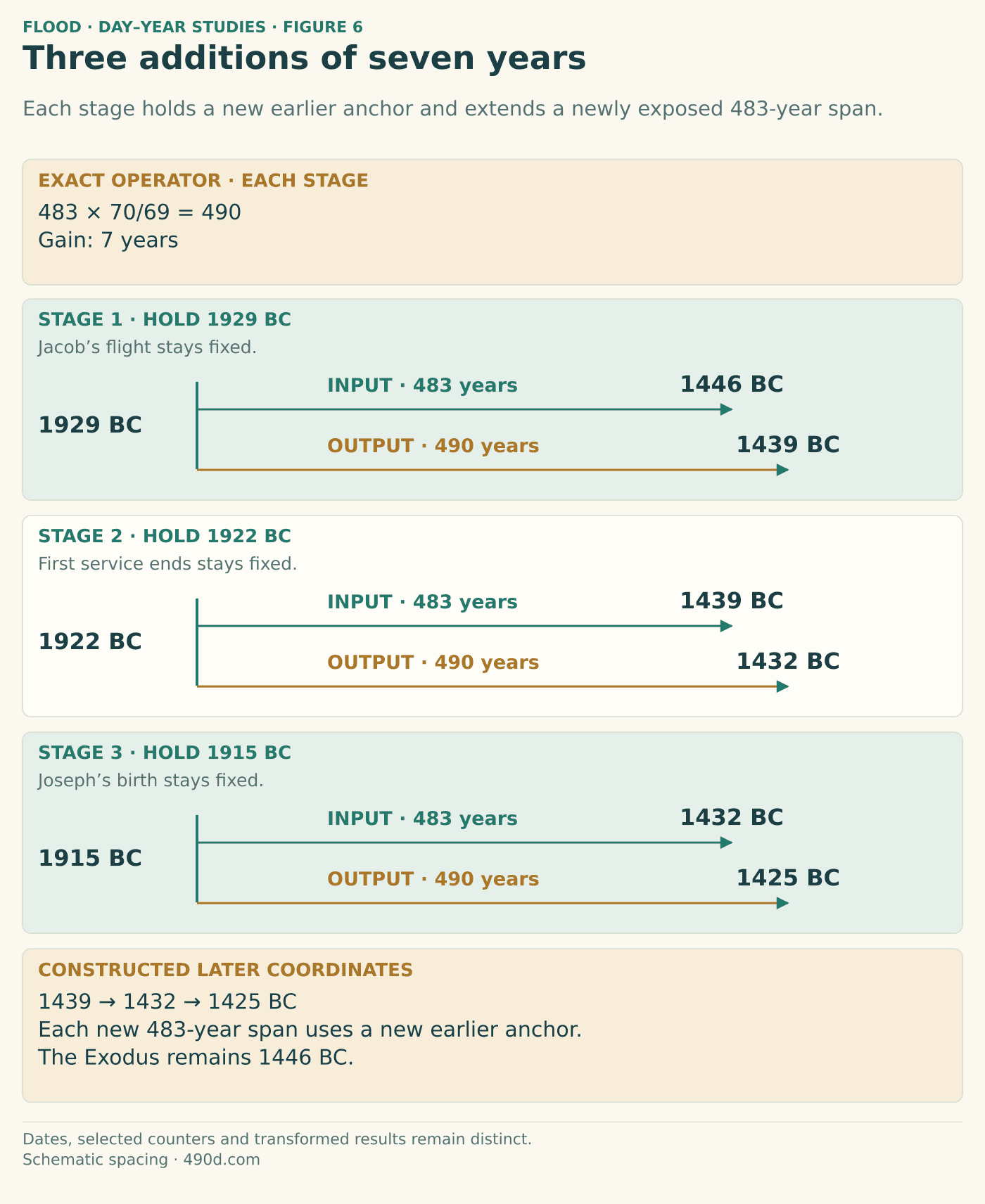
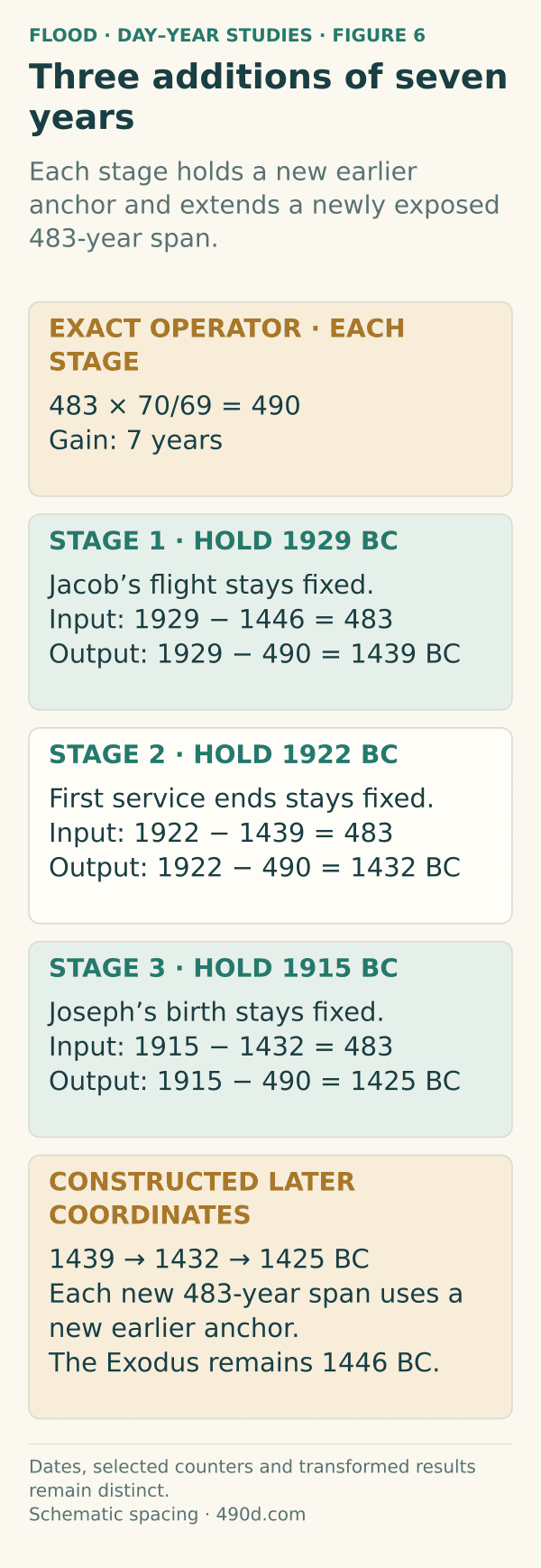
Hold the flight boundary at 1929 and extend the later endpoint seven years, producing the constructed coordinate 1439 BC. Jacob’s first service ends seven years later than the flight, at 1922. This new starting point is again 483 from the constructed later endpoint. Repeat with Joseph’s birth at 1915.
| Stage | Fixed earlier endpoint | Later endpoint before expansion | Input | Expanded length | New later endpoint |
|---|---|---|---|---|---|
| 1 | Flight, 1929 BC | Exodus, 1446 BC | 483 | 490 | 1439 BC |
| 2 | First service ends, 1922 BC | Constructed 1439 BC | 483 | 490 | 1432 BC |
| 3 | Second service ends / Joseph’s birth, 1915 BC | Constructed 1432 BC | 483 | 490 | 1425 BC |
Accessible text and image downloads
Stage one holds 1929 BC, Jacob’s flight: input endpoint 1446, length 483, expands by 70/69 to 490, output endpoint 1439 BC. Stage two holds 1922 BC, first service ends: input endpoint 1439, length 483, output length 490 and endpoint 1432. Stage three holds 1915 BC, Joseph’s birth: input endpoint 1432, length 483, output length 490 and endpoint 1425. Each gain is seven years and each output is a constructed coordinate.
Desktop PNG · Phone PNG · Desktop WebP (ZIP) · Phone WebP (ZIP) · Text-based SVG (ZIP) · Figure data CSV (data ZIP)
Full table and calculation · Scripture: Genesis 28:1–5; chronology date is reconstructed (BSB) · Genesis 29:18–20; service count, not a printed BC date (BSB) · Genesis 30:25; chronology date is reconstructed (BSB) · Exodus 12:40–41; duration and departure (BSB) · Genesis 29:18–20; narrative interval, not the fractional operator (BSB)
The constructed 1432 and 1425 coordinates are outputs of the residual model; no new dated narrative event is asserted at either. The 1439 partition also occurs in the Canon’s separate Conquest structure, but that wider structure needs its own stated anchors and does not turn 1439 into the Exodus date.
The forty-year additions from the covenant comparison
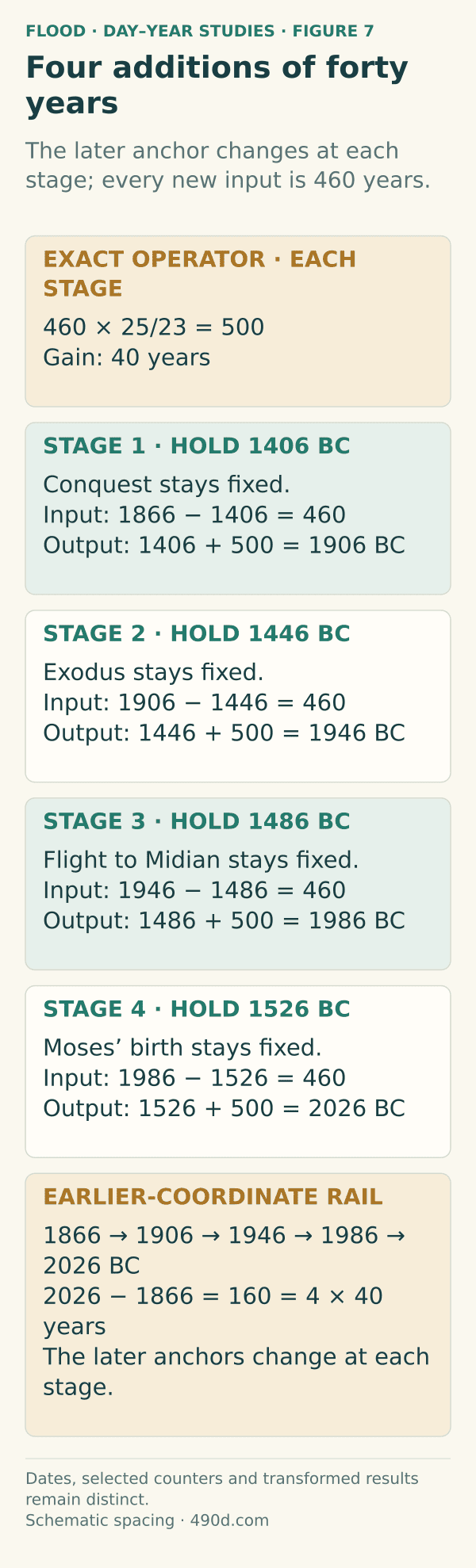
The comparative −215 chronology places the covenant-of-pieces comparison at 1866 BC, ten years after the call at 1876. Genesis 15 does not print Abraham’s age at that covenant; the table uses the repository’s selected covenant placement.
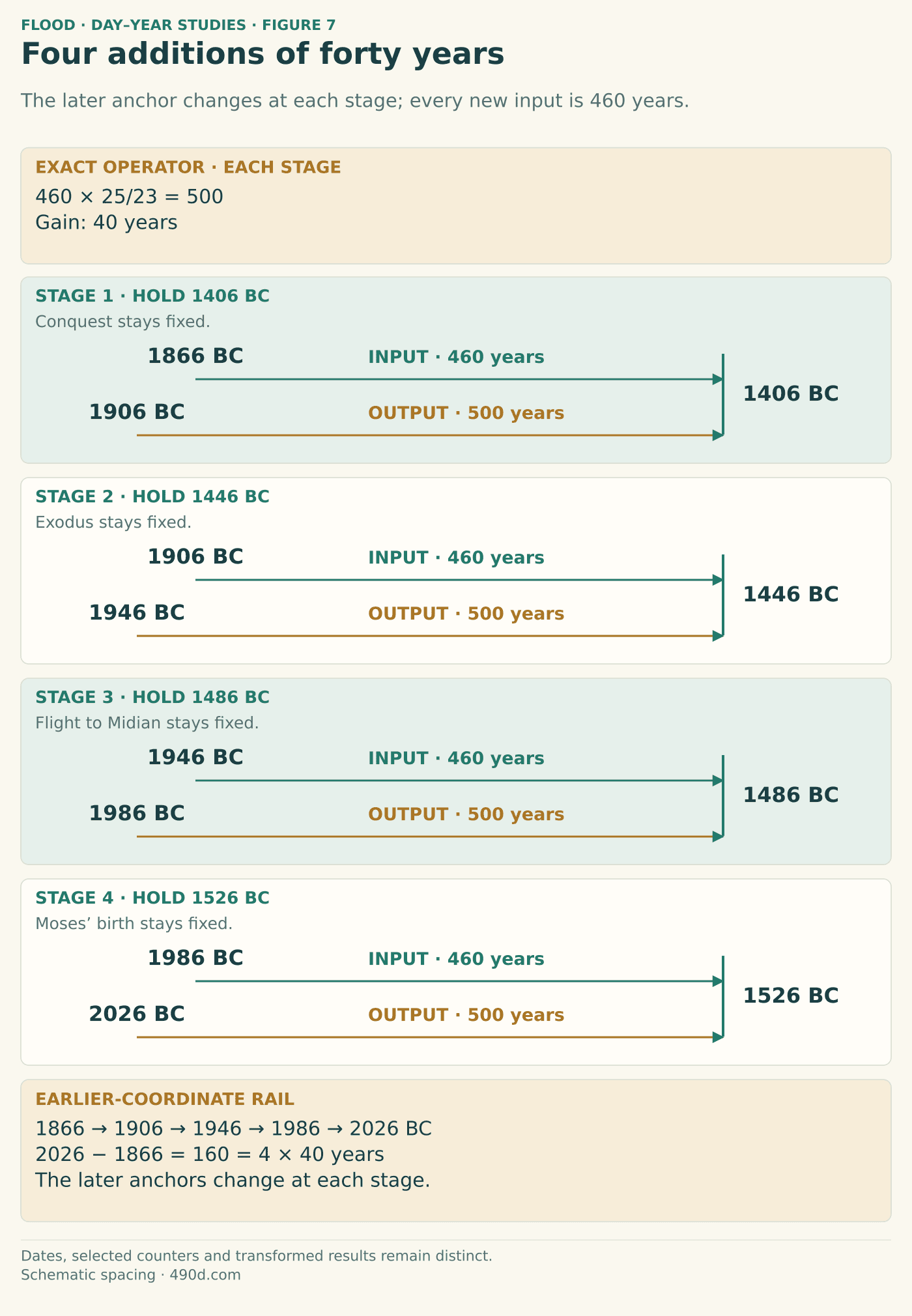
To the Conquest this gives 1866 − 1406 = 460, expanding to 500 by 25/23. Holding the Conquest fixed moves the earlier coordinate to 1906. Changing the later anchor to the Exodus makes another 460-year input possible. The process then uses Moses’ flight and birth.
| Stage | Input earlier coordinate | Fixed later anchor | Input length | Output length | New earlier coordinate |
|---|---|---|---|---|---|
| 1 | Covenant comparison, 1866 BC | Conquest, 1406 BC | 460 | 500 | 1906 BC |
| 2 | Constructed 1906 BC | Exodus, 1446 BC | 460 | 500 | 1946 BC |
| 3 | Constructed 1946 BC | Moses’ flight to Midian, 1486 BC | 460 | 500 | 1986 BC |
| 4 | Constructed 1986 BC | Moses’ birth, 1526 BC | 460 | 500 | 2026 BC |
Accessible text and image downloads
Four stages apply 460 times 25/23 equals 500, with the later endpoint held fixed each time. Stage one: earlier 1866 BC, held Conquest 1406, output earlier 1906. Stage two: earlier 1906, held Exodus 1446, output earlier 1946. Stage three: earlier 1946, held Moses’ flight 1486, output earlier 1986. Stage four: earlier 1986, held Moses’ birth 1526, output earlier 2026. Each added interval is forty years; the earlier output rail spans 160 years.
Desktop PNG · Phone PNG · Desktop WebP (ZIP) · Phone WebP (ZIP) · Text-based SVG (ZIP) · Figure data CSV (data ZIP)
Full table and calculation · Scripture: Genesis 15:13–16; selected chronology placement (BSB) · Joshua 4:19; entry calendar reference (BSB) · Exodus 12:40–41; duration and departure (BSB) · Acts 7:23–29; age and flight (BSB) · Deuteronomy 34:7; lifespan input for reconstructed birth (BSB) · Genesis 15:16; fourth generation, not the fractional operator (BSB)
Each step adds forty. The complete earlier-coordinate rail is 1866 → 1906 → 1946 → 1986 → 2026 BC, a spread of 160 = 4 × 40 years. The comparison echoes the fourth generation of the covenant promise (Genesis 15:16, BSB). That verse says the descendants will return in the fourth generation; the four-stage construction here interprets that promise numerically.
The source also places this residual rail across the BC–AD axis. Under the astronomical single-node reflection defined in the Mirror tables, constructed 1866 BC reflects to AD 1865, and the like-position comparisons with 1566, 1526, 1486, 1446, and 1406 BC give 3430 = 70 × 49. Here 1566 is a constructed companion forty years before Moses’ birth. Ordinary own-year AD labels give 3431 instead. This distinction is retained rather than silently adjusting every AD label in the article.
9. The Flood’s 69-squared Mirror comparison
The four MT-based Flood placements also contain a squared-span relationship. It needs the Canon’s paired seasonal Mirror, not a blanket rule that every reflected date loses one year.
The paired rule is:
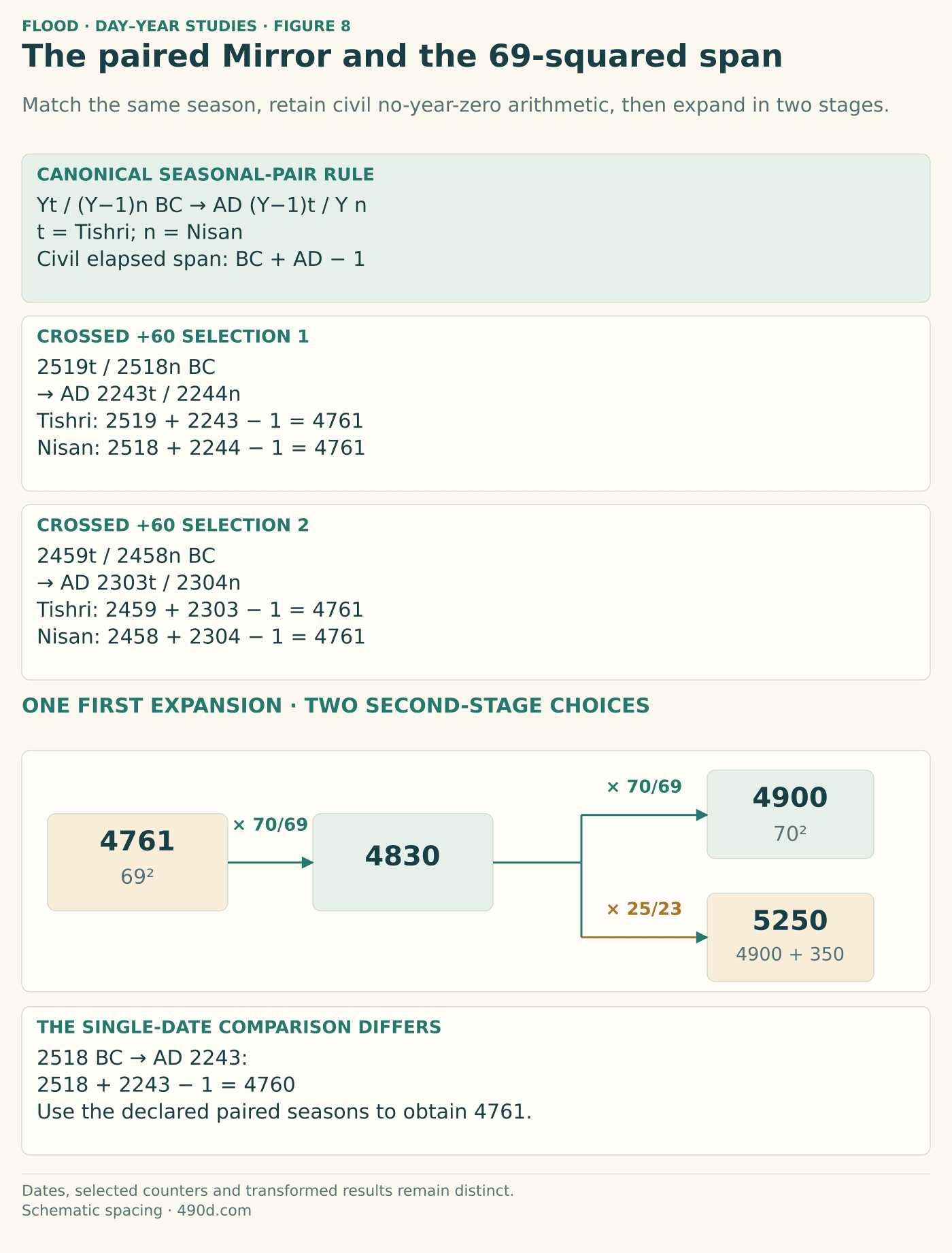
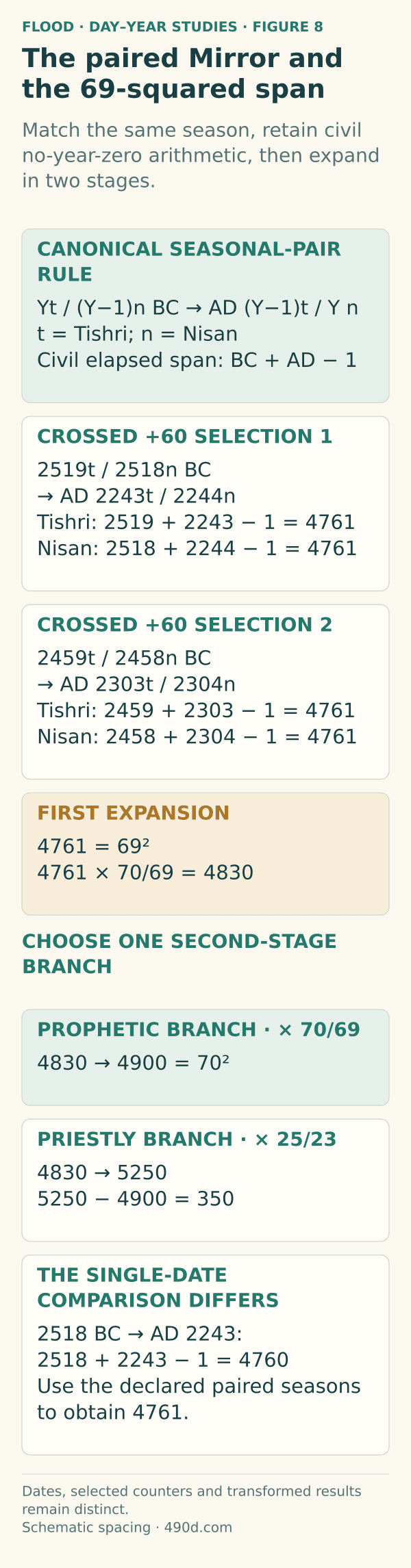
Yt/(Y − 1)n BC → AD (Y − 1)t/Yn.
Here t means the selected Tishri phase and n the selected Nisan phase. A BC pair whose Tishri component is half a year earlier has its displayed year labels reversed on the AD side. Matching the same seasonal phase then retains the intended span. Ordinary civil spans still obey BC + AD − 1, because the civil calendar has no year zero.
| Earlier Flood state | Reflected comparison state | Tishri component | Nisan component |
|---|---|---|---|
| +60/full-Egypt: 2519t/2518n BC | Minimum, no +60: AD 2243t/2244n | 2519 + 2243 − 1 = 4761 | 2518 + 2244 − 1 = 4761 |
| Standard/full-Egypt: 2459t/2458n BC | Minimum +60: AD 2303t/2304n | 2459 + 2303 − 1 = 4761 | 2458 + 2304 − 1 = 4761 |
These are crossed +60 selections. They are not a claim that all four possible pairings produce 4761. The same-state +60 selection gives 4821; the no-+60 selection gives 4701. A bare single-date comparison of 2518 BC → AD 2243 gives 4760, not 4761. The full Mirror audit makes every pairing visible.
The selected 4761 span factors as 69² and permits two integral prophetic expansions:
4761 × 70/69 = 4830; 4830 × 70/69 = 4900 = 70².
The second stage also permits a priestly branch:
4830 × 25/23 = 5250; 5250 − 4900 = 350.
Accessible text and image downloads
Two crossed seasonal Mirror comparisons are displayed. 2519t/2518n BC to AD 2243t/2244n gives Tishri 2519 plus 2243 minus one equals 4761 and Nisan 2518 plus 2244 minus one equals 4761. 2459t/2458n BC to AD 2303t/2304n gives 4761 for both phases. The letters t and n mean Tishri and Nisan. A branching expansion diagram starts 4761, equal to 69 squared, multiplies by 70/69 to 4830, then multiplies by 70/69 to 4900 or by 25/23 to 5250. The branch difference is 350.
Desktop PNG · Phone PNG · Desktop WebP (ZIP) · Phone WebP (ZIP) · Text-based SVG (ZIP) · Figure data CSV (data ZIP)
Full table and calculation · Scripture: Genesis 7:6; MT Flood-age input; variant BC coordinates are reconstructed (BSB) · Genesis 11:32 (BSB) · Acts 7:4; harmonization background (BSB) · Genesis 1:14; chronology background; Mirror is a model operation (BSB) · Genesis 9:28–29 (BSB)
The extra 350 recalls Noah’s stated 350 years after the Flood (Genesis 9:28–29, BSB). The original interpretation uses it to picture a 350 + 350 symmetry and a constructed 950 + 350 = 1300 = 600 + 700 overlay. Noah’s actual biblical lifespan remains 950; 1300 is the interpretive overlay’s total.
In this reading seven signifies completion, six recalls humanity made on the sixth day, and thirteen signifies the condition needing reconciliation. These are the study’s proposed numerical meanings. Genesis states Noah’s ages but does not define that symbolic dictionary. The distinction lets the theological proposal remain visible while the lifespan and Mirror calculations remain independently checkable.
The controls for this operation are File 00 §3.9 and File 09 Appendix A. Astronomical single-node reflection, seasonal-pair reflection, and retaining a numeric year on the opposite side of the axis are different operations. The Mirror introduction explains them in a shorter form.
10. The wider research retained with this study
The Jacob argument sits within a much larger set of comparisons in the original discussion. They remain available in the full tables and source notes, with their assumptions and endpoints displayed.
| Research family | Principal relationship | What the supporting study clarifies |
|---|---|---|
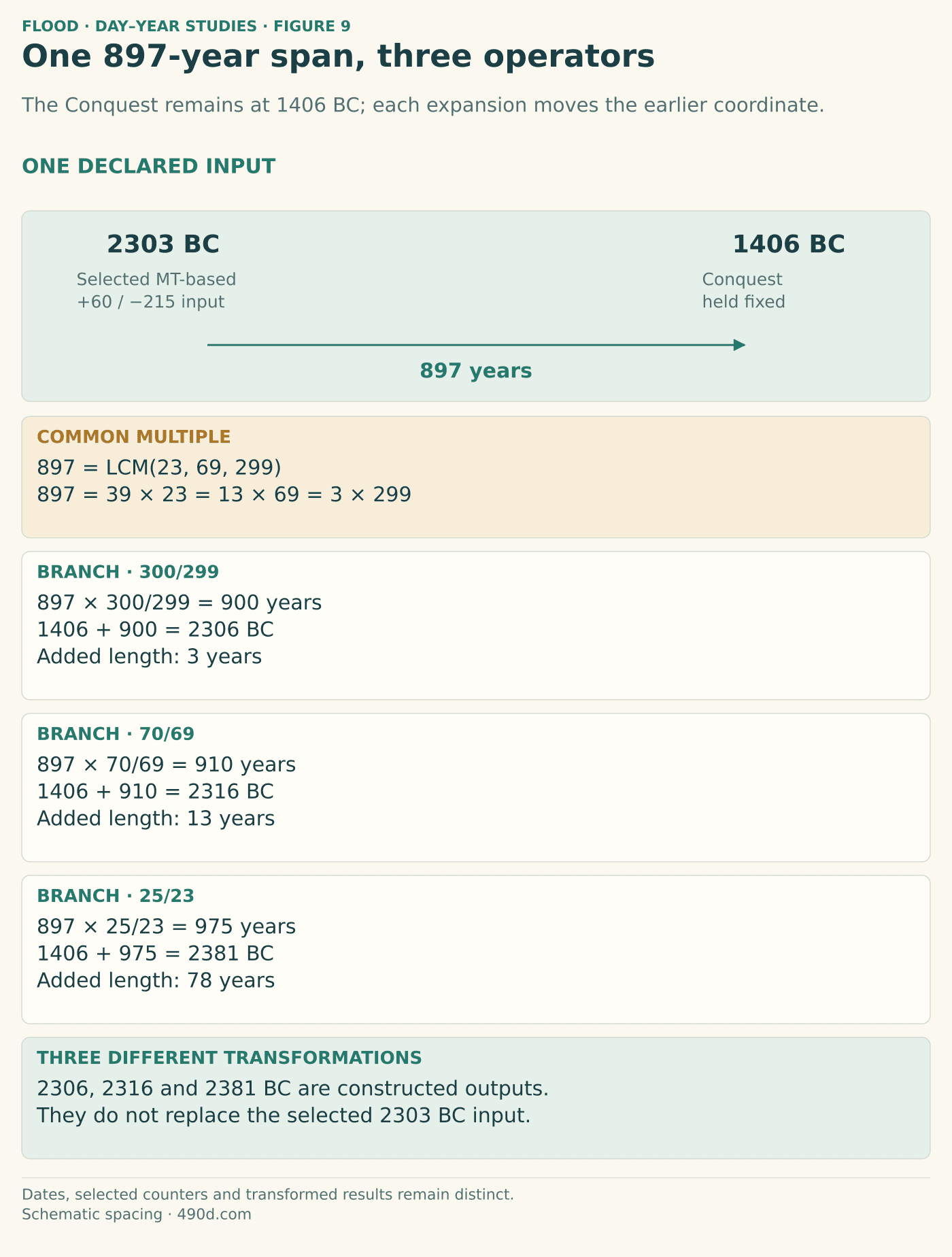
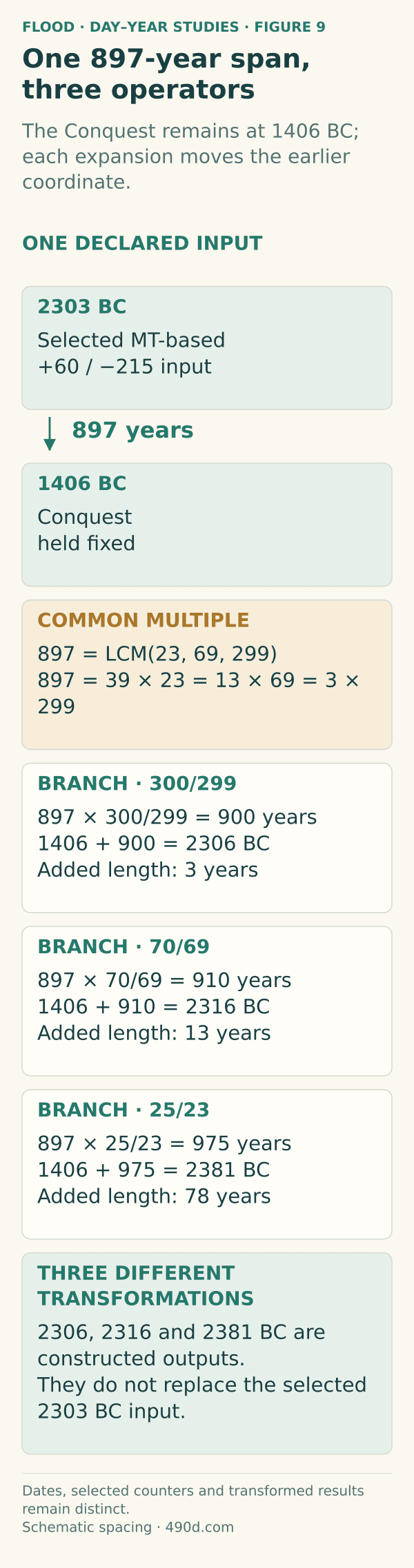
| Three operators at the same Flood/Conquest juncture | 897 → 900 / 910 / 975 | Fixed Conquest anchor; 430 + 75 + 430 reaches Exodus, with forty more to Conquest |
| Jared, the Watchers, and the Conquest | 1196 + 897 = 2093; 2093 → 2100 / 2275 | Matched +60/−215 state; seven-year extension and 182-year alternative extension |
| Noah/Shem and Jacob | 1012 → 1100; proposed 600 + 600 | Exodus-fixed result versus a declared Conquest reanchoring; Gear 1/2 differences |
| Creation and the seven-year envelopes | 2553 → 2775 / 2590 | 222 = 215 + 7 and 37 = 30 + 7; generated Creation labels |
| Prophetic half-weeks and rest | 2520, 2550, 2553.5, and 2595 | Calendar cores, seasonal phase, and the 1400–1399 rest interval |
| Creation and the Temple | 3966–3959 → 966–959 BC | 3000-year like-boundary comparison; without +60, 2940 |
| Calendar translations | 23 → 25; 69 → 70; 299 → 300; 391 → 403 | Three exact count expansions and a near physical lunar correspondence |
| Kings, Judges, and precession | Triple 430; 299/300; 25920/25921 | Historical versus compositional ledgers, and the one-year precession comparison |
Accessible text and image downloads
Input 2303 BC to held Conquest 1406 BC gives 897 years. The least common multiple of 23, 69 and 299 is 897. Three independent expansion branches keep the later endpoint at 1406: multiply by 300/299 to get 900 and earlier output 2306 BC; by 70/69 to get 910 and earlier output 2316; by 25/23 to get 975 and earlier output 2381. Added lengths are three, thirteen and seventy-eight. All output dates are constructed coordinates.
Desktop PNG · Phone PNG · Desktop WebP (ZIP) · Phone WebP (ZIP) · Text-based SVG (ZIP) · Figure data CSV (data ZIP)
Full table and calculation · Scripture: Genesis 7:6; MT Flood-age input; variant BC coordinates are reconstructed (BSB) · Joshua 4:19; entry calendar reference (BSB) · Ezekiel 4:6; day–year background, not the ratio rule (BSB)
These extensions retain the source’s interpretation of the Flood, the Watchers tradition, giant opponents in the land, the covenant, and restoration. Enoch’s Watchers account is identified as extra-biblical literature. Treating Jared’s birth as the Watchers’ date is a model selection, not an exact date printed in 1 Enoch. Likewise Numbers 13 records the spies’ report concerning the Nephilim; the identity and continuity proposed across the Flood and Conquest belong to the typological reading.
The shared interpretive premise is that biblical numerical relationships can function as a language of time: a repeated duration identifies a theme, and a stated operator determines how one span connects with another. Creation supplies the days, years, sun, moon, and stars underlying the calendars. The analogy with Babel’s common language expresses the possibility of a shared numerical vocabulary among cultures that observed the same heavens; it is not proof that every ancient scribe knowingly used the same code.
The smaller factors also retain their theological proposals. 2553 = 111 × 23 allows a Christian reflection on unity and threeness; 2775 = 5 × 555 allows a reflection on the helping/building hand and grace. Their decimal-digit symbolism is an interpretive analogy, not evidence that ancient writers encoded modern Arabic digit strings. The related appeal to John 6:29, BSB connects human work with belief in the one God sent.
The point of preserving these interpretations is to keep the numbers connected with the narratives whose meaning they are intended to illuminate. Jacob bears the burden of service; Ezekiel bears a sign concerning Israel and Judah; the dove looks for land; Israel seeks rest; exile is followed by restoration. A proposed numerical correspondence is most useful when its arithmetic and its narrative connection can both be examined.
11. From years back to days
The Day–Year Studies work in both directions. A stated biblical day interval generates a projected year-span; a larger chronological span can then be compared with particular days or week-units in the model’s calendar. The dove’s 7 + 7 interval is a small-scale instance of the structure compared here with Jacob’s 7 + 7 years and with larger prophetic measures.
Day-level precision requires more than matching whole-year numbers. The calendar, datum, phase, leap handling, and inclusive/exclusive counting must all remain the same throughout a particular calculation. The equations above are exact at their declared level. Where the original proposes an unrecorded hour, an undated half-year, or an associated prophetic event, the supporting notes identify that additional assumption. The aim is to make the proposed nesting inspectable, from the broad chronology down to the selected day or unit-week.
The calendar’s leap units can be counted or left outside a schematic calculation when that choice is declared. Thus a seven-year core can be written 1260 + 1260, while a counted leap month can produce 1260 + 1290, and a span crossing two suitable leap insertions can produce 1290 + 1290. These are separate counts, not competing corrections to one unstated calendar. The 606n BC epoch selected in the Ezekiel studies closes at 600n, 594n, 588n, 582n, 576n, 570n, and 566n BC in the 6 + 6 + 6 + 6 + 6 + 6 + 4 arrangement controlled by File 12 §7A; the Ezekiel calculations retain that placement.
The final theological proposal is that the correspondence of labor, judgment, waiting, and rest can extend beyond what any one human writer understood. That is a reading of the resulting structure. The documented counts and declared operations provide the part readers can reproduce; the interpretation gives the study its question and purpose.
Tables, sources, and the original discussion
- Full chronological tables, calendar calculations, Mirror comparisons, and retained research
- Figure and person/event index
- Canonical chronological source collection
- Flood introduction: Forty Days, 150 Days, and a New Beginning
- Day–Year charts and reference tables
- Part 4a: Flood sequence and calendar construction
- Part 4b: Seasonal columns and chronological Mirrors
Original discussion: Read the earlier Part 4c discussion, preserved unchanged. It retains the original wording and exploratory calculations; this detailed replacement supplies the reconciled chronology, distinctions, and source notes.
The Holy Bible, Berean Standard Bible, BSB is produced in cooperation with Bible Hub, Discovery Bible, OpenBible.com, and the Berean Bible Translation Committee. This text of God’s Word has been dedicated to the public domain.