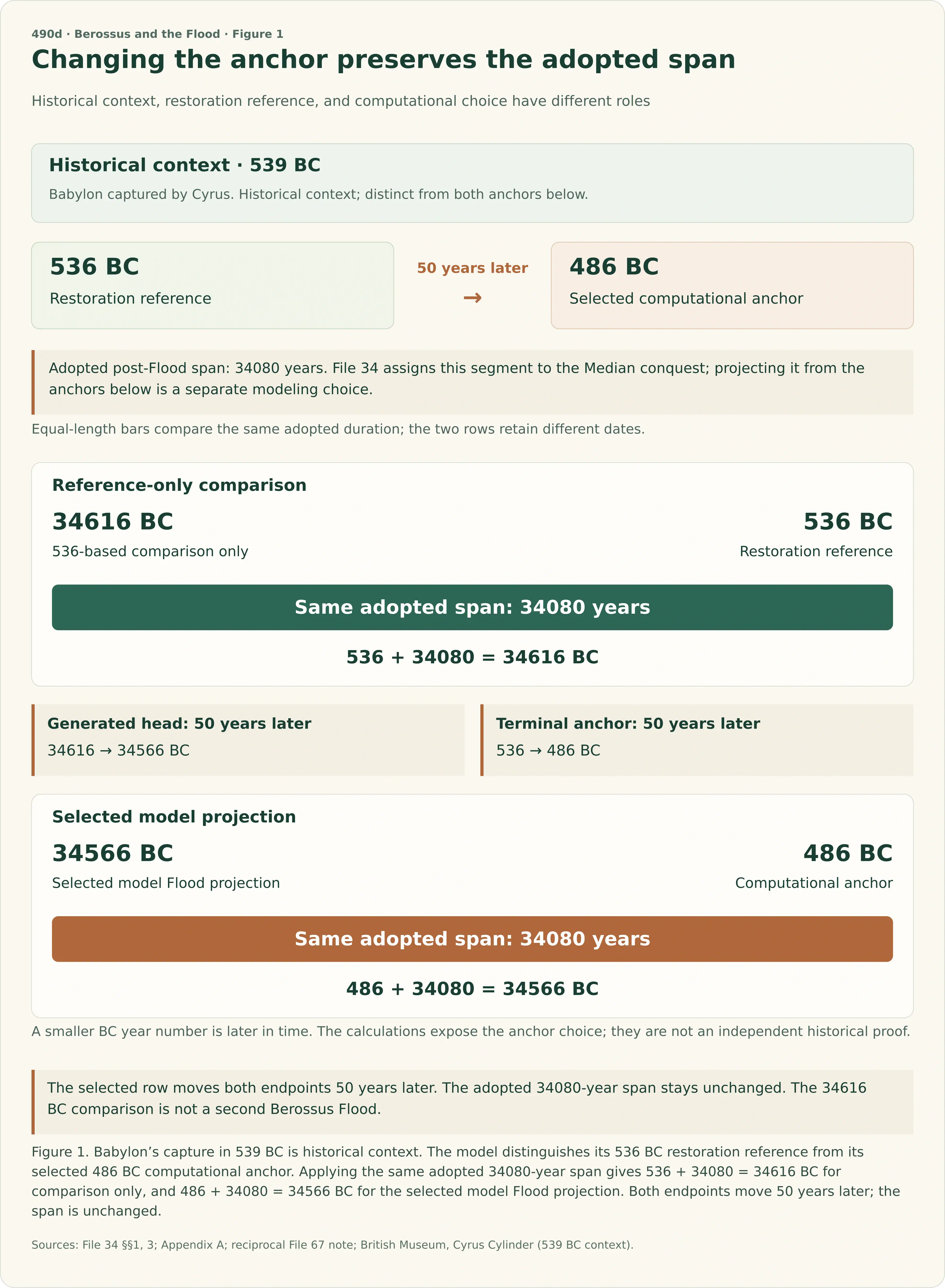
The Berossus comparison turns on a small change of reference point within a very large chronology. 536 BC remains the restoration reference in the 490d framework; 486 BC is the separate anchor used for its calculation. Moving the anchor fifty years later changes the resulting BC coordinates without changing the length of the period being counted.
That distinction connects this study with the Kings of Judah discussion and the Sumerian King List study. Each comparison asks us to distinguish a transmitted number, a chosen chronological arrangement, and the historical event to which an interpretation relates it. The supporting tables give the reign figures, source qualifications, and complete calculations.
1. Berossus and the kings before the Flood
The Babylonian writer Berossus is known through excerpts and summaries preserved by later authors. In Eusebius’s Chronicle, the account attributed to Alexander Polyhistor lists ten kings before the Flood, beginning with Alorus and ending with Xisuthrus. Their reigns are expressed in sars, each reckoned there as 3600 years. The ten reigns total 120 sars, giving:
120 × 3600 = 432000 years.
The much earlier Sumerian King List has its own textual history. The selected eight-king sequence in the Oxford edition totals 241200 years. These two totals belong to different lists:
| Before the Flood | Kings | Total years |
|---|---|---|
| Berossus tradition, as preserved through Polyhistor | 10 | 432000 |
| Selected Sumerian King List sequence | 8 | 241200 |
The parallel invites comparison, but it does not make the lists identical. Their names, numbers, and arrangements must first be read in their respective sources. In particular, dividing the 36000-year reign of Daos into two 18000-year segments for an illustration would still leave one king, not two.
The full reign tables preserve the two sequences separately. Proposed correspondences with biblical patriarchs belong to a further interpretive argument; they are not necessary to establish either total.
2. Three dates with different functions
The historical capture of Babylon by Cyrus belongs to 539 BC. The 490d restoration framework uses 536 BC as its reference in the subsequent return and Temple-foundation setting. File 34 then assigns 486 BC to its Berossus calculation. These dates should not be compressed into a single event.
| Date | Function in this discussion |
|---|---|
| 539 BC | Cyrus’s conquest of Babylon |
| 536 BC | Restoration reference retained by the biblical chronology framework |
| 486 BC | Computational anchor, fifty years later than the restoration reference |
Ezra describes the renewed building work in these terms:
In the second month of the second year after they had arrived at the house of God in Jerusalem, …
The passage supplies a relative setting for the renewed building work. Its wording does not print a BC date. The framework’s 536 BC reference and its subsequent numerical comparison are therefore identified separately from the Scripture quotation.
The fifty-year relationship comes from the Kings study’s distinction between its historical and schematic arrangements. For example, that study retains 966 BC for the historical Temple foundation and 1016 BC for the schematic Temple position. File 34 uses the same fifty-year magnitude when moving from the restoration reference to its computational anchor:
536 − 486 = 50 years.
These are different applications of the fifty-year relationship. The Temple comparison places the schematic coordinate earlier; the restoration-to-calculation comparison moves later. The reign totals, overlapping reigns, and partial-year conventions require the fuller Kings discussion. The fifty-year model should not be introduced as the unqualified exact sum of every displayed reign column.
3. Counting backward from the chosen anchor
The 490d model adopts 34080 years for the relevant post-Flood period, corresponding to the total of the sexagesimal quantities preserved in the Syncellus tradition. Its source history needs a qualification. The Polyhistor account preserved in Eusebius describes 86 kings ending with a capture of Babylon by the Medes. That episode is followed by further dynasties; it is not the much later conquest by Cyrus. Surviving decimal totals also differ. The witness note distinguishes the adopted 34080 from those other readings.
File 34’s operation is to take this adopted duration and project it backward from 486 BC:
486 + 34080 = 34566 BC.
All three quantities remain on the BC side. Counting backward makes the BC numeral larger, so this operation uses addition. The resulting 34566 BC is the model’s Berossus Flood coordinate. It is neither a BC date written by Berossus nor a newly established archaeological date for the Flood.
490d · Berossus and the Flood · Figure 1
Changing the anchor preserves the adopted span
Historical context, restoration reference, and computational choice have different roles
Equal-length bars compare the same adopted duration; the two rows retain different dates.
Reference-only comparison
536 + 34080 = 34616 BC
Selected model projection
486 + 34080 = 34566 BC
A smaller BC year number is later in time. The calculations expose the anchor choice; they are not an independent historical proof.
Sources: File 34 §§1, 3; Appendix A; reciprocal File 67 note; British Museum, Cyrus Cylinder (539 BC context).
Read the calculation and scope
The source-control roles are distinct: 539 BC is Cyrus’s historical capture of Babylon; 536 BC is the repository’s restoration reference; 486 BC is its selected figurative/computational projection anchor. The adopted 34080-year duration is associated in File 34 §3.1 with the post-Flood segment leading to the Median conquest. It is not being relabelled as an independently witnessed Flood-to-Cyrus or Flood-to-restoration duration. The diagram applies it to two stated anchors to expose the model choice: 536+34080=34616 and 486+34080=34566. The differences are 536−486=50 and 34616−34566=50, while 34616−536=34566−486=34080. A smaller BC year number is later. File 34’s reciprocal File 67 note explicitly preserves 34616 BC as a generated comparison rather than a second official Berossus Flood. The article discusses the witnesses and duration variants; this diagram does not claim that 34080 is uniform across them. Equal-width bars compare lengths schematically, not one common absolute-date axis.
Open the full-resolution image version
Download: PNG · WebP · SVG (ZIP download)
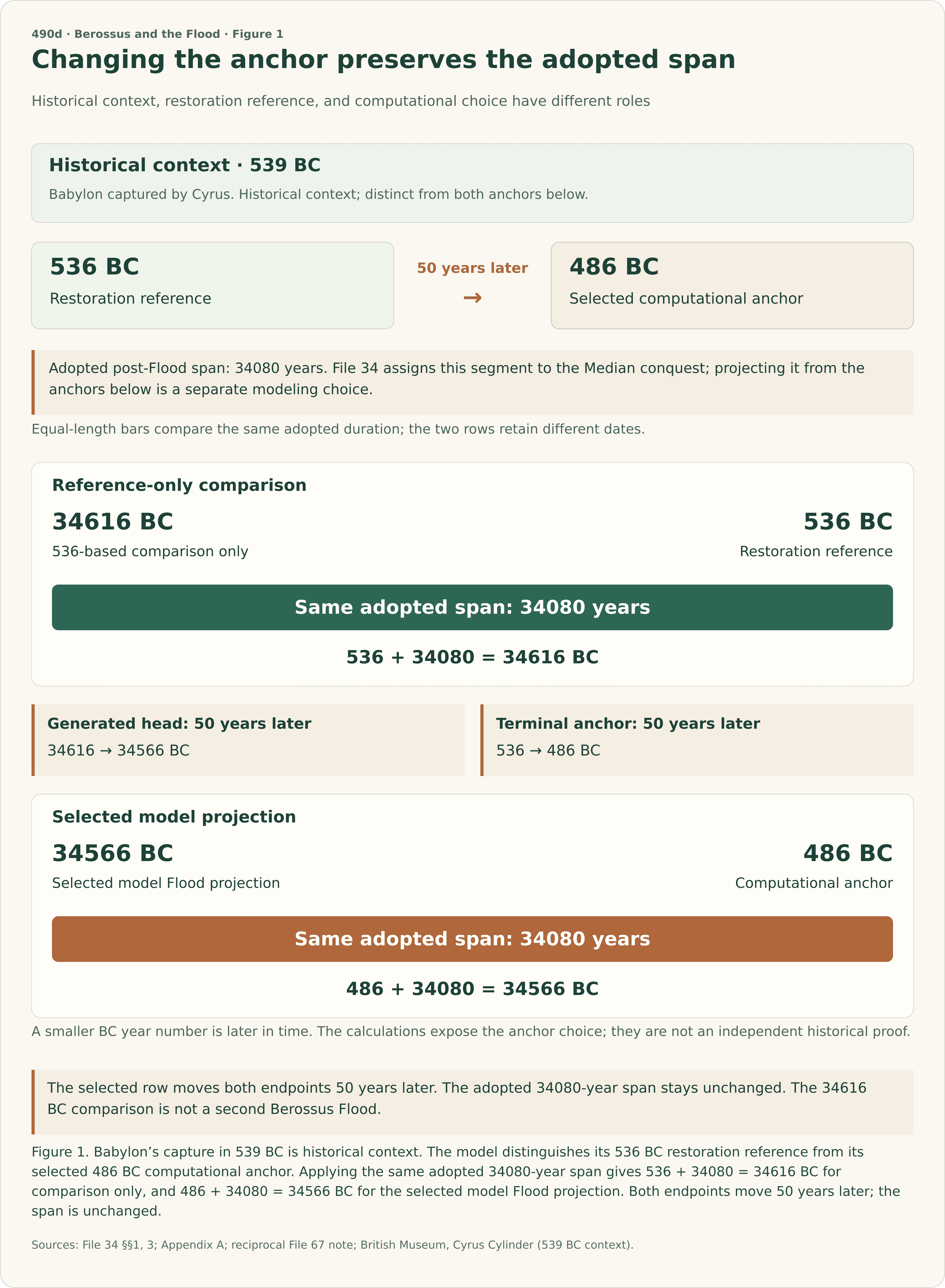
For comparison, leaving the same duration attached to 536 BC would produce 34616 BC. The two calculations differ by exactly fifty years:
| Calculation | Anchor | Duration | Generated Flood coordinate |
|---|---|---|---|
| Reference-only companion | 536 BC | 34080 | 34616 BC |
| Selected Berossus model | 486 BC | 34080 | 34566 BC |
The first row explains the effect of the shift; it is not a second independently adopted Berossus Flood date. In the selected model, extending the 432000-year pre-Flood total backward from 34566 BC gives 466566 BC for the beginning of the Alorus sequence. That opening is another generated coordinate, not a date contained in the surviving king-list fragment.
4. Why 6530 years produces a 6480-year separation
The Sumerian comparison makes the role of fifty especially clear. The selected whole-year reign figures for the first post-Flood dynasty at Kish total 17980. The transmitted dynasty summary gives 24510 years, with an additional three months and three and a half days. The 490d Short and Long models use the two whole-year quantities; the additional months and days remain a separate source datum.
Their difference is:
24510 − 17980 = 6530 years.
The models also have different adopted later boundaries. The Short setting ends at 2906 BC; the Long setting ends at 2856 BC, fifty years later. Counting backward produces:
| SKL setting | Adopted later boundary | Whole-year duration | Model Flood coordinate |
|---|---|---|---|
| Short | 2906 BC | 17980 | 20886 BC |
| Long | 2856 BC | 24510 | 27366 BC |
The Long interval therefore begins 6480 years earlier, while ending 50 years later. Together those changes account for the additional 6530 years:
27366 − 20886 = 6480; 6530 = 6480 + 50.
This is why the duration difference and the Flood-coordinate difference are not interchangeable. Both ends of each interval matter. The adopted 2906 and 2856 boundaries are model settings, not dates printed on the tablet. Likewise, “Short” and “Long” describe the research constructions; they should not conceal the distinction between a selected sum of individual reigns and a transmitted dynasty summary.
5. The matched Flood settings and the 720-year step
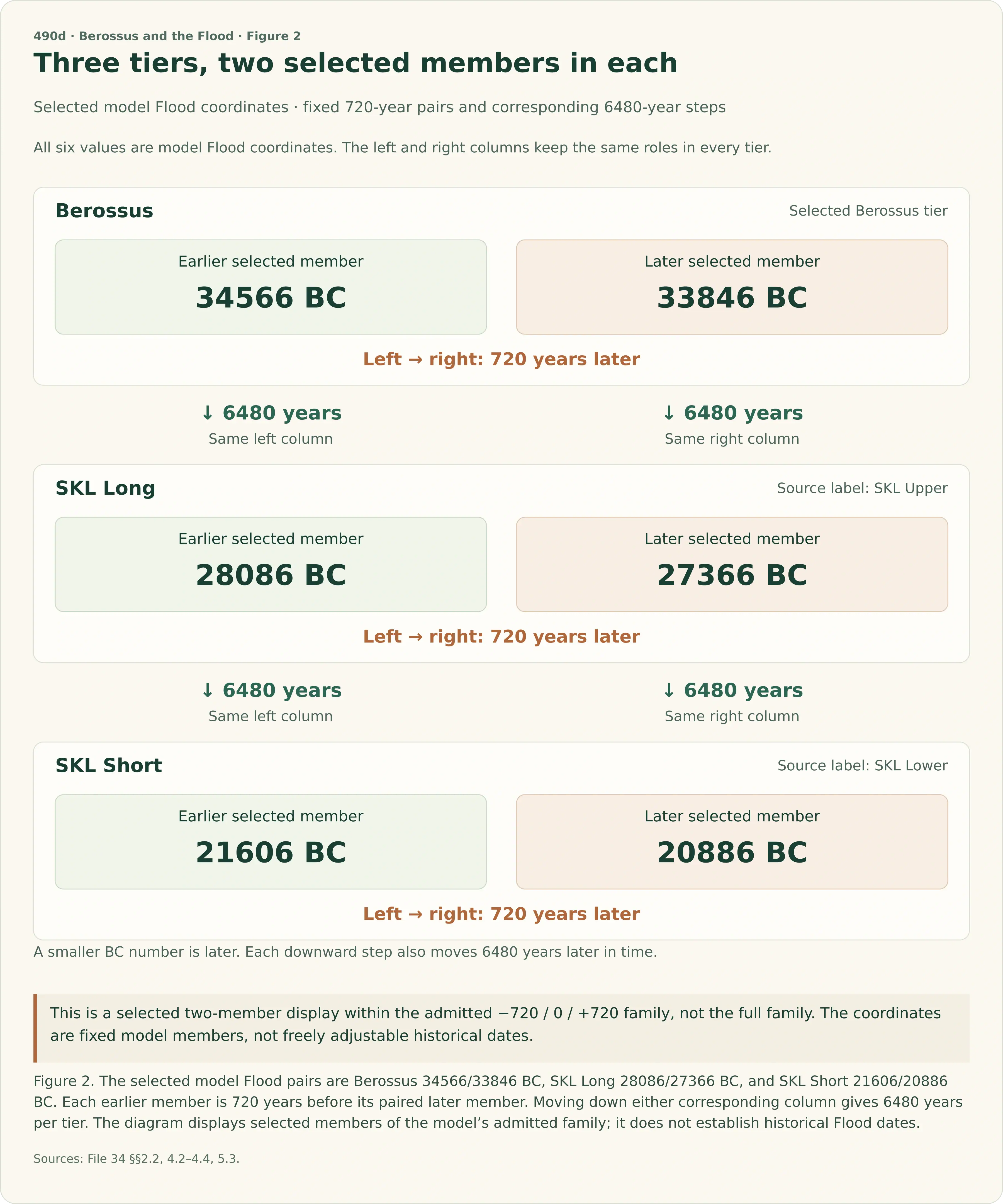
File 34 places the Berossus result beside the two SKL constructions in a matched table. Each row below shows two selected settings separated by 720 years. Moving down either column gives successive differences of 6480 years.
490d · Berossus and the Flood · Figure 2
Three tiers, two selected members in each
Selected model Flood coordinates · fixed 720-year pairs and corresponding 6480-year steps
All six values are model Flood coordinates. The left and right columns keep the same roles in every tier.
Left → right: 720 years later
Left → right: 720 years later
Left → right: 720 years later
A smaller BC number is later. Each downward step also moves 6480 years later in time.
Sources: File 34 §§2.2, 4.2–4.4, 5.3.
Read the calculation and scope
Each horizontal gap is 720: 34566−33846=720, 28086−27366=720, 21606−20886=720. Corresponding columns preserve the same vertical gap: 34566−28086=28086−21606=6480 and 33846−27366=27366−20886=6480. These are selected paired members of the admitted −720/0/+720 family controlled in File 34 §2.2, not an exhaustive display or permission to shift dates arbitrarily. For the native right-column SKL coordinates, the adopted whole-year arithmetic is Short 17980+2906=20886 and Long 24510+2856=27366. The duration difference is 24510−17980=6530, while the Long terminal is 50 years later: 2906−2856=50. Therefore the Flood-coordinate difference is 6530−50=6480. The durations, terminals, resulting coordinates, and selected 720 members are distinct inputs and outputs. Witness classification and appended fractional data are addressed in the article; they are not added to these whole-year equations.
Open the full-resolution image version
Download: PNG · WebP · SVG (ZIP download)
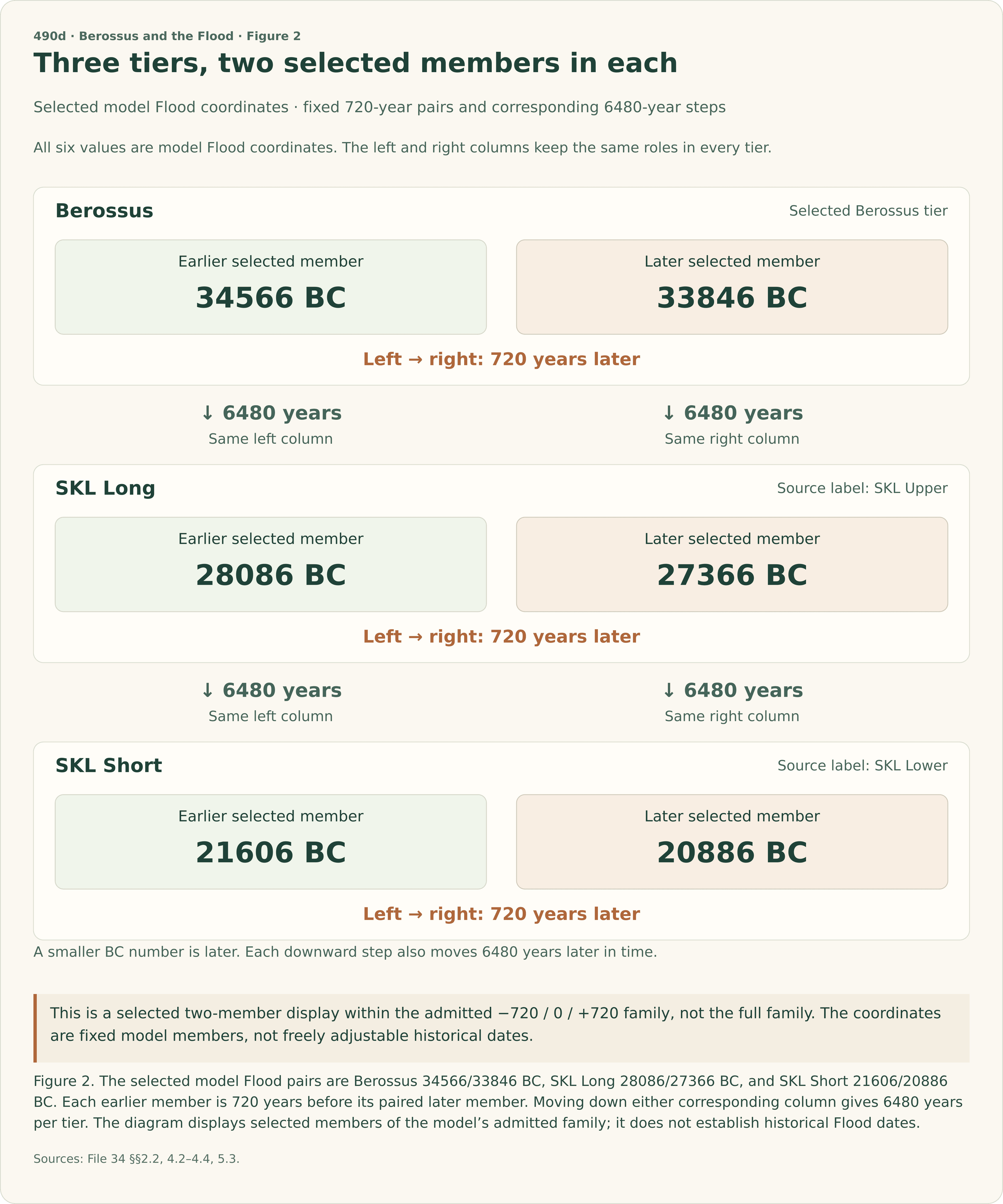
The matching columns can be checked directly:
34566 − 28086 = 6480; 28086 − 21606 = 6480.
33846 − 27366 = 6480; 27366 − 20886 = 6480.
The 720-year step belongs to a different operation from the fifty-year anchor shift. In the research framework, it is the enlarged counterpart of a two-year spacing under a declared 360:1 scale:
2 × 360 = 720.
The current controls allow a centered −720 / 0 / +720 family. The figure displays selected pairs from that wider family; it does not exhaust every setting or authorize an arbitrary adjustment to obtain a match. A larger BC label is earlier, and a smaller one is later. Stating the actual coordinates removes the ambiguity of a bare “plus” or “minus” label.
The model also expresses 6480 as 90 × 72, one quarter of its idealized 25920-year precessional cycle. This is the numerical framework used for the comparison, not a claim that the astronomical cycle is measured with that exact, unchanging length. The fifty-year shift, the 720-year scale step, and the 6480-year separation each retain their own role.
6. Reading the comparison
The argument has three layers. The ancient witnesses supply reign figures and narrative sequences. The 490d framework selects quantities and anchors for comparison. Arithmetic then shows the consequences of those choices: the 34566 BC projection, the fifty-year movement of its companion coordinate, and the matched 6480-year separations.
These relationships can be read theologically alongside biblical themes of kingship, judgment, exile, and restoration. They also offer a way to explore the use of large numbers in neighboring chronological traditions. Such a reading remains distinct from demonstrating that Berossus or an ancient scribe consciously used every element of this reconstruction.
The fifty-year shift is useful precisely because its function can be stated plainly. 536 BC remains the restoration reference; 486 BC anchors the selected calculation. The resulting model can then be evaluated through its named inputs and matched endpoints.
The supporting tables and source notes provide the full ten-king and eight-king inventories, the selected first-Kish sum, the post-Flood textual qualification, and the numerical checks. The detailed Berossus study develops the argument in full.
Sources
The model is controlled by File 34, especially §§1, 3–5 and Appendix A, with File 21 for the SKL settings. The Kings distinction follows File 08 and File 18.
Ancient numerical evidence is checked against Eusebius’s Chronicle, Book 1, the additional post-Flood witnesses identified in the appendix, and the Oxford Sumerian King List edition. Historical reference dates, transmitted durations, and generated coordinates are kept distinct throughout.
Scripture quotations: Berean Standard Bible (BSB), public domain. The Ezra excerpt preserves the translation’s wording; the ellipsis marks omitted continuation.