The 364-day calendar brings the week into the architecture of the entire year. Its 52 complete weeks divide into four equal seasons, each containing 13 weeks. The result is a stable relationship between the Sabbath, the months, and the annual round of sacred dates.
This detailed study develops the short introduction to the 364-day calendar. It explains the ancient calendar structure, the proposed leap-week adjustment, and the chronological comparisons that give the model its wider significance. The distinctions matter: the ancient texts describe the 364-day year; the particular 40- and 400-year adjustment developed here is a reconstruction.
Genesis places the ordering of time within the purpose of the heavenly lights:
And God said, “Let there be lights in the expanse of the sky to distinguish between the day and the night, and let them be signs to mark the seasons and days and years.
Jubilees gives the explicit weekly count:
And all the days of the commandment will be two and fifty weeks of days, and (these will make) the entire year complete.
— Jubilees 6:30, R. H. Charles translation, 1913
The relationship can be stated simply: 52 × 7 = 364 days.
Direct links: seasonal structure · 40-year cycle · 400-year boundary · day-count anchors · chronological anchors · half-week · symbolic comparisons · sources · additional studies appendix.
On a phone, swipe across a table to see every column.
1. The year, the seasons, and the four annual days
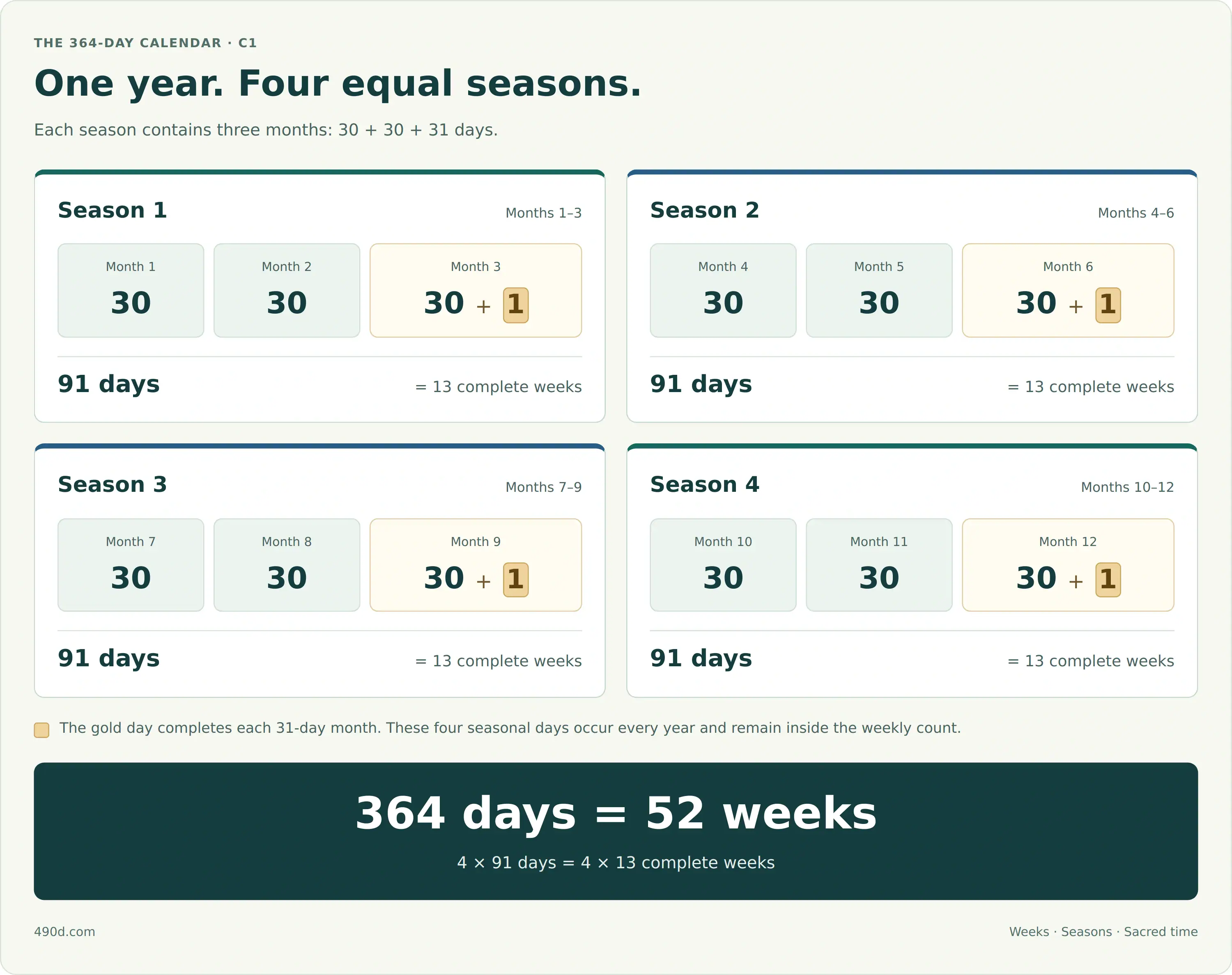
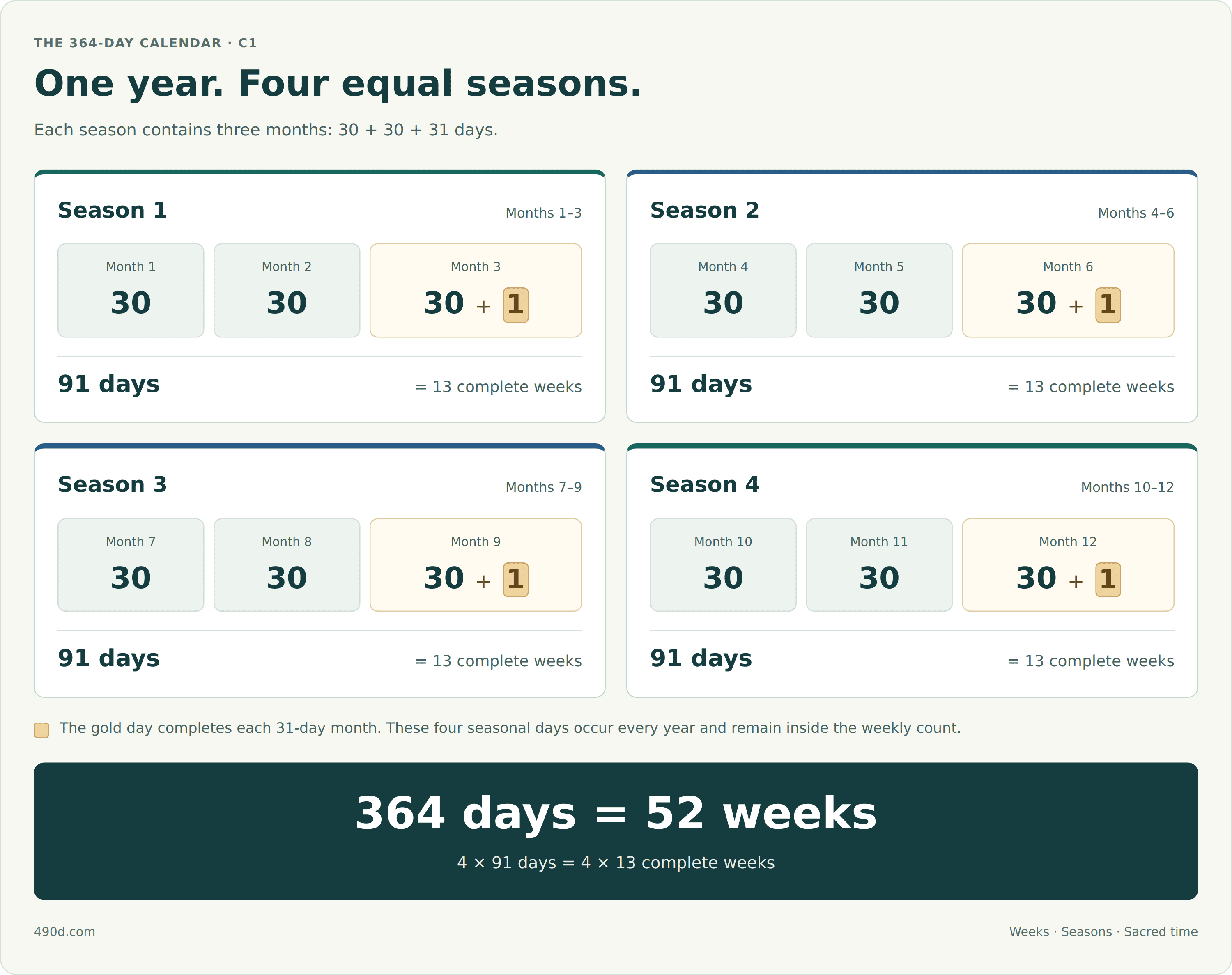
An ordinary year in this calendar contains four quarters of 91 days. Each quarter consists of two 30-day months followed by one 31-day month:
30 + 30 + 31 = 91 = 13 × 7.
The same pattern repeats four times. Because both 91 and 364 are divisible by seven, each quarter begins on the same weekday, and the next ordinary year returns to that weekday as well.
Season 1
Months 1–3Season 2
Months 4–6Season 3
Months 7–9Season 4
Months 10–12Sources: File 12 §§5.2, 7; File 20 §6H, Jubilees source-control table.
Image version and full-size download
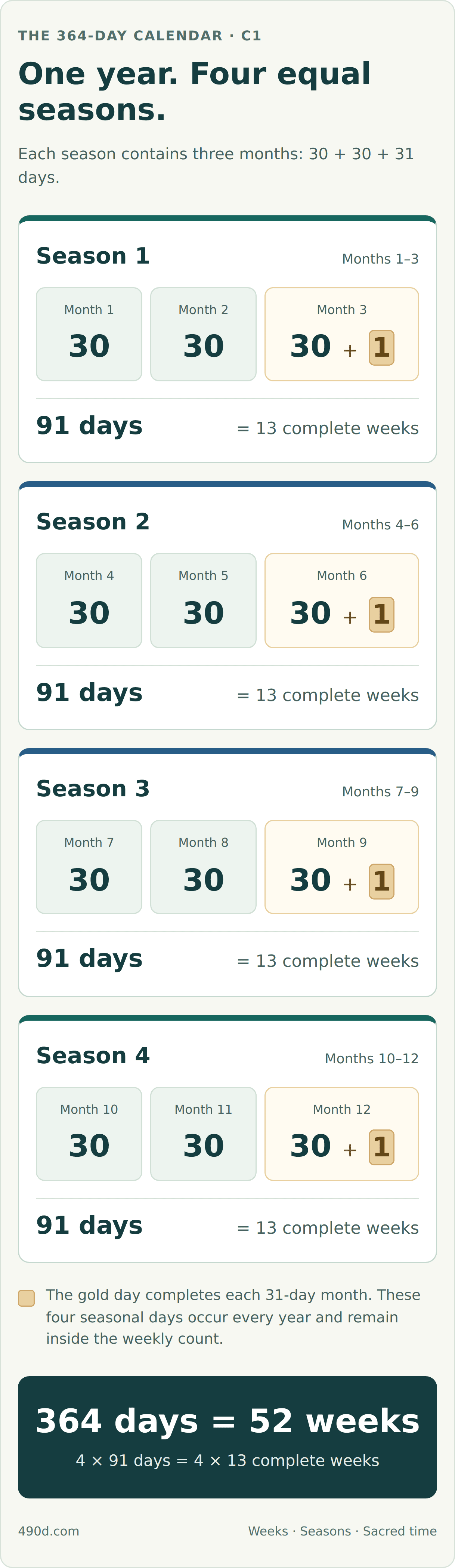
Download the full-size PNG · Download the WebP · Download the stacked phone PNG
| Quarter | Months | Month lengths | Quarter total |
|---|---|---|---|
| First | 1–3 | 30 + 30 + 31 | 91 days / 13 weeks |
| Second | 4–6 | 30 + 30 + 31 | 91 days / 13 weeks |
| Third | 7–9 | 30 + 30 + 31 | 91 days / 13 weeks |
| Fourth | 10–12 | 30 + 30 + 31 | 91 days / 13 weeks |
| Whole year | 12 months | 12 × 30 + 4 | 364 days / 52 weeks |
This month sequence follows 1 Enoch 72:8–32. The thirteen-week quarters and fifty-two-week year are explicit in Jubilees 6:29–32. The full month table gives the numbered days and weekday pattern.
The four additional days occur every year. They complete months 3, 6, 9, and 12 and remain inside the continuous weekly count. Their function is to bring twelve 30-day portions to 364 days. They do not, by themselves, bring the calendar to the length of the astronomical year.
The language of 1 Enoch is especially helpful here. Chapter 75:1–2 distinguishes the four service days in the reckoning, while 82:4–6, 11 includes them in the complete year. Thus 360 + 4 = 364 describes two aspects of the same arrangement: twelve equal 30-day portions, and the four annual days that complete the seasons.
In the Wednesday-start convention used here, the three month starts within a quarter fall on Wednesday, Friday, and Sunday. The next quarter begins on Wednesday again. Each recurring date keeps its own weekday; this does not put every festival on Wednesday. For example, Month 1, Day 14 falls on Tuesday, and Day 15 on Wednesday.
The calendar’s equal seasons are schematic quarters. They should not be mistaken for four astronomically equal intervals between equinoxes and solstices.
2. The priestly, prophetic, and Enochian counts
The chronology uses three related counts, each with a distinct purpose:
| Count | Calculation | What it brings into view |
|---|---|---|
| 336 days | 24 × 7 × 2 = 336 days = 48 weeks | Two schematic rotations of 24 weekly priestly courses |
| 360 days | 12 × 30 | Twelve equal monthly units in prophetic reckoning |
| 364 days | 4 × 91 = 52 × 7 | A complete year of equal thirteen-week seasons |
The priestly pattern supplies a useful bridge: 336 + 28 = 364, or 48 weeks plus four weeks. Its basis and applications are developed in Levi and the Priestly Year.
There are therefore two different additions to keep in view. The difference between 360 and 364 is four days; the difference between 336 and 364 is four weeks. The weekly priestly structure is source-supported, but the four-week arithmetic does not establish one universal historical method for administering festival weeks.
These distinctions follow File 12 §§6.3 and 7. They also prepare the way for intercalation: adding time to a running calendar is a separate operation from setting certain days apart in a schematic reckoning.
3. Why a leap week, and why forty years?
A tropical-year reference of approximately 365.2422 days exceeds 364 by 1.2422 days. A series of unadjusted 364-day years therefore moves gradually against the observed seasons. The annual four seasonal days have already been counted; the remaining difference requires a further adjustment if seasonal alignment is to be maintained.
A whole week is a natural adjustment for a calendar organized around complete weeks. Adding seven days preserves the weekday of the ordinary date that follows it. Adding one isolated day would shift that weekday.
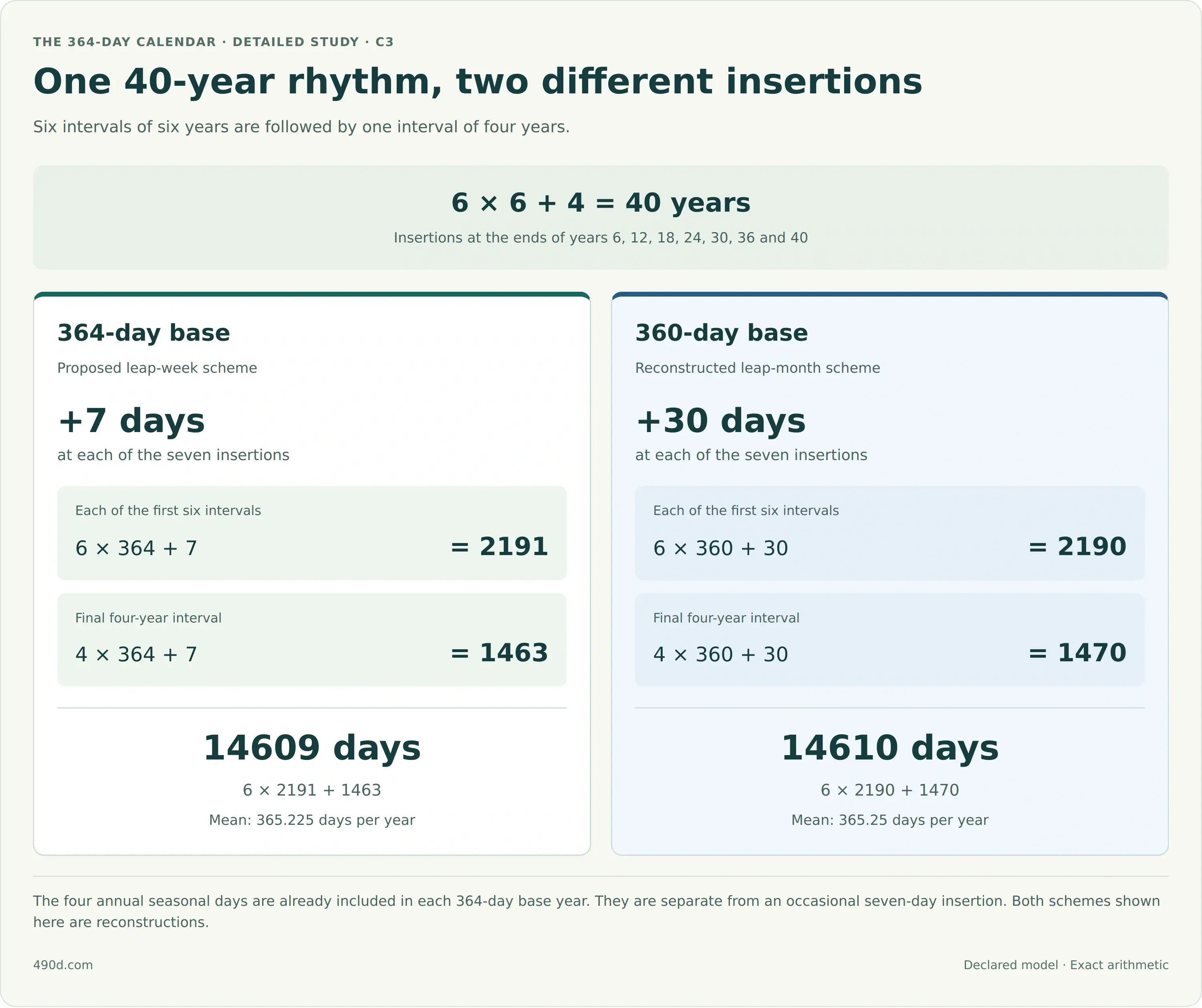
The proposed schedule inserts a leap week after years 6, 12, 18, 24, 30, 36, and 40. Its intervals are six years six times, followed by four years:
6 + 6 + 6 + 6 + 6 + 6 + 4 = 40.
The regular 40-year block therefore contains 7 added weeks, or 49 days:
40 × 364 + 7 × 7 = 14560 + 49 = 14609 days.
Its mean year is 14609 ÷ 40 = 365.225 days. This substantially reduces the seasonal discrepancy, although it does not yet reach the proposed 400-year mean.
The schedule is a constructed solution. Neither Jubilees 6 nor the Enoch passages cited above prescribes these seven particular insertion years. The ancient structure and the proposed method of adjusting it should be understood on their respective grounds.
A revealing comparison with the 360-day construction
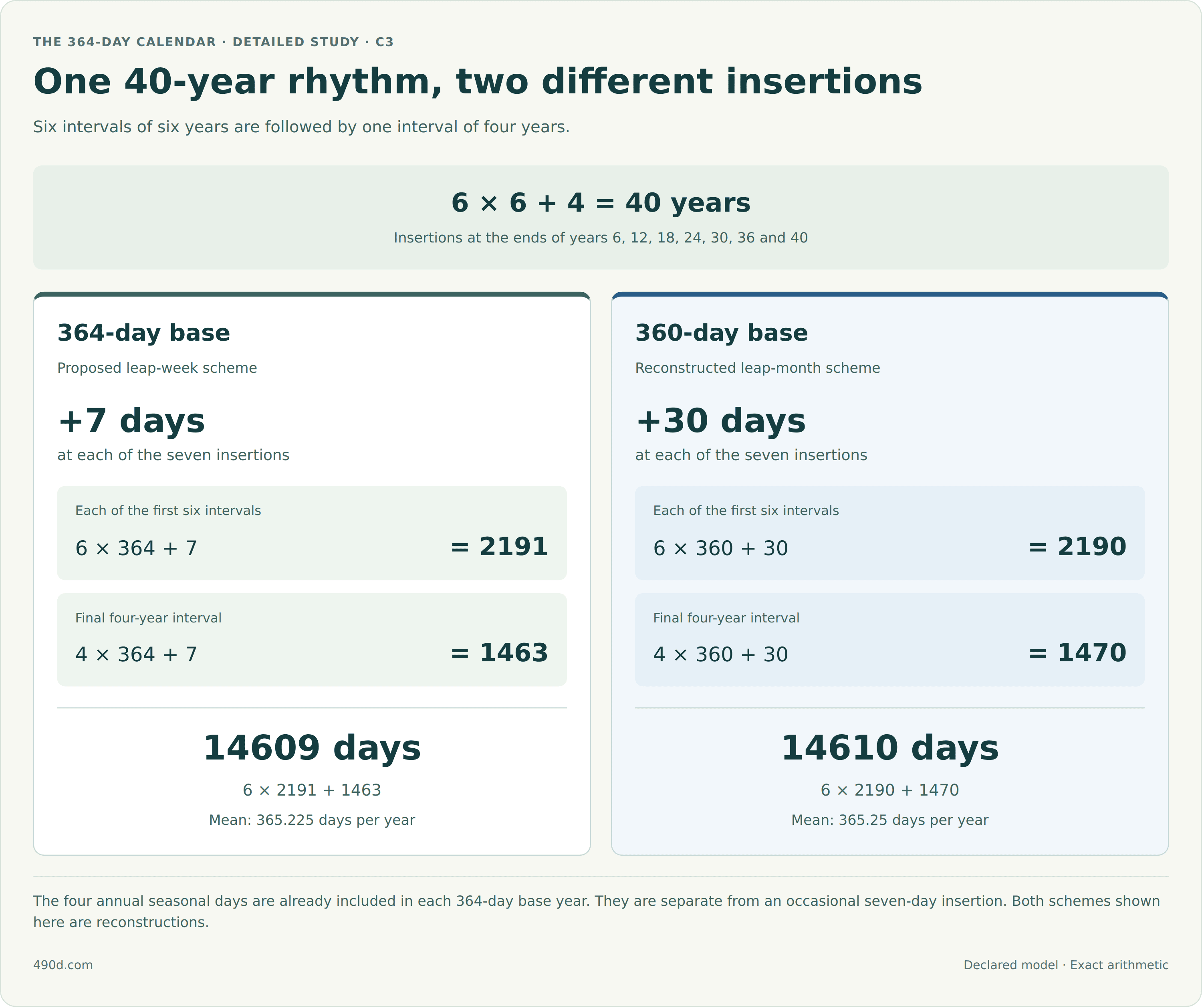
The same six-six-six-six-six-six-four rhythm can be used with a different base and a different insertion. File 12 §7A records a reconstructed 360-day calendar that adds a 30-day month at each of the seven cycle endings.
364-day base
360-day base
Sources: Proposed 364-day model, §3 of this study; File 12 §7A, separate 360-day reconstruction.
Image version and full-size download
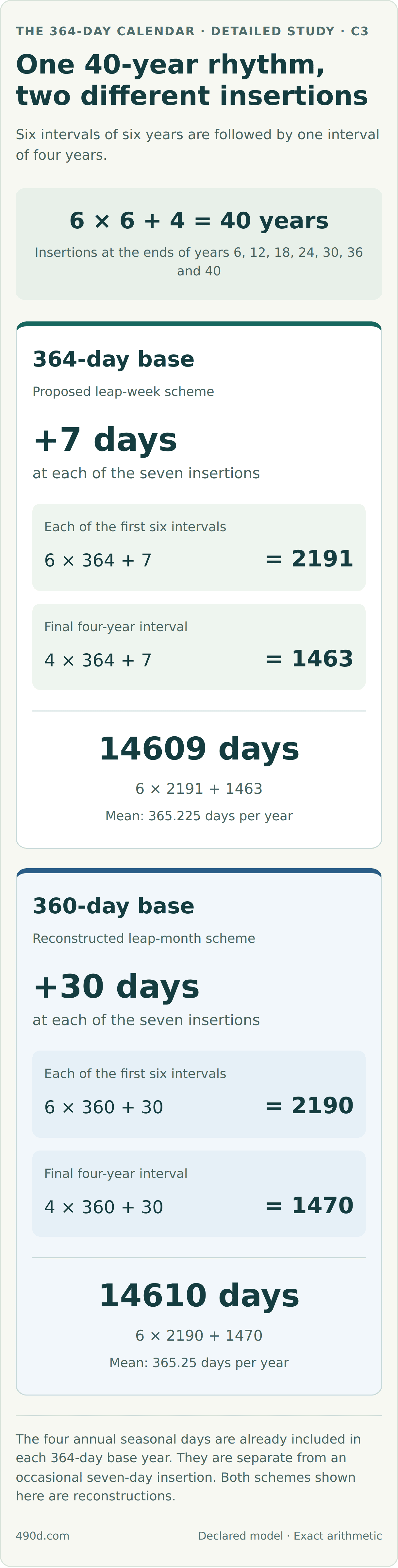
Download the full-size PNG · Download the WebP · Download the stacked phone PNG
| Construction | Each of six six-year segments | Final four-year segment | Forty-year total | Mean year |
|---|---|---|---|---|
| 364-day base; leap weeks | 6 × 364 + 7 = 2191 | 4 × 364 + 7 = 1463 | 14609 days | 365.225 days |
| 360-day base; leap months | 6 × 360 + 30 = 2190 | 4 × 360 + 30 = 1470 | 14610 days | 365.25 days |
The totals differ by only one day over forty years, but their internal operations remain different. One adds seven-day weeks to 364-day years; the other adds 30-day months to 360-day years. The latter reaches the Julian calendar’s mean of 365.25 days. Neither reconstruction becomes an explicit ancient prescription merely because its arithmetic closes neatly.
4. Completing the four-hundred-year cycle
Ten regular 40-year blocks supply 70 leap weeks. Their total is:
10 × 14609 = 146090 days.
One further week completes the proposed 400-year cycle:
146090 + 7 = 146097 days = 400 × 365.2425.
The total is 71 added weeks, or 497 days. It matches the Gregorian calendar’s 400-year total: 400 common years plus 97 leap days also give 400 × 365 + 97 = 146097 days. The Gregorian rule is summarized by the U.S. Naval Observatory.
Which block owns the boundary weeks?
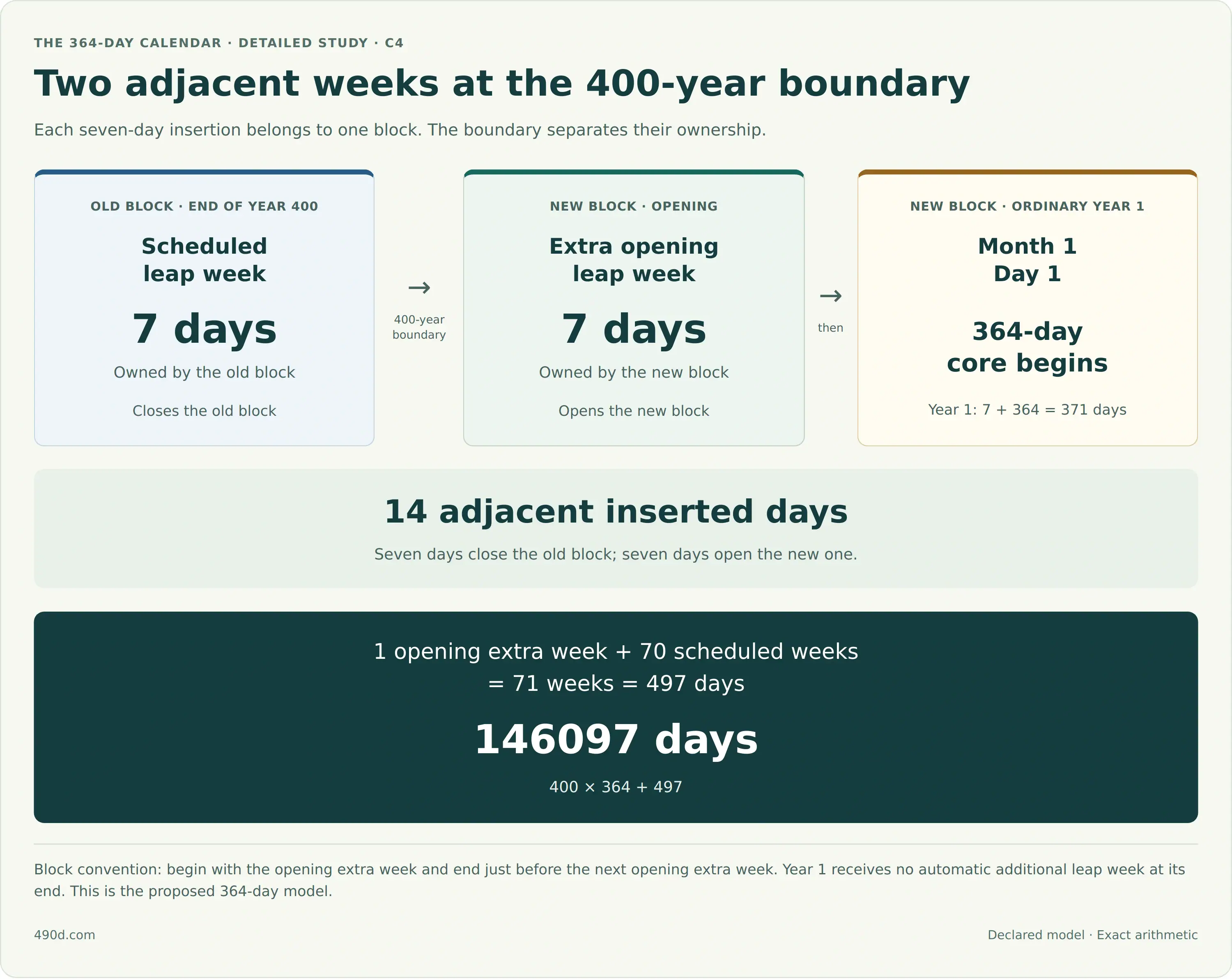
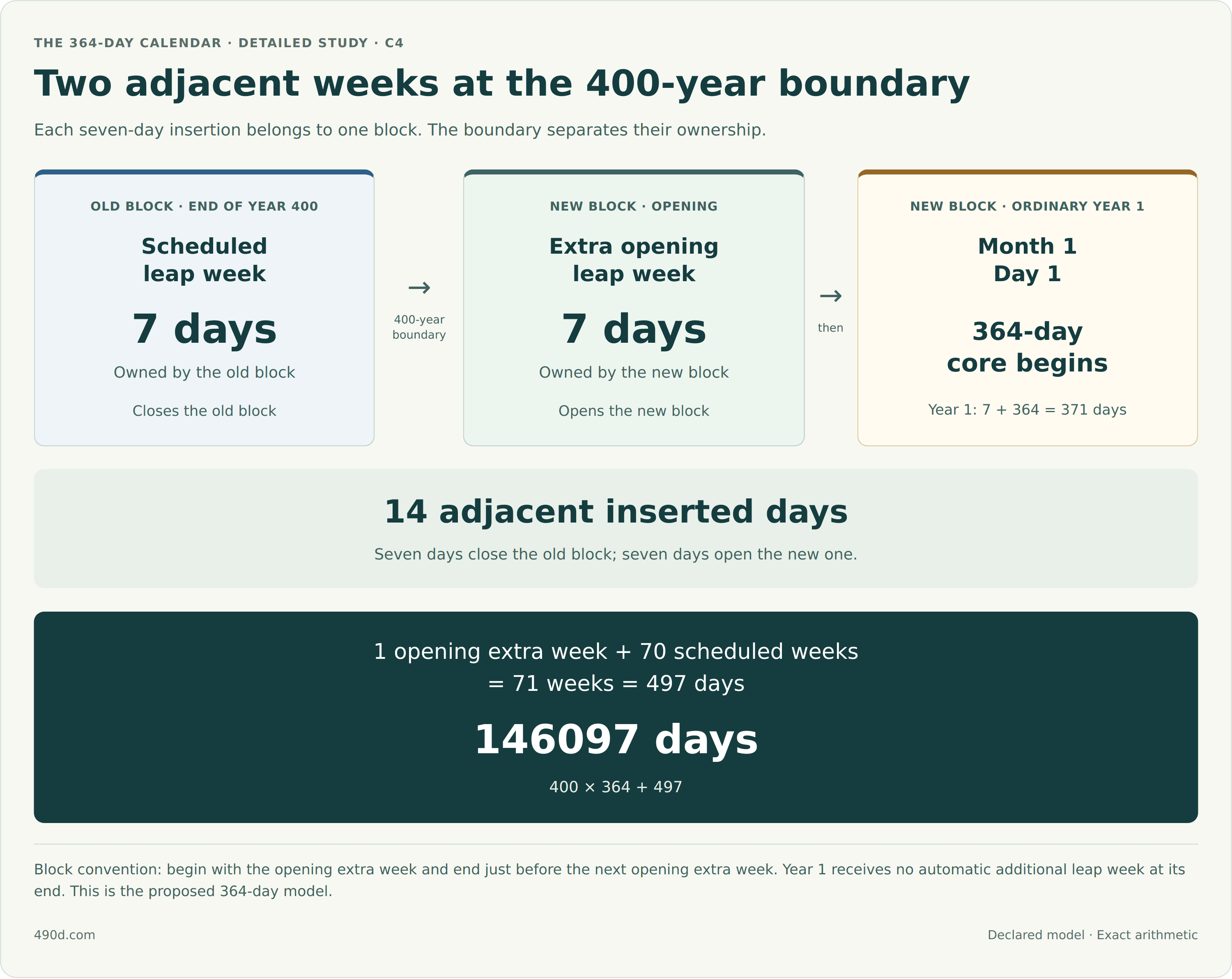
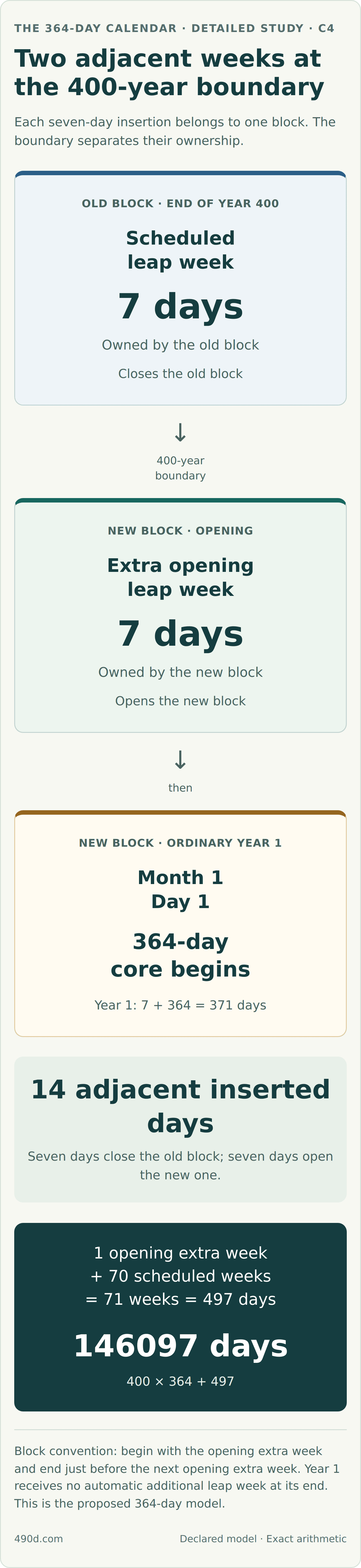
The placement used here puts the extra week at the opening of each 400-year block. The previous block finishes with its regularly scheduled leap week; the new block begins with its additional opening week. Two weeks are therefore adjacent at the boundary, with one belonging to each block.
Scheduled
leap week
Closes the old block
boundary
Extra opening
leap week
Opens the new block
Month 1
Day 1
core begins
Year 1: 7 + 364 = 371 days
= 71 weeks = 497 days
Sources: Proposed boundary model, §4 of this study; File 12 §§5.1A, 7, annual-day/calendar-state controls.
Image version and full-size download
Download the full-size PNG · Download the WebP · Download the stacked phone PNG
To count consistently, begin a block at the start of its opening extra week and end it immediately before the opening extra week of the next block. Within those boundaries it contains:
| Component within one block | Days |
|---|---|
| 400 ordinary year-bodies | 400 × 364 = 145600 |
| 70 regularly scheduled leap weeks | 70 × 7 = 490 |
| One opening extra week | 7 |
| Complete block | 146097 |
The first year consequently contains 7 + 364 = 371 days. Its ordinary Month 1, Day 1 follows the opening leap week. There is no additional leap week at the end of Year 1 under the stated schedule; the first regularly scheduled insertion follows Year 6.
This placement also means that the first 40-year portion of a 400-year block contains 14616 days, including the opening extra week. Each of the remaining nine portions contains 14609 days. Thus 14616 + 9 × 14609 = 146097. The 14609-day baseline and the 14616-day opening portion describe different counts, not competing totals.
The agreement with the Gregorian mean is exact calendar arithmetic. The tropical year varies with epoch, so 365.2425 should not be described as a permanently exact physical year. The current solar calibrations in File 12 §5.1A are separately defined and are not replaced by this proposed cycle mean.
5. The chosen epoch and its modern reference point
The model’s original epoch places an opening leap week at March 22–29, 14006 BC, from Wednesday at 06:00 to the following Wednesday at 06:00. Forty 400-year cycles later, the corresponding reference week falls on March 22–29, AD 1995.
These are proleptic Gregorian coordinates: Gregorian rules extended backward for calculation. The Julian Day count is a continuous numbering of days, not the Julian calendar. Its noon-based convention is explained by the U.S. Naval Observatory.
| Reference | Start of opening week | End of opening week / start of ordinary year-body | Duration |
|---|---|---|---|
| 14006 BC | March 22, 06:00; JD −3394081.25 | March 29, 06:00; JD −3394074.25 | 7 days |
| AD 1995 | March 22, 06:00; JD 2449798.75 | March 29, 06:00; JD 2449805.75 | 7 days |
The two starts are separated by:
2449798.75 − (−3394081.25) = 5843880 days = 40 × 146097.
The corresponding civil span is 14006 + 1995 − 1 = 16000 years. The subtraction of one is necessary because BC/AD dating has no year zero. A Gregorian conversion algorithm represents 14006 BC as astronomical year −14005; that computational numbering does not insert an extra year into the BC/AD chronology.
The 06:00 labels are formal coordinates in this construction. They are not a reconstruction of local sunrise or a claim to have measured an equinox in 14006 BC. The chosen spring orientation is consistent with the Nisan emphasis of the chronology; the astronomical event and the assigned calendar datum remain distinct.
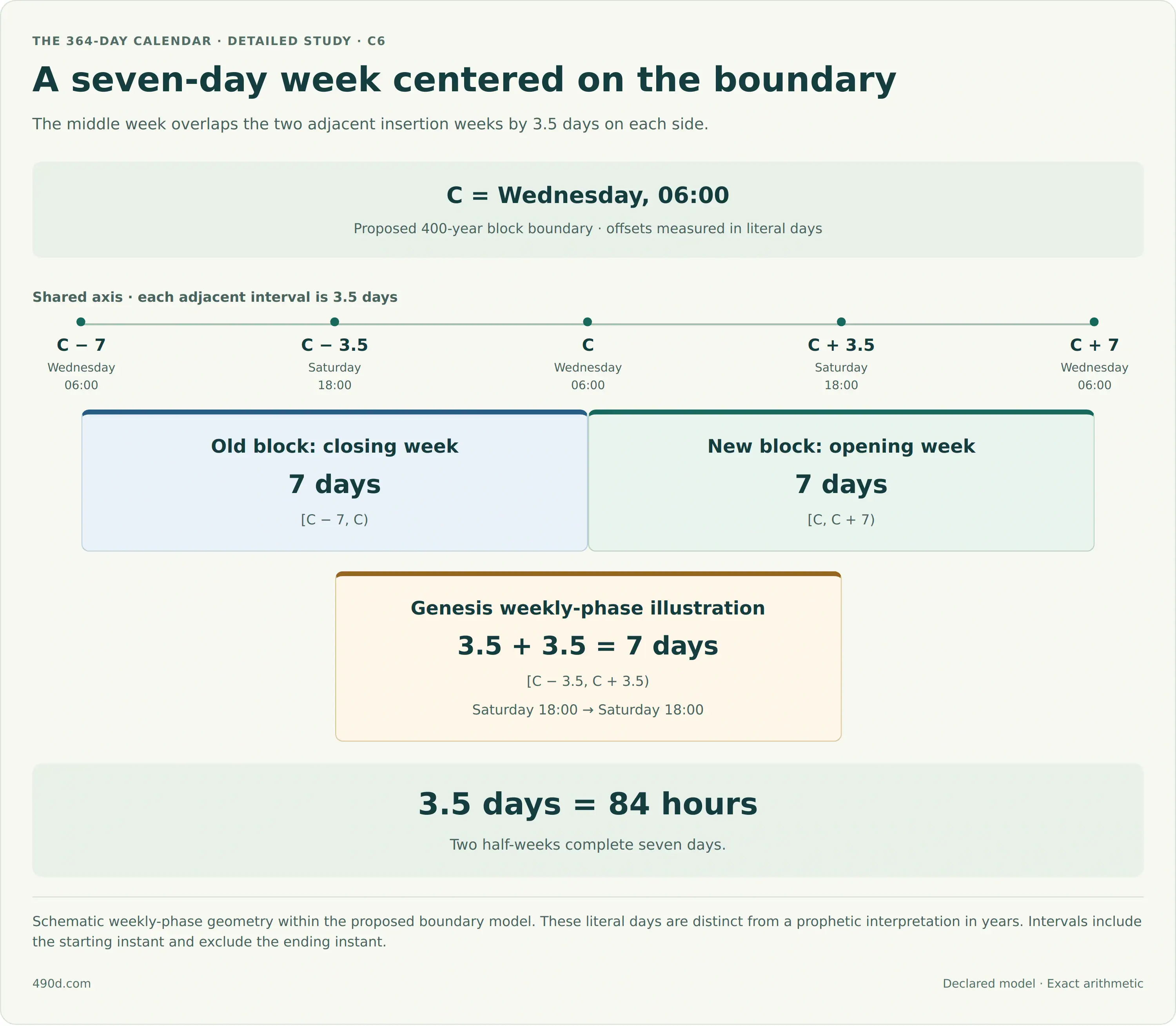
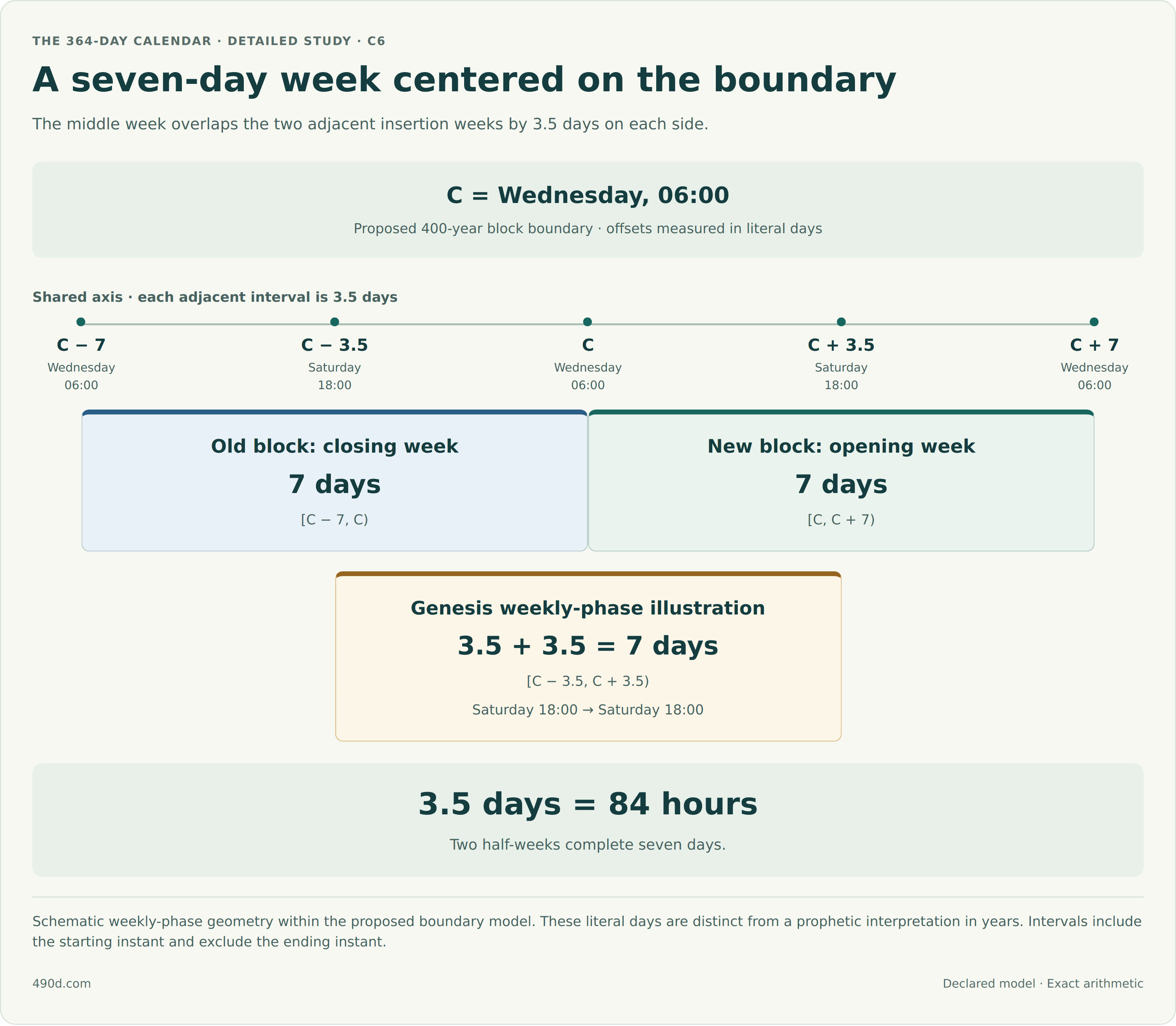
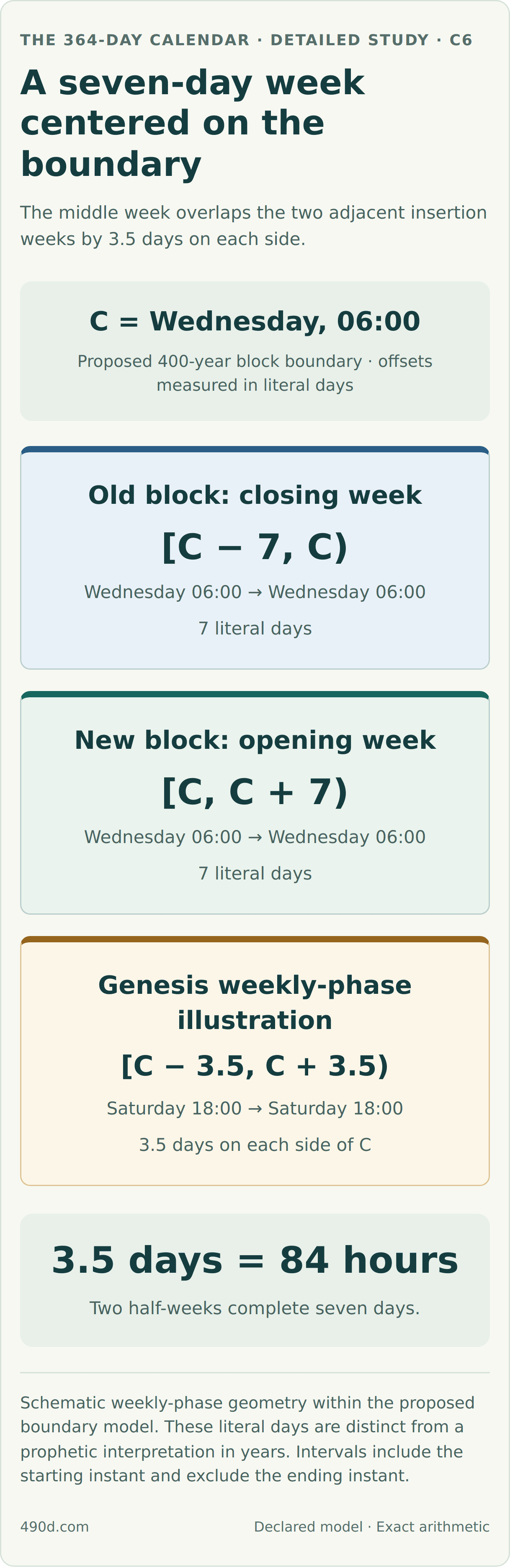
For calculations within this proposed scheme, let C be the start of a block’s opening week. The previous regular closing week occupies C − 7 to C; the new opening week occupies C to C + 7; the ordinary first year-body begins at C + 7. This boundary convention is sufficient to prevent either week from being counted twice.
6. Why use the cumulative Adam anchor?
The choice of 14006 BC comes from the cumulative MT chronology. In that method, complete lifespans are placed end to end along the ancestral line from Adam to Moses. The terminal anchor is Moses’ death and the Conquest in 1406 BC.
The 26 lifespans total 12600 years. A compact grouping makes the derivation easy to inspect:
| Direct-line group | Number of lifespans | Sum |
|---|---|---|
| Adam through Noah | 10 | 8575 years |
| Shem | 1 | 600 years |
| Arphaxad through Terah | 8 | 2396 years |
| Abraham through Moses, through Levi–Kohath–Amram | 7 | 1029 years |
| Total | 26 | 12600 years |
Joseph is not an extra member of this direct ancestral line. The full derivation is available in Cumulative Biblical Chronology and its supporting lifespan table.
Counting back from the terminal anchor gives 1406 + 12600 = 14006 BC. File 18 §6A identifies this specifically as the cumulative Adam/Year-6 center on the Moses–Nisan line. The wider cumulative envelope is 14011–14004 BC.
That distinction prevents two different kinds of week from being confused. The 14011–14004 envelope is a week of years in the cumulative framework. The proposed opening leap week at the selected 14006 coordinate is seven calendar days. Their association is a symbolic application of the calendar, not an equality of elapsed units.
A second count: twenty-six century-generations
There is also a simpler schematic comparison. Assigning 100 years to each of the same 26 generations gives 26 × 100 = 2600 years. Counting back from 1406 BC places the schematic starting coordinate at 4006 BC.
The century-generation idea is suggested by the juxtaposition of 400 years and the fourth generation in Genesis 15:13–16. File 15 §§1–3 develops this Abrahamic unit alongside the 100 years from Abraham’s call to his death. Here it serves as a stated interpretive unit. It does not make every actual generation exactly 100 years long.
Cumulative lifespans
Moses–Nisan line
Year-6 center
and Conquest
Schematic generations
A separate illustrative construction
starting coordinate
Conquest anchor
Sources: File 18 §§6, 6A, cumulative table; File 09, cumulative/ordinary coordinate controls; File 15 §4.3, 14000-year comparison; Schematic generation comparison, §6 of this study.
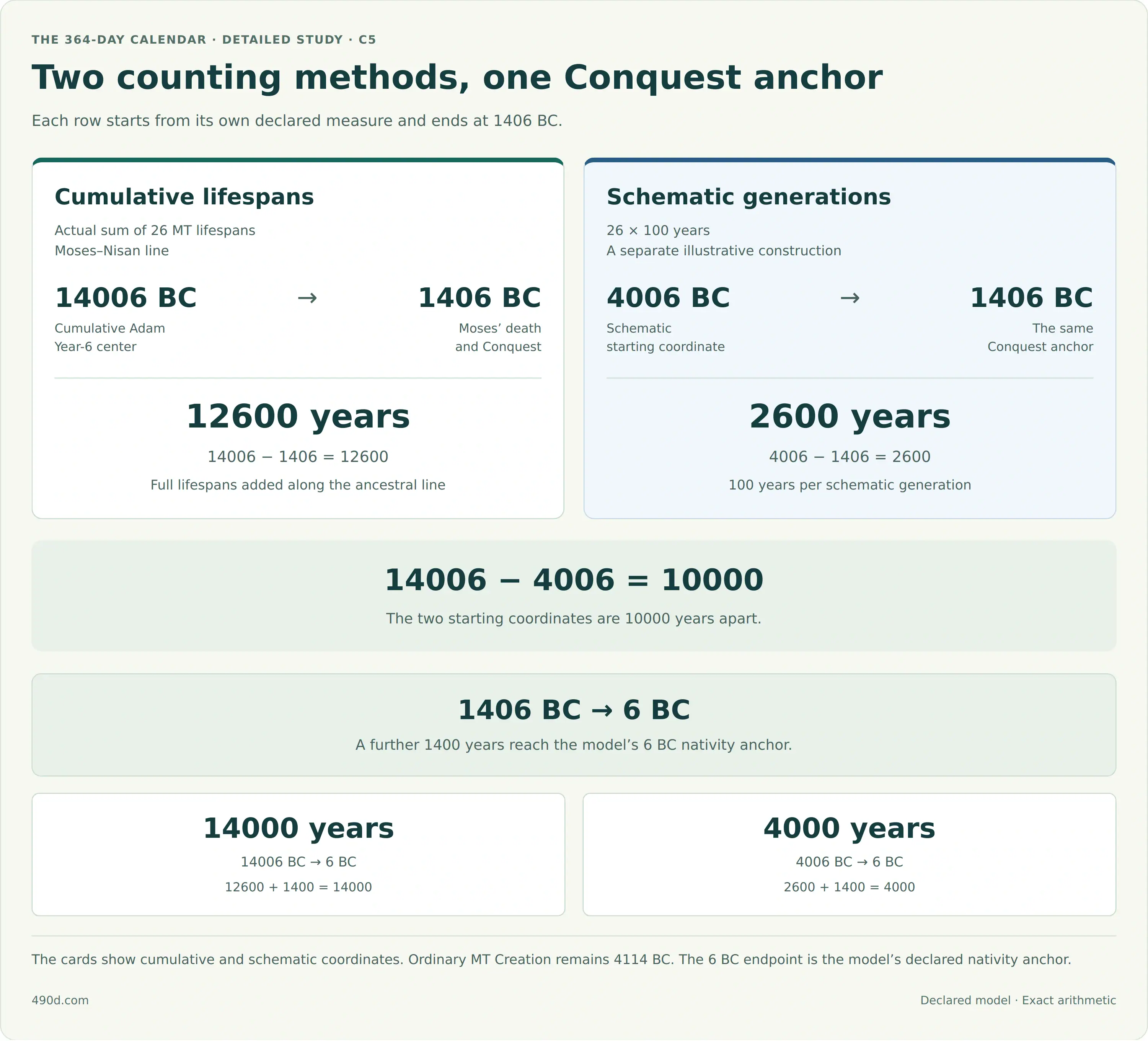
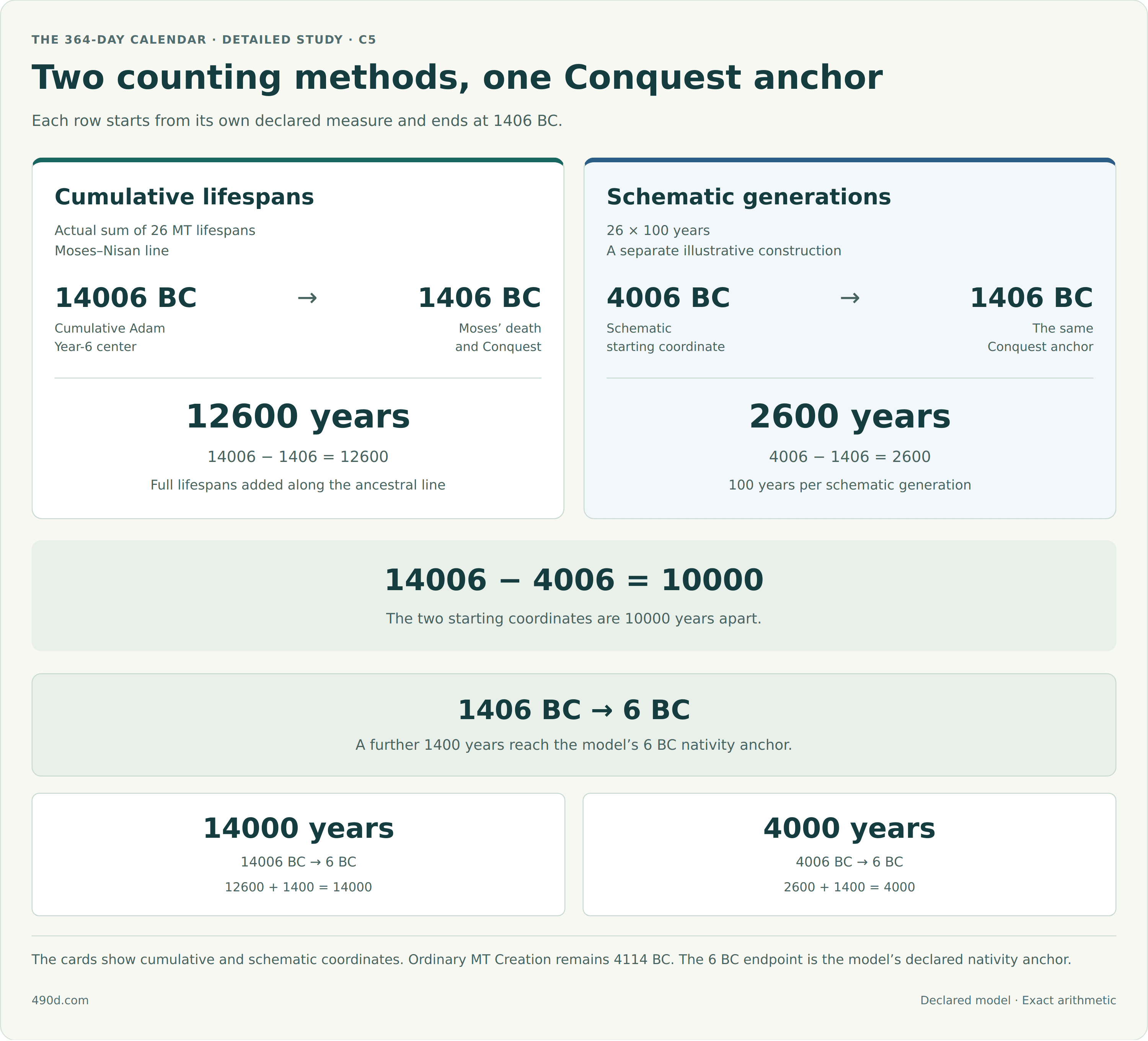
The two counting methods now share the same Conquest anchor:
| Count | Starting coordinate | Span to 1406 BC |
|---|---|---|
| Sum of 26 complete MT lifespans | 14006 BC | 12600 years |
| 26 schematic century-generations | 4006 BC | 2600 years |
| Difference between the two starts | 14006 − 4006 | 10000 years |
Using the chronology’s 6 BC Nativity anchor adds another 1400 years beyond the Conquest. The resulting spans are 4006 − 6 = 4000 and 14006 − 6 = 14000. File 15 §4.3 expressly records the latter span as 10 × 1400. The 14000-year span therefore ends at 6 BC; the span ending at the Conquest remains 12600.
The 10000-year difference offers an Enochic comparison: 1 Enoch 21:3–6 assigns a ten-thousand-year confinement to the seven bound stars. This supplies a literary parallel for the number, not a derivation of the chronological coordinates.
Neither 14006 nor the schematic 4006 replaces the ordinary MT Creation endpoint of 4114 BC. Cumulative lifespan coordinates, schematic century-generations, and ordinary birth-to-birth chronology answer different questions.
7. The half-week: a phase relationship and a duration
The creation of the heavenly lights on the fourth day gives the Wednesday beginning its symbolic setting. The Creation-week phase begins earlier, at Saturday evening/Sunday onset. From Saturday at 18:00 to Wednesday at 06:00 there are 84 hours, or 3.5 days.
File 12 §6.3.3 uses this as a structural relationship between the two weekly beginnings. Within the proposed 400-year boundary, the Saturday-evening week straddles the Wednesday boundary: half lies in the old closing week and half in the new opening week.
06:00
18:00
06:00
18:00
06:00
Old block: closing week
7 days[C − 7, C)New block: opening week
7 days[C, C + 7)Genesis weekly-phase illustration
3.5 + 3.5 = 7 days[C − 3.5, C + 3.5)Saturday 18:00 → Saturday 18:00Old block: closing week
[C − 7, C)Wednesday 06:00 → Wednesday 06:007 literal daysNew block: opening week
[C, C + 7)Wednesday 06:00 → Wednesday 06:007 literal daysGenesis weekly-phase illustration
[C − 3.5, C + 3.5)Saturday 18:00 → Saturday 18:003.5 days on each side of CSources: File 12 §6.3.3, weekly-phase geometry; Proposed boundary model, §4 of this study.
Image version and full-size download
Download the full-size PNG · Download the WebP · Download the stacked phone PNG
This weekly phase should remain distinct from a 3.5-year prophetic duration. Once years rather than days are being counted, their length must be stated:
| Stated span | At 360 days per year | At 364 days per year | Difference |
|---|---|---|---|
| 1 year | 360 days | 364 days | 4 days |
| 3.5 years | 1260 days | 1274 days | 14 days |
| 7.5 years | 2700 days | 2730 days | 30 days |
The four annual seasonal days accumulate to fourteen days over 3.5 years and thirty days over 7.5 years. This is one reason the distinction between 360 and 364 remains useful in prophetic chronology.
The 360-day reconstruction offers another comparison. A 3.5-year window can cross zero or one of its cycle endings. Its bare count is 1260 days; with one leap month it becomes 1260 + 30 = 1290 days. File 12 §7A.3 develops the corresponding typological reading of the 1260 and 1290 prophetic spans. The 1274 of the 364-day calculation remains a distinct count.
There is also a different way to reach 2730. In the declared schematic date mapping examined in File 17 §13A.3, the interval from Ezekiel’s call to the arrival of the news crosses one leap-month boundary. Its count is 2700 + 30 = 2730 days. The Enochian comparison gives 7.5 × 364 = 2730 days.
The totals agree, while their derivations differ: one includes a 30-day insertion; the other counts 7.5 years of 364 days. A longer interval cannot be assigned one leap month automatically—its placement within the stated cycle must be checked. This focused comparison provides a sound basis for further study without importing an entire reconstructed civil-date table.
8. Weeks, jubilees, and longer blocks
The 40-year construction gathers 7 leap weeks, making 49 added days. That number naturally invites comparison with the jubilee’s seven weeks of years. Leviticus 25:8 counts seven sabbaths of years, producing 49 years before the proclamation of the fiftieth year.
The parallel is between structures: seven weeks of days and seven weeks of years. The units remain explicit. The leap-week count does not turn 49 calendar days into 49 elapsed years.
At the 400-year scale, the regular adjustments amount to 70 weeks = 490 days. The additional opening week is then counted separately. This makes the seventy-week pattern visible without hiding the full intercalary total of 71 weeks. It also provides a typological comparison with the seventy weeks of Daniel 9:24–27; it is not a claim that Daniel states this leap-week schedule.
Larger multiples retain the same organization:
| Years in complete blocks | Regular leap weeks | Additional opening weeks | All added weeks |
|---|---|---|---|
| 400 | 70 | 1 | 71 |
| 2800 = 7 × 400 | 490 | 7 | 497 |
| 28000 = 70 × 400 | 4900 | 70 | 4970 |
The middle row is especially transparent: 490 regular weeks = 3430 days = 7 × 490, with 7 additional weeks = 49 days. These are exact multiples of the defined cycle. Their interest lies in how the same sevenfold organization recurs as the scale changes.
No BC/AD Mirror endpoints are required for this table. Assigning such endpoints would be a further chronological operation, with its own axis and elapsed-year conventions.
9. Calendar order and chronological interpretation
The calendar begins with a simple union of weeks and seasons: 52 weeks, four 91-day quarters, and twelve months arranged as 30 + 30 + 31. Its annual four-day completion explains the relationship between 360 and 364. The priestly count supplies the separate four-week bridge from 336 to 364.
The proposed leap-week system extends that weekly order into longer cycles. Seven regularly placed weeks organize forty years; seventy regular weeks and one opening week complete four hundred years. The cumulative Adam anchor supplies a chosen chronological setting, while the century-generation comparison opens a second way of viewing the same ancestral line.
These relationships are most useful when the reader can follow each count from its stated beginning to its stated end. Ancient testimony, exact arithmetic, and symbolic interpretation then support a coherent study without being made to stand for one another.
Sources and further reading
| Source | Sections used | Purpose |
|---|---|---|
| File 12: Calendrical Physics | §§0.8, 5.1–5.2, 6.3, 7, 7A | Annual seasonal days, calendar distinctions, weekly phase, solar references, and the reconstructed 360-day cycle |
| File 20: Jubilees, Fourth Witness | §6H, primary-text source-control table | Jubilees’ explicit fifty-two-week and 364-day statements |
| File 18: Chronological Data Tables | §§6, 6A | The direct-line lifespans and cumulative Adam/Year-6 anchor |
| File 09: Cumulative Architecture | Cumulative architecture and coordinate distinctions | The method and its separation from ordinary chronology |
| File 15: Generational Axiom | §§1–3, 4.3 | The Abrahamic 100-year unit and cumulative 14000-year comparison |
| File 17: Prophetic Time-Span Anatomy | §13A.3 | The two distinct 2730-day derivations |
The ancient passages are linked beside the claims they support. The 364-day leap-week schedule, its chosen epoch, and the century-generation comparison are presented here as proposed constructions; they are not attributed to the ancient texts or substituted for the canonical tables.
For an easier first reading, return to The 364-Day Calendar: Weeks, Seasons, and Sacred Time. Its technical appendix offers the full month table. Related studies are Levi and the Priestly Year, The Key of 23, and Cumulative Biblical Chronology.
Appendix — The tropical year, the 4000-year correction, and selected applications
Three further relationships complete the discussion: the near agreement of the tropical year around 4006 BC with the calendar’s mean, the corresponding 4000-year adjustment to the 360-day calendar, and a few applications of the day-year and Mirror patterns.
A. The tropical year around 4006 BC
The schematic 4006 BC coordinate has already been derived from 26 × 100 = 2600 years before the Conquest in 1406 BC. It stands 4000 years before 6 BC and 10000 years after the cumulative 14006 BC coordinate. A further numerical correspondence deserves to be retained: an astronomical estimate of the mean tropical year around 4006 BC rounds to 365.2425 days, the same number obtained exactly from the proposed 400-year calendar cycle.
The distinction between the two uses of that number is important. The Gregorian calendar contains 146097 days in 400 years, giving an exact rule-based mean of 365.2425 days. The proposed 364-day calendar reaches that same mean by adding 71 weeks. The physical tropical year changes slowly; near AD 2000 its mean is approximately 365.24219 uniform days, usually rounded to 365.2422. NASA’s account of calendars explains both the calendar rules and the astronomical approximation; Wikipedia’s tropical-year article reproduces the older expression used in the original calculation.
In that expression, T is the number of Julian centuries of 36525 days from J2000 in Terrestrial Time (TT), and Y is the mean tropical year in uniform days of 86400 seconds:
Y = 365.2421896698 − 0.00000615359 × T − 0.000000000729 × T² + 0.000000000264 × T³.
Astronomical year −4005 corresponds to 4006 BC. The original year-level approximation gives T ≈ (−4005 − 2000) ÷ 100 = −60.05. Substituting that value yields:
Y(−60.05) ≈ 365.2424993974 days ≈ 365.2425 days.
The later Simon expression reproduced in the FITS standard, §9.3, uses the TDB time scale and gives approximately 365.2425002264 days at the same approximate century coordinate. Thus both calculations round to 365.2425. Their tiny numerical differences from that value are outputs of the formulas, not evidence of subsecond accuracy in dating an ancient year. An exact epoch calculation would specify the date, time scale, and Julian Day rather than substitute a year label alone.
This preserves the original observation: the astronomical estimate around the schematic 4006 BC coordinate is very close to the exact mean produced by the calendar’s intercalation rule. The correspondence does not single out one uniquely established Creation year, measure the probability of design, or imply that a fixed calendar remains perfectly aligned with the seasons indefinitely. Uniform astronomical days also should not be equated without qualification with ancient Earth-rotation days. The distinct calibrated references in File 12 §5.1A retain their own roles.
B. A proposed correction to the 360-day calendar by omitting a month every 4000 years
The 360-day construction in Section 3 adds seven 30-day leap months in each 40-year cycle. Its mean is 365.25 days. The older study at 360calendar.com, Part One, carries that construction one step further: omit the final scheduled leap month of every 4000-year cycle. Step 4 gives the rule and its calculation explicitly.
There are 100 forty-year cycles in 4000 years. Without the omission they would insert 100 × 7 = 700 months. Omitting the month at the end of Year 4000 leaves 699 leap months:
4000 × 360 + 699 × 30 = 1440000 + 20970 = 1460970 days.
Equivalently:
100 × 14610 − 30 = 1460970 days.
The corrected mean is therefore:
1460970 ÷ 4000 = 365.2425 days.
Only the terminal insertion is omitted. The first 99 forty-year blocks retain their seven leap months; the last has six, at its local years 6, 12, 18, 24, 30, and 36. Its usual insertion after local Year 40, which is Year 4000 of the larger cycle, is skipped. Thus the last block contains 14610 − 30 = 14580 days. The count resumes with the next 40-year block.
This gives a direct comparison between the two proposed calendars over the same span:
| Construction over 4000 years | Ordinary year-bodies | Added time | Complete total |
|---|---|---|---|
| 364-day calendar — ten complete 400-year blocks | 4000 × 364 = 1456000 days | 710 weeks = 4970 days | 1460970 days |
| 360-day calendar — one corrected 4000-year block | 4000 × 360 = 1440000 days | 699 months = 20970 days | 1460970 days |
The ordinary year-bodies differ by 4000 × 4 = 16000 days; the added time differs by the same amount in the opposite direction: 20970 − 4970 = 16000. Both constructions consequently reach the exact Gregorian mean, using different units and different correction periods.
The 4000-year omission is an integral part of this proposed comparison. File 12 §7A supplies the forty-year leap-month framework; the older study supplies the longer correction. The result is exact arithmetic within the stated rules. Ancient use of this particular omission remains a separate historical question, and equality of long-term means does not make the two calendars’ month dates or annual weekday patterns identical.
C. Nativity, Mirror, and Exodus–Ezekiel applications
Nativity and purification. The birth, circumcision, and purification sequence illustrates how numbered days can be projected into symbolic years. Leviticus 12:2–6 supplies the childbirth pattern, and Luke 2:21–24 applies the rites to Jesus and Mary. Using the traditional December 25 birth datum, File 13 §§7.1–7.3 sets out the following interpretation:
| Event | Numbered day | Full days elapsed from birth | Symbolic year label |
|---|---|---|---|
| Birth | 1 | 0 | 7 BC |
| Circumcision and naming | 8 | 7 | AD 1 |
| Completion of the inclusive purification count | 40 | 39 | AD 33 |
The inclusive fortieth day comes 39 full days after the first. In the stated day-year register, Day −6 + 39 = Day 33. The correspondence retains the purification and Passion symbolism without turning forty numbered positions into forty elapsed years. The traditional December 25 datum serves this illustration; it is not a newly established historical birth date.
Mirror and local boundaries. The larger interpretive pattern places Christ at the center of reflected spans: 14000 + 14000 = 28000, with each half expressible as 12600 + 1400. This carries forward the Creation-to-Conquest and Conquest-to-Christ structure. On a smaller scale, the adjacent closing and opening weeks at each 400-year boundary provide a local reflection, with the half-week relationship explained in Section 7. These are comparisons of declared intervals. Specific BC/AD endpoint labels require their own Mirror rule: ordinary civil counting gives 14006 BC to AD 14006 = 28011 years, not 28000. The 28000-year structural comparison therefore stands without assigning that civil endpoint pair to it.
Exodus and Ezekiel. The common 390 + 40 = 430 pattern connects the Exodus chronology with the enacted day-for-year sign of Ezekiel 4:4–6. The anchors in File 17 §5.2 and File 15 §3.1 give 1876 BC to 1486 BC = 390 years, followed by 1486 BC to the Exodus in 1446 BC = 40 years, Moses’ Midian period. The older Exodus chart explores a corresponding 390-plus-40-day sequence; its broader day-year discussion remains a useful companion. The interval pattern can be followed without reproducing its full reconstructed date ledger.
For Ezekiel’s call-to-news comparison, File 17 §13A.3 gives the compact calendrical relation already developed in Section 7: 7.5 × 360 + 30 = 2730 days, while 7.5 × 364 = 2730 days. One calculation crosses the declared leap-month boundary; the other uses the Enochian year directly. Together these applications show how the calendar’s literal counts support further day-year and Mirror readings when the counting convention and the symbolic step remain visible.
Scripture quotations: Berean Standard Bible (BSB), public domain. The quotation from Jubilees uses R. H. Charles’s 1913 public-domain translation; references to 1 Enoch use the Charles translation in the 1917 edition. Original quotation wording and number formatting are retained.