Earlier edition preserved on 9 October 2026. Read the current edition.
Detailed companion to From Adam to Joshua: The 930–950–930 Pattern. The technical appendix supplies the core derivations and starting-point comparisons.
The parent article introduces a three-part pattern extending from Adam to Joshua: 930 + 950 + 930. This detailed study examines how that pattern relates to Cainan, the larger cumulative chronologies, and the distinct readings of the Masoretic Text (MT), Samaritan Pentateuch (SP), and Septuagint (LXX).
Adam’s and Noah’s lifespans provide the pattern’s central measures. Genesis 5:3–5 divides Adam’s life into 130 years before Seth and 800 afterward; Genesis 9:29 gives Noah a total of 950 years. Within the selected chronology, the span from Terah’s birth to Joshua’s death repeats Adam’s 130 + 800 division. The result connects the beginnings of humanity with the family through whom Israel inherits the land.
The argument develops in stages: first the dates and their arithmetic, then comparisons between explicitly identified chronological settings, and finally their theological significance. All dates in the tables are BC unless otherwise stated.
1. Dates and chronological settings
The core follows the canonical files’ regular MT chronology, using the Nisan framework, the full 430-year Egyptian sojourn, the Terah +60 adjustment, and the native genealogy without the second Cainan. Adam’s selected starting point is Year 6 at 4176 BC, within the files’ Creation-week framework. These BC dates express the reconstruction; Genesis itself supplies the ages and relationships from which it is developed.
File 07 §2.11.1a distinguishes the 4176 Year-6 position from the 4174 Creation endpoint in the same +60 setting. Measuring Adam’s lifespan from the selected Year-6 position gives 4176 − 930 = 3246. In the native-MT core, Adam’s measured lifespan therefore means 4176–3246. The endpoint-based table uses a different starting position, whose effect is shown in the technical appendix.
The Terah +60 adjustment comes from reading three passages together. In the MT, Genesis 11:32 gives Terah 205 years; Genesis 12:4 gives Abraham’s age as 75 at departure from Haran; and Acts 7:4 places the departure after Terah’s death. Aligning these events gives 205 − 75 = 130 for Terah’s age at Abraham’s birth. This is 60 years beyond the age of 70 at which Genesis 11:26 begins its account of Terah’s sons. In the selected reconstruction, Terah is born in 2296, Abraham in 2166, and Terah dies in 2091 BC. File 18 §1.3.1 records this adjustment. It shifts Terah and earlier ancestors; Abraham and the later comparison dates remain fixed.
Joshua’s regular lifespan is 1476–1366 BC, totaling 110 years, as stated in File 18 §2.4. The Conquest begins in 1406 and the Conquest/rest framework reaches 1399. Joshua’s death in 1366 closes the longer comparison. It is distinct from both those Conquest dates and the SP cumulative Joshua endpoint at 1296.
2. The 930–950–930 construction
The pattern follows four dates:
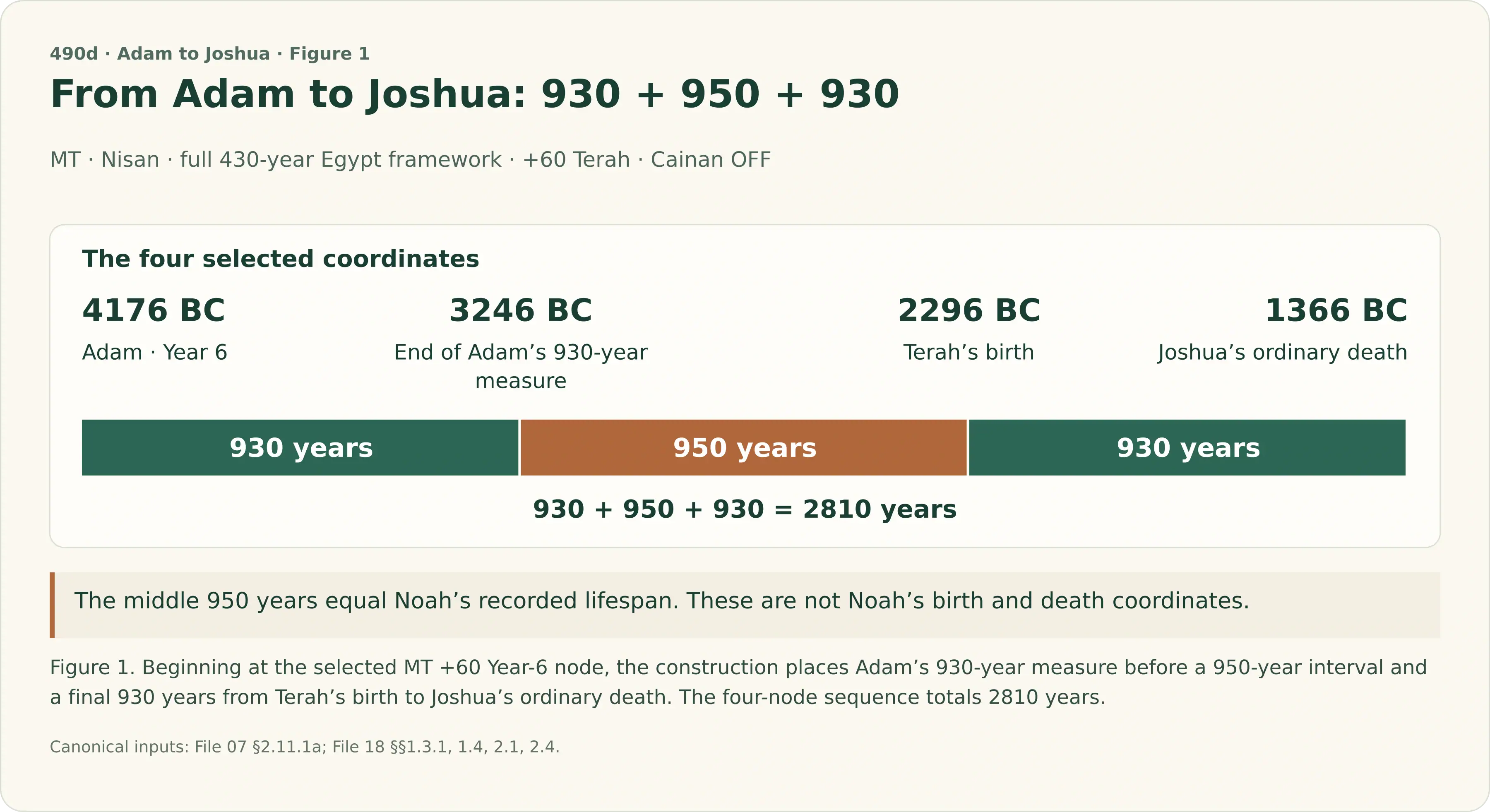
4176 → 3246 → 2296 → 1366 BC.
| Interval | Calculation | Role |
|---|---|---|
| Adam’s selected Year-6 start → end of his measured lifespan | 4176 − 3246 = 930 | First outer span |
| End of Adam’s measured lifespan → Terah’s birth | 3246 − 2296 = 950 | Middle span matching Noah’s lifespan |
| Terah’s birth → Joshua’s death | 2296 − 1366 = 930 | Second outer span |
| Entire sequence | 4176 − 1366 = 2810 | 930 + 950 + 930 |
490d · Adam to Joshua · Figure 1
From Adam to Joshua: 930 + 950 + 930
MT · Nisan · full 430-year Egypt framework · +60 Terah · Cainan OFF
The four selected coordinates
Canonical inputs: File 07 §2.11.1a; File 18 §§1.3.1, 1.4, 2.1, 2.4.
Read the dates, calculation, and scope
The selected Year-6 starting coordinate is 4176 BC, distinct from the 4174 BC Creation endpoint. Subtracting Adam’s 930 years gives the measured terminal 3246 BC. Then 3246 − 2296 = 950 and 2296 − 1366 = 930. The sum is 2810. Terah’s +60 birth state is 2296 BC; Joshua’s fixed ordinary death is 1366 BC. The middle interval compares a duration with Noah’s recorded 950 years, without identifying its endpoints as Noah’s birth and death. No second Cainan is inserted.
View the image version or download it full size
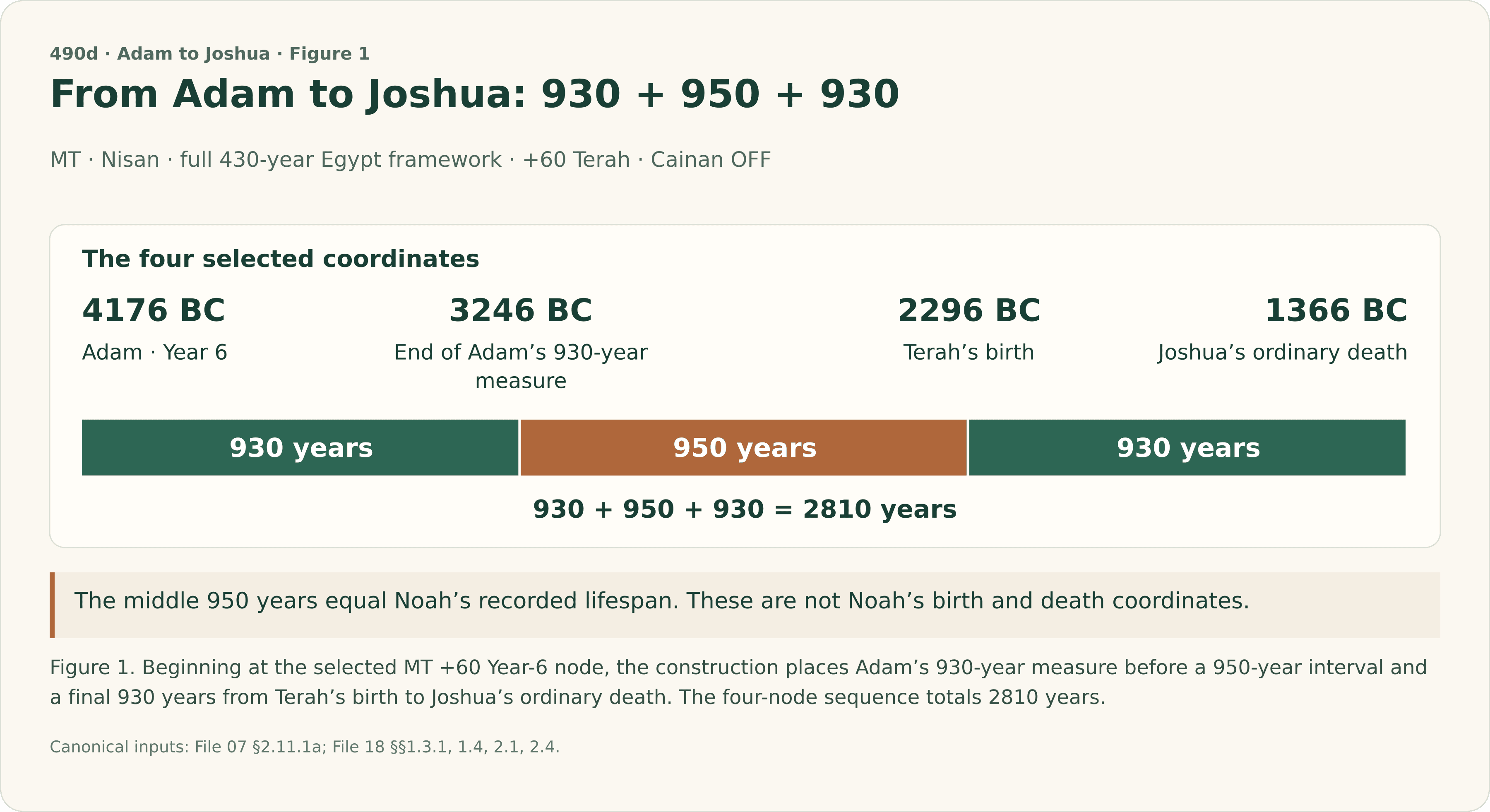
The arrangement has an A–B–A symmetry: two 930-year spans surround a 950-year span. The middle interval runs from the end of Adam’s measured lifespan to Terah’s birth and equals the length of Noah’s life. Section 5 develops the further correspondence with Noah’s birth and death dates under the restored-Cainan setting. That comparison uses a different genealogy from the native MT core.
The two outer measures have a more detailed correspondence:
| 930-year measure | First part | Second part |
|---|---|---|
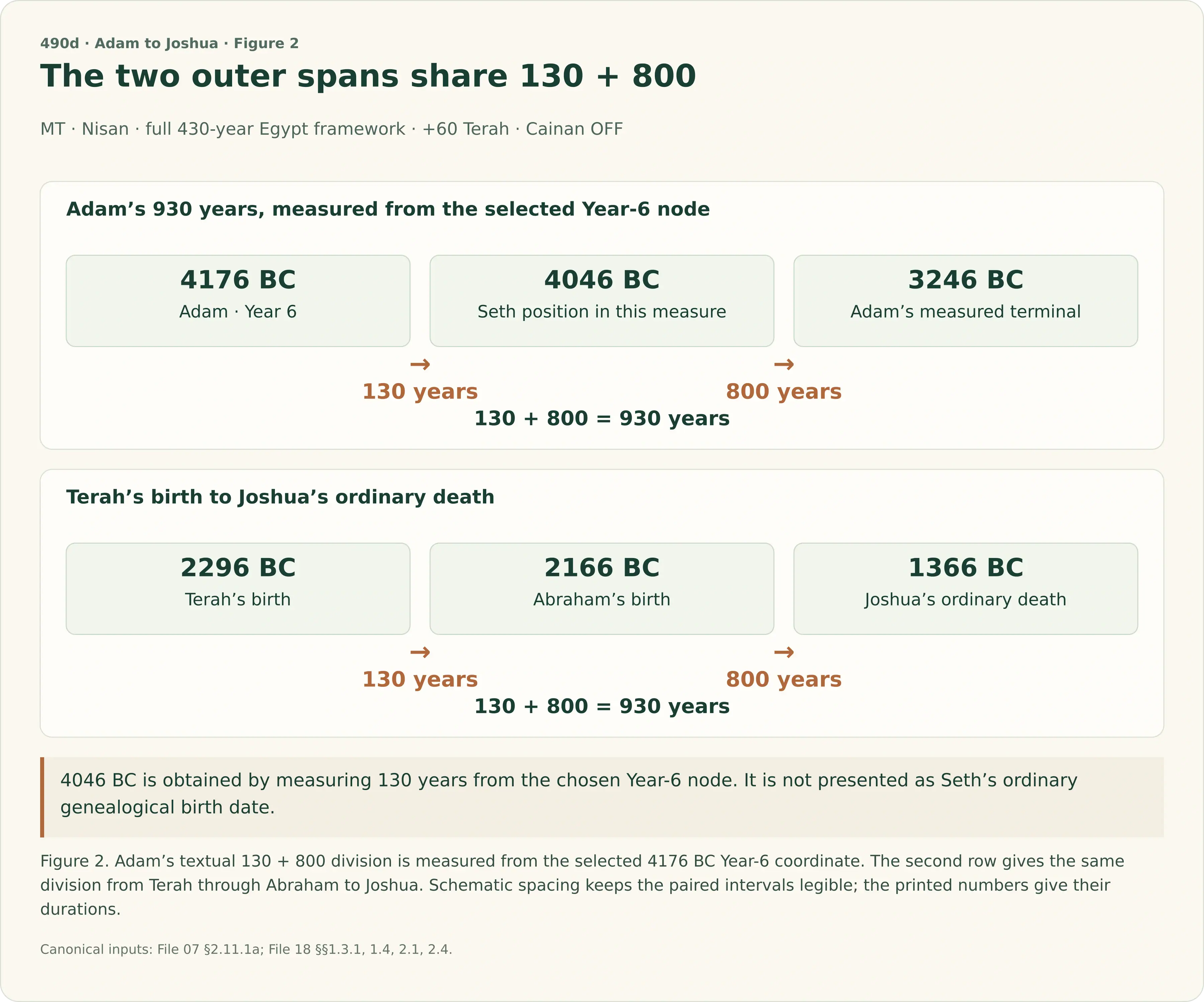
| Adam, measured from 4176 | 130 years to Seth: 4176 → 4046 | 800 afterward: 4046 → 3246 |
| Terah through Abraham to Joshua | 130 years to Abraham: 2296 → 2166 | 800 to Joshua’s death: 2166 → 1366 |
The first division belongs to Adam’s life; the second spans generations. The 4046 Seth position is derived within the selected Year-6 lifespan construction. Abraham’s own life remains 2166–1991 = 175 years. It is Terah to Joshua, not Abraham to Joshua, that totals 930.
490d · Adam to Joshua · Figure 2
The two outer spans share 130 + 800
MT · Nisan · full 430-year Egypt framework · +60 Terah · Cainan OFF
Adam’s 930 years, measured from the selected Year-6 node
Terah’s birth to Joshua’s ordinary death
Canonical inputs: File 07 §2.11.1a; File 18 §§1.3.1, 1.4, 2.1, 2.4.
Read the dates, calculation, and scope
Adam’s biblical lifespan is divided into 130 years before Seth and 800 afterward. Applied to the expressly selected Year-6 node, 4176 − 130 = 4046 and 4046 − 800 = 3246. This row measures the textual divisions from the chosen node; it does not replace the ordinary genealogical Seth row. The corresponding historical-coordinate comparison is 2296 − 2166 = 130 and 2166 − 1366 = 800. Abraham’s 2166 BC date and Joshua’s 1366 BC date remain fixed at this full-430 setting. Each row totals 930; schematic spacing is not a common absolute-date axis.
View the image version or download it full size
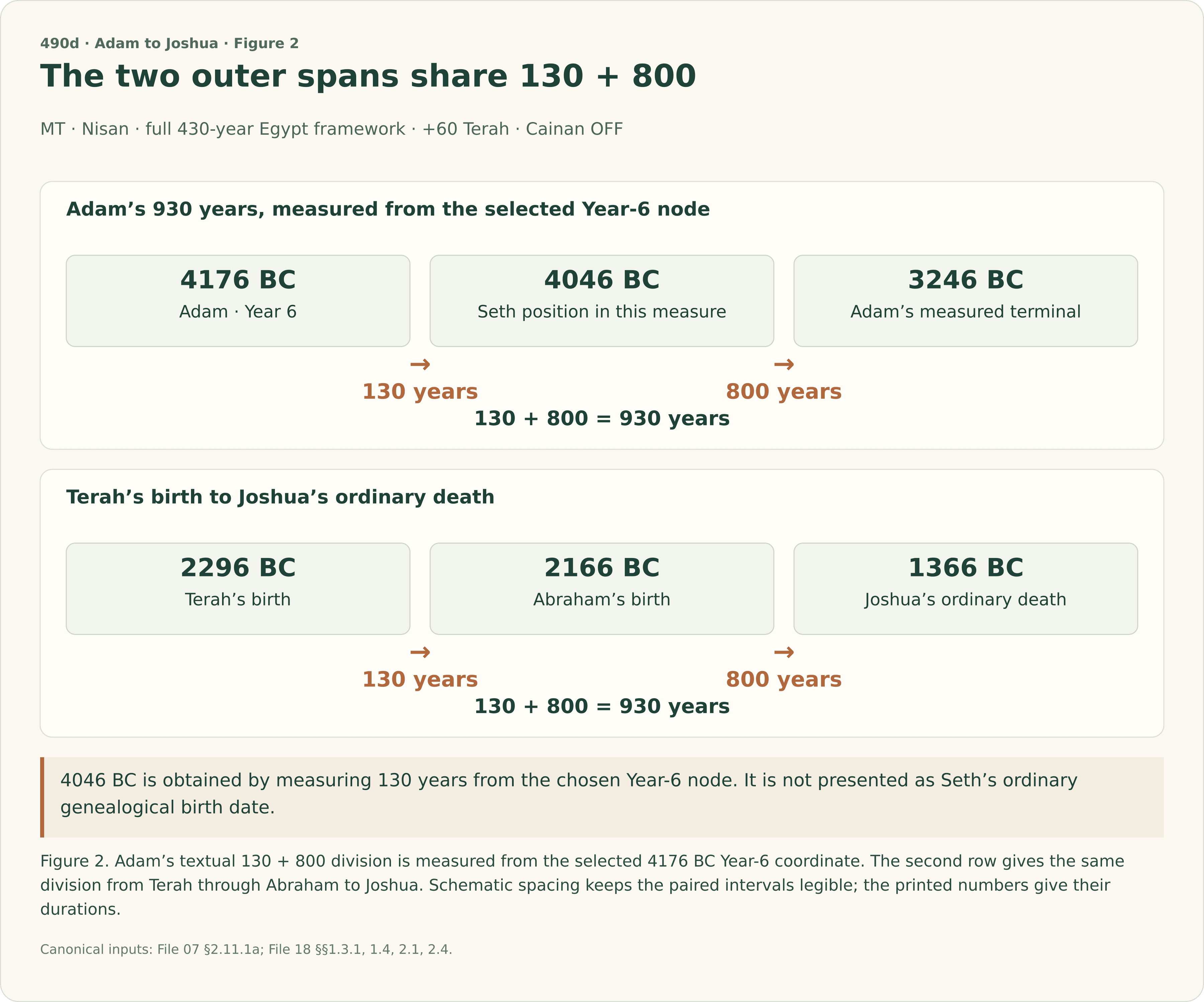
This comparison links the continuation of humanity through Seth with the promise-bearing family through Abraham. The chronology supplies an exact repeated measure; the reading of that measure as an Adamic pattern extended into Israel’s history is theological interpretation.
2.1 A related 930–888–930 comparison
A related arrangement retains the final Terah–Joshua span while selecting the no-+60 Creation-endpoint setting for Adam:
4114 → 3184 → 2296 → 1366 = 930 + 888 + 930.
The first two positions use the no-+60 MT Creation endpoint and a 930-year life measured from it. Its Terah position uses +60. It is therefore a cross-variant comparison, not a second continuous chronology in which all settings remain the same.
The difference from the principal pattern can be traced precisely. Changing the Adam start from 4176 Year 6 to 4114, no-+60 Creation endpoint, moves it 62 years: 60 from Terah’s variant and two from the starting-position choice. Its terminal likewise moves from 3246 to 3184, reducing the middle interval from 950 to 888 while holding the +60 Terah endpoint fixed.
The 888 arrangement therefore compares dates drawn from two variant settings. Its value lies in that explicitly defined numerical relationship. The principal 930–950–930 construction retains the single +60 setting declared in §1.
3. A selected succession of 27 positions
The narrative can also be arranged as three groups of nine, with the second Cainan absent:
| Group | Selected positions | Count |
|---|---|---|
| Adam’s opening line | Adam, Seth, Enosh, Kenan, Mahalalel, Jared, Enoch, Methuselah, Lamech | 9 |
| Noah’s line to Nahor | Noah, Shem, Arphaxad, Shelah, Eber, Peleg, Reu, Serug, Nahor | 9 |
| Terah’s family and the leaders of the Exodus/Conquest | Terah, Abraham, Isaac, Jacob, Levi, Kohath, Amram, Moses, Joshua | 9 |
Noah and Terah each introduce a family presentation involving three sons in Genesis 6:9–10 and 11:27. That literary parallel gives the grouping a narrative interest. The table is nevertheless a selected literary succession, not one unbroken father-to-son genealogy: Joshua is Moses’ successor and the son of Nun. The chronological 930-year first span also ends at Adam’s measured death, rather than at Lamech’s birth or death. The groups and the intervals are related ways of organizing the material, not identical boundaries.
Adding the second Cainan creates 28 selected positions through Joshua. File 18 §1.3.3 gives 27 through Moses with Cainan included. The difference is the final position: this study continues the selected succession through Joshua.
The principal 930–950–930 calculation stands independently of these selected counts. Their contribution is literary: they place the patriarchal history beside the transition to Moses and Joshua without turning succession into biological descent.
4. The 130-year motif
The outer 130 + 800 pattern draws attention to 130 at other turning points. Adam is 130 at Seth’s birth. In the selected Terah state, Abraham is born when Terah is 130. Jacob is 130 when he enters Egypt, according to Genesis 47:9. The second Cainan’s 130-year begetting interval introduces another comparison in the LXX and restored-MT settings.
File 29 §1.2 interprets 130 as a measure associated with curse, separation, and the passage toward restoration. The narratives give this interpretation its context: Seth’s birth follows the loss of Abel; Abraham’s family emerges through departure and promise; Jacob’s arrival in Egypt leads into a new stage of Israel’s history.
The repeated number can support that theological reading without functioning as a universal rule for every appearance of 130. Nor does sharing a number identify the events as one event. Adam’s age, Terah’s reconstructed begetting age, Jacob’s stated age, and Cainan’s genealogical interval retain their different roles.
The following 800 years in the paired outer spans can likewise be read as continuity after a new beginning. On Adam’s side, they are the remainder of his life. On Terah’s side, they connect Abraham’s birth with Joshua’s death. The comparison concerns the continuation of the human family and the development of the covenant promise at different scales.
5. Cainan and the Noah–Adam correspondence
5.1 The textual and chronological distinction
The second Cainan stands between Arphaxad and Shelah in the LXX genealogy used here and in Luke 3:36. He is distinct from the earlier Kenan between Enosh and Mahalalel. The native MT and SP omit the second Cainan. A restored-MT comparison adds this generation according to the canonical files’ defined procedure; its dates remain clearly distinguished from the native MT and SP tables.
Regular chronology inserts Cainan’s 130-year begetting interval. Cumulative chronology inserts his 460-year lifespan. These are different operations. In the regular restored-MT comparison, the +130 moves Arphaxad and earlier dates; Shelah and the later line through Terah, Abraham, and Joshua retain their selected dates. The LXX already includes Cainan in its native baseline and receives no second insertion.
The relevant Noah biographies follow File 18 §2.2.1 and the variant boundaries in §§1.3.1 and 1.6:
| Full-430 MT setting | G2 Noah, normal biography | G1 Noah, alternative biography | Adam Year 6 → measured 930-year terminal |
|---|---|---|---|
| Native, no +60 | 3058 → 2108 | 3056 → 2106 | 4116 → 3186 |
| Native, +60 | 3118 → 2168 | 3116 → 2166 | 4176 → 3246 |
| Restored Cainan, no +60 | 3188 → 2238 | 3186 → 2236 | 4246 → 3316 |
| Restored Cainan, +60 | 3248 → 2298 | 3246 → 2296 | 4306 → 3376 |
G1 and G2 name two Noah/Flood alignments in the canonical files, two years apart. Each displayed Noah biography lasts 950 years. These labels apply to Noah’s dates in this table. Adam’s starting positions are taken separately from File 07’s specified Year-6 field.
5.2 What the overlap establishes
The central interval of the native-MT pattern is 3246 → 2296. The restored-Cainan G1 Noah also lives 3246 → 2296 in the +60 comparison. Thus two date pairs coincide exactly:
- Native-MT Adam’s measured terminal 3246 matches restored-Cainan G1 Noah’s birth 3246.
- That restored-Cainan Noah’s death 2296 matches Terah’s unchanged birth 2296.
The correspondence gives the central 950 a second form: a span first identified by its length can also be compared with a dated Noah biography in another admitted setting. Its theological interest is the passage from Adam to the preserver of humanity, followed by the emergence of the family leading to Abraham.
The settings must remain explicit. In the restored-Cainan chronology itself, Adam’s selected start is 4306, and his measured terminal is 3376. Adam does not die in 3246 within that same restored construction. The overlap is a comparison across Cainan settings, not two simultaneous lives in one unchanging chronology.
5.3 Cainan’s life and Abraham’s call
The restored-MT Cainan biography also requires its own label:
| Full-430 restored MT | Cainan’s birth → death | Lifespan |
|---|---|---|
| No Terah +60 | 2551 → 2091 | 460 |
| Terah +60 | 2611 → 2151 | 460 |
The first row ends in 2091 BC, the full-430 date of Abraham’s departure from Haran. In the +60 Terah setting, Terah also dies in 2091. The latter comparison therefore joins different +60 settings: restored Cainan’s no-+60 death and Terah’s +60 death. Abraham’s 2091 call remains the later fixed target in both.
The 2551 → 2091 row is a restored-MT comparison, not the native LXX Cainan biography. File 18 §4.2 gives the native LXX minimum row as 2886 → 2426; adding 215 for the full-430 frame gives 3101 → 2641. These biographies share the 460-year lifespan while occupying different genealogical settings.
5.4 Jubilees and the omission hypothesis
Jubilees 8 associates Cainan with an inscription preserving forbidden astral knowledge connected with the Watchers. File 53 §§1–3 discusses Cainan’s treatment within Jubilees’ 22-fold genealogical architecture. This supplies a literary and theological context for considering how an ancestor can be present in a narrative yet treated differently in a structured count.
File 53 §14 makes the Jared comparison explicit. In its Book of Jubilees (BJ) framework, the span from Creation to Jared is 3856 − 3396 = 460 years, matching Cainan’s lifespan. These BJ dates belong to a separate comparison from the MT core. The Enochic tradition associates the Watchers with the days of Jared, providing the narrative connection; that association alone does not date their descent to the precise year of Jared’s birth.
Cainan’s association with forbidden knowledge offers a possible theological explanation for his treatment in structured genealogies. Establishing the history of his omission or inclusion, however, requires manuscript evidence beyond these numerical and literary correspondences. The chronology demonstrates two defined results: the native-MT 930–950–930 core and an additional Noah correspondence when Cainan is restored.
6. The restored-Cainan extension: 2940 years
Restoring Cainan moves the selected Adam Year-6 position from 4176 to 4306. Joshua’s regular death stays 1366. Therefore:
4306 − 1366 = 2940 = 6 × 490 = 60 × 49.
The coherent restored sequence is:
4306 → 3376 → 2296 → 1366 = 930 + 1080 + 930.
Its two outer 930s remain; its middle grows from 950 to 1080 = 950 + 130. Terah stays at 2296 because the insertion affects Arphaxad and earlier ancestors. The additional 130 years therefore enlarge the middle interval while leaving the Terah–Joshua span intact.
This preserves a meaningful relationship between the two constructions:
| Setting | Total | Internal form |
|---|---|---|
| Native MT, +60, selected Year 6 | 2810 | 930 + 950 + 930 |
| Restored Cainan, same later anchors | 2940 | 930 + 1080 + 930 |
| Difference | 130 | The regular Cainan insertion |
Expressing the total as 60 jubilees uses sixty 49-year comparison units. The factorization connects the total with the sevenfold measures used in the research and with Daniel’s seventy weeks. It does not on its own date sixty separately documented observances or prove six successive historical epochs of 490 years each.
6.1 Two further routes to 2940
File 07 §2.10 explicitly gives two ratio-based routes to the same total:
| Route | Exact calculation | Endpoint and operation |
|---|---|---|
| Restored MT, prophetic expansion | 4304 − 1406 = 2898; 2898 × 70/69 = 2940 | Creation endpoint to Conquest, with the stated ratio |
| Standard MT, priestly expansion | 4114 − 1446 = 2668; 2668 × 25/23 = 2900; 1446 + 2900 = 4346; 4346 − 1406 = 2940 | Expansion anchored at the Exodus, then measured to the Conquest |
The first route uses 4304, the restored Creation endpoint, rather than Year 6 at 4306. The second expands the 2668-year Creation-to-Exodus interval to 2900 years. Holding the Exodus at 1446 produces a transformed starting point of 4346, from which the span to the Conquest at 1406 is also 2940. That generated starting point expresses the transformation; it does not replace the ordinary Creation date.
These routes and the direct 4306 → 1366 span share the number 2940 while using different endpoints and operations. Their relationship can be stated exactly: the unexpanded endpoint-to-Conquest span is 2898; moving the beginning two years earlier to Year 6 and the ending forty years later to Joshua’s death gives 2898 + 2 + 40 = 2940. The prophetic ratio also adds 42, since 2898/69 = 42. This is a derived correspondence between two specified operations, not an identity of their chronological events.
6.2 The Flood-to-Conquest comparison
The same restored-Cainan, +60 MT setting places normal G2 Flood start at 2648 BC: 2458 + 130 + 60 = 2648. From there to the Conquest, 2648 − 1406 = 1242 = 18 × 69. Applying the prophetic ratio gives 1242 × 70/69 = 1260. This converts eighteen units of 69 into eighteen units of 70. The underlying Flood and Conquest dates remain the inputs to the calculation. File 07 §2.11.1a supplies the corresponding restored endpoint calculation, 4304 − 1656 = 2648.
7. Cumulative parallels: the 12,600-year translation
Cumulative chronology places complete lifespans end to end. Regular chronology instead uses begetting intervals and allows the lives to overlap. A cumulative coordinate therefore belongs to a different construction and must retain that label.
The primary MT Moses/Nisan line in File 18 §6A begins:
| Cumulative position | BC coordinate | Lifespan to the following position |
|---|---|---|
| Adam, Year 6 | 14006 | 930 |
| Seth | 13076 | 912 |
| Enosh | 12164 | 905 |
| Kenan | 11259 | — |
The full MT trunk reaches Moses’ death and the Conquest anchor at 1406:
14006 − 1406 = 12600 = 10 × 1260.
The 1260 comparison recalls the prophetic duration in Revelation 11–12. Its occurrence here is a numerical correspondence in years; it does not erase the distinction between the biblical passages’ days and the cumulative years.
The LXX cumulative table in File 18 §6D places Adam at 14896 BC, including the second Cainan and the selected Lamech lifespan of 753. Measuring Adam’s 930-year life gives 13966 BC as its terminal. Both ends then stand 12,600 years before the regular Terah–Joshua interval:
| LXX Cumulative | Subtract 12600 | Regular comparison target |
|---|---|---|
| Adam begins: 14896 | 14896 − 12600 = 2296 | MT +60 Terah’s birth |
| Adam’s 930-year life ends: 13966 | 13966 − 12600 = 1366 | Joshua’s death |
The two 930-year intervals correspond exactly:
14896 → 13966 = 930, and 2296 → 1366 = 930.
Subtracting the same 12,600 years from both dates preserves the 930-year interval, linking the named cumulative and regular constructions. It supplies a further Adam-sized form of the Terah–Joshua span. The source provides the inputs; the two parallel 12,600-year translations are direct derivations displayed here. Their theological interest lies in the recurring movement from the first human family to the generation inheriting the land.
The LXX and MT cumulative Adam starting dates differ by 14896 − 14006 = 890. This divides into 460 + 430: restoring Cainan’s 460-year lifespan moves MT Adam to 14466, and 14896 − 14466 = 430 remains. That remaining difference reflects the combined effect of other lifespan readings. The selected Lamech figures, for example, are 753 in the LXX and 777 in the MT.
These calculations consistently use the Moses/Nisan cumulative line. File 18 supplies the additional alignments for readers pursuing the wider cumulative system.
8. Three traditions and the 1656-year measure
The larger comparative argument includes another repeated duration, 1656 = 72 × 23. Here the setting changes to full-430, no Terah +60, with normal G2 Noah/Flood positions. The MT and SP use their native omission of the second Cainan; the LXX retains him.
| Tradition | Creation endpoint → selected Noah event | Years |
|---|---|---|
| MT | 4114 → Flood start 2458 | 1656 |
| LXX | 5494 → Noah’s birth 3838 | 1656 |
| SP | 4414 → Noah’s death 2758 | 1656 |
File 18 §§2.1.3 and 4.1 supplies the MT and LXX rows; File 11 §8.1 gives the SP Creation-to-death comparison. In the SP span, Noah’s life divides at the Flood into 600 + 350 = 950 years.
At Flood start, the corresponding dates are MT 2458, SP 3108, LXX 3238 BC. Their offsets form a 130-year family:
3238 − 3108 = 130; 3108 − 2458 = 650 = 5 × 130; 3238 − 2458 = 780 = 6 × 130.
The 130-year net difference between LXX and SP does not mean their complete genealogies are identical apart from Cainan. The table compares their resulting coordinates under a shared framework; each tradition retains its own begetting ages and lifespans.
A further no-+60 MT comparison reaches the Jerusalem endpoint at 586 BC: 4114 − 586 = 3528 = 72 × 49. The two factorizations thus pair 72 × 23 with 72 × 49, where 49 is the Jubilee comparison unit. This numerical relationship supplies a further subject for theological interpretation.
The three traditions can thus be read as complementary witnesses to a recurring chronological measure: the MT emphasizes the Flood, the LXX Noah’s birth, and the SP his completed life. This study interprets that convergence providentially while leaving the history of each textual tradition open to the appropriate textual evidence.
9. Creation, preservation, and inheritance
The theological thread is the continuity of God’s purpose through mortality and judgment. Adam’s family continues through Seth. Noah preserves a family through the Flood. Abraham’s call begins the history of a people whose entry into the land is led by Joshua. The numerical arrangements place those transitions beside one another at the scale of lives, generations, and cumulative constructions.
The core 930–950–930 is especially accessible because its outside measures repeat Adam’s lifespan and its center recalls Noah’s. The paired 130 + 800 gives the outer symmetry an internal form. The restored-Cainan study adds a further correspondence through Noah’s selected biography and a distinct 2940-year total. Cumulative chronology supplies the parallel 930-year spans separated by 12,600.
These results support a reading of the biblical numbers as a connected language of creation, preservation, and inheritance. The interpretation gains clarity when each operation remains attached to its proper setting: a native chronology, a restored comparison, a cumulative construction, or a ratio-based transformation. Their relationships can then be explored without asking one set of dates to perform every role at once.
For a Christian reading, Joshua’s place in this sequence also points beyond the first settlement in the land. Hebrews 4:8–11 develops the relation between the wilderness generation, Joshua’s rest, and the rest still offered to God’s people. The movement from Adam through preservation and promise can therefore be read in light of the purpose to unite all things in Christ described in Ephesians 1:10. This is the theological horizon of the study: the chronological patterns direct attention to the continuity of divine purpose, with fulfillment in Christ. The numerical relationships illustrate that reading rather than supply its sole foundation.
Source map
| Subject | Controlling sections |
|---|---|
| 4176/4174 and 4306/4304; selected Year-6 field | File 07 §§2.11.1–2.11.1a |
| Terah, sojourn, restored-Cainan scope | File 18 §§1.3.1, 1.4, 1.6 |
| Adam, Noah, Joshua, and LXX biographies | File 18 §§2.1.3, 2.2.1, 2.4, 4.1–4.2 |
| Selected generation counts | File 18 §1.3.3, with Joshua’s succession distinguished here |
| 130 as a theological measure | File 29 §§0.7 and 1.2 |
| Cainan and Jubilees’ literary structure | File 53 §§1–3 and 14 |
| Ratio-based routes to 2940 | File 07 §2.10 |
| MT and LXX cumulative heads | File 18 §§6A–6D |
| SP’s 1656 to Noah’s death | File 11 §8.1 |
Return to the main article · Technical appendix and derivation tables · Regular chronology tables · Cumulative chronology tables · Canonical source catalog.