Expanded detailed edition · 6 October 2026 · v2. The ordinary Temple chronology is followed by the restored symbolic date study. Read the five datum rows or open the full symbolic tables and calculations.
The Temple’s history is measured from more than one beginning. Kings dates its foundation from the Exodus and from Solomon’s accession. Ezra dates the renewed work from the community’s return. Destruction stands between the two houses, yet the second foundation deliberately recalls the first: the same sacred task, the same second month, and a renewed hope that God will dwell among His people.
The foundation of the house of the LORD was laid in the fourth year of Solomon’s reign, in the month of Ziv.
In his eleventh year and eighth month, the month of Bul, the temple was finished in every detail and according to every specification. So he built the temple in seven years.
This detailed companion to From Solomon to Zerubbabel: The Temple’s 430-Year Link develops the foundation dates, the royal reign totals, the restoration’s seventy years, and their larger cumulative and calendrical comparisons. The introductory appendix provides a shorter route through the principal tables.
The governing framework is the Unified Chronology, with the Masoretic Text (MT) and Nisan, the spring new year, as the ordinary starting points. Scripture supplies the reign notices, months, and events; the chronology supplies the reconstructed BC coordinates. A symbolic calendar count is identified when it enters the discussion.
Direct access: Foundation dates · Reign ledger · Restoration spans · Cumulative comparisons · Calendar calculations
1. Two foundations, 430 years apart
1 Kings 6:1 places Solomon’s foundation in the second month of his fourth year and in the 480th year from the Exodus. 2 Chronicles 3:2 supplies the additional detail: work began on the second day of that month. That day should be credited to Chronicles rather than inserted into Kings’ wording.
Ezra 3:8–10 likewise places the renewed work in the second month. Zerubbabel and Jeshua lead the returned community; priests and Levites praise God when the foundation is laid. The account names the month but does not give the corresponding foundation day.
In the canonical second-month comparison, the dates are 967 BC and 537 BC:
967 − 537 = 430 years.
The ordinary whole-year display is 966 BC to 536 BC, also 430 years. These are paired readings: both foundation labels move together. The foundation table keeps their functions visible.
Temple and prophetic time · Figure 1
Two foundations, two paired displays
Both pairs preserve 430 years. The selected comparison also retains the second month.
Solomon’s foundation
967 BC1 Kings 6:1, 37; 2 Chronicles 3:2Renewed foundation
537 BCEzra 3:8–10Ordinary whole-year display
Solomon’s foundation
966 BCRenewed foundation
536 BCBC dates are canonical reconstructions. The selected pair has year-and-month resolution, not an asserted matching day. Spacing is schematic.
Image version and full-size downloads
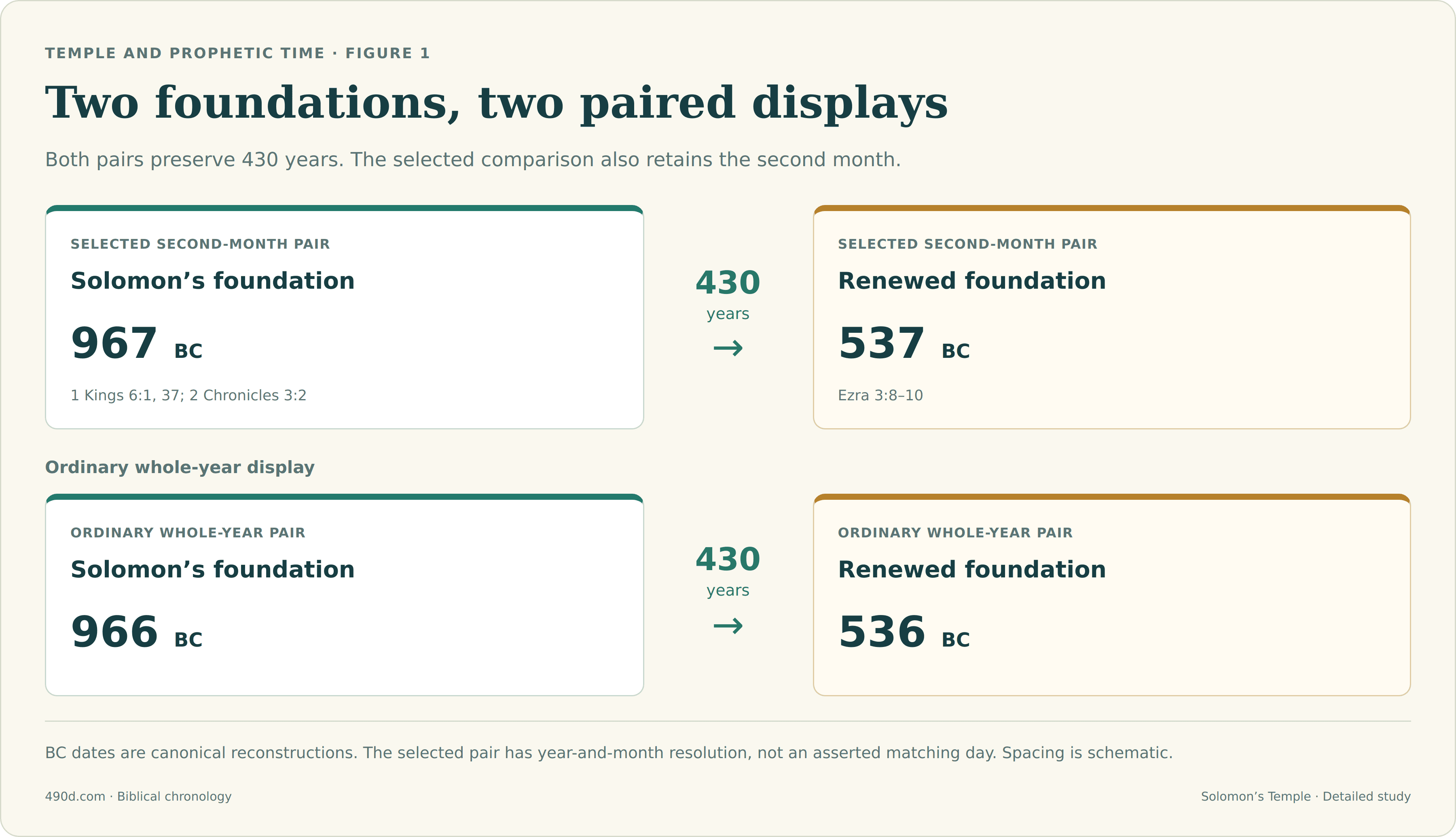
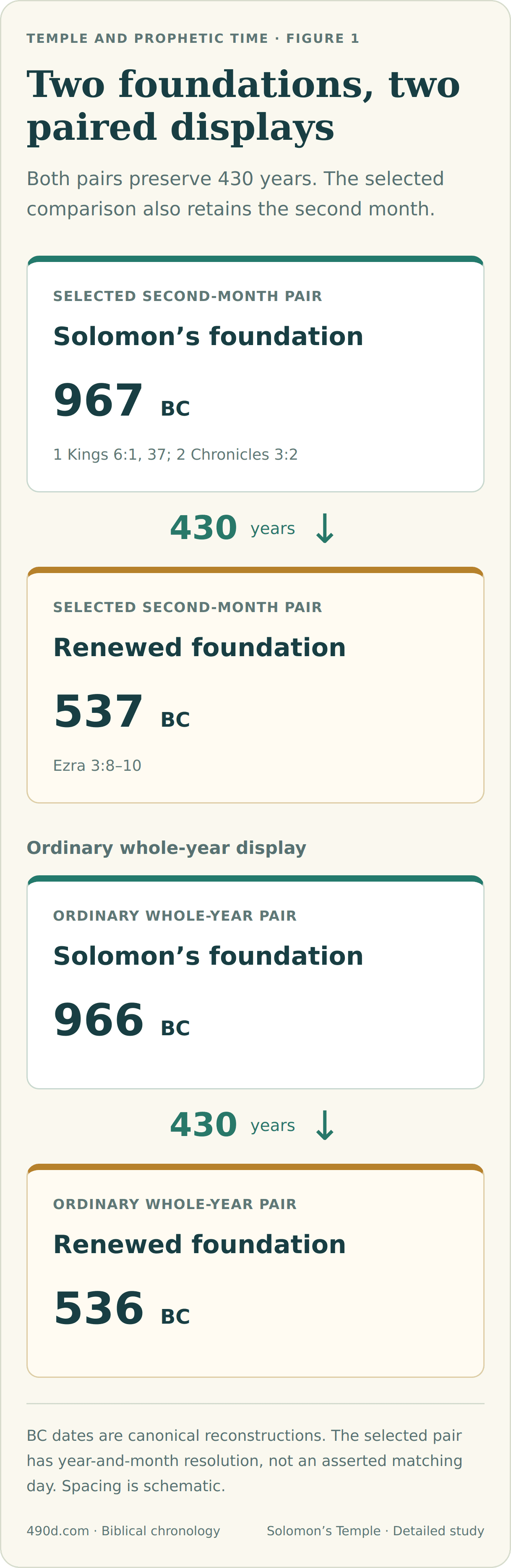
Two paired foundation timelines: Solomon’s foundation in 967 BC to the renewed foundation in 537 BC is 430 years, both in the second month. The ordinary whole-year pair is 966 BC to 536 BC, also 430 years. No matching foundation day is supplied in Ezra.
The first pair helps explain an easily missed distinction. From the Exodus in 1446 BC to 967 BC are 479 completed years; the event can therefore fall within the 480th year. The cardinal calculation, measuring 480 completed years, reaches 966 BC. The normal 966 BC foundation remains in use, while the adjacent 967 BC position serves the explicitly stated ordinal comparison. Files 18 §2.5.4 and 63 §5.6 preserve both.
The repeated second month makes the comparison more precise than an unqualified subtraction of years. It does not establish identical foundation days, because Ezra does not state one. The significance lies in foundation answering foundation across 430 years—the same total as Ezekiel’s 390 + 40 day–year sign (Ezekiel 4:5–6).
2. Why the reign totals produce a second Temple pattern
The First Temple’s lifetime and the interval between the two foundations are different measurements. On the ordinary historical year labels, Solomon’s foundation in 966 BC to Jerusalem’s fall in 586 BC is 380 years. The second foundation in 536 BC comes another 50 years later. Thus the foundation-to-foundation span is 380 + 50 = 430.
The sequential reign ledger asks a different question: what happens when the selected reign counts are added one after another? The twenty entries after Solomon total 394.5 years. Adding the ledger’s 36 years remaining after Solomon’s fourth-year foundation gives:
36 + 394.5 = 430.5 years.
The complete ledger makes that total reproducible. It uses Athaliah’s seventh-year boundary count, rather than claiming seven completed years; it also retains both three-month reigns as quarter-years. These choices matter to the result. A sum of selected regnal counts is not automatically the same as elapsed time on a chronology that resolves overlaps and accession conventions.
The canonical schematic Kings chronology separately places the Temple at 1016 BC. Its year-label interval to the fall in 586 BC is 430, fifty years beyond the ordinary 966 BC foundation position. The month-aware source treats this as a close Temple-to-destruction comparison; the detailed 430.5 reign total remains intact. File 19 §§10.4–10.6 explicitly preserves these distinctions.
Temple and prophetic time · Figure 2
Two routes through 430 years
The schematic First Temple route parallels the historical foundation-to-foundation route.
Schematic Temple-to-fall route · year labels
Schematic foundation
1016 BCJerusalem / Temple fall
586 BCHistorical foundation-to-foundation route · second month
Historical foundation
967 BCRenewed foundation
537 BC586 − 537 = 49
With the ordinary 966/536 pair, each offset is 50 years.
1016 BC is schematic, not the historical foundation date. Year-label 430 does not replace the 430.5 reign ledger. Spacing is schematic.
Image version and full-size downloads
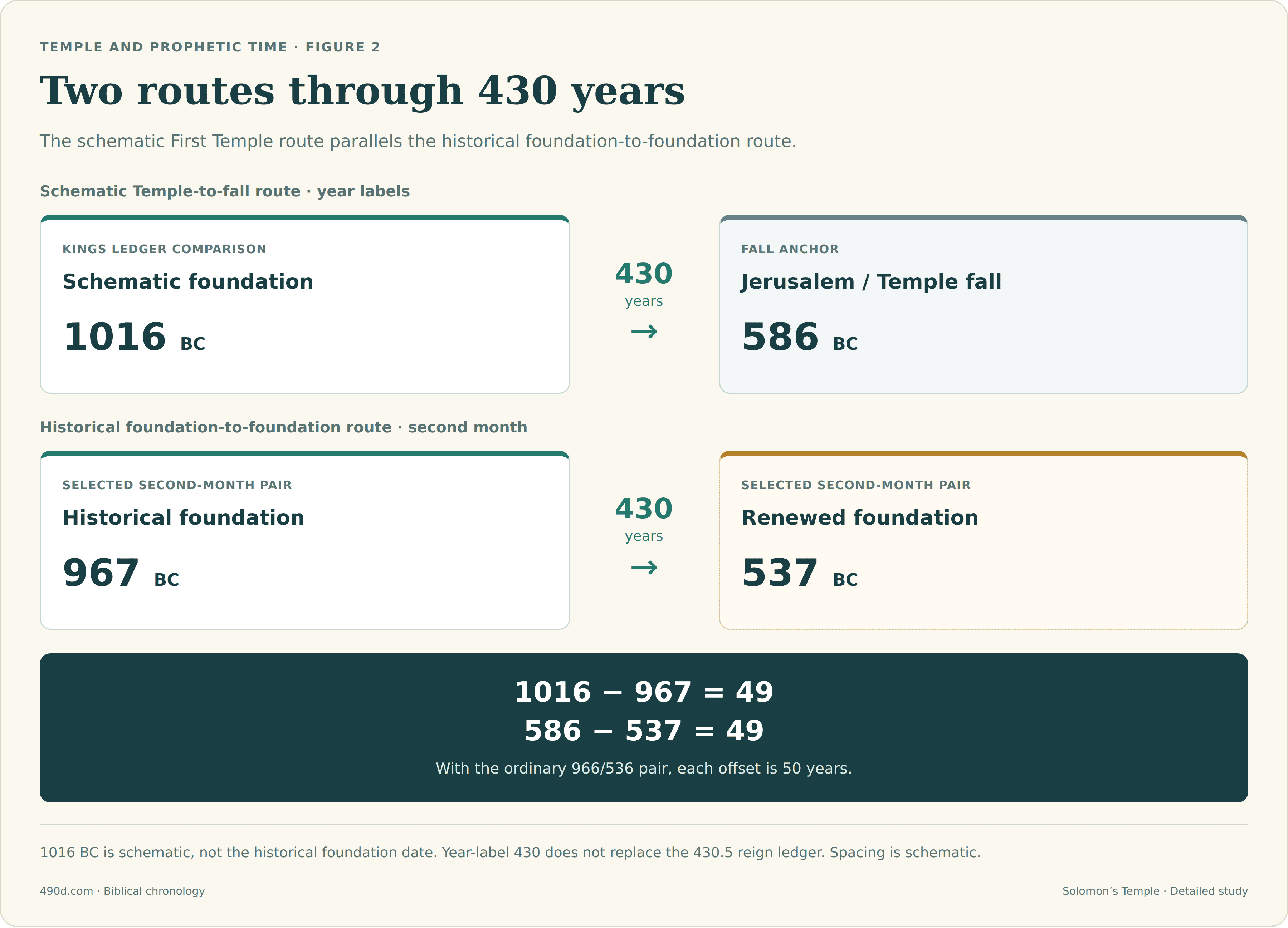
The schematic Temple foundation in 1016 BC to the fall in 586 BC spans 430 in year labels. The historical foundation in 967 BC to the renewed foundation in 537 BC spans 430 in the same month. Each pair of corresponding nodes differs by 49 years. The ordinary pair gives offsets of 50. The reign ledger is separately 430.5 years.
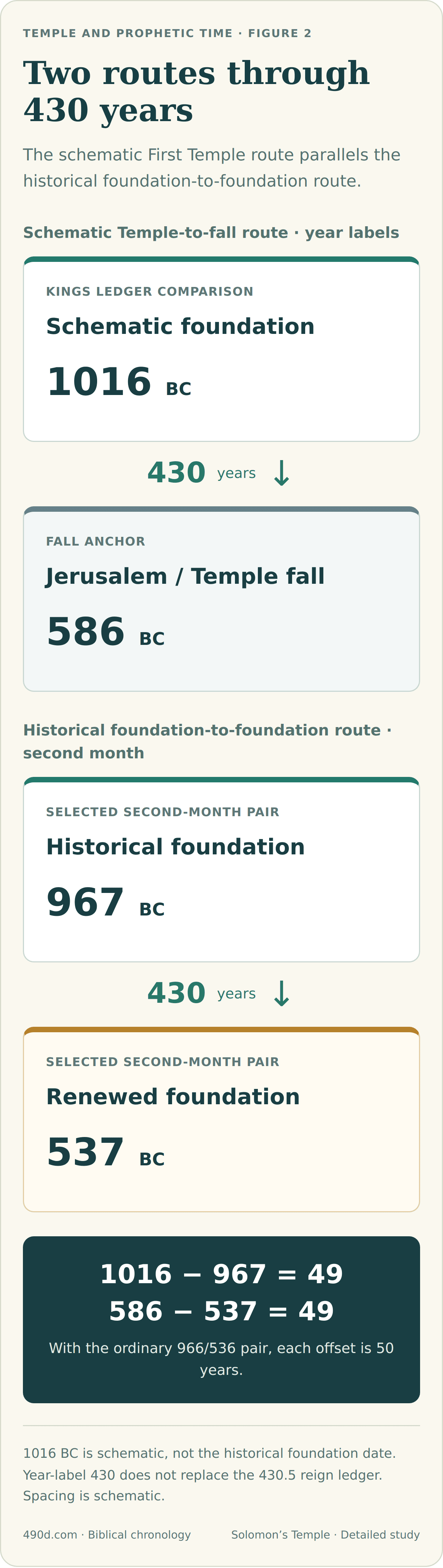
The two 430 routes are therefore complementary. One runs from the schematic First Temple foundation to destruction; the other runs from the historical foundation to the renewed foundation after exile. With the selected 967/537 pair, corresponding nodes differ by 49 years: 1016 − 967 and 586 − 537. With the ordinary 966/536 pair, both differences are 50 years.
The larger sequence also becomes visible: 1876 → 1446 → 1016 → 586 BC, in steps of 430. Here 1876 BC marks Israel’s Egyptian sojourn, 1446 BC the Exodus, and 1016 BC the schematic Temple position. The sequence does not move the historical foundation. It shows how the Kings ledger participates in a pattern extending from Egypt to Jerusalem’s fall. The 430-year sojourn remains distinct from the 400-year affliction of Genesis 15.
This is why the Kings of Judah study matters to the Temple argument: the difference between reign sums and historical placement becomes part of the comparison itself.
3. The seventy years divided into seven weeks and three
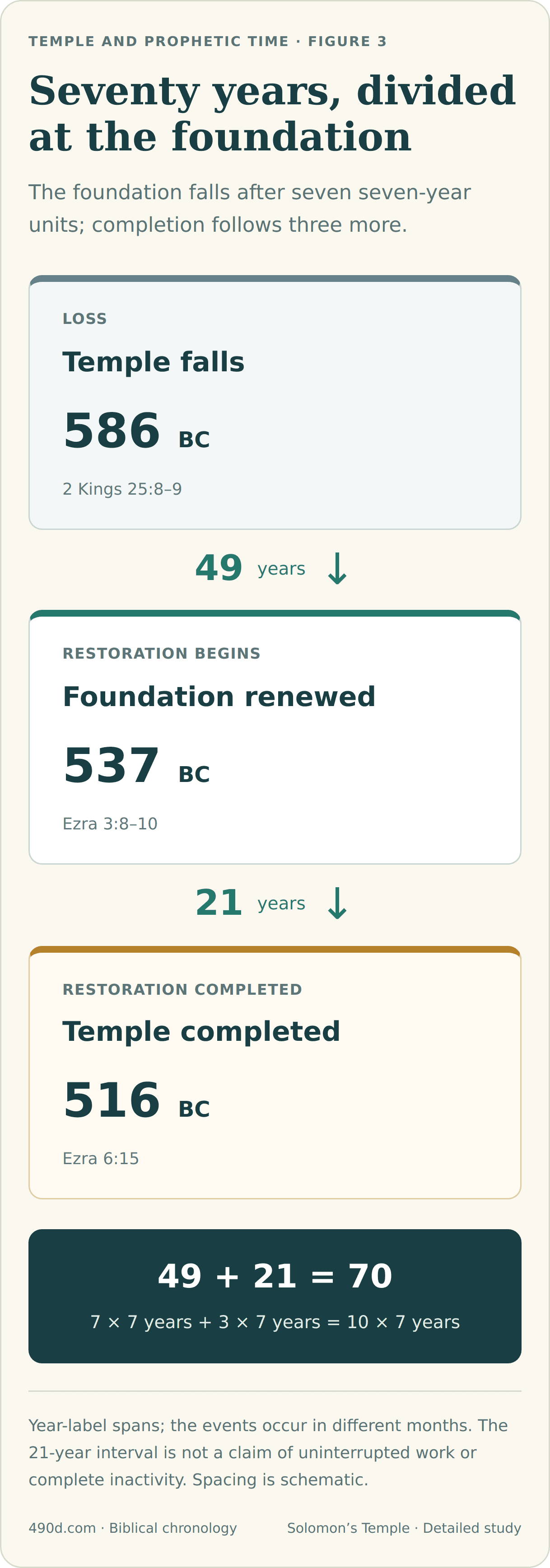
From the fall of Jerusalem to the Second Temple’s completion, the canonical year labels give:
586 → 537 → 516 BC: 49 + 21 = 70 years.
The foundation divides the total into seven seven-year units and three seven-year units. The first division recalls the seven sabbatical cycles counted in Leviticus 25:8; the second makes the theme of three weeks visible on the scale of years. The 49-year count is not an instruction to erase the distinction between the forty-ninth year and the jubilee’s fiftieth year.
Temple and prophetic time · Figure 3
Seventy years, divided at the foundation
The foundation falls after seven seven-year units; completion follows three more.
Temple falls
586 BC2 Kings 25:8–9Foundation renewed
537 BCEzra 3:8–10Temple completed
516 BCEzra 6:157 × 7 years + 3 × 7 years = 10 × 7 years
Year-label spans; the events occur in different months. The 21-year interval is not a claim of uninterrupted work or complete inactivity. Spacing is schematic.
Image version and full-size downloads
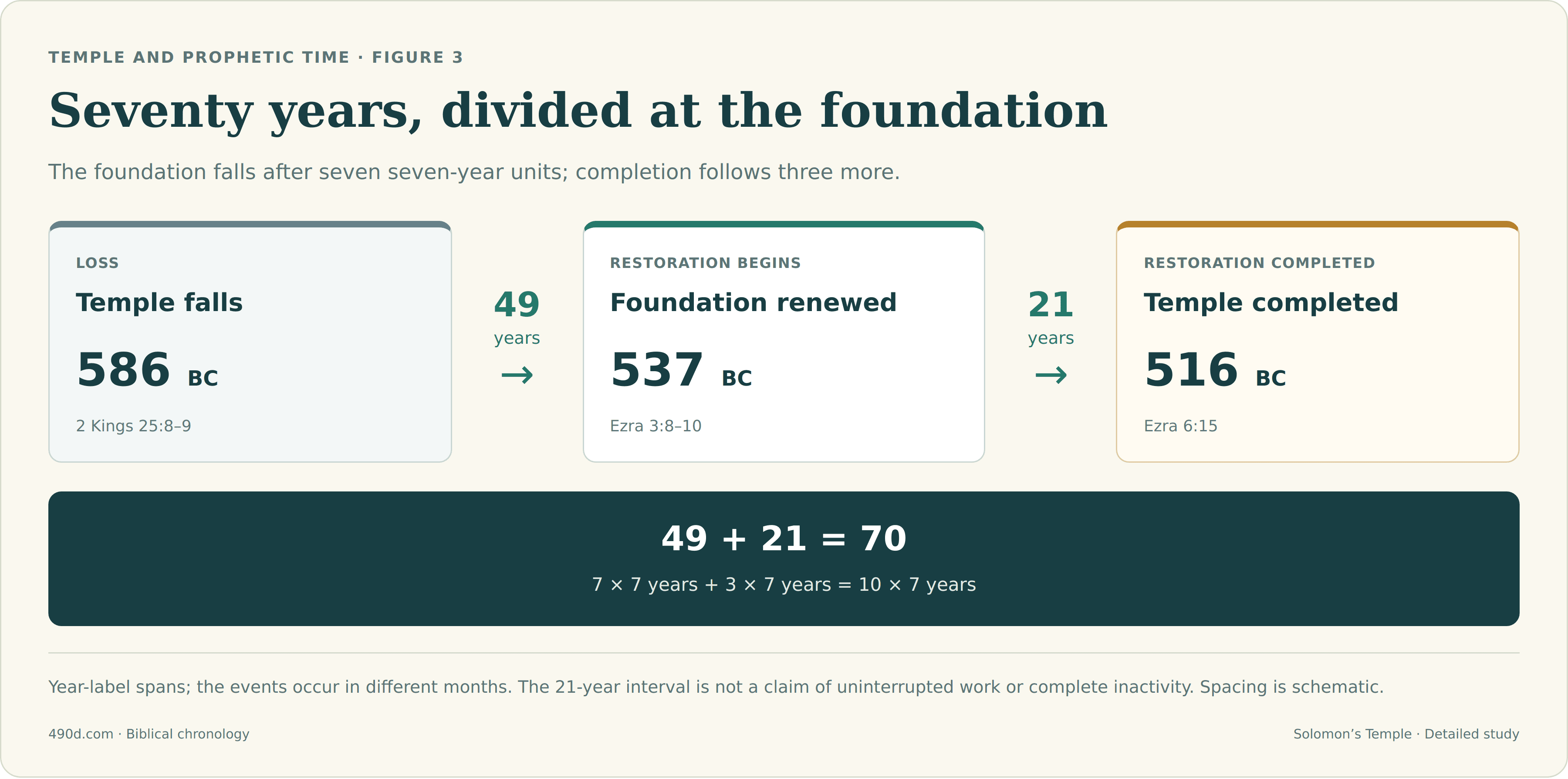
Jerusalem and the First Temple fall in 586 BC. After 49 years, the foundation is renewed in 537 BC. After another 21 years, the Temple is completed in 516 BC. The total is 70 years, divided into seven and three seven-year units. These are year-label spans, not exact matching-day durations.
Ezra’s story gives these numbers their human setting. The work faces opposition, discouragement, and interruption. Haggai and Zechariah encourage renewed building, and Zerubbabel’s hands finish what they began:
The hands of Zerubbabel have laid the foundation of this house, and his hands will complete it.
The 21 years cover the entire foundation-to-completion interval. They are neither 21 uninterrupted years of construction nor 21 years in which no work occurred. Ezra 4:24–5:2 distinguishes interruption from renewed work; Ezra 6:15, 19 dates completion in Adar and the subsequent Passover in the first month.
Daniel supplies a related three-week form. He mourns for three full weeks, and the messenger describes opposition lasting twenty-one days (Daniel 10:2–4, 13). I read the resemblance as a day–year correspondence: prayer and resistance occupy three weeks in Daniel, while the sanctuary’s restoration passes through a three-week span of years.
The correspondence is an interpretation of related patterns. Daniel does not say that his 21 days begin on the same date as the Temple’s 21 years. Nor should Daniel 9’s first year of Darius be merged with Daniel 10’s third year of Cyrus. Their distinct settings remain important even when the numbers are compared.
The larger form is simple: interruption does not dissolve the seventy-year pattern. 49 + 21 still equals 70. Foundation and completion belong within one restoration story. File 17 §§7.3–7.4 develops this reading; the restoration table distinguishes its dates from the separate 606–536 BC exile-and-return span.
4. The Temple within the cumulative chronology
The cumulative chronology adds complete ancestral lifespans rather than the years between successive births. Its coordinates are therefore a second method of arranging the genealogical data, not ordinary birth dates for the same people. The cumulative introduction explains the method and its terminal anchor.
For the following comparison we use the selected MT cumulative coordinates 5436 BC for Shem and 4836 BC for the Flood/Arphaxad boundary, together with the ordinary Temple and restoration pair 966/536 BC. The framework thus changes explicitly from the 967/537 second-month comparison above.
From the cumulative Flood boundary to Solomon’s foundation:
4836 − 966 = 3870 = 9 × 430 = 3 × 1290.
Another 430 years reaches the renewed foundation:
3870 + 430 = 4300 = 10 × 430.
Shem’s full 600-year lifespan stands before the cumulative Flood boundary. Including it yields:
600 + 4300 = 4900 = 10 × 490.
Temple and prophetic time · Figure 4
From cumulative lifespans to restoration
A 600-year lifespan joins the 4300 and 4900 totals.
Shem
5436 BCSelected earlier memberFlood / Arphaxad
4836 BCSelected boundarySolomon’s foundation
966 BCOrdinary pairRenewed foundation
536 BCOrdinary pair600 + 4300 = 4900
3870 = 9 × 430 = 3 × 1290 · 4300 = 10 × 430 · 4900 = 10 × 490
The earlier cumulative window members are selected. The 966/536 pair is intentional. Cumulative lifespan coordinates and regular chronology remain distinct. Spacing is schematic.
Image version and full-size downloads
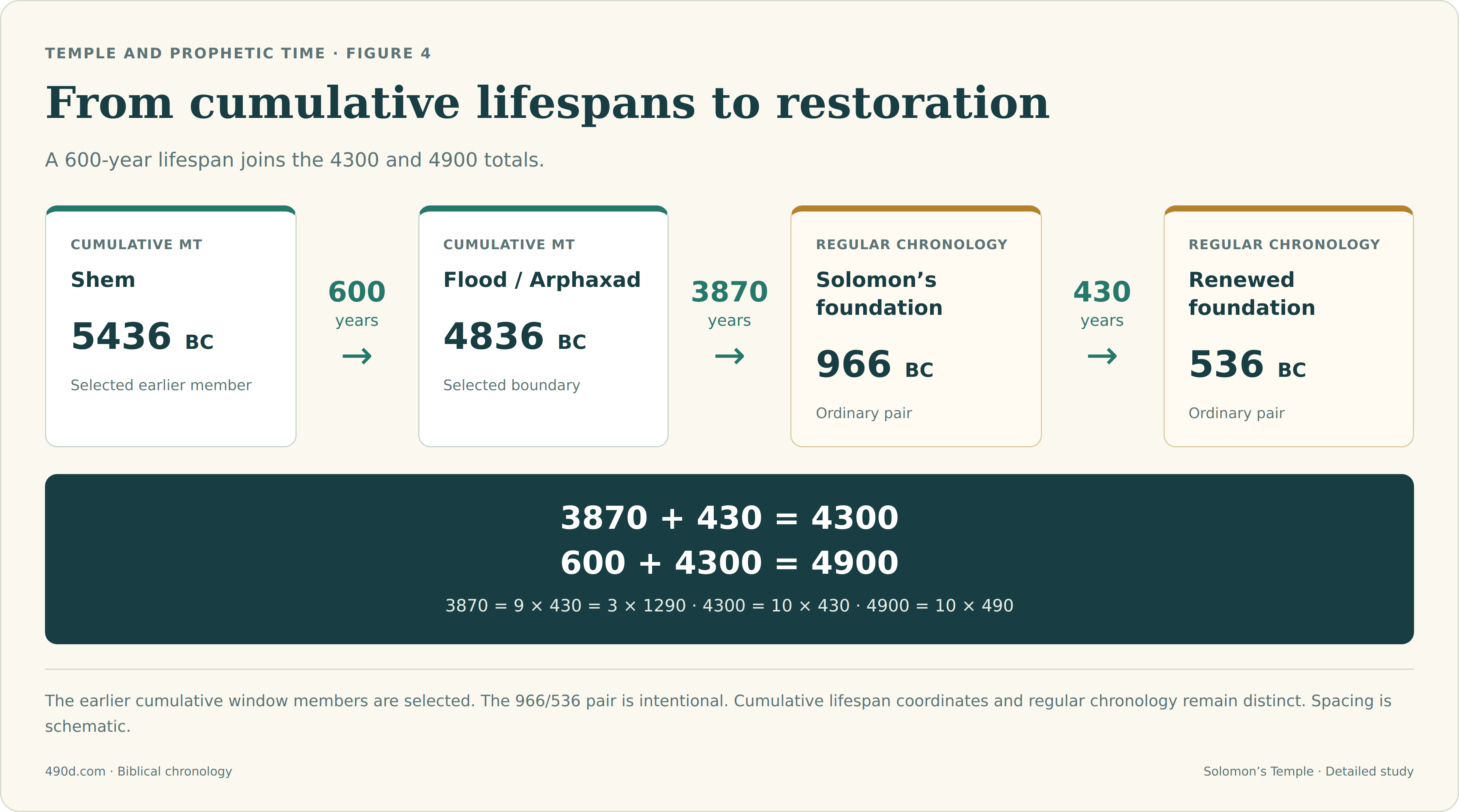
Cumulative Shem at 5436 BC is followed by the cumulative Flood/Arphaxad boundary at 4836 BC, a 600-year lifespan step. From 4836 BC to the ordinary Temple foundation at 966 BC are 3870 years; another 430 reaches restoration at 536 BC. Totals are 4300 from the Flood boundary and 4900 from Shem. Cumulative coordinates are not ordinary birth dates.
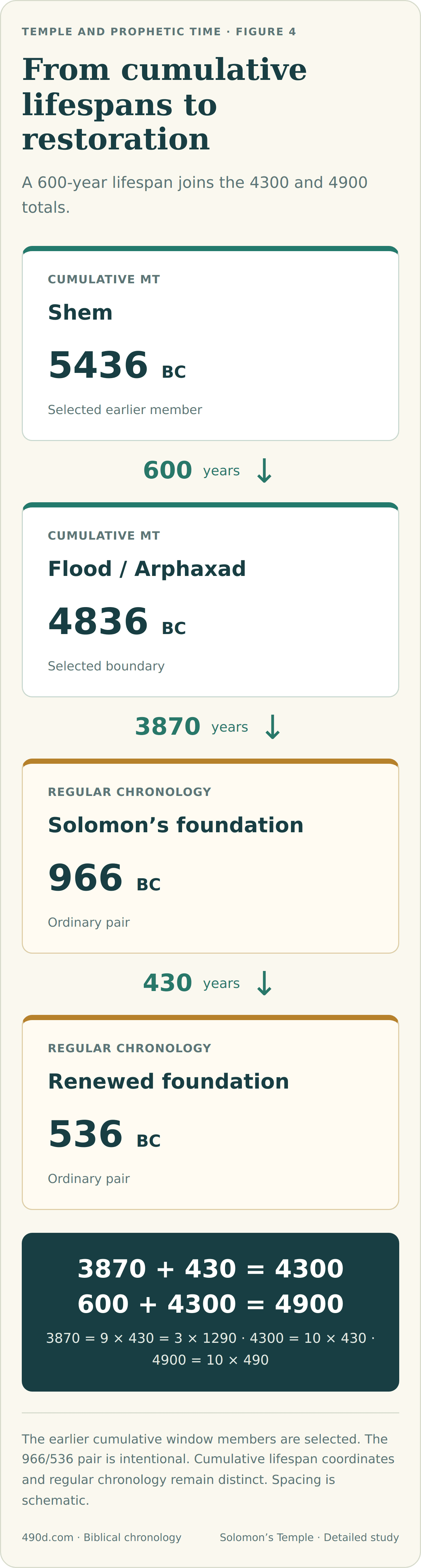
The 600-year difference is especially revealing. It joins two familiar prophetic totals at ten times their scale: 4900 − 4300 = 600, just as 490 − 430 = 60. The larger relationship depends on cumulative lifespan placement; it does not imply that Shem was 600 years old at the historical Flood.
File 30 §§1.2–2 also divides the Shem-to-return total at the exile boundary: 5436 → 606 → 536 BC = 4830 + 70 = 4900. The seventy years are visible within the larger total rather than added to it afterward.
The underlying cumulative coordinates have a seven-year display: Shem 5436–5429 BC, and the Flood/Arphaxad boundary 4836–4829 BC. The diagram selects their earlier members. The matched comparison to the conquest interval is 4836 − 1406 = 4829 − 1399 = 3430, or 70 × 49. A jubilee counted as seven sabbatical cycles explains why 3430 belongs naturally beside the restoration’s seven-year units.
When a single target such as 536 BC is used, the selected starting member must remain explicit. From 5429 BC to 536 BC are 4893 years, not 4900. The cumulative table therefore names its endpoints instead of allowing a date range to conceal different answers.
5. Seven years, six months, and the calendar models
Kings summarizes the construction as seven years. Its fourth-year, second-month foundation and eleventh-year, eighth-month completion also supply a month-based reading of seven years and six months:
(11 − 4) years + (8 − 2) months = 7 years + 6 months.
File 63 §5.7 retains the 7 and 7.5 forms together. The latter is precise within the stated month model; it is not an independently reconstructed count of historical lunar days. The completion day is not supplied, and a lunar calendar’s intercalations cannot be recovered merely by multiplying a decimal number of years.
Under three declared calendar models, the same 7.5-year quantity gives three different day totals:
Temple and prophetic time · Figure 5
One quantity, three calendar models
A 7.5-year construction model produces different day totals under different calendar assumptions.
336-day year
360-day year
364-day year
A separate 360-day route requires one explicitly placed leap month.
Kings states seven years; 7.5 is the month-based model from the regnal-year and month notices. Calendar products are schematic quantities, not an exact historical day count.
Image version and full-size downloads
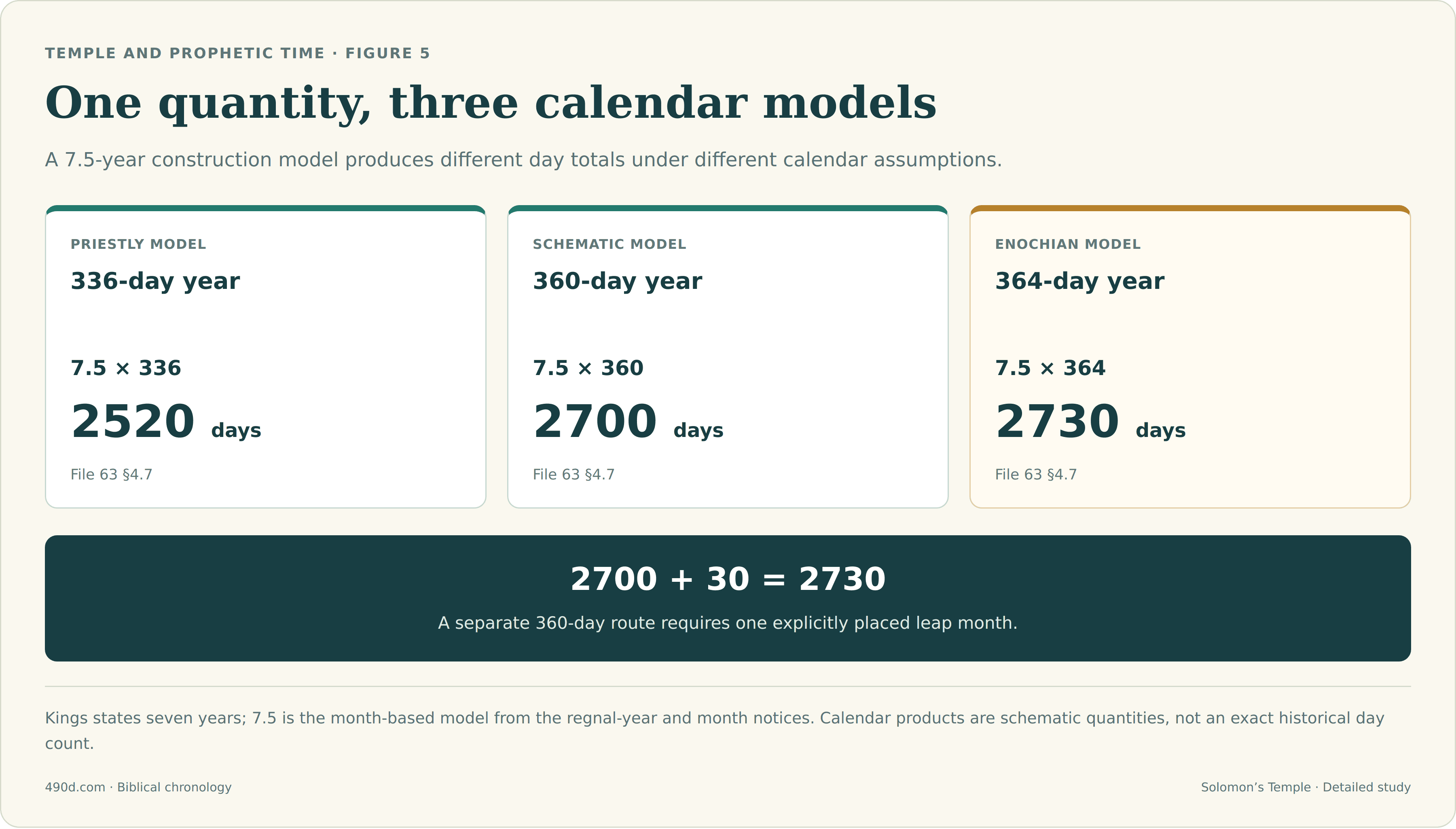
Three calendar models applied to 7.5 years: 336 days per year gives 2520 days; 360 gives 2700; 364 gives 2730. A separate intercalated 360-day route gives 2700 plus one 30-day month, also 2730. That extra month requires a declared placement. The models remain distinct.
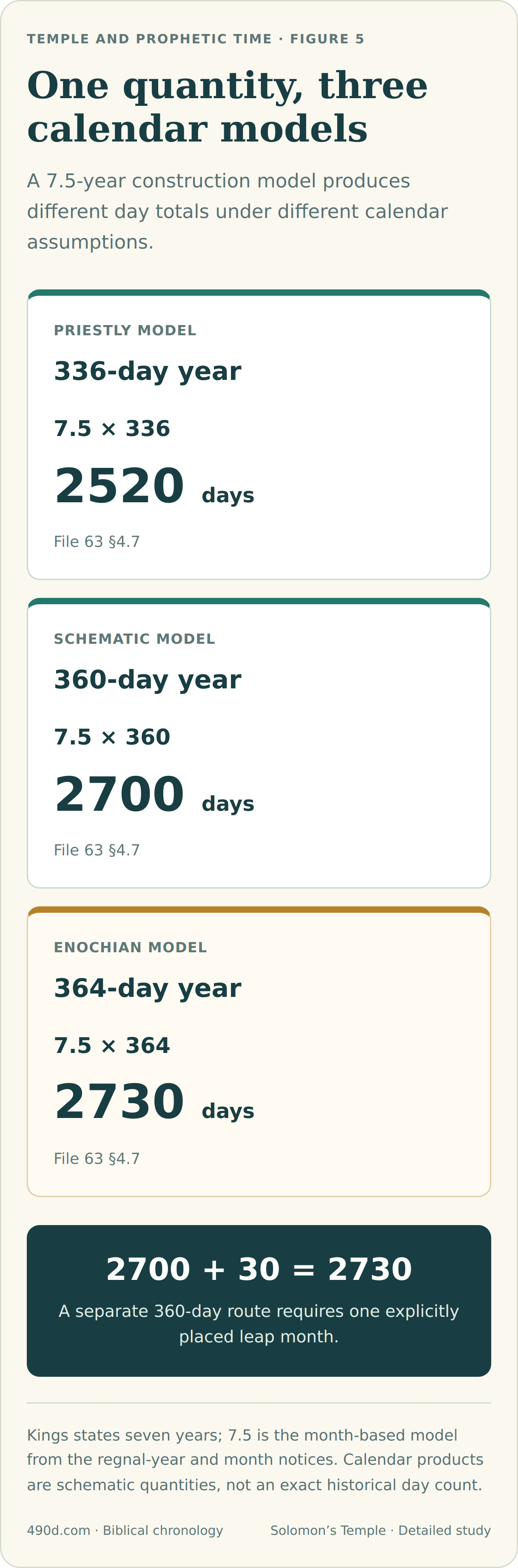
The priestly 336-day model gives 2520; the 360-day schematic year gives 2700; the 364-day Enochian year gives 2730. These are comparisons between named models, not three claims about how many actual days Solomon’s builders worked. File 63 §4.7 and Appendix D.7 registers these products explicitly.
The number 2730 can also arise through 2700 + 30, when a 360-day model includes one intercalary month. That route must specify its placement. File 12 §7A describes a reconstructed forty-year scheme with seven intercalations; it does not make one extra month automatic in every 7.5-year window. Equal totals do not make the intercalated 360-day model and the 364-day model the same calendar.
The 2700 form permits a further Temple-body comparison. A schematic nine-month gestation is 0.75 × 360 = 270 days; ten such quantities give 2700. The Temple’s formation can thus be read as a tenfold gestational image. This is typology built on a declared calendar model, not a claim that Kings calls the Temple a pregnancy.
The wider canonical setting makes that image more concrete. Abraham’s birth in 2166 BC to the ordinary foundation in 966 BC spans 1200 years. Adding the 7.5-year construction model gives 1207.5. The two totals can be written 30 × 40 and 30 × 40.25: thirty quarter-year additions accumulate to the same 7.5-year difference. File 63 §§4.6–4.9 develops this comparison while keeping the ordinary 966 BC foundation distinct from its adjacent ordinal state.
A symbolic day–year reading begins with such stated quantities and then compares their numerical form at another scale. Ezekiel explicitly supplies the day-for-year relation for his sign. Extending that relation to the Temple is an interpretive application; each calendar and each starting point still needs to be named. The calendar table collects the calculations without assigning new historical dates to them.
6. From a built house to the Temple of His body
The Temple’s chronology joins formation, loss, and restoration. Solomon’s house takes shape over years; the returned community begins again amid grief and praise; opposition delays the work but does not prevent completion. The numbers become meaningful within that story.
John gives the Temple-body connection its clearest expression. After Jesus speaks of raising the Temple in three days, the evangelist explains:
But Jesus was speaking about the temple of His body.
This textual connection gives the construction-and-restoration patterns a Christological setting. It does not require every symbolic coordinate to become a date in Jesus’ biography. The argument is strongest when the numerical comparison and the theological reading remain intelligible together.
The same discipline clarifies the whole study. 430 links foundation to foundation; 430.5 preserves the selected reign ledger; 49 + 21 divides restoration into seven-year units; 4300 and 4900 extend the comparison through cumulative lifespans. The construction models add another scale while retaining their own calendars. What emerges is a connected account of sacred time whose parts can be followed and checked, one relationship at a time.
7. Five ways of positioning the Temple’s symbolic dates
The Temple comparison belongs within a larger study of Creation, the Flood, the Exodus, Ezekiel and restoration. I first align the ordinary year spans, then examine the smaller day counts surrounding their events. My proposal is that related patterns recur at different scales: a day can represent a year, while a familiar span can return at ten times its earlier size. The ordinary and cumulative chronologies have different roles in that comparison; neither is replaced by the symbolic coordinates below. The cumulative framework stacks twenty-six Adam–Moses lifespans totaling 12600 years, realized in the primary 14006→1406 BC Creation-to-Conquest trunk. The 14004 BC envelope-close used below is a different selected endpoint, giving 12558 to the Exodus in 1446 BC.
A datum is the selected starting point of a count. Solomon’s accession provides a royal datum; the Temple’s beginning supplies a sanctuary datum. Nisan and Tishri provide spring and autumn alternatives. The general method selects a New Year associated with the event; the original Temple table also includes a later autumn datum, producing negative coordinates for an earlier spring event. That particular row must be read according to its stated direction.
Chronicles dates the foundation to the second day of the second month. In a thirty-day-month model, this is the 32nd numbered day, although only 31 days have elapsed since the beginning of day 1. The original symbolic table maps that numbered label to AD 32. It attaches a preceding seven-year envelope, AD 25–32, and carries the same envelope to the completion. The seven elapsed intervals in that envelope are distinct from the separate evening-to-morning comparison of 7.5 days explained in the full tables.
The five rows are preserved as selected symbolic projections. Their calendar and boundary choices are explained rather than assumed:
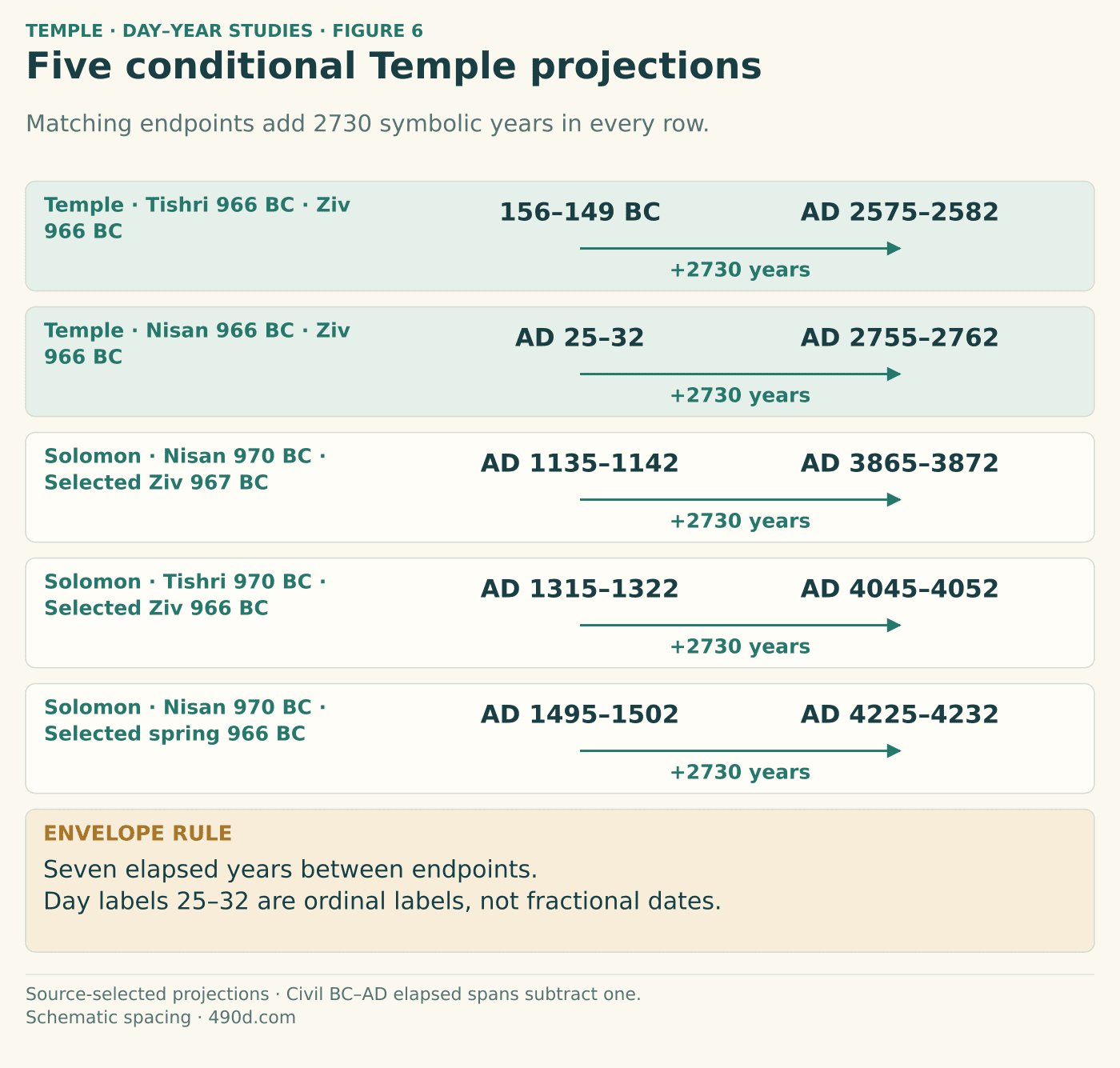
Figure 6. The five source-selected projections retain the original Temple and Solomon accession alternatives. Each construction-start envelope spans seven elapsed years, and the matching completion endpoints lie 2730 symbolic years later. The source’s ordinal day labels 25–32 are not fractional dates. These BC/AD coordinates represent the model’s projections of ancient events; they are not historical or predicted future Temple events.
Accessible text and image downloads
Five conditional rows show Temple Tishri 966: 156–149 BC to AD 2575–2582; Temple Nisan 966: AD 25–32 to AD 2755–2762; Solomon Nisan 970, selected Ziv 967: AD 1135–1142 to AD 3865–3872; Solomon Tishri 970, selected Ziv 966: AD 1315–1322 to AD 4045–4052; Solomon Nisan 970, selected spring 966: AD 1495–1502 to AD 4225–4232. Every matching endpoint spans 2730, and each envelope spans seven elapsed years.
Desktop PNG · Phone PNG · Desktop WebP · Phone WebP · Text-based SVG (ZIP)

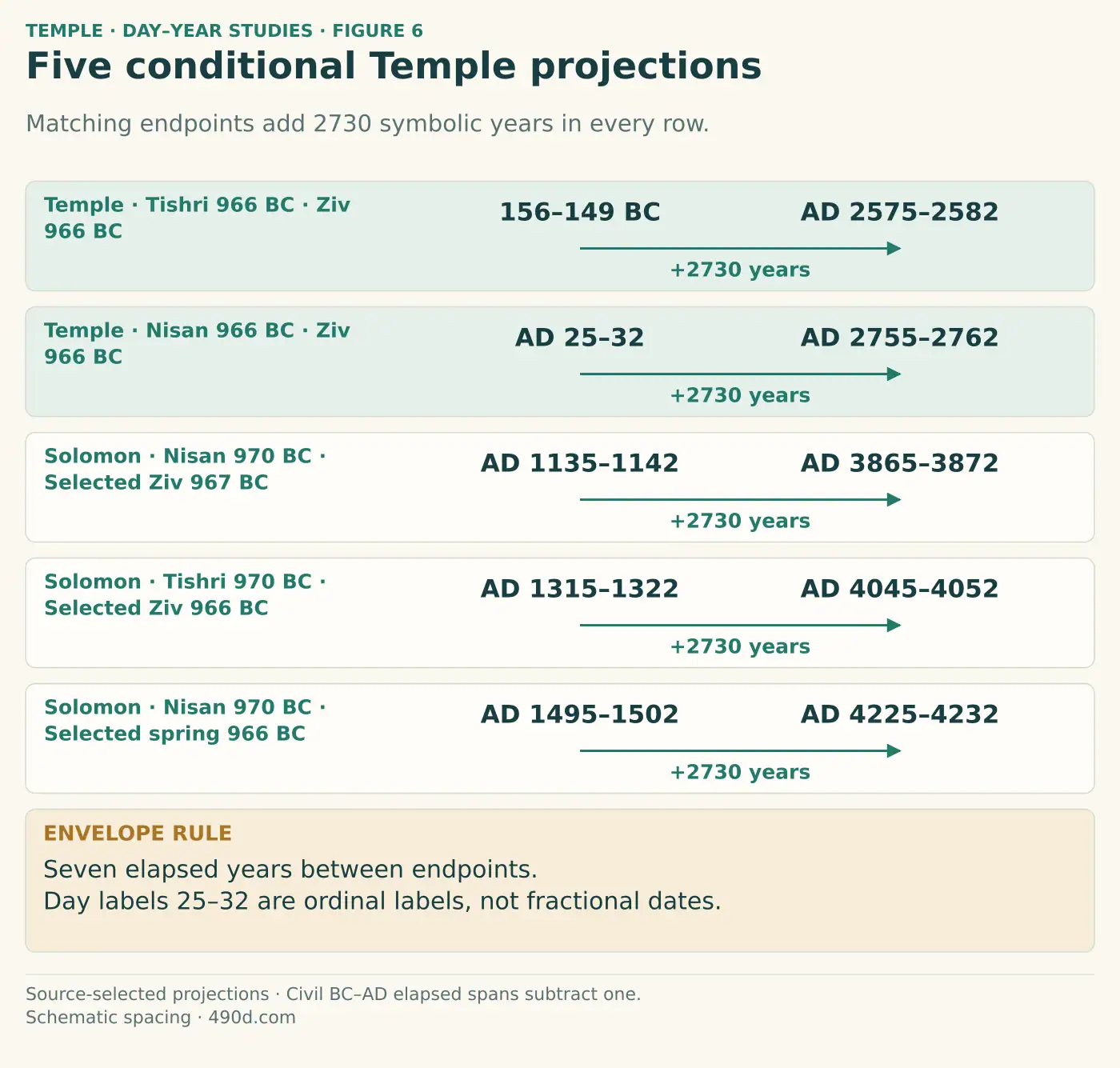

Every matching start/completion endpoint in this table is separated by 2730. This is the chosen construction register, 2700 + 30, also expressible as 7 × 390. It is not a claim that every alternative historical window necessarily contains exactly one insertion. The phase table shows when the fixed forty-year cycle would count zero, one or two leap months.
Nor are the AD labels predictions of future construction or destruction. They are coordinates assigned to older events by the day–year model. A calculation involving one of them therefore needs both the historical event and the symbolic coordinate to be named.
8. Three accession rows: 430, 460 and 490
The last three symbolic start envelopes sit 180 years apart. Against the ordinary Exodus anchor, their earlier endpoints give:
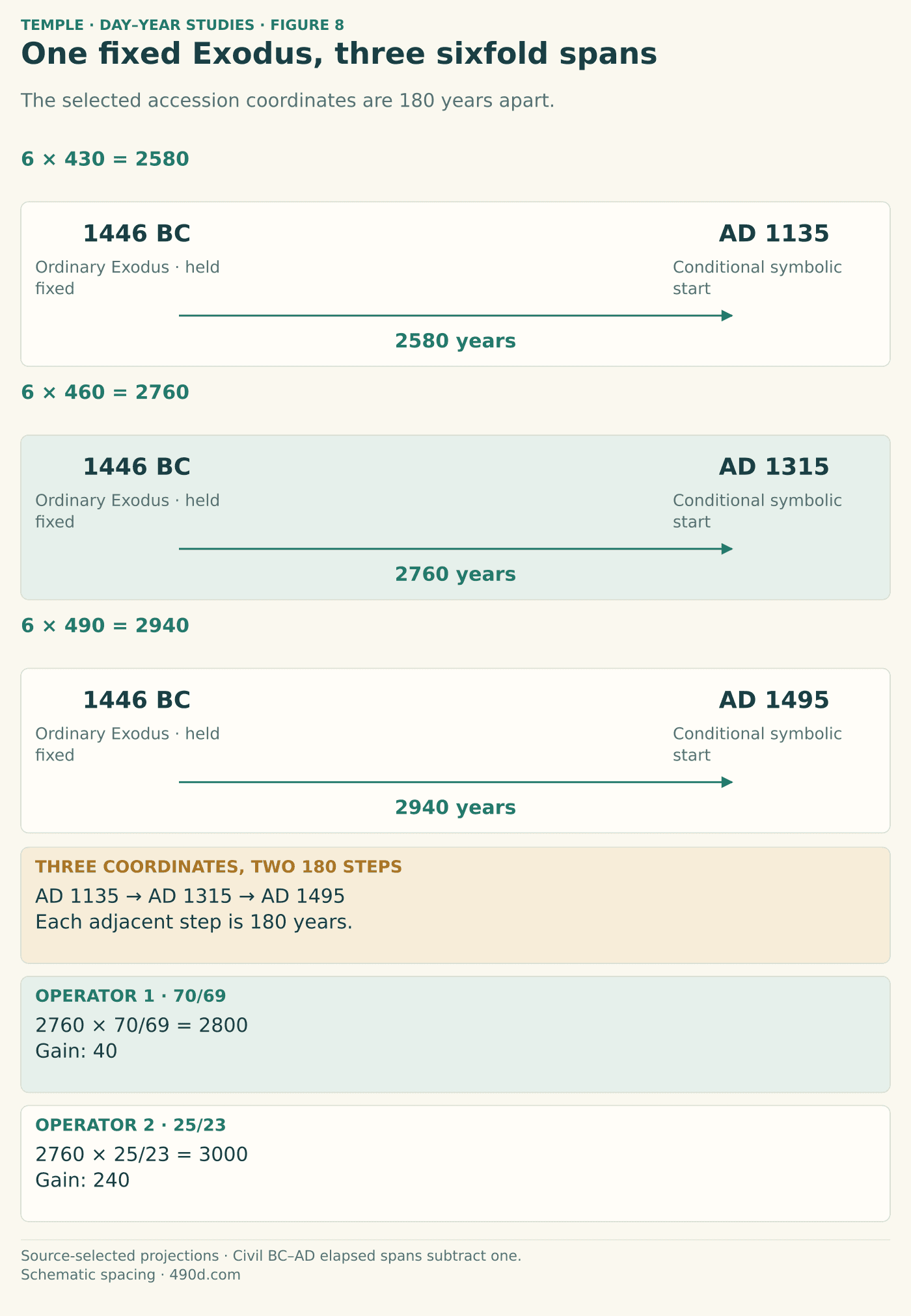
Figure 8. Keeping the ordinary Exodus at 1446 BC fixed, the conditional symbolic start coordinates AD 1135, AD 1315 and AD 1495 yield civil elapsed spans 2580=6×430, 2760=6×460 and 2940=6×490. The middle span can be expanded separately by 70/69 to 2800 or by 25/23 to 3000. These are different operators; neither operation is a formal Mirror. A proposed generational meaning for the gain remains an interpretation.
Accessible text and image downloads
Three rows keep Exodus 1446 BC fixed and compare AD 1135 by 2580 equals six times 430, AD 1315 by 2760 equals six times 460, and AD 1495 by 2940 equals six times 490. Adjacent symbolic start coordinates differ by 180. Two separate operations on the middle span show 2760 times 70/69 equals 2800, gaining 40, and 2760 times 25/23 equals 3000, gaining 240.
Desktop PNG · Phone PNG · Desktop WebP · Phone WebP · Text-based SVG (ZIP)
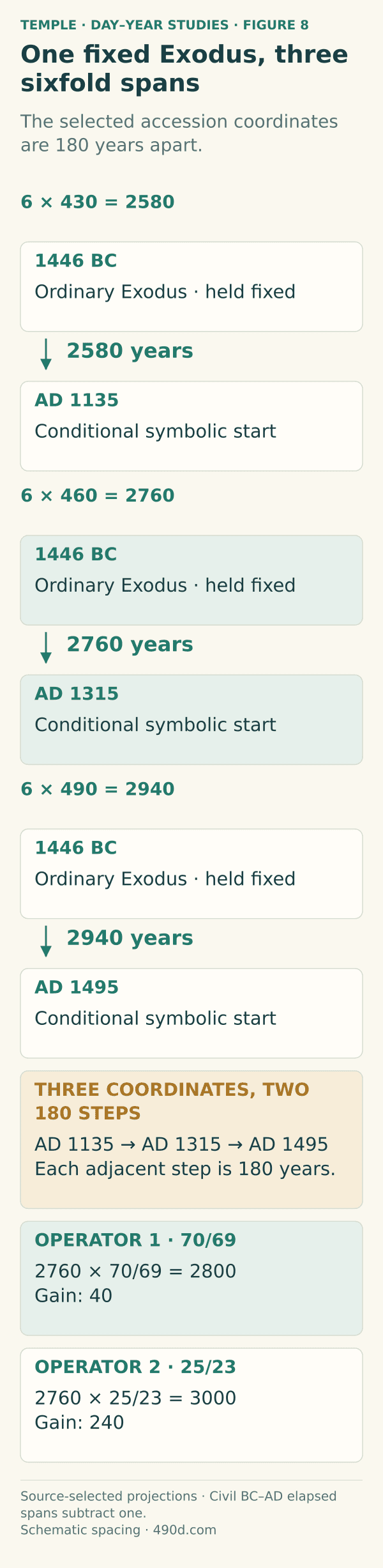
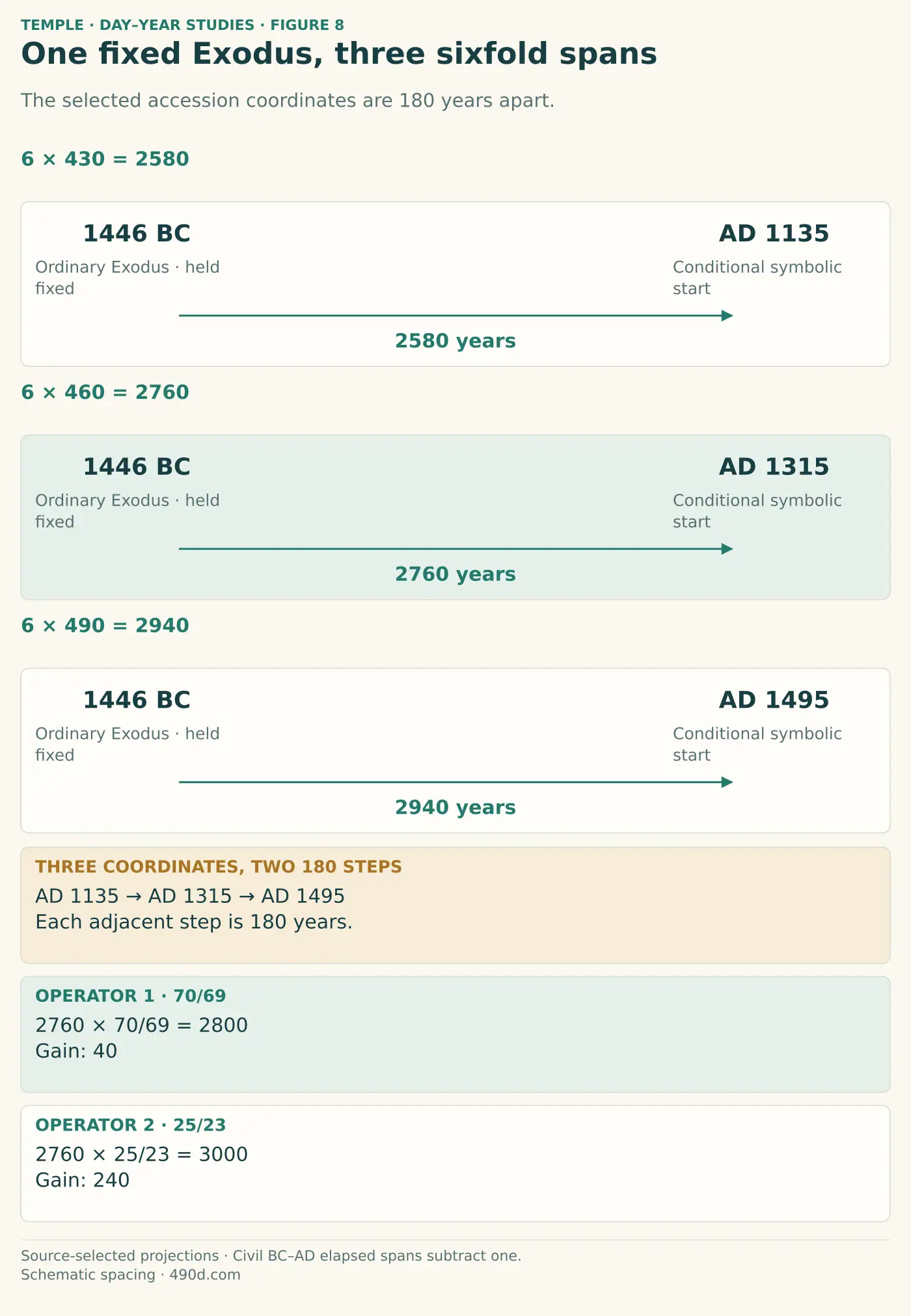
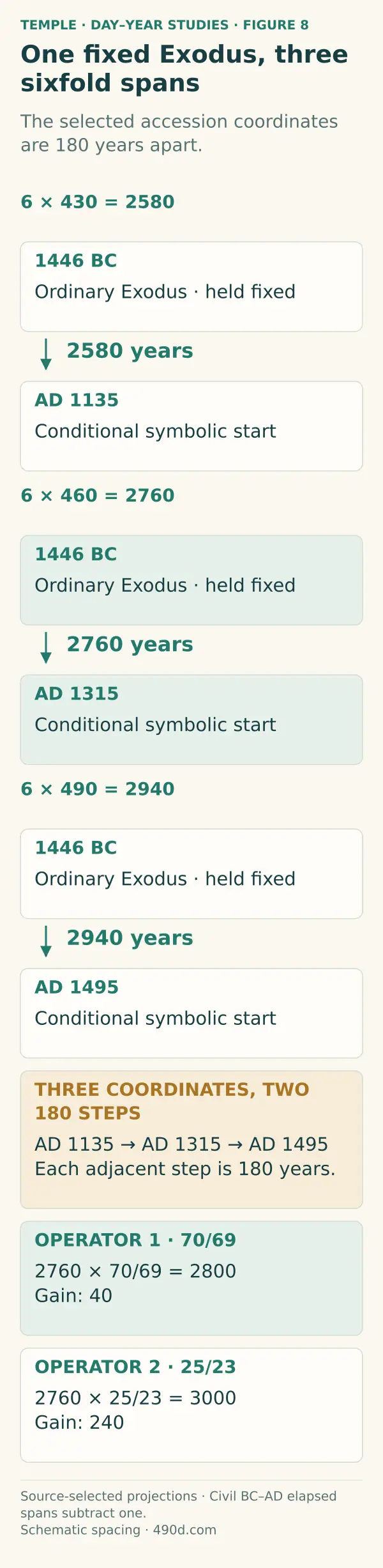
The comparison brings together Ezekiel’s 390 + 40 = 430, the 2300 = 5 × 460 quantity associated with Daniel 8, and Daniel 9’s 70 × 7 = 490. Each step increases the sixfold total by 6 × 30 = 180. I read the middle position as a link between the outer two prophetic measures.
The middle total permits two different Key-of-23 operations:
2760 × 70/69 = 2800; 2760 × 25/23 = 3000.
These ratios do different work. The latter compares the 23/25 solar and priestly measures developed in the Key of 23 study; it is not a declaration that the displayed Temple dates are all historical priestly-calendar dates. The former changes 69 units to 70. Their results must remain separately identified.
Civil BC–AD spans use BC + AD − 1. Thus 1446 BC→AD 25 is 1470, and AD 25→1495 is another 1470. The Exodus→AD 2755 comparison gives 4200, a tenfold counterpart of 420 within the 420 + 70 = 490 arrangement. These are additions and translations of intervals, not applications of the formal BC–AD Mirror.
The other rows also meet the ordinary and schematic Temple spine. For example, 1876 BC→AD 1135 is 3010; 1446 BC→AD 1135 is 2580; 1016 BC→AD 1135 is 2150; and 586 BC→AD 1135 is 1720. Those are seven, six, five and four times 430. The endpoint table keeps the schematic 1016 foundation distinct from the ordinary 966 foundation.
9. Two 2730 spans, with corresponding ends 2300 apart
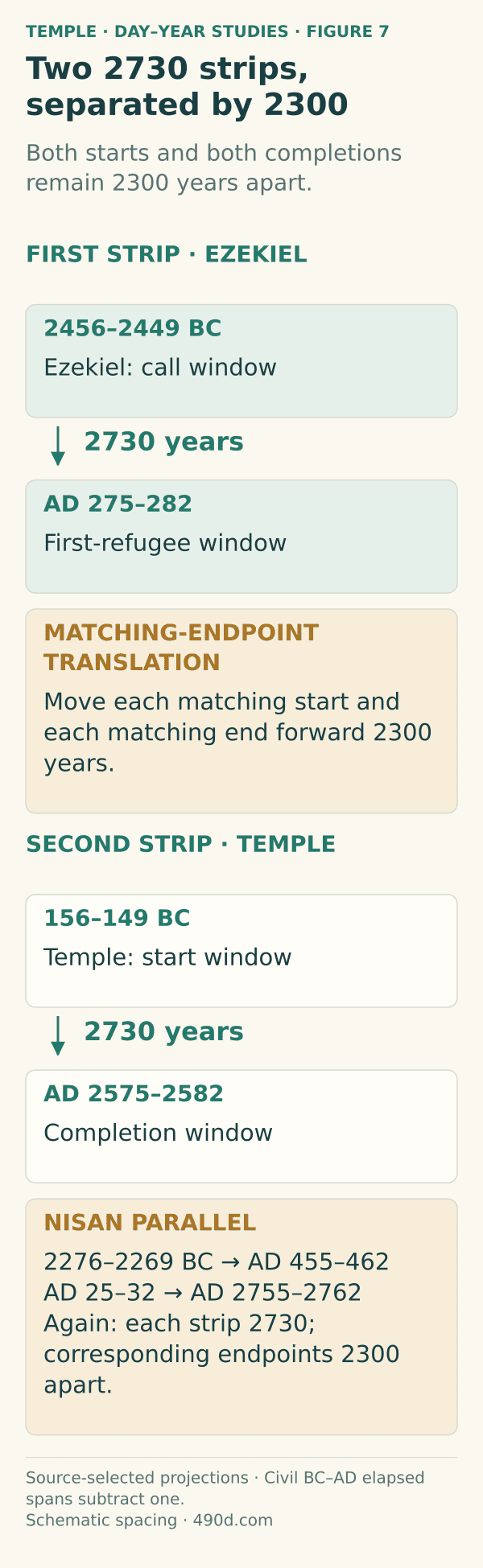
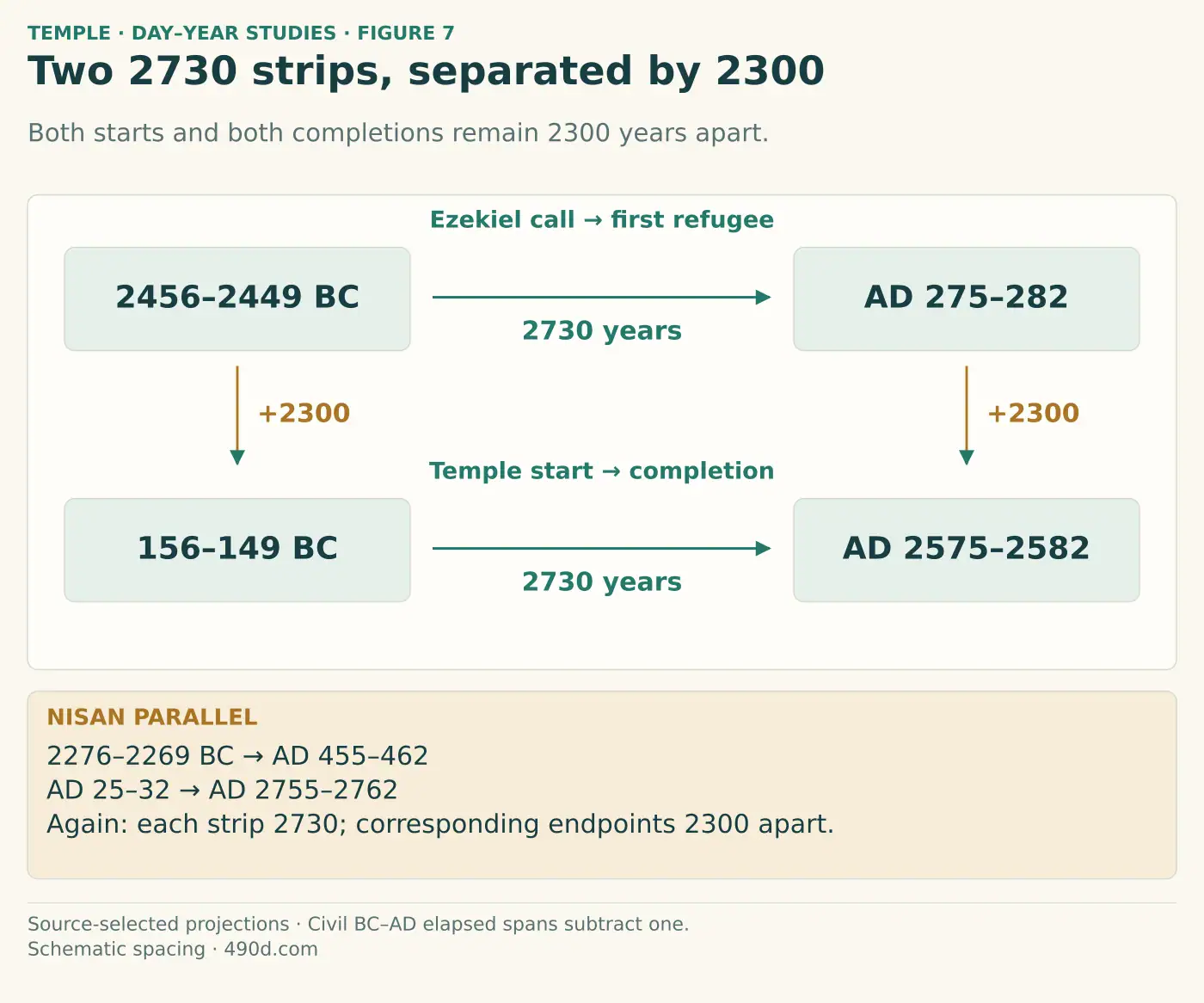
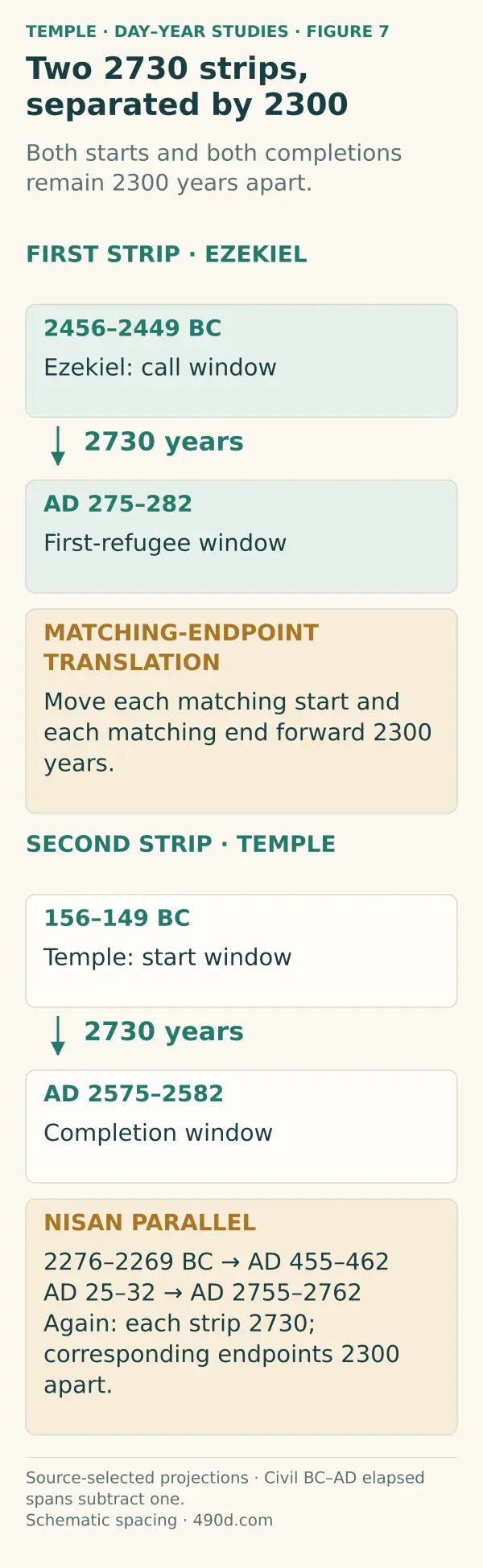
The original’s most useful chart comparison places a Temple-construction strip beside an Ezekiel strip. In the selected counted register, Ezekiel’s call to the refugee’s arrival is 2730; the Temple’s symbolic start to completion also spans 2730. Their corresponding ends are 2300 apart.
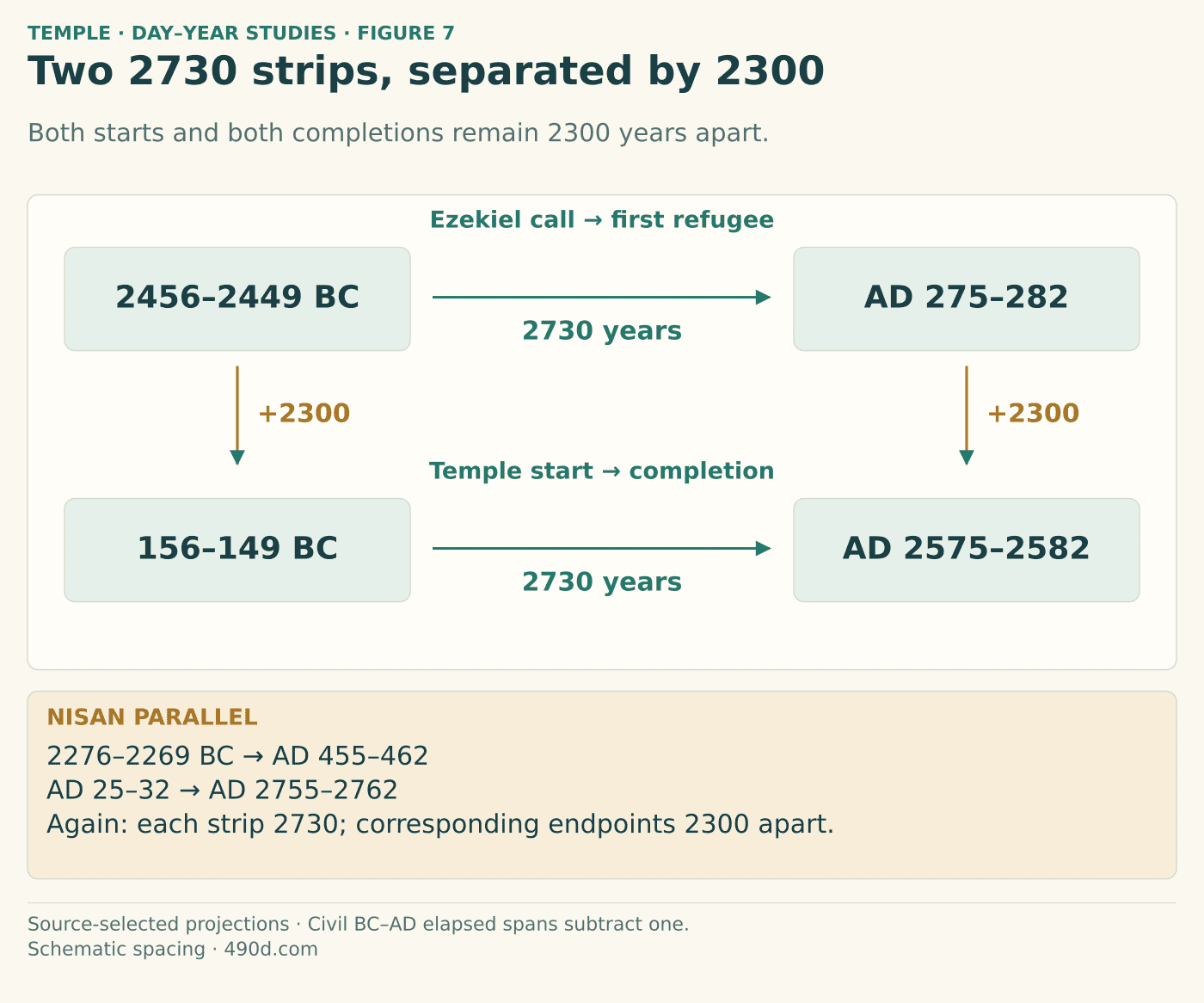
Figure 7. In the source-selected Tishri comparison, the Ezekiel call-to-refugee strip runs 2456–2449 BC→AD 275–282, while the Temple start-to-completion strip runs 156–149 BC→AD 2575–2582. Each strip spans 2730; corresponding starts and corresponding ends are 2300 apart. The Nisan parallel is 2276–2269 BC→AD 455–462 and AD 25–32→AD 2755–2762. These are conditional day–year projections, not ordinary event dates or formal Mirror reflections.
Accessible text and image downloads
A rectangular comparison shows the source-selected Ezekiel call window 2456–2449 BC to first-refugee window AD 275–282 by 2730, and Temple start window 156–149 BC to completion window AD 2575–2582 by 2730. Corresponding start endpoints and corresponding completion endpoints differ by 2300. All windows span seven elapsed years. The separate Nisan parallel preserves the same relationships.
Desktop PNG · Phone PNG · Desktop WebP · Phone WebP · Text-based SVG (ZIP)
The second seasonal version has the same form:
2276–2269 BC→AD 455–462, beside AD 25–32→AD 2755–2762.
Each strip spans 2730. Corresponding beginnings and endings differ by 2300. These Ezekiel coordinates come from the chart’s C/D projections; the complete four-datum matrix preserves A/B as well. Its seasonal alternatives remain visible.
The internal partition explains why 2300 recurs:
430 + 2300 = 2730.
The 430 is the selected duration of Ezekiel’s enacted siege; the remaining 2300 reaches the refugee’s report. The call’s overwhelming seven days, the prophet’s restricted speech and its reopening give the arithmetic a narrative setting (Ezekiel 3:15, 26–27; 24:25–27; 33:21–22). These episodes are related, while their exact narrated sequence is retained. I connect the repeated 2300 with Daniel 8’s sanctuary-restoration theme; the text does not itself equate all four diagram corners.
The A/B columns yield another family. AD 1135–1142→1565–1572 is 430, and another 430 reaches AD 1995–2002. The Temple’s 156–149 BC envelope lies 1720 before the selected call and 2150 before the sign’s completion. Translating the whole family by 180 preserves those spans; translating both strips by 2730 preserves the 2300 between them. The cross-table ledger writes these relationships once with their endpoints.
10. The 4300 bisection and the two sevenfold spans
The selected Temple-start coordinate and the Ezekiel Temple-fall coordinate form a 4300 span, divided at the completion of Ezekiel’s 430-day sign:
156 BC→AD 1995→AD 4145 = 2150 + 2150 = 4300.
Here AD 1995 represents the completion of the enacted siege; AD 4145 represents the historical Temple’s fall on the selected chart boundary. Both are symbolic labels for older events. The latter is not the civil year in which Jerusalem fell.
The parallel seasonal translation gives:
AD 25→AD 2175→AD 4325 = 2150 + 2150.
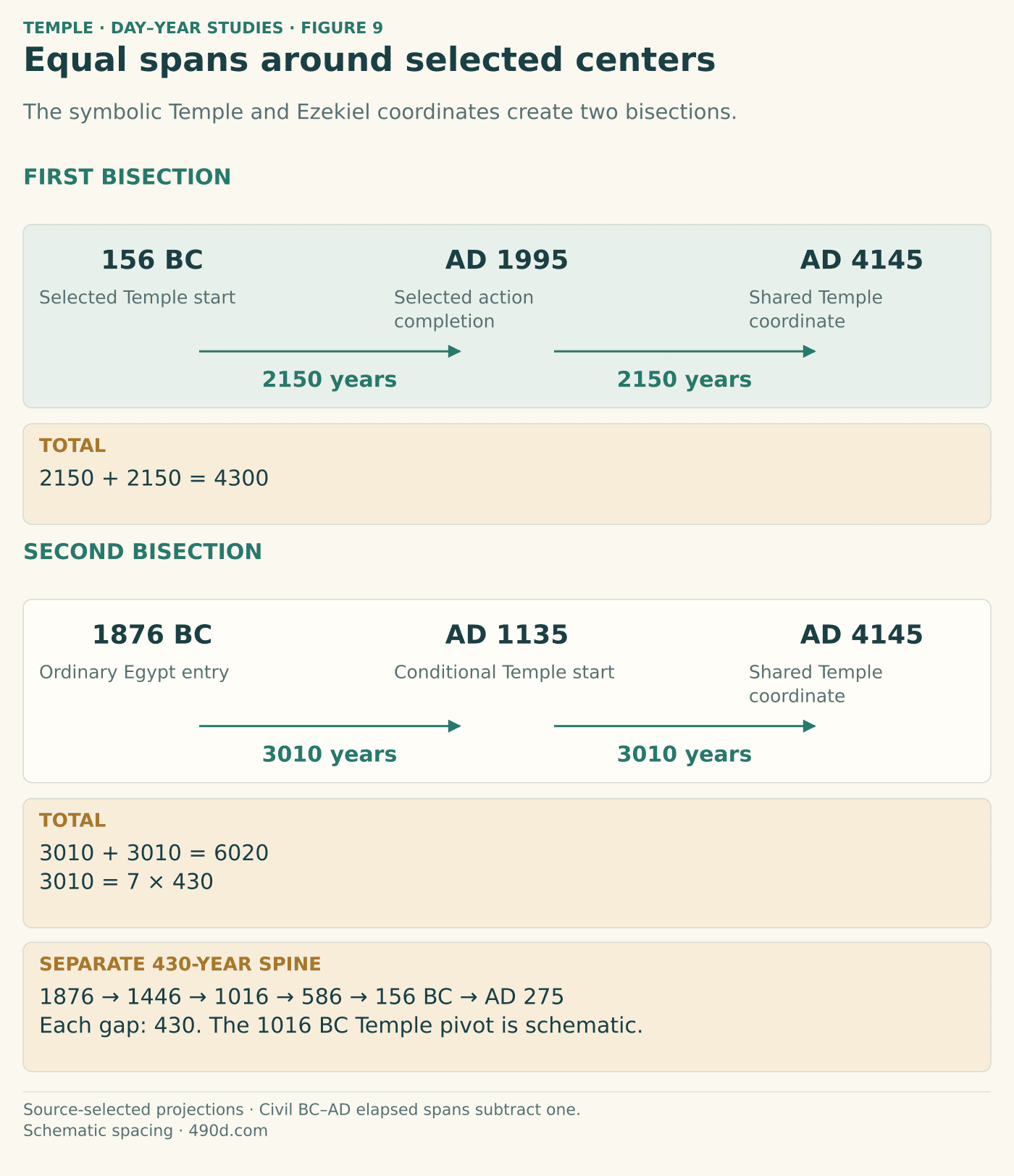
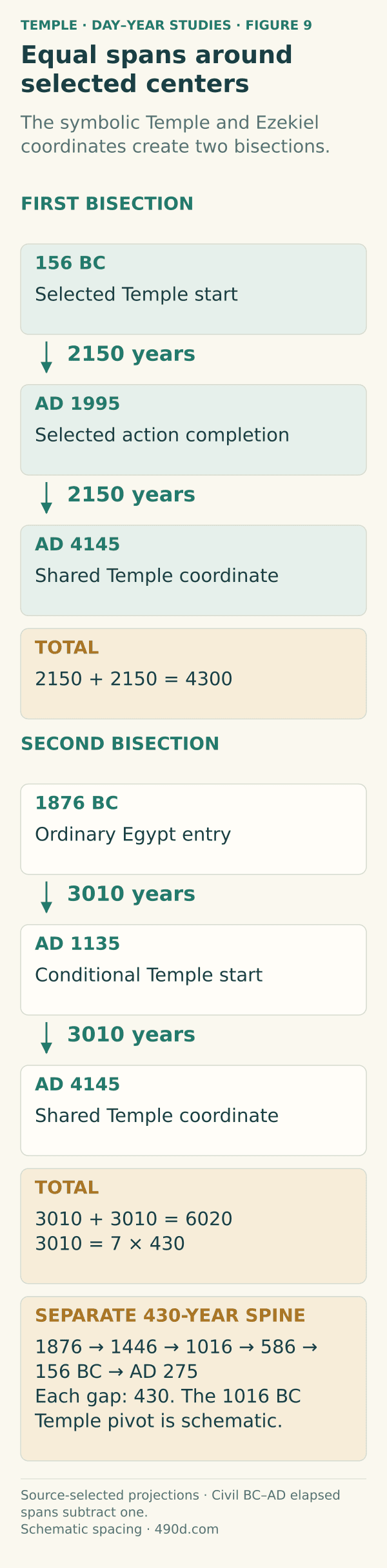
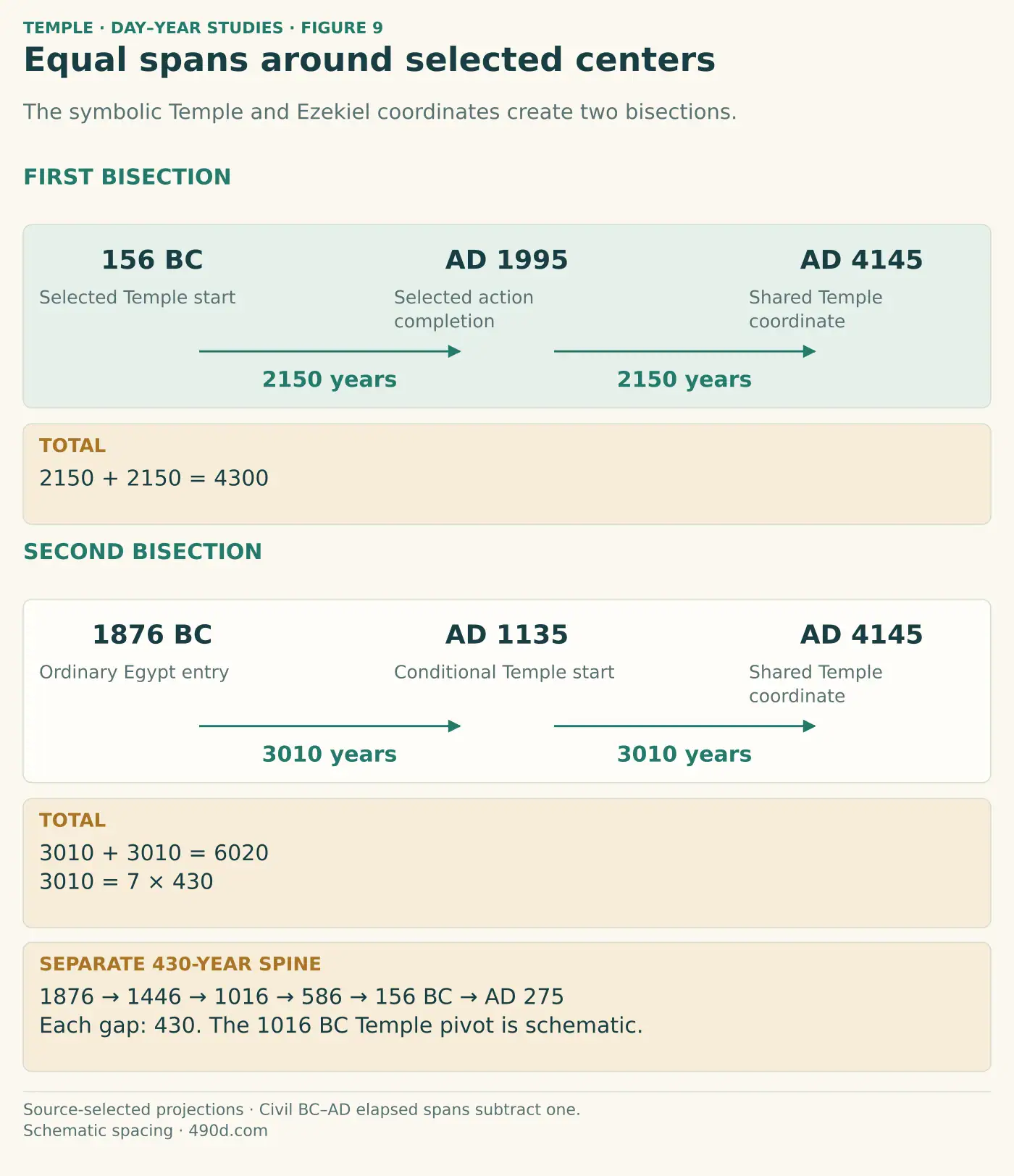
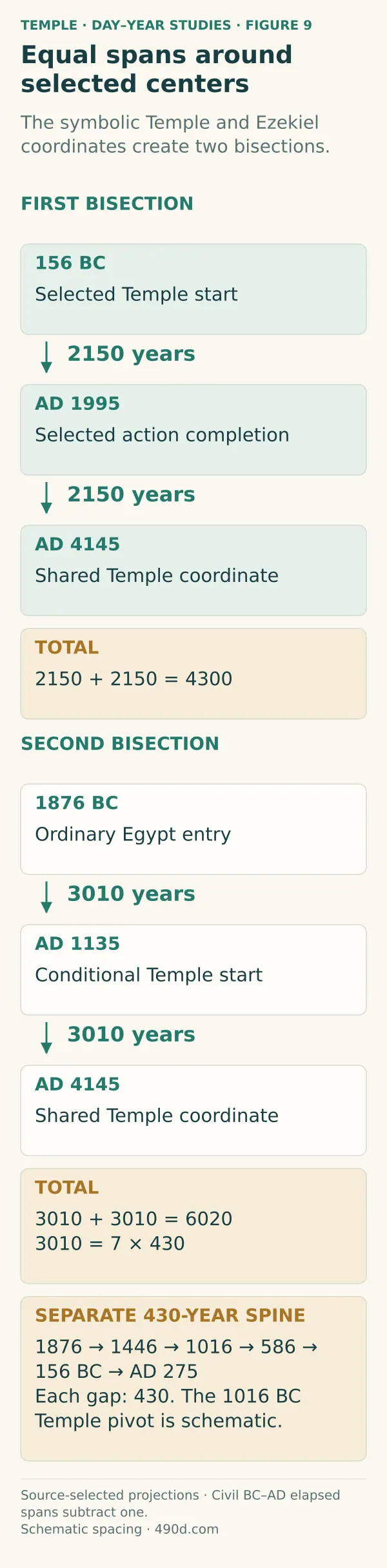
Figure 9. The first selected bisection is 156 BC→AD 1995→AD 4145, with 2150+2150=4300. The second is Egypt entry 1876 BC→AD 1135→AD 4145, with 3010+3010=6020 and 3010=7×430. The associated source-selected 430-year spine is 1876→1446→1016 schematic→586→156 BC→AD 275. The source’s printed AD 4146 is corrected to AD 4145 for the stated arithmetic. Generated AD coordinates are symbolic labels, not future-event dates.
Accessible text and image downloads
Two independent panels show equal spans: 156 BC to AD 1995 by 2150, then AD 4145 by another 2150, totaling 4300; and Egypt entry 1876 BC to AD 1135 by 3010, then AD 4145 by another 3010, totaling 6020. AD 1995 is the source-selected end of Ezekiel’s symbolic action, AD 1135 is a conditional Temple start, and AD 4145 is a shared Temple-destruction coordinate. Civil BC–AD spans subtract the missing year zero.
Desktop PNG · Phone PNG · Desktop WebP · Phone WebP · Text-based SVG (ZIP)
A different center produces two sevenfold spans:
1876 BC→AD 1135→AD 4145 = 3010 + 3010 = 14 × 430.
Egypt entry is the historical beginning here; the middle and final labels are symbolic Temple coordinates. The seven years of plenty and seven of famine supply a narrative association with the two sevens (Genesis 41:29–30). Jacob enters Egypt during the famine, not at the beginning of both fourteen years. The original’s final AD 4146 is corrected to AD 4145 by the actual addition.
The larger 430-cycle sequence is:
2091 BC→1876 BC→1446 BC→1016 BC→586 BC→156 BC,
with an initial half-step of 215 and then steps of 430. The 2091 call is Abraham’s movement from Haran to Canaan; the 1016 node is schematic. Moving the symbolic Solomon and Ezekiel tables together by 180 carries the comparison to AD 25–32. I read that transfer in light of Ezekiel bearing Israel and Judah’s iniquity and Christ fulfilling the sanctuary’s meaning through His own body and atonement.
AD 25–32 remains a symbolic envelope. The Canon permits an AD 25 conception-count ministry projection; its preferred Passion setting is AD 33, with AD 30 also allowed. The envelope is therefore not a substitute for Jesus’ ordinary biographical chronology. The Christ comparison table retains the original 2580/2550, 2760/2730 and 3870/3840 pairings without turning AD 32 into a preferred crucifixion date.
11. Creation, Jared and the restored-Cainan variant
The middle accession row, AD 1315–1322, also connects with selected regular and cumulative Creation coordinates. Its shorter endpoint gives:
14004 BC→AD 1315 = 15318 = 666 × 23 = 222 × 69.
Applying 70/69 gives 15540, or two halves of 7770. Adding the seven-year bookend at each end gives 15554, or two halves of 7777. The cumulative starting envelope is 14011–14004 BC; the original’s printed 14021–14004 is a seventeen-year range and is corrected explicitly in the full derivation.
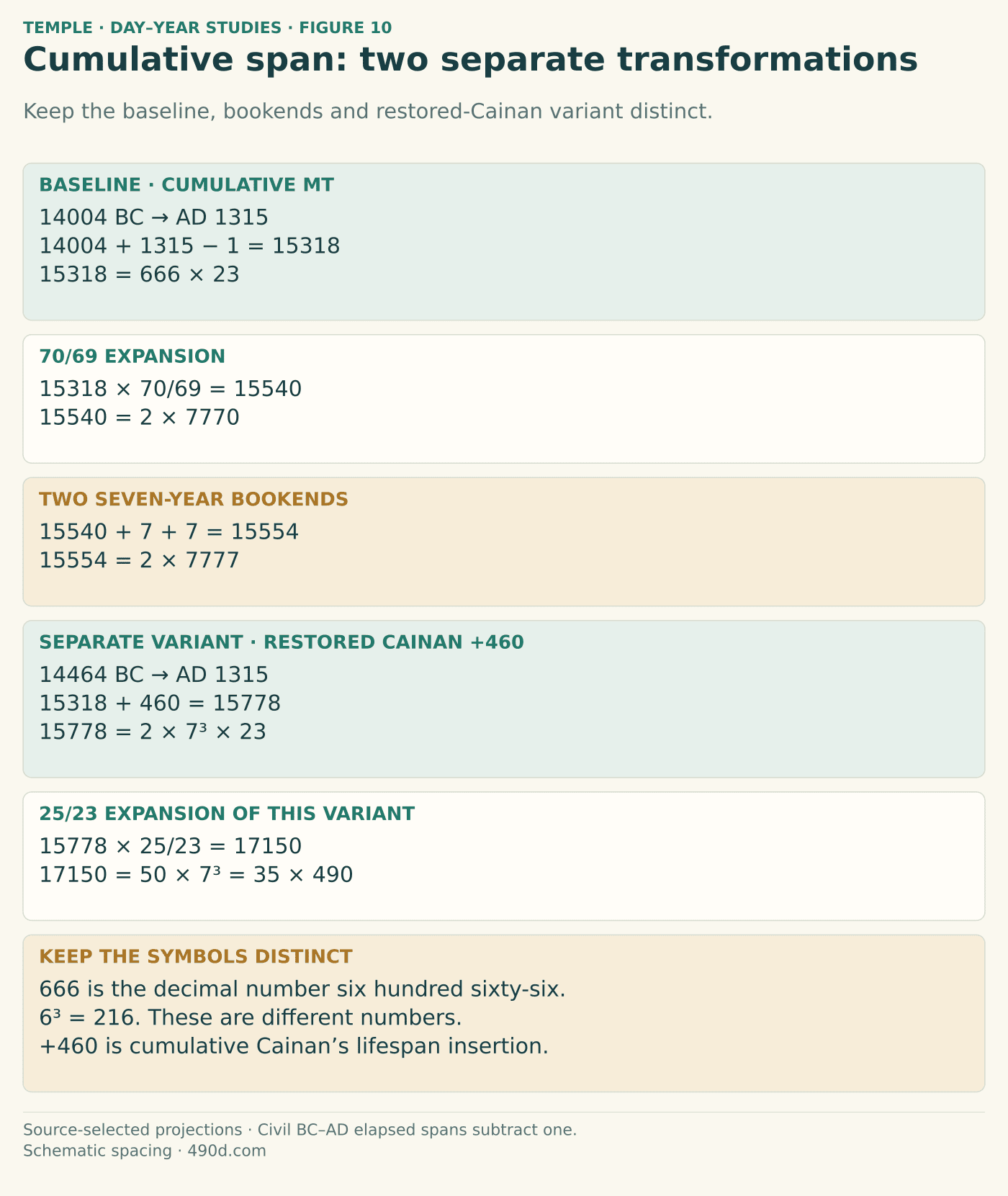
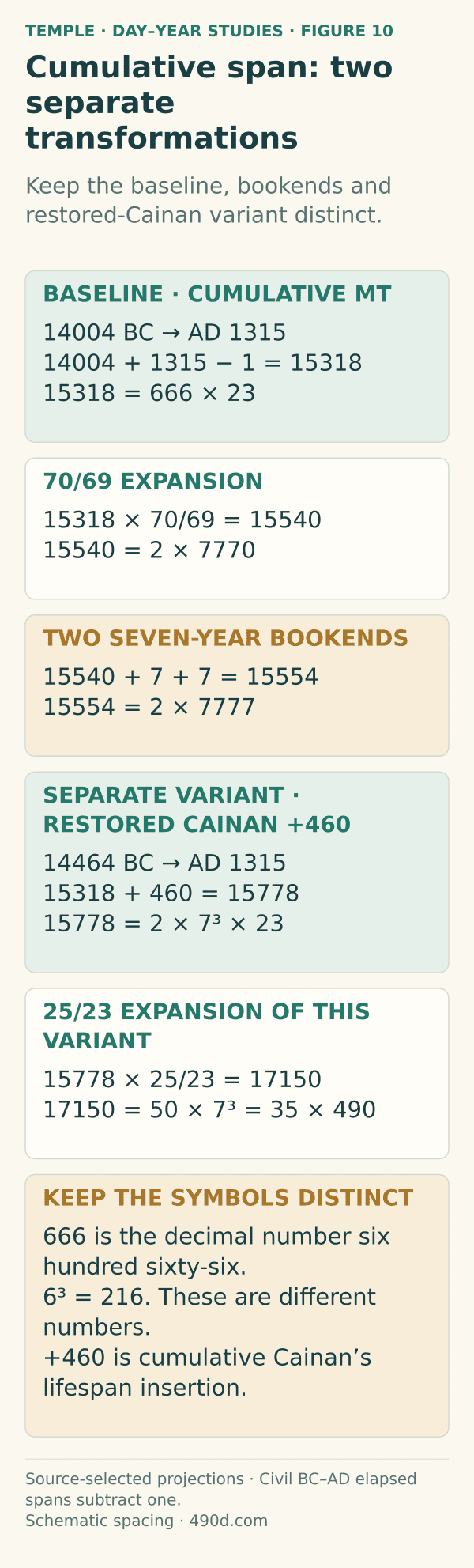
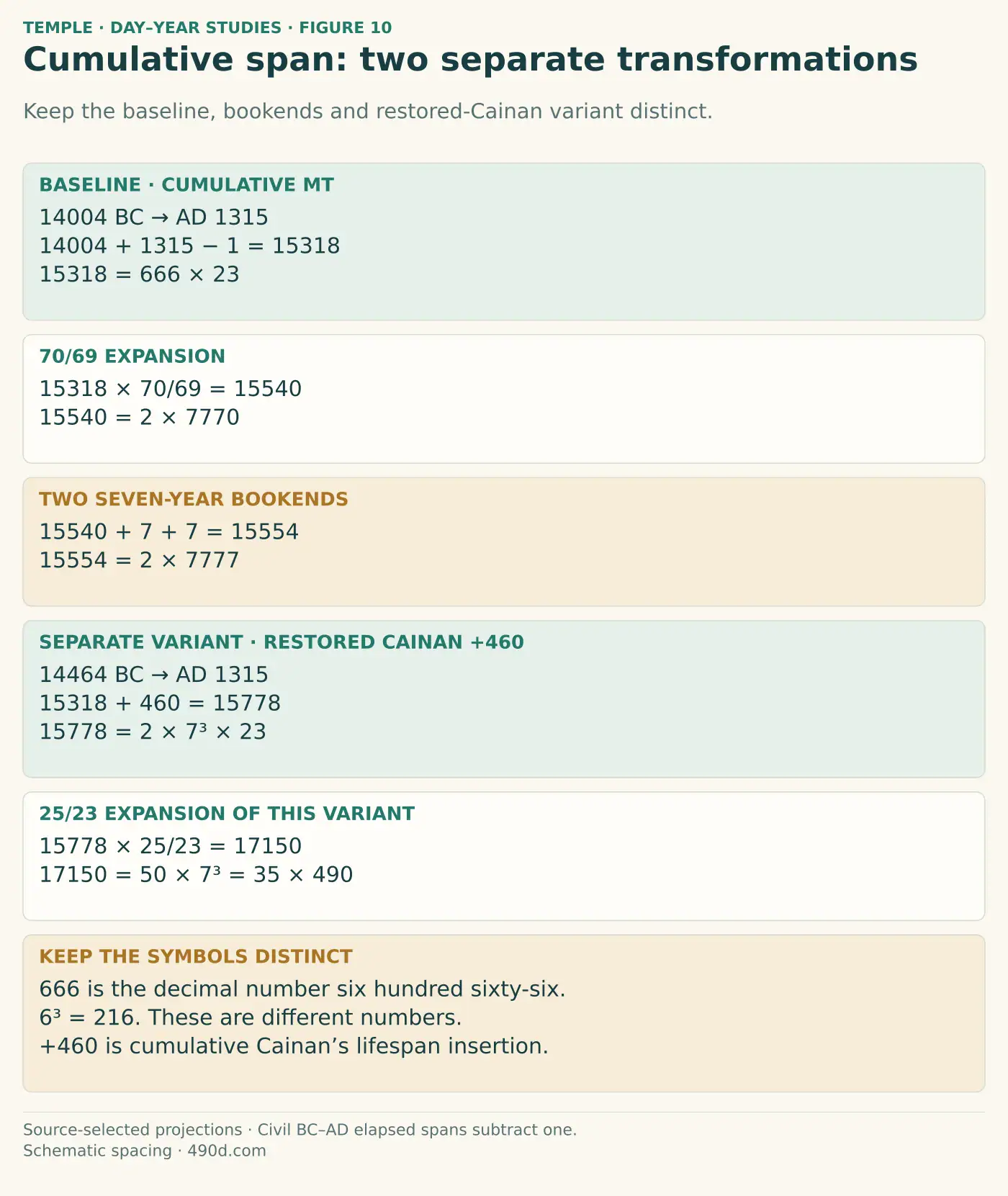
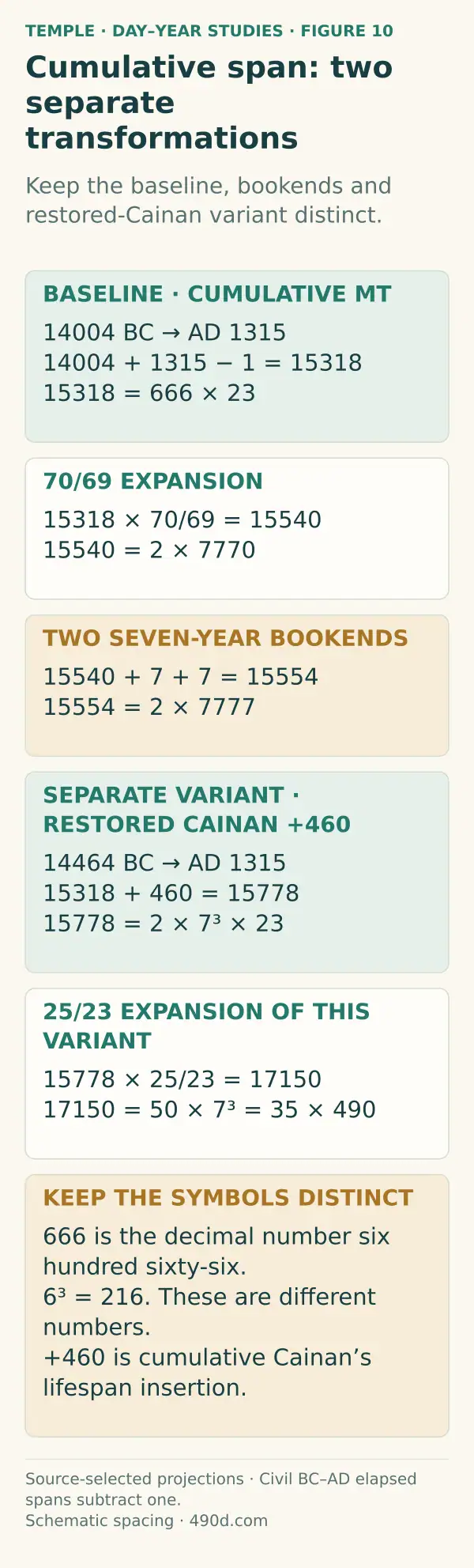
Figure 10. The MT cumulative 14004 BC→AD 1315 span is 15318=666×23. Expanding by 70/69 yields 15540=2×7770; adding two seven-year bookends gives 15554=2×7777. A separate restored-Cainan +460 lifespan insertion yields 15778=2×7³×23, expanded by 25/23 to 17150=50×7³=35×490. The decimal number 666 is not 6³. These spans and operations support the source’s symbolic interpretation without becoming formal Mirror reflections.
Accessible text and image downloads
An upper panel takes MT cumulative 14004 BC to symbolic AD 1315: civil elapsed span 15318 equals 666 times 23; multiplying by 70/69 gives 15540 equals two times 7770; adding seven plus seven gives 15554 equals two times 7777. A separate lower panel restores second Cainan’s 460-year cumulative lifespan, giving creation coordinate 14464 BC and span 15778 equals two times seven cubed times 23; multiplying by 25/23 gives 17150 equals fifty times seven cubed or thirty-five times 490. Decimal 666 and six cubed are distinct.
Desktop PNG · Phone PNG · Desktop WebP · Phone WebP · Text-based SVG (ZIP)
Restoring second Cainan’s 460-year lifespan changes the cumulative span to 15778. The 25/23 operation then gives:
15778 = 2 × 7³ × 23; 15778 × 25/23 = 17150 = 35 × 490 = 50 × 7³.
This is an explicit restored-Cainan cumulative variant. It does not replace the normal MT baseline, and it is distinct from the regular chronology’s Cainan begetting interval of 130. Luke names the second Cainan; the Greek Genesis inputs for his lifespan and Jubilees’ account of his forbidden learning must be identified separately.
Jared supplies a companion at another scale:
3654 BC→AD 1315 = 4968 = 6³ × 23 = 72 × 69.
The two transformations yield 5040 = 2 × 2520 and 5400 = 2 × 2700. The ordinary MT Creation-to-Flood span, 4114 − 2458 = 1656, is one-third of 4968 and gives 1680 or 1800 under the same respective ratios. Thus the smaller and larger totals become five and fifteen units of 336 or 360. The association of 72 with nations is interpretive; 6³ = 216 is mathematically distinct from the written number 666.
The original also compares 14464 BC with AD 27: 14490 expands by 25/23 to 15750, gaining 1260. The operand note distinguishes its Jared-associated 460 interval from the restored-Cainan lifespan insertion that produces the same cumulative coordinate. Shared arithmetic does not make those operations interchangeable.
I read these transformations against Revelation’s woman, ancient serpent, fallen stars, male child and ascension, together with the 1260 of chapter 12 and the 666 of chapter 13. Enoch’s Watchers and Jubilees’ Cainan contribute related extra-biblical themes. The arithmetic is reproducible; the reading of fall, redemption and repeated sevens is a theological interpretation. Its value lies in allowing related imagery to speak across scales while keeping Christ’s redemptive work central. The interpretive section preserves that argument without claiming that the arithmetic proves one exhaustive eschatological timetable.
12. Anniversaries, restored beginnings and unresolved boundaries
The original’s finer day comparison begins with Daniel’s three weeks and the first-month twenty-fourth day. It proposes successive endpoints on Nisan 10, 17 and 24, followed by an extension to the Temple’s second-month second day. Within that model, the Jordan crossing, an idealized Red Sea anniversary, the Ark’s rest under a spring reckoning, resurrection imagery and the Enochian fourth-day beginning form a related chain. The anniversary table distinguishes dated Scripture from inferred and ideal anniversary choices. Ezra supplies the second month for the renewed foundation, but no matching second day.
The restoration sequence also has a forward companion: 537→516→467 BC = 21 + 49 = 70. Alongside 586→537→516 = 49 + 21, I read the reversed divisions as a pattern that can continue through interruption and renewed authorization. The original relates Cyrus’s authorization to three further restoration authorizations: Darius’s confirmation, Artaxerxes’s authorization associated with Ezra, and Artaxerxes’s authorization associated with Nehemiah. Their distinct Temple, Law and wall settings remain visible; I interpret the sequence as restoration restarting within an enduring structure.
Two proposals remain visible with their unresolved endpoints. First, the sanctuary-start arrangement gives 480 + 480 = 960, using the Kings ledger’s schematic fifty-year difference; adding 21 by ordinary elapsed arithmetic gives 981, not 980. An inclusive boundary choice is needed before the intended 490 + 490 completion symmetry can be asserted. Second, the original’s proposed Jacob-to-AD 4052 span of 5980 does not follow from the printed 1859 BC death date: that pair gives 5910. The scalar transformations 5980→6500/6000 are retained. A corrected comparison starts at 1929 BC, which the Canon identifies as Jacob’s Bethel/Haran call, not his death. See the boundary register.
Likewise, the total call-to-Temple-fall span can be bisected as 1290 + 1290, but the printed dated siege-start cells do not sit at that midpoint. The full matrix preserves their actual values. Keeping the structural partition separate from a dated event allows the proposed pattern to remain available for study without changing the source dates to fit it.
The detailed symbolic tables and calculations provide the complete restored argument, calendar variants, matrix and correction notes. The ordinary Temple chronology explained above remains the foundation on which these finer comparisons are built.
Supporting tables and source notes
A. Foundation and destruction states
All coordinates below are BC. The selected second-month pair has year-and-month resolution; other displayed subtractions use year labels.
Crossing the foundation pairs gives 967 − 536 = 431 or 966 − 537 = 429. Neither is the selected 430 comparison. The ordinary and schematic dates also remain distinct from the 430.5-year sum below.
Sources: File 19 §§10.5–10.6, File 08 §§1.1–1.3, File 18 §§2.5.4–2.5.5. Return to explanation.
B. The selected post-Solomonic reign ledger
Solomon’s remaining ledger portion is 40 − 4 = 36; hence 36 + 394.5 = 430.5. This subtraction is the source’s standardized ledger operation, not an exact day count from his second-month foundation to his death.
Athaliah: 2 Kings 11:3–4 gives six years of concealment and action in the seventh year. The canonical schematic ledger selects the seventh-year boundary, 7, while preserving six completed years as a distinct reading. Substituting 6 would produce 393.5, a different ledger. The two quarter-year entries above represent the selected three-month reigns; they are not accession ages.
Sources: File 19 §§10.4–10.5; File 08, File 65 reciprocal-control note and guards. Return to explanation.
C. The restoration and its separate seventy-year fields
The 49 + 21 sequence uses 537 BC. Substituting 536 while keeping 586 and 516 gives 50 + 20, also 70 but a different division. These are year-label spans; the destruction, foundation, and completion occur in different months. The foundation day in Ezra remains unspecified.
Daniel’s 3 × 7 = 21 days are compared with the 3 × 7 = 21 years above; they are not a textual date equation. Daniel 9:1 and 10:1 retain different regnal settings. Temple completion and the subsequent Passover are also separate events in Ezra 6:15–19.
Source: File 17 §§7.3–7.4. Return to explanation.
D. Cumulative MT coordinates compared with regular anchors
The single-node examples select the earlier member of the cumulative seven-year display. They do not average its endpoints. Cumulative coordinates arise from full lifespan addition; regular coordinates arise from ordinary chronological placement.
Sources: File 18 §6/§6A, File 09, File 30 §§1.2–2. The intermediate 3870 + 430 partition is computed from these source-controlled nodes. Return to explanation.
E. Construction and calendar quantities
The dedication is not interchangeable with completion. Kings places completion in the eighth month and the dedication assembly in the seventh month, without stating that assembly’s regnal year (1 Kings 6:38; 8:2). File 63 §5.8 and Appendix C retains a bounded completion/dedication matrix rather than treating one derived date as explicit biblical wording.
Sources: File 63 §§4.6–4.9, 5.7–5.8; Appendix D.7, File 12 §7A. Return to explanation.
Source map and further reading
- File 19 §§10.4–10.6: reign ledger, 430.5 total, schematic Temple bridge, and the paired historical foundations.
- File 08 §§1.1–1.3 and controls: historical/schematic Kings chronology, the fifty-year difference, and Athaliah’s boundary count.
- File 17 §§5.5, 7.3–7.4: Temple 430 and the 70/49/21 restoration pattern.
- File 18 §§2.5.4–2.5.5 and 6/6A: ordinal/cardinal foundations and cumulative source tables.
- File 30 §§1.2–2: MT cumulative 4900/4300 and the 4830 + 70 division.
- File 63 §§4.6–4.9, 5.6–5.8 and appendices: construction quantities, Temple-body interpretation, and the completion/dedication distinction.
- File 12 §7A: the declared 360-day intercalation scheme.
Related studies: Ezekiel’s 430 Days, Cumulative Biblical Chronology, and the separate Solomon’s Temple as Chronological Template.
Return to the illustrated introduction · Introductory tables and appendix
Original version: Read the original version.
Scripture quotations: Berean Standard Bible (BSB), public domain.