Part 5C of the Birth of Jesus day–year studies. This detailed companion continues Part 5B’s expanding number sets. Start with Eight Days, Forty Days, and the Day–Year Pattern for the Gospel framework.
The individual numbers in a chronology may form patterns. Their totals can form another layer. Part 5B followed twelve symbolic coordinates as the Key of 23 expanded them into a closed set of forty. Here we add the two halves separately and ask what those totals express. The clearest result brings together 400, 430, and the 120 years of Moses.
The biblical setting is the covenant with Abram. Its promise includes these words:
“they will be enslaved and mistreated four hundred years”
“In the fourth generation your descendants will return here”
— Genesis 15:13, 16, BSB, excerpts. The animals are divided, and the covenant is confirmed between their halves. That setting gives the paired calculations their theological theme: division, promise, and return.
The 400-year affliction of Genesis 15 and the 430-year sojourn of Exodus 12 are distinct periods. In the normal Masoretic Text (MT) chronology used here, Israel’s Egyptian sojourn runs from 1876 to 1446 BC, a span of 430 years. The numerical comparison does not turn one period into the other. The sojourn study explains their relationship.
From individual coordinates to collective totals
A collective date is a total deliberately read as a new symbolic coordinate. It is a way to compare the whole set with the patterns within it. It does not date a future event, and it is not an ordinary elapsed interval obtained by adding historical dates. Its meaning depends on the stated origin, signs, and transformations.
The calculation begins with Part 5B’s exact set. Its lower twenty values sum to −180; its upper twenty sum to 42,980. The present study then applies a declared companion transformation: subtract 1 from each lower value and add 1 to each upper value. Twenty adjustments on each side give:
−180 − 20 = −200
42,980 + 20 = 43,000
These are the central expanded totals. The one-unit transformation belongs to this arithmetic family. It does not alter Part 5B’s seed or supply a general calendar uncertainty. The two-day Julian–Gregorian relationship and the Noah/Shem gears have their own definitions in the calendar-datum appendix.
A further 30-unit companion moves the lower addends down by 30 and the upper addends up by 30. With twenty values per side, each total changes by 600. With the original six values per side, it changes by 180.
| Stage / family | Values per side | Lower total | Upper total |
|---|---|---|---|
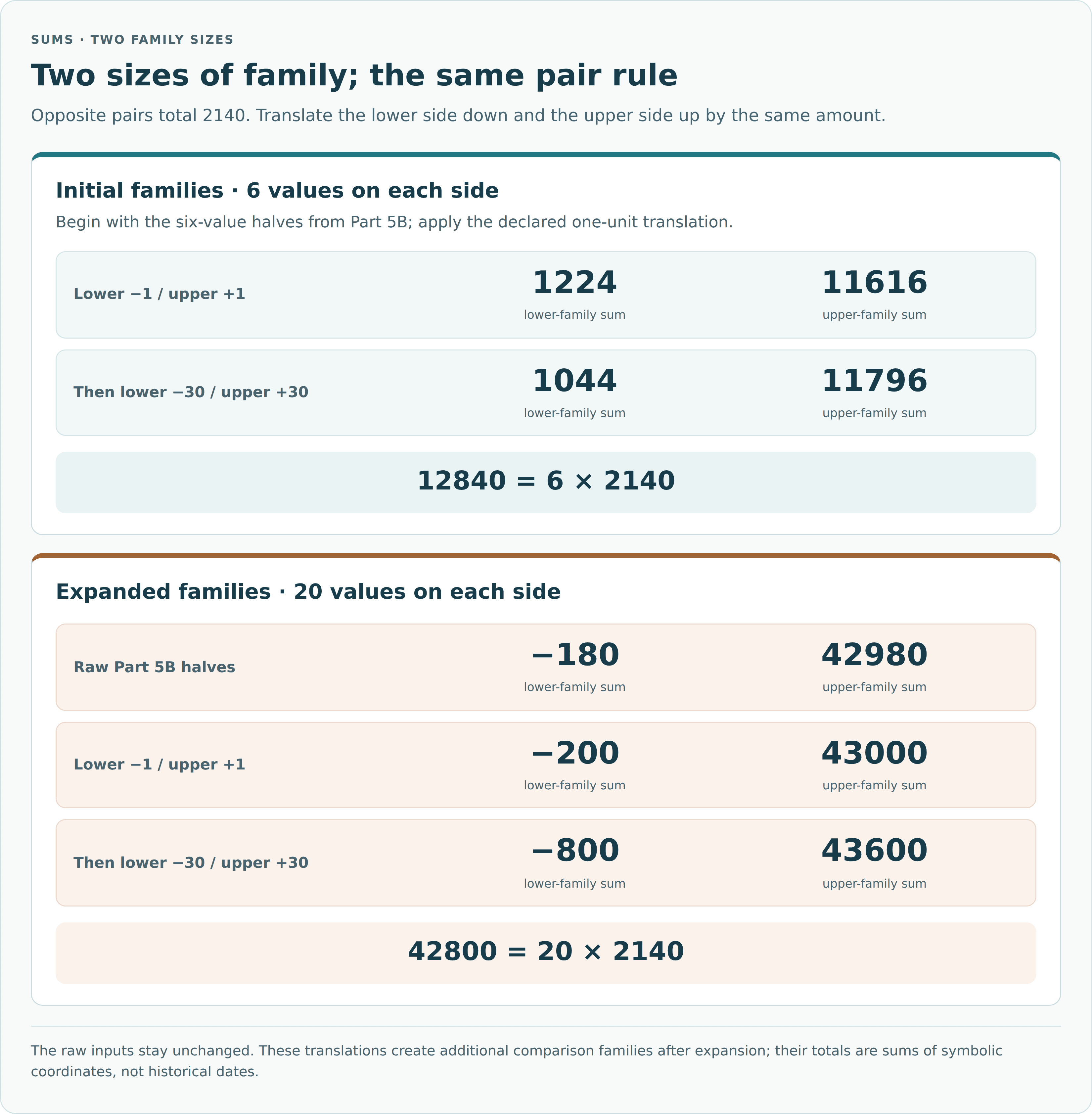
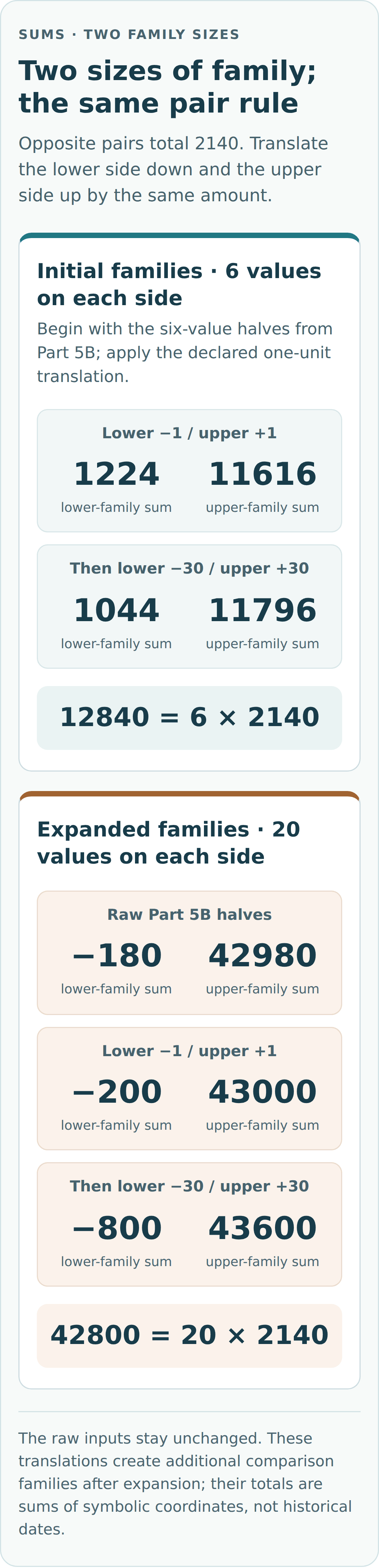
| Initial · six pairs · central | 6 | 1,224 | 11,616 |
| Initial · six pairs · 30-unit companion | 6 | 1,044 | 11,796 |
| Expanded · twenty pairs · central | 20 | −200 | 43,000 |
| Expanded · twenty pairs · 30-unit companion | 20 | −800 | 43,600 |
Open the complete addend tables to see every number behind these totals. The 30-unit companion uses the length of a month in the ideal 360-day register; it is a specified transformation, rather than an adjustment to every historical date.
SUMS · TWO FAMILY SIZES
Two sizes of family; the same pair rule
Opposite pairs total 2140. Translate the lower side down and the upper side up by the same amount.
Initial families · 6 values on each side
Begin with the six-value halves from Part 5B; apply the declared one-unit translation.
Expanded families · 20 values on each side
What stays constant when the halves move
Each lower number has an upper counterpart. The counterparts are paired in reverse order, and every pair adds to 2140. Moving one member down and the other up by the same amount preserves that sum.
For example, the central six-value families contain −6 and 2146, then 34 and 2106. Both pairs total 2140. Their six pairs therefore total:
1224 + 11,616 = 12,840 = 6 × 2140
The expanded families contain twenty such pairs:
−200 + 43,000 = 42,800 = 20 × 2140
The 30-unit companions preserve the same totals: 1044 + 11,796 = 12,840, and −800 + 43,600 = 42,800.
This explains why the sums remain orderly. The repeated pair total is inherited from the structure of the input set. It is a relationship to interpret, rather than a collection of independent coincidences.
Adding both family views gives 25,680 for the initial stage and 85,600 for the expanded stage. Those totals count two views of the same structure: 24 coordinate occurrences in twelve pairs, or eighty occurrences in forty pairs. They should not be confused with the single forty-value total of 42,800. The counting table keeps these views separate.
The 400-year division and the 430-year scale
The expanded upper total, 43,000, is 430 × 100. Read symbolically, it expresses 430 units of one hundred years. Genesis 15’s four generations and Abraham’s hundredth year provide the comparison; the total is not a list of 430 historical generations.
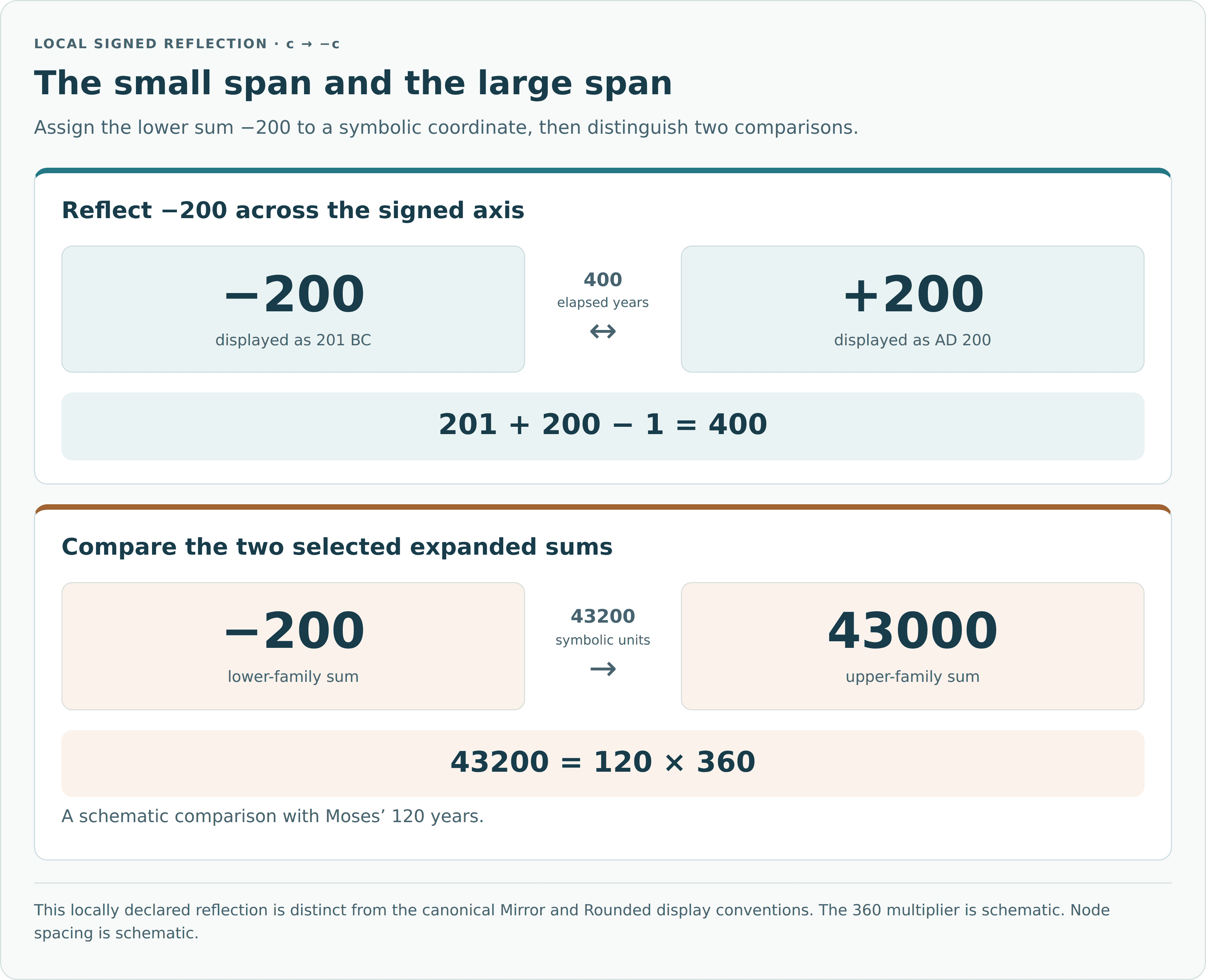
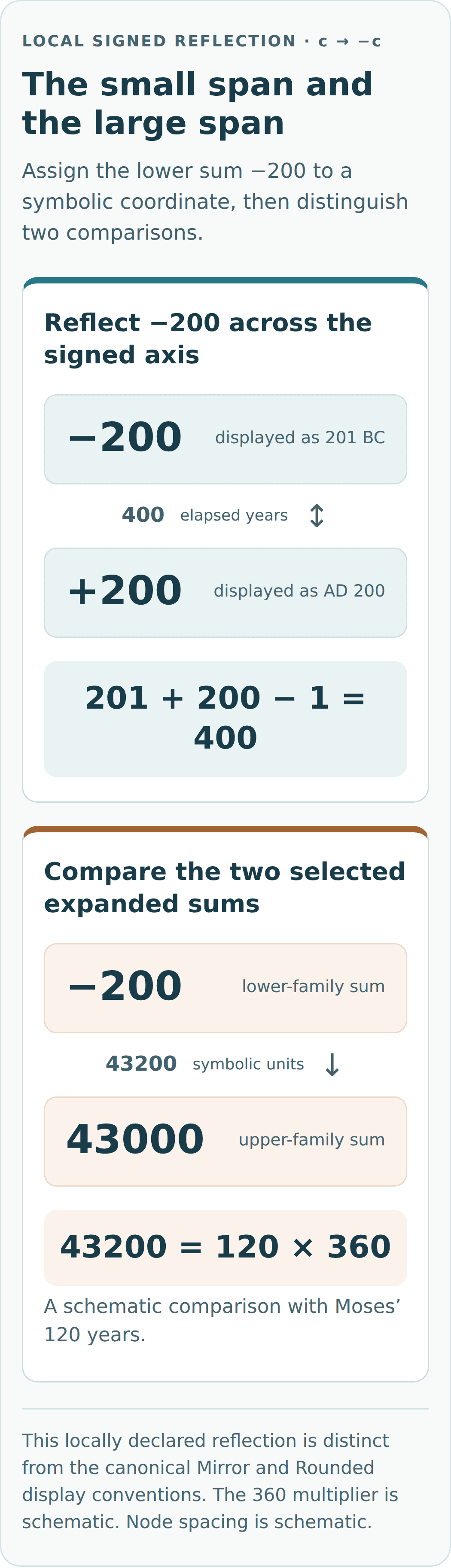
The paired lower total, −200, supplies the division. Reflecting that signed coordinate gives +200. The span between them is:
200 − (−200) = 400
Thus the 400-year comparison is divided into 200 + 200, recalling the divided pieces of the covenant. This is a local reflection of signed numbers, c → −c. The civil labels are 201 BC and AD 200, whose elapsed interval is 400 years. It is important to keep that local operation distinct from the phase conventions used in the canonical Chronological Mirror.
A second relationship joins the two expanded totals themselves:
43,000 − (−200) = 43,200 = 120 × 360
Moses lived 120 years. At the ideal scale of 360 days per year, that lifespan corresponds to 43,200 days. The collective-coordinate span repeats that number in symbolic years. Here the covenant theme and Moses’ lifespan meet in the same pair of totals.
LOCAL SIGNED REFLECTION · c → −c
The small span and the large span
Assign the lower sum −200 to a symbolic coordinate, then distinguish two comparisons.
Reflect −200 across the signed axis
Compare the two selected expanded sums
A schematic comparison with Moses’ 120 years.
The 30-unit companion extends the comparison. Its lower total, −800, reflected to +800, spans 1600 = 4 × 400 = 40². The upper total becomes 43,600. These calculations preserve the same covenant vocabulary while changing the scale. They are not additional dates assigned to the covenant itself.
How the small totals retain the pattern
The six-value totals make the method easier to see. The central lower family is:
−6, 34, 174, 214, 314, 494, totaling 1224.
Its 30-unit companion is:
−36, 4, 144, 184, 284, 464, totaling 1044.
The totals are 180 apart, half an ideal 360-day year. Their relationships with selected addends bring out familiar calendar lengths:
| Selected relationship | Difference | Schematic comparison |
|---|---|---|
| 1224 − 314 | 910 | 2½ × 364 |
| 1224 − 494 | 730 | 2 × 365 |
| 1044 − (−36) | 1080 | 3 × 360 |
| 1224 − (−36) | 1260 | 3½ × 360 · central sum with the shifted datum |
The 1260 and 1080 comparisons express 3½ × 360 and 3 × 360. They invite comparison with the 1260 days of Revelation 11 and its distinction between a ministry period and the witnesses’ subsequent 3½ days. The arithmetic does not establish an exact chronology of Jesus’ ministry or equate those separate passages. The supporting comparisons show which addends and conventions are used.
The upper family contributes a further example: 11,796 − 1996 = 9800 = 20 × 490. From the same total to the selected symbolic endpoint AD 36 is 11,760 = 24 × 490 = 35 × 336. That endpoint is an explicitly selected comparison, not the default historical date of the Passion.
From the covenant scale to larger spans
The original discussion also explores a seasonal companion. It assigns ninety days to each addend and applies an additional 360-to-1 conversion to their aggregate: six addends yield 1½, while twenty yield 5. This convention is separate from the original day–year correspondence. It is not the result of simply moving every symbolic coordinate ninety years, nor does it by itself identify an exact Nisan or Tishri date.
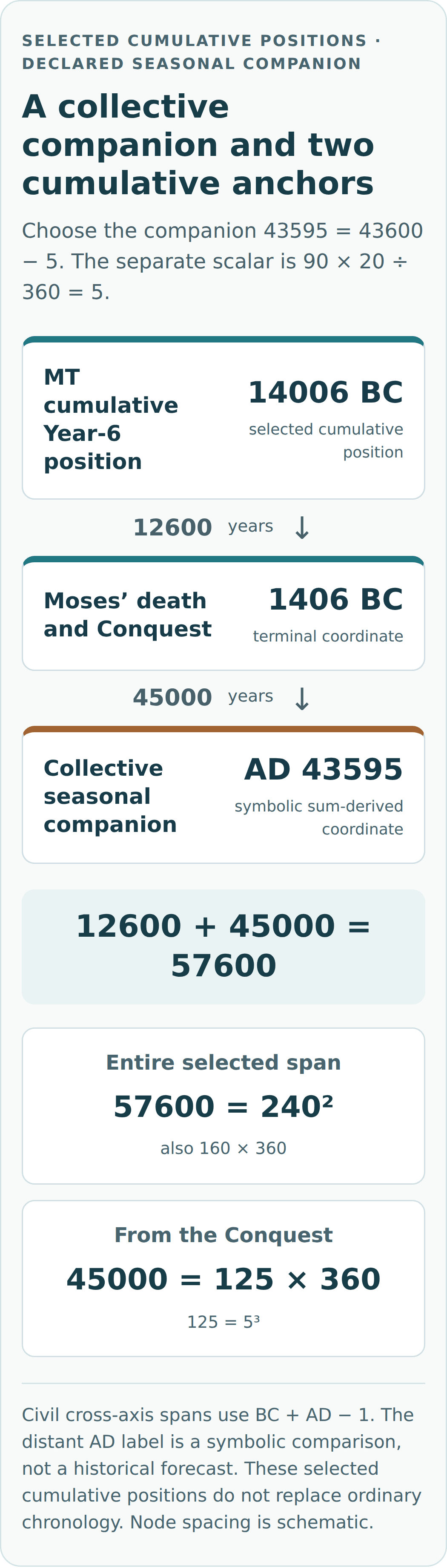
Under that declared five-unit convention, the upper total 43,600 has a companion at AD 43,595. Compare it with two established MT nodes: the selected cumulative Year-6 position at 14006 BC and Moses’ death/Conquest at 1406 BC.
14006 → 1406 BC = 12,600
1406 BC → AD 43,595 = 45,000
14006 BC → AD 43,595 = 57,600 = 240²
The cross-era spans use civil elapsed reckoning, BC + AD − 1. Their numerical shapes are clear: 45,000 = 125 × 360 = 5³ × 360, while 57,600 = 160 × 360. These are larger symbolic comparisons built from the declared companion; they do not enlarge the historical cumulative chronology.
SELECTED CUMULATIVE POSITIONS · DECLARED SEASONAL COMPANION
A collective companion and two cumulative anchors
Choose the companion 43595 = 43600 − 5. The separate scalar is 90 × 20 ÷ 360 = 5.
MT cumulative
Year-6 position
selected cumulative position
Moses’ death
and Conquest
terminal coordinate
Collective seasonal
companion
symbolic sum-derived coordinate
Entire selected span
57600 = 240²
also 160 × 360From the Conquest
45000 = 125 × 360
125 = 5³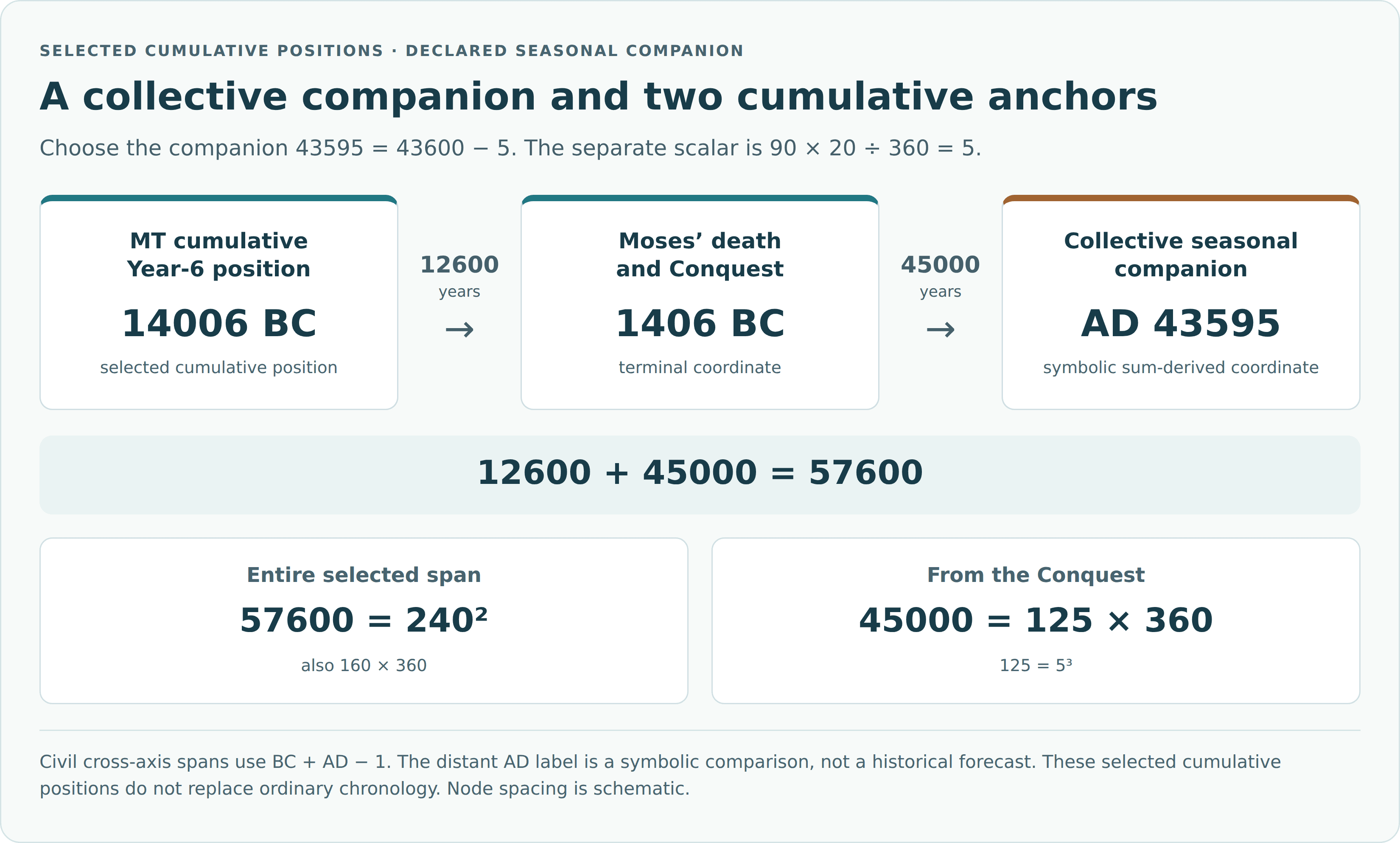
The linked tables retain the other Creation, Flood, Exodus, exile, and Key of 23 comparisons, including their exact endpoints. The further Sumerian, precessional, tripling, and fractal branches remain available as supporting research notes, with their additional assumptions stated where they arise.
What the collective view contributes
The capstone joins two levels of reading. The individual coordinates form a paired structure; their totals return to the same biblical themes on a larger scale. The clearest relationships are −200 with +200, 43,000 as 430 × 100, and 43,200 as 120 × 360. The smaller families then help explain the 180, 1080, 1260, 490, and 336 comparisons.
I read these relationships as a symbolic expression of covenant, division, and fulfillment. Their calculations can be checked exactly; their theological significance calls for interpretation. Keeping those tasks distinct allows the pattern to remain both intelligible and open to further study.
Continue: Part 5D: Expansion across the Mirror. Reference: Supporting tables and research notes · Current canonical sources.
Read the preserved original discussion.
Scripture excerpts: BSB. The Holy Bible, Berean Standard Bible, BSB is produced in cooperation with Bible Hub, Discovery Bible, OpenBible.com, and the Berean Bible Translation Committee. This text of God’s Word has been dedicated to the public domain.