Book 1 · The Cross at the Center of Time · Chapter 17 of 18
The Gospels, the calendars, and the heavenly testimony
“Father, the hour has come. Glorify Your Son, that Your Son may glorify You.”
— John 17:1
Jesus lifts His eyes toward heaven and speaks of the hour that has come. His prayer gathers the work the Father has given Him, the people entrusted to Him, and those who will believe through their testimony. The hour belongs within an earthly sequence, yet the prayer opens that sequence toward the glory He shared with the Father before the world existed.1
This is the vantage I have been seeking throughout the book. I follow John as a witness to the Word who entered our days, while trying to rise upon the eagle's wings and see those days within their heavenly reach. The Cross stands within history. I also consider the stronger possibility that its actual accomplishment gives past and future their redeemed order. The measures we have examined are ways of attending to that work.
Chapter 16 enlarged the company of witnesses. An eclipse at the edge of local visibility and a procession concealed by daylight can still, in my reading, bear testimony before heavenly beings. Their meaning need not begin when people notice them. That perspective will become especially important in Book 2. Here I want to gather what the present inquiry has taught us about John's hour, the calendars, and the fulfillment toward which they point.
In this chapter
Learning to see with the witness
John gives his Gospel a stated purpose: the written signs lead us to believe that Jesus is the Christ, the Son of God, and through believing to have life in His name. That purpose directs my reading of the numbers as much as of the miracles. A count becomes fruitful when it helps me attend to the One whom the testimony reveals.2
The Gospel also teaches me that recognition can follow the event. Jesus speaks of raising the temple, and John explains that He means His body. After He has risen, the disciples remember the saying and believe the Scripture and His word. The promise was already true while their understanding was still being formed.
At Bethany, Martha's hope of resurrection meets the One who is resurrection and life. At the empty tomb, the disciples encounter an accomplished act whose meaning they must learn. Thomas later moves from refusal to confession before the risen Lord. The Gospel repeatedly draws us through seeing, remembering, and believing. I come to its temporal details within that same movement.3
This leaves room for inspiration to exceed the human witness's reported understanding. Peter describes the prophets searching into the salvation of which they spoke, while the Spirit testified beforehand to Christ's sufferings and the glories to follow. The testimony was given through them, and its fullness called them into further inquiry. I believe John's inspired witness may likewise carry relationships that become clearer as Scripture, history, and creation are considered together.4
I need not supply an unrecorded calculation in John's mind to make that claim. His Gospel does not say that he multiplied 77 by 153 or plotted our calendar rows. The further chronological relationships are the inquiry I am bringing to his testimony. Their possible divine intention can reach beyond what the text reports about his conscious method.
The same care applies to the picture of John on Patmos. Revelation names that island as the setting of his testimony and vision. It does not place the composition of the Gospel there or tell us that he was then the last surviving apostle. I receive Gospel and Revelation together within the Johannine perspective adopted in this book, allowing each work to give its own setting.5
The hour that is coming and has come
The Greek noun ὥρα, hour, occurs 26 times in 24 verses in the SBL Greek text of John's Gospel. The count includes its different inflected forms. Ordinary clock notices and a passing season stand beside the sayings about Christ's appointed work. The number describes the whole lexical inventory; the pattern emerges as we hear the particular uses.6
John can tell us when disciples stayed with Jesus or when He sat beside a well. He can also speak of an hour in which worship is transformed, the dead hear the Son's voice, or His disciples face trial. The appointed hour grows through those settings until the Passion draws its strands together.
Table 1 — Different uses within John's hour language
| Setting | Passage examples | Contribution to the reading |
|---|---|---|
| Ordinary time and daylight | John 1:39; 4:6; 11:9 | The Word's earthly life unfolds within measured days |
| The hour has not yet arrived | John 2:4; 7:30; 8:20 | The appointed work remains under the Father's purpose |
| Coming fulfillment already present | John 4:23; 5:25 | Worship and life begin to disclose the fulfillment |
| The hour of glorification and departure | John 12:23; 13:1; 17:1 | The Passion gathers the work toward the Father |
| The disciples' scattering | John 16:32 | Their trial belongs within the same approaching crisis |
The movement is richer than a succession of unopened doors. At Cana, Jesus says His hour has not yet come, yet He supplies the wine and reveals His glory. To the Samaritan woman, He speaks of worship whose time is coming and has now come. He speaks similarly of the dead hearing His voice. In the farewell discourse, the disciples' scattering is coming and has already come. The promised future is becoming present through Him.7
I hear this interweaving as part of the Gospel's temporal depth. Christ enters the appointed course, and His presence already gives what that course will bring to fullness. The sign at Cana, the life given at Bethany, and the words spoken to the disciples can bear the form of His completed work before the Cross is reached in the narrative.
That is close to the possibility pursued through the earlier chapters: fulfillment may give an earlier witness its form because fulfillment is its source. The Father is accomplishing one purpose through moments that His creatures receive successively. I contemplate an actual work of God reaching through those moments, while the Gospel allows me to follow its earthly unfolding.
The public declaration comes when Greeks seek Jesus. He announces that the hour has come for the Son of Man to be glorified, and speaks immediately of the grain that bears fruit through death. His troubled soul and His purpose belong within the same hour. Glory comes through the giving of His life.8
The upper room brings that giving close to His own. John says that Jesus knows His hour has come to leave this world and return to the Father; he joins that knowledge to love carried to the end. The prayer then opens with the hour's arrival. Betrayal, suffering, sacrifice, departure, and glorification enter one appointed movement. The word hour can hold that movement while particular clock notices retain their smaller measures.
The meal and the Lamb
The calendars have contributed to this reading because the appointed work enters Israel's feasts. The Synoptic meal presents the covenant gift shared with the disciples. John's Passion presentation gives the preparation and sacrificial setting its own force. I have read their proposed Nisan 15 and Nisan 14 reckonings as witnesses gathered around the same Lord.9
The earlier and later lunar rows give that proposal a definite calendar form. One month beginning stands a day before the other. Friday can consequently bear different numbered dates without becoming two different Fridays. The historical questions about the earlier declaration and the arrangements for sacrifice remain those stated in Chapter 4. The theological joining concerns the One who gives the meal and gives Himself.
He is both the host and the gift. The body received in the meal is the body given in sacrifice; the covenant He announces is accomplished through His self-offering. I therefore seek a harmony in which the two presentations contribute their particular emphases. Their numerical difference can serve that reading when its actual calendar conditions remain visible.
The altar's ledger has prepared us for such a gathering. In the Tishri count examined in Chapter 6, 270 is followed by the final day's bull, ram, and goat, giving 273; its seven lambs complete 280. Isaac's beginning and covenant sign supply a related 273 + 7 comparison in Jubilees. The offerings, the child of promise, and the covenant body meet within my reading of Christ.10
The long count gives another bodily measure. The received chronology places 77 × 153 = 11,781 full civil days between the opening of January 1, AD 1 and the opening of April 4, AD 33. Crucifixion Friday is the final complete day in that midnight frame. Forgiveness, Ezra's lambs, the fish brought to shore, and the covenant sign have their distinct narrative settings; their joining brings me toward the life wholly given.11
I do not want the synthesis to lose the people within those measures. The restored Peter must feed Christ's lambs. The measured sanctuary includes worshipers. Lazarus returns to his sisters, and the frightened disciples receive peace and a commission. The gathering accomplished through the Cross becomes the life of a people who can forgive, worship, and bear witness.
The sixth hour and the center of the Cross
John's about-sixth-hour notice belongs to the proceedings before Pilate. Mark's sixth-hour darkness comes with Jesus already on the Cross. Both must remain at their stated places in the narratives. The word about gives an approximate notice; it does not make the whole interval from 09:00 to 15:00 one interchangeable clock hour.12
A proposed Roman 06:00 reading can be considered in the hour discussion, but a Roman midnight civil boundary does not by itself establish how John numbered this hour. Changing a month beginning likewise does not settle the difference between John's proceedings and Mark's crucifixion notice. The clock question has its own work to do alongside the calendar comparison.
Noon has a clear place in our adopted Passion display. Christ is on the Cross and darkness begins. His death follows the ninth-hour cry. The center I have followed is therefore the living Son giving Himself within the darkness, with the narrative proceeding toward His death. The measured midpoint need not absorb every event of the saving hour.
The wider frame is exact under its declared equal-hour choices:
Wednesday 18:00 → Friday 12:00 → Sunday 06:00.
42 + 42 = 84 hours = 3½ days.
The evening solar opening is Nisan 16, following the daylight of Nisan 15. Beginning instead when evening Nisan 15 opens, on Tuesday at 18:00, gives 108 hours, or 4½ days, to the same modeled Sunday dawn. The diagram makes both starts visible.13
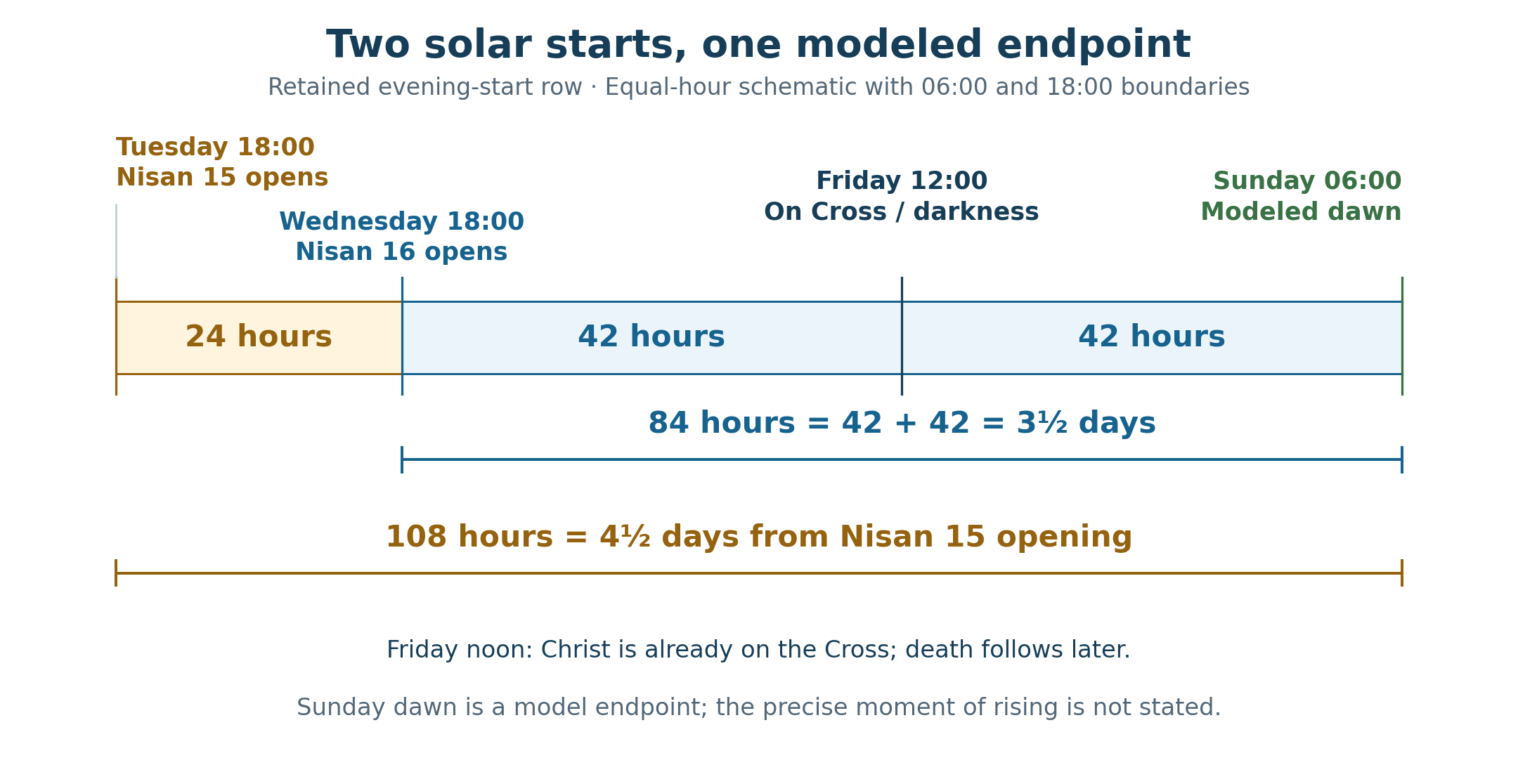
Reproduced unchanged from Chapter 13. The 84-hour frame begins at E16 before the burial and closes at a schematic dawn, not a recovered Resurrection hour. The longer E15 frame is 108 hours. Friday noon locates Christ on the Cross; death follows later. The authorized main chart remains in Chapter 10.
The chosen half-week can be read beside Revelation's witnesses, who lie exposed for three and a half days before receiving life from God. The correspondence joins testimony, apparent defeat, and vindication. It gives the Passion frame a prophetic setting while keeping the witnesses' exposure and Christ's burial as distinct events.14
The repeated forty-two also invites comparison with Revelation's months. Here the relationship needs its rule as well as its number.
Table 2 — The same prophetic form under named comparison rules
| Rule or register | Starting measure | Result within that comparison |
|---|---|---|
| Proposed hour-for-month correspondence | 42 model hours | 42 represented months |
| Day-for-year typological extension | 84 hours = 3½ days | 3½ represented years |
| Common 360-day form | 3½ years | 1,260 days = 42 thirty-day months |
| Regular 364-day form | 3½ years | 1,274 days |
One forty-two-hour half and the whole eighty-four-hour frame thus enter different comparisons. The hour-for-month proposal relates the former to forty-two months. The day-for-year reading relates the whole three and a half days to three and a half years. The common and regular day totals preserve their respective year measures.15
I read these forms as a prophetic grammar through which the suffering and vindication of Christ's witnesses can be contemplated. The measured relationships help articulate that grammar. The further possibility remains that the actual Cross gives the earlier pattern its order and opens the later pattern toward its fulfillment. A clock diagram shows where we place the center; it does not contain the reach of the One who acts there.
Life before its recognition
John brings Mary to the tomb while it is still dark. The stone has already been removed. The Lord's victory precedes her understanding, and the disciples must learn what the opened tomb means. I hear in that sequence something essential to the heavenly perspective: the reality of God's act does not wait for the arrival of its human interpreters.16
The pre-dawn setting also helps us read the calendars honestly. An evening-start day has begun at sunset; a midnight-start civil day has also begun. An ordinary dawn-start day still belongs to its preceding morning until the next dawn arrives. The phased morning overlay in our main chart gives the shared night a Sunday name through its particular ending-weekday convention. That agreement belongs to the selected pairing, rather than to every possible calendar.
I find no need to make all those labels identical before they can serve the same testimony. The calendars locate the events through different beginnings. The risen Christ is the Lord whom their accounts concern. His victory can gather their witness while their native rhythms remain distinct, as the Sun and Moon keep different courses within one created order.
The creation of the luminaries gives appointed times, days, and years a biblical setting. Human calendars organize their use, and their histories include observation, convention, disagreement, and correction. Within providence, even a received convention can acquire a place in the testimony. The later Christian era and its adopted childhood dates have served that role in our civil-day count.17
This is why I continue to treat the Cross as a possible source of order reaching in both directions. Earlier signs may receive their form from the fulfillment that lies ahead of them in human history. Later remembrance may also participate in the work already accomplished. Our investigations follow the relationships available to us, while the Spirit may open a meaning greater than the participants themselves reported.
The witness heard in heaven
The same principle governs the celestial scene. The partial lunar eclipse occurred on the preferred Crucifixion date whether or not its ending phase was recognizable from Jerusalem. The planetary company existed in the chosen Ascension scene whether or not those below could see it in daylight. Human discovery did not bring Uranus into existence, and human recognition need not inaugurate a sign's meaning.
I suggest that these features could bear witness before the heavenly host. The eclipse near the sunset-and-moonrise threshold and the procession veiled by the Sun may carry their very concealment within the symbolism. John's Revelation invites us into worship and conflict whose audience extends beyond the world of human observers.18
The Sabbath-day journey in Acts has a place beside that reading. It describes distance, and I also hear an intentional temporal clue in its carefully chosen Sabbath wording. Within the full-forty-elapsed-day construction, the Friday scene and the approach of the Sabbath contribute to a cumulative interpretation. The calculated common horizon interval remains its own measure, and the precise hour of the Ascension remains unreported.19
Luke gives the earthly ascent and the angelic promise; John's Revelation opens the heavenly view of the victorious Lamb. I receive the two together through the same redeeming act. The theological joining can be affirmed without requiring Luke to have recorded the planetary scene or John to have supplied our software's clock.
Paul gives this cosmic reach a powerful expression. Christ is before all things, all things hold together in Him, and reconciliation extends to things on earth and things in heaven through the blood of His Cross. The center is already personal and universal before I bring a single calculation to it. The numbers can direct our attention toward that scope because their subject is the Creator who gives Himself.20
From the Gospel to the city of light
The movement of John's Gospel opens toward Revelation. The body-Temple is given and raised; the measuring vision includes sanctuary, altar, and worshipers. The witnesses suffer and receive life. The beast's authority has its measured period, while the Lamb's kingdom brings the nations toward healing. The Passion gives me a center from which to contemplate those further patterns, and Book 2 will examine their celestial reach more fully.
I approach that larger field with the same distinction between a source and the measures through which we attend to it. The forty-two months in Revelation name their own scenes of opposition. The three-and-a-half-day witnesses have their own exposure and ascent. Their relationship to the Passion can be a real prophetic correspondence without making every scene one historical interval.
The deepest continuity is the light. Genesis begins the ordering of the world through God's command. John's Gospel presents life and light in the Word. The Passion carries the incarnate Son into the darkness, and Revelation brings us to a city illumined by God's glory:
“And the city has no need of sun or moon to shine on it, because the glory of God illuminates the city, and the Lamb is its lamp.”
— Revelation 21:23
The luminaries that served the appointed times yield their role as the city's necessary light to the glory of God and the Lamb. The vision tells us where its light comes from. It also retains a river, a tree yielding fruit for each month, service, the sight of God's face, and the reign that continues forever.21
I therefore read the removal of night as the fullness of God's presence, while allowing the vision's continuing order and fruitfulness to speak. The text does not require me to declare every form of sequence or calendrical imagery abolished. The seasons we have measured find their hope in the life they were made to serve. The Lamb is their light and their fulfillment.
The synthesis brings me back to worship. The hour gathers the meal and sacrifice, the covenant body and living Temple, the mercy shown to Peter and the people sent in peace. The witnesses on earth belong within a creation whose heavenly company also receives the Lamb's victory. The calendar relationships contribute their measured testimony to that gathering.
I have sought John’s vantage because the saving act is greater than the portion we can see from any one clock. I believe its reach may be actual: the Cross giving past and future their redeemed order, and revelation opening our sight to a work that heaven already beholds. The final chapter gathers the argument of Book 1 and carries this heavenly perspective into Book 2: Christ’s birth, then the celestial signs across the history from Abraham to Jerusalem’s fall and the spread of the Gospel around AD 70.
Sources and notes
1. John 17:1–5, 20–24. The opening is an exact BSB speech excerpt from verse 1, closed typographically for the excerpt. Verse 5 gives the glory before the world's existence. The appointed hour includes the work given by the Father; it is not confined here to sixty modern minutes. Return to text
2. John 20:30–31; 19:35. The Gospel explicitly connects its written witness with belief and life. The further chronological interpretation belongs to the author of this book. Return to text
3. John 2:19–22; 11:23–27; John 20:1–9, 24–29. The body-Temple explanation and later remembrance are explicit. The exact instant of rising is not given by Mary's discovery notice. Return to text
4. 1 Peter 1:10–12, 20. The prophets' inquiry, the Spirit's prior testimony to sufferings and glories, and the angels' interest ground the comparison. The claim that particular calendrical correspondences may exceed John's reported conscious understanding is the author's theological proposal, not a statement made by Peter about these calculations. Return to text
5. Revelation 1:9–11; John 21:20–24. The book continues its adopted Johannine reading. Patmos is Revelation's stated setting; these passages do not establish the Gospel's composition there, John's precise age, or his being the last surviving apostle. Return to text
6. MorphGNT's SBLGNT John, pinned in the accompanying Greek-hour evidence and source manifest, gives 26 lemma tokens in 24 verses; John 4:52 and 12:27 each contain two. See the MorphGNT SBLGNT primary dataset and SBL Greek New Testament. The count includes ordinary uses and inflected forms; it is not a count of 26 identical printed Greek words, 26 English BSB occurrences, or 26 exclusively Passion-related sayings. Translation can render the noun as hour, time, or season. Return to text
7. John 2:4–11; 4:21–23; 5:25, 28, 35; 7:30; 8:20; 16:2–4, 21, 25, 32. BSB uses time in 4:21, 23 and season in 5:35. Coming-and-present language in 4:23, 5:25 and 16:32 prevents the thematic table from becoming an exclusive chronological partition. Return to text
8. John 12:20–33; 13:1; John 17:1. The Greeks' request, fruitful grain, troubled soul, purpose, and glorification belong to the same discourse. The coming hour does not prevent Cana's earlier sign from revealing glory. Reading the earlier sign through the completed work is the author's theological joining. Return to text
9. Luke 22:7–20; John 19:14, 31. Chapters 4 and 10 state the proposed earlier/later lunar rows and their unresolved historical implementation. File 13, §§6.1–6.3 controls the preferred AD 33 and retained AD 30 Passion states. Civil dates used for the comparisons remain Julian. Nisan 14/15 and community assignments are the book's declared reconstruction rather than two date numbers explicitly printed together in the Gospel narratives. Return to text
10. File 58, §3.3, and current Chapter 6. The progression is 270 + 3 = 273, then +7 = 280, in the stated Numbers ledger. The Isaac conception/birth/circumcision comparison retains its separate Jubilees setting. No animal-to-time identity is asserted as an explicit statement of Numbers. Return to text
11. Current Chapters 8 and 15 govern the adopted December 25, 1 BC birth and January 1, AD 1 circumcision framework. January 1 opening → April 3 opening is 11,780 elapsed days; the full window through Crucifixion Friday closes April 4 opening and contains 11,781 complete civil days. These standardized boundaries do not establish an actual circumcision hour or death at noon. The 77/153 joining reads John 21:11 beside the forgiveness and offering discussions already developed. Return to text
12. John 19:13–16; Mark 15:25, 33–37. John's notice precedes handover; Mark's darkness begins with Christ already crucified, and death follows the ninth-hour cry. Neither about nor a midnight civil day independently resolves the hourly reckoning. No universal 09:00–15:00 tolerance is assigned to John's sixth hour. Return to text
13. In the selected evening solar row, E15 opens Tuesday March 31 at 18:00, and E16 opens Wednesday April 1 at 18:00, AD 33 Julian. Friday April 3 at noon lies 42 hours after the latter boundary and 42 before Sunday April 5 at 06:00. E15 → Sunday 06:00 is 108 hours. The displayed 06:00/18:00 boundaries are equal-hour model settings, not an ephemeris or a recovered Resurrection clock. The unchanged diagram comes from Chapter 13; Chapter 10 retains the authorized main chart. Return to text
14. Revelation 11:2–3, 7–12. Three and a half days concern the witnesses' exposure after death. The 84-hour Passion construction begins before Christ's burial; changing a calendar label does not lengthen that burial. File 17, §§12.1–12.2 and the current Chapters 10–13 govern the related span and typological distinctions. Return to text
15. 42 hours × one represented month/hour = 42 represented months. Separately, 84 hours ÷ 24 = 3½ days, then a represented year/day gives 3½ years. Finally 3½ × 360 = 1,260 and 3½ × 364 = 1,274. The hour-for-month step is the author's proposed correspondence; the day-for-year application extends biblical precedents discussed in Chapter 5. Revelation's stated 1,260 days are not silently replaced with 1,274 elapsed days. See File 12, §0.4. Return to text
16. John 20:1 and Mark 16:1–2. John gives darkness at Mary's visit; Mark gives a sunrise arrival in his account. Neither reports one simultaneous worldwide calendar observation of the Resurrection. Chapter 10 distinguishes the standard dawn-start reference from the local phased overlay and its ending-weekday names. Return to text
17. Genesis 1:14–18; current Chapters 2–4 and 7. A dawn-based day still contains the night before its closing dawn. The book's selected phase and naming convention must accompany any claim of pre-dawn Sunday agreement. The Repository foundation controls and File 29, §0.7 keep represented relationships, historical claims, and theological interpretation distinguishable. Return to text
18. Chapter 16 retains the April 3 eclipse and May 15 reference scene with their calculation settings. The author proposes a heavenly witness independent of contemporary human detection, consistent with Ephesians 3:10, Revelation 5:11–14, and File 21, Part VI, Source §21, Axiom 21.1. The stated longitudes and horizon interval remain those of Chapter 16; interpreting the scene as a heavenly witness does not alter its measured geometry. Return to text
19. Chapter 16 explains the proposed Sabbath inference. Forty elapsed days after April 5 gives May 15, AD 33; the fortieth included date is May 14. The proposed Friday scene belongs to the former count. The roughly six-hour common horizon overlap is a computed celestial interval, not an explicitly stated Ascension duration. The particular clock time remains a reference for calculation. Return to text
20. Colossians 1:16–20; Ephesians 1:9–10. These give the positive cosmic scope and Christological center of the synthesis. The claim that the Cross may actually order temporal patterns backward and forward is the author's theological proposal, continuously developed through the book. Return to text
21. Revelation 21:22–26; 22:1–5. The displayed city-and-Lamb quotation is exact BSB. The city needs no Sun or Moon as its light, and there is no more night; the text also retains fruit for each month. These images do not independently establish the nonexistence of luminaries or the abolition of every temporal sequence. The final heavenly interpretation follows the author's clarified perspective, which is especially relevant to the coming Book 2 inquiry. Return to text
Scripture quotations are from the Berean Standard Bible (BSB), public domain.