Exodus gives Kohath and Amram an unusual place in the ancestral record. Their lifespans are stated precisely, while their ages at the births of the next generation are left unstated:
“The sons of Kohath were Amram, Izhar, Hebron, and Uzziel. Kohath lived 133 years.”
“And Amram married his father’s sister Jochebed, and she bore him Aaron and Moses. Amram lived 137 years.”
Those complete lives invite a comparison with the chronology surrounding them. Levi also lives 137 years. Moses is 80 in the confrontation with Pharaoh and lives 120 years altogether. When these figures are placed beside the ordinary sequence from Levi to the Exodus, a difference of fourteen years appears. That difference connects several related arrangements: the cumulative lifespans, Levi’s regular biography, Jacob’s double sevens, and the symbolic language of birth and inheritance.
The introductory article presents the central relationship. This detailed study explains the supporting dates, the movement of the cumulative boundaries, and the principal extensions preserved in the current canonical sources. The framework is the normal MT/Nisan chronology with 430 years in Egypt. The stated lifespans are retained without rounding; the additional Terah and Cainan variants are not needed here.
Direct links: chronological inputs · the fourteen-year difference · the matching lifespan blocks · Jacob and the 490 · 270 and the birth-law comparison · Joseph’s double portion · complete calculation tables · sources.
1. What the genealogy tells us
The distinction between a lifespan and a begetting interval is essential. Genesis 5 and 11 often supply both. In the Levi–Kohath–Amram sequence, Exodus preserves complete lifespans without saying how old Kohath was when Amram was born or how old Amram was when Moses was born. A total of complete lives can therefore be calculated even where a continuous birth-to-birth chronology cannot be recovered from the stated ages alone.
On smaller screens, scroll a wide table horizontally to see every column.
| Figure | Lifespan or age used | Textual basis |
|---|---|---|
| Jacob | 147 years | Genesis 47:28 |
| Levi | 137 years | Exodus 6:16 |
| Kohath | 133 years | Exodus 6:18 |
| Amram | 137 years | Exodus 6:20 |
| Moses before Pharaoh | 80 years | Exodus 7:7 |
| Moses, complete life | 120 years | Deuteronomy 34:7 |
| Aaron, complete life | 123 years | Numbers 33:39 |
| Joseph, complete life | 110 years | Genesis 50:22 |
Table numerals are calculation figures. They do not alter the number formatting of the Bible quotations.
Regular chronology reconstructs a sequence of overlapping lives and events. Cumulative chronology places complete lifespans end to end along the selected ancestral line. Its earlier coordinates are boundaries in the resulting sum, not assertions that each son was born when his father died. The cumulative introduction explains that method from Adam through Moses.
One narrative constraint must remain visible throughout. Genesis 46:11 already names Kohath among the family entering Egypt. He cannot therefore be treated as historically unborn until Levi’s death in Egypt. The calculations below compare a formal lifespan arrangement with the adopted regular chronology; they do not recover Kohath’s or Amram’s missing birth dates.
2. The regular setting: two pairs of seven years
Joseph’s story provides the sequence used to place Jacob’s family. Joseph is 30 when he enters Pharaoh’s service. Seven years of plenty follow, and Jacob’s household arrives after two years of famine. On these inputs, Joseph is 39 at the Entry. Jacob, then 130, was therefore 91 when Joseph was born. The reconstruction places Joseph’s birth at the completion of Jacob’s fourteen years of service for his wives. Counting back those years places Jacob’s departure for Haran at age 77.
The controlling passages are Genesis 41:46, 45:6, 47:9, 30:25, and 31:41. The BC dates are the reconstruction built from these ages and the adopted Exodus anchor.
| Event | Normal date, BC | Relationship |
|---|---|---|
| Jacob’s birth | 2006 | 130 years before the Entry |
| Jacob’s departure for Haran | 1929 | Age 77 |
| Marriage pivot after the first service period | 1922 | First seven years completed |
| Levi’s birth | 1919 | The canonical regular placement within the family’s birth sequence |
| Joseph’s birth / completion of wife-service | 1915 | Second seven years completed |
| Jacob’s return from Haran | 1909 | After the additional six years of service |
| Beginning of plenty | 1885 | Joseph is 30 |
| Beginning of famine | 1878 | Seven years later |
| Entry into Egypt | 1876 | Two years into famine |
| End of famine | 1871 | Completion of the second seven |
The marriage pivot does not place Rachel’s wedding seven years after Leah’s. Genesis 29:27–30 distinguishes the bridal week from the second seven-year service obligation. Nor should Jacob’s departure in 1929 be confused with his return in 1909.
Levi’s adopted regular life is 1919–1782 BC. He is 43 at the Entry and lives 94 years afterward. The Exodus follows his death by 336 years:
43 + 94 = 137, and 94 + 336 = 430.
Thus Levi’s birth, the Entry, and Levi’s death provide three starting points for measuring toward the same Exodus in 1446 BC. Their respective intervals are 473, 430, and 336 years.
3. The same fourteen years from three starting points
Place Levi’s complete life beside those of Kohath and Amram, then add Moses’ 80 years to the Exodus:
137 + 133 + 137 + 80 = 487.
The ordinary span from Levi’s birth to the Exodus is 1919 − 1446 = 473. The formal sum exceeds it by 14.
Beginning at the Entry instead removes Levi’s first 43 years from both totals. The formal sum becomes 94 + 133 + 137 + 80 = 444, compared with the regular 430. Beginning at Levi’s death removes his remaining 94 years: 133 + 137 + 80 = 350, compared with 336.
KD1 · Kohath and Amram · Detailed study
One difference, three starting points
Compare the formal end-to-end lifespan sums with ordinary elapsed time.
From Levi’s birth
Formal sum
137 + 133 + 137 + 80= 487
Levi + Kohath + Amram + Moses to the Exodus
Regular elapsed span
1919 − 1446= 473
487 − 473 = 14
From the Entry
Formal sum
94 + 133 + 137 + 80= 444
Levi’s remaining years + Kohath + Amram + Moses to the Exodus
Regular elapsed span
1876 − 1446= 430
444 − 430 = 14
From Levi’s death
Formal sum
133 + 137 + 80= 350
Kohath + Amram + Moses to the Exodus
Regular elapsed span
1782 − 1446= 336
350 − 336 = 14
One fourteen-year difference, seen from three starting points.
The same earlier segments are removed from both sides.
Image version and full-size download
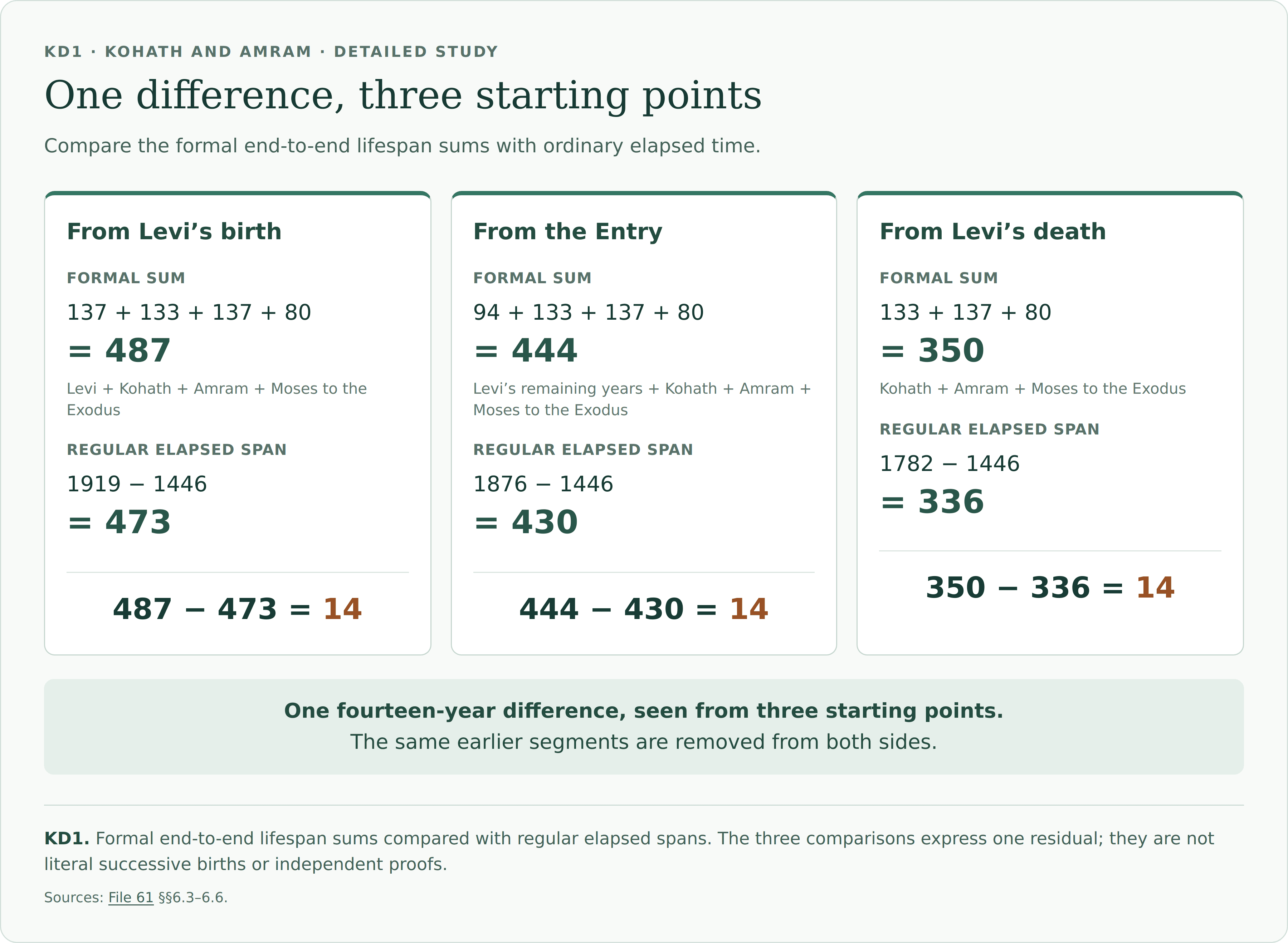
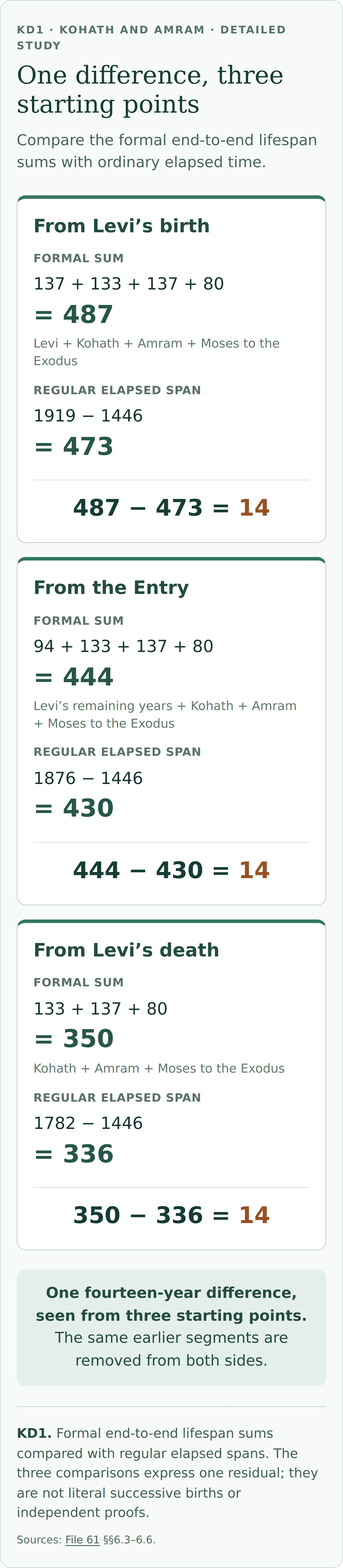
KD1. Formal end-to-end lifespan sums compared with regular elapsed spans. The three comparisons express one residual; they are not literal successive births or independent proofs.
The relationship is therefore:
487 − 473 = 444 − 430 = 350 − 336 = 14.
These are three presentations of one residual. Removing the same earlier segment from both sides preserves the difference. Their value lies in showing how the same fourteen years remains visible as the comparison narrows from Levi’s full life to the Kohath–Amram sequence.
The canonical discussion calls the sums maximum non-overlap lifespan envelopes. Here “maximum” describes the artificial arrangement of complete lives in succession. It is not a historically admissible upper bound after every narrative constraint has been imposed. Because Kohath is already present at the Entry, adding Levi’s remaining 94 years before Kohath’s entire life cannot describe their actual succession.
Indeed, even the generous allocation of Kohath’s entire 133 years after Entry, followed by Amram’s 137 and Moses’ 80, totals only 133 + 137 + 80 = 350 before allowing for overlap. That immediate named succession does not by itself supply the full Egyptian 430 years. The genealogy question therefore remains separate from the numerical comparison; missing begetting ages alone do not solve it.
4. Where the fourteen-year link becomes concrete
The cumulative calculation begins at Moses’ death and the Conquest in 1406 BC. Add Moses’ full 120 years to reach 1526. Then add Amram’s 137, Kohath’s 133, Levi’s 137, and Jacob’s 147:
| Complete life added backward | Calculation | Cumulative boundary, BC |
|---|---|---|
| Moses | 1406 + 120 | 1526 |
| Amram | 1526 + 137 | 1663 |
| Kohath | 1663 + 133 | 1796 |
| Levi | 1796 + 137 | 1933 |
| Jacob | 1933 + 147 | 2080 |
Now move the cumulative boundaries fourteen years forward. Because BC labels decrease as time advances, subtract fourteen from each label. Two adjoining blocks then acquire particularly clear regular counterparts:
KD2 · Kohath and Amram · Detailed study
Two adjacent lifespans, one shift
The same fourteen-year movement preserves the Jacob and Levi lifespan blocks.
Source cumulative boundaries
Jacob boundary
147-year Jacob block begins
Levi boundary
137-year Levi block begins
Kohath boundary
Levi block ends
↓ Subtract 14 from each BC coordinate
All three boundaries moved fourteen years forward
Regular Isaac birth
Translated Jacob boundary
Regular Levi birth
Translated Levi boundary
Regular Levi death
Translated Kohath boundary
147 and 137 remain unchanged.
The translated 137-year block matches Levi’s regular birth and death.
Image version and full-size download
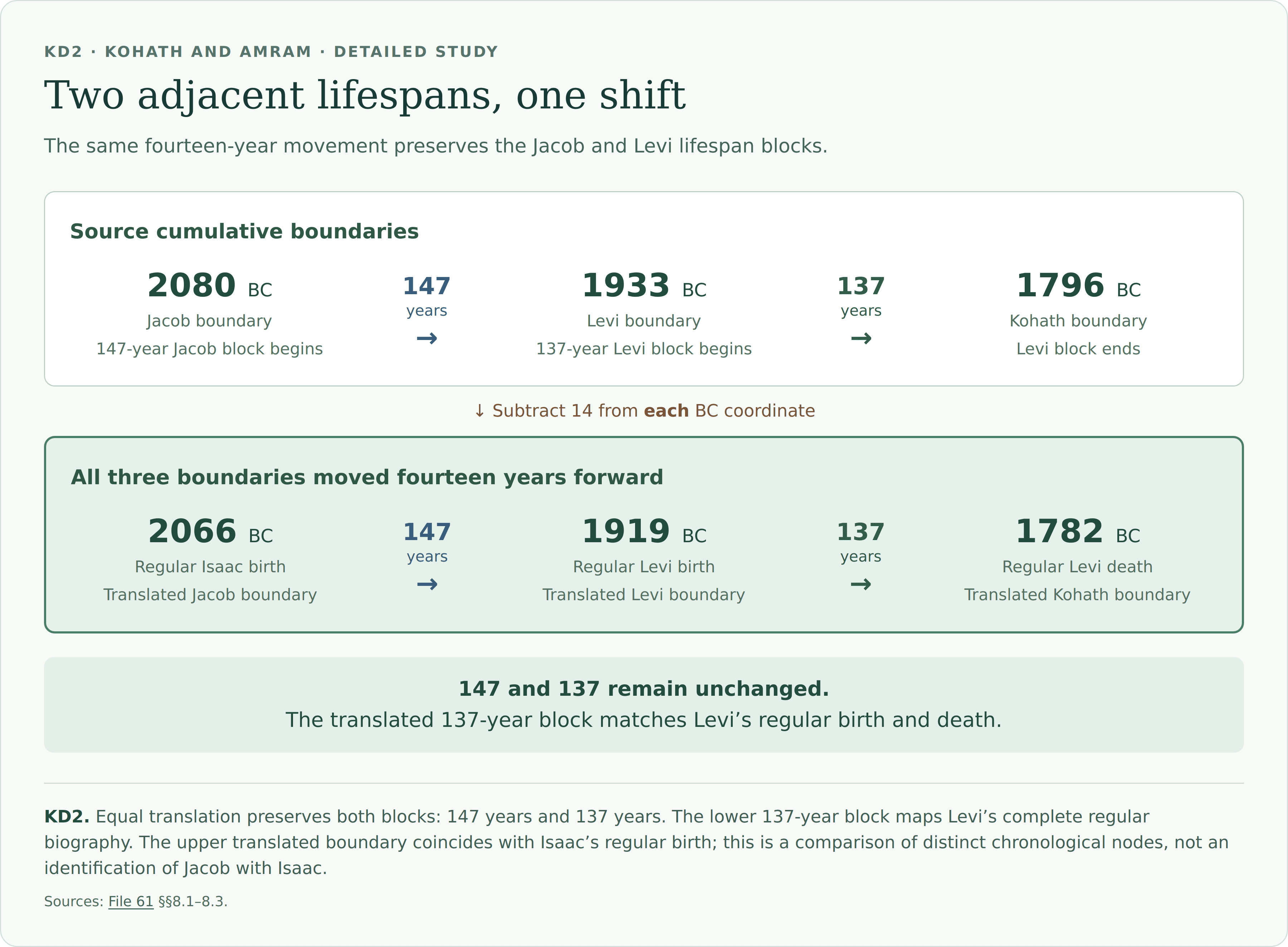
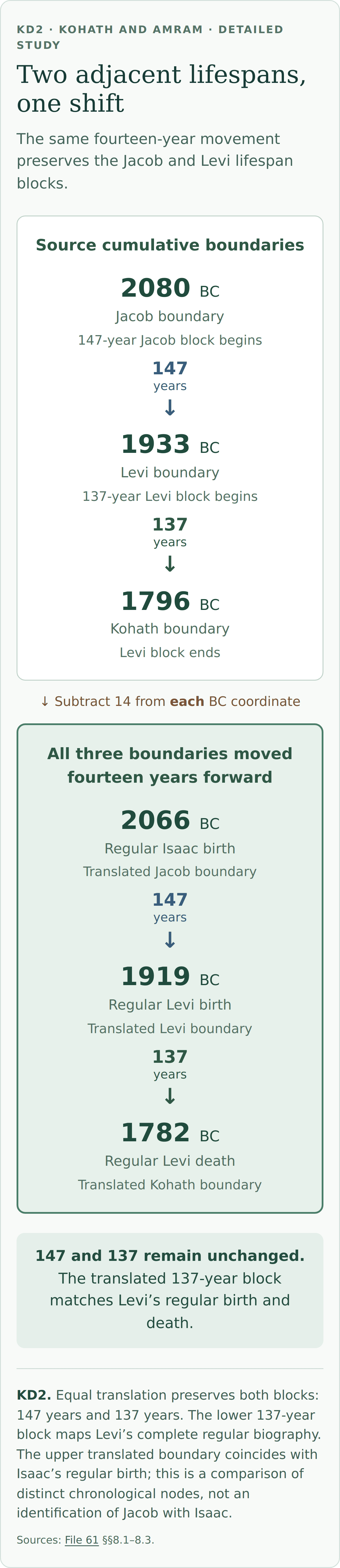
KD2. Equal translation preserves both blocks: 147 years and 137 years. The lower 137-year block maps Levi’s complete regular biography. The upper translated boundary coincides with Isaac’s regular birth; this is a comparison of distinct chronological nodes, not an identification of Jacob with Isaac.
The cumulative Jacob block, 2080–1933, spans 147 years. Its translated endpoints, 2066–1919, coincide with the regular births of Isaac and Levi. The cumulative Levi block, 1933–1796, spans 137 years. Its translated endpoints, 1919–1782, coincide with Levi’s own birth and death.
The latter is the clearest local correspondence: Levi’s complete cumulative block reaches Levi’s complete regular biography. Once the Kohath boundary reaches Levi’s death, the other end must fall 137 years earlier, at Levi’s birth. The two endpoint matches therefore belong to one construction. The adjoining 147-year block extends the comparison to the regular Isaac–Levi interval. The people and kinds of date remain distinct; a shared coordinate does not identify Jacob with Isaac.
A related fourteen appears at the upper boundary. 2080 BC is also the normal regular birth of Ishmael, while 2066 BC is Isaac’s birth. The cumulative Jacob boundary thus moves between the year-labels of Abraham’s two sons.
The sources call the operation a fourteen-year clutch: two chronological arrangements engage through a fixed movement. Moving both boundaries equally always preserves their separation. The particular observation here is where the source-defined blocks arrive.
Below Levi, the translated blocks remain 1782–1649 = 133 and 1649–1512 = 137. They preserve Kohath’s and Amram’s lifespans as formal consecutive intervals. They do not establish their historical births or deaths. Moses’ birth remains 1526, the Exodus 1446, and the Conquest 1406 BC.
5. The halfway step and the lifespan pairs
Fourteen contains two equal steps of seven. Levi’s block can therefore be displayed in three positions:
| Placement | Beginning, BC | End, BC | Length |
|---|---|---|---|
| Original cumulative block | 1933 | 1796 | 137 |
| Seven years forward | 1926 | 1789 | 137 |
| Fourteen years forward | 1919 | 1782 | 137 |
The middle position is calculated from the movement itself. It does not introduce another historical Levi biography. The complete table carries the same operation through the Abraham–Moses portion of the cumulative line.
Fourteen also links the stated lifespan classes:
147 − 133 = 14: Jacob and Kohath.
137 − 123 = 14: Levi or Amram and Aaron.
The numerical midpoints are 140 and 130: 147→140→133 and 137→130→123. These relations help explain why the same unit fits naturally within this family of lifespans; they do not change any stated lifespan.
There is also a useful distinction between moving one boundary and moving both. Abraham’s cumulative block is 2435–2260 = 175. Moving only its earlier boundary gives 2421–2260 = 161. Moving the later boundary too gives 2421–2246 = 175, restoring the full span in a later position.
Thus 175→161→175 describes contraction followed by restoration. It also meets the Key of 23 relation 161 × 25/23 = 175. The additive movement and the proportional conversion are different operations that meet at the same values. The complete contraction table includes all outputs, including those without a proposed special meaning.
6. Jacob’s divided life and the 490-year comparison
Jacob’s normal 147-year life, 2006–1859 BC, admits two complementary divisions:
| Internal point | Before it | After it | Total |
|---|---|---|---|
| 1936 BC: Jacob at 70 | 70 | 77 | 147 |
| 1929 BC: departure for Haran at 77 | 77 | 70 | 147 |
The two points are seven years apart. Their center is 1932.5 BC, the midpoint of Jacob’s life: 73.5 + 73.5 = 147. Each point stands 3.5 years from that center.
The 1936 label has a second role: it is the whole-year Aaron-side display of cumulative Levi. On that declared display, the interval to the Exodus divides as follows:
| Span, BC | Years | Unit |
|---|---|---|
| 1936→1929 | 7 | One week of years |
| 1929→1782 | 147 | Three 49-year units in this model’s Jubilee reckoning |
| 1782→1446 | 336 | Forty-eight weeks of years |
| Total | 490 | Seventy weeks of years |
7 + 147 + 336 = 490, or 1 + 21 + 48 = 70 weeks.
The middle span runs from Jacob’s departure to Levi’s death and equals Jacob’s complete lifespan. The final span is the 336 discussed in Levi and the Priestly Year. Here it remains a count of years; its numerical correspondence with a 336-day priestly arrangement does not change the length of historical years.
This 490 belongs to a different stated coordinate from the earlier 487. The Moses/Nisan boundary is 1933, giving 1933−1446 = 487. The whole-year Aaron-side display is 1936, giving 490. Exact half-year comparisons require their own endpoints. The phase table shows them without replacing one reading with another.
7. The 270-year span and the language of birth
Kohath and Amram together contribute:
133 + 137 = 270 = 9 × 30.
That total survives each placement:
| Placement | Kohath-side boundary to terminal, BC | Span |
|---|---|---|
| Original | 1796→1526 | 270 |
| Halfway | 1789→1519 | 270 |
| Full movement | 1782→1512 | 270 |
Levi and Kohath provide the same total in the opposite order: 137 + 133 = 270, represented by 1933→1663. The three successive lifespans, 137–133–137, therefore carry equal two-life totals on either side of Kohath.
The factorization 9 × 30 permits a schematic nine-month reading. It is a numerical analogy, not a claim that every pregnancy lasts exactly 270 days. Its relevance here is strengthened by the way the translated terminal divides Moses’ age at the Exodus:
1526→1512 = 14, followed by 1512→1446 = 66.
The total is 80, partitioned as 14 + 66. Leviticus 12:2–5 supplies a comparable ritual structure. For a male child, it gives seven days followed by thirty-three; for a female child, two weeks followed by sixty-six. The law itself counts days. The chronological comparison counts years.
KD3 · Kohath and Amram · Detailed study
The birth-law pattern and Moses’ years
Two divisions in Leviticus 12 are compared with two intervals in Moses’ life.
Male-child rule
Leviticus 12:2–4
Ritual periods · days
7 + 33 = 407 days followed by 33 days
Chronological comparison · years
7 + 33 = 40 years
Female-child rule
Leviticus 12:5
Ritual periods · days
14 + 66 = 8014 days = two weeks
Chronological comparison · years
14 + 66 = 80 years
Ritual days and chronological years remain distinct.
The repeated divisions invite a typological comparison; they are not a conversion between units.
Image version and full-size download
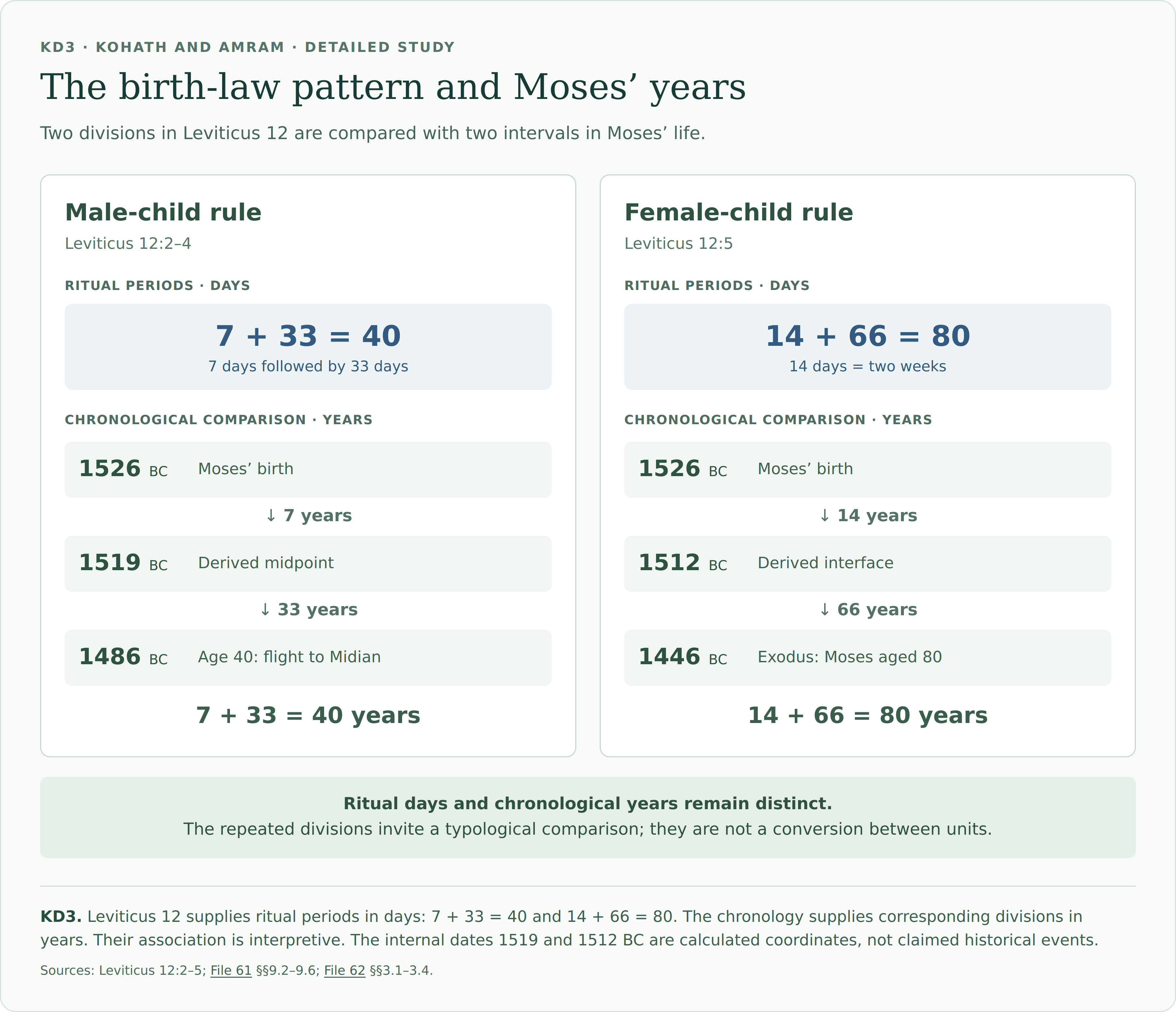
KD3. Leviticus 12 supplies ritual periods in days: 7 + 33 = 40 and 14 + 66 = 80. The chronology supplies corresponding divisions in years. Their association is interpretive. The internal dates 1519 and 1512 BC are calculated coordinates, not claimed historical events.
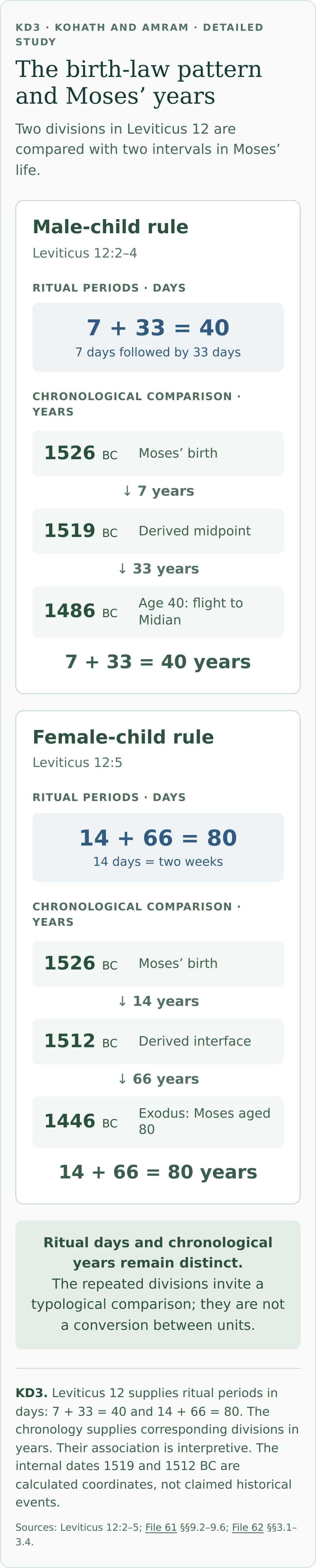
The seven-year halfway movement supplies the parallel 7 + 33 = 40 arrangement: 1526→1519→1486 BC. In the adopted chronology, 1486 is Moses’ age-forty flight horizon, reconstructed from Acts 7:23, 29–30. The 1519 midpoint and 1512 interface are calculated positions, not separately attested events in Moses’ life.
The numerical relation between the two forms is exact:
2 × (7 + 33) = (7 + 7) + (33 + 33) = 14 + 66 = 80.
Reading these as a national-birth pattern is an interpretation. Moses’ own language supplies an appropriate setting: in Numbers 11:12, he asks whether he conceived or gave birth to the people and describes carrying them as a nurse carries a child. The protest denies literal parenthood while using the imagery of birth and care. The chronology can be read alongside that imagery without making Leviticus 12 a direct chronological prediction of the Exodus.
8. Joseph’s two portions within Levi’s lifespan
The wider cumulative arrangement returns to the family whose two seven-year periods supplied the regular setting. Joseph’s complete life is 110 years. Jacob gives Joseph a double tribal portion by receiving Ephraim and Manasseh as his own sons in Genesis 48:5.
The cumulative comparison places two 110-year portions within Levi’s 137-year block. One begins at the Levi boundary; the other ends at the Kohath boundary:
| Formal Joseph portion | Calculation | Placement, BC |
|---|---|---|
| Count forward from Levi | 1933 − 110 = 1823 | 1933–1823 |
| Count backward from Kohath | 1796 + 110 = 1906 | 1906–1796 |
Their ordered boundaries are 1933→1906→1823→1796, dividing Levi’s block into 27 + 83 + 27 = 137. Each Joseph portion spans 110; they overlap by 83:
110 + 110 − 83 = 137.
Joseph is a collateral comparison. He is not inserted between Levi and Kohath as another genealogical generation. These constructed portions also leave his regular 1915–1805 BC biography unchanged.
Moving the two portions fourteen years forward gives 1919–1809 and 1892–1782. Joseph’s regular life falls between them, and the three equal spans display the same smaller intervals in different orders:
KD4 · Kohath and Amram · Detailed study
Joseph’s 110 years within Levi’s 137
The same three parts appear in a different order in each placement.
Forward formal portion
A calculated 110-year placement
1919–1809 BC
4 + 23 + 83 = 110
Joseph’s regular life
Actual birth-to-death chronology
1915–1805 BC
23 + 83 + 4 = 110
Backward formal portion
A calculated 110-year placement
1892–1782 BC
83 + 4 + 23 = 110
Within Levi’s 1919–1782 BC field
27 + 83 + 27 = 137 yearsForward and backward portions share 1892–1809 BC: 83 years.
All segment labels are years. Equal-size colored panels identify repeated intervals; they are not drawn to scale.
Image version and full-size download
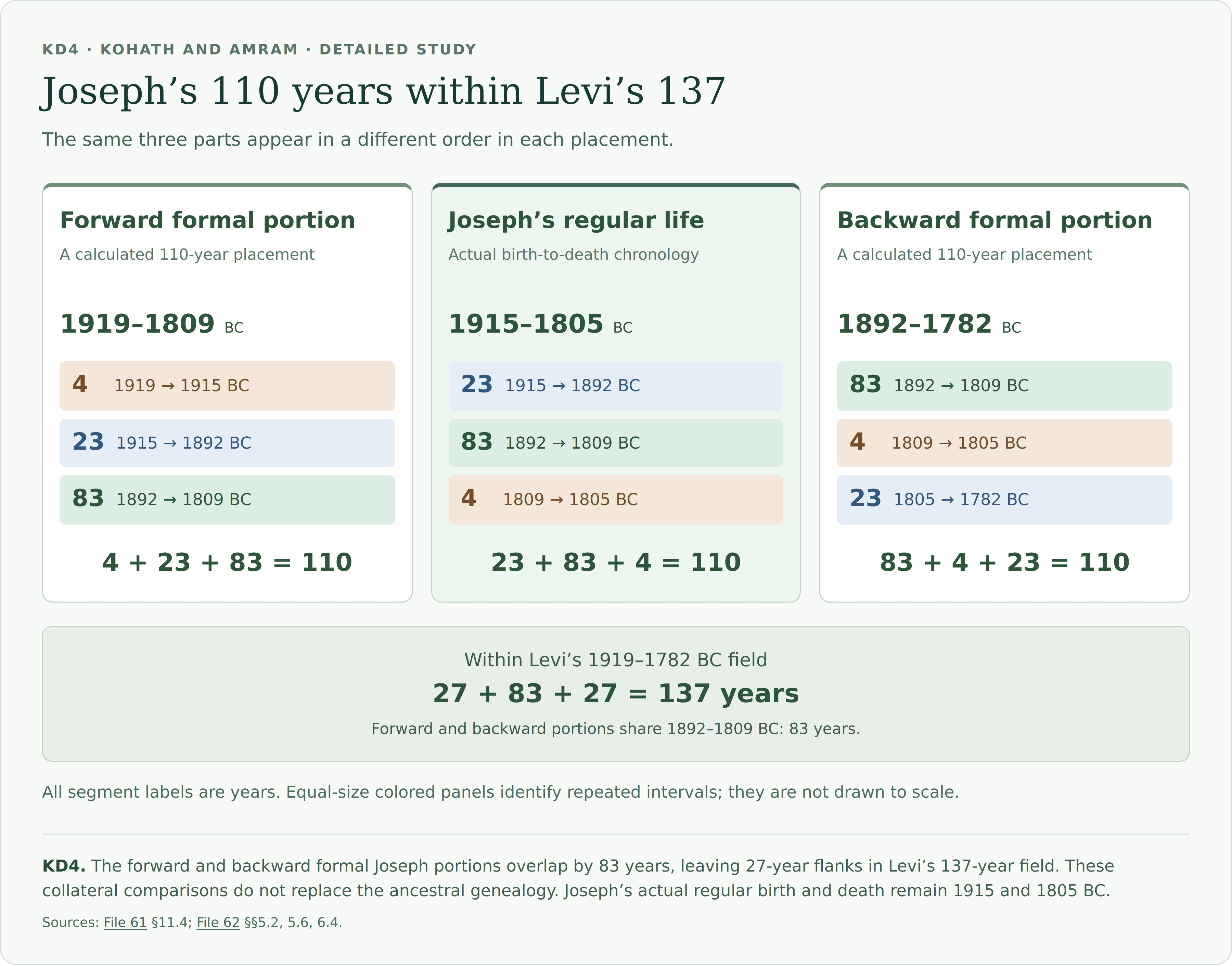
KD4. The forward and backward formal Joseph portions overlap by 83 years, leaving 27-year flanks in Levi’s 137-year field. These collateral comparisons do not replace the ancestral genealogy. Joseph’s actual regular birth and death remain 1915 and 1805 BC.
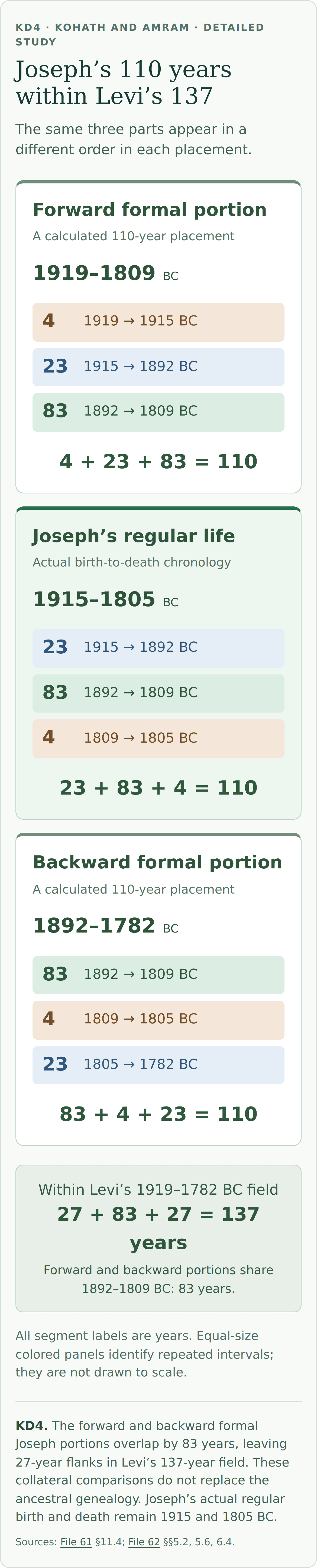
The forward portion begins and ends 4 years before the corresponding regular Joseph dates. The backward portion begins and ends 23 years after them. Together the offsets make 27, the difference between Levi’s 137 and Joseph’s 110.
The terminal relation is already familiar in the regular chronology: Joseph’s death in 1805 precedes Levi’s death in 1782 by 23 years. The equal 110-year portions carry that same displacement to their starting dates. The two endpoint matches follow together once equal lifespans have been used; they are not independent proofs.
The double-portion interpretation brings the numerical construction into conversation with Jacob’s blessing. The arithmetic establishes the overlapping spans. Reading them as an expression of Joseph’s inheritance gives those spans a theological meaning.
9. From personal lifespans to the exile and restoration
The same source framework traces the Jacob–Levi–Kohath values into larger spans. Three examples make the change of scale easy to follow:
| Starting point and selected endpoint | Calculation | Lifespan scale |
|---|---|---|
| Whole-year cumulative Levi 1936 → Exile 606 BC | 1936 − 606 = 1330 | 10 × Kohath’s 133 |
| Backward cumulative Joseph boundary 1906 → restoration 536 BC | 1906 − 536 = 1370 | 10 × Levi’s 137 |
| Regular Jacob birth 2006 → restoration 536 BC | 2006 − 536 = 1470 | 10 × Jacob’s 147 |
These use the explicitly selected 606/536 BC exile-and-restoration framework. The first row uses the whole-year Aaron-side 1936 display; the second uses the Moses/Nisan Joseph boundary 1906. They are labeled separately because the larger comparison draws on different positions in the source model.
The scaled lifespan differences yield 1470−1370 = 100 and 1370−1330 = 40, while the selected exile interval is 606−536 = 70. The familiar 100, 70, and 40 units thus accompany the personal lifespan values at the larger scale. File 61 §16 develops this extension; it is a further comparison within the adopted model, rather than an additional reason to assign historical births to Kohath and Amram.
10. Reading the structure as a whole
The argument begins with something the text preserves and something it leaves unsaid. Kohath and Amram have stated lifespans but unstated begetting ages. Their complete lives can be added, and that sum can be compared with the regular setting without pretending that the two arrangements describe the same kind of time.
The fourteen-year residual leads to the most concrete correspondence: Levi’s cumulative 137-year block reaches Levi’s full regular life. The halfway step, Jacob’s divided lifespan, the 270-year pair, and Joseph’s overlapping portions then explain how the relationship belongs to a wider family of sevens, lifespans, and inherited portions.
I read these connections as a purposeful use of number within the family’s story: marriage forms the household, famine brings it into Egypt, birth imagery accompanies its deliverance, and inheritance carries it onward. The calculations are exact within their declared settings. That reading of their intention remains an interpretation, open to assessment alongside the textual and chronological evidence.
The strength of the study lies in preserving both levels: the precision of the numerical relationships and the distinction between a formal pattern and a recovered historical date.
Supporting calculation tables
All coordinates below are BC. For ordinary same-era intervals, subtract the smaller, later BC label from the larger, earlier one. The local movement of a cumulative boundary does not change the established dates of Moses, Exodus, or Conquest.
A. The complete three-placement table
Let C be the original cumulative coordinate. The halfway position is C−7; the full movement is C−14.
| Cumulative boundary | Original C | Halfway C−7 | Full C−14 |
|---|---|---|---|
| Abraham | 2435 | 2428 | 2421 |
| Isaac | 2260 | 2253 | 2246 |
| Jacob | 2080 | 2073 | 2066 |
| Levi | 1933 | 1926 | 1919 |
| Kohath | 1796 | 1789 | 1782 |
| Amram | 1663 | 1656 | 1649 |
| Moses-side interface | 1526 | 1519 | 1512 |
The successive lengths are 175, 180, 147, 137, 133, and 137 in every column. The last row’s 1519 and 1512 are derived interfaces. Moses’ historical birth in this framework remains 1526.
These seven-year movements are distinct from the seven-year cumulative envelopes in File 18 §6A: for example, Levi 1938–1931, Kohath 1801–1794, and Amram 1668–1661. Those ranges express the source’s cumulative state framework, not uncertainty estimates for historical births. They are not the same construction as the midpoint shown here.
B. Complete one-boundary contraction and two-boundary restoration
For a block P−S = L, moving only its earlier boundary gives (P−14)−S = L−14. Moving both gives (P−14)−(S−14) = L.
| Block | Original length | Earlier boundary moved alone | Both boundaries moved |
|---|---|---|---|
| Abraham→Isaac | 175 | 161 | 175 |
| Isaac→Jacob | 180 | 166 | 180 |
| Jacob→Levi | 147 | 133 | 147 |
| Levi→Kohath | 137 | 123 | 137 |
| Kohath→Amram | 133 | 119 | 133 |
| Amram→Moses-side boundary | 137 | 123 | 137 |
| Moses→Exodus | 80 | 66 | Exodus remains fixed: 80 = 14 + 66 |
This displays the whole set, including 166 and 119. No special interpretation is required for every output. The final row is a fixed-endpoint partition rather than a translation of the Exodus.
C. Why 487, 490, and 486.5 must stay distinct
| Comparison | Declared endpoints, BC | Span |
|---|---|---|
| Normal Moses/Nisan cumulative Levi to Exodus | 1933→1446 | 487 |
| Whole-year Aaron-side Levi display to Exodus | 1936→1446 | 490 |
| Exact matched Aaron/Tishri phases | 1936.5→1446.5 | 490 |
| Moses/Nisan Levi to the earlier confrontation horizon | 1933→1446.5 | 486.5 |
| Regular Jacob’s departure to Exodus | 1929→1446 | 483 |
The exact cumulative Aaron-side position lies 3.5 years before the selected Moses/Nisan position. Its whole-year display differs by 3. The 1446.5 coordinate belongs to the earlier Tishri confrontation horizon, displayed as 1447t, while the Exodus is 1446n. The phase scheme is a chronological reconstruction; Exodus 7:7 supplies whole ages, not the exact half-year dating by itself.
Consequently, 487 is not 486.5 rounded. Each is exact for its listed endpoints. The 483→486.5→490 ladder advances by 3.5 at each step but uses the declared changes of endpoint shown above.
The related 273 = 3×91 = 39×7 comparison also requires its display label: 1799−1526 = 273 uses the whole-year Aaron-side Kohath coordinate. Using the exact 1799.5 against 1526 gives 273.5. The main 270-year argument uses one consistent Moses/Nisan line and does not depend on this cross-branch comparison.
Sources and further reading
| Controlling source | Sections used | Contribution |
|---|---|---|
| File 61 — Jacob–Moses Cumulative–Regular Root System | §§1–4, 6–9, 11, 16; §17.2 | Regular/cumulative settings, fourteen-year residual, translated lifespan blocks, Jacob’s divisions, 270, Joseph portions, and larger lifespan scales |
| File 62 — Half-Clutch Birth-Law Interface | §§1–3, 5–7 | Seven-year midpoint, preserved lifespans, birth-law forms, Joseph translations, and cyclic 110-year comparisons |
| File 18 — Chronological Data Tables | §§2.3–2.4, 6A | Regular dates, cumulative boundaries, and the distinct seven-year envelopes |
| File 04 — Jacob and the Sojourn | §§1–3 | Jacob’s movements, family sequence, and sojourn settings |
| File 09 — Cumulative Architecture | Cumulative lifespan method and principal tables | Complete-life construction and the ancestral line |
| File 22 — Cumulative MT Harmonics | §3.3; File 61 §4.5 | Whole-age and exact calendar-phase distinction |
| File 60 — Levitical Covenant Spine | §1.3; §§2–4 | Regular Levi biography, the priestly 336 span, and the 161/175 relationship |
For shorter introductions, see Kohath and Amram: The Fourteen-Year Link, Adding the Lifespans, Harmonizing the Exodus Sojourn, and Levi and the Priestly Year. The canonical files also develop Joseph–Joshua comparisons and larger cumulative structures beyond the scope of this focused detailed study.
The earlier research discussion is preserved as a historical record of this study’s development.
Scripture quotations: Berean Standard Bible (BSB), public domain.