Genesis gives us two measures of a generation. One follows the years from a father’s birth to the birth of his son. The other takes the father’s entire life. Adam’s genealogy places both measures together:
When Adam was 130 years old, he had a son in his own likeness, after his own image; and he named him Seth.
And after he had become the father of Seth, Adam lived 800 years and had other sons and daughters.
So Adam lived a total of 930 years, and then he died.
The regular chronology uses 130 years to move from Adam to Seth. The cumulative chronology uses 930 years, placing the complete lifespans of the ancestral line end to end. The second method creates a much longer arrangement of the same biblical material. It is a formal lifespan construction: it does not imply that a son waited until his father died to be born.
This study asks how those two arrangements fit together. The starting relationship is exact: their corresponding Creation boundaries stand 9,890 years apart, or 23 × 430. From there, the same numbers open into comparisons involving Abraham, the Exodus, the 360- and 364-day calendar patterns, and selected spans of exactly 10,000 years. Each comparison becomes clearer when its dates, endpoints, and operation remain visible.
For a shorter introduction, begin with Between Two Chronologies: The 9,890-Year Bridge. Its technical appendix supplies a compact reference. Here the argument is developed in greater detail.
Go directly to the supporting tables: Creation boundaries · Abraham’s seven lifespans · The shared Exodus anchor · 23, 24, and 25 sojourns · Calendar-sized totals · Enosh and 10,000 · The advanced SP comparison.
The dates behind the comparison
The starting framework is the normal Masoretic Text (MT) chronology: Nisan dates, 430 years in Egypt, no added 60 years for Terah, and no restored second Cainan. Abraham’s regular birth is 2166 BC, the Exodus is 1446 BC, and Moses’ death and the Conquest boundary are placed at 1406 BC.
In this framework, the 26 complete lifespans from Adam through Moses total 12600 years. Placing that total before the 1406 BC endpoint gives the cumulative Adam position:
1406 + 12600 = 14006 BC.
The selected ancestral line runs through Levi, Kohath, Amram, and Moses. It does not add Aaron beside Moses as an extra generation, and it does not include Joshua in the 26-life total. The complete unrounded cumulative tables show the individual rows; the cumulative introduction explains how to read them.
Adam’s position lies within a symbolic seven-year Creation envelope. In regular chronology that envelope is 4121–4114 BC, with Adam’s internal Year-6 position at 4116 BC. In cumulative chronology the corresponding envelope is 14011–14004 BC, with the Moses-line Adam position at 14006 BC.
The whole-year cumulative arrangement can also be displayed as 14011 → 14009 → 14006 → 14004, dividing the seven years into 2 + 3 + 2. Here 14009 is the Aaron-side whole-year position, while 14006 is the Moses-side position. These are defined positions in the construction, rather than an uncertainty range around one date. The phase-resolved Aaron value, 14009.5 BC, belongs to a separate half-year treatment; it is not silently substituted into the integer comparisons below. The cumulative technical appendix develops that foundation.
The exact 9,890-year bridge
The two chronologies must be compared at corresponding positions. Beginning with beginning, Year 6 with Year 6, or close with close gives the same answer:
| Position compared | Cumulative MT, BC | Regular MT, BC | Difference in years |
|---|---|---|---|
| Beginning of the Creation envelope | 14011 | 4121 | 9890 |
| Adam’s internal Year-6 position | 14006 | 4116 | 9890 |
| Close of the Creation envelope | 14004 | 4114 | 9890 |
Thus 14004 − 4114 = 9890 = 23 × 430. Comparing 14006 with 4114 would instead produce 9892, because it would mix an internal position with a closing boundary.
The number 430 already has a clear biblical setting:
Now the duration of the Israelites’ stay in Egypt was 430 years.
At the end of the 430 years, to the very day, all the LORD’s divisions went out of the land of Egypt.
In the normal MT chronology, 1876 − 1446 = 430 measures the stay in Egypt. The much larger Creation comparison contains 23 units of that same length. This is a numerical relationship between the two chronological constructions; it does not posit two historical creations separated by 9,890 years. The controlling calculation is in File 22, §§5.1–5.2.
Abraham supplies the smaller counterpart
The cumulative arrangement also places Abraham 989 years before the regular Exodus. This position can be reconstructed from seven complete lifespans:
| Person in the ancestral line | Lifespan used, years | Biblical reference, BSB |
|---|---|---|
| Abraham | 175 | Genesis 25:7 |
| Isaac | 180 | Genesis 35:28 |
| Jacob | 147 | Genesis 47:28 |
| Levi | 137 | Exodus 6:16 |
| Kohath | 133 | Exodus 6:18 |
| Amram | 137 | Exodus 6:20 |
| Moses | 120 | Deuteronomy 34:7 |
| Total | 1029 | Seven lifespans |
Anchored at 1406 BC, the total gives 1406 + 1029 = 2435 BC for cumulative Abraham. Since the Exodus precedes the Conquest by 40 years, the span from this cumulative Abraham position to the Exodus is:
1029 − 40 = 989 = 2435 − 1446 = 23 × 43.
The full 1029 also equals 21 × 49, or 7 × 147: 21 jubilee periods of 49 years (Leviticus 25:8, BSB), and seven measures of Jacob’s 147-year life. The 989 comparison arises by stopping at the Exodus rather than continuing through the final 40 years to the Conquest.
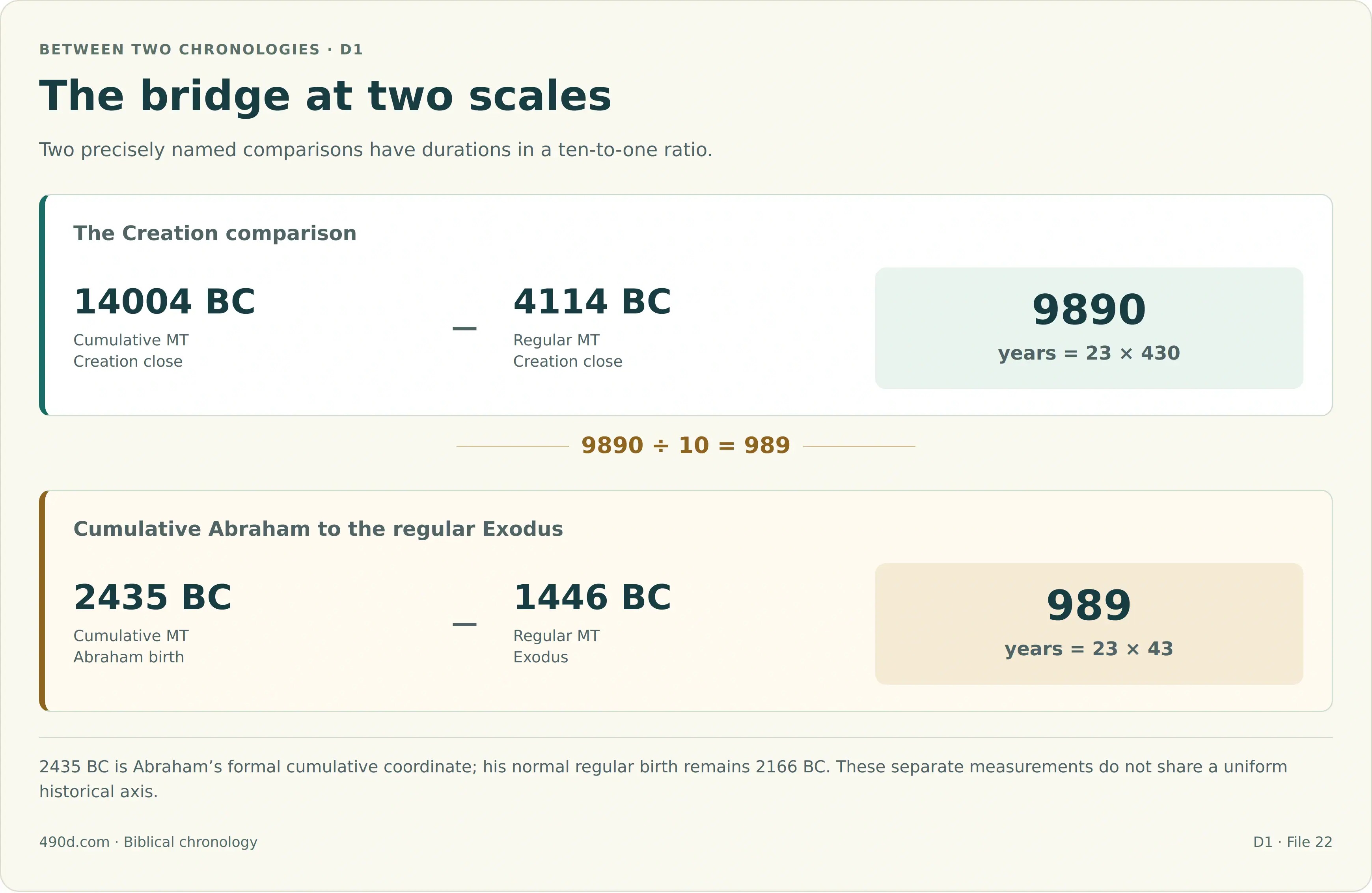
The bridge at two scales
Two precisely named comparisons have durations in a ten-to-one ratio.
The Creation comparison
Creation close
Creation close
Cumulative Abraham to the regular Exodus
Abraham birth
Exodus
2435 BC is Abraham’s formal cumulative coordinate; his normal regular birth remains 2166 BC. These separate measurements do not share a uniform historical axis.
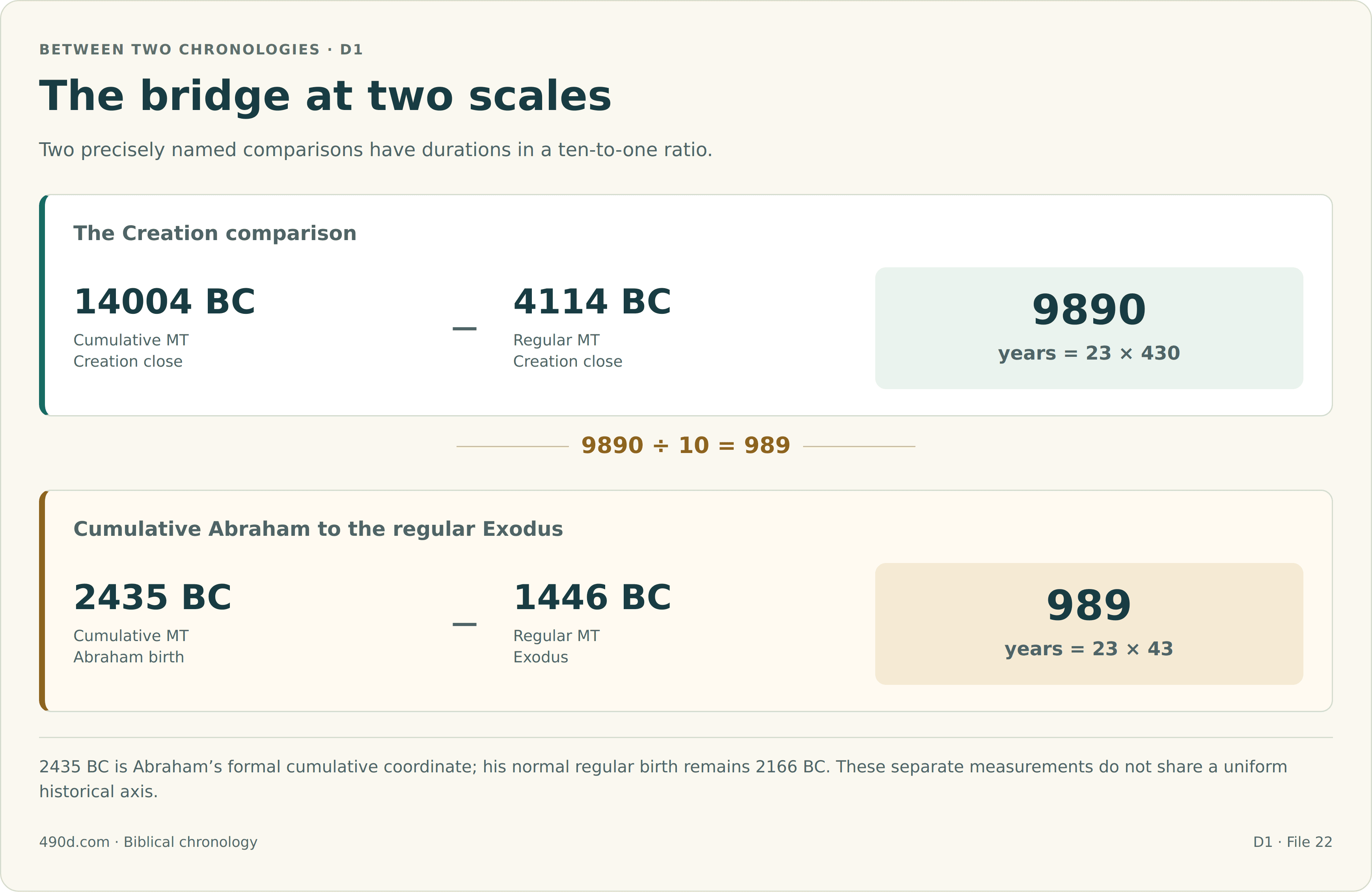
The two scales now stand together: 9890 = 10 × 989. The larger comparison joins corresponding Creation boundaries; the smaller joins cumulative Abraham to the regular Exodus. Abraham’s ordinary birth remains 2166 BC. The cumulative position at 2435 is a different kind of coordinate, generated by the lifespan sum. See File 22, §§3.1 and 5.2, and File 18, §6A.
From 989 to 1075: the 25/23 relationship
The 25/23 expansion replaces each group of 23 with a group of 25. Because 989 is exactly 23 × 43, its expanded value is 25 × 43 = 1075:
989 × 25/23 = 1075.
Keep the Exodus at 1446 BC and place this expanded duration before it. The resulting boundary is 1446 + 1075 = 2521 BC. This is a generated comparison boundary, not a revised birth date for Abraham.
Its significance becomes visible when the intervening dates are named:
| Part of the sequence | Dates, BC | Years |
|---|---|---|
| Generated boundary to Abraham’s call | 2521 → 2091 | 430 |
| Abraham’s call to Jacob’s entry into Egypt | 2091 → 1876 | 215 |
| Entry into Egypt to the Exodus | 1876 → 1446 | 430 |
| Whole sequence | 2521 → 1446 | 1075 |
The arrangement is 430 + 215 + 430. The central 215 belongs to the patriarchal period before Egypt; it does not shorten the following Egyptian stay. The sojourn study explains the distinction. File 22, §5.4 controls this expanded comparison.
Expanding both chronologies from the same anchor
The same operation can be applied to the larger Creation comparison. The clearest method is to hold one endpoint fixed and measure both Creation spans from it.
From the cumulative Creation close to the Exodus, 14004 − 1446 = 12558. From the regular Creation close to the same Exodus, 4114 − 1446 = 2668. Their difference is the bridge already found:
12558 − 2668 = 9890.
Expand both durations by 25/23, still holding the Exodus fixed:
| Construction | Original years to 1446 BC | Years after ×25/23 | Generated closing boundary, BC |
|---|---|---|---|
| Cumulative | 12558 | 13650 | 15096 |
| Regular | 2668 | 2900 | 4346 |
| Difference | 9890 | 10750 | 15096 − 4346 |
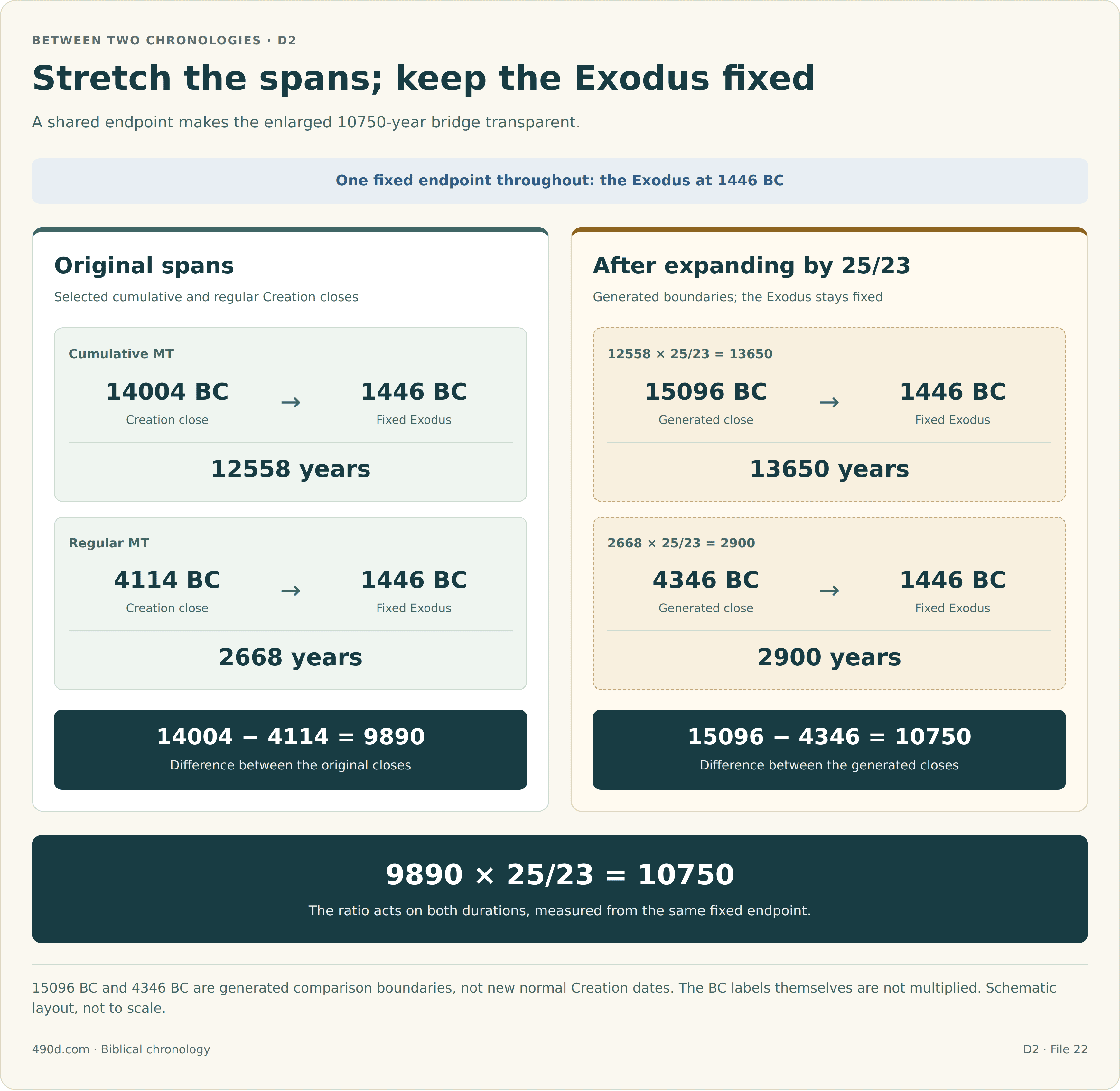
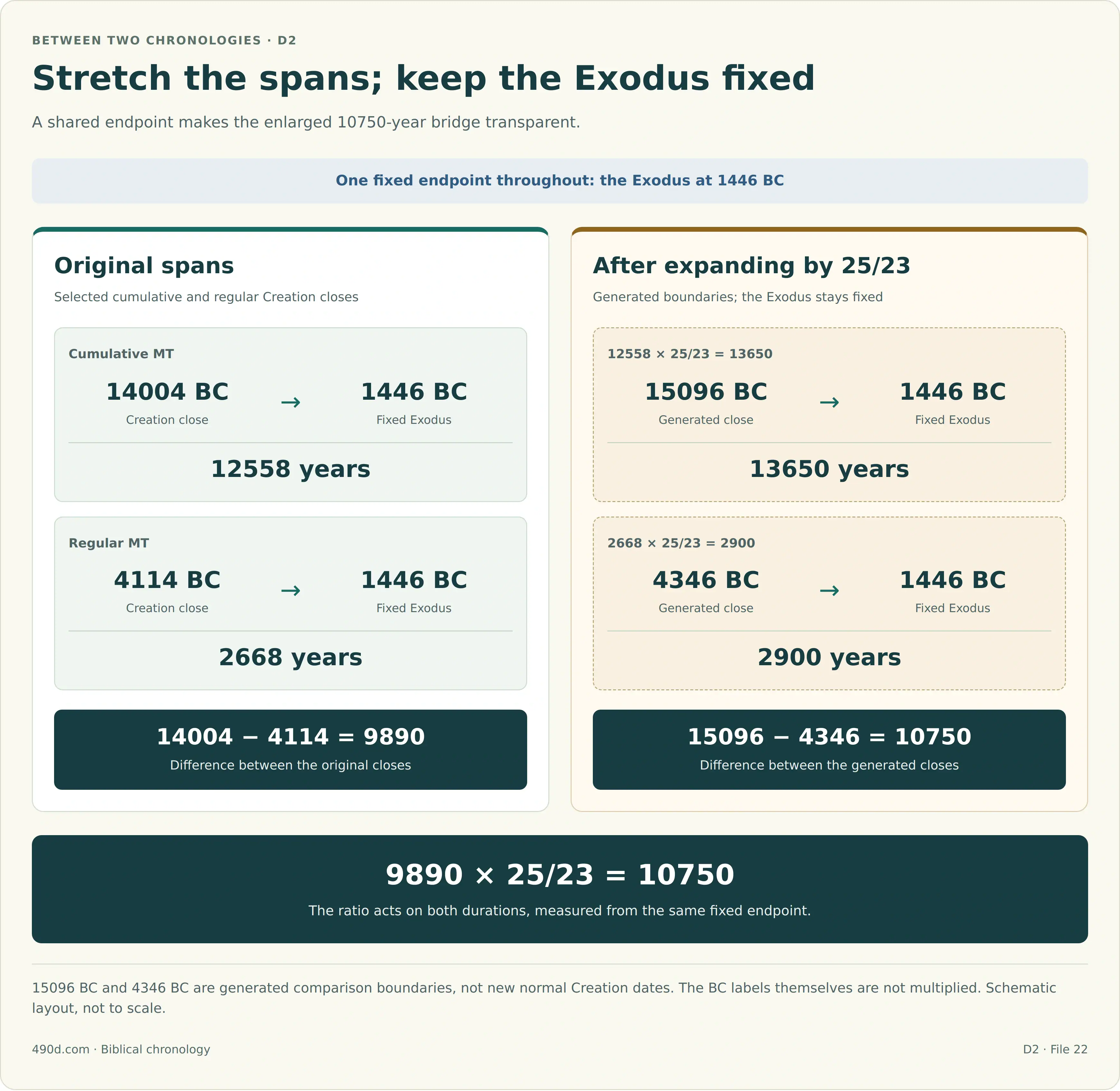
Stretch the spans; keep the Exodus fixed
A shared endpoint makes the enlarged 10750-year bridge transparent.
One fixed endpoint throughout: the Exodus at 1446 BC
Original spans
Selected cumulative and regular Creation closes
14004 − 4114 = 9890Difference between the original closes
After expanding by 25/23
Generated boundaries; the Exodus stays fixed
15096 − 4346 = 10750Difference between the generated closes
15096 BC and 4346 BC are generated comparison boundaries, not new normal Creation dates. The BC labels themselves are not multiplied. Schematic layout, not to scale.
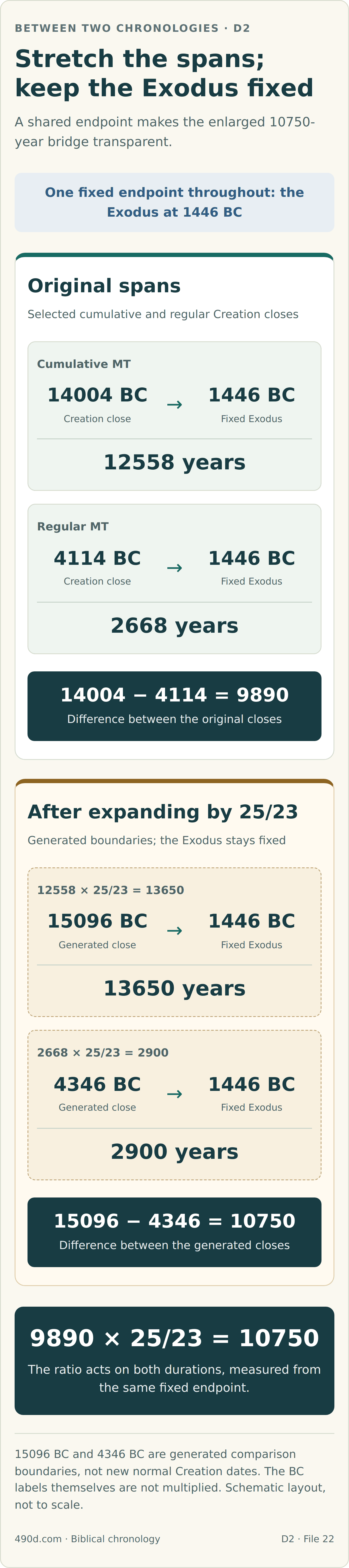
Image version and full-size download
Download full-size PNG · Download WebP · Download stacked phone PNG
This explains the expanded bridge without multiplying calendar labels as though they were durations. The calculation acts on 14004 − 1446, then adds the fixed 1446 back to the result. Multiplying the bare number 14004 would perform a different operation with a different implicit anchor.
Both spans share the Exodus endpoint, so their difference expands by exactly the same ratio:
9890 × 25/23 = 10750 = 25 × 430.
The generated regular boundary, 4346 BC, also stands 2940 years before the Conquest: 4346 − 1406 = 2940 = 6 × 490. That follows from its 2900 years to the Exodus plus the following 40 years. These are the linked cumulative and regular calculations in File 22, §§8.6 and 9.2–9.5.
Twenty-three, twenty-four, and twenty-five sojourns
The canonical comparison also produces a sequence of 23, 24, and 25 units of 430 through three declared choices of endpoints. This is where two variants are useful, although neither replaces the normal MT starting point.
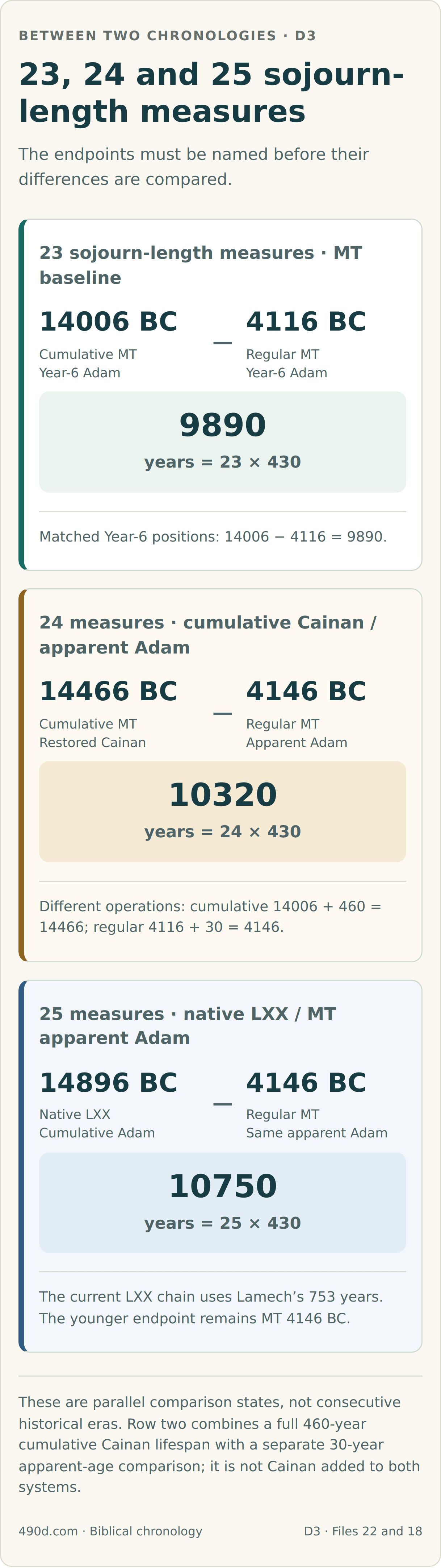
A restored second Cainan contributes his complete 460-year lifespan to the cumulative line (Genesis 11, Brenton Septuagint Translation). Separately, an inferred 30-year apparent-age overlay places Adam’s regular Year-6 comparison position at 4116 + 30 = 4146 BC. Genesis does not state that Adam was created thirty years old; this is a symbolic overlay used in the source model.
| Declared comparison | Cumulative position, BC | Regular comparison position, BC | Difference |
|---|---|---|---|
| Normal MT, matched Year 6 | 14006 | 4116 | 9890 = 23 × 430 |
| MT with restored cumulative Cainan; regular apparent Adam | 14466 | 4146 | 10320 = 24 × 430 |
| Native LXX cumulative line; MT regular apparent Adam | 14896 | 4146 | 10750 = 25 × 430 |
The middle row is especially important to read correctly. It changes the cumulative side by +460 and the regular side by +30. Consequently, 9890 + 460 − 30 = 10320. It does not insert Cainan into both chronologies: a regular birth-age insertion and a cumulative full-lifespan insertion are different operations.
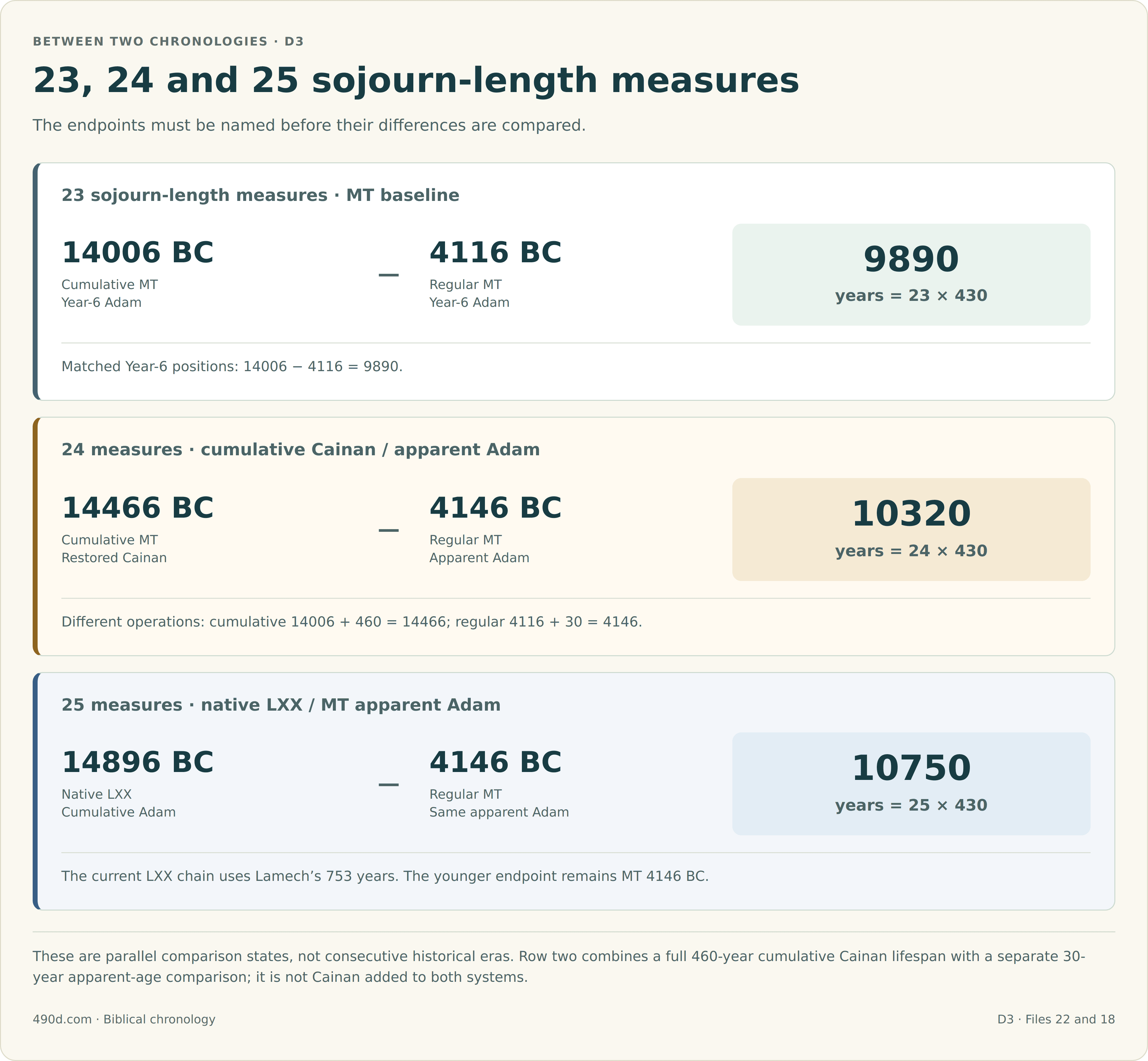
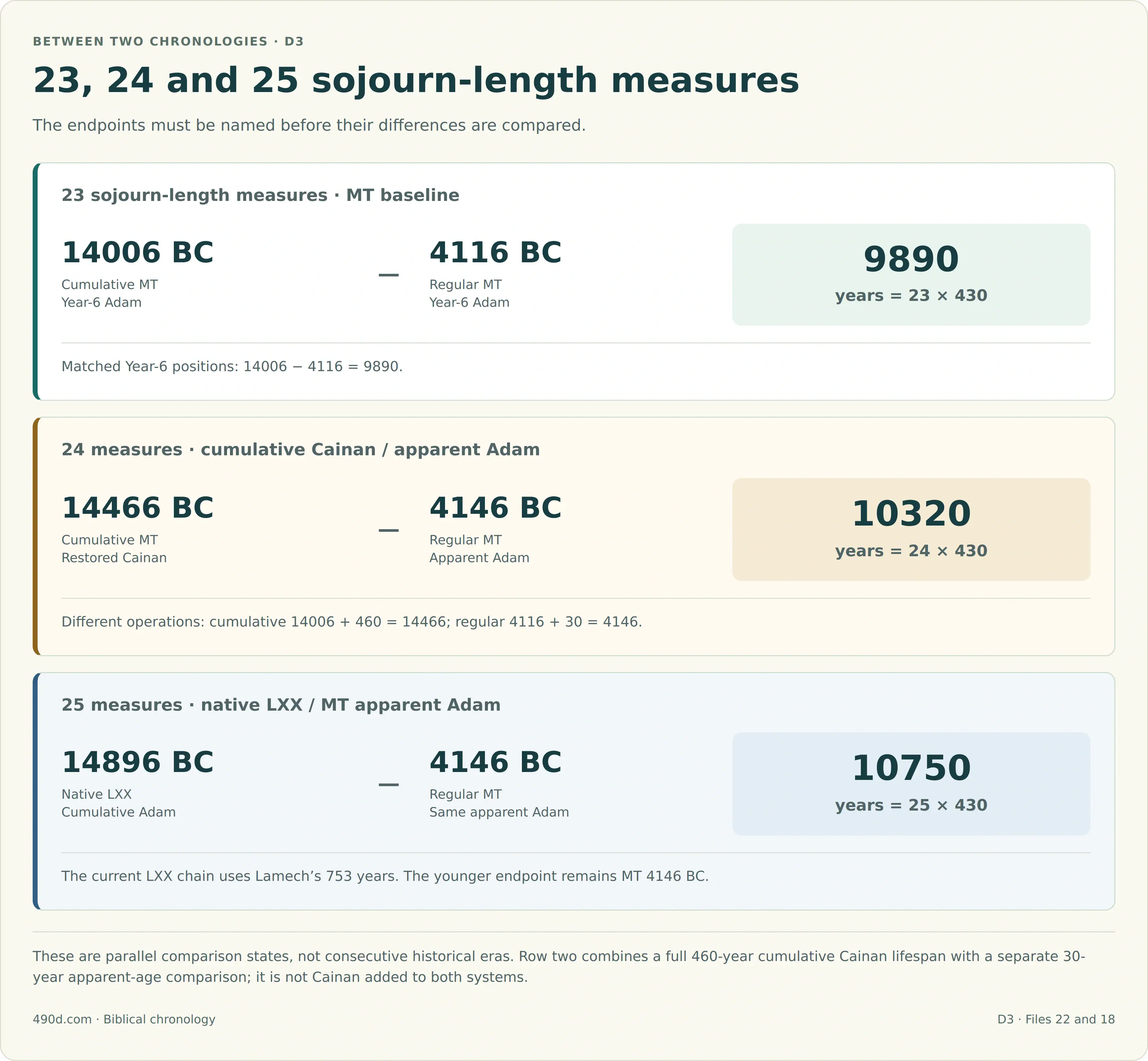
23, 24 and 25 sojourn-length measures
The endpoints must be named before their differences are compared.
23 sojourn-length measures · MT baseline
Year-6 Adam
Year-6 Adam
Matched Year-6 positions: 14006 − 4116 = 9890.
24 measures · cumulative Cainan / apparent Adam
Restored Cainan
Apparent Adam
Different operations: cumulative 14006 + 460 = 14466; regular 4116 + 30 = 4146.
25 measures · native LXX / MT apparent Adam
Cumulative Adam
Same apparent Adam
The current LXX chain uses Lamech’s 753 years. The younger endpoint remains MT 4146 BC.
These are parallel comparison states, not consecutive historical eras. Row two combines a full 460-year cumulative Cainan lifespan with a separate 30-year apparent-age comparison; it is not Cainan added to both systems.
Image version and full-size download
Download full-size PNG · Download WebP · Download stacked phone PNG
The last row uses the Septuagint (LXX) cumulative line, including its native second Cainan. Its older endpoint stands 430 years before 14466 BC. The younger endpoint remains the MT apparent-Adam position at 4146 BC; it is not LXX regular Creation. The current cumulative tables retain 14896 BC with their selected 753-year Lamech lifespan, so this comparison does not require an older 777-year LXX overlay.
These three comparisons form a numerical family. They are parallel constructions with stated inputs, rather than three consecutive eras or three equally default MT chronologies. File 22, §§7.1–7.4, and the amendments governing File 18, §6D, supply the controls.
One root, two calendar-sized totals
The cumulative Creation-to-Exodus span, 12558, connects the bridge to the 360- and 364-day calendar patterns. Its factors make two exact expansions possible:
12558 = 42 × 299 = 69 × 182 = 26 × 483.
| Operation on the root | Result, years | Added years | Calendar-related factorization |
|---|---|---|---|
| 12558 × 300/299 | 12600 | 42 | 35 × 360 |
| 12558 × 70/69 | 12740 | 182 | 35 × 364; also 26 × 490 |
One root, two calendar-sized totals
Two exact ratios expose 360 and 364 within the same starting duration.
The output units echo 360-day and 364-day calendar lengths numerically. They are durations in years, not equal physical calendars or replacement date assignments.
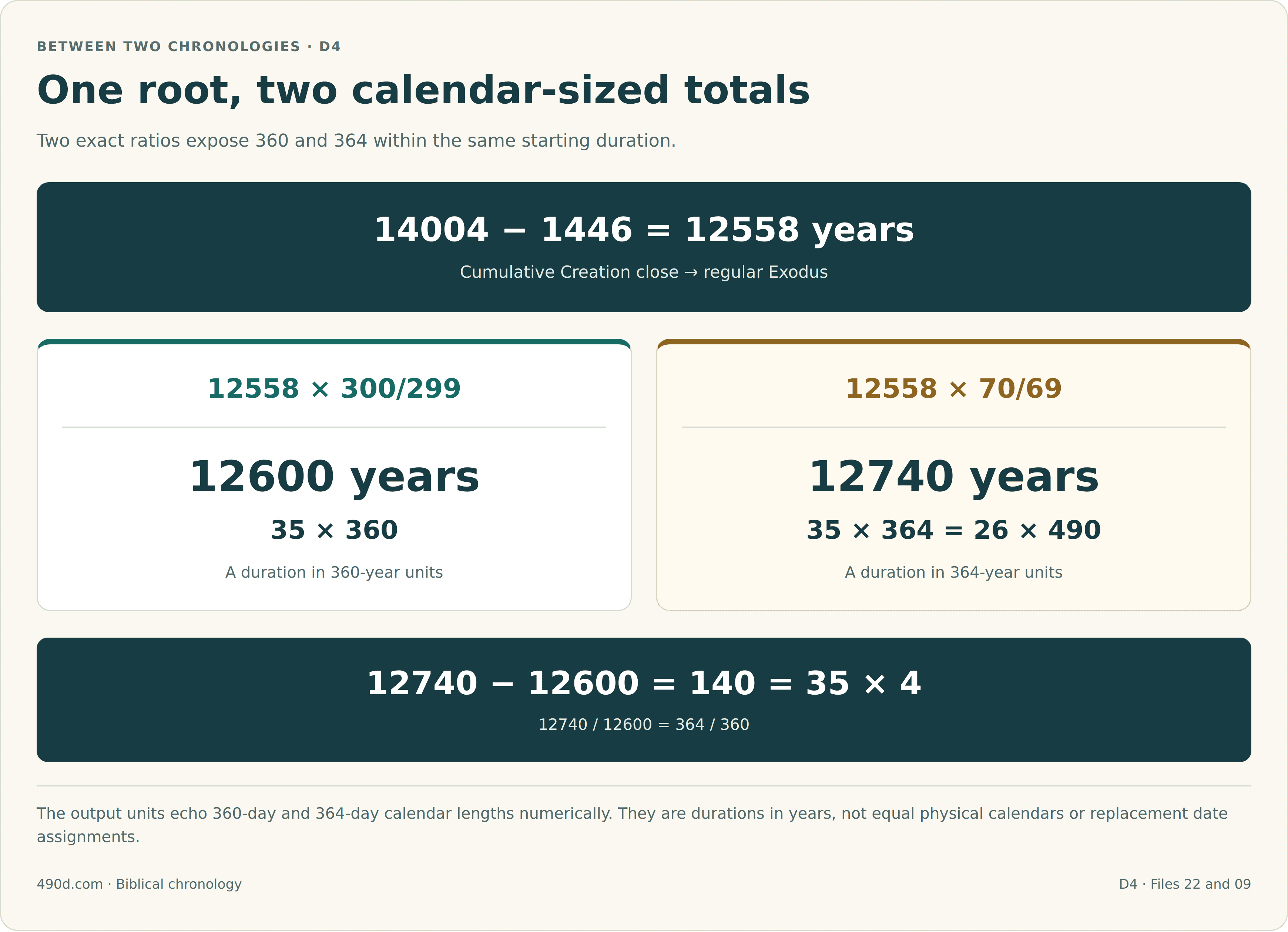
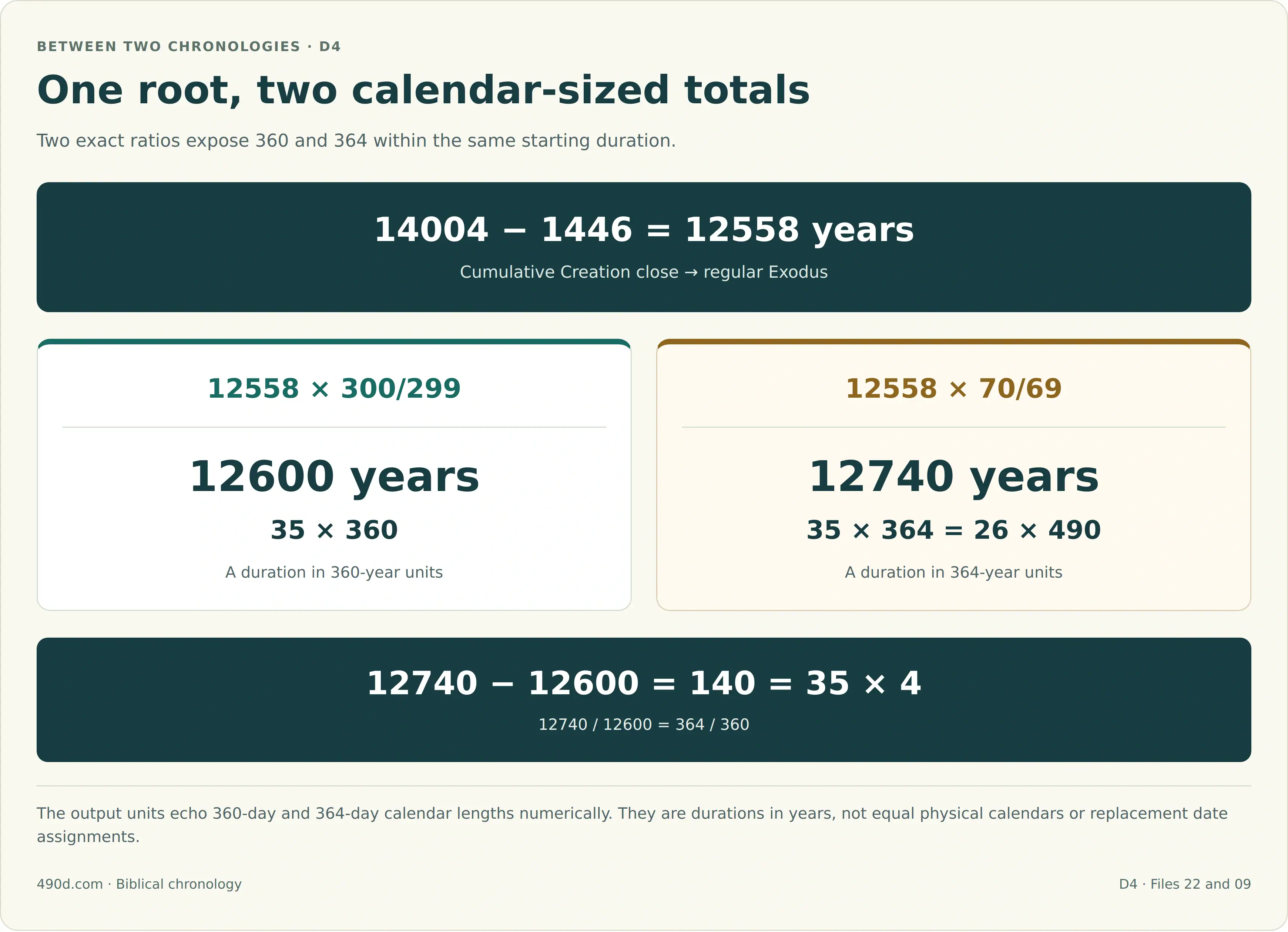
The numbers 360 and 364 enter as calendar-shaped units within spans measured in years. A 364-day year has four more days than a 360-day scheme; here, at the enlarged scale, 35 × 364 exceeds 35 × 360 by 140, or 35 × 4. Accordingly:
12740 / 12600 = 364 / 360.
The equality concerns the numerical structure. It does not make 360-day and 364-day calendars identical or convert either into the solar year. The separate operations are set out in File 22, §§8.3–8.5 and 9A.3, with calendar distinctions in File 12.
The same totals can have different endpoints
There are two ways to place these expanded durations. If the Exodus stays fixed at 1446 BC, 12600 reaches a generated closing boundary at 14046 BC, and 12740 reaches 14186 BC. The whole seven-year envelope moves with its closing boundary; its width is not multiplied.
The cumulative architecture also realizes those totals through a different selection of endpoints:
| Endpoint realization, BC | Duration | Increase beyond 12558 |
|---|---|---|
| Creation close 14004 → Exodus 1446 | 12558 | Starting span |
| Adam Year 6, 14006 → Conquest 1406 | 12600 | 2 at the older end + 40 at the younger end = 42 |
| Apparent Adam 14036 → cumulative Joshua endpoint 1296 | 12740 | 2 + 30 at the older end; 40 + 110 at the younger end = 182 |
In the last row, 14036 = 14006 + 30 is the apparent-Adam position. The 1296 BC endpoint results from placing Joshua’s complete 110-year lifespan after the 1406 boundary in the formal cumulative arrangement. It is not a claim that Joshua’s ordinary historical death occurred in 1296 BC, nor is Joshua added to the original 26-name Moses total.
The table and the fixed-Exodus calculation reach the same durations by different placements. 14036 and 14046 therefore must remain distinct. The first is an apparent-Adam position; the second is generated by placing an expanded duration before a fixed Exodus. File 09, §3A.5, explains this endpoint anatomy alongside File 22, §8.9.
Why the calendar ratio comes close to 10,000
The 364/360 relationship invites one further calculation. Applying it to the 9890 bridge gives:
9890 × 364/360 = 89999/9 = 9999 + 8/9 years.
The result falls 1/9 year short of 10000. That shortfall corresponds to 40 days if a 360-day schematic year is specified. The proximity is interesting, but the fraction must remain: this operation does not produce exactly 10,000.
An exact 10,000 requires a different, explicitly stated comparison. The next example supplies one without discarding a remainder or altering Abraham’s normal date.
Enosh and Abraham: a selected 10,000-year comparison
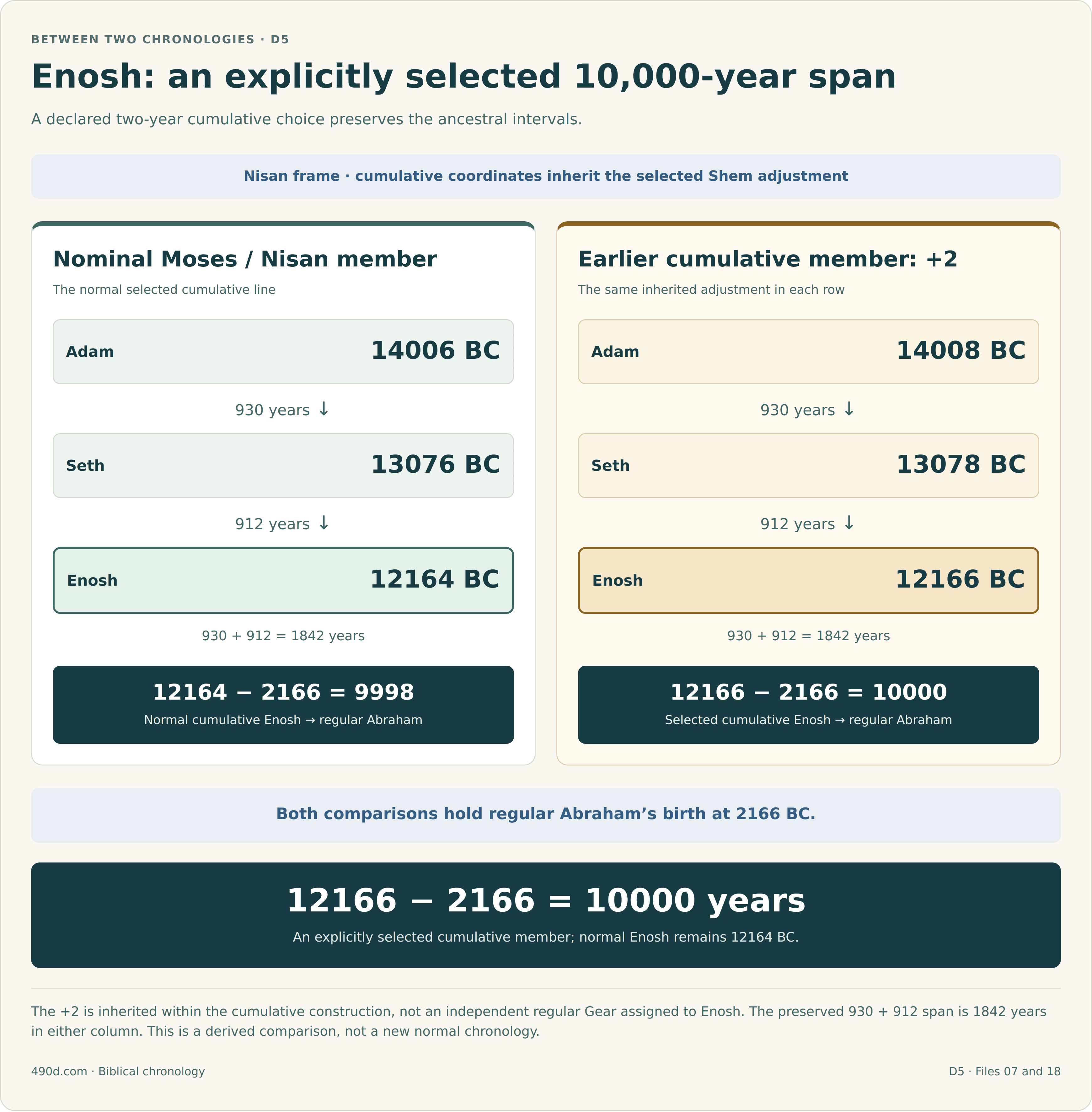
On the normal Moses/Nisan cumulative line, Adam is at 14006 BC, Seth at 13076 BC, and Enosh at 12164 BC. The first two complete lifespans give 930 + 912 = 1842 years from Adam to Enosh.
The canonical cumulative system also allows an inherited +2 member, arising from the Shem two-year relationship propagated through the ancestral chain. Selecting that member moves all three cumulative positions together:
| Cumulative selection | Adam, BC | Seth, BC | Enosh, BC | Enosh to regular Abraham, 2166 BC |
|---|---|---|---|---|
| Normal Moses/Nisan line | 14006 | 13076 | 12164 | 9998 years |
| Selected +2 member | 14008 | 13078 | 12166 | 10000 years |
Enosh: an explicitly selected 10,000-year span
A declared two-year cumulative choice preserves the ancestral intervals.
Nisan frame · cumulative coordinates inherit the selected Shem adjustment
Nominal Moses / Nisan member
The normal selected cumulative line
930 + 912 = 1842 years
12164 − 2166 = 9998Normal cumulative Enosh → regular Abraham
Earlier cumulative member: +2
The same inherited adjustment in each row
930 + 912 = 1842 years
12166 − 2166 = 10000Selected cumulative Enosh → regular Abraham
Both comparisons hold regular Abraham’s birth at 2166 BC.
The +2 is inherited within the cumulative construction, not an independent regular Gear assigned to Enosh. The preserved 930 + 912 span is 1842 years in either column. This is a derived comparison, not a new normal chronology.
Image version and full-size download
Download full-size PNG · Download WebP · Download stacked phone PNG
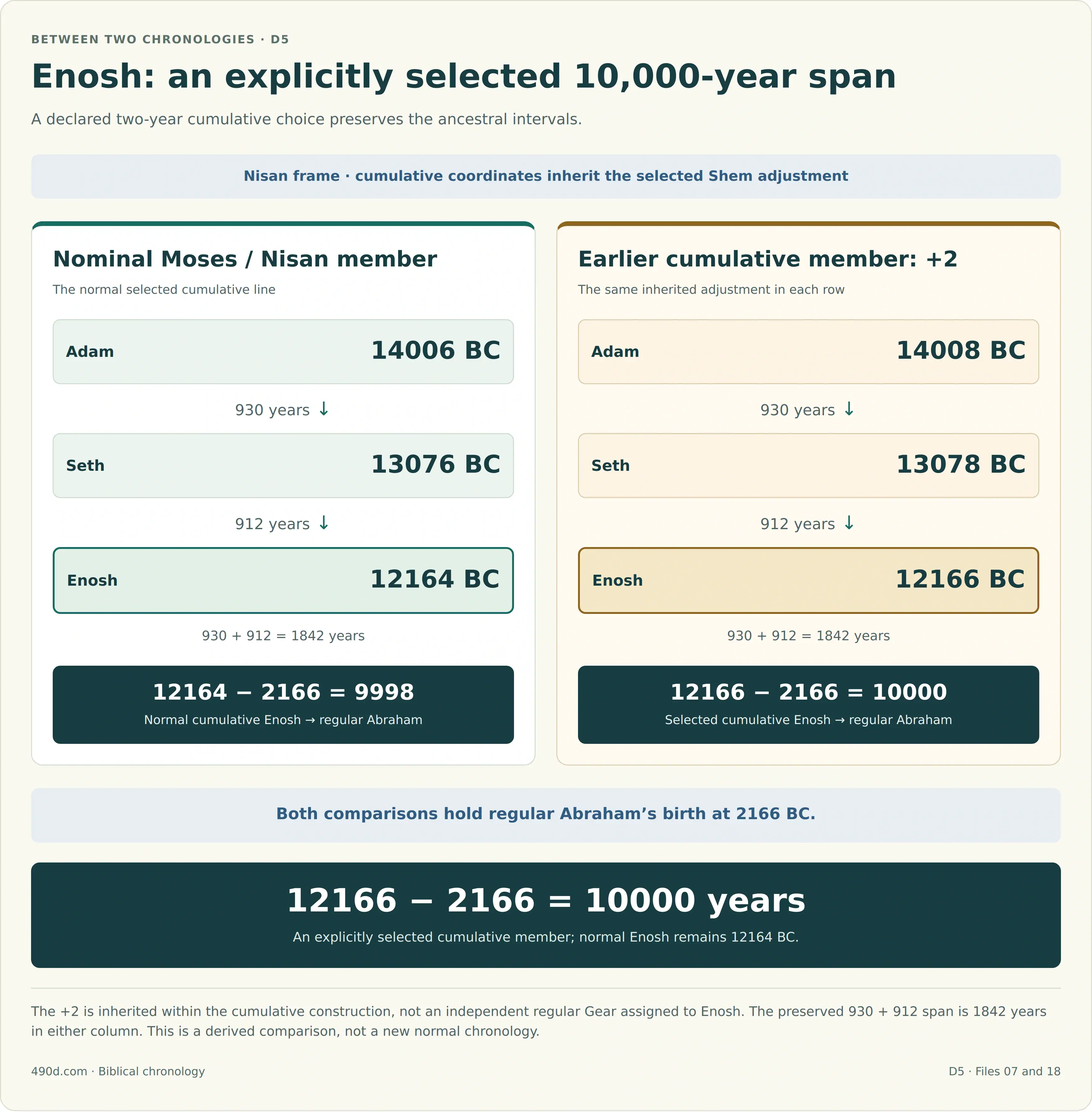
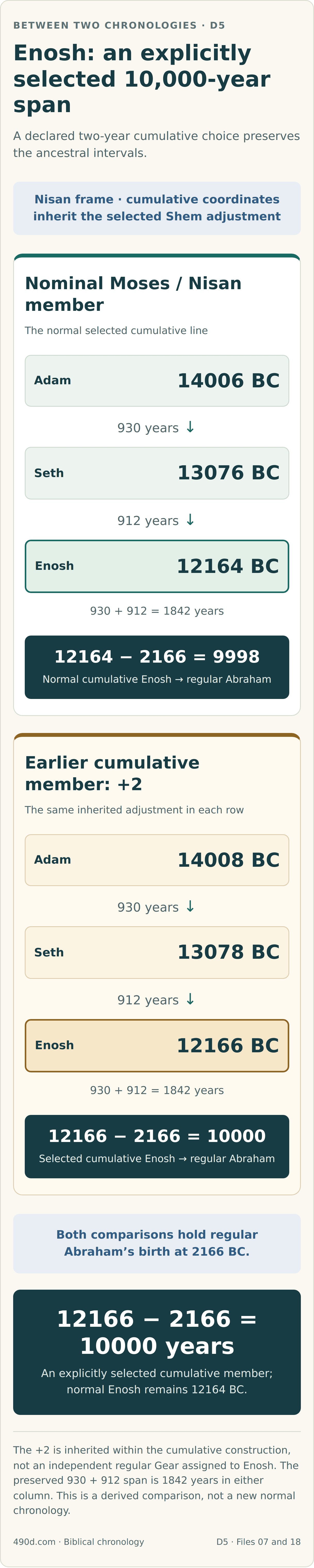
The exact comparison is 12166 − 2166 = 10000. Its selection is part of its meaning: without the inherited shift, the difference is 9998. Adam-to-Enosh remains 1842 in both rows. This does not assign Enosh an independent alternative regular chronology, and it does not move Abraham’s regular birth. The permitted cumulative members are specified in File 07, §§1.3–1.4, with the normal rows in File 18, §6A.
There is also a literary reason to place Enosh and Abraham beside one another. Genesis associates Enosh’s time with calling on the divine name:
And to Seth also a son was born, and he called him Enosh. At that time men began to call upon the name of the LORD.
Later, Abram builds an altar and calls on the name of the LORD (Genesis 12:8, BSB). The repeated theme gives the numerical comparison a narrative setting. Genesis does not date the beginning of that practice to Enosh’s exact birthday, and Abram’s altar scene is not his birth event. The literary parallel and the selected 10,000-year separation are related observations, rather than identical chronological claims.
A compact comparison from the shorter-sojourn variant
One further example is useful because it shows why matching boundaries matters. The alternative that shortens the sojourn chronology by 215 years places the actual, unrounded Creation envelope at 3906–3899 BC. Compared with the 1406–1399 BC Conquest-to-rest envelope, it gives:
| Corresponding boundaries, BC | Years |
|---|---|
| 3906 → 1406 | 2500 = 50 × 50 |
| 3899 → 1399 | 2500 = 50 × 50 |
This is the explicitly identified −215 variant, preserved in File 51a, §23.6. Its presence in the Rounded Scaffold file does not make this particular comparison rounded. The default in the present study remains 430 years in Egypt. The table illustrates a source-defined alternative without blending its Creation dates into the normal MT calculations above.
A further exact 10,000 in the SP comparison
A more elaborate Samaritan Pentateuch (SP) comparison appears in the canonical Creation study. It is worth retaining for readers following the wider numerical architecture, provided its symbolic coordinates are derived openly.
The starting point is MT Year 6 at 4116 BC. This example deliberately selects the +60 Terah and +130 restored-Cainan variants, adds the apparent-age overlay, and then applies the source’s SP comparative offset. It is therefore not an ordinary Samaritan Pentateuch Creation date.
| Step in the construction | Calculation | Result, BC |
|---|---|---|
| MT Year 6 with the two stated variants | 4116 + 60 + 130 | 4306 |
| Apparent-age overlay | 4306 + 30 | 4336 |
| Scaled seven-year companion | 4336 − 70, where 70 = 10 × 7 | 4266 |
| SP comparative offset applied to both positions | 4336 + 300; 4266 + 300 | 4636 and 4566 |
The 70-year interval is a scaled symbolic companion, not a literal 70-year Creation week. The 300-year SP comparative offset is likewise a distinct comparison rule; it is not an extension of the one-year Noah/Shem companion adjustment through every earlier SP ancestor.
In the minimum-frame comparison, the preferred SP head at 4199 BC stands 300 years before the MT head at 3899 BC: 4199 − 3899 = 300 (File 18, §3).
For this local comparison, the source uses the civil Mirror label rule x BC ↔︎ AD (x − 1). The two derived BC positions are then paired across with each other’s reflected coordinates:
| Cross-pair | Civil elapsed calculation | Years |
|---|---|---|
| 4636 BC → AD 4565 | 4636 + 4565 − 1 | 9200 |
| 4566 BC → AD 4635 | 4566 + 4635 − 1 | 9200 |
The subtraction of one accounts for the absence of a civil year zero. Both crossings give 9200 = 23 × 400, and therefore:
9200 × 25/23 = 10000.
This is an exact expansion of the span. The source does not specify a new fixed endpoint for the expanded 10,000 here, so no further AD date is implied. The complete construction is in File 07, §5.1.16, “The SP 9200 baseline and the 10000 Priestly lock”. Its derivation stands on its own; it does not turn the normal 9890-year Creation gap into 10000.
Keeping 9,890, 9,900, and 10,000 distinct
The three prominent numbers belong to different comparisons:
| Number | Meaning in these studies |
|---|---|
| 9890 | The actual matched Creation difference: 14004 − 4114, or 14006 − 4116. |
| 9900 | The separate Rounded Scaffold comparison: 14006 − 4106. |
| 10000 | Exact results of explicitly selected constructions, such as cumulative Enosh 12166 to regular Abraham 2166, or the SP 9200 span expanded by 25/23. |
The rounded 9900 study develops the overlapping 1650-year structure belonging to its own rounded dates. It complements the present discussion, whose starting calculations use the actual, unrounded tables. A repeated date label does not make the underlying operations interchangeable.
What gives these comparisons their interest is the way several relationships meet: 9890 and 989, the 430-year sojourn measure, the 25/23 expansion, and the 12600/12740 calendar ratio. The strongest reading preserves each derivation. Then the patterns can be considered together without confusing the two chronology methods or treating an approximate equality as exact.
Sources and further study
The current canonical source collection governs the dates and comparison rules used here. The most direct routes into its supporting detail are:
| Source | Sections and purpose |
|---|---|
| File 18: Chronological Data Tables | §§6–6A and 6D: actual cumulative MT line; native LXX line and current amendments. |
| File 22: Cumulative MT Harmonics | §§3.1, 5, 7–9 and 9A.3: 9890/989, the sojourn family, expansions, and calendar-sized totals. |
| File 09: Cumulative Architecture | §§3A.1 and 3A.5: the whole-year envelope and distinct endpoint realizations. |
| File 07: Creation Seed and Decimal Root | §§1.3–1.4 and 5.1.16: inherited cumulative members and the advanced SP comparison. |
| File 12: Calendrical Physics | Calendar and ratio distinctions. |
| File 51a: Rounded Scaffold | §§16.1–16.2 for the separate 9900 comparison; §23.6 for the explicitly actual −215 comparison. |
For the complete numerical rows, use the regular chronology tables and unrounded cumulative tables. For a shorter route through the central argument, return to the introductory article and its appendix.
The stated equalities follow from the specified dates and operations. Their theological significance is an interpretation of that structure; the calculations alone do not supply a statistical probability or establish ancient authorial intention.
Scripture quotations: Berean Standard Bible (BSB), public domain.