Part 5B · Supporting material for The Key of 23 Capstone: Expanding the Number Sets
The main study follows one finite expansion from twelve values to forty. These tables expose its origins, every round, and the separate growing branches. The later notes preserve the additional chronological and theological connections without making them prerequisites for understanding the basic calculation.
All expansion inputs are raw signed coordinates. Ordinary BC–AD comparisons use BC + AD − 1. A signed coordinate −n displays as civil (n + 1) BC; positive n displays as AD n. Actual chronology, selected calendar origins, schematic periods, coordinate reflections and decimal digit reversals are identified separately.
Jump to seed origins · operators · round totals · all basic states · final forty · raw/display signs · optional branches · research connections · calendar leads.
1. The seed and its stated origins
The twelve-value seed is retained unchanged:
−5, 35, 175, 215, 315, 495, 1645, 1825, 1925, 1965, 2105, 2145
The upper family uses ordinals from the fixed Exodus-era start, Julian March 23, 6 BC. The lower family can be reconstructed by rebasing the same event coordinates to Julian January 30, AD 1 as local +1, then reflecting their signs.
| Modeled event | Own-Jan-1 coordinate q | Jan-30 local coordinate q − 29 | Reflected local coordinate | Exodus ordinal |
|---|---|---|---|---|
| John’s conception | −466 | −495 | 495 | 1645 |
| Jesus’ conception | −286 | −315 | 315 | 1825 |
| John’s birth | −186 | −215 | 215 | 1925 |
| John: forty completed days | −146 | −175 | 175 | 1965 |
| Jesus’ birth | −6 | −35 | 35 | 2105 |
| Jesus: forty completed days | 34 | 5 | −5 | 2145 |
This is an explicit corrected reconstruction of the seed. January 1 → January 30 is 29 completed days, or thirty inclusive date labels. The earlier research’s combination of an added one and a thirty-unit subtraction yields the same algebra: (q + 1) − 30 = q − 29. That algebra does not make every earlier explanation of its origins exact.
January 1 remains the primary circumcision/covenant Mirror. With its own calendar’s January 1 assigned +1, December 25 is −6, displayed as symbolic 7 BC. Read the same Julian December 25 from the Gregorian January 1 datum and it is −8, not −5. Thus the seed’s −5 is a computational coordinate in the selected secondary family, not an exact Gregorian conversion of the traditional birthday.
The shared 2140 complement is twenty short of 2160 = 6 × 360. The earlier research interprets that twenty as half the forty-day purification period. This preserves the proposed six-year analogy; it does not supply a new exact calendar conversion or make 2140 equal 2160.
The seed retains completed forty-day terminals: +40 after birth. The inclusive fortieth numbered day is +39. Circumcision is not included among its six events; the exact seven-completed/eight-inclusive and eight-completed research terminals remain in Part 5A’s event table.
Calendar families already explained in Part 5A
| Supporting family | Direct established explanation | Treatment here |
|---|---|---|
| December 24 → January 1 and the two-day calendar relationship | Calendar-datum appendix | Exact own-calendar and reciprocal coordinates; no general ±1 allowance. |
| Complete John/Jesus event table, including circumcision and forty-day markers | Part 5A: complete events | Exact rows are reused by reference rather than copied. |
| Julian/Gregorian means and older +1/−30 symbolic families | Part 5A: legacy coordinate families | Genuine means and historical research states are labeled; they do not replace exact endpoints. |
| Fixed February 21 / March 23, 6 BC beginnings | Part 5A: era endpoints | Starts remain physically thirty days apart. |
2. Scalar conversions and two-end extensions
Let a < b, with d = b − a. Every scan uses the complete input set as it existed at the beginning of that scan.
| Rule | Eligible difference | Scalar conversion | Increment at each end | Full output width |
|---|---|---|---|---|
| Basic 23 | d divisible by 23 | 25d/23 | δ = 2d/23 | 27d/23 |
| Basic 230 formulation | d divisible by 230 | 250d/230 = 25d/23 | δ = 20d/230 = 2d/23 | 270d/230 = 27d/23 |
| Optional 69 | d divisible by 69 | 70d/69 | δ = d/69 | 71d/69 |
The generated outputs are a − δ and b + δ. All outputs are collected before being added to the input set; duplicates are removed. Newly generated values first participate in the next scan.
Every basic seed member is 5 modulo 10. Differences are therefore multiples of 10. A difference divisible by both 10 and 23 is divisible by 230; the basic increment is then a multiple of twenty, preserving the remainder-5 class. This proves equivalence of the two divisibility formulations for this seed. It is not a claim about arbitrary seeds. The optional 69 rule also preserves the remainder-5 class here: its eligible differences are multiples of 690, making its increments multiples of ten.
The canonical scalar ratios are controlled by File 46 §1. The simultaneous two-end set procedure is defined here; it does not inherit the proof status of a different canonical genealogy-lattice argument.
Worked seed pairs
| Input pair | Input span d | Scalar 25d/23 | Increment δ | Output pair | Full width |
|---|---|---|---|---|---|
| 35 → 495 | 460 | 500 | 40 | −5 → 535 | 540 |
| 35 → 1645 | 1610 | 1750 | 140 | −105 → 1785 | 1890 |
| 495 → 1645 | 1150 | 1250 | 100 | 395 → 1745 | 1350 |
| 35 → 2105 | 2070 | 2250 | 180 | −145 → 2285 | 2430 |
The seed already contains −5. The pair 35 → 495 therefore adds only 535. Likewise, 1645 → 2105 produces 1605 and 2145: the first is new, and the second is the existing completed forty-day terminal. Its one-sided extension gives 500, while the outer pair spans 540. “Generated output” and “new set member” are different counts.
3. Every basic round
| Round / source set | Count | Distinct additions | Raw bounds | Raw sum | Display sum |
|---|---|---|---|---|---|
| 0 / 1 | 12 | Seed | −5 → 2145 | 12840 | 10380 |
| 1 / 2 | 24 | 12 | −145 → 2285 | 25680 | 21000 |
| 2 / 3 | 32 | 8 | −325 → 2465 | 34240 | 30000 |
| 3 / 4 | 36 | 4 | −505 → 2645 | 38520 | 36220 |
| 4 / 5 | 40 | 4 | −685 → 2825 | 42800 | 43160 |
| 5 / unchanged | 40 | 0 | −685 → 2825 | 42800 | 43160 |
“Raw sum” means the sum used to describe the actual computational set. “Display sum” negates the first half of the sorted raw list solely for presentation and summation. It does not alter the next round’s inputs.
The first scan has eight qualifying pairs and twelve distinct additions:
−145, −105, 75, 355, 395, 535, 1605, 1745, 1785, 2065, 2245, 2285
Complete pair-by-pair provenance is supplied in basic23-pairs.csv. The reproducible calculation (ZIP) uses exact integers.
Complete raw and displayed basic states
The display lists retain their lower-half order after negation. They are not re-sorted or deduplicated, because they are displayed entries rather than the computational set.
Round 0 · source Set 1 · 12 values
Raw: −5, 35, 175, 215, 315, 495, 1645, 1825, 1925, 1965, 2105, 2145
Displayed: 5, −35, −175, −215, −315, −495, 1645, 1825, 1925, 1965, 2105, 2145
Raw sum 12840; display sum 10380.
Round 1 · source Set 2 · 24 values
Raw: −145, −105, −5, 35, 75, 175, 215, 315, 355, 395, 495, 535, 1605, 1645, 1745, 1785, 1825, 1925, 1965, 2065, 2105, 2145, 2245, 2285
Displayed: 145, 105, 5, −35, −75, −175, −215, −315, −355, −395, −495, −535, 1605, 1645, 1745, 1785, 1825, 1925, 1965, 2065, 2105, 2145, 2245, 2285
Raw sum 25680; display sum 21000.
Round 2 · source Set 3 · 32 values
Raw: −325, −285, −185, −145, −105, −5, 35, 75, 175, 215, 315, 355, 395, 495, 535, 575, 1565, 1605, 1645, 1745, 1785, 1825, 1925, 1965, 2065, 2105, 2145, 2245, 2285, 2325, 2425, 2465
Displayed: 325, 285, 185, 145, 105, 5, −35, −75, −175, −215, −315, −355, −395, −495, −535, −575, 1565, 1605, 1645, 1745, 1785, 1825, 1925, 1965, 2065, 2105, 2145, 2245, 2285, 2325, 2425, 2465
Raw sum 34240; display sum 30000.
Round 3 · source Set 4 · 36 values
Raw: −505, −465, −325, −285, −185, −145, −105, −5, 35, 75, 175, 215, 315, 355, 395, 495, 535, 575, 1565, 1605, 1645, 1745, 1785, 1825, 1925, 1965, 2065, 2105, 2145, 2245, 2285, 2325, 2425, 2465, 2605, 2645
Displayed: 505, 465, 325, 285, 185, 145, 105, 5, −35, −75, −175, −215, −315, −355, −395, −495, −535, −575, 1565, 1605, 1645, 1745, 1785, 1825, 1925, 1965, 2065, 2105, 2145, 2245, 2285, 2325, 2425, 2465, 2605, 2645
Raw sum 38520; display sum 36220.
Round 4 · source Set 5 · 40 values
Raw: −685, −645, −505, −465, −325, −285, −185, −145, −105, −5, 35, 75, 175, 215, 315, 355, 395, 495, 535, 575, 1565, 1605, 1645, 1745, 1785, 1825, 1925, 1965, 2065, 2105, 2145, 2245, 2285, 2325, 2425, 2465, 2605, 2645, 2785, 2825
Displayed: 685, 645, 505, 465, 325, 285, 185, 145, 105, 5, −35, −75, −175, −215, −315, −355, −395, −495, −535, −575, 1565, 1605, 1645, 1745, 1785, 1825, 1925, 1965, 2065, 2105, 2145, 2245, 2285, 2325, 2425, 2465, 2605, 2645, 2785, 2825
Raw sum 42800; display sum 43160.
4. The final forty values
Each row pairs a lower raw value with its upper complement 2140 − x. The upper column descends so the pairing is explicit; the algorithm itself always sorts the complete raw set in ascending order.
| Lower raw value x | Upper complement 2140 − x | Pair sum |
|---|---|---|
| −685 | 2825 | 2140 |
| −645 | 2785 | 2140 |
| −505 | 2645 | 2140 |
| −465 | 2605 | 2140 |
| −325 | 2465 | 2140 |
| −285 | 2425 | 2140 |
| −185 | 2325 | 2140 |
| −145 | 2285 | 2140 |
| −105 | 2245 | 2140 |
| −5 | 2145 | 2140 |
| 35 | 2105 | 2140 |
| 75 | 2065 | 2140 |
| 175 | 1965 | 2140 |
| 215 | 1925 | 2140 |
| 315 | 1825 | 2140 |
| 355 | 1785 | 2140 |
| 395 | 1745 | 2140 |
| 495 | 1645 | 2140 |
| 535 | 1605 | 2140 |
| 575 | 1565 | 2140 |
All 42 eligible final pairs generate outputs already in this table. The closure certificate records every pair and both outputs. This finite check establishes closure for the exact seed and basic rule.
Half-year boundaries and gap counts
| Flank | Eight boundaries |
|---|---|
| Lower | −685, −505, −325, −145, 35, 215, 395, 575 |
| Upper | 1565, 1745, 1925, 2105, 2285, 2465, 2645, 2825 |
Both rows contain seven consecutive 180-unit intervals: 7 × 180 = 1260.
| Consecutive gap | Per flank | Whole forty-value set | Contribution to whole width |
|---|---|---|---|
| 40 | 12 | 24 | 960 |
| 100 | 5 | 10 | 1000 |
| 140 | 2 | 4 | 560 |
| Central 990 | — | 1 | 990 |
| Total | 19 gaps per flank | 39 gaps | 3510 |
One flank totals 12 × 40 + 5 × 100 + 2 × 140 = 1260. The forty- and hundred-unit contributions together total 1960 = 4 × 490 = 40 × 49. Forty values, twenty-four forty-unit gaps, and forty-nine-year jubilee units describe different aspects of the construction.
5. Raw coordinates, display signs, and the Mirror
TWO LAYERS · ALGORITHM STATE AND PRESENTATION
Preserve raw state; flip only the display
The lower six signs change for the displayed sum. The upper six stay unchanged.
| Raw lower sixalgorithm state | Display lower sixsign reversed | Upper sixunchanged |
|---|---|---|
| −5 | 5 | 1645 |
| 35 | −35 | 1825 |
| 175 | −175 | 1925 |
| 215 | −215 | 1965 |
| 315 | −315 | 2105 |
| 495 | −495 | 2145 |
Raw 12-coordinate sum
12840
12 × 1070Selected display sum
10380
negated lower six + unchanged upper six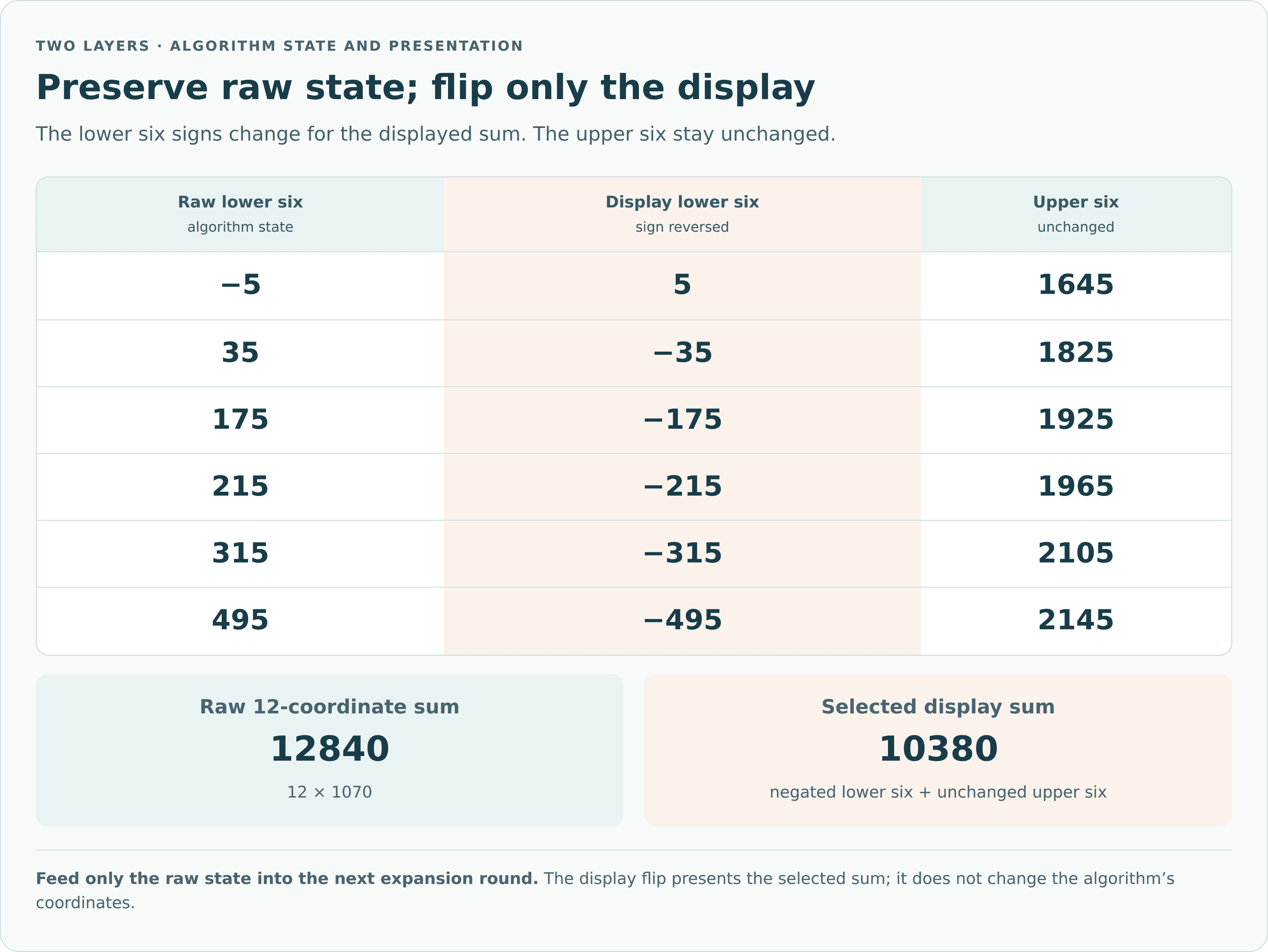
All raw states have complement x ↔ 2140 − x, hence mean 1070. The raw sum is therefore 1070 × count. At closure it is 42800. The display operation instead gives 43160.
These distinctions prevent three different operations from being conflated:
| Operation | Definition | Purpose |
|---|---|---|
| Seed-set complement | x → 2140 − x | Pairs the two raw families around 1070. |
| Signed coordinate reflection | c → −c | Declared local reflection; civil labels must still account for no year zero. |
| Lower-half display reversal | Negate only the first half of the sorted raw entries | Reproduces the source’s displayed lists and sums; not an expansion input. |
For example, raw −5 displays as civil 6 BC, whereas coordinate +5 displays as AD 5. The distance between 6 BC and AD 5 is 6 + 5 − 1 = 10, matching the signed-coordinate difference. A mirrored pair is not automatically 230-eligible: −535 → 535 = 1070 and −495 → 495 = 990 both fail the basic divisibility test.
This article does not substitute its local complement or display operation for the Canon’s phase-resolved Mirror conventions. The Mirror study and calendar-datum appendix supply the wider distinctions.
6. Two optional growth branches
A. Apply 23 and 69 at every scan
| Round | Count | Distinct additions | Raw bounds | Raw sum | Display sum |
|---|---|---|---|---|---|
| 0 | 12 | Seed | −5 → 2145 | 12840 | 10380 |
| 1 | 26 | 14 | −145 → 2285 | 27820 | 23130 |
| 2 | 46 | 20 | −325 → 2465 | 49220 | 44910 |
| 3 | 68 | 22 | −505 → 2645 | 72760 | 68280 |
| 4 | 138 | 70 | −685 → 2825 | 147660 | 147170 |
| 5 | 290 | 152 | −925 → 3065 | 310300 | 341910 |
| 6 | 408 | 118 | −1265 → 3405 | 436560 | 522320 |
The original published five states stop at round 4. Rounds 5 and 6 are checked continuations, with 290 and 408 values. They show continued growth over those finite scans, not a proof of growth without end.
Complete first five mixed states
Round 0 · source Set 1 · 12 values
Raw: −5, 35, 175, 215, 315, 495, 1645, 1825, 1925, 1965, 2105, 2145
Displayed: 5, −35, −175, −215, −315, −495, 1645, 1825, 1925, 1965, 2105, 2145
Raw sum 12840; display sum 10380.
Round 1 · source Set 2 · 26 values
Raw: −145, −105, −5, 5, 35, 75, 175, 215, 315, 355, 395, 495, 535, 1605, 1645, 1745, 1785, 1825, 1925, 1965, 2065, 2105, 2135, 2145, 2245, 2285
Displayed: 145, 105, 5, −5, −35, −75, −175, −215, −315, −355, −395, −495, −535, 1605, 1645, 1745, 1785, 1825, 1925, 1965, 2065, 2105, 2135, 2145, 2245, 2285
Raw sum 27820; display sum 23130.
Round 2 · source Set 3 · 46 values
Raw: −325, −285, −185, −175, −145, −135, −105, −35, −5, 5, 35, 45, 75, 145, 175, 185, 215, 315, 355, 395, 495, 535, 575, 1565, 1605, 1645, 1745, 1785, 1825, 1925, 1955, 1965, 1995, 2065, 2095, 2105, 2135, 2145, 2175, 2245, 2275, 2285, 2315, 2325, 2425, 2465
Displayed: 325, 285, 185, 175, 145, 135, 105, 35, 5, −5, −35, −45, −75, −145, −175, −185, −215, −315, −355, −395, −495, −535, −575, 1565, 1605, 1645, 1745, 1785, 1825, 1925, 1955, 1965, 1995, 2065, 2095, 2105, 2135, 2145, 2175, 2245, 2275, 2285, 2315, 2325, 2425, 2465
Raw sum 49220; display sum 44910.
Round 3 · source Set 4 · 68 values
Raw: −505, −465, −355, −325, −315, −285, −205, −185, −175, −145, −135, −105, −35, −5, 5, 35, 45, 65, 75, 145, 165, 175, 185, 215, 315, 325, 355, 365, 395, 455, 495, 535, 555, 575, 1565, 1585, 1605, 1645, 1685, 1745, 1775, 1785, 1815, 1825, 1925, 1955, 1965, 1975, 1995, 2065, 2075, 2095, 2105, 2135, 2145, 2175, 2245, 2275, 2285, 2315, 2325, 2345, 2425, 2455, 2465, 2495, 2605, 2645
Displayed: 505, 465, 355, 325, 315, 285, 205, 185, 175, 145, 135, 105, 35, 5, −5, −35, −45, −65, −75, −145, −165, −175, −185, −215, −315, −325, −355, −365, −395, −455, −495, −535, −555, −575, 1565, 1585, 1605, 1645, 1685, 1745, 1775, 1785, 1815, 1825, 1925, 1955, 1965, 1975, 1995, 2065, 2075, 2095, 2105, 2135, 2145, 2175, 2245, 2275, 2285, 2315, 2325, 2345, 2425, 2455, 2465, 2495, 2605, 2645
Raw sum 72760; display sum 68280.
Round 4 · source Set 5 · 138 values
Raw: −685, −645, −575, −565, −545, −535, −525, −515, −505, −495, −465, −425, −405, −385, −355, −335, −325, −315, −285, −255, −205, −195, −185, −175, −155, −145, −135, −115, −105, −65, −45, −35, −25, −5, 5, 25, 35, 45, 65, 75, 145, 165, 175, 185, 195, 215, 225, 245, 275, 305, 315, 325, 345, 355, 365, 375, 395, 415, 425, 435, 455, 495, 505, 535, 545, 555, 565, 575, 615, 1525, 1565, 1575, 1585, 1595, 1605, 1635, 1645, 1685, 1705, 1715, 1725, 1745, 1765, 1775, 1785, 1795, 1815, 1825, 1835, 1865, 1895, 1915, 1925, 1945, 1955, 1965, 1975, 1995, 2065, 2075, 2095, 2105, 2115, 2135, 2145, 2165, 2175, 2185, 2205, 2245, 2255, 2275, 2285, 2295, 2315, 2325, 2335, 2345, 2395, 2425, 2455, 2465, 2475, 2495, 2525, 2545, 2565, 2605, 2635, 2645, 2655, 2665, 2675, 2685, 2705, 2715, 2785, 2825
Displayed: 685, 645, 575, 565, 545, 535, 525, 515, 505, 495, 465, 425, 405, 385, 355, 335, 325, 315, 285, 255, 205, 195, 185, 175, 155, 145, 135, 115, 105, 65, 45, 35, 25, 5, −5, −25, −35, −45, −65, −75, −145, −165, −175, −185, −195, −215, −225, −245, −275, −305, −315, −325, −345, −355, −365, −375, −395, −415, −425, −435, −455, −495, −505, −535, −545, −555, −565, −575, −615, 1525, 1565, 1575, 1585, 1595, 1605, 1635, 1645, 1685, 1705, 1715, 1725, 1745, 1765, 1775, 1785, 1795, 1815, 1825, 1835, 1865, 1895, 1915, 1925, 1945, 1955, 1965, 1975, 1995, 2065, 2075, 2095, 2105, 2115, 2135, 2145, 2165, 2175, 2185, 2205, 2245, 2255, 2275, 2285, 2295, 2315, 2325, 2335, 2345, 2395, 2425, 2455, 2465, 2475, 2495, 2525, 2545, 2565, 2605, 2635, 2645, 2655, 2665, 2675, 2685, 2705, 2715, 2785, 2825
Raw sum 147660; display sum 147170.
B. Add only 5 and 2135, then use 23 alone
The pair 35 → 2105 spans 2070 = 69 × 30. Its optional increment is thirty at each end, giving 5 and 2135. Add only these two to the twelve-value seed, then resume the 23 rule alone.
| 23-only round after prefill | Count | Distinct additions | Raw bounds |
|---|---|---|---|
| 0 | 14 | Prefill | −5 → 2145 |
| 1 | 26 | 12 | −145 → 2285 |
| 2 | 34 | 8 | −325 → 2465 |
| 3 | 38 | 4 | −505 → 2645 |
| 4 | 42 | 4 | −685 → 2825 |
| 5 | 46 | 4 | −745 → 2885 |
| 6 | 68 | 22 | −1005 → 3145 |
| 7 | 84 | 16 | −1245 → 3385 |
| 8 | 116 | 32 | −1505 → 3645 |
The first 23-only scan from this fourteen-value seed gives exactly the same 26 values as branch A’s first mixed scan. The next results diverge: 34 here versus 46 when 69 continues to be applied. Thus a fourteen-value preliminary insertion and a complete twenty-six-value mixed update must not be called the same starting state.
The generated 2135 matches the Christ-frame birth ordinal because its start precedes the Exodus start by thirty days. The pair also creates 1645 → 2135 = 490. This is a useful correspondence; it does not prove that every coordinate’s thirty-unit shadow is generated.
Edge retention and the limit of the experiment
The original exploration retains only the 100 lowest and 100 highest values when an update exceeds 200. It discards the middle before the next scan. That is an edge-retained experiment, not an exhaustive complete-set expansion.
Both growing edge-retained branches were checked through 1000 rounds, retaining 200 values at the last round and reaching 73-digit extrema. The selected fourteen-seed branch first trims at round 10; the twelve-seed mixed branch first trims at round 5. The basic twelve-seed/23-only branch closes before trimming is needed.
The supplied summary tables (ZIP), code (ZIP) and complete finite traces (ZIP) preserve the research. The compressed trace expands to a large file and is for computational use. No infinite-growth theorem or statistical probability is supplied by these finite runs.
The original note that 299 has no effect lacks a defined 299 operator. No positive 299-multiple difference occurs in the basic forty-value family, but fifteen such pairs occur in the mixed 138-value state. The note remains an undeveloped research lead, not a general exclusion of 299.
7. Selected spans, overlaps, and prophetic parallels
These connections preserve the wider research behind the Capstone. Exact calculations are stated first; event identifications and theological readings are separately qualified. The normal Masoretic Text (MT) chronology is used unless another state is named.
Overlapping intervals
| Construction | Selected endpoints / spans | Shared interval | Union and counted total |
|---|---|---|---|
| Seed outline | −5 → 495 → 1645 → 2145: 500 + 1150 + 500 | — | Whole width 2150 = half of 4300 = 10 × 430 / 2. |
| Two 1290 intervals | 355 → 1645; 495 → 1785 | 495 → 1645 = 1150 | Union 1430; counted total 2580 = 1430 + 1150. |
| Two 1750 intervals | −105 → 1645; 495 → 2245 | 495 → 1645 = 1150 | Union 2350; counted total 3500 = 2350 + 1150. |
| Shared service-pair analogy | 1150 + 1150 = 2300 | Same interval counted twice | Possible evening/morning interpretation of Daniel 8:14; not another elapsed 2300 inside the 2350 union. |
The 1290 comparisons arise from 1610 × 25/23 = 1750, adding 140 at each end. The two 1750s total 3500, half of a schematic 7000. The two 500 flanks can be read as evening and morning halves of a thousand-year day (2 Peter 3:8). These are typological interpretations of the stated counted intervals.
The selected sequence −5, 35, 175, 215, 315, 495, 535 and its complementary upper sequence form a fourteen-value intermediate selection. Adding the 1150-pair outputs 395 and 1745 makes a sixteen-value selection, inviting a 4 × 4 analogy. Neither selection is the complete first round, which has twenty-four values.
The upper six-event family alone gains a seventh distinct value, 1605, when its 460 span is extended: 2145 was already present. I read the six/seven progression through Creation’s forming-and-filling imagery; the seventh/eighth comparison with Revelation 17:11 remains typological. The generated value is not a newly established date in John’s life.
Jubilee and Gabriel connections
| Relationship | Exact calculation | State / reading |
|---|---|---|
| From the Esau-marriage boundary | 1966 BC → 496 BC → 6 BC: 1470 + 490 = 1960 | Normal MT marriage boundary; selected symbolic 496 BC boundary; 6 BC birth hinge. |
| Across signed coordinates | −1925 → 35 = 1960 | Reflected coordinate corresponds to 1926 BC; +35 is symbolic AD 35. |
| Optional reflected chain | 2135 → 1645 → 175 → −315 → −1785 | Successive widths 490, 1470, 490, 1470; each half totals 1960. Negative endpoints are explicitly reflected coordinates. |
| Elizabeth’s schematic five months and sixth month | −495 → −345 → −315 = 150 + 30 | A schematic reading of Luke 1:24–26; not an exact pregnancy measurement from the text. |
| Parallel 2450s | −345 → 2105; −315 → 2135 | Each 2450 = 5 × 490. |
Gabriel is named in Daniel 8:16, then appears in Daniel 9 and Luke 1. His association with prophetic explanation and the announcements to Zechariah and Mary supports the theological comparison. It does not establish that all the visions of Daniel 9–12 occurred in 536 BC.
The optional 69 rule adds thirty to its scalar 2070, whereas the 23 rule adds 180. Thus 2105 → 2135 → 2285 = 30 + 150, with the corresponding lower ordering −145 → 5 → 35 = 150 + 30. These are the numerical bases for the five-month/sixth-month analogy. An additional legacy pairing of −1825 and −1795 remains a research lead because its exact generating map was not specified.
Abraham: a useful overlap analogy
Abraham’s normal MT dates are 2166 birth, 2091 call at seventy-five, 2066 Isaac’s birth, and 1991 death. His life has the shape 75 + 25 + 75 = 175. Birth → Isaac and call → death are two intervals of 100 years sharing twenty-five years. Their counted total is 200; their union is 175.
An additional ±25 extension is a schematic overlay, not his literal biography. Its later boundary, 1966 BC, also marks Esau’s marriage in the study’s chronology. The marriage grieved Isaac and Rebekah (Genesis 26:34–35). From 1966 BC to Moses’ birth, age-forty station, Exodus and Conquest in 1526, 1486, 1446 and 1406 BC are 440, 480, 520 and 560: eleven through fourteen forty-year units.
The two alternative 200-year overlays are 2191 → 2091 → 1991 BC and 2166 → 2066 → 1966 BC, each 100 + 100. Their outer extension illustrates the proposed doubling of the shared twenty-five without redating Abraham’s literal birth or death.
That same 1966 boundary divides Isaac’s 180 years into 100 + 80: 2066 → 1966 → 1886 BC. It is an established chronological station used by the overlay, rather than an extension of Isaac’s life.
| Further comparison | Span | Qualification |
|---|---|---|
| Abraham birth 2166 BC → 6 BC | 2160 = 6 × 360 | Schematic six-year/Creation analogy. |
| Isaac birth 2066 BC → symbolic AD 35 → AD 2135 | 2100 + 2100 | First span uses no-year-zero civil arithmetic. |
| Abraham birth 2166 BC → symbolic AD 2135 | 4300 = 10 × 430 | Symbolic endpoint, not a forecast. |
| 1966 BC → 6 BC | 1960 = 40 × 49 | Jubilee-unit comparison. |
Genesis 15:16 speaks of the descendants’ return in the fourth generation. It is not a statement that God would come to Abraham in that generation.
8. Comparisons with chronological anchors
The generated coordinates below are displayed as civil years for comparison. They are not automatically dates of events. MT remains the default; localized Septuagint (LXX) and other states are named at their point of use.
| Comparison | Exact span / conversion | Chronological state |
|---|---|---|
| −685 displayed as 686 BC | 4116 → 686 BC = 3430 = 7 × 490 | MT Year-6 position; Hezekiah-extension endpoint. |
| −645 → 2785 | 3430 = 7 × 490 | Raw signed coordinates, not a second historical interval. |
| −1565 displayed as 1566 BC | 1566 → 1406 = 160; 1566 → 586 = 980 | Reflected central boundary; ordinary BC subtraction. |
| AD 1565 from normal MT Egypt entry | 1876 + 1565 − 1 = 3440 = 8 × 430 | Symbolic AD endpoint. |
| AD 1565 from Exodus | 1446 + 1565 − 1 = 3010 = 7 × 430 | Normal MT. |
| AD 1565 from Jerusalem’s fall | 586 + 1565 − 1 = 2150 = 5 × 430 | 586 BC selected fall boundary. |
| −575 ↔ 575 | 1150 = 5 × 230 | Explicit signed reflection; −575 is not a member of the basic final set. |
| −2825 displayed as 2826 BC | 2826 → 2136 → 1446 BC = 690 + 690 | 2136 is the midpoint; 2826 is the outer endpoint. |
| Reflected outer and adjacent boundaries | 2826 → 1446 = 1380; 2786 → 1406 = 1380 | Reflected −2785 displays as 2786 BC. |
| LXX/MT Creation comparison | 5494 − 4114 = 1380 | Native LXX Cainan ON; no additional Cainan or Terah adjustment. |
| MT Year-6 position → reflected boundary | 4116 − 2826 = 1290 | Normal Creation 4114 would give 1288; 1288 × 25/23 = 1400 is a separate scalar comparison. |
| Normal MT Jared → reflected boundary | 3654 − 2826 = 828 | 828 × 25/23 = 900; 828 × 70/69 = 840. |
| Reflected boundary → normal MT Flood | 2826 − 2458 = 368 | 368 × 25/23 = 400; then 400 + 600 = 1000 is a further schematic comparison. |
| Return-era boundary → symbolic endpoint | 536 BC → AD 2825 = 3360 = 10 × 336 | 536 BC return-era boundary; not the completed Second Temple in 516 BC. |
| Normal MT Jacob birth → symbolic endpoint | 2006 BC → AD 2825 = 4830 = 1470 + 3360 | Civil cross-axis span. |
| Herodian Temple comparison | 20 BC → AD 27 = 46 | A selected historical comparison with John 2:19–20; the verse alone does not establish these exact construction/ministry dates. |
The 686 BC endpoint belongs to the end of Hezekiah’s fifteen-year extension, 701 → 686 BC, rather than the initial announcement of the sign. The 3430 Creation comparison specifically uses 4116 BC, the Year-6 position; normal MT Creation at 4114 gives 3428. The LXX comparison uses its separately identified 5494 BC state.
For the localized LXX −33 / 33 + 397 comparison, Jacob enters Egypt in 1843 BC and dies in 1826 BC. Thus 1826 → 536 BC = 1290. This is File 04’s local interpretation, not the normal MT entry/death pair 1876/1859, and not a universal shift of the LXX.
The proposed 490 link from 496 to 6 BC, and the generated 536 BC boundary, invite comparisons with Jacob’s blessing and Daniel’s prophecies. Event assignments remain interpretations; exact distances alone do not date a vision.
Decimal inverses and the 1300 motif
The interval 1645 → 2285 = 640 has decimal inverse 460. Using the separate Year-6 position gives 4116 BC → AD 2285 = 6400 = 80²; normal 4114 gives 6398. The related 46/64 and 4600/6400 comparisons preserve their declared decimal scale. These observations do not execute the Canon’s distinct whole-span inverse procedure or derive a chronology from 4600 alone.
Generated −145 displays as 146 BC. From the Conquest in 1406 BC the span is 1260; from the Exodus in 1446 BC it is 1300. Adding a schematic 180 to the former produces 1440 = 4 × 360. The legacy’s “1300 curse” language remains a proposed theological motif, with the forty-year Exodus-to-Conquest distinction intact.
9. The thirty-unit shadow and the sojourn
A uniform +30 translation preserves every width. The longer 1290 occurs only when an endpoint from the original family is compared with one from its translated shadow.
| Comparison | Span | Endpoint states |
|---|---|---|
| 1565 → 2825 | 1260 | Both original. |
| 1595 → 2855 | 1260 | Both +30 shadow. |
| 1565 → 2855 | 1290 | Original lower endpoint; shadow upper endpoint. |
The same thirty-unit offset is seen in the fixed Christ/Exodus era counts. The translated set is a declared comparison layer; it is not automatically identical to an optional-69 expansion result.
| Normal MT / symbolic comparison | Calculation | Meaning here |
|---|---|---|
| Egypt entry → Moses’ age-forty station → Exodus | 1876 → 1486 → 1446 BC: 390 + 40 = 430 | Israel’s Egyptian sojourn; the age-forty station is not a second Exodus date. |
| Exodus → Conquest | 1446 → 1406 BC = 40 | Wilderness interval. |
| Entry → symbolic AD 2825 | 1876 + 2825 − 1 = 4700 | 4300 + 400 = 10 × (430 + 40). |
| Exodus → symbolic AD 2855 | 1446 + 2855 − 1 = 4300 | Ten 430-unit spans. |
| Exodus → AD 1565 → AD 2855 | 3010 + 1290 = 4300 | Seven then three 430-unit spans; mixed original/shadow endpoints. |
| Call → symbolic AD 2855 | 2091 + 2855 − 1 = 4945 | 23 × 215; ×25/23 gives 5375, an increase of 430. |
| Entry → Jerusalem’s fall | 1876 → 586 BC = 1290 | Three 430s. |
| Affliction boundary → Jerusalem’s fall | 1846 → 586 BC = 1260 | Separate endpoint thirty years later. |
The 400-year affliction and 430-year sojourn are distinct biblical periods. The symbolic relation 4700 = 4300 + 400 does not redefine one as a merely rounded version of the other. See the sojourn introduction.
10. Calendar scales, priestly service, and the interpretation
The priestly service ledger gives 24 × 7 = 168, and twice that gives 336. Its equivalent arrangement is 12 × 28 = 336; 13 × 28 = 364 belongs to a separate calendar. Zechariah’s membership in Abijah’s division (Luke 1:5) supplies a narrative connection. The alternatives of uninterrupted courses, leap-week arrangements and festival pauses must not be combined into one proven historical schedule.
The developed explanations are in the Levi/priestly-year study and the 364-day calendar study. File 12 controls the foundational 336 ledger, its historical-execution safeguards, and the forty-year 6 × 6 + 4 intercalation architecture. Thirty-day leap months and the six-plus-one Creation analogy belong to those declared schematic frames.
Exact ratios versus selected mean solar years
| Selected physical-year comparison | Calculation at 365.242236 days/year | Status |
|---|---|---|
| 1610 solar years versus 1750 priestly years | 1610 × 365.242236 = 588039.999960; 1750 × 336 = 588000 | Difference 39.999960 days, approximately 40. |
| Jubilee-volume comparison | 588000 = 12000 × 49 | Exact integer equality; not by itself an astronomical interval. |
| 460 solar years versus 500 priestly years | 460 × 365.242236 = 168011.428560; 500 × 336 = 168000 | Difference 11.428560 days, approximately 11.5. |
The decimal rate is the selected rate in the original research. No integration of changing tropical years across those historical dates is supplied. File 00 §3.1 distinguishes the exact rational Key from approximate solar-calendar analogies. The scalar 1610 × 25/23 = 1750 is exact; the physical-year comparison is approximate.
Typological readings retained as interpretations
The two 1260 wings invite comparison with Revelation’s prophetic periods. The central 360 + 270 + 360 admits a gestation-and-season reading, with schematic 270 representing nine thirty-day months. Its total is 990, or 2¾ schematic 360-day years; it is not a literal two-year pregnancy.
In a schematic 360-unit seasonal cycle, a 270-unit advance can take spring to winter, or autumn to summer. The equinox-to-solstice language expresses this quarter-cycle model; the partition alone does not establish an astronomical calendar date.
John and Jesus can be read typologically alongside the Two Witnesses and the two olive trees (Revelation 11:3–4; Zechariah 4). This is not an established identification of Revelation’s future witnesses. The forty-unit purification/generation analogy and Isaiah 53 likewise form a theological reading; Isaiah does not supply a numerical forty-year period there.
The older symbolic families also allow 6 BC → AD 35 = 40 and 8 BC → AD 33 = 40. These are exact civil spans in their stated translated research families, not a replacement of the exact December 25 coordinate or a claim that the literal Crucifixion occurred in AD 35.
The final forty-/hundred-unit gaps invite the tribal, apostolic, Temple and millennial comparisons 480, 960, 1000 and 1960. They recur inside one generated construction and should not be counted as independent proofs. “Fractal-like” or “crystalline” describes the research proposal of recurring structure across scales, not a demonstrated mathematical classification.
The four 140 = 70 + 70 gaps additionally total 280 + 280, allowing a paired four-generation interpretation at seventy years per generation. The central 990 = 33 × 30 supplies a separate month-unit comparison.
The broader kernel proposal extends to regular/cumulative MT, SP, LXX, the Book of Jubilees, Matthew/Luke and Sumerian comparisons. The finite result here does not prove that every such chronology is generated by this seed. Enoch’s calendar language and the shortening-of-days theme (Matthew 24:22) remain interpretive connections, not textual specifications of the algorithm.
11. Converter snapshots and later calendar leads
Four exact Julian anchors underlie the calendar comparison:
| Julian datum | JD | Exodus elapsed / ordinal | Christ elapsed / ordinal |
|---|---|---|---|
| February 21, 6 BC | 1719282.5 | -30 / -29 | 0 / 1 |
| March 23, 6 BC | 1719312.5 | 0 / 1 | 30 / 31 |
| December 25, 1 BC | 1721416.5 | 2104 / 2105 | 2134 / 2135 |
| January 1, AD 1 | 1721423.5 | 2111 / 2112 | 2141 / 2142 |
The fixed-start metadata is preserved with the original research: Exodus/Christ 360-calendar quarter-day display, forty-year and four-thousand-year cycle labels, Hebrew calendar lookups, and ancient Egyptian/Sothic rows. These are source-bound converter lookups, not independently demonstrated ancient event dates.
| Reported field | Jan 1, AD 1 | Dec 25, 1 BC | Feb 21, 6 BC | Mar 23, 6 BC |
|---|---|---|---|---|
| Weekday (civil check) | Saturday | Saturday | Sunday | Tuesday |
| MJD (JD − 2400000.5) | −678577 | −678584 | −680718 | −680688 |
| Exodus: day / month / year | 12.25 / 11 / 6 | 5.25 / 11 / 6 | 1.25 / 13 / 40 | 1.25 / 1 / 1 |
| Exodus: 40-year cycle / 4000-year cycle | 37 / 1 | 37 / 1 | 36 / 1 | 37 / 1 |
| Exodus: year type | Leap, 390 days | Leap, 390 days | Leap, 390 days | Normal, 360 days |
| Christ: day / month / year | 12.25 / 12 / 6 | 5.25 / 12 / 6 | 1.25 / 1 / 1 | 1.25 / 2 / 1 |
| Christ: 40-year cycle / 4000-year cycle | 1 / 2 | 1 / 2 | 1 / 2 | 1 / 2 |
| Christ: year type | Leap, 390 days | Leap, 390 days | Normal, 360 days | Normal, 360 days |
| Hebrew date (reported) | 16 Teveth 3761 | 9 Teveth 3761 | 3 Adar 3755 | 4 Nisan 3755 |
| Hebrew year type (reported) | Common complete, 355 | Common complete, 355 | Common regular, 354 | Common regular, 354 |
| Egyptian: day / month (reported) | 12.75 / 5 | 5.75 / 5 | 1.75 / 7 | 1.75 / 8 |
| Egyptian year (reported) | 4245 | 4245 | 4239 | 4239 |
| Sothic year (reported) | 3 | 3 | 3 | 3 |
The special 4006 BC calibration is a local Creation/Birth frame used in this calendar apparatus. It does not replace normal MT Creation 4114 BC, the separate 4116 BC Year-6 position, or the seven symbolic years 4121–4114 BC. The Exodus calibration remains a separately named 1446 BC frame. Their converter cycles are not interchangeable free choices of New Year.
The final terminal: what the saved image actually shows
The preserved original terminal image shows JD 1722136.5:
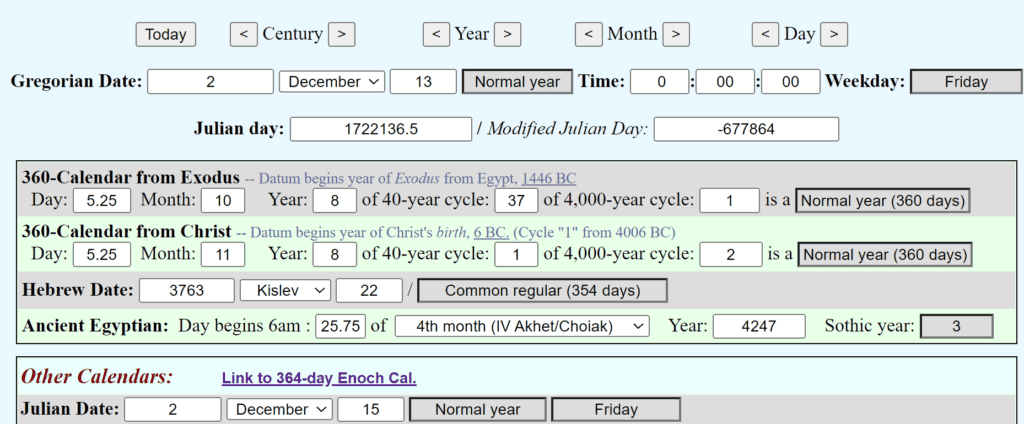
| Reading | Exact datum / recorded lookup |
|---|---|
| Exodus era | 2824 elapsed days; ordinal 2825. |
| Christ era | 2854 elapsed days; ordinal 2855, same instant. |
| Julian date | December 15, AD 2, Friday. |
| Gregorian date | December 13, AD 2, Friday. |
| Hebrew lookup in the image | Year 3763, Kislev 22. |
| Exodus 360 lookup | Day 5.25, month 10. |
| Christ 360 lookup | Day 5.25, month 11. |
The correct literal year is AD 2, near AD 3. “2825 days after” would instead mean 2825 elapsed days and reach the following day. The two descriptions must not be interchanged.
The image places the Hebrew lookup near Hanukkah, but it does not show Kislev 25. Nor does Exodus day 5.25 in month 10 establish an exact anniversary of the biblical siege’s tenth day of the tenth month (2 Kings 25:1). These remain calendar research leads.
| Preserved lead | What needs to be fixed before treating it as an exact correspondence |
|---|---|
| Earliest endpoint in 8 BC and the proposed sixty-fifth schematic day/Pentecost position | Specify era, day boundary, ordinal versus elapsed count, and feast-calendar instance. |
| Terminal near Hanukkah in AD 2; thirty symbolic years to a proposed AD 32 Dedication | Distinguish the saved Kislev 22 from Kislev 25; identify the later calendar instance. |
| Forty-year overlay to AD 33 Ascension/Pentecost | Select an exact earlier endpoint, inclusive/elapsed rule, and distinct Ascension and Pentecost dates. |
| AD 29 Tabernacles → AD 32 Hanukkah as 1150 | Specify both festival calendars and date conventions; do not identify this with the final central 990. |
| Proposed 1260/1290 ministry and siege-anniversary links | Supply exact endpoints and chronology; the present screenshot does not establish them. |
The outer expansion itself remains exact: 2145 → 2825 = 680, while 2105 → 2825 = 720 = 2 × 360. On the lower side, −685 → −5 = 680, and −685 → 35 = 720. Decimal inverse 680 ↔ 860 = 2 × 430 is a further scale observation. Two schematic 360-unit years are not automatically two elapsed Julian or Gregorian years.
Herod’s order concerning boys two years old and under (Matthew 2:16) supplies a typological comparison with this 720-unit extension. The narrative gives an age range selected for the order, not an exact measured interval from Jesus’ birth to the decree.
The compressed ±2 day–year analogy can be compared with Noah/Shem’s gears, using Gear 2 as the normative center and named alternatives on either side. It is distinct from the retired blanket ±1 allowance; a later explicitly defined post-expansion adjustment would require its own rule. See the calendar-datum appendix’s gear tables.
12. Sources and further reading
The principal controls are File 46 for scalar operators, File 13 for the circumcision and purification datums, File 12 for calendar distinctions, and File 18 for ordinary chronological nodes. Anchor-specific applications retain their controlling local source.
The novel set experiment and the qualified research proposals remain defined here. They are not presented as repository-wide canonical theorems. The Unified Chronology supplies the wider source map.
Return to the main Part 5B study.
Original research discussion: Read the preserved original Part 5B.
Scripture references use clean links to the Berean Standard Bible. The Holy Bible, Berean Standard Bible, BSB is produced in cooperation with Bible Hub, Discovery Bible, OpenBible.com, and the Berean Bible Translation Committee. This text of God’s Word has been dedicated to the public domain.