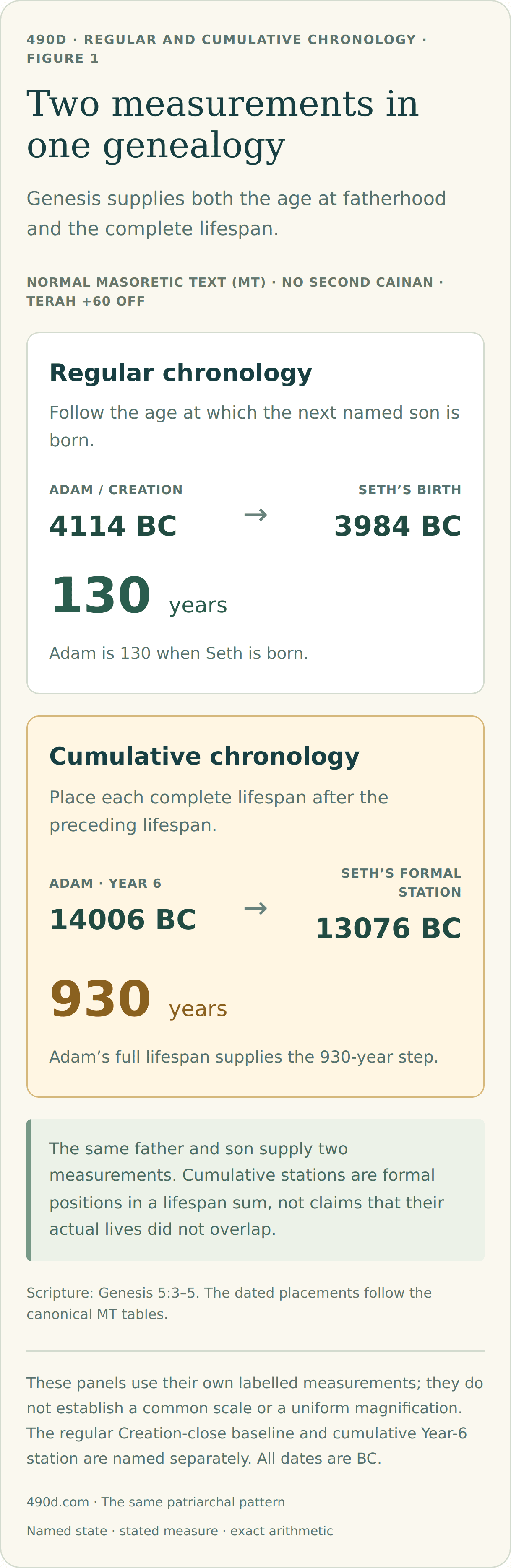
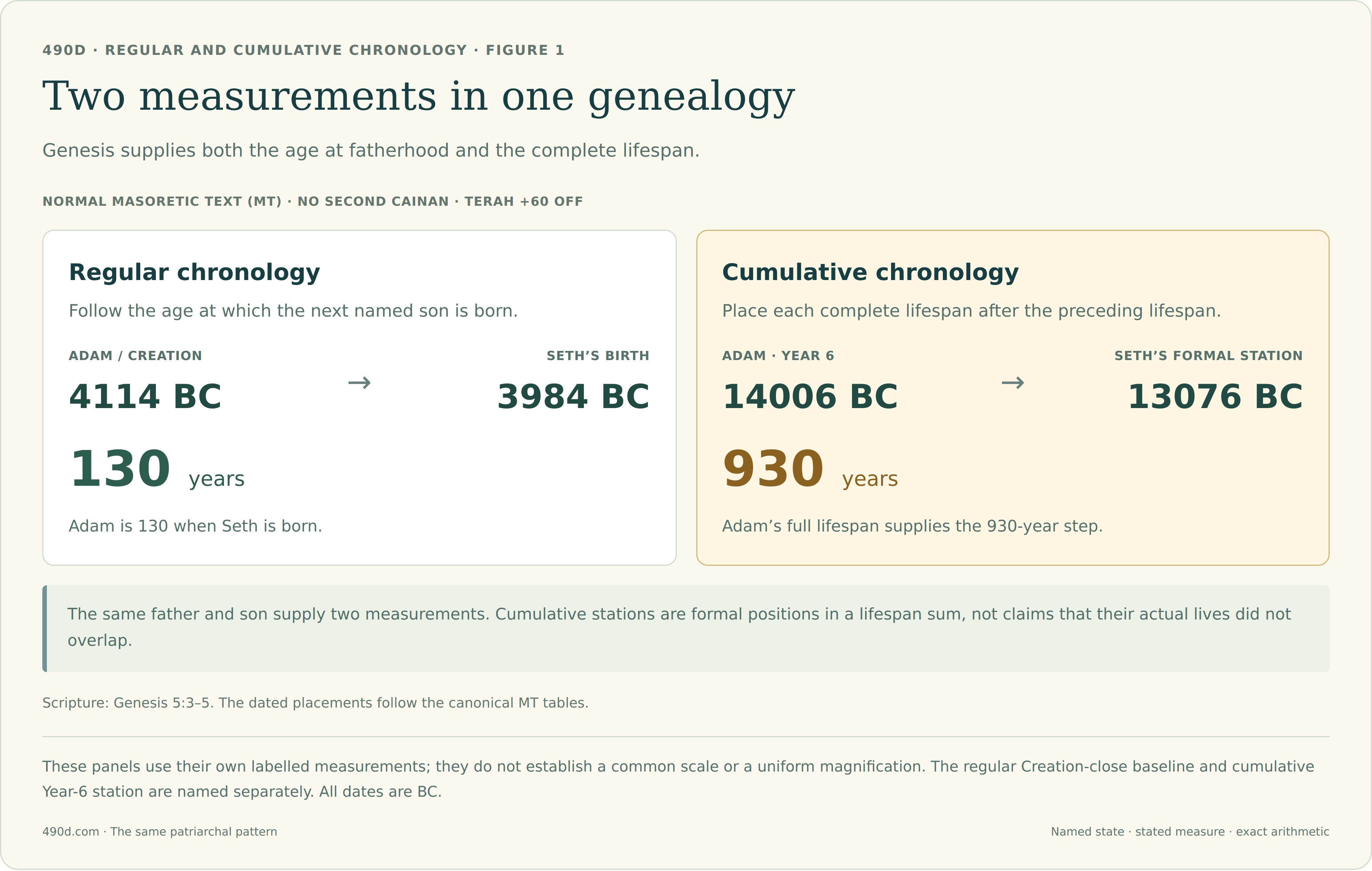
Genesis gives two kinds of time within the same family line: a father’s age when his son was born, and the full length of his life. The distinction is plain in Adam’s genealogy:
When Adam was 130 years old, he had a son in his own likeness, after his own image; and he named him Seth.
— Genesis 5:3, Berean Standard Bible (BSB)
So Adam lived a total of 930 years, and then he died.
The 130 years carry the genealogy from Adam’s birth to Seth’s birth. The 930 years measure Adam’s whole life. Regular chronology follows the first kind of number; cumulative chronology places complete lifespans one after another along the ancestral line.
The resulting timelines differ greatly in length. Yet selected relationships among the patriarchs preserve a recognizable numerical pattern. One particularly clear example brings together Jared, the second Cainan, and the unit of 460 years. It begins with an ordinary genealogical sum and develops into a comparison whose two ends can both be checked.
This study uses the Masoretic Text (MT) as its baseline. The ordinary framework is Nisan reckoning, 430 years in Egypt, and no additional 60 years for Terah. The second Cainan enters only in the explicitly identified restored-Cainan comparison below. These are precise chronological figures, rather than the separately constructed Rounded Chronology.
One genealogy, two measurements
In regular chronology, generations overlap: Seth is born while Adam is still alive. In cumulative chronology, Adam’s entire 930-year lifespan occupies the first position, followed by Seth’s entire lifespan, and so on. The cumulative dates are therefore formal positions in a lifespan sum, not a second set of historical birth dates.
490d · Regular and Cumulative Chronology · Figure 1
Two measurements in one genealogy
Genesis supplies both the age at fatherhood and the complete lifespan.
Normal Masoretic Text (MT) · no second Cainan · Terah +60 off
Regular chronology
Adam is 130 when Seth is born.
Cumulative chronology
Adam’s full lifespan supplies the 930-year step.
Scripture: Genesis 5:3–5. The dated placements follow the canonical MT tables.
These panels use their own labelled measurements; they do not establish a common scale or a uniform magnification. The regular Creation-close baseline and cumulative Year-6 station are named separately. All dates are BC.
Continue this comparison as far as Jared. The regular genealogy adds the five ages at fatherhood from Adam through Mahalalel:
130 + 105 + 90 + 70 + 65 = 460 years.
The cumulative calculation adds those same five men’s complete lifespans:
930 + 912 + 905 + 910 + 895 = 4552 years.
The people and their order remain the same; the quantity being measured changes. This matters when looking for patterns. Cumulative chronology does not multiply every regular interval by a fixed factor. Its relationships have to be demonstrated individually. The five-row supporting table makes both sums immediately visible.
The full cumulative MT line contains 26 lifespans totaling 12600 years, with Moses’ death and the Conquest in 1406 BC as its terminal anchor. The introduction to cumulative chronology explains that foundation. Here our concern is how selected relationships in that longer structure correspond to the regular genealogy.
Jared supplies the 460-year unit
In the regular MT table, Adam stands at 4114 BC and Jared at 3654 BC:
4114 − 3654 = 460 = 20 × 23.
This is the first connection to the Key of 23: the interval contains twenty units of 23 years. It comes directly from the five begetting ages just listed.
The same 460-year unit becomes especially useful when the second Cainan is introduced. He is the post-Flood Cainan placed between Arphaxad and Shelah, distinct from the earlier Kenan in Genesis 5. He is absent from the ordinary MT ancestral list. The canonical comparison opens a separate restored-Cainan state, using 130 years to the birth of Shelah and a 460-year complete lifespan.
The textual background is explained in The Second Cainan: Why 130 and 460 Years Matter. That distinction explains why his insertion affects the two methods differently.
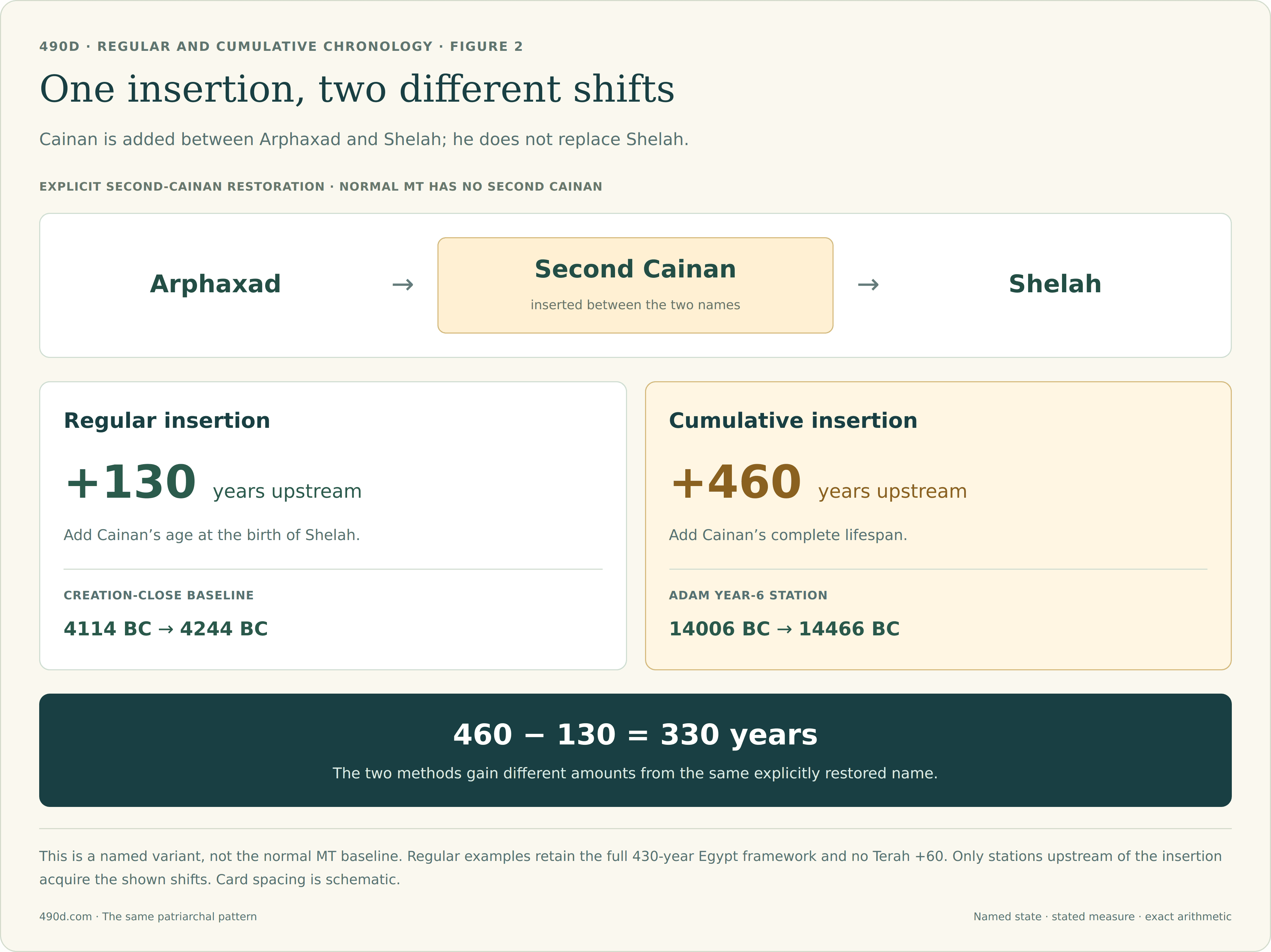
Why one insertion adds 130 years here and 460 there
Regular chronology gains the additional 130-year father-to-son interval. Cumulative chronology gains the additional 460-year life. In each case, earlier positions move back by the added amount while the later ancestral line remains fixed.
490d · Regular and Cumulative Chronology · Figure 2
One insertion, two different shifts
Cainan is added between Arphaxad and Shelah; he does not replace Shelah.
Explicit second-Cainan restoration · normal MT has no second Cainan
Regular insertion
Add Cainan’s age at the birth of Shelah.
Cumulative insertion
Add Cainan’s complete lifespan.
The two methods gain different amounts from the same explicitly restored name.
This is a named variant, not the normal MT baseline. Regular examples retain the full 430-year Egypt framework and no Terah +60. Only stations upstream of the insertion acquire the shown shifts. Card spacing is schematic.
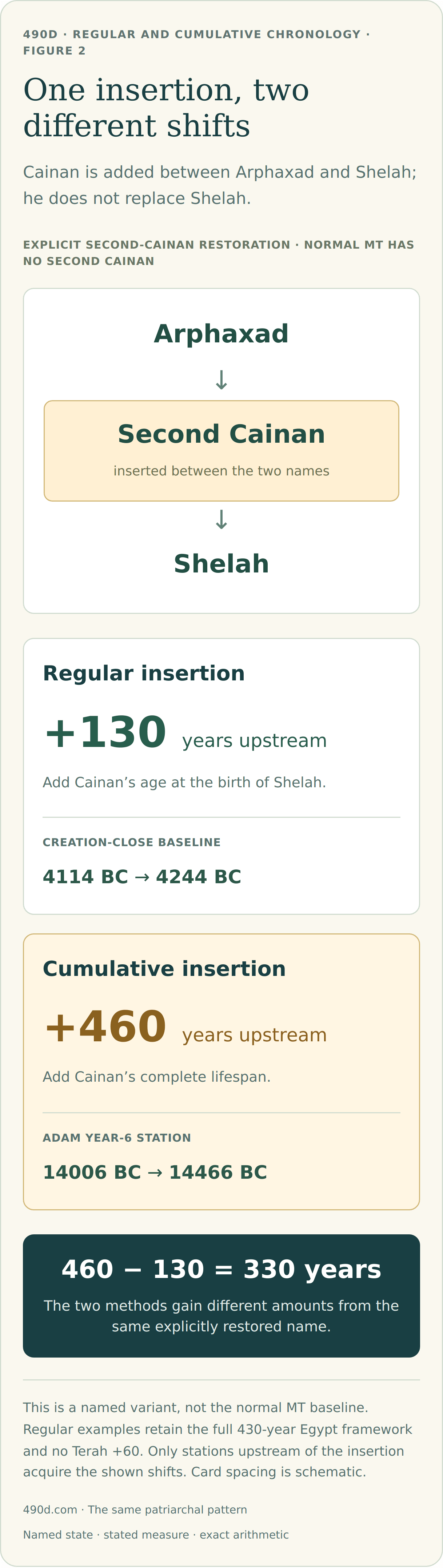
The effect on the cumulative Adam position is straightforward: 14006 + 460 = 14466 BC. These are the original and restored-Cainan Year-6 positions. In the regular table, its Creation endpoint moves from 4114 to 4244 BC, an addition of 130 years. Each example keeps its own kind of position; the appendix identifies the endpoints and the affected generations.
The restored comparison therefore brings together two uses of 460. It is the regular interval from Adam to Jared, and it is the full life added by the second Cainan to the cumulative line. From there, we can ask a more specific question: how does Cainan’s own lifespan sit in the two chronologies?
A 460-year life, translated by 2300 years
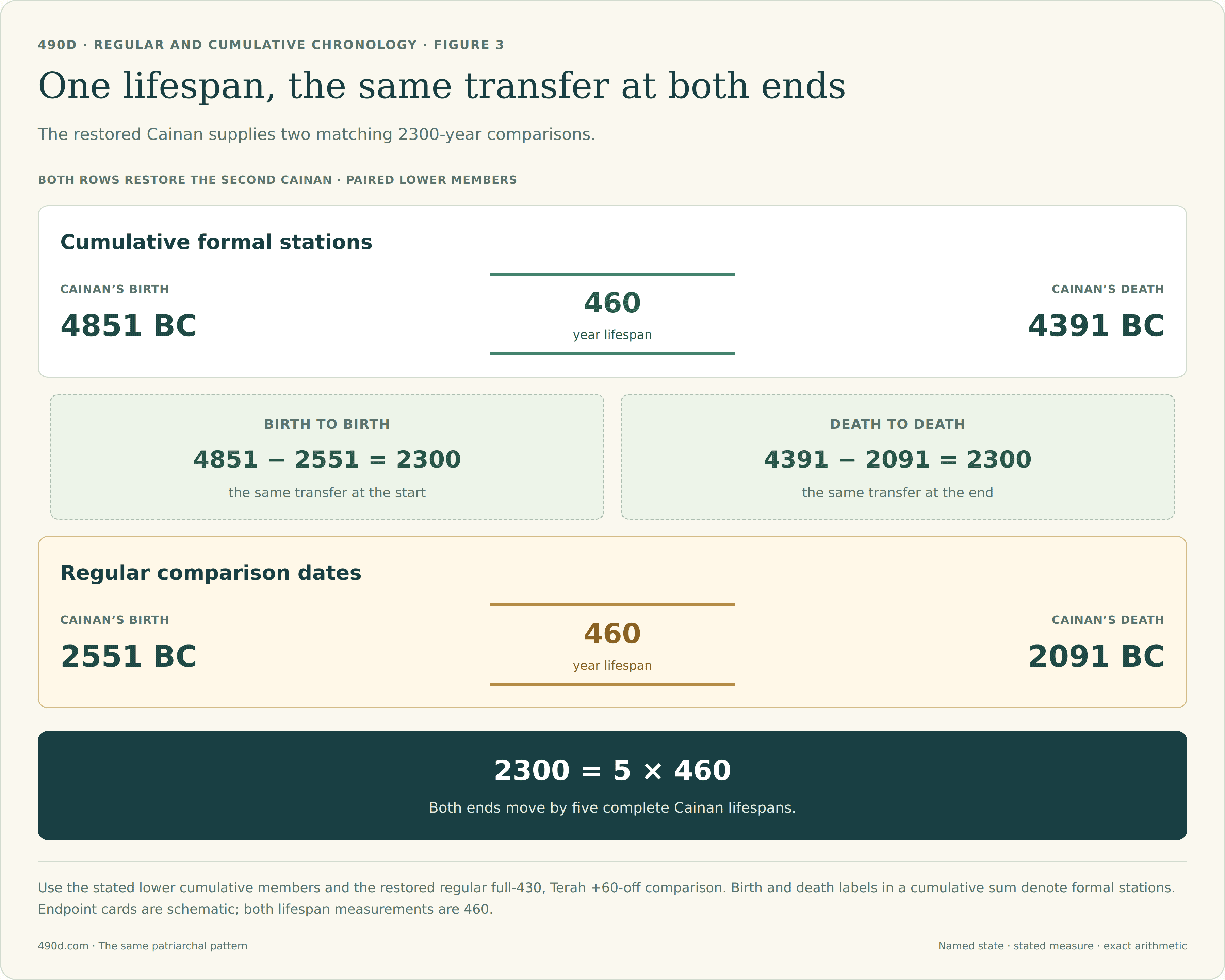
For this comparison, use the lower members of the cumulative Cainan birth and death ranges, 4851 and 4391 BC. The corresponding restored regular dates are 2551 and 2091 BC, in the normal 430-years-in-Egypt framework without the additional Terah years.
Both pairs describe the same length of life:
4851 − 4391 = 460 years.
2551 − 2091 = 460 years.
More strikingly, the distance between the two birth positions equals the distance between the two death positions:
4851 − 2551 = 2300 years.
4391 − 2091 = 2300 years.
490d · Regular and Cumulative Chronology · Figure 3
One lifespan, the same transfer at both ends
The restored Cainan supplies two matching 2300-year comparisons.
Both rows restore the second Cainan · paired lower members
Cumulative formal stations
Regular comparison dates
Both ends move by five complete Cainan lifespans.
Use the stated lower cumulative members and the restored regular full-430, Terah +60-off comparison. Birth and death labels in a cumulative sum denote formal stations. Endpoint cards are schematic; both lifespan measurements are 460.
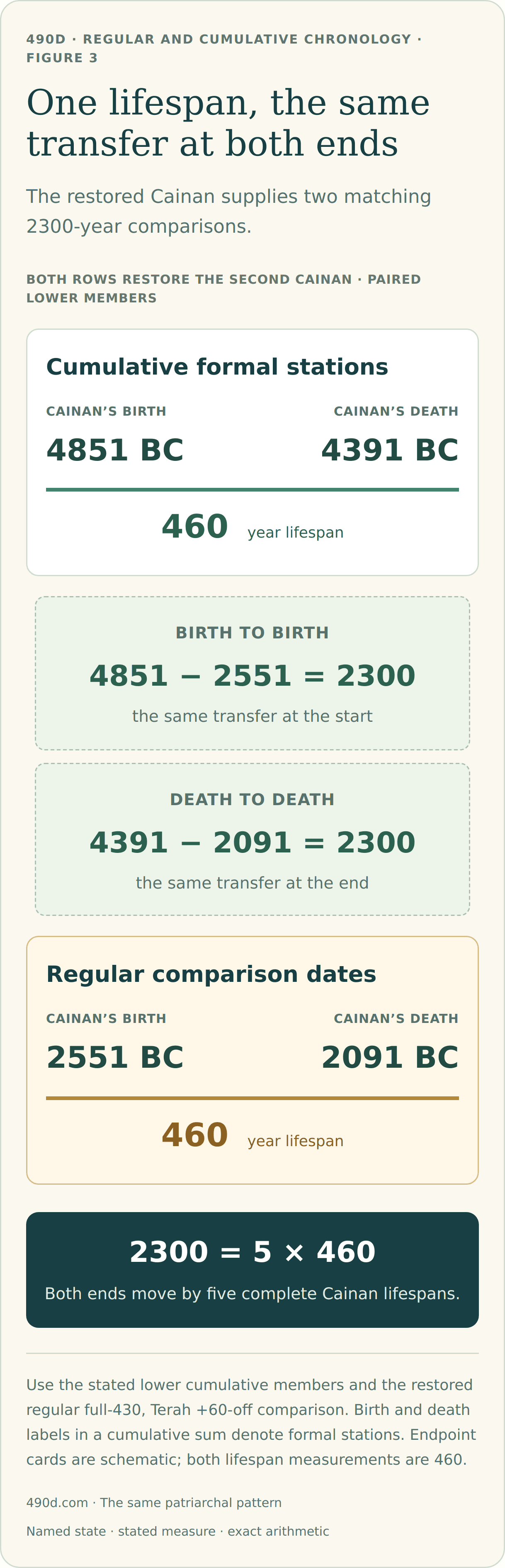
This is a complete correspondence, with both ends of the lifespan preserved. The 460-year life has moved by 2300 = 5 × 460 years. Checking the birth as well as the death shows exactly what is being compared.
The canonical files associate 2300 with the sanctuary number in Daniel 8:14. Here the chronological arithmetic is sufficient to establish the comparison; the prophetic association supplies a further interpretive connection. Neither association makes the cumulative positions ordinary historical dates. The paired-transfer table gives the four endpoints, their states, and both calculations.
Jared and Cainan: ten, eleven, and twelve units
The fuller Jared–Cainan comparison arranges the same unit into a small ladder. Current File 22 defines completed boundary spans of 4600, 5060, and 5520 years—ten, eleven, and twelve units of 460.
Two changes each add one unit. Moving from Cainan’s birth to his death adds his 460-year life. Moving from the original cumulative Jared range to the restored-Cainan Jared range adds the 460 years inserted earlier in the cumulative line.
490d · Regular and Cumulative Chronology · Figure 4
The Jared–Cainan 460-year ladder
Four comparisons reveal ten, eleven, eleven, and twelve complete units.
Cumulative chronology · canonical completed-boundary spans
Original Jared Restored Cainan’s birth
Original Jared Restored Cainan’s death
Restored Jared Restored Cainan’s birth
Restored Jared Restored Cainan’s death
Changing either selected endpoint adds one 460-year unit.
Each row is an independent, explicitly named comparison. These are the canonical completed-boundary totals, not raw subtraction of displayed BC labels. Endpoint-label totals are respectively 4601, 5061, 5061, and 5521. See the linked appendix table for both columns.
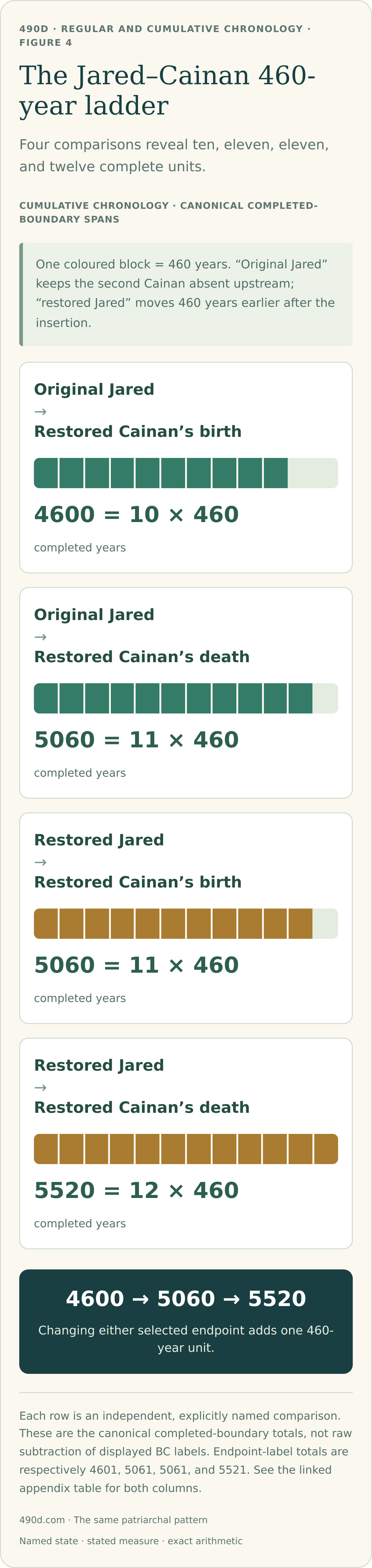
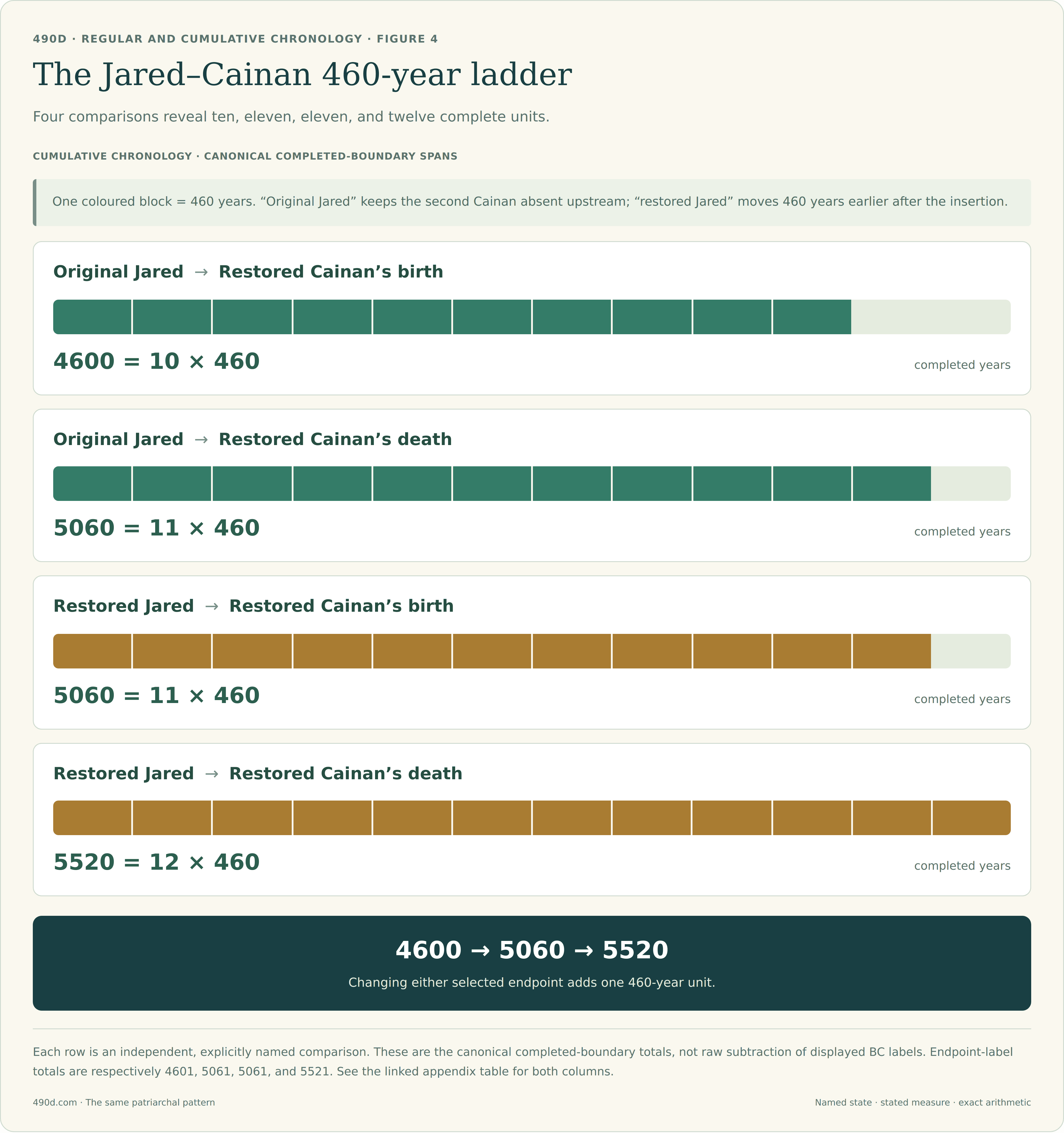
The two middle comparisons consequently agree. Original Jared to Cainan’s death and restored Jared to Cainan’s birth each contain 11 × 460 = 5060 completed years. Applying both changes gives 12 × 460 = 5520.
The counting convention matters here. In these particular forwarded seven-year ranges, subtracting corresponding printed endpoint labels gives 4601, 5061, and 5521. File 22 distinguishes those label differences from the completed boundary spans shown in the diagram. The appendix puts the ranges and both counts side by side; this one-year distinction is local to that comparison, not a general instruction to subtract an extra year from BC dates.
With the convention stated, the shape is easy to follow: ten units; eleven by either route; twelve when both changes are included. Each step retains a named genealogical meaning.
What the correspondence shows
The pattern begins with 460 years from Adam to Jared in regular chronology. The restored second Cainan supplies a 460-year life; his birth and death positions transfer between the two methods by five such units; and the completed Jared–Cainan comparison develops the unit into ten, eleven, and twelve.
This is the sense in which the same patriarchal pattern appears across the two chronologies. The recurrence belongs to particular people, particular endpoints, and stated ways of counting. It invites a theological reading of order within the genealogies while leaving the calculations open to inspection. The arithmetic establishes the relationships; their significance is an interpretation of that structure, not a statistical probability claim.
Readers who want to follow the numbers can go directly to the method table, the Cainan transfer, or the completed-span ladder. The literal cumulative tables provide the larger ancestral sequence. The controlling discussion is in File 22, §6.1 and §§7.5–7.10, read alongside File 18’s chronological tables.
For the full study, continue to Regular and Cumulative MT Chronology: Patriarchal Relationships and the Key of 23.
Scripture quotations: Berean Standard Bible (BSB), public domain.