Revelation’s words and temporal patterns · Part 5 reference appendix
The inventories and tables below distinguish lexical occurrences from the hours assigned to them. They also preserve the original study’s supplementary models while making their boundaries, arithmetic, and evidential status explicit.
Clock values use a schematic 24-hour day. Noon on Friday, Nisan 14, is the centre of the main thematic grid. Its signed indices measure hours before or after that centre. The direct temporal-word overlays use their own noon-start convention, as specified in each table. None of the tables is a fresh count against a different Greek edition.
In this appendix
A. The complete 26-occurrence index of “hour” in John
These 26 occurrences occupy 24 verses. John 4:52 and 12:27 each contain the word twice. A plural word, as in John 11:9’s twelve hours, is one lexical occurrence. An occurrence can name a duration, a clock hour, an appointed moment, or a short while; the inventory records the word, not a uniform length of time.
| No. | Reference | Greek phrase in the inherited index | Meaning in context |
|---|---|---|---|
| 1 | John 1:39 | ὥρα ἦν ὡς δεκάτη | About the tenth hour; the first disciples remain with Jesus. |
| 2 | John 2:4 | οὔπω ἥκει ἡ ὥρα μου | Jesus’ hour has not yet come. |
| 3 | John 4:6 | ὥρα ἦν ὡς ἕκτη | About the sixth hour; Jesus sits at the well. |
| 4 | John 4:21 | ἔρχεται ὥρα | An hour is coming when worship will not be tied to either mountain. |
| 5 | John 4:23 | ἔρχεται ὥρα καὶ νῦν ἐστιν | The hour is coming, and is now here, for true worship. |
| 6 | John 4:52a | τὴν ὥραν … ἐπύθετο | The father asks at what hour his son began to recover. |
| 7 | John 4:52b | χθὲς ὥραν ἑβδόμην | The servants name the seventh hour. |
| 8 | John 4:53 | ἐκείνῃ τῇ ὥρᾳ | The father recognizes the same hour in which Jesus spoke. |
| 9 | John 5:25 | ἔρχεται ὥρα καὶ νῦν ἐστιν | The hour is coming, and is now here, when the dead hear the Son. |
| 10 | John 5:28 | ἔρχεται ὥρα | The hour is coming when those in the tombs hear His voice. |
| 11 | John 5:35 | πρὸς ὥραν | The people were willing to rejoice in John’s light for a time. |
| 12 | John 7:30 | οὔπω ἐληλύθει ἡ ὥρα αὐτοῦ | Jesus’ hour has not yet come. |
| 13 | John 8:20 | οὔπω ἐληλύθει ἡ ὥρα αὐτοῦ | His hour has not yet come. |
| 14 | John 11:9 | δώδεκα ὧραί εἰσιν τῆς ἡμέρας | The twelve hours of the day. |
| 15 | John 12:23 | ἐλήλυθεν ἡ ὥρα | The hour has come for the Son of Man to be glorified. |
| 16 | John 12:27a | ἐκ τῆς ὥρας ταύτης | Jesus speaks of being saved from this hour. |
| 17 | John 12:27b | εἰς τὴν ὥραν ταύτην | He has come to this hour for this purpose. |
| 18 | John 13:1 | ἦλθεν αὐτοῦ ἡ ὥρα | His hour has come to leave the world and go to the Father. |
| 19 | John 16:2 | ἔρχεται ὥρα | An hour is coming when persecutors will think they serve God. |
| 20 | John 16:4 | ὅταν ἔλθῃ ἡ ὥρα | The warning is to be remembered when their hour comes. |
| 21 | John 16:21 | ἦλθεν ἡ ὥρα αὐτῆς | A woman in labor grieves because her hour has come. |
| 22 | John 16:25 | ἔρχεται ὥρα | An hour is coming when Jesus will speak plainly of the Father. |
| 23 | John 16:32 | ἰδοὺ ἔρχεται ὥρα καὶ ἐλήλυθεν | The hour is coming, and has come, when the disciples will scatter. |
| 24 | John 17:1 | ἐλήλυθεν ἡ ὥρα | Father, the hour has come. |
| 25 | John 19:14 | ὥρα ἦν ὡς ἕκτη | About the sixth hour on the Preparation of the Passover. |
| 26 | John 19:27 | ἀπ᾽ ἐκείνης τῆς ὥρας | From that hour the disciple takes Jesus’ mother into his own home. |
Clock language and literary time
With a schematic sunrise at 6 a.m., the tenth, sixth, and seventh daytime hours correspond approximately to 4 p.m., noon, and 1 p.m. Such equivalents are working clock illustrations. They do not establish a modern civil timestamp for every Johannine passage. In particular, John 19:14’s trial scene should be compared with Mark’s crucifixion sequence without being identified with it merely because both use numbered hours.
The original preliminary table combined the two occurrences in John 4:52 and likewise combined those in John 12:27. Its 24 rows were therefore a verse-level synopsis of the same 26 words. The complete index above preserves the actual occurrence count. John 13:30’s reference to night and John 20:19, 26’s evening and eight-day notices remain relevant narrative context; they add no occurrences to this 26-word inventory.
The Lazarus comparison
The proposed 3½-day template combines an assumed one-day messenger journey, Jesus’ stated two-day delay, and a half-day associated with His daylight journey to Bethany. John 11:6 supplies the two days, John 11:9 the twelve-hour daylight saying, and John 11:17 the four-day condition of Lazarus in the tomb. The first travel duration and the allocation of the last twelve hours are interpretive assumptions. The combination 1 + 2 + ½ = 3½ is exact once those assumptions are adopted; John does not spell out that complete travel timetable.
The companion Passion interpretation uses a Wednesday-evening-to-Sunday-morning template of 84 hours, divided by Friday noon into 42 + 42. That is a calendar mapping around the cross. The stated Friday-noon-to-Sunday-6-a.m. portion is 42 elapsed hours. A Sunday 5-a.m. visit is 41 hours after Friday noon. Calling either interval 72 or 84 hours requires a separate symbolic scale or a different starting event.
B. Revelation’s direct time words
The selected Part 1 inventory retains ten ordinary hour occurrences, 21 day occurrences, six month occurrences, one eniautos year occurrence, four chronos occurrences, and seven kairos occurrences. A separate half-hour expression occurs at Revelation 8:1. Its assigned half-unit does not make a lexical occurrence half a word.
| Selected category | Greek lemma | Count | Scope |
|---|---|---|---|
| Hour | ὥρα | 10 | A separate half-hour term occurs at 8:1. |
| Day | ἡμέρα | 21 | The sequence developed as three symbolic weeks. |
| Month | μήν | 6 | Five occurrences in the judgments; one in the new creation. |
| Year | ἐνιαυτός | 1 | The hour–day–month–year sequence at 9:15. |
| Span or duration | χρόνος | 4 | Patience, waiting, the end of delay, and a brief release. |
| Appointed time | καιρός | 7 | Includes three occurrences within 12:14. |
| Night | νύξ | 8 | Seven within the day sequence; one after its final occurrence. |
The five-category sum 10 + 21 + 6 + 1 + 4 = 42 and the addition of seven kairos occurrences to give 49 remain as in Part 1. The symbolic half-hour weighting changes the selected hour total to 10½; it should not be inserted into a lexical sum without saying so. The comparison with John likewise retains 26 + 10 = 36 ordinary hour occurrences, or 36½ weighted units when the separate half-hour is included.
B1. Ten hour words and the separate half-hour
The following overlay begins exactly at noon in the positive direction. Each ordinary hour occurrence receives a one-hour band. The Revelation 8:1 expression receives a half-hour band in its textual place after the two church-hour occurrences. The negative band is the exact reflection of that weighted interval about noon. “Ordinary-hour no.” is an ordinal within the ten ordinary words; it is not the signed coordinate of the thematic grid.
| Reading order | Ordinary-hour no. | Revelation | Context | Negative clock band | Positive clock band |
|---|---|---|---|---|---|
| 1 | 1 | 3:3 | An unexpected hour | 11:00–12:00 | 12:00–13:00 |
| 2 | 2 | 3:10 | The hour of trial | 10:00–11:00 | 13:00–14:00 |
| 3 | Separate ½-hour | 8:1 | Silence in heaven | 09:30–10:00 | 14:00–14:30 |
| 4 | 3 | 9:15 | The appointed hour | 08:30–09:30 | 14:30–15:30 |
| 5 | 4 | 11:13 | That hour | 07:30–08:30 | 15:30–16:30 |
| 6 | 5 | 14:7 | The hour of judgment | 06:30–07:30 | 16:30–17:30 |
| 7 | 6 | 14:15 | The hour to reap | 05:30–06:30 | 17:30–18:30 |
| 8 | 7 | 17:12 | One hour | 04:30–05:30 | 18:30–19:30 |
| 9 | 8 | 18:10 | One hour | 03:30–04:30 | 19:30–20:30 |
| 10 | 9 | 18:17 | One hour | 02:30–03:30 | 20:30–21:30 |
| 11 | 10 | 18:19 | One hour | 01:30–02:30 | 21:30–22:30 |
The inherited grouping is 2 + ½ + 2 + 2 + 4 = 10½ weighted hours: the church pair, silence, trumpet-and-earthquake pair, harvest pair, and the ten-kings/Babylon block. Thus 10½ = 3 × 3½. The first 3½ weighted hours end with the occurrence in Revelation 9:15. They are one third of the weighted total, a proposed comparison with the repeated third-part judgments. The ten ordinary occurrences also invite comparison with the ten kings receiving authority for one hour in Revelation 17:12. The count is preserved; the linkage is an interpretation.
B2. The seven kairos occurrences
Each occurrence receives one hour in this overlay, including all three words within Revelation 12:14. Their lexical weights are equal here even though the phrase itself describes a time, times, and half a time. The final row’s clock values are the consequence of the same one-hour rule used in the preceding six rows.
| No. | Revelation | Sense | Negative band | Positive band | Context |
|---|---|---|---|---|---|
| 1 | 1:3 | The time is near | 11:00–12:00 | 12:00–13:00 | Opening bookend. |
| 2 | 11:18 | The time to judge the dead | 10:00–11:00 | 13:00–14:00 | The seventh trumpet and the announcement of judgment and reward. |
| 3 | 12:12 | A short time | 09:00–10:00 | 14:00–15:00 | The devil knows his opportunity is limited. |
| 4 | 12:14 | A time | 08:00–09:00 | 15:00–16:00 | The middle token of seven; the first term of the wilderness formula. |
| 5 | 12:14 | Times | 07:00–08:00 | 16:00–17:00 | The plural term, read as two within the prophetic formula. |
| 6 | 12:14 | Half a time | 06:00–07:00 | 17:00–18:00 | The final term of the three-and-a-half formula. |
| 7 | 22:10 | The time is near | 05:00–06:00 | 18:00–19:00 | Closing bookend. |
The third pair covers 09:00–10:00 and 14:00–15:00. This is the basis of the comparison with the first and last hours in the six-hour crucifixion scheme. It uses the kairos overlay, whose noon-start rule differs by half an hour from the centred thematic bands.
B3. The complete 21-occurrence day inventory
The following is the established Part 1 sequence. It is provided here in full so that the seven plotting checkpoints discussed next cannot be mistaken for seven lexical entries replacing these 21 occurrences. The final occurrence is Revelation 21:25. Revelation 22:20, named in the supplementary checkpoint table, is not the final day occurrence.
| No. | Revelation | Day expression | Context in Part 1 |
|---|---|---|---|
| 1 | 1:10 | The Lord’s Day | The opening vision; a beginning associated with the first day and resurrection. |
| 2 | 2:10 | Ten days of testing | Smyrna’s tribulation; the duration ten occurs within a single day-token. |
| 3 | 2:13 | The days of Antipas | Pergamum’s faithful witness and martyrdom; a possible comparison with Daniel 3. |
| 4 | 4:8 | Praise day and night | The four living creatures; an association with the fourth creation day and its lights. |
| 5 | 6:17 | The great day of wrath | The sixth seal; an early preview of the final confrontation. |
| 6 | 7:15 | Service day and night | The great multitude before the throne; redeemed humanity in God’s presence. |
| 7 | 8:12 | A third of the day darkened | The fourth trumpet; the seventh token completes the first third of the grid. |
| 8 | 9:6 | People seek death in those days | The locust judgment; a dark reversal of the new beginning suggested by an eighth day. |
| 9 | 9:15 | The appointed day | Hour, day, month, and year converge at the sixth trumpet and the Euphrates. |
| 10 | 10:7 | The days of the seventh angel | The mystery reaches completion; the proposed Thunder Week begins. |
| 11 | 11:3 | 1,260 days of testimony | The two witnesses prophesy; their lampstand imagery also recalls light-bearing witness. |
| 12 | 11:6 | The days of their prophecy | The witnesses shut the sky and strike the earth with plagues: Elijah and Moses imagery. |
| 13 | 11:9 | Three and a half days | The witnesses’ bodies are exposed; apparent victory for their enemies. |
| 14 | 11:11 | After three and a half days | Life returns to the witnesses; the second third of the grid is complete. |
| 15 | 12:6 | 1,260 days in the wilderness | The woman is protected and nourished; a new-exodus association. |
| 16 | 12:10 | Accusation day and night | The accuser is thrown down; the proposed Thunder Week ends with victory. |
| 17 | 14:11 | No rest day and night | Judgment on beast worship; the chapter also presents the redeemed as firstfruits. |
| 18 | 16:14 | The great day of God | The sixth bowl; the kings gather for battle after the Euphrates is dried up. |
| 19 | 18:8 | Plagues in one day | Babylon’s destruction; possible echoes of Egypt’s plagues and Jericho’s fall. |
| 20 | 20:10 | Torment day and night | The devil’s final judgment; evil is brought to its end. |
| 21 | 21:25 | Open gates by day; no night | The new Jerusalem; the final position of the third symbolic week. |
B4. What the seven-row day ribbon actually represents
The source’s supplementary day ribbon combines two presentations. Its positive column has seven plotted checkpoints, separated by six intervals of 3½ hours, from noon to 9 a.m. the next day. Its negative clock column has seven checkpoints from 3 p.m. on the preceding day to noon. Those two clock progressions each span 21 hours. The printed negative labels are retained below so that the half-hour differences between some labels and clock positions remain visible.
| Checkpoint | Printed negative label | Printed negative clock | Positive offset | Positive clock | Actual negative clock offset |
|---|---|---|---|---|---|
| 1 | −20½ | Thursday 15:00 | 0 | Friday 12:00 | −21 hours |
| 2 | −17 | Thursday 18:30 | +3½ | Friday 15:30 | −17½ hours |
| 3 | −13½ | Thursday 22:00 | +7 | Friday 19:00 | −14 hours |
| 4 | −10 | Friday 01:30 | +10½ | Friday 22:30 | −10½ hours |
| 5 | −6½ | Friday 05:00 | +14 | Saturday 02:00 | −7 hours |
| 6 | −3 | Friday 08:30 | +17½ | Saturday 05:30 | −3½ hours |
| 7 | 0 | Friday 12:00 | +21 | Saturday 09:00 | 0 hours |
Three constructions should remain distinct. Twenty-one one-hour bands occupy 21 hours on one side. Seven checkpoint centres separated by six 3½-hour steps also span 21 hours. Twenty-one bands of 3½ hours occupy 73½ hours, while 21 point centres separated by 20 such steps span 70 hours. The source’s statement that 21 day words each step by 3½ hours yet have a 21-hour total conflates these measurements.
The outer clock points, Thursday 3 p.m. and Saturday 9 a.m., are 42 hours apart. Their respective relationships to Friday’s 3-p.m. death marker and 9-a.m. crucifixion marker are each 24 hours, but those two 24-hour comparisons overlap by six hours. They therefore do not make a 48-hour outer span. The proposed day ribbon remains a 42-hour frame when those outer clock points are retained.
B5. Month and year overlays at the boundaries
At one hour per month occurrence, the six month words occupy 06:00–12:00 on the negative side and 12:00–18:00 on the positive side. The last outer bands are 06:00–07:00 and 17:00–18:00, centred at offsets −5½ and +5½. The year occurrence at Revelation 9:15 receives 11:00–12:00 and 12:00–13:00. These are temporal overlays; their boundaries differ from the thematic band centres.
On the positive side, the first year band crosses the thematic 0/+1 boundary at 12:30. A day ribbon ending at Saturday 09:00 crosses the churches/seals boundary at Saturday 08:30, inside its final one-hour segment. This supplies the proposed “year/day” boundary echo. The reference to 08:30–09:30 in the source is the whole thematic +21 band, not the final noon-start day-overlay band, which would be 08:00–09:00.
C. The complete thematic hour grid
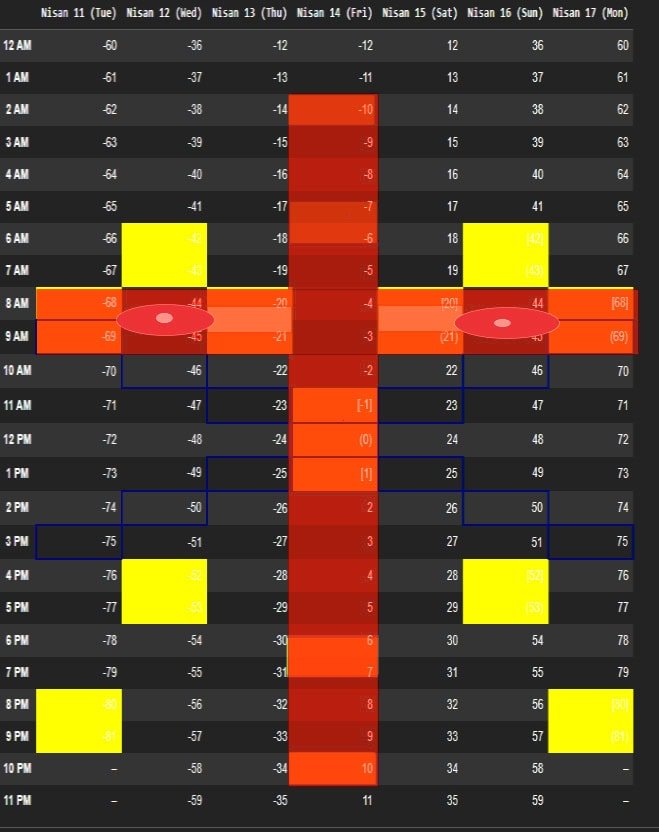
Each number below identifies the centre of a one-hour band extending 30 minutes before and after the printed clock time. The axis is Friday noon, position 0. A positive sign applies the sequence forward; a negative sign reflects it backward. Blank cells outside the −81…+81 range are shown as “Outside” rather than counted as further positions.
The weekday column names identify civil 24-hour columns. Their Nisan numbers identify the daylight date in the working scheme: Friday daylight is Nisan 14, and Friday evening after sunset is Nisan 15. At the midnight edge of a column, a centred band straddles two civil weekdays while remaining within the same sunset-based date.
| Band centre | Tuesday · Nisan 11 daylight | Wednesday · Nisan 12 daylight | Thursday · Nisan 13 daylight | Friday · Nisan 14 daylight | Saturday · Nisan 15 daylight | Sunday · Nisan 16 daylight | Monday · Nisan 17 daylight |
|---|---|---|---|---|---|---|---|
| 00:00 | Outside | −60 | −36 | −12 | +12 | +36 | +60 |
| 01:00 | Outside | −59 | −35 | −11 | +13 | +37 | +61 |
| 02:00 | Outside | −58 | −34 | −10 | +14 | +38 | +62 |
| 03:00 | −81 | −57 | −33 | −9 | +15 | +39 | +63 |
| 04:00 | −80 | −56 | −32 | −8 | +16 | +40 | +64 |
| 05:00 | −79 | −55 | −31 | −7 | +17 | +41 | +65 |
| 06:00 | −78 | −54 | −30 | −6 | +18 | +42 | +66 |
| 07:00 | −77 | −53 | −29 | −5 | +19 | +43 | +67 |
| 08:00 | −76 | −52 | −28 | −4 | +20 | +44 | +68 |
| 09:00 | −75 | −51 | −27 | −3 | +21 | +45 | +69 |
| 10:00 | −74 | −50 | −26 | −2 | +22 | +46 | +70 |
| 11:00 | −73 | −49 | −25 | −1 | +23 | +47 | +71 |
| 12:00 | −72 | −48 | −24 | 0 | +24 | +48 | +72 |
| 13:00 | −71 | −47 | −23 | +1 | +25 | +49 | +73 |
| 14:00 | −70 | −46 | −22 | +2 | +26 | +50 | +74 |
| 15:00 | −69 | −45 | −21 | +3 | +27 | +51 | +75 |
| 16:00 | −68 | −44 | −20 | +4 | +28 | +52 | +76 |
| 17:00 | −67 | −43 | −19 | +5 | +29 | +53 | +77 |
| 18:00 | −66 | −42 | −18 | +6 | +30 | +54 | +78 |
| 19:00 | −65 | −41 | −17 | +7 | +31 | +55 | +79 |
| 20:00 | −64 | −40 | −16 | +8 | +32 | +56 | +80 |
| 21:00 | −63 | −39 | −15 | +9 | +33 | +57 | +81 |
| 22:00 | −62 | −38 | −14 | +10 | +34 | +58 | Outside |
| 23:00 | −61 | −37 | −13 | +11 | +35 | +59 | Outside |
C1. The family boundaries on the positive side
| Section | Indices | Complete occupied interval | Centre information |
|---|---|---|---|
| First | 0 | Friday 11:30–12:30 | Friday 12:00 |
| Churches | +1…+20 | Friday 12:30–Saturday 08:30 | First centre Friday 13:00; last Saturday 08:00 |
| Seals | +21…+42 | Saturday 08:30–Sunday 06:30 | First centre Saturday 09:00; last Sunday 06:00 |
| Thunders | +43…+52 | Sunday 06:30–16:30 | First centre 07:00; last 16:00 |
| Trumpets | +53…+68 | Sunday 16:30–Monday 08:30 | First centre Sunday 17:00; last Monday 08:00 |
| Bowls | +69…+80 | Monday 08:30–20:30 | First centre 09:00; last 20:00 |
| Last | +81 | Monday 20:30–21:30 | Monday 21:00 |
C2. The inherited original/inverse overlay
The earlier overlaid table is reproducible as a reflection of the clock row within each day-column. Let d be the day-column offset from Friday, and h the hour printed in the first clock label. The two values are 24 d + h − 12 and 24 d + 12 − h. Their sum is 48 d. This operation reflects around noon in each column; it is not the global transformation n → −n except in Friday’s column.
The second clock label is 24:00 − h. Thus the midnight row pairs 00:00 with 24:00, the following midnight; the noon row pairs 12:00 with 12:00. This corrects the earlier AM/PM labels while retaining its numerical pairs. Values beyond ±81 are guide coordinates of the surrounding rectangle, not additional model positions.
| Original / reflected clock row | Tuesday · Nisan 11 daylight | Wednesday · Nisan 12 daylight | Thursday · Nisan 13 daylight | Friday · Nisan 14 daylight | Saturday · Nisan 15 daylight | Sunday · Nisan 16 daylight | Monday · Nisan 17 daylight |
|---|---|---|---|---|---|---|---|
| 00:00 / 24:00 | −84 / −60 | −60 / −36 | −36 / −12 | −12 / +12 | +12 / +36 | +36 / +60 | +60 / +84 |
| 01:00 / 23:00 | −83 / −61 | −59 / −37 | −35 / −13 | −11 / +11 | +13 / +35 | +37 / +59 | +61 / +83 |
| 02:00 / 22:00 | −82 / −62 | −58 / −38 | −34 / −14 | −10 / +10 | +14 / +34 | +38 / +58 | +62 / +82 |
| 03:00 / 21:00 | −81 / −63 | −57 / −39 | −33 / −15 | −9 / +9 | +15 / +33 | +39 / +57 | +63 / +81 |
| 04:00 / 20:00 | −80 / −64 | −56 / −40 | −32 / −16 | −8 / +8 | +16 / +32 | +40 / +56 | +64 / +80 |
| 05:00 / 19:00 | −79 / −65 | −55 / −41 | −31 / −17 | −7 / +7 | +17 / +31 | +41 / +55 | +65 / +79 |
| 06:00 / 18:00 | −78 / −66 | −54 / −42 | −30 / −18 | −6 / +6 | +18 / +30 | +42 / +54 | +66 / +78 |
| 07:00 / 17:00 | −77 / −67 | −53 / −43 | −29 / −19 | −5 / +5 | +19 / +29 | +43 / +53 | +67 / +77 |
| 08:00 / 16:00 | −76 / −68 | −52 / −44 | −28 / −20 | −4 / +4 | +20 / +28 | +44 / +52 | +68 / +76 |
| 09:00 / 15:00 | −75 / −69 | −51 / −45 | −27 / −21 | −3 / +3 | +21 / +27 | +45 / +51 | +69 / +75 |
| 10:00 / 14:00 | −74 / −70 | −50 / −46 | −26 / −22 | −2 / +2 | +22 / +26 | +46 / +50 | +70 / +74 |
| 11:00 / 13:00 | −73 / −71 | −49 / −47 | −25 / −23 | −1 / +1 | +23 / +25 | +47 / +49 | +71 / +73 |
| 12:00 / 12:00 | −72 / −72 | −48 / −48 | −24 / −24 | 0 / 0 | +24 / +24 | +48 / +48 | +72 / +72 |
| 13:00 / 11:00 | −71 / −73 | −47 / −49 | −23 / −25 | +1 / −1 | +25 / +23 | +49 / +47 | +73 / +71 |
| 14:00 / 10:00 | −70 / −74 | −46 / −50 | −22 / −26 | +2 / −2 | +26 / +22 | +50 / +46 | +74 / +70 |
| 15:00 / 09:00 | −69 / −75 | −45 / −51 | −21 / −27 | +3 / −3 | +27 / +21 | +51 / +45 | +75 / +69 |
| 16:00 / 08:00 | −68 / −76 | −44 / −52 | −20 / −28 | +4 / −4 | +28 / +20 | +52 / +44 | +76 / +68 |
| 17:00 / 07:00 | −67 / −77 | −43 / −53 | −19 / −29 | +5 / −5 | +29 / +19 | +53 / +43 | +77 / +67 |
| 18:00 / 06:00 | −66 / −78 | −42 / −54 | −18 / −30 | +6 / −6 | +30 / +18 | +54 / +42 | +78 / +66 |
| 19:00 / 05:00 | −65 / −79 | −41 / −55 | −17 / −31 | +7 / −7 | +31 / +17 | +55 / +41 | +79 / +65 |
| 20:00 / 04:00 | −64 / −80 | −40 / −56 | −16 / −32 | +8 / −8 | +32 / +16 | +56 / +40 | +80 / +64 |
| 21:00 / 03:00 | −63 / −81 | −39 / −57 | −15 / −33 | +9 / −9 | +33 / +15 | +57 / +39 | +81 / +63 |
| 22:00 / 02:00 | −62 / −82 | −38 / −58 | −14 / −34 | +10 / −10 | +34 / +14 | +58 / +38 | +82 / +62 |
| 23:00 / 01:00 | −61 / −83 | −37 / −59 | −13 / −35 | +11 / −11 | +35 / +13 | +59 / +37 | +83 / +61 |
C3. Centres, bands, and enclosing templates
| Construction | Positions or cells | Endpoint-centre distance | Complete band width | Use |
|---|---|---|---|---|
| 0…80 | 81 | 80 hours | 81 hours | Original opening-plus-keywords sequence. |
| 0…81 | 82 | 81 hours | 82 hours | Adds the closing Christ bookend. |
| −12…+12 | 25 | 24 hours | 25 hours | Two midnight centres; complete endpoint bands add an hour. |
| −24…+24 | 49 | 48 hours | 49 hours | The 24 + 1 + 24 elders/Jubilee display. |
| −42…+42 | 85 | 84 hours | 85 hours | Wednesday-evening-to-Sunday-dawn centre interval. |
| −81…+81 | 163 | 162 hours | 163 hours | Complete mirrored extended hour grid. |
| Contracted 0…71 | 72 | 71 hours | 72 hours | 70 lexical occurrences plus two bookends. |
| Contracted −71…+71 | 143 | 142 hours | 143 hours | Mirrors that contracted centred-band convention. |
| Ideal seven-day rectangle | 168 one-hour cells | Depends on chosen endpoints | 168 hours | An enclosing template; not identical to the occupied −81…+81 bands. |
The contracted positions 0–71 have a complete width of 72 hours. Mirroring their centres gives −71…+71: 143 bands, 142 hours between the outer centres, and 143 hours across their full width. A separate template with limits at ±72 hours spans 144 elapsed hours, or six days. That six-day interval requires the stated extension beyond the contracted display. Likewise ±84 hours describes seven elapsed days around a centre, while the displayed ±81 centres are six days and eighteen hours apart. A seven-day extension is possible only after its added margins are specified.
D. Fixed indices and the additional visual highlights
The main family boundaries are 0; 1–20; 21–42; 43–52; 53–68; 69–80; 81. Within the trumpet family, position 62 is its tenth lexical entry and describes the sounding of the third trumpet (Revelation 8:10); position 68 is its sixteenth lexical entry and describes the sounding of the seventh (11:15). Trumpet-event numbers and lexical occurrence numbers are different indices. The original Aleph illustration also printed the following seven positive/negative pairs. They are retained as selected graphic points, because several are not first or last positions of the family named beside them.
| Original illustration label | Selected indices retained | Relationship to the fixed family table |
|---|---|---|
| Alpha | ±1 | First church positions in the signed display; 0 is the actual opening bookend. |
| Church | ±22 | Within the seal family; the church boundary is 20/21. |
| Seal | ±42 | Final seal position. |
| Thunder | ±52 | Final thunder position. |
| Trumpet | ±68 | Final trumpet position. |
| Bowl | ±69 | First bowl position. |
| Omega | ±81 | Closing bookend in either reflected direction. |
The other highlighted junctions are −53/−52 with +42/+43, and −21/−20 with +68/+69. These remain available to the original Aleph-like connecting strokes. The seven-points-per-side comparison with seven horns and seven eyes arises from those selected marks; it is not a second count of horns or eyes in Revelation.
The two diagonal runs, −75 to +75 in steps of 25 and −69 to +69 in steps of 23, each contain seven selected points. Opposite endpoints differ by 150 and 138 respectively; 25 and 23 are the differences between consecutive points. Their geometry follows from a 24-column grid. A vertical reflection may suggest a stepped altar or ziggurat, which the source associated with Ezekiel’s altar vision. That is another optional visual comparison, not a new calendrical result.
D1. The exact 80½-to-87½ calculation
80½ = 7 × 11½
80½ × 25/23 = 87½
87½ − 80½ = 7.
These equations hold for hours, weeks, or another consistently chosen unit. If the first number describes a whole symmetric interval, the total increase is seven, allocated as 3½ on each flank. If it describes each of two radii, the increase is seven per radius. The source’s two phrasings represent different constructions and are kept distinct here.
The source also associated ±68 with the half-hour silence. In the main hour grid, −68 is centred on Tuesday 16:00 and +68 on Monday 08:00. In the direct hour-word overlay, Revelation 8:1 occupies Friday 09:30–10:00 and 14:00–14:30. They belong to different grids and cannot be used as interchangeable timestamps. The 3½-hour margin of a scaled graphic is a third quantity, distinct from the biblical half-hour.
E. Calendar boundaries and date labels
The table separates a rule that places a boundary from a rule that assigns a name. The simplified clock assumes sunset at 18:00 and sunrise at 06:00. It does not calculate the actual solar altitude at Jerusalem on a proposed crucifixion date.
| Comparison | Boundary or label rule | What changes | Sunday 05:00 | Status |
|---|---|---|---|---|
| Sunset-based date | Saturday 18:00 | Sunday date after Saturday sunset | Already within the first day | The relevant biblical date convention in this model. |
| Evening-solar comparison | Saturday 18:00, as assumed here | Sunday date after Saturday sunset | Already within the first day | A model combining a solar calendar with an evening boundary; annual length alone does not establish a daily boundary. |
| Proposed earlier morning label | Sunday label stamped Saturday 06:00; sunset retained separately | Label precedes Saturday sunset by 12 h | Carries the Sunday label | An interpretive convention; no quoted 4Q321 instruction establishes this 12 h label shift. |
| Midnight-based civil date | Sunday 00:00 | Sunday at midnight | Already within Sunday | A separate civil naming convention. |
E1. What Enoch contributes
The Book of the Luminaries gives real primary material for the calendar comparison. 1 Enoch 72:32 completes the year in 364 days; 74:12–16 compares solar and lunar totals; 75:1–3 discusses four supplementary days; and 82:4–6, 11 includes those four days in the complete annual reckoning while distinguishing them from the 360-day arrangement. These references correct the earlier attribution of the supplementary-day language to 74:1–3.
The twelve-month 360-day body plus four supplementary days provides a 364-day schematic calendar. Over three and a half such years, the difference from a 360-day scheme is fourteen days: 3½ × 364 = 1,274, compared with 3½ × 360 = 1,260. The comparison does not show that Revelation secretly means 1,274 historical days whenever it says 1,260, nor does it turn 364 days into the actual tropical year.
The source’s “sun first” interpretation draws on the order and language of Enoch 72. It can support a symbolic preference for light leading the calendar. It does not supply a stated rule that the next weekday’s name was attached at the preceding dawn. The moon is already discussed in Enoch 73–74; the former summary saying that lunar discussion begins only in chapters 76–79 was inaccurate.
E2. What the Qumran reference establishes
The Israel Antiquities Authority’s 4Q321 image record identifies the manuscript as Calendrical Document/Mishmarot B. The Library of Congress exhibition supplies context and links to a translation. Those sources support using Qumran’s calendrical material as a comparative setting. The exact “Sunday of Jeshua begins at Saturday dawn” sentence and the claimed scholarly consensus in the original article were not substantiated there. They are therefore retained as a proposal of this study, not attributed to Talmon, VanderKam, Schiffman, or Tov as an established joint conclusion.
E3. The afternoon offering and the half-hour claim
Mishnah Pesaḥim 5:1, rather than the cited Tamid 3–4 passage, provides the relevant schedules. Its stated hours are:
| Occasion | Slaughter: numbered hour | Offering completed: numbered hour | Schematic modern equivalents |
|---|---|---|---|
| Ordinary day | 8½ | 9½ | 14:30 and 15:30 |
| Passover eve, weekday or Sabbath | 7½ | 8½ | 13:30 and 14:30 |
| Passover eve on Friday | 6½ | 7½ | 12:30 and 13:30 |
The Temple’s ordered hours remain an appropriate contextual comparison with Revelation’s worship and silence. The earlier claim that a prescribed post-sacrifice hush “exactly” matches ±68 cannot carry the argument. It combines an unsupported ritual assertion with positions drawn from a different clock scale.
F. Passover, Tabernacles, and the half-day bridge
The festival structures themselves are clear: Nisan 14 precedes seven days of Unleavened Bread, Nisan 15–21; Tabernacles runs Tishri 15–21 and is followed by the assembly on Tishri 22 (Leviticus 23:5–8, 34–36). This supplies the 1 + 7 / 7 + 1 comparison. When seven hour positions such as +68…+74 are used to represent those feast days, the scale has changed from hours to days. Their seven hour-bands on the main clock are not seven elapsed festival days.
The supplementary proposal links the Passion to a Tishri centre through a forward 1,260½-day interval and a backward 1,259½-day interval. Both values are preserved here. Together they give 2,520 days, with their midpoint half a day after the original anchor. They are an asymmetric pair around that original anchor, although they can become symmetric around the shifted midpoint.
| Statement in the original proposal | Arithmetic or coordinate qualification |
|---|---|
| Friday noon, Nisan 17, as the bridge’s start | The main hour grid has Friday Nisan 14; its Nisan 17 daylight is Monday. This is a separate source coordinate, not a second label silently placed on the same grid. |
| Noon +1,260½ days = noon at the endpoint | An ordinary elapsed-day addition of an integer plus ½ changes noon to midnight. A noon endpoint needs another clock or anchor adjustment. |
| Three and a half 364-day years =1,274 days | Exact schematic conversion:1,260+14=1,274. The annual supplementary days are not modern astronomical leap-day corrections. |
| Noon Saturday Tishri 18 +3½ days = pre-dawn Wednesday Tishri 22 | 84 hours after Saturday noon is Wednesday 00:00. A 05:00 endpoint would be 89 hours after noon. |
| Jesus’ tomb interval at position 0…+69 | On the fixed hour grid, +69 is Monday 09:00. Sunday 05:00 is +41; Sunday 06:00 is +42. |
| Friday noon to Sunday pre-dawn ≈45 hours | Sunday 05:00 is 41 h after Friday noon; Sunday 06:00 is 42 h. 45 h reaches Sunday 09:00. |
| Tishri 14 noon → Tishri 18 noon → Tishri 21 noon | The two intervals are 4 days and 3 days, not equal 3½-day radii. |
| Tishri 15 noon → Tishri 18 noon → Tishri 22 noon | The two intervals are 3 days and 4 days. The 7+1 festival typology is separate from a symmetric elapsed-time fan. |
| Backward endpoint in autumn AD 27 from an AD 30? Passion anchor | Retained as the earlier alternative ministry setting. It is not established by the main article’s hour arithmetic or substituted for the site’s AD 33 preference. |
The half-day comparison itself remains simple: 72 + 12 = 84 hours. The theological parallels are the third-day motif in Luke 13:32, Lazarus already four days in the tomb in John 11, the witnesses’ three and a half days in Revelation 11, and the earthquakes accompanying resurrection or vindication in Matthew 28:2 and Revelation 11:13. These parallels do not require treating inclusive day names, ideal 24-hour multiples, and observed tomb-discovery times as one measurement.
For a literal symmetric fan around Tishri 18 noon, the endpoints at ±3½ days would fall at midnight boundaries, not both at noon. A morning-label convention could change their date names, but it would not change those clock differences. The earlier festival diagram therefore remains an interpretive placement of feast motifs rather than a verified date-conversion table.
G. The eight-position Creation and Nativity table
The original table’s literal Julian dates and symbolic year labels are retained below. The Julian-day values identify midnight at the beginning of each literal date. The associated events are theological echoes assigned within this display; the table is not an alternative set of historical birth dates replacing the site’s normal 6 BC anchor.
| Symbolic position | Symbolic year interval | Literal Julian date | JD at midnight | Weekday | Assigned echo |
|---|---|---|---|---|---|
| Day 0 | 7 BC autumn–6 BC autumn | 25 December 1 BC | 1721416.5 | Saturday | Pre-existent Word; before the counted creation days |
| Day 1 | 6 BC autumn–5 BC autumn | 26 December 1 BC | 1721417.5 | Sunday | Light; angelic-annunciation comparison |
| Day 2 | 5 BC autumn–4 BC autumn | 27 December 1 BC | 1721418.5 | Monday | Waters divided; a suggested journey comparison |
| Day 3 | 4 BC autumn–3 BC autumn | 28 December 1 BC | 1721419.5 | Tuesday | Land and seed; Bethlehem/bread comparison |
| Day 4 | 3 BC autumn–2 BC autumn | 29 December 1 BC | 1721420.5 | Wednesday | Luminaries; the star comparison |
| Day 5 | 2 BC autumn–1 BC autumn | 30 December 1 BC | 1721421.5 | Thursday | Living creatures; shepherds and heavenly-host comparison |
| Day 6 | 1 BC autumn–AD 1 autumn | 31 December 1 BC | 1721422.5 | Friday | Nativity assigned as the second-Adam motif |
| Day 7 | AD 1 autumn–AD 2 autumn | 1 January AD 1 | 1721423.5 | Saturday | Rest and new creation; circumcision motif |
G1. Nine months, eight inclusive days, and forty days
The 18-hour offset is exactly three quarters of a 24-hour day. Mapping it to three quarters of a year gives nine equal months on a twelve-month symbolic year. March 25 to December 25 is nine civil-calendar months and 275 elapsed days in the proleptic Julian calendar. It is not nine average lunar months. The traditional dates serve the incarnation typology; the astronomical equinox and solstice cannot be assumed to fall on those dates in every year.
December 25 as an inclusive birth-day count reaches January 1 as day 8. By contrast, Day 6’s December 31 Nativity label followed by Day 7’s January 1 is only two inclusive civil dates. The table therefore contains two different symbolic associations: a December 25-to-January 1 circumcision week, and a Day 6/Adam Nativity association. They cannot be a single literal birth-to-circumcision chronology. A Nativity label left at Day 6 does not make the next day seven elapsed days later.
Similarly, December 25 to February 2 is forty inclusive dates, or 39 elapsed day intervals. Leviticus 12:2–4’s seven-plus-thirty-three-day purification structure, Luke 2:22–24’s offering, and Acts 1:3’s forty days after the resurrection support a comparative pattern. The chronology of one rite does not transfer its historical event date to the other by numerical resemblance alone.
G2. Macro-scale anchors retained, with their limits
| Proposed relationship | Result under ordinary elapsed-year reckoning | Interpretive treatment |
|---|---|---|
| 1446 BC → 1406 BC | 40 years | Established Exodus–Conquest framework retained. |
| 1 BC → AD 34 /AD 35 | 34 /35 elapsed years | Does not equal 40. The earlier 40-year statement used inconsistent starting labels. |
| 6 BC → AD 35 | 40 elapsed years | Shows which established Nativity anchor supports 40; presented as a distinct anchor, without silently replacing 1 BC in the source table. |
| 6 BC → AD 34 | 39 elapsed years; 40 named years inclusively | An inclusive count must be labelled. |
| 2167 BC +2,160 elapsed years | 7 BC at the same point in the year | The source’s summer 2167-to-spring 6 proposal needs an explicit seasonal offset or rounding; 2166 BC→6 BC is 2,160 elapsed years. |
| 1446 BC +1,440 years | 6 BC | Exact same-era subtraction; 1,440=4×360. |
| 1406 BC +1,440 years | AD 35 | Exact across the BC/AD boundary with no year zero; pairs the Conquest with the stated endpoint. |
| 1,440 and 144,000 | 144,000=1,440×100 | A numerical resonance. 100 generations×100 years is 10,000, not 144,000. |
| Seven-year position 0 in Part 3 | 6 BC–AD 2, midpoint in autumn 3 BC for a spring-to-spring interval | An interval is not a single year; the original “AD−2→+1 midpoint” was not a defined midpoint. |
The supplementary conception date for Abraham is consequently retained as a proposed seasonal coordinate rather than called a traditional historical date. The wider theological comparison—Abraham before Christ, the Exodus before the Nativity, the Conquest before the proposed ascension-era marker—can still be explored. Its arithmetic must state whether it uses whole elapsed years, inclusive named years, or a fraction of a year.
H. The original visual interpretations
The source’s illustrations combine the thematic family highlights with the direct temporal overlays. The chosen display can suggest a cross, Aleph-like strokes, a face, or a hillside. The inherited reading associates the central line with the nose, selected kairos regions with the eyes, seal-to-bowl links with mouth or beard, and the whole with Golgotha. Some images deliberately intensify the eyes to make the interpretation easier to see.
These pictures should be captioned as visual interpretations of selected and reflected marks. They do not reproduce an unaltered manuscript image, and they are not an independent test of the word count. Two pictures produced from the same chosen construction are also not two independent witnesses in the evidential sense, even when the biblical language of two witnesses provides their theological analogy.
| Original image | Use in the source | Caption qualification |
|---|---|---|
| Aleph-Tav-82-Tokens-of-Revelation 3.jpg | Letter/cross overlay | Selected family points and 23/25 diagonals; consult sectionD for points that are not actual family endpoints. |
| face-of-Alpha-Omega 5 a.jpg | Portrait with eyes emphasized | Eye treatment added to clarify the intended reading. |
| face-of-Alpha-Omeg 6 a.jpg | Portrait with month overlay | Includes the six month-word bands and their±5½ outer centres. |
| face-of-Alpha-Omega 4 e.jpg | Hill/Golgotha interpretation | A visual reading formed by marking, joining, and reflection. |
Original Aleph–Tav graphic · Portrait with emphasized eyes · Portrait with month-word overlay · Golgotha interpretation.
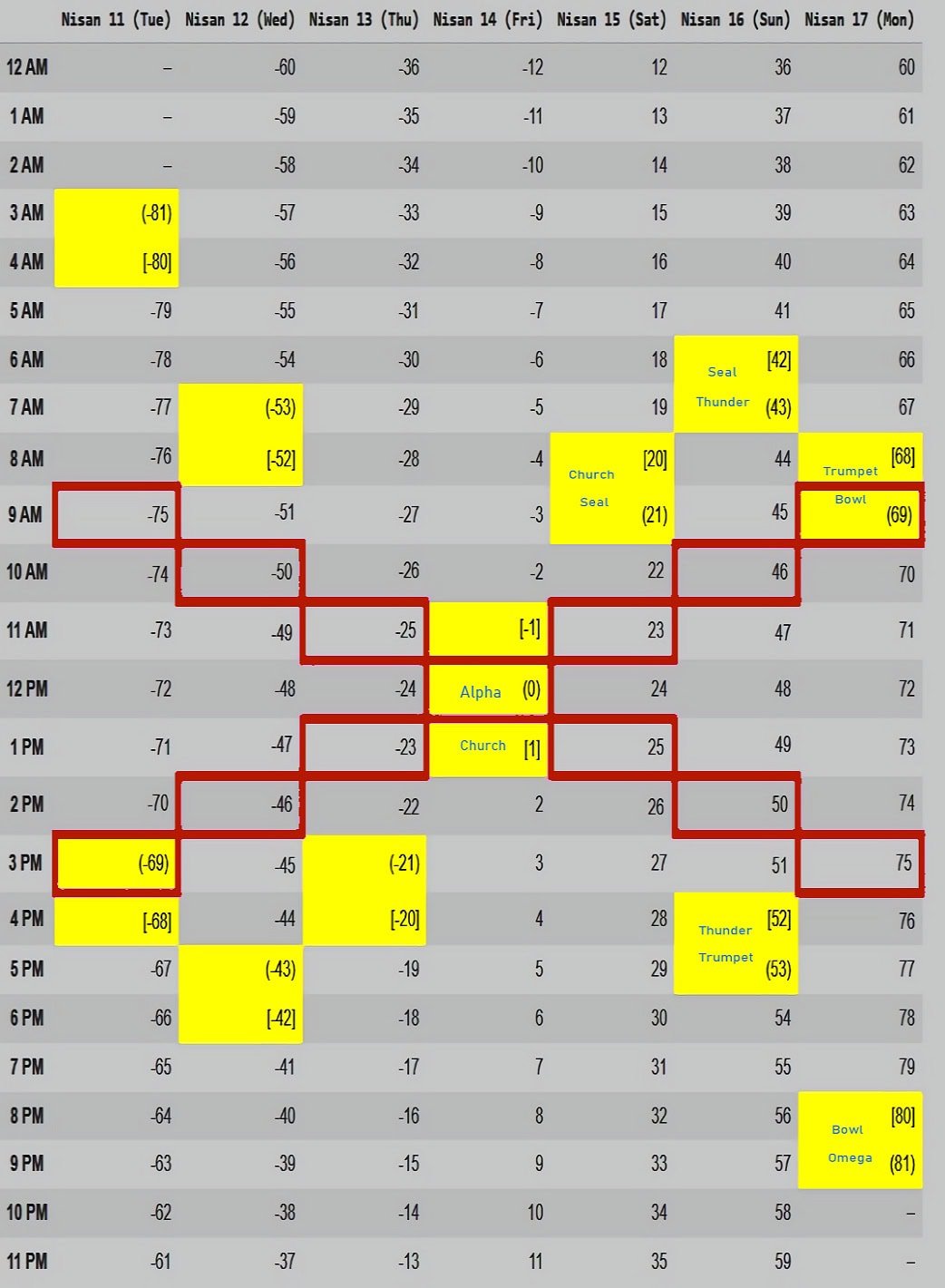
H1. Aleph–Tav: the letter and cross interpretation
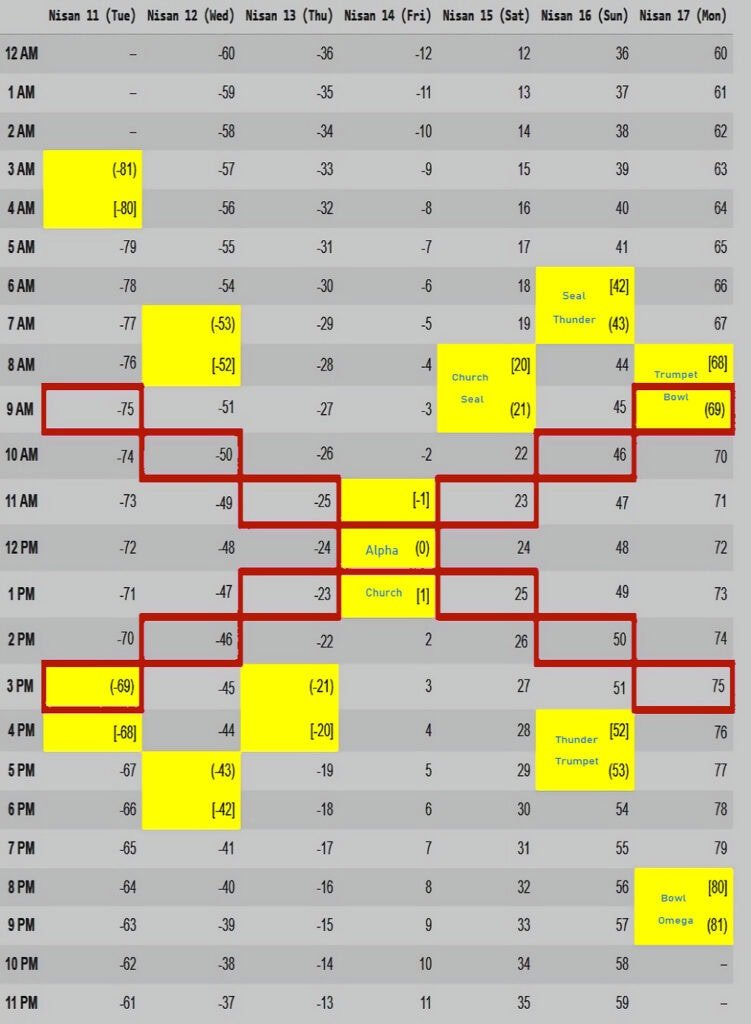
H2. The portrait with emphasized eyes
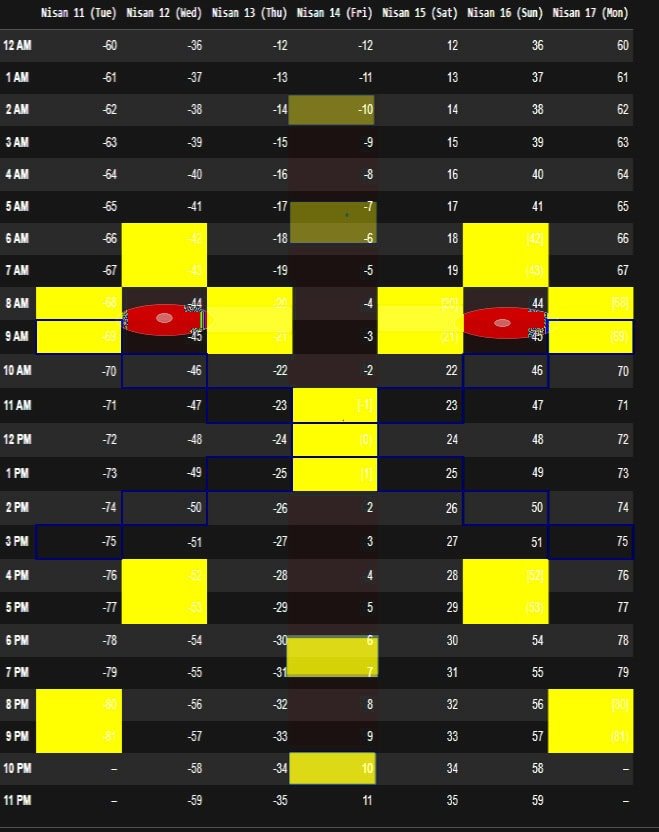
H3. The portrait with month-word bands
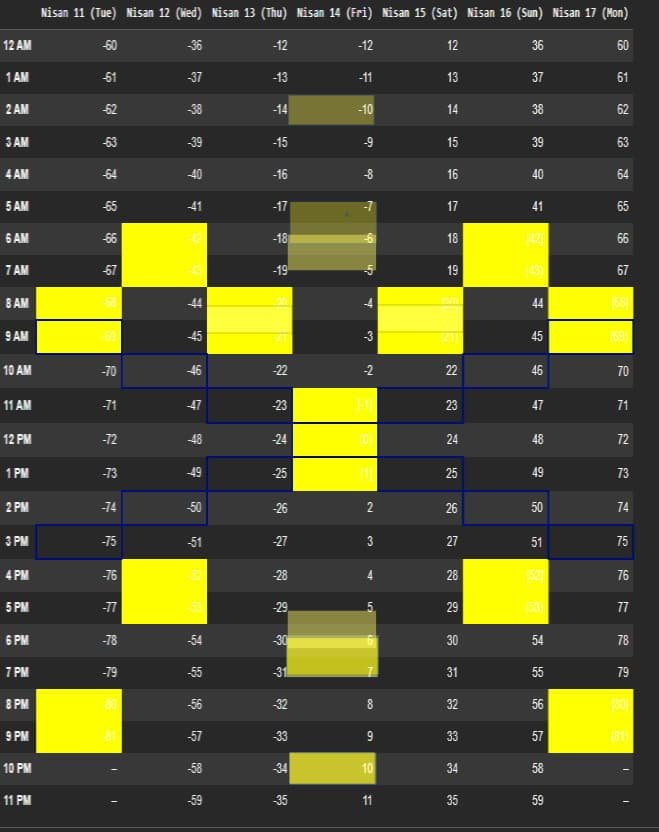
H4. Golgotha: the hillside interpretation
The reference to twelve categories combines the seven model sections—five lexical families and two conceptual bookends—with five temporal overlays: hours, appointed times, days, months, and the selected year word. The half-hour remains a separate expression within the weighted hour overlay. The larger lexical inventory also includes chronos and night; they were not separate layers in this particular portrait. “Twelve” therefore describes the selected display categories, not the total number of temporal lemmas in Revelation.
I. What has been checked and what remains a proposal
The primary counts, full inventories, source-model anchors, and family ranges have been preserved. The rebuilt tables explicitly calculate the hour bands and inclusive widths defined in this appendix. The Julian dates can likewise be verified by an ordinary proleptic-Julian calculation. These are checks of stated data and arithmetic.
The theological correspondences, calendar-label hypothesis, festival re-anchoring, selected letter forms, and face interpretation have a different status. They are arguments offered for consideration. A numerical equality can be exact without proving that a biblical author intended its symbolic use, and a display can be meaningful without independently demonstrating historical chronology. The earlier blanket claims that every calendar, historical source, and visual alignment passed an independent test have therefore been replaced by these specific descriptions.
Further research could compare the alternative day-label proposals with complete transcriptions of the relevant calendrical manuscripts; test astronomical dawn and twilight under an explicitly chosen Passion chronology; examine the different Enoch witnesses; and explore the seven-year historical scale as a separate interpretive study. Such work would need to preserve the already established counts and state each new assumption. The present article supplies no new date prediction from those possible extensions.
J. Sources and related studies
Biblical references are supplied beside the arguments and inventories. The opening quotation in the main article is John 12:23 in the King James Version. The Greek phrases in the Johannine inventory are retained identifying excerpts from the original study. The comparative clock and day-word tables follow the series’ existing inventory rather than introducing a different Greek-text basis.
- 1 Enoch 72, 74, 75, 82, in R. H. Charles’s 1917 translation: chapter 72, chapter 74, chapter 75, and chapter 82. Used for the 364-day scheme and supplementary-day language, not as evidence of a 12-hour weekday-name shift.
- Mishnah Pesaḥim 5:1. Used for the three afternoon-offering schedules.
- Israel Antiquities Authority, 4Q321 image record, with the Library of Congress exhibition’s Calendrical Document section as contextual guidance.
- Resolving the Passion Week Timeline. The companion calendar interpretation should be read with the distinction between historical elapsed time and symbolic calendar mapping maintained.
- Cross at the Center of Time. Related development of the cross-centred interpretation.
The original preliminary discussion acknowledged assistance from ChatGPT (GPT-4 o). Broad secondary-source attributions from that draft have been replaced here by direct biblical reasoning and the identified primary passages. The author’s numerical research, original visual interpretations, and established counts remain the basis of the study.