Matthew and Luke give Jesus’ ancestry a place within a larger story. Matthew begins with Abraham, follows the royal line through David and Solomon, and organizes the genealogy around the Babylonian exile. Luke traces the line backward through David and Nathan, beyond Abraham to Adam, and finally to God. Their arrangements connect Jesus with Israel’s promises and with the human family.
This study develops the comparison introduced in Matthew and Luke’s Genealogies: Sevens, Fourteens, and Sacred Time. It begins with the actual lists, then examines the equal-generation models used in the 490d research. The distinction matters: a name printed in a Gospel, a position assigned in an interpretation, and a date calculated from that position are different kinds of evidence.
The chronological models below follow the current controls in Files 43, 54, and 69. Their principal unit is 70 years, with AD 65 completing the final modeled period. These are declared choices of the research framework. Neither Gospel gives a 70-year begetting age for each ancestor or supplies the BC dates generated by this procedure.
1. Begin with the text and the object being counted
Matthew 1:1–17 BSB moves from Abraham toward Jesus. Luke 3:23–38 BSB moves from Jesus toward Adam and God. Matthew’s Davidic branch passes through Solomon; Luke’s passes through Nathan. Both passages name Joseph. Matthew identifies him as Mary’s husband and specifies that Jesus was born of her; Luke qualifies Joseph’s relationship to Jesus and then names Heli. Luke does not explicitly label its genealogy as Mary’s line, so that familiar harmonization should not be treated as the passage’s own explanation.
Before comparing totals, four terms need to be kept distinct:
| Term | Meaning | Example |
|---|---|---|
| Figure | A person in the continuing genealogical line | Matthew’s two Jacobs are two men, despite the repeated name |
| Occupied position | A place in a stated arrangement | Jeconiah can occupy a position on each side of the exile boundary |
| Adjacent interval | The link between successive positions | A sequence of 41 figures has 40 adjacent intervals |
| Schematic period | A duration allocated by the model | Assigning 70 years to each of 41 positions produces 2870 years |
A count of figures is therefore neither a count of unique spellings nor a count of every person mentioned in the passage. Mothers, brothers, and other associated figures contribute to the narrative without automatically becoming additional positions in the main male sequence.
The same care applies to interpretation. Matthew explicitly states its three fourteens. The selection of Jeconiah as the overlap explains that statement. Assigning equal years to those positions is a further modeling step. The resulting dates can be checked arithmetically, but their precision does not make them dates explicitly transmitted by Matthew.
2. Matthew’s fourteens: 41 figures, 42 positions
Matthew concludes its genealogy with a numerical summary:
In all, then, there were fourteen generations from Abraham to David, fourteen from David to the exile to Babylon, and fourteen from the exile to the Christ.
The continuing male line in verses 2–16 contains 41 figures, including Jesus. One clear undoubled partition is Abraham through David, 14; Solomon through Josiah, 13; and Jeconiah through Jesus, 14. Thus 14 + 13 + 14 = 41.
The leading interpretation in File 69 §1.9 places Jeconiah at the end of the middle group and again at the beginning of the final group. Matthew names him in the deportation setting in verse 11 and resumes with him after the deportation in verse 12. This seam allows one figure to carry two occupied positions.
The following table displays that interpretation. Read down each column before moving to the next. The two highlighted Jeconiah positions refer to the same man. Names follow the BSB.
| Position within group | Abraham–David | Solomon–Jeconiah | Jeconiah–Jesus |
|---|---|---|---|
| 1 | Abraham (1:2) | Solomon (1:6) | Jeconiah (same man) (1:12) |
| 2 | Isaac (1:2) | Rehoboam (1:7) | Shealtiel (1:12) |
| 3 | Jacob (patriarch) (1:2) | Abijah (1:7) | Zerubbabel (1:12) |
| 4 | Judah (1:2) | Asa (1:7) | Abiud (1:13) |
| 5 | Perez (1:3) | Jehoshaphat (1:8) | Eliakim (1:13) |
| 6 | Hezron (1:3) | Joram (1:8) | Azor (1:13) |
| 7 | Ram (1:3) | Uzziah (1:8) | Zadok (1:14) |
| 8 | Amminadab (1:4) | Jotham (1:9) | Achim (1:14) |
| 9 | Nahshon (1:4) | Ahaz (1:9) | Eliud (1:14) |
| 10 | Salmon (1:4) | Hezekiah (1:9) | Eleazar (1:15) |
| 11 | Boaz (1:5) | Manasseh (1:10) | Matthan (1:15) |
| 12 | Obed (1:5) | Amon (1:10) | Jacob (Joseph’s father) (1:15) |
| 13 | Jesse (1:5) | Josiah (1:10) | Joseph (1:16) |
| 14 | David (1:6) | Jeconiah (same man) (1:11) | Jesus (1:16) |
490d · Gospel genealogies · Figure 1
Matthew: forty-one figures, forty-two positions
The Jeconiah boundary-overlap model · one person occupies two block positions
Undoubled male begetting chain
14 + 13 + 14 = 41distinct male figures, including Jesus
Jeconiah counted at both sides of the deportation boundary
14 + 14 + 14 = 42occupied positions, including Jesus
Sources: Matthew 1:11–17 (BSB); File 69 §1.9.
Read the calculation and scope
Matthew 1:11 places Jeconiah at the deportation; 1:12 resumes after the deportation with Jeconiah. File 69 §1.9 uses this boundary overlap as its leading compositional model. Without overlap, 14 + 13 + 14 = 41 distinct male genealogical figures, comprising forty antecedent figures and Jesus as terminal figure. Counting Jeconiah in both the middle and final blocks gives 14 + (13 + 1) + 14 = 42 occupied positions. This count does not include the women as separate male begetting-chain positions; their presence in the narrative remains important. Other valid partitions of the undoubled inventory do not change its total. A later schematic Christ-generation extension is a separate state and does not supply Matthew’s internal missing position.
Open the full-resolution image version
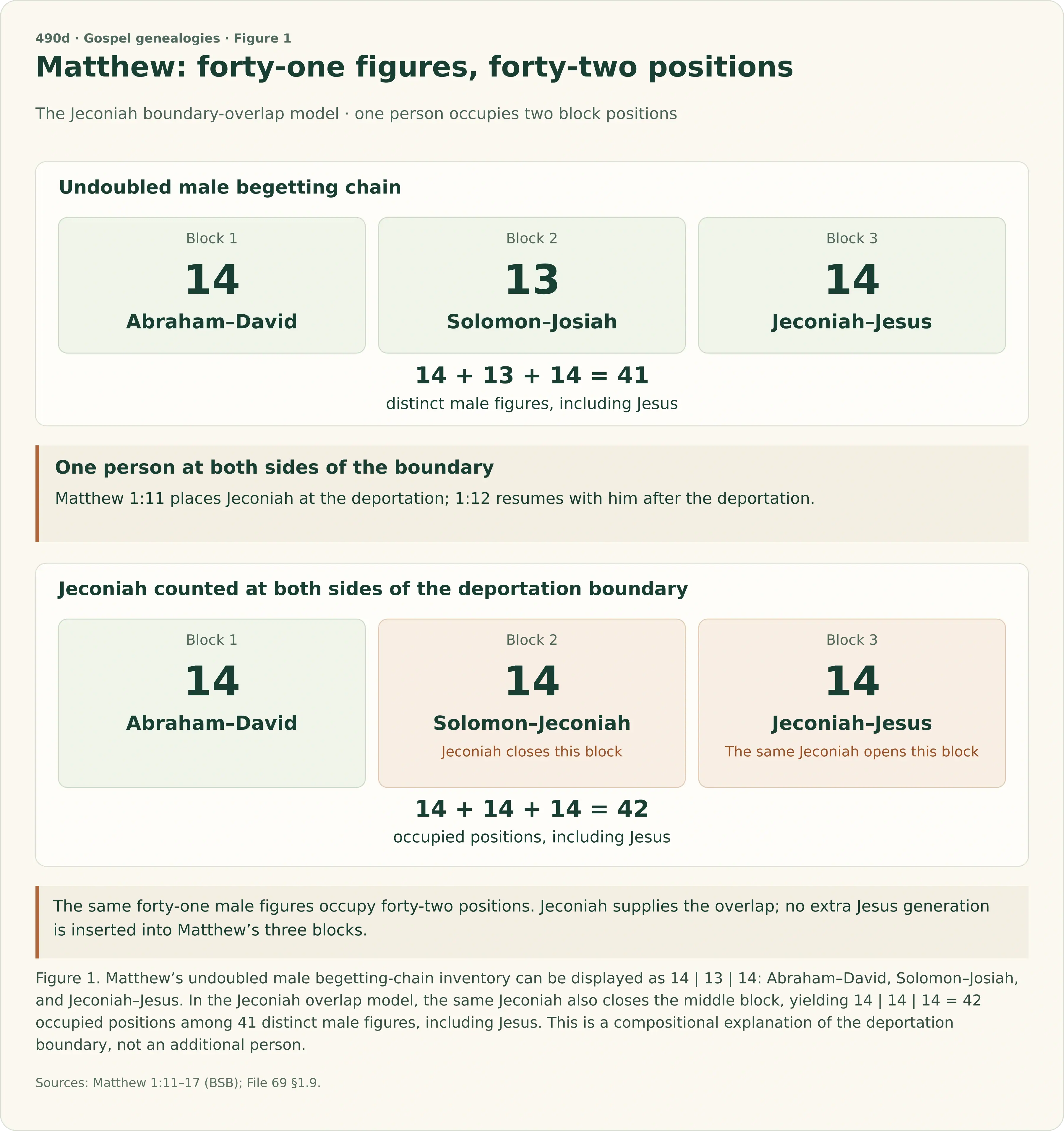
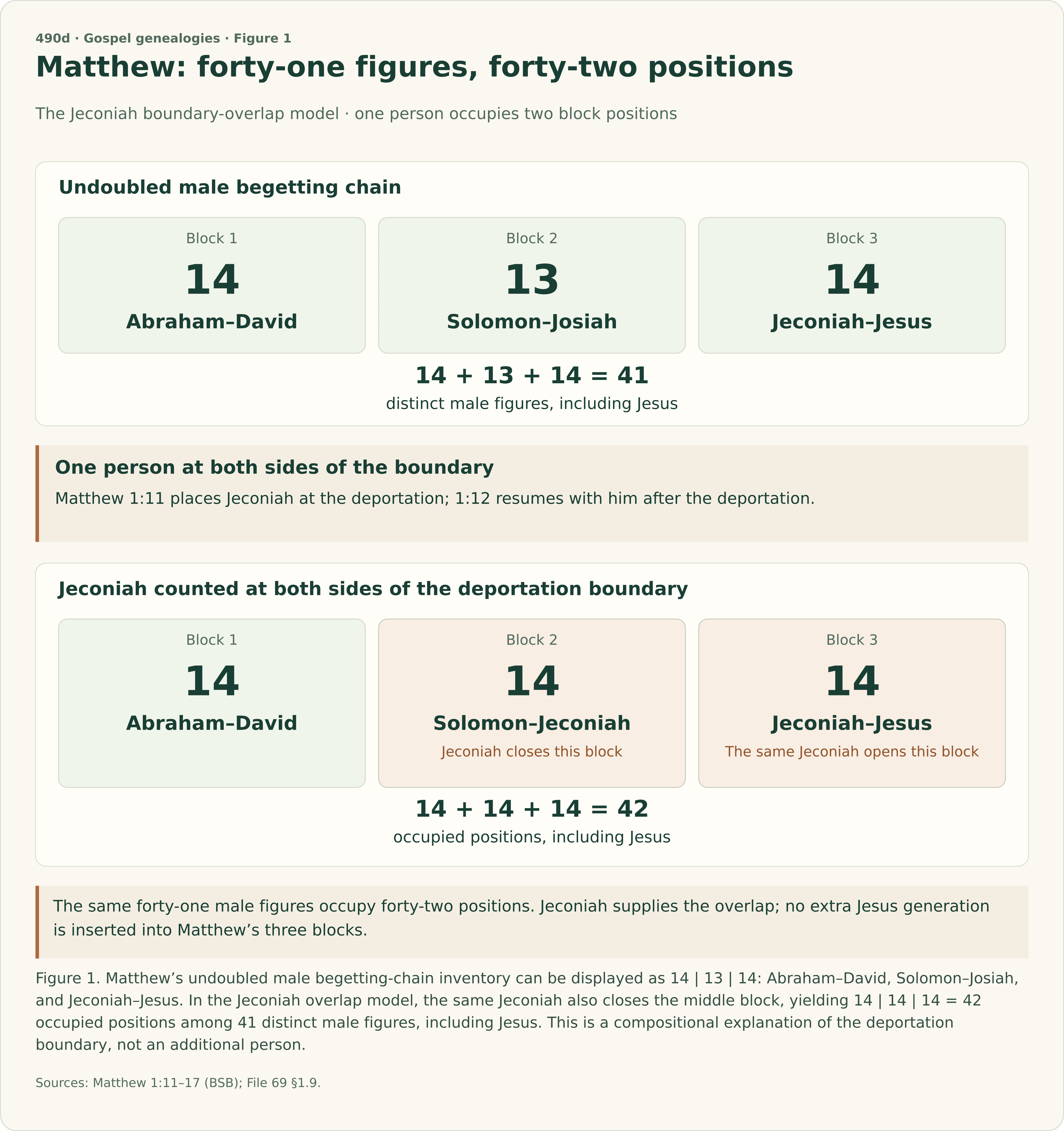
The result is 14 + 14 + 14 = 42 occupied positions, while the inventory remains 41 figures. Matthew announces the three groups but does not explain the overlap procedure. The Jeconiah arrangement is the study’s adopted reading of the structure, rather than an additional sentence supplied by the Gospel.
The women named or identified in the genealogy—Tamar, Rahab, Ruth, Uriah’s wife, and Mary—remain central to its presentation of ancestry. Zerah, Uriah, and the brothers mentioned alongside the continuing line also belong to the passage. Their presence should enrich its interpretation without being used to alter an unrelated male-line count.
Matthew also selects from a longer royal succession. 1 Chronicles 3:10–16 BSB supplies Ahaziah, Joash, and Amaziah between Joram and Azariah/Uzziah, and Jehoiakim between Josiah and Jeconiah. These omissions show why the presented genealogy must be distinguished from an exhaustive list assembled from other biblical books. Restoring the omitted kings and still calling the result Matthew’s counted list would change the object under study.
The exile is consequently more than a convenient place to adjust a total. It divides Matthew’s account of kingship and promise. Jeconiah stands at that rupture, and the resumed line leads through Shealtiel and Zerubbabel toward Jesus. A theological reading may connect this arrangement with judgment and restoration; the count itself establishes the narrower point that the selected overlap yields three fourteen-position groups.
3. Luke’s count depends on the edition
Luke concludes:
the son of Enosh, the son of Seth, the son of Adam, the son of God.
God belongs to Luke’s theological conclusion, but is not another human ancestor. A total including God therefore needs a different label from a total of human figures. Whether Jesus is included must also be stated.
A further distinction comes from Luke 3:33. The BSB prints Amminadab → Admin → Arni → Hezron → Perez → Judah. The NIV prints Amminadab → Ram → Hezron → Perez → Judah. The eBible KJV likewise has one Aram position, with its own spellings for the surrounding names. The BSB therefore has one additional position in this part of the list. Its notes identify the relevant single-Aram readings.
| Count, following Luke backward | BSB printed list | NIV single-Ram / KJV single-Aram lists |
|---|---|---|
| Human figures, Jesus through Adam inclusive | 77 | 76 |
| Human antecedents, Joseph through Adam inclusive | 76 | 75 |
| All positions, Jesus through God inclusive | 78 | 77 |
| Adjacent links, Jesus through Adam | 76 | 75 |
| Adjacent links, Jesus through God | 77 | 76 |
All three editions retain the later Cainan between Arphaxad and Shelah in Luke 3:36. The earlier ancestor in Luke 3:37 is called Cainan in BSB and KJV, and Kenan in NIV. Removing one Cainan from the BSB to obtain a preferred total would obscure two independent issues: the Cainan position and the Admin/Arni variant.
The 490d model uses a single Ram/Aram position and retains the second Cainan. File 43’s display calls the ancestor Ram. Its total is 76 human figures plus a figurative God opening, giving 77 positions. That count agrees with the NIV and KJV forms just identified; it does not reproduce the BSB’s longer printed inventory. The BSB remains the primary quotation translation here. The table preserves NIV as the original study’s counting witness and gives the BSB inventory alongside it; KJV supplies an additional comparison.
Open the complete verse-by-verse BSB and NIV name lists
The numbers below start with Jesus as position 1 and follow Luke’s reading direction. Each column preserves its own edition’s spelling. God is identified separately by the counting table above.
The lists below contain names only, preserving each edition’s spellings. Numbers count positions backward from Jesus; God is the final position, not a human ancestor. Verse wording and notes remain available in the linked source chapters.
| Verse | BSB: 78 positions | NIV: 77 positions |
|---|---|---|
| Luke 3:23 | 1. Jesus; 2. Joseph; 3. Heli | 1. Jesus; 2. Joseph; 3. Heli |
| Luke 3:24 | 4. Matthat; 5. Levi; 6. Melchi; 7. Jannai; 8. Joseph | 4. Matthat; 5. Levi; 6. Melki; 7. Jannai; 8. Joseph |
| Luke 3:25 | 9. Mattathias; 10. Amos; 11. Nahum; 12. Esli; 13. Naggai | 9. Mattathias; 10. Amos; 11. Nahum; 12. Esli; 13. Naggai |
| Luke 3:26 | 14. Maath; 15. Mattathias; 16. Semein; 17. Josech; 18. Joda | 14. Maath; 15. Mattathias; 16. Semein; 17. Josek; 18. Joda |
| Luke 3:27 | 19. Joanan; 20. Rhesa; 21. Zerubbabel; 22. Shealtiel; 23. Neri | 19. Joanan; 20. Rhesa; 21. Zerubbabel; 22. Shealtiel; 23. Neri |
| Luke 3:28 | 24. Melchi; 25. Addi; 26. Cosam; 27. Elmadam; 28. Er | 24. Melki; 25. Addi; 26. Cosam; 27. Elmadam; 28. Er |
| Luke 3:29 | 29. Joshua; 30. Eliezer; 31. Jorim; 32. Matthat; 33. Levi | 29. Joshua; 30. Eliezer; 31. Jorim; 32. Matthat; 33. Levi |
| Luke 3:30 | 34. Simeon; 35. Judah; 36. Joseph; 37. Jonam; 38. Eliakim | 34. Simeon; 35. Judah; 36. Joseph; 37. Jonam; 38. Eliakim |
| Luke 3:31 | 39. Melea; 40. Menna; 41. Mattatha; 42. Nathan; 43. David | 39. Melea; 40. Menna; 41. Mattatha; 42. Nathan; 43. David |
| Luke 3:32 | 44. Jesse; 45. Obed; 46. Boaz; 47. Sala; 48. Nahshon | 44. Jesse; 45. Obed; 46. Boaz; 47. Salmon; 48. Nahshon |
| Luke 3:33 | 49. Amminadab; 50. Admin; 51. Arni; 52. Hezron; 53. Perez; 54. Judah | 49. Amminadab; 50. Ram; 51. Hezron; 52. Perez; 53. Judah |
| Luke 3:34 | 55. Jacob; 56. Isaac; 57. Abraham; 58. Terah; 59. Nahor | 54. Jacob; 55. Isaac; 56. Abraham; 57. Terah; 58. Nahor |
| Luke 3:35 | 60. Serug; 61. Reu; 62. Peleg; 63. Eber; 64. Shelah | 59. Serug; 60. Reu; 61. Peleg; 62. Eber; 63. Shelah |
| Luke 3:36 | 65. Cainan; 66. Arphaxad; 67. Shem; 68. Noah; 69. Lamech | 64. Cainan; 65. Arphaxad; 66. Shem; 67. Noah; 68. Lamech |
| Luke 3:37 | 70. Methuselah; 71. Enoch; 72. Jared; 73. Mahalalel; 74. Cainan | 69. Methuselah; 70. Enoch; 71. Jared; 72. Mahalalel; 73. Kenan |
| Luke 3:38 | 75. Enosh; 76. Seth; 77. Adam; 78. God | 74. Enosh; 75. Seth; 76. Adam; 77. God |
Count check: BSB has 77 human figures plus God; NIV has 76 human figures plus God. At Luke 3:33, BSB includes Admin and Arni where NIV has a single Ram. Both retain the post-Flood Cainan in verse 36. In verse 37, the earlier ancestor is called Cainan in BSB and Kenan in NIV.
These edition distinctions do not settle the history of every Greek variant. They make the present calculation reproducible and prevent a model based on one list from being attributed silently to another.
4. From a genealogy to equal 70-year periods
The primary construction in File 43 §§1–3 assigns 70 years to each selected genealogical position. Its nativity hinge is 6 BC, and the completed Christ period ends at AD 65. With no year zero, the elapsed span is:
6 + 65 − 1 = 70 years.
AD 65 is thus a model boundary, not a proposed date for Jesus’ death. Likewise, the period allocated to an ancestor is not that person’s reconstructed lifespan. This distinction allows the arrangement to be studied without confusing symbolic chronology with ordinary biography.
The choice of 70 can be discussed alongside biblical lifetime and kingship motifs. For example, 2 Samuel 5:4 BSB gives David’s accession age and the duration of his reign; their sum is 30 + 40 = 70. File 43 treats such connections as interpretive context. Its optional 40/70/100 comparisons do not make those three numbers interchangeable clocks for the calculations below.
The crucial distinction is between the gaps in a sequence and periods assigned to all its members. Luke’s selected 76 human figures have 75 adjacent intervals. If each figure receives a completed 70-year period instead, there are 76 periods. Adding the figurative God opening gives the full 77-period model.
| Model measurement | Boundaries | Years |
|---|---|---|
| Luke: 75 adjacent human intervals | Adam 5256 BC → Jesus 6 BC | 5250 = 75 × 70 |
| Luke: 76 completed human periods | Adam 5256 BC → AD 65 | 5320 = 76 × 70 |
| Luke: earlier corresponding boundaries | Figurative God head 5326 BC → Jesus 6 BC | 5320 = 76 × 70 |
| Luke: full 77-period model | Figurative God head 5326 BC → AD 65 | 5390 = 77 × 70 |
| Matthew: 40 adjacent intervals, undoubled | Abraham 2806 BC → Jesus 6 BC | 2800 = 40 × 70 |
| Matthew: 41 completed periods, undoubled | Abraham 2806 BC → AD 65 | 2870 = 41 × 70 |
| Matthew: 42 occupied periods, Jeconiah overlap | Abraham bracket 2876 BC → AD 65 | 2940 = 42 × 70 |
The two 5320-year Lukan spans are equal because both endpoints have moved by one period. Their labels remain different. Similarly, Matthew’s 2800, 2870, and 2940 totals answer different questions. They must not be exchanged within a calculation simply because each concerns Matthew’s genealogy.
The figurative God opening supplies a symbolic frame drawn from Luke’s conclusion. It assigns neither an origin nor an age to God. The full Lukan model ledger, including every allocated period, is available in the supporting chronological tables.
5. Extending the comparison before Abraham
Matthew begins its presented sequence with Abraham. To compare its arrangement with Luke’s longer scope, the research model supplies a pre-Abraham sequence. This is an extension made for comparison, not an unnoticed passage in Matthew.
With the second Cainan retained, the human sequence from Adam through Terah contains 20 positions:
| Portion of the preface | Figures in forward order | Count |
|---|---|---|
| Adam through Noah | Adam, Seth, Enosh, Cainan, Mahalalel, Jared, Enoch, Methuselah, Lamech, Noah | 10 |
| Shem through Terah | Shem, Arphaxad, Cainan, Shelah, Eber, Peleg, Reu, Serug, Nahor, Terah | 10 |
| Figurative opening | God, separately identified as a symbolic bookend | 1 |
| Total pre-Abraham positions | Abraham begins the following block | 21 |
This yields two legitimate but distinct composites:
21 + 41 = 62 positions with Matthew’s undoubled inventory.
21 + 42 = 63 occupied positions with the Jeconiah overlap.
File 69 §§1.7–1.10 uses the latter for its full comparison with Luke and the Enochic framework. The second Cainan remains in the preface; the repeated Jeconiah position does not replace him.
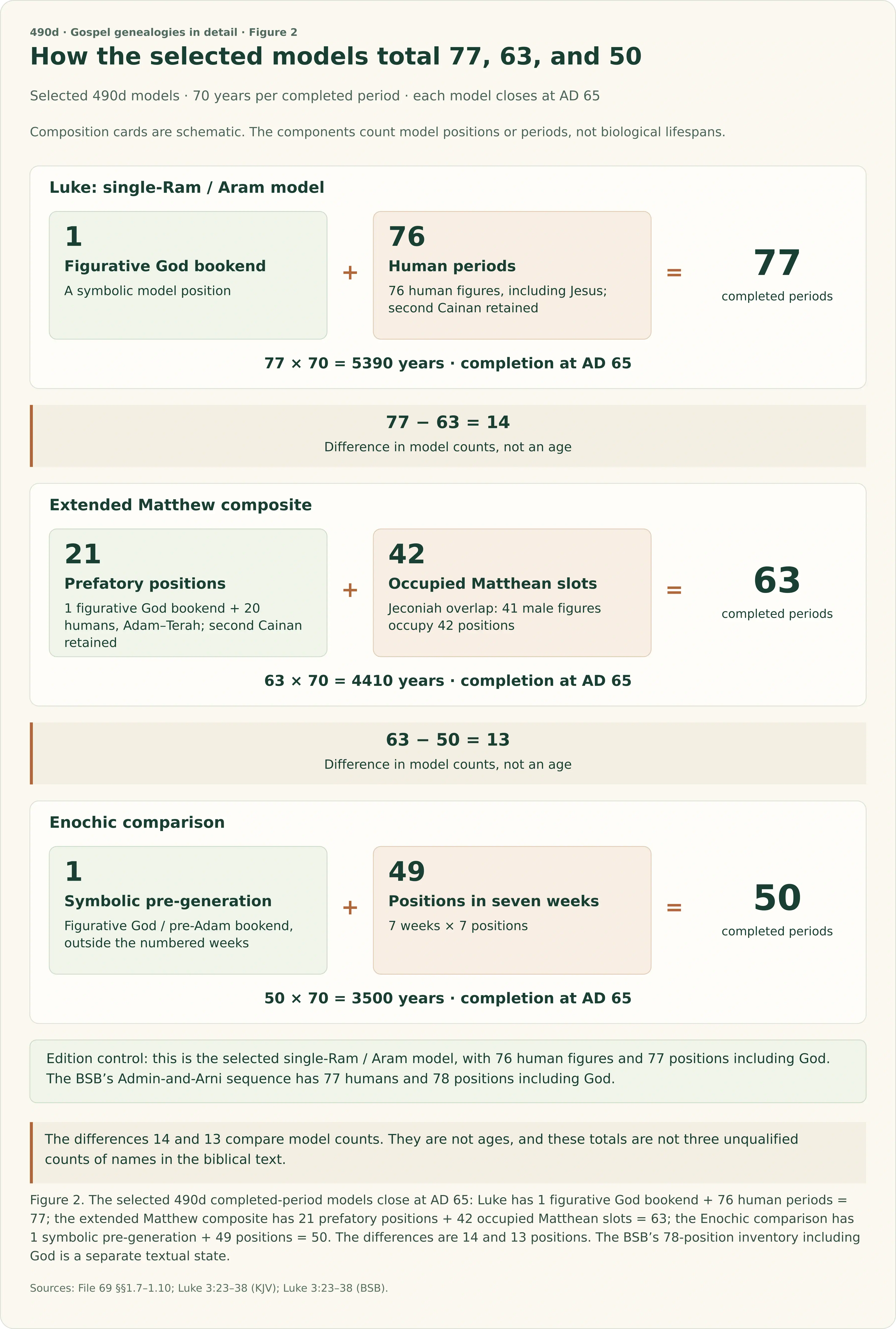
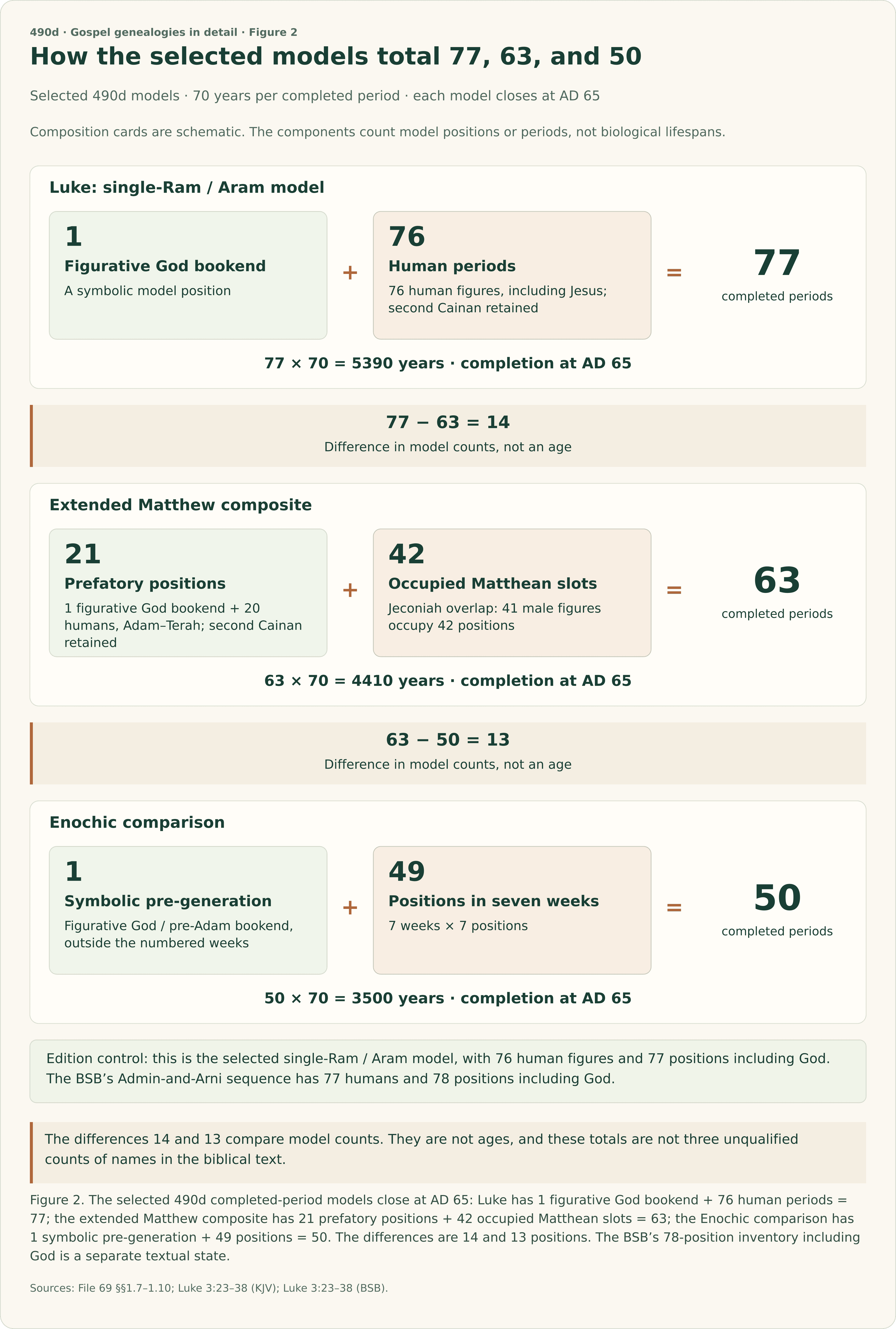
490d · Gospel genealogies in detail · Figure 2
How the selected models total 77, 63, and 50
Selected 490d models · 70 years per completed period · each model closes at AD 65
Composition cards are schematic. The components count model positions or periods, not biological lifespans.
Luke: single-Ram / Aram model
77 × 70 = 5390 years · completion at AD 65
Extended Matthew composite
63 × 70 = 4410 years · completion at AD 65
Enochic comparison
50 × 70 = 3500 years · completion at AD 65
Sources: File 69 §§1.7–1.10; Luke 3:23–38 (KJV); Luke 3:23–38 (BSB).
Read the calculation and scope
File 69 §§1.7–1.10 controls these completed-period comparison states. Luke uses the selected single-Ram/Aram sequence, represented by the KJV reading in Luke 3:33 with second Cainan retained in 3:36: 76 humans including Jesus, plus the figurative God bookend. The BSB’s Admin and Arni make its inventory one position longer, so its 78 positions including God must not be silently treated as 77. Matthew’s composite is not Matthew’s textual roster alone: its preface adds 20 humans from Adam through Terah plus one figurative God position to the 42 occupied Matthean slots under the Jeconiah overlap model. The Enochic comparison places a symbolic pre-generation outside the numbered seven-week field. Multiplying each completed-period total by 70 gives 5390, 4410, and 3500 years to the shared model close at AD 65. The figure compares composition schematically and supplies no historical ages for the figures.
Open the full-resolution image version
| Completed model | Composition | Positions | Years at 70 per position |
|---|---|---|---|
| Luke, selected single-Ram form | Figurative God opening + 76 human periods | 77 | 5390 |
| Matthew, full composite | 21-position preface + 42 occupied positions | 63 | 4410 |
| Enochic comparison | Figurative opening + 49 positions | 50 | 3500 |
All three fields complete at AD 65 in this comparison. Their differences are 77 − 63 = 14, 63 − 50 = 13, and 77 − 50 = 27 positions. At 70 years per position these become 980, 910, and 1890 years. Substituting the reduced Matthew total of 62 changes the differences; it does not preserve the same comparison under a new label.
The 50-position Enochic field represents the research framework’s proposed seven-week core, with one symbolic opening period added to its 49 modeled positions. The received Apocalypse of Weeks has ten weeks; the earlier seven-week core is the reconstruction argued in File 68. It is not a claim that 1 Enoch prints a Gospel-style list of 50 named ancestors. The Enoch study explains that construction in its own setting.
6. Enoch, four fourteen-period blocks, and forty jubilees twice
Enoch is seventh in the human sequence beginning with Adam. That inclusive ordinal corresponds to six adjacent intervals from Adam’s opening to Enoch’s opening. In Luke’s selected model:
5256 − (6 × 70) = 4836 BC.
Starting instead with the earlier figurative God boundary gives seven completed periods to the same Enoch opening: 5326 − 4836 = 490 = 7 × 70. Enoch is the eighth listed row if the symbolic God row is counted first. Calling him simply “seventh from God” would confuse an interval count with a row number.
The extended Matthew model supplies a different Enoch coordinate. Its full 63-position field opens at 4346 BC; seven periods later the Enoch boundary stands at 3856 BC. File 69 §3.6 compares that coordinate with the selected Creation coordinate in the Book of Jubilees chronology. They share a year label while identifying different things: one is a generated Enoch boundary in the Matthew composite; the other is Creation in the Jubilees framework.
From this Enoch boundary, the composite runs through four consecutive fourteen-period blocks:
| Boundary in the full Matthew composite | Coordinate | Years to the next boundary |
|---|---|---|
| Figurative God opening | 4346 BC | 490 = 7 × 70 |
| Enoch opening; shared coordinate with Jubilees Creation | 3856 BC | 980 = 14 × 70 |
| Abraham bracket, 42-position state | 2876 BC | 980 = 14 × 70 |
| David group boundary | 1896 BC | 980 = 14 × 70 |
| Exile/Jeconiah seam | 916 BC | 980 = 14 × 70 |
| Completed Messiah period | AD 65 | — |
490d · Gospel genealogies in detail · Figure 3
The 63-period ladder and the David midpoint
The extended Matthew composite · selected 70-year periods · all dates are model boundaries
Schematic vertical spacing; each interval is stated explicitly. This is the extended 42-slot, Jeconiah-overlap Matthew model.
David divides the Enoch-to-completion span equally
40 + 40 jubilees = 80 × 49 = 3920 years
No year zero: 916 + 65 − 1 = 980; 1896 + 65 − 1 = 1960.
Sources: File 69 §§3.6–3.9; File 69 §1.10.
Read the calculation and scope
This ladder is File 69’s extended 42-slot, Jeconiah-overlap Matthew composite, not File 43’s undoubled ledger. File 69 §§3.6–3.9 gives the selected boundaries. Same-side BC subtraction yields 4346−3856=490, 3856−2876=980, 2876−1896=980, and 1896−916=980. The cross-era final span is 916+65−1=980, because there is no year zero. The total is 4346+65−1=4410=63×70=9×490. The Enoch-to-completion subspan is 3856+65−1=3920. It divides at the model David boundary: 3856−1896=1960 and 1896+65−1=1960. Each half is 40×49, so the two halves give 80 jubilees of 49 years. The figurative God head is not a claim about a divine origin, the David and exile labels do not supply historical event dates, and AD 65 is not Jesus’ death. The shared 3856 BC label preserves distinct Enoch-model and Jubilees-Creation events.
Open the full-resolution image version
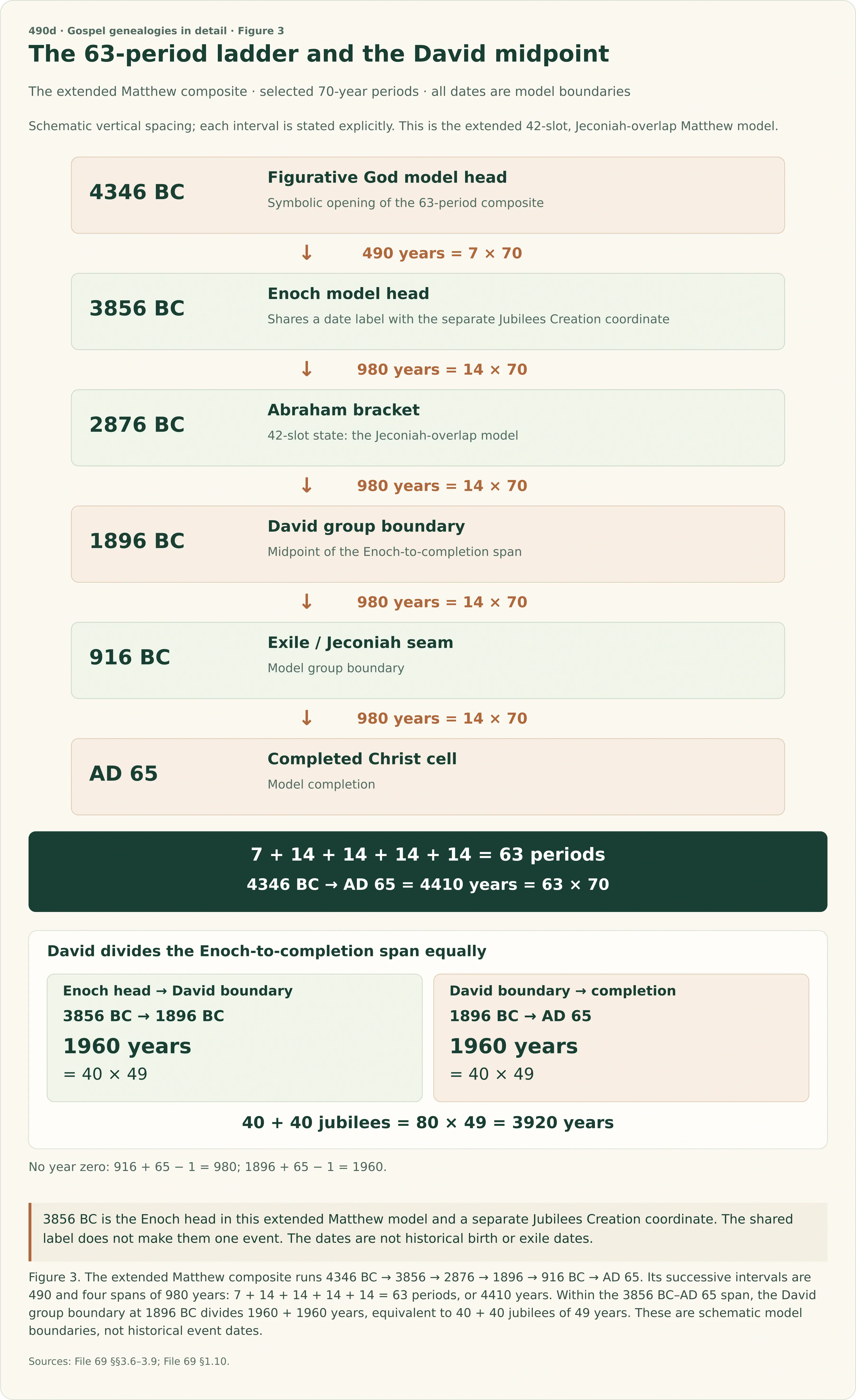
The full sequence is 7 + 14 + 14 + 14 + 14 = 63 periods, or nine seven-period blocks. The first fourteen-position block runs from Enoch through Terah in the supplied pre-Abraham comparison; the remaining three are Matthew’s declared arrangement. These group boundaries must not all be called historical births. In particular, 1896 BC marks the David group boundary in this construction, and 916 BC marks its exile seam.
The David boundary divides the Enoch-to-completion span into equal halves:
3856 − 1896 = 1960 years.
1896 + 65 − 1 = 1960 years.
Since 1960 = 40 × 49, each half equals forty 49-year jubilees. The whole field is 3920 years, or eighty such jubilees. This is the model’s 40 + 40 jubilee structure, derived from its stated positions and boundaries. It should not be attributed to a verse in Matthew or presented as a new transmitted date in Jubilees.
File 69 §§3.7–3.8 also compares Matthew’s 42 positions with six Enochic weeks. In the primary 70-year construction, a seven-period week spans 490 years; a fourteen-period group spans 980. Matthew’s Abraham bracket coincides with the close of the translated Enochic Week 1, and its three groups fill Weeks 2–7. David, exile, and completion fall at the closes of Weeks 3, 5, and 7. This makes the relationship visible without claiming that Matthew explicitly cites that Enochic scheme.
The distinction between a 49-year jubilee and a 490-year modeled week remains essential. A 490-year block contains ten 49-year jubilees. The identical word “week” can describe different levels of a schematic arrangement; the unit must accompany the number.
7. What changes when the period is 72 years?
The companion 72-year model retains the positions and the AD 65 completion, while recalculating their lengths. It therefore changes the opening coordinates. The following ordinary comparison, without the additional 110-year shift, comes from File 69 §§3.2–3.4:
| Selected boundary | 70-year periods | 72-year periods |
|---|---|---|
| Lukan Enoch opening | 4836 BC | 4976 BC |
| Matthew-composite Enoch opening | 3856 BC | 3968 BC |
| Enochic Enoch opening | 2946 BC | 3032 BC |
| Enochic Enoch close | 2876 BC | 2960 BC |
At 70 years, the consecutive distances are 980 + 910 + 70 = 1960, representing 14 + 13 + 1 = 28 periods. At 72 years, the same count gives 1008 + 936 + 72 = 2016. In both versions, the Matthew Enoch boundary is the midpoint between the Lukan Enoch opening and the Enochic Enoch close.
The added final period is important. Comparing the three Enoch openings alone gives 14 + 13 = 27 periods. Moving to the Enochic closing boundary adds one more. The two statements describe different endpoint choices, rather than competing totals.
Matthew’s three fourteen-period blocks likewise become 2960 BC → 1952 BC → 944 BC → AD 65, each spanning 1008 years. The count structure survives; the primary 1960-year halves and their forty-jubilee factorization do not transfer unchanged to the companion model.
File 69 also studies larger constructions involving a 110-year addition. They require their own rules. Adding 110 once to every generation gives 70 + 110 = 180, or 72 + 110 = 182. Adding it once to an entire seven-generation block instead gives 7 × 70 + 110 = 600, or 7 × 72 + 110 = 614. Those operations differ from adding 110 to each of the seven generations. Keeping them separate prevents the ordinary 70/72 comparison from acquiring expanded coordinates without explanation.
8. The 2450-year bridge between the Gospel models
The full Lukan field opens at 5326 BC, while Matthew’s 42-position Abraham bracket opens at 2876 BC. Both end at AD 65. Their 35-position difference therefore produces:
5326 − 2876 = 2450 = 35 × 70 = 5 × 490 = 50 × 49.
File 43 §4 calls this a jubilee bridge. The factorization means fifty jubilees of 49 years each; it does not make a jubilee 50 years long.
There is a second corresponding pair. Move both opening boundaries one 70-year period later: Luke begins with human Adam at 5256 BC, and Matthew begins its undoubled Abraham sequence at 2806 BC. The difference remains 2450 years.
| Matched opening boundaries | Difference |
|---|---|
| Luke’s figurative God opening 5326 BC; Matthew’s overlap bracket 2876 BC | 2450 |
| Luke’s human Adam opening 5256 BC; Matthew’s undoubled Abraham opening 2806 BC | 2450 |
Pairing 5326 with 2806, or 5256 with 2876, changes the difference. A slash notation such as “5326/5256” can conceal that choice, which is why the two valid pairs are shown separately.
The same total occurs in the selected Jubilees Creation-to-Conquest field, 3856 − 1406 = 2450, as recorded in File 54 §10.2. Equal durations make a useful comparison between the models. Their starting and ending events remain distinct. The Gospel-head equality is arithmetic; its interpretation through jubilee language is a further structural reading.
The Conquest anchor as a midpoint
File 69 §3.4D identifies a further symmetry within Matthew’s primary construction. The 42-period field divides at the framework’s 1406 BC Conquest anchor:
2876 − 1406 = 1470; 1406 + 65 − 1 = 1470.
Using the undoubled Abraham opening at 2806 BC and ending at the 6 BC Christ opening shortens the full envelope by 70 years at each end. The resulting head-to-head span retains the same center:
2806 − 1406 = 1400; 1406 − 6 = 1400.
This midpoint is a relationship between the model and an anchor selected elsewhere in the framework. Matthew does not name the Conquest date. Nor does the calculation insert Moses into its genealogy: the Gospel line continues through Judah. A comparison through Levi, Kohath, Amram, and Moses would be a separately declared branch, not an identification of Matthew’s Ram with Moses. The 72-year counterpart has a different generated center, 1448 BC, and does not replace the framework’s 1406 BC Conquest anchor.
9. Luke’s Enoch boundary and the cumulative chronology
File 54 §7.1 compares the Lukan Enoch opening at 4836 BC with the selected cumulative MT Flood boundary, also 4836 BC. “Cumulative” identifies a separately constructed chronological scheme. This is not the ordinary Flood date obtained by simply adding the MT begetting ages, and it must not be relabeled as the regular SP Flood.
| Construction | Meaning of 4836 BC |
|---|---|
| Lukan equal-period model | Jared’s closing boundary and Enoch’s opening boundary |
| Selected cumulative MT scheme | Flood boundary |
The equal coordinate invites a comparison involving Enoch and Flood judgment. It does not identify Enoch’s birth with the Flood or turn Luke’s model periods into literal patriarchal lifespans. MT, SP, and LXX chronology must retain their own readings and event labels whenever they are compared; a coordinate selected from one cannot stand for all three.
File 54 §10.3 extends the selected boundary to the framework’s 1406 BC Conquest anchor:
4836 − 1406 = 3430 = 49 × 70 = 7 × 490.
This connects forty-nine modeled periods, or seven 490-year blocks, with the Enoch/Flood-to-Conquest comparison. The study’s thematic reading of judgment and the Conquest follows the calculation. The subtraction does not independently establish that Luke knew or intended the full cumulative scheme.
A precise example of transforming a span
File 54 §6.1 also tests the distance from Enoch’s opening to the selected 6 BC hinge. The starting quantity is 4836 − 6 = 4830 years. Applying the two declared ratios and returning to the same hinge gives:
| Operation on the 4830-year span | Resulting length | Reattached to the 6 BC hinge |
|---|---|---|
| 4830 × 70/69 | 4900 | 4906 BC: Jared’s model opening |
| 4830 × 25/23 | 5250 | 5256 BC: Adam’s model opening |
The calculation acts on an elapsed span, then restores its reference point. Multiplying the bare date label 4836 would be a different operation. These equalities show a relationship among already defined positions in the research model; their interpretation belongs to that model rather than to the wording of Luke.
Repeated names: two exact 490-year comparisons
Recurrent names in Luke provide a compact example derived directly from the selected ledger in File 43 §3.4. The table uses that ledger’s display labels and forward indices, with the figurative God opening at position 1. The two blocks begin twenty-eight positions apart.
| Row within block | Earlier figure and model position | Model opening | Later figure and model position | Model opening |
|---|---|---|---|---|
| 1 | Joseph, 42 | 2456 BC | Joseph, 70 | 496 BC |
| 2 | Judah, 43 | 2386 BC | Jannai, 71 | 426 BC |
| 3 | Simeon, 44 | 2316 BC | Melki, 72 | 356 BC |
| 4 | Levi, 45 | 2246 BC | Levi, 73 | 286 BC |
| 5 | Matthat, 46 | 2176 BC | Matthat, 74 | 216 BC |
| 6 | Jorim, 47 | 2106 BC | Heli, 75 | 146 BC |
| 7 | Eliezer, 48 | 2036 BC | Joseph, 76 | 76 BC |
| 8 | Joshua, 49 | 1966 BC | Jesus, 77 | 6 BC |
The first block runs from the Joseph in Luke 3:30 to the Joshua in 3:29. The latter is Luke’s named ancestor, not Joshua son of Nun. The second runs from the Joseph in Luke 3:24 to Jesus in 3:23. These are distinct people at their respective places in the genealogy.
Each block contains eight positions but seven intervals between its first and last openings: 2456 − 1966 = 490, and 496 − 6 = 490. Completing all eight periods would instead give 560 years. Joseph, Levi, and Matthat recur in corresponding rows; each corresponding opening is 1960 = 28 × 70 years later in the second block.
The nearby Mattathias example reinforces the endpoint distinction. Its two openings at 986 and 566 BC are separated by 420 = 6 × 70, not 490. The additional period reaches the following Joseph opening at 496 BC, giving 986 − 496 = 490. These are selected comparisons within the published ledger, not a universal rule governing every repeated name or proof that Luke selected the names to encode these dates.
Open the related 770-year sampling of the full model
The same full 5390-year model can be divided as 7 × 770 or 11 × 490. Sampling its boundaries at eleven-period intervals gives:
| Boundary | Forward model position | Coordinate |
|---|---|---|
| Figurative God opening | 1 | 5326 BC |
| Shem opening | 12 | 4556 BC |
| Isaac opening | 23 | 3786 BC |
| Jesse opening | 34 | 3016 BC |
| Earlier Levi opening | 45 | 2246 BC |
| Shealtiel opening | 56 | 1476 BC |
| Nahum opening | 67 | 706 BC |
| Completed Christ period | Boundary after position 77 | AD 65 |
Every step spans 770 = 11 × 70 years; the final step is 706 + 65 − 1 = 770. AD 65 is the closing boundary after the final period, not an additional named ancestor. The regular spacing follows from sampling the equal-period ledger. Any theological reading of the selected figures is a further interpretation.
10. A controlled comparison of the two interval spans
A later consolidation in File 43 §§5 and 8 makes the treatment of intervals especially clear. It adds Luke’s 75 adjacent human intervals to Matthew’s 40 undoubled intervals, both ending at the 6 BC hinge:
5250 + 2800 = 8050 years.
This is a sum of two separately defined spans, not a continuous 8050-year family history. Applying the research framework’s 25/23 expansion gives:
8050 ÷ 23 = 350; 350 × 25 = 8750.
The increase is 8750 − 8050 = 700 = 10 × 70. The source retains the technical label MirrorVolume for the initial sum, but explicitly treats this calculation as span arithmetic; the label does not introduce a mirrored timeline.
The input labels are decisive. Matthew’s completed 41-period total of 2870 cannot replace its 2800 interval span here. Nor can Luke’s completed human total of 5320 replace 5250. Either substitution changes the starting sum and breaks this particular equality.
File 43 §8 then places the expanded length beside a separate comparison:
14006 − 5256 = 8750 = 125 × 70 = 5³ × 70.
Here 14006 BC is the cumulative MT Adam/Year-6 coordinate on the Moses–Nisan line, within the 14011–14004 BC envelope; 5256 BC is the Lukan model’s Adam opening. See File 18 §6A. The same length appears by two declared routes: transforming the sum of the interval spans, and subtracting one independently specified coordinate from another. The cube expression simply restates 125 as 5³. It does not add a third chronology or turn either coordinate into an ordinary historical date for Adam.
The comparison depends on preserving the exact inputs and acknowledging the chosen transformation. Keeping both routes visible allows readers to assess the arithmetic and the interpretation separately.
11. What the pattern can support
The strongest starting evidence is literary: Matthew explicitly organizes its genealogy into three fourteens, and Luke explicitly extends its line to Adam and God. The counted lists can then be inspected, including the textual differences that affect their totals. Those observations precede any chronological model.
Within the declared 490d construction, the arithmetic is reproducible. The selected Lukan field contains 77 completed positions; the full Matthew composite contains 63; the Enochic comparison contains 50. Their differences, the four fourteen-period blocks from the Matthean Enoch boundary, and the 2450-year bridge follow from stated counts, units, and endpoints.
A Christian interpretation can read these structures in relation to promise, kingship, exile, restoration, and fulfillment in Christ. The sevens and fourteens give that reading an intelligible numerical form. Wider comparisons with Enoch and Jubilees may support discussion of shared chronological interests or compatible symbolic traditions. Numerical agreement alone does not establish direct borrowing, collaboration between the evangelists, or knowledge of every later reconstruction.
The present study therefore does not treat the following as additions to the Gospel lists: the pre-Abraham Matthew preface, a symbolic period allocated to God, a Mosaic branch through Levi, or a further period after AD 65. Each belongs, where used, to a separately declared interpretive construction. An AD 65–135 or AD 65–137 extension cannot fill Matthew’s internal overlap position, and its endpoint is not made a predicted historical event merely by appearing on a chart.
The detailed comparison is most useful when its layers remain visible: the transmitted genealogy, the interpretation of its arrangement, the assigned chronological model, and the theological meaning proposed for the result. That method preserves the original study’s interest in sacred time while giving readers the information needed to evaluate each claim.
Sources and further study
| Source | Role in this study |
|---|---|
| Matthew 1 BSB, Luke 3 BSB, Luke 3 NIV, and Luke 3 KJV | Printed genealogies, exact quotations, and the single-Ram/Aram comparison |
| 1 Chronicles 3 BSB; 2 Samuel 5:4 BSB | Royal omissions and the bounded Davidic age/reign comparison |
| File 43: Genealogical Bridge | §§1–4: periods, endpoints, and jubilee bridge; §§5, 8–9: controlled span expansion and display limits |
| File 54: Luke’s 70-Year Genealogical Lattice | §§1, 6–7, 10: date classes, the 4830 transformation, cumulative comparison, and Conquest span |
| File 69: Enoch-Centered Genealogical Accordion | §§1.7–1.11: figures and occupied positions; §§3.2–3.9: ordinary 70/72 models, Enoch, and the full Matthew ladder |
The introductory article gives the shorter explanation; the supporting tables include the full Lukan model ledger. Related studies develop the 364-day calendar, Enoch’s generations, and Jubilees chronology.
The original discussion’s Part 2 remains a separate article. Its linked presence does not extend this revision’s verification to that page.
Scripture quotations: Berean Standard Bible (BSB), public domain. BSB quotations and name spellings have been checked against the linked eBible edition. KJV is identified separately as an additional comparison witness.
The NIV name inventory was checked against Luke 3:23–38, New International Version. NIV text copyright © 1973, 1978, 1984, 2011 by Biblica, Inc. All rights reserved worldwide. Publisher permissions information.